Two Financial Instruments that made the Modern World

Following my Mr. Darcy piece that outlined the use and convenience of British government debt instruments in the eighteenth (and predominantly the nineteenth) century, I thought to extend the discussion to two particular financial instruments. In addition to the Consols (homogenous, tradeable perpetual government debt) that formed the center of public finance – and whose active secondary market that made them so popular as savings devices – the Bill of Exchange was the prime instrument used by merchants for financing trade and settling debts.

The complementarity of the Consol and the Bill in international finance, roughly from the South Sea Bubble (1720) to the end of Napoleon (1815), was the “secret of success for international finance” (Neal 2015: 101) and arose without an overarching plan, i.e. rather spontaneously. As the Consol is more easily understood for a modern reader, and the Bill is both more ancient and less well understood, I’ll focus the bulk of my attention on the latter.

According to Anderson (1970: 90), the Bill constituted “a decisive turning-point in the development of the English credit system,” but is much older than that. In practice, it was a paper indicating debt and a time for repayment, allowing financing of current trade. Cameron (1967:19) writes that the Bill

was far more ancient than either the banknote or the demand deposit; it had been developed in the Middle Ages. At first the bill was used as a device for avoiding the cost and risks of shipping coin or bullion over great distances, then as a credit instrument which circumvented the Church’s prohibition of usury. When it first came to be used as a means of current payment is a moot question that may never be answered, but that it was so used in eighteenth-century England is beyond doubt.

The Bill was predominantly used in coastal cities in the Mediterranean and around the North-Sea, becoming frequent perhaps in the 1700s. One observer even dates an early instance of its use to 1161, and it was of standard use among traveling traders, merchants and brokers throughout the Middle Ages (Cassis & Cottrell 2015: 12). Occasionally – warranting a discussion of its own – Bills in England became “so widespread that they drove out even banknotes” (Cameron 1967: 19).

There is an unfitting competition among financial historians as to who can produce the most persuasive, informative or complicated schedule for how Bills worked (I know of at least four similar, yet uncredited, renditions). Here’s Anthony Hotson’s (2017: 92) attempt from last year:

1aDeI0Nu0W4AIXASg.jpg

  1. We start, counter-intuitively, in the top-right corner. Andrew, an English exporter of Apples, draws up a Bill on Bas, a Amsterdam maker of Bankets – a Dutch pastry. Bas, having no coin/gold available to pay Andrew – either because he won’t have the funds until after he has sold his apple-flavored(!) Bankets, or because the risk of loss or cost of transportation is too great – accepts the Bill and returns it to Andrew.
  2. Having returned it to Andrew, we now have a debt and a financial instrument; Bas has promised to pay Andrew £x for the apples in 90 days, a common duration for a Bill of exchange.
  3. But like most merchants, Andrew cannot wait 90 days for payment; he has sold and shipped his Apples, but needs funds for himself (feeding his family, or investing in new Apple-harvesting equipment etc). In the heyday of British financial markets, Andrew could simply visit a bank, Bill-broker or the London financial markets himself, and offer to sell the Bill there. Of course, Andrew won’t be able to sell the Bill for £x, since his buyer is effectively providing him with a loan for 90 days. The bank, bill-broker or financial market trader will discount the Bill with the going interest rate (say 6%, for one-quarter of a year, so ~1.5%), paying at most £0.985x for the Bill. Besides, there is a risk-of-default element involved, so the buyer applies a risk premium as well, perhaps buying the Bill at £0.95x.
  4. In the schedule above Hotson uses the Bill trade to show how merchants trading Bills could net out their respective debts and minimize the need to send payment across the British channel. For (3) and (4), then, we replace the banker with an English importer – Dave – of Dutch goods (perhaps tin-glazed pottery) looking for a way to pay his Amsterdam pottery supplier, Cremer. Instead of shipping gold to Amsterdam, Dave may purchase Andrew’s Bill, and settle his account with Cremer by sending along the Bill drawn on Bas. Once the 90 days are up, Cremer can simply wander over to Bas’ pastry shop and present him with the Bill to receive payment for the goods Cremer already shipped to England.

This venture can – and usually was – made infinitely more complicated; we can add brokers and discounting banks in every transaction between Andrew, Bas, Dave and Cremer, as well as a number of endorsers and re-discounters. In his popular book Exorbitant Privilege, Barry Eichengreen recounts a 12-step, several-pages long account for how a U.S. importer of coffee and his Brazilian supplier both get credit and signed papers from their local (New York + Brazil) banks, how both banks send their endorsed bills to their London correspondent banks, and some investor in the London money markets purchase (and perhaps re-sell) the Bill that eventually settles the transaction between the American coffee importer and the Brazilian farmer.

Although it might sound excessive, complicated and impossible to overlook, the entire process simplified business for everyone involved – and allowed business that otherwise couldn’t have been done. In econo-speak, the Bill of Exchange set within a globalizing financial system, extended the market for merchants and farmers and customers alike, lowered transaction costs and solved information asymmetries so that trade could take place.

Turning to the opposite end of the maturity spectrum, the Consol as a perpetual debt by the government was never intended to be repaid. Having a large secondary market of identical instruments, allowed investors or financial traders everywhere to pass Gorton’s No-Questions-Asked criteria for trade. A larger market for government debt, such as after Britain’s wars in the late-1700s and early 1800s, allowed dealers in financial markets to a) be reasonably certain that they could instantly re-sell the instrument when in need of cash, and b) quickly and effortlessly identify it. These aspects contributed to traders applying a smaller risk premium to the instrument and to be much more willing to hold it.

While the Bills were the opposite of Consols in terms of homogeniety (they all consisted of different originators, traders, and commodities), there developed specialized dealers known as Discount Houses whose task it was to assess, buy, and sell Bills available (Battilosso 2016: 223). Essentially, they became the credit rating institutions of the early modern age.

Together these two instruments, the Bills of Exchange and the Consols, laid the foundations for the modern financial capitalism that develops out of the Amsterdam-London nexus of international finance.
Nightcap

  1. The Ottoman origins of capitalism (pdf) Kerem Nisancioglu, Review of International Studies
  2. The book on Marx that Arendt never finished Geoffrey Wildanger, Boston Review
  3. An insider’s perspective of the Algerian War Lincoln Krause, War on the Rocks
  4. The racing cheetahs of the 1930s Jennifer Noonan, Damn Interesting

Nightcap

  1. Good riddance to cultural Christianity James Rogers, Law & Liberty
  2. When failure succeeds Chris Dillow, Stumbling & Mumbling
  3. Interest rates and the gold standard Larry White, Alt-M
  4. Trump’s America, Netanyahu’s Israel Adam Shatz, London Review of Books

Nightcap

  1. What can we learn from the Islamic State Katherine Brown, Disorder of Things
  2. The early years of Christianity Jay Parini, Literary Hub
  3. Russia and the Arabs agree on the U.S., but not on Iran Marianna Belenkaya, Al-Monitor
  4. Ninotchka: a rare anti-communist film David Henderson, EconLog

Nightcap

  1. Shaka Jacob Ivey, Age of Revolutions
  2. Stalin Jeremy Friedman, Modern Age
  3. Saladin Jason Burke, Spectator
  4. Shakespeare Geoffrey Marsh, TLS

Nightcap

  1. Japan’s new imperial era Thisanka Siripala, the Diplomat
  2. The sad decline of American democracy Scott Sumner, EconLog
  3. Understanding Israel Brent Sasley, Duck of Minerva
  4. The last struggle of the Yanomami Alma Guillermoprieto, NYRB

Nightcap

  1. How a burning cathedral rebukes a divided Catholic Church Ross Douthat, New York Times
  2. Bombay’s 19th century factory workers Arun Kumar, Aeon
  3. Why the European Elections will be painful to watch for some Remainers Simon Wren-Lewis, mainly macro
  4. John Mearsheimer’s nationalist straight jacket Paul Miller, Law & Liberty

Mr. Darcy’s Ten Thousand a Year

On popular demand, I’m reviving a reoccurring theme of mine: teaching economic history through the lens of popular culture. Today: bonds, yields and 18th century English financial planning.

In what is probably my favourite piece ever written, I tried to estimate exactly how rich Mr. Darcy was – Mr. Darcy, of course, of Jane Austen’s classic novel Pride & Prejudice. I showed that whatever method you use to translate incomes to the present, all characters in Austen’s captivating story are astonishingly rich. But, as we well know today, there are large differences even among the superrich; compare Bernie Sanders (small-time millionaire) with George Lucas and Steven Spielberg (single-digit billionaires) or Jeff Bezos (wealthiest man alive).

Using Pride & Prejudice to illustrate some economic point is hardly unconventional (Piketty did this in his Capital in the Twenty-First Century), so let me similarly discuss 18th and 19th century British financial markets using the characters in this well-known tale.

The starting point is the following musing, courtesy of former Oxford Economist Martin Slater’s (2018: 52) The National Debt; how come “female characters in nineteenth-century novels always seem to have a suspiciously exact income of ‘so many pounds per year'”? Where does this money come from? Why is it so exact? And what’s the reason Piketty uses this particular literary example to illustrate the permanence and steady stream of income that capital somehow just throws off?

Consols and Financial Markets

Financial markets are truly awesome – not just in their impressive scope or potential devastation, but in the many different needs they simultaneously fulfil for many different people. Slater ably guides us through the confusing mishmash that is the 17th and 18th century English public finance, but what emerges by 1757, after Henry Pelham’s consolidation of government debt, is two main – and for our purposes, equivalent – securities: the Consolidated 3% Annuities (and the ‘Reduced annuities’), affectionately named ‘Consols’. These were permanent government bonds with annual interest payments of 3%. This means that they had no maturity date, i.e. the holder of the security could expect the government to keep paying 3% of the face value for all future (a Churchill-issued subsequent Consol was actually repaid and retired just a few years ago, after almost a century in service).

Two cool things happen. First, the “initial value” – the face value – of debt running in perpetuity becomes almost irrelevant, since all that matters for the issuer is the ability to maintain interest rate payments; there is no presumption of future repayment. Second, creditors – that is, holders of the Consols who receive the regular interest payments – may trade that asset on financial markets. Since the plethora of different debt assets were now condensed into a single, credible, identical and easily-identified asset, the market for 3% Consols in London developed into a very large and liquid market. With such ease of access and predictable and stable payoffs, the Consols became the instrument of saving for well-off families in Austen’s time.

A note on yields

The Consols, essentially a piece of paper with a face value of £100, entitled the owner to a perpetual stream of payments by the government, in this case 3% – or £3. Now, the actual price at which this paper could be sold in London fluctuated extensively depending on the conditions of the financial market and, most prominently in Austen’s lifetime, the Napoleonic wars. As the £3 annual pay was serviced by the British government, and financial strain during the war increased the risk for defaults (through a foreign invasion or British government itself), the price of Consols was chiefly reflecting the military success.

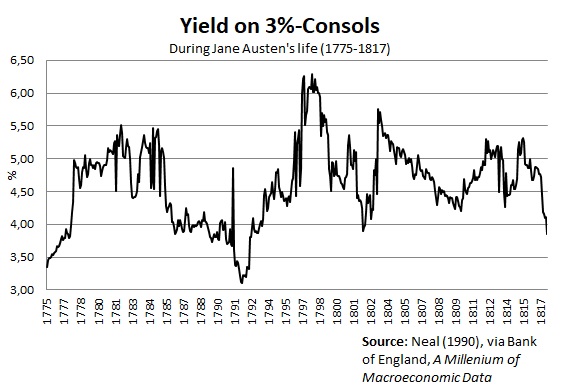
When the market price of a debt falls below its face value, the effective interest rate (the “yield”) that a prospective investor receives increases; paying £50 for a Consol with face value of £100 and a £3 perpetual interest payment, effectively earns the investor 6% interest instead of 3% (3/50 = 0.06). Since the Consols were the most dominant asset on the largest financial market in the world, their price became “the single most important asset price in the world economy” as Klovland (1994: 165) called it. Here’s the yield on Consols during Austen’s life:

JA, yield on 3%

It reached a low of 3.11% in 1792 (almost at par), and a high of 6.22% in 1798 (below £50) after the suspension of the gold standard.

The Bennets and the fortunes of handsome young men

The families of Pride & Prejudice made good use of this thriving financial market – not specifically for trading but for financial planning (others, such as British economist David Ricardo, and the banking families of Rothschild and Barings, made some of their fortune trading Consols).

In the novel, Mr. Bennet – the protagonist Lizzy’s father – has an income of £2,000 a year (again, see my 2016 piece for three different attempts at “translating” these sums into today’s money). It is not clear what his income comes from, but it’s a fair guess that it stems, like many other landed gentry of the time, from renting out farm lands belonging to the family home Longbourne. In addition, we know that Mrs. Bennet’s portion to the family home is a £5,000 contribution which is the sole inheritance the (five) Bennet daughters are entitled to.

Now, the way well-off families like the Bennets would make use of Consols was to ensure that non-inheriting children had at least some source of income after the passing of their father. The underlying concern in Pride & Prejudice, causing Mrs. Bennet to worry so about fortunate marriages for her daughters, is that the Bennet estate is entailed away to Mr. Collins – and with it the presumed rental income of £2,000 a year. That would leave the girls homeless, reduced to living off Mrs. Bennet’s inheritance of £5,000.

Austen began writing First Impressions (the initial title for Pride & Prejudice) in October 1796. During the decade leading up to this, the yield on Consols had been firmly within the interval 3.5-4.5%, hovering around 4% for years. It should thus not surprise us that Mrs. Bennet’s fortune of £5,000 presumably consisting of Consols, would have been purchased at around £75, predictably yielding the family an annual return of 4%. Indeed, the characters of Pride & Prejudice seem to be squarely set on 4% being the general norm. For instance, in a desperate attempt to enhance his already-inane proposal to Lizzy, Mr. Collins explicitly says:

“To fortune I am perfectly indifferent, and shall make no demand of that nature on your father, since I am well aware that it could not be complied with; and that one thousand pounds in the 4 per cents, which will not be yours till after your mother’s decease, is all that you may ever be entitled to.”

(Chapter 19, p. 133 in the 2009 HarperCollins edition)

Here we see the great use that Consols offered families like the Bennets. Once the Bennet parents pass away, the £5,000 of Consols could be divided equally among her children; Lizzy’s share would be a thousand pounds, which earns her an annual 4% interest return, or £40 (although maybe several year’s earnings for a regular worker, this was a rather small sum for such rich families – in contemplating Lizzy’s sister Lydia’s imprudent marriage, we learn that Mr. Bennet spent almost £100/year on Lydia’s purchases and pocket money alone). Being liquid financial assets, dividing up the Consols among children was very easy, and their steady income stream ensured that they would have at least some income. Bar Napoleonic conquest, the interest payment on the Consols would reliably show up year after year.

As for the handsome young men, Mr. Bingley’s case is easier than Mr. Darcy’s. We know that Bingley’s income is not agricultural, but investments from a fortune of almost  £100,000 inherited from his father, who had not yet acquired an estate. The fortune was “acquired by trade”, where (being from the North) cotton or shipping are prime candidates, but the slave trade is also a possibility. We also know that the ambiguity of his annual income (£4,000 or £5,000) lies well within the return from a fortune of that size invested in Consols. Indeed, for Bingley to hold that kind of fortune, earn that income and still not have an estate of his own, suggests that his financial wealth consists predominantly of Consols – perhaps complemented with some other stock (Bank of England or East India Company stock are plausible candidates). Clearly, new money.

Mr. Darcy, on the other hand, is plainly old money. And a lot of it. There are subtle hints in the novel that Pemberley has been in the Darcy family for generations. What we don’t know is precisely how his £10,000 a year is earned. When visiting Pemberley in Derbyshire with her aunt and uncle, Lizzy is told by the housekeeper that Mr. Darcy is such a generous and fair man: “ask any of his tenants”, she says, which indicates that Mr. Darcy, has a fair number of them – as one would expect from a sizeable estate like Pemberley. Now, what we don’t know is if the entirety of his £10,000 a year is reaped from rental income; it could be that some of his income is financial – or that either his financial or rental income is excluded from this rumoured number. Beyond a mention of his sister, Georgiana’s, fortune of £30,000 – which for convenience would likely be held in Consols – we know very little about the personal finances of Mr. Darcy.

The use and abuse of Consols

The financial market for government debt in the late-18th and early 19th century was not created with financial planning in mind, but by incremental improvements to previous government funding problems. The outcome, however, was a striking success for Britain, whose thriving financial market in no small part accounted for Britannia’s Century until WWI.

Moreover, as contemporary economists from Ricardo and John Stuart Mill to Malthus and Lauderdale observed, the recurring interest payments, funded by taxes, may have had quite large macroeconomic consequences. Taxing ‘productive’ investments and trade in order to fund ‘unproductive’ holders of government debt was, it was argued, harmful to the country – and in a time where government expenditures largely consisted of the military and debt maintenance, the impacts of funding the debt was of prime political interest.

Piketty’s use of Austen’s England (and Balzac’s France) was used for precisely the same distinction. Wealth, in Piketty’s view, perpetuates itself, and effortlessly earns its return (never mind the work, risk and selection issues involved). By continually paying the interest on its debt, the governments of Austen’s Britain financed the leisurly lifestyles of the rich, just as the “natural” return of the modern-day rich contribute and maintain today’s inequality.

The Consol was a revolutionary invention, but it is possible that it was not part of Mr. Darcy’s Ten Thousand a Year.

Nightcap

  1. The making of an Anti-Semitic myth Jacob Soll, New Republic
  2. Lessons from Greece Scott Sumner, MoneyIllusion
  3. Identity norms Robin Hanson, Overcoming Bias
  4. South Korean courts and Japanese diplomacy Masao Okonogi, the Diplomat

The nonexistent moral decay of the west

Humankind’s struggle with moral is of course nothing new, it rather inherent to our nature to revolt against the meaningless world and the manmade system of reason. Furthermore, moral values vary over a specific period of time swinging from rather high moral standards to very low ones. Regarding morality as an abstract compass guiding our thought, goals and behaviour, Economist, in general, are not known for dealing in depth with the metaphysical reason behind our behaviour yet they explore and explain human actions through our surrounding incentives, which also structure and direct our action. Economist such as Daron Acemoglu & James Robinson or William J. Baumol have explored these changes in human behaviour through changing incentive structures thoroughgoingly.

However, folks mourning the moral decline of today’s west often fail to provide concrete evidence for their argument. They either cherry-pick events or legislatures to infer a macro trend inductively or they lose themselves in difficult language trying to somehow save their argument by making it incomprehensible. I cannot help feeling that mourning the moral decay of the west has somehow become a shibboleth for eloquently expressing the “Things used to be way better back then” narrative. However, I admit that there were probably a couple of sociological papers who have covered this issue very well which I am unaware of. Contrary, the public debate was dominated by a few grumpy intellectuals holding the above-named attitude. I was recently provided with a very concrete set of indicators to measure moral decline while digging through Samuel P. Huntington’s infamous classic “The clash of civilization” from 1996. He states that there are five main criteria which indicate the ongoing decline of moral values in the West. [1]

After being provided with a concrete framework to quantify the moral decline of the west, I was keen to see how the moral decline of the west has developed in the 20 years since the book has first been published in 1996. Although I also take issue with some of these indicators to measure moral decline, I avoid any normative judgement in the first part and just look at their development over time. Furthermore, since Samuelson himself mostly takes data from the USA representing the West, I might as well do so too for the sake of simplicity. So, let’s see what happened to moral values in the West in the last years by checking each of Huntington’s indicator one by one.

1. Increasing antisocial behaviour such as acts of crime, drug use and general violence

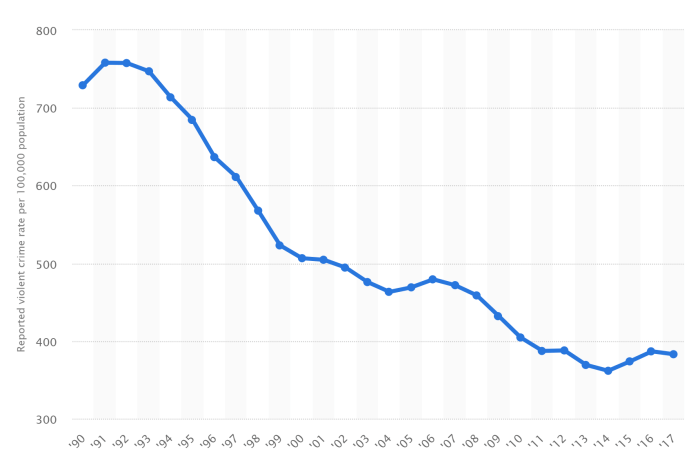
Apart from the global long-term trend of declining homicides, we can also observe a recent downward trend in the reported violent crime rate since 1990 in the USA. Scholars agree that the crime rate is in an extreme decline. Expanding the realm towards Europe, you will see similar results (see here).

1Source: Statista

Despite these trends, the public (as well as some intellectuals as well I assume) vastly still holds a distorted perception of the crime rate. The sharp decline in actual crimes strongly contradicts the fact that a majority of the people still uphold the myth of increasing crime rates.

2

Source: Pew Research Center

Regarding drug use in the USA, it is important to mention that the absolute amount of illicit drugs consumed has slightly gone up since 1990. This development is mostly driven by an increasing  consumption of marijuana: Use of most drugs other than marijuana has stabilized over the past decade or has declined., states the National Institute on drug abuse in 2015.

Contrary, the number of deadly injections are increasing. However, the share of the population with drug use disorders has remained on the same level of 5.3% over the last 20 years.

2. Decay of the family resulting in increasing divorce rates, teenage motherhood and single parents

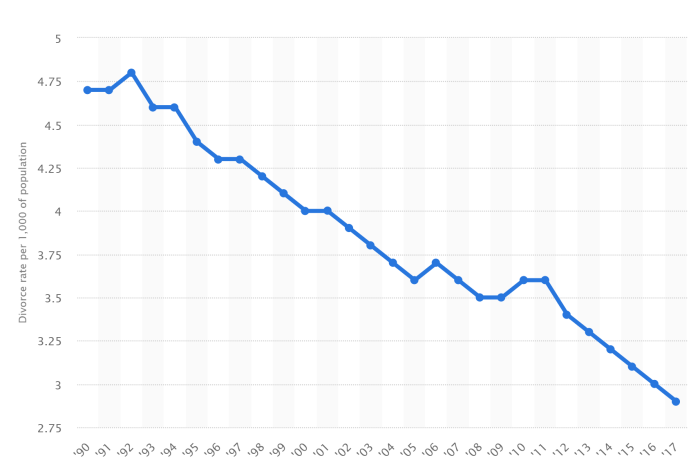
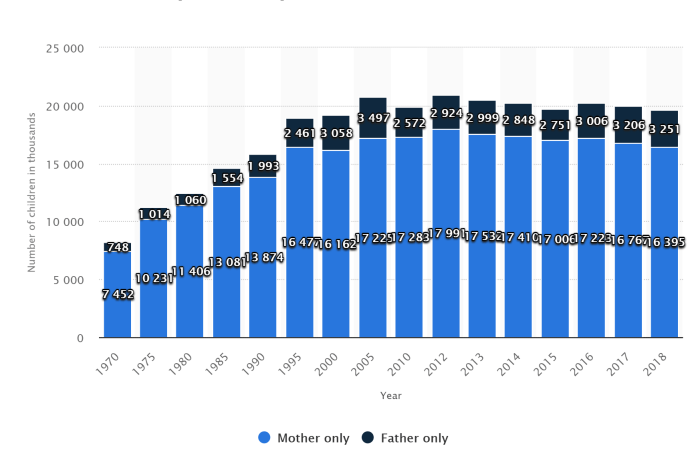
It is hard to measure the “Decay of the family” itself. Luckily, Huntington further concretizes his claim by naming some of the measurable effects. There is nothing much to do to refute these statement except for looking at the following graphs.

a) Firstly, the divorce rate is sharply declining.

3

Source: Statista

b) Second, teenage pregnancy rates are also dropping since 1990.

4Source: National Vita Statistics Report

c) Third, the number of Americans living in single parenthood is not increasing drastically since 1990.

5Source: Statista

I often take issue when (especially conservative) scholars mourn the declining importance of family. Even if there are certain indicators which would back up Huntington’s claims, he does not name them himself. While it is indeed true that “family” as an institution is undergoing changes, there is no evidence (at least named by Huntington) to back up the claim of a decline of its importance.

3. Declining “social capital” and voluntarism leading to less trust.

It is indeed true, that the adult volunteering rate declined from early 2000 to 2016 from 27.4% to 24.9%. Interestingly, it recently bounced back to a new high in 2018, hitting the 30% target. Really the only point where one must agree to Huntington’s claim is the decrease of interpersonal trust as well as trust in public institutions. This trend is indeed very worrisome considering that trust is a major factor for flourishing societies.

4. The decline in work ethic

The research here is a little bit tricky and points in both directions. Although there has been wide academic coverage of the millennial work ethic scholars could not find a consensus on this issue. Its is especially difficult to extract the generational influence from other key determinants of work ethic, such as position or age. Academics warn to mistake the ever-ongoing conflict between young vs. old with the Boomer vs. Millenial conflict. I haven’t settled my opinion on this one. These Articles from Harvard Business Review and Psychology Today provide a good overview of both sides of the medal.

5. Less general interest in Education

This indicator is particularly interesting for me because as a member of the 90’ generation, I have experienced quite the opposite in Germany. But let’s have a look at the data.

Despite ranking only in the middle in a global country comparison, the US students still made a huge leap in terms of maths and reading proficiency, which only slowed down in 2015:

6

Source: Pew Research Center

Furthermore, the overall educational level of the USA continues to rise, resulting in the fact that  “the percentage of the American population age 25 and older that completed high school or higher levels of education reached 90% [for the first time ] in 2017.” Contrary, there are still major differences when one looks at features like race or parent household (See here), but the overall trajectory of the educational level is sloping upwards.

What do these criteria measure?

As you can see, there is little to no evidence to empirically back up the claim of western moral decay. Furthermore, while many case studies have shown that lack of interpersonal trust, lack of education or a declining work ethic can pose a great threat to society, I refuse to see a connection (a no known to me study disproves me here) between (recreational) drugs consumption, alternative family models, increasing hedonism and moral decline. Thus I believe that many advocates of the moral decay theory regard it as an opportunity to despise developments they personally do not like. I do not imply that everyone arguing for the moral decline of the west is unaware of the global macro-trends which heavily improved our life, but I highly doubt their assumption, that we are currently in a short-to-medium term “moral recession”. Even when one upholds the very conservative statements such as drug consumption adding to moral decline, is hard to argue that we are currently witnessing a moral decay of the west. Contrary, It may be true that Huntington has observed something different in the period before publishing “The clash of civilization” in 1996. Of course, I myself witness the ongoing battle against norms on the increasing hostility towards the intellectual enemy in the west, but one should always keep in mind the bigger picture. Our world is getting better – in the long- and in the short-run; There is no such thing as a moral decline of the West.


[1] Huntington, Samuel P. (2011): Kampf der Kulturen. Die Neugestaltung der Weltpolitik im 21. Jahrhundert. Vollst. Taschenbuchausg., 8. Aufl. München: Goldmann (Goldmann, 15190). P. 500

Nightcap

  1. The eye of the needle, again John Quiggin, Crooked Timber
  2. The audible universe Nick Nielsen, Grand Strategy Annex
  3. They don’t want the wage system to go away. They just want to run it.” Thomas Knapp, TGC
  4. The making of Soviet Kazakhstan Joshua Bird, Asian Review of Books

Nightcap

  1. Marxism for Tories Chris Dillow, Stumbling & Mumbling
  2. Open Borders and self-determination Eric Mack, Bleeding Heart Libertarians
  3. The 2nd Amendment and public housing Eugene Volokh, Volokh Conspiracy
  4. It’s time to start watching Japan’s best military sci-fi series Robert Beckhusen, War is Boring

Nightcap

  1. Paul Gauguin in San Francisco Bradley Anderson, Claremont Review of Books
  2. Did European colonisation precipitate the Little Ice Age? Dagomar Degroot, Aeon
  3. What if climate warriors put their money where their mouths are? Joakim Book, Mises Wire
  4. It all started with my balls.” Colm Tóibín, London Review of Books

Brazil, 1984

Danilo Gentili, one of Brazil’s most famous and popular comedians, was convicted and sentenced to seven months of prison time for defaming Maria do Rosário, a Brazilian federal congresswoman with a suggestion that she was a whore in a YouTube video. I wrote about Maria do Rosário before here.

Danilo has been literally on the Worker’s Party blacklist for many years because of his political remarks against it. His “crime” this time, according to the official sentence, was to offend a congressperson. The same kind of defamation against a “normal” citizen would not lead him to jail. Here is what happened: in his twitter account, Danilo criticized Maria do Rosário, saying that she was a hypocrite. The reason was because José de Abreu, a Brazilian actor famous for supporting the Worker’s Party, spit on the face of a woman in a restaurant after she criticized his political positions. Abreu did that shortly after Jean Wyllys, a former Brazil congressman, spit on Jair Bolsonaro. Maria do Rosário, who always presents herself as a feminist, defended José de Abreu. Danilo commented in the case in his twiter account saying that Maria do Rosário was a hypocrite. The congresswoman sent Danilo an official congress letter asking him to delete his twits. The comedian answered putting the letter inside his paints and then sending it back, an action he recorded on video and uploaded to YouTube.

In a similar case, not too long ago, Supreme Court judge Enrique Ricardo Lewandowski threatened with jail an airplane passenger who, turning to him, said he was ashamed of the Supreme Court. Lewandowski is often perceived as defending the Worker’s Party and its interests.

Why do I so frequently write in English about Brazil? In part because I want a broader audience who doesn’t know Portuguese to know what is going on there. As far as I know, for quite some time people outside Germany or the USSR thought that they were doing pretty well. Little did they know. Also because I want to offer a counterpoint to the (more often than not) leftist media that calls Bolsonaro a far-right racist, misogynist. Finally, because I hope that people from outside who read this might engage with the cause of freedom in Brazil. George Soros and others are engaging with the cause of slavery. They count on you not caring about it.

As I wrote before, Brazilian democracy is under threat. And it is not because of Jair Bolsonaro.

Poverty Under Democratic Socialism — Part III: Is the U.S. Denmark?

The Americans who call themselves “socialists,” do not, by and large, think in terms of government ownership of the means of production. Their frequent muted and truncated references to Sweden and Denmark indicate instead that they long for a high guarantees, high services state, with correspondingly high taxation (at least, for the more realistic among them).

When I try to understand the quasi-programmatics of the American left today, I find several axes: End Time-ism, a penchant for demanding that one’s collective guilt be dramatically exhibited; old-style pacifism (to an extent), a furious envy and resentment of the successful; indifference to hard facts, a requirement to be taken care of in all phases of life; a belief in the virtuousness and efficacy of government that is immune to all proof, demonstration, and experience. All this is often backed by a vigorous hatred of “corporations,” though I guess that not one in ten “progressives” could explain what a corporation is (except those with a law degree and they often misuse the term in their public utterances).

I am concerned that the last three features – nonchalance about facts, the wish to be cared for, and belief in government – are being woven together by the American left (vaguely defined) into what looks like a feasible project. I think that’s what they mean when they mention “democratic socialism.” The proponents seem to know no history. They are quick to dismiss the Soviet Union, currently foundering Venezuela, and even scrawny Cuba, as utterly irrelevant (though they retain a soft spot for the latter). And truly, those are not good examples of the fusion of socialism and democracy (because the latter ingredient was and is lacking). When challenged, again, American proponents of socialism refer vaguely to Sweden and to Denmark, about which they also seem to know little. (Incidentally, I personally think both countries are good societies.)

The wrong models of democratic socialism

Neither Sweden nor Denmark, however, is a good model for an eventual American democratic socialism. For one thing, the vituperative hatred of corporations on the American left blocks the path of economic growth plus re-distribution that has been theirs. In those two countries, capitalism is, in fact, thriving. (Think Ikea and Legos). Accordingly, both Sweden and Denmark have moderate corporate tax rates of 22% (same as the new Trump rate), higher than the German rate of only 16%, but much lower than the French rate of 34%.

The two countries pay for their generous welfare state in two intimately related ways. First, their populace agrees to high personal income taxes. The highest marginal rates are 60+% in Denmark and 57+% in Sweden. (It’s 46% currently in the US.) The Danes and the Swedes agree to such high rates for two reasons. For one thing, these rates are applied in a comparatively flat manner. Everyone pays high taxes; the rich are not publicly victimized. This is perceived as fair (though possibly destructive to economic growth). For another thing, their governments deliver superb social services in return for the high taxes paid.

This is the second way in which Danes and Swedes pay for their so-called “socialism” (actually welfare for all): They trust their government and the associated civil services. They generally don’t think of either as corrupt, or incompetent, as many, or at least a large minority of Americans do. As an American, I think of this trust as a price to pay. (I am not thinking of gross or bloody dictatorship here but more of routine time-wasting, exasperating visits to the Department of Motor Vehicles.) The Danes and the Swedes, with a different modern experience, do not share this revulsion or this skepticism.

Denmark and Sweden are both small countries, with populations of fewer than six million and about ten million, respectively. This means that the average citizen is not much separated from government. This short power distance works both ways. It’s one reason why government is trusted. It makes it relatively easy for citizens’ concerns to reach the upper levels of government without being distorted or abstracted. (5) The closeness also must make it difficult for government broadly defined to ignore citizens’ preoccupations. Both counties are, or were until recently, quite homogeneous. I used to be personally skeptical of the relevance of this matter, but Social-Democrat Danes have told me that sharing with those who look and sound less and less like your cousins becomes increasingly objectionable over time.

In summary, it seems to me that if the American left – with its hatred of corporations – tries to construct a Denmark in the US, it’s likely to end up instead with a version of its dream more appropriate for a large, heterogeneous county, where government moreover carries a significant defense burden and drains ever more of the resources of society. The French government’s 55% take of GDP is worth remembering here because it’s a measure of the slow strangling of civil society, including in its tiny embodiments such as frequenting cafés. In other words, American democratic socialists will likely end up with a version of economically stuck, rigid, disappointing France. It will be a poor version of France because a “socialist” USA would not have a ready-made, honest, elite corps of administrators largely sharing their view of the good society, such as ENA, that made the unworkable work for a good many years. And, of course, the quality of American restaurant fare would remain the same. The superior French gourmet experience came about and is nurtured precisely by sectors of the economy that stayed out of the reach of statism.

Poverty under democratic socialism is not like the old condition of shivering naked under rain, snow, and hail; it’s more like wearing clothes that are three sizes too small. It smothers you slowly until it’s too late to do anything.


(5) When there are multiple levels of separation between the rulers and the ruled, the latter’s infinitely variegated needs and desires have to be gathered into a limited number of categories before being sent up to the rulers for an eventual response. That is, a process of generalization, of abstraction intervenes which does not exist when, for example, the apprentice tells his master, “I am hungry.”

[Editor’s note: Part I can be found here, Part II here, and the entire, longform essay can be read in its entirety here.]