- Why fascism is the wave of the future (1994) Edward Luttwak, London Review of Books
- The rise of the rise of the global Right (2019) Paul Urie, Counterpunch
- A climate change denier, Part 2 (2019) Jacques Delacroix, Liberty Unbound
- Sen or sense? (1999) Barun Mitra, the Freeman
Nightcap
- Democracy in America: Tocqueville v. Trump Harvey Mansfield, City Journal
- The tyranny of the “national interest” Pierre Lemieux, EconLog
- Ayn Rand had Asperger’s Syndrome Shanu Athiparambath, Veridici
- Autism and National Public Radio Jacques Delacroix, NOL
Nightcap
- Christianity and the West: which came first? Jonathan Sumption, Spectator
- Argentina’s infernal cycle Branko Milanovic, globalinequality
- Good riddance to the INF Treaty Andrew Erickson, Foreign Affairs
- The assault on American excellence? Nicholas Lemann, New York Times
“Return to the Bronze Age… national nudism”
It seems that the alt-right (have we normalized it past the point of quotation marks?) is seriously studied almost exclusively by the political left, and demsoc journalists of the Vice variety, who will study anything edgy. This is a shame, because the alt-right was a point on the political axes chart that has grown to a blob, with its own online mythos, layered culture, and, recently, mass shooters.
The alt-right is an interesting group to study. I’m as interested in them as the Posadists, and agree with them about as much. They are no friends of liberty, so, given the 2016-and-on talk of toxic forces latching onto libertarian institutions, it seems appropriate that the libertarian mind analyze more thoroughly just what the deal is – rather than having the left stoke a pipeline theory ad infinitum.
I’m reading a recent work that is very popular among the alt-right (and other groups), and, in fairness, I do not know whether or not it is “deplorably” alt-right yet. Bronze Age Mindset came out last year and caught mainstream media attention this year, written by an irreverent anonymous author who, like any modern philosopher, has highly public blue thumbs. It’s about some sort of modern scourge, a return to greatness (a familiar theme by this point), and sex politics, I think.
It feels peculiar pausing my ongoing reading – Feyerabend, Land and Krafft-Ebing – for a piece that seems like a 200-page version of Real Social Dynamics, but the alt-right is here, it is, I still think, growing, and I don’t yet think we’ve seen the worst it will do, unfortunately.
If Bronze Age Pervert is one of the in-house philosophers of the alternative right, we should treat his work with the same critical stewardship. I’ll post a review when I’m finished with it.
Nightcap
- The ongoing chess match between Iran and Israel Saeid Jafari, Al-Monitor
- Britain’s not-so-evil empire Daniel Bring, Modern Age
- “The point is not to win, though.” Rick Repetti, Quillette
- Exposing capitalism’s blind domination Lambert Zuidervaart, Footnotes to Plato
The mythology of Lochner v. New York
In the highly competitive world of most misunderstood Supreme Court decisions, Lochner v. New York sits high on the list. The reason is simple enough: it has undergone a transcendent ascent to the world of abstraction, where it now embodies the platonic essence of a black-robed cadre of old, straight, white men hankering to smash the plebeian’s face in the dirt.
Yesterday, the Intelligencer–a publication of New York Magazine–dragged out these old tropes with the galumphing rhetoric typical of someone simply parroting a battered playbook with no real concern for its accuracy. The article is entitled, “Conservatives Want a ‘Republic’ to Protect Privileges.” Its basic premise is to push back against the anti-democratic tendencies of those who oppose direct, untrammeled democracy.
The article lists several “limitations on democracy to justify and even expand privilege.” The second references the conservative legal movement’s supposed attempt to resurrect the “Lochner era,” in order to protect the wealthy from democratic majorities.
First, off, it’s wrong to say that the “conservative legal movement” wants to revive Lochner. Both progressive and conservative jurists are generally united in their rejection of Lochner. Robert Bork, a thoroughly majoritarian conservative, railed against the case, as did Justice Antonin Scalia. Granted, this is because the conservative legal movement, sadly, has largely embraced the progressive juridical project of the 30’s, which was devoted to weakening the judiciary in order to shove the New Deal down the nation’s throat.
Second, Lochner‘s many detractors almost never grapple with the facts of the case. As a result, they frequently misunderstand it. Here’s what actually happened. In the early 1900’s, New York enacted a nitpicky law that saddled bakeries with an avalanche of finite requirements–limits on ceiling heights, limits on the kind of floor, and the demand to whitewash the walls every three months, among other things. But the provision dealt with in Lochner was this: “No employee shall be required or permitted to work in a biscuit, bread or cake bakery or confectionary establishment than 60 hours in one week or more than 10 hours in any one day.”
A Bavarian immigrant named Joseph Lochner who owned a Utica bakery was criminally indicted for violating this law. Aman Schmitter, another immigrant, lived with his family above the bakery and worked for Joseph. Aman happily worked over sixty hours a week in order to care for his family and increase his skills, and he said so in a sworn affidavit.
It is undisputed that New York’s law was not about health, safety, or protecting workers, though New York tried to say so at the time. Rather, New York passed the law at the behest of powerful bakeries and baker unions in a patent attempt to crush small, family-owned bakeries that relied upon flexible work schedules. It gets worse–the law intentionally targeted immigrant bakeries in particular, which tended to be of the small variety that leaned on overtime. The state’s legal brief contained a detestable line that progressives today would certainly associate with Trump: “there have come to [New York] great numbers of foreigners with habits which must be changed.” This is the law that progressives who hate Lochner are defending.
In a 5-4 decision, the Supreme Court thankfully struck down this law that was passed to serve the powerful and crush a weak immigrant population. Put that way, it seems startling that anyone today would wish to stand up for this piece of anti-immigrant, protectionist garbage.
But then again, Lochner is no longer about Lochner. It’s about rejecting a mythical “Lochner era.” Progressives believe that Lochner represented an entire ecosystem of turn-of-the-century jurisprudence in which corrupt judges were smothering the will of the people wholesale. Turns out that era never existed. Law professor David Bernstein has examined old court records concerning state exercises of their police power during that time period and found that there simply was no lengthy period in which courts were whack-a-moling every piece of social legislation that dared to lift its head.
To the extent that courts of that era did strike down social legislation under the liberty of contract, they did so not to serve the wealthy, but to protect weak minorities–which is of course why robust judicial review exists in the first place. For instance, the Illinois state supreme court struck down a deeply misogynistic law limiting women’s maximum work hours. The Court used the same liberty-of-contract reasoning as Lochner, arguing that women “are entitled to the same rights under the Constitution to make contracts with reference to their labor as are secured thereby to men.” And in Bailey v. Alabama, the wicked Lochner Court struck down a Jim Crow law that created a presumption of fraud when a worker quit after getting an advance payment. The law was aimed at penalizing black workers–an attempt essentially to revive peonage. Do progressives really want to own up to disagreeing with these “Lochner era” precedents? Somehow I doubt it.
Lochner did not, as Lochner‘s enemies love to claim, replace the legislature’s judgment with the judgment of the Court. Instead, the Court was willing to look skeptically at the legislature’s motives and demand that the legislature do its work and show that a law burdening a basic right is necessary. The New York law failed that test spectacularly.
Of course, Lochner‘s legacy does demand that courts counter democratic will when it conflicts with fundamental rights. Alexander Bickel famously called this the counter-majoritarian difficulty, something that has preoccupied the judiciary for a century. If you really care about minorities, though, you might consider Judge Janice Rogers Brown’s insight: “But the better view may be that the Constitution created the countermajoritarian difficulty in order to thwart more potent threats to the Republic: the political temptation to exploit the public appetite for other people’s money–either by buying consent with broad-based entitlements or selling subsidies, licensing restrictions, tariffs, or price fixing regimes to benefit narrow special interests.”
In any case, if progressives continue to take a polly-anna view of unfettered democracy despite the evidence, they should at least bother to get the facts right on Lochner.
Nightcap
- The threat of fanaticism Chris Dillow, Stumbling & Mumbling
- On targeting the price of gold George Selgin, Alt-M
- Reinventing language Catherine Charrett, Disorder of Things
- Geopolitics and Greenland Jon Rahbek-Clemmensen, War on the Rocks
Nightcap
- The oligarch threat Tamsin Shaw, New York Review of Books
- Vasily Grossman’s lost epic Sophie Pinkham, New Republic
- It’s time for Germany to step up Mathieu von Rohr, Spiegel
- How slavery shaped American capitalism John Clegg, Jacobin
Look what just arrived in my hands
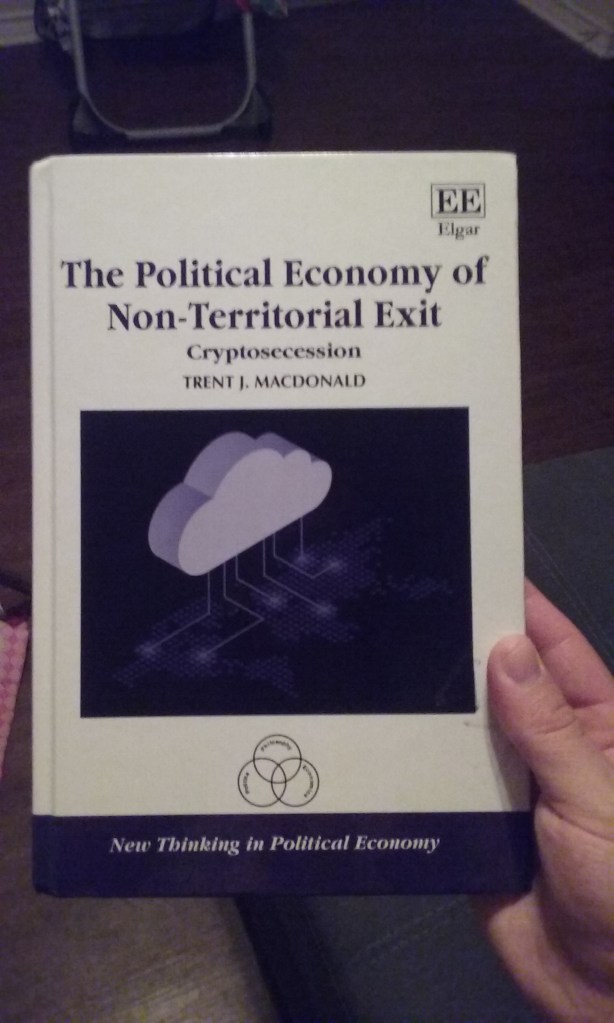
Trent MacDonald is an economist in Australia. You can order the book here. Or you might have better luck hollering at him on Twitter. Thanks Trent!
Be Our Guest: “Of Monies and Juries and Freedoms”
Be Our Guest is a new, experimental series at NOL. Basically, NOL is invite-only but you can, and should, submit your thoughts to us. The latest piece is by Michalis Trepas, a Greek national working in the financial sector. An excerpt:
The judicial system was reluctant to intervene, out of respect of the separation of powers (according the Weimar Constitution, currency matters were reserved for the parliament). So, at first, the courts upheld the nominalistic principle and refused to accept a revalorisation of debts. But then, something began to change in the courts’ reasoning. The currency’s slide prior to 1921 could be attributed to the conditions of the “war economy”, whose burden was to be shared by everyone in the country. The unrestrained fall thereafter, the courts said, was a monetary phenomenon, punishing “blindly and unpredictably” only the creditor class.
If you cannot guess by now what Michalis is writing about, read on! If you have figured out what the subject of his piece is about, read on, as it only gets more interesting.
There are cultural and geopolitical considerations to think about here, too, in regards to Greece and Germany and financial markets and constitutionalism.
Nightcap
- Why Islamic debates over slavery still matter Bruce Clark, Erasmus
- Stealing corpses in Gabon Lionel Ikogou-Renamy, Africa is a Country
- The last of the Beatniks Kaya Oakes, Commonweal
- Subscription capitalism Tim Gooding, American Affairs
Nightcap
- Indonesia is building a new capital city Niniek Karmini, Associated Press
- Blasphemy laws are quietly vanishing…in the West Bruce Clark, Erasmus
- Lonely Russia and its multipolar world Hélène Richard, Le Monde diplomatique
- Brasilia, urban planning, and spontaneous order Bruno Gonçalves Rosi, NOL
Nightcap
- Israel’s un-Machiavellian Prince Ben-zion Telefus, Duck of Minerva
- Macron’s Iranian G7 gamble Herszenhorn & Momtaz, Politico
- Why the French love to say ‘no’ Sylvia Sabes, BBC
- An ah-hah moment while shopping David Henderson, EconLog
Mexican Productivity and Poverty: a Superficial, Street-Level View
I just spent three and a half weeks in Puerto Vallarta, Mexico (summer 2019). Below are some impressions. First things first; I have to give you the severe limits of my field of vision while I was there.
My wife and I stayed in an old-fashioned, 1950s low-rise hotel on the ocean with a pleasant faded kind of glory. (My wife Krishna does not let me go to Mexico by myself, for obvious reasons!) It was very hot throughout so, we did not go out much except that we had to shop for food every day at the mall across a broad avenue. We took taxis to and from the dentist about fifteen times. I always chat with taxi drivers; they gave us the foundation of sociology, I am sure! We spent a little time in the old touristy market district (where we have friendly acquaintances from past visits). We also walked some on Puerto Vallarta’s beautiful and interesting seafront (the “malecon”). I speak Spanish well, I understand everything in the language; I read it with ease. I read the paper a few times; I watched the Spanish language news on television a few times. I read free brochures on this and that.
There is much to like in Mexico, and especially Mexicans. They are low-key, unexcitable, stoical cordial, affable, and eager to help, and not only vis-à-vis this pleasant, well-disposed gringo, myself. Living for a short time in pleasant, clean Puerto Vallarta, it’s difficult to remember that Mexico’s homicide rate is three times the US rate. It takes the occasional sighting of a truckful of the new, nattily dressed National Guard with automatic weapons to jog your memory. (See notes from a previous visit: “Mexicans in Mexico,” 2017, )
Low productivity
My main observation is a repeat from what I recounted the last time I was there (See my “Mexican Underdevelopment: Pop-Sociology.”) It’s about productivity. For most of our stay, there was work going on on a brick path right beneath my windows. It was mind boggling. At one point, there were seven people working on the same two steps, including a master craftsman. They continued by restoring and cleaning a flat brick path. The thought stuck me that,in California, two, or two-and-a-half of the same Mexican workers (the very same guys) would have done the same work in the same time easily. And, yes, I know something about brick laying, both personally (I used to be very poor; now I am moderately poor), and as a customer. I am talking about a more than fifty per cent rise in productivity obtained by simply moving workers into a different environment. Bosses and economic leaders would easily kill for a change of such magnitude!
Of all the guys on the bricklaying and brick cleaning site, only one had a proper power tool, and it was only operational part of the time. The others labored by hand, mostly on their knees. No one had thought of giving them knee-guards. They had not themselves.
Moderate Poverty
The workers told me they were making about US$23 a day, or $115 for a forty-hour week. That’s not bad given that beginning professional positions – that require a university education – in thriving, manufacturing Monterrey are advertised for US$600 a month. Yet, and although most food, housing, gasoline, and health care are all cheaper in Mexico than in the US, this is still not much money on which to rear a family. But, this is also not dire poverty of the kind we used to see, and sometimes still find in India or in Africa. In that part of Mexico, everyone looks healthy, especially the children. Many adults are obese, more or less like in the US. Everyone is well dressed, by the admittedly low standards of central California where I live.
Over-staffing
Here is striking fact: Wherever you go, you find overstaffed shops, restaurants, etc, often very overstaffed. I mean like three shop attendants doing nothing in the middle of the afternoon. There must be a reasonable number of exceptions because my dentist’s office makes good use of its human resources. The same young women who serve as assistants, also act as receptionists. (I know, know, comparative advantage; don’t get me started, this is not the time or place.)
Productivity and Income
Over-staffing and the failure to provide workers with the best tools matter a great deal if you think, as I do, that incomes roughly follow productivity though often with big time lags, and often not in a linear fashion. Although employers sometimes fail to share the product of productivity gains with workers, the fact is that they cannot share gains that have not occurred. Low productivity pretty much guarantees low wages.
Note what I am not saying. The Mexican work ethic is not the problem. The guys who worked in the hot sun of tropical Mexico for eight hours a day don’t need lessons from anyone on that count. Also, those of us who live in California remember well the recession years when the vegetable picking lines remained nearly all-Mexican (with a handful of Filipinos) while poor Anglos lamented the absence of jobs. Now that wages in the field have increased substantially because of a chronic farm labor shortage, still few college students are flooding in, California sky-high rents or not.
Going back to fairly prosperous Puerto Vallarta, where construction is thriving (because of Canadian refugees from the cold, I am told), there is also the mysterious fact of the invisible zealot pounding stakes close to my hotel at 5:30 AM. I am not complaining. I respect this instance of unreasonable industriousness!
Social Structure and Productivity
Mexicans remain poor, the Mexican economy keeps growing but only slowly. This is, at least in part, I think, because Mexicans have normative standards that do not feed high productivity. These standard maintain a permanent social structure that makes increasing productivity difficult. A vicious/virtuous circle is at work. Labor is cheap because of its low productivity. It’s so cheap that, why not hire an additional worker for the same job? The incentive to hire nonchalantly is probably high because of Mexicans’ high connectivity. Mexicans, even in a fairly new city like Puerto Vallarta appear much more interconnected than Californians. (I don’t know much about the East Coast of the US.) There are many more individuals in one’s life there to please by giving their relatives and liege a job than is the case where I live.
Take the lifelong relationship of “compadre” and “comadre” between adults who are usually not kin to each other. The titles denote the link between a man and a woman who are respectively godfather and godmother to the same child. It easily multiplies by two or three beyond actual relatives the circle of individuals to whom one is to some extent obligated. And, it does not end there. Why, there is even a word in Mexican Spanish to denote the relationship of two people who have the same first name! I forgot the word but I was charmed to discover that I was ##### to any number of “Diegos.” I can even imagine situations where someone would succeed in using that tenuous link to extract a small favor from me (with a probable intention to reciprocate).
High Connectivity not a Specific Feature of Mexico, and Over-Staffing
I don’t think this high connectivity is an idiosyncratic feature of Mexican society. I believe rather that something similar prevails in India (that I know a little). It seems to me that high connectivity was visible also, in rural Brittany when I was a child in the forties and fifties. It was largely absent in Paris by contrast where I lived most of the time (Order my book of socio-historical memoirs of that period: I Used to Be French: An Immature Autobiography; avoid the middle person, go through me.). Having obligations to few rather than to many is a salient feature of modernity (that includes also urbanization, small nuclear families, and a search for formal education).
I speculate that Mexicans, even in comparatively modern places like Puerto Vallarta, have a high tolerance for over-staffing because of the large social networks within which they exist. Over-staffing is thus a primary contributor to low productivity. Low productivity keeps many people poor. Poor people need a supportive network more than do the more prosperous. Long and short of it: to break the cycle would require a degree of de-humanization of Mexican society. It’s not inexorable. Mexicans may collectively choose a bearable level of poverty (see life expectancy below) over the destruction of the emotional comfort larger social networks promote.
Not Following in the Footsteps….
It seems to me that a high degree of familiarity with the negative example of American society next door with its low connectivity – in places – may guide them toward such a choice. In point of fact, I have met a strikingly large number of Mexican men who had worked in the US for several years and who had returned home under their own power, by choice, according to their narratives. (I also note with satisfaction that ten years ago, S. Nikiforov and I had evoked precisely that sort of preference in a big article on Mexican immigration: “If Mexicans and Americans could cross the border freely,” in The Independent Review, 14-1: 101-133 [Summer] 2009.)
There is no law of nature that requires the people of less developed countries to retrace all the steps of their predecessors in development. The cellphone shows us that often, they don’t have to: Several African countries have phone landlines only in the center of their major city but 80% of their population has access to a cellphone. Trying to skip stages is the rational thing to do, of course. I would guess it’s most successful when it depends largely on a myriad of individual decisions, as with cellphones. Nevertheless, it seems to work pretty well – for some reason – even with collective decisions regarding health care, specifically.
Perhaps, societies can pick and choose what features of modernity they actually want thanks to a density of available information and a richness in inter-communications that was unimaginable forty years ago. (That was when I was studying underdevelopment with rigorous methods.) I can picture a partial national consensus forming that says, “We don’t need everything the big guys have; a little bit more of this and of that, and we are OK.” If this scenario is realistic, food, schooling, and health care will probably be its dominant themes. The Mexican food situation appears fine (I will consider contradiction on this.). In my subjective judgment, based on its products, on the average, Mexican K-12 is superior to its American public counterpart.
Illness and Health care
One component of socio-economic underdevelopment and also an obstacle to development in its own right used to be widespread illness. The morbidity figures I saw in the seventies about the situation in the fifties were horrifying. Illness also obstructed development indirectly because it destroyed family units through the death of parents or older siblings, even of aunts and uncles who might have provided. This is largely in the past. The present in poor countries is very different, greatly improved from the narrow standpoint of health. And, it turns out, the Mexican health picture, in particular appears fairly bright.
Single Payer Health Care
Something to think about for my conservative friends: Mexico has single payer healthcare for those who want it. It has a pretty poor reputation, it’s true. A private health network subsists side-by-side with it for the prosperous. (I like that.) Yet, yet, the life expectancy of Mexicans is only 2.6 years lower than that of Americans, same as the difference between the US and the Netherlands (WHO 2015, in Wikipedia). Americans live longer than Mexicans in the same proportion as the Dutch live longer than Americans. So, either, it’s possible to get fairly similar results health-wise at much lower cost than do Americans, or health care does not matter all that much, as far as not dying is concerned. (Hate to twist the knife in the conservative wound but the Dutch also spend much less money than Americans on their health care.)
Incidentally, I am well aware that there are non-economic arguments against entrusting what is now 17% of the US GDP to the government, to any government. But, perhaps, conservatives should restrict themselves to combating govt. health care on political and principle grounds alone. (End of digression.)
Where To?
So, where am I going with this, you may fairly ask? I am expressing my doubts that Mexican society – and other less developed societies – will be forced to undergo the dislocating social change that would be required to improve much its (their) productivity, according to the old schemes. I have to stop here, more or less, but it seems to me that Mexico is more likely to improve first its societal-level productivity by having more women join the work force. The preservation of a high existing level of connectivity – with its baked-in child care and food services – would ease, and facilitate such mass social change, of course.
Nightcap
- Criticizing libertarianism (meh; racism is a much bigger problem) Arnold Kling, askblog
- The Black Boys’ rebellion Michael Taube, Claremont Review of Books
- Rudyard Kipling’s American years John Butler, Asian Review of Books
- The strangling of European democracy Daniel Ben-Ami, spiked

