Greenland and the Spirit of 1776

On this sacred 250th anniversary of our Republic’s birth, to fully grok how the liberation of Greenland can fulfill our unextinguishable Spirit of 1776, we must discard the outdated notion that the Arctic is a frozen, peripheral wasteland. 

Throughout my career analyzing Arctic sovereignty, borderlands, and geopolitics, I have argued (since I was a young man in 1991) that the Far North is emerging as a central arena for global freedom, resource independence, and democratic sovereignty. Upon this July 4th’s sacred, quarter-millenium celebration of our liberty, this long-foreseen centrality has come to pass.

In my view, the Spirit of 1776 is not a static historical event: it is instead an ongoing, dynamic process of expanding self-determination, rolling back old-world colonial empires, and securing our continental perimeter against authoritarian overreach. 

To fulfill our Spirit of 1776 in the 21st century, the United States must extend its democratic umbrella northward! This is not an act of alliance-imploding imperial conquest as Denmark has sought to portray; rather, it is an inclusive act of collaborative liberation

By helping Greenland sever its last colonial ties to Europe and integrating it into North America’s hemispheric security and economic architecture, we can achieve three philosophical and strategic imperatives:

Continental Completeness: We complete the geopolitical vision of the Monroe Doctrine, ensuring North America is entirely governed by consent and free from European or Asian state interference.

Democratic Self-Determination: We empower the Kalaallit (Greenlandic Inuit) people with true economic and military independence, backed by American constitutional guarantees.

Frontier Ethos: We re-ignite the American pioneer spirit on the Arctic frontier, viewing the far north as a dynamic space for democratic civilization.

To help actualize this collabarative liberation, Greenland can craft a Constitution mirroring while customizing our own paradigmatic Constitution. Some key components could include the following.

A Proposed Constitution of the Republic of Kalaallit Nunaat

Preamble

We, the people of Kalaallit Nunaat, grateful to our ancestors who survived and thrived across the Arctic frontier, determined to preserve our culture, our language, and our environment, and committed to the universal principles of human liberty and democratic self-governance, do establish this Constitution for our sovereign Republic.

Article I: Sovereign Status and Geography

  1. The Republic of Kalaallit Nunaat is a sovereign, democratic, and independent nation encompassing the entire island mass of Greenland, its continental shelf, and its territorial waters.
  2. The sovereign power resides in the people, to be exercised through their elected representatives and direct democratic referendums.
  3. The official national languages are Greenlandic (Kalaallisut) and English.

Article II: Bill of Rights and Liberties

  1. Fundamental Rights: Every citizen is born free and equal in dignity. No law shall discriminate based on race, ancestry, language, or creed.
  2. Freedom of Expression: The right to free speech, a free press, and peaceful assembly shall not be abridged.
  3. Property and Private Enterprise: The right to private property is guaranteed. Free-market enterprise is the baseline economic system of the Republic, protected against arbitrary state nationalization.
  4. Indigenous Customs: The collective right of the Inuit people to hunt, fish, and manage local community lands in accordance with sustainable tradition is permanently protected.
  5. The Right to Bear Arms and Self-Defense: The right of the people to keep and bear arms for self-defense, protection against wildlife, hunting, and the security of the Republic shall not be infringed. No law shall prohibit the possession, carry, or responsible use of firearms by citizens. Licensing and registration shall be kept minimal and non-prohibitive to ensure remote families are never left defenseless against the elements or predators.
  6. Inherent Rights to Traditional Harvest and Lifeways: The right of citizens to engage in traditional hunting, fishing, gathering, and harvesting is an unalienable birthright. This includes the absolute right to harvest marine mammals, specifically whaling and sealing, as well as terrestrial fur trapping. The use, breeding, training, and deployment of sled dogs (Qimmit) for transportation and hunting is protected. No administrative regulation or international treaty shall penalize or restrict these practices. The local trade, consumption, or garment-making of legally harvested furs, skins, or traditional foods shall not be criminalized.
  7. Conversion of Ecological Zones to Subsistence Hunting Preserves: All lands previously designated as national parks, restrictive nature reserves, or ecological preserves under foreign administration are permanently converted into National Subsistence Hunting Preserves. The right of local populations to access these lands for subsistence hunting, traditional trapping, fishing, and temporary shelter is absolute and supreme over pure preservationist mandates.
  8. Family Sovereignty and Prevention of Child Removal: The family is the foundational and sacred unit of society. No agency of the state or external non-governmental organization shall have the authority to separate families or remove children from their parental home based on poverty, standard of housing, or adherence to traditional indigenous child-rearing practices. Separation shall be permitted only as an absolute last resort in instances of proven, severe physical harm, established by an independent jury of peers in a court of law. Preferential placement must be given to extended kinship networks and local community members.

Article III: Legislative Branch (Inatsisartut)

  1. Legislative power is vested in a unicameral parliament, the Inatsisartut, consisting of 31 members elected by proportional representation every four years.
  2. It has sole authority to pass domestic laws, levy taxes, approve national budgets, control and restrict immigration, and ratify commercial treaties.
  3. All laws concerning the extraction of critical mineral wealth require a three-fifths supermajority vote.

Article IV: Executive Branch (The Presidency)

  1. The executive power of the Republic is vested in the President, elected by direct popular vote for a term of five years, limited to two terms.
  2. The President serves as the Head of State, Head of Government, and Commander-in-Chief.
  3. Strategic Alliance Provision: The President has the constitutional power, with the consent of parliament, to delegate the external defense and aerospace protection of the Republic to the United States of America under a permanent Compact of Free Association.

Article V: Judiciary

  1. The judicial power is independent of the executive and legislative branches, vested in a Supreme Court and lower regional courts.
  2. The courts interpret the laws of the Republic, integrating western common law with traditional Inuit customary justice.

Article VI: Amendment and Ratification 

  1. Amendments to this Constitution may be proposed by a two-thirds vote of the Inatsisartut or by a petition signed by twenty percent of registered voters.
  2. An amendment becomes valid only when ratified by a majority vote of the citizens in a nationwide referendum.

Why This Fulfills the Spirit of 1776

Greenland’s current status under the Danish Realm represents a lingering anomaly of old-world European colonialism. While Nuuk has enjoyed increasing “Home Rule” and later “Self-Rule” governance, its security, defense, and monetary systems remain anchored in Copenhagen, with multiple levels of continuing dependency.

The Rejection of Imperial Feudalism: The Spirit of 1776 revolted against a small island nation in Europe governing a vast continent across the sea. Denmark’s management of Greenland inverse-mirrors this dynamic with a small continental nation governing a vast North American Arctic island. Facilitating Nuuk’s exit completes the decolonization of the Western Hemisphere.

Guarding the Empire of Liberty: Thomas Jefferson envisioned a continental space where democratic institutions could multiply safely. By more tightly integrating Greenland into America’s hemispheric perimeter, we can more ably protect critical minerals and contested seabeds from our rivals, while expandine the rule of law and the zone of liberty.

Self-Actualization of Indigenous Peoples: My scenario of liberation places the Kalaallit people at the center of their own destiny. By partnering with the United States, they trade a paternalistic European welfare state for a high-growth, constitutionally protected partnership, becoming absolute masters of their own nation.

It is time for their colonial dependency to end. It is time for the whole of North America to be free. It is time, on this sacred quarter millennium since America’s birth, for Greenland to declare its own independence, and to join us in the brotherhood of nations and free peoples. Let our 250th Independence Day become Greenland’s first!

Code Blue: How America Can Help Heal Greenland’s Rural Health Crisis

The vast, ice-locked expanse of Greenland is facing a quiet, structural rural health crisis. While global powers look north to debate emerging shipping lanes, untapped deposits of rare-earth minerals, and increasingly salient geopolitical positioning in the Arctic, a human crisis is unfolding across the territory’s remote coastal settlements. Greenland’s rural healthcare system is straining under the weight of persistent staffing shortages, extreme geographic isolation, and an overwhelming infrastructural deficit.

As America expands its diplomatic and strategic footprint in the Arctic and High North Atlantic, Washington can no longer afford to view Greenland solely through the lens of national defense and radar stations. Addressing Greenland’s rural health crisis is not just a moral imperative; it is a critical opportunity for the United States to practice meaningful, localized diplomacy that secures long-term stability and goodwill in a vital region.

The recent public rejection of a U.S. hospital ship by Greenlandic and Danish officials was a triumph of nationalist pride, but a tragedy for the island’s most vulnerable residents. The political friction began on February 21, 2026, when U.S. President Donald Trump announced on Truth Social that he was deploying a “great hospital boat” to Greenland, claiming the population lacked proper care.

The response from Nuuk and Copenhagen was immediate. As ABC News reported, “‘It’s a no thank you from here,’ Greenlandic Prime Minister Jens-Frederik Nielsen said,” just hours after President Trump’s generous offer: “‘President Trump’s idea of sending an American hospital ship here to Greenland has been noted. But we have a public healthcare system where treatment is free for citizens. That is a deliberate choice — and a fundamental part of our society. That is not how it works in the USA, where it costs money to see a doctor.'” But as all residents of Nordic states know, it costs money to see doctors there too, through higher taxes and in the specific case of Greenland, Danish subsidies.

Denmark’s leadership quickly reinforced this message. As the New York Times reported, “Troels Lund Poulsen, the Danish defense minister, told Denmark’s public broadcaster, DR, that his government had not been made aware of the plan. He said that there was ‘no need for special health care efforts, in Greenland.'” Perhaps he needs to spend more time in rural Greenland before making such a bold but dubious claim.

Danish PM Mette Frederiksen — who barely survived Denmark’s March parliamentary elections by assembling a four-party minority coalition government 69 days after her party, the Social Democrats, delivered their worst electoral performance in over a century — responded similarly but indirectly to President Trump’s generosity, writing on Instagram “I’m happy to live in a country where there is free and equal access to health care for everyone,” as the New York Times also reported, “The same approach exists in Greenland.”

In dismissing the U.S. President’s generous offer so quickly and cavalierly as an unnecessary political stunt, these Greenlandic and Danish leaders touted Greenland’s free, national healthcare system. Yet, their defensive reaction masks a grim reality familiar to anyone living outside the capital of Nuuk: for Greenland’s remote and isolated settlements, access to that “free” healthcare is often a distant, and at times dangerous, illusion.

Just look at the dispararity in life expectancies in Greenland and Denmark: in Greenland, the average life expectancy is 69.3 years for men and 73.9 for women, while in Denmark it’s 79.9 for men and 83.7 for women—nearly a full decade of precious life longer for both men and women (for those lucky enough to have survived Denmark’s decades-long policies of Greenlandic population suppression). Outside of Nuuk, whose life expectancy numbers enjoy a boost from its high concentration of non-Greenland born residents, life expectancies are even lower by some three to four years.

While elite urban leaders lean into their ideological purity from modern, state-of-the-art “Potemkin” facilities, rural Greenlanders continue face severe doctor shortages, long transport times for emergencies, an ongoing specialist crisis, and heartbreaking levels of suicide. In a vast, Arctic nation where geography is the ultimate barrier to the practice of medicine, a floating, fully-equipped hospital ship is not an insult to sovereignty—it is a highly practical, life-saving solution to the undeniable failures of rural Arctic healthcare.

Anatomy of an Arctic Health Crisis

Greenland operates a universal healthcare system that is free at the point of use. However, equity in theory does not translate to equity in geography. For most of the island’s 57,000 residents—scattered across dozens of isolated villages accessible only by plane, helicopter, dog sled, or boat—access to basic medical care is akin to a lottery. The system is suffocated by an unsustainable reliance on short-term, rotational medical professionals traveling from Denmark. These practitioners rarely stay long enough to learn Greenlandic or understand local cultural nuances. This in turn exhausts the few permanent, bilingual local health workers, driving severe burnout and rapid turnover.

In the remotest of settlements, basic lifesaving tools like defibrillators are frequently absent. When emergencies strike, the territory relies on expensive, logistically complex medevacs. At a rate of 7.7 evacuations per 1,000 inhabitants every year, these flights drain tens of millions of dollars from an already strained public budget. Because preventive care is practically non-existent in the rural periphery, chronic conditions like cardiovascular disease and cancer are routinely diagnosed at late, terminal stages.

Compounding these structural challenges is a profound legacy of historical trauma. The revelation of protracted, forced contraception campaigns enacted by Danish authorities in recent decades has left deep scars. It has fostered a persistent, understandable distrust of institutional medical systems among Indigenous communities.

Washington to the Rescue


For decades, America’s relationship with Greenland has been transactional, anchored by the strategic outpost of Pituffik Space Base (formerly Thule Air Base). However, in an era of renewed Arctic competition, hard military power is no longer enough to maintain durable alliances.

The Greenlandic government currently faces an estimated one-billion-kroner (US $150 million+) deficit just to modernize its clinical infrastructure and bridge the health equity gap between rural settlements and the capital, Nuuk. By actively intervening to help close this gap, the United States can deploy a strategy of medical diplomacy. This approach will alleviate human suffering while demonstrating that American partnership brings tangible, life-saving benefits to everyday Greenlandic citizens.

An Action Plan for American Medical Diplomacy

The United States possesses the exact technological, logistical, and clinical infrastructure needed to revolutionize rural health care in Greenland. To achieve maximum impact, Washington should deploy a targeted, three-tiered action plan:

1. Scale AI-Powered, Pan-Arctic Telehealth Collaboration

The greatest barrier to rural healthcare in Greenland is distance. Rather than trying to solve this in isolation, the United States should integrate Greenland into a broader, pan-Arctic telehealth network. By creating a collaborative digital medical grid between Alaska’s tribal health organizations—which have decades of experience in remote, sub-zero care—and Greenland’s regional clinics, providers can seamlessly share best practices, billing efficiencies, and translation strategies.

Crucially, this pipeline can be supercharged with Artificial Intelligence. American technologists like Elon Musk can help develop and deploy automated AI diagnostic software to rural Greenlandic nursing stations. These algorithms can instantly evaluate X-rays, spot early-stage oncological abnormalities on skin scans, and read basic blood work without waiting days for a specialist in Nuuk or Copenhagen. By pairing low-Earth orbit satellite arrays with AI triage tools, minor health issues can be resolved locally, stopping the financial bleed of avoidable medical evacuations.

2. Deploy Seasonal U.S. Hospital Ships for Direct Care

While digital health addresses daily care, Greenland’s immense surgical backlogs require physical intervention. The United States Navy maintains the world’s most capable floating medical platforms. Washington should institutionalize annual, seasonal deployments of U.S. hospital ships (such as the USNS Comfort or Mercy, or newly designed agile medical vessels) to the High North Atlantic and Arctic during the ice-free summer months.

Operating as high-profile medical diplomacy, these ships would anchor off regional hubs like Qaqortoq, Sisimiut, or Ilulissat. Over a multi-week deployment, American naval surgeons and dental corps could perform hundreds of elective surgeries, joint replacements, and advanced dental procedures that rural Greenlanders currently wait years to receive. This surge of direct, high-impact clinical aid would immediately relieve the strain on Greenland’s domestic budget while forging deep cultural goodwill directly with the populace.

Indeed, commissioning a new, dedicated medical icebreaker designed for maritime health delivery to Arctic coastal villages would provide a critical, helpful new layer to the region’s much-needed rural healthcare infrastructure. Geopolitical grandstanding aside, achieving this logistical breakthrough requires cooperation over pride. America can genuinely help by offering specialized maritime medical expertise and use of its hospital ships, but Denmark can and must do more too, leveraging its substantial wealth and sovereign responsibility to co-fund a permanent mobile care solution for the citizens it aims to protect.

3. Establish a High North Atlantic and Arctic Medical Scholarship Program

True healthcare sustainability cannot be imported; it must be grown from within. The U.S. State Department should launch a scholarship and residency pipeline inviting Greenlandic students to train at top-tier American medical and nursing schools, funded by allied donors who will all benefit from a healthier and more secure Arctic.

This program must place special emphasis on rural medicine, telehealth deployment, and culturally informed community health care. In exchange, graduates would commit to returning to Greenland’s rural clinics for a designated period. This initiative would systematically build a permanent, bilingual, and Indigenous medical workforce, directly dismantling the cycle of foreign medical dependency.

Rx for Change

True Arctic security is impossible to achieve when the region’s inhabitants are left vulnerable to preventable systemic health crises. The structural deficiencies in Greenland’s rural healthcare network require resources, technology, and logistical capabilities that Nuuk cannot assemble alone.

By stepping forward with an innovative blend of AI-driven pan-Arctic telehealth networks, seasonal hospital ship deployments, and long-term educational pipelines, the United States can help heal a profound humanitarian rift in the High North Atlantic and Arctic. In doing so, America will prove that its commitment to the Arctic is measured not just in military muscle, but in the health, dignity, and longevity of the people who call the Arctic home.

After Greenland’s Liberation: Inuit Sovereign Expansion

Why Greenland and Nunavut Could Join Forces Under a U.S. Shield

June 21 — just two weeks away — marks not only the summer solstice, but in Canada it’s also National Indigenous Peoples Day, a day that celebrates the resilience of the Arctic’s original inhabitants. Yet, celebration without sovereignty seems in many ways premature and incomplete.  True self-determination for Inuit still requires a profound political transformation.

Indeed, the path to a strong, viable and unified Inuit state runs through Nuuk, Iqaluit, and Washington. By leveraging Greenland’s path to independence from Denmark and negotiating with President Trump, and then more tightly integrating Greenland and Nunavut under America’s defense and economic umbrella, Inuit can finally achieve a cohesive and sovereign Arctic state, an historic first.

The current geopolitical map fragments the Inuit nation across artificial colonial borders. Greenland operates under Danish self-rule, while Nunavut remains a territory within the Canadian confederation. Both face a shared vulnerability: vast geographic scale, small populations, and intensifying pressures from Arctic and “near-Arctic” neighbors Russia and China (and, 80 years earlier, Germany and Japan).

Neither Nuuk nor Iqaluit possesses the economic or military heft to secure the top of the world alone. A bold diplomatic realignment is required to bridge this divide. This alignment would not be entirely unprecedented, but rather an historic restoration.

During World War II, the United States stepped in as the de facto protector of both regions. Following the 1940 Nazi occupation of Denmark, Washington established a protective mandate over Greenland to secure its strategic cryolite mines and critical Arctic weather stations. Simultaneously, the U.S. Army’s Air Forces built a massive and vital airfield at Frobisher Bay — now modern-day Iqaluit — to ferry aircraft to the European front. This shared history of wartime continental defense laid the early structural and geopolitical foundations for a unified North American Arctic.

Greenland holds the key to unlocking this future. As Greenland moves closer to full independence from Denmark, it faces a gathering financial and security vacuum. Denmark’s annual subsidy cannot be easily replaced, and an independent Greenland cannot defend its massive coastline and vast EEZ. 

This is where strategic pragmatism meets historic opportunity. President Trump has famously viewed Greenland through a lens of immense strategic and economic value. Rather than resisting this interest, Greenlandic leadership should lean into it.

Instead of pivoting to Copenhagen’s familiar embrace, Nuuk could instead leverage its ongoing (if fractious) discussions with Washington to flip the script and directly negotiate a compact of free association with President Trump. Turning the table like this has been done before, and is a quirk of Trump statecraft: Just ask the Taliban, which eventually learned the frenemy of my enemy is my new best friend.

Under a COFA framework, Greenland could achieve full sovereignty and a seat at the UN, while granting the USA exclusive and perpetual military basing rights and a mandate over its external defense (powers America largely has already, through its bilateral defense treaty with Denmark, its leadership role at NATO, and its predominance at NORAD). 

This would solve Greenland’s security dilemma and inject massive American infrastructure investment into its domestic economy, replacing Danish financial dependence with American strategic partnership.

With a secure, America-protected Greenland established, the second phase of Inuit unification can begin: with its sovereign expansion and integration of Nunavut. Nunavut’s current status within Canada limits its economic autonomy and binds its security to Ottawa’s chronically underfunded, albeit newly reaffirmed, Arctic defense efforts. To break free of its stagnation, Nunavut could exercise its right to self-determination, secede from Canada, and merge with a newly independent Greenland to form a unified greater Inuit state.

This expanded Inuit state could logically find safety under a COFA negotiated by Greenland, and once Ottawa came to accept Nunavut’s secession, all parties could amicably remain part of reimagined NORAD. For Washington, extending its Greenland defense umbrella over Nunavut is logical and efficient. It would create a contiguous, secure North American Arctic buffer, streamlining continental defense under a single, unified command structure. 

For Inuit, it rejoins families, ecosystems, and resources separated for generations by western cartography. Nunavut could offer Greenland its distinct, multilevel governance model wedding its three decade-long settled Indigenous land claim treaty with its quarter-century of territorial self-governance, deftly balancing tradition and modernity. This would be transformative.

Critics may argue that trading Canadian or Danish oversight for an American protectorate merely swaps one master for another. But this misunderstands the nature of modern protectorates, such as Palau and the Marshall Islands. Under a COFA, an Inuit state would retain complete domestic sovereignty, cultural autonomy, and control over its natural resources while leveraging its new economic and educational links to America. The United States would handle the financial and logistical burden of defense, leaving the Inuit free to govern their homeland.

On the upcoming 21st day of June, a day infused with so much symbolic meaning across the North, we cannot forget that the Arctic is melting, and that a geopolitical scramble for its resources is accelerating. The status quo leaves the Inuit homeland divided, and exposed to global power struggles. On this year’s National Indigenous Peoples Day, let us look beyond symbolic recognition. 

A sovereign Inuit state, anchored by Greenland, expanded by Nunavut, and shielded by American power, is neither a radical nor imperial fantasy. It is instead a realistic pathway to enduring Arctic autonomy, and a true Inuit sovereign restoration.

An Arctic Deal of the Century: Why It’s Time to Liberate Greenland

The old way of running the world is broken. For decades, Washington politicians sat back while China bought up global supply chains and Russia re-militarized its frontiers from Eastern Europe to the High North. European empires faded long ago, yet Copenhagen continues to hold onto Greenland — a massive landmass forty times its size — relying on outdated colonial attitudes and hierarchies that hold the Greenlandic people back from their true potential.

When President Donald J. Trump first spoke about acquiring Greenland years ago, the media laughed. They couldn’t see the big picture. Just as the critics of 1867 mocked “Seward’s Folly” before Alaska proved to be a geopolitical masterstroke, the establishment failed to understand Trump’s profound Sewardian vision. They didn’t comprehend the vast, untapped wealth under the ice or the incredible strategic value of that geography.

Today, the world increaingly sees that Trump was entirely right. But we aren’t looking to buy islands anymore. We are looking to make deals that unleash freedom and secure the western hemisphere. It’s time to execute a modern Sewardian breakthrough. It’s time for a new Arctic North American vision. It’s time for a sovereign, independent Greenland.

True sovereignty requires economic strength. Right now, Greenland is trapped in a cycle of financial dependence, relying on Denmark to fund half its public budget. Yet this dependency is not an accident; it’s the direct byproduct of a shameful legacy of Danish colonial oppression. For generations, Copenhagen enforced policies of forced assimilation and cultural erasure that amounted to a form of cultural genocide against the native Greenlandic population.

This urban engineering was epitomized by the infamous ⁠Blok P, built in Nuuk in 1966. This massive, soulless concrete monolith housed (imprisoned) roughly one percent of the island’s population, tearing Inuit families away from their traditional hunting communities and packing them into cramped quarters utterly alien to their way of life. Though the toxic, asbestos-ridden structure was mercifully demolished in 2012, its architectural ghost remains a symbol of top-down dislocation that fractured the social fabric of the island and suppressed Inuit language and identity before the era of Home Rule (1979), and later Self-Rule (2009), began.

Nowhere is this dark history clearer than in the horrifying “Spiral Case” (Spiralkampagnen), where Danish authorities fitted thousands of Inuit women and girls with intrauterine devices without their consent or knowledge in a calculated effort to suppress the Greenlandic birth rate. Copenhagen’s recent official apology comes too late and rings too hollow — a classic, half-hearted “sorry, not sorry” political gesture — to undo decades of systemic trauma.

Greenland’s deep-seated, manufactured dependency blocks the world’s largest island from fully healing and independently stepping onto the world stage. Meanwhile, American technology, defense and resource companies stand ready to invest billions of dollars to responsibly extract Greenland’s massive deposits of critical minerals and rare earth elements. These are the exact materials we need to build our future, power our military, and eliminate our supply chain dependence on China.

We have a proven American blueprint for this exact kind of success, showing that resource development does not require cultural destruction. Look at how we empowered our own northernmost citizens: the 1971 Alaska Native Claims Settlement Act (ANCSA) unleashed a wave of historic business innovation by creating highly successful native corporations that transformed the regional economy. A decade later, the 1980 Alaska National Interest Lands Conservation Act (ANILCA) legally protected and preserved vital Indigenous hunting, fishing, and subsistence traditions.

By channeling the same forward-thinking statecraft that defined the Alaska purchase and its subsequent economic model, we can do the exact same thing for Greenland — combining native-owned, local and regional corporate economic engines with ironclad protections for ancestral ways of life. Further, by negotiating a Compact of Free Association (COFA), Greenland and America can create a win-win partnership built for the 2020s — 55 years after ANCSA, nearly 160 years after Seward’s prescient Alaska purchase, and a full 250 years since the founding of our beloved republic.

Under such a deal, Greenland will gain total domestic independence, and Greenlanders will keep their culture, their land, their flag, and their distinct identity. In return, the United States military will provide an ironclad security guarantee, installing an advanced aerospace missile shield — Golden Dome — to protect our shared northern skies from hostile powers, boldly continuing a tradition of innovative Arctic megaprojects in defense of our mutual security established in the 1950s by the DEW Line and its Greenland extension, the DYE stations.

This isn’t about empire building; it’s about empire breaking. We’re offering Greenlanders a seat at the table, as partners, fulfilling our bold vision for continental security. Our allies in Europe and our neighbors in Canada have nothing to fear from a free Nuuk: a secure, self-funded, independent Greenland will act as a permanent anchor of peace and stability in the global North.

It’s a smart deal, a beautiful deal, and a necessary deal for our national and hemispheric security. And with it, the era of Arctic neglect will be officially over — at long last.

The Cruel, Conceited Follies of Trump’s Foreign Policy: 2026 Edition

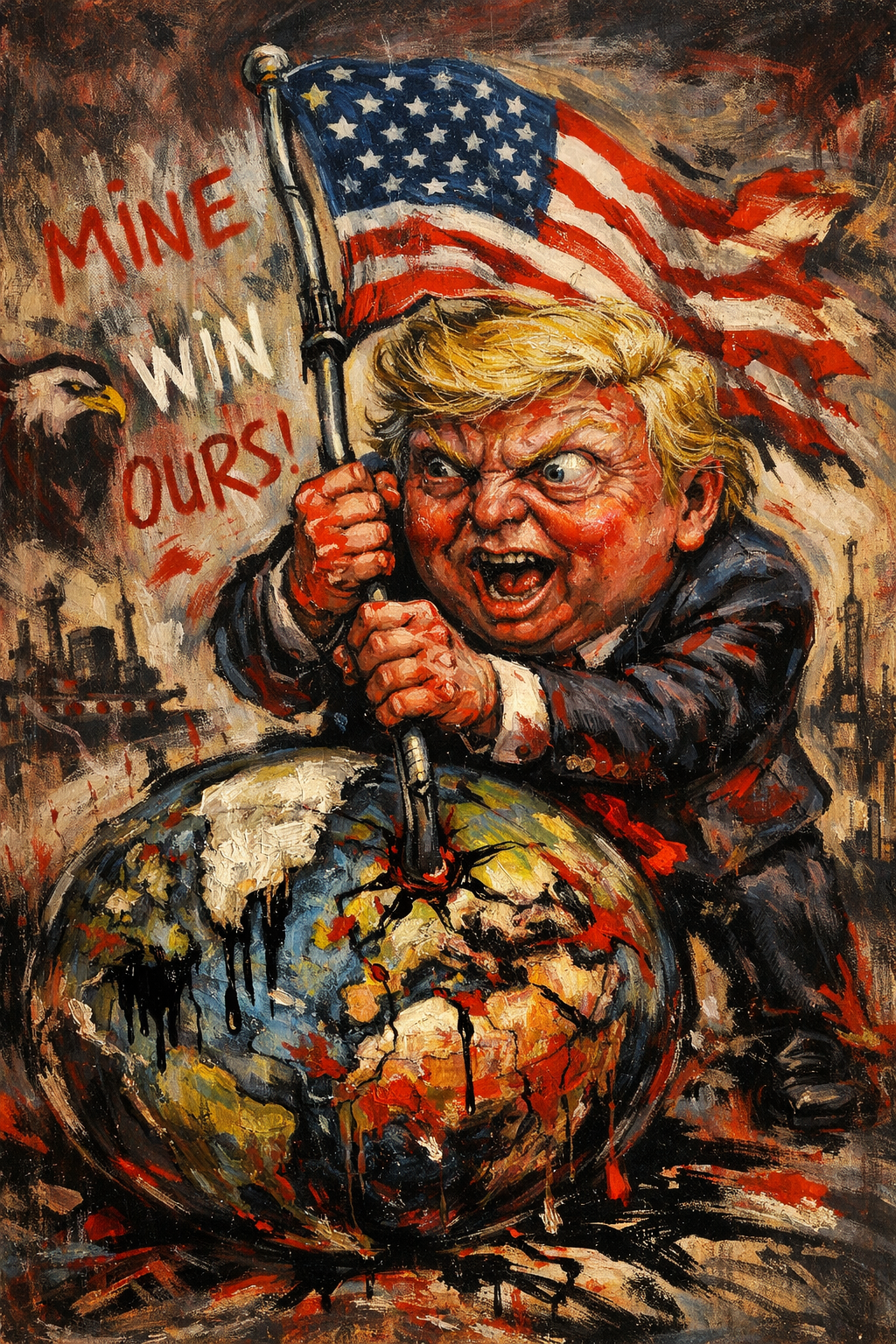
A neo-expressionist painting of Trump jamming an American Flag into the Globe with "Yours Win Ours" written in blood in the background, a bald eagle, and pastiches of factories and oil refineries.

Trump has now taken extralegal military action in Venezuela. Trump is strongly considering such action in Iran. And Trump keeps flirting with aggressive globally destabilizing military annexation of Greenland, a NATO ally. Many people are acting perplexed. After all, didn’t libertarian “genius” and totally-not-delusional-reactionary Walter Block tell us back in 2016 that libertarians should vote for Trump because he is anti-war? After this proved to be false the first term, didn’t totally-not-delusional-reactionary Walter Block then tell us again case for libertarianism was that he was anti-war and anti-foreign intervention, and that he was super cereal this time?

Sarcasm aside, I think it is worth revisiting why Trump’s foreign policy turn towards a radical sort of imperialist interventionism is so evil and unsurprising. I was confident back in 2016 that he was always going to be an old-school imperialist who uses US military conquest purely for resource extraction in a way that would be far worse than neocon warmongering. I wrote at the time, following Zach Beauchamp (who continues to emphasize this point), that Trump’s foreign policy was neither the neo-conservative interventionism of the Clintons and Bushes of the world, nor the principled anti-interventionism of libertarian scholars like Christopher Coyne and Abigail Hall, nor even the nationalist isolationism of paleoconservatives like James Buchanan. Instead, Trump’s foreign policy has always (quite consistently, since he was still a pro-choice democrat in the 90s) been about advancing inchoate national economic and political interestswhich really just means the interests of the politically connected.

This connection between Trump’s completely crankish economic nationalism and his imperialist foreign policy is even tighter now than it was then. It seems Trump is likely facing a rejection of his unconstitutional overreach of unilaterally applying economically suicidal tariffs from SCOTUS. The tariffs, which originally, might I add, were based on perhaps the single dumbest attempt to do economics I have ever seen, appeared to be lifted straight from ChatGPT, given that his main economic advisor on these matters, Peter Navarro, is literally a fraudster. As a result, he now seems to be manufacturing a national security crisis so he can impose tariffs without congress’ blessing.

But I do not want to revisit Trump’s imperialist foreign policy just to gloat. I also want to revisit and restate why this foreign policy is unbelievably unjust and self-destructive. What I wrote back in 2016 is still worth reposting at length:

First, Trump’s style of Jacksonian foreign policy is largely responsible for most of the humanitarian atrocities committed by the American government. Second, Trump’s economic foreign policy is antithetical to the entire spirit of the liberal tradition; it undermines the dignity and freedom of the individual and instead treats the highest good as for the all-powerful nation-state (meaning mostly the politicians and their special interests) as the end of foreign policy, rather than peace and liberty. Finally, Trump’s foreign policy fails for the same reasons that socialism fails. If the goals of foreign policy are to represent “national interest,” then the policymaker must know what that “national interest” even is and we have little reason to think that is the case, akin to the knowledge problem in economic coordination.

… This is because the Jacksonian view dictates that we should use full force in war to advance our interests and the reasons for waging war are for selfish rather than humanitarian purposes. We have good reason to think human rights under Trump will be abused to an alarming degree, as his comments that we should “bomb the hell out of” Syria, kill the noncombatant families of suspected terrorists, and torture detainees indicate. Trump is literally calling for the US to commit inhumane war crimes in the campaign, it is daunting to think just how dark his foreign policy could get in practice.

To reiterate: Trump’s foreign policy views are just a particularly nasty version of imperialism and colonialism. Mises dedicated two entire sections of his chapter on foreign policy in Liberalism: The Classical Tradition to critiquing colonialism and revealing just how contrary these views are to liberalism’s commitment to peace and liberty. In direct opposition to Trump’s assertions that we should go to war to gain another country’s wealth and resources and that we should expand military spending greatly, Mises argues:

“Wealth cannot be won by the annexation of new provinces since the “revenue” deprived from a territory must be used to defray the necessary costs of its administration. For a liberal state, which entertains no aggressive plans, a strengthening of its military power is unimportant.”

Mises’ comments on the colonial policy in his time are extremely pertinent considering Trump’s calls to wage ruthlessly violent wars and commit humanitarian crises. “No chapter of history is steeped further in blood than the history of colonialism,” Mises argued. “Blood was shed uselessly and senselessly. Flourishing lands were laid waste; whole peoples destroyed and exterminated. All this can in no way be extenuated or justified.”

Trump says the ends of foreign policy are to aggressively promote “our” national interests, Mises says “[t]he goal of the domestic policy of liberalism is the same as that of its foreign policy: peace.” Trump views the world as nations competing in a zero-sum game and there must be one winner that can only be brought about through military conquest and economic protectionism, Mises says liberalism “aims at the peaceful cooperation between nations as within each nation” and specifically attacks “chauvinistic nationalists” who “maintain that irreconcilable conflicts of interest exist among the various nations[.]” Trump is rabidly opposed to free trade and is horrifically xenophobic on immigration, the cornerstone of Mises’ foreign policy is free movement of capital and labor over borders. There is no “congruence” between Trump and any classically liberal view on foreign policy matters in any sense; to argue otherwise is to argue from a position of ignorance, delusion, or to abandon the very spirit of classical liberalism in the first place.

…Additionally, even if we take Trump’s nationalist ends as given, the policy means Trump prefers of violent military intervention likely will not be successful for similar reasons to why socialism fails. Christopher Coyne has argued convincingly that many foreign interventions in general fail for very similar reasons to why attempts at economic intervention fail, complications pertaining to the Hayekian knowledge problem. How can a government ill-equipped to solve the economic problems of domestic policy design and control the political institutions and culture of nations abroad?  Coyne mainly has the interventionism of neoconservatives and liberals in mind, but many of his insights apply just as well to Trump’s Jacksonian vision for foreign policy.

The knowledge problem also applies on another level to Trump’s brand of interventionism. Trump assumes that he, in all his wisdom as president, can know what the “national interest” of the American people actually is, just like socialist central planners assume they know the underlying value scales or utility functions of consumers in society. We have little reason to assume this is the case.

Let’s take a more concrete example: Trump seems to think one example of intervention in the name of national interest is to take the resource of another country that our country needs, most commonly oil. However, how is he supposed to know which resources need to be pillaged for the national interest? There’s a fundamental calculation problem here. A government acting without a profit signal cannot know the answer to such a problem and lacks the incentive to properly answer it in the first place as the consequences failure falls upon the taxpayers, not the policy makers. Even if Trump and his advisors could figure out that the US needs a resource, like oil, and successfully loots it from another country, like Libya, there is always the possibility that this artificial influx of resources, this crony capitalist welfare for one resource at the expense of others, is crowding out potentially more efficient substitutes.

For an example, if the government through foreign policy expands the supply of oil, this may stifle entrepreneurial innovations for potentially more efficient resources in certain applications, such as natural gas, solar, wind, or nuclear in energy, for the same reasons artificially subsidizing these industries domestically stifle innovation. They artificially reduce the relative scarcity of the favored resource, reducing the incentive for entrepreneurs to find innovative means of using other resources or more efficient production methods. At the very least, Trump and his advisors would have little clue how to judge the opportunity cost of pillaging various resources and so would not know how much oil to steal from Libya. Even ignoring all those problems, it’s very probable that it would be cheaper and morally superior to simply peaceably trade with another country for oil (or any other resource) rather than waging a costly, violent, inhumane war in the first place.

Having said all that, there is plenty I got wrong in picturing Trump as an old-school imperialist. During Trump’s first term, I underestimated the extent to which institutional constraints would stop him from acting on his worst nationalist and imperialist impulses. But this term, those constraints are gone. The Mattises, Tillersons, Boltons, and Pences of the world have been replaced with the Vances, Noems, Rubios, and Hegseths. As a result, thinking of Trump as an old-school imperialist and nationalist is becoming more accurate since he is allowed to act on his irrational, deranged impulses.

Second, I failed to distinguish sufficiently between resource extraction through indirect means of violent regime change, tariffs, weapons supply, and 19th-century colonialist-style direct annexation versions of it. I do still think that if Trump really did what he most consistently wants he would do quite a bit of annexation and old school colonialism (see his comments on Greenland and Canada), but he seems a bit more content than I projected back then to use military force to install stooges and puppet regimes for resource extraction (as he has sought to do in both Gaza and now Venezuela). Which, to your point, is not as different from the Nixon/Bush/Clinton/Reagan type intervention as reactionary centrists would have you believe, but the nakedness of the extractive nationalist motivation does mark a difference that encourages even more brazenly cruel, more illegal, and more strategically incoherent and unpredictable interventionist warmongering.

Thirdly, and most obviously, I greatly overestimated his coherence on foreign policy. Whether it is him handicapping US influence in the Pacific by withdrawing from the TPP while implementing tariffs on Chinese goods to seem tough in the first term, which just gave China more leverage in the region. Or whether it’s his delusional flip-flopping on Russia and Ukraine based on who he talked to last, constantly this term. Or whether it’shis random provocation against Iran in 2019 by killing one of their generals. Or whether it’s his insane flip-flopping between Nuclear War talk and sychophancy with North Korea. Or the total randomness of his attacking Venezuela for more domestic than foreign policy reasons now. He is simply far more impulsive and deranged than I would have predicted in 2016. This part of that old article seems especially stale now:

After all, it doesn’t matter so much the character of public officials as the institutional incentives they face. But in matters of foreign policy problems of temperament and character do matter because the social situation between foreign leaders in diplomacy can often make a huge difference.

I did hedge that by allowing that Trump may be a uniquely unfit person so as to constitute a sui-generis case. But I should have been more emphatic about that: Trump really is a uniquely world-historically dangerous monster, and he has gotten more and more incoherent and impulsive over the years with his cognitive decline.

Finally, the biggest miss in my analysis of Trump’s foreign policy back then is that I put far too much emphasis on Trump’s focus on material goods, thinking he really just thought of geopolitics like a 12-year-old approaches a turn-based strategy game like Risk in just accruing more stuff. But in reality, his approach is far more disturbing and vile than even that. It is not simply about getting oil for US oil companies. In the case of Venezuela, oil execs do not seem so gun-ho. As one private equity investor told the Financial Times last week, “No one wants to go in there when a random fucking tweet can change the entire foreign policy of the country.” Indeed, the political risk is so big there Exonn’s CEO has called Venezuela “uninvestable” and Trump is trying to force oil companies to misallocate capital to Venezuela.

Narrow left-wing materialists’ critiques like mine misfire because they treat material resources as the main thing. It is not the oil per se that Trump wants, but what the oil represents. He is instead approaching international geo-politics like an 8-year-old driven by malignant narcissism: he wants symbols of nationalist masculine domination. Indeed, when asked why he wanted Greenland, Trump was quoted as saying:

Because that’s what I feel is psychologically needed for success. I think that ownership gives you a thing that you can’t do, whether you’re talking about a lease or a treaty. Ownership gives you things and elements that you can’t get from just signing a document.

Indeed, the fact that Greenland looks big on a Mercator projection of the earth has as much to do with why Trump wants it as the oil. As Trump continues his authoritarian assaults on individual liberty domestically and pursues semiotic nationalist domination internationally, one can only vainly pray that something keeps his dark, demonic, twisted sadist fantasies in check without devolving into a true civilization-level threat.

“Towards a Complete Libertarianism”

from Kevin Vallier, in the latest issue of Isonomia Quarterly.

Don’t forget to check out the rest, which includes essays on Hayek, the geopolitics of Greenland, the nuclear bombing of Nagasaki, and a poem by Robert Frost.

Nightcap

  1. Think big, but don’t buy Greenland Scott Sumner, EconLog
  2. Institutions, intentions, and Hayekian international relations” (pdf) Nicolas Onuf, RIS
  3. F.A. Hayek and the Reinvention of Liberal Internationalism” (pdf) Jorg Spieker, IHR
  4. Hayek, Colonialism, Kantian Perpetual Peace, and… Eric Schliesser, D&I

Nightcap

  1. We are in the midst of a technological panic.” Robert Lurie, Modern Age
  2. What is a concentration camp? Emma Kuby, History Today
  3. Kleptocracy Irfan Khawaja, Policy of Truth
  4. Greenland in Danish-American-Chinese relations Mercy Kuo, Diplomat

Nightcap

  1. The threat of fanaticism Chris Dillow, Stumbling & Mumbling
  2. On targeting the price of gold George Selgin, Alt-M
  3. Reinventing language Catherine Charrett, Disorder of Things
  4. Geopolitics and Greenland Jon Rahbek-Clemmensen, War on the Rocks

The World of the Inuktitut

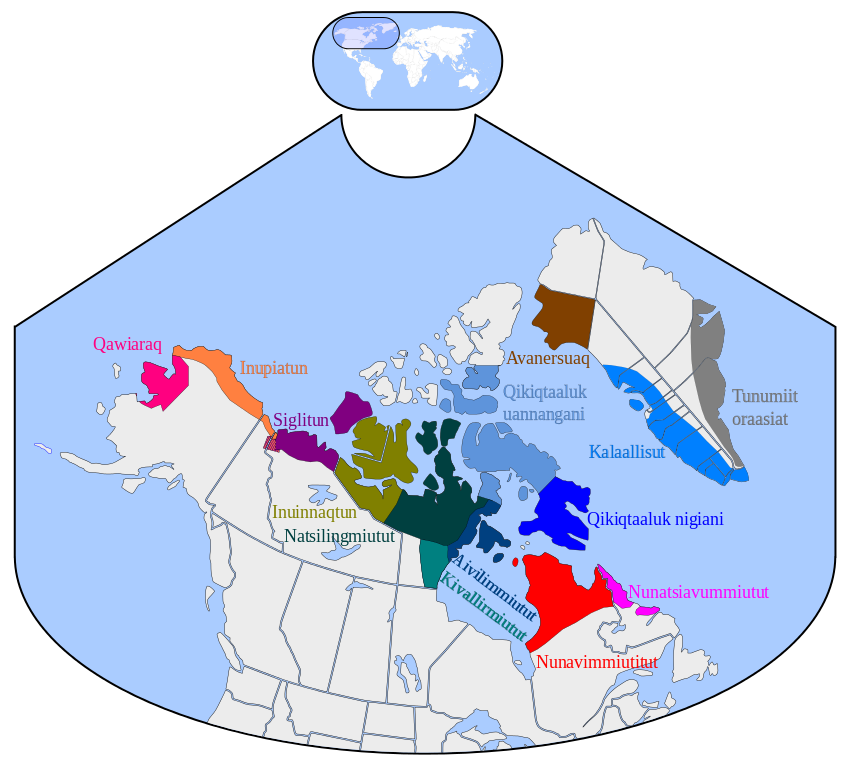
Check out this sweet map of the Eskimo world today. It is broken down by linguistic groups. I wonder if these linguistic groups consider themselves ethnically distinct as well as linguistically distinct.

The Eskimo World

Here is a Wiki article on Nunavut, an experiment in Canada with indigenous self-governance (don’t get me started!).

And an article on Danish colonialism in Greenland (possibly gated).

Updated: I changed the title from ‘Eskimo’ to ‘Inuktitut’ because I just learned that the former is used as a pejorative term in Canada and Greenland (like the n-word here in the States). Inuktitut is term preferred by those highlighted in the map above. I’m not politically correct by any means, and in the US the term ‘Eskimo’ doesn’t carry any negative connotations, but being polite and being politically correct are two very different things.