On the rift between economics and everything else

The line is often heard: economists are “scientific imperialists” (i.e. they seek to invade other fields of social science) jerks. All they try to do is “fit everything inside the model”. I have this derisive sneer at economists very often. I have also heard economists say “who cares, they’re a bunch of historians” (this is the one I hear most often given my particular field of research, but I have heard variations involving sociologists and anthropologists).

To be fair, I never noticed the size rift. For years now, I have been waltzing between economics and history (and tried my hand at journalism for some time) which meant that I was waltzing between economic theory and a lot of other fields. The department I was a part of at the London School of Economics was a rich set of quantitative and qualitative folks who mixed history of ideas, economics, economic history and social history. To top it all, I managed to find myself generally in the company of attorneys and legal scholars (don’t ask why, it still eludes me). It was hard to feel a big rift in that environment. I knew there was a rift. I just never realized how big it was until a year ago (more or less).

There is, however, something that annoys me: the contempt appears to be self-reinforcing.  Elsewhere on this blog (here and here) (and in a forthcoming book chapter in a textbook on how to do economic history), I have explained that economists have often ventured into certain topics with a lack of care for details. True, there must be some abstraction of details (not all details are useful), but there is an optimal quantity of details. And our knowledge grows, the quantity of details necessary to answering each question (because the scientific margin is increasingly specialized) should grow. And so should the number (and depth) of nuances we make to answer a question.  There is a tendency among economists to treat a question outside the usual realm of economics and ignore the existing literature (thus either rushing through an open door or stepping in a minefield without knowing it).  The universe is collapsed into the model and, even when it yields valuable insights, other (non-econs) contributors are ignored.  That’s when the non-econs counter that economists are arrogant and that they try to force everything into a mold rather than change the mold when it does not apply. However, the reply has often been to ignore the economists or criticize strawmen versions of their argument. Perceived as contemptuous, the economists feel that they can safely ignore all others.

The problem is that this is a reinforcing loop: a) the economists are arrogant; b) non-economists respond by dismissing the economists and ridiculing their assumptions; c) the economists get more arrogant. The cycle persists. I struggle to see how to break this cycle, but I see value in breaking it. Elsewhere, I have made such a case when I reviewed a book (towards which I was hostile) on Canadian economic history. Here is what I said for the sake of showcasing the value of breaking the vicious circle of ignoring both sides:

These scholars (those who have been ignored by non-economists) could have easily derived the same takeaways as Sweeny. Individuals can and do engage in rent-seeking, which economists define as the process through which unearned gains are obtained by manipulating the political and social environment. This could be observed in attempts to shape narratives in the public discourse. According primacy to the biases of sources is a recognition that there can be rent-seeking in the form of actors seeking to generate a narrative to reinforce a particular institutional arrangement and allow it to survive. This explanation is well in line with neoclassical economics.

This point is crucial. It shows a failing on both sides of the debate. Economists and historians favorable to “rational choice” have failed to engage scholars like Sweeny. Often, they have been openly contemptuous. The literature has evolved in separate circles where researchers only speak to their fellow circle members. This has resulted in an inability to identify the mutual gains of exchange. The insights and meticulous treatments of sources by scholars like Sweeny are informative for those economists who consider rational choice as if the choosers were humans, with all their flaws and limitations, rather than mechanistic utility-maximizing machines with perfect foresight (which is a strawman often employed to deride the use of economics in historical debates) . In reverse, the rich insights provided by rational choice theorists could guide historians in elucidating complex social interactions with a parsimony of assumptions. Without interaction, both groups loose and resolutions remain elusive.

See, as a guy who likes economics, I think that trade is pretty great. More importantly, I think that trade between heterogeneous groups (or different individuals) is even greater because it allows for specialization that increases the value (and quantity) of outputs.  I see the benefits of trade here, so why is this “circle of contempt” perpetuating so relentlessly?

Can’t we just all pick the 100$ bill on the sidewalk?
Nightcap

  1. The firing of Kevin Williamson was a bad idea Conor Friedersdorf, the Atlantic
  2. Among the abortion extremists Ross Douthat, New York Times
  3. Back alley regulation Bryan Caplan, EconLog
  4. What deterring abortion means Russell Arben Fox, In Medias Res

Brazil-Africa Relations, Now and Then

The first academic paper I ever published was about Brazil-Africa Relations, approximately from the 1960s to the 2000s. The main point of the article was to compare three moments of Brazilian Foreign Policy Towards Africa: the Independent Foreign Policy of the Early 1960s; the Foreign Policy of the latter Military Governments (late 1970s) and the Foreign Policy of the Lula administration (2003-2011). My main conclusion was that the foreign policy towards Africa of these three moments was very similar. Although some would exalt Lula’s foreign policy as something extraordinary, the truth, as I saw it, was that it was very well grounded in a tradition of Brazilian Foreign Policy.

Today I feel somewhat ashamed of that paper. I failed to highlight the irony: the leftist government of Lula had a foreign policy strikingly similar to that of the (supposedly) far-right military regime. The information, to be sure, is all there. One has simply to come to this obvious conclusion.

The foreign policy of Lula and Dilma was indeed very similar to that of Ernesto Geisel and João Batista Figueiredo, the last two generals to be presidents of Brazil, and not only regarding Africa. Dilma’s economic policy was extremely similar to that of Geisel, the same policy that, by the way, led Brazil to the hyperinflation of the 1980s and early 1990s.

It is definitely ironic. The Workers Party began as an opposition to the military government in Brazil. Dilma was a terrorist guerrilla warrior who fought against that regime (and never publicly apologized for that). However, once in power, they became very similar to their enemies. I’ll leave the readers to come to their own conclusions about this. But regarding Africa: I wasn’t able to continue my research. But I’m still very interested in that continent. Brazil is geographically and culturally very similar to many African nations. I believe there are great opportunities for mutual aggrandizement. But “mutual” is not what I saw in my research. I saw Brazil being hypocritical: The US is (in the sick mind of some leftist Brazilian politicians and diplomats) imperialist towards Brazil; therefore, Brazil will be imperialist towards Africa. I hope that a more market-friendly Brazil will be able to do something different.

Nightcap

  1. How British architects conquered the world Joe Lloyd, 1843
  2. The demise of the nation-state Rana Dasgupta, Guardian
  3. The survivors of the Syrian wars Patrick Cockburn, London Review of Books
  4. There is no personality cult around Viktor Orbán Jan-Werner Müller, New York Review of Books

Nightcap

  1. We’ve lost our faith in God *and* reason Kenan Malik, Guardian
  2. Pope Francis is beloved, but disaster looms for the Vatican Ross Douthat, NY Times
  3. What did Karl Marx think about freedom? Daniel Luban, the Nation
  4. Hungary’s slow, sad decline into dictatorship Matthew Engel, New Statesman

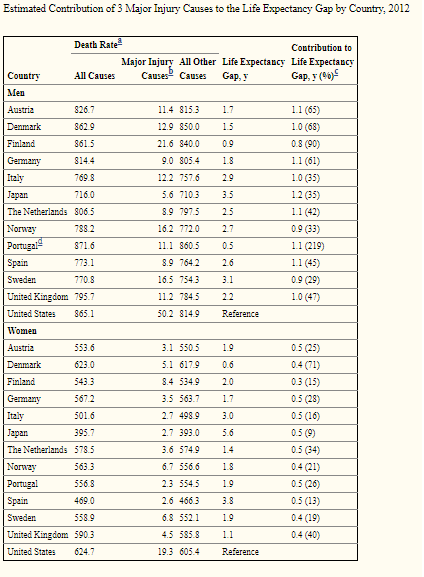
Life expectancy at birth is not a predictor of health care efficiency…

This is going to be a short post to argue that pundits (and some economists) need to stop quoting life expectancy figures to argue for/against a particular health care system. This belief is best exemplified in a recent paper in the Journal of the American Medical Association where Papanicolas et al. (2018)  point out that the United States “spent nearly twice as much as 10 high-income countries (…) and performed less well on many population health outcomes”. While the authors make good points about administrative costs, they point out that the US has a low level of life expectancy.

Sure, that is actually true – but Americans tend to die in greater proportions from homicides, drug overdoses and car accidents (Americans drive more than Europeans) than in other rich countries. While these factors of mortality are tragic (except car accidents since Americans seem to prefer the benefits of mobility to the safety of not driving), they are in no way related to the efficiency of health care provision. How much of a deal are these in explaining differences with other industrialized countries? A pretty big deal.  For example, these three factors alone account for 64% of the male life expectancy gap between Austria and the United States (see table reproduced below). For women, 26% of the gap between Austria and the United States is explained by these three factors.

The study I cite here only includes three factors. If you add in other factors like drownings among youths (Americans tend to have more drownings than several industrialized countries) which is a result of the fact that Americans are richer and can afford pools (while Europeans tend not to), then you keep explaining away the difference.  This is not to say that American health care is great. However, this says that American health care is not as bad as life expectancy outcomes suggest.

Mortality


Bolton’s Iran policy: could it strengthen the China-Russia-Iran-Pakistan axis?

John Bolton, who took over as Donald Trump’s National Security Adviser on April 8, has had significant differences with India on a number of issues in the past. As US Ambassador to the UN, he opposed India’s elevation to the United National Security Council (UNSC), even at a time when relations were at a high during the Manmohan Singh-Bush era. Bolton had initially opposed the Indo-US nuclear deal, though later he lent his support. While the Trump administration has sought to elevate India’s role in the Indo-Pacific region, Bolton has expressed the view that there are some fundamental differences between India and the US. In the short term, though, there is no serious divergence.

Bolton and Iran

What would really be of concern to India however is Bolton’s hawkish approach towards Iran. Bolton’s views are not very different from those of US President Donald Trump and recently appointed Secretary of State John Pompeo. Bolton is opposed to the Iran Nuclear Agreement signed between Iran and P5+1 countries in 2015. In 2015, the NSA designate called for bombing Iran, last year he had criticized the deal, and last year he had called for scrapping the deal.

The Iranian response to Bolton’s appointment was understandably skeptical. Commenting on Bolton’s appointment, Hossein Naghavi Hosseini, the spokesman for the Iranian parliament’s National Security and Foreign Policy Commission, said: Continue reading

Nightcap

  1. What the FBI’s Cohen raid means Ken White, NY Times
  2. Documenting a police detention in New Jersey Irfan Khawaja, Policy of Truth
  3. Why do we have prisons in the United States? Livia Gershon, JSTOR Daily
  4. Erdogan refreshed after talks with Putin, Rouhani Amberin Zaman, Al-Monitor

Is it always wrong to be angry?

Recently it was brought to my attention a text by a Brazilian journalist “chocked with the anger the Brazilian middle-class has for Lula,” evidenced in the celebrations over Lula’s imprisonment. Honestly, I couldn’t finish reading it because I have better things to do, but in the first lines, she questions how people can be so angry and at the same time rejoicing while Brazil goes through such a turbulent moment. In her understanding, Lula represented the aspirations of millions of Brazilians, and these aspirations are now failing.

Ironically, I believe I know where her frustration comes from. Marxism is nothing but a Christian heresy.  Marx belongs to the group of 19th-century intellectuals who declared that God is dead. However, Marx was not able to get rid of all the Christian ethos. He simply transformed the working class into the suffering Messiah, the socialist intellectuals (like himself) into prophets and the future communist society into Paradise. Classical liberalism has its roots in Christianism, and Marxism is one step further away from it.

One of the most basic Christian teachings (expressed by Jesus himself) is “love your enemies.” Maybe this doesn’t sound controversial today, but it certainly was in 1st century Palestine. My understanding is that, as a deformed form of Christianity, Marxism is questioning how people in Brazil are failing to love Lula, their enemy.

However, Jesus didn’t simply say “love your enemy.” He went on to explain what he meant by love. Love in a Christian sense is less a feeling (although it is also a feeling) and more an attitude. It is mostly to follow the 10 commandments in our relationship with God and with other people.

The love Marxists preach lacks definition and as so lacks meaning. Therefore it is open to abuse. The love Christians preach is deep and complex, and not always easy to understand or to put into practice. But it is certainly not shallow. It is possible, Biblically speaking, to love your enemy and at the same time rejoice with justice.

Some may argue that this is not necessarily due to Christianity. Some philosophical school that predates Christianism (such as stoicism) preached something similar. I’m not going to argue about that. I’m not doing the most scholarly argument here, so you can’t take it or leave it.

Some may argue that the journalist I’m referring to is not a Marxist. To those, I quote John Maynard Keynes (who was not always a very good economist, but sometimes was very accurate in his observations about life):

Practical men who believe themselves to be quite exempt from any intellectual influence, are usually the slaves of some defunct economist.

As a Christian, I don’t hate Lula and I don’t rejoice in his suffering. But I’m certainly rejoicing with justice. It may be hard to understand or to accept, but while I love my enemy I don’t necessarily approve his actions. And I certainly don’t consider my enemy my friend. It’s complex. As C.S. Lewis put it “people who have never been to Narnia find these things hard to understand.”

A quick thought on UBI

I’m still not sure where I land on the issue of Universal Basic Income (UBI), but I just thought of a bit of clarifying language that lead to a thought. I’m sure this thought isn’t original, but I’m also sure it doesn’t come up as often as it ought to.

A UBI system’s appeal stems from the fact that it’s a minimal welfare state (kinda sorta). We all know the old debate between proponents of a minimal state–and the debates about what exactly that constitutes–and those of a welfare state–and again, there’s plenty of disagreement on what that actually means.

On a 0-10 spectrum of “how important should the government be? / how important is the government currently” a UBI is a lateral move with obvious efficiency gains. It strips out all the bureaucracy in our current welfare state, provides a wide safety net, and allows the poor to exercise their own agency using their local knowledge about their particular circumstances and opportunities. No cookie cutter solutions, no lines, just a modest check in the mail and an entire population looking for good ways to use it.

On the other hand, it lays bare some of the worst case scenarios of a maximal welfare state. Subsidizing sloth and dependency, enormous costs, reduction in savings, net negative cultural effects, and who knows what else!

But still, perhaps UBI with some minimal modifications is an improvement over what we’ve got now?

2×2 matrix (robust vs thin welfare state and broad vs targeted welfare state).

The maximal welfare state is robust, and broad. There’s a housing bureau, a food bureau, a work bureau, and nearly everyone is waiting in line at one of them at some point each week.

The minimal state would have no welfare, but the minimal welfare state would have a thin and targeted system. No social workers, no bureaucrats, just a check. And unlike a UBI, this would only apply to the poor. Which might cost it political support.

A UBI is thin but broad. That might require it to be less generous, but could (literally) buy it some votes. On the other hand, what do I know about what makes people vote?

The thinness and breadth of a UBI makes it startling next to the old dichotomy. It simultaneously opens up whole new realms of possibilities–it dramatically increases the opportunity cost of drudgery and bureaucracy and provides an easy enough safety net to allow widespread entrepreneurial activity. If we had the right culture we could do anything! But (!) we don’t get to choose the culture.

That breadth is pretty scary when we consider some of the negative behaviors it will surely breed. The lunatic fringe will be funded by the rest of us. A cult is easy to finance when all your members sign over a government check to you every month.

Here’s a possibility: Imagine a vastly simpler tax code. “What’s your income? Scan your tax/employment card that isn’t as stupid as a Social Security Number.” $X “Thank you, give us f(X). Insert cash or card into the machine.” You could file taxes every month (or more or less frequently if you prefer). In that world, we could just give a refundable tax credit to anyone who had a low enough income.

Mind you, I’m assuming away the issue of designing the right marginal tax rates and setting the level of the tax credit. But such a system could be simultaneously broad (it kicks in for anyone as soon as you need it) and narrow (you only get it if you’re poor… and you end up paying it back if you get rich). I think a simpler tax system would be necessary to make a minimal UBI workable

Nightcap

  1. Slavery didn’t dehumanize anybody Walter Johnson, Boston Review
  2. Some uncomfortable Gaza truths Michael Koplow, Ottomans and Zionists
  3. Some problems in the theory of imperialism Ben Reynolds, Fragments
  4. The new communists (same as the old) Lili Bayer, Politico

Why the left loves democracy

The left loves to talk about democracy. Brazil’s former president Lula da Silva is in jail. Finally. Leftists inside and outside Brazil call this a crime against democracy because the polls were showing that in the upcoming October elections Lula would be elected president. The people wanted Lula president, and a judge, Sergio Moro, against the will of the majority, jailed Lula.

I will consent to this argument. Maybe Lula was going to be elected in October (although I have serious doubts about it). Would this be democratic? Maybe. In its most pure form, democracy is the rule of the majority. A good picture of this is three wolves and a sheep voting on what they are going to have for dinner. Leftists in power (or hoping to be in power) love this.

A pure Democracy, by which I mean a Society consisting of a small number of citizens, who assemble and administer the Government in person, can admit of no cure for the mischiefs of faction. A common passion or interest will, in almost every case, be felt by a majority of the whole; a communication and concert result from the form of Government itself; and there is nothing to check the inducements to sacrifice the weaker party, or an obnoxious individual. Hence it is, that such Democracies have ever been spectacles of turbulence and contention; have ever been found incompatible with personal security, or the rights of property; and have in general been as short in their lives, as they have been violent in their deaths. Theoretic politicians, who have patronized this species of Government, have erroneously supposed, that by reducing mankind to a perfect equality in their political rights, they would, at the same time, be perfectly equalized and assimilated in their possessions, their opinions, and their passions. — James Madison, Federalist No. 10

Nightcap

  1. The French king who thought he was made of glass Amelia Soth, JSTOR Daily
  2. Uganda: Land of many kingdoms Rhys Griffiths, History Today
  3. Scholarship on African history continues to impress Howard French, NY Review of Books
  4. The illegal slave trade in Texas (1808-1865) Maria Esther Hammack, Not Even Past

From Petty Crime to Terrorism

I grew up in France. I know the French language inside out. I follow the French media. In that country, France, people with a Muslim first name are 5% or maybe, 7% of the population. No one estimates that they are close to 10%. I use this name designation because French government agencies are forbidden to cooperate in the collection of religious (or ethic, or racial) data. Moreover, I don’t want to be in the theological business of deciding who is a “real Muslim.” Yet, common sense leads me to suspect that French people who are born Muslims are mostly religiously indifferent or lukewarm, like their nominally Christian neighbors. I am not so sure though about recent immigrants from rural areas bathed in a jihadist atmosphere, as occur in Algeria, and in Morocco, for example. Continue reading

Nightcap

  1. The story of our species needs rewriting again Christopher Bae, Aeon
  2. Conjuring anthropology’s future Simon During, Public Books
  3. Picasso’s year of erotic torment Michael Prodger, New Statesman
  4. “What Have the Romans Ever Done For Us?” Robert Darby, Quillette