- How British architects conquered the world Joe Lloyd, 1843
- The demise of the nation-state Rana Dasgupta, Guardian
- The survivors of the Syrian wars Patrick Cockburn, London Review of Books
- There is no personality cult around Viktor Orbán Jan-Werner Müller, New York Review of Books
Nightcap
- We’ve lost our faith in God *and* reason Kenan Malik, Guardian
- Pope Francis is beloved, but disaster looms for the Vatican Ross Douthat, NY Times
- What did Karl Marx think about freedom? Daniel Luban, the Nation
- Hungary’s slow, sad decline into dictatorship Matthew Engel, New Statesman
Life expectancy at birth is not a predictor of health care efficiency…
This is going to be a short post to argue that pundits (and some economists) need to stop quoting life expectancy figures to argue for/against a particular health care system. This belief is best exemplified in a recent paper in the Journal of the American Medical Association where Papanicolas et al. (2018) point out that the United States “spent nearly twice as much as 10 high-income countries (…) and performed less well on many population health outcomes”. While the authors make good points about administrative costs, they point out that the US has a low level of life expectancy.
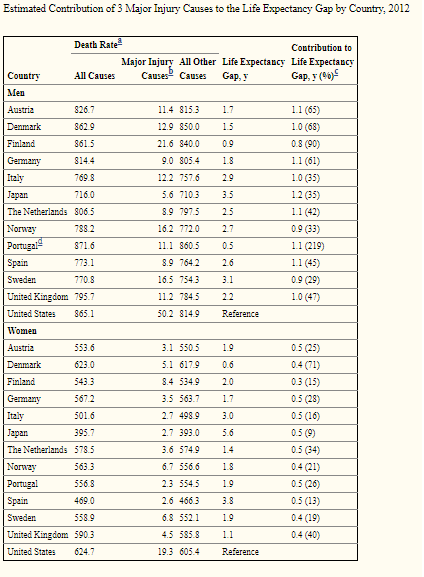
Sure, that is actually true – but Americans tend to die in greater proportions from homicides, drug overdoses and car accidents (Americans drive more than Europeans) than in other rich countries. While these factors of mortality are tragic (except car accidents since Americans seem to prefer the benefits of mobility to the safety of not driving), they are in no way related to the efficiency of health care provision. How much of a deal are these in explaining differences with other industrialized countries? A pretty big deal. For example, these three factors alone account for 64% of the male life expectancy gap between Austria and the United States (see table reproduced below). For women, 26% of the gap between Austria and the United States is explained by these three factors.
The study I cite here only includes three factors. If you add in other factors like drownings among youths (Americans tend to have more drownings than several industrialized countries) which is a result of the fact that Americans are richer and can afford pools (while Europeans tend not to), then you keep explaining away the difference. This is not to say that American health care is great. However, this says that American health care is not as bad as life expectancy outcomes suggest.
Bolton’s Iran policy: could it strengthen the China-Russia-Iran-Pakistan axis?
John Bolton, who took over as Donald Trump’s National Security Adviser on April 8, has had significant differences with India on a number of issues in the past. As US Ambassador to the UN, he opposed India’s elevation to the United National Security Council (UNSC), even at a time when relations were at a high during the Manmohan Singh-Bush era. Bolton had initially opposed the Indo-US nuclear deal, though later he lent his support. While the Trump administration has sought to elevate India’s role in the Indo-Pacific region, Bolton has expressed the view that there are some fundamental differences between India and the US. In the short term, though, there is no serious divergence.
Bolton and Iran
What would really be of concern to India however is Bolton’s hawkish approach towards Iran. Bolton’s views are not very different from those of US President Donald Trump and recently appointed Secretary of State John Pompeo. Bolton is opposed to the Iran Nuclear Agreement signed between Iran and P5+1 countries in 2015. In 2015, the NSA designate called for bombing Iran, last year he had criticized the deal, and last year he had called for scrapping the deal.
The Iranian response to Bolton’s appointment was understandably skeptical. Commenting on Bolton’s appointment, Hossein Naghavi Hosseini, the spokesman for the Iranian parliament’s National Security and Foreign Policy Commission, said: Continue reading
Nightcap
- What the FBI’s Cohen raid means Ken White, NY Times
- Documenting a police detention in New Jersey Irfan Khawaja, Policy of Truth
- Why do we have prisons in the United States? Livia Gershon, JSTOR Daily
- Erdogan refreshed after talks with Putin, Rouhani Amberin Zaman, Al-Monitor
Is it always wrong to be angry?
Recently it was brought to my attention a text by a Brazilian journalist “chocked with the anger the Brazilian middle-class has for Lula,” evidenced in the celebrations over Lula’s imprisonment. Honestly, I couldn’t finish reading it because I have better things to do, but in the first lines, she questions how people can be so angry and at the same time rejoicing while Brazil goes through such a turbulent moment. In her understanding, Lula represented the aspirations of millions of Brazilians, and these aspirations are now failing.
Ironically, I believe I know where her frustration comes from. Marxism is nothing but a Christian heresy. Marx belongs to the group of 19th-century intellectuals who declared that God is dead. However, Marx was not able to get rid of all the Christian ethos. He simply transformed the working class into the suffering Messiah, the socialist intellectuals (like himself) into prophets and the future communist society into Paradise. Classical liberalism has its roots in Christianism, and Marxism is one step further away from it.
One of the most basic Christian teachings (expressed by Jesus himself) is “love your enemies.” Maybe this doesn’t sound controversial today, but it certainly was in 1st century Palestine. My understanding is that, as a deformed form of Christianity, Marxism is questioning how people in Brazil are failing to love Lula, their enemy.
However, Jesus didn’t simply say “love your enemy.” He went on to explain what he meant by love. Love in a Christian sense is less a feeling (although it is also a feeling) and more an attitude. It is mostly to follow the 10 commandments in our relationship with God and with other people.
The love Marxists preach lacks definition and as so lacks meaning. Therefore it is open to abuse. The love Christians preach is deep and complex, and not always easy to understand or to put into practice. But it is certainly not shallow. It is possible, Biblically speaking, to love your enemy and at the same time rejoice with justice.
Some may argue that this is not necessarily due to Christianity. Some philosophical school that predates Christianism (such as stoicism) preached something similar. I’m not going to argue about that. I’m not doing the most scholarly argument here, so you can’t take it or leave it.
Some may argue that the journalist I’m referring to is not a Marxist. To those, I quote John Maynard Keynes (who was not always a very good economist, but sometimes was very accurate in his observations about life):
Practical men who believe themselves to be quite exempt from any intellectual influence, are usually the slaves of some defunct economist.
As a Christian, I don’t hate Lula and I don’t rejoice in his suffering. But I’m certainly rejoicing with justice. It may be hard to understand or to accept, but while I love my enemy I don’t necessarily approve his actions. And I certainly don’t consider my enemy my friend. It’s complex. As C.S. Lewis put it “people who have never been to Narnia find these things hard to understand.”
A quick thought on UBI
I’m still not sure where I land on the issue of Universal Basic Income (UBI), but I just thought of a bit of clarifying language that lead to a thought. I’m sure this thought isn’t original, but I’m also sure it doesn’t come up as often as it ought to.
A UBI system’s appeal stems from the fact that it’s a minimal welfare state (kinda sorta). We all know the old debate between proponents of a minimal state–and the debates about what exactly that constitutes–and those of a welfare state–and again, there’s plenty of disagreement on what that actually means.
On a 0-10 spectrum of “how important should the government be? / how important is the government currently” a UBI is a lateral move with obvious efficiency gains. It strips out all the bureaucracy in our current welfare state, provides a wide safety net, and allows the poor to exercise their own agency using their local knowledge about their particular circumstances and opportunities. No cookie cutter solutions, no lines, just a modest check in the mail and an entire population looking for good ways to use it.
On the other hand, it lays bare some of the worst case scenarios of a maximal welfare state. Subsidizing sloth and dependency, enormous costs, reduction in savings, net negative cultural effects, and who knows what else!
But still, perhaps UBI with some minimal modifications is an improvement over what we’ve got now?
2×2 matrix (robust vs thin welfare state and broad vs targeted welfare state).
The maximal welfare state is robust, and broad. There’s a housing bureau, a food bureau, a work bureau, and nearly everyone is waiting in line at one of them at some point each week.
The minimal state would have no welfare, but the minimal welfare state would have a thin and targeted system. No social workers, no bureaucrats, just a check. And unlike a UBI, this would only apply to the poor. Which might cost it political support.
A UBI is thin but broad. That might require it to be less generous, but could (literally) buy it some votes. On the other hand, what do I know about what makes people vote?
The thinness and breadth of a UBI makes it startling next to the old dichotomy. It simultaneously opens up whole new realms of possibilities–it dramatically increases the opportunity cost of drudgery and bureaucracy and provides an easy enough safety net to allow widespread entrepreneurial activity. If we had the right culture we could do anything! But (!) we don’t get to choose the culture.
That breadth is pretty scary when we consider some of the negative behaviors it will surely breed. The lunatic fringe will be funded by the rest of us. A cult is easy to finance when all your members sign over a government check to you every month.
Here’s a possibility: Imagine a vastly simpler tax code. “What’s your income? Scan your tax/employment card that isn’t as stupid as a Social Security Number.” $X “Thank you, give us f(X). Insert cash or card into the machine.” You could file taxes every month (or more or less frequently if you prefer). In that world, we could just give a refundable tax credit to anyone who had a low enough income.
Mind you, I’m assuming away the issue of designing the right marginal tax rates and setting the level of the tax credit. But such a system could be simultaneously broad (it kicks in for anyone as soon as you need it) and narrow (you only get it if you’re poor… and you end up paying it back if you get rich). I think a simpler tax system would be necessary to make a minimal UBI workable
Nightcap
- Slavery didn’t dehumanize anybody Walter Johnson, Boston Review
- Some uncomfortable Gaza truths Michael Koplow, Ottomans and Zionists
- Some problems in the theory of imperialism Ben Reynolds, Fragments
- The new communists (same as the old) Lili Bayer, Politico
Why the left loves democracy
The left loves to talk about democracy. Brazil’s former president Lula da Silva is in jail. Finally. Leftists inside and outside Brazil call this a crime against democracy because the polls were showing that in the upcoming October elections Lula would be elected president. The people wanted Lula president, and a judge, Sergio Moro, against the will of the majority, jailed Lula.
I will consent to this argument. Maybe Lula was going to be elected in October (although I have serious doubts about it). Would this be democratic? Maybe. In its most pure form, democracy is the rule of the majority. A good picture of this is three wolves and a sheep voting on what they are going to have for dinner. Leftists in power (or hoping to be in power) love this.
A pure Democracy, by which I mean a Society consisting of a small number of citizens, who assemble and administer the Government in person, can admit of no cure for the mischiefs of faction. A common passion or interest will, in almost every case, be felt by a majority of the whole; a communication and concert result from the form of Government itself; and there is nothing to check the inducements to sacrifice the weaker party, or an obnoxious individual. Hence it is, that such Democracies have ever been spectacles of turbulence and contention; have ever been found incompatible with personal security, or the rights of property; and have in general been as short in their lives, as they have been violent in their deaths. Theoretic politicians, who have patronized this species of Government, have erroneously supposed, that by reducing mankind to a perfect equality in their political rights, they would, at the same time, be perfectly equalized and assimilated in their possessions, their opinions, and their passions. — James Madison, Federalist No. 10
Nightcap
- The French king who thought he was made of glass Amelia Soth, JSTOR Daily
- Uganda: Land of many kingdoms Rhys Griffiths, History Today
- Scholarship on African history continues to impress Howard French, NY Review of Books
- The illegal slave trade in Texas (1808-1865) Maria Esther Hammack, Not Even Past
From Petty Crime to Terrorism
I grew up in France. I know the French language inside out. I follow the French media. In that country, France, people with a Muslim first name are 5% or maybe, 7% of the population. No one estimates that they are close to 10%. I use this name designation because French government agencies are forbidden to cooperate in the collection of religious (or ethic, or racial) data. Moreover, I don’t want to be in the theological business of deciding who is a “real Muslim.” Yet, common sense leads me to suspect that French people who are born Muslims are mostly religiously indifferent or lukewarm, like their nominally Christian neighbors. I am not so sure though about recent immigrants from rural areas bathed in a jihadist atmosphere, as occur in Algeria, and in Morocco, for example. Continue reading
Nightcap
- The story of our species needs rewriting again Christopher Bae, Aeon
- Conjuring anthropology’s future Simon During, Public Books
- Picasso’s year of erotic torment Michael Prodger, New Statesman
- “What Have the Romans Ever Done For Us?” Robert Darby, Quillette
Recent developments in the context of Indo-Pacific
At a time when a massive churn is taking place in the Donald Trump Administration (HR Mcmaster was replaced as head of the NSA by John Bolton, while Secretary of State Rex Tillerson was replaced with the more hawkish Mike Pompeo), Alex Wong, Deputy Assistant Secretary of State for East Asian and Pacific Affairs, gave a briefing with regard to the US vision for ‘Indo-Pacific’ strategy, on April 3, 2018 (a day before a trilateral dialogue took place between senior officials from India, Japan and US). Wong outlined the contours of the strategy, and spoke not just about the strategic vision, but also the economic vision of the US, with regard to the Indo-Pacific.
A backgrounder to the Indo-Pacific, Quad, and the China Factor
For a long time, the US referred to the region as ‘Asia-Pacific’ (which China prefers), but the current Trump Administration has been using the term ‘Indo-Pacific’. During his visit to East Asia and South East Asia, in November 2017, the US President had used the term more than once (much to the discomfort of China) giving a brief overview of what he meant by a ‘Free and Fair Indo-Pacific’. While speaking to a business delegation at Asia-Pacific Economic Cooperation, Trump spoke about ‘rule of law’ and playing by the rules. Former Secretary of State Rex Tillerson had referred to the Indo-Pacific and the Quad Alliance (consisting of US, India, Japan, and Australia) in an address at the Center for Strategic and International Studies (a Washington think tank) in October 2017, a week before his India visit.
In order to give a further thrust to the Quad, representatives of all four countries met on the eve of East Asia Summit in Manila. A statement of the Indian Foreign Ministry said: Continue reading
Eye Candy: Poo-Pooing in Public, Percentages

My only question is: how do they compile data on this? The World Bank put this thing together, but I can’t see any economists doing fieldwork on this. Maybe the Bank hired anthropologists to do the poo-poo stuff…
Nightcap
- Libertarianism is just as feasible as the rest Nikolai Wenzel, Law and Liberty
- Trump’s war on the Deep State Conrad Black, National Interest
- Black litigation under Jim Crow Melissa Milewski, OUPblog
- Avoiding the Cicero trap Bruce Fein, American Conservative
 Notes On Liberty