- Syria: the knowledge problem Chris Dillow, Stumbling and Mumbling
- Why tribal sovereignty is so important Ryan McMaken Mises Wire
- Seattle baseball fans are eating grasshoppers, not hot dogs Eric Gomez, ESPN
- Art, science, and political economy Peter Boettke, Coordination Problem
The problem with Brazil (and it’s not socialism)
The problem with Brazil is not Luis Inacio Lula da Silva. It’s not the Worker’s Party. It’s not Socialism.
Certainly one of the most important politicians in Brazilian History was Getulio Vargas. Vargas came to power in a coup (that symptomatically most Brazilian historians call a revolution) in 1930. He ended up staying in power, without ever being elected by popular vote, until 1945. Then he peacefully resigned, not without electing his chosen successor, Eurico Gaspar Dutra. Vargas came back to power immediately after Dutra, and committed suicide while in office. Almost all Brazilian presidents from 1945 to 1964 were from Vargas’ close circle.
Brazilians to this day are still taught that Vargas was a hero, persecuted by an evil opposition. Initially, Vargas was some kind of Brazilian positivist. He was anti-liberal because liberalism is weak and slow. We need a strong technical government, able to identify problems and come with solutions fast. However, while in office, he became “the father of the poor,” a defensor of the lower classes. Nothing could be farther from the truth, of course, but that’s how Vargas is remembered by many.
One of my favorite interpretation of Brazil comes from Sergio Buarque de Holanda. According to Holanda, the problem with Brazil is that Brazilians are cordial. What he means by that is this: using Weber’s models of authority, he identified that Brazilians were never able to support a Legal-Rational authority. Vargas was seen as “a father.” not a president. The country is seen as a big family. Lula used a very similar vocabulary and tried to reenact Vargas’ populism.
As I mentioned, Holanda’s interpretation is Weberian. Weber’s most famous book is The Protestant Ethic and the Spirit of Capitalism. The problem with Brazil is that it never went through a protestant reformation. And because of that, it never developed the “spirit of capitalism” that Weber describes. Brazil is still, to a great degree, stuck with traditional and charismatic forms of authority.
To be sure, Brazil has many features of a modern liberal state. Since late 18th century Portugal tried to copy these from more advanced nations, especially England. Brazil followed suit. But you can’t have the accidents without the substance. Unless Brazil actually goes through a transformation in its soul, it will never become the modern liberal state many want it to be. Quoting Domingo Faustino Sarmiento, “An ignorant people will always choose Rosas.”
Nightcap
- A profile of new NY Fed Chairman John Williams Tate Lacey, Alt-M
- How to win a trade war Oliver Roeder, FiveThirtyEight
- The road to Iranian democracy Luma Simms, Law and Liberty
- Where Arnold Kling gets his news Arnold Kling, askblog
Brazilian Senator Aécio Neves close to jail
Brazilian Senator Aécio Neves is close to the jail. He is charged with corruption and obstruction of justice.
Aécio Neves is one of the main leaders of PSDB, the party that, especially since 1994, has been the main electoral opposition to the Worker’s Party (PT) of Luis Inacio Lula da Silva. Fernando Henrique Cardoso, president from 1995 to 2002, is also in the PSDB. Neves was presidential candidate in the last elections, in 2014, and was really close to defeating Dilma Rousseff, the candidate of PT that was later impeached.
The Aécio Neves trial is extremely symptomatic in Brazilian politics. There are no popular manifestations in his favor. No political analyst is claiming that he is innocent and being unjustly accused. In other words, the contrast between Aécio Neves and Lula, recently sent to jail under a lot of noise, couldn’t be greater.
A popular phrase in Brazil is very telling. The translation to English loses the rhyme, but here it goes: when Lula was facing trial, some militants of PT carried signs saying “Lula is my friend, you mess with him, you mess with me.” Former Aécio voters later carried signs saying “Aécio is not my friend, if you mess with him I couldn’t care less.” As usual, the right is right.
“Horrors Didn’t End When Bataan Death March Did”
That’s the title of last week‘s Tuesday post over at RealClearHistory. I’ve been so busy I forgot to share it here. Check it out:
Camp O’Donnell was no relief from the Death March of Bataan. In it, disease spread like wildfire and starvation was rampant. The Japanese, who were fighting Americans elsewhere and Filipino guerrillas close by, had no empathy for their prisoners. The prisoners who survived the harsh march from Bataan had another 3 ½ years of hard manual labor in prison camps to look forward to, if they survived the horrific conditions of the camps.
As the Allies began slowly retaking the Philippines from Japanese forces, these prisoners of war were shipped from one of the 70 prisoner camps on the archipelago to China and Japan itself to continue their slave labor for the Empire. The Japanese shipped these prisoners to the mainland on unmarked vessels, a violation of the Geneva Conventions, and it’s possible that the American and British Navies may have inadvertently sunk a number of these vessels.
Please, read the rest.
Nightcap
- Syria’s humanitarian disaster is fast becoming a global crisis Bob Seely, CapX
- Trump is celebrating torture, not tolerating it Andrew Sullivan, Daily Intelligencer
- The brutal legacy of childhood trauma Junot Díaz, New Yorker
- Which countries get the most sleep? James Tozer, 1843
Time for optimism in Brazil
If you only read left-leaning newspapers, things might appear dismal in Brazil right now. But I am very convinced that it isn’t so.
With former president Lula in jail, it becomes more and more likely that Jair Messias Bolsonaro will be Brazil’s next president.
I already wrote about Bolsonaro here. To sum things up, I don’t think that he is a libertarian champion. Far from it. There are many things about Bolsonaro that will displease those who are more market-friendly. He is still too nationalistic in his economic thinking. He fails to see how awful the military government in Brazil (1964-1985) was (even though the alternative – Brazil turning into a South-American USSR – was even worse). But Bolsonaro represents something extremely important: the left is losing the culture war in Brazil. After decades of hegemony in Brazil, Antonio Gramsci and the Frankfurt School seem to be on the ropes. People are so sick and tired of cultural Marxism that they are willing to elect someone whose agenda is to fight against it.
Maybe a world with Bolsonaro president is not the best of worlds. Maybe he is very much a Brazilian Donald Trump. But it is certainly good to know that cultural Marxism is turning against itself and that now Brazilians might be willing to elect a president that, although only moderately market-friendly, is not ashamed to call himself a conservative.
Pot smoking and freedom: ‘Murica!
My latest Tuesday column over at RealClearHistory takes aim at the history of marijuana in the United States. I’ve got a 600 word limit, but hopefully I packed in plenty of info. Here’s an excerpt:
During the much-loathed Prohibition era (1920-33), marijuana was targeted along with alcohol and other substances deemed immoral by bootleggers and Baptists. Unlike alcohol, which was re-legalized in 1933, marijuana ended up in a legal limbo that continues to this day. The legal, political, economic, and cultural battles surrounding marijuana use in the United States have helped shape three generations of lawyers, businesspeople, activists, academics, and medical professionals. Thanks to the questions posed by marijuana prohibition, rigorous and creative arguments in favor of the drug’s legalization have contributed to a better understanding of our federal system of government, of Judeo-Christian morality, and non-Western ethical systems (pot-smoking “Buddhists” are practically cliche today), of the human body and especially the brain, of global trading networks throughout history, and of intercultural exchange and communication. Freedom still defines us as a society. Freedom binds Americans together. Freedom drives our conversations and our institutional actors. This may be difficult to remember as the news cycle grows ever more sensational, but this quiet, humble truth still remains.
Please, read the rest.
Nightcap
- Skripal Case Descends into a Propaganda War der Spiegel
- American options in the face of Turkish-YPG crisis Burak Kadercan, War on the Rocks
- Syria’s Nuclear Program Was Always a Doomed Idea Robert Farley, National Interest
- How George HW Bush dodged death by cannibalism in WWII Jennifer Wright, RealClearLife
Monarchical Brazil was not a conservative paradise
Seems to me that there is a strong tendency between contemporary Brazilian conservatives to consider the Brazilian Empire (1822-1889) a golden age in Brazilian history. Many Brazilian conservatives are now defending the monarchy as an ideal form of government for Brazil.
As someone said, “the more we change, the more we remain the same.” Brazil became independent from Portugal in 1822. The independence was officially proclaimed by Dom Pedro I, son of Dom João VI, the king of Portugal. I think that maybe Brazilians are so acquainted with this fact that they don’t realize how crazy it is: the prince of Portugal declared the independence of Brazil! That didn’t happen because Dom Pedro fought with his father. By all accounts, father and son enjoyed the best relationship possible. Dom Pedro declared Brazil’s independence because if he didn’t, someone else would.
Dom Pedro’s independence was just one among many others. Tiradentes tried to proclaim the independence of [at least part of] Brazil in 1789, basically 30 years before Dom Pedro! And this is just one example! Tiradentes independence was not successful because it was averted by Portugal. Dom Pedro’s independence was successful because he was Portugal (ok, he wasn’t Portugal, but he was part of it)!
The fact that Brazil’s independence was proclaimed by a Portuguese monarch gives a very special meaning to what means to be conservative in Brazil. Today, in the US, one may call himself a conservative because he defends the ideas of Thomas Jefferson. But in his day Thomas Jefferson was a radical! A rebel who revolted against the British monarchy. Dom Pedro was not exactly a rebel. He wanted, to a great degree, to maintain things just the way they were. Certainly, many of his supporters were afraid of a more radical independence movement. To say the least, Brazil’s independence was a compromise between radicals and conservatives.
Brazilian monarchy avoided many reforms, inspired by classical liberalism, that were happening in other places. To give just one example (in my personal view, the most glaring), Brazil was the last country in the Western Hemisphere to abolish slavery (in 1888). I don’t blame Dom Pedro I for this. I also don’t blame his son, Dom Pedro II, who ended up being emperor for the majority of the monarchical period (1840-1889). But the fact is that the monarchy maintained many of the privileges inherited from Portugal, and avoided reforms that Anglo-American conservatives would support.
Brazilian conservatives have to be careful with the use of this word. To be a conservative in Brazil is not necessarily the same as being a conservative in England or the US.
Nightcap
- Religion and human rights Bruce Clark, Erasmus
- Voltaire and the Buddha Donald Lopez, Public Domain Review
- The politics of the past in Europe and Russia Douglas Smith, LA Review of Books
- Lessons unlearned, empire falls Niall Ferguson, Vanity Fair
Eye Candy: Kurdistan
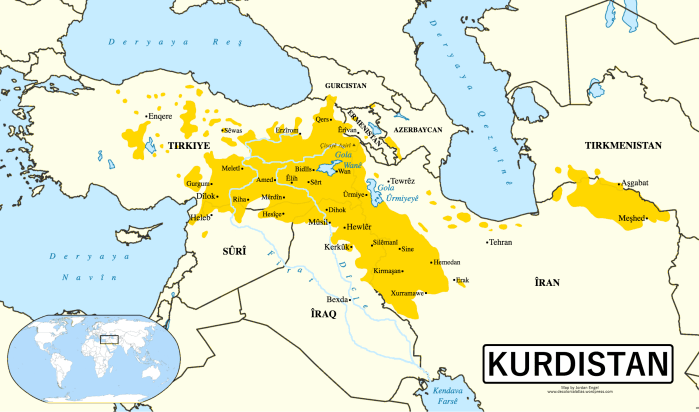
Countries with significant Kurdish populations in the Near East: Turkey, Syria, Iraq, and Iran.
Countries with significant Kurdish populations in the Near East that the United States has bombed or put boots on the ground in: Iraq and Syria.
Countries with significant Kurdish populations in the Near East that the United States has threatened to bomb and possibly invade: Iran.
Countries with significant Kurdish populations in the Near East that the United States is allied with: Turkey.
Three of the four countries with significant Kurdish populations in the Near East are (or was, in the case of Iraq) considered hostile to the US government, so the use of Kurds to further American Realpolitik in the region is almost obvious, until you consider that Turkey has been a longtime ally of Washington.
Suppose you’re a big-time Washington foreign policy player. Do you arm Kurdish militias in Syria, encourage continued political autonomy in Kurdish Iraq, finance Kurdish discontent in Iran, and shrug your shoulders at Istanbul? Seriously, what do you do in this situation?
On the rift between economics and everything else
The line is often heard: economists are “scientific imperialists” (i.e. they seek to invade other fields of social science) jerks. All they try to do is “fit everything inside the model”. I have this derisive sneer at economists very often. I have also heard economists say “who cares, they’re a bunch of historians” (this is the one I hear most often given my particular field of research, but I have heard variations involving sociologists and anthropologists).
To be fair, I never noticed the size rift. For years now, I have been waltzing between economics and history (and tried my hand at journalism for some time) which meant that I was waltzing between economic theory and a lot of other fields. The department I was a part of at the London School of Economics was a rich set of quantitative and qualitative folks who mixed history of ideas, economics, economic history and social history. To top it all, I managed to find myself generally in the company of attorneys and legal scholars (don’t ask why, it still eludes me). It was hard to feel a big rift in that environment. I knew there was a rift. I just never realized how big it was until a year ago (more or less).
There is, however, something that annoys me: the contempt appears to be self-reinforcing. Elsewhere on this blog (here and here) (and in a forthcoming book chapter in a textbook on how to do economic history), I have explained that economists have often ventured into certain topics with a lack of care for details. True, there must be some abstraction of details (not all details are useful), but there is an optimal quantity of details. And our knowledge grows, the quantity of details necessary to answering each question (because the scientific margin is increasingly specialized) should grow. And so should the number (and depth) of nuances we make to answer a question. There is a tendency among economists to treat a question outside the usual realm of economics and ignore the existing literature (thus either rushing through an open door or stepping in a minefield without knowing it). The universe is collapsed into the model and, even when it yields valuable insights, other (non-econs) contributors are ignored. That’s when the non-econs counter that economists are arrogant and that they try to force everything into a mold rather than change the mold when it does not apply. However, the reply has often been to ignore the economists or criticize strawmen versions of their argument. Perceived as contemptuous, the economists feel that they can safely ignore all others.
The problem is that this is a reinforcing loop: a) the economists are arrogant; b) non-economists respond by dismissing the economists and ridiculing their assumptions; c) the economists get more arrogant. The cycle persists. I struggle to see how to break this cycle, but I see value in breaking it. Elsewhere, I have made such a case when I reviewed a book (towards which I was hostile) on Canadian economic history. Here is what I said for the sake of showcasing the value of breaking the vicious circle of ignoring both sides:
These scholars (those who have been ignored by non-economists) could have easily derived the same takeaways as Sweeny. Individuals can and do engage in rent-seeking, which economists define as the process through which unearned gains are obtained by manipulating the political and social environment. This could be observed in attempts to shape narratives in the public discourse. According primacy to the biases of sources is a recognition that there can be rent-seeking in the form of actors seeking to generate a narrative to reinforce a particular institutional arrangement and allow it to survive. This explanation is well in line with neoclassical economics.
This point is crucial. It shows a failing on both sides of the debate. Economists and historians favorable to “rational choice” have failed to engage scholars like Sweeny. Often, they have been openly contemptuous. The literature has evolved in separate circles where researchers only speak to their fellow circle members. This has resulted in an inability to identify the mutual gains of exchange. The insights and meticulous treatments of sources by scholars like Sweeny are informative for those economists who consider rational choice as if the choosers were humans, with all their flaws and limitations, rather than mechanistic utility-maximizing machines with perfect foresight (which is a strawman often employed to deride the use of economics in historical debates) . In reverse, the rich insights provided by rational choice theorists could guide historians in elucidating complex social interactions with a parsimony of assumptions. Without interaction, both groups loose and resolutions remain elusive.
See, as a guy who likes economics, I think that trade is pretty great. More importantly, I think that trade between heterogeneous groups (or different individuals) is even greater because it allows for specialization that increases the value (and quantity) of outputs. I see the benefits of trade here, so why is this “circle of contempt” perpetuating so relentlessly?
Can’t we just all pick the 100$ bill on the sidewalk?
Nightcap
- The firing of Kevin Williamson was a bad idea Conor Friedersdorf, the Atlantic
- Among the abortion extremists Ross Douthat, New York Times
- Back alley regulation Bryan Caplan, EconLog
- What deterring abortion means Russell Arben Fox, In Medias Res
Brazil-Africa Relations, Now and Then
The first academic paper I ever published was about Brazil-Africa Relations, approximately from the 1960s to the 2000s. The main point of the article was to compare three moments of Brazilian Foreign Policy Towards Africa: the Independent Foreign Policy of the Early 1960s; the Foreign Policy of the latter Military Governments (late 1970s) and the Foreign Policy of the Lula administration (2003-2011). My main conclusion was that the foreign policy towards Africa of these three moments was very similar. Although some would exalt Lula’s foreign policy as something extraordinary, the truth, as I saw it, was that it was very well grounded in a tradition of Brazilian Foreign Policy.
Today I feel somewhat ashamed of that paper. I failed to highlight the irony: the leftist government of Lula had a foreign policy strikingly similar to that of the (supposedly) far-right military regime. The information, to be sure, is all there. One has simply to come to this obvious conclusion.
The foreign policy of Lula and Dilma was indeed very similar to that of Ernesto Geisel and João Batista Figueiredo, the last two generals to be presidents of Brazil, and not only regarding Africa. Dilma’s economic policy was extremely similar to that of Geisel, the same policy that, by the way, led Brazil to the hyperinflation of the 1980s and early 1990s.
It is definitely ironic. The Workers Party began as an opposition to the military government in Brazil. Dilma was a terrorist guerrilla warrior who fought against that regime (and never publicly apologized for that). However, once in power, they became very similar to their enemies. I’ll leave the readers to come to their own conclusions about this. But regarding Africa: I wasn’t able to continue my research. But I’m still very interested in that continent. Brazil is geographically and culturally very similar to many African nations. I believe there are great opportunities for mutual aggrandizement. But “mutual” is not what I saw in my research. I saw Brazil being hypocritical: The US is (in the sick mind of some leftist Brazilian politicians and diplomats) imperialist towards Brazil; therefore, Brazil will be imperialist towards Africa. I hope that a more market-friendly Brazil will be able to do something different.
 Notes On Liberty