The nonexistent moral decay of the west

Humankind’s struggle with moral is of course nothing new, it rather inherent to our nature to revolt against the meaningless world and the manmade system of reason. Furthermore, moral values vary over a specific period of time swinging from rather high moral standards to very low ones. Regarding morality as an abstract compass guiding our thought, goals and behaviour, Economist, in general, are not known for dealing in depth with the metaphysical reason behind our behaviour yet they explore and explain human actions through our surrounding incentives, which also structure and direct our action. Economist such as Daron Acemoglu & James Robinson or William J. Baumol have explored these changes in human behaviour through changing incentive structures thoroughgoingly.

However, folks mourning the moral decline of today’s west often fail to provide concrete evidence for their argument. They either cherry-pick events or legislatures to infer a macro trend inductively or they lose themselves in difficult language trying to somehow save their argument by making it incomprehensible. I cannot help feeling that mourning the moral decay of the west has somehow become a shibboleth for eloquently expressing the “Things used to be way better back then” narrative. However, I admit that there were probably a couple of sociological papers who have covered this issue very well which I am unaware of. Contrary, the public debate was dominated by a few grumpy intellectuals holding the above-named attitude. I was recently provided with a very concrete set of indicators to measure moral decline while digging through Samuel P. Huntington’s infamous classic “The clash of civilization” from 1996. He states that there are five main criteria which indicate the ongoing decline of moral values in the West. [1]

After being provided with a concrete framework to quantify the moral decline of the west, I was keen to see how the moral decline of the west has developed in the 20 years since the book has first been published in 1996. Although I also take issue with some of these indicators to measure moral decline, I avoid any normative judgement in the first part and just look at their development over time. Furthermore, since Samuelson himself mostly takes data from the USA representing the West, I might as well do so too for the sake of simplicity. So, let’s see what happened to moral values in the West in the last years by checking each of Huntington’s indicator one by one.

1. Increasing antisocial behaviour such as acts of crime, drug use and general violence

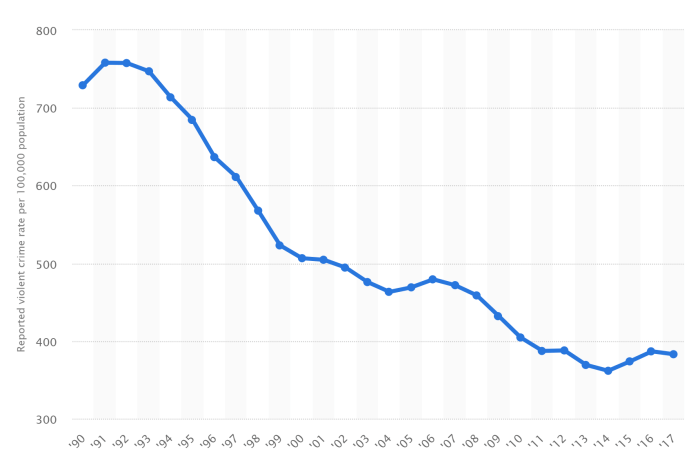
Apart from the global long-term trend of declining homicides, we can also observe a recent downward trend in the reported violent crime rate since 1990 in the USA. Scholars agree that the crime rate is in an extreme decline. Expanding the realm towards Europe, you will see similar results (see here).

1Source: Statista

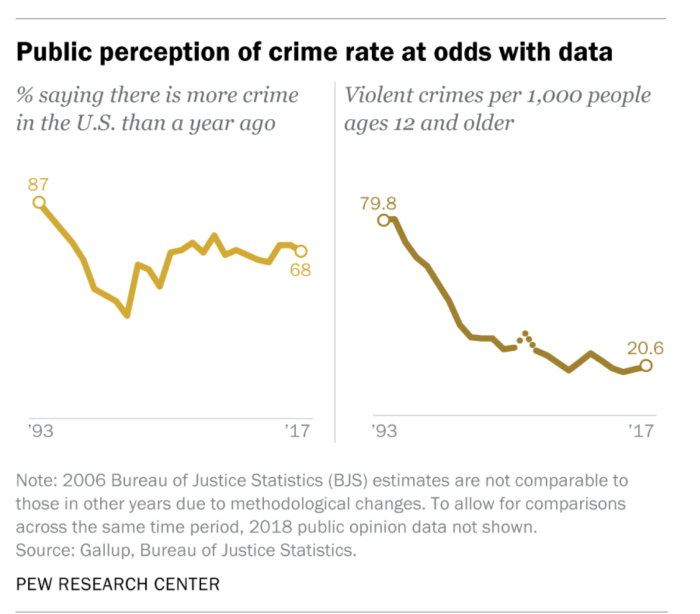
Despite these trends, the public (as well as some intellectuals as well I assume) vastly still holds a distorted perception of the crime rate. The sharp decline in actual crimes strongly contradicts the fact that a majority of the people still uphold the myth of increasing crime rates.

2

Source: Pew Research Center

Regarding drug use in the USA, it is important to mention that the absolute amount of illicit drugs consumed has slightly gone up since 1990. This development is mostly driven by an increasing  consumption of marijuana: Use of most drugs other than marijuana has stabilized over the past decade or has declined., states the National Institute on drug abuse in 2015.

Contrary, the number of deadly injections are increasing. However, the share of the population with drug use disorders has remained on the same level of 5.3% over the last 20 years.

2. Decay of the family resulting in increasing divorce rates, teenage motherhood and single parents

It is hard to measure the “Decay of the family” itself. Luckily, Huntington further concretizes his claim by naming some of the measurable effects. There is nothing much to do to refute these statement except for looking at the following graphs.

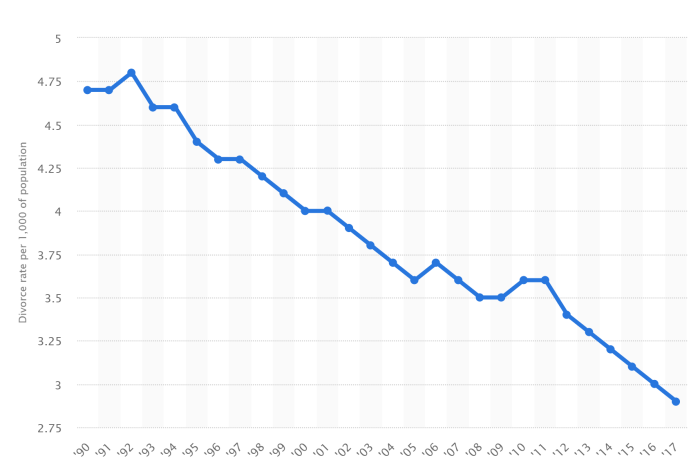
a) Firstly, the divorce rate is sharply declining.

3

Source: Statista

b) Second, teenage pregnancy rates are also dropping since 1990.

4Source: National Vita Statistics Report

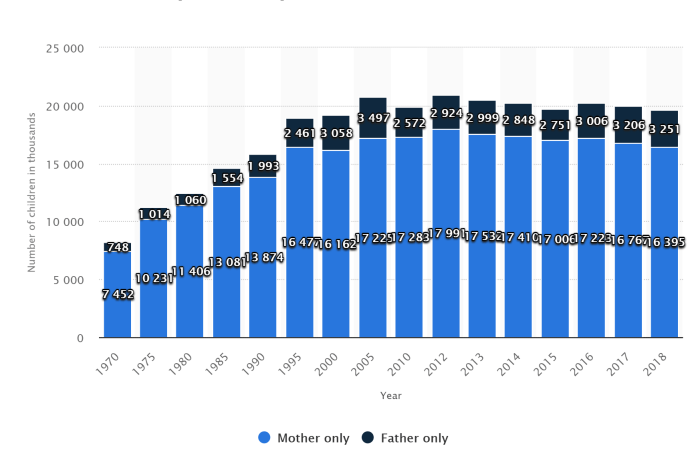
c) Third, the number of Americans living in single parenthood is not increasing drastically since 1990.

5Source: Statista

I often take issue when (especially conservative) scholars mourn the declining importance of family. Even if there are certain indicators which would back up Huntington’s claims, he does not name them himself. While it is indeed true that “family” as an institution is undergoing changes, there is no evidence (at least named by Huntington) to back up the claim of a decline of its importance.

3. Declining “social capital” and voluntarism leading to less trust.

It is indeed true, that the adult volunteering rate declined from early 2000 to 2016 from 27.4% to 24.9%. Interestingly, it recently bounced back to a new high in 2018, hitting the 30% target. Really the only point where one must agree to Huntington’s claim is the decrease of interpersonal trust as well as trust in public institutions. This trend is indeed very worrisome considering that trust is a major factor for flourishing societies.

4. The decline in work ethic

The research here is a little bit tricky and points in both directions. Although there has been wide academic coverage of the millennial work ethic scholars could not find a consensus on this issue. Its is especially difficult to extract the generational influence from other key determinants of work ethic, such as position or age. Academics warn to mistake the ever-ongoing conflict between young vs. old with the Boomer vs. Millenial conflict. I haven’t settled my opinion on this one. These Articles from Harvard Business Review and Psychology Today provide a good overview of both sides of the medal.

5. Less general interest in Education

This indicator is particularly interesting for me because as a member of the 90’ generation, I have experienced quite the opposite in Germany. But let’s have a look at the data.

Despite ranking only in the middle in a global country comparison, the US students still made a huge leap in terms of maths and reading proficiency, which only slowed down in 2015:

6

Source: Pew Research Center

Furthermore, the overall educational level of the USA continues to rise, resulting in the fact that  “the percentage of the American population age 25 and older that completed high school or higher levels of education reached 90% [for the first time ] in 2017.” Contrary, there are still major differences when one looks at features like race or parent household (See here), but the overall trajectory of the educational level is sloping upwards.

What do these criteria measure?

As you can see, there is little to no evidence to empirically back up the claim of western moral decay. Furthermore, while many case studies have shown that lack of interpersonal trust, lack of education or a declining work ethic can pose a great threat to society, I refuse to see a connection (a no known to me study disproves me here) between (recreational) drugs consumption, alternative family models, increasing hedonism and moral decline. Thus I believe that many advocates of the moral decay theory regard it as an opportunity to despise developments they personally do not like. I do not imply that everyone arguing for the moral decline of the west is unaware of the global macro-trends which heavily improved our life, but I highly doubt their assumption, that we are currently in a short-to-medium term “moral recession”. Even when one upholds the very conservative statements such as drug consumption adding to moral decline, is hard to argue that we are currently witnessing a moral decay of the west. Contrary, It may be true that Huntington has observed something different in the period before publishing “The clash of civilization” in 1996. Of course, I myself witness the ongoing battle against norms on the increasing hostility towards the intellectual enemy in the west, but one should always keep in mind the bigger picture. Our world is getting better – in the long- and in the short-run; There is no such thing as a moral decline of the West.


[1] Huntington, Samuel P. (2011): Kampf der Kulturen. Die Neugestaltung der Weltpolitik im 21. Jahrhundert. Vollst. Taschenbuchausg., 8. Aufl. München: Goldmann (Goldmann, 15190). P. 500

Poverty Under Democratic Socialism — Part III: Is the U.S. Denmark?

The Americans who call themselves “socialists,” do not, by and large, think in terms of government ownership of the means of production. Their frequent muted and truncated references to Sweden and Denmark indicate instead that they long for a high guarantees, high services state, with correspondingly high taxation (at least, for the more realistic among them).

When I try to understand the quasi-programmatics of the American left today, I find several axes: End Time-ism, a penchant for demanding that one’s collective guilt be dramatically exhibited; old-style pacifism (to an extent), a furious envy and resentment of the successful; indifference to hard facts, a requirement to be taken care of in all phases of life; a belief in the virtuousness and efficacy of government that is immune to all proof, demonstration, and experience. All this is often backed by a vigorous hatred of “corporations,” though I guess that not one in ten “progressives” could explain what a corporation is (except those with a law degree and they often misuse the term in their public utterances).

I am concerned that the last three features – nonchalance about facts, the wish to be cared for, and belief in government – are being woven together by the American left (vaguely defined) into what looks like a feasible project. I think that’s what they mean when they mention “democratic socialism.” The proponents seem to know no history. They are quick to dismiss the Soviet Union, currently foundering Venezuela, and even scrawny Cuba, as utterly irrelevant (though they retain a soft spot for the latter). And truly, those are not good examples of the fusion of socialism and democracy (because the latter ingredient was and is lacking). When challenged, again, American proponents of socialism refer vaguely to Sweden and to Denmark, about which they also seem to know little. (Incidentally, I personally think both countries are good societies.)

The wrong models of democratic socialism

Neither Sweden nor Denmark, however, is a good model for an eventual American democratic socialism. For one thing, the vituperative hatred of corporations on the American left blocks the path of economic growth plus re-distribution that has been theirs. In those two countries, capitalism is, in fact, thriving. (Think Ikea and Legos). Accordingly, both Sweden and Denmark have moderate corporate tax rates of 22% (same as the new Trump rate), higher than the German rate of only 16%, but much lower than the French rate of 34%.

The two countries pay for their generous welfare state in two intimately related ways. First, their populace agrees to high personal income taxes. The highest marginal rates are 60+% in Denmark and 57+% in Sweden. (It’s 46% currently in the US.) The Danes and the Swedes agree to such high rates for two reasons. For one thing, these rates are applied in a comparatively flat manner. Everyone pays high taxes; the rich are not publicly victimized. This is perceived as fair (though possibly destructive to economic growth). For another thing, their governments deliver superb social services in return for the high taxes paid.

This is the second way in which Danes and Swedes pay for their so-called “socialism” (actually welfare for all): They trust their government and the associated civil services. They generally don’t think of either as corrupt, or incompetent, as many, or at least a large minority of Americans do. As an American, I think of this trust as a price to pay. (I am not thinking of gross or bloody dictatorship here but more of routine time-wasting, exasperating visits to the Department of Motor Vehicles.) The Danes and the Swedes, with a different modern experience, do not share this revulsion or this skepticism.

Denmark and Sweden are both small countries, with populations of fewer than six million and about ten million, respectively. This means that the average citizen is not much separated from government. This short power distance works both ways. It’s one reason why government is trusted. It makes it relatively easy for citizens’ concerns to reach the upper levels of government without being distorted or abstracted. (5) The closeness also must make it difficult for government broadly defined to ignore citizens’ preoccupations. Both counties are, or were until recently, quite homogeneous. I used to be personally skeptical of the relevance of this matter, but Social-Democrat Danes have told me that sharing with those who look and sound less and less like your cousins becomes increasingly objectionable over time.

In summary, it seems to me that if the American left – with its hatred of corporations – tries to construct a Denmark in the US, it’s likely to end up instead with a version of its dream more appropriate for a large, heterogeneous county, where government moreover carries a significant defense burden and drains ever more of the resources of society. The French government’s 55% take of GDP is worth remembering here because it’s a measure of the slow strangling of civil society, including in its tiny embodiments such as frequenting cafés. In other words, American democratic socialists will likely end up with a version of economically stuck, rigid, disappointing France. It will be a poor version of France because a “socialist” USA would not have a ready-made, honest, elite corps of administrators largely sharing their view of the good society, such as ENA, that made the unworkable work for a good many years. And, of course, the quality of American restaurant fare would remain the same. The superior French gourmet experience came about and is nurtured precisely by sectors of the economy that stayed out of the reach of statism.

Poverty under democratic socialism is not like the old condition of shivering naked under rain, snow, and hail; it’s more like wearing clothes that are three sizes too small. It smothers you slowly until it’s too late to do anything.


(5) When there are multiple levels of separation between the rulers and the ruled, the latter’s infinitely variegated needs and desires have to be gathered into a limited number of categories before being sent up to the rulers for an eventual response. That is, a process of generalization, of abstraction intervenes which does not exist when, for example, the apprentice tells his master, “I am hungry.”

[Editor’s note: Part I can be found here, Part II here, and the entire, longform essay can be read in its entirety here.]

Poverty Under Democratic Socialism — Part II: Escaping the Padded Cage

There aren’t many signs that the French will soon free themselves from the trap they have sprung on themselves. The Macron administration had been elected to do something precisely about the strangling effect of taxation on French economic life and, on individual freedom. (The latter message may have been garbled during his campaign.) Are there any solutions in sight for the French crisis of psychic poverty, framed by both good social services and high taxes?

I see two kinds of obstacles to reform. The first is comprised of collective cognitive and of attitudinal deficiencies. The second, paradoxically, is a feature of French society that American progressives would envy if they knew about it.

Cognition and attitudes

After four months of weekly demonstrations, the gilets jaunes (“yellow vests”) protesters had not found the language to articulate clearly their frustration. I mean, at least those who were left protesting. They seem to be falling back increasingly on crude views of “social justice” (“les inégalités”) as if, again, the issue was never to produce more, or to retain more of what they produce, but only to confiscate even more from the (fleeing) rich. Over the many years of democratic socialism, French culture has lost the conceptual vocabulary that would be necessary to plan an exit out of the impasse. Here is an example of this loss: In the past twenty years of reading and watching television in French almost every day, I have almost never come across the single word “libéral.” (That would be in the old English meaning of “market oriented.”) The common, nearly universal term is “ultra-libéral.” It’s as if favoring an analysis inclined toward market forces could not possibly exist without being “ultra,” which denotes extremism.

What started as a fairly subtle insult against those who discreetly appreciate capitalism has become fixed usage: You want more free market? You are a sort of fanatic. This usage was started by professional intellectuals, of course (of which France has not shortage). Then, it became a tool tacitly to shut off certain ideas from the masses, all the while retaining the words derogatory muscle. So, in France today, one can easily think of oneself as a moderate socialist – on the center left – but there is no balancing position on the center right. (3) It makes it difficult to think clearly, and especially to begin to think clearly about politics. After all, what young person wants to be an extremist, except those who are really extremists?

I saw recently online a French petition asking that French economist Frédéric Bastiat’s work be studied in French schools. Bastiat is one of the clearest exponents of fundamental economics. His contribution is not as large or as broad as Adam Smith’s but it’s more insightful, in my judgment. (He is the inventor of the “broken window” metaphor, for instance.) He also wrote unusually limpid French. Bastiat has not been part of secondary studies in France in my lifetime. His name is barely known at the university level. Marx and second, and third-rate Marxists, on the other hand, are omnipresent. (Some cynics would claim that whatever their conversation, the educated French do not read Bastiat, or A. Smith, but neither do they really read Marx!)

Few, in France, are able to diagnose the malaise that grips the country because it has ceased to have a name. The handful who understand capitalism are usually allergic to it because it does not guarantee equal outcomes. A minority, mostly business people, grasp well enough how it works and how it has pulled most of humanity out of poverty but they are socially shamed from expressing this perception. There is little curiosity among the French about such questions as why the American GDP/capita is 35% higher than the French. They treat this information as a sort of deed of Nature. Or, for the more ideological, among them, it’s the sad result of America’s unfairness to itself. A debate that ought to take place is born dead. How did this happen? Socialists of my generation, most good democrats, born during and right after WWII largely, early on took over the media and the universities. They have shaped and constrained public opinion since at least the sixties. They have managed to stop discussions of alternative economic paths without really conspiring to do so, possibly without even meaning to.

A really deep state

In 1945, after the long night of the 1940 defeat and of the Nazi occupation, many French people where in a mood to engender a new society. They created a number of novel government organizations designed to implement their vision of clean government but also, of justice. (They took prosperity for granted, it seems.) One of the new organizations was a post-graduate school especially designed to ensure that access to the highest levels of the government bureaucracy would be democratic and meritocratic. It’s called, “École Nationale d’Administration” (ENA). It accepts only graduates of prestigious schools. The ENA students’ per capita training costs are about seven times the average cost for all other higher education students. ENA students are considered public servants and they receive a salary. France thus possesses a predictably renewed cadre of trained administrators to run its government. And, repeating myself here, its members are chosen according to a strictly meritocratic process (unlike the most prestigious American universities, for example), a process that is also extremely selective.

In 2019, ENA is flourishing. The school has contributed four presidents and eight Prime Ministers to-date. Its graduates are numerous among professional politicians, as you might expect. In addition, they are teeming in the highest ranks of the civil service, and also of business. That’s because they go back and forth between the two worlds, with some benefit to their careers and to their wallets. This iteration does not imply corruption. Mostly, ENA graduates do not have a reputation for dishonesty at all. They help one another but it’s mostly above board. (4) This being said, it’s difficult to become really poor if you are an ENA graduate.

Graduates of ENA are often disparagingly described as a “caste,” which is sociologically inaccurate because caste is inherited. The word is meant to render a certain collective attitude of being smugly sealed from others. The intended meaning is really that of “upper caste,” of Brahman caste, to signify: those who think they possess all the wisdom.

All ENA graduates have made it to the top by taking the same sort of exam. The style of exams and the way they are corrected become known over time. Naturally, ENA candidates study to the exam. The ENA formula for success is not a mystery although it’s not just a formula; ENA also requires a sharp intelligence and character. ENA graduates have important traits in common, including a willingness to spend their adolescence cramming for increasingly difficult competitive exams. There are few charming dilettantes in their ranks. They all emerge from a process that does not reward imagination.

ENA graduates – dubbed “énarques” – seem overwhelmingly to share a certain view of the desirable interface between government and the economy. It’s not hard to guess at, based on thousands of their speeches reproduced in the media, and with the help of a little familiarity with French classical education. Its origin is neither in capitalism nor in socialism. (Sorry for the only slightly misleading title of this essay.) It predates both by 100-150 years. It’s rooted in the well known story of the Minister Colbert’s 17th century economic reforms. (It’s well known in the sense that every French school kid knows his name and a thing or two about the reforms themselves.) Colbert (1619-1683) raised tariffs, regulated production in minute detail and, above all, he created with public funds whole industries where none existed, in glass, in porcelain, but also in textiles, and others. I believe his main aim was only to increase government (royal) revenue but others think differently. At any rate, there is a widespread belief that general French prosperity rose under his administration.

To make matters worse, Colbert is a historical figure easy to like: hard working, honest, an effective patron of the arts. With such a luminary to look up to, it’s fairly effortless to ignore both the actual disorderly origins of capitalism, and also the initially compassionate roots of its socialist counter-reaction. (On capitalism’s origins, and originality, you might consult my entry: “Capitalism.” The Blackwell Encyclopedia of Sociology. Blackwell Publishing. Vol. 2, Malden, Mass. 2006. Make sure of that particular edition – 2006 – my predecessors and successors were mostly opaque Marxist academic lowlifes.)

For seventy years, French economic policy has thus been made largely by deeply persuaded statists, people who think rule from above natural (especially as it takes place within a broadly democratic framework), who judge government intervention in economic matters to be necessary, fruitful, and virtuous, people who believe that government investment is investment, people who have given little thought to private enterprise, (although they occasionally pay lip service to it, largely as if it were a kind of charity). Almost none of them, these de facto rulers, is a bad person. Their pure hearts make them all the more dangerous, I believe. The result is there in France for all to see: a sclerotic economy that has failed to provide enough jobs for fifty years, a modest standard of living by the criteria of societies that industrialized in the nineteenth century, a worsening unease about the future, a shortage of the freedom of small pleasures for the many.

I do not use the conventional words of “tyranny” or “despotism” here because both are normally more less deliberately imposed on the populace. Nothing of the sort happened in France. On the contrary, lack of individual freedom in France is the accumulated consequence of measures and programs democratically adopted within the framework described above. Together, these well-meaning social programs are squeezing the liveliness out of all but the upper layers of French society.

There exists in the country a growing resentment of the énarques’ basically anti-capitalist rule. One recent president, Sarkozy, even declared he partly owed his election to bragging about not being a graduate from ENA. Yet, the thousands of énarques permanently at the levers of command for seventy years are not about to relinquish them, irrespective of the political party or parties in power. Few groups controlling as much as they ever does so voluntarily. The deep sentiment of their collective virtuousness will make them even more intransigent. Most French critics believe that the énarquesare incapable of changing as a cadre, precisely because they are really an intellectual elite of sorts, precisely because they are not corrupt. And, as I remarked above, ENA’s statist (“socialist”) reign has lasted so long that the French people in general have lost track of the very conceptual vocabulary an anti-bureaucrat rebellion would require. (We know what we don’t want, but what do we want?)


(3) It’s true also that historical accidents have deprived France of a normal Tory party. Its place is currently occupied by reactionary nationalists (currently the “Rassemblement national,” direct descendant of the “Front National,” of Marine Le Pen) who don’t favor market forces much more than does the left.

(4) I take the ENA graduates’ reputation for probity seriously because, right now, as I write, there are clamors for abolishing the school but its generating corruption in any way is not one of the reasons advanced.

[Editor’s note: Here is Part I, and here is the entire longform essay.]

School choice at the Supreme Court

Another school funding case is knocking at the U.S. Supreme Court’s door. This case, Espinoza v. Walborn, hales from Montana, where the state’s fledgling school-choice program was killed moments after it left the crib. The Court now has a chance to revive it and land a major victory for educational choice across the country.

Montana’s first school-choice law, passed in 2015, took the form of a tax-credit scholarship program. If a taxpayer donated to an approved scholarship organization, she could claim up to $150 of the donation as a tax credit. The scholarship organizations then dished out scholarships to help parents afford to put their kids through private school.

Then the Montana Department of Revenue gutted it. The Department promulgated a rule that none of that scholarship money could go to religious private schools. This basically killed the program, since the vast majority of private schools in Montana–and in most states–are religious schools.

The Department claimed that the state constitution prohibited the scholarship dollars from going to religious schools because of the state ban on indirect public aid to religious schools. This is an absurd argument. The scholarship funds are privately donated dollars–they never touch a public coffer. The fact that someone can claim a tax credit hardly means that the donation becomes “public funds” because of diverted revenue. Such an argument, extended to its logical conclusion, would mean that all money is the government’s, and when it graciously declines to tax us, that extra money of ours is in fact part of the public fisc.

Nonetheless, the government prevailed at the Montana Supreme Court. In fact, the Court did the state one better–they just invalidated the whole tax-credit program, even for the few parents who might use a scholarship to send their kids to a secular school.

It’s a terrible blow to parents in Montana trying to find some genuine variety in education. But it also gives the Supreme Court a chance to right a wrong that has been festering in education policy for well over a century. The Supreme Court should hold that barring religious schools from accessing a neutral and generally available funding program violates the Free Exercise Clause and the Equal Protection Clause of the U.S. Constitution.

The portion of Montana’s state constitution that laid the tax-credit program in an early grave is known as a Blaine Amendment, named after 19th-century Congressman James Blaine. In 1875, Blaine proposed a federal constitutional amendment that would, among other things, prohibit states from funding “sectarian” schools with public money. Blaine’s federal amendment failed, but many states passed state-level amendments to the same effect, and Congress managed to make inclusion of such amendments a condition of statehood for new states entering the union.

The history is clear that these amendments are rooted in anti-Catholic bigotry. As the United States transitioned to a public school system, public schools had a distinctly Protestant flavor (often state-endorsed or even state-forced). Catholic migrants therefore began forming and attending private religious schools of their own. The backlash was fierce, and anti-Catholic sentiment often expressed itself in hostility to Catholic schools. James Blaine’s proposed amendment was a key manifestation of this bigotry.

And the bigotry lives on today. Ironically, however, now opponents of genuine choice in education have retrofitted Blaine Amendments as a partisan weapon to combat vouchers, tax credits, and education savings accounts. Montana’s law is only the most recent victim. If the Supreme Court doesn’t grant this case and strike down these state laws rooted in religious bigotry, it won’t be the last.

Poverty Under Democratic Socialism — Part I: the French Case

I saw a televised investigation by the pretty good French TV show, “Envoyé spécial” about current French poverty. It brought the viewer into the lives of six people. They included a retired married couple. The four others were of various ages. They lived in different parts of mainland France. All sounded French born to me. (I have a good ear for accents; trust me.) All were well spoken. The participants had been chosen to illustrate a sort of middle-class poverty, maybe. Or, perhaps to illustrate the commonness of poverty in one of the first countries to industrialize.

All the interviewees looked good. They seemed healthy. None was emaciated; none was grossly obese, as the ill-fed everywhere often are. All were well dressed, by my admittedly low standards. (I live in the People’s Democratic Republic of Santa Cruz, CA where looking dapper is counter-revolutionary.) None of those featured was in rags or wearing clothes inappropriate for the season.

The reporter took the viewer into these people’s homes. There was no indoor tour but you could see that the outside of the houses was in good repair. Most of the interviewing took place in kitchens. Every kitchen seemed equipped like mine, more than adequately. There was a range and a refrigerator in each. Every house had at least one television set.(I couldn’t determine of what quality.) No one said he or she was cold in the winter though two complained about their heating bills.

The show was geared to sob stories and it got them. Each participant expressed his or her frustration about lacking “money,” precisely, specifically. It seems to me that all but two talked about money for “extras.” I am guessing, that “extras” mean all that is not absolutely necessary to live in fairly dignified comfort. One single woman in her forties mentioned that she had not had a cup of coffee in a café for a year or more. (Keep her in mind.)

Another woman talked about the difficulty of keeping her tank filled. She remarked that a car was indispensable where she lived, to go to her occasional work and to doctors’ appointments. Her small car looked fine in the video. The woman drove it easily, seemingly without anxiety or effort.

A woman of about forty, divorced, took care of her two teenage daughters at home two weeks out of each month. She explained how she went without meat for all of the two weeks that her daughters were away. She did this so she could afford to serve them meat every day that they were with her. I could not repress the spontaneous and cynical reaction that most doctors would probably approve of her diet.

Yet, another woman, single and in her thirties, displayed her monthly budget on her kitchen table. She demonstrated easily that once she had paid all her bills, she had a pathetically small amount of money left. (I think it was about $120 for one month.) She had a boyfriend, a sort of good-looking live-in help whose earnings, if any, were not mentioned.

The retired couple sticks to my mind. The man was a retired blue-collar worker. They were both alert and in good shape. Their living room was comfy. They also talked about their bills – including for heating – absorbing all of their income. The wife remarked that they had not taken a vacation in several years. She meant that she and her husband had not been able to get away on vacation, somewhere else, away from their house and from their town. They lived close to a part of France where some rich Americans dream of retiring some day, and where many Brits actually live.

I ended up a little perplexed. On the one hand, I could empathize with those people’s obvious distress. On the other hand, I got yanked back to reality toward the end when the retired lady blamed the government for the tightness of her household budget. Then I realized that others had tacitly done the same. The consensus – which the reporter did not try expressly to produce – would have been something like this: The government should do something for me (no matter who is responsible for the dire straights I am in now).

Notably, not one of the people in the report had a health care complaint, not even the senior retired couple.

So, of course, I have to ask: Why are all those people who live far from abject poverty, by conventional standards, why do all those people convey unhappiness?

The first answer is obvious to me only because I was reared in France, where I retain substantial ties: Many small French towns are dreadfully boring, always have been. That’s true, at least, if you don’t fish and hunt, or have a passion for gardening, and if you don’t attend church. (But the French are not going to church anymore; nothing has taken the social place of church.)

And then, there is the issue of what the French collectively can really afford. This question in turn is related to productivity and, separately, to taxation. I consider each in turn.

French productivity

According to the most conventional measure – value produced per hour worked – French productivity is very high, close to the German, and not far from American productivity: Something like 93% of American productivity for the French vs 95% for the Germans. (Switzerland’s is only 86%.) However, to discuss how much money is available for all French people together, we need another measure: the value of French production divided by the number of French people. Annual Gross Domestic Product per capita is close enough for my purpose. (The version I use is corrected to incorporate the fact that the buying power of a dollar is not the same in all countries: “GDP/capita, Purchasing Power Parity”).

For 2017, the French GDP/capita was $43,600, while the German was $50,200. (The American was $59,500.) Keep in mind the $6,600 difference between the French and the German GDP/capita (data).

If French workers are almost as productive as the Germans when they work, what can account for the low French GDP/capita? The answer is that the French don’t work much. Begin with the 35/hr legal work week. (1) (A study published recently in the daily Le Figaro asserts that 1/3 of the 1.1 million public servants work even less than 35 hours per week.) Consider also the universal maximum retirement age of 62 (vs 67 in Germany), a spring quarter pleasantly spiked with three-day weekends for all, a legal annual vacation of at least thirty days applied universally, a common additional (short) winter (snow) vacation. I have read (I can’t confirm the source) that the fully employed members of the French labor force work an average of 600 hours per year, one of the lowest counts in the world. Also log legal paid maternity leave. Finish with an official unemployment rate hovering around 9 to 10% for more than thirty years. All this, might account for the $6,600 per year that the Germans have and the French don’t.

There is more that is seldom mentioned. The fastest way for a country to raise the official, numerical productivity of its workers is to put out of work many of its low-productive workers. (That’s because the official figure is an arithmetic mean, an average.) This can be achieved entirely through regulations forbidding, for example, food trucks, informal seamstress services, and old-fashioned hair salons in private living rooms, and, in general, by making life less than easy for small businesses based on traditional techniques. This can be achieved entirely – and even inadvertently – from a well-meaning wish to regulate for the collective good. The more of this you do, the higher your productivity per capita appears to be and also, the higher your unemployment, and the less income is available to go around. I think the official high French productivity oddly distorts the image of real French income. I suspect it fools many French people, including public officials: They think they are wealthier than they are.

La vie est belle!

The French have nearly free health care – which works approximately as well as Medicare in the USA, well enough, anyway. (French life expectancy is higher than American expectancy.) Education is tuition-free at all levels. There are free school lunches for practically anyone who asks. University cafeterias are subsidized by the government (and pretty good by, say, English restaurant standards!) Many college students receive a stipend. Free drop-off daycare centers are common in big and in medium-size cities. Unemployment benefits can easily last for two years, three for older workers. They amount to something like 55% of the last wages earned, up to 75% for some.

That’s not all. The fact that France won the World Cup in soccer in 2018 suggests that the practice of that sport is widespread and well supported. It’s mostly government subsidized. Other sports are also well subsidized. French freeways are second to none. They are mostly turnpikes but the next network of roads down is excellent, and even the next below that. This is all kind of munificent, by American standards. The French are taken care of, almost no matter what. The central government handles nearly all of this distribution of services directly and some, indirectly through grants that local entities have to beg for.

Someone has to pay for all this generosity. After sixty or seventy years, many, perhaps most French people, still believe that the rich, the very rich, have enough money that can be pried from their clutching hands to pay for the good things they have, plus the better things they wish for. (No hard numbers here, but I would bet that ¾ of French adults believe this.) In fact, multi-fingered, ubiquitous, invasive taxation of the many who are not very rich pays for all of it.

French taxation

The French value added tax (VAT) is 20% on nearly all transactions. When a grower sells $100 of apples to a jelly producer, the bill comes to $120. When the jelly-maker in turn sells his product to a grocery wholesaler, his $200 bill goes up to $240, etc. Retail prices are correspondingly high. The French are not able to cheat all the time on the VAT although many try. (Penalties are costly on the one hand, but there exists a complicated, frustrating official scheme to get back part of the VAT you do pay, on the other hand.) I speculate that the VAT is so high because the French state does not have the political will nor the capacity to collect an effective, normal income tax, a progressive income tax. Overall, the French fiscal system is not progressive; it may be unintentionally regressive. To compensate, until the Macron administration, there was a significant tax on wealth. (That’s double taxation, of course.) It’s widely believed that rich French people are escaping to Belgium, Switzerland, and even to Russia (like the actor Gérard Dupardieu).

The excise taxes are especially high, including the tax on gasoline. In 2018, the mean price of gasoline in France was about 60% higher than the mean price in California, where gas is the most taxed in the Union. An increase to gasoline taxes, supposedly in the name of saving the environment, is what triggered the “yellow vests” rebellion in the fall of 2018. Gasoline taxes are particularly regressive in a country like France where many next-to-poor people need a car because they are relegated to small towns, far from both essential services and work. (2)

All in all, the French central government takes in about 55% of the GDP. This may be the highest percentage in the world; it’s very high by any standard. It dries up much money that would otherwise be available to free enterprise. Less obviously but perhaps more significantly, it curtails severely what people individually, especially, low income citizens, may spend freely, of their own initiative.

What’s wrong?

So, with their abundant and competent social services, with their free schooling, with their prodigal unemployment benefits, with their superb roads, with their government-supported prowess in soccer, what do the French people in the documentary really complain about? Two things, I think.

Remember the woman who couldn’t afford to take her coffee in a café? Well, the French have never been very good at clubs, associations, etc. They are also somewhat reserved about inviting others to their homes. The café is where you avail yourself of the small luxury of avoiding cooking chores with an inexpensive but tasty sandwich. It’s pretty much the only place where you can go on the spur of the moment. It’s where you may bump into friends and, into almost-friends who may eventually become friends. It’s the place where you may actually make new friends. It’s the best perch from which to glare at enemies. It’s where that woman may have a chance to overhear slightly ribald comments that will make her smile. (Not yet forbidden in France!) The café is also just about the only locale where different age groups bump into one another. The café is where you will absorb passively some of that human warmth that television has tried for fifty years but failed to dispense.

This is not a frivolous nor a trivial concern. In smaller French towns, a person who does not spend time in cafés is deprived of an implicit but yet significant part of her humanity. The cup of coffee the woman cannot afford in a café may well be the concrete, humble, quotidian expression of liberty for many in other developed countries as well. (After all, Starbucks did not succeed merely by selling overpriced beverages.) The woman in the video cannot go to cafés because the social services she enjoys and supports – on a mandatory basis – leave no financial room for free choice, even about tiny luxuries. She suffers from the consequences of a broad societal pick that no one forced on her. In general, not much was imposed on her from above that she might have readily resisted. It was all done by fairly small, cumulative democratic decisions. In the end, there is just not enough looseness in the socio-economic space she inhabits to induce happiness.

She is an existential victim of what can loosely be called “democratic socialism.” It’s “democratic” because France has all the attributes of a representative republic where the rule of law prevails. It’s “socialistic” in the vague sense in which the term is used in America today. Unfortunately, there is no French Bureau of Missing and Lost Little Joys to assess and remedy her discontent. Democratic socialism is taking care of the woman but it leaves her no elbow room, space for recreation, in the original meaning of the word: “re-creation.”

The second thing participants in the documentary complain about is a sense of abandonment by government. Few of them are old enough to remember the bad old days before the French welfare state was fully established. They have expected to be taken care of all their adult lives. If anything is not satisfactory in their lives, they wait for the government to deal with it, even it takes some street protests. Seldom are other solutions, solutions based on private initiative, even considered. But the fault for their helplessness lies with more than their own passive attitudes. An overwhelming sense of fairness and an exaggerated demand for safety combine with the government’s unceasing quest for revenue to make starting a small business, for example, difficult and expensive. France is a country where you first fill forms for permission to operate, and then pay business taxes before you have even earned any business income.

The French have democratically built for themselves a soft cradle that’s feeling more and more like a lead coffin. It’s not obvious enough of them understand this to reverse the trend, or that they could if they wished to. There is also some vague worry about their ability to maintain the cradle for their children and for their children’s children.


(1) I am aware of the fact that there exists a strong inverse correlation between length of week worked and GDP/capita: In general, the richer the country, the shorter the work week. Again, this is based on a kind of average. It allows for exceptions. It seems to me the French awarded themselves a short work week before they were rich enough to afford it.

(2) You may wonder why I don’t mention the French debt ratio (amount of public debt/GDP). All the amenities I describe must cost a lot of money and the temptation to finance them partly through debt must be great. In fact, the French debt ratio is lower than the American: 96% to 109% in 2018 according to the International Monetary Fund. This is a little surprising but all debtors are not equal. A country with near full employment and plenty of talent is better able to pay off its debts than one with high long term unemployment and a labor force decreasingly accustomed to laboring. The latter is, of course, a predictable result of inter-generational unemployment and underemployment. Nowadays, it’s common to cross paths in France with people over thirty who have never experienced paid work. International investors think like me about the inequality of debtors. Investors flock to the US but they are reserved about France.

[Editor’s note: You can find the entire, longform essay here if you don’t want to wait for Parts II and III.]
Catholic Emancipation as a Constitutional Revolution 

Religious toleration is important to Britain’s historical self-image as a bastion of liberty against continental tyrants like Hitler, Napoleon, and Louis XIV.

But for much of the 18th century, Catholics in Britain were barred from government service, the army and navy, the law, and the universities. Formally, they were not allowed to inherit land or even marry with Catholic rites (though in practice there were well-recognized workarounds). Catholic priests faced life imprisonment and Catholic schools were illegal. When these laws were liberalized in 1778, this provoked the worst riot in early modern British history, the Gordon Riots.

Frazer details the travails involved in passing Catholic Emancipation. The King and the Anglican establishment were strenuously opposed to liberalizing laws against Catholics. Despite the fact that he had Catholic friends, George III opposed emancipation because it violated his coronation oath to champion the Protestant religion.

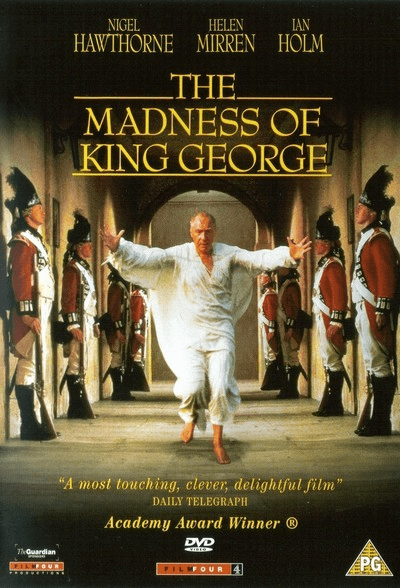
Prime Minister William Pitt proposed emancipation in 1801 and offered to resign if the King disapproved. This prompted George III’s descent into paranoia or “madness”. Frazer notes that

“There had already been a bout of this madness in 1788 and 1789, with the younger George as temporary Regent. Whatever the actual illness from which he periodically suffered, it included among the symptoms an obessional quality which certain topics unquestionably aroused. Catholic Emancipation, that appalling prospect which would cause him to be damned for breaking his sacred vow, was prominent among them:

None of this is mentioned in the 1996 film, featuring Nigel Hawthrone, of course!


Why did Catholic emancipation provoke this reaction? The British state faced a crisis in the early 19th century. Most accounts focus on the French and Industrial Revolutions, which disrupted the existing social order and alarmed ruling elites. Religion is scarcely mentioned. Thus from a Marxian perspective, the Chartists and the passing of the Great Reform Act — which extended the franchise to property holders — represent the bourgeoisie, demanding political rights to match their economic power. Acemoglu and Robinson model the transition from oligarchy to democracy as a game theoretic problem, in which the threat of revolution from below obliged elites to grant democratic rights, in order to make the promise of economic redistribution credible. Neither spends much time on religion.

But an older historical tradition saw the Catholic Emancipation as among the key causes of the constitutional crisis that the British state underwent in the 1820s and 1830s. According to John Derry (1963, 95):

‘The Protestant ascendancy was part of the Constitution: one might say without it the Constitution would never have existed. The Coronation Oath pledged the monarch to maintain the Protestant religion as by law established, while the Act of Settlement ensured a Protestant succession. Both the landed gentry and the commercial classes — as well as the urban mob — believed that if the Protestant ascendancy went the gates were open to unimaginable horrors.”

To understand why this was so, and why Catholic Emancipation paved the way for further liberalization and the rise of liberal democracy, let us revisit the argument of Persecution & Toleration.

The significance of the Protestant Ascendency reflected Reformation England’s Church-State equilibrium. The treatment of Catholics is a canonical instance of what we call condition toleration. Catholicism per se was not illegal, but it was constrained, and these constraints were justified in political terms. Throughout the 17th century, Protestants feared a return of Catholicism which they associated with unrestrained autocratic rule. For Henry Capel MP in 1679:

“From popery came the notion of a standing army and arbitrary power. Formerly the Crown of Spain, and now France, supports the root of this popery amongst us; but lay popery flat and there’s an end of arbitrary government and power. It is a mere chimera without popery”.

It was on these grounds that the Whigs sought to disbar James II from the throne. After the Glorious Revolution, the Toleration Act of 1689 excluded both Catholics and atheists. And famously, the great advocate of religious toleration, John Locke rejected toleration for Catholics, as they were loyal to a foreign prince.

The religious aspect of the Glorious Revolution is neglected in the seminal accounts of it in the political economy and economic history literatures (i.e. here). But the Glorious Revolution settlement did not only guarantee the independence of Parliament from the Crown, it also safeguarded the political position of the Anglican Church by excluding Catholics from positions of power. In return, the Church of England remained the mainstay of state. As J.C.D. Clark (1985, 438) observed:

“The Church justified its established status on a principle of toleration — the toleration of other forms of Trinitarian Christian worship. It drew a sharp distinction between this and the admission of Nonconformists to political power.”

This was particularly significant in Ireland, where the Protestant Ascendency ensured the political and economic dominance of the Anglo-Scottish Protestant elite over the Catholic majority.

Now 18th century Britain was much less reliant on religion to legitimate political authority than prior regimes. As Jared Rubin argues, one consequence of the Reformation was a decline in the legitimizing power of religion; it was superseded by institutions such as parliaments, which represented economic rather than religious elites.

Other things had changed too. The ascendancy of the Church of England was seen as crucial to state security in post-Reformation England. But this was no longer the case by 1800. Following the initial break with Rome in the 16th century, these fears had not been groundless: Protestant Englishmen felt threatened by revanchist Catholic powers such as Spain and France and, in the Gunpowder plot, Catholic conspirators threatened the death of the king and the destruction of Parliament. The fact that the vast majority of Catholics were loyal to crown and country was not enough to alleviate Protestant fears, which occasionally erupted into persecutions, such as those that accompanied the Popish plot.

Following the French Revolution, however, Catholicism was no longer associated with an aggressively expansionist continental power. The old enemy was now secular. Catholic priests fleeing Revolutionary persecution found sanctuary in Britain. And by the 1820s there was a growing pragmatic and liberal opinion in favor of Catholic Emancipation. Lord Palmerston’s argument, as summarized by Frazer (p 157), was that

“. . . times had inevitably changed, and the argument to history could not be sustained: what if Nelson, Fox and Burke had all happened to be Catholics by birth. Would it have been right to deprive the nation of their services?”

Liberal Protestant clergy further argued that

“a Catholic layman who finds all the honor of the state open to him, will not, I think, run into treason and rebellion” (quoted from Frazer, 2018, 158).

Translated into the framework of Persecution & Toleration: the equilibrium had changed. Catholics no longer posed a political threat. The legitimatizing power of the Church of England was waning. Population growth, urbanization — particularly the rise of new urban centers — as well as immigration from Ireland, undermined the ideological hold of the Church of England.

Nevertheless, when the issue finally came to head in 1827–1829, it brought down the government. Catholic Emancipation was the Brexit of its day. When the pro-emancipation George Canning became Prime Minister, its leading opponents, the Duke of Wellington and Robert Peel resigned and the Tory party split into two. Canning then died. But the move towards liberalization now had momentum. Agitation in Ireland raised fears of revolution. In 1828 the Test Act was Repealed. Wellington and Peel reluctantly switched sides. 1829 Catholic Emancipation passed, despite the fact that King George IV disapproved of it.

Thus according to J.C.D. Clark’s insightful (though contested) account:

“As significant were the consequences of Emancipation: the belief that the sovereign would not resist massive constitutional change; and the profound schism which now rent the party of Wellington and Peel” (Clark, 1985, 536).

Catholic Emancipation thus set in motion a more general constitutional revolution. Both Whigs and Tory ultras who opposed Catholic Emancipation lost faith in the existing Parliamentary system. A fundamental pillar of society, the Church-State alliance, had been undermined. It was followed by the Great Reform Act and the rise of liberal democracy. In Clark’s word’s

“. . . the effect of the measures of 1828–1832 was to open the floodgates to a deluge of Whig or radical reform aimed against the characteristics institutions of the former social order . . . English society can point to few events which changed the pattern on the ground with the totality and the dynamism of 1776, 1789 or 1917: 1832 was not such an event. It was, however, decisive in many other ways, for it dealt a death blow to England’s old order. In the process, it produced what in other disciplines is called a ‘paradigm shift’”(Clark 1985, 555–556).

Brazil’s Military Coup, 55 years later

Fifty-five years ago, in 1964, Brazilian president João Goulart was overthrown and substituted by Castelo Branco, a military president. Until 1985 the country was governed by military presidents. To this day people are still debating the coup (some even denying that there was a coup), much because the victims and perpetrators are still commanding the debate. In light of that, I’d like to offer some thoughts about 1964 here.

In 1789, only thirteen years after the American Revolution, a small group of Brazilian discontents planned an independent attempt in the region of Minas Gerais. The movement failed miserably, leaving one infamous victim, Tiradentes, who would much later be considered the patron of Brazilian independence. In the following years Brazil saw many other revolts and independence attempts, but in 1808 a significant change of events took over the country: instead of fighting in Europe a war against Napoleon he believed he could not win, Dom João VI, the Portuguese prince-regent, decided to move his capital from Lisbon to Rio de Janeiro. However, some years later Dom João had to choose between staying in Brazil or losing his crown. He decided to go back to Portugal. His son, Dom Pedro I, remained in Brazil as a new prince-regent. Legend has it that, when embarking back to Europe, João turned to Pedro and said, “make the independence of this country before someone else does.”

And he did: on September 7, 1822, Dom Pedro I proclaimed Brazil’s independence and became the country’s first emperor. His son, Dom Pedro II, would succeed him in 1840 and rule until 1889 when the monarchy was overthrown, and the republic established. Now, just imagine if the king or prince of England or Spain proclaimed himself emperor of America. Well, that’s what happened in Brazil. It seems to me that people forget how absurd this scenario really was.

Fast-forward: Dom Pedro I followed his father’s steps in 1831. He had to choose between staying in Brazil or jeopardizing his family’s position in Europe. He went back to Portugal but left his son to become emperor in Brazil. Because Dom Pedro II was still only four years old, that wouldn’t happen until almost a decade later. And so, the 1830s were a very turmoiled time in Brazilian history. The country was ruled by several regents and was about to be torn apart. This favored speeding up Dom Pedro II’s coronation. Although he was only 14 years old, his rise to power helped to heal several wounds and bring a union to Brazil. The country’s subsequent history, at least until the proclamation of the republic in 1889, was lived under the shadow of the 1830s. To a high degree the Brazilian elites were afraid that without a strong central power, represented by the emperor, the country would fall apart, much like Hispanic America. On top of that, Brazilian economy was majorly dependent on African slaves, and the same elites were afraid that the Haitian Revolution of 1803 would be emulated in their country in the absence of a strong centralized government.

These are in my view the basics of Brazilian history in the 19th century. To prevent regional fragmentation (as in Hispanic America) or a slave revolution (as in Haiti) a very strong and centralized government was established. Liberal on the surface, but very far from that in reality. I don’t question that in the absence of this choice Brazilian history might have been quite different. However, I think that it is important to notice that Brazilian political history didn’t have a very democratic beginning.

As I already mentioned, the monarchy in Brazil ended in 1889. Dom Pedro II suffered a textbook coup d’état: some economic elites colluded with the military (mostly the army) and took over the power. The first forty years of Brazilian republic were notoriously oligarchic, ruled mostly by the coffee elites of the states of São Paulo and Minas Gerais. These elites, however, tasted their own medicine when, in 1930, Getúlio Vargas took over power by force. He would be the country’s dictator until 1945.

Vargas deserves special attention, both because of his long time in power and his enduring influence. On many occasions, he has been classified as a fascist, or something close to that. Populist is also a label that has been associated with him. I prefer to label him as “getulist”. To be sure, Vargas had some resemblance to fascists in Europe and populists in Latin America, but I understand that this is mainly so because all these governments share in their anti-liberalism, centralization of power and tendency to extreme violence.

Vargas peacefully stepped down from power in 1945, only to come back (democratically elected!) in 1951. He committed suicide in 1954. The whole period of 1945-1964 was lived under his shadow. Many tried to be his successor. Juscelino Kubitsheck, president from 1956 to 1961, began his political career as Vargas’ protégé and remained faithful to the mentor until Getúlio’s death. Leonel Brizola, governor of Rio Grande do Sul (1959-1963) – Vargas’ home state – also tried to continue Getúlio’s legacy. Even more so did Brizola’s brother in law, João Goulart, president from 1961 until the 1964 coup.

Even more than Juscelino Kubitsheck, João Goulart began his political career as a protégé of Getúlio Vargas, but never achieved the political brilliance of his mentor. Jango, as he was called, was not a communist by any means. Very much like Vargas, his ideology was a confused mix of positivism, laborism, populism and any other -isms. Very pragmatic. However, above all, Jango was a fool. He was unable to understand that the World had changed. What was successful for Vargas in the 1930s could not be reproduced in the 1960s. Because of that, amid the Cold War scenario he was mistaken for a communist by some. Others, more pointedly, realized that he was too oblivion to the communist threat Brazil was facing.

Communists had been trying to come to power in Brazil (rarely democratically) since the 1920s. The Cold War only intensified this threat. After the Cuban Revolution of 1959 many feared that Brazil would be the next domino to fall.

And this is in short, the scenario in which the military came to power in Brazil in 1964. As late Brazilian economist Roberto Campos very lucidly pointed, democracy was sadly not an option for Brazil in 1964. The country had to choose between a right-wing or a left-wing dictatorship. I believe they chose correctly. The communists took power in Cuba in 1959. They are still there. The military seized control in Brazil in 1964. They pacifically laid over power 21 years after and never tried to come back. I am not saying that a right-wing dictatorship is a good solution against leftism. Anyone who reads this here is reading his prejudices solely. What I am saying is that Brazil sadly has little democratic tradition and had even less 55 years ago. Therefore, we should not be surprised that the military took over power in 1964. Surprisingly would be if things happened in any other way. I don’t celebrate the military government of 1964-1985. Just the opposite: as with so many things in Brazilian history (or in life!) it is not something to celebrate. Just to accept and live with it.

Bourgeois II: place in the world

Quite recently, I was reading musicologist Martha Feldman’s book The Castrato: Reflections on Natures and Kinds, which is, unsurprisingly, a study on the castrato and the music written for the voice type during the 17thand 18thcenturies. The concept is exactly what it sounds like – a male singer whose physical development was surgically ended in order to preserve his access to the high soprano range. The surgery in theory created an ideal singer because his head and ribs continued to grow to normal male size, creating someone with tremendous lung capacity and also large head space which created greater resonance. 

For anyone who might be wondering, no, castrati did not sing female roles; the type was still male in identity and was often associated with nobility or demi-gods in character casting. Incidentally, the practice of castrati eventually led to the operatic custom, beginning in the late 18thcentury, of mid-range female singers (mezzo-sopranos) singing the roles of young males because as religious and civil laws cracked down on the creation of castrati, this particular type of singer gradually disappeared, even as the music written for them increased in popularity. By the time Mozart wrote Le Nozze di Figaro(1785 – 86) and La Clemenza di Tito(1789), the roles of the junior males, Cherubino and Annio respectively, were written for women singers from the outset. 

The aspect that was, for me, quite interesting about the castrati was the level to which a concept which musicians more or less take for granted stemmed from larger social, legal, and cultural changes in Europe in the late 1500s. Explaining the castrato’s history in Italy, where the practice originated, Feldman mentioned philosopher and sociologist Jürgen Habermas and his work, particularly on the “weakening of industrialization and the refeudalization of Europe” following the Renaissance. More directly related to the trend of castrati, Feldman wrote:

Most of the time first sons were excluded (from castration in order to make a castrato) because primogeniture was the rule in Italy, hence first sons were heirs, breeders, and eventual legatees, though very poor or very ambitious families sometimes did have first sons castrated, including the family of Handel’s principal castrato Senesino (Francesco Bernardi), whose older brother was a castrato, and first son Gaetano Berenstadt (1687 – 1734), of Tyrolean descent, who ended up caring extensively for his family’s needs (Feldman, 13).

And further explained,

If some form of patriarchy had long been the rule, patriliny by contrast took root in a historically precise way only around 1570, as we have glimpsed above [a preceding paragraph on the combination of increased lifespan and the introduction of estate entail in Italy]. Prior to that time the ideal had been to marry off all or most sons to increase a family’s power not just vertically but horizontally, within a wider network of kin, with the goal of fortifying the clan as a whole. With the marrying off of first sons only, a situation arose in which younger sons were typically consigned to military or ecclesiastical careers and thus formally speaking to legal or effective celibacy at the same time as most upper-class daughters entered convents. Both strategies intensified with the severe economic crisis of the seventeenth-century, but the practice continued afterward, albeit with increasing tendencies toward diversification (45).

Before 1570, the law of entail was not prevalent in continental Europe, which also tended to include females in the line of succession – Salic law applied only to the throne in the case of France, so noble women could and did inherit their parents’ property. Since one of the central points of the Counter-Reformation was ending the abuse of Catholic religious facilities, either as retirement homes for dowagers or as cold-storage for spare heirs once their elder brother fulfilled his duty, convents, monasteries, and the priesthood quickly became unviable career options, at least for the aristocracy. 

This little tweak to Canon Law had two effects: 1) the Catholic clergy gradually ceased being a profession as such, which resulted in an increased number of non-elites joining voluntarily and rising to high places, and 2) the performing arts, particularly music, exploded as the young men enrolled in ecclesiastical preparatory schools and originally destined for careers in the Church had to find new avenues for their skills. On a side note, the struggle to enforce the new regulation took centuries, was closely related to the battle for separation of church and state, and it is a story for another time.

The point to this tale is the response of the younger sons to their change in fortunes and status. Being in cathedral schools, and even more impractically in music-specialist cathedral schools, at first glance there was not much use for what these young men could do in the secular world. They were fluent in Latin, usually had a good command of Greek, frequently had a solid understanding of modern European languages and literature in general, and they were competent musicians. In a world that not only was still largely agrarian but was also “refeudalizing” into a system where they were, on the one hand, very much locked into the expectations of their caste – an impoverished younger son was still an aristocrat – while simultaneously being locked out of any claim to family property, the position of these men appeared hopeless. 

Instead of giving in to the circumstances, though, these men went out and turned their skills into an industry – classical music as we know it. They taught it, wrote it, and developed it into a dominant art form. Some found multivariant use for their “irrelevant” skills. For example, the castrato Carlo Broschi (1705 – 1782) didn’t use his real name out of respect to his aristocratic family, performing under the name Farinelli. However, his birth and skill with languages also caused him to be appointed a diplomat-at-large and it was not uncommon for him to be in cities, such as London or Madrid, for opera engagements and be suddenly called upon to go to the royal court and help sort out a diplomatic issue. When he died at the unusually old age of 77 (a perfect example of Jonah Goldberg’s point about Second Sons as both victims and beneficiaries of the upper-classes having better medicine), he left behind a fortune, which in a delightful ironic twist bailed out his elder brother’s family.[1]What is remarkable is not that he did this, but that he was only slightly unusual in terms of his financial success. 

In her book The Bourgeois Dignity, Deirdre McCloskey argued, rather controversially, that all movement, no matter how organic, comes top down in terms of the social pecking order. In the case of capitalism, the movement occurred, in part, because the group whom Goldberg termed “Second Sons” and McCloskey “bourgeois” had a particular knack for both recognizing and creating markets, even in very negative situations. The resilience evinced in the story of the castrati and their role in the history of music is a type of proof that McCloskey’s thesis is correct. 


[1]In fairness to the elder Broschi, he was a well-regarded musician in his own right and had a strong career up until he inherited the estate and, following convention, retired to it to become a penniless landed gentleman, rather than a wealthy performer, like his younger brother. The suspicion is that Farinelli covered most of his brother’s family’s living expenses; it is known that he paid for the education of his nephews and niece. 

Three Lessons on Institutions and Incentives (Part 1): Introduction

There are books that are aimed at a spectrum of readers that are counted within the “well-informed public.” They are not books confined to academic circles, they are not for mass consumption, but they do concern problems that involve entire countries and are written in a register that involves certain intellectual training. In this genre, there are three works that have much to say about the relationship between institutions and incentives. The first of them dates from 1990 and was published by a Nobel Prize winner in Economics, Douglass C. North: Institutions, Institutional Change and Economic Performance, which elaborates the distinction between formal and informal institutions and incremental and disruptive institutional change, ending with a historical analysis that seeks to explain the differences in economic performance between the United States and Latin America. It is an academic book that can be approached by the said well-informed public.

Eleven years later, in 2001, William Easterly published The Elusive Quest for Growth: Economists’ Adventures and Misadventures in the Tropics. It is proposed as a political essay in which an economist interprets his own professional experience as a member of international teams for the development of Third World countries. To do this, drawing on the theoretical notions of other leading economists, such as Paul Romer (who later, in 2018, received the Nobel Prize in Economics), he makes an assessment on the development plans for the Third World that were implemented since the end of World War II. The central thesis of Easterly stresses that, in order to have an empirical relevance, every theory of development -or of the absence of it- must carry the following behavioral postulate: “people respond to incentives.” If this reality is not taken into account, there is no public policy that can be successful. The main lessons that can be drawn come from the theoretical instruments deployed to explain the political dynamics of most of these countries, particularly in regard to the phenomenon of polarized societies.

The third book to consider is also the more recent publication. Why Nations Fail, by Daron Acemoglu & James A. Robinson, was published in 2012 and reached the global debate on the realm of the well-informed public. The proportions achieved by the population of academics and professionals, in addition to the extension of the internet, allowed the aforementioned book to generate varied opinions along both traditional and digital media throughout the world. Acemoglu & Robinson dedicate their pages to those countries that were successful, as well as those that were not, but also here, in the case of this book, the most juicy lessons truly comes from the conceptual structure that articulates the whole book. Among such notions, we find those of inclusive and extractive institutions, which in turn are divided into political and economic institutions. The worst of the institutions are preferable to the total lack of institutions. Thus, a country organized around a closed political and economic system will be preferable to a failed state. However, once a certain degree of centralization and institutionality has been achieved, it is preferable to move towards a pluralist democracy and a competitive economy. The challenge is how to accomplish such transitions.

Since there are still four years left until the year 2023 – following the periodicity of the selected works – we are still in time to make a brief synthesis of the ideas that can be applied to the analysis of the impact of the institutions on economic and political incentives.

[Editor’s note: this is the first part of a rich series on institutions and incentives. You can find the full, Longform Essay here.]

The Institutional Foundations of Antisemitism

Antisemitism has returned to mainstream politics in Europe and America. One fundamental misconception about antisemitism is that it is simply another form of racism. Thus Jeremy Corbyn responds to charges of antisemitism with “ ‘I’ve spent my whole life exposing racism in any form”. But of course, Corbyn is, at the very least, an enabler of antisemitism (and there is evidence he holds antisemitic prejudices himself — see here).

Why is antisemitism different from other forms of racism? And what makes antisemitism unique. When Noel Johnson and I began writing Persecution & Toleration, we didn’t envision antisemitism returning to prominence, but I believe our analysis sheds important insight on the institutional foundations of antisemitism.

Continue reading

RCH: 10 most brutal massacres in history

That’s the subject of my latest at RealClearHistory (I submitted it before the vicious, anti-Muslim shooting in New Zealand occurred). An excerpt:

7. Chios massacre (March – July 1822). The Ottomans were bad people for a few centuries during the Middle Ages (RealClearHistory has more on the Ottomans here). In 1822, Istanbul massacred 52,000 Greeks on the island of Chios during the Greek War of Independence. The massacre was used deftly by imperial proponents in London, Paris, and Moscow, and further isolated the Ottomans from European diplomacy. As for the inhabitants of Chios, most were apathetic toward the rebellion until the massacre.

Here’s another one:

5. Massacre of the Latins (1182). In the 12th century, Roman Catholics in Constantinople, the capital city of the Roman Empire, were known as Latins and in 1182 they were slaughtered, driven out of the city, or sold into slavery. Tens of thousands of people are estimated to have died. The massacre occurred because the vast majority of non-Roman Catholic inhabitants were much poorer than the Latins of the city, due to the latter’s connections to the wealthy city-states on the Italian peninsula (Venice, Genoa, Pisa, etc.). The massacre also made it harder for the Pope to unify the Christian world, as the split between Catholic and Orthodox sects only became more hardened.

Lots of bad things have happened in Turkey and Greece and over the years. Please, read the rest. There’s more massacres, but also thoughts on the genocide-versus-massacre debate, and the sheer lack of knowledge that humanity possesses in regards to its own history.

Why Persecute?

Why was religious persecution common in the premodern world? This is the question Noel Johnson and I address in Persecution and Toleration.

Answers that rely on the alleged barbarism of the times or the brutality or narrowed-mindedness of individual churchmen or rulers are unsatisfying. We need to understand why religious dissent was so alarming that political and religious authorities resorted to violent repression.

In Persecution and Toleration, we outline why states often had an incentive to enforce religious conformity.

Suppose the ruler wants to pass a law. The religious authority can choose to legitimate this law or to oppose it. If the religious authority opposes it, the law will be seen as illegitimate, and the ruler will face unrest or opposition in attempting to enforce it. If the religious authority legitimates the law, then compliance with the law will be greater and the law will be enforced at a much lower cost for the ruler. Rulers therefore have a good reason to want legitimacy. Because religious authorities were the most powerful source of legitimacy in the premodern period, it was natural for rulers to rely on religious legitimacy.

Rulers can bargain with religious authorities to obtain legitimacy. One way to do this is to enforce religious conformity. This provides a natural framework for studying religious persecutions.

One insight is that persecutions are necessarily political. The justification for persecution can vary. Secular authorities will persecution in terms of secular arguments. Religious authorities may persecute on religious or doctrinal grounds. But structurally these persecutions will resemble one another.

A second key argument is that some form of religious repression was the default in the premodern world but outright persecution was, in fact, quite rare. The default level of religious repression we characterize as a state of conditional toleration. Religious differences were usually tolerated, but only conditionally. Outright persecution was quite rare. But the threat of persecution played an important role in enforcing religious conformity, restricting dissent and providing states with legitimacy.

How general is our account? Is this story only applicable to Western Europe? Or to monotheistic societies? Can it explain the persecution of Christians in pagan Rome or the persecution of Christians in 17th century Japan? And what distinguishes religious persecutions from other persecutions?


To address these concerns, consider the persecution of Christians in the Roman Empire. Historians such as Candida Moss downplay these persecutions (here). Catherine Nixey’s The Darkening Age — reviewed positively in the New York Times —for example, writes:

“The idea, therefore, of a line of satanically inspired emperors, panting for the blood of the faithful is another Christian myth. As the modern historian Keith Hopkins wrote, ‘the traditional question: “Why were the Christians persecuted?” with all its implications of unjust repression and eventual triumph, should be re-phrased: “Why were the Christians persecuted so little and so late?”

Nixey correctly cautions the reader not to view Christian accounts of the death of martyrs as historical accounts. But her argument is a larger one. To her mind, the persecution of Christians was not a religious persecution. Commenting on the Roman governor Pliny’s decision to persecute some Christians, she writes:

“Pliny’s problem with all of this is not religious. He is not upset because Jupiter has been neglected, or Hera has been slighted: he is upset because the citizens of his province are becoming disgruntled by the Christians’ behaviour . . .”

“. . . Even the locals who were forcing Pliny’s hand might not have been complaining about Christians for religious reasons either: it has been speculated that what was really upsetting them was not theology but butchery. Local tradesmen were angry because this surge of Christian sentiment had led to a drop in the sales of sacrificial meat and their profits were suffering: anti-Christian sentiment caused less by Satan than by a slow trade in sausage-meat.”

Because Christians were punished as pests and social deviants, rather than for reasons conventionally identified as religious, Dixey suggests this was a simple matter of“law and order”. If anything her sympathies appear to be with the Roman governor responsible for prosecuting Christians:

“What should Pliny do with these odd people? Trajan’s reply is brief and to the point. He doesn’t get into theological or legal debates about the legal status of Christianity (to the disappointment of later scholars); nor does he (thus confounding the martyrdom tropes) fulminate against the Christians. He does agree with Pliny that those who are proved to be Christian ‘must be punished’ — though for precisely what charge is unclear. He also adds that ‘in the case of anyone who denies that he is a Christian, and makes it clear that he is not by offering prayers to our gods, he is to be pardoned as a result of his repentance however suspect his past conduct may be’. Roman emperors wanted obedience, not martyrs. They had absolutely no wish to open windows into men’s souls or to control what went on there. That would be a Christian innovation.”

This hardly not exculpates the Romans or implies the persecution of Christians was a myth. Nixey is correct that the Roman authorities were unconcerned with what Christians believed. But she is wrong to suppose that this is the defining characteristic of religious persecution. And the urge to downplay the persecution of Christians suggests other anachronistic instincts are at work. After all, no-one denies that Christians were killed, often horrifically, in the Roman persecutions (for a critical review of Moss’s book, on which Nixey relies, see here).

Theologians were, of course, concerned with wrong beliefs. But the reason why religious dissent became a major concern to both secular and religious authorities in medieval Europe was precisely due to the threat heresy posed to the established social and political order.


Consider another example from medieval Europe. Norman Cohn’s Pursuit of the Millennium explains the threat heretical movements posed to political order. Focusing on the most revolutionary millennium sects — movements that envisioned the last days as at hand, and took action to herald their coming — Cohn’s text vividly captures both the appeal as well as the radicalism and violence of these movements. Describing the manifesto of the “Revolutionary of the Upper Rhine”, Cohn writes:

“the route to the Millennium leads through massacre and terror. God’s aim is a world free from sin. If sin continues to flourish, divine punishment will surely be visited upon the world; whereas if sin is once abolished, then the world will be ready for the Kingdom of the Saints. The most urgent task of the Brethren of the Yellow Cross is therefore to eliminate sin, which in effect means to eliminate sinners . . . To achieve that end assassination is wholly legitimate: ‘Whoever strikes a wicked man for his evildoing, for instance for blasphemy — if he beats him to death he shall be called a servant of God; for everyone is in duty bound to punish wickedness.’ In particular the Revolutionary calls for the assassination of the reigning Emperor, Maximilian, for whom he had an overwhelming hatred.”

Such beliefs were a threat to all established authority. Church authorities were naturally concerned with monitoring belief and practice. But heresy also posed a potent threat to secular authority.

Of course, many people in medieval society had incorrect and unorthodox religious beliefs. What principally concerned the Church was not ignorance but heresy: obstinately holding beliefs that directly contradicted Church teachings.

Heresy was feared because it was a source of disorder. Religious dissent had the potential to unleash revolutionary violence and social chaos. This was one reason why Martin Luther recanted his earlier support for religious liberty during the Peasant Revolt.

Arguments for enforcing religious conformity went deeper than the fear of revolutionary violence. Such was the importance of the Church to the social and political order that all challenges to Church authority were perceived as threats to society.


Consider the doctrine of apostolic poverty — which emerged in the 11th and 12th centuries as the Commercial Revolution was transforming the European economy increasing urbanization, trade, wealth, inequality and also poverty. Shocked by the growing gap between the rich and the poor, adherents to this doctrine aspired to the simple poverty of Christ’s followers. They lived without property or money and they were critical of the wealth accumulated by the Church.

The fact that the Church was wealthy did not, of course, imply that Churchmen were not devout or dedicated. The problem was, however, that the Church was also a political institution. Many bishoprics were the preserve of the nobility who would jostle to ensure that their younger sons became influential churchmen. These prelates were expected to be the equal of the secular nobles, to entertain lavishly, and to dress splendidly. Taken too far, therefore, apostolic poverty threatened the legitimacy of the Church and its relationship with secular authority.

Through mendicant orders such as the Franciscans, the Church could accommodate these demands and concerns. But groups who directly attacked the legitimacy of the Papacy itself, such as the Waldensians and the Spiritual Franciscans could not be tolerated. The leader of the Spiritual Franciscans, Angelo da Clareno denied that Pope John XXII was pope, a direct challenge to the legitimacy of the Church. Precisely because of the threat they posed to the church and state alliance — and not because of their theological beliefs, which were unremarkable — the Spiritual Franciscans had to be repressed.

Were the concerns of the Roman Emperors so different from those of medieval rulers and churchmen? Religion was not a private affair in antiquity. It had political consequences; it mattered for the fate of the Empire. The first Empire-wide persecution of Christians occurred under Decius (r. 249–251). Decius’s response to the political crisis facing the Empire — invasions from both Persia and the Goths — was a revival of the state religion and the imperial cult.

Claiming that Roman persecutions of Christianity were not religious but political, as Moss and Nixey do, is misleading; all persecutions are political. Because it began as a persecuted cult, Christianity as a religion contained many potent arguments against religious persecution. For these reasons, it was probably less predisposed to persecution than many other religions. Nevertheless, the fact that the medieval Church eventually came to persecute dissent points to deep, structural, political economy factors that made religious freedom impossible. It this these factors that are the subject matter of Persecution & Toleration.

Interwar US inequality data are deeply flawed

For some years now, Phil Magness and myself have been working on improving the existing income inequality for the United States prior to World War II. One of the most important point we make concerns why we, as economists, ought to take data assumptions seriously. One of the most tenacious stylized facts (that we do not exactly dispute) is that income inequality in the United States has followed a U-curve trajectory over the 20th century. Income inequality was high in the early 1920s and descended gradually until the 1960s and then started to pick up again. That stylized fact comes from the work of Thomas Piketty and Emmanuel Saez with their data work (first image illustrated below). However, from the work of Auten and Splinter and Mechling et al. , we know that the increase post-1960 as measured by Piketty is somewhat overstated (see second image illustrated below).  While the criticism suggest a milder post-1960 increase, me and Phil Magness believe that the real action is on the left side of the U-curve (pre-1960).

Inequality

NOL1

Why? Here is our case made simple: the IRS data used to measure inequality up to at least 1943 are deeply flawed. In another paper recently submitted, I made the argument that some of the assumptions made by Piketty and Saez had flaws. This did not question the validity of the data itself. We decided to use state-level income tax data from the IRS to compute the state-level inequality and compare them with state-income tax data (e.g. the IRS in Wisconsin versus Wisconsin’s own personal income tax data). What we found is that the IRS data overstates the level of inequality by appreciable proportions.

Why is that? There are two reasons. The first is that the federal tax system had wide fluctuations in tax rates between 1917 and 1943 which means wide fluctuations in tax compliance. Previous scholars such as Gene Smiley pointed out that when tax rates fell, compliance went up so that measured inequality went up. But measured inequality is not true inequality because “off-the-books” income (which was unmeasured) divorced true inequality from measured inequality.  This is bound to generate false fluctuations in measurement as long as tax compliance was voluntary (which is true until 1943). State income taxes do not face that problem as their tax systems tended to be more stable throughout the period. The same is true with personal exemptions.

The second reason speaks to the manner the federal data is presented. The IRS created wide categories with the numbers of taxpayers according to net taxable income (rather than gross income) in each categories. For example, the categories go from 0$ to 1,000$ per filler and then increase by slice of 1,000$ until 10,000$ and then by slices of 5,000$ etc. This makes it hard to pinpoint where to start each the calculations for each of the fractiles of top earners. This is not true of all state income tax systems. For example, Delaware sliced the data by categories of 100$ and 500$ instead. Thus, we can more easily pinpoint the two. More importantly, most state-income tax systems reported the breakdown both for net taxable and gross income. This is crucial because Piketty and Saez need to adjust the pre-1943 IRS data – which are in net income – to that they can tie properly with the post-1943 IRS data – which are in adjusted gross income. Absent this correction, they would get an artificial increase in inequality in 1943. The problem is that the data for this adjustment is scant and their proposed solution has not been subjected to validation.

What do our data say? We compared them to the work of Mark Frank et al. who used the same methodology and Piketty Saez but at the state-level using the same sources. The image below pretty much sums it up! If the points are above the red line, the IRS data overestimates inequality. If below, the IRS underestimates. Overall, the bias tends towards overestimation. In fact, when we investigated all of the points separately, we found that those below the red line result merely from the way that Delaware’s (DE) was adjusted to convert net income into gross income. When we compared only net income-based measures of inequality, none are below the red line except Delaware from 1929 to 1931 (and by much smaller margins than shown in the figure below).

IRS.png

In our paper, we highlight how the state-level data is conceptually superior to the federal-level data. The problem that we face is that we cannot convert those measures into adjustments for the national level of inequality. All that our data do is suggest which way the bias cuts. While we find this unfortunate, we highlight that this would unavoidably alter the left side of the curve in the first graph of this blog post. The initial level of inequality would be less than it is now. Thus, combining this with the criticisms made for the post-1960 era, we may be in presence of a U-curve that looks more like a shallow tea saucer than the pronounced U-curve generally highlighted.  The U-curve form is not invalidated (i.e. is it a quadratic-looking function of time or not), but the shape of the curve’s tails is dramatically changed.

RCH: “10 Worst Space Disasters in History”

My latest at RealClearHistory:

When I think about space disasters, I am reminded of the space battle between Earth and Trisolaris in Liu Cixin’s fantastic sci-fi novel. Stay with me here. Liu Cixin’s Dark Forest novel needs to be read. In the novel, humans make contact with a nearby alien civilization, who proceed to make plans to invade earth, wipe out its human population, and re-populate it with themselves. The first battle between Earth’s space forces and the would-be invaders ends badly for Earth, as thousands of space warships are destroyed in a matter minutes by a Trisolaran probe. The novel brings up an uncomfortable theory that humans have been all-too-willing to neglect: what if the universe is a hostile, deadly place instead of a curious one?

Please, read the rest.

RCH: The secession of Texas from Mexico

My latest at RealClearHistory deals with Texas and its secession from Mexico. An excerpt:

There are other similarities, too, starting with the fact that Texas was not the only state in Mexico to try and secede from Mexico City. The self-declared republics of Rio Grande, Zacatecas, and Yucután also asserted their independence from Mexico, though Texas was the only state to actually succeed in its rebellion. Unlike the 13 North American states attempting to secede from the British Empire, the Mexican provinces did not band together to form a united front against a common enemy.

Texas itself was the northern part of a larger state called Coahuila y Tejas. When Mexico originally seceded from Spain, Coahuila y Tejas joined the new republic as its poorest, most sparsely populated member state. In addition to economic and demographic problems, Coahuila y Tejas shared a border with the Comanche and Apache Indians, who in the 1820s were still powerful players in regional geopolitics. Life in Coahuila y Tejas was nasty, brutal, and short.

Please, read the rest.