Joaquim Nabuco, a Brazilian visionary in Washington

During most of the 19th century Brazil and the United States showed little mutual interest. Brazilian foreign policy was initially directed to Europe (mainly England) and then to border problems in South America (particularly with Argentina and Paraguay). Meanwhile, the US was concerned about its expansion to the west and its internal tensions between north and south. With little convergence in these priorities, the two countries basically ignored each other.

However, this picture began to change at the end of the century, especially because Brazilian coffee found in the USA an excellent consumer market. The definitive change occurred in the first decade of the 20th century, when Barão do Rio Branco, Brazil’s foreign minister for 10 years (1902-1912) decided that the country should privilege relations with the US in its foreign policy. The Baron understood that after Africa and Asia, South America (especially the unprotected Amazon) would be the target of European imperialism. Without an army and a navy that could deal with Europeans, Brazil needed US protection.

Fortuitously, this was also the period in which Theodore Roosevelt gave his corollary to the Monroe Doctrine. Roosevelt had already made clear his intention to keep Europeans away from the American continent, particularly in his intervention to build the Panama Canal. An unwritten alliance was formed between the two countries: the convergence of interests caused Brazil and the United States to experience an unprecedented approach in history. To consolidate the new paradigm of foreign policy the Baron elevated the Brazilian diplomatic representation in Washington to the level of embassy. In the diplomatic gesture of the time this was a clear indication of the preference that the country gave to the USA. The Baron chose Joaquim Nabuco to be Brazil’s first ambassador to Washington.

Nabuco is a well-known personage to the scholars of Brazilian history. When he became ambassador to Washington he was already famous for his struggle against slavery in Brazil and for his work as a historian. Like the Baron, Nabuco believed that Brazil would be the target of European imperialism, and that it needed US help to protect itself. Unlike the Baron, however, Nabuco saw an opportunity at the time to do something more: to turn America into a zone of peace, a continent with international relations essentially different from those of Europe.

The Baron saw international relations only as a zero-sum game. He also did diplomacy thinking in terms of a balance of power. Nabuco was not unaware of these aspects, but he believed that through regular international conferences and open trade, America could avoid the wars that were so characteristic of Europe. But for that the US leadership was essential, and should be supported by all. The Baron sought the US punctually: he wanted the protection of a stronger country while Brazil was not able to protect itself. Nabuco wanted a permanent alliance. In his foreign policy the Baron was a kind of conservative: changes do not occur easily. The story simply repeats itself. The 20th century would simply repeat the 19th. Nabuco believed that change is possible. He believed in universal principles linked to classical liberalism.

Nabuco passed away in 1910, only five years after assuming the position of ambassador. Perhaps if he had been more successful in his foreign policy we would have had a very different twentieth century. The United States would not have become involved in Europe, as it did in World War I. America would be a continent of peace, contrasting with the Old World. America would lead by example, not intervention. And many problems we face today, the fruits of American interventionism, would be avoided.

When (Where and Why) Women Were More Literate than Men

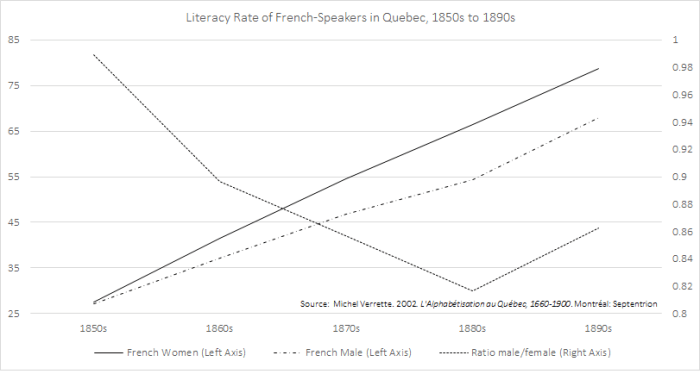
For most of history, men tended to be more literate than women. In essence, illiteracy was widespread but even more so for women. There is one exception: the French-Canadians. For most of the 19th century, literacy rates were greater for French-Canadian women than French-Canadian men.

literacy

This is a fascinating piece of economic history and somewhat of a puzzle (given that it is an oddity). It also shows how important institutions are to determining paths of development. In a 1999 article in the Journal of Economic History, Gillian Hamilton indicates that the more “liberal” institution of marriage contracts for the French-Canadians probably induced this result :

Quebec’s unique legal institutions offered the opportunity to draw up a prenuptial contract to couples who could benefit from a different property structure than the law provided. Not surprisingly, a prenuptial contract was unnecessary for most couples. Within this transaction cost-competitive marriage market framework, contracts generally were desirable only in cases of mismatch, either due to an exceptional woman or a relatively productive husband whose job did not entail a significant component of family participation. Their contracting decisions are consistent with terms that would have provided them with more appropriate incentives for work and the production of jointly produced goods, and at least the potential for greater utility and wealth than they otherwise would have accumulated. The use of contracts likely provided Quebec with higher overall wealth and a wider income distribution than it would have experienced without contracts (because the skilled disproportionately signed agreements).


How much has Cuban productivity increased since 1960?

Is it possible for two equally rich countries (on a per capita basis) to have different level of output per worker? The answer is obviously yes, and it matters in the case of measuring growth in Cuba since the revolution.

A country with a very young population will tend to have fewer workers than one with an older (but not too old) population. Let’s say that countries A and B have a median age of 22.5 in year one.  However, in year ten, country A has a median age of 35 but country B has seen a more modest increase to a median age of 25. This will bias any estimates of growth comparison between both country. The increase in the median age suggests that there are more and more workers in country A (people of prime age) than in country B. As a result of that, output per capita will increase faster in country A than in country B even if both countries have equal rates of growth in output per worker.

Well, countries A and B are basically Cuba and most of the rest of Latin America. Since the 1950s, Cuba’s population has aged rapidly but birth rates have plummeted so fast that families shrunk. With fewer kids in the population, it means that the share of the Cuban population that are of prime working age increased rapidly. This is what biases the comparison of Cuban living standards with other Latin American countries.

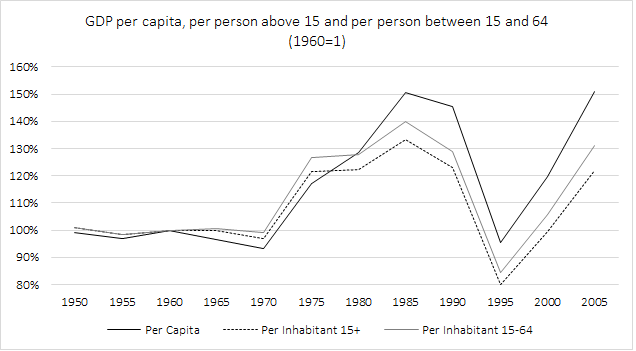
In the figure below, I took the GDP (the Maddison data) of Cuba since 1950 (indexed at 1960 to see the arrival of Castro) and divided it by the total population, the population above 15 years of age and the population between 15 and 64.

cubagdp

As one can see, with the GDP per capita series, Cubans saw a 50% increase in their incomes between 1960 and 2005 (the Maddison data stops at 2008). However, when you look at GDP per working age adult in order to capture the growth in productive capacity, you get moderately different results whereby the cumulative increase is three-fifths to half as small.

In light of this, it seems like Cuba’s living standards are less and less impressive.

On Tax Resistance, Censuses and the Cliometrician’s Craft

In the process of finalizing another research article (under revise and resubmit for Agricultural History), I found a small case of tax resistance in Canada East (modern day Quebec) in 1851  that is interesting.

The district of Grenville, northwest of Montreal, was an ethnically mixed district (25% French, the rest were English-Canadians) operating under the British freehold tenure system (as opposed to most of the rest of the province that operated under French seigneurial tenure). During the 1851 census, the enumerator complained that the population of roughly 2,000 inhabitants refused to report statistical information.

Basically, the enumerator pointed out that the majority supposed the information they were giving was “the precursor of a general tax for schools which they are strongly opposed to”.

tax-resistance-in-the-censuses

I find this to be interesting because it is a nice little case of how hard to master the craft of an economic historian. As a cliometrician, my task is to find the best data possible to answer historical questions with strong economic theory (while enriching theory with historical evidence). The data for that area would be biased downwards as peasants would understate their incomes to avoid being heavily taxed. Any statistical test to assert the applicability of a theory to historical questions of Canada (or Quebec) would be altered by this reaction on the part of peasants.

True, for some broad questions (like measuring GDP), this would not be too dramatic an issue. However, for more specific questions like “what was the role of tenure systems in explaining Quebec’s relative poverty”, the issue would be more problematic.

How much do the little things matter, right?

Is Trump So Old? Its all relative really!

Today is inauguration day. Donald Trump will officially be the 45th President of the United States of America. Many have pointed out that Trump is the oldest president (slightly above 70 years of age). I disagree.

Old is not a “purely” absolute concept. Advances in living standards mean advances in our ability to live longer lives. Not only do we live longer lives than in the past, but at any point in our life, our health is better. Someone who reached 65 years of age in 1900 probably did not have the same health prospects as someone who reaches that age today. Basically, the “quality” of old age has increased over time (see this great book on the economic history of aging). So, when people say “old”, I ask “old as compared to what”.

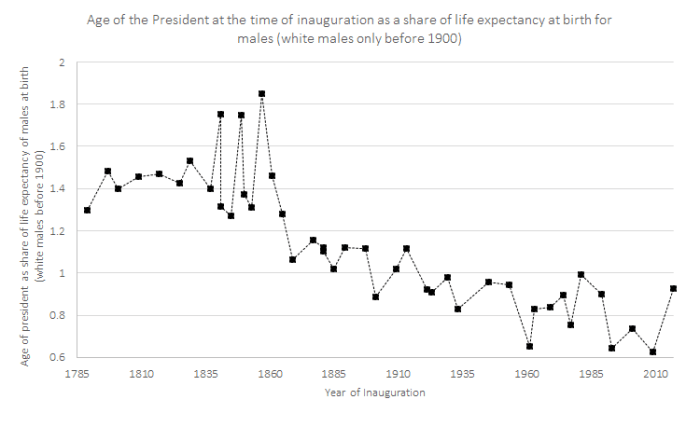
To meet that test, I took the CDC data on life expectancy as well as soon historical database  from 1900 to today. I combined it with David Hacker’s work on life tables in the US from 1790 to 1900 which can be found in this article of Historical Methods.  Hacker’s data concerns only the white population. I took only the age expectancy at birth of males. Then, I plotted the age of the president at the time of inauguration as a share of the life expectancy at birth (E0). This is the result:

inauguration

As one can see, the age of presidents as a share of life expectancy is falling steadily since the early 1900s. In this light, Donald Trump is not the oldest president. In fact, the oldest president is …. drumroll…James Buchanan (1.85 times the life expectancy of white males at birth). Moreover, in this light, the youngest president at inauguration is not Teddy Roosevelt (Kennedy was the youngest elected). Rather, the youngest is Barack Obama followed very closely by Bill Clinton and John F. Kennedy.

I find this post to be interesting as it shows something more important in my eyes: how the poorest in society have done. Presidents have generally stemmed from the top of the income distribution. Over time, the ages of presidents at inauguration (in absolute terms) has not followed any clear trend. The drop seen in the graph above is entirely driven by increases in the life expectancy of the “average” American. In a certain way, it shows that the distance between that “Joe the Plumber” and the “Greatest Man in America” (huh…Lord Acton anyone?) seems to be diminishing over time.

The Pox of Liberty – dixit the Political Economy of Public Health

9780226922171

A few weeks ago, I finished reading the Pox of Liberty authored by Werner Troesken. Although I know some of his co-authors personally (notably the always helpful Nicola Tynan whose work on water economics needs to be read by everyone serious in the field of economic history – see her work on London here), I never met Troesken. Nonetheless, I am what you could call a “big fan” in the sense that I get a tingling feeling in my brain when I start reading his stuff. This is because Troesken’s work is always original. For example, his work on the economic history of public utilities (gas and electricity) in the United States is probably one of the most straightforward application of industrial organization to historical questions and, in the process, it kills many historical myths regarding public utilitiesThe Pox of Liberty is no exception and it should be read (at the risk of become a fan of Troesken like I am) as a treatise on the political economy of public health.

Very often, it will be pointed out that public health measures are public goods that government should provide lest it be “underprovided” if left to private actors. After all, it is rare to hear of individuals who voluntarily quarantined themselves upon learning they were sick. As a result, the “public economics” argument is that the government should mandate certain measures (mandatory vaccination and quarantine) that will reduce infectious diseases. Normally, the story would end there. And to be sure, there is a lot of evidence that mild coercive measures do reduce some forms of mortality (mandatory vaccination and quarantine). The more intense the policies, the larger the positive effects on health outcomes. For example, taxes on cigarettes do reduce consumption of cigarettes and thus, secondhand smoke. In fact, even extreme coercive measures like smoking bans seem to yield improvements in terms of public health (another example is that of Cuba which I discussed on this blog).

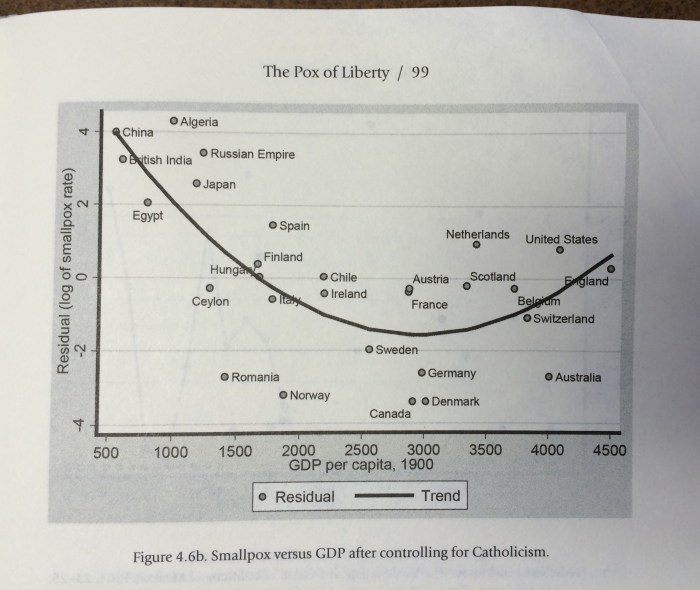
However, Troesken’s contribution is to tell us that the story does not end there. In a way, the “public economics” story is incomplete. The institutions that are best able to deploy such levels of coercion are generally also the institutions that are unable to restrain political meddling in economic affairs. Governments that are able to easily deploy coercive measures are governments that tend to be less constrained and they can fall prey to rent-seeking and regulatory capture. They will also tend to disregard property rights and economic freedom. This implies slower rates of economic growth. As a result, there is a trade-off that exists: either you get fast economic growth with higher rates of certain infectious diseases or you get slow economic growth with lower rates of certain infectious diseases (Troesken concentrates mostly on smallpox and yellow fever). The graphic below illustrates this point of Troesken. Countries like Germany – with its strong centralizing Prussian tradition – were able to generate very low levels of deaths from infectious diseases. But, they were poorer than the United States. The latter country had a constitutional framework that limited the ability of local and state governments to adopt even mild measures like mandatory vaccination. Thus, that meant higher mortality levels but the same constitutional constraints permitted economic growth and thus the higher level of living standards enjoyed by Americans relative to the Germans.

fullsizerender

But Troesken’s story does not end there.  Economic growth has some palliative health effects (in part the McKeown hypothesis*) whereby we have a better food supply and access to better housing or less demanding jobs. However, in the long-run economic growth means that new sectors of activity can emerge. For example, as we grow richer, we can probably expend more resources on drugs research to extend life expectancy. We can also have access to more medical care in general.  These fruits take some time to materialize as they grow more slowly. Nonetheless, they do form a palliative effect that contributes to health improvements.

However, there is an analogy that allows us to see why these palliative effects are important in any political economy of public health provision. This analogy relates to forestry. The health outcomes fruits from a “coercive institutional tree” can only be picked once. Once they are picked, the tree will yield no more fruits.  However, the yield from that single harvest is considerable. In comparison, the “economic growth tree” yields fewer and smaller fruits, but it keeps yielding fruits. It never stops yielding fruits. In the long-run, that tree outperforms the other tree. The problem is that you cannot have both trees. If you chose one, you can’t have the other.

In this light, public health issues become incredibly harder to decipher and understand. However, we can see a much richer wealth of information under this light. In writing the Pox of Liberty, Troesken is enlightening and anyone doing health economics should read (and absorb his work) as it is the first comprehensive treatise of the political economy of public health.


* I should note that I think that the McKeown hypothesis is often unfairly lambasted and although I have some reservations myself, it can be adapted to fit within a wider theoretical approach regarding institutions – like Troesken does. 

From the Comments: Ottoman autocracy, Turkish liberty

Jacques, if you want to look at a libertarian/classical liberal case for the Ottoman Empire you should look at Islam without Extremes (Norton 2013) by Mustafa Akyol. I can’t claim to have got round to reading it myself, but I have seen Akyol’s summaries of his argumnents.

The power of Akyol’s argument in term of Turkey’s political scene has been somewhat undermined by his support for the AKP governemnt until after the Gezi Park protests. He is very critical of the AKP now, but as he was previously known as an AKP apologist (and enthusiast for Intelligent Design theory) it’s doubtful how much of an asset he is to Turkey’s rather small pro-liberty scene.

In any case I do not endorse myself straight on Ottomanist libertarianism and there are reasons it does not have much of a hold in Turkey’s pro-liberty scene though there are a few who think like this. The problems are endless and complex because the Ottoman system lasted from the 14th to 20th centuries and you can’t really talk about the same system, or at least few historians think you can. The millet system is a term applied late in Ottoman history, while the system was at its peak in terms of the size of the empire, along with it general prestige in the world, in the sixteenth century. Of course at that time, it could be said to have established some version of some liberty with order as good as many Christian states, and to me more power ful than any. I don’t think even at its height though you could say the Ottoman empire had more liberty than the most law governed and tolerant places in ‘Christendom’ and certainly while European thinkers respect the Ottoman system at its height it very much looked like an example of strong orderly monarchy, not decentralised liberty.

Even at its peak the Ottoman system obliged Balkan Christian families to send one son away at a very early age to be brought up as Muslim convert soldier-bureaucrat slave of the Sultan. The Janissary system, a very privileged kind of slavery and forced conversion, but that is what it was. The Sultan employed black eunuch slaves, transported from Africa, again a privileged position but not really an example of liberty.

Jumping forward, the Ottoman system started to imitate the west in some respects from the late eighteenth century, following military defeats to Russia. The biggest act of ‘reform’ was the violent repression/massacre of the Janissaries which formed a whole class of soldiers, bureaucrats and Istanbul firemen who were also market traders on the side, blocking the Sultan’s ideas of reform, including the formation of a more modern military.

Jumping forward again, the Ottoman sultan most revered by Turkey’s current Ottomanists on the whole, Abdulhamit II, suspended the national assembly, pursued a program of bureaucratic-military-technical centralisation, which included the early massacres of Armenians to which you refer. In the end he was overthrown as a ruker (not as holder of the title of Sultan) by westernising reformers (Committee of Union and Progress/Young Turks) who ended up continuing a centralising reform process which alienated people outside the Muslim Ottoman elite and the Anaotlian heartlands of the Empire. Jumping back to the period between the suppression of the Janissaries and Abdulhamit II’s rule, the Greek Independence movement was resisted with staggering levels of violence and cruelty (the Greek insurgents were not always fastidious in their methods either, it must be also be said). By the nineteenth century, the Ottoman system of relative tolerance towards non-Muslims on a communal rights basis was looking less impressive compared with a growing European tendency towards tolerance based on individual rights.

The ‘millet system’ at its peak provided a way Muslims, Christians and Jews could live together, but mostly as separate communities able to continue communal traditions, within a hierarchy in which Muslims had the real power. As with looking to models of liberty in ‘feudal’, medieval Europe, we may see some liberty benefits in the elements of localism and communal autonomy under a monarchy, but in both cases we are not talking about a system of individual rights or free interaction, we are talking about individuals constrained by communal traditions and hierarchies, along with the hierarchies between communities. If we value individual rights under common legal rights then this is not a model for us, even if we can see some lessons.

Even at its peak the Ottoman system blocked the spread of printing, one of the major elements of modern liberty. The reasons for the block combine the power of religious conservatism and the guild interests of manuscript copyists which seems to me to sum up the problems of even peak time Ottomanism for liberty. It was a system based on an assemblage of local, communal and guild privileges finding change difficult except through dramatic acts of autocratic rulers. The transition from Empire to French-modeled republic, but less liberal than the France of the time, in the 20s and 30s under Atatürk was itself the last great example of this and was a product of the difficulties the Ottoman system had with peaceful consensual change, even if it did have a few good moments on that score (e.g. the 1840 Tanzimat reforms).

Finally the Ottoman system was condemned by its own failure to defend itself, the last Sultan could only give into the victorious powers of World War One, while the republican-nationalists, who emerged from the most educated sections of the Ottoman elite, were able to mobilse a successful military struggle (the Independence War) even without control of the state apparatus. A system which can’t win a war is not a successful system, regardless of how sad the importance of war in human history is.

Arguments now about reviving the Ottoman Empire are surely self-evidently hypothetical only for anyone who does not take Erdoğan’s more bombastic statements seriously. In what way would the Middle East resolve anything by rule from Istanbul, particularly as part of a centralised state ruled by Erdoğan? If the question is should the Ottoman Empire have been prolonged at the end of World War One, the Ottoman government of the war undermined that possibility by massacres of Arabs, along with the leaders Faisal gave to Arab nationalists, aided by devious British and French policy.

The Ottoman Empire was in the Balkans before it was in the Middle East. Ottoman sultans used the title Kaiser-i rum (Emperor of Rome) after the Fall of Constantinople before they adopted the title of Caliph (leader of the faithful) after the later conquest of the Hezaz (i.e. the region containing Mecca and Medina). There is nothing natural or inevitable about a Turkey leaning predominantly towards the Middle East and nothing inherently desirable about Beirut, Amman, Riyadh, Damascus, etc coming under the dominance of Turks; there is nothing obviously healing for Arab Shiite Muslims in living under a Sunni Caliph in a palace on the Bosphorus, not now and not in 1919.

Ottomanist libertarianism makes most sense for those inclined to paleolibertarianism based on dispersal of power between homogenous traditionalist localised communities. I don’t see it has so much to offer to other kinds of libertarian. If we think about more modern liberal forms, there was some interest in Britsh style liberalism (already at that time in transition from classical liberalism to left liberalism) amongst the last Ottomans, most notably Prince Sabahattin, but this was a minority within a weakened elite, discredited by collaboration with British occupation at the end of World War One, which never had anything like a politics capable of mobilising the elite (very influenced by French republicanism politically and intellectually by the sociological expression of French republicanism in the work of Emile Durkheim), never mind the population as a whole.

(Yes Brandon I should be posting this kind of thing, in refined and revised form, but I really don’t have time to do this properly at present, believe me I really am in extreme crisis mode with writing/editing deadlines), after a particularly busy semester, believe me I will be posting when I can, and I should be able to manage within the next few months, sorry I can’t say any more than that, but it is the reality.)

This is from Barry Stocker, responding to Jacques’ musings on the Ottoman Empire and libertarian arguments that are sometimes in favor of it. The rest of the thread is pretty good too, though Dr Delacroix has yet to respond…

Ten best papers/books in economic history of the last decades (part 2)

Yesterday, I published part 1 of what I deemed were the best papers and books in the field of economic history of the last few decades. I posted only the first five and I am now posting the next five.

  • Carlos, Ann M., and Frank D. Lewis. Commerce by a frozen sea: Native Americans and the European fur trade. University of Pennsylvania Press, 2011.

This book is not frequently cited (only 30 cites according to Google Scholar), but it has numerous gems for scholars to include in their future work. The reason for this is that Carlos and Lewis have pushed the frontier of economic history into the history of Natives in the New World. This issue of Natives in North America is one of those topics that irritates me to no end as an economic historian. A large share of the debates on economic growth in the New World have been centered on the idea that there was either some modest growth (less than 0.5% per year in per capita income) or no growth at all (which is still a strong testimonial given that the population exploded). But all that attention centres on comparing “whites” (and slaves) in the New World with everyone in the Old World. In the first decades of the colonies of Canada and the United States, aboriginals clearly outnumbered the new settlers (in Canada, the native population around 1736 was estimated at roughly 20,000 which was slightly less than the population of Quebec – the largest colony). Excluding aboriginals, who comprised such a large share of the population, at the starting point will indubitably affect the path of growth measured thereafter. My “gut feeling” is that anyone who includes natives in GDP accounting will lower the starting point dramatically. That will increase the rate of long-term growth. Additionally, the output that aboriginals provided was non-negligible and probably grew more rapidly than their population (the rising volume of furs exported was much greater than their population growth). This is why Carlos and Lewis’s work is so interesting: because it is essentially the first to assemble economic continuous time series regarding trade between trappers and traders, the beaver population, property rights and living standards of natives. From their work, all that is needed is a few key defensible assumptions in order to include natives inside estimates of living standards. From there, I would not be surprised that most estimates of growth in the North American colonies would be significantly altered and the income levels relative to Europe would also be altered.

  • Floud, Roderick, Robert W. Fogel, Bernard Harris, and Sok Chul Hong. The changing body: Health, nutrition, and human development in the western world since 1700. Cambridge University Press, 2011.

This book is in the list because it is a broad overview of the anthropometric history that has arisen since the 1980s as a result of the work of Robert Fogel. I put this book in the list because the use of anthropometric data allows us to study the multiple facets of living standards. For long, I have been annoyed at the idea of this unidimensional concept of “living standards” often portrayed in the general public (which I am willing to forgive) and the economics profession (which is unforgivable). In life, everything is a trade-off.  A peasant who left the countryside in the 19th century to get higher wages in a city manufacture estimated that the disamenities of the cities were not sufficient to offset wage gains (see notably Jeffrey Williamson’s Coping with City Growth during the British Industrial Revolution on this). For example, cities tended to have higher food prices than rural areas (the advantage of cities was that there were services no one in the countryside could obtain).  Cities were also more prone to epidemics and pollution implied health costs. Taken together, these factors could show up in the biological standard of living, notably on heights. This is known as the “Antebellum puzzle” where the mean heights of individuals in America (and other countries like Canada) fell while there was real income and wage growth. The “Antebellum puzzle” that was unveiled by the work of Fogel and those who followed in his wake represents the image that living standards are not unidimensional. Human development is about more than incomes. Human development is about agency and the ability to choose a path for a better and more satisfying life. However, with agency comes opportunity costs. A choice implies that another path was renounced. In the measurement of living standards, we should never forget the path that was abandoned. Peasants abandoned lower rates of infant mortality, lower overall rates of mortality, the lower levels of crowding and pollution, the lower food prices and the lower crime rates of the countryside in favor of the greater diversity of goods and services, the higher wages, the thicker job market, the less physically demanding jobs and the more secure source of income (although precarious, this was better than the volatile outcomes in farming). This was their trade-off and this is what the anthropometric literature has allowed us to glean. For this alone, this is probably the greatest contribution in the field of economic history of the last decades.

  • De Vries, Jan. The industrious revolution: consumer behavior and the household economy, 1650 to the present. Cambridge University Press, 2008.

Was there an industrious revolution before the industrial revolution? More precisely, did people increase their labour supply during the 17th and 18th centuries which lead to output growth? In proposing this question, de Vries provided a theoretical bridge of major significance between the observations of wage behavior and incomes in Europe during the modern era. For example, while wages seemed to be stagnating, incomes seemed to be increasing (in the case of England as Broadberry et al. indicated). The only explanation is that workers increased their labor supply? Why would they do that? What happened that caused them to increase the amount of labor they were willing to supply? The arrival of new goods (sugar, tobacco etc.) caused them to change their willingness to work. This is a strong illustration of how preferences can change more or less rapidly (when new opportunities are unveiled). In fact, Mark Koyama (who blogs here) managed to insert this narrative inside a very simple restatement of Gary Becker’s model of time use. Either you have leisure that is cheap but time-consuming (think of leisure in the late middle ages) or leisure that is more expensive but does not consume too much time (think the consumption of tea, sugar and tobacco). Imagine you only have the time-expensive leisure which you value at level X. Now, imagine that the sugar and tea arrive and, although you pay a higher price, it provides more utility than the level and it takes less time. In such a context, you will likely change your preferences between leisure and work. I am grossly oversimplifying Mark’s point here, but the idea is that the industrious revolution argument advanced by de Vries can easily fit inside a simple neoclassical outlook. On top of solving many puzzles, it also shows that one does not need to engage in some fanciful flight of Marxian theory (I prefer Marxian to Marxist because it is one typo away from being Martian which would adequately summarize my view of Marxism as a social theory). If it fits inside the simpler model, then you don’t need the rest.  De Vries does just that.

  • Anderson, Terry Lee, and Peter Jensen Hill. The not so wild, wild west: Property rights on the frontier. Stanford University Press, 2004.

Governance is not the same as government (in fact, they can be mutually exclusive). In recent years, I have been heavily influenced by Elinor Ostrom’s work on how communities govern the commons in very subtle (but elaborate) ways without the use of coercion. These institutional arrangements are hard to simplify into one variable for a regression, but they are theoretically simple to explain: people respond to incentives. Ostrom’s entire work shows that people on the front line of problems generally have the best incentives to get the right solution because they have skin in the game. What her work shows is that individuals govern themselves (see also Mike Munger’s Choosing in Groups) by generating micro-institutions that allow exchanges to continue. Terry Anderson and Peter Hill provide the best illustration in economic history in that regard by studying the frontier of the American west. Settlers moved to the American West faster than the reach of government and the frontier was thus an area more or less void of government action. So, how did people police themselves? Was it the wild west? No, it was not. Private security firms provided most of the policing, mining clubs established property rights without the need for government, farmers established constitutions in voluntary associations that they formed and many “public goods” were provided privately. The point of Anderson and Hill is that governance did exist on the frontier in a way that demonstrates the ability of voluntary actions (as opposed to coercive government actions) to generate sustainable and efficient solutions. The book has a rich theoretical framework on top of a substantial body of evidence regarding the emergence of institutions. Any good economic historian should own and read this book.

  • Vedder, Richard K., and Lowell E. Gallaway. Out of work: unemployment and government in twentieth-century America. NYU Press and Independent Institute, 1997.

The last book on the list is an underground classic for me. Richard Vedder and Lowell Gallaway are very good economic historians. It was produced like many other underappreciated classics (like Higgs’s Crisis and Leviathan) by the Independent Institute (see their great book list here). Most of their output was produced from the 1960s to the 1980s. However, as the 1990s came, they moved towards the Austrian school of Economics. With them, they brought a strong econometric knowledge – a rarity among Austrian scholars. They attempted one of the first (well-regarded) econometric studies that relied on Austrian theory of the labor-market (a mixture of New Classical Theory with Austrian Theory). Their goal was to explain variations in unemployment in the United States by variations in “adjusted real wages” (i.e. unit labor costs) all else being equal. At the time of the publication, they used very advanced econometric techniques. The book was well received and even caught the attention of Brad DeLong who disagreed with it and debated Vedder and Gallaway in the pages of Critical Review. Although there are pieces that I disagree with, the book has mostly withstood the test of time. The core insights of Out of Work regarding the Great Depression (and many of its horrible policies like the National Industrial Recovery Act) have been conserved by many like Scott Sumner in his Midas Paradox and they feature prominently in the works of scholars like Lee Ohanian, Harold Cole, Jason Taylor, Price Fishback, Albrecht Ristchl and others. In the foreword to the book, they mention that D.N. McCloskey (then the editor of the Journal of Economic History) had pushed hard for them to publish their work regarding the 1920s and 1930s. McCloskey was right to do so as many of their contentions are now accepted as a legitimate (if still debated) viewpoint. The insights regarding the “Great Depression of 1946” (a pun to ridicule the idea that the postwar reduction in government expenditures led to a massive reduction in incomes) have been generally conserved by Robert Higgs in his Journal of Economic History article I mentioned yesterday (and in this article as well) and even by Alexander Field in his Great Leap Forward However, Out of Work remains an underground classic that is filled with substantial pieces of information and data that remains unused. There are numerous unexploited insights (some of which Vedder and Gallaway have followed on) as well. The book should be mandatory reading for any economic historian.

Ten best papers/books in economic history of the last decades (part 1)

In my post on French economic history last week,  I claimed that Robert Allen’s 2001 paper in Explorations in Economic History was one of the ten most important papers of the last twenty-five years. In reaction, economic historian Benjamin Guilbert asked me “what are the other nine”?

As I started thinking about the best articles, I realized that such a list is highly subjective to my field of research (historical demography, industrial revolution, great divergence debate, colonial institutions, pre-industrial Canada, living standards measurement) or some of my personal interests (slavery and the great depression). So, I will propose a list of ten papers/works that need to be read (in my opinion) by anyone interested in economic history. I will divide this post in two parts, one will be published today, the other will come out tomorrow.

  • Higgs, Robert. “Wartime Prosperity? A Reassessment of the US Economy in the 1940s.” Journal of Economic History 52, no. 01 (1992): 41-60.

Higgs’s article (since republished and expanded in a book and in follow-ups like this Independent Review article) is not only an important reconsideration of the issue of World War II as a causal factor in ending the Great Depression, it is also an efficient primer into national accounting. In essence, Higgs argues that the war never boosted the economy. Like Vedder and Gallaway, he argues that deflators are unreliable as a result of price controls. However, he extends that argument to the issue of measuring GDP. In wartime, ressources are directed, not allocated by exchange. Since GDP is a measure of value added in exchanges, the wartime direction of resources does not tell us anything about real production. It tells us only something about the government values. As a result, Higgs follows the propositions of Simon Kuznets to measure the “peacetime concept” of GDP and finds that the prosperity is overblown. There have been a few scholars who expanded on Higgs (notably here), but the issues underlined by Higgs could very well apply to many other topics.  Every year, I read this paper at least once. Each time, I discover a pearl that allows me to expand my research on other topics.

  • Allen, Robert C. The British industrial revolution in global perspective. Cambridge: Cambridge University Press, 2009.

I know I said that Allen’s article in Explorations was one of the best, but Allen produces a lot of fascinating stuff. All of it is generally a different component of a “macro” history. That’s why I recommend going to the book (and then go to the article depending on what you need). The three things that influenced me considerably in my own work were a) the use of welfare ratios, b) the measurement of agricultural productivity and c) the HWE argument. I have spent some time on items A and C (here and here). However, B) is an important topic. Allen measured agricultural productivity in England using population levels, prices and wages to proxy consumption in a demand model and extract output from there (see his 2000 EREH paper here). As a result, Allen managed to compare agricultural productivity over time and space. This was a great innovation and it is a tool that I am looking to important for other countries – notably Canada and the US. His model gives us the long-term evolution of productivity with some frequency. In combination with a conjonctural estimate of growth and incomes or an output-based model, this would allow the reconstruction (if the series match) of a more-or-less high frequency dataset of GDP (from the perspective of an economic historian, annual GDP going back into the 17th century is high-frequency). Anyone interested in doing the “dirty work” of collecting data, this is the way to go.

  • Broadberry, Stephen, Bruce MS Campbell, Alexander Klein, Mark Overton, and Bas Van Leeuwen. British economic growth, 1270–1870. Cambridge University Press, 2015.

On this one, I am pretty biased. This is because Broadberry (one of the authors) was my dissertation supervisor (and a pretty great one to boot). Nonetheless, Broadberry et al. work greatly influenced my Cornucopian outlook on the world. Early in my intellectual development, I was introduced to Julian Simon’s work (see the best of his work here and here and Ester Boserup whose argument is similar but more complex) on environmental trends. While Simon has generally been depicted as arguing against declining environmental indicators, his viewpoint was much broader. In essence, his argument was the counter-argument to the Malthusian worldview. Basically, Malthusian pressures caused by large populations which push us further down the curve of marginally declining returns have their countereffects. Indeed, more people means more ideas and ideas are non-rival inputs (i.e. teaching you to fish won’t make me unlearn how to fish). In essence, rising populations are no problems (under given conditions) since they can generate a Schumpeterian countereffect (more ideas) and a Smithian countereffect (size of market offsets). In their work, Broadberry et al. basically confirm a view cemented over the last few decades that England had escaped the Malthusian trap before the Industrial Revolution (see Crafts and Mills here and Nicolinni here). They did that by recreating the GDP of Britain from 1270 to 1870. They found that GDP per capita increased while population increased steadily which is a strong piece of evidence. In their book, Broadberry et al. actually discuss this implication and they formulate the Smithian countereffect as a strong force that did offset the Malthusian pressures. Broadberry and al. should stand in everyone’s library as the best guidebook in recreating long-term historical series in order to answer the “big questions” (they also contribute to the Industrious Revolution argument among many other things).

  • Chilosi, David, Tommy E. Murphy, Roman Studer, and A. Coşkun Tunçer. “Europe’s many integrations: Geography and grain markets, 1620–1913.” Explorations in Economic History 50, no. 1 (2013): 46-68.

Although it isn’t tremendously cited yet, this is one of the best article I have read (and which is also recounted in Roman Studer’s Great Divergence Reconsidered). This is because the paper is one of the first to care about market integration on a “local” scale. Most studies of market integration consider long-distance trade for grains and they generally start with the late 19th century which is known as the first wave of globalisation. However, from an economic historian perspective, this is basically studying things once the ball had already started rolling.  Market integration is particularly interesting because it is related to demographic outcomes. Isolated markets are vulnerable to supply shocks. However, with trade it is possible to minimize shocks by “pooling” resources. If village A has a crop failure, prices will rise inciting village B where there was an abundant crop to sell wheat to village A. In the end, prices in village A will drop (causing fewer deaths from starvation) and increase in village B. This means that prices move in a smoother fashion because there are no localized shocks (see the work of my friend Pierre Desrochers who argues that small local markets were associated for most of history with high mortality risks). In their work, Chilosi et al. decide to consider the integration of markets between villages A and B rather than between country A and B. Basically, what they wonder is when geographically close areas became more integrated (i.e. when did Paris and Bordeaux become part of the same national market?). They found that most of Europe tended to be a series of small regions that were more or less disconnected from one another. However, over time, these regions started to expand and integrate so that prices started moving more harmoniously. This is an important development that took place well before the late 19th century. In a way, the ball of market integration started rolling in the 17th century. Put differently, before globalization, there was regionalization. The next step to expand on that paper would be to find demographic data for one of the areas documented by Chilosi et al. and see if increased integration caused declines in mortality as markets started operating more harmoniously.

  • Olmstead, Alan L., and Paul W. Rhode. Creating Abundance. Cambridge Books (2008).

This book has influenced me tremendously. Olmstead and Rhode contribute to many literatures simultaneously. First of all, they show that most of the increased in cotton productivity in the United States during the antebellum era came from crop improvements. Secondly, they show that these improvements occured with very lax patents systems. Thirdly, they show how crucial biological innovations were in determining agricultural productivity in the United States (see their paper on wheat here and their paper on induced innovation). On top of being simply a fascinating way of doing agricultural history (by the way, most economic history before 1900 will generally tend to be closely related to agricultural history), it forces many other scholars to reflect on their own work. For example, the rising cotton productivity explains the rising output of slavery in the antebellum south. Thus, there is no need to rely on some on the fanciful claims that slaveowners became more efficient at whipping cotton out of slaves (*cough* Ed Baptist *cough*). They also show that Boldrine and Levine are broadly correct in stating that most types of technological innovations do not require extreme patents like those we know today (and which are designed to restrict competition rather than promote competition). In fact, their work on biological innovations have pretty much started a small revolution in that regard (see one interesting example here in French). Finally, they also invalidated (convincingly in my opinion) the induced innovation model that generally argued that technologies are developped merely to ease scarcities of factors. While theoretically plausible, this simplified model did not fit many features of American economic history. Their story of biological innovations is an efficient remplacement.

Stock markets and economic growth: from Smoot-Hawley to Donald Trump

In a recent article for the Freeman, Steve Horwitz (who has the great misfortune of being my co-author) argued that stock markets tell us very little about trends in economic growth. Stock markets tell us a lot about profits, but profits of firms on the stock market may be higher because of cronyism. Basically, that is Steve’s argument. He applies this argument in order to respond to those who say that a soaring stock market is the proof that Donald Trump is “good” for the economy.

I know Steve’s article was published roughly a month ago, so I am a little late. But I tend to believe it is never too late to talk about economic history. And basically, its worth pointing out that there are economic history examples to show Steve’s point. In fact, its the best example: Smoot-Hawley.

Bernard Beaudreau from Laval University has advanced, for some years, an underconsumptionist view of the Great Depression (I consider it a “dead theory”). While I am highly unconvinced by this theory (in both its original and current “post-keynesian” reformulation), Beaudreau tries hard to resurrect the theory (see here and here) and merits to be discussed. In the process, Beaudreau attempted to reestimated the effects of of Smoot-Hawley on the stock market with an events study. Unconvinced about the rest of his research, this is a clear instance of sorting the wheat from the chaff. In this case, the wheat is his work (see here for his article in Essays in Economic and Business History) on Smoot-Hawley.

Basically, Beaudreau found that good news regarding the probability of the adoption of the tariff bill actually pushed the stock market to appreciate. Thus, Smoot-Hawley -which had so many negative macroeconomic ramifications* – actually boosted the stock market. Firms that gained from the rising tariffs actually saw greater profits for themselves and thus the firms on the stock market would have been excited at the prospect of restricting their competitors. If that is true, could it be that Donald Trump is the modern equivalent (for the stock market) of Smoot-Hawley.

*NDLR: I believe that Allan Meltzer was right in saying that the Smoot-Hawley might have had monetary ramifications that contributed to the money supply collapse. It was a real shock that precipitated the collapse of weak banks which then caused a nominal shock and then the sh*t hit the proverbial fan.

On 19th Century Tariffs & Growth

A few days ago, Pseudoerasmus published a blog piece on Bairoch’s argument that in the 19th century, the countries that had high tariffs also had fast growth.  It is a good piece that summarizes the litterature very well. However, there are some points that Pseudoerasmus eschews that are crucial to assessing the proper role of tariffs on growth. Most of these issues are related to data quality, but one may be the result of poor specification bias. For most of my comments, I will concentrate on Canada. This is because I know Canada best and that it features prominently in the literature for the 19th century as a case where protection did lead to growth. I am unconvinced for many reasons which will be seen below.

Data Quality

Here I will refrain my comments to the Canadian data which I know best. Of all the countries with available income data for the late 19th century, Canada is one of those with the richest data (alongside the UK, US and Australia). This is largely thanks to the work of M.C. Urquhart who recreated the Canadian GNP series fom 1870 to 1926 in collaborative effort with scholars like Marvin McInnis, Frank Lewis, Marion Steele and others.

However, even that data has flaws. For example, me and Michael Hinton have recomputed the GDP deflator to account for the fact that its consumption prices component did not include clothing. Since clothing prices behaved differently than the other prices from 1870 to 1885, this changes the level and trend of Canadian incomes per capita (this paper will be completed this winter, Michael is putting the finishing touch and its his baby).  However, like Morris Altman, our corrections indicate a faster rate of growth for Canada from 1870 to 1913, but in a different manner. For example, there is more growth than believed in the 1870-1879 period (before the introduction of the National Policy which increased protection) and more growth in the 1890-1913 period (the period of the wheat boom and of easing of trade restrictions).

Moreover, the work of Marrilyn Gerriets, Alex Chernoff, Kris Inwood and Jim Irwin (here, here, here, here) that we have a poor image of output in the Atlantic region – the region that would have been adversely affected by protectionism. Basically, the belief is a proper accounting of incomes in the Atlantic provinces would show lower levels and trends that would – at the national aggregated level – alter the pattern of growth.

I also believe that, for Quebec, there are metrological issues in the reporting of agricultural output. The French-Canadians tended to report volume units in manners poorly understood by enumerators but that these units were larger than the Non-French units. However, as time passed, census enumerators caught on and got the measures and corrections right. However, that means that agricultural output from French-Canadians was higher than reported in the earlier census but that it was more accurate in the later censuses. This error will lead to estimating more growth than what actually took place. (I have a paper on this issue that was given a revise and resubmit from Agricultural History). 

Take all of these measurements issue and you have enough doubt in the data underlying the methods that one should feel the need to be careful. In fact, if the sum of these (overall) minor flaws is sufficient to warrant caution, what does it say about Italian, Spanish, Portugese, French, Belgian, Irish or German GDP ( I am not saying they are bad, I am saying that I find Canada’s series to be better in relative terms).

How to measure protection?

The second issue is how to measure protection. Clemens and Williamson offered a measure of import duties revenue over imports volume. That is a shortcut that can be used when it is hard to measure effective protection. But, it may be a dangerous shortcut depending on the structure of protection.

Imagine that I set an import duty so high as to eliminate all entry of the good taxed (like Canada’s 300% import tax on butter today). At that level, there is zero revenue from butter import and zero imports of butter. Thus, the ratio of protection is … zero. But in reality, its a very restrictive regime that is not being measured.

More recent estimates for Canada produced by Ian Keay and Eugene Beaulieu (in separate papers, but Keay’s paper was a conference paper) attempted to measure more accurate indicators of protection and the burden imposed on Canadians. Beaulieu and his co-author found that using a better measure, Canada’s trade policy was 11% more restrictive than believed. Moreover, they found that the welfare loss kept increasing from 1870 to 1890 – reaching a figure equal to roughly 1.5% of GDP (a non-negligible social cost).

It ought to be noted though that alongside Lewis and Harris, Keay has found that the infant industry argument seems to apply to Canada (I am not convinced, notably for the reasons above regarding GDP measurements). However, that was in the case of Canada only and it could have been a simple outlier. Would the argument hold if better trade restriction measures were gathered for all other countries, thus making Canada into a weird exception?

James Buchanan to the rescue

My last argument is about political economy. Was the institutional arrangement of protection a way to curtail government growth? Protection is both a method for helping national industries and for raising revenues. However, the government cannot overprotect at the risk of loosing revenues. It must protect just enough to allow goods to continue entering to earn revenues from imports.  This tension is crucial especially since most 19th century countries did not have uniform general tariffs (like a flat 5% import duty) which would have very wide bases. The duties tended to concern a few goods very heavily relative to other goods. This means very narrow tax bases.

Standard public finance theory mandates wide tax bases with a focus on inelastic sources. However, someone with a public choice perspective (like James Buchanan) will argue that this offers the possibility for the government to grow. Basically, a public choice theorist will argue that the standard public finance viewpoint is that the sheep is tame. Self-interested politicians will exploit this tameness to be elected and this might imply growing government. However, with a narrow and elastic tax base, politicians are heavily constrained. In such a case, governments cannot grow as much.

The protection of the 19th century – identified by many as a source of growth – may thus simply be the symptom of an institutionnal arrangement that was meant to keep governments small. This may have stimulated growth by keeping other sectors of the economy more or less free of government meddling. So, maybe protection was the offspring of the least flawed institutional arrangement that could be adopted given the political economy of the time.

This last argument is the one that I find the most convincing in rebuttal to the Bairoch argument. It means that we are suffering from a poor specification bias: we have identified a symptom of something else as the cause of growth.

My favorite posts at NOL this year

Last week I promised y’all a post on my favorite reads at NOL this year. I almost always keep my promises, so below is a long-ish list of essays I really enjoyed reading and learning from this year.


My absolute favorite essay of 2016 at NOL was Barry Stocker’s analysis of the attempted coup in Turkey. Dr Stocker has spent a quarter of a century in the Turkish-speaking world and all of his acquired wisdom of the region is on display in the piece. Barry didn’t post much here this year, but I am hoping that, given the geopolitical situation in his neck of the woods (Dr Stocker teaches political philosophy at Istanbul Tech), he’ll be able to provide much more insight into the challenges the region will face in 2017.

Jacques, who has become sidetracked ever since Donald Trump became the GOP nominee, had an excellent post titled “A Muslim Woman and the Sea” that everyone should read. I don’t agree with it, but the quality of his writing almost demands that you read through the entire piece. In it is the peaceful nostalgia for both youth and French Algeria, the almost careless way he describes his surroundings, and the slow, deliberate manner in how he attacks his enemies. It is all on display for you, his audience, to devour at your leisure. Dr Delacroix is a world-class storyteller.

Mark Koyama’s piece on Jewish communities in premodern Europe garnered a lot of praise, but I found his post on medieval China to be much more fascinating. In the post, Dr Koyama summed up his recent paper (co-authored with UCLA Anderson’s Melanie Meng Xue) on literary inquisitions during the Qing era (1644-1912). What they did was tally up the number of times the state dragged scholars and artists to court in order to accuse them of delegitimizing the Qing government. This had the unfortunate (but predictable) effect of discouraging discussion and debate about society in the public sphere, which stifled dissent and emboldened autocratic impulses.

Chhay Lin had a number of great posts here, some of which were picked up by major outlets like RealClearWorld and 3 Quarks Daily, and Notes On Liberty is lucky to have such a cool cat blogging here. My favorite post of his was the one he did on his childhood in a Cambodian refugee camp along the Khmer-Thai border. What an inspiring story! I hope there are more to come in 2017. (Chhay Lin, by the way, splits his time at NOL with SteemIt, so be sure to check him out there).

Zak Woodman had lots of good posts in his debut year (including NOL‘s most-read article), but the two I enjoyed most were his thoughts on empathy in cultural discourse and his Hayekian take on safe spaces. Both pieces took a libertarian line on the freedom of speech, but Mr Woodman’s careful articles, which are as much about being true to the original meaning of some of the 20th century’s best thinkers as they are about libertarianism, suggests that he has a bright future ahead of him as one of the movement’s deeper thinkers (he’s an undergraduate at UM-Ann Arbor). I look forward to his thoughts in 2017.

Bruno Gonçalves Rosi burst on to NOL‘s scene this year with a number of posts (in both English and Brazilian Portuguese). His blistering critiques of socialism were fundamental and – to me, at least – reminiscent of the debates between libertarians and statists here in the United States in the 1970s and 1980s. My favorite of Dr Rosi’s 2016 posts, however, was his reflection of the 2016 Rio Paralympics that took place in the late summer (at least it was late summer here in Texas). Bruno brilliantly applied the Games to the famous argument about inequality between 20th century American philosophers Robert Nozick and John Rawls. I hope the piece was but a glimpse of what’s to come from Dr Rosi, who also has a keen interest in history and international relations.

Lode Cossaer is probably busy with his very intriguing dissertation (“the institutional implications of the tension between universal individual rights and group self governance”), but he did manage to find some time to dip his feet into the blogging pool with a few insightful posts. My favorite was his explanation of Donald Trump’s Carrier move, which was blasted from all sides of the political spectrum (including libertarians) for being a prime example of “crony capitalism.” Cossaer, in his own delightfully contrarian manner, pointed out that there is a trade-off between the rule of law and lower taxes. This trade-off might not be pretty, but it exists regardless of how you feel about it. Lode, in my opinion, is one of very few thinkers out there who can walk the tight-rope between Rothbardian libertarianism and plain ole’ classical liberalism, and he does so ruthlessly and efficiently. I hope we can get more contrarianism, and more insight into Cossaer’s dissertation, in 2017.

Vincent has been on a roll this month, and I simply cannot choose any single one of his 2016 posts for recognition. His pêle-mêle comments on the debate between historians and economists over slavery is well-worth reading, especially his insights into how French Canadians are portrayed by economic historians in graduate school, as are his thoughts on the exclusion of Native Americans from data concerning living standards in the past. These posts highlight – better than his more famous posts – the fact that economists, along with political philosophers and anthropologists, are doing way better historical work than are traditional historians. Dr Geloso’s post on fake news as political entrepreneurship did a wonderful job, in my eyes, of highlighting his sheer passion for history and his remarkable ability to turn seemingly boring topics (like “political entrepreneurship”) into hard talking points for today’s relevant policy debates.

Federico is still practicing corporate law in Argentina, so every article he writes at NOL is done so in his free time. For that I am deeply grateful. His early August question, “What sort of meritocracy would a libertarian endorse, if he had to?” was intricately stitched together and exemplifies Federico’s prowess as one of the world’s most novel scholars of Hayekian thought. I also enjoyed, immensely, a careful, probing account of human psychology and our ability to act in this short but rewarding post on homo economicus. I look forward to a 2017 filled with Hayekian insights and critical accounts of social, political, and economic life in Buenos Aires.

Rick spent the year at NOL blogging about whatever the hell he wanted, and we were all rewarded for it. Dr Weber is obviously emerging as important conduit for explaining how “politics” works in democratic societies, and perhaps more importantly how to be a better, happier person within the American system. I hope Rick continues to explore federalism though a public choice lens, but I also suspect, given Dr Weber’s topics of choice this year, that Elinor Ostrom would have been interested in what he has to say as well. 2017 awaits! Here is Rick breaking down Trump’s victory over Clinton. You won’t get a finer explanation for why it happened anywhere else. Oh, and how about a libertarian argument for an FDA?

Michelangelo, who is now a PhD candidate in political science at UC Riverside, won my admiration for his brave post on safe spaces and the election of Donald Trump. While 2017 may be composed of uncertainties, one thing that is known is that Trump will be president of the United States. We need to be wary and vocal (just as we were with Bush II and Obama).  Michelangelo was in top form in his piece “…Why I Don’t Trust the Police,” so much so that it stuck with me throughout the year. It is libertarianism at its finest.

William Rein, a sophomore (“second-year”) at Chico State, has been impressive throughout the year. His thoughts do very well traffic-wise (literally thousands of people read his posts), and it’s all well-deserved, but I thought one of his better pieces was one that was relatively slept on: “Gogol Bordello & Multiculturalism.” Mr Rein points out that Political Correctness is destroying fun, and the election of Donald Trump is merely the latest cultural challenge to PC’s subtle tyranny. William weighed in on the safe spaces concept as well and, together with Zak’s and Michelangelo’s thoughts, a coherent libertarian rationale has formed in response to this cultural phenomenon. If you want to know which clouds young libertarian heads are in, NOL is a great place to be.

Edwin initiated the best debate of the year here at NOL with his post on classical liberalism, cosmopolitanism, and nationalism. Barry replied (in my second-favorite post of his for 2016), and Dr van de Haar responded with a third volley: “Classical Liberalism and the Nation-State.” At the heart of their disagreement was (is?) the concept of sovereignty, and just how much the European Union should have relative to the countries comprising the confederation. Dr Stocker concluded the debate (for 2016, anyway) with a final post once again asserting that Brexit is bad for liberty. For Edwin and Barry, sovereignty and international cooperation are fundamental issues in Europe that are not going away anytime soon. NOL is lucky to have their voices and, like Dr Stocker, I hope Dr van de Haar will be able to provide us with many more fascinating and sometimes contrarian insights in 2017.

Lucas Freire wasn’t able to post much here this year (he is doing postdoc work in South Africa), but his post on economics in the ancient world is well worth reading if you are at all interested in methodology and the social sciences. Dr Freire has continually expressed interest in blogging at NOL, and I am almost certain that 2017 will be his breakout year.

Those are my picks and I’m sticking to ’em (with apologies to Rick). Notewriters are free to publish their own lists, of course, and if readers would like to add their own in the ‘comments’ I’d be honored (you can always email me, too). The post I most enjoyed writing this year, by the way (thanks for asking…), was a snarky one questioning the difference between Saudi Arabia and Islamic State. Thanks for everything.
How Well Has Cuba Managed To Improve Health Outcomes? (part 2)

In a recent post, I pointed out that life expectancy in Cuba was high largely as a result of really low rates of car ownerships.  Fewer cars, fewer road accidents, higher life expectancy. As I pointed out using a paper published in Demography, road fatalities reduced life expectancy by somewhere between 0.2 and 0.8 years in Brazil (a country with a car ownership rate of roughly 400 per 1,000 persons). Obviously, road fatalities have very little to do with health care. Praising high life expectancy in Cuba as the outcome Castrist healthcare is incorrect, since the culprit seems to be the fact that Cubans just don’t own cars (only 55 per 1,000). But that was a level argument – i.e. the level is off.

It was not a trend argument. The rapid increase in life expectancy is undeniable, so my argument about level won’t affect the claim that Cubans saw their life expectancy increase under Castro.

I say “wait just a second”.

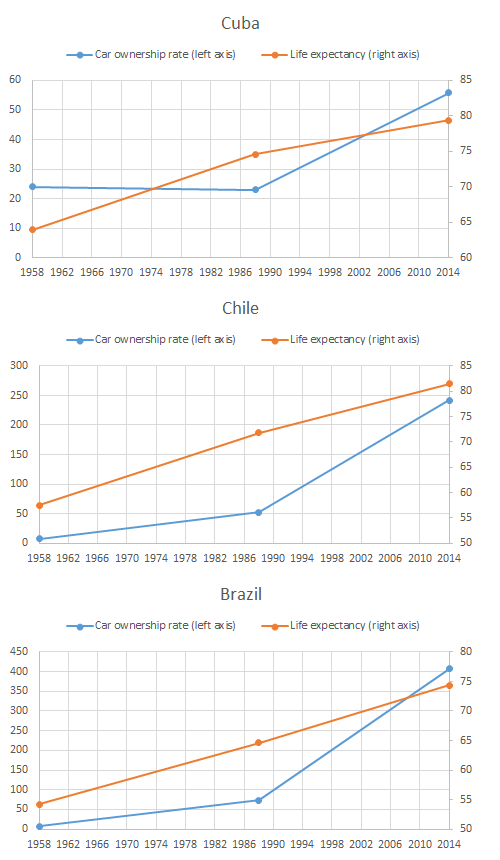
Cuba is quite unique with regards to car ownership. In 1958, it had the second highest rate of car ownership of all Latin America. However, while the rate went up in all of Latin America between 1958 and 1988, it went down in Cuba. During that period, life expectancy went up in all countries while there were substantial increases in car ownership (which would, all things being equal, slow down life expectancy growth). Take Chile and Brazil as example. In these countries, the rate went up by 6.9% and 8.1% every year – these are fantastic rates of growth. During the same period, life expectancy increased 25% in Chile and 19% in Brazil compared with Cuba where the increase stood at 17%. In Cuba, the moderate decline in car ownership (-0.1% per annum) would have (very) modestly contributed to the increase of life expectancy. In the other countries, car ownership hindered the increase. (The data is also from the WHO section on Road Safety while the life expectancy data is from the World Bank Database)

This does not alter the trend of life expectancy in Cuba dramatically, but it does alter it in a manner that forces us, once more, to substract from Castro’s accomplishments. This increase would not have been the offspring of the master plan of the dictator, but rather an accidental side-effect springing from policies that depressed living standards so much that Cubans drove less and were less subjected to the risk of dying while driving. However, I am unsure as to whether or not Cubans would regard this as an “improvement”.

Below are the comparisons between Cuba, Chile and Brazil.

cars

The other parts of How Well Has Cuba Managed To Improve Health Outcomes?

  1. Life Expectancy Changes, 1960 to 2014
  2. Car ownership trends playing in favor of Cuba, but not a praiseworthy outcome
  3. Of Refugeees and Life Expectancy
  4. Changes in infant mortality
  5. Life expectancy at age 60-64
  6. Effect of recomputations of life expectancy
  7. Changes in net nutrition
  8. The evolution of stature
  9. Qualitative evidence on water access, sanitation, electricity and underground healthcare
  10. Human development as positive liberty (or why HDI is not a basic needs measure)

The struggle for life

Below is an excerpt from my book I Used to Be French: an Immature Autobiography. You can buy it on amazon here.


In elementary school, grades were handed out in class in a terrifying monthly ceremony. The same deranged Principal would walk into each classroom in turn holding a thick pile of “livrets scolaires,” individual grade-booklets, rather than simple, one-shot report cards, under his arm. There was one livret per student per year with numerical scores and verbal comments for each subject matter, and a monthly overall ranking of students. The Principal would lay the grade-books upside down, in reverse order of students’ ranking for the month ending hence, lowest-ranking student first.

For several years, every month, without fail, the lowest-ranking pupil and the first on the mental scaffold was a runty, scrawny, rheumy-eyed boy who always sat in the last row, “Colinet.” The Principal would start ranting as he entered the room; his glasses would drop down his nose and he would deliver himself of the same furious tirade at the top of his voice against miserable, crouching Colinet. He was a large middle-aged man whose eyes became globulous when he was angry. He would foam at the mouth and spittle would dribble down his shirt as he promised Colinet the guillotine or worse. Colinet never got used to it. I sure did not. I almost crapped my pants several times although I was sitting near the front row and the Principal was staring over my head, straight at the back of the room, as he yelled and screamed. As he called out names from Colinet to the higher-ranking pupils, he would calm down, his voice would subside, and his comments became briefer. By the time he reached the livret of the tenth-ranker, his manner had become civilized as if there had been no raging storm minutes earlier.

In my family, there was a completely arbitrary rule that only the first six places were acceptable. I think my parents secretly thought only the first five were really acceptable but added the sixth because it made them feel magnanimous. Once the Principal had called out the ninth-ranked name, my body began to relax and I was breathing normally. If the Principal was down to the fifth livret and my name had not come up, the sweet song of victory began ringing in my heart. “Very good, my boy,” the Principal would say in a low, calm voice as he handed me my livret (to be signed by both parents).

Has Canada been Poorer than the US for so long?

A standard stylized fact in Canada is that we are poorer, on average, than the average American. This has been presented as a fact that is as steady as the northern star. But our evidence on Canadian incomes is pretty shoddy prior to 1870 (here I praise M.C. Urquhart for having designed a GNP series that covers from 1870 to 1926 and links up with the official national accounts even if I think there are some improvements that can be brought to measuring output from some key industries and get the deflator right). But what about anything before 1870? There are some estimates for Ontario from 1826 to 1851 by Lewis and Urquhart (great stuff), but Ontario was pretty much the high-income of Canada.

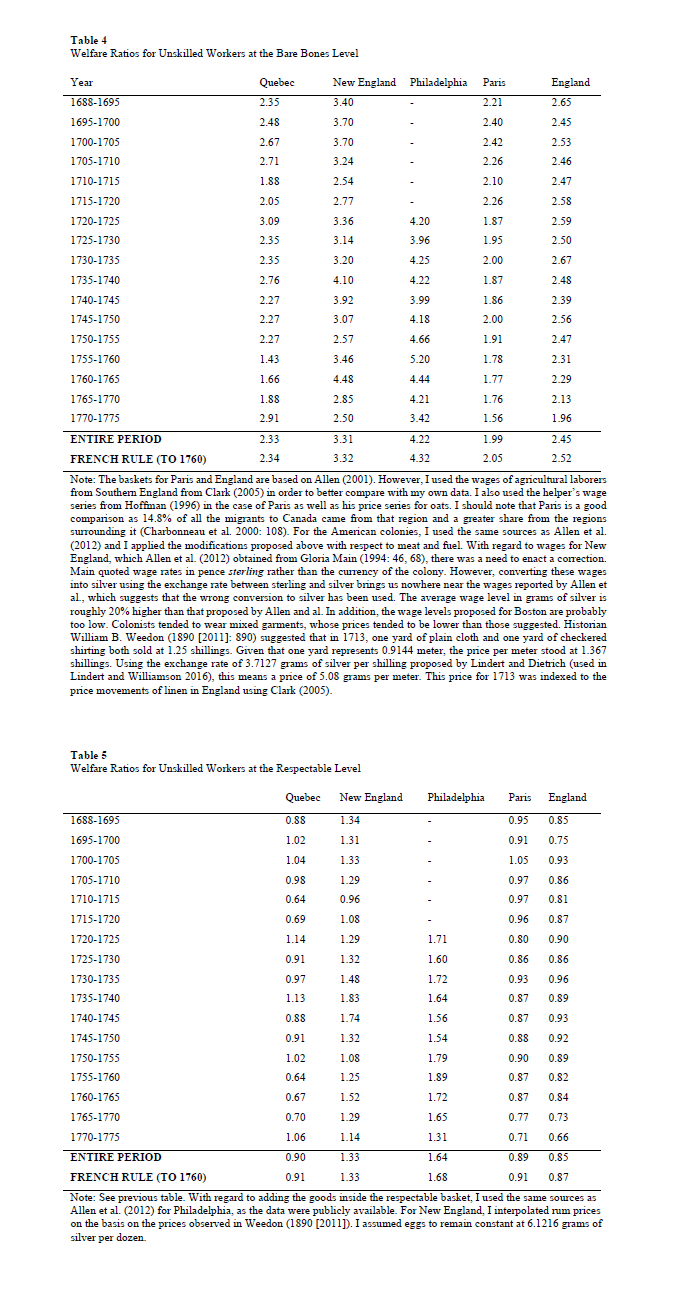
So, can we go further back? This is what my work is about (partially), and I just made available my results on Canadian living standards (proxied by Quebec where the vast majority of the population was) from 1688 to 1775 as captured by welfare ratios. So that’s pretty much the closest we can get to the “founding”. Below are my results derived from this paper. They show that the colonists in Canada were not very much richer than their counterparts in France with the basket meant to capture the meanest of subsistence and roughly equal to their counterparts in France with a basket that includes more manufactured goods like clothing and more alcohol. This explains why most migrants from France to Canada were “volunteered” (in the sense that they were pretty much reluctant migrants) for migration. But the key interesting result is that relative to New England – the poorest of the American colonies – it is poorer regardless of the basket used. Thus, there seems to be truth to the common logic about Canadians being always poorer than the Americans.

comparingcanadane

However, I am not fully convinced of my own results. This may surprise some. The reason is not that I do not trust my data (in fact, I think it is superior to most of what exists for the time given that I will be able to proceed to tons of other data). The reason is simple (and rarely discussed): natives.

Natives are always omitted from the stories of living standards. But they existed nonetheless. In terms of national accounts, if the British and French settlers dispossessed and killed natives, their welfare losses are just not computed. But the welfare losses of a musket shot to the head are real. I have always been convinced that if we could correct estimates of living standards to account for the living standards of natives, the picture would change terribly. The reason is two-fold. The first reason is that the historiography is pretty clear that while they were obviously not nice, the French were nicer than the British towards the Natives (at least until 1763 when the British shifted strategy). In fact, trade between French and Natives was very frequent and so it might be that for the whole population (natives + settlers), the French-area peoples enjoyed more growth and higher average levels. In the British colony, if the settlers killed and dispossessed natives, this is basically the British turning native capital stocks into their own capital stock or into consumption (which would enter settlers GDP but not change total GDP). In essence, this is basically a variation on the arguments of Robert Higgs with regards to measuring the American GDP in World War Two and Albrecht Ritschl on the German interwar growth. I am pretty sure that adjusting for the lives of natives would show a greater level for Canada leading to rough equality between the two colonies. However, I am not sure if the argument would cut that way (my guts say yes) since in their conjectural growth estimates, Mancall and Weiss show that with the natives included, their zero rate of income per capita growth turns into a positive rate.

Nonetheless, I still think that knowing that the settlers were better off in the US as an improvement over the current state of knowledge. Until ways to impute the value of native output and production are found, my current estimates are only a step forward, not the whole nine yards.