On doing economic history

I admit to being a happy man. While I am in general a smiling sort of fellow, I was delightfully giggling with joy upon hearing that another economic historian (and a fellow  Canadian from the LSE to boot), Dave Donaldson, won the John Bates Clark medal. I dare say that it was about time. Nonetheless I think it is time to talk to economists about how to do economic history (and why more should do it). Basically, I argue that the necessities of the trade require a longer period of maturation and a considerable amount of hard work. Yet, once the economic historian arrives at maturity, he produces long-lasting research which (in the words of Douglass North) uses history to bring theory to life.

Economic History is the Application of all Fields of Economics

Economics is a deductive science through which axiomatic statements about human behavior are derived. For example, stating that the demand curve is downward-sloping is an axiomatic statement. No economist ever needed to measure quantities and prices to say that if the price increases, all else being equal, the quantity will drop. As such, economic theory needs to be internally consistent (i.e. not argue that higher prices mean both smaller and greater quantities of goods consumed all else being equal).

However, the application of these axiomatic statements depends largely on the question asked. For example, I am currently doing work on the 19th century Canadian institution of seigneurial tenure. In that work, I  question the role that seigneurial tenure played in hindering economic development.  In the existing literature, the general argument is that the seigneurs (i.e. the landlords) hindered development by taxing (as per their legal rights) a large share of net agricultural output. This prevented the accumulation of savings which – in times of imperfect capital markets – were needed to finance investments in capital-intensive agriculture. That literature invoked one corpus of axiomatic statements that relate to capital theory. For my part, I argue that the system – because of a series of monopoly rights – was actually a monopsony system through the landlords restrained their demand for labor on the non-farm labor market and depressed wages. My argument invokes the corpus of axioms related to industrial organization and monopsony theory. Both explanations are internally consistent (there are no self-contradictions). Yet, one must be more relevant to the question of whether or not the institution hindered growth and one must square better with the observed facts.

And there is economic history properly done. It tries to answer which theory is relevant to the question asked. The purpose of economic history is thus to find which theories matter the most.

Take the case, again, of asymetric information. The seminal work of Akerlof on the market for lemons made a consistent theory, but subsequent waves of research (notably my favorite here by Eric Bond) have showed that the stylized predictions of this theory rarely materialize. Why? Because the theory of signaling suggests that individuals will find ways to invest in a “signal” to solve the problem. These are two competing theories (signaling versus asymetric information) and one seems to win over the other.  An economic historian tries to sort out what mattered to a particular event.

Now, take these last few paragraphs and drop the words “economic historians” and replace them by “economists”.  I believe that no economist would disagree with the definition of the tasks of the economist that I offered. So why would an economic historian be different? Everything that has happened is history and everything question with regards to it must be answered through sifting for the theories that is relevant to the event studied (under the constraint that the theory be consistent). Every economist is an economic historian.

As such, the economic historian/economist must use advanced tools related to econometrics: synthetic controls, instrumental variables, proper identification strategies, vector auto-regressions, cointegration, variance analysis and everything you can think of. He needs to do so in order to answer the question he tries to answer. The only difference with the economic historian is that he looks further back in the past.

The problem with this systematic approach is the efforts needed by practitioners.  There is a need to understand – intuitively – a wide body of literature on price theory, statistical theories and tools, accounting (for understanding national accounts) and political economy. This takes many years of training and I can take my case as an example. I force myself to read one scientific article that is outside my main fields of interest every week in order to create a mental repository of theoretical insights I can exploit. Since I entered university in 2006, I have been forcing myself to read theoretical books that were on the margin of my comfort zone. For example, University Economics by Allen and Alchian was one of my favorite discoveries as it introduced me to the UCLA approach to price theory. It changed my way of understanding firms and the decisions they made. Then reading some works on Keynesian theory (I will confess that I have never been able to finish the General Theory) which made me more respectful of some core insights of that body of literature. In the process of reading those, I created lists of theoretical key points like one would accumulate kitchen equipment.

This takes a lot of time, patience and modesty towards one’s accumulated stock of knowledge. But these theories never meant anything to me without any application to deeper questions. After all, debating about the theory of price stickiness without actually asking if it mattered is akin to debating with theologians about the gender of angels (I vote that they are angels and since these are fictitious, I don’t give a flying hoot’nanny). This is because I really buy in the claim made by Douglass North that theory is brought to life by history (and that history is explained by theory).

On the Practice of Economic History

So, how do we practice economic history? The first thing is to find questions that matter.  The second is to invest time in collecting inputs for production.

While accumulating theoretical insights, I also made lists of historical questions that were still debated.  Basically, I made lists of research questions since I was an undergraduate student (not kidding here) and I keep everything on the list until I have been satisfied by my answer and/or the subject has been convincingly resolved.

One of my criteria for selecting a question is that it must relate to an issue that is relevant to understanding why certain societies are where there are now. For example, I have been delving into the issue of the agricultural crisis in Canada during the early decades of the 19th century. Why? Because most historians attribute (wrongly in my opinion)  a key role to this crisis in the creation of the Canadian confederation, the migration of the French-Canadians to the United States and the politics of Canada until today. Another debate that I have been involved in relates to the Quiet Revolution in Québec (see my book here) which is argued to be a watershed moment in the history of the province. According to many, it marked a breaking point when Quebec caught up dramatically with the rest of  Canada (I disagreed and proposed that it actually slowed down a rapid convergence in the decade and a half that preceded it). I picked the question because the moment is central to all political narratives presently existing in Quebec and every politician ushers the words “Quiet Revolution” when given the chance.

In both cases, they mattered to understanding what Canada was and what it has become. I used theory to sort out what mattered and what did not matter. As such, I used theory to explain history and in the process I brought theory to life in a way that was relevant to readers (I hope).  The key point is to use theory and history together to bring both to life! That is the craft of the economic historian.

The other difficulty (on top of selecting questions and understanding theories that may be relevant) for the economic historian is the time-consuming nature of data collection. Economic historians are basically monks (and in my case, I have both the shape and the haircut of friar Tuck) who patiently collect and assemble new data for research. This is a high fixed cost of entering in the trade. In my case, I spent two years in a religious congregation (literally with religious officials) collecting prices, wages, piece rates, farm data to create a wide empirical portrait of the Canadian economy.  This was a long and arduous process.

However, thanks to the lists of questions I had assembled by reading theory and history, I saw the many steps of research I could generate by assembling data. Armed with some knowledge of what I could do, the data I collected told me of other questions that I could assemble. Once I had finish my data collection (18 months), I had assembled a roadmap of twenty-something papers in order to answer a wide array of questions on Canadian economic history: was there an agricultural crisis; were French-Canadians the inefficient farmers they were portrayed to be; why did the British tolerate catholic and French institutions when they conquered French Canada; did seigneurial tenure explain the poverty of French Canada; did the conquest of Canada matter to future growth; what was the role of free banking in stimulating growth in Canada etc.

It is necessary for the economic historian to collect a ton of data and assemble a large base of theoretical knowledge to guide the data towards relevant questions. For those reasons, the economic historian takes a longer time to mature. It simply takes more time. Yet, once the maturation is over (I feel that mine is far from being over to be honest), you get scholars like Joel Mokyr, Deirdre McCloskey, Robert Fogel, Douglass North, Barry Weingast, Sheilagh Ogilvie and Ronald Coase (yes, I consider Coase to be an economic historian but that is for another post) who are able to produce on a wide-ranging set of topics with great depth and understanding.

Conclusion

The craft of the economic historian is one that requires a long period of apprenticeship (there is an inside joke here, sorry about that). It requires heavy investment in theoretical understanding beyond the main field of interest that must be complemented with a diligent accumulation of potential research questions to guide the efforts at data collection. Yet, in the end, it generates research that is likely to resonate with the wider public and impact our understanding of theory. History brings theory to life indeed!

The Protestant Reformation and freedom of conscience

This year we celebrate 500 years of the Protestant Reformation. On October 31, 1517, the then Augustinian monk, priest, and teacher Martin Luther nailed at the door of a church in Wittenberg, Germany, a document with 95 theses on salvation, that is, basically the way people are led by the Christian God to Heaven. Luther was scandalized by the sale of indulgences by the Roman Catholic Church, believing that this practice did not correspond to the biblical teaching. Luther understood that salvation was given only by faith. The Catholic Church understood that salvation was a combination of faith and works.

The practice of nailing a document at the door of the church was not uncommon, and Luther’s intention was to hold an academic debate on the subject. However, Luther’s ideas found many sympathizers and a wide-spread protestant movement within the Roman Catholic Church was quickly initiated. Over the years, other leaders such as Ulrich Zwingli and John Calvin joined Luther. However, the main leaders of the Roman Catholic Church did not agree with the Reformers’ point of view, and so the Christian church in the West was divided into several groups: Lutherans, Anglicans, Reformed, Anabaptists, later followed by Methodists, Pentecostals and many others. In short, the Christian church in the West has never been the same.

The Protestant Reformation was obviously a movement of great importance in world religious history. I also believe that few would disagree with its importance in the broader context of history, especially Western history. To mention just one example, Max Weber’s thesis that Protestantism (especially Calvinism, and more precisely Puritanism) was a key factor in the development of what he called modern capitalism is very accepted, or at least enthusiastically debated. But I would like to briefly address here another impact of the Protestant Reformation on world history: the development of freedom of conscience.

Simply put, but I believe that not oversimplifying, after the fall of the Roman Empire and until the 16th century, Europe knew only one religion – Christianity – in only one variety – Roman Catholic Christianity. It is true that much of the paganism of the barbarians survived through the centuries, that Muslims occupied parts of Europe (mainly the Iberian Peninsula) and that other varieties of Christianity were practiced in parts of Europe (mainly Russia and Greece). But besides that, the history of Christianity was a tale of an ever-increasing concentration of political and ecclesiastical power in Rome, as well as an ever-widening intersection of priests, bishops, kings, and nobles. In short, Rome became increasingly central and the distinction between church and state increasingly difficult to observe in practice. One of the legacies of the Protestant Reformation was precisely the debate about the relationship between church and state. With a multiplicity of churches and strengthening nationalisms, the model of a unified Christianity was never possible again.

Of course, this loss of unity in Christendom can cause melancholy and nostalgia among some, especially Roman Catholics. But one of its gains was the growth of the individual’s space in the world. This was not a sudden process, but slowly but surely it became clear that religious convictions could no longer be imposed on individuals. Especially in England, where the Anglican Church stood midway between Rome and Wittenberg (or Rome and Geneva), many groups emerged on the margins of the state church: Presbyterians, Baptists, Congregationalists, Quakers, and so on. These groups accepted the challenge of being treated as second-class citizens, but maintaining their personal convictions. Something similar can be said about Roman Catholics in England, who began to live on the fringes of society. The new relationship between church and state in England was a point of discussion for many of the most important political philosophers of modernity: Thomas Hobbes, John Locke, Edmund Burke, and others. To disregard this aspect is to lose sight of one of the most important points of the debate in which these thinkers were involved.

The Westminster Confession of Faith, one of the most important documents produced in the period of the Protestant Reformation, has a chapter entitled “Of Christian Liberty, and Liberty of Conscience.” Of course there are issues in this chapter that may sound very strange to those who are not Christians or who are not involved in Christian churches. However, one point is immediately understandable to all: being a Christian is a matter of intimate forum. No one can be compelled to be a Christian. At best this obligation would produce only external adhesion. Intimate adherence could never be satisfactorily verified.

Sometime after the classical Reformation period, a new renewal religious movement occurred in England with the birth of Methodism. But its leading leaders, John Wesley and George Whitefield, disagreed about salvation in a way not so different from what had previously occurred between Luther and the Roman Catholic Church. However, this time there was no excommunication, inquisition or wars. Wesley simply told Whitefield, “Let’s agree to disagree.”

Agreeing to disagree is one of the great legacies of the Protestant Reformation. May we always try to convince each other by force of argument, not by force of arms. And that each one has the right to decide for themselves, with freedom of conscience, which seems the best way forward.

Auftragstaktik: Decentralization in military command

Many 20th century theorists who advocated central planning and control (from Gaetano Mosca to Carl Landauer, and hearkening back to Plato’s Republic) drew a direct analogy between economic control and military command, envisioning a perfectly functioning state in which the citizens mimic the hard work and obedience of soldiers. This analogy did not remain theoretical: the regimes of Mussolini, Hitler, and Lenin all attempted to model economies along military principles. [Note: this is related to William James’ persuasion tactic of “The Moral Equivalent of War” that many leaders have since used to garner public support for their use of government intervention in economic crises from Great Depression to the energy crisis to the 2012 State of the Union, though one matches the organizing methods of war to central planning and the other matches the moral commitment of war to intervention, but I digress.] The underlying argument of the “central economic planning along military principles” was that the actions of citizens would be more efficient and harmonious under direction of a scientific, educated hierarchy with highly centralized decision-making than if they were allowed to do whatever they wanted. Wouldn’t an army, if it did not have rigid hierarchies, discipline, and central decision-making, these theorists argued, completely fall apart and be unable to function coherently? Do we want our economy to be the peacetime equivalent of an undisciplined throng (I’m looking at you, Zulus at Rorke’s Drift) while our enemies gain organizational superiority (the Brits had at Rorke’s Drift)? While economists would probably point out the many problems with the analogy (different sets of goals of the two systems, the principled benefits of individual liberty, etc.), I would like to put these valid concerns aside for a moment and take the question at face value. Do military principles support the idea that individual decision-making is inferior to central control? Historical evidence from Alexander the Great to the US Marine Corps suggests a major counter to this assertion, in the form of Auftragstaktik.

Auftragstaktik

Auftragstaktik was developed as a military doctrine by the Prussians following their losses to Napoleon, when they realized they needed a systematic way to overcome brilliant commanders. The idea that developed, the brainchild of Helmuth von Moltke, was that the traditional use of strict military hierarchy and central strategic control may not be as effective as giving only the general mission-based, strategic goals that truly necessitated central involvement to well-trained officers who were operating on the front, who would then have the flexibility and independence to make tactical decisions without consulting central commanders (or paperwork). Auftragstaktik largely lay dormant during World War I, but literally burst onto the scene as the method of command that allowed (along with the integration of infantry with tanks and other military technology) the swift success of the German blitzkrieg in World War II. This showed a stark difference in outcome between German and Allied command strategies, with the French expecting a defensive war and the Brits adhering faithfully and destructively to the centralized model. The Americans, when they saw that most bold tactical maneuvers happened without or even against orders, and that the commanders other than Patton generally met with slow progress, adopted the Auftragstaktik model. [Notably, this also allowed the Germans greater adaptiveness and ability when their generals died–should I make a bad analogy to Schumpeter’s creative destruction?] These methods may not even seem foreign to modern soldiers or veterans, as it is still actively promoted by the US Marine Corps.

All of this is well known to modern military historians and leaders: John Nelson makes an excellent case for its ongoing utility, and the excellent suggestion has also been made that its principles of decentralization, adaptability, independence, and lack of paperwork would probably be useful in reforming non-military bureaucracy. It has already been used and advocated in business, and its allowance for creativity, innovation, and reactiveness to ongoing complications gives new companies an advantage over ossified and bureaucratic ones (I am reminded of the last chapter of Parkinson’s Law, which roughly states that once an organization has purpose-built rather than adapted buildings it has become useless). However, I want to throw in my two cents by examining pre-Prussian applications of Auftragstaktik, in part to show that the advantages of decentralization are not limited to certain contexts, and in part because they give valuable insight into the impact of social structures on military ability and vice versa.

Historical Examples

Alexander the Great: Alexander was not just given exemplary training by his father, he also inherited an impressive military machine. The Macedonians had been honed by the conquest of neighboring Illyria, Thrace, and Paeonia, and the addition of Thessalian cavalry and Greek allies in the Sacred Wars. However, as a UNC ancient historian found, the most notable innovations of the Macedonians were their new siege technologies (which allowed a swifter war–one could say, a blitzkrieg–compared to earlier invasions of Persia) and their officer corps. This officer corps, made up of the king’s “companions,” was well trained in combined-arms hoplite and cavalry maneuvers, and during multiple portions of his campaign (especially in Anatolia and Bactria) operated as leaders of independent units that could cover a great deal more territory than one army. In set battles, the Macedonians showed a high degree of maneuverability, with oblique advances, effective use of reserves, and well-timed cavalry strikes into gaps in enemy formations, all of which depended on the delegation of tactical decision-making. This contrasted with the Persians, who followed standards into battle without organized ranks and files, and the Greek hoplites, whose phalanx depended mostly on cohesion and group action and therefore lacked flexibility. [Also, fun fact, the Macedonians had the only army in recorded history in which bodies of troops were identified systematically by the name of their leader. This promoted camaraderie and likely indicates that, long-term, the soldiers became used to the tactical independence and decision-making of that individual. Imagine dozens of Rogers’ Rangers.]

The Roman legion: As with any great empire, the Macedonians spread through their military innovations, but then ossified in technique over the next 150 years. When the Romans first faced a major Hellenistic general, Pyrrhus, they had already developed the principles of the system that would defeat the Macedonian army: the legion. In the early Roman legion, two centuries were combined into a maniple, and maniples were grouped into cohorts, allowing for detachment and independent command of differing group sizes. Crucially, centurions maintained discipline and the flexible but coordinated Roman formations, and military tribunes were given tactical control of groups both during and between battles. The flexibility of the Roman maniples was shown at the Battle of Cynoscephalae, in which the Macedonian phalanx–which had frontal superiority through its use of the sarissa and cohesion but little maneuverability–became disorganized on rough ground and was cut to pieces on one flank by the more mobile and individually capable Roman legionaries, This (as well as many battles in the Macedonian and Syrian Wars proved) showed the value of flexibility and individual action in a disciplined force, but where was the Auftragstaktik? At Cynoscephalae, after defeating one flank, the Romans on that flank dispersed to loot the Macedonian camp. In antiquity, this generally resulted in those troops becoming ineffective as a fighting force, and many a battle was lost because of pre-emptive looting. However, in this case, an unnamed tribune–to whom the duty of tactical decisions had been delegated–reorganized these looters and brought them to attack the rear of the other Macedonian flank, which had been winning. This resulted in a crushing victory and contributed to he Roman conquest of Greece. Decentralized control was also a hallmark of Julius Caesar himself, who frequently sent several cohorts on independent campaigns in Gaul under subordinates such as Titus Labienus, allowing him to conquer the much more numerous Gauls through local superiority, lack of Gallic unity, and organization. Also, at the climactic Battle of Alesia, Caesar used small, mobile reserve units with a great deal of tactical independence to hold over 20 km of wooden walls against a huge besieging force.

The Vikings: I do not mean to generalize about Vikings (who could be of many nations–the term just means “raider”) when they do not have a united culture, but in their very diversity of method and origin, they demonstrate the effectiveness of individualism and decentralization. Despite being organized mostly based on ship-crews led by jarls, with central leadership only when won by force or chosen by necessity, Scandinavian longboatmen and warriors exerted their power from Svalbard to Constantinople to Sicily to Iceland and North America from the 8th to 12th centuries. The social organization of Scandinavia may have been the most free (in terms of individual will to do whatever one wants–including, unfortunately, slaughter, but also some surprisingly progressive women’s rights to decisions) in recorded history, and this was on display in the famous invasion of the Great Heathen Army. With as few as 3,500 farmer-raiders and 100 longboats to start, the legendary sons of Ragnar Lothbrok and the Danish invaders, with jarls as the major decision-makers of both strategic and tactical matters for their crews, won a series of impressive battles over 20 years (described in fascinating, if historical-fiction, detail in the wonderful book series and now TV series The Last Kingdom), almost never matching the number of combatants of their opponents, and took over half of England. The terror and military might associated with the Vikings in the memories of Western historians is a product of the completely decentralized, nearly anarchic methods of Scandinavian raiders.

The Mongols: You should be sensing a trend here: cultures that fostered lifelong training and discipline (and expertise in siege engineering, which seems to have correlated with the tactics I describe, as the Macedonians, Romans, and Mongols were each the most advanced siege engineers of their respective eras) tended to have more trust in well-trained subordinates. This brought them great military success and also makes them excellent examples of proto-Auftragstaktik. The Mongols not only had similar mission-oriented commands and tactical independence, but they also had two other aspects of their military that made them highly effective over an enormous territory: their favored style of horse-archer skirmishing gave natural flexibility and their clan organization allowed for many independently-operating forces stretching from Poland to Egypt to Manchuria. The Mongols, like the Romans, demonstrate how a force can have training/discipline without sacrificing the advantages based on tactical independence, and the two should never be mixed up!

The Americans in the French and Indian War and the Revolutionary War: Though this is certainly a more limited example, there were several units that performed far better than others among the Continentals. The aforementioned Rogers’ Rangers operated as a semi-autonomous attachment to regular forces during the French and Indian War, and were known for their mobility, individual experience and ability, and tactical independence in long-range, mission-oriented reconnaissance and ambushes. This use of savvy, experienced woodsman in a semi-autonomous role was so effective that the ranger corps was expanded, and similar tactical independence, decentralized command, and maneuverability were championed by the Green Mountain Boys, the heroes of Ticonderoga. Morgan’s Rifles used similar experience and semi-autonomous flexibility to help win the crucial battles of Saratoga and Cowpens, which allowed the nascent Continental resistance to survive and thrive in the North outside of coastal cities and to capture much of the South, respectively. The forces of Francis Marion also used proto-guerrilla tactics with decentralized command and outperformed the regulars of Horatio Gates. Given the string of unsuccessful set-piece battles fought by General Washington and his more conventional subordinates, the Continentals depended on irregulars and unconventional warfare to survive and gain victories outside of major ports. These victories (especially Saratoga and Cowpens) cut off the British from the interior and forced the British into stationary posts in a few cities–notably Yorktown–where Washington and the French could siege them into submission. This may be comparable to the Spanish and Portuguese in the Peninsular War, but I know less about their organization, so I will leave the connection between Auftragstaktik and early guerrilla warfare to a better informed commenter.

These examples hopefully bolster the empirical support for the idea that military success has often been based, at least in part, on radically decentralizing tactical control, and trusting individual, front-line commanders to make mission-oriented decisions more effectively than a bureaucracy could. There are certainly many more, and feel free to suggest examples in the comments, but these are my favorites and probably the most influential. This evidence should cause a health skepticism toward argument for central control on the basis of the efficiency or effectiveness demonstrated in military central planning. Given the development of new military technologies and methods of campaign (especially guerilla and “lone wolf” attacks, which show a great deal of decentralized decision-making) and the increasing tendency since 2008 to revert toward ideas of central economic planning, we are likely to get a lot of new evidence about both sides of this fascinating analogy.

Geopolitics and Asia’s Little Divergence: State Building in China and Japan After 1850

Crossposted at the Medium

Why did Japan successfully modernize in the 19th century while China failed to do so? Both China and Japan came under increasing threat from the Western powers after 1850. In response, Japan successfully undertook a program of state building and modernization; in China, however, attempts to modernize proved unsuccessful and the power of the central state was fatally weakened. The failure to build a modern state led to China’s so-called lost century while Japan’s success enabled it to become the first non-western country to industrialize. In a paper with Chiaki Moriguchi (Hitotsubashi University) and Tuan-Hwee Sng (NUS), we explore this question using a combination of historical evidence and formal modeling.

On the surface this East Asian “little divergence” is extremely puzzling. Qing China, as late as the end of the eighteenth century, was a powerful centralized empire. An impersonal bureaucracy selected by exams, and routinely rotated, governed the empire. In contrast, the institutions of Tokugawa Japan are usually described as feudal. The shogun directly ruled only 15% of the country. The remainder was divided into 260 domains ruled by lords known as daimyo who collected their own taxes, possessed their own armies, and issued their own currencies. To the outside observer China would have seemed much more likely to have been able to establish the institutions or a centralized state than Japan.

Figure 1: Qing China and Tokugawa Japan

For much of the early modern period (1500–1700) China and Japan possessed military capabilities that made them more than a match for any western power. This changed dramatically after the Industrial Revolution and their vulnerability exposed by the Opium War (1839–1840) and the Black Ships Incident of 1853, respectively. During the First Opium a small number of British ships overpowered the entire Chinese navy, while Commodore Perry’s show of force in landing in Japan in 1853 convinced the Japanese of western naval superiority. Within a few years, political elites in both countries recognized the need to modernize if only to develop the military capacity required to fend off this new danger.

* * *

koyamajapanperry
Figure 2: Commodore Perry in Japanese eyes

In China, after the suppression of the Taiping Rebellion, there were attempts at modernizing — notably the Self-Strengthening movement associated with Li Hongzhang and others. Recent scholarship has reevaluated this movement positively. At the purely military-technological level it was in fact quite successful. The Jiangnan Arsenal and the Fuzhou Shipyard saw the successful importation of western military technology into China and the Chinese were soon producing modern ships and weaponry. However, these developments were associated with a process of political decentralization as local governors took on more and more autonomy. The importation of military technology was not associated with more far-reaching societal or political reforms. There was no serious attempt to modernize the Qing state.

In contrast, Japan, following the Meiji Restoration, embarked on whole scale-societal transformation. The daimyo lost all power. Feudalism was abolished. Compulsory education was introduced as was a nationwide railway system. A new fiscal system was imposed in the teeth of opposition from farmers. The samurai were disarmed and transformed from a military caste into bureaucrats and businessmen.

Qing China and the newly modernized Meiji Japan would collide in the first Sino-Japanese war (1894–1895). Before the war, western observers believed China would win in part because of their superior equipment. But the Chinese lacked a single national army. It was the Beiyang army and the Beiyang fleet that fought the entire Japanese military force. The fact that Japan had undergone a wholesale transformation of society enabled them to marshal the resources to win a rapid victory.


koyamabaiyanfleet
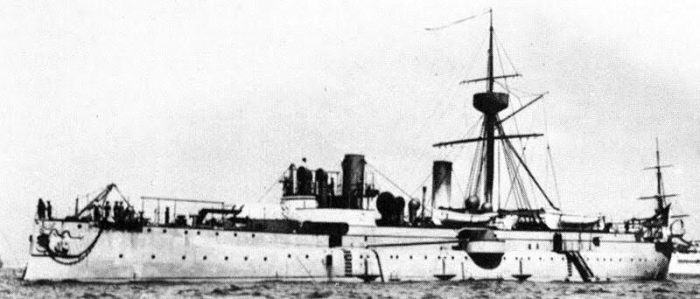
Figure 3: The Jingyuan, one of the ships in the Baiyang fleet

* * *

Why did the Japanese succeed in modernizing while Qing China failed to do so? Historians have proposed numerous explanations. In our paper, however, rather than focusing on cultural differences between Japan and China, we focus on how different geopolitical incentives shaped their decisions to invest in state capacity and state centralization.

Before the mid-19th century China only faced a threat from inner Asia from where historically nomadic invasions had routinely invaded and threatened the sedentary population of the Chinese plain. Due to this threat, historically China tended to be a centralized empire with its capital and the bulk of its professional army stationed close to the northern frontier (see Ko, Koyama, and Sng (2018)). In contrast, Japan faced no major geopolitical threats prior to 1850. This meant that it could retain a loose and decentralized political system.

After 1850 both countries faced major threats from several directions. China was threatened on its landward borders by Russian expansionism and from the coast by Britain and France (and later Germany and the United States). Japan was threatened from all directions by western encroachment.

We build a simple model which allows for multidirectional geopolitical threats. We represent each state as a line of variable length. States have to invest in state capacity to defend against external geopolitical threats. Each state can use centralized fiscal institutions or decentralized fiscal institutions.

If there is strong threat from one direction, as China faced prior to 1850, the dominant strategy is political centralization. In the absence of major geopolitical threats decentralization may be preferable as was the case in Tokugawa Japan.

The emergence of a multidirectional threat, however, changes things. A large country facing a multidirectional threat may have to decentralize in order to meet the different challenges it now faces. This is what happened in China after 1850. In contrast, for a small state with limited resources, an increase in the threat level makes centralization and resource pooling more attractive. For a small territory like Japan, the emergence of non-trivial foreign threats renders political decentralization untenable.

We then consider the incentives to modernize. Modernization is costly. It entails social dislocation and creates losers as well as winners, the losers will attempt to block any changes that hurt their interests. We show that for geographically compact polities, it is always a dominant strategy to modernize in the face of a multidirectional threat as the state is able to manage local opposition to reform. This helps to explain why all members of the Japanese political elite came around to favoring rapid modernization by the late 1860s.

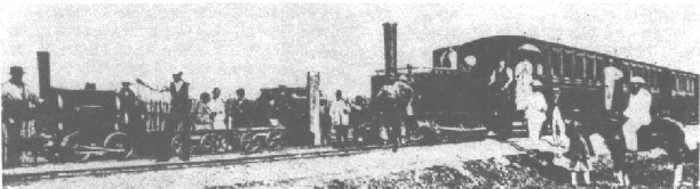
Consistent with our model, modernization was more difficult and controversial in China. The Qing government and particularly the Empress Dowager famously opposed the building of railroads. The most well-known example of this was the Wusong Road in Shanghai. Built using foreign investment it was dismantled in 1877 after locals complained about it. The Qing state remained reactive and prepared to kowtow to local powerholders and vested interests rather than confront them. Despite local initiatives, no effort was made at wholesale reforms until after China’s defeat at the hands of Japan in 1895.

koyamaindustrialization
Figure 4: The Wusong Railroad in 1876

* * *

By 1895 it was too late, however. The attempts of the Qing state to reform and modernize led to its collapse. Needless to state, East Asian’s little divergence would have lasting consequences.

Japan’s modernization program astonished foreign observers. Victory over Russia in 1904 propelled Japan to Great Power status but also set Japan on the path to disaster in the World War Two. Nevertheless, the institutional legacy of Japan’s successful late 19th century modernization played a crucial role in Japan’s post-1945 economic miracle.

Following the collapse of the Qing dynasty China fragmented further entering the so-called warlord era (1916–1926). Though the Nationalist regime reunified the country and began a program of modernization, the Japanese invasion and the Second Sino-Japanese War (1937–1945) devastated the country. The end result was that China came to be reunified by the Communist party and to experience more conflict and trauma until it began to embrace market reforms after 1979.

Differences in life expectancy within Canada, 1921 to 2011

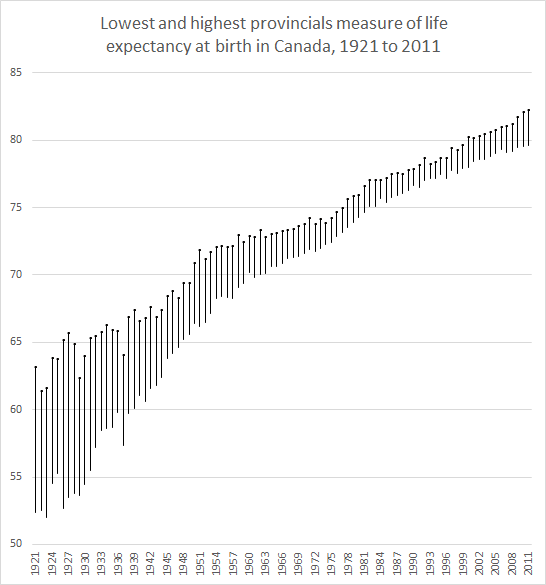
I’ve been playing around with some data for a paper I have been trying to write about the economic history of Canada in the 20th century. In the process, I assembled the data from the Base de données sur la longévité canadienne regarding life expectancy at birth. Then, I thought that it would be interesting to see how large were the differences between the provinces and how fast did they close. They closed pretty dramatically during the 20th century – see for yourself.

LifeExpectancyCanada

The GDP, real wages and working hours of France since the 13th century

Every few years, an economic historian in training spends thousands of hours in archives assembling a long quantitative essay. It’s the work of monks (in fact, when you go far back in history, you also end up working with monks and nuns – which was my case on Canadian economic history). It’s the kind of work that requires patience, attention to details and (did I say it already?) patience.

I did that for my own work on Canadian economic history. For two years, I locked myself in the archives of two religious congregations to collect and transcribe close to a million price and wages information. For these two years, I did not write one single paper. I just collected the data and constituted a list of the papers I could write. However, once its finished, you may party like a sailor fresh off the boat because you end up with a wealth of data to answer hundreds of questions. When I finished my own thing on Canada, I was thrilled as I thought it constituted a great advance in quantitative knowledge (which I could use to assess tougher historical questions).

However, compared to the work of Leonardo Ridolfi, my own work looks like a dwarf (I confess envy here).  Ridolfi spent hundreds of hours assembling a quantitative essay on France’s economy since 1250. This is monumental!  France has generally been a statistical abyss (except for demography and some price series) especially when compared to England. Yet, the country is highly relevant to western economic history. After all, the question of why did the Industrial Revolution take place in Britain is the mirror of asking why it did not happen in France. As a result, Ridolfi’s work fills one of the largest voids in the field of economic history and will end up being one of the most cited dissertations for the next ten years I expect.

He constructed estimates of real wages, prices, incomes and working hours. As such, he provided the widest possible statistical portrait possible which (I wont get into details here) circumvents tons of empirical complications that may limit the quality of each variable taken separately (see for example the manner in which GDP is calculated and the role that estimating working hours plays).

I invite anyone interested in economic history to read his work. But, I will give you the main conclusion I gathered: France was not as poor as many believed. I recently pointed this out in an article which I am trying to get published, but Ridolfi’s work proves my point beyond my wildest expectations. I assembled the most relevant figures below.

Ridolfi.png

How to take over Syria, Roman edition

While Trump’s decision to bomb a Syrian airfield in response to use of chemical weapons by the Syrian government got the lion’s share of the press attention about American involvement in Syria (probably because of the contrast with Obama’s preference for diplomacy despite his “red line” threat), the more important strategic operations have not been discussed as fully. Building upon the successful establishment of two airfields last year, the US has expanded or established bases at crucial locations and begun to attack key targets in the northern part of Syria that show an excellent understanding of the topography and logistics of the region. These developments may be the linchpin in choking off traffic and crippling supply and movement of ISIL, and should contribute to the long-term goal of securing Hasakah and Raqqah provinces. What is interesting in all of this, perhaps due to the historical expertise of National Security Adviser H.R. McMaster, is that this logistical focus mimics the attack routes that were vital to invasions of the area from Alexander the Great down to Julian the Apostate.

The Euphrates River as an ancient supply highway

In the era of Alexander the Great, supply and communication were important constraints on military action; the logistics of his march through Syria are extremely well described by Donald Engels. Essentially, because of the lack of water sources in surrounding areas, the rough Taurus Mountains to the north and Arabian Desert to the south, and the provisions and easy transport supplied by it, the Euphrates River was a common “highway” for military movement in antiquity. Controlling and utilizing it was essential to control of the trade and military actions between the Mediterranean coast and Mesopotamia. In his defense against Alexander, Darius III kept his army on the Euphrates, and Alexander surprised him by crossing northern Mesopotamia to follow the Tigris River (near Mosul, which ISIL also recognized as vital) instead. However, almost every major invasion of the area from the west has gone through what is now southeastern Turkey to reach the headwaters of the Euphrates, including those of Trajan, Septimius Severus, and Julian the Apostate. Crassus reaped the gruesome rewards of avoiding the Taurus/Euphrates route.

The Euphrates valley was important not only as a military route, but also as a source of agricultural income and a crucial portion of the early Silk Road. Therefore, the nation that controlled the northern Euphrates valley could finance their military through control of trade and taxation (which Zenobia’s husband used to assert his own quasi-independence from a city that ISIL has ironically destroyed), a fact that has changed only in the economic transition from agricultural production to petroleum extraction. Now, ISIL not only taxes and sells oil to support its endeavors, but it knew from the outset to seize strategic locations on the route and even wanted to use the Euphrates river as its logo!

The mountains north of the Euphrates

The famous historian and general, Xenophon, was part of an army that followed the Euphrates down to a fateful battle at Cunaxa, and his retreat through the Taurus Mountains and ancient Armenia involved encounters with natives who were extremely capable in skirmishing on mountainous terrain. Both Xenophon and Mark Antony learned how difficult this route was, and the successful Kurdish defense of the Sinjar mountains and victories in the mountains of northeastern Syria using small arms and mobile forces while conceding villages is reminiscent of these ancient raiding methods. Though bombing obviously differs in technology and methods from ancient infantry, it also involves avoiding direct battle in order to destroy resources and harass enemy armies in motion, and so the American strategies based on assaults from the Rmeilan and Incirlik airfields over the past year have used the same attrition tactics to wear down ISIL strongholds.

What comes next?

If ancient campaigns can tell us anything, it may be that the US is transitioning from bombing from afar to more direct assaults on the cities, roads, and resources of ISIL along the northern Euphrates. The US still holds bases in northwestern Syria, defending the western flank of Kurdish-controlled territory and providing a buffer to Turkey (which, along with Turkish efforts to stop individual penetration of the border, should mitigate ISIL recruitment and international travel). Now that it has augmented this by creating bases that choke off routes to the headwaters of the Euphrates and allow closer engagement with ISIL since January, the US seems to be poised to contain ISIL attacks with greater alacrity and support Kurdish ground assaults on the ISIL capital of Raqqa. The escalation may be as support in the race to Raqqa and to take advantage of victories in eastern half of the campaign in Mosul, and comparison to the campaigns cited above would indicate that the US and Kurds are moving much slower than ancient campaigns, but using the same routes, attacking targets in similar ways, and with the same respect for topography and logistics.

On the reversal of fortune, urbanization and Canada

One of the more famous articles of economist Daron Acemoglu is his 2002 article on the reversal of fortunes where he points out that countries colonized by Europeans in 1500 that were relatively rich then are relatively poor now. In the paper, they use urban density as a proxy for economic development at that point in time.

I was not particularly convinced by this because of the issue of ruralization in colonial economies. I am still not convinced in fact. As many scholars interested in American colonial history point out, the country de-urbanized (ruralized) during the colonial era as cities grew at a slower pace than the general population. As such, the share of the US population in rural areas increased. But Jeffrey Williamson and Peter Lindert documented that in 1774, the United States were the richest place in the world (beating England on top of being more egalitarian). 

This is normal. Economies on the frontier had land to labor ratios that were the exact opposite of those in Europe. The opportunity cost of congregating in one area was high given the abundance of land that could be brought under cultivation. This is why the Americas (North America at least) was the Best Poor Man’s Country. As such, areas with low population density are not necessarily poor (even if urbanization is a pretty strong predictor of wealth).

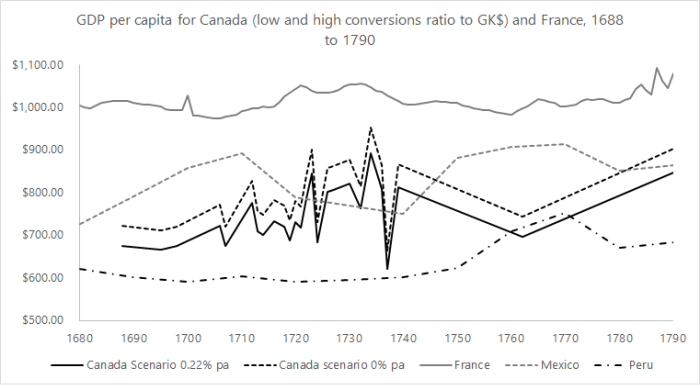
This is where Canada comes in. Today, the country easily fits in the “relatively rich” group. According to the figures 1 and 2 in the work of Acemoglu, Johnson and Robinson, it would have been in the “relatively poor” group well behind countries in Latin America. However, I recently finished compiling the Canadian GDP figures between 1688 and 1790 which I can now compare with those of Arroyo Abad and Van Zanden for Peru and Mexico. With my Canadian data (see the figure below), we can see that Canada was as poor as Latin America around 1680 (the start date of my data).

GelosoGDP.png

So, Canada was a relatively poor country back which was equally poor (or moderately richer) than Latin American countries. Why does that matter to the reversal of fortune story? Well, with the urbanization data, one shows that the non-urbanized of 1500 are the rich of the today. With the GDP data for the 1680s, we see that the more urbanized countries were also poorer than the less urbanized countries.

Now, my argument is limited by the fact that I am using 1680s GDP rather than 1500 GDP. But, one should simply extend the urbanization series to circa 1700 and the issue is resolved.  In any case, this should fuel the skepticism towards the strength of the reversal of fortune argument.

French Africa

This is a meandering essay; although it’s about history, it’s a bit personalized, for effect. In other words, it’s far from straightforwardly scholarly history but I think it’s all or mostly true. Be patient, at one point it will become about the former French African colonial empire and socio-cultural strata it deposited in France, and there to this day.

Acting Uncool

Often, in my dotage, I sneak a look at TV5, the French language cable channel. Often too, I fall asleep on the couch while watching its usually – but not always – insipid programs. One day, a short documentary catches my attention. It’s about sexual harassment of French women on the public way. It catches my attention because it’s not obvious to me what would pass for sexual harassment in France, I mean, this side of grabbing and such. So, it turns out that the makers of the documentary had placed a man with a hidden camera near a cafe on a street with a bad reputation. The street is near to one of the main railroad stations in Paris, guaranteeing a two-way flow of commuters, including women, of course.

In the course of twenty minutes, the documentary displays about thirty episodes of “sexual harassment.” I am only a man, of course, and thus limited, and a skeptic, but the worst harassment I witness takes the form of annoying mouth noises that I am not talented enough to reproduce with words. Mostly, there are gauche invitations to have a cup of coffee. The documentary ends with the expected boring, trite lamentations, blah, blah. There is zero mention of a striking fact: All the harassers without exception sport a thick North African accent.

I say a “thick” accent to signify recent arrival in France. The accent normally erodes in a few years or months. I imagine the harassers were young immigrants from small villages in Algeria and Morocco trying artlessly to deal with the knowledge that they were now in a society where sex could theoretically be had outside of marriage and outside of prostitution. Some may have been merely lonely and naively hoping to make a French friend. Political correctness clashes with political correctness: Harassing women, even if only verbally, is terrible but mentioning that the harassers all proceed from Muslim countries is terrible too. So, make the documentary and shut up about the obvious!

This is not a very interesting story, of course; I know this. Would anyone expect probably poorly educated rural young men from sex-segregated societies to learn to be cool with women as they are stepping off the boat? It will take quite a while, at best. For some, it will never happen; they will remain uncool forever. Then, they will marry an immigrant woman from their area of origin. Again, it would be absurd to expect anything else. In the same vein, would it be reasonable to imagine that all those immigrants would quickly come to appreciate the importance of the separation of religion from governance (of “church and state”) when it’s anathema in Islam?

Is it possible that a few will never appreciate at all the beauty of such separation? Is it possible that their ignorance, or their hostility, will be passively transmitted to their offspring, together with pork avoidance, for example? Will (would) that transmission have a cumulative effect on French society? France contributed more than its share of apprentice terrorists to ISIS, even would-be war brides, even young women ready for the sexual jihad. The one thing may have little to do with the other. And, it’s true that a startling number of the above are converts from Christianity or, more likely, from atheism.

French people who are not racist, or even “Islamophobic” in any mechanistic sense, carry this sort of question on their minds all the time. Some French people who have been in France for a long time but have Muslim names become themselves attached to secularism (la laïcité). They also discreetly worry about the very same issue. Those who will actually talk about it appear more worried than their fellow citizens with names like mine, or like “Pierre Dupont.” This is all impressionistic, of course. There is no survey. For one thing, it’s illegal in France to gather data about ethnicity.

How did it come to this, you might wonder. Why are these guys in France at all, the ones acting uncool in every conceivable meaning of the word?

Quitting Algeria

In 1962, the French Republic and the Algerian nationalists of the Front de Libération Nationale (“FLN”) came to an agreement about Algerian independence. That was after 130 years of French colonization and eight years of brutal war, including war against civilians, from both sides. The colonization had been in depth, with hundreds of thousands of French settlers convincing themselves that Algeria was a kind of second France, resembling the original in every way. Except, that is, for the inconvenient prior presence of numerous exotically dressed people who were neither Christians nor free-thinkers. Except for the fact that many of the French settlers were newly minted poor immigrants from Spain and Italy.

At Independence, I participated in the evacuation of large number of French civilians from the country as a little sailor. I mean “French French.” By that time and belatedly, the presumably Muslim population had been granted citizenship. Too little, too late. Probably in an an effort to divide to conquer, the numerous (Arabic speaking) Algerian Jews had all been granted citizenship in the 1880s. In the days of evacuation, the number of (old) French who wanted to leave was much greater than French authorities had planned for. An aircraft carrier – emptied of its planes – had to be used. It was a pathetic show, complete with broken, uncomprehending old grandmothers who had probably never set foot in France. There were no deluxe suitcases in sight but there were used mattresses. Some factions within the FLN were threatening the French with death if they did not go immediately; others would have liked to keep them, or some of them. The death threats prevailed.

It was too bad that the French left in such large numbers. It made the transition to independence technically more difficult than it could have been. It gave the upper hand in Algeria to those who had the best guns rather than to those who could govern, or to the people. It was a pity for all concerned. The French refugees faced an uncertain and harsh future in France, for the most part. For the Algerians, many positions were left for a while without competent personnel, including a budding oil industry in the Sahara. There was a shortage of medical doctors for many years.

Make a mental note of this fact: The French French were not the only ones fleeing. They were accompanied by tens of thousands of families with Muslim names and whose native language was other than French. They were Algerians who had chosen the wrong side in the war of independence and who feared to be massacred in the new Algeria (correctly so, it turned out). Those joined the other hundreds of thousands who had been living in France for economic reasons beginning with WWI.

I think of those events as a double tragedy or a tragedy leading to a tragedy. The Algerian independence fighters who had prevailed by shedding quantities of their blood were definitely not (not) Islamists. In most respects, intellectually and otherwise, they were a lot like me at the time, moderate, democratic leftists. In fact, I once spent a moving three hours drinking coffee with a convalescing FLN soldier my age, in a third country. He and I had most things in common, including the French language. (More needs to be said about communities of language.)

The true Algerian revolutionaries were soon replaced in power in Algiers however by the professional soldiers of an army that had never really fought because it had been formed outside Algeria while partisan-style forces battled the French army. The military is still in power, fifty-five years later. I think of their regime as a classical but fairly moderate kind of fascism. It has bloodily fought Islamism to a standstill on Algerian soil so, everyone pretends to like them.

The Poor Politics of Colonialism

I went back to Algeria – as a tourist, a spear fisherman, believe it or not- six years after independence. I was warmly received and I liked the people there. They felt like cousins, the sort of cousins you played with in childhood but have not seen in adulthood. I think now, as I thought in 1962, that the nationalists were on the right side of the argument but I miss Algeria nevertheless. It’s like a divorce that should not have happened if someone had been more reasonable. Even such a short time after the events, events I had lived through as an adult, it was difficult to comprehend what had gone wrong. It was difficult to find any trace of hatred for the French. A young man I wanted to thank for a favor done asked me to take him to a restaurant where he could eat Brie, made expensive by a tariff. (Do I have the talent to make up this anecdote?)

I blame the astonishing incompetence of a French political class that failed in the course of 130 years to invent a form of citizenship that would have accommodated a large and fast growing Muslim population. At the time, it was widely argued that the Muslims insisted on being ruled by a mild form of Sharia insofar as their personal affairs, such as marriage and divorce, were concerned. Such an arrangement was incompatible with the strictly secular laws of the French Republic, of course, they were told. The Muslim numerical majority thus had to remain subjects, with only individual access to citizenship, more or less like any Finn or any Bulgarian. I don’t know if this was a genuine obstacle or an excuse for a simple case of yielding to the local French population who did not wish to live under Muslim rule, even if only for local affairs. In spite of their well publicized humanitarian and liberal values, French parties of the left played a prominent part in colonization and in the attendant repression of native populations. The late Socialist Pres. Mitterand, for example, was vigorously policing Algeria when he was a young politician (who had had one foot in the Resistance and one foot in Vichy, earlier, another story, of course).

A brief history of imperialism

After completing the military conquest of Algeria in 1847, which had been arduous, France soon developed a vague appetite for easy territorial gains overseas. The age-old British rival’s imperialism probably inspired the French. By WWI, France had placed under its control, Algeria’s neighbors Tunisia and Morocco (the latter, split with Spain), and the present countries of Mali, Niger, Mauritania, Senegal, Guinea, Cote d’Ivoire, Burkina Faso, Chad, Benin, the Central African Republic, Gabon, and the Congo (the small one, next to the Belgian Congo). During World War I, France also took Togo, and the southern half of Cameroon from Germany. We must add Djibouti on the Red Sea and the large island of Madagascar in the Indian Ocean.

Most – but not all – of the population in the colonies was Muslim. Possibly close to half were native speakers of Arabic dialects. However in North Africa, large minorities knew no Arabic but were speakers of several varieties of Tamazigh (“Berber”). French colonial power did not fail to utilize this linguistic dichotomy, as you might expect. Be it as it may, at the close of WWII, you could travel straight south from Algiers on the Mediterranean to Pointe Noire, (across the river Congo from Kinshasa in the larger and better known Belgian Congo) without ever leaving French control.

The possession of a colonial empire seems to have generated monopolistic profits for a few French people, the extraction of which were accompanied by routine atrocities in some parts. The horrors of French rule in the equatorial colonies where hevea -rubber trees – grew, was documented by the great writer André Gide in his travel narrative Un Voyage au Congo. National possession of the empire gave the average French person much psychic income, I think. At least, it facilitated fantasizing – under the gray French skies – about palm trees and warm seas. And adventurous but skill-less young Frenchmen could always find jobs easily in the southern colonies, overseeing native (black) labor just for being white, French, and knowing the common language (French) well.

All the sub-Saharan African countries achieved independence peacefully in the late fifties or early sixties. Morocco and Tunisia had preceded them in 1956. Before that, in Sétif, Algeria, a peaceful demonstration against the French government was put down in 1945 in a massacre where thousands perished. In 1947, an attempted insurrection against French colonial power in faraway Madagascar was ended with another bloodbath. One concrete objection to colonialism is that it regularly places mediocre men in charge of the destinies of many others, some of whom are not mediocre. Those who gave the order to shoot in both Sétif and Madagascar where low level public servants.

Compare

There is an intuitive tendency to view colonialism largely or completely in terms of the culture of the colonial power. This is probably wrong. What matters is the circumstances of the colonial acquisition and the use to which it was put. The contrasting cases of Algeria and Senegal are instructive in this respect.

Algeria was conquered militarily between 1830 and 1847 in a thoroughly ravaging war. Note that 1830 was only 18 years after the Waterloo defeat. The Napoleonic era’s stupendous French military victories (excepting Waterloo) were fresh in the collective consciousness. Plus, the political entity centered in Algiers had been far from a bucolic and peaceful place before the French conquest. Its economy relied heavily on piracy and various forms of slaving. It made a likely prey. No one or almost no one was going to miss it. (It’s a mystery why Thomas Jefferson ran out of breath before he got to that Barbary state.) Algeria always mattered because it seemed a likely colony of settlement. It became one, a good one, in spite of the existence of a large native population.

The balance of France’s African colonies – with the exception of Tunisia that was wrested from nominal Ottoman rule by a brief military invasion – was acquired without much purposefulness and with little fighting. A large swath of land near the Equator was taken without a fight by an Italian adventurer, a naturalized Navy officer, a contemporary of Stanley. Brazza was usually accompanied only by a handful of native troops. Wherever he went, he cheekily raised the French flag and abolished slavery. The capital of the Congo bears his name to this day (indicating that he left a pretty good memory).

The smallish country of Senegal in western Africa is a special case of French colonization. French political presence there dates back to the 17th century, first in the form of slave trading posts. Later, the four main cities of Senegal were re-formed as French political municipalities. This, in the absence of a significant local French population. The inhabitants of those cities obtained French citizenship in 1792, that is, earlier than many inhabitants of France. They were eligible to vote and to be elected. French power over the countryside extended slowly from those four towns meeting little resistance.

This special case matters because the assimilationist current in Senegal was strong before independence in 1960 and it continued after independence. Today, it’s difficult to find a Senegalese who does not speak good to excellent French. The unknown percentage who can write do it in French. Interestingly, the casual racism guiding the interaction with the natives of the few French administrators and military personnel, plus a handful of businessmen, was largely suspended when they dealt with the Senegalese. (Personally, I think labels matter, “citizen,” for example. Obviously, that’s another story.)

The narrative of the colonization of Senegal is fairly important because it shows one case where a Muslim country (95%) is explicitly friendly toward the West and well informed about it (via the French language). It is also politically stable and democratic although it is poor (GDP/capita of only about $2,600 around 2015). It’s a case of successful intellectual colonization. I have even personally heard English-speaking Africans accuse Senegalese intellectuals of the same sins of arrogance and obstinacy that usually stick to Paris Left Bank intellectuals. Something went right in Senegal.

By the time of WWII, much of public opinion – including the still-large officer class – was enamored with the notion of France as a great Muslim power.

Colonial strata within France

Every new acquisition of territory in Africa generated a new wave of emigrants to France: students, low-level civil servants climbing the bureaucratic ladder, and some laborers. Public school teachers of native extraction – a large number – would go to France for training through what was intended as a revolving door. There, some would find true love, marry and stay. Every loss of a colony did the same as every acquisition because – as I have mentioned – not everyone knows how to choose the right side in a conflict. Every war also brought Africans to France, as soldiers and as laborers both. Many won French citizenship and remained too. Over the twentieth century that African-originated population grew inside France because immigrants, mostly from rural areas, usually multiply faster than the more urban host population. All immigrants and all their children and all their grandchildren attended the Republic’s schools, or, more rarely, the few Catholic schools.

There was comparatively little true racism, racism by color. (Read the subtle observations of the black American writer Richard Wright, for example.) The existence on the soil of Metropolitan France of a long assimilated black West Indian population may have contributed to deny conventional racism much traction. Despised cultural traits and a condition of economic inferiority on the one hand, and skin color on the other, just did not coincide well enough.

The relative rarity of color sentiment and its shallowness, does not mean that the French were or are free of prejudice, of course. For more than one century, the worst jobs in the country were occupied by immigrants from North Africa, mostly Algeria. Those were people from deeply rural, primitive regions, literate in no language. For most of that period, they lived in ghettos, while their wives and children remained behind in a Maghreb that was always fairly near.

Those people were subject to systematically poor treatment. It was made much worse by the Algerian war of independence that was fought partly in France, with numerous acts of terrorism. French French people never knew enough about Islam until recently and they were too religiously indifferent to call that prejudice “Islamophobic,” I think. What is now the largest political party in France, the Front National, used to be overtly anti-Muslim. Under new leadership, it has cleaned up its act in this respect, avowedly because that stance was doing it more electoral harm than good. It’s now against all immigration. In the current (2017) presidential campaign, some people with Muslims names have said publicly that they would vote for the Front. (They remain a curiosity, I am guessing.)

I am trying to be fair and descriptive here. Two relevant stories. When I was a teenager, I worked part time in an expensive hotel in Paris. Luxury hotels are like theaters; they have a public stage and a backstage. There was a middle aged guy who was the fix-everything man. He was knowledgeable and he had all the tools of most trades. His name was “Ahmed” backstage but it became magically “Jean” when he was in the public area. The great and luminous French movie star Isabelle Adjani (b. 1955) kept her half Algerian origins in the closet for half of her career. To be fair, when she disclosed that she was the daughter of an Algerian Amazigh (a Muslim) a consensus quickly formed that her secrecy had been silly. It’s also possible that she feared the nude scenes in her movies would meet with dangerous disapproval from her father’s group of origin.

In the end, there is a large sub-population in France today that traces its ancestry to various parts of Africa, north, west, and central. By American standards, some are black, some are white. Many or most are citizens. Many are not but have a legal right to live in France by virtue of some international post-colonial agreement or other. Some almost have that right. Many – and still coming – don’t have any such right at all but their cousin lives there. Their children all attend school. They all arrive knowing some French from the schooling in their countries of origin. Given the comparatively effective (comparatively) French school system, and given the unsmiling, generalized French contempt for multilingualism, they all end up “French” in some sense, knowing the French language well, familiar with the fundamentals of civics, well versed in basic French history.

Muslim identity

The only trait that consistently differentiates some, or probably most people of African origin from the rest of the French population, is their presumed Muslim identity. (Notably, you almost never hear of people of African descent who are Christian, or even nothing at all.) Islam matters as a cultural fact, even irrespective of genuine religious sentiment, because it prevents mixing to a large extent, and especially, intermarriage. Previous immigrants, from Poland, Germany, Italy, Spain, and more recently, Portugal all tended to marry French. Even more so did their daughters. Muslims from Africa mostly don’t except that a few men marry non-Muslim women.

I say “presumed” Muslim identity because there is no rigorous way to estimate the current Muslim population in France. That too, is forbidden. Going by names – which is often done – is sure to give bad results. It’s likely that most French people with a Muslim name are like the bulk of other French people, religiously indifferent.  Hence name counting inflates the number of Muslims in any meaningful sense. Still, there are many mosques in France and many recriminations about their being in insufficient number. There is a large, monumental, highly visible mosque near central Paris. It shelters the headquarters of the official national organization that represents the interests of French Muslims with the government. I don’t know how representative that representative organization currently is, of course.

People with Muslim first names and last names are everywhere in France, over the latitude and longitude of the territory but also from the bottom – sweeping the streets of Paris – to the top of the socioeconomic pyramid. (A while ago, I was half in love with a French woman named Rachida Dati. She was a minister in Pres. Sarkozy’s cabinet. It did not work out!) The first French soldier to die in the NATO expedition in Bosnia was named El Hadji. The Paris cop terrorists killed outside of Charlie Hebdo also had a Muslim name.

There are many other markers of long-term African presence in France. Here are some, pell-mell: Best couscous in the world. The North African Arabic word for “fast” is commonly used in French, including by people with 32 ancestors born in France. One of the many vocables for the male appendage in French, also one of the most commonly used, is straight from Arabic. (Don’t count on me to satisfy you salacious curiosity; do your own research.) Paris is the world center for the promotion and recording of rich West African music. Same for most fiction and poetry in French, including a significant production from Africa. The strange, often baffling intellectual movement “la négritude“(“negroeness,” I think) developed in France. The largest or second largest collection (after that of the British Museum, maybe) of black African art in the world is in a Paris museum, etc.

Cultures

Those who know me, in person or through Notes On Liberty, or Liberty Unbound, those who spend even a little time on my blog (factsmatter.worldpress.com), or on my FB page will have heard me lamenting loudly the sterility of contemporary French culture. I cry torrents, especially over the impoverishment and the muddiness of the current French public French language, I mean, as spoken in France, specifically.* For the past fifty years, the French have had precious little to show by way of visual arts, or music and much of their contemporary literature projects the very cold of the grave. Aided by endless government subsidies, the French make many mediocre movies whose slowness and technical imperfection passes for intellectual depth, especially among a certain category of Americans.  (On this topic of government help to the French movie industry, you might read Delacroix and Bornon: Can Protectionism Ever Be Respectable? A Skeptic’s Case for the Cultural Exception, with Special Reference to French Movies.” [pdf])

French public figures talk like teenagers and they generally don’t know how to finish a sentence. If a member of the French intelligentsia speaks to you about Iraq, for example, say a journalist at prestigious Le Monde, you know no more about Iraq when he is finished than you did when he begun; you may know less. It was not always like this. (And, I will not insist that the decline of French culture and language are due to my emigration to the US at age 21 but the dates coincide pretty well.) Incidentally, the museums are still good; actually, the whole country of France is like an attractive museum that would have a superlative cafeteria attached. But I digress. This is all to let you know of a certain critical pessimistic state of mind of mine.

Still, there are French cultural phenomena that continue to interest me. One is a “culture” TV show with a strong political component that’s tougher on politicians than anything we do in the US. (It’s called, “On nest pas couchés.“) Another is a pure political show, also hard on the politicians interviewed there. (It’s called simply, “L’ Emission politique.“)

So, another time, I am watching French TV intently because there is a retrospective show on the anarchizing singer/composer George Brassens who died in 1981. Brassens is the closest thing France has – except for Edith Piaf –  to a secular modern saint. He wrote elegant poems addressed to ordinary people that the intellectual elite also admired. He also put to music Victor Hugo and even the medieval poet François Villon. He sang all with a distinctive stage presence.

That night several current stars of French popular song have been gathered in one setting to each sing one or more of Brassens’s songs. A man named “Slimane” takes one of the three or four most popular, most familiar of Brassens’ pieces and sings it in a deliberately Arabized manner. When he is finished, the eyes of several women singers sparkle. I am strongly moved myself. Slimane has given new life to a classic. No one will ever forget his hybrid rendition of the song.

This is yet another time, I am dozing on the couch (again) after a good French political show I mentioned elsewhere. The TV is still on, of course. Something stops me from falling right asleep; something drags me back to consciousness. This has never happened to me before. What’s waking me is the clarity of the language used by a youngish man being interviewed for one of those culture/literature shows that abound on French television.** The man to whom the voice belongs enunciates precisely; his words are well chosen without being precious; his grammar is impeccable; he finishes every one of the sentences he begins; he does not stutter. He speaks like a man who has thought of what he is speaking about.

Soon, I am alert enough to realize that the fine speaker of French is on the show to flog his newly published book. The book is about conversations he has had in his mind with the writer/philosopher Albert Camus. Now, Camus died in 1960, by the look of it, before the current writer on Camus was born. Camus has a special place in the minds and hearts of several generations of a certain category of French men that used to include me. He is one of the fathers of popular “existentialism.” (I have to use the qualifier and the quote marks to avoid the predictable correction by pedants who will push quotes in German into my email to prove that Camus is in no way a real existentialist. WTF!) Camus received the Nobel in literature in 1957 but that’s not why we care about him. I cannot describe here in detail the particular category of French men who revere him but here is a pointer: Early on in his fame Camus broke up very publicly with his good buddy, the better known Jean-Paul Sartre because Sartre would not denounce Stalinism.

The young writer on TV is black. I am told he is a well-known rapper in France. His name is Abd el Malik. Anecdotal evidence about nothing, some will say. Will it influence me in the future in spite of my good social science training? You bet. How can I avoid it? How can millions of French people ignore this kind of episode irrespective of their views on immigration? That man’s short presentation was like a ray of sunshine in a uniformly dark forest. Why should they not let it impress them?

The story does not end here, Camus himself was a Frenchman from Algeria, obviously not a Muslim. He was born to a widowed, half-deaf and illiterate Spanish immigrant woman who cleaned houses to support herself and Albert. The French are not so much confused about the legacies of their former colonial Empire as they are faced with a confounding reality.


* French is well spoken in various places, in Senegal, first, in much of urban Morocco and Tunisia, and among the Haitian elite, of all places. Romanians and Lebanese also tend to speak a very classical French as a second language.

**I say this with a little bitterness because, as someone who is still practicing being a commercially unsuccessful American writer, I regret strongly that we don’t have a plethora of such shows in the US of A.
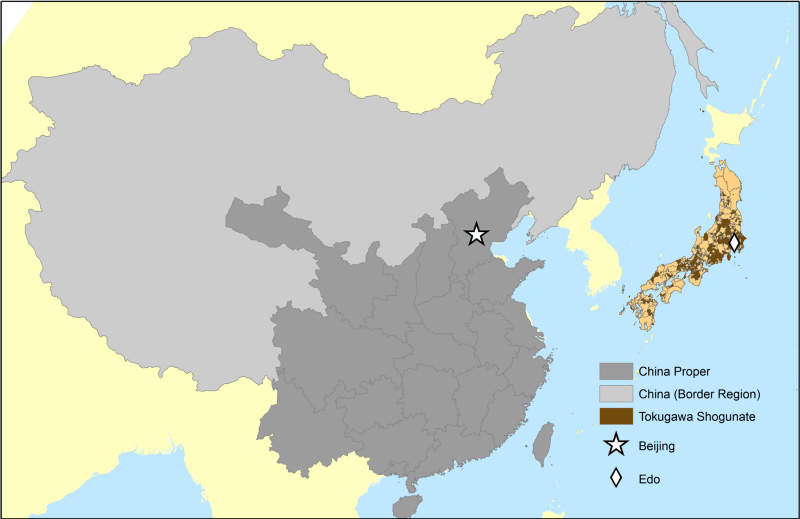
Military Dictatorship in Brazil: Was it worth it?

The title of this text can already cause controversy since many understand that there was no dictatorship in Brazil, but a series of military governments that could not be classified as dictatorial. But the fact is that, in 1964, Castelo Branco became president in place of João Goulart, being succeeded by Costa e Silva, Medici, Geisel and João Figueiredo. Calling this dictatorship or not, the fact is that João Goulart was deposed and Castelo Branco occupied the presidency to avoid that the country was taken by groups sympathetic to the communism, making Brazil a “Big Cuba”. And it is against this fact that I ask if it was worth it: was it worth having 21 years of military governments to prevent a socialist government from being implanted in Brazil?

A socialist government was implemented in Brazil in 2003 by popular vote. Although political propaganda in 2002 had proclaimed an inclination towards the center of the political spectrum, the fact is that the PT never completely abandoned its socialist inclinations. It could even be said that FHC is worthy of the same comment: although less inclined to the left, the PSDB does not carry “democratic socialism” in the name for nothing. In light of this, I ask if it was worth having 21 years of military governments in Brazil. In 1988, just three years after João Figueiredo left the presidency of the country, a Constitution was promulgated with a strong Progressive character. In 1994, less than 10 years after the last military president stepped down, Brazil elected a “Third Way” president. In 2002 a president with a past of explicit connections with socialism came to power, and in 2011 the country happened to be governed by a former guerrilla warrior. If the objective of placing the military in power has been to avoid the implantation of socialist governments in Brazil, it can be said that this goal was not achieved. It was only postponed for just over 21 years.

What is socialism? Why is it so bad? Even without any empirical research, I am quite sure that most of the Brazilian population would not know how to answer these questions. In a similar vein, I am quite convinced that most of the country’s “literate class” (artists, academics, and intellectuals of all kinds) is sympathetic to socialism. Many of the political parties in Brazil carry “socialism” or “communism” in the name.

What did the military governments offer in exchange for socialism? Although they had varied characteristics, most of the governments between 1964 and 1985 tended to be a modernized version of Positivism. Positivism states that all knowledge (tradition, common sense, religion) will be superseded by positive scientific knowledge. Another way of defining it is to say that only what is empirically proven is true. Positivism, however, presents some problems. First, it is self-defeating, that is, it does not stand up to its own validation criteria: “Only what is empirically proven is true.” Is this empirically proven? Is it empirically proven that “only that which is empirically proven is true”? No. And it could not even be. Another difficulty is to carry out the empirical tests. It is possible, even with constraints, to conduct empirical tests in a controlled environment (in laboratories) to test theories and hypotheses. But it is not possible to declare the universality of the results, even if the tests are performed a very large number of times.

This “problem of induction” (to draw universal conclusions from particular, albeit many, observations) was famously answered by Karl Popper: in Popper’s definition, the aim of science is not to prove universal truths, but to affirm with confidence a set of information. In other words, nothing is “scientifically proven,” but many things are scientifically falsified by the lack of favorable evidence. Ludwig von Mises answered the problem of induction in another way: not everything has to be empirically tested to be considered true. There are truths that are self-evident, even without any empirical test. Despite the differences, both Popper and Mises offered possibilities of non-positivistic sciences (in the sense of systematic knowledge), especially valid for the study of human beings living in society.

Positivism and Marxism are sister doctrines. Both emerged in the 19th century in response to liberalism. The origin of liberalism lies in Christianity, if not in the affirmation of the existence of the Christian God in all the details presented by the Bible, at least in elements such as Natural Law and an anthropology similar to that of Christian teaching. Positivism and Marxism have moved away from Christianity by adopting a materialist view of reality (it only exists, or at least it only matters what we can experience empirically) and by denying the natural limitations of the human being.

Following von Mises, the Austrian School rejects the positivist methodology, and therefore is classified as heterodox. Although we should avoid anachronisms, the tendency of classical economists was the same: from introspection and axioms, rather than from empirical tests. It is not a matter of despising the scientific method altogether, quite the opposite! The scientific method is excellent for taking the man to the moon and discovering the cure of diseases. It just is not fit for a human “science.” To believe so is to fall into a “fatal conceit”. The military that governed Brazil between 1964 and 1985 can be accused of this fatal conceit. They generally believed that they could rule the country as if it were a barracks.

In conclusion: was it worth it? Certainly avoiding Socialism is a great and necessary goal. But combating it with Positivism is not the right path. Two mistakes do not make a hit. Was there the possibility of combating socialism with liberalism? I think not. Brazil didn’t have the liberal tradition necessary to confront socialism and other forms of authoritarianism or totalitarianism (and maybe it still hasn’t). Looking back, we can only regret that the options were so bad. Looking forward, we can try to improve our options by building a true liberalism in Brazil.

The End of the Past


On Branko Milanovic’s recommendation, I read Aldo Schiavone’s The End of the Past. Scholarly and elegantly written, it provides one of the best imaginative reconstructions of the ancient Roman economy.

Previous posts have touched on the economies of late antiquity, the modernist primitivist debate, and diagnosed problems in many recent assessments of the ancient economy (here, here, here, and here). I want to use Schiavone’s book to revisit a question raised by Peter Temin in The Roman Market Economy. How advanced was the Roman economy? Specifically, how did it compare to the economy of Europe in late medieval or early modern times? Was the Roman economy only as developed as that of Europe circa 1300 or was it as advanced as that of western Europe on the eve of the Industrial Revolution in say 1700.

This question is not mere idle speculation. It matters for our understanding of the causes of long-run economic growth whether an industrial revolution could have happened in Song China or ancient Rome. This type of counterfactual history is crucial for pinning down the casual mechanisms responsible for sustained growth, especially as historians like Bas van Bavel are now proposing explicitly cyclical accounts of growth in societies as varied as early medieval Iraq and the Dutch Republic (see The Invisible Hand? (OUP, 2016))

Temin’s GDP estimates suggest that Roman Italy had comparable per capita income to the Dutch Republic in 1600. The Empire as a whole, he suggests, may have been comparable to Europe in 1700 (Temin 2013, 261). My gut reaction is that this is plausible as an upper-bound. Schiavone (who was writing several years before Temin), however, raises important points that I had fully not considered previously.

Schiavone opens with an account of a speech given by Aelius Aristides celebrating the wealth of the Roman empire in the mid-2nd century AD.

“Whatever each culture grows and manufactures cannot fail to be here at all times and in great profusion. Here merchant vessels arrive carrying these many commodities from every region in every season and even at every equinox, so that the city takes on the appearance of a sort of common market for the world. One can see cargoes from India and even from southern Arabia in such numbers that one must conclude that the trees in those lands have been stripped bare, and if the inhabitants of those lands need anything, they must come here to beg for a share of what they have produced….

Your farmlands are Egypt, Sicily, and all of cultivated Africa. Seaborne arrivals and departures are ceaseless, to the point that the wonder is, not so much that the harbor has insufficient space for all these merchant vessels, but that the sea has enough space (if it really does). Just as there is a common channel where all waters of the Ocean have a single source and destination, so that there is a common channel to Rome and all meet here: trade, shipping, agriculture, metallurgy— all the arts and crafts that are or ever were and all things that are produced or spring from the earth. What one does not see here does not exist” (Aristides, The Roman Oration).

This is a panegyric addressed to flatter the emperor but its emphasis on long-distance trade, commerce, manufacturing is highly suggestive. Such a speech is all but impossible to imagine in an predominantly rural and autarkic society. Aristides is painting a picture of a highly developed commercialized economy that linked together the entire Mediterranean and beyond. Even if he is grossly exaggerates, the imagine he depicts must have been plausible to his audience. In evaluating the Roman economy in the age of Aristides, Schaivone notes that:

“Until at least mid-seventeenth century Amsterdam, so expertly described by Simon Schama — the city of Rembrandt, Spinoza, and the great sea-trade companies, the product of the Dutch miracle and the first real “globalization of the economy — or at least, until the Spanish empire of Philip II, the total wealth accumulated and produced in the various regions of Europe reached levels that were not too far from those of the ancient world” (Schiavone, 2000, 94).

This is the point Temin makes. Whether measured in terms of the size of its largest cities — Rome in 100 AD was larger than any European city in 1700 — or in the volume of grain, wine, and olive oil imported into Italy, the scale of the Roman economy was vast by any premodern standard. Quantitatively, then, the Roman economy looks as large and prosperous as that the early modern European economy.

Qualitatively, however, there are important differences that Schiavone draws out and which have been obscured in recent quantitative debates about GDP estimates.

Observe that Roman history leaves no traces of great mercantile companies like the Bardi, the Peruzzi or the Medici. There are no records of commercial manuals of the sort that are abundant from Renaissance Italy; no evidence of “class-struggle” as we have from late medieval Europe; and no political economy or “economics”, that is, no attempts to systematize one’s thoughts and insights concerning the commercial world. The ancient world, in this view, only superficially resembled that of early modern Europe. Seen from this perspective, the latter contained the potential for sustained growth; the former did not. Why is this?


The most obvious institutional difference between the ancient world and the modern was slavery. Recently historians have tried to elevate slavery and labor coercion as crucial causal mechanism in explaining the industrial revolution. These attempts are unconvincing (see this post) but slavery certainly did dominate the ancient economy.

In its attempt to draw together the various strands through which slavery permeated the ancient economy, Schiavone’s chapter “Slaves, Nature, Machines” is a tour de force. At once he captures the ubiquity of slavery in the ancient economy, its unremitting brutality—for instance, private firms that specialized in branding, retrieving, and punishing runaway slaves — and, at the same time, touches the central economic questions raised by ancient slavery: to what extent was slavery crucial to the economic expansion of period between 200 BCE and 150 AD? And did the prevalence of slavery impede innovation?

It is impossible to do justice to the argument in a single post. Suffice to say that after much discussion, and many fascinating interludes, Schiavone suggests that ultimately the economic stagnation of the ancient world was due to a peculiar equilibrium that centered around slavery.

One can think of this equilibrium as resting on a two legs. The first is the observation that the apparent modernity of the ancient economy — its manufacturing, trade, and commerce rested largely on slave labor. The expansion of trade and commerce in the Mediterranean after 200 BC both rested on, and drove, the expansion of slavery. Here Schiavone note that the ancient reliance on slaves as human automatons — machines with souls — removed or at least weakened, the incentive to develop machines for productive purposes.

The existence of slavery, however, was not the only reason for the neglect of productive innovation. There was also a specific cultural attitude that formed the second leg of the equilibrium:

“None of the great engineers and architects, none of the incomparable builders of bridges, roads, and aqueducts, none of the experts in the employment of the apparatus of war, and none of their customers, either in the public administration or in the large landowning families, understood that the most advantageous arena for the use and improvement of machines — devices that were either already in use or easily created by association, or that could be designed to meet existing needs — would have been farms and workshops”

The relevance of slavery colored ancient attitudes towards almost all forms of manual work or craftsmanship. The dominant cultural meme was as follows: since such work was usually done by the unfree, it must be lowly, dirty and demeaning:

“technology, cooperative production, the various kinds of manual labor that were different from the solitary exertion of the peasants on his land — could not but end up socially and intellectually abandoned to the lowliest members of the community, in direct contact with the exploitation of the slaves, for whom the necessity and demand increased out of all proportion . . . the labor of slaves was in symmetry with and concealed behind (so to speak) the freedom of the aristocratic thought, while this in turn was in symmetry with the flight from a mechanical and quantitative vision of nature”

Thus this attitude also manifest itself in the disdain the ancients had for practical mechanics:

Similar condescension was shown to small businessmen and to most trade (only truly largely-scale trade was free from this taint). The ancient world does not seem to have produced self-reproducing mercantile elites. Plausible this was in part because of the cultural dominance of the landowning aristocracy.

The phenomenon coined by Fernand Braudel, the “Betrayal of the Bourgeois,” was particularly powerful in ancient Rome. Great merchants flourished, but “in order to be truly valued, they eventually had to become rentiers, as Cicero affirmed without hesitation: ‘Nay, it even seems to deserve the highest respect, if those who are engaged in it [trade], satiated, or rather , I should say, satisfied with the fortunes they have made, make their way from port to a country estate, as they have often made it from the sea into port. But of all the occupations by which gain is secured, none is better than agriculture, none more delightful, none more becoming to a freeman’” (Schiavone, 2000, 103).

Such a cultural argument fits perfectly with Deirdre McCloskey’s claim in her recent trilogy that it was the adoption of bourgeois cultural norms and specifically bourgeois rhetoric that distinguished and caused the rise of north-western Europe after 1650 (here, here, and here).


Having taken note of the existence of such a powerful equilibrium — one resting on both material and cultural foundations, we can now return to Schiavone’s argument for why a modern capitalist economy did not develop in antiquity. He argues that given the prominence of slavery and the prestige of the landowning elite, economic expansion and growth of the kind that took place between c. 200 BCE to 150 CE was not self-reinforcing. It generated a growth efflorescence that lasted several centuries, but it ultimately undermined itself because it was based on an intensification of the slave economy that, in turn, reinforced the cultural supremacy of the landowning aristocracy and this cultural supremacy in turn eroded the incentives responsible for driving growth.

Compare and contrast with early modern Europe. The most advanced economies of early modern Europe, say England in 1700, were on the surface not too dissimilar to that of ancient Rome. But beneath the surface they contained the “coiled spring”, or at least the possibility, of sustained economic growth — growth driven by the emergence of innovation (a culture of improvement) and a commercial or even capitalist culture. According to Schiavone’s assessment, the Roman economy at least by 100 CE contained no such coiled spring.

We are not yet at the point when we can decisively assess this argument. But the importance of culture and the manner in which cultural and material factors interacted is clearly crucial. The argument that the slave economy and the easy assumptions of aristocratic superiority reinforced one another is a powerful one. For whatever historical reasons these cultural elements in the Roman economy were relatively undisturbed by the rise of merchants, traders and money grubbing equites. Likewise slavery did not undermine itself and give rise to wage labor.

Why this was the case can be left to future analysis. The full answer to the question why this was the case and a more careful consideration of the counterfactual “could it have been otherwise” are topics deserving their own blog post.

Did Inequality Fall During the Great Depression ?

Inequality

The graph above is taken from Piketty and Saez in their seminal 2003 article in the Quarterly Journal of Economics. It shows that inequality fell during the Great Depression. This is a contention that I have always been very skeptical of for many reasons and which has been – since 2012 – the reason why I view the IRS-data derived measure of inequality through a very skeptical lens (disclaimer: I think that it gives us an idea of inequality but I am not sure how accurate it is).

Here is why.

During the Great Depression, unemployment was never below 15% (see Romer here for a comparison prior to 1930 and this image derived from Timothy Hatton’s work). In some years, it was close to 25%. When such a large share of the population is earning near zero in terms of income, it is hard to imagine that inequality did not increase. Secondly, real wages were up during the Depression. Workers who still had a job were not worse off, they were better off. This means that you had a large share of the population who saw income reductions close to 100% and the remaining share saw actual increases in real wages. This would push up inequality no questions asked. This could be offset by a fall in the incomes from profits of the top income shares, but you would need a pretty big drop (which is what Piketty and Saez argue for).

There is some research that have tried to focus only on the Great Depression. The first was one rarely cited NBER paper by Horst Mendershausen from 1946 who found modest increases in inequality from 1929 to 1933. The data was largely centered on urban data, but this flaw works in favor of my skepticism as farm incomes (i.e. rural incomes) fell more during the depression than average incomes. There is also evidence, more recent, regarding other countries during the Great Depression. For example, Hungary saw an increase in inequality during the era from 1928 to 1941 with most of the increase in the early 1930s. A similar development was observed in Canada as well (slight increase based on the Veall dataset).

Had Piketty and Saez showed an increase in inequality during the Depression, I would have been more willing to accept their series with fewer questions and doubts. However, they do not discuss these points in great details and as such, we should be skeptical.

The Antebellum Puzzle, Anthropometric History and Quebec

I recently gave an interview on Economics Detective Radio with Garrett Petersen to talk about my forthcoming article in Economics & Human Biology (with Vadim Kufenko and Alex Arsenault Morin). In the interview, I explain why anthropometric history is important to our understanding of living standards, their evolution and short-term trade-offs in economic history. The interview is below, but you should subscribe to Garrett’s podcast as he is well on his way to becoming a serious competitor to EconTalk with the bonus that he does lots of economic history.

Podcast link (download).

Star Trek Did More For the Cultural Advancement of Women Than Government Policies

The fondest memories of my childhood center on the time I spent with my father watching Star Trek. At the time, I simply enjoyed science fiction. However, as an adult I have often revisited Star Trek (on multiple occasions) and I realized that I had incorporated subconsciously many elements of the show into my own political reasoning.

Not to give too much away about my age, my passion with Star Trek started largely with the Voyager installments. As a result, I ended up seeing Kate Mulgrew as Captain Janeway. And that’s what she was: the captain. I never saw the relevance that she was a woman. A few years ago, I saw her speak at the Montreal Comic-Con (yes, I am that kind of Trekkie) and she mentioned how crucial she thought her role to be for the advancement of women. By that time, I had already started to consider Star Trek as one of the most libertarian-friendly shows ever to have existed. While its economics were strange, its emphasis on tolerance, non-intervention and equality of rights make it hard to argue that it is not favorable to broadly-defined liberal mindset. However, I had not realized how much so until I heard Mulgrew speak about her vision of the role. After all, I had somehow forgotten that Mulgrew was a woman and how novel her role was.

One person who understands how important was this point is Shannon Mizzi who wrote a piece for Wilson Quarterly which I ended up reading while I was still a PhD student. Her core point was that in Star Trek, women were simply professionals. They were rarely seen doing other things than their work. While she argues that this meant that Star Trek played an underappreciated role in the history of women’s advancement, I am willing to go a step further. That step is to assert that the cause of the cultural advancement of women has been better served by Star Trek than by governments. (Please note that I am only considering cultural advancement)

The pre-1900 economic and social history of women would be sufficient in itself to make this point of mine. After all, women were given a lesser legal status by governments. This is both a necessary and sufficient element to assert that, overall, governments have been noxious to women’s advancement over many centuries. One century of legal emancipation would still leave Star Trek as a net positive force. But that would be a lazy argument on my part and I should simply focus on the present day. In fact, thanks to a wealth of data on wage gaps, gender norms and measures of legal institutions, I can more easily back up the claim.

My friend Rosemarie Fike of Texas Christian University is the first person that comes to mind in that regard. Her own doctoral dissertation, Economic Freedom and the Lives of Womenintroduced me to a wide literature on the role of economic freedom in the advancement of women. To be sure, Rosemarie was not the first to try to measure the role of economic freedom (which we should understand as how small and non-interventionist a government is). There had already been some research showing that higher levels of economic freedom were associated with smaller hourly wage gaps between genders and how liberalizing reforms were associated with wage convergence between genders. However, some economists have been arguing that there are other “soft sides” to economic freedom – like in the promotion of cultural equality and norms that promote certain types of attitudes. This is where Rosemarie’s work is most crucial. In a section of her dissertation, she essentially builds up on the work of (my favorite Nobel laureate) Gary Becker regarding preferences and discrimination. Basically, the idea is that free markets will penalize people who willingly discriminate. After all, if an employer refuses to hire redheads for some strange reason, I can compete by hiring the shunned redheads at a lower wage rate and out-compete him. In order to stay in business, the ginger-hating fool has to change his behavior and hire redheads which will push wages up. Its hard to be a racist or misogynist when it costs you a lot of money.

However, if you prevent this mechanism from operating (by intervening in markets), you are making it easier to be bigoted-chauvinistic-male-pigs. As a result, laws that prevent market operations (like the Jim Crow laws did for blacks) enshrine discriminatory practices. Individuals growing up in such environment may accept this as normal and acceptable behavior and strange beliefs about gender equality may cement themselves in the popular imagination. When markets are allowed to operate, beliefs will morph to reflect the actions taken by individuals (see Jennifer Roback’s great story of tramways in the US South as an example of how strong markets can be in changing behavior and see her article on how racism is basically rent-seeking). As a result, Rosemarie’s point is that societies with high levels of economic freedom will be associated with beliefs favorable to gender equality.

But the mirror of that argument is that government policies, even if their spirits have no relation to gender issues, may protect illiberal beliefs. Case in point, women are more responsive to tax rates than men – much more. In short, if you reduce taxes, women will adjust their labor supply more importantly at the extensive and intensive margin than men will. This little, commonly accepted, fact in labor economics is pregnant with implications. Basically, it means that women will work less in high tax environments and will acquire less experience than men will. Since it is also known that differences in the unmeasured effects of experience weigh heavily in explaining the remaining portion of the gender pay gap, this means that high tax rates contribute indirectly to maintaining the small gender pay gap that remains. Now, imagine what would be the beliefs of employers towards women if they did not believe that women are more likely to work fewer hours or drop out of the workforce for some time? Would you honestly believe that they would be the same? When Claudia Goldin argues that changes in labor market structures could help close the gap, can you honestly say that the uneven effect of high tax rates on the labor supply decisions of the different genders are not having an effect in delaying experimentation with new structures? This only one example meant to show that governments may, even when it is not their intent, delay changes that would be favorable to gender equality. There are mountains of other examples going the larger effects of the minimum wage on female employment to the effects of occupational licencing falling heavily on professions where women are predominant.

With such a viewpoint in mind, it is hard to say how much governments helped the cultural advancement of women (on net) over the 20th and 21st centuries . However, Star Trek clearly had a positive net effect on that cultural advancement.  That is why I am willing to say it here: Star Trek did more for the cultural advancement of women than governments did.

Famine and Finance: Credit and the Great Famine of Ireland

41YjUSWp3JL._SX351_BO1,204,203,200_I have recently finished reading Famine and Finance by Tyler Beck Goodspeed. While short, it should have a prominent place on the shelves of economic historians interested (obviously) in Irish history and (less obviously) in Malthusian theory.

Famine and Finance is a study of the response of Irish farmers to the potato blight. As it is known to many, many individuals simply left Ireland. However, where micro-credit was available, Goodspeed finds that farmers adapted by shifting to different types of activities – notably livestock. These areas experienced a smaller decline in population. Basically, where the institution of micro-credit was present, the demographic shock was much less severe. If only for this nuance, the book makes a sizeable contribution to the historiography of Ireland. The methods used are also elegantly simple and provide an interesting road map for anyone interested in studying the responses of local population to environmental shocks.

However, the deeper point comes from it tells us about institutions. In Goodspeed’s story, the amplitude of the collapse of the Irish population in the 19th century depends on the presence of the institution of micro-credit. Basically, the institution determined the amplitude of the shock. Since Ireland’s potato blight is often presented as the textbook case of Malthusian pressures, Goodspeed’s results are particularly interesting. In his chatper titled”Was Malthus Right?”, he shows that when controls for the institution of micro-credit is present, the typical Malthusian variables fail to explain population changes. In other words (i.e.  my words) , Malthusian pressures (the change in population) are in fact institutional failures.

This is a point I have often made elsewhere (see here, here and here and a blog post here). And because Goodspeed backs this point of mine, he has earned himself a place on my shelf of “go-to” books.