Methodological Individualism

That’s the title to co-blogger Warren Gibson’s latest piece in the Freeman. I wish I could copy and paste the whole thing, but you’ll have to settle for this juicy tidbit:

Let’s start with what methodological individualism is not.  It has nothing to do with “rugged individualism.”  It is not ideology at all.  It is a term that describes the essential nature of human thought and action.  It is a bedrock principle on which Mises grounds his entire exposition of economics.

“The Hangman, not the state, executes a criminal.”  This is Mises’s pithy summary of methodological individualism […]

When we think about the hangman from the point of view of praxeology (Mises’s name for the science of human action) we are not concerned with the social or psychological factors that may have influenced his action, nor the neural firings in his brain, nor the musculoskeletal actions in his arm.  We are simply observing that actions are always initiated and carried out by individuals and are always motivated by the individual’s expectation of being better off as a result of the chosen action rather than some alternative.

Do read the whole thing.

Warren Harding’s Fiscal Cliff

The economy is in rough shape right now but suppose it were even worse: unemployment at 12% rather than 8%; GDP falling at a 17% annual rate rather than rising slowly.  A close advisor to the President counsels an array of interventions to stimulate the economy but is ignored.  Instead, the President cuts Federal spending in half and engineers drastic reductions in income  tax rates for all groups.  Meanwhile the Federal Reserve, rather than cranking up the printing presses for a round of monetary stimulus, snoozes through the whole year.

Now there’s a fiscal cliff for you.  If today’s thinking about the fiscal cliff of Jan. 1, 2013 held true, surely such policies would tank the economy big-time.

The foregoing scenario actually happened.  The year was 1920, the President was Warren G. Harding and his close advisor was none other than Herbert Hoover, who as President from 1929 to 1933 would have his way – raising taxes, jawboning wages, and slapping a killer tariff on the economy, thereby doing a great deal to turn the rather mild downturn of 1929-30 into the Great Depression which, with lots of help from Franklin Roosevelt, would plague the nation for another decade.
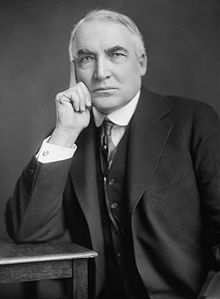
So what happened in Harding’s time?  Things were pretty rough for a while but by the summer of 1921, signs of recovery were already visible.  The following year, unemployment was back down to 6.7% and hit 2.4% by 1923 (source: Thomas Woods, “The Forgotten Depression of 1920″).  A budget surplus arose resulting in a noticeable decline in the national debt.  Business confidence soared and the 1920’s boom was off and running.

President Harding has gotten a bad rap from history because of the scandals that erupted during his administration as well as his chronic womanizing and his passion for the bottle.  But in the countdown of 20th century Presidents that I might do for this blog should I ever get ambitious, I will start with Harding as the least bad President of that sad century and work my way down from there.  I’ll let you  guess who I will honor as the Worst President of the Century.

How does the looming fiscal cliff compare with the policies of 1920?  In case you’ve been hiding under a rock lately (not a bad way to ride out the election campaign!), the fiscal cliff is the set of automatic tax increases and spending cuts that were agreed to when the debt ceiling was raised in 2011.  Congress decided to force its future self to act by lighting a time bomb that it would surely – surely! – defuse before it could go off.  The fuse has now burned to within 1/8 inch of the bomb.

The bomb’s tax increases and spending cuts would reduce the deficit by an estimated $600 billion in one year.  That may be the most accurate estimate but it’s only an estimate.  Congress can set tax rates but tax revenues depend on the size of the tax base.  If highly productive people, those who would take the biggest hit, decide to Go Galt, the tax base could shrink.  And as Jeff Hummel likes to point out, tax rates, particularly the top marginal rates, have varied drastically over the years and yet tax receipts have not varied much from 20% of GDP, excepting the World War II years.

Not only might tax receipts fall short, but expenditures could rise if additional welfare payments such as unemployment benefits or food stamps were to rise.

But let’s assume the fiscal cliff happens and the deficit is indeed reduced by $600 billion. Using figures for the fiscal year just ended, we would still have a $400 billion deficit which would have to be financed by borrowing.  As always, this would be new borrowing, on top of the borrowing needed to roll over the daily stream of maturing debt.  And we mustn’t forget the Social Security Trust Fund which until last year has mitigated the deficit by “investing” its surpluses (FICA tax revenues minus benefit payments) in Treasury securities.  Those FICA surpluses have now turned to deficits which for the present are offset by interest payments on Trust Fund holdings but will eventually require the Trust Fund to stop rolling over maturing securities and, should the trend continue, to deplete its holdings entirely.  All of these developments exacerbate the main federal deficit.  The same applies to the much smaller Medicare Trust Fund.

So I say, with a glance over my shoulder at 1920, bring on the fiscal cliff!  Let the cuts happen, thereby ending a lot of wasteful and harmful spending – particularly “defense” spending.  Let tax rates rise; people will work around them.

But it won’t happen because too many special interests will rise up to prevent it:

  • There are enough military personnel, military contractors, their suppliers, relatives and hangers-on to prevent significant cuts in defense spending.
  • The 27% cut in Medicare physician fees will lead doctors to brush away their Medicare patients like flies, sending those patients hobbling off to howl at their their Congressmen.
  • Millions of middle class people will gasp when their tax preparer tells them they’ve been caught in the dreaded Alternative Minimum Tax trap.  Others will escape the trap only to find that their ordinary income tax rates have risen substantially.
  • Still more millions will see their FICA (Social Security) tax rate revert to the 2010 rate of 6.2% from the current 4.2% “stimulus” figure.

The fiscal cliff won’t happen, at least not all of it, except perhaps for a brief period in January which will be fixed retroactively.  And so, though I hate to say it, I think the longer-term odds of pulling out of our fiscal death spiral are pretty slim.  Many think the government will resort to the time-honored remedy of the printing press, but Jeff Hummel has made a solid argument as to why this option won’t work and why there will be a default on Treasury securities instead.

Hummel also urges economists to do whatever they can to warn people not to count on government largess.  Most young people have written off Social Security for their future and that’s a good thing.  (Not so good for Social Security recipients like me who are increasingly unemployable yet hope to live another 25 years.)  We must take responsibility for our own health care, first by watching our health habits and second by cultivating a personal relationship with a physician, perhaps offering him or her cash payments.  We should be leery of Treasury Securities or of banks, mutual funds, etc. that rely heavily on these securities.  Sock away a few gold and silver coins.

We’re in for a rough ride, I fear, over the next few years.  But the sun will still rise and tangible assets will remain.  Provided enough of us have taken precautions, social unrest will be manageable and maybe, just maybe, the cancer that is called Social Democracy will be shaken off once and for all.
National Economic Systems: An Introduction for Intelligent Beginners – 3

My Debt, your Debt and Future Poverty.

I told you in previous installments of this series of essays that we, in the USA, are not facing one economic crisis but two.

The fist crisis is a recession. It’s a common event in the long run of market economies. Recessions are defined by serious people (according to me) as two consecutive quarters or more of economic shrinkage. Recessions go away whether any government does anything about them or not. One school of thought (Keynesian), to which the Obama administration belongs, maintains that large government spending – stimulation- can lessen or shorten a recession. I argued that the Obama stimulus package of several months ago cannot possibly stimulate, even if you believe in the stimulation scenario.

The second crisis, by far the most serious, is the abnormally high debt the federal government has incurred since President Obama came to office. It disturbs me because the people, you and I, will have to pay interest on the debt for a long time, and eventually re-pay the principal. Else, the government will have to repay its debt in bad currency, in devalued or in eroded currency. If this happens, we will simply all be poorer, in real terms, If your dollar is worth half in ten years of what it is worth now, you will simply have to pay two dollars for what you buy today for one dollar. There is no reason to assume your income will automatically follow. This is a common fallacy (perhaps the topic for another essay): It takes about forty Indian rupees to buy a US dollar today and the same mountain bike that costs 400 US dollars in this country costs 600 US dollars in India. A good income in India would be 12,000 dollars per year. (That’s about twelve times the national average.)  Continue reading

Foldvary on the Concept of “Forward”

Co-editor Fred Foldvary has an excellent post on the historical meaning of the Obama campaign’s choice of the word “Forward” as its political slogan. He writes:

The issue here is not about any political campaign, but the social concept of “forward.” Socialism is, first of all, a family of concepts. Some socialists seek greater statism, the control of society by the state. Other seek “social democracy,” whereby people vote on the major policy options. There are also socialists who seek to put the means of production, land as well as capital goods, in the hands of worker cooperatives.

Usually the “forward” thinkers seek, if not as an ultimate goal, then as the instrumental goal, a governmental control at least of the “commanding heights” of the economy: the financial system, the highways, education, medical care, and retirement pensions. Socialists seek strong controls on the remaining private production, and they also seek an equalization of wealth through a massive redistribution, with highly progressive taxation.

But the world has already experienced the results of “forward” policies in the failed economies of the old USSR, the China of the 1950s and 1960s, Cuba, North Korea, and Eastern Europe. The “forward” socialists seek a progression to the failed past. Of course they claim that their brand of socialism is different from that of the collapsed USSR, but the evidence of history reveals what was attempted in practice world-wide, even when it differs from hypothetical doctrines.

And this, too:

Instead of “forward,” a better metaphor may be “upwards.” Upward takes us to a higher place, and also to the origin of a flow such as a river. But how do we know which way is “up”?

Do read the whole thing, and what do you guys think of Dr. Foldvary’s suggestion of moving “upwards”?

National Economic Systems: An Introduction for Intelligent Beginners – 2

Part Two: Taxing the Rich.

I argue in Part One of this essay that the stimulus package could not possibly stimulate the economy the way a stimulus package is supposed to do. That is, the present stimulus package cannot shorten or lessen the current recession by stemming the growth of unemployment and by jump-starting the national economy, the way Keynesian economics has it. I suggested there had to be another agenda for this massive spending of public money.

Recessions – two consecutive quarters when the national economy contracts instead of expanding – are common under capitalism, in market economies. They wane, whether or not anyone does anything about them. This fact makes if difficult to assign credit to government measures designed to lessen or shorten recessions when economic indicators do look good. Economic indicators don’t look good right now, although some of the press is announcing the beginning of the beginning of the end of the recession.

At any rate, the recession will end eventually. That is, economic growth will resume. I would bet on it but I don’t know when. When growth resumes, we will be left with the second economic crisis facing us. That second crisis is less routine, more extraordinary, and more worrisome than the first crisis, the recession itself. It’s massive public indebtedness. I have to go into the reasons why the Federal Government is even able to incur massive debt. Continue reading

Brandon Vindicated (and Relieved!)

I read a lot of blogs in my spare time, and one of my favorites is the Monkey Cage, a blogging consortium made up of technocratic, internationalist-minded Left-wing political science professors. They rarely disappoint. I know what you’re thinking, but if I could choose which faction of the left I would want opposing libertarian policies it would be the technocratic Left. It a movement that has individual liberty in mind and is, as I mentioned, internationally-minded.

Notice also how I take into account the fact that an opposition to my own views are a necessary component of my utopia. Too many advocates of liberty don’t realize this when they argue about politics. Which factions would play the role of opposition in an anarcho-capitalist paradise, for example? It seems to me that the quality of one’s perfect opposition is actually quite a good gauge for measuring the quality of one’s political ideal (if I do say so myself!).

Anyway, Patrick Egan, of NYU, has a new post up explaining that the economy was indeed the central issue of the election, and then busts out the data to back up his argument (and help me save face!). I think this is an important point because I’ve already made the rounds around the blogosphere and many otherwise smart, competent people seem to want to chalk up Obama’s victory to something other than the economy.

From Egan’s post: Continue reading

“Gold and Money”

That’s the title of this piece in the Freeman by our very own Dr. Gibson. In it, he suggests:

Let’s turn down the heat a bit and look into some propositions about gold. That should lead us to some reasonable ideas about whether or how gold might return.

Indeed. I’m  tempted to copy and paste the whole thing, but just check it out.

PS I’ve been a very busy man lately, but I’ve got a bunch of almost-finished writings in the works. Stay tuned!

Power and Happiness (President Obama in India)

There is widespread confusion around between two ideas that should be easy to separate from each other. I keep bumping into it. I had several lengthy discussions of it with strangers on Facebook. Some were of the left, some of the right. I found it in my morning paper under the pen of no less than columnist David Brooks of the New York Times (“Midwest at Dusk”11/7/1)).

I refer to the confusion between the happiness of a country’s citizens and the country’s standing in the world. David Brooks wrote:

“If America can figure out how to build a decent future for the working-class people in this (mid-Atlantic) region, then the US will remain a predominant power. If it can’t, it won’t.”

Like this.

President Obama’s post- “shellacking” visit to India is a good time to clear the confusion.

It may be that there is some sort of connection between the happiness of a country’s citizens (or some) and being a “predominant power.” It may be but it’s far from obvious. You would have to demonstrate it. It would be hard; casual evidence does not support the idea. Deeper research does not either. Continue reading

Around the Web: Nobel Prize Edition

I just got three of them.

  1. Why we need to separate the central bank from the monetary authority.
  2. “Market Design”
  3. Noble Matching.

Maybe one of our in-house economists can share their thoughts on the award this year as well…

Look Who’s Practicing Trickle-Down Economics

Thomas Sowell is one of the clearest contemporary thinkers on economic and political issues, both as a theoretician and a commentator on current events. His recent piece on “Tax Cuts for the Rich and Trickle-Down Theory” is an excellent example. In it, he shows how tax rate cuts for the highest earners can actually increase the tax revenue collected from that group. He also recalls challenging his readers to name a single economist who advocated a “trickle-down” theory of economics. No one did so.

Trickle-down is the idea that when the highest income-earners keep more of their income, some of their spending will eventually reach lower-income workers. Their purchases of luxury items will bolster employment in the production of those items. Leftists are fond of setting up this theory and then attacking it on the grounds that the benefits to the wealthiest overshadow the benefits that trickle down to those at the bottom. Government spending cuts hurt low-income people the most. Therefore, they say, tax cuts for the highest earners are a disguised scheme to siphon yet more wealth from the bottom to the top.

The “trickle down” phrase has been around at least since the 1930’s and was restated recently by the current White House occupant when he attacked what he called “The economic philosophy which says we should give more to those with the most and hope that prosperity trickles down to everyone else.”

Does the theory make sense? First off, it ignores the morality of the situation. As T. J. Rodgers, CEO of Cypress Semiconductor, puts it, “I’m proud of my wealth. I earned it.” He explains how increased income taxes will not reduce his personal consumption but will instead reduce his investments in Silicon Valley startups and his charitable activities. Just what is the benefit, he asks, in taking money away from these uses and giving it instead to programs like Cash for Clunkers or Solyndra?

Secondly, trickle-down theory ignores the fact that high-income people like T. J. tend to invest a greater portion of their marginal income. Capital accumulation is the key to higher worker productivity and thus higher wages and higher standards of living.

There is actually one institution that does practice trickle-down economics. That would be the Federal Reserve System. The Fed recently announced its QE3 program under which it will purchase $40 billion of mortgage-backed securities each month for an indefinite period of time. One aim of this program is to push down long-term interest rates and thereby encourage businesses to borrow. But those rates are already historically low. Can we really expect further cuts to have any significant stimulative effect given the current high level of regime uncertainty?

The other purpose mentioned by Chairman Bernanke is to keep the stock and bond markets propped up. The idea is to pump up the “wealth effect.” This is the idea that when people who see increases in the market value of their holdings of investment or real estate, they will be more inclined to spend, even with unchanged income. Their spending will then trickle down into the economy. As an investor I ought to say thanks but as a citizen I would say to the leftists, look to the Fed to find a real example of exploitative trickle-down economics.

New Issue of Econ Journal Watch is Out

For those of you who don’t know, co-editor Fred Foldvary is an editor for the Journal, and Warren Gibson is the math reader. From the website:

James Tooley on Abhijit Banerjee and Esther Duflo’s Poor Economics: Banerjee and Duflo propose to bypass the “big questions” of economic development and focus instead on “small steps” to improvement. But, says Tooley, they proceed to make big judgments about education in developing countries, judgments not supported by their own evidence.

Why the Denial? Pauline Dixon asks why writers at UNESCO, Oxfam, and elsewhere have denied or discounted the success and potentiality of private schooling in developing countries.

Neither necessary nor sufficient, but… Thomas Mayer critically appraises Stephen Ziliak and Deirdre McCloskey’s influential writings, particularly The Cult of Statistical SignificanceMcCloskey and Ziliak reply.

Was Occupational Licensing Good for Minorities? Daniel Klein, Benjamin Powell, and Evgeny Vorotnikov take issue with a JLE article by Marc Law and Mindy Marks. Law and Marks reply.

Mankiw vs. DeLong and Krugman on the CEA’s Real GDP Forecasts in Early 2009: David Cushman shows how a careful econometrician might have adjudicated the debate among these leading economists over the likelihood of a macroeconomic rebound.

Rating Government Bonds: Can We Raise Our Grade? Marc Joffe, a former Senior Director at Moody’s Analytics, discusses limitations of the methods employed at the credit rating agencies and problems in trying to infer default risks from market prices, suggesting another approach.

Also, if you’re unsatisfied with the status quo in terms of political parties, including the Libertarian party, Dr. Foldvary has established the Free Earth Party for you to look at. Be sure to check it out!

“Happyism”

If a man tormented by starvation and civil war in South Sudan declares that he is “happy, no, very happy, a regular three, mind you,” we have learned something about the human spirit and its sometimes stirring, sometimes discouraging, oddity. But we inch toward madness if we go beyond people’s lips and claim to read objectively, or subjectively, their hearts in a 1-2-3 way that is comparable with their neighbors or comparable with the very same South Sudanese man when he wins an immigration lottery and gets to Albany.

From Deirdre McCloskey in the New Republic. It’s about the mismeasurement of happiness. Read the whole thing, but don’t you dare smile!

State of Florida Wants NASA Land

…so Tallahassee can develop a commercial spaceport.

This is both good and bad. Here’s why:

Liquidating NASA as a government entity will likely have the same type of effect on society that liquidating the computer industry had. There is a lot of technology in NASA that is just waiting to be developed by average, everyday geeks wanting to get rich.

Unfortunately, when I read that the state of Florida wants to buy up land and, presumably, technology from NASA I see a big problem ahead. It’s the same type of problem that always happens when “privatization” occurs. Instead of full-fledged privatization, as was the case when computer-based technology was passed on to the private sector, what we are seeing is a hybrid-type of privatization where the state still has a say in the process.

What’ll end up happening if Florida is any indication is probably nothing with big financial loses. “Nothing” by itself, however, is a bad sign, because again, there is a lot of potential bottled up in the NASA program. If the politicians in Florida really want a commercial spaceport, they would do well to heed to historical precedent and let the greedy geeks of the world make it happen with their own time and money being invested and potentially lost, rather than the taxpayers.

Many good economists have been talking about a “great stagnation” looming ahead for the West – a period where all of the available technology has been used up, as have all the available new ideas – and this stagnation may well come true, but I think that the de-socialization of NASA could help to alleviate this looming problem in a major way. It’s a shame that politicians think so lowly of their fellow citizens.

Also on the backburner: aside from the inevitable failure of a project like this, think of the ominous associations being created with ventures like these. Government and business working hand-in-hand to create a new niche in the economy for the citizens of Florida and the United States. This is the worst kind of fascism at work. The private sector could do much better, as could the American people.

Around the Web: Cato Unbound Edition

The response essays to Dr. Horwitz’s Cato Unbound lead-off essay are now up.

Horwitz, Economy and Empirics by Bryan Caplan, a very good critic of the Austrian School

Free bankers George Selgin asks: How Austrian Is It?

And Antony Davies plays nice by saying “come to the middle!”

My own quick thought: none of these guys are hostile to the Austrian School the way a Keynesian would be. I take this as a sign that Keynesianism is dead intellectually, rather than any sort of selective bias on the part of Cato Unbound’s very good editors.

The Economic Recovery: Jobs Edition

Economist Mark Perry has a great take on the current sluggishness of the jobs rate over at Carpe Diem. He brings our attention to the following graph:

His observations:

Most of the weakness in the U.S. labor market, the stubbornly high unemployment rate, and the slow rate of overall job creation can be traced to the ongoing decreases in government jobs, see chart above, especially at the local level […] Perhaps the significant downsizing of government at the state and local level is a positive development for the future growth of the U.S. economy, and one benefit of the Great Recession.  But we should also pay some attention to the fact that one of the reasons for the disappointing monthly employment reports is the persistent weakness in the public sector employment, which is offsetting the relatively healthy increases in private sector hiring.

This is a damn good point: unemployment rates have remained high because of losses in the public sector, not the private sector (which has been steadily growing). As Dr. Perry observes, this is good for long-run growth, but I can’t help but lament the fact that cuts in government spending have not been deeper and more robust. Imagine what the economy would look like if if deep cuts had been made six years ago.

As always, it is important to look at what the graph does not tell us. The graph explains that government jobs have been decreasing, but tells us nothing about expenses for current and retired government employees. Federal and state employees have gained notoriety for their lavish retirement packages (especially in California!), and none of this is covered in the graph. Public sector pension reform is still a vital issue that needs to be solved.

One other lament that I feel I must make pertains to the bank and auto bailouts of 2008-09. Although the bailouts don’t have any casual correlation to the graph I reproduced, I don’t think it is hard to image, again, what the economy would look like today if there had been a rigorous separation between business and state.