A note on India’s performance at the recent SCO Summit

The Shanghai Cooperation Organization (SCO) Summit, from June 9-10, went largely as expected. The Indian Prime Minister, Narendra Modi, met the Chinese President, Xi Jinping, on the sidelines of the summit. New Delhi’s proposal to have an informal summit, in India in 2019, on the lines of the Wuhan Summit (held in April 2018) was accepted by the Chinese. Agreements were also signed between both countries with regard to sharing hydrological data on the Brahmaputra River, and export of non-Basmati varieties of rice from India. Another issue, which was discussed during the Modi-Xi meeting, was the joint capacity development project in Afghanistan, which was first proposed during the Wuhan Summit.

Commenting on his meeting with the Chinese President, Modi tweeted:

Met this year’s SCO host, President Xi Jinping this evening. We had detailed discussions on bilateral and global issues. Our talks will add further vigour to the India-China friendship.

Modi’s meetings with leaders of other member countries

The Indian PM met other leaders of member countries, including the presidents of Tajikistan and Uzbekistan. While there was no formal meeting with the Pakistani President Mamnoon Hussain, Modi did shake hands with Hussain and exchange pleasantries. Interestingly, Chinese President Xi Jinping, during his address, had spoken about the presence of both leaders, as well as entry of both countries into the SCO. Said the Chinese President: Continue reading

The Politics of the Incredibles (minimal spoilers)

I saw an early release of the Incredibles 2 last night. I wasn’t expecting too much given Pixar’s history with sequel. Finding Dorothy, Monsters University and the Cars sequels were okay, but below average for Pixar. I am happy to report that the Incredibles 2 was a pleasant exception. Not only did the film re-capture the magic of the original, it made a point that many readers and fellow Notewriters should appreciate: legality doesn’t equal right.

The film starts off directly after the events of the first film. The titular Incredibles family fights off the Underminer, a mining themed super villain. Instead of getting praised for their actions though, they get arrested. Superheroes are still illegal. The events of the past film haven’t changed that. One of the characters wisely remarks, “Politicians don’t understand why someone would do the right thing for its own sake. They’re scared of the idea.”

The family is let go, but they’re at a low point. Their home has been destroyed. They’re unemployed and broke. They’re gifted with super powers, but they live in a world where they can’t legally use them. That’s when a businessman approaches them and asks – why not use their super powers? The businessman proposes that the family continue to use their powers illegally, and convince the government to change the law after the public has been shown how useful superheroes are. This leads to a funny exchange where the characters argue about how they’re being asked to be illegal in order to become legal.

I won’t spoil the remainder of the film, but I love the businessman character’s early scenes. It’s refreshing to see a corporate character, and his disregard for legislated morality, portrayed in a positive light. Tony Stark/Iron Man starts off this way in the early MCU films, but makes a u-turn by Captain America: Civil War. This new character, for better or worse, stands by his beliefs.

The tension between legislation and morality isn’t a new theme for Pixar. The idea of breaking the rules to do what’s right was a central feature of Monsters University as well. It’s a lesson I think many children, and their parents, could benefit to learn. Legislation isn’t morality.

I give the film a solid 9/10. It’s around Wall-E or Up levels of quality. It’s easily one of the funniest Pixar films in a while. The animated short before the film is, as standard for Pixar, a tear jerker. Bring some tissues.

Thoughts? Opinions? Post in the comments.

A note on the three Californias and arbitrary borders

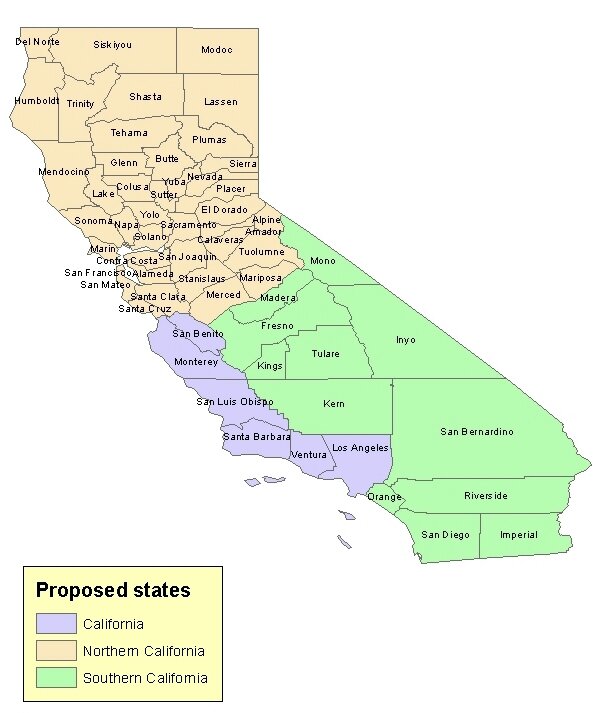
As many of you may know, there is a proposal to split up California into three parts: north, south and ‘ye olde’ California. This proposal is idiotic on several fronts. For starters the best university in LA, the University of Southern California, would find itself in ye olde California. Meanwhile my university, UC Riverside, would overnight become USC Riverside. Now, I wouldn’t be against the Trojan football team relocating to Riverside, especially since Riverside doesn’t have a team of it’s own. However the proposed split would cut off the Inland Empire and Orange County from Los Angeles county.

This despite the fact that the greater LA area is composed of LA-Ventura-Riverside-San Bernardino-Orange counties. These counties are deeply interwoven with one another, and dividing them is bizarre. Imagine the poor “Los Angeles Angels at Anaheim”. What horrendous name will they have to take on next? The “San Diego Angeles at Anaheim”?

Beyond it’s idiocy the proposal makes a larger point: government borders are, for the most part, arbitrary and plain stupid. The proposal to split up California ignores the regions socio-cultural ties to one another, but there are countless other examples of senseless borders.

For example, who was the bright guy that decided to split up Kansas City between Missouri and Kansas? And let’s not even get started on the absurd borders of the old world.

Thoughts? Disagreements? Post in the comments.

Turkey elections: Elections, Rappers, Media, Micro-Party, Rigging, Iraq

The Turkish State’s War On Rap

The election campaign has not slowed down the Erdoğanist state in its efforts to punish anyone who deviates from Erdoğan’s ideal of obedient, socially conservative, and conformist citizens. One of the best known Turkish rappers, Ezhel, with very leftist and counter culture lyrics, has been arrested recently for ‘encouraging drug use’. A prosecutor ordered his detention, which was implemented after he voluntarily went to the police station to answer a ‘complaint’, with no warning about detention. Onur Dinç (known as Khontkar), and Young Bego have also been detained. They can all be found on Spotify and YouTube. Listening on Spotify generates a little income for people who deserve a bit of solidarity at the moment.

İnce’s Presidential Campaign

An interview on HaberTürk TV with the leading opposition candidate for President of Turkey, Muharrem İnce (from the secularist, centre-left Republican People’s Party), has gone down very well. The interviewers let İnce express his views and had a selfie with him afterwards. HaberTürk TV is a private channel but, like all commercial private channels, accepts (and has no real choice) the biases and silences imposed by the Erdoğanist-AKP regime.

It is normal for Erdoğan himself to phone media groups and complain about coverage, demanding firings of journalists, where the bias is not as complete as he requires. So how long are these journalists, and the responsible manager, going to survive? A manager on another private channel was fired (officially ‘left for personal reasons’, ha ha ha) after allowing a very brief segment on the second most popular opposition, and more right wing, candidate, Meral Akşener. Will these HaberTürk people survive until the election? Are they more willing to push the limits because the opposition is doing better than expected?

On recent polls (leaving aside companies who enjoy close relations with the Erdoğanists) only rigging (or some extreme situation) can now stop 1. the opposition winning a majority in the National Assembly (could be stopped on current polling by stealing/losing about 2/3% points from HDP, a Kurdish rights-leftist party which appears to be between 1 and 3% points above the 10% election threshold). The main left-right opposition list seems to be about 3 points behind the right wing government list 2. the presidential election going to a second round, i.e. Erdoğan cannot get 50%+ of the vote in a several-candidate field (except by rigging at least 7% points of votes cast) and might lose in the run off.

I can only presume the interviewers of İnce will be out of a job if Erdoğan and the AKP-dominated electoral list do win by some means, and HaberTürk will suffer other penalties. Yes, polls can be wrong and they don’t all show the same thing, but those most favourable to the government tend to be run by cronies and there is widespread suspicion that in the current atmosphere in Turkey, some voters would prefer not to tell a stranger they are voting for an opposition party, particularly HDP. This is confirmed by the relation between opinion polls and the final result in last year’s referendum on moving to a presidential system (in which the final result itself may have been affected by losing and faking ballots, and by the difficulty that many voters in the Kurdish southeast had with getting to polling stations, a tactic the regime is setting up for this time as well).

The AKP-Erdoğanist Media Strategy: Why Turkish Media promotes an ex-terrorist micro-party.

Presenting the Opposition

Following on from the above, though İnce gets a lot less coverage on all media, including state media which is legally required to provide balanced coverage, than Erdoğan for the Presidential campaign, he gets far more than the more nationalist-conservative opposition candidate Meral Akşener (who would be the first female President of the Republic). She is polling behind İnce, but mostly by a moderate margin. She receives almost no coverage, her campaign is in fact a completely banned subject in the Erdoğan-controlled media (that is all state media and all the major private media groups).

Clearly the Erdoğan strategy (and we can be sure that he dictates it, without any delegation of overall strategy to campaign organisers) is to promote İnce as the only opposition candidate, in the belief that Akşener is a more of a threat to conservative support for himself. I used to believe this, but as far as we can tell from polls, İnce is leading in the first round and would do as well as Akşener in a second round play-off, both going down to very narrow defeat. This strategy has a high chance of backfiring by enabling someone further from Erdoğan in politics to become President.

The media manipulations may not make much difference since people open to voting for the opposition are going to treat the Erdoğanist media with scepticism and seek other news sources, but it is at least worth noting what the strategy is. It might be that the main aim is to make electors forget that Akşener’s party İYİ (Good) exists, on a common list with İnce’s party, but voters for the list can choose between them. It is unlikely that many voters are unaware of Akşener, the İYİ party, and the common list, and those that are unaware must be hardcore Erdoğanists who will not switch support to anyone in this election for any reason.

Promoting a Micro-Party

The most bizarre aspect of Erdoğanist coverage of the elections is that Hür Dava Partisi receives a great deal more coverage than İYİ. Hür Dava Partisi means Free Cause Party and the Turkish name is usually contracted to Hürda Partisi or Hüda Par. It was founded by people who had supported the Kurdish religious terrorist group Hizbollah. This is nothing to do with Hizbollah in Lebanon, which is a Shi’a group. Hizbollah in Turkey is defunct and was Sunni Muslim, as is Hüda Par.

It advocates religious law in Turkey and operates only in southeastern provinces where ethnic Kurds are in a majority, and has no more than 5% support in any individual province, giving it overall less than 5% in the whole region and less than 1% in the whole country. For it to receive much election coverage is of course absurd. The reason this happens is in the hope that the more religious Kurdish voters who are dissatisfied with the AKP after voting for it in the past (AKP is the second party in the region) will vote for Hüda Par instead of the secular-leftist HDP, which is the leading party in the region. The aim is to keep the HDP vote below 10% nationally, the electoral threshold for the National Assembly.

I don’t think it is possible that Hüda Par can soak up those votes sufficiently, but from the Erdoğanist point of view, it is worth trying and might just keep HDP below 10% in conjunction with electoral trickery such as moving polling stations away from HDP areas to make it less easy for them to vote and the possibility of outright electoral fraud, particularly in those polling stations where opposition observers may not turn up, in remote very pro-AKP areas. Electoral law has been changed recently to make removal of ballot boxes by the police easier and to legalise the illegal decision of the Supreme Election Council to count unstamped ballot papers in last year’s referendum.

On current polling, the opposition electoral list is a few percentage points behind the Erdoğanist list, so keeping the HDP out of the National Assembly would give his list an overall majority. This is why a micro-party of extreme religious conservative Kurds gets a high level of coverage in the Turkish media compared with conservative nationalists in İYİ who oppose Erdoğan and have created the third largest party in Turkey in terms of opinion polling.

Resisting Electoral Fraud

The possibility of electoral fraud and the use of fraud to keep HDP out of the National Assembly to the advantage of the Erdoğanists has of course been noted by the opposition and they are co-operating to work against this. The electoral list which comprises the second, third, and fourth parties in Turkey (secular centre-left CHP, nationalist conservative İP, and religious conservative SP) is cooperating with the HDP in a platform to ensure a fair and accurate count of votes. That the more nationalist parts of the opposition list and the Kurdish autonomy leftist people are able to work together on this is itself a good sign. There are no guarantees that the platform can prevent decisive fraud, but at least it will make fraud more difficult and shows there is unity in a very diverse opposition against the AKP-Erdoğan abuse of power.

Iraq Surprise?

I’ve seen a report that Turkish army units in the Kurdistan Regional Government of Northern Iraq, which have been stationed in a mountainous border part of the region for some years by ‘invitation’ (or possibly in reality extreme pressure), are moving closer to the PKK (Kurdish separatist and extreme left terrorists of Turkey) base in Kandil. Kandil is in the mountains and provides obvious difficulties for an army aiming to destroy the PKK. It is inherently difficult to observe, fire on, occupy, and completely control a mountainous region. It is a certainty that the PKK has contingency plans to move its base through the mountain, dispersing it if necessary.

I cannot predict if the Turkish Armed Forces will attack the Kandil base soon, or if it can succeed in a mixture of eradication and control. The PKK is a dangerous terrorist organisation and should be eliminated, but whether it can be eliminated in practice, without lessening the reasons some Turkish Kurds want to fight for it (very misguided people in my view) is another matter.

What I can say at the moment is I won’t be surprised if there is an offensive against Kandil before the election on June 24th, particularly if polling shifts against Erdoğan and his electoral list, or if the Turkish lira resumes its decline against foreign currencies. The consequences, militarily and political, are not matters I can think through at present.

Latest thoughts on Brexit: Its Decay, Italy (and Ireland), Cars, and Giving up British Citizenship

The slow decay of Brexit: a Rule-Taking Country

I don’t mean that the UK will stay in the EU. I fully expect it to formally depart next year. If the poor performance of the UK economy compared with the Eurozone continues, I also expect the UK to rejoin in a few decades, when the growth divergence is not just in figures, but felt in everyday life, such as when people find it too expensive to travel in Europe or buy goods from Europe; if they do travel they notice that everything seems expensive and there are more nice things abroad than at home, while European tourists will seem to have huge amounts of money to throw around.

It might or might not work out like that, but the point here is that the UK, behind headlines about soft versus hard Brexit, is moving towards an ‘alignment’ with the single market and the customs union: not formal membership but keeping nearly all the rules. The short term losses in trade from leaving both the single market and the customs union, along with the Republic of Ireland/Northern Ireland border question, have combined to make de facto membership of the single market and the customs union inevitable. Hardening the border at all between the two parts of the island of Ireland is economically disruptive and very threatening to a Northern Ireland peace settlement, in which the Irish nationalist-republican side in NI can live with being part of the UK as long as the North and the Republic are unified via the EU and associated commercial agreements.

This is what I get from following Eurosceptic sources when they get round to proper conversation and analysis, rather than fighting the remain-leave battle. Brexit outbursts of premature triumphalism over Italy, or demands to abolish the upper House of Parliament because the Lords uses its constitutional rights to pass amendments they don’t agree with back to the Commons for the final decision, are a distraction from the collapse of full Brexit.

The idea of a ‘no deal’ walk-away from the EU has been abandoned and inevitably the UK will accept single market/customs union rules while the government makes a show of leaving everything. Because the UK very probably will not be a formal member of the single market (though there is a possibility of joining the EEA which would mean formally staying in the single market), it will be able to reduce migration from the EU (not a great thing to my mind), which will bring joy to a large part of the population (particularly the Brexit-voting part). No doubt the reality of moving to what Jacob Rees-Mogg (a well known, hard-Brexit Conservative MP) calls ‘vassal state’ status will be covered over with that issue, but the reality is the UK will accept rules for customs and economic regulation made by the EU indefinitely.

‘Indefinitely’ means ‘permanent’ though this is being covered up by talk of ‘transitional periods’. Alternatives to this have collapsed with the failure of ‘no deal’. The New Hard Brexit is to accept aligned rules on goods, but not on services, with the UK’s exceptional role in financial services in mind. However, there is no indication that the EU will give this kind of deal, despite the Brexiteer posturing about the UK being too powerful to push around, which has clearly been shown as empty by negotiations so far.

Over-excited Brexiteers getting Italy wrong (and Ireland)

So a new government formed without anti-Euro currency finance minister. 5 Star and the League (the coalition partners) are not impeaching President Sergio Mattarella. The idea they would is a bit of a joke anyway, as it would require the agreement of the Supreme Court and a vote of both chambers of the Italian parliament to achieve an impeachment. The issue behind the non-impeachment was that Mattarella had vetoed an anti-Euro candidate for finance minister: Paolo Savona (who now has another post in the government).

Some relevant facts here. 1. Italian presidents have the constitutional right to veto ministerial nominations and have frequently done so before 2. Recent Italian opinion polls show support for the Euro at over 60% 3. Neither coalition party ran on an anti-Euro manifesto.

Claims that Mattarella is some pathetic weak instrument of the European institutions who ordered him to keep Savona out are themselves absurd. 1. There is a shared preference of Mattarella, the Italian public, and European institutions for staying in the Euro 2. Mattarella is from a political family in Sicily, which went anti-mafia and Sergio Materall’s brother, Piersanti, who was head of the regional government, was assassinated by the mafia as a result. I think we can say Sergio is a character of substance to stay in politics after that.

Regarding constitutions and democracy, constitutions establish limits on the power of temporary majorities through rules and institutions designed to embed basic rules about rights and the use of power. This is why democracy of a kind worth having is referred to as ‘constitutional liberal democracy’. You cannot both be in favour of constitutional democracy and complain when constitutional constraints express themselves in the action that Mattarella took, which is well within his formal powers and previous precedent.

Many of the triumphalist Brexiteers in the UK, who were shouting about Mattarella as an enemy of democracy who was about to be punished, are admirers of the US ‘constitutional conservatism’ which, on the face of it, advocates very strict restraints on the actions of elected bodies according to the supposed original meaning of the constitution. You can’t have it both ways. And even if you think democracy means the unrestrained right of a majority, there is no majority support for leaving the Euro in Italy and no manifesto mandate for the coalition to leave the Euro.

You could argue that Mattarella made a mistake about perceptions and had been outplayed, that had some plausibility for a few days but does not look so correct now. Mattarella has got what he wanted and will not be impeached. It’s true that the League has strongly increased its support since the election in opinion polls, but that mostly precedes the ministerial crisis. Brexiteers are still clinging to an attempted triumphalism over Italy. The Italians are standing up to Brussels, which supposedly is a lesson to Britain to be tougher in Brexit negotiations. Well it is a bit soon to say whether the Coalition in Italy represents Eurosceptic triumph and hard to see what this has to do with Brexit negotiations.

What loud mouthed Brexiteers in the UK say about Italy is in some ways not very important, but what is important is the presumption to know more than they do and circulate false assumptions about European politics in the UK, which in turn distorts our debates and assumptions, and which can then pop up amongst Proper centre-right journalists and commentators Who Should Know Better.

Something similar has emerged with Brexiteer attitudes towards Ireland’s attempts to keep an open border with Northern Ireland. Manipulated by the EU institutions with naive and incompetent leaders (rather reminiscent of old prejudices about the Irish being stupid) has been standard opinion, and then there was the claim by a senior Conservative politician, Iain Duncan-Smith, that the Irish position is to do with a forthcoming presidential election. 1. The Irish president has no political powers whatsoever 2. There may not be an election, since no one has announced a wish to run against the incumbent so far and it may suit the major parties in Ireland to leave it like that. Funnily enough all those stupid naive Irish leaders manipulated by the EU have given Ireland much greater economic growth than the UK. What an economic miracle there would be in Ireland if they were as clever as Brexiteers!

It’s difficult to stop Brexiteers from 1. using simplistic rhetoric about majorities and Will of the People to suit their immediate anti-EU goals without concern for consistency and the values of liberal democracy 2. Living in an imagined world where European politicians they disagree with are stupid and/or slaves of the European Commission, conspiring against democracy. These views should be challenged and left with the true believers, away from informed debate.

Brexiteers and German car companies

UK enthusiasts for leaving the EU have a strange obsession with German car makers. They export so many cars to the UK, they will MAKE the German government which will MAKE the European Commission give us the exit deal we want. This has been going on from all kinds of people ever since the Leave Referendum (maybe during the campaign as well, but I missed that). It is an expectation that has obviously been falsified by the course of negotiations in which the EU has got 10s of billions of Euros from the UK to even start negotiations (though the UK tries to pretend otherwise) and has refused the kind of market access the Brexiteer enthusiasts assumed they would get automatically thanks to Volkswagen, BMW, and Mercedes (!).

Even today, listening to the Telegraph Brexit podcast, I heard Christopher Hope (the highly affable and mostly reasonable chair) keep on about how German carmakers were going to make Brussels gives the UK what it wants. The guests, pro-Brexit people from the Telegraph, were clearly bemused as they had been explaining how the UK was going to remain ‘aligned’ with the single market. Clearly if the UK is already de facto accepting the ‘indefinite’ (i.e. permanent) application of single market rules, German car makers have no incentive to MAKE Merkel give the UK another deal preferable to hardcore Brexiteers.

Of course the saddest expression of this muddled thinking came from Boris Johnson (the notoriously attention seeking and inconsistent foreign minister) when he claimed Italian prosecco wine manufacturers would make Rome/Brussels give the UK a Brexiteer-friendly trade deal. It turns out demand for prosecco in Italy is greater than supply and the makers can easily live with reduced demand in the UK.

The German car industry is of course much larger and not dependent on the supply of a particular kind of grape. Still, just one seventh of German cars are sold in the UK. Now obviously it would be very bad news to lose one seventh of the market, but there are no circumstances in which German manufacturers would sell no cars in the UK, the drop would never be as great as one seventh. Sales of German cars are already declining in the UK and given weak UK economic performance compared with Germany, the decline is likely to continue. Anyway, it should now just be really bloody obvious that German car manufacturers have not united to force Berlin/Brussels to accept a hardcore Brexit agenda! There is clearly a very big stream of reality distorting national self-obsession amongst Brexiteers who believe this kind of thing. Well it has now been shown to be thoroughly incorrect, let go now!

Brexit Bureaucracy and Renouncing UK Citizenship

UK nationals living outside the UK in the EU are applying for citizenship abroad to retain rights they lose after Brexit. Some of these countries forbid dual citizenship so UK citizens are renouncing UK citizenship. The Home Office takes the opportunity to raise fees for renouncing citizenship, though evidently its revenue is already increasing because of charges for renouncing citizenship. Didn’t Brexiteers tell us Brexit would reduce state bureaucracy?

ICE as Education Planners

Yale recently reclassified economics as a STEM (science, technology, engineering, and math), and other schools may follow suit. It’s a public-spirited regulatory arbitrage–by reclassifying to “Econometric and Quantitative Economics” they make it easier for international students to continue working in the U.S. after graduation. But by capitulating to regulatory nonsense, they’re sacrificing the long-run vitality of the field.

Here’s how this whole classification thing works: Immigration and Customs Enforcement (ICE) has a “STEM Designated Degree Program List” that specifies which programs on the Department of Education’s list of degree programs qualify as STEM. Students with degrees in these fields get special status as far as immigration. ICE’s list includes (among others) several psychology programs and three social science programs: Archaeology; Cyber/Computer Forensics and Counterterrorism; and Econometrics and Quantitative Economics.

What can we infer from this? That the feds are defining STEM narrowly, with a greater emphasis on engineering than science. STEM is about training people to do science-y work with practical applications. Basic research gets lip service, but only really matters so far as it’s likely to have clear applications in the future.

Economics has some parts that fit into such a view of STEM. Even I’ll admit (controversially for Austrians and Anarcho-Capitalists) that positive-sum social engineering a) is possible (in modest increments), and b) has something to learn from economics. But to include all of econ in STEM would require using a broader definition of STEM.

So what’s the upshot? High profile departments will focus more on a narrower part of economics pushing much of the field to the periphery. This is a retreat into more isolated academic silos. “Economics, general” leaves a vague space around a department, but taking a more specific designation means they can be held to more specific expectations. It might have little impact on the day-to-day life of a department, but in the long run they’re hamstringing themselves.

The problem these departments are trying to address is that ICE has too much power. But by playing this game they’re letting ICE play central planner in the education industry!

More on the Turkish Elections

This is a sequel to my recent post Turkish Elections: Some Hope, so is best read after reading its predecessor.

In the last post, I covered the National Assembly elections on the 24th June. The first round of the presidential elections will take place on the same day and there will be a run-off between the two main candidates on the 8th July, if no candidate gets more than 50% on the first round.

As by far the strongest personality in Turkish politics over the last 15 years, Recep Tayyıp Erdoğan was no doubt expecting to win in the first round easily. He did so in 2014 when he was first elected to the presidency at a time when the president’s powers were much smaller. The two largest opposition parties of the time (CHP and MHP) put up a joint presidential candidate little known to the public and who did become much better known during the campaign. The campaign was in fact a surrender to Erdoğan who went on to ignore the constitutional limits on the presidency and push through plans for a presidential republic with little of the checks and balances known in other presidential republics, at least those in established democracies.

This presidential campaign has been an unpleasant surprise for Erdoğan. He has turned the MHP into a satellite party which supports him for the presidency. The cost of that, however, is that he has tied himself to a declining party in an attempt to compensate for a weakening of AKP (Erdoğan’s party) support since the days when it got 50% and over of the electorate.

The opposition has now found an energy unprecedented during the Erdoğan-AKP years (since 2002). It has turned the first round of the presidential election into a run-off to decide who will face Erdoğan in the second round, maximising opposition strength as its candidates enthuse different sectors of Turkish society against the current regime. It now looks impossible for Erdoğan to win the first round (without the help of rigging which is a real danger).

Some thought the opposition had already failed the presidential election when Abdullah Gül, who was President before Erdoğan, declined to run as a candidate of the small opposition religious conservative party SP. The idea around was that the two main opposition parties would accept him as a joint candidate. It is not clear this would have ever happened, and anyway Gül declined to run. He had been a founder of the AKP, but has not re-joined since leaving the office of President in 2014. At that time the President was required to resign from any political party. Gül has made indirect criticisms of the AKP under Erdoğan, but is a non-confrontational politician who has not put himself in clear opposition to Erdoğan and few expected he ever would. Some had the attitude that Gül was the only chance of the opposition winning the presidential election. I was never convinced myself. Adopting an AKP politician central to the AKP’s colonisation of the state and parts of civil society, particularly the main media companies, would have been a defeatist gesture, particularly given Gül’s own lack of energy in very stark contrast with Erdoğan.

The four largest opposition parties will all run presidential candidates, though three of these parties have formed a joint list for the National Assembly elections. Two of these candidates have a real chance to win. That is Meral Akşener and Muharrem İnce. Akşener is the leader of the second opposition party, İYİ, which broke away from the MHP. It has overtaken the MHP as the largest nationalist party. Though it has a clearly nationalist orientation, mixing Atatürk republicanism with nostalgia for the Ottomans and pre-Ottoman Turkish leaders, it has a a milder version of this than the MHP. İnce is a centre-left secularist CHP politician who previously tried to replace Kemal Kılıçdaroğlu as leader of the CHP.

Kılıçdaroğlu is not a strong public personality and has often been dismissed even by CHP sympathisers. However, he did a good job of keeping the CHP relevant in the period after the coup attempt of July 2016, when Erdoğan seemed to be achieving even more complete domination of Turkish public life. Kılıçdaroglu most famously led a Justice March from Ankara to Istanbul last summer, usefully turning his anti-charisma reputation into an image of quiet decency and endurance, marching for many days under a hot Turkish sun, though he is in his late 60s and there were constant fears of state promoted violence against the march.

Kılıçdaroğlu was again dismissed as too passive at the time Gül declined to run, and Kılicdaroğlu ruled himself out of the Presidential contest. It has turned out that he has maximised his strengths and weaknesses, by showing the inner self-confidence to allow his rival İnce to run for the most powerful office in Turkey. İnce has been a great campaigner so far and is doing better than I expected.

I thought Akşener would easily be the strongest opposition candidate, and she is doing well, but is very close to İnce, both for getting through to the second round and defeating Erdoğan. The latest opinion polls suggest Erdoğan would beat both but by a very small margin, meaning that a strong campaign by İnce or Akşener could win in the end, particularly if supporters of rival parties turn out in a spirit of unity for change.

The general thinking in Turkey now is that the opposition is likely to win the National Assembly but not the Presidency. Nevertheless the presidential contest is going far better than expected for the opposition and Erdoğan could look very diminished running in the second round after the AKP-MHP electoral list loses the National Assembly (where it currently has a two-thirds majority). İnce represents the most leftist and most nationalist element of the CHP. This combination is not unusual in Turkey, though left-nationalists prefer to identify themselves through the Turkish word for patriot rather than nationalist. I thought this would be a problem for İnce, in that he might be a negative both for Kurdish and centrist voters, but he has shown a capacity to reach out and make gestures to these sectors. Since the CHP National Assembly list has reduced the number of left-nationalists, his presidency would not be the unconstrained triumph of that particular point of view.

Eye Candy: the US Asian population, circa 2010

NOL map US Asian population
Click here to zoom

“Asian” is a pretty broad term. Racial classifications are, perhaps, the dumbest thing in the world.

Imagine seeing something like this in the press today, or this as an advertisement. There’s been lots of progress in this country, it’s just hard to see sometimes.

Lucas Freire: 2018 Novak Award winner

Edwin just alerted me to this announcement from the Acton Institute:

GRAND RAPIDS, Mich., May 23, 2018—In recognition of Professor Lucas G. Freire’s outstanding research in the fields of philosophy, religion, and economics in the ancient Near East, the Acton Institute will be awarding him the 2018 Novak Award.

Despite Michael Novak’s passing in February 2017, his memory will continue to be honored every year with the presentation of the Novak Award. This recognizes new outstanding research by scholars early in their academic careers who demonstrate outstanding intellectual merit in advancing understanding of the relationship between religion, the economy, and economic freedom. Recipients of the Novak Award make a formal presentation at an annual public forum known as the Calihan Lecture. The Novak Award comes with a $15,000 prize.

Lucas G. Freire is an assistant professor at Mackenzie Presbyterian University in São Paulo, Brazil, and a fellow at the university’s new Center for Economic Freedom. He is also a postdoctoral fellow at North-West University in Potchefstroom, South Africa. He received his PhD in politics from the University of Exeter. Previously, he also served as a research associate with the Kirby Laing Institute for Christian Ethics in Cambridge, UK.

Professor Freire has commented on political and economic issues drawing on Christian thinking in the Reformed tradition. He has published on political theory and philosophy in journals such as Philosophia Reformata and Acta Academica. His current research focuses on the connection between religion, politics and economics in the ancient Near East and the biblical world. He lives in São Paulo with his wife and two children.

Congratulations Lucas!

Here are his posts at NOL so far. Now that he’s got a bit more money in his pocket, perhaps he will have some time to spare for blogging…

Israelis Kill Unarmed Palestinians in Gaza

The Israeli Defense Force is killing unarmed demonstrators in Gaza. The Defense Force is on one side of the fence, the demonstrators on the other. What happened is that the ruling political party in Gaza, Hamas, sent the demonstrators to try and breach the fence separating Gaza from Israel. The declared purpose was to have Gaza Palestinians exercise their “right of return.” Hamas means the “right” of Palestinians to return where their forebears used to live, or maybe not, or nearby, etc, right inside present-day Israel. Of course, if Israel allowed this, Israelis might just as well start packing. It would be the end of the Jewish state that already has about 1.85 million Muslim and Christian Arab citizens. Both Palestinians and Israeli Arabs reproduce faster than Israeli Jews, by the way. (It’s the Jews’ fault, of course; they should get busy.) Hamas generously would allow Jews of Middle Eastern origin to remain as second-class, tribute-paying dhimmis. All the others, the majority, would have to leave quickly. Ethnic cleansing is the best scenario if Hamas wins, according to Hamas. The worst? Hamas does not say.

The mid-May 2018 demonstration was presented as a way to commemorate what Palestinians call “the disaster “– meaning the creation of Israel and the wholesale defeat the Arabs suffered in the war they had started against the new state. Initially, it had nothing to do with the inauguration of the new American Embassy in Jerusalem. It was mostly the Amerileft media that created a link with such devices as showing the inauguration in Jerusalem on a split screen with the rioting in Gaza. Many Americans, some of whom can’t place the US on a world map, would have believed that Palestinians were dying while the Americans and Israelis were gaily drinking champagne right next door.

The Israelis had warned early on that they would shoot demonstrators who tried to breach the fence separating Israel from Gaza. They did, killing about 70 Palestinians. That’s harsh but no one can call it unfair: They said it clearly: If you touch our fence, we will kill you. Don’t touch the fence, I would say. Little detour: the magazine Commentary pointed out that the Gaza authorities claim that 1600 Gazans were wounded by real bullets. What’s wrong here is the ratio of wounded to killed, 1600/70. It should be something like 1600/500 . It does not add up or else, the Israelis snipers are real bad at their job. Go figure!

Hamas thinks it’s winning because of the large number of unarmed demonstrators, its youths, wounded and killed. It’s been acting like this forever. Just a week ago, Gazans (who may have been Hamas agents or not) deliberately destroyed the valve to the main pipeline supplying Gaza with diesel fuel. The more misery ordinary residents of Gaza suffer, the happier the Hamas government is because Israeli atrocities give it standing among the ill-informed and mindless everywhere. I am tempted to feel sorry for Gazans myself because of the terrible government they live under. I can’t quite do this; below is why.

Hamas was elected in proper well observed elections. Although the Hamas government is well overdue for a new election, I would argue that the initial election makes Hamas one of the most legitimate governments in the Middle East. Hamas is explicitly an Islamist party. It does not think well of freedom of religion. It wants to impose sharia but does not feel strong enough yet. Hamas is in favor of polygamy. Young Gaza Palestinians are dying because of actions encouraged by their government, the Hamas government. Their parents properly elected that government. There has been no rebellion against it. The mass of the population seems loyal.

Hamas is insuring an aggravation of a situation in Gaza that is pretty much intolerable already. Israel left Gaza unilaterally 15 years ago but it maintains a partial blockade of the territory. It provides fuel and electricity and most of the water available, on its terms. It allows certain merchandise in but not others. Cement is limited, for example, I read in a source I can’t quote now but that I found credible at the time that Israeli Customs allow in milk and sugar but not instant coffee – which makes life more enjoyable. There is almost no work in Gaza, except working for the Hamas government. Nevertheless, no one there is starving because the territory is largely on welfare. Gaza has one of the highest educational achievement scores in the world although there is malnutrition there.

Gaza is a welfare non-state. It has no industry and very little else by way of earning its living. (That’s in part because of Israeli control over its borders, of course.) It’s an economic ward of the UN and secondarily of the European Union and of the USA. American Jews are thus among those supporting through their taxes riots where the main demand is “Death to the Jews!” The Leftmedia does not seem to be willing to mention, or it actually does not know, that the Israeli blockade of Gaza would be ineffective, almost useless, if Egypt did not join in. Yes, Egypt is also impeding the movement of goods, funds, and especially of people between itself and Gaza. And the PLO, which rules the West Bank, the other part of Palestine, has its own punitive measures against Gaza. Hamas is everyone’s favorite!

If you too feel revolted by the Israeli killings of Gaza demonstrators, and if you don’t think that righteous indignation is its own reward, I invite you to take two minutes to answer the following simple and sensible question:

Suppose you have a chance to advise the Israeli Prime Minister; suppose further that you have reason to believe that he will pay attention to you; what’s your advice to him regarding the present situation in Gaza (mid-May 2018)?

You can be sure that I have answered the question myself.

PS I am not Jewish, never have been, never will be. I am not a fundamentalist Christian either.

What is the proper role of government?

Former Brazil’s president Dilma Rousseff publicly lied by saying that she had a M.A. and a Ph.D. in Economics. The lie was discovered in 2009, when she still wasn’t Brazil’s president. Maybe that’s the problem with Dilma: she would even lie to say she was highly competent in economics.

Nobody in the 19th century believed that the role of government was to control the economy. This notion only became strong in the 20th century and to a great degree thanks to Keynesianism. It was Keynes who popularized the notion that the free market is inherently unstable, and that government should exercise some oversight on it.

Jair Bolsonaro, the Brazilian presidential candidate ahead in the opinion polls, has no problem admitting he doesn’t know enough about economics. For me, this is one of his main strengths. In the past, Bolsonaro was more statist. Today he shows signs of becoming more inclined towards free markets. He is clearly willing to delegate the economic policy of his government to people who are strongly favorable to the free market. In other words, Bolsonaro doesn’t know a lot about economics and he is not ashamed of admitting it. But he knows that too much government control ruins a country’s economy.

Dilma is arrogant. Part of her arrogance is to believe that she would be able to control the economy politically. Bolsonaro seems to be humble enough to admit that’s impossible. Keynes believed that the economy is inherently unstable. Contradictorily he advised governments to try to control it. Hayek’s answer to Keynes was that economics is not a science you can master in college. There are simply way too many variables for any human to control.

Bolsonaro’s focus is on public security. Criminality is on the rise in Brazil. People are afraid of walking on the streets, especially in big cities like Rio de Janeiro and São Paulo. That should be the role of government: to guarantee we can go out for work, come back, and not get killed or robbed on the way. If the government is doing that, it is already doing a lot. People freely and willingly interacting with one another can do the rest. Guarantee that evildoers will be punished, and watch the economy fly. And before I forget: contrary to cultural Marxism (and Rousseau), criminals are not victims of the society. Society is the victim of criminals.

The Mexican-American War, and another warm welcome

My topic over at RealClearHistory today is the Mexican-American War and slavery, so be sure to show me a little extra love and have a peek. An excerpt:

The British, for their part, played an ingeniously devious role. London convinced Mexico to finally recognize Texas independence in 1845, as long as Texas agreed to avoid annexation by another sovereign polity. This put enormous pressure on factions in Washington, Austin, and Mexico City, so much so that Tyler, by then a lame-duck, urged Congress to put aside its differences and offer statehood to the Republic of Texas (which it did). In Austin, the process was a little trickier. The Congress of the Texan Republic had to vote on whether to be independent or to be annexed, but so did a newly-formed convention of elected delegates, which was one of the requirements imposed on Texas by the United States. (Washington felt that a convention of elected delegates better fit the profile of an incoming state than a Congress that had been independent for 10 years.) Both the Congress and the convention of delegates voted in favor of annexation over independence. The convention of delegates then drew up a state constitution, turned it over to the people of Texas to be ratified, and then sent it to Washington for Congressional acceptance. On Dec. 29, 1845, the U.S. Congress finally ratified statehood for Texas.

Please, read the rest. Annexation is a topic I will continue to explore, albeit from NOL rather than RealClearHistory, so stay tuned. “Entrance” is just as important as “exit” in libertarian theory, even though the latter gets all of the fame and fortune these days.

Speaking of entrances, I’d like to officially, warmly welcome Shree Agnihotri to the consortium and highlight her first thoughts with NOL: “Role of a Citizen in Hegemonic Authoritarianism.” I’m not going to spoil it for you, but it’s about Hannah Arendt, so if you haven’t read it yet, now would be a good time (don’t forget to say ‘hi’ while you’re at it). Here is her bio. Here is more from NOL on Hannah Arendt. I’m stoked to see what she has to say over the years!

A Confession: I Voted for Trump

A younger friend of mine, an immigrant like me, keeps having trouble understanding why I voted for President Trump, toward whom she drips with hatred. She produces so much hatred of the president you might think she knows him personally. He might even be an ex-husband of hers. This is a little hard for me to understand. Here is my honest reconstruction of how I came to vote for Donald Trump in 2016. May it be useful to her and, if not, to others.

During the 2016 campaign, I was mostly sad and resigned. It looked like the Dems had the wind in their sails. The Republican contest between 16 viable candidates had ended in the victory of the least viable of them, Donald Trump. For the record, my candidate was Marco Rubio, who dropped off early.

Donald Trump was loud and ignorant, and loudly ignorant. His statements about international trade were those of a lazy undergraduate who has barely skimmed the relevant chapter, and got it all wrong. His project for a southern wall struck me as the wrong solution to the wrong problem at the wrong time. Illegal immigration through the Mexican border has been dropping for years. A good wall might even end up trapping more illegal Mexicans wanting to go home than keep illegals out. Besides, no wall would stop visitors from entering legally and then overstaying their visa. Finally, I don’t even think illegal immigration is a pressing problem although it must be stopped for reasons of sovereignty. Mr Trump wanted less immigration of all kinds; I think this country needs more immigration but better regulated.

There is no doubt, (there was none then) that Mr Trump has impossibly bad manners (although that makes part of me smile). I think he has a personality disorder (as I have) which causes him to speak out of turn, to think only after he opens his mouth, and to open his mouth even when his brain tells him he shouldn’t. He gives the cultural elite heartburn. I am not sure how I feel about this though because I know the cultural elite well since I spent thirty years in academia. They are mostly a bunch of half-literate pretenders who richly deserve the occasional heartburn.

At any rate, it wasn’t obvious I would vote for Mr Trump; I kept looking over the fence. I did this in spite of the fact that the Dems keep enlarging government against civil society, the reverse of what I want to see. I did it in spite of the Democratic Party’s promotion of identity politics which are bad for America, I believe, and bad even for the Democratic Party. (As I write, even African Americans are deserting the party.)

There, on the Dem side, for a while, it looked like Sen. Sanders had a fighting chance. I don’t like socialism – whatever that means – but here was an honest man with a clear record. Sanders is my age. I feel as if we had gone to college together. He has not changed since 1968. Everything about him feels familiar, even his college president wife with the short hair. I thought that if elected, he would only attempt modest reforms that would easily be frozen out by a Republican Congress. The result would be a kind of federal immobility, not the worst scenario, in my book. If Mr Sanders had become the Dem candidate, I would at least have had a serious talk with myself about voting for him. That’s at least.

Mr Sanders was eliminated from the Dem race in a way that revived all my aversion for the Democratic Party as an organization. The thoroughly dishonest manner of his removal would have been enough to ensure that I would not vote for the actual Dem candidate, pretty much whoever that candidate was. The fact that Sanders protested but feebly the gross cheating against him makes cold sweat run down my back because of what it implies about the Dem culture.

The actual candidate was not just anyone (“whoever”). Mrs Clinton was a caricature of the bad candidate. She was a feminist previously elected on her husband’s coattails, and a career politician with no political achievements of her own. Her main contribution as Secretary of State was to get the US militarily involved in the events in Libya. (I was in favor of such involvement myself at the beginning, I must confess.) She ran for president with no economic program – which normally implies the continuation of the predecessor’s program. But Mr Obama’s economics were very bad; what was not bad could be credited to the independent Fed. I did not want more of this. Then, there was the personal issue. It’s a little difficult to explain but I developed the idea in my mind that even her supporters did not like her. So, how could I?

Mrs Clinton’s campaign was naturally an embodiment of the Dem Party’s silly identity politics which I think are bad for American democracy in ways I won’t develop here: “Vote for me,” she said, “because I am a woman.” So, what? So are 52% of the adult American population; many of those are brilliant. Mrs Clinton is not brilliant, not even close. By contrast, take Prof. Condoleeza Rice, the former Secretary of State, for example. (Plus, she is black; you get a two for one; plus, she is probably a closeted lesbian too, that’s a three for one!)

Donald Trump throughout his campaign was attacked for being a racist. I saw and heard many imprudent statements, some rude statements, and many goofy declarations but I did not notice racist statements. That’s if “racist” means attributing to a whole class of people negative moral qualities or objectionable behaviors based solely on their race (whatever race is, another story). My common sense also says you can’t live as a prominent New Yorker in various guises for a whole adult lifetime and not be called out for racism if you act like a racist. It’s jut a little late to do it when the man is seventy. It’s ridiculous, in fact. Or, perhaps, I have just stopped paying attention to charges of racism coming from the left. Leftists intemperate verbal habits may have trivialized racism the way they trivialized so many serious social problems, including sexual violence.

There was no doubt in my mind though that Donald Trump would be dangerous as president because he is unpredictable, does not readily listen to advice, and does not understand well how our institutions work. So, I was never enthusiastic about voting for him. I even took a detour through the Libertarian campaign. It was based on the assumption that any Dem, including Clinton, would carry California, where I vote, and that I could therefore afford the luxury of a symbolic ballot. However, after a short time, I became convinced that the Libertarian candidate was not even libertarian. So, end of story here.

During the period preceding the campaign, when Clinton was Secretary of State, and during the campaign itself, I paid increasing attention to the goings-on around the Clinton Foundation, including the pattern of donations. I came out convinced that Mrs Clinton’s eagerness to sell the Republic and her disregard for the law (30,000-plus lost emails) made her a political gangster of the same ilk and magnitude as Vladimir Putin.

So, you might say that I voted for Donald Trump because I thought he was unpredictable. Clinton, by contrast, was horribly predictable. It’s fair to add that I did not think my vote would carry the day. Like just about everyone else, I thought my side had lost until about 7 pm, Pacific Time on election day.

One year and a half later, I feel no buyer’s remorse; instead, I am pleasantly surprised. Pres. Trump has not really done any of the things I feared – such as dismantle the modern world system of fairly free world trade; he has not built a wall. When he does, I think it will be a small elegant one with viewing balconies over Mexico. Mexican tourists will gladly pay for the privilege of going up its exterior elevator. There will be a lounge and bar with overpriced drinks on the last floor.

Pres. Trump has done a couple of the things I wanted him to do, beginning with the appointment of a conservative Supreme Court Justice. He also instigated and carried out a major tax reform which will fuel good economic growth for years to come. (I am dissatisfied with the current rate. I think anything under 3.5% is not good enough. But, it’s a start.) The tax cut may even make up for the disastrous spending bill which he signed reluctantly but did sign.

Pres. Trump has also done the deliciously unexpected. I am not holding my breath (writing on 5/9/18 ) but I am amazed and delighted he has gone so far on the road to the denuclearization of North Korea. The fact that the thaw is largely a product of his bullying the North Korean bully makes this even sweeter.

After more than a year of unlimited investigation with limitless resources, the only Russian collusion in sight is that of the Clinton campaign buying from a shady international operative grotesque stories about Trump in Russia. The only shadow on this bright picture is that I am not completely sure that Mr Trump did not have sex with a porn queen several years before running for office. The horror!

“How could Nixon have won? Nobody I know voted for him”

It’s always nice, now and then, to remind people in the press and in academia of Pauline Kael’s famous (or infamous) quote referring to George McGovern’s loss to Richard Nixon in the 1972 presidential election. Apparently, it is a misquote, but I don’t think that it matters all that much.

The fact is that too many people in the press and in academia live in a leftist cultural bubble. This bubble made many people blind to Trump’s favoritism in the last US presidential election. The same bubble is happening in Brazil now, where journalists and political analysts are disconcerted by Jair Bolsonaro’s favoritism in the October elections.

The fact is that people in different social circles have different Overton windows. Created by Joseph P. Overton, the Overton window, or the window of discourse, describes the range of ideas tolerated in public discourse. But by “public” many people consider only their close social circle. People grow up in specific neighborhoods, go to specific universities, work in specific places, and are never or rarely exposed to different thoughts. And this is not entirely accidental. Cultural Marxism (Gramsci and Frankfurt School) want to create a cultural hegemony of the left, making sure that alternative discourse is thrown out of the acceptable range of ideas.

The result is a lot of Pauline Kaels.

A short note on the India-Pakistan thaw

Over the past couple of months, both India and Pakistan have been trying to lower the temperatures through some good gestures and reconciliatory statements, while both sides have reiterated their commitment to amicably resolve the issue of harassment of diplomats. India and Pakistan have also agreed to some humanitarian gestures with regard to prisoners languishing, on both sides, in jails.

There have also been indicators that the two neighbors are keen to revive economic ties and give a boost to bilateral trade, which is way below potential.

In the month of March, Indian High Commissioner to Pakistan, Ajay Bisaria, while addressing the Lahore Chamber of Commerce and Industry, spoke about the need for greater bilateral trade:

We should not talk about negative and positive lists rather we should work on the windows of opportunities. At present, over $5 billion trade is being done through third country but after removal of non-tariff barriers, liberalisation of visa and normalisation of mutual relations, the two-way trade could touch a high $30 billion.

Bisaria, while addressing the Employers Federation of Pakistan and the South Asian Forum of Employers, reiterated the need to increase the level of trade, and also said that if South Korea and North Korea could work towards resolving their serious differences, there is no reason why India and Pakistan could not.

Interestingly, in the month of April, Pakistan High Commissioner to India, Sohail Mahmood, met with the Chief Minister of Punjab (India), Captain Amarinder Singh, and discussed possible areas where both countries can cooperate. Not only was there an emphasis on reviving people-to-people contact between the two Punjab’s, but also to give a boost to trade through the Wagah-Attari land route. In the two phases (2004-2007 and then 2011-2014), when India and Pakistan made headway in terms of connectivity and economic linkages, the two Punjab’s played a pivotal role. The area of Punjab, of course, was split by the British Partition of 1947.

Change in mindset of Pakistan Army and RUSI report

What is interesting is a commentary, authored by Kamal Alam, published by premier British think-tank RUSI (Royal United Services Institution), which emphatically argues that there is a paradigm shift in the mindset of the Pakistani military, under the leadership of current Chief of Army Staff, Qamar Ahmed Bajwa, and a genuine realization for the need to move away from a zero-sum approach.

Alam’s commentary refers to an address by Bajwa last year, where he made a case for India being part of the $60 billion China Pakistan Economic Corridor (CPEC). The Pakistan army chief stated:

The Pakistan army is now no more insecure and feels confident of its future and that he welcomes Indian participation in Pakistan’s flagship infrastructure project, the China Pakistan Economic Corridor (CPEC).

Alam, to strengthen his argument, also points to some other instances, such as Bajwa’s speech at the passing-out parade of cadets at the Pakistan Military Academy in Kakul, where the Pakistan Army Chief referred to the necessity of dialogue between both countries, and an invite to the Indian Military attache, Sanjay Vishwasrao, and other senior diplomats posted at the Indian High Commission, for the military parade to mark Pakistan’s National Day. The diplomats attended the parade alongside Vishwasrao.

Another interesting development flagged by Alam is the military drill (conducted under the umbrella of Shanghai Cooperation Organisation) in September 2018, where both India and Pakistan along with other member nations will participate.

Alam’s commentary has quoted a number of other high level members of the Pakistan army who have spoken in favor of mending ties, and also argues that a change in the Pakistan army’s mindset has been visible since 2013.

In December 2016, Pakistan’s Southern Command Lt General, Amir Riaz, while speaking at an awards distribution ceremony at Balochistan FC Headquarters, invited India to join CPEC and ‘share the fruits of future development by shelving the anti-Pakistan activities and subversion.’ Riaz, as Director General of Military Operations in 2013, had met his counterpart at Wagah to reduce tensions across the Line of Control.

According to Alam, Major General Ahmed Hayat, the Director-General-Analysis of the Inter-Services-Intelligence for Pakistan, had authored, in 2013, what was dubbed as the India Plan. While agreeing that engagement and not conflict was the answer, the report sought to identify the appropriate time to reach out to India from a position of strength.

Points of contention moving forward

While Alam’s report has generated a lot of interest, a few facts need to be borne.

First, the recent meeting between Modi and Xi, where China, without making a mention of Pakistan, committed to flag terrorism as a key concern. In recent months, China has given some indicators that it may be willing to re-think its approach towards terrorism emanating from Pakistan. Pakistan is now likely to be put on the watchlist of an international financial watchdog, Financial Action Task Force (FATF). Beijing was initially opposed to this move, but relented after India lent its support to Beijing for the Vice Presidency of FATF.

China has of course been pitching for a better relationship between New Delhi and Islamabad for some time, keeping in mind its own economic interests, and has even asked New Delhi to be part of CPEC. New Delhi has been steadfast in its opposition to China’s One Belt One Road (OBOR) Initiative, given the fact that CPEC passes through disputed territory, but with the changing dynamics in the New Delhi-Beijing relationship, it is likely that Bajwa and the upper echelons of India’s diplomatic corps are making the right noises to look good to the international community, especially China.

Second, the incumbent PML-N civilian government in Pakistan, which has been completely overwhelmed in the past two years with the weakening of former Prime Minister Nawaz Sharif. The fall of Sharif began with the joint Tahir Ul Qadri-Imran Khan protests (backed by the Pakistan army) in 2014, and ever since the Panama Case leaks in April 2016, things have spiraled downhill for Sharif. In July 2017, Nawaz Sharif was disqualified by the Supreme Court from holding any public office, and had to resign as Prime Minister of Pakistan. In April 2018, he was disqualified from holding any position for life.

Sharif, who has on more than one occasion dubbed political rival and former cricket star Imran Khan, Chairman of Pakistan-Tehreek-E-Insaaf (PTI) as ‘laadla’ (favorite) of the army, has also argued that the judiciary and military are jointly conspiring against him. One of the points of divergence between Sharif and the army were relations with India, as Sharif has always batted for better relations with New Delhi.

There is absolutely no doubt that Imran’s relations with the army have improved considerably according to some. Imran has also publicly praised the army chief, recently calling Bajwa “probably the most pro-democratic man [Pakistan] has ever seen.” There is a good chance that PTI, backed by the military establishment, may win in the upcoming elections of 2018. The commentary, and Bajwa’s statements, could be a message to India that New Delhi will have to engage with the military in case PTI were to come to power.

In this context, Bajwa has been trying to cultivate the image of a pragmatist not opposed to peace. A few months ago in an article written for The News, the prominent left-leaning Pakistani journalist Sohail Warraich wrote:

The Bajwa doctrine stands for regional peace and, like China, wants to make peace with India while keeping our differences on core issues. The doctrine is ready for peaceful negotiations but without compromising on the Kashmir issue. The doctrine is fully aware of the Chinese advice to Pakistan that instead of war, other peaceful measure be negotiated for Kashmir issue.

Conclusion

It is important for New Delhi to wait and watch, while engaging with the business community and Pakistan’s vibrant civil society is absolutely essential. Not much should be read into Bajwa’s remarks. They should be taken note of, and not dismissed, but it is a bit premature to be optimistic. After all, the army has been backing the Milli Muslim League (MML), a civil front of the JuD, headed by the Mumbai terror attack mastermind, Hafiz Saeed.

It will also be interesting to see the ultimate outcome of the upcoming election in July.

New Delhi needs to deal with whoever is in power in Pakistan, and the army is an important power center there. A civilian government (possibly PTI) beholden to the establishment will not address India’s concerns the way a firm civilian government which has the fervent backing of the people (this may not happen in the imminent future, but is a reality) would. The Pakistan Army Chief’s words would have had more meaning if he had backed Nawaz Sharif’s attempts towards improving ties with India, and not joined hands with the judiciary to plot his downfall.