A short note on God

I’ve been re-reading Neil Gaiman’s American Gods, thanks in large part to the new TV series on Starz based on the novel. Gaiman’s works always disappoint me in the end. Not because they’re bad, (I can never put them down), but because I prefer two types of endings: fell-good cheesy ones and depressing I-hope-you-learned-your-lesson ones. Gaiman’s endings always make me think, and I don’t necessarily like that in my fiction.

Behavioral economists will tell me that I’m not actually disappointed in Gaiman’s work because I always come back for more, but I insist they’re wrong.

At any rate, American Gods got me thinking about, well, God. The God I grew up with was the Mormon God (I’m a reluctant atheist now). The Mormonย God is a loving god. It’s a man, with a wife, who views human beings as his children. Jesus Christ is his oldest son, and Lucifer is the 2nd oldest.Prior to human life on earth, a war erupted in Heaven between two factions, one led by Jesus and the other by Lucifer. (I highlight the word “war” because this is how Mormons describe what is essentially a philosophical argument. No blood was shed. It is a culture war. Mormons view themselves as God’s warriors. Because they view their God as a loving one, they smile and are nice to everybody, but they do so because they are at war.)

Jesus argued that everybody should have free choice in what they do on earth. All of his brothers and sisters (i.e. God’s children) should be free to make mistakes and sin. Jesus offered himself up as a sacrificial lamb for everybody. He would die on earth so that his brothers and sisters would get a chance to repent for their mistakes and sins.

Lucifer argued that everybody should have an outline of what to do in order to get back to Heaven. His brothers and sisters would already have their lives planned out for them when they were born, and there would be no room to make mistakes. Thus nobody would have to worry about making mistakes, so nobody would not make it back to Heaven.

At the end of their great debate, the people of Heaven, God’s children, the future inhabitants of earth, held a vote and decided to go with Jesus’ plan. Lucifer was butthurt, and left Heaven to found his own society, based on his plan, in Hell. According to the founders of the Mormon Church, about 1/3 of Heaven went with Lucifer. They didn’t have the courage to be tested through free agency. They wanted every aspect of their lives to be planned for them.

This portrait gives you a view, I hope, of a distinctly American God, born as he was in the early 19th century: democratic, freedom-loving, and generous. There is a lot to chew on here, I know. There’s lots of questions, too, such as “why did we have to leave Heaven in the first place?” The answer I received to most of my questions was “faith.”

The Mormon God, though, was also a mass murderer. He killed lots of people (or had people killed) to make his point, more than once. How can a loving God commit (or support) such atrocities? Nothing adds up. It didn’t add up when I was 10, or 16, or 25.

I think the bad math explains polytheistic logic pretty well. Instead of an omnipotent god who loves you immensely and also slaughters human life in anger or jealousy, there is a god responsible for love, and one for war, one for greed, etc. You can simply worship as you please. This polytheistic framework leads directly to questions about self-discipline, though: If you have many gods for many motives, wouldn’t this make it easier to murder people without feeling guilty about it? To swindle people? Just ignore the gods of love or forgiveness or justice and pray to the gods of anger or expedience.

Reality doesn’t conform to this rough logic, though. India’s Hindu population is no less violent than, say, Muslim Albania or Christian Serbia (or secular Los Angeles). India’s merchant class is no less devout than the West’s or Islam’s. Religion can shape a person’s life, indeed a whole culture, but it has less of an effect on good and bad than we like to think.

From the Comments: Naval Power and Trade

This is an extremely interesting point, the worth of fighting pirates and guerre de course seems difficult but is completely worth the effort. Strangely, just before reading this post, I finished the book To Rule The Wavesย by Arthur Herman, which asserts that the rise of large-scale trade went hand in hand with the growth of British naval strength, and points very specifically to the 18th and 19th centuries. On page 402, he asserts that it was only naval protection that enabled British trade to grow considerably during the Napoleonic wars (over 11,000 British merchants were captured by the French from 1793-1815 and far more would have been but for the British blockades and convoy protection). How much can one measure the cost-to-yield of maintaining peaceful trade against such depredation?

Herman also argues that Naval research and technology drove the development of far better seagoing technologies without which large-scale merchant ventures would have had far lower yield (perhaps the most famous example is the Longitude Prize) and the demand for iron and ship production was a major driver of the early Industrial Revolution. While I think that both of these arguments are very vulnerable to crowding out arguments, it seems to me that there were nuanced interconnections between technology, trade, and naval power that each had positive feedback into the others. It seems to me that by examining the very large investment made by the British East India Company in their merchant marine in this very period gives a parallel in which private interests made similar investments in protection of sea trade routes, showing its probable positive return on investment.

I am glad to see that you have recognized that naval production was almost always based on relative strengths of navies. The huge decomissioning trends of the mid-19th century in Britain was exceeded by that of their enemies/rivals (the Dutch had been weak since the late 1600s, the French were exhausted completely, and the Spanish and Portuguese were on a long decline worsened by French occupation). However, there is one major aspect to consider in examining naval strength longitudinally: complete revolution in ship technology. Steam, iron plating, and amazing advances in artillery picked up hugely after 1815, and the British navy in the Crimean War would have been unrecognizable to Nelson. I am not sure how this would affect your analysis, because navies became simultaneously more expensive and more effective, and GDP was exploding fast enough to support such high-tech advances without bankrupting the Brits. I am sure this is not an original problem, but I am interested in seeing how historical economists can control for such changes.

Good luck on this paper, it seems like an extremely useful examination with a lot of interesting complications and a fundamentally important commentary on the balance between maintaining law and allowing market determination of resource distribution.

This is from my fellow Notewriter Kevin on another fellow Notewriter’s (Vincent)ย recent post about shipping and imperial navies.

A short note on the Trump-Russia scandal

This whole thing is much ado about nothing.

Intelligence sharing in regards to the global war on Islamic peoples terrorism has been an ongoing affair for numerous states since the collapse of socialism in 1989. Russia, the US, Europe, Israel, states in the Near East, and China have all shared intelligence in this regard.

Here’s what’s happening in the US: the American Left needs a foreign boogeyman to harp on the Right. The Right uses Muslims, immigrants, and China to harp on the Left, but the Left counters with charges of racism and xenophobia. The Left still needs a foreign boogeyman (voters love foreign scapegoats) and Russia’s political class is white, conservative, and Christian.ย Traditionally (at least in my time) the Left’s foreign boogeyman has been Israel and its political class (white and conservative but not Christian), but populism in Russia has produced a product that the American left just couldn’t resist.

This is a boring scandal.

(Reminder: I’m not a Trump supporter.)

BC’s weekend reads

  1. The demise of ISIS is greatly exaggerated. Good analysis, but Whiteside isย still asking the wrong question
  2. 10% of DR Congo’s landmass is dedicated to national parks and other protected environmental areas. Guess how well they’re protected. Privatization might not work here, though. Why not go through traditional “tribal” property rights first, and then, eventually, mix up the customary land rights with private property rights?
  3. Has Stephen Walt been reading reading NOL? This great essay suggests he has…
  4. Russian politics. Authoritarian regimes have factions, too

From the Comments: Weber, Geloso on inequality

How did I not see these before? Rick chimed in on Zak’s post about inequality and libertarianism awhile back. As usual, he tries to give the opposition the benefit of the doubt:

Taking public choice logic seriously means considering the political distortions/impediments to proposed policy. Taking inequality seriously is the flip side of that. Perceptions of (and attitudes towards) inequality matter and libertarians (and conservatives) would do well to acknowledge it.

I suspect that the problem is that 1) (like any ideology) weโ€™ve got a blind spot, and inequality is in that spot. 2) Our liberal friends can see into that blind spot. 3) Theyโ€™ve got a blind spot that leads them to make silly policy prescriptions (e.g. ignoring public choice roots of inequality and instead calling for policies that would reduce growth). And as a result, 4) weโ€™re turned off by discussion of inequality before considering it.

Vincent, in the usual French manner,ย has a different take:

Okay massive disagreement here:

A: Inequality is not something โ€œmeasurableโ€ in the sense of utility. I chose to be an economist. My income is X% below that of my wife who went to school fewer years than I did and her income grows faster than mine and she will live longer than me (in probabilistic terms given life expectancy differences M/F). According to that definition, my couple is an unequal one and growing more unequal. Yet, I would not trade her job for mine even if her job was twice as remunerative (she is an attorney). I chose a path of lesser income because it made me happy. Income maximization was, in that case, not synonymous with utility maximization. By definition, rich societies will have more cases like that since gains in marginal utility may not be associated with marginal gains in monetary income. See the issue of the backward-bending labor supply curve.

B: The literature on linking growth to inequality is VERY weak. Look at the empirical papers, the results often depend on the choice of variables and the time window. It NEVER accounts for what I mentioned in point A. More importantly, there is NO THEORETICAL LINK with neoclassical theory on this (with the notable exception of Herb Gintis and Sam Bowles and I am working on a paper tackling their logic) that is axiomatically consistent. An empirical observation without a theory that is logically sound (the most repeated is the general Keynesian argument about consumption, but that is very weak and that rebuttal is powerful in the theoretical papers) is basically rubbish.

C: The Great Gatsby Curve is also rubbish since most of the past observations are based on the weird assumptions that mobility based on father-sons is a proper estimate to compare with modern estimates. You can consult the very convincing rebuttals made by Scott Winship. Moreover, the Great Gatsby curve is again a case of empirical observations without theory. I donโ€™t need any of this story to see that mobility is down (modestly) at the same time that labor market restrictions are up.

There is more discussion, too.

BC’s weekend reads

  1. ‘Itโ€™s true you have better hair than I do,’ Trump said matter-of-factly. ‘But I get more pussy than you do.’ Click.
  2. French elites have convinced themselves that their social supremacy rests not on their economic might but on their common decency.”
  3. Chelsea Clinton seems to have a more crippling want: fashionabilityโ€”of the sort embraced by philanthropic high society.”
  4. Iranโ€™s Guardian Council announces presidential candidate list

A short note on monarchical nostalgia

Kingship organizes everything around a high centre. Its legitimacy derives from divinity, not from populations, who, after all, are subjects, not citizens. In the modern conception, state sovereignty is fully, flatly, and evenly operative over each square centimetre of a legally demarcated territory. But in the older imagining, where states were defined by centres, borders were porous and indistinct, and sovereignties faded imperceptibly into one another. Hence, paradoxically enough, the ease with which pre-modern empires and kingdoms were able to sustain their rule over immensely heterogeneous, and often even contiguous, populations for long periods of time. (19)

This passage, from Benedict Anderson’s much-cited book on nationalism (Imagined Communities), does a good job of summarizing what the world looked like politically prior to the Industrial Revolution. It does a less good job of summarizing what monarchy is, politically (see this or this), but does do a great job of explaining why monarchies were able to exert governance over populations that were linguistically, religiously, and ethnically diverse.

What is less clear in this passage is its explanation for why paleolibertarians are so enamored with monarchy and why some non-paleo libertarians often write nostalgically about imperial pasts. Even though this is not clear in the passage (I doubt Anderson had intra-libertarian squabbles in mind when he wrote Imagined Communities), it is a great way to explore why libertarians have nostalgia for monarchy and empire.

Let’s start from the top, though. Libertarians don’t like nation-states because of nationalism, because of borders with taxes and restrictions on movement of goods and people, and because of the power that governments can exert over well-defined spaces of territory. So, instead of delving into the intricacies of why nation-states are around, some libertarians reach back to an older age, where “borders were porous and indistinct,” state sovereignty was not the end game of geopolitics, and governments had ways other than nationalist propaganda to bring diverse populations to heel. So on the surface, nationalism was non-existent, borders were open, and diverse groups of people lived together in relative harmony under one roof. What libertarian wouldn’t like that? Fred Foldvary’s post on restoring the Ottoman Empire is a good example of this kind of historical naivety. (Barry and Jacques have both written good rebuttals to this kind of wishful thinking.)

Historical naivety is one thing, but the arguments of so-called “anarcho-monarchists” are quite another. Arguing that monarchy is anarchy because monarchs don’t reign over a nation-state (instead they rule over the private property of the crown) is disingenuous at best, and nefarious at worst. Royal property and private property are two different things (“L’etat c’est moi“). This argument leads directly to the awful, embarrassing arguments of Hans-Hermann Hoppe and his acolytes, who have a bad habit of claiming that anarcho-monarchism is somehow libertarian. I’m going to skip over the specifics of their arguments (Zak has done great work on this topic, but in short Hoppeans claim that anarcho-monarchist societies would be able to physically remove undesirable people from their societies; “undesirables” mostly mean socialists, homosexuals, and non-Europeans), and instead point out that Hoppe and company are simply wrong about what a monarchy actually is.

Monarchies had porous borders, they constantly warred against their neighbors (sometimes for “interests of state”), and their populations were polyglot and illiterate. I haven’t spent any time reading Hoppe, so maybe I am treating him unfairly here and he is perhaps an advocate of a new type of monarchy, but as a student of Habermas I would assume Hoppe likes to use history as a guide for understanding and explaining the world around him. How on earth could he be so wrong about what monarchy actually is, unless he is being disingenuous about his whole anarcho-monarchist utopia?


On a completely unrelated note, Benedict’s Anderson’s book on nationalism is published by Verso Books, rather than a traditional academic press (such as Princeton University Press or University of California Press). Verso Books is a left-wing publishing house dedicated to radical critiques of everything non-leftist, so I find it a bit odd that Anderson’s book has come to be so well-cited in the academic literature on a number of topics. It’s a great book, don’t get me wrong, but I think it’s popularity, despite being an explicitly ideological book rather than an academic one, explains much of the strife currently happening on campuses across the West regarding freedom of speech and freedom of assembly.

BC’s weekend reads

  1. Could Kurds hold independence referendum this year?
  2. Meet Germany’s Alt-Right
  3. Tolerated theft, suggestions about the ecology and evolution of sharing, hoarding and scroungingย [pdf]
  4. Itโ€™s time for some game theory, United Airlines edition
  5. Mormon Transhumanists

BC’s weekend reads

  1. From a nation of romantic philosophers, Russia is today a bastion of rationalism and pragmatism
  2. India’s merchant class aided the British instead of the Indian elite
  3. Why is Ethiopia building a space program?
  4. When Charlie Chaplin met Pablo Picasso

Artificial Intelligence and Medicine

When teaching the machine, the team had to take some care with the images. Thrun hoped that people could one day simply submit smartphone pictures of their worrisome lesions, and that meant that the system had to be undaunted by a wide range of angles and lighting conditions. But, he recalled, โ€œIn some pictures, the melanomas had been marked with yellow disks. We had to crop them outโ€”otherwise, we might teach the computer to pick out a yellow disk as a sign of cancer.โ€

It was an old conundrum: a century ago, the German public became entranced by Clever Hans, a horse that could supposedly add and subtract, and would relay the answer by tapping its hoof. As it turns out, Clever Hans was actually sensing its handlerโ€™s bearing. As the horseโ€™s hoof-taps approached the correct answer, the handlerโ€™s expression and posture relaxed. The animalโ€™s neural network had not learned arithmetic; it had learned to detect changes in human body language. โ€œThatโ€™s the bizarre thing about neural networks,โ€ Thrun said. โ€œYou cannot tell what they are picking up. They are like black boxes whose inner workings are mysterious.โ€

The โ€œblack boxโ€ problem is endemic in deep learning. The system isnโ€™t guided by an explicit store of medical knowledge and a list of diagnostic rules; it has effectively taught itself to differentiate moles from melanomas by making vast numbers of internal adjustmentsโ€”something analogous to strengthening and weakening synaptic connections in the brain. Exactly how did it determine that a lesion was a melanoma? We canโ€™t know, and it canโ€™t tell us.

More here, fromย Siddhartha Mukherjee in the New Yorker (h/t Azra Raza).

And, in the same vein, here are some thoughts on terrorism.

BC’s weekend reads

  1. Understanding Trump’s trade mistakes
  2. Empiricism and humility
  3. Epistemological modesty and unintended consequences
  4. Immigrants and slaves
  5. 5 takeaways from the Dutch election

BC’s weekend reads

  1. Path-dependence of measuring real GDP?
  2. Technological creativity and the Great Enrichment (h/t Federico)
  3. The deadly serious accusation of being a “so-called judge”
  4. Why Congress isn’t reigning in Trump
  5. How did Germany and Austriaโ€™s elite musical institutions navigate the vicissitudes of early 20th-century European history?ย (review)
  6. Western nationalism and Eastern nationalism

The New Colossus

Not like the brazen giant of Greek fame,
With conquering limbs astride from land to land;
Here at our sea-washed, sunset gates shall stand
A mighty woman with a torch, whose flame
Is the imprisoned lightning, and her name
Mother of Exiles. From her beacon-hand
Glows world-wide welcome; her mild eyes command
The air-bridged harbor that twin cities frame.
โ€œKeep, ancient lands, your storied pomp!โ€ cries she
With silent lips. โ€œGive me your tired, your poor,
Your huddled masses yearning to breathe free,
The wretched refuse of your teeming shore.
Send these, the homeless, tempest-tost to me,
I lift my lamp beside the golden door!โ€
— poem by Emma Lazarus, 1883

From the Comments: Ottoman autocracy, Turkish liberty

Jacques, if you want to look at a libertarian/classical liberal case for the Ottoman Empire you should look at Islam without Extremes (Norton 2013) by Mustafa Akyol. I canโ€™t claim to have got round to reading it myself, but I have seen Akyolโ€™s summaries of his argumnents.

The power of Akyolโ€™s argument in term of Turkeyโ€™s political scene has been somewhat undermined by his support for the AKP governemnt until after the Gezi Park protests. He is very critical of the AKP now, but as he was previously known as an AKP apologist (and enthusiast for Intelligent Design theory) itโ€™s doubtful how much of an asset he is to Turkeyโ€™s rather small pro-liberty scene.

In any case I do not endorse myself straight on Ottomanist libertarianism and there are reasons it does not have much of a hold in Turkeyโ€™s pro-liberty scene though there are a few who think like this. The problems are endless and complex because the Ottoman system lasted from the 14th to 20th centuries and you canโ€™t really talk about the same system, or at least few historians think you can. The millet system is a term applied late in Ottoman history, while the system was at its peak in terms of the size of the empire, along with it general prestige in the world, in the sixteenth century. Of course at that time, it could be said to have established some version of some liberty with order as good as many Christian states, and to me more power ful than any. I donโ€™t think even at its height though you could say the Ottoman empire had more liberty than the most law governed and tolerant places in โ€˜Christendomโ€™ and certainly while European thinkers respect the Ottoman system at its height it very much looked like an example of strong orderly monarchy, not decentralised liberty.

Even at its peak the Ottoman system obliged Balkan Christian families to send one son away at a very early age to be brought up as Muslim convert soldier-bureaucrat slave of the Sultan. The Janissary system, a very privileged kind of slavery and forced conversion, but that is what it was. The Sultan employed black eunuch slaves, transported from Africa, again a privileged position but not really an example of liberty.

Jumping forward, the Ottoman system started to imitate the west in some respects from the late eighteenth century, following military defeats to Russia. The biggest act of โ€˜reformโ€™ was the violent repression/massacre of the Janissaries which formed a whole class of soldiers, bureaucrats and Istanbul firemen who were also market traders on the side, blocking the Sultanโ€™s ideas of reform, including the formation of a more modern military.

Jumping forward again, the Ottoman sultan most revered by Turkeyโ€™s current Ottomanists on the whole, Abdulhamit II, suspended the national assembly, pursued a program of bureaucratic-military-technical centralisation, which included the early massacres of Armenians to which you refer. In the end he was overthrown as a ruker (not as holder of the title of Sultan) by westernising reformers (Committee of Union and Progress/Young Turks) who ended up continuing a centralising reform process which alienated people outside the Muslim Ottoman elite and the Anaotlian heartlands of the Empire. Jumping back to the period between the suppression of the Janissaries and Abdulhamit IIโ€™s rule, the Greek Independence movement was resisted with staggering levels of violence and cruelty (the Greek insurgents were not always fastidious in their methods either, it must be also be said). By the nineteenth century, the Ottoman system of relative tolerance towards non-Muslims on a communal rights basis was looking less impressive compared with a growing European tendency towards tolerance based on individual rights.

The โ€˜millet systemโ€™ at its peak provided a way Muslims, Christians and Jews could live together, but mostly as separate communities able to continue communal traditions, within a hierarchy in which Muslims had the real power. As with looking to models of liberty in โ€˜feudalโ€™, medieval Europe, we may see some liberty benefits in the elements of localism and communal autonomy under a monarchy, but in both cases we are not talking about a system of individual rights or free interaction, we are talking about individuals constrained by communal traditions and hierarchies, along with the hierarchies between communities. If we value individual rights under common legal rights then this is not a model for us, even if we can see some lessons.

Even at its peak the Ottoman system blocked the spread of printing, one of the major elements of modern liberty. The reasons for the block combine the power of religious conservatism and the guild interests of manuscript copyists which seems to me to sum up the problems of even peak time Ottomanism for liberty. It was a system based on an assemblage of local, communal and guild privileges finding change difficult except through dramatic acts of autocratic rulers. The transition from Empire to French-modeled republic, but less liberal than the France of the time, in the 20s and 30s under Atatรผrk was itself the last great example of this and was a product of the difficulties the Ottoman system had with peaceful consensual change, even if it did have a few good moments on that score (e.g. the 1840 Tanzimat reforms).

Finally the Ottoman system was condemned by its own failure to defend itself, the last Sultan could only give into the victorious powers of World War One, while the republican-nationalists, who emerged from the most educated sections of the Ottoman elite, were able to mobilse a successful military struggle (the Independence War) even without control of the state apparatus. A system which canโ€™t win a war is not a successful system, regardless of how sad the importance of war in human history is.

Arguments now about reviving the Ottoman Empire are surely self-evidently hypothetical only for anyone who does not take ErdoฤŸanโ€™s more bombastic statements seriously. In what way would the Middle East resolve anything by rule from Istanbul, particularly as part of a centralised state ruled by ErdoฤŸan? If the question is should the Ottoman Empire have been prolonged at the end of World War One, the Ottoman government of the war undermined that possibility by massacres of Arabs, along with the leaders Faisal gave to Arab nationalists, aided by devious British and French policy.

The Ottoman Empire was in the Balkans before it was in the Middle East. Ottoman sultans used the title Kaiser-i rum (Emperor of Rome) after the Fall of Constantinople before they adopted the title of Caliph (leader of the faithful) after the later conquest of the Hezaz (i.e. the region containing Mecca and Medina). There is nothing natural or inevitable about a Turkey leaning predominantly towards the Middle East and nothing inherently desirable about Beirut, Amman, Riyadh, Damascus, etc coming under the dominance of Turks; there is nothing obviously healing for Arab Shiite Muslims in living under a Sunni Caliph in a palace on the Bosphorus, not now and not in 1919.

Ottomanist libertarianism makes most sense for those inclined to paleolibertarianism based on dispersal of power between homogenous traditionalist localised communities. I donโ€™t see it has so much to offer to other kinds of libertarian. If we think about more modern liberal forms, there was some interest in Britsh style liberalism (already at that time in transition from classical liberalism to left liberalism) amongst the last Ottomans, most notably Prince Sabahattin, but this was a minority within a weakened elite, discredited by collaboration with British occupation at the end of World War One, which never had anything like a politics capable of mobilising the elite (very influenced by French republicanism politically and intellectually by the sociological expression of French republicanism in the work of Emile Durkheim), never mind the population as a whole.

(Yes Brandon I should be posting this kind of thing, in refined and revised form, but I really donโ€™t have time to do this properly at present, believe me I really am in extreme crisis mode with writing/editing deadlines), after a particularly busy semester, believe me I will be posting when I can, and I should be able to manage within the next few months, sorry I canโ€™t say any more than that, but it is the reality.)
This is from Barry Stocker, responding to Jacques’ musings on the Ottoman Empire andย libertarian arguments that are sometimes in favor of it. The rest of the thread is pretty good too, though Dr Delacroix has yet to respond…

From the Comments: New Republics, Westphalia, and Russian Strategy

Thomas L. Knapp (check out his two contributions to the most recent Cato Unbound symposiumย on voting) has a great comment about Ukraine (Russia)ย that deserves further scrutiny:

In order for Putin to โ€œpull out ofโ€ Ukraine, heโ€™d first need to be in Ukraine.

The new republics which seceded from Ukraine are not in Ukraine.

Knapp brings up an interesting point that most geopolitical outlets and experts rarely consider (the Washington Post‘s Worldviews is a notable exception, as is Ilya Somin over at Volokh Conspiracy), and because of that these outlets fail to provide any depth or light to the world around us. There are three aspects of Knapp’s excellent comment that I’d like to hone in on.

The new republics

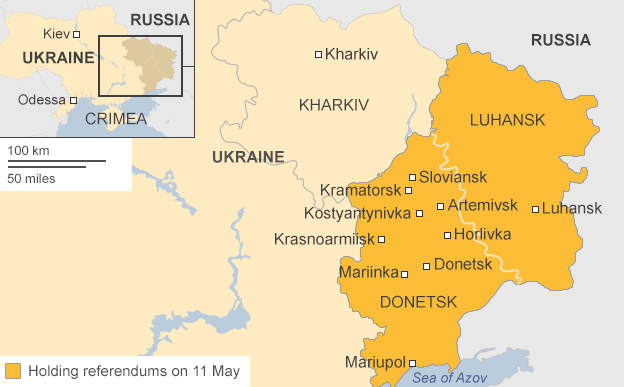
First, what are these “new republics” Knapp mentions? If you don’t count Crimea (wiki), which Moscow formally recognized in 2014, then the new republics that declared their independence from Ukraine are Luhansk (wiki) and Donetsk (wiki). Both polities are roughly 3300 square miles in area and house roughly 1.5 million people (you can get the exact numbers from the wiki links I provided above). Here is a map:

74717073_ukraine_donetsk_luhansk_referendum_624
(source)

Alarmingly, both republics style themselves “people’s republics” and (less alarmingly) have aligned publicly with Moscow. Russia, by the way, has not recognized these “new republics,” for geopolitical reasons I hope to make clear below.

Westphalian sovereignty

Russia does not like to recognize new polities (“republics”)ย because of its adherence to the ideal of Westphalia, which is state sovereignty (elsewhere at NOL Barry Stocker argues that the Westphalian ideal can be better understood asย an early modern cosmopolitanism rather than state sovereignty). All throughout the Cold War Russia and China were staunch supporters of the Westphalian ideal (as were states in Africa and Asia that broke away from colonial empires), and they became even more so after the collapse of socialism in 1993. State sovereignty is the idea that states (“countries”) have sole control over what goes on in their own borders, and that any interventions of any kind, by any type of organization, needs to be approved by the state. It is called “Westphalian” because of the Treaty of Westphalia that was signed by a number of major and minor European states in the 17th century. The major states were able to maintain a balance of power and the minor states were able to assert more sovereignty over their territories than ever before because they were signatories of an international treaty. (Edwin van de Haar’s article in the Independent Review [pdf] on the balance of power as the most libertarian option available is worth reading, and is made stronger, I believe, by Giovanni Arrighi’s argument [pdf] that the balance of power led directly to the “capitalist oligarchies” that eventually pushed feudalistic institutions out of Europe beginning in the late 15th century.)

Russia, China, and other autocratic regimes prefer an international system that is respectful ofย state sovereignty because of the fact that this idea helps their governments to administer an amount of coercion on populaces that Western states consider immoral or rights-violating.

Russian strategy

Why did Russia hint at recognizing Donetsk and Luhansk, but ultimately decide not to recognize them? Because the West has been recognizing separatist republics since the USSR fell apart, and it has done so in the traditionally Russian sphere of influence (noticeably carving up Yugoslavia at Serbia’s geographic expense). The West has not carved up post-Soviet space by simply recognizing the sovereignty of self-proclaimed republics, but also by incorporating these polities into the international system that it dominates. Russia wants to show elites (but not necessarily the public) that it is tired of policymakers ignoring Westphalian notions of sovereignty (which are enshrined in the UN charter that almost all recognized states have signed; when they sign it they get rent-seeking privileges, but that’s a story for another day…).

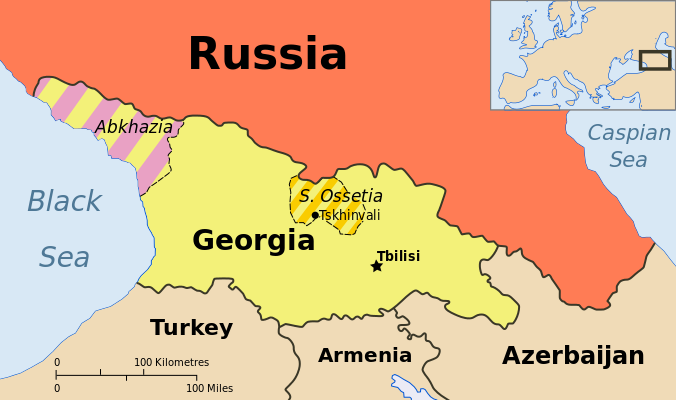
This is fairly straightforward logic on Moscow’s part. When the West supported Kosovo’s secession from Serbia (in defiance of Article 2(4) of the UN charter), Russia responded by supporting South Ossetia and Abkhazia breaking away from Georgia before annexing them. The interesting thing here is that Russia even mimicked Western use of force to back up its play. When the West supported Montenegro’s secession from Serbia (in defiance of Article 2(4) of the UN charter), Russia responded by supporting Donetsk, Crimea, and Luhansk breaking away from Ukraine before annexing Crimea. The interesting thing here is that Russia even mimicked Western use of force to back up its play. Both Russia and the West used minimal military resources to achieve their objectives, and both played the sovereignty card to back up their actions.

blog-map-of-caucasus
(source)

Western policymakers will never be able to bring liberty to Russia, and liberty will never be known by Russians if the rule of law is trumped by geopolitics. The West dominates the world’s international governing organizations. It has made the rules. It has drawn up the contracts. It has invited the non-West to participate. It has given concessions in order to gainย the non-West’s support. So when the West breaks the rules it first outlined and drew up, the non-Western polities it convinced to join IGOs in the first place cannot be expected to take such rules seriously. The fact that Russia does play by the West’s rules, by taking seriously the claims of breakaway regions, suggests that the West has been in the wrong post-1993.

American media pundits and critical thinking

All of this leads me back to sensationalist headlines aboutย nefarious Russian meddling in the American presidential election. Don’t believe any of that garbage. Firstly, look at how often American foreign policy pundits haveย been wrong. Just look!ย Amid the cries of Russian meddling in the Clinton-Trump contest you can surely hear the faint echoes about weapons of mass destruction in Iraq. Secondly, all good analyses of geopolitical affairs provideย at least some bit of historical context to them. Does your foreign policy pundit use history as a guide? Thirdly (and lastly), when thinking about a country remember that most accounts willย have a point of view that shadows the consensus found inย the world’s political and financial centers, which are useful but willย sacrifice important details in the name of efficiency (and efficacy).

American libertarians, of all the factions out there, realize this best. Unfortunately, until they can shake the isolationist dogma that has paralyzed the movement since the Rothbard era of the 70s and 80s, they will continue to be marginalized in contemporary discussions about foreign policy, either as token libertarians in a Republican administration or as token libertarians in the “anti-war” movement (I put “anti-war” in scare quotes because by now it should be obvious that this movement represents the Democratic Party [pdf], not an ideal; see, though, Michael Kazin’s excellent, if ultimately unconvincing, argument for a different take on the disappearance of the anti-war movement once Obama and the Democrats came to power). New republics, secessionist movements, and other endeavors of exit are often embraced by American libertarians because of their autonomist appeal, but if they don’t pay attention to how state actors view such movements, especially regional and global hegemons, they may end supporting some very nasty regimes in the name of liberty.