Time for optimism in Brazil

If you only read left-leaning newspapers, things might appear dismal in Brazil right now. But I am very convinced that it isn’t so.

With former president Lula in jail, it becomes more and more likely that Jair Messias Bolsonaro will be Brazil’s next president.

I already wrote about Bolsonaro here. To sum things up, I don’t think that he is a libertarian champion. Far from it. There are many things about Bolsonaro that will displease those who are more market-friendly. He is still too nationalistic in his economic thinking. He fails to see how awful the military government in Brazil (1964-1985) was (even though the alternative – Brazil turning into a South-American USSR – was even worse). But Bolsonaro represents something extremely important: the left is losing the culture war in Brazil. After decades of hegemony in Brazil, Antonio Gramsci and the Frankfurt School seem to be on the ropes. People are so sick and tired of cultural Marxism that they are willing to elect someone whose agenda is to fight against it.

Maybe a world with Bolsonaro president is not the best of worlds. Maybe he is very much a Brazilian Donald Trump. But it is certainly good to know that cultural Marxism is turning against itself and that now Brazilians might be willing to elect a president that, although only moderately market-friendly, is not ashamed to call himself a conservative.

Pot smoking and freedom: ‘Murica!

My latest Tuesday column over at RealClearHistory takes aim at the history of marijuana in the United States. I’ve got a 600 word limit, but hopefully I packed in plenty of info. Here’s an excerpt:

During the much-loathed Prohibition era (1920-33), marijuana was targeted along with alcohol and other substances deemed immoral by bootleggers and Baptists. Unlike alcohol, which was re-legalized in 1933, marijuana ended up in a legal limbo that continues to this day. The legal, political, economic, and cultural battles surrounding marijuana use in the United States have helped shape three generations of lawyers, businesspeople, activists, academics, and medical professionals. Thanks to the questions posed by marijuana prohibition, rigorous and creative arguments in favor of the drug’s legalization have contributed to a better understanding of our federal system of government, of Judeo-Christian morality, and non-Western ethical systems (pot-smoking “Buddhists” are practically cliche today), of the human body and especially the brain, of global trading networks throughout history, and of intercultural exchange and communication. Freedom still defines us as a society. Freedom binds Americans together. Freedom drives our conversations and our institutional actors. This may be difficult to remember as the news cycle grows ever more sensational, but this quiet, humble truth still remains.

Please, read the rest.

Nightcap

  1. Skripal Case Descends into a Propaganda War der Spiegel
  2. American options in the face of Turkish-YPG crisis Burak Kadercan, War on the Rocks
  3. Syria’s Nuclear Program Was Always a Doomed Idea Robert Farley, National Interest
  4. How George HW Bush dodged death by cannibalism in WWII Jennifer Wright, RealClearLife

Monarchical Brazil was not a conservative paradise

Seems to me that there is a strong tendency between contemporary Brazilian conservatives to consider the Brazilian Empire (1822-1889) a golden age in Brazilian history. Many Brazilian conservatives are now defending the monarchy as an ideal form of government for Brazil.

As someone said, “the more we change, the more we remain the same.” Brazil became independent from Portugal in 1822. The independence was officially proclaimed by Dom Pedro I, son of Dom João VI, the king of Portugal. I think that maybe Brazilians are so acquainted with this fact that they don’t realize how crazy it is: the prince of Portugal declared the independence of Brazil! That didn’t happen because Dom Pedro fought with his father. By all accounts, father and son enjoyed the best relationship possible. Dom Pedro declared Brazil’s independence because if he didn’t, someone else would.

Dom Pedro’s independence was just one among many others. Tiradentes tried to proclaim the independence of [at least part of] Brazil in 1789, basically 30 years before Dom Pedro! And this is just one example! Tiradentes independence was not successful because it was averted by Portugal. Dom Pedro’s independence was successful because he was Portugal (ok, he wasn’t Portugal, but he was part of it)!

The fact that Brazil’s independence was proclaimed by a Portuguese monarch gives a very special meaning to what means to be conservative in Brazil. Today, in the US, one may call himself a conservative because he defends the ideas of Thomas Jefferson. But in his day Thomas Jefferson was a radical! A rebel who revolted against the British monarchy. Dom Pedro was not exactly a rebel. He wanted, to a great degree, to maintain things just the way they were. Certainly, many of his supporters were afraid of a more radical independence movement. To say the least, Brazil’s independence was a compromise between radicals and conservatives.

Brazilian monarchy avoided many reforms, inspired by classical liberalism, that were happening in other places. To give just one example (in my personal view, the most glaring), Brazil was the last country in the Western Hemisphere to abolish slavery (in 1888). I don’t blame Dom Pedro I for this. I also don’t blame his son, Dom Pedro II, who ended up being emperor for the majority of the monarchical period (1840-1889). But the fact is that the monarchy maintained many of the privileges inherited from Portugal, and avoided reforms that Anglo-American conservatives would support.

Brazilian conservatives have to be careful with the use of this word. To be a conservative in Brazil is not necessarily the same as being a conservative in England or the US.

Nightcap

  1. Religion and human rights Bruce Clark, Erasmus
  2. Voltaire and the Buddha Donald Lopez, Public Domain Review
  3. The politics of the past in Europe and Russia Douglas Smith, LA Review of Books
  4. Lessons unlearned, empire falls Niall Ferguson, Vanity Fair

Eye Candy: Kurdistan

NOL map Kurdistan.png
Click here to zoom (courtesy of the excellent Decolonial Atlas)

Countries with significant Kurdish populations in the Near East: Turkey, Syria, Iraq, and Iran.

Countries with significant Kurdish populations in the Near East that the United States has bombed or put boots on the ground in: Iraq and Syria.

Countries with significant Kurdish populations in the Near East that the United States has threatened to bomb and possibly invade: Iran.

Countries with significant Kurdish populations in the Near East that the United States is allied with: Turkey.

Three of the four countries with significant Kurdish populations in the Near East are (or was, in the case of Iraq) considered hostile to the US government, so the use of Kurds to further American Realpolitik in the region is almost obvious, until you consider that Turkey has been a longtime ally of Washington.

Suppose you’re a big-time Washington foreign policy player. Do you arm Kurdish militias in Syria, encourage continued political autonomy in Kurdish Iraq, finance Kurdish discontent in Iran, and shrug your shoulders at Istanbul? Seriously, what do you do in this situation?

On the rift between economics and everything else

The line is often heard: economists are “scientific imperialists” (i.e. they seek to invade other fields of social science) jerks. All they try to do is “fit everything inside the model”. I have this derisive sneer at economists very often. I have also heard economists say “who cares, they’re a bunch of historians” (this is the one I hear most often given my particular field of research, but I have heard variations involving sociologists and anthropologists).

To be fair, I never noticed the size rift. For years now, I have been waltzing between economics and history (and tried my hand at journalism for some time) which meant that I was waltzing between economic theory and a lot of other fields. The department I was a part of at the London School of Economics was a rich set of quantitative and qualitative folks who mixed history of ideas, economics, economic history and social history. To top it all, I managed to find myself generally in the company of attorneys and legal scholars (don’t ask why, it still eludes me). It was hard to feel a big rift in that environment. I knew there was a rift. I just never realized how big it was until a year ago (more or less).

There is, however, something that annoys me: the contempt appears to be self-reinforcing.  Elsewhere on this blog (here and here) (and in a forthcoming book chapter in a textbook on how to do economic history), I have explained that economists have often ventured into certain topics with a lack of care for details. True, there must be some abstraction of details (not all details are useful), but there is an optimal quantity of details. And our knowledge grows, the quantity of details necessary to answering each question (because the scientific margin is increasingly specialized) should grow. And so should the number (and depth) of nuances we make to answer a question.  There is a tendency among economists to treat a question outside the usual realm of economics and ignore the existing literature (thus either rushing through an open door or stepping in a minefield without knowing it).  The universe is collapsed into the model and, even when it yields valuable insights, other (non-econs) contributors are ignored.  That’s when the non-econs counter that economists are arrogant and that they try to force everything into a mold rather than change the mold when it does not apply. However, the reply has often been to ignore the economists or criticize strawmen versions of their argument. Perceived as contemptuous, the economists feel that they can safely ignore all others.

The problem is that this is a reinforcing loop: a) the economists are arrogant; b) non-economists respond by dismissing the economists and ridiculing their assumptions; c) the economists get more arrogant. The cycle persists. I struggle to see how to break this cycle, but I see value in breaking it. Elsewhere, I have made such a case when I reviewed a book (towards which I was hostile) on Canadian economic history. Here is what I said for the sake of showcasing the value of breaking the vicious circle of ignoring both sides:

These scholars (those who have been ignored by non-economists) could have easily derived the same takeaways as Sweeny. Individuals can and do engage in rent-seeking, which economists define as the process through which unearned gains are obtained by manipulating the political and social environment. This could be observed in attempts to shape narratives in the public discourse. According primacy to the biases of sources is a recognition that there can be rent-seeking in the form of actors seeking to generate a narrative to reinforce a particular institutional arrangement and allow it to survive. This explanation is well in line with neoclassical economics.

This point is crucial. It shows a failing on both sides of the debate. Economists and historians favorable to “rational choice” have failed to engage scholars like Sweeny. Often, they have been openly contemptuous. The literature has evolved in separate circles where researchers only speak to their fellow circle members. This has resulted in an inability to identify the mutual gains of exchange. The insights and meticulous treatments of sources by scholars like Sweeny are informative for those economists who consider rational choice as if the choosers were humans, with all their flaws and limitations, rather than mechanistic utility-maximizing machines with perfect foresight (which is a strawman often employed to deride the use of economics in historical debates) . In reverse, the rich insights provided by rational choice theorists could guide historians in elucidating complex social interactions with a parsimony of assumptions. Without interaction, both groups loose and resolutions remain elusive.

See, as a guy who likes economics, I think that trade is pretty great. More importantly, I think that trade between heterogeneous groups (or different individuals) is even greater because it allows for specialization that increases the value (and quantity) of outputs.  I see the benefits of trade here, so why is this “circle of contempt” perpetuating so relentlessly?

Can’t we just all pick the 100$ bill on the sidewalk?

Nightcap

  1. The firing of Kevin Williamson was a bad idea Conor Friedersdorf, the Atlantic
  2. Among the abortion extremists Ross Douthat, New York Times
  3. Back alley regulation Bryan Caplan, EconLog
  4. What deterring abortion means Russell Arben Fox, In Medias Res

Brazil-Africa Relations, Now and Then

The first academic paper I ever published was about Brazil-Africa Relations, approximately from the 1960s to the 2000s. The main point of the article was to compare three moments of Brazilian Foreign Policy Towards Africa: the Independent Foreign Policy of the Early 1960s; the Foreign Policy of the latter Military Governments (late 1970s) and the Foreign Policy of the Lula administration (2003-2011). My main conclusion was that the foreign policy towards Africa of these three moments was very similar. Although some would exalt Lula’s foreign policy as something extraordinary, the truth, as I saw it, was that it was very well grounded in a tradition of Brazilian Foreign Policy.

Today I feel somewhat ashamed of that paper. I failed to highlight the irony: the leftist government of Lula had a foreign policy strikingly similar to that of the (supposedly) far-right military regime. The information, to be sure, is all there. One has simply to come to this obvious conclusion.

The foreign policy of Lula and Dilma was indeed very similar to that of Ernesto Geisel and João Batista Figueiredo, the last two generals to be presidents of Brazil, and not only regarding Africa. Dilma’s economic policy was extremely similar to that of Geisel, the same policy that, by the way, led Brazil to the hyperinflation of the 1980s and early 1990s.

It is definitely ironic. The Workers Party began as an opposition to the military government in Brazil. Dilma was a terrorist guerrilla warrior who fought against that regime (and never publicly apologized for that). However, once in power, they became very similar to their enemies. I’ll leave the readers to come to their own conclusions about this. But regarding Africa: I wasn’t able to continue my research. But I’m still very interested in that continent. Brazil is geographically and culturally very similar to many African nations. I believe there are great opportunities for mutual aggrandizement. But “mutual” is not what I saw in my research. I saw Brazil being hypocritical: The US is (in the sick mind of some leftist Brazilian politicians and diplomats) imperialist towards Brazil; therefore, Brazil will be imperialist towards Africa. I hope that a more market-friendly Brazil will be able to do something different.

Nightcap

  1. How British architects conquered the world Joe Lloyd, 1843
  2. The demise of the nation-state Rana Dasgupta, Guardian
  3. The survivors of the Syrian wars Patrick Cockburn, London Review of Books
  4. There is no personality cult around Viktor Orbán Jan-Werner Müller, New York Review of Books

Nightcap

  1. We’ve lost our faith in God *and* reason Kenan Malik, Guardian
  2. Pope Francis is beloved, but disaster looms for the Vatican Ross Douthat, NY Times
  3. What did Karl Marx think about freedom? Daniel Luban, the Nation
  4. Hungary’s slow, sad decline into dictatorship Matthew Engel, New Statesman

Life expectancy at birth is not a predictor of health care efficiency…

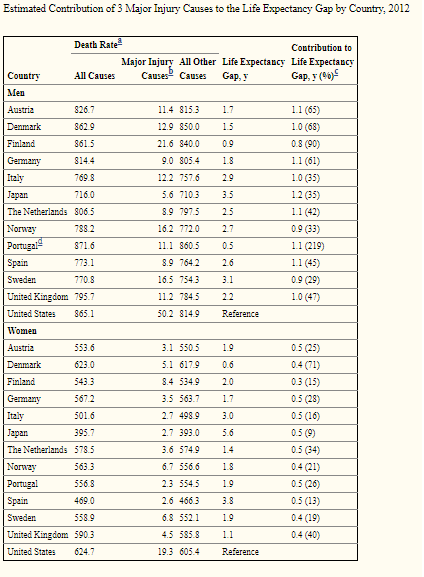
This is going to be a short post to argue that pundits (and some economists) need to stop quoting life expectancy figures to argue for/against a particular health care system. This belief is best exemplified in a recent paper in the Journal of the American Medical Association where Papanicolas et al. (2018)  point out that the United States “spent nearly twice as much as 10 high-income countries (…) and performed less well on many population health outcomes”. While the authors make good points about administrative costs, they point out that the US has a low level of life expectancy.

Sure, that is actually true – but Americans tend to die in greater proportions from homicides, drug overdoses and car accidents (Americans drive more than Europeans) than in other rich countries. While these factors of mortality are tragic (except car accidents since Americans seem to prefer the benefits of mobility to the safety of not driving), they are in no way related to the efficiency of health care provision. How much of a deal are these in explaining differences with other industrialized countries? A pretty big deal.  For example, these three factors alone account for 64% of the male life expectancy gap between Austria and the United States (see table reproduced below). For women, 26% of the gap between Austria and the United States is explained by these three factors.

The study I cite here only includes three factors. If you add in other factors like drownings among youths (Americans tend to have more drownings than several industrialized countries) which is a result of the fact that Americans are richer and can afford pools (while Europeans tend not to), then you keep explaining away the difference.  This is not to say that American health care is great. However, this says that American health care is not as bad as life expectancy outcomes suggest.

Mortality


Bolton’s Iran policy: could it strengthen the China-Russia-Iran-Pakistan axis?

John Bolton, who took over as Donald Trump’s National Security Adviser on April 8, has had significant differences with India on a number of issues in the past. As US Ambassador to the UN, he opposed India’s elevation to the United National Security Council (UNSC), even at a time when relations were at a high during the Manmohan Singh-Bush era. Bolton had initially opposed the Indo-US nuclear deal, though later he lent his support. While the Trump administration has sought to elevate India’s role in the Indo-Pacific region, Bolton has expressed the view that there are some fundamental differences between India and the US. In the short term, though, there is no serious divergence.

Bolton and Iran

What would really be of concern to India however is Bolton’s hawkish approach towards Iran. Bolton’s views are not very different from those of US President Donald Trump and recently appointed Secretary of State John Pompeo. Bolton is opposed to the Iran Nuclear Agreement signed between Iran and P5+1 countries in 2015. In 2015, the NSA designate called for bombing Iran, last year he had criticized the deal, and last year he had called for scrapping the deal.

The Iranian response to Bolton’s appointment was understandably skeptical. Commenting on Bolton’s appointment, Hossein Naghavi Hosseini, the spokesman for the Iranian parliament’s National Security and Foreign Policy Commission, said: Continue reading

Nightcap

  1. What the FBI’s Cohen raid means Ken White, NY Times
  2. Documenting a police detention in New Jersey Irfan Khawaja, Policy of Truth
  3. Why do we have prisons in the United States? Livia Gershon, JSTOR Daily
  4. Erdogan refreshed after talks with Putin, Rouhani Amberin Zaman, Al-Monitor

Is it always wrong to be angry?

Recently it was brought to my attention a text by a Brazilian journalist “chocked with the anger the Brazilian middle-class has for Lula,” evidenced in the celebrations over Lula’s imprisonment. Honestly, I couldn’t finish reading it because I have better things to do, but in the first lines, she questions how people can be so angry and at the same time rejoicing while Brazil goes through such a turbulent moment. In her understanding, Lula represented the aspirations of millions of Brazilians, and these aspirations are now failing.

Ironically, I believe I know where her frustration comes from. Marxism is nothing but a Christian heresy.  Marx belongs to the group of 19th-century intellectuals who declared that God is dead. However, Marx was not able to get rid of all the Christian ethos. He simply transformed the working class into the suffering Messiah, the socialist intellectuals (like himself) into prophets and the future communist society into Paradise. Classical liberalism has its roots in Christianism, and Marxism is one step further away from it.

One of the most basic Christian teachings (expressed by Jesus himself) is “love your enemies.” Maybe this doesn’t sound controversial today, but it certainly was in 1st century Palestine. My understanding is that, as a deformed form of Christianity, Marxism is questioning how people in Brazil are failing to love Lula, their enemy.

However, Jesus didn’t simply say “love your enemy.” He went on to explain what he meant by love. Love in a Christian sense is less a feeling (although it is also a feeling) and more an attitude. It is mostly to follow the 10 commandments in our relationship with God and with other people.

The love Marxists preach lacks definition and as so lacks meaning. Therefore it is open to abuse. The love Christians preach is deep and complex, and not always easy to understand or to put into practice. But it is certainly not shallow. It is possible, Biblically speaking, to love your enemy and at the same time rejoice with justice.

Some may argue that this is not necessarily due to Christianity. Some philosophical school that predates Christianism (such as stoicism) preached something similar. I’m not going to argue about that. I’m not doing the most scholarly argument here, so you can’t take it or leave it.

Some may argue that the journalist I’m referring to is not a Marxist. To those, I quote John Maynard Keynes (who was not always a very good economist, but sometimes was very accurate in his observations about life):

Practical men who believe themselves to be quite exempt from any intellectual influence, are usually the slaves of some defunct economist.

As a Christian, I don’t hate Lula and I don’t rejoice in his suffering. But I’m certainly rejoicing with justice. It may be hard to understand or to accept, but while I love my enemy I don’t necessarily approve his actions. And I certainly don’t consider my enemy my friend. It’s complex. As C.S. Lewis put it “people who have never been to Narnia find these things hard to understand.”