Alguns mitos, equívocos e objeções comuns ao capitalismo parte 2

Continuando um post antigo, seguem mais alguns mitos, equívocos e objeções comuns ao capitalismo.

Três mitos a respeito da Grande Depressão e do New Deal

Mito #1: Herbert Hoover praticava o laissez-faire, e foi sua falta de ação que levou ao colapso econômico.

Na verdade Herbert Hoover era tremendamente intervencionista na economia. Sua intervenção cooperou para o início da depressão e sua continuada intervenção evitou que a economia se recuperasse logo.

Mito #2: o New Deal trouxe fim à Grande Depressão.

Longe de ser uma série de medidas coerentes contra a depressão, o New Deal foi uma tentativa de Frank Delano Roosevelt de demonstrar que estava fazendo alguma coisa. As medidas do New Deal apenas agravaram e prolongaram a crise. Países que adotaram uma postura menos intervencionista se recuperaram da crise mais rápido do que os EUA.

Mito #3: A Segunda Guerra Mundial deu fim à Grande Depressão.

Talvez este seja o pior mito de todos: a produção industrial no contexto da Segunda Guerra gerou empregos, aumentou o PIB, e com isso acabou com a Depressão. Conforme Friedrich Hayek afirmou, “da última vez que chequei, guerras apenas destroem”. Este mito é uma aplicação da falácia da janela quebrada, observada por Frédéric Bastiat. Guerras não produzem riqueza. Na verdade elas a destroem. O exame cuidadoso dos dados históricos demonstra que a economia dos EUA só se recuperou realmente quando a Segunda Guerra Mundial já havia acabado.

Mais alguns mitos, equívocos e objeções comuns ao capitalismo:

1. Capitalismo é racista e sexista

Considerando o capitalismo economia de livre mercado, onde indivíduos são livres para escolher, nada poderia estar mais longe da verdade. O capitalismo assim definido é cego para raça ou gênero. O que importa é a troca de valores. Para ficar em apenas um exemplo, as lideranças políticas do sul dos EUA pressionavam os donos de empresas de ônibus a segregar os passageiros com base na cor da pele. Os próprios empresários de ônibus queriam ganhar dinheiro com transporte de pessoas, independente da cor da pele. Apenas uma observação: recusar serviço com base em cor de pele, gênero, orientação sexual ou qualquer outro motivo é uma prerrogativa do indivíduo dentro do capitalismo. Leve seu dinheiro para uma instituição que o receba. A instituição que recusa serviço está perdendo dinheiro, e neste sentido já recebeu a punição dentro do capitalismo.

2. Capitalismo tende a bolhas e pânico

Esta é uma observação presente tanto em Marx quanto em Keynes. Conforme observado nos mitos sobre a Grande Depressão e o New Deal, exatamente o oposto é verdade. Conforme a Escola Austríaca em geral e Friedrich Hayek de forma especial observaram, é a intervenção do governo, particularmente no setor bancário e financeiro, que produz bolhas e pânico. A tentativa do governo de estimular a economia através de juros baixos e outros artifícios apenas cria ciclos de crescimento e queda. Milton Friedman e a Escola de Chicago fizeram observações semelhantes. Deixada livre a economia é de certa forma imprevisível, mas através do sistema de preços podemos nos guiar sobre quando e no que é melhor gastar.

3. Capitalismo não investe em coisas importantes

É difícil saber o que seria um investimento importante. Somente indivíduos podem avaliar o que é importante para eles mesmos. O raciocínio aqui é que há investimentos de longo prazo, que custam muito dinheiro e não produzem resultado imediato. Capitalistas não investiriam em voos espaciais ou na cura de doenças, por exemplo. Mais uma vez observa-se a falácia da janela quebrada: investir em uma coisa significa não investir na próxima melhor opção. Exemplos recentes mostram que empresas atuando no livre mercado podem fazer mais, melhor e com menos desperdício do que governos, inclusive quando o assunto é exploração espacial.

4. Capitalismo leva a produção de coisas duvidosas

Mais uma vez este é um argumento de orientação subjetiva. Aquilo que é duvidoso para um individuo pode ser bom para outro. Há aqui a velha máxima de que “o capitalismo produz necessidades artificiais”. Conforme Voltaire respondeu a Rousseau mais de 200 anos atrás, este argumento não se sustenta. O que é uma “necessidade artificial”? Tesouras são necessidades artificiais? E sabão? E pasta de dente? Porque seres humanos viveram por séculos sem estas coisas. Conforme já foi observado por Joseph Schumpeter, a grande virtude do capitalismo é justamente trazer conforto a baixo preço não para reis e rainhas, mas para as pessoas mais simples em uma sociedade. Ainda que alguns possam considerar certos produtos de consumo duvidosos. Apenas não comprem.

Referências:

3 Myths of Capitalism (YouTube)

Top 3 Myths about the Great Depression and the New Deal (YouTube)

Common Objections to Capitalism (YouTube)
“Statogenic” Climate Change?

Is climate change government-made? For some years, I have been saying to my colleagues that climate change is real. Nonetheless, I am not an alarmist and I do not believe that stating that there is a problem is a blank cheque for any policy. Unlike many of my colleagues who believe that climate change is “anthropogenic”, I argue that it is “statogenic” in the sense that government policies over the last few decades basically amplified the problem.

Obviously, there is a social cost to pollution – an externality not embedded in the price system. On that basis, many have proposed the need for a carbon tax to “internalize the externality”. The logic is that anything that brings the “market price” closer to the “social cost” is an improvement.

Rarely do they consider the possibility that governments have “pushed” the market price away from the “social cost” (Note: I really hate that term as it has been subverted to mean more than what economists use it for). Consider the example of road pricing. In my part of Canada (Quebec), road pricing was eliminated in the 1970s. By eliminating road pricing, the government incentivized the greater use of vehicles and, basically, the greater burning of fossil fuels. Thus, by definition, the return of road pricing would bring the market price and the social cost closer together (and it might do so more efficiently than a carbon tax). Thus, there can be “statogenic” climate change because governments encourage indirectly the greater use of fossil fuels.

How big is that “statogenic” climate change? I think it is pretty “yuge.” For the last few months, I have been involved in a research project with Joanna Szurmak and Pierre Desrochers of the University of Toronto regarding environmental indicators in the debates between Paul Ehrlich and Julian Simon (see Joanna’s podcast with Garrett Petersen here at Economics Detective Radio). In that paper, we mention the fact that roughly a quarter of the world consumption of fossil fuels is subsidized directly or indirectly (through price controls setting local prices below world prices). That is a large share of total consumption and, according to an OECD paper, 14% of the effort needed to attain the most ambitious climate change mitigation plan could be made by eliminating those subsidies.

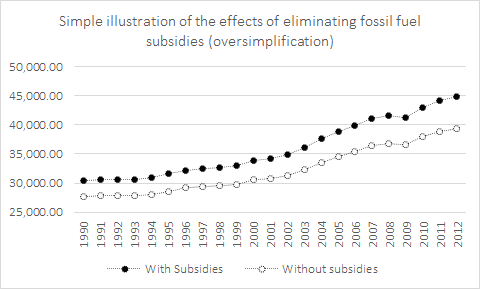
Now imagine that estimate was made in 2011. These policies have existed since the 1970s! One paper from the World Bank from the 1990s argued that eliminating them back in the 1980s would have reduced greenhouse gas emissions by 5% to 9%. Imagine a level lower by 9% (just for the sake of illustration) and imagine that the growth rate of greenhouse gases would have been reduced by 9% as well. Using CAIT data, we can see how this oversimplified scenario (which is by no means a general equilibrium scenario – which is the only way to measure the overall lower levels) means in terms of lower levels of GHGs. Relative to the observed data, a 9% drop back in 1990 with a 9% reduction in the growth rate of GHGs mean that the level of GHGs in 2012 in a world without subsidies would have been more than 12% lower relative to what they were in a world of subsidies.

subsidies

Again, this is an oversimplification. However, it works against my claim. The use of sophisticated methods is likely to yield much larger differences over time. Think about it for a second – alone the policy of fossil fuel subsidies explains a lot even with the oversimplification. Now, imagine adding the fact that many countries do not practice road pricing; that some countries tax the resale of used goods forcing the production of more goods; that they discourage construction in urban environments forcing a greater population sprawl; that trade barriers in agriculture prevent us from concentrating production where it is the most efficient; and the list goes on!

When people say “anthropogenic” climate change, I hear “incentives-driven” climate change or “statogenic.”

When are safe places okay?

I am against the idea of safe places (see my previous post on the issue), especially in academia. I believe that if an idea is worthwhile it should be able to survive critic from all sides and safe places, regardless of their intent, hamper that process. How can you critic something if you aren’t supposed to even acknowledge its existence?

I also believe that, if our pluralistic society is to continue, we need to be able to empathize with those who are our intellectual opponents. I’m not saying we should become Marxists and rename the site The People’s Notes. Nor should we become Trumpistas. However we should be able to break bread with non-liberals and hear their side of the story out. We can continue to disagree with them, but we need to be careful to not de-humanize someone because of their ideological leanings. Safe places make this hard to do. If X group isn’t politically correct to talk about, much less with, how can we learn about them?

Safe places are, in more than one way, harmful to a free society.

-But they may still have a place in a free society.

Why the change of heart? It is this whole Trump fiasco. If you haven’t read them yet, several NoL bloggers have written about it here, here, here, etc.

I have seen several extreme reactions to the election of Trump, including quite a bit of anger and sadness. I cried for a good six hours myself when I saw the election results; as I’ve mentioned before I’m an illegal alien and so there is a very real chance I’ll be deported and torn away from the country I’ve loved since childhood. After drying up my eyes though I put that aside and went back to work. How I see it, as liberals we are constantly fighting against anti-liberal forces.

Am I sad that Trump won? Yes, but Hillary wasn’t an angel either. Before Trumpistas we had to fight Communists, Fascists, and every other type of ‘ists’ imaginable. After the Trumpistas are defeated we will have new enemies pop up. I am optimistic that in the grand scheme of things the future is better than the past, but I don’t think we will ever be rid of anti-liberal thought. Equilibrium is an illusion.

But I digress. I went back to work after my crying session, but many others around me didn’t. They couldn’t. And we shouldn’t try to force them to.

I still think safe places are a bad idea in so far that we are concerned about promoting free discussion and would never want to go into one. However maybe I can tolerate one or two of them if they help others improve their mental health. Maybe I can use ‘undocumented’ instead of ‘illegal’ if people are really that emotionally disturbed by it. Maybe I can use someone’s preferred pronoun if ‘he’ really hurts them that much. Maybe I can keep my mouth shut and just listen to someone who is in pain.

I think that in the long run we need to be able to stand up to our critics. If you’re gay, you’ll eventually find someone who goes out of their way to tell you your leading a sinful life. If you’re a woman and feel that the patriarchy is why you’re paid less, an economist will eventually lecture you on why that’s wrong. Infantilizing people doesn’t help them. The world is tough, and you need to be rough to survive it. 

However if someone needs a bit more time before they go out and face that world, is it wrong to provide a safe place for them until they feel ready? If I want to make a controversial remark, maybe I shouldn’t do so in the middle of the class. Maybe I should just blog it on NoL.

As always thoughts and comments are always appreciated.

From the Comments: Lenin knew what he was doing when he picked Stalin

Barry and William had an interesting discussion in the ‘comments’ threads of Dr Rosi‘s post about Lenin. At the heart of the dialogue is whether or not Lenin thought Stalin was an incompetent fool. Here is Dr Stocker’s final response:

This all depends on accepting that a text written by Krupskaya was Lenin’s own view. Leaving that aside, Kotkin is very against the idea that Stalin was stupid and I don’t think we should equate Stalin’s crassness with stupidity. Even leaving aside Kotkin, it is clear that Stalin did intellectually demanding things over many years, with regard to political organisation, political journalism and writing on Marxist doctrine (particularly the national question and this was before the Revolution long before issues of Stalin getting people to write things for him).

General Secretary of the Party was a very influential job, which meant selecting the people to run the party and therefore the country along with a complex range of other tasks which require some intellectual capacity. If Lenin appointed Stalin believing that Stalin was not very bright and could therefore be given an unimportant job, he was bizarrely mistaken about the demands and influence of the party secretary, the head of the Party in a party-state. Lenin did not need this title as he was the undoubted leader and instigator of the October Revolution. After he was off the scene, the party secretary would inevitably be the most powerful person in Russia. Stalin was at all times crude, brutal, cunning, calculating and dishonest in his behaviour, but this is not same as intellectual lack.

As Robert Service, amongst others, have pointed out Trotsky portrayed himself as the great intellectual with the right to inherit Lenin’s mantle and needed to portray Stalin as stupid and maybe needed to believe that someone lacking in his formal education, knowledge of foreign languages and manners associated with intelligentsia culture really was stupid. Well Stalin won the power struggle and I think it had something to do with intelligence behind the crassness.

Lenin and Trotsky themselves have been exaggerated as Great Thinkers by their followers. Clearly they had some scholarship and intellectual capacity, but what did they write which anyone would care about if they hadn’t come to power in 1917? Interest in Lenin’s writings has dropped off in a quite extreme way since Leninism stopped being the official ideology of what used to be the USSR, allied regimes and some large allied political parties outside the socialist bloc. Sort of equalises the intellectual legacy of Lenin, Trotsky and Stalin.

Read the whole thing.

“Apparently they have been whispering while others have been shouting obscenities and interrupting guest speakers.”

This is an observation found in the ‘comments’ threads of economist Mark Perry’s blog, Carpe Diem, on a post he did about the reaction of students at the University of Michigan-Ann Arbor to their president’s remarks about Donald Trump.

(I’m not going to summarize it here, because you are all probably familiar with this storyline. You can read Perry’s whole post here.)

I wanted to highlight that this comment basically summed up my political experience on campus. I am by no means a conservative, but there was no way in hell I was going to pipe up in class discussions on alternative understandings of “neoliberalism” or even play the role of contrarian. Doing so would have hurt my GPA. It would have resulted in a loss of social standing. It would have invited accusations that I was racist, or sexist, or – gasp! – conservative.

So instead I started this blog and talked about sports or homework with my peers.

My guess is the guy who left this comment was a libertarian or conservative in college back in the 70s or 80s. Michelangelo recently blogged about his experience on campus, but has anyone else found that this is the norm on campuses in the West?

I understand that conservative and libertarian groups like to get obnoxious sometimes, by carrying out public demonstrations like “affirmative action bake sales” or whatever, but the fact that these don’t work (they do help promote a culture of toleration on campuses, albeit in an indirect manner, so I guess I should be thankful for that, but if this is the case then the drum-beating and chanting done by Leftists on campus does the same thing for me in this regard) in convincing the other side of their wrongness suggests that the quiet whisperers are the better thinkers.

So, something that makes me smile for a change.

It’s a fact that I feel pain in several parts of my body, including in parts I did not know I had. One of the sources of pain is permanent shingles. I only mention this in the hope that it will trigger some of you to get vaccinated or to get their aging parents vaccinated.

So, anyway, recently, someone who ought to know (if you know what I mean) convinced me to try cannabis for my pains. So, I went to the specialized doctor (at least, I think he is a doctor). I gave him $100 and I came out with a medical marijuana card.

I went straight to the dispensary and purchased some cookies, of the kind my adviser had previously let me taste. The effect on my pain was almost miraculous. I felt none from about five pm until I went to bed around 10 pm.

Several things sill trouble me. First, I can’t find a dose small enough to avoid getting a little high, which I would like to avoid. Second, it makes me hungry (surprise!). Third, what if frequent use re-ignites my passions, what then? Fourth, I am really, really pissed off about the $100 because it looks like Californians just passed a recreational cannabis law.

My sage adviser is an excellent auto mechanic in his spare time. You write me, I will give you his name. That would be for mechanical services, of course.

Explicando a eleição de Trump para brasileiros

Para qualquer um que acompanhou as notícias pela grande mídia brasileira (leia-se especialmente Globo e Globonews) a eleição de Donald Trump para a presidência dos EUA parece ter sido em primeiro lugar uma surpresa imprevisível e em segundo lugar a maior desgraça que poderia se abater sobre aquele país e o mundo, quando ao mesmo tempo estes perderam a chance de serem agraciados com a primeira mulher presidente dos EUA, a imaculável Hillary Clinton. Para responder a esta avaliação, faço aqui algumas observações a respeito do sistema político e eleitoral dos EUA.

Há basicamente dois partidos políticos nos EUA: Democratas e Republicanos. Diferente de algumas bobagens que vi nos principais canais de notícias, o Partido Democrata não remonta a Thomas Jefferson. Remonta sim a Andrew Jackson, primeiro presidente populista dos EUA e notório assassino de índios. Ao longo do século 19 o Partido Democrata foi o grande defensor da escravidão, e com a abolição desta nefasta instituição tornou-se o grande defensor da segregação. Woodrow Wilson e Franklin Delano Roosevelt, famigerados presidentes democratas, muitas vezes tratados como grandes heróis da democracia, foram grandes expansores do governo federal e enfraquecedores da economia americana. Na década de 1960 o Partido Democrata criou uma versão norte-americana de Welfare State que desde então mais prejudica do que ajuda os mais pobres. Do século 19 ao 21, o Partido Democrata está sempre ao lado dos mais poderosos e contra os mais pobres, não importa se dizem o contrário.

A origem do Partido Republicano é menos antiga. O GOP (grand old party), como é chamado, foi formado pela união de vários movimentos abolicionistas, e seu primeiro presidente foi Abraham Lincoln. Em resposta à eleição de Lincoln, estados escravistas do sul dos EUA romperam com a União, dando início à Guerra Civil. Embora a história do GOP esteja cheia de controvérsias, o fato é que ao longo do tempo este partido foi mais inclinado ao livre mercado, defensor mais forte dos direitos individuais e menos populista do que seu adversário Democrata.

Para além dos partidos, a população dos EUA se divide basicamente em duas correntes políticas: liberais e conservadores. Diferente do que ocorre no Brasil ou na Europa, o termo liberal é utilizado nos EUA para indivíduos de esquerda. O termo liberal passou por uma mudança na virada do século 19 para o 20, sendo adotado por indivíduos do movimento progressivista (notoriamente o já citado presidente Woodrow Wilson), que defendia a expansão dos poderes do estado e menor liberdade de mercado. Eventualmente o termo liberal tornou-se associado aos Democratas.

Conservadores nos EUA são as pessoas que querem conservar o país como este foi fundado no final do século 18. Conservadores são mais constitucionalistas do que os liberais, defendem um governo mais limitado e maior liberdade de mercado. Em outras palavras, conservadores são liberais clássicos, enquanto que liberais deturparam este termo, quando deveriam se chamar de progressivistas (embora seja altamente questionável se sua posição promove algum progresso). Eventualmente conservadores também se tornou um termo ligado a cristãos, embora esta ligação seja menos necessária do que possa parecer. Conservadores estão particularmente ligados ao Partido Republicano.

Evidentemente é impossível que a população de um país grande como os EUA se encaixe perfeitamente em somente dois partidos políticos ou duas tendências ideológicas. Os liberais em geral defendem liberdades sociais (como legalização das drogas e união civil de homossexuais), mas são contra liberdades econômicas (como contratos livres entre trabalhadores e empregados). Conservadores são contra liberdades sociais e favoráveis a liberdades econômicas. Pessoas favoráveis aos dois tipos de liberdade sentem-se pouco representadas nos dois principais partidos, e, embora em geral optem pelo GOP, também tem como opção o Partido Libertário ou o movimento Tea Party (não um partido político formal, mas sim um movimento de protesto contra o crescimento do estado, em favor do retorno aos parâmetros constitucionais). Há também socialistas, ambientalistas, comunistas, e todo o tipo de tendência política nos EUA. O fato é apenas que somente dois partidos possuem uma representatividade nacional.

O fato de que os EUA possuiriam somente dois partidos políticos expressivos foi previsto bastante cedo por James Madison, um dos Pais Fundadores e principal autor da Constituição. No final do século 18, Madison previu que devido ao tamanho do país (ainda pequeno se comparado com as dimensões atuais) e sua diversidade, um partido de projeção nacional precisaria evitar extremismos e se focar em posições moderadas, que pudessem atender à população como um todo. Foi o que aconteceu. Ao longo de toda a sua história os EUA tiveram um sistema bipartidário, variando apenas os partidos que compõem este sistema. Republicanos e Democratas tem sido estes dois partidos desde meados do século 19.

Na primeira metade do século 19 outros partidos compuseram o sistema bipartidário previsto por Madison. Mudanças variadas levaram partidos antigos a perder relevância e serem substituídos por novos. É possível que o mesmo fosse ocorrer com Democratas e Republicanos, mas mudanças na lei eleitoral realizadas especialmente na década de 1970 tornaram mais difícil a entrada de competidores nas eleições. Estas mudanças são em parte responsáveis pela animosidade de grande parte do eleitorado, que não se sente representado por nenhum dos partidos, e consequentemente não se importa em votar. Este quadro é um alerta para pessoas que defendem uma genérica reforma política no Brasil, particularmente uma que limite a entrada de novos partidos.

Há em geral uma grande distância entre o que políticos falam em uma campanha e o que fazem uma vez nos cargos. Isto é particularmente verdade a respeito de Hillary Clinton. Graças à sua vasta experiência em cargos públicos, podemos dizer com segurança que Clinton é uma política profissional que busca angariar votos com argumentos que não necessariamente irão guiar suas ações uma vez no cargo. Trump é um político novato, e assim esta mesma avaliação torna-se impossível de fazer, mas há a impressão de que sua campanha foi conduzida como um dos reality shows de que ele fazia parte anos atrás: trata-se de uma realidade produzida com o objetivo de alcançar audiência, não de realidade real. É bastante provável que Trump presidente seja bem mais moderado do que Trump candidato, para o bem ou para o mal. Simpatizantes de Hillary podem se impressionar, assim como eleitores de Trump podem se sentir traídos.


Come back Jon Stewart!

By the way, I’m enjoying the crap out of John Oliver’s righteous indignation, but the truth is he’s probably doing more harm than good. Oliver panders to his dedicated fan base. Jon Stewart held his audience to a higher standard. He was biased, but he didn’t let his side get away with sloppy thinking.

Also by the way, Malcolm Gladwell had a nice episode that (if I’m remembering this right) nicely reflected the sort of ideological pluralism that Jonathan Haidt promotes. A recent video of Haidt has prompted a lot of my recent thinking on this issue.

Two points that bear repeating

  1. We could have elected Hitler and it wouldn’t have turned out significantly worse than if Clinton had won.
  2. The left and right aren’t speaking the same language, and whoever fails to take the first step (which is to not blame the other side) shares the larger share of the blame.

I just listened to the post election episode of the excellent series, The United States of Anxiety. Two interviews stand out: the Trump supporter who fails (I think) to understand the genuine (albeit overblown) fear of a black teenager, and the Trump opponent who fails to understand that trump supporter. (There was also a notably boring interview with another Trump opponent, some hand wringing by the hosts, and some genuinely insightful commentary from Chris Arnade stuffed into the back corner of the episode.)

Maybe I’m in a privileged position because I used to see myself as part of the right and now see myself as part of the left (what’s left of it). Many people on the left are being sore losers about this election and they’re making things worse. I’m talking about humans, not (necessarily) politicians. That’s what’s really disappointing.

To be fair, it’s a common pool problem. We each get social capital brownie points for being angry (“10 reasons you should be angry” gets more Internet points than “difficult social science that requires you to do things you don’t like“), and we don’t get the same rewards for sober reflection (or maybe NOL is a sensible echo chamber? Agree with me in the comments.).

The fact remains that in-group signalling trumps ideological inclusion. The result could mean wild swings of power between the right and the left with due process (and the blessings of civilization… like tolerance, economic growth, freedom, and social mobility) being steamrolled in the process.

It’s fun to blame Facebook, the media, politicians, or anyone else but ourselves. The truth is, consumer sovereignty is far stronger a force than is commonly accepted. We aren’t the victims, we’re the perpetrators. It feels good to have an ideologically tight-knit Internet cocoon and so we spend more time listening to our podcasts (talk radio) while driving our Priuses (pickups) past the coast (vast ocean of farms).

And we’ll always have some of that, but we’ve got important disagreements that we have to resolve… not permanently, but for the next generation or so. All sides (libertarians have to participate too; I don’t think we’re to blame, but some people do) have to eat some humble pie and try to genuinely understand what the others are talking about. They aren’t all morons (and we aren’t all geniuses).

What really struck me in those interviews (mostly the second, longer, better quality one by the well spoken liberal academic) was that they weren’t speaking as though they were really trying to convince their intellectual opponents. Patty (Trump supporter) was happy and felt like she was finally part of the decision making process in DC (whether that’s true is another issue). He was speaking to a liberal

Both sides need to try to adopt the language of the other side. You should be trying to convince them! Why should you expect any degree of success when you say shit like “just look at the evidence [you big dummy!]” as though they don’t think they’ve been looking at legitimate evidence. You’re both falling for confirmation bias.

The way forward is intellectual humility. Will that happen? Not a chance, but that’s all the more reason for me to shout into the void. Culture changes slowly.

People will always disagree, and always should. Ideologies have blind spots and need to depend on critics from the other ideologies to account for them. The policy we get reflects the desires of those who might do something about it. Even dictators have to walk a thin line to stay in power. What seems to be at issue here is meta-policy (Buchananian constitutional issues… not the literal constitution, but informal shared understandings about how government wields power). Right now the position from the two big camps is “to the victor go the spoils.” That’s happening because each camp has closed themselves off to the other. It’s similar to what Bastiat said; when we don’t get gains from ideological trade and cooperation, we get political strife.

Everything will be fine

Eight years ago I identified more with the right. Obama represented a charismatic leader with scary ideologies and an uncertain background. (McCain represented a very old man who didn’t seem to care much about freedom.) Obama had a cult of personality and looked ready to dismantle society.

What do I think now? I think he’s handled his position gracefully (though I haven’t been following too closely… gov’t is ~1/5 of the economy and I intend to keep it <1/5 of my life), and he’s done a good deal of harm (further entrenching the role of insurance in health care finance, drone strikes, etc.). But I don’t think he did any more harm than a Republican candidate in his position. The world didn’t end, and despite a big recession, freedom ultimately proved to be a hearty weed rather than a delicate flower.

I think Trump will follow a similar trajectory. He’ll make things worse, but the outcome won’t be dramatically different (overall) than if Clinton had won. Different special interests will be rewarded, and different special interest groups will suffer. But overall, four years from now we’ll be a little less free, a bit more rich (though probably going through a recession… that would have happened under either candidate), and ready for some more political change.

Bill Burr’s got it right: nothing’s going to change. Meet the new boss, same as the old boss.

Fight for your economic right to party

pubestablish.jpg

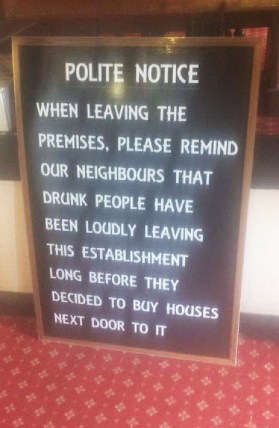
Two months ago, London’s iconic Fabric nightclub was shut-down by Islington Council on the dubious grounds that it had failed to adequately search club-goers for drugs. Fabric, a sprawling multi-level concrete venue, is dear to the heart of many Londoners. Its dramatic closure came as a shock. David Nutt blamed our hypocritical drug laws, while others spied conspiracies to turn the venue over to housing developers. In response to the public outcry, this month, London Mayor Sadiq Khan has appointed Amy Lamé as ‘night tzar’ (some use the even grander title Night Mayor) with the task of reviving London’s nightlife and especially trying to save venues like Fabric.

Tzars sound great in theory but tend to fail in practice. They are meant to break-up bureaucratic silos and join-up policymaking so that it conforms to a grand plan in a particular policy area. Rather than following rules regardless of outcomes, they have an outcome that the executive asks them to pursue remorselessly. However, I argue that this is precisely the opposite of what you want if your goal is a sustainable, thriving night-life culture. London night-life has suffered because of its politicization, not from a lack of it. The answer is strong rights for entrepreneurs to provide entertainment to willing consumers. This means reforming of government powers to license venues and prohibit development on arbitrary grounds. While ending drug prohibition is of deep importance, here the drug-use excuse was the face of a more pernicious power that local governments have to shut down successful businesses on arbitrary grounds.

In the United Kingdom, land development and property-use decisions have essentially been nationalized since 1947. While building still takes place, it only happens following detailed, expensive consultation with local planning authorities with significant input from local residents. As a result, the supply of building amenities has become unmoored from demand. The most noticeable impact has been rising house prices and rents in areas where the economy is growing. This is a boon to landlords lucky enough to own property in areas of high demand. But it causes those without property to suffer significantly higher living costs. It has led to bizarre developments such as it being easier to open a new golf course in the South-East than to start a new housing development.

While the majority of people feel the strain primarily through higher rents, less visible is the impact on businesses who are equally constrained by planning laws. They struggle to find suitable buildings for their commercial activities. Competitors and local residents can use the planning process to block new construction or changes to lawful uses for particular venues. Businesses lack legitimate expectations about where they will be allowed to expand. Those that do succeed need to invest heavily in lobbying and legal support. The result is that people end up travelling further to get to shops and to their places of work.

Club venues face a number of additional biases in this process. Local officials are more likely to be blamed for noise and crime associated with clubs but not praised for their fun and economic benefits. This fosters risk-aversion amongst local policymakers. At the same time, club-goers may outnumber local residents but most are not able to vote in local council elections. Residents might well have originally moved into a central London location precisely to experience fun, exciting nightlife. But once there, perhaps especially as they get a little older, their priorities change. They realize that they may want to live in an exciting city, but just so long as their particular neighborhood is a little less exciting. Rather than move to a quieter area, they express their preferences through the political process and demand that venues that have been around a lot longer than they have be closed.

Unfortunately, if too many residents in the city come to the same conclusion, you end up shutting down historic clubs on the slightest pretext. When it comes to hosting unlawful activities, businesses can be presumed guilty, with no secure way of ever proving their innocence.

In this context, having a tzar is an understandable response as a counter-balance to the call of the NIMBYs. But it doesn’t solve the core problem which is a system that cannot adequately represent revelers but augments complaints. The tzar can champion venues but will be silenced once these entrenched interests turn up the noise. Instead, we need a system that recognizes the presumptive right of businesses to market entertainment to willing consumers. Only provable nuisance should be cause to fine or eventually close venues. Once established, entertainment venues should not have to regularly prove their social worth to a licensing committee (the fact that they have willing customers is sufficient warrant for that).

Most importantly, complaints from recent arrivals against historic venues that have always hosted loud parties should be discounted. This works in a fashion in Tokyo, where mixed development is widely permitted (no one stops people from taking up residence in an otherwise commercial district) but without any assumption that those residents can then alter the make-up of their community through the political process.

Trump Will Probably Win the Election

What’s that you say? The election is over? In fact, the presidential election will be held on December 19, at which time each state’s chosen electors will meet in their respective state capitals to cast their votes. The results are due in Washington about a week later.

Did you really think you voted for President? In California, you voted for a slate of 55 electors who were appointed by your favorite party. You can find their names online.

The number 55 comes from the number of senators plus representatives. In Maine and one or two other states, each congressional district picks its own elector, and two more are selected at large. Maine’s delegation is split 3/1 for Clinton. That seems like a fair way to go. California, like most other states, is a winner-take-all state. Boo!

Does all this make any difference? I say it ain’t over till it’s over. There have been a few scattered instances of electors jumping ship, most recently Roger McBride, a Republican elector who changed his vote from Republican to Libertarian in 1972. Trump now has 290 electoral votes plus 16 more likely for a total of 306. If 37 of those people could be persuaded to change their votes, Trump would fall below the 270 needed to win. If that put Clinton over 270, she would win. If some of the votes went to Johnson or Sanders or Donald Duck, the election would be thrown into the House where each state would get one vote. Then the fireworks would start!

Why would they change their votes? I wouldn’t put it past the Clintonistas to resort to bribes or threats. A long shot to be sure, but stay tuned!

BC’s weekend reads

  1. The ABC’s of really bad news
  2. Most ideologies have no use for distinguishing between prophet and politician
  3. The conservative split over Donald Trump
  4. Will we proceed with campaign slogans, or with reflection and hard work? A must read
  5. Healing through decentralization

Trump, Liberty and Pizza

These are my obligatory thoughts about this Trump fiasco;

These past twenty four hours have been an emotional roller coaster for me.

I am an illegal alien. I have been able to do accomplish some great things these past few years because I was granted deferred action, a temporary suspension of deportation, and work authorization by the Obama administration. This has allowed me to work with the Cato Institute, the Reason Foundation, the Property and Environment Research Center, among others. I have been able to meet several of my intellectual heroes. I went from having been stuck to Los Angeles to travelling through most of the United States (with the notable exception of the south). I have formed countless friendships that would have been unimaginable to me a few years prior. I am today one of a handful of illegal aliens who have gone to do their doctoral study. If you read through NoL’s archives you’ll quickly realize I’m not terribly bright and I have a long way to go intellectually, but I’ve done well for myself I think.

Prior to deferred action I was in a dark place mentally. I was about to finish my undergraduate studies, but had no work experience unless you counted under the table odd jobs. How could I have any experience? Up till then it had been illegal to employ me. Once I graduated I had no idea what I could do. Become a gardener? I had no future. It didn’t help me that the longest romantic relationship I had been in ended because my significant other couldn’t stand my (lack of) legal status anymore.  Deferred action gave me the chance to give my life meaning.

It is highly likely that, due to its discretionary nature, Trump will cancel deferred action once he enters the White House. I honestly don’t know what I will do. It is very likely that my life has reached a dead end. Upon hearing that Trump had won I spent several hours crying. I wept for all the things that I am likely to never have. I wept for the fact that I am unlikely to ever become a US citizen. I wept for the fact that I am unlikely to ever find a wife or have children. After crying though I decided that it was pointless to let myself be consumed by it any further.

I think it better to concentrate on counting my blessings.

I am not a US citizen, and I am likely to never become one. Truth be told though I don’t feel like a stranger in this country. I have friends, family, and work colleagues that have extended a helping hand to me in the worst of times. I am grateful beyond words for that. Thank you. I love you all for it.

I may never be recognized as a son of America and I cannot claim to be a blood descendant from American heroes like Thomas Jefferson, Frederick Douglas, or Milton Friedman. I am however an intellectual descendant of them. I am a son of liberty.

Mind you an American conception of liberty. I think that government, in so far as it exists, should exist to minimize social conflict by promoting disputes to be resolved through non-violence. I think that society should judge people by their actions, not incidents of birth. I think that the market is the best mechanism for peaceful coordination of production of goods, services, ideas, and love. I emphasize that word because love only matters when it is felt voluntarily. Forced love is not love.

The common interpretation of Trump’s victory is that his supporters were a collection of racists, bigots, and pigs. While I am sure there are genuine racists mixed among his supporters, I think such a view too simplistic because it fails to consider why this racism has fermented.

Racism, in its many forms, is an inherit condition of man. Due to evolution we human beings have a built-in system of distinguishing between in and out groups, between those who are ‘us’ and those who are alien. This trait was necessary to allow early hunter-gatherers to form bands and survive. I do not pretend to be exempt from this; I’ve told my share of racist jokes over the years and am more inclined to help others that share similarities to myself. Racism, to the extent we see currently, however is not due to natural conditions.

I think that today’s level of racism is due to us forcing fake love down people’s throats. There is nothing wrong with celebrating diversity. Pizza, one of mankind’s greatest achievements, is the ultimate symbol of diversity. It’s core ingredients could not have been combined until relatively recently. Pizza is born of the union of the old world (Europe, Africa and Asia) and the new world (the Americas). There is nothing wrong with praising pizza.

The problem is that when we try to force others to eat a specific type of pizza. If someone won’t eat pineapple with their pizza we consider them bigots and exclude them from our social group. We tell them they’re subhuman and banish them far away. Should we be surprised then if, upon being ostracized, they come to resent pineapple pizza? In the past they simply didn’t care for pineapple, but now they hate it because it reminds them of how they were rejected in the past for holding unpopular views.

In our pursuit of celebrating pizza we ended up forgetting the great thing about pizza – choice. Pizza comes in countless varieties from plain cheese to pepperoni or a mix of vegetables and meats. Pizza doesn’t even need to have tomato sauce or cheese to be a pizza. Pizza is the ultimate manifestation of choice. It is no wonder that we Americans, in our love for liberty, love pizza.

Diversity is great. However if someone doesn’t like to be around blacks, homosexuals, or Jews we are not advancing the cause by making them feel like awful people. They may come from a background where they only interacted with others like themselves. They may feel uncomfortable in diverse environments, but we should not presume it to be because of bigotry. It is better to give them the benefit of the doubt. If diversity is great it will win them over time – they will voluntarily come to love diversity.

If we force them to love something however we deny them the opportunity to fully understand why diversity matters. We also force them to be hypocrites that claim to love something they don’t care for. We set up the groundwork for someone to come along and offer them a chance to get back at those who dehumanized them if they vote for him.

It is easy to want to punch people and force them to agree with you. I know full well the temptation of violence. Again, in the past day my life has come to an end. It would be easy to fuel my emotions into anger. It wouldn’t solve things though.

If we want to live in a better world we need to break this cycle of hatred and concentrate on what brings us together, our love for pizza.

Lifehacks: How to use Facebook better

Despite disagreeing with many (most?) of my friends on political issues I don’t think I’ve lost any Facebook friends this election. Let me share my secrets.

Step 1: Empathize. Life is hard, and few of us are trained for political life.

Step 2: Listen. We all have the same goal… getting other people to agree with us. You’re not going to be successful by telling people their stupid. You’ll get lots of Internet points… but only from people who already agree with you. You’re actually making things worse because fewer people will listen to people who are apparently incapable of treating them like a decent human being (and most people outside the Beltway are, in fact, decent and human).

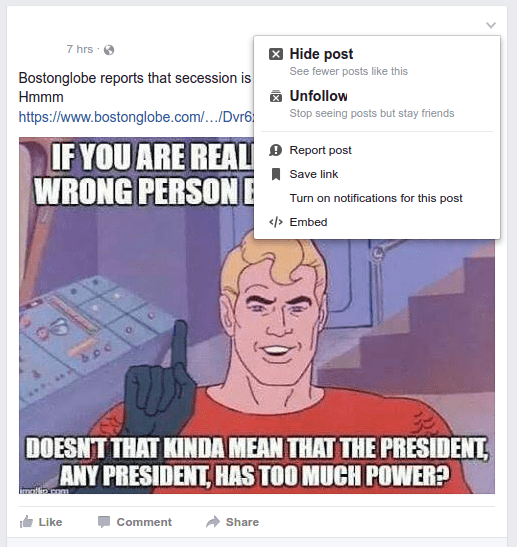
Step 3: Filter. (This is the big one.) You’re not going to convince everyone. For good or ill, morality isn’t about rationality for most people. So click that little “V” in the top right of your idiot friend’s post and tell Facebook to hide it.
fb-posts

Step 4: Relax. This stuff works by osmosis. You’re not going to change anyone’s mind over night (certainly not anyone over the age of 25). Be like the Colorado river. You don’t get a Grand Canyon of tolerance by refusing to trickle over land that doesn’t already agree with you.

Step 5: Step back. The government is about 20% of the economy. Try not to let it be more than 20% of your life. Your attention is scarce. Political life matters, but don’t let it get out of proportion. The Internet isn’t just for getting angry, it’s also for adorable gifs and pictures of pigs wearing boots.

Meta-intolerance doesn’t work. Take the worst case scenario: you’re Facebook friends with actual Hitler. You’ve got three options: A) Argue with him constantly. B) Unfriend him. C) Ignore his hateful posts and like his posts about his art. Which will do the most good for the world? Alright, potential employers and friends would probably prefer to avoid Hitler’s friends. But they’ll be more tolerant of your crazy uncle Rudy and you’ll do more good by being an occasional voice of reason in his feed than by stepping out of his Internet bubble entirely.

Most people are basically good even if they’ve got silly opinions about how to be good. And communication is hard. We speak different languages when we talk about politics and few of us have the tools to properly express ourselves. When people support politicians or policies you dislike, it might just be that they think that’s the lesser of two evils. (I’ve got opinions on why it’s sad that people think they’re “wasting” their vote by voting with their conscience, but I can hardly be mad at them for learning the fallacious reasoning that’s been foisted on them since high school civics. Let me add that if Vermonters had voted Stein and New Hampshirtonians had voted Johnson, then maybe next cycle we’ll get better options and we might push out of this two party system so many people dislike.)

I promised you Facebook lifehacks. They all boil down to this: tend your Internet bubble. You can do this with three easy steps:

  1. Like more non-controversial stuff than controversial stuff.
  2. Ignore and hide infuriating posts from people you’d rather respect (and imagine that you live in a world of respectable but flawed people instead of a world of evil charlatans).
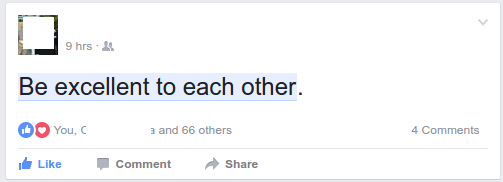
  3. excellent

The US elections: good, bad, and ugly

Good

Media will finally start doing its job after 8 years of hanging all over Obama’s nuts.

Bad

The GOP has control of the executive branch and both houses of Congress.

Ugly

The ugly part is over. Trump won’t be as bad as the Left wants him to be (the Left might even like his protectionism), but he’ll still be plenty bad by libertarian standards. We’ve got a lot of work to do, if we’re to make his job as president as hard as possible.

Have a good day!