Chetty et al and the metamorphosis of the earnings curve

The Chetty et al. paper is probably one of the most important papers of 2016 and it will long be debated. Many comments have been made on this and I need to reiterate that I do not believe the trend to be off, merely the level. I have just found another reason to doubt the level by thinking about demography. It relates to one key methodological decision made in the paper: taking the income of parents in the 25 to 35 years old age-window. This is a fixed window where their incomes are compared to that of a child at age 30.

This is probably a flaw that alters the level evolution importantly. My argument is simple. A person born in 1940 was, by the time he was 30, close to his peak earning point. A person born in 1980, by the time he is 30, is further away from a higher peak earning point. Thus, you are not comparing the same type of birth cohorts. In simpler terms, I am saying that with the 1940 birth cohort you are comparing children who, by age 30, were at the apex of their earnings while those of the 1980 birth cohort were not at the apex.

From the work of Ransom and Sutch on the economic history of aging in the United States, I remembered that graph (for late 19th century Michigan).  What I see is that for most workers, by 30 years of age, they are pretty much at the top of their earnings cure. Over time, if the shape of the curve does not change and simply keeps moving upwards, then there are no problems with the level of absolute mobility measured by Chetty et al.

earningfunctionsusa1890

But here is the problem, the curve does change shape! There are no longer flat lines like that of the Michigan farm laborers in the figure above. Earnings curve look more and more like that of the Michigan railroad employees. Not only that, the peak point is now higher in terms of income and at a further point in time. And that makes sense since we are studying longer and working menial jobs while we do for which we earn low incomes. When we enter the labor force, we get a very steep rise at a later point in our lives than our fathers or mothers did. So the earning curve of younger cohorts is more skewed than that of earlier cohorts. Kitov and Kitov shows the evolution of income by age groups relative to a fixed groups and as one can see, the youngest are getting further away from the peak over time – implying that it is shifting.  Again, from Kitov and Kitov, you can see that the 2013 curve starts later and has a steeper curve than the 1967 curve. From this trend in the earnings curve, we can more or less be certain that by 30, a person born in 1940 was closer to peak earnings than a person born in 1980. Thus, the person born in 1940 is at his apex (by the time he turns 30) when compared to his parents and the person born in 1980 is not at his apex when compared to his parents. (I am only using Kitov and Kitov for the sake of showing the evolution but this metamorphosis of the curve, I think, is not in dispute).

So, by setting the boundaries for measuring absolute mobility at a fixed point, Chetty et al. are capturing some changes that are purely related to changing demographics of the labor market and not absolute mobility. The 1940 level of mobility is too high relative to that of 1980. Chetty et al. do try to address this by looking at different time windows (they just don’t have a “rolling age window” which would be ideal – like indexing to the median age of the population).

I do accept that mobility has fallen since 1940, but I am very skeptical about how robust the big drop shown actually is. The issues of changes in family size, price deflators, taxes and transfers made me willing to entertain a fall of 25-30 points (rather than 40-45), now with this issue of the metamorphosis of the earning curves in mind, I am inching towards 20-25 points drop (still substantial).

Note: Still a big fan of Chetty et al. and their works is crucial, that’s why I don’t want pundits to try and extract this beyond what it actually says and does not say.

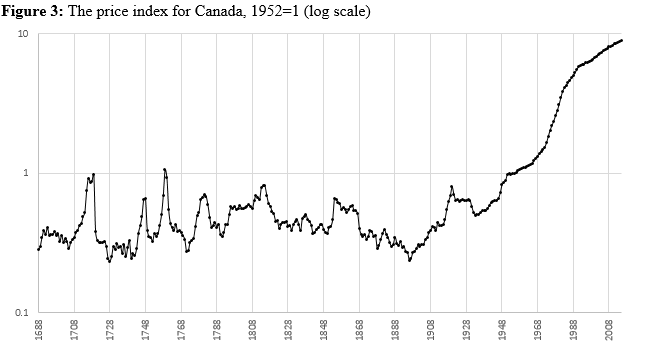
Prices in Canada, 1688 to 2015

I have just finished my working paper creating a price index for Canada that covers the period from 1688 to 1850 in order to link with the existing datasets that cover up to 2015. Here is the result (and the paper is currently consideration for publication). The paper is here and it shows how much prices have changed in Canada since the late 17th century.

pricescanada

Sons outearning Fathers in Chetty et al. : working hours should be considered

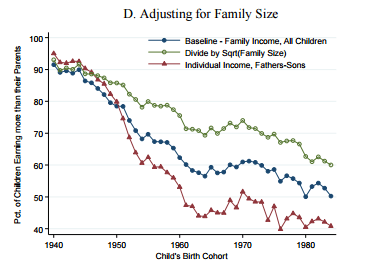
In response to my post yesterday, my friend and economist/nuclear engineer (great mix) Laurent Béland pointed out that the Father-Sons mobility figures in Chetty et al. are depressing. Yes, at first glance, they are (see below – the red line). fathersons

But, at second glance, it is not as terrible. Think about family structures with the 1940 birth cohorts. The father works and, in most likelihood, the mother is a stay-at-home father. Most of the earnings come from the father who probably works 45 to 60 hours a week.  If my father earns 40,000$ at 60 hours a week or earn 40,000$ at 40 hours a week, the line remains at the same height, but we are not talking about the same living standard in reality. Chetty et al. do not account for hours worked to achieve income.  The steep decline – faster than the baseline of household-size adjusted decline – matches the steep increase in female labor force participation and the decline labor force participation of males (see graph here and Nicolas Eberstadt’s work here) as well as the decline in hours worked by males.

If the question had been “what are your chances of out-earning your father per hour worked”, then the red line would not have fallen like that. Income divided by labor supplied would probably bring the red-line back with the blue-line.

Note: Again, please note that I am not trying to rip apart Chetty et al. (as some have claimed elsewhere). Their work is great and as a guy who does all his research on providing data series regarding economic history, I am never going to rip on someone who does hard data work like Chetty et al. did ! My point is that I am not convinced that the decline is so big. And, in good faith, it seems that Chetty et al. do try to put the “caution” labels where its needed – and its important to discuss those caution labels before some politician or two-cents-pundit goes all Trump on us by saying stuff that this doesn’t say!

Cheap college: Ten Tips

If you’re about to embark on your undergraduate education in the US or Canada, you probably have a good chance of ending up owing some money to pay for your studies and expenses. Can you avoid financial disaster and still end up with a pretty good “education” section on your CV? I believe so, and I’d like to share with you a few tips on cheap college education. They might turn out to be useful, whether you want to go straight to the job market after graduation or whether you have further studies in mind.

I did my undergraduate degree in Brazil. Then, I moved to the UK and completed my graduate education there with a very generous stipend. I also taught in higher education in both countries, including two top universities in the UK. I worked part-time for an institute attached to a university in Europe. Now I work at a major university in South Africa. I know a few things about higher education, and here’s a list of tips for you.

1. Accept a full-tuition scholarship.
If you’ve received an offer of a full-tuition scholarship, go for it. As long as it’s not a loan. No brainer. You’re being subsidised to study full-time. This is your job now. Do a little bit of networking and career skills training, but focus on your degree. Try to do as well as you can. The problem with this strategy is that, quite frankly, the vast majority of students aren’t offered scholarships that get even close to covering full tuition costs.

2. Avoid the athletics trap.
Don’t count on your prowess in sports to put you in a position where you earn full tuition to study. Athletics scholarships cover at most a fraction of the college cost. At most, you’d be able to combine an athletics scholarship with some other source of funding, but even if you get to that stage, you’ll have to figure out a way of earning B+ or A on average with little time to study.

3. Split your degree.
This is the oldest trick in the book. Yet, not enough students seem to follow it. I didn’t know the North American system very well, and I owe this point to Gary North. He explains it on this video. In the US, you can save a lot of money by doing the first two years of your degree at a community college or some other low-cost higher education institution. You can earn an Associate degree and then transfer credits to a four-year college to complete your Bachelor’s degree. One advantage (apart from the financial factor) is that you could do it in the evenings, while you earn some money during the day. Another advantage is that permanent teaching staff in a small college or a community college are gifted teachers – that’s why they were given their jobs in the first place – whereas at a major university professors are rewarded according to their research achievements and teaching might not be terrible, but it’s not necessarily the best you can get either.

4. Try distance learning.
This is emerging as a major alternative to traditional university attendance. You can either earn credits (which you can, later, transfer) or a whole degree at a fraction of the normal cost of university attendance. You can also combine this with point (3) above.

5. Stay with your parents.
Okay, as a Brazilian I didn’t see any problem in staying home for another four years during my university education. There are advantages and disadvantages to this, and it’s up to you to decide if this strategy is worth it, depending on your family’s culture and habits. But the fact is that, even if your parents charge you some rent, they won’t charge as much as the average university dorm would. This means you can save. Plus there won’t be any learning curves related to living in a completely new locality. This strategy requires you to do either a distance-learning degree or to attend your local college, and you can combine this with points (3) and (4) above.

6. Distance learning abroad.
This can be combined with (3), (4) and (5) above. The truth is, most employers don’t care very much about where you got your undergraduate education, except if the place is one of the top five or ten universities in the country. Higher education in the UK is slightly cheaper (on average) than in the US, and often much cheaper if you’re doing it online. You can register at the Open University, or at the University of London’s international programmes. Depending on the area of study, you can even do a distance degree part-time while you work, paying for each course at a time. The University of Aberdeen, for example, offers a distance degree in Religious Studies along those lines. If you give up halfway, you can still earn a CHE degree after completing the first year, a HE Diploma after two years, and the undergraduate course in the UK normally lasts for three years (except, normally, for Scotland).

If you want to save even more money and benefit from favourable exchange rates, you could also apply to study at the University of South Africa (UNISA), one of the world’s largest universities. UNISA has a very good reputation. Remember Nelson Mandela? He earned a degree there. For South Africans, each year of study costs around 1,000 dollars, and if you live abroad, you need to pay extra, but not a whole lot more. There are no classes. Normally, you use multimedia material, lots of written material, and travel to some place in your country where you can do the exams. So you need to factor in the cost of travel, but it still might be worth it. Other South African universities, such as North-West University, also offer distance degrees for certain fields.

7. Move abroad.
This is also becoming more of an alternative for North Americans. In Germany, for example, you can register at a university, as long as you can prove you know the German language well, and get a degree from some of the top universities in the world. The downside is the learning curve of moving abroad, visa bureaucracy and, perhaps, the cost of living in Europe might not be worth it. For example, you could pay low tuition fees in Finland, but it’s not that cheap to live there. For a tuition fee of around 1,000 Euros per year you can also do a degree in Portugal or Spain. Tuition fees in France and Italy are also relatively cheap. All this assumes you can prove you know the local language well enough to register. Depending on where you go, the case for doing a degree abroad is even stronger. In Portugal and Spain, an undergraduate degree normally takes four years. In Italy and France, it depends. In Germany, it normally takes three. This means you save a whole year of expenses.

8. Erasmus+.
If you decide to do your degree in Europe, you can still end up experiencing campus life and networking in North America. The reason is that students at European universities can be selected to do a year abroad under the Erasmus+ programme, and some of the partner universities are from North America. This is not very easy, but what I mean to say is simply that going abroad doesn’t mean abandoning any hope of experiencing student life in North America.

9. Cut corners while still following the rules.
You should thank Gary North for pointing this out. In a North American degree, you must do a number of credits, including electives or credits you can choose, as part of the total number of credits you must earn to obtain the degree. You can cut corners and save time and money by learning independently and then doing a credit-awarding exam. Some of the exams you can do are for general courses you’d end up doing as an elective anyway.

10. Make sure you do French and German.
How does this relate to “cheap college”? I confess there’s no direct relation. But I’d still urge you to do French and German as electives, particularly if they’re “for reading knowledge“. Those are intensive courses that get you to be able to read scholarly work in French or German by the end of a semester. This might not in itself make your college life cheaper now, but it will get you some skills you can use in the future. It gives you a head start in applying for the top, well-funded, PhD programmes in the US and Canada, in case that’s what you’re planning to do. Most PhD courses require you to have reading knowledge of at least one, if not two, of these languages. You might as well do it now. Moreover, if you just want to go to the workplace after you graduate, this can also give you a little advantage over the competition. While it doesn’t necessarily make your college any cheaper, this strategy will make your life easier by adding another relevant item to your CV which might turn out to be very useful in the near future.

I hope those tips can be useful. Maybe you’re even reconsidering whether you should really get deep into debt in order to earn a degree. Well, here’s my appeal. Please reconsider. Student loans may be common. Some even call this kind of debt an investment. But it’s not healthy to owe tens, if not hundreds of thousands of dollars when you’re just 22 or 23 and under pressure to find a good job to pay that money back. You want to be free. Maybe you want to go to a well-funded graduate programme without that stress. Maybe you want to get married. Who knows? Before accepting a loan to finance your education, please consider these alternative options. I urge you.

Before concluding, a disclaimer. I’m not saying any of these tips will work in every case. Be responsible and make sure you understand the details and implications of any decisions you make. Check, for example, if your target university or college will accept credit transfers from the place where you obtained those credits. Read the small print. But this is more or less what you’d be doing if you accepted a loan – you’d read the small print, right?

A flaw regarding the chance of “out-earning” your parents

When Raj Chetty publishes a paper, it generally comes with a splash. The last one is no exception. His paper (co-authored), picked up by David Leonhardt at the New York Times and Justin Wolfers on Twitter, basically measures the American dream : what are your chances to do better than your parents. The stunning conclusion is that someone born in 1940 had a 90%+ chance of “out-earning” his parents compared with a few points above 50% for those born in the 1980s. I am not convinced. Well, when I am not convinced, I am saying I am not convincing about how big the drop is! I think the drop is smoother (the slope of decline is gentler) and the starting point for the 1940 cohort is too high.  As a big fan of Chetty, I must press this point.

More precisely, I am saying that the bar (income threshold) over which someone had to jump in 1940 is underestimated and overestimated in 1980. Setting the bar too low (high) means very high (low) chances of “out-earning” your parents. To set the bar too low, you must underestimate (overestimate) the income of the parents.  This could occur if household economies of scale are not accounted for.

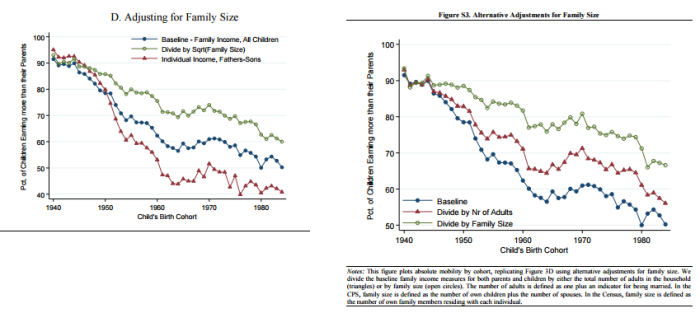
An income of 30,000$ for 3 persons is not the same as an income of 60,000$ for 6 peoples. On a per capita basis, the income is the same. But, if you adjust for economies of scale in housing and furnitures, there are differences (the simplest is square root).  This gives you income per adult equivalent. Chetty et al. are aware of that and they provided a sensitivity analysis which is not mentioned by those who are relaying the article. Since household size has tended to fall over time, the growth in per capita income is faster than the growth in income per adult equivalent (a better measure). Any correction for this long-term demographic trend would attenuate the slope of the decline of the chance to out-earn your parents. And indeed, once Chetty et al. make the correction, the decline is much more modest (but still present – see below).

size

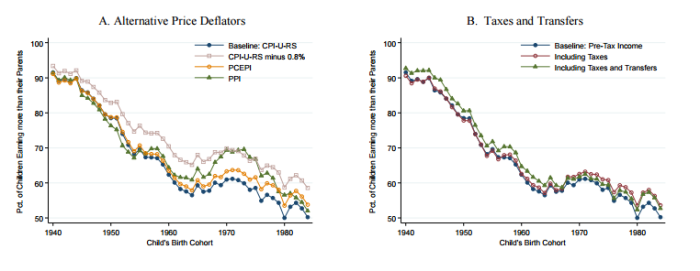
Simultaneously, Chetty et al. also present other important sensitivity checks. All of them relevant. But, in a strange decision, Chetty et al. decided to isolate each of the sensitivity checks rather than compile them. Taken individual, they all seem minor – except adjusting for family size. But compound this with the other sensitivity check proposed by Chetty et al.: price deflators. Using the well-known bias in the the CPI that overestimates inflation by 0.8%, Chetty et al. find that, by the end of their perod, there is roughly a ten percentage point difference between the baseline uncorrected CPI and the corrected CPI (see below). Compound this with the corrections for family and you still get a decline – but again the slope of the decline is much more modest. If you add panel B from figure 3 in Chetty et al – which includes taxes and transfers – you probably get a few extra points up. There will still probably be a decline, but a moderate one.

pricetaxes

Finally, at footnote 19, Chetty et al. also point out that they do not account for in-kind transfers prior to 1967 (there were some).  And, on page 13, they point out that “one may be concerned that levels of absolute mobility for recent cohorts may still be understated because of increases in fringe benefits, nonmarket goods, or under-reporting of income in the CPS”. Add in all these little extra problems to the family size, the transfers and the inflation correction and I am not sure how big the drop from 1940 to the end of the studied period is. Finally, I would also add that an understudied point in economic history is what the distribution of in-kind payments according to income was. From studying the British industrial revolution, I have generally to see that it is the poorest workers who receive in-kind payments (which are not measured) and the richest receive much fewer of those in proportion of their incomes. One of the few to note that distributional was the hardcore left-leaning scholar Gabriel Kolko who mentioned this issue in Dissent back in the 1950s.  If Kolko is correct, then the income of “poor parents” in 1940 is underestimated. As a result, the bar over which the children of said parents must jump is set mildly too low. If that is the case, the odds for the 1940 birth cohort are overestimated.

Combine all of these things together and I am not sure that the drop is as dramatic as many are making it out to be. I would be very satisfied if Chetty et al. would publish all the corrections they did and do a sensitivity check with hypothetical regarding a sliding-scale of in-kind payments in 1940 according to income (10% of income for poorest to 0% for the richest). I would just like to see how much it matters.

In Cuba, not having a car might save your life

My two blog posts on the health statistics of Cuba have convinced me to try to assemble a research article on the topic of assessing health outcomes under Castro’s regime. My first blog post was that there is a trade-off (the core of the article) that Castro decided to make. He would use extreme coercive measures to reduce some forms of mortality in order to shore up support abroad. The cost of such institutions is limited economic growth and increased mortality from other causes (dying from waterborne diseases or poverty diseases rather than dying from measles).

When I thought of that, I was inspired by Werner Troesken’s Pox of Liberty on the American constitution and the disease environment of the country. I was mostly concerned by direct medical interventions. However, the extent of coercive measures used by Castro go well beyond simple medical care (or medical imposition). Price controls, rationing and import restrictions on many goods could also help improve life expectancy. Indeed, rationing salt at 10g (hypothetical number) per person per day is a good way to prevent dietary diseases that emerge as a complication from overconsumption of salt. That will, by definition, raise life expectancy.

And so will bans on importing cars.

There is an extensive literature on the role that car fatalities has on life expectancy. This paper in Demography (one of the top demographic journals) finds that male life expectancy in Brazil is lowered by 0.8 years by traffic deaths. And traffic has very little to do with the quality of health care services. Basically, the more you drive, the more chances you have of dying (duh!). But, people don’t care much because the benefits of driving outweigh the personal risks.

In Cuba, people don’t get to make that choice. As a result, the very few drivers on Cuban roads have few accidents. According to WHO data, the car fatality rate is 8.15 per 100,000. There is also only 55 cars per 1,000 persons in Cuba. The next closest country is Nicaragua at 93 cars per 1,000 and the top country is Uruguay at 584 cars per 1,000. When you compute reported (rather than WHO estimated) car fatalities per 1,000 cars (rather than persons), Cuba becomes the unsafest place to drive in Latin America (1.46 fatalities per 1,000 cars) after El Salvador (2.22 fatalities per 1000 cars but only 129 cars per 1000), Ecuador (1.78 fatalities per 1000 cars but only 109 cars per 1000) and Bolivia (1.53  fatalities per 1000 cars and only 113 cars per 1000).

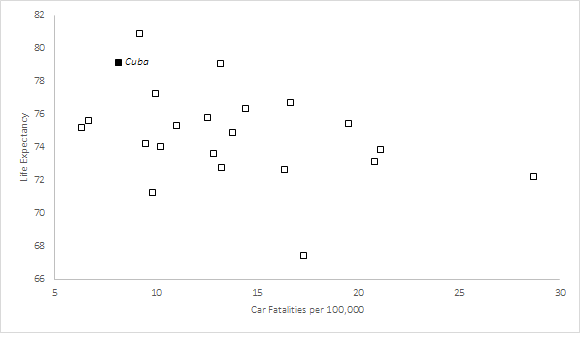
The graph below shows the relation between car fatalities per 100,000 inhabitants and life expectancy. Cuba is singled out as a black square. Low rate of car fatalities, higher life expectancy. Obviously, this is not a regression and so I am not trying to infer too much. However, it seems fair to say that Cuba’s life expectancy can easily be explained by the fact that Cubans face stiff prohibitions on the ability to drive. Those prohibitions give them a few extra years of life for sure, but would you really call that a ringing endorsement of the health outcomes under Castro’s regime? I don’t…

life-expectancy

Regional jealousies and transboundary rivers in South Asia

In the final reckoning, Pakistan got about 80 per cent of the Indus and India 20 per cent. India has limited rights on the western rivers and cannot undertake projects on those rivers without providing all the details to Pakistan and dealing with Pakistan’s objections. Why did India put itself in that position? The answer is that if Pakistan got the near-exclusive allocation of the three western rivers, India for its part got the eastern rivers. This was important from the point of view of the Indian negotiators because the water needs of Punjab and Rajasthan weighed heavily with them in seeking an adequate allocation of Indus water for India. Yet, Punjab had a serious grievance over the signing of the IWT [Indus Waters Treaty] by the union government. Citing provisions of the IWT which caused transfer of three river waters to Pakistan, Punjab had terminated all its water-sharing agreements with its neighbouring states in 2004.

The demand of Kutch (in Indian Gujarat), which used to fall into a catchment area of River Indus, decades back, was not taken into consideration despite many petitions, arguing about their historical claim on its water, sent by the prominent Kutchi leaders, in 1950s, to India’s Ministry of Irrigation and Power. Also people from the Indian side of Kashmir always show their ire against the IWT. On 3 April 2002, the Jammu & Kashmir Legislative Assembly, cutting across party affiliations, called for a review of the treaty. The state government has been contending that in spite of untapped hydroelectric potential, the state has been suffering from acute power deficiency due to restrictions put on the use of its rivers by the Indus Treaty. They claim that their interests were not taken into consideration and their views were not taken while signing the treaty. (6-7)

This is from my latest paper, “Disputed Waters: India, Pakistan and the Transboundary Rivers,” published by Studies in Indian Politics, and which you can find here.

Here is a map of all the Indian states mentioned in the excerpt above:

blog-india


Testing the High-Wage Economy (HWE) Hypothesis

Over the last week or so, I have been heavily involved in a twitterminar (yes, I am coining that portemanteau term to designate academic discussions on twitter – proof that some good can come out of social media) between myself, Judy Stephenson , Ben Schneider , Benjamin Guilbert, Mark Koyama, Pseudoerasmus,  Anton Howes (whose main flaw is that he is from King’s College London while I am from the LSE – nothing rational here), Alan Fernihough and  Lyman Stone. The topic? How suitable is the “high-wage economy” (HWE) explanation of the British industrial revolution (BIR).

Twitter debates are hard to follow and there is a need for summaries given the format of twitter. As a result, I am attempting such a summary here which is laced with my own comments regarding my skepticism and possible resolution venues.

An honest account of HWE

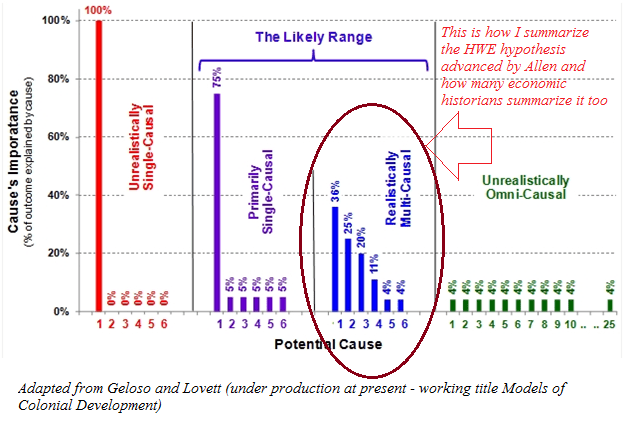
First of all, it is necessary to offer a proper enunciation of HWE’s role in explaining the industrial revolution as advanced by its main proponent, Robert Allen.  This is a necessary step because there is a literature attempting to use high-wages as an efficiency wage argument. A good example is Morris Altman’s Economic Growth and the High-Wage Economy  (see here too) Altman summarizes his “key message” as the idea that “improving the material well-being of workers, even prior to immediate increases in productivity can be expected to have positive effects on productivity through its impact on economic efficiency and technological change”. He also made the same argument with my native home province of Quebec relative to Ontario during the late 19th century. This is basically a multiple equilibria story. And its not exactly what Allen advances. Allen’s argument is that wages were high in England relative to energy. This factors price ratio stimulated the development of technologies and industries that spearheaded the BIR. This is basically a context-specific argument and not a “conventional” efficiency wage approach as that of Allen. There are similarities, but they are also considerable differences. Secondly, the HWE hypothesis is basically a meta-argument about the Industrial Revolution. It would be unfair to caricature it as an “overarching” explanation. Rather, the version of HWE advanced by Robert Allen (see his book here) is one where there are many factors at play but there is one – HWE – which had the strongest effects. Moreover, while it does not explain all, it was dependent on other factors that contributed independently.  The most common view is that this is mixed with Joel Mokyr’s supply of inventions story (which is what Nick Crafts has done). In the graph below, the “realistically multi-causal” explanation is how I see HWE. In Allen’s explanation, it holds the place that cause #1 does. According to other economists, HWE holds spot #2 or spot #3 and Mokyr’s explanations holds spot #1.
hwe

In pure theoretical terms (as an axiomatic statement), the Allen model is defensible. It is a logically consistent construct. It has some questionnable assumptions, but it has no self-contradictions. Basically, any criticism of HWE must question the validity of the theory based on empirical evidence (see my argument with Graham Brownlow here) regarding the necessary conditions. This is the hallmark of Allen’s work: logical consistency. His work cannot be simply brushed aside – it is well argued and there is supportive evidence. The logical construction of his argument requires a deep discussion and any criticism that will convince must encompass many factors.

Why not France? Or How to Test HWE

As a doubter of Allen’s theory (I am willing to be convinced, hence my categorization as doubter), the best way to phrase my criticism is to ask the mirror of his question. Rather than asking “Why was the Industrial Revolution British”, I ask “Why Wasn’t it French”. This is what Allen does in his work when he asks explicitly “Why not France?” (p.203 of his book). The answer proposed is that English wages were high enough to justify the adoption of labor-saving technologies. In France, they were not. This led to differing rates of technological adoptions, an example of which is the spinning jenny.

This argument hinges on some key conditions :

  1. Wages were higher in England than in France
  2. Unit labor costs were higher in England than in France (productivity-adjusted wages) (a point made by Kelly, Mokyr and Ó Gráda)
  3. Market size factors are not sufficiently important to overshadow the effects of lower wages in France (R&D costs over market size mean a low fixed cost relative to potential market size)
  4. The work year is equal in France as in England
  5. The cost of energy in France relative to labor is higher than in England
  6. Output remained constant while hours fell – a contention at odds with the Industrious Revolution which the same as saying that marginal productivity moves inversely with working hours

If most of these empirical statements hold, then the argument of Allen holds. I am pretty convinced by the evidence advanced by Allen (and E.A. Wrigley also) regarding the low relative of energy in England. Thus, I am pretty convinced that condition #5 holds. Moreover, given the increases in transport productivity within England (here and here), the limited barriers to internal trade (here), I would not be surprised that it was relatively easy to supply energy on the British market prior to 1800 (at least relative to France).

Condition #3 is harder to assess in terms of important. Market size, in a Smithian world, is not only about population (see scale effects literature). Market size is a function of transaction costs between individuals, a large share of which are determined by institutional arrangements. France has a much larger population than England so there could have been scale effects, but France also had more barriers to internal trade that could have limited market size. I will return to this below.

Condition #1,2,4 are basically empirical statements. They are also the main points of tactical assault on Allen’s theory.  I think condition #1 is the easiest to tackle. I am currently writing a piece derived from my dissertation showing that – at least with regards to Strasbourg – wages in France presented in Allen (his 2001 article) are heavily underestimated (by somewhere between 12% and 40% using winter workers in agriculture and as much as 70% using the average for laborers in agriculture). The work of Judy Stephenson, Jane Humphries and Jacob Weisdorf has also thrown the level and trend of British wages into doubts. Bringing French wages upwards and British wages downwards could damage the Allen story. However, this would not be a sufficient theory. Industrialization was generally concentrated geographically. If labor markets in one country are not sufficiently integrated and the industrializing area (lets say the “textile” area of Lancashire or the French Manchester of Mulhouse or the Caën region in Normandy) has uniquely different wages, then Allen’s theory can hold since what matters is the local wage rate relative to energy. Pseudoerasmus has made this point but I can’t find any mention of that very plausible defense in Allen’s work.

Condition #2 is the weakest point and given Robert Fogel’s work on net nutrition in France and England, I have no problem in assuming that French workers were less productive. However, the best evidence would be to extract piece rates in textile-producing regions of France and England. This would eliminate any issue with wages and measuring national productivity differences. Piece rates would perfectly capture productivity and thus the argument could be measured in a very straightforward manner.

Condition #4 is harder to assess and more research would be needed. However, it is the most crucial piece of evidence required to settle the issue once and for all. Pre-industrial labor markets are not exactly like those of modern days. Search costs were high which works in a manner described (with reservations) by Alan Manning in his work on monopsony but with much more frictions. In such a market, workers may be willing to trade in lower wage rates for longer work years. In fact, its like a job security argument. Would you prefer 313 days of work guaranteed at 1 shilling per day or a 10% chance of working 313 days for 1.5 shillings a day (I’ve skewed the hypothetical numbers to make my point)? Now, if there are differences in the structure of labor markets in France and England during the 18th and 19th centuries, there might be differences in the extent of that trade-off in both countries. Different average discount on wages would affect production methods. If French workers were prone to sacrifice more on wages for steady employment, it may render one production method more profitable than in England. Assessing the extent of the discount of annual to daily wages on both markets would identify this issue.

The remaining condition (condition #6) is, in my opinion, dead on arrival. Allen’s model, in the case of the spinning jenny, assumed that labor hours moved in an opposite direction as marginal productivity. This is in direct opposition to the well-established industrious revolution. This point has been made convincingly by Gragnolati, Moschella and Pugliese in the Journal of Economic History. 

In terms of research strategy, getting piece rates, proper wage estimates and proper labor supplied estimates for England and France would resolve most of the issue. Condition #3 could then be assessed as a plausibility residual.  Once we know about working hours, actual productivity and real wages differences, we can test how big the difference in market size has to be to deter adoption in France. If the difference seems implausible (given the empirical limitations of measuring effective market size in the 18th century in both markets), then we can assess the presence of this condition.

My counter-argument : social networks and diffusion

For the sake of argument, let’s imagine that all of the evidence favors the skeptics, then what? It is all well and good to tear down the edifice but we are left with a gaping hole and everything starts again. It would be great to propose a new edifice as the old one is being questioned. This is where I am very much enclined towards the rarely discussed work of Leonard Dudley (Mothers of Innovation). Simply put, Dudley’s argument is that social networks allowed the diffusion of technologies within England that fostered economic growth. He has an analogy from physics which gets the point across nicely. Matter has three states : solid, gas, liquid. Solids are stable but resist to change. Gas, matter are much more random and change frequently by interacting with other gas, but any relation is ephemeral. Liquids permit change through interaction, but they are stable enough to allow interactions to persist for some time. Technological innovation is like a liquid. It can “mix” things together in a somewhat stable form.

This is where one of my argument takes life. In a small article for Economic Affairs, I argued (expanding on Dudley) that social networks allowed this mixing (I am also expanding that argument in a working paper with Adam Martin of Texas Tech University). However, I added a twist to that argument which I imported from the work of Israel Kirzner (one of the most cited books in economics, but not by cliometricians – more than 7000 citations on google scholar). Economic growth, in Kirzner’s mind,  is the result of entrepreneurs discovering errors and arbitrage possibilities. In a way, growth is a process of discovering correcting errors. An analogy to make this point is that entrepreneurs look for profits where the light is while also trying to move the light to see where it is dark. What Kirzner dubs as “alertness” is in fact nothing else than repeated and frequent interactions. The more your interact with others, the easier it becomes for ideas to have sex. Thus, what matters is how easy it is for social networks to appear and generate cheap information and interactions for members without the problem of free riders. This is where the work of Anton Howes becomes very valuable. Howes, in his PhD thesis supervised by Adam Martin who is my co-author on the aforementioned project (summary here), showed that most innovators went in frequent with one another and they inspired themselves from each other. This is alertness ignited!

If properly harnessed, the combination of the works of Howes and Dudley (and also James Dowey who was a PhD student at the LSE with me and whose work is *Trump voice* Amazing) can stand as a substitute to Allen’s HWE if invalidated.

Conclusion

If I came across as bashing on Allen in this post, then you have misread me. I admire Allen for the clarity of his reasoning and his expositions (given that I am working on a funded project to recalculate tax-based measures in the US used by Piketty to account for tax avoidance, I can appreciate the clarity in which Allen expresses himself). I also admire him for wanting to “Go big or go home” (which you can see in all his other work, especially on enclosures). My point is that I am willing to be convinced of HWE, but I find that the evidence leans towards rejecting it. But that is very limited and flawed evidence and asserting this clearly is hard (as some of the flaws can go his way). Nitpicking Allen’s HWE is a necessary step for clearly determining the cause of BIR. It is not sufficient as a logically consistent substitute must be presented to the research community. In any case, there is my long summary of the twitteminar (officially trademarked now!)

P.S. Inspired by Peter Bent’s INET research webinar on institutional responses to financial crises, I am trying to organize a similar (low-cost) venue for presenting research papers on HWE assessment. More news on this later.
Carta de Voltaire dirigida a Rousseau, em resposta a ele

Um excelente texto mostrando o contraste entre dois conceitos de liberdade. Voltaire representa a liberdade do liberalismo clássico: o indivíduo deve ser livre de constrangimentos externos, ser livre para buscar sua concepção individual de felicidade. Rousseau representa outra concepção de liberdade: o indivíduo só será livre se acatar um conceito de felicidade que os demais irão lhe impor. Rousseau está por trás de basicamente todas a ditaduras estabelecidas desde então, principalmente as de esquerda, formadas por pessoas de bem que sabem o que é bom para os outros, que falam que o capitalismo só cria problemas e que deveríamos fazer um governo mais “democrático”. Em outras palavras, pessoas chatas, agressivas, que não respeitam as decisões alheias e sentem uma incontrolável vontade de ensinar para os outros o que é bom.

30 de Agosto de 1755

Recebi, senhor, vosso novo livro contra o gênero humano, e vos agradeço por isso. Vós agradareis aos homens, sobre quem fala vossas verdades, e não os emendará. Ninguém poderia pintar um quadro com cores mais fortes dos horrores da sociedade humana, para os quais nossa ignorância e debilidade tem tanta esperança de consolo. Ninguém jamais empregou tanta vivacidade em nos tornar novamente animais: pode-se querer andar com quatro patas, quando lemos vossa obra. Entretanto, como já faz mais de sessenta anos que perdi este costume, percebo, infelizmente, que é impossível recomeçar, e deixo essa maneira natural àqueles que são mais dignos que vós e eu. Já não posso mais embarcar para encontrar os selvagens do Canadá, em primeiro lugar, porque as doenças de que sofro me prendem ao redor do maior médico da Europa, e não encontraria a mesma assistência junto aos Missouris. Em segundo, porque a guerra está sendo travada lá naquele país, e o exemplo de nossas nações tornou os selvagens quase tão perigosos quanto nós. Devo me limitar a ser um selvagem pacífico, na solidão que escolhi, perto de vossa pátria, onde vós devíeis estar.

Concordo convosco que a literatura e as ciências causaram ocasionalmente muitos danos. Os inimigos de Tasso fizeram de sua vida uma longa série de infortúnios. Os de Galileu fizeram-no gemer dentro da prisão, aos setenta anos de idade, por haver entendido como a Terra se movimenta; e o que é ainda mais desonroso, obrigaram-no a desdizer-se. Desde que vossos amigos começaram a publicar o Dicionário Enciclopédico, os rivais os desafiam com o tratamento de deístas, ateus e mesmo de jansenistas.

Se porventura eu puder me incluir entre aqueles cujos trabalhos não trouxeram mais do que a perseguição como única recompensa, poderei mostrar-vos o tipo de gente perseguidora que me prejudica desde que produzi minha tragédia Édipo; uma biblioteca de calúnias ridículas impressas contra mim. Um ex-padre jesuíta, que salvei da desgraça total, me pagou o serviço que lhe prestei com um libelo difamatório; um homem, ainda mais culpado, imprimiu minha própria obra sobre o século de Luís XIV com notas nas quais a mais crassa ignorância vomitou as mais baixas imposturas; um outro, que vendeu a um editor, usando meu nome, alguns capítulos de uma pretensa História Universal; o editor, ávido o suficiente para imprimir esse amontoado de erros crassos, datas erradas, fatos e nomes mutilados; e, finalmente, os homens covardes e vis o suficiente para me responsabilizar pela publicação desta rapsódia. Eu mostrar-vos-ei a sociedade contaminada por este tipo de homens – desconhecido em toda a antiguidade – que, não podendo abraçar uma profissão honesta, seja de trabalho manual ou de serviço, e desafortunadamente sabendo ler e escrever, se tornam agentes literários, vivem de nossas obras, roubam os manuscritos, alteram-nos, vendem-nos. Eu poderia lamentar-me porque fragmentos de uma zombaria, feitos há pelo menos trinta anos, sobre o mesmo sujeito que Chapelain foi burro o bastante para tratar seriamente, circulam hoje pelo mundo, graças à traição e avareza desses infelizes, que misturaram suas grosserias às minhas pilhérias, e preencheram as lacunas com uma estupidez equiparada somente à sua malícia e que, ao cabo de 30 anos, vendem por toda parte um manuscrito que é apenas deles, e digno tão somente deles.

Eu poderia acrescentar, em último lugar, que roubaram uma parte do material que eu juntei nos arquivos públicos para usar na História da Guerra de 1741, quando era historiador da França; que venderam a uma livraria de Paris esse fruto de meu trabalho; que nessa época invejaram minhas posses, como se eu estivesse morto e pudessem colocá-las à venda. Eu poderia mostrar a ingratidão, a impostura e o roubo me perseguindo por quarenta anos, do pé dos Alpes ao pé do meu túmulo. Mas o que eu concluiria de todos esses tormentos? Que não tenho o direito de reclamar; que o Papa, Descartes, Bayle, Camões e centenas de outros sofreram injustiças iguais, ou ainda maiores; que este destino é o de quase todos daqueles que foram inteiramente seduzidos pelo amor às letras.

Admita, senhor, que estas coisas são pequenas desgraças particulares de que a sociedade pouco se apercebe. Que importa para a humanidade que alguns zangões roubem o mel de poucas abelhas? Os homens das letras fazem grande estardalhaço de todas estas pequenas querelas, enquanto o resto do mundo ou os ignora ou disso gargalha.

De todos os desgostos afetando a vida humana, esses são os menos graves. Os espinhos ligados à literatura, ou um pouco menos de reputação, são flores quando comparados aos outros males que a todo momento inundam a terra. Admita que Cícero, Varrão, Lucrécio ou Virgílio não tiveram a menor culpa nas proscrições. Mário era um ignorante, Sila, um bárbaro, Antônio, um crápula, o imbecil Lépido leu um pouco de Platão e Sófocles; enquanto Otávio César, covardemente apelidado de Augusto, esse tirano sem coragem, agiu apenas como um assassino detestável no momento em que privou a sociedade dos homens de letras.

Admita que Petrarca e Boccaccio não fizeram nascer os problemas da Itália; que as brincadeiras de Marot não produziram São Bartolomeu, e que a tragédia de Cid não produziu a guerra da Fronde. Os grandes crimes são cometidos apenas pelos grandes ignorantes. O que faz e fará sempre deste mundo um vale de lágrimas é a avidez e o indomável orgulho dos homens, desde Thamas-Kouli-Kan, que não sabia nem ler, até um oficial de alfândega, que não sabe nem contar. As letras alimentam, endireitam e consolam a alma; elas vos servem, senhor, durante o tempo que escreveis contra elas. Vós sois como Aquiles, que se encolerizava contra a glória, e como o padre Malebranche, que, com sua imaginação brilhante, escrevia contra a imaginação.

Se alguém tem o direito de queixar-se da literatura, sou eu, porque em todos os momentos e em todos os lugares ela serviu à minha perseguição; mas deve-se amá-la, não obstante o mau uso que dela fazem; como deve-se amar a sociedade na qual tantos homens maldosos corrompem os suscetíveis; como deve-se amar a sua pátria, mesmo que ela nos trate com alguma injustiça; como se deve amar o Ser Supremo, apesar das superstições e do fanatismo que desonram tão freqüentemente o seu culto.

M. Chappuis disse-me que vossa saúde anda muito mal, deveis restabelecê-la na terra natal, aproveitando junto à sua liberdade, beber comigo o leite de nossas vacas, e passear em seus campos.

Muito filosoficamente e com a mais alta estima, etc

The Uniqueness of Italian Internal Divergence

A few weeks ago, I got engaged in a twitter debate with Garett Jones, Pseudoerasmus and Anna Missiaia (see her great work here) about institutions in Italy. During the course of that discussion, I was made aware that I held a false belief. Namely, the belief that since the late 19th century, there had only been a minor divergence within Italy. In reality, there has been considerable divergence within the country since the late 19th century.

In the wake of the Italian referendum, it is worth examining how big is this divergence. Below is a map of regional GDP per capita taken from Europa.ec.  The southern regions of Italy have GDP per capita below 75% of the European average while some of the northern regions have GDP per capita above 125% of the European average. The IStat database suggest similar levels of divergence across regions in Italy.

Gross_domestic_product_(GDP)_per_inhabitant_in_purchasing_power_standard_(PPS)_in_relation_to_the_EU-28_average,_by_NUTS_2_regions,_2014_(¹)_(%_of_the_EU-28_average,_EU-28_=_100)_RYB2016.png

So, how much divergence was there – say a little a more than one hundred years ago? Well, according to the great work of Felice (see here in the Economic History Review and here), there were more similarities back in the 19th century than there are today. Take the Liguria which – in 1891 – had per capita value added of 44% above national average. Take also Campania which was 3% below the national average. Today, the IStat data places Liguria 9% above national average but the region of Campania is 37% below the national average. Overall, regardless of how you present the data , divergence has increase. Just expressed at coefficient of variations, there has been an increase. In 1891, the coefficient of variation stood at 22.95% while it stood at 28.95% in 2013.

italiangdp

This makes Italy into an oddity. My own work shows that in Canada, since the 19th century, there has been considerable convergence (see article in Economics Bulletin). The same happened in the United States (see this paper by Michener and McLean), in England (here and here) and in Sweden (here). Among western countries, increased internal divergence is rare and Italy is the prime case example. And this is a strong indictment. Either Italy as a whole shares the same steady-state status and something is preventing upwards convergence from the South or Italy has two different economies with two different steady-states. In both cases, the implications are depressing.

Has there been any improvements in the relative economic conditions of American blacks?

A few years ago, I was teaching at HEC Montréal and I explained that putting people in prison – by statistical definition – did reduce unemployment. My students were shocked that I would say that. I told them that it was important to know definitions like that because you can then analyze the BS that politicians and pundits can spew.

And the case of Black-Americans is the best example, especially with regards to the wage gap. In recent years, I have seen pundits (left and right) use the slightly increasing ratio of black-to-white wages as a tool to promote their favored political narrative (i.e. the BS that I am referring to).

But, at the same time, the incarceration rates of Blacks has increased dramatically. Tell me, do you think that the socio-economic features of blacks in jail are distributed the same way as the socio-economic features of blacks not in jail? Of course not, criminals tend to be clustered disproportionately at the bottom of the income ladder. However, when its time to collect the wage statistics for blacks and whites, you are basically considering only the wages of blacks not in jail (i.e. blacks who are in the top centiles of the wage distribution). So, you’re basically committing a sin of statistical composition.

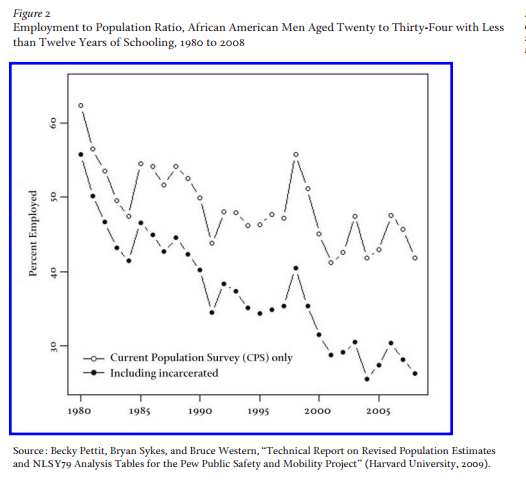
Some bloggers have caught on to that – the wage ratio is going up at the same pace as the incarceration rate for blacks. But they caught on after the work of scholars like Becky Pettit and Bruce Western came along (here and here and see graph below that illustrates the effect of correcting for incarceration on the employment rate of blacks).

pettit

When I look at this evidence, I understand why some people are pissed off at the conditions of Black Americans. It throws in doubt the contention that there has been racial convergence in America. At the same time, I wonder if the lack of recognition given to this statistical issue is a form of cognitive dissonance. If you claim that the convergence is mostly an artifice of composition fallacies, then what does it say about the policies of the last 30-40 years?

How I Helped Win World War Two

Below is an excerpt from my book I Used to Be French: an Immature Autobiography. You can buy it on amazon here.


All of a sudden, that road was flooded by a long column of trucks overflowing with big, loud, laughing men in distinctive uniforms. People were shouting greetings and waving flags. It seems that an American soldier jumped off his vehicle, swept me up into his arms and kissed me on both cheeks. That may have been because my mother, who had wanted her second child to be a daughter, processed my long blond hair into Goldilock-style ringlets. That I am straight today is a testimony to the resiliency of genetic programming. My mother always insisted the kissing soldier was black. On the one hand, she may have made up this detail for colorful effect. On the other hand, there were so many trucks the soldiers may have belonged to a transport unit and hence, probably to a black unit in the segregated Army of the day.

It was August 1944. I was two and my family lived in a (nice) city project right on the periphery of Paris, near one of its main access roads. One thing that bothers me about this visual and auditory recollection is that we lived on the east side of Paris. American soldiers should have been arriving from Normandy, in the west. Yet, the memory is clear.

Before the American forces reached Paris, my mother had sewn a makeshift tricolor French flag. The blue came from my father’s old military service flannel sash (a forgotten and now incomprehensible item of clothing). The red came from a Nazi flag my father had stolen from a German general’s car he was supposed to guard. (The Germans were packing up at the time and very nervous. He might have been shot on the spot if he had been caught.) At a loss for white, my mother made the center piece out of one of my diapers. That’s why I have always felt I played a part, although a small one, in the liberation of Paris, a symbolically important phase of WWII.

I was born and conceived during the Nazi Occupation of France when life was tough and entertainment scarce. My father was a Paris cop. His life was not so tough, however, that he did not have the energy to make my mother pregnant one more time before the Liberation, this time with twins. There was little to eat and milk was rationed so, my mother breastfed me for the longest time. I was precocious. At one point, I think I was able to ask for the breast in grammatically perfect French. It must have been embarrassing for her. Or perhaps I made this up on the basis of bits and pieces I picked up while I was growing up, like some of the other early recollections in these truncated memoirs. They stop at age 21 when I moved to the US for good. I made that choice because I think the second part of my life would be less  interesting to an American readership than the first, the preparatory phase, so to speak.

I  described above my first, full, cinematographic memory. From the days before the Liberation, I remember bit and pieces, like still photographs with some sound, glimpses of German uniforms and the vast, beautiful fire of the Paris general mills, a mile away, set by the US Army Air Corps. It’s a little known fact that the Allies bombed the hell out of France right before and during the Normandy landing. The French never complained much; they were different then, and too sick of the German presence to bitch about collateral damage. When the air raid siren sounded, my mother would wrap me up in a blanket and take me down to the basement of our seven-story apartment house. Some tenants were so jaded by then that they did not bother to take shelter. The basement was a crowded but not especially tragic place.

In spite of this dramatic, first, fully formed memory, nothing really important ever happened to me. I have escaped the Chinese curse, of “living in interesting times,” although I did live in fact in quite interesting times. I waltzed through the murderous second half of the twentieth century with hardly a scratch to show for it. All my life, I have been mostly fortunate. The undeserved lucky breaks more than made up for the few unjustified blows fate has dealt me. The luckiest break was my first coming to the US at eighteen, a prelude to immigration three years later. In this country, no one ever oppressed me successfully though a few tried.  Many gave me a push at just the right moment. Mine is a happy story. This makes it worth telling to the largely glum denizens of the twenty-first century.

I live in the sunny, warm climate I longed for as a child, near the sea I always loved, in a small town rich with the small pleasures I have always appreciated: a variety of movies, a good café in an interesting, animated downtown, several bookstores within easy reach, and young people everywhere. My wife is a talented painter whose work I enjoy so much I don’t ever like her to sell it. She has few obligations, and she has not had many for  quite a while. That’s what keeps her beautiful, I think. She is also an immigrant, from the other side of the world from me, yet we see eye-to-eye on most matters. Nevertheless, we each have our own house, feet apart, each gracious in its own way. Although, it’s in the center of town, our tiny plot contains an apple tree, a plum tree, two lemon trees, and a big fig tree. All bear fruits, especially the fig tree, a sort of miracle I never fully grasp, for reasons that will become clear below.

I am a retired university professor and scholar, fairly proud of my scholarship, happy to have been a professor and equally happy to not be one anymore. Most mornings, weather permitting (it permits often, here in California), after the gym and after coffee at Lulu’s, I am forced to decide whether I want to go sailing, or fishing, or just putter about my boat, or start one of my sometimes fairly good postcard paintings, or again, write a micro-story. Sometimes, I just simply spend the whole day reading, for no particular reason and to no particular purpose. I read much history but also almost anything anyone hands me. That would include a fair amount of trash. You guessed it: I am a satisfied lazy man.

The pages below tell the tale of the unlikely beginnings of the journey that brought me to my current state of beatific smugness.

On the trade off between the rule of law and lower taxes

The recent Carrier deal has caused some controversies in liberty-oriented circles. For example, The Mises Institute published a defense of the deal, arguing (along other lines, please read the article yourself):

there is nothing inherently wrong with an administration focused on keeping jobs in America — especially if this is accomplished by relieving tax and regulatory burdens.

The point I wish to make here is a general point, so I won’t go into the specifics of the Carrier deal. Among other reasons: I don’t know the specifics of the deal (I don’t know the content and I don’t know how the deal came to pass.) What I wish to do here is to argue the general case on how to view these kinds of tax exceptions.

The point we ought to remember, I think, is that there are a trade offs between two important liberal values, although they are important in different ways. On the one hand, we have the idea of rule of law, the idea that the law is general, not specific, applies to everyone rather than some, and that it’s not designed to favor some because it should serve an open-ended order. Things that contribute to such a legal order are ipso facto prima facie good, things that take away from such a legal order are ipso facto prima facie bad.

On the other hand we have the idea that taxes are bad. Things that lower taxes are prima facie good, things that increase taxes are prima facie bad.

But neither of these things trump all other considerations. Let me give you two examples.

  • Suppose there was a law that said that the taxes on, for example, business started by family members of politicians are automatically exempted from taxes. Would this be a good law?
  • Suppose there was a law that said that everyone has to be drafted and has to serve mandatory military service overseas, except the family members of politicians. Again: would this be a good law?

In both of these questions, the answer depends on the liberty-inspired framework you use to answer the question. If you think the value of the rule of law outweighs the value of individual liberty of those family members (who are, after all, not responsible for the actions of their political family members) than you think these are bad laws. If you think the increase in individual liberty for those family members is more important than the violation of a rule of law principle, than you think these are good laws. My point is not to say how one should determine this, my point is that there are two liberty-inspired frameworks that can justify an outcome, and both of these frameworks are relevant in determining what kind of laws we ought to support.

To make the issue slightly more applicable: is the increased damage on the rule of law (created by allowing a specific exception on the general laws on taxes) larger or smaller than the benefits that allow a company to have less taxes?

Some people have tried to argue by analogy – for example, comparing it to the draft. The problem is that analogies quickly run into the problem of changing the relative values of the two important concepts. For example: is it a good thing that women are exempted from the draft? Yes, this seems like obviously a good thing. Would it be a good thing that male children of politicians would be automatically exempted from the draft? This seems like less obviously a good thing.

Would it be a good thing if white people were automatically exempted from the draconian drug laws? Maybe it would, but maybe that also lowers the chance of getting rid of the drug laws altogether. Different margins matter in these kinds of evaluations.

The wrong thing to think is that all policies are pro tanto good just because they increase liberty on some margin for some people, especially if this allows for the prolonging of bad policies by the current ruling class. Some policies can be bad on some margins and good on others and reasonable people can disagree whether the complete net effect of this is good for all.

Maybe it’s a good thing that some people are exempted from evil laws (such as taxes), but it’s not good that the political class gets to choose who does so. Because those who will be exempted will be those who are connected to the political class. So one can absolutely like lower taxes, oppose politicians’ power to choose who is exempted and oppose that, and still be happy for a company that they got a tax cut. (Unless, of course, the company itself is evil. This is certainly possible if they are partners in, for example, the wars that the USA commits.)

So tl;dr. As I posted somewhere on facebook:

Rule of law and lower taxes are two good things. A president (or important person connected to the ruling class such as the president elect) getting to pick and choose winners isn’t desirable, but a tax break is. A higher tax isn’t desirable, but a rule of law is.

Trying to argue the case based on principle seems wrong. It depends on the margins. In the case of the draft, the margin *against* rule of law seems important enough to say it’s a clear victory for liberty to not have women included.

In the case of tax breaks, this is less obvious and reasonable people can come out on different sides of this, I think.

When Black Unemployment Rates Were Equal to White Unemployment Rates…

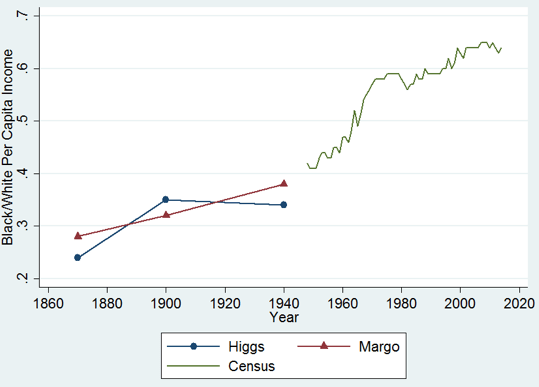
In a twitter-debate with Tariq Nasheed, I pointed out that the wages rates did converge between the 1940s and 1990s. Recently, Robert Margo of the University of Chicago extended this to per capita incomes since 1870. It is fascinating to see that there was convergence between 1870 and 1940 in spite of Jim Crow laws (it tells you how much more blacks could have achieved had the laws not existed – see notably the work of Bob Higgs on this).

income-convergece

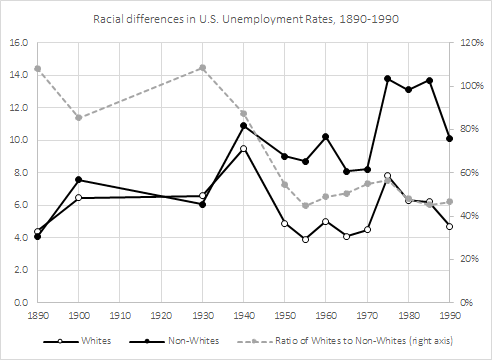
Each time I see this evidence, I am bemused. You see, I often debate colleagues on particular features of social policy in order to assess policy reforms or the effects of past reforms. But, its always good to take a step back and look at the long-view of history. It puts things in perspective. The Margo graph does just that. It tells me the story of what could have been. And just for the sake of remembering properly (infer whatever conclusions you like), it is worth showing racial differences in unemployment rates since 1890. What strikes me is how similar the rates are until the 1950s. What happened at that point? When you ask yourself this question, you’re forced to put everything in perspective. And it becomes harder to have “generic” answers in the lazy-form of “its racism”. Why would racism explain the difference after 1950, but not before?
whites

Maybe, just maybe, people like Tariq Nasheed should stop proving that H.L. Mencken was right in saying that “for every complex problem, there is an answer that is simple, clear and plainly wrong”.


Who needs a list of progressive professors?

Turning Point USA has a new list out of progressive professors. The list has already begun to be attacked as signaling the rise of a new era of McCarthyism where academics will be prosecuted for anti-American discourse.

I agree that the list should be attacked in so far that it tries to define what is acceptable discourse in academia. Academia should be a place where ideas, no matter how absurd or controversial, can be discussed and this list doesn’t help that goal.

There may be a limited place for safe places. Recently I’ve been willing to accept ‘safe places’ in those cases where individuals genuinely cannot handle certain ideas being discussed. There’s no point in, for example, attending the university’s Jewish student club and claiming that the Holocaust didn’t happen. There’s no point in going to a support meeting of transsexuals and claiming they’re going to hell. Etc etc. Emphasize on the limited though. I am willing to hold my tongue in support group settings, but that’s it.

That said the list, and the response to it, are funny in several ways.

Turning Point USA crafted the list to indicate professors who have been documented attacking conservatives. One professor barged into a Republican student and shouted profanity. I can see a point in the list if it listed only those professors who had a reputation for encouraging an environment of hostility – there is a different between being able to discuss radical ideas and yelling fire in a theater. I’m not so clear why Holocaust deniers are listed though. I don’t agree with such individuals, but if they only express the ideas I see no reason to avoid them. If Turning Point USA is serious about promoting a culture where conservative ideas can be freely discussed in academia it must be willing to protect the Holocaust deniers. Does Turning Point USA not realize the absurdity of trying to, on one hand, create a safe place for Judeo-Christian conservatives, and promoting the right of conservative ideas to be discussed in academia

What I find funny about progressives talking about the need for universities to tolerate their own ‘radical’ speech (what’s radical about wanting more government?), they themselves are intolerant to conservatives. Consider this: I’m a double minority – an illegal alien libertarian. Which of these two identities do you think is more cumbersome in academia?

After the election of Trump several members of the academic community assured me that I would be protected if need be. Yesterday the President of the University of California system released an op-ed defending the undocumented student community. Earlier today she announced that the UCs, including its police force, would refuse to cooperate with any deportation efforts.

In comparison as a libertarian I am often advised to keep quiet about my political views. At minimum I should try to avoid researching things that make it clear that I diverge from the rest of academia in political thought. Otherwise I will have a hard time getting my research published or be cut off from the social networks needed in the job market. On occasion I have found myself ostracized socially for voicing dissent on things like the minimum wage or affirmative action. I’m not alone in this.

In an ideal world I should be able to be an illegal alien, a Holocaust denier*, homosexual, and a devout Muslim** without feeling the need to suppress my view points. Academia should be a safe place for ideas no matter how radical.

Thoughts, comments?

*I’m not a Holocaust denier.
**I’m not a Muslim either.