This week’s episode of EconTalk was fantastic, and in particular drew an important parallel between the complexity of the human brain and the complexity of market economies. The guest was discussing radical nanotechnology (basically the idea that engineers could out do bacteria by applying good design principles in place of random mutation and natural selection), and Russ pointed out that the logic is basically the same as in Socialism. Radical nanotechnology runs into a fundamental problem as long as it ignores the emergent processes occurring at the molecular/cellular level.
Later, the guest discusses the issue of artificial intelligence and points out that the fundamental unit of biological computing is not the neuron (which we simulate on computers using neural networks), but the molecule. In other words, natural intelligence is the outcome of a complex process that isn’t simple enough for us to easily replicate on a computer.
All that in mind, the idea of socialism* is like the idea that we could replace a brain with a pocket calculator. Yes, the idea is to get a very powerful calculator, but the problem is that it’s replacing a computer that’s far more complex and sophisticated.
* i.e. Centralized control of the means of production… socialism has nothing to do with sharing (you’re thinking “Egalitarianism”) and everything to do with control, and particularly the attempt to rationalize complex systems.
Did you know that in 1987 the government of Morocco formally submitted an application to become a member of the European Union?
Brussels flatly rejected the application, arguing publicly that Morocco was not a European country and also that Morocco had a poor human rights record. This rejection marks one of the biggest mistakes that Brussels has ever made in its short-but-brilliant history (along with instituting a central bank).
Does anyone know of any scholarly literature showing that the admittance of authoritarian states to the EU or other federal-esque institutions will have the effect of liberalizing the political regimes of such states, as long as the republics admit these states one or two at a time? I did a blog post on it awhile back, but a blog post is not a peer-reviewed journal article.
The best counter-example of federalism-as-a-path-to-liberty that I can think of is the pre-Civil War US. The US federal system was made up, in part, of a number of authoritarian states that promoted and enforced chattel slavery. This example does not address the EU model, however, where Brussels admits neighboring poor states and a gradual liberalizing effect takes place.
In the US example, factions within the slave states benefited economically from the use of slaves, and this economic prosperity was tied up directly to the political institutions of the US. So, the US Senate had a number of pro-slavery representatives that not only made sure slavery could not be attacked politically, but also that the interests of slaveholders were advanced at the expense of the non-slaving states (and, of course, the slaves themselves). In other words, a powerful minority with interests very different from the general intent of the classical liberal framework of Madison’s constitution.
Once the number of free states became great enough to overcome the number of slave states in the Senate, a war became much more likely. It became more likely because the interests of the (illiberal) slaveholders were directly challenged by the numerical superiority of free state representatives in both houses.
In short, the pre-Civil War US was made up of two factions – one liberal and one illiberal – that were almost equal in power. The EU does not have to worry about this, though. It should be much bolder in admitting despotic, neighboring states into its apparatus. (The same goes for the US.) Imagine if Morocco had been admitted into the EU in 1987. There would likely be representatives in Brussels bitching about austerity instead of representatives of the King torturing and imprisoning Moroccan citizens for reasons unknown.
The notion of the person is constantly renegotiated and is at stake between groups situated within the same political entity as well as between neighboring political entities. With advent of [France’s colonial] district register and the resulting written registration of identity, the notion of a person acquired a greater fixity. It became much more difficult to change identity or even to modify the spelling of one’s first or last name. Since it could no longer affect the components of the person, the negotiation of identity shifted, as in the case of the West, onto other sectors of social and individual life. (135)
This is from the French anthropologist (and high school friend of our own Jacques Delacroix) Jean-Loup Amselle, in his book Mestizo Logics: Anthropology of Identity in Africa and Elsewhere. The book is hard to read. The English translation (the one I’m reading) was published by Stanford University Press in 1998, but the original French language version came out in 1990. Between the translation and the fact that the book was written for specialists in the field of political anthropology and the region of French Sudan, strenuous effort was required on my part to stay focused and motivated to finish the book. The preface alone is worth the price of admission, though, especially if you’ve been following my blogging with any great interest over the years.
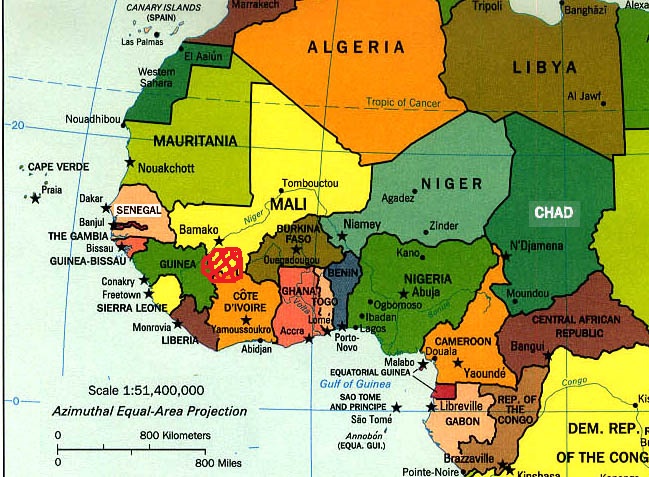
My intent is not to write a review, but rather to build off Amselle’s work and present some of my efforts in blog form here at NOL. But first, a map of the region, Wasolon, that Amselle specializes in:
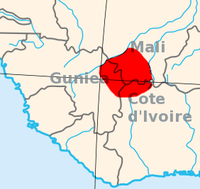
Wasolon is that big red marking that I’ve drawn on the map. You can see that it’s about as big as Sierra Leone. Just for clarity’s sake, here is a second map with a closer view of Wasolon:
Notice the rivers? source: wikipedia
Amselle’s argument for why his approach to identity is superior to others’ is convincing. He performed all of his fieldwork (15 years’ worth as of 1990) in Wasolon, or briefly in neighboring areas, reasoning that “research within numerous regions of a well-circumscribed area […] has allowed me to observe systems of transformation [in] societies that have been in contact for centuries. This has protected me from being forced into large analytical leaps and from engaging in [the current anthropological trends of] abstract comparativism and the identification of structures (xii-xiii).” This defense of his methodology, coupled with his insights on French colonial administration in the late 19th and early 20th centuries, gives me reason to believe that Amselle’s work is an excellent blueprint for better understanding the complete and utter failure of post-colonial states and the violence these collective failures have produced.
I want to take a specific route using the introductory quote, even though I could take a number of different routes using that passage. I could, for example, focus on the invention of the individual and muse about its consequences in regards to the rise of the West. I could go on and on about how other societies had writing – but not the individual- and therefore did not have the institutions necessary for “capitalism” that the West did around the 16th century. Et cetera, et cetera. Instead, I’m going to take a geopolitical route (the West is still practicing colonialism) that has a decidedly philosophical direction to it (nationalism and ethno-nationalism are both bullhooey).
First, the geopolitical context. Wasolon was basically a war zone in the 18th and 19th centuries. It was an important producer of cotton, a minor producer of rubber and ivory, and a net exporter of slaves. Wasolon was unfortunate enough to be caught between Saharan empires backed by Arabic culture, money, and technology, and coastal empires recently enriched through cultural, economic, and technological exchange with rapidly-expanding European populations. Caught between these two geographic poles, polities in Wasolon oscillated between being decentralized chiefdoms, small independent states, empire builders themselves, and vassals of empires. In such an uncertain setting, the identity of people themselves necessarily oscillated as often as their political systems did.
When the French arrived militarily on the scene (there was already a long history of economic, political, and cultural exchange between the “French” and Wasolonians; I put French in quotation marks because, of course, many Europeans found it to be much easier to use “French” as an identity in French Sudan rather than their own), Wasolon was home to many decentralized chiefdoms, and they were all in the midst of a protracted and brutal war with the Samori Empire, a Saharan polity that rose quickly and ruthlessly to prominence in the late 19th century.
The Samori Empire – which the French military was in contact with due to its centralized political structure (it had a bureaucracy and an organized military, for example) – claimed Wasolon as a vassal state and the French, out of ignorance or expediency (to attribute it to malice gives French central planners too much credit), simply took Samori at its word (a policy that continues to play out to this day in international affairs, but more on this below).
The French military commanders and, later, colonial administrators eventually figured out that Wasolon was not a loyal vassal. From the French perspective, the resisting chiefdoms in Wasolon had formed an alliance against the Samori Empire, and this alliance was based on an ethnic solidarity shared by all Fulani. Amselle labors to make the point that this alliance was based on a “mythical charter” long prominent in Fula oral traditions (and has some basis in the historical accounts of Arab and European travelers). This “mythical charter” served as the basis for the French colonial understanding of the Fula and eventually for the notion of a Fulani ethnic identity. The problem here is that the “mythical charter” was just that: a myth.
As we saw in Chap. 5, colonial ethnology merely reproduces this local political theory by taking it literally, thereby assimilating these “mythical charters” to a real historical process. Such a reproduction is what makes this ethnology truly colonial. (179)
In the Chapter 5 that Amselle alludes to in his footnotes, Mestizo Logics explains how the Fula people of Wasolon adopted fluid political identities over the centuries, depending on who was in power and who was about to be in power. This fluidity played, and continues to play, a much more important role in how people identified themselves politically (“local political theory”) than either culture or language.
Amselle illustrates this point best by pointing out that a number of chiefdoms in Wasolon claimed to be Fula at the time of the French conquests in the late 19th century, but that the populations spoke a different language than the Fula and were culturally distinct from the Fula (these Wasolon chiefdoms claiming Fulaniship were Banmana and Maninka in language and culture rather than Fula). Amselle then points out that Fula chiefdoms existed outside of Wasolon that don’t claim to be Fula – even though they are culturally and linguistically Fula – and instead identified as something more politically expedient (he doesn’t elaborate on what those non-Fula Fulani identify as, only that they did, and still do).
The French state’s act of writing down and categorizing this “mythical charter” as a distinct feature of Wasolon’s Fulani thus created the Fula ethnic group and, through imperial governance, ensconced this new group into its empire’s hierarchy based on traits that ethnographers, colonial administrators, historians, and managers of state-run corporations had recorded (accounts written by merchants not connected to the state in some way could not be trusted, of course).
Basically, when the French showed up to build their empire in west Africa they bought the narrative espoused by a couple of the factions in the region and based their empire (which was only feasible with the advent of peace in Europe after the Napoleonic Wars) on that narrative. The results of this policy are eye-opening. Aside from the fact that the present-day states of Mali, Cote d’Ivoire, and Guinea are failures, the old rules of fluid identity used by Wasolonians for political and economic reasons were erased and new rules, based on bureaucratic logic (“ethnicity”), were wrested into place by the French imperial apparatus. These new ethnic identities soon took on characteristics, ascribed to them by others, that quickly became stereotypes. The ethnic groups with good stereotypes (like being hard-working) ended up – you guessed it – in positions of power, first in France’s imperial apparatus and then for a short time after independence.
Sound familiar?
If it doesn’t, think about international governing institutions (IGOs) like the United Nations or the World Bank for a moment. Why don’t these institutions recognize the likes of Kurdistan, Baluchistan, or South Ossetia? Is it because these IGOs are evil and oppressive, or simply because these bureaucracies cannot adapt quickly enough to a world where identity and the necessities of political economies are always in flux?
This phenomenon is not limited to post-colonial Africa, either. Think about African-Americans here in the United States and the stereotypes attributed to them. Those stereotypes – good and bad – are a direct result of bureaucracy.
Individualism, to me, is the best way to tackle the long-standing problem created by colonial logic abroad, and racism at home. Government programs that seek to help groups by taking from one and giving to another are just an extension of the bureaucratic logic revealed by Amselle’s work in French West Africa. But what is a good way to go about implementing a more individualized world? Open borders?Federation?
Watch almost any anthropological film about a newly discovered “isolated tribe,” and you’re likely to see at least one “tribesman” wearing a t-shirt.
People in bands and tribes and chiefdoms — who have since time immemorial handled most of their economic transactions for food, clothing, and shelter through traditional economies of gift exchange and family sharing — eagerly become buyers and sellers for products on the global market as soon as they get the chance.
They grow coffee beans or trap furs, and they use the money to buy firearms, machetes, cell phones, and jean shorts. In other words, they jump right in to the market. And usually, the tendrils of global trade have arrived way before the anthropologists and their film crews.
But people in the same bands, tribes, or chiefdoms seem to hang on to their family and gift-based economies for political, military, and legal services.
They do not jump to create or hire market solutions (mercenaries, defense corporations), and they instead eventually transform — by hook or by crook — into a state or into a people subjugated by a state.
Why does this happen? Why do we get states for defense and markets for everything else?
Let me back up and explain my terms:
In the examples I’m familiar with, humans use one of four main methods to organize law enforcement and military protection:
1. Kin-based. Your extended family (a “band,” “clan,” or a “lineage”) and maybe an alliance of intermarried and neighbouring extended families (a “tribe” or a “village”), protects you. You are technically free to leave the family or the village, but that could leave you without protection unless you are marrying into a new one.
2. Prestige-based. A famous leader (a “big man” or “chief”) and his warriors protect you in return for material gifts and social deference. You can pull your support from the leader — more easily if he’s just an informal “big man” and less easily if he’s a formal “chief.” And there are usually other nearby leaders or aspiring leaders who would happily accept your patronage.
Systems #1 and #2 are often blended together, as in the Trobriander case, where each man’s connections to the chief are determined partly by family relatedness and partly by gift exchange.
3. State-based. A compulsory ruler (a “king” or “president”) and his warriors protect you in return for taxes and/or labor. You are never free to pull your support, although you are sometimes free to leave through emigration.
Examples: Aztec Empire, Canada, People’s Republic of China
4. Market-based. A private enterprise (a “defense contractor”) protects you in return for money. You are free to pull your support and choose another contractor, or go without.
Now, we could also sketch out the same 4 methods for the basic kinds of economic exchange people do for food, shelter, and all the other goods and services in life besides defense. People can give and receive the things they want and need through #1 family networks, #2 prestige-oriented gift exchange, #3 state redistribution, and #4 markets.
What I see throughout the world in the last 500 years is that as globalisation advances, people in all or almost all cultures eagerly take their systems of food, shelter, etc. out of systems #1 and #2 and go into system #4. In other words, people in bands, tribes, and chiefdoms all over the world desperately want the metal tools, firearms, t-shirts, cell-phones, and everything else that the market offers, and so they find ways to sell goods or services and thus money that lets them buy that stuff.
For instance, hunter-gatherers who once collected food to share with their family now collect furs to sell internationally, or instead serve as bush guides to wealthy tourists from foreign cultures.
But people almost never eagerly or rapidly take their law and defense systems out of kin and prestige and into markets.
Instead, they tend to hang on to kin or prestige-based methods of law enforcement and warfare until they (a) get conquered by a state or (b) organize themselves as a state (whether to fend off would-be conquerors or to become conquerors themselves).
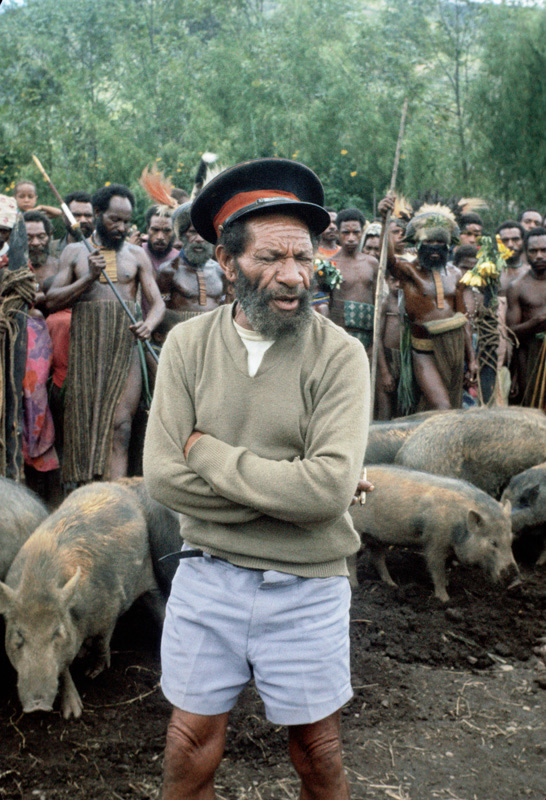
So in highland Papua New Guinea for instance, the Dani and the Kawelka were happy to grow coffee beans and other crops to put on the market by the 1970s. But they didn’t start hiring mercenaries for defense. Instead, they stuck to their big men and their tribes until their military organizations were absorbed into state militaries or turned into paramilitary movements aiming to create or seize control of a state.
Markets became the center of food production. States became the center of defense production.
Later on, after states have arrived as military organizations, sometimes they start expanding and controlling parts of the economics of food, shelter, education, etc., through compulsory redistribution.
Conversely, shifts to market-based defense seem to occur after a society has already had state-based defense — like in Moresnet or Kowloon (PDF). And the market organizations arise when, for some reason, the state-based defense system relaxes or collapses.
Why does this bifurcated trend keep happening?
Why do people in these societies transition into markets for most goods and services but states for law and war?
Do state-based militaries and police forces simply outcompete (or outfight) market ones?
Am I missing major counterexamples, or even misunderstanding my own examples?
News item: the Georgia governor has just vetoed a bill that would, among other things, have allowed ministers to decline to wed gay couples.
What a tangle. Let’s see if we can sort things out.
First of all, many decent people, your humble servant included, find the concept of “gay marriage” troubling. I believe any two adults (or three or more) should be free to make any contract they like regarding sharing assets, pledging fidelity, and so forth. I just wish they wouldn’t call it “marriage.” That term is taken.
Second, hate is not a crime. Some people express repugnance or hatred for homosexuality. Ayn Rand called the practice immoral, an attitude that is hard to fathom in this day and age but perhaps understandable given the tenor of her times. Some go farther and express hatred for homosexuals per se. But as long as these people refrain from initiating force or fraud, they should not be molested. Boycotts, shunning, and criticism are legitimate responses to such people, but forcible restraint is not.
Third, rights are not granted by governments. Rights derive from our basic nature as humans, as thinkers such as Ayn Rand and Murray Rothbard have so eloquently demonstrated. Contractual “rights” should have a different name, perhaps “privileges.” These are actions that have been legitimized by a voluntary agreement. Thus for example, no one has free speech “rights” on a campus. Students may have free speech “privileges” on a campus if the owners of the campus have granted that privilege in a written or implied contract.
Fourth, freedom of association is a basic human right, and includes freedom of dissociation, whether in personal or business relations. Some years ago I posted a defense of the late Lester Maddox who famously attempted to exclude blacks from his chicken restaurant. My post generated considerable blowback, but I stand by it and note that in this day and age, anyone who tried to exclude blacks would not be elected governor of Georgia as Maddox was, but instead lose most of his customers and close his doors.
In summary, no minister needs permission from the state to deny wedding services to a gay couple. And religion has nothing to do with it. Anyone should free to decline business or personal relationships with anyone, for any reason whatever, or for no reason at all.
John T. Flynn’s As We Go Marching was written in 1944, but there isn’t a line in this excerpt that doesn’t fit today’s situation perfectly. I read the book many years ago and will pull it out and read it again.
Fascism will come at the hands of perfectly authentic Americans who have been working to commit this country to the rule of the bureaucratic state; interfering in the affairs of the states and cities; taking part in the management of industry and finance and agriculture; assuming the role of great national banker and investor, borrowing billions every year and spending them on all sorts of projects through which such a government can paralyze opposition and command public support; marshaling great armies and navies at crushing costs to support the industry of war and preparation for war which will become our nation’s greatest industry; and adding to all this the most romantic adventures in global planning, regeneration, and domination, all to be done under the authority of a powerfully centralized government in which the executive will hold in effect all the powers, with Congress reduced to the role of a debating society.
HT: Jacob Hornberger, Future of Freedom Foundation
Sheng [Hong] uses the term in this broader sense, so that we can say that tianxia zhuyi is the idea of a global civilization that encompasses a diversity of cultures. In fact, this interpretation matches with the historical evolution of the Chinese empire, which was a multiethnic body politic based on certain universal civilizational principles and artifacts such as the Chinese script.
It is essential why Sheng makes that distinction. He claims that globalism, which he considers to be a Western term, is actually violating basic principles of economic liberalism in opting for trade liberalization but containing international migration.
That is from Carsten Herrmann-Pillath, a Professor of Business Economics at the Frankfurt School of Finance and Management, in a chapter titled “Smith, Confucius and the Rise of China.” The chapter is in Volume 8 of The Adam Smith Review, edited by Fonna Forman, which in turn was a gift from Edwin to me. There is no mention of Mises or Hayek (or NOL!) in the bibliography. Herrmann-Pillath continues:
So, globalism is a conceptual framework which still builds on the conception of the nation state and hence economic nationalism […] Ideas about the transition from the ‘nation state’ to a new political order based on culture and civilization continue to flourish among Chinese intellectuals until today. (88)
Unlike Chhay Lin and Matthew, I don’t know very much about ancient or medieval Chinese political thought, but I can buy Sheng’s argument. In fact, I’m surprised it has taken this long for scholars anywhere in the world to realize that certain schools of thought in an empire would be internationalist. What is more curious to me, though, is this “new political order based on culture and civilization.” Why not base it on the individual? It seems to me that basing political orders on hard-to-define terms like “culture” and “civilization” will only lead to major problems, such as cultural chauvinism, down the road.
It is always hard to start again from the vacuum, but I’ll try to do my best. Today we all survived another act of animal-like agression in Belgium. Our thoughts should be with ones who didn’t make it out alive and with their families. I still remember attacks in Volgograd in late 2013. What can I see now? While police and army trying to deal with situation, politicans make their loud announcements. Traditionally, weird things come from Ukraine: “There may be a trace of russians!”. I really try to understand, but I can’t. What should be in your head, that you let yourself to say such a nonsense?
Demonic face of Russia and russians – it’s like a stamp now, a cliche. When something happens somewhere – it’s our fault. Your kitty pooped on your new carpet? Just check under it! Probably there’s a russian flag forgotten, or Putin’s portrait. It’s hard to live and understand, that even if you a gardener or an engineer – you can read disturbing content about yourself when something happens, and it’s unacceptable. Why can’t we find a terrorists first, and then make a conclusions?
Why can’t we live and trust each other a priori. I know, that in some ways our politic decisions are wrong (from western position), but try to understand us too, as we trying to understand you.
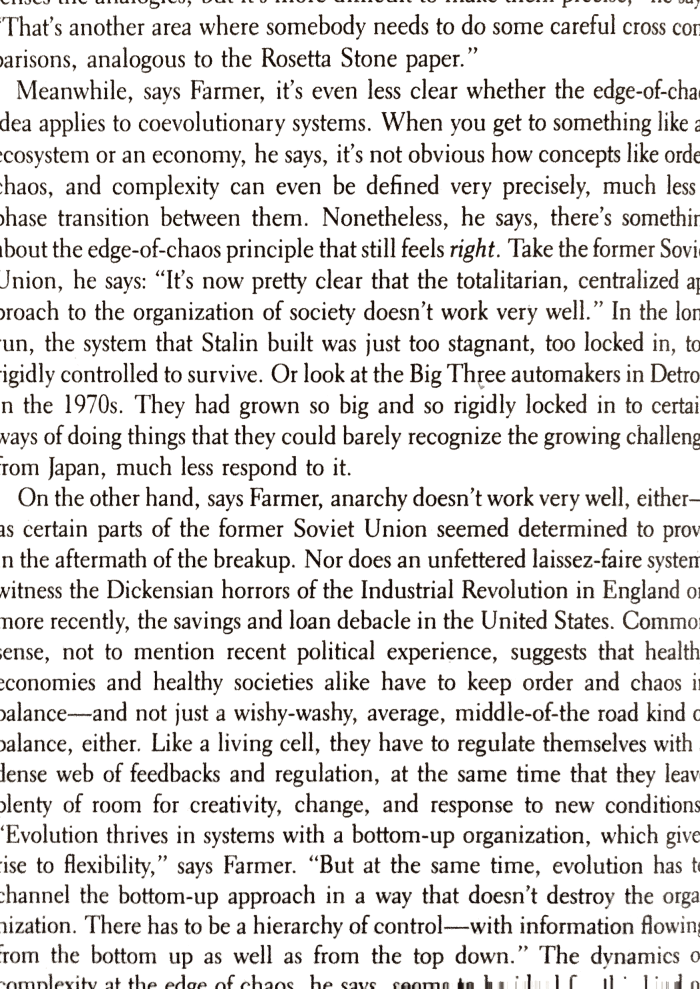
This book was written in 1993 so I’m pretty late to the show, but it’s worth raising the issue: complex systems require governance, but that need not mean government.
In the copy below the author is writing about how complex systems–systems with components that affect one another in simple ways resulting in emergent orders at the system-wide level–occupy an interesting space between chaos and order. Too much order and you end up with something fixed and unchanging. Too much chaos and you’ve got noise.
The second full paragraph misses an important point that should have been obvious to the author and the researchers who he’s paraphrasing. The government is an endogenous element in the wider economy. If we think of the economy as a network of people (individual nodes) who cluster into sub-networks (organizations), the government is just a collection of nodes and clusters that follow different rules than the rest. Granted, these clusters often serve important roles (e.g. courts). But the anarchist branches of economics have pretty clearly demonstrated that removing the state from these roles doesn’t always lead to chaos. Ripping the state out like a band-aid would be an awful idea, but gently scaling (scoping?) back the state need not be a disaster.
This band between chaos and order is wider than they’re giving it credit for. We can only examine this band from our own perspective… as human beings who are tiny components of this much larger network of networks. The range of configurations that could allow a peaceful, flourishing society is essentially infinite. Yes, governance is necessary, but strengthening any particular set of nodes cannot allow for governance of the system as a whole. It can only allow for governance of a sub-set of the wider network.
pp. 171-172 of Competition and Entrepreneurship has J.K. Galbraith asserting, “that independently determined consumer desires [do not] dictate the pattern of production. The ‘institutions of modern advertising and salesmanship…cannot be reconciled with the notion of independently determined desires, for their central function is to create desires–to bring into being wants that previously did not exist.'”
Beyond the obvious first step (recognizing that consumers’ desires could not possibly be determined independently of the market process), this raises an interesting hypothesis: Advertisers should a) recognize that they’re selling snake oil and consume significantly less than similar people, or b) be particularly excited about the prospects of new and exciting products generally. In either case advertising should affect them differently than regular consumers and they should consume a different amount than consumers generally. At the very least, their consumption patterns should be different from regular consumers in the particular goods that they are advertising.
The criticism of advertising as socially wasteful (i.e. using up resources without actually making consumers better off) may hold up if evidence is found in support of the above hypothesis. In the case of pattern ‘a)’ it may be clear that advertising is manipulative and anti-social. But in the case of pattern ‘b)’ or the null (advertisers buy the same junk as the rest of us) we either have to abandon the criticism of advertising or come up with some ad hoc story about how everyone is stupid and their preferences shouldn’t matter.
I have a new paper that has just been published in Asian Affairs. Here is an excerpt:
Questions over the India-China border are not a new phenomenon. They are asked whenever there is a Sino-Indian state visit. Despite having close to $100 billion of trade between them, China and India have failed to bring their frontier disputes to an end. In the 1980s and 1990s it was thought that the increasing economic cooperation between the two countries would act as a prompt to resolve their political disputes, but it has not. Military stand-offs and confrontations between border guards from India and China occur at regular intervals. To address their boundary disputes, they have engaged in frequent dialogues (17 rounds of focused dialogues can be counted between 1988 and 2015), but nothing substantive has yet been yielded through such engagements.
The boundary disputes between India and China have their ultimate origin in the ‘Great Game’ played during the British Empire. At present, the two main areas of dispute along the Himalayan frontier are the western sector (Aksai Chin around 37,250 sq km/14,380 square miles) and the eastern sector (Arunachal Pradesh, around 83,740 sq km/32,330 sq mile). This article traces the roots of the boundary disputes between India and China and attempts to discuss sources of tensions and probable solutions.
The link to the whole paper can be found here [pdf].
I am currently writing a piece with Pierre Desrochers (University of Toronto at Mississauga) regarding environmental trends and economic theory for the conference of the Association for Private Economic Education (see here). In the process of writing up the first draft of the article, I had to revisit another article I wrote (with Desrochers) and I found a passage which now offers me a greater value than when I initially wrote it. In that piece, me and Desrochers basically argued that rising prices for certain environmental goods may not always indicate rising scarcity. In fact, we argued that prices could increase even if a resource grew in abundance. Here is the passage from our article currently undergoing revise and resubmit:
Thirdly, technological innovations that increase productivity might drive up the price of a commodity without this truly reflecting the scarcity of the resource. Whale oil is a case in point. The decline of the whaling industry in the United States began around 1850 at which point real prices began to increase (Bardi 2007). However, economic historians agree that this was not because of resource depletion or overfishing (Davis, Gallman and Hutchins 1988). Brook Kaiser (2013) thus found that the increasing demand for illuminants created pressures on prices, which in turn motivated the development of substitutes like petroleum-derived kerosene. However, whale bone and oil prices did not fall as kerosene production expanded and, in spite of falling demand, prices stayed high and even increased. The answer to this conundrum is opportunity cost as the important surge in American labor productivity was greater than the observed increase in productivity in the whaling industry. This meant that the opportunity cost of using workers, capital and other resources in the whaling industry was great. These workers, capital goods and other resources were progressively reallocated to other industries. In the process, the whaling industry faced higher costs relative to productivity. While marginal players in the whaling industry exited, the supply of inputs to the whaling industry decreased and prices had to be increased [by the remaining firms in order for economy-wide equilibrium to be achieved]. Hence, prices in that situation are not reflective of depletion or expansion of resource stock.
I wanted to write something on this, but Selgin got there faster. Indeed, the historical evidence of free banking in Canada, Scotland, Sweden and the limited experiences observed in France and elsewhere provide a strong backing for soundness of private money. Selgin is right to emphasize this.
However, I can provide a small piece of evidence to support his case. It is not only scholars like Selgin who believe that the historical experience of Scotland was positive. As far back as 1835 and as far away as Canada, the robustness of the Scottish free banking experience was lauded. Consider the following quote from a report to the House of Assembly of Upper Canada (modern day Ontario):
“In Scotland, private banking has long existed and fewer failures have occurred there than in any other part of the world; their Joint Stock Banking Companies embrace some of the following principles by which the public are quite secured and the institutions useful as Banks of Deposit and circulation, while the stock is above par, and proved to be a good investment”
This report was actually presented in Canada arguing that Scottish free banking was a solution to a longstanding problem in the colony : dearth of small denominations. The “big problem of small change” was a real issue in the colony and created important frictions. The problem was most likely created by the fixing of exchange rates between the different currencies at levels dissonant with the actual value of different currencies so that “bad money drove out good money” (see Angela Redish’s work). The report recommended legislative actions to encourage the formation of banks that would issue private notes to solve this problem. Newspapers in the neighboring colony of Lower Canada also praised (in the early 1830s) the role that banks played in easing the problem of “poor money”.
I have made an initial foray on this with Mathieu Bédard of Aix-Marseille School of Economics (and we plan to make another few) and showed that the role of free banking in improving economic growth was considerable exactly because of the issue of private money. While Canada is a small, it provides some additional support to the claim that private money can indeed exist, survive and be superior to state money.
Source: House of Assembly of Upper Canada. 1835. Report of the Select Committee to which was referred the subject of The Currency. Toronto : M.Reynolds Printer.
P.S. Below there is a picture of a half-penny issued by the Quebec Bank in 1837 showing that there was even private coinage in Canada.
Here is an interview a colleague of mine did with me last month regarding my summer trips, which somewhat are connected by a same thematic thread – on how I stumbled upon incidents of big and small nationalisms. It appeared in our obscure university newsletter with an open access. An excerpt:
When I left Estonia and arrived in St. Petersburg, which is in northern Russia, the first thing I saw, when coming out of the airport, was a large posh car that was passing me. Its windshield was decorated with an orange and black “St. George ribbon”; this ribbon (a symbol of the patron saint of the Russian military) is currently a badge of patriotism for millions of my former compatriots. The back of the car sported big letters in blue: “Onward to Berlin! I honor WWII vets.” The irony of the situation was that the car driven by that well-to-do patriot was a German Mercedes! By the way, the topic of World War II is a “sacred cow” in Russia. From the Soviet times to the present, the government and conservative elements have been constantly bombarding people with two pieces of propaganda. First, they have being arguing that the Soviet Union/Russia had singlehandedly saved the world from fascism. For this reason, the whole world owes them everything. Second, since the country lost in that war more people than any other country, Russians suffered more than anybody else and, again, for this reason, the world owes them. Many people internalized this mythology.

 Notes On Liberty