NGDP, NGO and total expenditures

I did not think that my post on NGO versus NGDP would gather attention, but it did (so, I am happy). Nick Rowe of Carleton University and the (always relevant) blog Worthwhile Canadian Initiative responded to my post with the following post (I was very happy to see a comment by Matt Rognlie in there).

Like Mr. Rowe, I prefer to speak about trade cycles as well. I do not know how the shift from “transactions” to “output” occurred, but I do know that as semantic as some may see it, it is crucial. While a transaction is about selling a unit of output, the way we measure output does not mean that we focus on all transactions.  I became aware of this when reading Leland Yeager (just after reading about the adventures on Lucas’ Islands). However, Nick (if I may use first names) expresses this a thousand times better than I did in my initial post. When there is a shift of the demand for money, this will affect all transactions, not only those on final goods. Thus, my first point: gross domestic product is not necessarily the best for monetary transaction.

In fact, as an economist who decided to spend his life doing economic history, I do not like gross domestic product for measuring living standards as well (I’ll do a post on this when I get my ideas on secular stagnation better organized). Its just the “least terrible tool”. However, is it the “least terrible” for monetary policy guidance?

My answer is “no” and thus my proposition to shift to gross output or a measure of “total spending”. Now, for the purposes of discussion, let’s see what the “ideal” statistic for “total spending” would be. To illustrate this, let’s take the case of a change in the supply of money (I would prefer using a case with the demand for money, but for blogging purposes, its easier to go with supply)

Now unless there is a helicopter drop*, changes in the money supply generate changes in relative prices and thus the pattern (and level) of production changes too. Where this occurs depends on the entry point of the increased stock of money. The entry point could be in sectors producing intermediary goods or it could closer to the final point of sale. The closer it is to the point of sale, the better NGDP becomes as a measure of total spending. The further it is, the more NGDP wavers in its efficiency at any given time. This is because, in the long-run, NGDP should follow the same trend at any measure of total spending but it would not do so in the very short-run. If monetary policy (or sometimes regulatory changes affecting bank behavior “cough Dodd-Frank cough”) causes an increase in the production of intermediary goods, the movements the perfect measure of total spending would be temporarily divorced from the movements of NGDP. As a result, we need something that captures all transaction. And in a way, we do have such a statistic: input-output tables. Developed by the vastly underrated (and still misunderstood in my opinion) Wassily Leontief, input-output tables are the basis of any measurement of national income you will see out there. Basically, they are matrixes of all “trades” (inputs and outputs) between industries. What this means is that input-output tables are tables of all transactions. That would be the ideal measure of total spending.  Sadly, these tables are not produced regularly (in Canada, I believe there are produced every five years). Their utility would be amazing: not only would we capture all spending (which is the goal of a NGDP target), but we could capture the transmission mechanism of monetary policy and see how certain monetary decisions could be affecting relative prices.** If input-output tables could be produced on a quarterly-basis, it would be the amazing (but mind-bogglingly complex for statistical agencies).

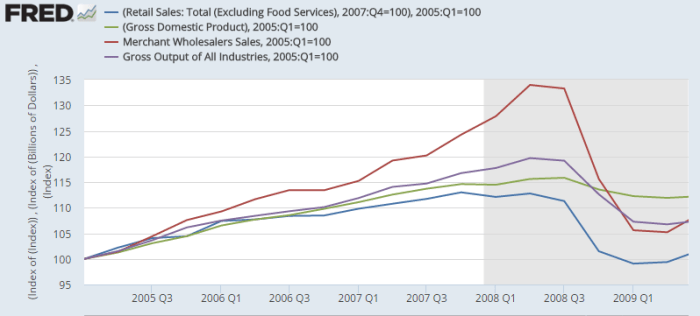
The closest thing, at present, to this ideal measure is gross output. It is the only quarterly statistic of gross output (one way to calculate total spending) that exists out there. The closest things are annual datasets. Yet, even gross output is incomplete as a measure of total spending. It does not include wholesale distributors (well, only a part of their activities through value-added). This post from the Cobden Centre in England details an example of this. Mark Skousen in the Journal of Private Enterprise published a piece detailing other statistics that could serve as proxies for “total spending”. One of those is Gross Domestic Expenditures and it is the closest thing to the ideal we would get. Basically, he adds wholesale and retail sales together.  He also looks at business receipts from the IRS to see if it conforms (the intuition being that all sales should imitate receipts claimed by businesses). His measure of domestic expenditure is somewhat incomplete for my eyes and further research would be needed. But there is something to be said for Skousen’s point: total nominal spending did drop massively during the recession (see the fall of wholesale, gross output and retail) while NGDP barely moved while, before the recession, total nominal spending did increase much faster than NGDP.
NGONGDP1

In all cases, I think that it is fair to divide my claim into three parts: a) business cycles are about the deviation from trends in total volume of trades/transactions, thus the core variable of interest is nominal expenditures b) NGDP is not a measure of total nominal spending whose targeting the market monetarist crowd aims to follow; c) since we care about total nominal spending, what we should have is an IO table … every month and d) the imperfect statistics for total spending show that the case made that central banks fueled spending above trend and then failed to compensate in 2008-2009 seems plausible.

Overall, I think that the case for A, B and C are strong, but D is weak…
* I dislike the helicopter drop analogy. Money is never introduced in an equal fashion leading to a uniform price increase. It is always introduced through a certain number of entry points which distort relative prices and then the pattern of trade (which is why there is a positive short-term relation between real output and money supply). The helicopter drop analogy is only useful for explaining the nominal/real dichotomy for introductory macro classes.
** Funny observation here: if I am correct, this means that Hayek’s comments about the structure of production would have been answered by using Leontief’s input-output table. Indeed, the Austrians and Neoclassicals of the RBC school after them have long held that monetary policy’s real effects are seen through changes in the structure of production (in the Austrian jargon) or by inciting more long-term projects to be undertaken creating the “time to build” problem (in the RBC jargon). Regardless of which one you end up believing (I confess to a mixed bag of RBC/Austrian views with a slight penchant to walk towards Rochester), both can be answered by using input-output tables. The irony is that Hayek actually debated “planning” in the 1970s and castigated Leontief for his planning views. Although I am partial (totally) to Hayek’s view on planning, it is funny that the best tool (in my opinion) in support of Hayek is produced by an intellectual adversary

South Asia and the Glass Ceiling

That is the broad topic of my latest article (pdf), which was just published by Pakistan Journal of Women’s Studies: Alam-e-Niswan. Here is the abstract:

South Asia is one of the most violent societies in the world, and also the most patriarchal. Both characteristics have led to continuity of violence, in which women are the silent and non-recognised victims. The situation is such despite the fact that women have occupied the highest office in their respective countries. The post-1991 wave of globalisation has led to the emergence of two parallel societies, based on different values, in almost all South Asian countries. In both societies women are being exploited and violence has been unleashed on them. Revolution in information and communication technology has helped in the dissemination of patriarchal values through ‘objectification’ of women in the name of ‘liberation’ from the grip of tradition. These patriarchal trends are clearly reflected in the making of domestic policies as well as formulating foreign policies of South Asian states. In such a situation, an academic argument for feminist foreign policy is relevant, though not encouraged by social actors.

You can also find the article on my ‘About…‘ page here at NOL.

Giving Up On The Masses

In 2012, during Ron Paul’s second presidential candidacy as a Republican, I felt deflated with the masses again. Again, the masses were not going to vote a libertarian into office. It was the same year in which I read Murray Rothbard’s Ethics of Liberty and Hans-Hermann Hoppe’s Democracy: The God That Failed. What struck me at that time was the realization that democracy is actually an extremely poor political system to make society become more libertarian. Democracy is not even a guarantee whatsoever for political and economic freedoms. Its success is dependent on the uprightness of the masses, but where are the masses to stand up against war, bank bailouts, taxation, police aggression etc? If the government is truly a gang of thieves and murderers, as I believe it is, then the voting masses are advocates of theft, harassment, assault, and murder.

I do not believe that the masses are ready for freedom, because freedom means taking responsibility for one’s life and actions – a frightening prospect for the masses who lack the strength to face insecurities in life. Ingrained with fear of their own and their neighbours’ incapability to live a ‘responsible’ life, they are attracted to masters who can arrange their lives for them. The masses have also never thirsted for truth. Whoever can supply them with illusions is easily their master, and whoever attempts to destroy their illusions is always their victim. They want to be comfortable and cuddled to death. Thinking is too much hassle for the mass-man. The masses have moreover a love for egalitarianism and a disdain for those who are different, who are more successful and more beautiful. They hate freedom, because in freedom man naturally maintains his distance from his fellow human beings.

Being discontent with the masses and deflated in my philosophical views on politics and economics, I took Peter Thiel’s following dictum to heart: “The masses have given up on unregulated capitalism, so those who still support unregulated capitalism should give up on the masses.” Instead, I have put my hope on such technological advances of decentralization as cryptocurrencies, seasteading, 3D-printing, and localized energy conservation and production.

Don’t target NGDP, target NGO!

Before I start blogging at Notes on Liberty, I just want to say how happy I am to join this collaborative venture. I generally blog in French at the Journal de Montréal and my English writings are confined to my academic papers. Hence, I am very happy to communicate with English audiences.

Actually, this is an opportunity to write about NGDP targeting. In the anglosphere, this rule-based approach to monetary policy has been very popular. In the french world where I evolve, it is close to a fringe point of view (given a strong Old Keynesian/New Keynesian viewpoint). As a result, any effort to expand on the issue requires that the issue first be raised. Hence, I have avoided discussing monetary policy in my French writings. But there is a point that needs to be made about NGDP targeting as advanced by people like Scott Sumner, George Selgin, the late Bill Niskanen, Marcus Nunes, Benjamin Cole, David Beckworth, Lars Christensen and David Glasner : the idea of targeting nominal spending (me switching from the term NGDP to “nominal spending” is important) does not mean that we ought to target nominal gross domestic product.

The intuition behind NGDP target is that monetary policy should be aimed at reacting to changes in demand for money. Thinking of the equation of exchange (MV=PY), a change in V should be matched by an opposite change in M so that MV remains stable. Any increases in Y(output)should be met by reductions in P(rices) and no changes in MV. In practice, NGDP targeting is about avoiding deviations from long-term trends in NGDP. However, while the equation is often presented as MV=PY, the original papers by Irving Fisher and others present it as MV=PT where Y (output) is substituted by T (transactions).

But is PT the same as NGDP? At any point in time, total spending in the economy is much greater than the sum of final goods. There are intermediate goods which are being produced – intangible capital, capital inputs and producers goods.  NGDP avoids calculating these because it would lead to double-counting. Work by Austrian-friendly scholars like Mark Skousen proposes that the double-counting is actually a strength in certain cases. This is because the double-counting gives greater weight to production.  Skousen calls it “Gross Output”(GO) and he finds that GDP is generally a fraction of GO (at 53% in 1982).

Now, GDP is best for measuring welfare in the long-run. However, for short-run discussion, nominal GDP is not (at all) the sum of nominal spending. Imagine an easy monetary policy which incites firms to produce more, there might be a lag between the increased production and “arrival on shelves” for consumers to buy.  This occurs as firms acquire new producer goods and/or gear themselves to producing goods for other producers. This means that in the short-run, the ratio of NGO to NGDP (nominal Gross Output) could vary. Easy monetary policy could make NGO grow faster than NGDP.

In a way, I am saying that NGDP is while the equation of exchange should be about all transactions (T in the original Irving Fisher papers) and transactions is best represented by NGO. As a result, NGO is a better proxy for trends of nominal spending. Let’s make a first test of this (and I hope this gets the ball rolling) by looking at the data.

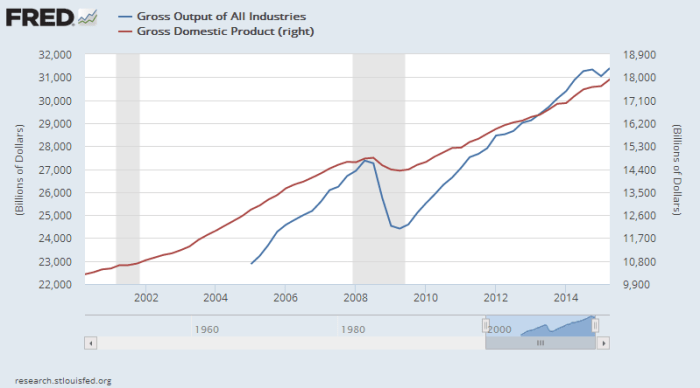
The NGDP crowd claims that prior to 2008, monetary policy was easy, allowing NGDP to grow above trend. Tight monetary policy during 2008-2009 led to a significant drop below trend which was the cause of the recession. With NGO (gross domestic output for all industries as presented by St-Louis Fed), we see the same story but much more clearly!

NGONGDP

From 2005 (when the data start for NGO) to 2008, NGO grows much more rapidly that NGDP (the ratio actually increases to 2008) and then it falls dramatically in 2008-2009 and barely recovers to remain stable thereafter. However, the drop from 2008-2009 is much more pronounced than that for NGDP. This suggests that “overall” nominal spending did fall more than NGDP suggests.

If monetary policy should shift to targeting nominal spending, NGDP is not the best indicator – NGO is.

Natural Rights and Taxation

A moral right is a correlative or flip side of a moral wrong. The right to have X means that it is morally wrong or evil to deny the holder from having X by stealing or destroying it. The right to do X means it is evil for others to forcibly prevent a person from doing X.

People have the natural right to do anything that does not coercively harm others, and the natural right to be free from coercive harm. Natural rights are based on natural moral law, as expressed by the universal ethic. By the universal ethic, all acts, and only those acts, which coercively harm others are evil. I and others have written on natural moral law, easily searched on the Internet.

A legal privilege is a special power or income granted to particular people because of their political status. A king is privileged because of his inheritance and laws regarding this. A slave owner is privileged to own another human being. There are no privileges in natural moral law, since one of the premises from which the universal ethic is derived is human moral equality, an equality of moral worth, implemented as equality before the law and equal legal rights.

In the Constitution of the United States, the 9th Amendment states, in its entirety, “The enumeration in the Constitution, of certain rights, shall not be construed to deny or disparage others retained by the people.” The other rights are common-law and natural rights. Therefore the U.S. Constitution recognizes natural rights, and all laws in the USA should be consistent with the 9th Amendment, although in practice, the 9th is ignored and not widely understood.

This brings us to two court cases. In Murdock v. Pennsylvania, 319 U.S. 105 (1943), the Supreme Court stated that a law requiring solicitors to purchase a license was an unconstitutional tax on the Jehovah’s Witnesses’ right to freely exercise their religion. The Court ruled that “The state cannot and does not have the power to license, nor tax, a Right guaranteed to the people,” and “No state shall convert a liberty into a license, and charge a fee therefore.”

In another case, the Court ruled similarly, that “If the State converts a right (liberty) into a privilege, the citizen can ignore the license and fee and engage in the right (liberty) with impunity.” (Shuttlesworth v. City of Birmingham, Alabama, 373 U.S. 262).

The principles behind the statements of the Court have to apply generally. The federal and state governments may tax privileges, but may not tax a natural right. Since people have a natural right to engage in labor for wages, taxes on wages violate natural rights and therefore the Constitutional rights recognized by the 9th Amendment. Taxes on trade and goods also violate natural rights, which is why state laws claim, incorrectly, that, when they impose a sales tax, they are taxing the privilege of selling goods. (For example, it is written that “California assesses a sales tax on sellers for the privilege of doing business in California.”)

If natural rights are violated by taxing wages, the same applies to the products of labor and the income from the products. Thus a person has the natural right to fully keep and trade produced goods and the financial counterparts as shares of companies and their incomes.

The U.S. Constitution does provide government with the power to tax. Article I, Section 8, states, “The Congress shall have power to lay and collect taxes, duties, imposts and excises.” The 16th Amendment restricts the income tax to being levied as an indirect tax, but otherwise did not alter or add to the powers of Article I.

There is an apparent contradiction. Article I empowers government to tax imports and goods, and other taxes, but the 9th Amendment prohibits taxing acts which are natural rights.

Clearly the founders did not oppose taxing as such. But the letter and spirit of the law have to go beyond the intents of the founders. The Constitution also did not explicitly outlaw slavery, despite its recognition of preexisting rights. When slavery was later abolished, this was in accord with justice as prescribed by natural moral law and the 9th.

If a parent says to a child, you may go outside and play, and also says, do not throw rocks at the squirrels, the permission to play does not imply that anything goes. Thus when the Constitution authorizes taxes, but then, in an Amendment, says, by implication as recognized by the Supreme Court, that government may not tax a right, then the power of taxation has been constrained.

The U.S. Constitution creates an imposed but limited government, and the founders recognized the need for revenues. The sources of government revenue boil down to two original sources: labor and land. There is human exertion, and there is what nature provides.

Since human exertion and its gains are a natural right, the only source left is nature’s resources, land. Thus the moral question is whether the ownership of land is a natural right. This issue is, of course, much disputed. In my judgment, the moral law of property is, “To the creator belongs the creation, and where there is no creator, the benefits belong to the people in equal shares.” The universal ethic is based on the premise, from the nature of humans being, as John Locke wrote, “all equal and independent,” the independence being that thinking and feeling occur individually.

The benefits of land are measured as its economic rent. Therefore, the rent belongs to the people, and by natural moral law, the individual right of the possession of land is conditional on paying the rent to the rightful owners, the people. A tax on land rent does not violate the natural rights of the title holder.

Although the rent really belongs to the people and not to an imposed government, since government is already an imposition, it violates natural rights the least when rent is used for public revenues to pay for public goods that generally benefit the people. The people receive the rent in kind rather than in cash.

If consistently implemented, the 9th Amendment, backed up by the Murdock case, implies that the income tax as well as excise taxes should not tax the right of labor and trade. The greatest challenge of humanity is to recognize the full spectrum of human natural moral rights.

—————————————————

A similar article by me appears in progress.org as “Rights and Privileges”.

BC’s weekend reads

  1. The Criminalization of Curiosity
  2. Britain needs Christianity – just ask Alan Partridge
  3. Libertarians have nowhere to turn
  4. In light of ongoing events in Poland, this October piece by Dr Stocker here at NOL is worth reading again
  5. The West in the Arab world, between ennui and ecstasy

From the Comments: What is a “National Interest”? (Why not federalism?)

Michelangelo writes:

I sympathize with your pro-federation views, but it is admittedly a difficult position to argue from a purist libertarian view. I would support offering statehood to Japan and South Korea, as I mentioned earlier this week.* I would not however offer the same deal to Ukraine or the Baltic states. If pressed why I would be okay with federation with one group of countries but not another is because I consider the Ukraine/Baltic region to have little value to American interests. I can see Japan/South Korea federation helping economic growth and military might to the US and therefore in our interests. Note my use of plural pronouns.

From a purely libertarian basis what regions would you offer federation with? Or, if you’d offer federation to all of them, which regions would you offer federation with first? Taiwan might entertain an offer to join the federation tomorrow, but I suspect the PRC or Russia wouldn’t.

*I imagine they’d join as multiple states in practice. I wouldn’t offer Japan 114 seats in the senate, but I would entertain giving them 10 senators.

Why only ten? Michelangelo’s quibble about the number senators can illustrate why federation is more libertarian than isolationism (I’ll get to his question in just a minute).

The Japanese would never accept any sort of union where they give up some sovereignty for other benefits and only have ten representatives in the senate. That wouldn’t be a bargain for the Japanese; it’d be highway robbery. The key conceptual point to keep in mind in this scenario is that there are two sides bargaining and cooperating with each other in order to arrive at a mutually beneficial deal. Japan and the US cease to exist as sovereign political units but become more secure militarily, economically, and politically through a federation with each other.

Contrast this view with what, say, isolationists such as Doug Bandow or Daniel McAdams argue; they want much less cooperation and, by implication, much less choice. Cooperation would be limited to negotiating trade details, arming factions, and coordinating responses to natural disasters. This is radically different from the status quo, but not in a beneficial way. Think of all the things isolationism and the status quo exclude from their policies. People in Japan and the US are overwhelmingly in favor of a continued US presence in Japan. The reasons for this are clear, but as it stands the Japanese are taking the US for a ride. Isolationist arguments are arguably worse, as they’d remove US troops (angering vast swathes of both societies in the process), which would put Japan in a position to fend for itself. Isolationism is “doing something,” and it’s doing something uncooperative.

I agree wholeheartedly with mainstream libertarians about the unfair nature of the status quo. I just think their proposals are equally unfair (if not worse). A libertarian position should emphasize cooperation, choice, and trade-offs above all else. The current stable of libertarian foreign policy experts don’t do this, despite their pertinent critiques of the status quo.

Now, before I get to Michelangelo’s question of who (I promise it’s coming), I want to spend a little time on his proposal for 10 senators, and tie it into the concept of “national interest,” which is a fuzzy concept and hence popular to wield in public discourse.

What is the national interest (or US interest)?

Think it through and write down your answer on a piece of scratch paper you have lying around.

Go ahead. I’ll wait patiently.

Is your answer really the national interest, though? Why is your definition of the national interest true and Walter Russell Mead’s not? Here is how I defined the concept of a national interest back in 2014:

…the national interest is an excuse [scholars and activists use] for a policy or set of policies that [they believe] should be taken in order to strengthen a state and its citizens (but not necessarily strengthen a state relative to other states…)

Now go back and look at what you wrote down as “the national interest.” Am I right or am I right? There’s no such thing as a national interest. Cooperation, choice, and trade-offs do exist, though, and I think they can walk us through a hypothetical federation between Japan and the US.

Michelangelo rightly decries the fact that Japan, a country with 126 million people in it (California has 40 million) should get 114 senators. Yet 10 senators seems far too few to give up sovereignty for federation. This appears to be a stubborn impasse, right? Wrong! One of the great benefits of cooperation is having to learn new things.

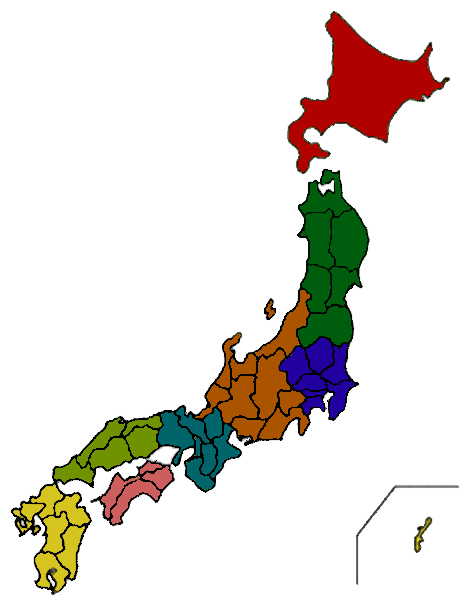
The 47+ prefectures of Japan, for example, have been in use since 1888. The prefectures had steadily been declining in number as the Meiji oligarchy began in earnest to nation-build in what is now Japan. Up until the surrender of Japan to the US, these prefectures were not representative and had little say in how each prefect was to be governed. MacArthur’s constitution gave these 47+ prefectures some autonomy in 1947, but recent attempts at reforming the administrative units of Japan have called for the abolition of these prefectures in favor of fewer administrative units that will also have much more independence from Tokyo. The policymakers who want to take this track are not creating these fewer administrative units out of thin air, either. Rather, reformists are calling for representative units to be based on the unofficial cultural areas of the country that have been around for centuries. Check out the map:

This map shows nine regions, but some people argue that there are actually 13-14 cultural regions within the country (a tough problem to have!). source: wikipedia
This map shows eight cultural areas, but some people argue that there are actually 12-14 cultural regions within the country. source: wikipedia

A cooperative approach to tackling free-riding and imperial expenses would be to reach out to the factions that want fewer administrative states with more autonomy. Adding anywhere from 8 to 14 administrative units into the Madisionian system is much more doable than, say, trying to incorporate 47 administrative units, especially since the latter units have little experience with the autonomous governance that federalism requires of its “states.” At most, there would be 28 additional members of the Senate. The costs associated with free-riding would be gone, and the Japanese people would get the benefits of being a part of the most powerful military the world has ever seen.

Would 28 Senate seats be enough to give up sovereignty? I don’t know, but I do know that the status quo is unsustainable and so, too, are current alternatives.

To finally answer Michelangelo’s question (“From a purely libertarian basis what regions would you offer federation with? Or, if you’d offer federation to all of them, which regions would you offer federation with first?”), I’d start with the Canadian provinces and Mexican states (though I would make it clear that any region is welcome to apply for membership). Then I’d approach the Caribbean islands, the administrative units in Western Europe (including the Baltic states but excluding Ukraine), and the administrative units in Japan and South Korea. Good neighbors and military allies.

My reasoning behind this approach is simply that 1) most of these regions are almost as rich as the United States, 2) they have a good history of actually being representative of their constituents, 3) they have a long history of either interacting with the Madisonian system or acknowledging its tremendous benefits, and 4) they have experience with being somewhat autonomous in a federal system (a federal system that is much less liberal than the one found in the US, but a federal system nonetheless).

Again, I’m not opposed to allowing poor regions to apply and join such a federation, but I think they would be less inclined to do so. Why? Because poorer states are more parochial, more protectionist, and more likely to be uncooperative than rich ones. If regions within these poorer states wanted to apply for membership, we should be open to it, but we’d have to recognize that these poorer regions have a long, hard slog ahead of them. They would, for example, have to market reasons for why they should no longer be a part of a poor state, and they’d have to do it under the harsh watch of the said poor state. Not an easy task, to be sure, but it can be done and the Madisonian federation should be open to the idea of picking apart post-colonial states if it means federating with an oppressed (or poorly governed) region.

Why “post-colonial”? Because of Realpolitik. Entertaining applications from the likes of Tibet or Chechnya is too risky. Entertaining applications from Baluchistan or Biafra? I’d have no problem risking the ire of Pakistan or Nigeria if it meant partnering up with people who want a better life and are willing to cooperate in order to get it.

PS: I think the dialogue in the ‘comments’ thread of this 2014 piece is also worth reading in tandem with my thoughts on Michelangelo’s comment here.

A Very Merry Christmas, from India

Dr Ranjan sent me the following email:

Dear Brandon and gang

I wish you and to your family members a merry Christmas in advance. Hope you will have a great time this Christmas.
Have fun
4-christmas-cards
Thanks for the thoughtful card, Dr Ranjan. (And a Merry Christmas to all of you!)

Urging Cambodians To Critique Their Culture

Brandon has recently referred to my comment that the Cambodian culture is ‘backward’ in this post. In response to that, I would like to share some more thoughts about the Cambodian culture and why I would urge all Cambodians (and all others) to critique their own culture.

I notice that some Cambodian people romantically adore their Khmer culture. Some people’s adoration stretches to the extent that they cannot accept any critiques about their culture as if critiquing the culture equals criticizing the person. Their adoration takes levels that are frightening me – examples are sentiments of supreme nationalism, the gullible belief in distorted histories that have pushed Cambodians into a victimized position that they gladly exploit in political and personal relations, and their willingness to fight and die for the country. To them, the excessive love of one’s culture or nation is noble, but to me it is ridiculous. It doesn’t require heart to love something, it requires more heart to critique the thing you love.

Several aspects of the Khmer culture that I find absolutely deplorable:

  • the hierarchical structure of its social life. Cambodian children are raised to respect and to be obedient toward their elders and toward Buddhist monks. Instilled with strict social rules, the Cambodians are unable to properly reflect on social values and social norms. Children are not encouraged to think for themselves, and to oppose their elders as the elders are always considered right. It should be no surprise that they grow up lacking self-reflective skills;
  • the people´s highly status oriented attitude and their low demeanor toward those who are more wealthy. Cambodian people are extremely status oriented and excessively adore those who enjoy a higher status. It is considered impolite to make eye contact with someone of higher status. In return, empowered by a feeling of superiority despite their plain stupidity, those of higher status look down on the lower classes;
  • their idleness and slowness, which seems to be common among most native South-East-Asians and which may be attributed to their tropical climate. Cambodian people are lazy and like to spend their time gazing around mind-numbingly;
  • its false and pretentious intelligentsia. The Cambodian intelligentsia are like dogs: they bark so much, but they know absolutely nothing! Equipped with beautiful words and eloquent expressions, their words are often empty of substance. They are good at doubtlessly regurgitating any knowledge or wisdom that they have read, but are incapable of critical thinking and of constructing their own ideas;
  • and worst of all its culture of self-pity. Cambodians like to pity their own existence and it is in this self-pity that their suffering is multiplied and their extreme egoism is revealed. This most self-destructive emotion which drowns them in a sea of depression is often used as a weapon to manipulate others, and is sometimes expressed through hysterical lamentations. See here and here for some examples of their miserable cries.

Although I know that my harsh critique of Cambodian culture does not please some Cambodians, they should know that in criticism there is often a desire to improve the people’s situation and to elevate them. It requires effort and energy to care enough about something to speak freely about it. I would urge all Cambodians who would like to improve their nation to gather the strength to stand above their culture so that they can look down on it, reflect on it, and critique it – even better, make fun of it and eventually transcend it.

Hence, Cambodian, go and indulge yourself in some self-mockery!

Freedom of Speech on Campus

Much controversy rages over campus speech these days. Examples abound; here’s one from George Washington University about students hanging flags from their dorm windows. What legitimate free speech rights do students enjoy on campus? The answer is: it depends.

Before examining the dependency, let’s distinguish natural rights from contractual rights. Natural rights are entitlements that stem directly from our humanity. It’s often said that freedom of religion and freedom of speech are natural rights but they aren’t. The only genuine natural rights are property rights: control of our own body, control of our own material and intellectual creations, and control of things we have acquired through voluntary transactions.

Contractual rights arise from an exchange that plays out over time. If I’m a student at GWU, a private University, I may have been promised that in return for my tuition, I will acquire a number of entitlements including freedom of speech on campus, within limits (no yelling “fire!” in a crowded lecture hall). That’s the only freedom of speech I have on campus. If GWU should want to forbid pro-Israel speeches on campus, for example, and I accept that as a condition of admission, then I have no right to lobby for Israel on campus.

Things get complicated when the institution is publicly owned.[1] Who owns San Jose State University? Not “the people”—that would be meaningless. The owner is the person or group who has final say over campus property and policies. That might be the Board of Trustees of the California State University, but how much of their control have they relinquished to what other parties? Hard to say, and in particular it’s hard to say who gets to set restrictions on campus speech—and of course all manner of such restrictions are necessary if the business of the University is to go forward. No blocking hallways, no disrupting classes, etc.  In the case of a public university, somebody has to decide what sort of speech is allowed, usually according to what is politically palatable to the loudest voices.


To repeat, the only genuine natural rights are property rights. Freedom of speech or religion are not fundamental rights but are contingent on the ownership of property involved in any particular speech or religious activity.

[1] “Public ownership” is actually an oxymoron because ownership means some people are excluded while public means everybody is included.

Why Few ‘Social Justice Warriors’ Actually Care About Social Justice

I notice that many people love to defend ‘equality for the sexes’, ‘equality for all ethnicities’, because ‘everyone is beautiful… everyone is awesome… everyone is sacred’. All these sound extremely good, noble and well, but I have realized throughout the years that most of these so-called ‘social justice warriors’ do not truly care about social justice at all as one cannot truly stand for justice without an inquisitive mind.

These people repeat everything that sounds good, but barely put any effort in understanding the issues at hand. They lack the critical faculty to subject ideals to severe critical scrutiny. For this reason, they are extremely susceptible for ideals that at first sight seem wonderful, but that are actually rotten and damaging. They also do not possess enough modesty in how little they know. Most social justice warriors are therefore irrationally and vehemently defending a cause they do not truly understand. The worst thing is that many of them refuse to explore the issues of social justice, to look for underlying evidence to support their arguments, to read, and to learn. Many of them are self-deceivers, and discussions with them often turn out to be a vexation as it is impossible to appeal to their reason.

I agree with Michael Huemer that actually most people who fight for a ‘noble cause’ “are chiefly moved, not by a desire for some noble ideal, but by a desire to perceive themselves as working for the noble ideal – not, for example, by a desire for justice, but by a desire to see themselves as promoting justice” (Huemer, 2012, p. 19). The ultimate test to find out whether a social justice warrior truly cares about justice is to have a rational conversation about issues of justice and see whether he is willing to defend his noble ideals rationally and whether he is open for learning.

Reference
Huemer, M. (2012). In Praise Of Passivity. Studia Humana, 1, 2, pp. 12-18.

A Warm Welcome

Folks, NOL is coming up on 5 years as a cooperative venture. It’s been a lot of fun and it wouldn’t have the feel it has without your continued support and encouragement. I’d like to extend a warm welcome to two new members of the consortium: Dr Vincent Geloso and William Rein. Behold:

Vincent Geloso has recently completed his PhD dissertation at the London School of Economics and Political Science in the field of economic history. He specializes in law and economics, development economics, and economic demography. He has published articles in Journal of Population Research, Essays in Economic and Business History and Economic Affairs.

Vincent was my roommate at a FEE summer seminar back in 2009 (the same summer I met Rick at an IHS summer seminar). He’s from Quebec but is a Canadian first and foremost. You can start checking out his non-NOL work here. If you are considering a non-profit to give to for this holiday season, I highly recommend IHS and FEE. Just look at what their work has done in regards to NOL. And:

William Rein is a sophomore studying Philosophy and Criminal Justice at Chico State University. He married jurisprudence a long time ago, starting seeing modern physics on the side, and just recently has been hooking up with phenomenology. Every now and then he gets caught up in journalism and opinion writing.

You can start checking out his non-NOL work here. I have many a fond memory of Chico State (and some not-so-fond ones too). Please, be on your best behavior for at least their first couple of posts!

A quick update on NOL’s art project

Chhay Lin sent me this email detailing a rough timeline for the NOL art project he initiated:

I met my friend about the art project last weekend. He told me that he is experimenting with an Escher-esque logo/banner for NOL. He doesn’t know how long it will take, and is not working on it full-time. In the meantime he is busy moving out from the city of Breda to Rotterdam, opening his own workshop, and making portraits for a book that he and I are working on. 🙂 I’ll keep you up to date if I hear anything new about the NOL artsy project.

His friend, Cheerted Keo, has a website that you can check out here.

BC’s weekend reads

  1. A rifle’s journey from Belgium to Gaza
  2. No Libertarian Case for Empire (this is the piece that sparked my little tirade yesterday)
  3. A dust-up over dissenting views at Ohio State law
  4. What really happened on Thanksgiving (le duh; this screams “why Econ 101 is so important”)

A Quick PSA: Putting “boots on the ground” in Syria is still a dumb idea

Readers might be mistaken into thinking that I am some kind of statist or rabid interventionist because I often put forth arguments that are nowhere to be found at the Cato Institute or the Mises Institute when it comes to American foreign policy.

I have argued that the federation of countries would be a good idea. I have argued that multilateralism is of the utmost importance when it comes to solving problems. I have no problem using IGOs like the UN or the IMF to bolster diplomacy. I have entertained the notion that the US should take a back seat in hot spots in order to better bait autocratic states into committing blood and treasure to the said hot spot, and then unleashing hell. Sanctions are dumb and never work, but building closer trading ties with an adversary’s enemies is a underdeveloped path.

Statist AF, right?

Wrong!

I am trying to put forth alternatives to “boots on the ground.” I understand that military interventions are a bad thing. I don’t want “boots on the ground.” I understand that the costs far outweigh the benefits. I understand that war is the health of the state. What I don’t understand is how “doing nothing” is a libertarian position. Dogmatic slogans made us lazy a century ago. We lost our claim to the title “liberal” because of it. Dogmatic slogans made us lazy a century and a half ago, and we lost our claim to the title “internationalist” because of it. What will our laziness cost us today?

Boots on the ground? We should be so lucky.