Why Hayek was Wrong about American and European Conservatism II

The first post in this series concentrates on the more radical authoritarian populist side of conservatism in Europe. Before getting on to American conservatism and other aspects of European conservatism, I will respond to requests in the comments for definitions of what I mean by liberalism and conservatism. The shortest class definition I am aware of is that of David Hume in his essay ‘Of the Parties of Great Britain’ where he suggests that Whigs (liberals) favour liberty with a monarchy and that Tories (conservatives) favour monarchy with liberty. This can be expanded with little, if any controversy, to be taken as: liberals advocate liberty with order; conservatives favour order with liberty.

I will move from Hume to Benjamin Constant in Principles of Politics Applicable to all Governments. Constant is surely an unimpeachable source on what it is to be a classical liberal and it is important to note that Constant thinks there is something different in a politics based on principles of freedom than the thought of Edmund Burke. The distinction Constant makes is key to thinking about the relation between classical liberalism and conservatism, so is key to the claim that I make that (classical) liberalism are very distinct.

To increase the force of collective authority is never other than giving more power to some individuals. If the wickedness of men [an emphasis on this is a mark of conservative thinking], it is an even stronger one against power. For despotism is only the freedom of one or a few against the rest. Burke says that freedom is power. One can likewise say that power is freedom.(Book XV, Chapter 2)

This thought flows right into this thought from a later chapter:

Freedom is a power only in the sense that a shield is a weapon. So that when one speaks of possible abuses of the principle of freedom, such an expression is inaccurate. The principles of freedom would have prevented anything under the heading of abuses of freedom. These abuses, whoever their author, taking place always at the expense of another’s freedom, have never been the consequence of these principles, but rather their reversal.  (Book XVII. Chapter 1)

In my summary of the above: conservatism defines freedom as limited because of a dangerous power in excess, so requiring tradition, hierarchy, and the aggressive use of state sovereignty to to curb it, while liberalism suggests that more freedom is the answer to abuses of power.

Since Burke is a key figure for those advocating some kind of kind of intimate alliance, or even identity, between (classical) liberalism and conservatism or libertarian conservative fusionism, Constant’s criticism of Burke is important. I won’t get into the detail of Reflections on the Revolution in France, Burke’s central text on politics here, I will just note that the reader of this classic of conservatism will find many passages on the absolute sovereignty of the state, the virtues of rigid social hierarchy and of traditions supporting such hierarchy, along with the perfection of the British constitution of the time.

These passages, it seems to me, should raise concern to the advocate of liberty, which I believe derives its energy from the criticism of tradition, hierarchy, and existing institutions. As Constant recognises, we should not be quick to replace institutions that have grown over centuries with a perfect new design, but we should certainly not be afraid to innovate either, as we should not be slow to notice the growing faults of institutions over time as they come into conflict with new circumstances.

Burke was perhaps a bit more liberty-minded and a bit more innovation-friendly than the other famous critics of liberalism and Jacobinism – de Maistre, de Bonald and Donoso Cortés, but the understanding of liberty as particular Liberties inherited from tradition, upheld by a state that insists on its own absolute authority is something he has in common with them. For Constant, the excesses of the French Revolution are a reason to argue for more liberty, for Burke they are a reason to uphold hierarchy, tradition, and royal authority along with endless war against the French.

While addressing comments to the last post, I should refer to my fellow Notewriter, Edwin van de Haar, though thinking just as much of a previous social media conversation as his recent comment. As far as I understand, he advocates a definition of conservative liberalism that corresponds with F.A. Hayek’s views in The Constitution of Liberty and a share of GDP devoted to public spending substantially below the the average in advanced industrial countries. I’m not aware of anywhere in which Hayek used such a term, though he was certainly more sympathetic to Burke than I am here.

My argument is that there is nothing inherent to conservatism that makes it opposed to expanding the state in terms of welfare intervention or in terms of the police power of the state. Otto von Bismarck is just one particularly notable conservative from history who had a great belief in an intrusive state in various ways, including measures designed to take voters away from the strong Marxist-socialist current of the time, through incorporating socialist-friendly policies. Conservatism is a doctrine of order, state power (where national or imperial), and tradition.

Where conservatives have favoured market-friendly and relatively small state polices, they have done so in order to preserve order, the core of state power and tradition. Economically liberal conservatives like Margaret Thatcher and Ronald Reagan were also great believers in narratives of restored national grandeur, the security state, ‘law and order’ and ‘war on drugs’ polices expanding state power, while sucking an increasing number of people into the extreme state-socialist institution of prison.

As far as I can see Thatcher and Reagan are the heroes of ‘liberal conservatism’. With all due respect to their valuable economic reforms, the liberalism seems to me to be very subordinate to the conservatism. As I pointed out in the last post, ideas of aggressive populism are growing in the conservative world, ideas which have deep precedents in the ways that Bismarck figures have mobilised nationalism, statism, and reactionary identity politics against liberals.
RCH: the Cherokee Nation and the US Civil War

That’s the topic of my Tuesday column over at RealClearHistory. An excerpt:

Ross was critical of the success of the death warrants against the Treaty Party Men, but the most interesting aspect of the two mens’ rivalry was the fact that they used the rule of law to fight their battles. Now, the rule of law in the 19th century meant the use of violence between factions (think here about Tombstone, Ariz., where Wyatt Earp and his friends were U.S. Marshals and the friends of the Clantons were Sheriffs), but there was a belief held at the time that violence could only be used by civilized men if the law was on their side. Ross and Watie were both firm believers in this form of rule of law.

Please, read the rest and share it with your friends.

Nightcap

  1. Syria: the knowledge problem Chris Dillow, Stumbling and Mumbling
  2. Why tribal sovereignty is so important Ryan McMaken Mises Wire
  3. Seattle baseball fans are eating grasshoppers, not hot dogs Eric Gomez, ESPN
  4. Art, science, and political economy Peter Boettke, Coordination Problem

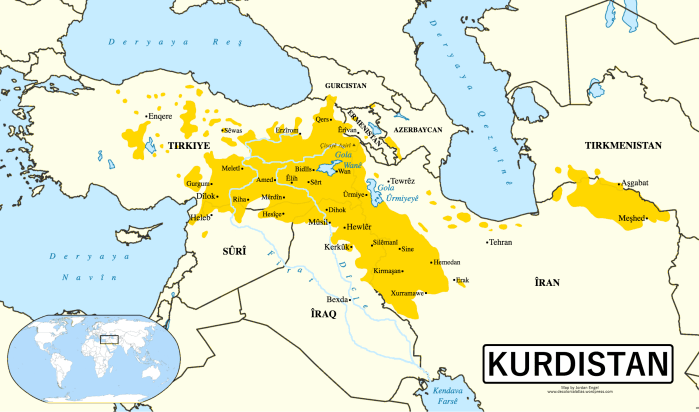
Eye Candy: Kurdistan

NOL map Kurdistan.png
Click here to zoom (courtesy of the excellent Decolonial Atlas)

Countries with significant Kurdish populations in the Near East: Turkey, Syria, Iraq, and Iran.

Countries with significant Kurdish populations in the Near East that the United States has bombed or put boots on the ground in: Iraq and Syria.

Countries with significant Kurdish populations in the Near East that the United States has threatened to bomb and possibly invade: Iran.

Countries with significant Kurdish populations in the Near East that the United States is allied with: Turkey.

Three of the four countries with significant Kurdish populations in the Near East are (or was, in the case of Iraq) considered hostile to the US government, so the use of Kurds to further American Realpolitik in the region is almost obvious, until you consider that Turkey has been a longtime ally of Washington.

Suppose you’re a big-time Washington foreign policy player. Do you arm Kurdish militias in Syria, encourage continued political autonomy in Kurdish Iraq, finance Kurdish discontent in Iran, and shrug your shoulders at Istanbul? Seriously, what do you do in this situation?

What on earth was the Dervish state?

That’s the topic of my latest column at RealClearHistory. An excerpt:

2. Sovereignty and suzerainty are concepts that have little to no bearing on today’s world, but perhaps they should. Prior to the end of World War II, when the U.S. and U.S.S.R. became the globe’s alpha powers, suzerainty was often used by imperial powers to manage their colonies. Suzerainty is a formal recognition, by a power, of a minor polity’s independence and autonomy, and a formal recognition by the minor polity of the power’s control over its diplomatic and economic affairs. Suzerainty was used especially often by the British and Dutch (and less so by France and other Latin states, which preferred more direct control over their territorial claims), as well as the Ottoman Empire. The U.S.-led order has focused on sovereign states rather than unofficial spaces, and this has led to many misunderstandings. Somalia, which has long been a region of suzerains, is a basketcase today largely because it is approached by powers as a sovereign state.

Please, read the rest. The Dervish state was an ally of the Ottoman and German empires during World War I.

Worth a gander

  1. the term ‘hippie trail’ began to circulate in the late 1960s: it referred principally to the long route from London (or sometimes Amsterdam) to Katmandu.| The Protestant Reformation and freedom of conscience

  2. Flags, Chinese Pirates, and the American Navy | Naval power and trade

  3. Xi Jinping is looking more and more like Mao | The legacy of autocratic rule in China

  4. that time when North Korea saved Benin from a coup led by mercenaries | The re-privatization of security

  5. how Brexit has reopened old Irish wounds | Credit and the Great Famine of Ireland

Ayn Rand and International Politics

In a previous post I promised to write about Ayn Rand and her views on international politics, based on a recently published article.

I find Ayn Rand a fascinating figure in libertarian history, for a number of reasons. Her life style and ways she went about it in her life are so far distanced from me, that made me curious. Some of her philosophical ideas are great, others do not appeal to me at all. I plainly admire her for making the moral case for capitalism and individualism, which stands out in the economist-dominated libertarian tradition.

I am on the one hand annoyed by the way she fostered such cult-like circle of followers, in her own day and after her death in 1982, that led to dogmatism and intellectual isolationism, which goes against all basic academic standards I think are crucial.

On the other hand, I think the people at the Ayn Rand Institute do a great job preserving her legacy and attempting to widen her appeal. Overall, I am convinced that no matter what your take on this fascinating figure or her work is, Rand deserves to be studied in academia, because she remains influential to this day, especially in the US, and left a serious collection of writings that warrant intellectual analysis, even by people who do not consider themselves Randian.

Against this background I made a comparison between mainstream liberal theories of International Relations (IR) and the ideas on world affairs of Ayn Rand. The brief summary of the first is as follows:

  • World peace is attainable, in the belief that humans are rational enough to overcome war and conflict.
  • The nation is seen as a problematic actor in world affairs. Its room for maneuvering needs to be curtailed, including the importance of the balance of power between states, and the alleged influence of ‘war mongering’ diplomats and the so-called military-industrial complex.
  • Peace oriented foreign policies can be fostered by domestic institutional arrangements, most notably democracy (democratic peace theory).
  • In the international realm, there is an important role for intergovernmental and non-governmental organizations, regimes and international law (liberal institutionalism), which aim to overcome or neutralize the effects of the logic of power politics.
  • International trade is also expected to foster peace, often in combination with the alleged pacifying influence of interest groups and public opinion of foreign policy decision-making.
  • A recent addition is the broad support for humanitarian intervention.

To keep this blog at readable length I will not go into the details of Rand’s writings, but limit myself to her main views on these ideas, which should be seen in the context of her fierce opposition to the Soviet Union and its allies in the Cold War, and her concern for America losing its super power position through internal causes, not least the loss of the individual liberty-enhancing spirit among the American people.

  • In contrast to classical liberals from Smith to Hayek, Rand did indeed think that world peace would be attainable, but only in an Objectivist world. Among rational men living according the Objectivist principles there would be a harmony of rational interests. Yet in the current world there was also abundant irrational behaviour, bad morality, and other grounds for dispute.
  • The main causes of war were not material issues, domestic interests, institutional arrangements, or the structure of the international system. Rather, war was rooted in human nature. It went back to the tribal era, when brute force was the prime rule of conduct. The (socialist) dictatorships were contemporary examples in her mind, with their lack of respect for the rights of their own citizens, and those of foreigners alike. ‘Statism needs war, a free country does not’.
  • Rand was inconsistent in her valuation of the power of public opinion. She noted that most people often do not want war. Yet the origins of war still lay with those civilians, also in non-democratic regimes, because they failed to reject the doctrine that it was right and justified to achieve goals by physical force. If people put up with a dictatorship like the Soviet Union, or decided not to flee, they were co-responsible for the deeds, and deserved the same fate as their government.
  • Rand recognized that individuals live in groups or communities, but she regarded respect for tribal roots, ethnicity, and regional languages as uncivil and, above all, irrational and a limit on individual liberty. Ethnicity was also an important cause of war. Nationalism was perhaps less abstract than Marxism, but it was at least as vicious in stirring emotions such as hatred, fear, and suspicion. Therefore rational people would altogether disregard their roots as guides in (political) life.
  • Rand had two positions on the issues of sovereignty and intervention, depending on the moral character of the nation in question. Sovereignty was a right that had to be earned, but could also be forfeited. If a nation fully respected the principle of individual rights, it’s right to sovereignty was morally secured and should be respected by other nations. However, if a state violated the rights of its citizens it would lose its sovereign rights. ‘A nation ruled by brute force is not a nation, but a horde, whether led by Atilla, Genghis Khan, Hitler, Khrushchev, or Castro.’
  • Dictatorships were outlaws and could therefore be invaded as a matter of choice for the free nations, although there was no duty to do so. The right to self-determination and sovereignty only existed for free nations, and for societies seeking to establish freedom.
  • Yet this way, anarchy loomed. Rand divided the world into three groups of countries. First, countries complying to the Objectivist principles, with full sovereign rights. Second, countries on their way to freedom, often referred to as ‘mixed economies’, or half-way houses between freedom and dictatorship. Third, countries not worth existing, such as dictatorships and tyrannies. Unfortunately, the world lacked fully free countries. The mixed economies did not have unlimited right of intervention, they could only interfere when another country seriously breached Objectivist principles, for example by establishing one party rule, enacting censorship laws, executing people for political offences without trial, or nationalizing or expropriating private property.
  • Rand acknowledged the perpetual influence of power in world politics. The character of international politics was, and always had been among states, a balance of power game.
  • The US army was under domestic, non-patriotic attack for its virtues, for being a competent and strong force. It was unwise to cut the defence budget, while -in another contrast to liberal IR thought- ‘the military-industrial complex’ was ‘a myth or worse’.
  • Statism at the international level, in the form of ‘a planetary community’ and other cosmopolitan ideas had to be rejected. The collaboration of semi-free countries with communist dictatorships in the UN was evil and stood in contrast to reason, ethics, and civilization. The UN provided the Russian camp with prestige and moral sanction, suggesting that ‘the difference between human rights and mass slaughter is just a matter of opinion’.
  • Another point of contention with the social liberals was development cooperation. Foreign aid was nothing but ‘altruism extended to the international realm’.
  • While, in contrast to social liberals, she lacked faith in international law as such, Rand did regard international treaties as firm obligations.
  • Also, Rand saw peaceful effects of laissez-faire capitalism, because it was based on the recognition of self-interest by free individuals and the non-initiation of force. Capitalism fostered a society of traders. Therefore the essence of Objectivist foreign policy had to be free trade.

To briefly sum up: Rand’s writing show that not all liberals are peace-seeking cosmopolitans, attempting to minimise the role of the nation, the balance of power, the military, and warfare in international relations. She rejected most forms of international governmental organization and other expressions of liberal institutionalism. Often her ideas lack sufficient (legal) detail, while they are also centred on America, and hence limited to the perspective of an influential super power with large military capacity. Yet her writings show that fostering liberty in international relations can be done in several ways, and that different liberals have different ideas about the route towards that goal.

Mea Culpa: Israel and Palestine

So, I let myself be captured by Irfan’s cultured, bright, well-spoken, and fact-studded critique. He is right, on the main. My short essay is loose on many facts. I did not know what I did not know. And where it’s not completely wrong, it’s often sloppy. So, for example, I shouldn’t have said that Jews were not allowed on the mosque’s esplanade. I should have said (and the damned thing is that I knew it) that they were not allowed to pray there – but then, what if a Jew takes a walk on the esplanade and prays inside his head, and what if, unbeknownst to him, his lips move a little? As they say in French: “Irfan m’a mené en bateau.” At any rate, I will simply confess that nearly all my facts are wrong so I can recover my purpose, at last. Don’t worry, I won’t take much of your time. Here are a handful of real real facts and their obvious implications:

  • Palestinian Muslims (or a single one) assassinated two Israeli police officers a few weeks ago on the mosques esplanade or near it.
  • The assassin or assassins used a gun or guns.
  • Israeli authorities – that exercise de facto control over the area- responded by setting up metal detectors on entrances to the mosque’s esplanade.
  • Metal detectors are useful to alert to the presence of most firearms and of some bombs.
  • Palestinian Muslims protested this measure in several ways, including with riots.
  • The people whose safety could have been improved by the existence of the metal detectors were both Israeli security forces in the area and the great many Palestinian Muslims who constitute the bulk of the visitors to the same area.
  • Thus, Palestinian Muslims protested -including with rioting – security measures that were likely to benefit them most (in terms of numbers).*

That is collective irrationality.

I suppose that Irfan, or another subtle defender of irrationality, will argue that the installation of metal detectors at those sites is another step in Palestinians’ loss of sovereignty over the Holy Places, and thus the violent reaction. Sure thing! This defense implies that Palestinian Muslims have to be ready to be assassinated by other Palestinian Muslims in order to enforce a shred of Palestinian Muslim sovereignty over that small area.

That is insane.


*I ignore, of course, the idiotic view that Muslim terrorists could not possibly kill other Muslims at a sacred site of Islam. Muslims have been killing tens of thousands of Muslims, specifically, for the past twenty years. Some terrorists, who called themselves Muslims, chose to engage precisely in mass killing at Muslim religious sites such as mosques. And then, there are Jewish terrorists, and even the occasional dangerous illuminated Christian.

BC’s weekend reads

  1. on BBC bias | fake news and political entrepreneurship
  2. Leftist hypocrisy at its finest | goose pimples and hypocrisy
  3. classical liberals and libertarians are asking the wrong question about sovereignty | myths of British sovereignty and isolation (XII)
  4. 4 reasons why the academy will remain mostly unwelcoming to the Right | Carlos Castaneda’s fraudulent scholarship
  5. Soviet ice cream | the economics of hard choices

BC’s weekend reads

  1. Understanding Trump’s trade mistakes
  2. Empiricism and humility
  3. Epistemological modesty and unintended consequences
  4. Immigrants and slaves
  5. 5 takeaways from the Dutch election

My favorite posts at NOL this year

Last week I promised y’all a post on my favorite reads at NOL this year. I almost always keep my promises, so below is a long-ish list of essays I really enjoyed reading and learning from this year.


My absolute favorite essay of 2016 at NOL was Barry Stocker’s analysis of the attempted coup in Turkey. Dr Stocker has spent a quarter of a century in the Turkish-speaking world and all of his acquired wisdom of the region is on display in the piece. Barry didn’t post much here this year, but I am hoping that, given the geopolitical situation in his neck of the woods (Dr Stocker teaches political philosophy at Istanbul Tech), he’ll be able to provide much more insight into the challenges the region will face in 2017.

Jacques, who has become sidetracked ever since Donald Trump became the GOP nominee, had an excellent post titled “A Muslim Woman and the Sea” that everyone should read. I don’t agree with it, but the quality of his writing almost demands that you read through the entire piece. In it is the peaceful nostalgia for both youth and French Algeria, the almost careless way he describes his surroundings, and the slow, deliberate manner in how he attacks his enemies. It is all on display for you, his audience, to devour at your leisure. Dr Delacroix is a world-class storyteller.

Mark Koyama’s piece on Jewish communities in premodern Europe garnered a lot of praise, but I found his post on medieval China to be much more fascinating. In the post, Dr Koyama summed up his recent paper (co-authored with UCLA Anderson’s Melanie Meng Xue) on literary inquisitions during the Qing era (1644-1912). What they did was tally up the number of times the state dragged scholars and artists to court in order to accuse them of delegitimizing the Qing government. This had the unfortunate (but predictable) effect of discouraging discussion and debate about society in the public sphere, which stifled dissent and emboldened autocratic impulses.

Chhay Lin had a number of great posts here, some of which were picked up by major outlets like RealClearWorld and 3 Quarks Daily, and Notes On Liberty is lucky to have such a cool cat blogging here. My favorite post of his was the one he did on his childhood in a Cambodian refugee camp along the Khmer-Thai border. What an inspiring story! I hope there are more to come in 2017. (Chhay Lin, by the way, splits his time at NOL with SteemIt, so be sure to check him out there).

Zak Woodman had lots of good posts in his debut year (including NOL‘s most-read article), but the two I enjoyed most were his thoughts on empathy in cultural discourse and his Hayekian take on safe spaces. Both pieces took a libertarian line on the freedom of speech, but Mr Woodman’s careful articles, which are as much about being true to the original meaning of some of the 20th century’s best thinkers as they are about libertarianism, suggests that he has a bright future ahead of him as one of the movement’s deeper thinkers (he’s an undergraduate at UM-Ann Arbor). I look forward to his thoughts in 2017.

Bruno Gonçalves Rosi burst on to NOL‘s scene this year with a number of posts (in both English and Brazilian Portuguese). His blistering critiques of socialism were fundamental and – to me, at least – reminiscent of the debates between libertarians and statists here in the United States in the 1970s and 1980s. My favorite of Dr Rosi’s 2016 posts, however, was his reflection of the 2016 Rio Paralympics that took place in the late summer (at least it was late summer here in Texas). Bruno brilliantly applied the Games to the famous argument about inequality between 20th century American philosophers Robert Nozick and John Rawls. I hope the piece was but a glimpse of what’s to come from Dr Rosi, who also has a keen interest in history and international relations.

Lode Cossaer is probably busy with his very intriguing dissertation (“the institutional implications of the tension between universal individual rights and group self governance”), but he did manage to find some time to dip his feet into the blogging pool with a few insightful posts. My favorite was his explanation of Donald Trump’s Carrier move, which was blasted from all sides of the political spectrum (including libertarians) for being a prime example of “crony capitalism.” Cossaer, in his own delightfully contrarian manner, pointed out that there is a trade-off between the rule of law and lower taxes. This trade-off might not be pretty, but it exists regardless of how you feel about it. Lode, in my opinion, is one of very few thinkers out there who can walk the tight-rope between Rothbardian libertarianism and plain ole’ classical liberalism, and he does so ruthlessly and efficiently. I hope we can get more contrarianism, and more insight into Cossaer’s dissertation, in 2017.

Vincent has been on a roll this month, and I simply cannot choose any single one of his 2016 posts for recognition. His pêle-mêle comments on the debate between historians and economists over slavery is well-worth reading, especially his insights into how French Canadians are portrayed by economic historians in graduate school, as are his thoughts on the exclusion of Native Americans from data concerning living standards in the past. These posts highlight – better than his more famous posts – the fact that economists, along with political philosophers and anthropologists, are doing way better historical work than are traditional historians. Dr Geloso’s post on fake news as political entrepreneurship did a wonderful job, in my eyes, of highlighting his sheer passion for history and his remarkable ability to turn seemingly boring topics (like “political entrepreneurship”) into hard talking points for today’s relevant policy debates.

Federico is still practicing corporate law in Argentina, so every article he writes at NOL is done so in his free time. For that I am deeply grateful. His early August question, “What sort of meritocracy would a libertarian endorse, if he had to?” was intricately stitched together and exemplifies Federico’s prowess as one of the world’s most novel scholars of Hayekian thought. I also enjoyed, immensely, a careful, probing account of human psychology and our ability to act in this short but rewarding post on homo economicus. I look forward to a 2017 filled with Hayekian insights and critical accounts of social, political, and economic life in Buenos Aires.

Rick spent the year at NOL blogging about whatever the hell he wanted, and we were all rewarded for it. Dr Weber is obviously emerging as important conduit for explaining how “politics” works in democratic societies, and perhaps more importantly how to be a better, happier person within the American system. I hope Rick continues to explore federalism though a public choice lens, but I also suspect, given Dr Weber’s topics of choice this year, that Elinor Ostrom would have been interested in what he has to say as well. 2017 awaits! Here is Rick breaking down Trump’s victory over Clinton. You won’t get a finer explanation for why it happened anywhere else. Oh, and how about a libertarian argument for an FDA?

Michelangelo, who is now a PhD candidate in political science at UC Riverside, won my admiration for his brave post on safe spaces and the election of Donald Trump. While 2017 may be composed of uncertainties, one thing that is known is that Trump will be president of the United States. We need to be wary and vocal (just as we were with Bush II and Obama).  Michelangelo was in top form in his piece “…Why I Don’t Trust the Police,” so much so that it stuck with me throughout the year. It is libertarianism at its finest.

William Rein, a sophomore (“second-year”) at Chico State, has been impressive throughout the year. His thoughts do very well traffic-wise (literally thousands of people read his posts), and it’s all well-deserved, but I thought one of his better pieces was one that was relatively slept on: “Gogol Bordello & Multiculturalism.” Mr Rein points out that Political Correctness is destroying fun, and the election of Donald Trump is merely the latest cultural challenge to PC’s subtle tyranny. William weighed in on the safe spaces concept as well and, together with Zak’s and Michelangelo’s thoughts, a coherent libertarian rationale has formed in response to this cultural phenomenon. If you want to know which clouds young libertarian heads are in, NOL is a great place to be.

Edwin initiated the best debate of the year here at NOL with his post on classical liberalism, cosmopolitanism, and nationalism. Barry replied (in my second-favorite post of his for 2016), and Dr van de Haar responded with a third volley: “Classical Liberalism and the Nation-State.” At the heart of their disagreement was (is?) the concept of sovereignty, and just how much the European Union should have relative to the countries comprising the confederation. Dr Stocker concluded the debate (for 2016, anyway) with a final post once again asserting that Brexit is bad for liberty. For Edwin and Barry, sovereignty and international cooperation are fundamental issues in Europe that are not going away anytime soon. NOL is lucky to have their voices and, like Dr Stocker, I hope Dr van de Haar will be able to provide us with many more fascinating and sometimes contrarian insights in 2017.

Lucas Freire wasn’t able to post much here this year (he is doing postdoc work in South Africa), but his post on economics in the ancient world is well worth reading if you are at all interested in methodology and the social sciences. Dr Freire has continually expressed interest in blogging at NOL, and I am almost certain that 2017 will be his breakout year.

Those are my picks and I’m sticking to ’em (with apologies to Rick). Notewriters are free to publish their own lists, of course, and if readers would like to add their own in the ‘comments’ I’d be honored (you can always email me, too). The post I most enjoyed writing this year, by the way (thanks for asking…), was a snarky one questioning the difference between Saudi Arabia and Islamic State. Thanks for everything.

From the Comments: Sovereignty, the Commons, and International Relations

There have been a number of excellent discussions in the ‘comments’ threads these days. Dr Khawaja adds more depth to the discussion on Iran and foreign policy. Me and Chhay Lin are in the midst of a debate on democracy and libertarianism. Michelangelo’s post on splitting up California generated a good discussion. You can see what’s hot in the threads by looking to your right, of course. I wanted to highlight this ‘comment’ by Rick in the threads of Edwin’s recent post on liberalism and sovereignty:

“[S]overeignty is a constitutional idea of the rights and duties of the governments and citizens or subjects of particular states.”

To me, a constitution is like a contract. It’s close to set in stone and it lays out these rights and duties. But the idea of sovereignty Jackson is pointing toward in that quote would be better understood as laying out a sort of meta-prize; it’s a delineation of the commons that potential groups within that area may compete over or cooperate in. To be fair, a constitution is a similar sort of commons (especially when that constitution includes the right to collect tax and lead armies). The question of how to govern the commons is *the* question on the domestic side.

On the international end of things, anarcho-capitalism calls for muddying the borders of these commons. This has obvious costs and benefits: it makes the emergence of a productive polycentric order easier, but it also opens access to what would have been relatively closed commons. I think the missing piece in the world governance question, whether from a classical liberal, minarchist, or anarchist perspective is the question of how a polycentric order would emerge and function (e.g. standards associations, norms of arbitration/dispute resolution, etc.).

More discussion is needed on this point…

Liberalism and Sovereignty

More than a year ago I promised Jacques a post on sovereignty and while I am not always able to follow up very quickly, I tend to do what I promise. So here it is! Jacques’ main cri de coeur was why (classical) liberals should care about sovereignty at all.

When it comes to the theoretical discussion about sovereignty (the literature is huge), I think there is no better start than the work of international relations theorist Robert Jackson. Or better and broader: any thinking about international relations benefits from this Canadian, former Boston University professor, especially his magnum opus The Global Covenant: Human Conduct in a World of States (Oxford University Press, 2000). But this is a side step.

In his 2008 book Sovereignty: Evolution of an Idea (Polity Press) he argues that:

sovereignty is an idea of authority embodied in those bordered territorial organizations we refer to as states, and is expressed in their various relations and activities, both domestic and foreign. It originates from the controversies and wars, religious and political of sixteenth and seventeenth century Europe. It has become the fundamental idea of authority of the modern era, arguably the most fundamental.

Also in regions where other kinds of arrangements existed before Western imperialism.

It is at the same time both an idea of supreme authority in the state, and an idea of political and legal independence of geographically separate states. Hence, sovereignty is a constitutional idea of the rights and duties of the governments and citizens or subjects of particular states. It is also an international idea of multiple states in relation to each other, each one occupying its own territories and having foreign relations and dealing with others, including peaceful and cooperative relations as well as discordant relations and periodical wars.

Of course a lot of popular and academic discussion follows from this, for example about the particular form of sovereignty (popular, or not), the relation between power and sovereignty, sovereignty and globalization, or if and when sovereignty may be breached to protect others through intervention. Yet here I solely  focus on the relation between sovereignty and liberal political theory.

Concerning the domestic supremacy side of sovereignty a lot has been written by liberals. Most liberals (classical, social, and even libertarian minarchists, such as Ayn Rand or Robert Nozick; see my Degrees of Freedom for the precise definitions) realize some form of state is needed to protect individual rights. A state embodied with sovereignty. At the same time most liberals (social liberals less so, because they favor a relatively large state) recognize the state is also the largest danger to individual freedom. How to balance the two is the perpetual question of liberal political thought, one also without a definitive answer or solution, so far.

Less attention has been given to the international side of sovereignty. There are a number of libertarians, such as the anarcho-capitalist Murray Rothbard, or his intellectual successor Hans-Hermann Hoppe, who think there should not be states, hence no issues of sovereignty exist once their stateless world has materialized (they remain largely silent about how to reach that situation). Yet it seems to me the thinking should not stop there. These same thinkers romanticize the idea of secession, yet seem to overlook that those seceded groups or communities also need to deal with other seceded groups and communities. They are a bit lazy when stating everybody should look after themselves, and only defend themselves in case of attack by others. If everything would be nice and neat among people this might be ok. Yet of course history shows (also in those areas where sovereignty never played a big role before Western imperialism) that people interfere all the time in each others affairs, some rulers may have malign intentions, others belief some parts of the seceded lands belong to their community, let alone issues about religion, et cetera. In short, chances on a peaceful world with the occasional conflict that can be solved by self defense are zero.

Funnily enough, social liberals share the idea of the possibility of a world peace and cosmopolitan harmony. They also favor the abolition of sovereign states, not through secession but through the pooling of sovereignty at the transnational level, with the European Union as an example and a world federation as the ultimate end goal. This seems just as unrealistic, as even the EU is still mainly governed from the member states, as the current refugee crisis and the possible dissolution of the Schengen agreement illustrates. More generally, the pooling of sovereignty proves rather difficult, also in other parts of the world. ASEAN in South East Asia is an example.

More realistic are classical liberals, such as Hume, Smith, and Hayek, who acknowledged an emotional tie between the individual and his country, as well as the constant need to defend individual property rights against invasion by others, through standing armies, diplomacy, some international treaties, the balance of power, et cetera.  Human nature does not allow for starry eyed fantasies about international harmony, let alone international peace. Hence, it is rather normal to care about external sovereignty, as it is foremost a means of protection.  Not the sole means, but an important and fundamental institution of international relations.

From the Comments: Military intervention, democracy, and stability

Longtime reader (and excellent blogger in his own right) Tam has an interesting response to Chhay Lin’s thoughts on the Paris terrorist attacks:

It is an interesting read indeed but there are two or even more sides to every story. What we are also noting is that many of these groups that hate Western interventionist policies also hate their own people for being different in one way or the other. However, I agree that the misplaced perception of democracy as the superior form of governance overlooks the essential internal historical and socio-political factors behind the politics of the different countries that have become victims of Western ‘sanctification’ processes fronted by bombs after daring to opt not to embrace democracy. Libya and Iraq were stable before Western intervention.

Tam’s point strikes at the heart of the difference between military interventionists and non-interventionists, I think. Libya and Iraq were indeed stable, but not everybody was free. In Iraq, Shias, Kurds, liberals, and religious Sunnis were all brutally suppressed, and this oppression stood in stark contrast to the freedoms that secularists, women, union members, some socialists, and the politically apathetic enjoyed. The sociopolitical dynamics in Libya were the same, though with different local actors.

This reality is something that both sides of the interventionist debate recognize, though the interventionist side seems to place much more faith in government when it comes to “doing something.” Jacques and Edwin, for example, have both argued that bombing ambiguous factions in Iraq, Syria, and Libya would contribute to the freedoms of the oppressed factions in those countries. Looking back on the debate makes it clear that they weren’t wrong, but look at what those freedoms have produced. Those freedoms have come at the expense of the freedoms of the factions that the dictators were protecting.

What this situation shows me is that the states of the post-colonial world are unviable. Stability comes at too steep a price (dictatorship), and democracy’s unpredictability only leads to predictably violent results in the post-colonial world.

This impasse, which I cannot be the only one in the world who recognizes, has led me to take a hard glance at two specific peace processes in the Western world: The diplomatic efforts of Europeans after the Napoleonic Wars (“Concert of Europe”) and the founding of the American republic, which is, in my mind, the most successful endeavor in the history of international relations. Neither of these efforts led to the complete abolition of war, but both have helped to maintain a relatively peaceful co-existence between large numbers of factions for long periods of time.

The Concert of Europe bought time for factions in the region to solidify their legitimacy at home, culminating in both the creation of Germany and Italy in the late nineteenth century and the infamous overseas imperial  domains of France, the UK, and the Netherlands (among a few others). While this peace process brought about prosperity for Western Europe, it was not inclusive and it still adhered to the Westphalian notion of state sovereignty. What state sovereignty means is that each state, in the context of international affairs, has a right to do whatever it pleases within the confines of its own borders (such as massacre hundreds of thousands of people in the name of stability). The Concert of Europe was also the precursor to the post-1945 peace process that created the state system that we all live with today, though I would argue that there are some elements that could be republican, such as the IMF and World Bank, provided some changes in mindset.

Aside from the problems produced by the notion of state sovereignty, the states of the post-colonial world today suffer from an issue of legitimacy, both from domestic populations and from foreign ones. Domestically, all of the factions that stability-inducing dictatorships oppress do not buy in to the argument that the states purporting to govern them are legitimate. In foreign affairs, many factions do not believe that these post-colonial states are legitimate either. Hence the calls for bombing campaigns, proxy wars, or outright invasions and occupations of states like Iraq and Libya by states like the US or France (even if these invasions come at the expense of domestic and international rule of law).

This situation, where post-colonial states claim to have sovereignty within an international state system but where domestic and international factions ignore such claims, is where we’re at today. It’s the status quo, and while it worked relatively well in a small part of the world for about hundred years or so, it’s obviously failing today.

Enter the founding of the American republic. Unlike the Concert of Europe, self-determination à la breaking away from the UK was a guiding principle of the federal system, rather than state sovereignty. Like the Concert of Europe, the statesmen who crafted the American republic were concerned about invasion, hegemony, and all of the other bad stuff that happens in the international arena. So they set up an inclusive, republican system of states rather than attempt to balance power off on each other, like they did in Europe. The republican, or federal, system tied each state up into the affairs of the other states, whereas the balance of power system contributed to the formation of rival blocs within the system. This is why Europe switched from trying to maintain yet another balancing act to building an actual confederation (though one that is far too complex than it has to be) after World War II.

From a strictly war and peace view, the republican state system has led to one war so far (dating from 1789). From the end of the Napoleonic Wars, in 1815, to today, the balance of power state system has led to numerous wars.

Now, I know what you’re thinking: Woodrow Wilson’s foreign policy was based on self-determination, and his foreign policy was a disaster. This is true, though I would argue that Wilson was simply confused about what self-determination actually implied. For Wilson, recognizing the self-determination of various groups within empires would lead to state sovereignty for these groups, and that this state sovereignty would then be protected by the institutions trying to maintain a balance of power. Wilson never entertained the notion of republicanism when it came to recognizing the self-determination of peoples living in empires, he simply thought empires were undemocratic. Thus, he was actually a proponent of state sovereignty rather than self-determination.

What I am not arguing for here is a Concert of Europe-type effort for Middle Eastern actors. I think it would be a disaster, largely because regional efforts at peace-building (rather than, say, trade agreements) are useless in today’s globalized world. The Middle East needs the West, and vice-versa. Peace will only be achieved if self-determination is embraced (by not only large swathes of Mideast factions, but Western ones as well) and the new polities can be incorporated into existing republican-esque institutions. This way, more factions have a voice, and bad actors can be more easily isolated. I am not necessarily arguing that the US or EU should welcome burgeoning Mideast states into their federations, but policymakers and statesmen from these countries should at least start thinking about how to encourage and embrace the notion of a Middle East that looks a lot like our own republican world and less like the one we gave them following the destruction of the Ottoman Empire.

Stability is overrated, especially if the notion of creative destruction is taken into account.

A Matter of Legitimacy

Dictionaries give us two definitions of “legitimacy”: “the quality of being legal” and “the quality of being reasonable and acceptable”. The two meanings are intertwined: we expect reasonability from the laws and we infer the content of a law we do not properly know from what we regard as reasonable. Unreasonable laws are not acceptable to the people and Cesare Beccaria warned us about how unreasonable prohibitions engender more and new crimes.

Political Realism and Legal Positivism cross their paths when it is time to discuss what is the ultimate foundation of obligation, both political and legal: facts and force. An overwhelming force deployed upon individuals and peoples will always be able to impose what is reasonable and acceptable. For Thomas Hobbes, as fear is not a sufficient reason for annulment of covenants, the feeling of terror from the subject to the sovereign does not challenge the legitimacy of his power.

Libertarianism is, in principle, a political stance on the state that denies its legitimacy or, at least, denies unlimited sovereignty. And we stress “in principle” because we want to point out that not all versions of Libertarianism accomplish the said aims. In this regard, we want to single out one crucial trait of every Libertarian political theory: is it possible a stateless order of cooperative coordination between individual plans? Does its existence depend upon our own volition and agreement? We want to make a distinction between two strains of Libertarianism: the one which affirms the possibility of a stateless society and the one which does not.

Paradoxically, the affirmation of the possibility of a stateless order of cooperation legitimates the Hobbesian stance on unlimited sovereignty: having at their disposal the alternative of a stateless political order, individuals opt freely for a Leviathan. What we have to decide now is the extension of the power of the government, but at this point there is no restriction left to the power of the Leviathan to determine its own limits.

On the other hand, for the strain of Libertarianism that regards the absence of a state as impossible or not desirable ­because, for example, the justice is an artificial virtue that demands a government to enforce it­, the state is a fact that has no reasonable alternatives. As the theft that compels us to choose between our bag or our life, there are no reasonable options left to us but accepting the power of the state. As David Hume pointed out, tacit conventions as the stability of the possessions require a political order to enforce it. Therefore, the factual power of the state will be legit only as long as it enforces the tacit order of human cooperation that allows individuals to fulfil their plans. Notwithstanding this last strain of Libertarianism does not deny the legitimacy of the state, it does consistently deny the legitimacy of any type of unlimited sovereignty.