Separation of Children: an American Tradition

Many Americans deplore the forced separation of children from their parents when they attempt an unauthorized entry into the USA. The recorded crying of children traumatized from having their parents taken away is terrible to hear for anyone with empathy. Administrations excuse this by claiming that they are only enforcing a legally mandated zero tolerance, that this separation acts as a useful deterrent to immigration, and that the law is ordained by God.

The claim by those opposing this policy is that this cruel separation is un-American. But in fact, the forced separation of children is an American tradition. Under slavery prior to the end of the Civil War, children were sold separately from their parents. This action too was presumably a law ordained by God.

The separation of children from their parents was also imposed on native American Indians. Children were forcibly removed from their homes and put into boarding schools, the aim being the assimilation of Indians into Euro-American culture. Indian children were not allowed to speak in their native languages. Rather than being un-American, this physical and cultural separation was seen as an Americanization. Canada had a similar program for its Indians.

This separation continued the genocide of Indians by having a high rate of death. The misery that children felt in their familial and cultural separation was compounded by abusive treatment and a high mortality rate.

Since the current child separation is a continuation of past policies, we can expect similar outcomes: abuse, death, and suicides. Feeling no hope of ever seeing their parents again, confined to small cages, suffering from boredom, and constantly hearing other children crying, there could be substantial illness and even suicide in these detention camps. It would at first be covered up, and then exposed, and denied as “fake news.”

This anti-family policy is supported by many Republicans and conservatives. The conservative claim of supporting “family values” has now been shown to be fake. The real conservative stance is the imposition of traditional European culture and supremacy. Most of the migrants from Central America and Mexico are of native Indian ancestry. When they are rejected and sent back to their home countries to get killed by the violence from which they fled, this is in accord with the American tradition of European racial supremacy over native American Indians. If those seeking to immigrate were Norwegians, those families would not be split up.

Indeed, those subjected to forced family separation were races that were conquered and regarded as inferior. A large immigration from Mexico and Central America would repopulate the USA with native Indian “blood,” unacceptable to Euro-American supremacists.

Therefore the forced separation of native Indians from their parents and the rejection of further immigration is as American as one could get.

Nightcap

  1. Conservatives in academia Fabio Rojas, orgtheory
  2. Cuba’s lack of literature Nick Caistor, Times Literary Supplement
  3. The Democratic Party’s identity crisis William Voegeli, Claremont Review of Books
  4. How Fortress Europe was built Kenan Malik, Guardian

Nightcap

  1. Britain’s Open Doors Policy Chris Dillow, Stumbling and Mumbling
  2. About those Ancestry dot com commercials… Ryan Anderson, Anthro{dendum}
  3. The Unfinished World Nick Nielsen, The View from Oregon
  4. “State Capacity” is Sleight of Hand Bryan Caplan, EconLog

Nightcap

  1. The secrets of Katyn Louis Proyect, CounterPunch
  2. Europe’s curse of wealth Branko Milanovic, globalinequality
  3. The new Europeans Christopher de Bellaigue, NY Review of Books
  4. Nuclear diplomacy between Brazil and Argentina Sara Kutchesfahani, War on the Rocks

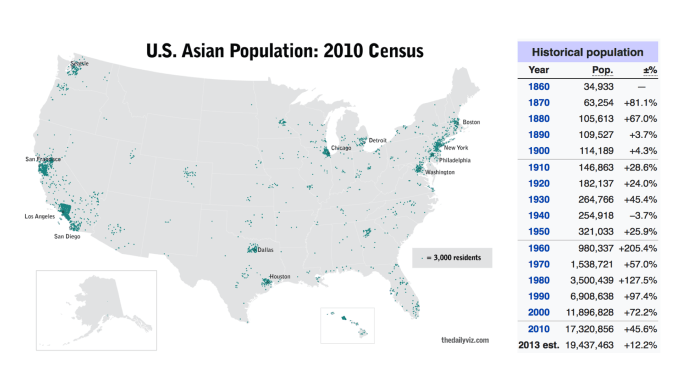
Eye Candy: the US Asian population, circa 2010

NOL map US Asian population
Click here to zoom

“Asian” is a pretty broad term. Racial classifications are, perhaps, the dumbest thing in the world.

Imagine seeing something like this in the press today, or this as an advertisement. There’s been lots of progress in this country, it’s just hard to see sometimes.

Yasmina

I was sick, still am, sort of. That’s why I have not done much. Here is a story (story) about immigrants I wish you would re-read. It was posted at NOL in March of 2012.

The deadliest riots in American history

That’s the subject of my weekend column over at RealClearHistory. The riots are all, by far, due to racism and nativism, but for some strange reason labor’s riots in the late 19th century get the lion’s share of the spotlight in history textbooks.

An excerpt:

6. Memphis, May 1-3, 1866. Another post-Civil War riot, the Memphis unrest was more violent and more organized than the brawl in New Orleans. Like N’awlins, Memphis was a Southern city long under Union occupation, but unlike the port city, Memphis had a large immigrant population of Irishmen who were in direct economic, political, and social competition with recently freed blacks. The Irish had such a large population in Memphis that they were able to take control of many levers of local government once Union troops banned native whites from holding office (for being Confederates), and the new group on the block was none too kind to the recently freed black population. Forty-eight people lost their lives, but the burning of homes (often with black families still inside of them) and churches, the raping of black women, and the fact that no prosecutions were carried out meant that Memphis would remain a hotbed of white supremacy for another century. (The riot enraged much of the Union, however, and led to a sweeping victory for Republicans later that year. The GOP quickly passed the First Reconstruction Act in 1867.)

Please, read the whole thing.

I’ve never been to Memphis, but it’s a city with good hip-hop music and good BBQ. Someday I’ll get up there for a long weekend or something.

From Petty Crime to Terrorism

I grew up in France. I know the French language inside out. I follow the French media. In that country, France, people with a Muslim first name are 5% or maybe, 7% of the population. No one estimates that they are close to 10%. I use this name designation because French government agencies are forbidden to cooperate in the collection of religious (or ethic, or racial) data. Moreover, I don’t want to be in the theological business of deciding who is a “real Muslim.” Yet, common sense leads me to suspect that French people who are born Muslims are mostly religiously indifferent or lukewarm, like their nominally Christian neighbors. I am not so sure though about recent immigrants from rural areas bathed in a jihadist atmosphere, as occur in Algeria, and in Morocco, for example. Continue reading

Nightcap

  1. Was he a literary genius or simply Stalin’s stooge? Stefan Dege, Deutsche Welle
  2. The world’s longest wine list is in…Florida Patrick Edward Cole, 1843
  3. Identity and Assimilation Luma Simms, National Affairs
  4. Immigrants Give America a Foreign-Policy Advantage Kori Schake, the Atlantic

West Coast Hillbillies

A long time ago, after moving from San Francisco, I bought a beautiful Labrador puppy from a woman named Brigid Blodgett, in the hills above Santa Cruz California. (I think she won’t mind the free advertising in the unlikely case that she reads Notes On Liberty or my blog.) Her house was an older conventional California so-called “ranch house,” with low roofs and a sprawling house plan. The pup she had in mind for me was playing with his ten siblings in a concrete backyard when I arrived. There was one new litter, lying with Mom on some rags in the living room, and another in the kitchen, that I could see and smell. The lady, the breeder, told me there was yet another litter in the garage.

To get my new dog, I had not gone to just anybody since most dogs last longer than most cars. I had gathered recommendations in Santa Cruz (pop. 60,000) and its suburbs. Brigid Blodgett’s name kept coming up. Other things being more or less equal, (“et cetibus…” as they say in Latin) I believe in the predictive power of redundancy. I purchased the pup, “Max” (for the German sociologist Max Weber. My previous dog was “Lenin,” another story, obviously). He was a wonderful animal, big, sturdy, healthy, smart, and with a physique that turned heads. I never saw Ms Blodgett again. She asked me once by phone to enter Max in a show but I thought it would inflate his ego and I declined. Her name came up a couple of times when perfect strangers stopped me to ask if Max was one of “Brigid’s dogs.” Continue reading

Nightcap

  1. The Persistence of Tyranny Ken White, Popehat
  2. The father of consumer sovereignty Henry Farrell, Crooked Timber
  3. UK’s Labor (Left-wing) Party and the Custom’s Union Chris Dillow, Stumbling and Mumbling
  4. Kosher Salt Stefan Kanfer, City Journal

Nightcap

  1. What Causes Cities to Become Sites of Revolution? David Bell, the Nation
  2. William Farquhar – the founder of Singapore Alex Colville, Spectator
  3. American History Needs Defenders Amity Shlaes, City Journal
  4. U.S. Once Had Lots of Norwegian Immigrants Nurith Aizenman, Goats and Soda

Nightcap

  1. Czeslaw Milosz: A Worker in the Vineyard Andrew Motion, Hudson Review
  2. When Americans Despised the Irish Christopher Klein, History
  3. How Brexit Has Reopened Old Irish Wounds Tony Connelly, New Statesman
  4. Quantum Mechanics? Try Entangled Time Instead! Elise Crull, Aeon

The US Immigration Lottery

As I write, Democrats and Republicans are gearing up for a battle to transform an American immigration system that has changed little in fifty years. President Trump seems eager to alter both the number of immigrants and the nature of qualifications for immigration. His Democratic opponents call him “racist.” (Democratic extremists call anyone they don’t like “racist,” perhaps because they have exhausted all normal political insults.) The so-called “lottery” door to immigration is attracting special scorn from the president and from other high-ranking Republicans. Many in the general public, not well versed in matters of immigration, listen to the president’s attacks with perplexity or disbelief: a “lottery”? This short essay aims to throw light on the topic with a small number of figures.

In 2016 there were 1,200,000 admissions to permanent residency in the US. That’s the granting of the famous “green card” which gives one full rights to work, to go in and out of the country, but no political rights, no right to vote, and no right to be elected – until now. Permanent residency is not citizenship. This must be obtained later, separately after five or three years (the latter, for spouses of US citizens) in almost all cases. Nearly all legal residents who wish to eventually become American citizens.

“Admission” is a legal-bureaucratic term. Many of those so admitted have already been in the US, some for years, while their case was being processed. The number physically arriving in the US on that year is much larger because it includes tourists, students, and others who are supposed to be visitors staying only for a stated length of time. Immigrants are admitted on the basis of one of five broad categories:

Occupational/business qualification, family relationship to someone already legally in the US. (The latter actually includes two legal-bureaucratic categories. The distinction between the two need not concern us here.) This family-based category accounts for the bulk of legal immigration, 67% of the total in 2016. Refugees (and “asylees”) account for another large number that is variable from year to year. There is also a category “Others” which gathers a small number of odds and ends admissions otherwise not fitting into another category.

The most interesting basis for admission is the quaintly called “Diversity.” It’s an actual lottery. It’s a lottery without admission fee where one can play as often as one cares to. It contributed 50,000 admissions in 2016, or 4% of the total admitted. The number is so small that it hardly would seem to be worth the attention of policy makers, except perhaps when a lottery winner engages in spectacular criminal acts as happened in New York in the fall of 2017.

Once, in the late 80s, Senator Ted Kennedy discovered that immigration to the US included practically no Irish people. He got angry and, on the spot, devised a remedy that became – through his influence in Congress – the diversity lottery. I can’t guarantee this story is true but it’s plausible and its spirit explains well the existence of this strange anomaly.

The main reason some parts of the globe send few immigrants to the US is that most opportunities to do so are sucked up by the prevalence of immigration based on family status in other areas. It’s the result of a quasi-random starting point combined with chain immigration. Suppose a single young Mexican male manages to move to the US legally (worry not how). Within a couple of years he goes back to Mexico to get married. He brings his wife to the US. It turns out he already had a son in Mexico, from another woman. He brings the son over too. The couple has several children, all US born. Soon, they would like to have built-in babysitters. They bring in both of the wife’s parents and the husband’s surviving mother. So, in this unremarkable story, we go – in the space of less than ten years – from one immigrant from Mexico, to six. After a few more years, any of the foreign born adults may bring one or two more immigrants, including brothers and sisters. The US-born children can also bring in their Mexican uncles, aunts, and cousins, though it would take a long time. There is a natural snowball effect built into the system.

To the extent that Congress wishes to cap the total number of immigrants brought in (excluding refugees), national contingents that happened to be numerous early may monopolize a very large number of available immigration opportunities. This leaves the door almost closed to other nationalities that were not present in large numbers early. The purpose of the lottery is to improve the US immigration chances to people living in areas of the world that have been under-served for a little while. Accordingly, lottery slots are allocated among regions observed to be contributing a small number of immigrants by other means. The drawing occurs individual under-served region to under-served region. Each region corresponds more or less to a continent (distinguishing between South America and North America).

The lottery products are interesting. First, the lottery results in a frequency distribution of admissions by country of origin that would be difficult to predict in general. Second, it would be hard to forecast which countries would end up still undeserved. In 2016, lottery admissions included people from 152 countries. Only six countries passed the (arbitrary) bar of “diversity” lottery of 2,000 immigrants into the US. They were, by order of the magnitude of their immigrant contingent:

  • Egypt, Nepal, Iran, Congo (formerly Zaire), Uzbekistan, and Ethiopia.
  • Ukraine, with 1,915, almost made the cut.
  • In 2016 also, four Uruguayans qualified under the lottery (that’s 4, four units.)

Together, the core western European countries of Belgium, Denmark, France, Germany, Italy, Ireland, the Netherlands, Portugal, Spain, the United Kingdom, Sweden, and Norway, sent a grand total of 1,390 to the US under this qualification. That’s between 2 and 3% of the total diversity lottery winners. Although European countries do send immigrants to the US under other programs, Europe is classified as one of the under-served regions. It also turns out to be under-served by the lottery. In 2016, about one per thousand of the immigrants admitted to the US came from the conventionally defined core western European areas under an admission program intended to correct for under-representation. The Republic of Ireland produced 51 winners. Sen. Kennedy hardly got his way.

Anybody who calls the current American immigration system racist is out of his mind, probably dishonest as well as ignorant and, more likely, dishonestly ignorant. Inevitably, any forthcoming reform of American immigration laws is going to give results that will seem racist in comparison. Brace yourselves with facts!

All data from Homeland Security: Immigration Statistics and Data


I am an American sociologist by training, with a doctorate from a good university. I am also an immigrant and married to another immigrant, from another country. Together, we have two adopted children, both born abroad. I have lived in the US for fifty years. During that time, I have rarely been out of touch with immigration issues although they are not one of my subjects of systematic scholarly inquiry. Many other essays are here in Notes On Liberty and also on my blog: factsmatter.wordpress.com.
Shitholes: Where the President is Wrong

I am both a brilliant social scientist and a sensitive moralist. Both facts force me to wade into the “shithole” controversy. I will try to diverge from what has been said ad nauseam in the media but I cannot avoid some repetition.

First, I would bet 60/40 that he said it, just as reported. The president is a sort of verbal pervert, an addict. He gets so much pleasure from scandalizing the prim liberals that he can’t stop himself. Policy successes only encourage him; they give him room to maneuver, so to speak. I can certainly empathize. So, I don’t want to deny him but I wish he had not said it. See why below.

Second, yes, some countries are shitholes. That’s why so many, NOT displaced by war, are eager to risk drowning in the cold winter Mediterranean to escape. That’s why some escape a couple of unnamed countries in the Caribbean by floating on inner tubes. That’s why Venezuelan border guards are unequal to the task of keeping immigrants out. (I made this up. I want to make sure you are paying attention.) All the same, there are plenty of good people who live in shithole countries, friends and potential friends of America. The president should avoid making them feel worse than they already do.

Third, there was rush, a veritable melee, to charge President Trump with racism because of the comment. Rude and crude is not enough because not enough Americans care. (Many of us are both; many more are one or the other, at least occasionally.) The president has to be a racist; that’s important. So, this leaves me pondering: If Mr Trump had called, say, Russia a shithole it would have been OK because Russians are 97% white? Do you see the credibility problem here?

What provided the steam, the power in this matter is Mr Trump’s infatuation with merit-based immigration. His eruction took place shortly after Mr Trump had declared the US needs more immigrants from countries such as Norway (where many people must have merit, obviously).

I think that here his logic is dead wrong or, at least, mostly wrong.

For whatever historical reasons or because of their own current virtues, or because of their oil deposits, Norwegians live very well. I think it’s all Norwegians. Even poor Norwegians have it good. Possibly, it’s especially poor Norwegians who have it good because of an insanely generous social safety net. I hate to tell you but Norwegians have both a GDP/capita higher than Americans AND a welfare state. The only weak spot is the climate but then, they are used to it, what, after centuries, and many are rich enough to go south for part of the winter anyway.

Given all this, what kind of Norwegians would think of emigrating to the US? I think, two kinds. First, there would be adventurers and very ambitious entrepreneurs. Second, there would be the scum of Norwegian society, including a large criminal element not satisfied with the lifestyle the dole provides.*

Now, think of a society that is less than rosy. (I won’t call it a bad name because I follow my own advice.) I am thinking of a society where there is no escape from garbage and even from human feces except deep in the tropical forest. Would the well educated, decent people with middle-class aspirations from such a society wish to come to the US? You bet! That society has given us thousands of quality entrepreneurs, many dedicated and hard workers, and talent in every segment of American society, including academia, the judiciary, and literature. I am thinking of India, of course.

So, here is the question: Would we rather have the cream of an objectionable society such as India or the scum of a good society such as Norway**. I think that’s the real choice and Mr Trump does not begin to understand it.


* I use the conditional here because there is currently practically no way for a Norwegian to emigrate to the US except by marrying an American.

** I understand that there are moral objections to skimming off the cream of poor societies such as India. Another topic, obviously.