Climate Change and the First Amendment

Like nearly everyone in the world, I don’t have the training to judge directly the pronouncements of organizations that affirm that there is:

a) Serious temperature rise on a global scale (“global warming”).

b) That it is caused by human activity (such as burning fossil fuels or keeping too many belching cattle).

c) That human beings must quickly reverse manufacturing growth and driving (and growth in cattle) or suffer devastating consequences.

Instead, I have to rely on indirect evidence to judge the claims of specialists and to decide what the appropriate action would be (including deliberate inaction). This is not a new situation. We all do this all the time. So, I am unable to assess the talent of the surgeon who is going to open up my chest but I can sure smell the booze on his breath and make the logical jump that it’s not good news. Similarly, I know little about the care of automobile engines but when I see a car mechanic banging on an engine with the back of a screwdriver, I am alerted.

The quality of specialists is not the only way indirectly to gauge the quality of a viewpoint. It’s also legitimate to infer the seriousness of a claim by assessing the quality of its believers. Thus, I am leery of so-called “alternative medicine” and other “informal” health perspectives because many of their proponents seem to live in la-la Land in matters other than health. And if marathon runners kept falling dead at 39, I would have good reason to wonder if running is that good for you. (I said “if.”) If the proponents of Chinese traditional medicine turned out to be sick all the time, I would have to think twice (thrice) about its merits. (I know, there is a causation issue in this sentence. It’s not a solution; it’s part of the problem.)

The quality of its followers say something about the credibility of a creed, I believe.

Here is an anecdote about the credibility of climate change proponents, “ccprops.” It’s only an anecdote. It may be isolated. It may represent no one but those involved. Or, it may sound familiar. Think!

I live in the Green People’s Socialist Republic of Santa Cruz. My wife and I may be the only residents with anti-Obama bumper stickers. (There is a good chance we only get away with it because leftists can’t spell: “Obamination,” mine says.) Those residents who are not greenies or leftists of some kind tend to observe a discreet silence. The voice of rationalists like me who oppose big government and the myths that support it is muffled to the point of being mostly inaudible. I am not saying that I am a victim; I am suggesting a minor degree of heroism.

One ordinary day, I am peacefully drinking coffee at my downtown coffee shop. My daughter and my five-year old grand-daughter are with me. There is a demonstration on the other side of the street, yards away, of about 200 people, most young, a few of retirement age. They have placards and they sing slogans against pipelines, all pipelines, against global warming, for the environment. I notice that some of them wear what I think is a fairly witty t-shirt sign: “Don’t frack your mother.” The usual collection of Mother-Earth loving catastroph-tropic semi-educated Santa Cruz crowd, I think.

When the demonstration disperses because of rain (the environment does not cooperate), a group of five demonstrators comes to sit under an umbrella of my coffee shop. After a while, they start making ingratiating noises toward my attractive, impossibly cute grand-daughter. I tell them in a calm voice that they may not talk to the child because I think they carry a bad, morally objectionable message.

I am just tired of letting my enemies go unchallenged. I believe they have enough influence collectively to sap what’s left of the economic life of California. They are precisely endangering my grand-daughter’s future with their anti-economic mindless message. There is no reason to waste an opportunity to show some unkindness here.

They are stupefied. This is Santa Cruz, California, after all. It’s one of the world centers of foo-foo-headedness. By locals standards, these people are 100% virtuous. More importantly, in their parochial minds, they are 100% right. They have never encountered hostility before, not even opposition. No one has ever treated them that way. They did not know anyone actually could, even legally. They kind of believe that the First Amendment protects them against criticism. They don’t know that it only enjoins the government. (“Congress shall make no law … abridging the freedom of speech, or of the press….”) They don’t know that the First does not guarantee against a private person making you cry with unkind comments. Nowhere does the First say or suggest: “Dr D shall not say hurtful things to silly Luddite greenies.”

Many young people are in the same state of ignorance nowadays. It may be because they don’t read much. It may be because they believe wrongly that they already know the Constitution. It’s the result of many years of left liberal education that is both biased and lazy. Even a friend of mine accuses me of “starting a fight.” I did no such thing. I was peacefully drinking my coffee while reading the WSJ. A bunch of strangers began yelling empty and offensive slogans near my face and I replied very moderately. “But they have a right….” Of course, they have a right; I did not say otherwise. I only instructed them to not speak to the child for whom I am responsible. I told them why in a brief and moderate way.

Immediately, the demonstrators start using religious-sounding language: You are “deniers” they say. Boy, that hurts! Boy, I am glad there is not much firewood handy! (I am not that stupid. I know well that they are trying to compare me to with theory of evolution “deniers.”)

A  frumpy woman in her forties presents herself as an expert because she is making a documentary on climate change, she says. This leaves me cold. Santa Cruz is full of self-declared, self-admiring artists. (I know this for sure, I am one.) I am thinking that if I worked on a movie about human female sexuality it would be no evidence that I know anything on the topic. Am I right?

For some mysterious reason, the film-making housewife insists on treating me as if I were a born-again Christian. Again, I have no idea what she would have done that. I don’t look the part in any way. I am sure I don’t act Christian, whatever that may be. I am absolutely certain I did not say anything leading to that kind of identification. I am an atheist of the calm, non-militant kind. Religion is not at the forefront of my preoccupations except sometimes, the silly Earth worshiping of her gang, precisely. As I said, the madness is close to the surface. The woman appears a little strange, a little twisted.

Temperatures have already risen by 1.4 degrees – the woman experts asserts in a loud voice.

Centigrade or Fahrenheit – I ask?

Yes – she says.

I ask again.

I don’t know – she brushes off my question.

In how long – I ask viciously – in what period?

I don’t know, she says with disarming honesty.

I am under the impression that her ignorance about the things she, herself, chose to evoke does not trouble her a bit.

Are you smarter than the 95.5% of scientists who believe in climate change – she challenges me with finality?

I refrain from answering out of humility. (Could well be that I am; I wouldn’t be that surprised; depends what you call a scientist; I have been reading for more than a half century; I read well; I retain better than most – not better than most at Harvard, better than most in the street. I went to an excellent or maybe just good graduate school, etc.) Also, I was seized like an overworked engine by this affirmation. I have encountered it for years with some variations in digits. I will just make again the obvious point the statement calls for:

If it were true that 95.5 % of scientists believed that there was man-made global warming that will have disastrous consequences, if it were true in reality, how in the world would anyone know this? Has there been a worldwide poll with strict definitions of who is a “scientist”? Was it conducted according to all the known intricate rules of polling including careful, neutral wording? What qualified pollster organization accomplished such a big difficult task? Why isn’t the pollster bragging about it? 95.5% is obviously a bogus number some one made up years ago and that keeps being repeated by believers. Its precision itself cries out, “Phony.” People who assert it are asserting that they don’t know what they are talking about, that they lack ordinary criticality. They are asking to not be believed.

The woman is joined by two younger people who appear to be her children. (Craziness might be hereditary.) A young man of about twenty is using the F word loudly five feet from my grand-daughter they all thought so cute three minutes ago. I am not a prude; I am not especially clean talking but there is no chance, zero chance that I would use such language in the presence of a small child. These people are insane. I don’t mean this figuratively. I mean literally. I mean that if they showed the same loud zeal in connection with say, parking, or house painting, they would risk being institutionalized.

In addition to factual waywardness and bad logic ccprops demonstrate their moral blindness in small ways as well as in big ones. They insist on their right to kill birds, for instance, including the legally protected bald eagle, in order to continue installing wind mills that contribute essentially nothing to the resolution of the imaginary problem of global warming (WSJ 10/11/13 “Fighting Climate Change by killing Eagles,” Robert Bryce.)

I listen to them calling the local talk shows. (I used to have a local talk show radio program myself.) They sound insane even if they are right. Most callers of talk shows are perfectly reasonable. Left-oriented ccprops are of a feather with rightists Bildeberg conspirators. Why do both kinds of callers sound regretful that it’s not yet technically feasible to murder over the airways?

Notice what I am not doing: They can go on demonstrating their irrationality, their lack of trustworthiness, their ignorance. It’s protected by the First Amendment. I will continue to try to make them cry every chance I get. It’s protected too.

Anti-Tesla bill rejected by Ohio Senate.

On December 3rd, an amendment to Ohio Senate Bill 137 failed to pass. The amendment would have required Tesla Motors to sell its electric cars through a third party rather than directly to consumers. Ohio is number two in auto manufacturing in the midwest and Tesla’s new line of ultra-efficient electric vehicles are a threat to the entire automotive industry. Contrary to what those in Detroit and Ohio would have you think, this is a good thing.

For far too long the automotive unions and automotive industry lobbyists have suckered the individuals in this country into believing they were the backbone of American manufacturing when in fact they were a leech sucking money from more productive uses. For example through the years 2008 to 2011 Ohio granted $80.8 million in subsidies to General Motors, $54.4 million to Ford, and $28.7 million to Chrysler. This is ignoring the billions of dollars spent on the auto bailout last decade which, much like Chrysler bailout in 1980, simply saved failing corporations from their own shoddy business practices. While Tesla gets its own fair share of subsidies any threat to the auto industry is a positive thing for consumers.

The Tyranny of Ambiguity: “Hate Speech” laws in Japan and subtle Western imperialism

Economist Tyler Cowen linked to the following report in the Washington Post about a supposed increase in enmity between Japanese citizens and Korean expats in Tokyo’s Koreatown. Setting aside all of the hyperbole on the part of the Post concerning rising tensions, and setting aside the interesting fact that there is a Koreatown in Tokyo, and setting aside the fact that there seems to be an increase in nationalism throughout the developed world, I’d like to focus on the Post‘s advocacy of “hate speech” laws. The Post reports:

“Japan is right now at a crisis point,” said Yoshifu Arita, a [Left-wing] lawmaker who is campaigning for new laws to regulate hate speech. “A situation like this — people getting so publicly hostile — never happened in the seven decades after the war until now.” […] In 1995, Japan did accede to the United Nations’ convention to eliminate racial discrimination, including hate speech, but its parliament has not passed legislation to enforce that treaty commitment. Its reluctance, experts and politicians say, stems from a separate war-era legacy — the wholesale suppression of anti-government dissent. Japan created free-speech laws to prevent a repetition of that censorship, and many still oppose the idea of regulating speech, said Kenta Yamada, a media law professor at Senshu University. The Japanese government’s hope, Yamada said, is to reduce hate speech with education and enlightenment, not with new laws.

Now I think we can all agree that ethno-nationalism is a bad thing, and there has been a rise in ethno-nationalism throughout the world since the 2007-2008 economic crisis began. However, I hope we can all equally agree that squelching free speech in the name of an imposed tolerance would be a much, much worse outcome.

“Hate speech,” of course, is ambiguous and invites arbitrary censorship. The fact that the Leftist politician pushing for the assault on free speech is employing the language of crisis does nothing to relieve my suspicions of her intentions.

This piece brought up three more quick thoughts in my mind:

  1. The report states, in the above quoted passage, that Japan created free speech laws after the war. This is all well and good for the most part, but I’ll never tire of reminding people that the right to free speech cannot be created by government. Free speech is a natural human right, and as such it is impossible for governments to create free speech. For example, what would happen if Japan had not created free speech laws after the war? Would free speech not exist? It’s possible, but this could only be true if governments had laws in place prohibiting free speech.
  2. Is it just me, or did the reporter – a Western Leftist – come off as sounding a bit imperialistic in his subtext?
  3. Imagine what a federal incorporation with the US would do for ethnic relations between Koreans and Japanese.

College Football Blurb

Ohio State versus Florida State for the national championship? What a joke. The national championship should be played between the SEC and PAC-12 champions. These champions play the toughest schedules in the nation by virtue of their conferences, and it is ludicrous when the shot at a title is awarded to schools that are not in these two conferences. Remember last year’s “championship” game between Alabama and Notre Dame? Just imagine what would’ve happened if Alabama had to play Oregon instead. There might’ve been a game to watch.

We now return to your regularly scheduled programming.

Here’s what I knew about education when I was 18

Fresh out of 12+ years of high end public education in Canada I had learned two (and a half) things about education. These two bits of information are relevant for understanding the closely related problems of poor academic performance and school violence.

1) Education means going to a school where bundles of knowledge are presented to students who are compelled by law (and subsidy, but I figured that out later) to be there. This learning occurs while sitting quietly at desks in rows, listening patiently to a teacher (most of whom genuinely care) teaching a standardized curriculum (the best!). Smart students will get good grades without much effort, “dumb” students will pass without much effort (because they need that education to succeed it would be unfair to deny them their future).

1.5) Europe’s version of this system has higher standards and works better some how.

2) The above I learned from experience and discussion with my peers, the following from watching discovery channel and in science class: all mammals learn by play fighting. Bear cubs gnaw on each other’s faces, squirrels chase each other, and in this constant movement they learn how to survive.

This second stylized fact about education points to a deep systemic cause for gruesome violence in schools. School is not the same thing as education. By confusing the two and establishing policy to dramatically increase schooling, we are essentially bear baiting teenagers and being left with predictable results.

Around the Web

  1. Spontaneous Order and Social Justice
  2. Persuading the Scots in regards to secession from the UK
  3. The prospects of Scottish secession from the UK
  4. The waxing and waning schools of economics: Chicago, Vienna and San Francisco
  5. Cooperation Emerging: Institutional diversity and the history of the West

From the Comments: Secession and Nationalism in the Middle East

My dear, brave friend Siamak took the time to craft a very insightful rebuttal to my argument on supporting decentralization in the Middle East. He writes:

Brandon,

First of all thanks a lot for your attention to my comment…

You know that I have problems in English and maybe that’s the cause of some mis-understandings…

Look my friend. I did understand what you mean but the problem is sth else… As a libertarian I’m not completely against decentralization in the method you mentioned (I mean dealing with new nations)… USSR was a great example for this… My problem is that you can’t compare today’s med-east with USSR. Soviet Union was a country formed by some “nations”. Nation has a unique meaning. I think the best meaning for that is a set of people with close culture and common history which “want” to stay together as a nation. A country like Iran is formed of many ethnics including: Fars, Azeri (I’m Azeri), Kurd, Mazani, Gilani, Turkemen, Balooch, Sistani, Arab, etc. If you come and visit the whole part of this country you can see that all of them believe that they are Iranian. I don’t know that much about Arabian countries but I think that’s the same. Even all of them are Arabs and speak the same language but there are big cultural differences between for example Egypt and Saudi Arabia!

My reaction to your post has got a reason. 8 years of Ahmadinejad presidency, not only killed the economy, culture and any kind of freedom, But made us a weak country in mid-east. What I see today is that some little groups created and supported by Azerbaijan, Turkey, Qatar and Emirates are working so hard to make Arabian and Azeri groups to separate from Iran. They even do terrors for their aims. What I see is decentralization in mid-east not only doesn’t solve any problem but makes new problems! Makes new never-ending ethical wars.

You mentioned about US Imperialism. (I hate this word, Because when the leader speaks from three words he speaks two is “Enemy” and one is “Imperialism”! :D ) One of the biggest problems in mid-east is Al-Qaida, which everybody knows that without the support of the united states they couldn’t be this big. You in your post didn’t say that you think US should start the decentralization of mid-east, But you believe decentralization and Schism is good for the peace of mid-east. My objection is to this belief. Arabs are very nationalist. Iranians and Afghans are nationalists too. Changing the current map of mid-east will bring new problems. A big problem of mid-eastern countries is their governments. But Governments are not the only problem… The problem is not “just democracy”, It’s not even “Just modernism”! In some parts the problem is “Savagery”! The people are a big problem. If anybody wants peace for mid-east they should economic relationships more and more… We libertarians know the power of free business. Don’t be afraid of central powerful governments. Even sometimes their power is useful. We are in a Transient status between “Savagery & Civilization”, “Tradition & Modernism” and “Dictatorship (Even Totalitarianism) & Democracy”.
If the western countries want to help Democracy, Modernism, Civilization and peace they should make economical relations. Sanctions just gives the right to Islamic Radical groups and makes them stronger… As you mentioned Imperialism just gives them credit. Any decentralization makes new problems. The Communist Soviet Union was a block of different nations that their only common point was Communism. New Nations that are formed on the basis of ethnics just makes new dictator governments and new enemies. Mid-east is different from Soviet Union. I hope that this time I have less grammar mistakes! :)

Siamak, by the way, is a citizen of Iran and ethnically an Azeri. I always prize the views and arguments of foreigners in matters of philosophy, culture and policy. All individuals bring diversity to my world, but when the voice speaks with an accent and carries experience that I know nothing about, it – well – it makes my world and my life that much richer.

With that being said, I don’t buy Siamak’s argument. largely because I don’t see much of a difference between the Soviet Union and Iran ethnically-speaking. That is to say, I think Siamak’s argument falls flat because both the Soviet Union and Iran have numerous nations within their borders, so the distinction between the two states doesn’t quite add up.

I think the rest of Siamak’s argument stands up pretty well.

Blind Faith

By Adam Magoon

On November, 26th Eric Liu, founder of “Citizen University”, a pro-government think-tank, wrote a telling article about having faith in government on the CNN opinion page. He begins the piece with a story about leaving his suitcase in a New York City cab saying:

“I had an experience recently that reinvigorated my faith in humanity — and bureaucracy.”

Keep that equivalency in your mind for a few minutes. Humanity and bureaucracy.

He goes on to explain that he did not even realize he left the suitcase in the cab for twenty minutes and only then began calling people for help. He explains this process in detail, emphasis mine:

“For almost three hours, various people tried to help me — two folks at my bank, whose credit card held the only record of the cab ride; three people at two yellow cab companies based in Long Island City; a service rep at the New York City Taxicab & Limousine Commission; people in my office back in Seattle.”

So Eric was helped by no less than eight individuals (counting the cab driver) in his successful search for his luggage. Eight people helped improve Eric’s business trip. He then claims this experience taught him three lessons.

First:

“Always, always get a receipt.”

This, as he says, is obvious.

Second:

“Another is that New Yorkers, contrary to popular belief and their own callous pose, are essentially nice.”

As someone born in New York I would like to think this is true, but I adhere to the maxim that terms such as “New Yorker” can only describe places where someone lives or is born. Saying “all New Yorkers are nice” is equivalent to saying “all Scots are drunks” or “all Scandinavians are attractive”. Essentially it is a non-statement that is easily refuted. There are just as many people who would have taken anything of value from his case and threw it into the nearest dumpster.

That is just the appetizer though, here is the main course.

His final lesson, and where the train totally leaves the rails, is this:

“But the third, even more deeply contrary to popular belief, is that government is not the enemy.”

Wait, what?! What kind of logic is Mr. Liu using? Of the eight people who helped him only one (the service representative at the New York City Taxicab & Limousine Commission named Valerie) even worked for a governmental organization and “she insisted she was just doing her job”. How did Mr. Liu get to “government is not the enemy” from that series of events? He goes on to claim that:

“Government is not inherently inept. It’s simply us — and as defective or capable of goodness as we are”.

Mr. Liu tries to rationalize his faith in government with a single good experience with a few select people. What he ignores though, is that many people are not “essentially nice”. If that were the case crime, corruption, and violence simply wouldn’t exist. There are people in the world who only seek to exploit and profit from the work of others and to quote the great classical liberal theorist Frédéric Bastiat:

As long as it is admitted that the law may be diverted from its true purpose — that it may violate property instead of protecting it — then everyone will want to participate in making the law, either to protect himself against plunder or to use it for plunder”

Even if we were to assume that most people in the world are “essentially nice” the very nature of government attracts precisely the opposite type; the corrupt, the malevolent and the lazy. His agenda finally becomes clear nearly two-thirds of the way through the article when Mr. Liu unabashedly asks us to not wonder what our country can do for us, but rather what we can do for our country in response to the failed Obamacare launch.

Individuals are expected to bail the government out when it fails at intruding into our lives? How can we expect the government to run healthcare without kickbacks and corruption when they cannot even get someone to build the website without it being a disaster?

Mr. Liu fails to offer any helpful advice on how to improve things but he does offer one revealing suggestion. He says that citizens should not expect the “state…to serve us perfectly” and that individuals should not “forget how to serve”.

The argument often goes that taxes pay for services provided by the government but Mr. Liu suggests we shouldn’t expect too much from those services. That we shouldn’t get upset when we pay a third of our labor to the government and it spends that money on things we do not want; in fact he implies we should fix for free the broken things they have already spent our money on.

If Mr. Liu goes out to dinner and his silverware is dirty when he sits at the table does he go back to the sink and wash them? Or does he expect more from the things he spends his money on? At least in that situation Mr. Liu could choose to spend his money elsewhere. With the government spending our money for us we aren’t even afforded that meager victory.

A Warm Welcome

Hello readers. I’d like to welcome Adam Magoon to consortium:

Adam is an on-again, off-again student focusing on history and economics.  First introduced to libertarianism in 2009, he quickly became fascinated with libertarian history stretching from Ron Paul today to the individualists of antiquity.  His own history has been wrought by individualist personalities and due to his blue-collar heritage one of his passions is destroying the myth that capitalism is harmful to the working class.  Other pursuits include amateur astronomy, cooking, writing short stories, and exploring the beautiful scenery of upstate New York.

You can find his posts here. I look forward to reading what he comes up with.

Around the Web: US-Iranian “Peace Accords” Edition

  1. Ezra Klein in the Washington Post
  2. Ed Krayewski in Reason
  3. John Allen Gay writing in the National Interest
  4. Daniel Larison in the American Conservative
  5. Stephen Walt has a great piece in Foreign Policy
  6. Angelo Codevilla on the Liberty Law blog

My own reaction is “great!”

This is fantastic news for everybody, including the Israelis. If the Israelis were smart, they’d jump on the opportunity and start forging ties with the Iranians again. Saudi Arabia, the state Israel is nudging closer and closer to, is the real terrorist factory in the Middle East and I don’t see how Israeli long-term interests would benefit from an alliance with the most vicious regime in the Arab world.

With that being said, I don’t know too many details about the deal. I know Tehran promised not to build a bomb (yeah right), but will sanctions end? If so, how soon?

To me sanctions are the most important issue here. Tehran getting a nuclear bomb is understandable given her neighborhood, so it’s not really a big deal when it gets the bomb. However, if sanctions are still around when Iran gets the bomb then you can bet Tehran is going to be much more bellicose than it is, and the people of Iran will give the regime the legitimacy it needs to wield its newfound power.

IP Anyone?

There is a debate afoot now about whether one ever owns the likes of a novel, poem, computer game, song, arrangement or similar “intellectual” items. Some argue, to quote the skeptic, Professor Tom Bell of Chapman University’s School of Law, “Copyrights and patents function as a federal welfare program of sorts of creators,” while others, such as James V. DeLong of the Competitive Enterprise Institute, hold that “It is difficult to see why intellectual property should be regarded as fundamentally different from physical property.” I want to suggest a way to come to terms with this dispute in this brief essay and offer a possible resolution.

A major issue that faces one who wishes to reach a sensible understanding of intellectual property is just what “intellectual” serves to distinguish among what surrounds us in the world and how that contrasts with other kinds and types of possible property. What quality does “intellectual” point to about something? In my list, above, I am assuming that whatever is an invention or creation of the human mind amounts to potential IP, while others would argue that nothing intellectual in fact can constitute property, let alone private property. But this is merely to start things off, in need of clarification and analysis.

Some have proposed that the major element distinguishing intellectual from other property is that it is supposed to be intangible. So, for example, home or car or land parcels are tangible, capable of being brought into contact with our senses. However, a musical score or arrangement or a romance novel is supposed to be intangible – such a thing cannot be touched, felt or otherwise brought into contact with our sensory organs. Yet an immediate problem this attempt to distinguish intellectual property is that there are tangible aspects to inventions, and there are intangible aspects to these other items that are supposedly all tangible. A home is not just some raw stuff but a building that is the result of a combination of ideas, some of them inventions. Even land isn’t own exactly as it occurs in the wild but is configured by the more or less elaborate design work of landscapers. The same with whatever so called tangible items that function is property. A watch is not just some metal, mineral, glass and such assembled randomly but some assembly of such materials designed to show time and otherwise be appealing as well. In turn, a novel, song or computer game is also a combination of tangible and intangible stuff – the paper, typewriter or pen and the lead or ink with which the novel is written – only the author, and only for a little while, encounters the novel in intangible form after which the novel becomes an often very tangible manuscript.

The tangible/intangible distinction is not a good one for what can and cannot be owned and, thus, treated as distinctive enough to be related to owners. Indeed, the distinction seems to derive from a more fundamental one, in the realm of philosophy and its basic branch, metaphysics. In a dualist world reality would come in either a material or a spiritual rendition. Our bodies, for example, are material objects, whereas our minds or souls are spiritual or at least immaterial ones.

This goes back to Plato’s division of reality into the two realms, actual and ideal, although in Plato particular instances of poems or novels belong to the actual realm. A less sophisticated version of dualism, however, suggests the kind of division that’s hinted at through the tangible-intangible distinction. In nature we may have physical things as well as stuff that lacks any physical component, say our minds or ideas. Yet much that isn’t strictly and simply physical is intimately connected with what is, such as our minds (to our brains) and ideas (to the medium in which they are expressed).

So, the tangible versus intangible distinction does not seem to enable us to capture the distinguishing aspect of intellectual property. What other candidates might there be?

One candidate is that unless government or some other force bearing agency bans the supply of some item of intellectual property, there is never any scarcity in that supply.

There is certainly something at least initially plausible about this view. What is tangible is more subject to delimitation and capable of being controlled by an owner than something that is intangible. A car or dresser is such a tangible item of property, whereas a novel or musical composition tends to be fuzzy or less than distinct. One cannot grab a hold of a portion of a novel, such as one of its characters, as one can of a portion of a house, say a dresser.

Yet intellectual property isn’t entirely intangible, either. Consider that a musical composition, on its face, fits the bill of being intangible, yet as it appears, mainly in a performance or on a recording, it takes on tangible form. Consider, also, a design, say of a Fossil watch. It is manifest as the watch’s shape, color, and so on. Or, again, how about a poem or musical arrangement? Both usually make their appearance in tangible form, such as the marks in a book or the distinctive style of the sounds made by a band. These may be different from a rock, dresser, top soil or building but they aren’t exactly ghosts or spirits, either.

It might also appear that the theological division between the natural and supernatural mirrors the tangible-intangible division but that, too, is misleading since no one who embraces that division would classify a poem or novel as supernatural. Thus it seems that there isn’t much hope in the distinction some critics of intellectual property invoke. The tangible-intangible distinction seems to be independent of the usual types of ontological dualism and so the case against intellectual property, then, seems unfounded. If there is such a distinction, between ordinary and intellectual property, it would need to be made in terms of distinctions that occur in nature, without recourse to anything like the supernatural realm. Supposedly, then, in nature itself there are two fundamentally different types of beings, tangible and intangible ones. Is this right?

Again, it may seem at first inspection that it is. We have, say, a brick, on the one hand, and a poem, on the other. But we also have something very unlike a brick, for example, smoke or vapor or clouds. In either case it’s not a problem to identify and control the former, while the latter tend to be diffused and allusive. We also have liquids, which are not so easy to identify and control as bricks but more so than gases. Indeed, it seems that there is a continuum of kinds of beings, from the very dense ones to the more and more diffused ones, leading all the way to what appear to be pure ideas, such as poems or theater set designs.

So, when we consider the matter apart from some alleged basic distinction between tangible and intangible stuff, one that seems to rest on certain problematic philosophical theories, there does not appear to be any good reason to divide the world into tangible versus intangible things. Differentiation seems to be possible in numerous ways, on a continuum, not into two exclusive categories. Nor, again, does it seem to be the case that there is anything particularly intellectual about, say, cigarette smoke or pollutants, albeit they are very difficult to identify and control. They are, in other words, not intellectual beings, whatever those may be, yet neither are they straightforwardly tangible.

I would like to explore the possibility of a very different distinction, namely, one between what is untouched by human meaning and whatever is subject to it. For example, there would be no poems without intentions, decisions, deliberations and so forth. There would, however, be trees, rocks, fish or lakes. Is it the point of those who deny that intellectual property is possible that when people produce their intentional or deliberate objects, such as poems, novels, names, screenplays, designs, compositions, or arrangements, these things cannot be owned? But this is quite paradoxical.

The very idea of the right to private property is tied, in at least the classical liberal tradition – starting with William of Ockham, to John Locke and Ayn Rand – to human intention. It is the decision to mix one’s labor with nature that serves for Locke as the basis for just acquisition. In the case of such current champions of this basic individual right, such as James Sadowsky and Israel Kirzner, it is the first judgment made by someone to invest something with value that serves to make something an item of private property.

However all of this comes out in the end, one thing is certain: the status of something as property appears to hinge on it’s being in significant measure an intentional object. But then it would seem that so called intellectual stuff is a far better candidate for qualifying as private property than is, say, a tree or mountain. Both of the latter are only remotely related to human intentions, whereas a poem or novel cannot have their essential identity without having been intended (mentally created) by human beings.

Of course, in becoming owned, a tree and mountain does become subject to intentionality, as when someone decides to make use of such a thing for his or her purposes. And, conversely, even in the case of a poem, there are words that are as it were pre-existing and only their particular concatenation is a matter of intention.

I am not certain what the outcome should be from these and related reflections. They do suggest something that is part of both the ordinary and the so called “intellectual” property traditions, namely, that when human beings are agents of creation, when they make something on their own initiative – when they invest the world with their distinctive effort, they gain just possession of what they have produced. And if there is anything that they produce more completely than such items as poems or computer games, I do not know what it might be.

For me, then, the issue is this: When one designs and produces something novel that one has thought up, some gadget or machine or such, does one then own this design/product? And if someone else copies it, did they take something from the former against his or her will? If the answer is yes to the former, then I think the answer must be yes to the latter.

Whether the protection of one’s property occurs via this or that legal device — patent, contract, trademark, what have you — seems a secondary issue and detail. The first is ownership. Also, what one’s owning something one conceives and makes may mean for others who may be thinking up the same thing later is irrelevant, no less so than if one finds a piece of land and appropriates it and then later others, too, find it and would like to appropriate it but now may not.

Those, by the way, who complain that governments enforce patents and copyright laws, should realize that governments also enforce property rights in societies with governments. Governments in such societies are akin to body or security guards. Certainly, taxing others for this enforcement is unjust but that isn’t the essential idea behind the enforcement, not if one understands that copyright and patents could be protected without government, as well, just as other private property can be protected without government. But until it is government that protects — not establishes but protects — rights, it will also protect the right to intellectual property, if there be such a distinct thing in the first place. Taxation for such protection is irrelevant since taxation for the protection of other types of property is also beside the point.

Finally, that patents run out may be compared to the fact that ownership can cease with death, too. Of course, patents or trademarks or copyrights could all be reassigned from one to another owner, just as property in anything can be reassigned upon voluntary exchange or transfer. There is nothing necessarily odd about this, simply because the matter hasn’t developed very smoothly and consistently.

Debunking the Wage Slavery Myth

By Adam Magoon

It is often stated by those who are ignorant of economics that work is not a voluntary endeavor even when a wage is agreed upon voluntarily by both parties.  The rationale behind this claim is that a human being must eat, drink, and have shelter and therefore the employer has this leverage to use in order to strangle wealth from the poor worker.  In order to examine this erroneous belief we must start as we do with all economic examination with the Robinson Crusoe scenario.

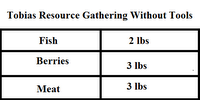
Assume a shipwrecked sailor (Tobias) on an island with no resources but his own two hands and his ingenuity.  To survive he has a number of options:  He can gather fruit/berries for a return of 3 pounds of berries per day, he can fish in the shallows(without tools) for a return of 2 pounds of fish per day, or he can hunt wildlife(without tools) for a return of 3 pounds of meat per day.

wageslavery1

Tobias requires 2 pounds of consumer goods per day to survive.  On this island consumer goods are either Berries, Meat, or Fish and given Tobias’ productive capacity of either 2 pounds of berries or 3 pounds of the other two consumer goods any intake of resources allows him to maintain his existence (subsistence).  It is at this point we must examine whether Tobias’ work is slave labor.

The definition [1] of a slave is:

1.

a person legally owned by another and having no freedom of action or right to property

2.

a person who is forced to work for another against his will

In our scenario is Tobias the property of anyone other than himself?  The answer is clearly “no” since Tobias is quite literally the only person on this island.  While he is “forced” to work due to his innate need for sustenance it would be counter-factual to claim he is somehow a slave to himself since the definitions of slave-master and slave are incompatible with another [2].  It is also absurd to say that because they provide his method of survival that Tobias is somehow slave to the ocean or the land [3].  So as we can see; when Tobias is alone on the island working to survive he is a slave to no one.

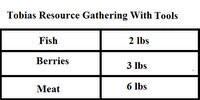
To this point we have been dealing with Tobias merely using his nature given resources to obtain and consume consumer goods.  However by collecting berries or hunting for two days (6pounds collected – 4 pounds consumed) he obtains 2 pounds of excess goods he can save.  Through this method of saving and then consuming the saved goods on the third day he can then use that time to create capital goods.  This means that on the third day, instead of hunting he can fashion himself a spear from collected wood.  The spear allows him to take on larger game and thus increases his collection of meat to 6 pounds per day.

 wageslavery2

At this point we need to examine two things.  First, at this point it would be foolish for Tobias to do anything other than hunt.  He has a decisive gain in resources due to his construction of the Spear and can use the vast amount of saved food to create even more goods (extra spears, traps, shelter, etc…).  As foolish as it may be objectively that diagnosis ignores his subjective valuations; perhaps he finds it distasteful to kill animals even in his situation, or simply prefers to pick berries due to the relative safety.  The reasons are irrelevant, just keep in mind that despite the obvious advantage of hunting in this scenario he can always choose not to.

The second thing we need to examine is whether Tobias is now a slave.  All of the evidence from the previous examination applies; he is still not a slave to himself.  The only thing that has changed is the creation of a spear from the saving of consumer goods.  It is clear that Tobias cannot be a slave to either the spear or his own saved consumer goods, again due to their nature as objects.  So we have seen that a worker working, both with and without capital goods, is a slave to no one.

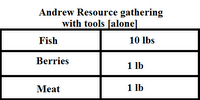
Now here is where the hypothesis comes into question.  Let us assume a second person becomes stranded on the island; except this person (let’s call him Andrew) has been able to scavenge from his wrecked ship a small life boat and netting that is suitable for fishing.  Using his tools while alone Andrew can Hunt for 1 pound of meat, gather 1 pound of berries, or gain 10 pounds of fish.

 wageslavery3

In this economy Tobias will gain the most by hunting and Andrew will gain the most by fishing and they both are likely to pursue those activities [4].  Now we must again identify if this change in circumstance has resulted in slavery.  Tobias’ situation has not changed at all, so he is not a slave to anyone.  Andrew is not interacting with Tobias in any way, he cannot be a slave to his boat, his net, the ocean, or himself so he is also obviously a slave to no one either.

However Andrew soon comes to believe that if he had someone to operate the net while he piloted the boat he could obtain 20 pounds of fish per day, this may be an erroneous prediction but that is the entrepreneurial risk Andrew must take to earn a profit.  For the sake of this examination we will assume that Andrew is an amazing entrepreneur and his prediction is exactly right; but to obtain the 20 pounds of fish Andrew needs an employee.

Here we reach the concept of wages.  In the economy where both Andrew and Tobias work alone they obtain 10 pounds and  6 pounds of consumer goods respectively for a total of 16 pounds.  Andrew, as an entrepreneur, sees that if he employed Tobias they would obtain 20 pounds of total consumer goods which is an increase in the size of their economy by 4 pounds of consumer goods.    At this point Andrew needs to hire Tobias.

If you remember; the subsistence level for Tobias is 2 pounds of consumer goods per day; so any attempt to hire Tobias for less than that will be ignored since he could not survive at that wage.  Currently though Tobias is producing 6 pounds of meat using just his own intelligence and skill so any attempt to hire Tobias below that rate will also be denied.

Andrew would obtain 10 pounds of goods without Tobias’ help so he would be amiss in paying Tobias more than that since then Andrew would then be taking a loss.  Using our final profit of 20 pounds if Tobias agrees to work for Andrew the wage rate must be between 6 and 10 pounds of goods per day.

In this scenario let’s assume Andrew offers to pay Tobias 7 pounds of goods in exchange for his work operating the net [5].   Tobias would then be gaining 1 pound of goods over his efforts if he worked alone.  Andrew would be gaining 3 pounds of goods compared to his work alone.  Tobias agrees to this arrangement and both parties are better off.  Here is where the proponent of wage slavery points to the fact that Tobias is seemingly generating 10 pounds of goods but only obtaining 7 pounds and thus he is being exploited by the capitalist-pig Andrew but let’s examine whether there is a master-slave arrangement here.

Andrew has freely chosen to hire Tobias at the cost of 7 pounds of consumer goods with the expectation of gaining 13 pounds for his own use.  He is free to terminate this agreement at any time.   Tobias is in a voluntary agreement to help Andrew obtain a total of 20 pounds of consumer goods in exchange for a payment of 7 pounds of goods.  He is free to leave at any time if the agreement becomes unsatisfactory and hunt for himself, though he would suffer a net loss of 1 pound of consumer goods to do so.

There is nothing here that fits the definition of slavery, Tobias is not forced to work against his will and Andrew is not forced to hire him.  Both parties own their own property and neither owns the other in part or in whole.  Even though Tobias would be taking a loss by leaving Andrew’s employment the loss to Andrew would be even greater!  Andrew would be losing 3 pounds of profit and Tobias would only be losing 1 pound.  Therefore despite Tobias’ innate need to work this does not cause a master-slave arrangement or “exploitation”.  It is true Tobias has to work to survive but he does not need to work for Andrew; but he voluntarily will continue to do so as long as it benefits him.

Finally, what of the “missing” 3 pounds of goods that Tobias is somehow losing?  The answer is obvious; it is the price put on Tobias’ use of Andrew’s capital goods which in this scenario are his boat and net.  Without these capital goods Tobias would not be able to generate 10 pounds of consumer goods and therefore there is a premium placed upon them by Andrew; after all they are his property and he must maintain them.  If Andrew’s boat was to spring a leak or his net tear Tobias would not have any responsibility to fix them and could happily take his 1 pound loss and go back to hunting while Andrew (if he had not achieved some profit) would suffer the far greater loss of both his 3 pounds of goods and the destruction of his capital goods.

It is worthwhile to note how this scenario compares to the classic opinion that people born into wealth have somehow acquired it illegitimately.  In our scenario Andrew did not need to save consumer goods like Tobias did in order to obtain capital goods, he simply has them due to luck, or fate, or what-have-you.  This does not change the fact that he does indeed own them and can utilize them how he wishes and that utilization is totally legitimate.  Would anyone scoff if Tobias handed down the hunting spear to a future son for his protection and livelihood?  To remain consistent we cannot then harry Andrew for passing down his fishing equipment for the sole reason that it would give his own heirs an “unfair competitive advantage”.

It is evident by now that the entire concept of wage slavery is simply a misunderstanding of economic principles.  Even the myth that somehow the wage earner does not get “his fair share” has been debunked.  The simple reason why so many find these concepts hard to extrapolate in the real world is due to the hundreds of years of savings, production of capital goods, and the highly specialized division of labor that has made worker productivity increase to such an extent that the fall to subsistence seems unfathomable.

The productivity of the workers in the industrialized world has become so great that any work outside of this world, such as gathering berries or fishing to feed an entire family, would require a massive drop in quality of life.  This is somehow turned around to be a slight on employers when they are the ones who have made this increase in the quality of life possible.

If we had replaced Andrew’s life boat in our scenario with a commercial fishing trawler that allowed Tobias to obtain 500 pounds of fish per day would we then say he is Andrew’s slave because he would be “forced” to return to hunting only 6 pounds of meat per day should he choose to leave?  Would Andrew be a villain for hiring Tobias and paying him such a vast increase over the wage he could obtain by working alone?  No! Of course not! It doesn’t logically follow!  Yet that is the accusation from the proponents of wage-slavery and it is clearly absurd.

[1] http://dictionary.reference.com/browse/slave?s=t

[2]  It is true that a slave could himself be the master of a third slave, but a slave master logically cannot be a slave to his own slave since either one slave or the other would end his own involuntary servitude.

[3] By their nature as objects they cannot own other objects.

[4] Whether they actually trade goods at this point is irrelevant because both parties are satisfying their base needs through their own effort.

[5] We are also assuming that the number of hours worked are the same and subjective preferences of hunting over fishing or vice versa are non-existent.

Bad News Bears: Ukraine, Russia and the West

No, I’m not talking about the Bruins choking in Pasadena earlier tonight. I’m talking about the Ukrainian government’s decision to balk at the latest Western offer for integration.

Well, at least I think it’s bad. The New York Times has all the relevant information on what happened between Kiev and the West. According to the Grey Lady, Kiev either balked at an IMF offer or had its arm twisted by Moscow. Both scenarios seem plausible, but I’d like to dig a bit deeper.

Ukrainians have been hit hard by this global recession, and last year they elected a government that is much more pro-Russia than it is pro-West. Unfortunately, I think the economy is only a small fragment of what ails the people in the post-colonial, post-socialist state of Ukraine (some people have started labeling “post-” states as “developmentalist” states; I like it but I’m not sure readers would). First of all, here are some relevant maps:

Ethno-linguistic map of Ukraine
2012 presidential election results in Ukraine
Map of per capita income in Ukraine

Notice a pattern? Yeah, me too. Basically, Ukraine is split along ethnic lines between Russians and Ukrainians and instead of recognizing this fact and focusing on property rights reforms first and foremost, the Ukrainians have decided to try their hand at democracy (on the inability of democracy to solve political problems in multi-ethnic states, see Ludwig von Mises’s Nation, State and Economy 72-84).

The conflation of democracy with property rights as freedom has been the single biggest mistake of all societies in the post-war world. From Ghana to Indonesia to Iraq to India to Ukraine, elites have focused their efforts on implementing democracy rather than property rights, and the inevitable, unfortunate results (“dictatorship and poverty”) continue to frustrate me. I’m sure the people who actually have to live under these conditions don’t like it much either.

Wouldn’t it be better if the current Ukrainian state  split into (at least) two independent states? I ask because it seems to me that having (at least) two different states will cut the number of losers in half (losers of elections in “post-” societies truly are losers; it’s nothing like having to “live under” Obama or Bush) and make the new, smaller governments more accountable and more accessible to the people.

The other aspect of Kiev’s rejection of Western integration that troubles my mind is that of the attitudes towards liberalization of Ukrainian society that many people obviously harbor.

For example:

  • Ukrainian-speaking Ukrainians overwhelmingly support more integration with the West. There are demonstrations (and I use this term loosely; riots may soon start) against the government’s decision to balk at the West going on right now.
  • And Russian-speaking Ukrainians (being Ukrainian can be either an ethnic thing or political thing [“citizenship”], which just goes to show you how stupid anything other than individualism is, but I digress) overwhelmingly support Moscow.

Yet it seems to me that both sides take the “pro-” and “anti-” stances that they do more out of spite for the other side than out of an understanding of what liberalization actually entails (I base this hunch on my watching of the recent elections here in the US). It’s also not clear to me that a pro-Western tilt would actually lead to more liberalization.

It may be easy for the Ukrainian-speaking Ukrainians to integrate and work with the West, but I think the Russian-speaking Ukrainians have good cause to look upon pro-Western deals with suspicion. After all, the Russian speakers are the richest faction in Ukraine, and freer trade with the West  would seriously undermine their political power (why do you think Russian-speaking Ukrainians have all the good jobs?).

Perhaps Evgeniy can enlighten us on the Russian perspective.

If Evgeniy doesn’t have the time you could just read Daniel Larison’s thoughts on the matter (Dr Larison is a historian with a PhD from the University of Chicago who specializes in the Slavic world).

New Mexico’s Police Breaking Badly

by Fred Foldvary

The AMC television channel recently concluded the drama “Breaking Bad.” The series was about a high-school chemistry teacher who has terminal cancer and “breaks bad” by making methamphetamine to get money for his treatments and for his family. The episodes take place in New Mexico, and some of the scenes occur in the desert.

Now the state government of New Mexico is breaking into real-life evil. Its police are stopping drivers and forcing them to submit to intrusive body searches and medical tests for drugs, including X-rays and colonoscopies. The hospitals then bill the victims for the involuntary procedures.

The State of New Mexico is establishing the principle that the state may force people to undergo medical procedures that they then must pay for. The worst aspect of governmental medical provision is that the health of individuals becomes a governmental matter, and therefore the state takes control over medical decisions. The federal and state governments may, in the future, force people to adopt preventive measures and periodic tests. The government will not only force citizens to have medical insurance, but also force people to submit to procedures such as anti-smoking treatments and colonoscopies.

One of the victims of medical coercion is suing the City of Deming in a U.S. District Court for being forced to submit to X-rays, enemas, and a colonoscopy. The police and doctors did not find any drugs in his body. As justification, the police claim that the driver was clenching his buttocks after being stopped for a traffic violation and ordered out of his car.

After that lawsuit was registered, it was reported that another man was probed for drugs in a New Mexico hospital after his car was stopped by police for failure to signal. The news media are now reporting that other drivers in New Mexico are being searched after getting stopped for alleged traffic violations. The police suspect the drivers of drug violations due to their appearance or due to dog sniffing, often with untrained dogs, and obtain warrants for the intrusive drug tests and body searches. In the case of the driver suing the state, the warrant was not even valid for the county and the time in which the colonoscopy took place.

The police in other states have been doing similar things. In Tennessee, the police took a man cited for an expired car licence to a hospital for drug tests, after a sniffing by a drug dog. A woman in Texas was strip-searched and double-probed by the police and by doctors.

The Fourth Amendment to the United States Constitution states, “The right of the people to be secure in their persons, houses, papers, and effects, against unreasonable searches and seizures, shall not be violated, and no Warrants shall issue, but upon probable cause, supported by Oath or affirmation, and particularly describing the place to be searched, and the persons or things to be seized.”

Unfortunately it is easy for the police to evade the Fourth Amendment because they can claim that their searches and seizures are reasonable. and some judges will routinely issue warrants if a dog, even if untrained, growls or points at the victim, or perhaps if the victim seems nervous.

Long ago, and still in some countries, highways were dangerous because robbers would halt a carriage or train and steal from the riders. Now, in the USA, the highwaymen are the police who are not content to merely issue citations, but use traffic violations as an excuse to enforce the drug laws. Driving in New Mexico is now dangerous because of the police predators.

Ecology is the relationship of living beings to one another and the environment. Evolution seems to generate predator-prey ecologies. Now that large predators such as lions and wolves have been eradicated from human habitat, ecology has generated human predators such as hijackers. Government is supposed to protect the public from such predators, but the drug laws have turned the police into yet another set of predators.

The German philosopher Nietzsche wrote that the “will to power” is the strongest human motivator. Individuals who seek the thrill of exerting power now become traffic officers, because they can stop any driver and have power over and into his body. This police predation is legalized rape.

From the Comments: Federalism, Small States and Central Banks

Rick Searle asks the following question after reading my argument with George Ayittey on secession in Africa:

Brandon, how do you respond to the geopolitical and macro-economic arguments in favor of strong federalism rather than small-state nationalism? The experience of Central Europe after the First World War seems to offer a telling example of what happens when you break-up multi-national states along ethnic lines. The collapse of the Austro-Hungarian Empire created a power vacuum which Hitler and Stalin were only too glad to fill. All of the thriving national states you have named exist under the implied or real security guarantee of the US.

Secondly, whatever the attraction of economic integration without political integration seems to be coming apart at the seams with the example of the European Union as we speak.

Breaking up Africa’s multi-ethnic states- unless they were replaced with a robust form of federalism- would, thus, seem to condemn that continent to perpetual interference by the big powers, and economic weakness.

Rick,

Thanks for chiming in. Your question and comments are very good ones.

how do you respond to the geopolitical and macro-economic arguments in favor of strong federalism rather than small-state nationalism?

As far as strong federalism goes, it is actually my preferred system of governance for the withering away of the state. Unfortunately, strong federal republics are few and far between in history. There are very hard to maintain and even harder to govern effectively. The best way to achieve a strong federal state is to start small and work your way up to a confederation, and if all sides want more political integration, then it would be wise to start putting together a federal state.

As far as small-state nationalism goes, I don’t want that. At all. What I am in favor of is smaller states without the nationalism. Remember, of all the small states I’ve listed most are fairly multi-ethnic. Denmark isn’t (I blame the crappy weather), but is still very open to immigration and international firms, while South Korea is currently trying to push an immigration reform bill through its parliament. Small states are good, nationalism is bad. More on this just below, but first:

The experience of Central Europe after the First World War seems to offer a telling example of what happens when you break-up multi-national states along ethnic lines. The collapse of the Austro-Hungarian Empire created a power vacuum which Hitler and Stalin were only too glad to fill.

Ah, great example Rick. Just to be clear: I don’t want to go around breaking states up. That would be both pompous and disastrous. Playing god is something only Leftists do! All I am saying is this: if a region within a state wants to secede from another state, then the international community should recognize this secession. There are a couple of caveats, of course. Doing this in China or Russia’s backyard would be a bad idea, but in the post-colonial world I think this is something that we should be looking at as a policy option to stunt the violence and poverty in these areas.

Recognizing the legitimacy of the secession would have three effects that would stop the violence for a time: 1) it would require that the new states prove their worth in the international community in the form of not persecuting minorities in their new state, 2) it would deter the state that just lost the region to secession from attacking another sovereign state for fear of reprisals and 3) the recognition of independence would inevitably lead to talks by both sides. Perhaps they could figure out a way to re-federate a few years on down the line, or perhaps they could come to some sort of agreement on trade. Whatever they do, they would at least be talking instead of fighting.

Failure to build an international consensus to recognize the independence of regions seeking independence will lead to more of the wars we have seen in much of the post-colonial world, as well as in the Caucasus and the Balkans.

Back to the nationalism you brought up earlier. A lot of states that try to secede are actually very multi-ethnic. Azawad, in Mali, for example, is a good example of a multi-ethnic region trying to break free from Bamako’s inept rule. With the advent of the market economy throughout the world (see my reply to NEO above), nationalism will continue to decline in prominence, and the areas of the world where nationalism is prevalent will be the hottest ones on the planet. States that thrive on nationalism are going to have to struggle to assert their authority over their people, and where there is nationalist promotion in government, there we will see most of the violence. I am thinking of China, Russia, Israel, Palestine, North Korea, and India-Pakistan.

In other cases, secession has taken place within a state that is largely homogenous ethnically. Somaliland, a democratic, relatively prosperous, but unrecognized state in the north of Somalia is a case in point. They want out of Somalia until all the violence and competition for the center of power dies down. They are open to re-federating, but in the meantime…

All of the thriving national states you have named exist under the implied or real security guarantee of the US.

Yes, but isn’t this in itself a form of confederation, or loose federalism? I’m all for more integration between the US and other societies, by the way. If we could get these states to integrate further economically, and could make our political borders largely irrelevant within the confederation: then security costs would largely be paid for. My co-blogger Jacques Delacroix has actually written one of the most stimulating papers on the subject of integration between states: “If Mexicans and Americans Could Cross the Border Freely.” I highly recommend it. Remember, one of the pillars of individualism is internationalism. Hayek, among others, lamented that we had lost this fight to the Marxists in the 19th and 20th centuries.

Secondly, whatever the attraction of economic integration without political integration seems to be coming apart at the seams with the example of the European Union as we speak.

Ah, but the problems of the EU don’t stem from economic integration, they stem from more political integration. The European Central Bank – a political creation if I’ve ever seen one – and proposed measures for a European parliament with more delegated powers is what has caused the strife in the Eurozone, not the ability of Greeks to work and vote in France, and vice versa.

Breaking up Africa’s multi-ethnic states- unless they were replaced with a robust form of federalism- would, thus, seem to condemn that continent to perpetual interference by the big powers, and economic weakness.

Agreed! But again, I don’t want to go around breaking up states. One big hole I see in my support for secession theory so far is the question of what if: what if the new state’s neighbors don’t play ball economically? Won’t that new state be isolated? Co-blogger Fred Foldvary actually wrote an article on this subject using Turkey’s rejection from the EU as an example: “Let Turkey Join NAFTA.” Another highly recommended piece!

Whew. Thanks again for contributing to the conversation, Rick, and don’t be bashful in throwing more fastballs my way. It helps me learn and clarify my thoughts!