“The Idea Trap” e o nacional-inflacionismo venezuelano-argentino

Minhas breves observações sobre a Venezuela e a Argentina. Aqui.

Seven Ways Libertarians Sometimes Run Off the Rails

I’m a dedicated libertarian but my first allegiance is to accuracy.  It pains me when I see libertarians making arguments that are inaccurate, irrelevant, or just plain wrong.  When they do so, they do themselves and our movement a big dis-service.  I list seven such arguments here.  More could be added.

  1. The Fed is privately owned. This is true only superficially. Member banks own shares of stock in one of twelve district Federal Reserve Banks and they receive dividends on those shares. But they have little in the way of genuine ownership privileges. They cannot sell their stock and their voting rights are very limited. The President of the United States appoints the Board of Governors. Just because a legal arrangement is given labels that suggest private ownership, that doesn’t make it so.

  2. The Bureau of Labor Statistics disguises the true unemployment situation by excluding workers who are “discouraged,” i.e., not seeking jobs. This is true of the U-3 unemployment figure which is the most widely cited figure, and the one the Fed says it is targeting. That figure is currently about 6.5%. The BLS also publishes its U-6 figure, which includes discouraged workers and currently stands at around 13%, down from about 17% at the height of the Great Recession. The BLS is not covering up anything here, although politicians may certainly choose to emphasize one figure or the other depending on what ax they’re grinding. Which is the “true” unemployment rate? There’s no such thing. The figures are what they are and observers can make of them what they will.

  3. “Chain-weighted” versions of the Consumer Price Index are politically motivated.  These adjustments are intended to recognize the substitution effect, the classic example of which is when the price of beef rises and the price of chicken doesn’t, people eat less beef and more chicken. Peoples’ cost of living rises less than it otherwise would. CPI increases as measured by a chain-weighted formula reflect this fact, and the resulting price inflation estimates come out lower than under the old approach. That flashes a green light to some conspiracy theorists. While these adjustments are tricky business, substitution effects are real and the attempt to compensate for them should not be impugned.
  4. The Consumer Price Index is politically manipulated by excluding food and energy. There are many versions of the CPI. One of them excludes food and energy because those prices are usually very volatile. That figure may be useful to economists who want to filter out volatile effects and focus on secular trends. Again, the figures are what they are, and politicians or for that matter we bloggers can use or misuse them as we wish.

  5. “Banksters” control the U.S. government. There is a grain of truth in this one. The big banks are both victims and beneficiaries of government dominance of banking and finance. The reality of government regulation is that regulated firms employ many very smart and very well paid individuals who are constantly finding ways to manipulate or sidestep the regulations to which they are subject. The fact is that the regulators and the regulated are very thick. Banking and finance are controlled by a cabal of government and Wall Street firms and individuals. It’s a mistake to say that either group totally dominates the other.

  6. Global warming is a myth and a scam. Ron Paul, whom I admire very much, blotted his copy book when he said on Fox News, “The greatest hoax I think that has been around for many, many years if not hundreds of years has been this hoax on […] global warming.” A few basic facts are beyond dispute: (a) carbon dioxide is a greenhouse gas, (b) CO2 levels are at an all time high, and (c) human activity is the primary cause of the increase. Beyond that, the evidence starts to get sketchy and incomplete. We do seem to have melting polar ice caps, record high temperatures in some places, droughts, etc. But overall there has been almost no temperature increase during the last ten years or so.  Projections of rising temperatures and rising sea levels appear to be too pessimistic. This is a very complex issue and one where biases can overwhelm us if we aren’t careful. Statists are prone to accept the global warming thesis because they see it as a way to increase state power. Libertarians want the issue to go away for the same reason. This would be a great time for all parties to step back an exercise some epistemic humility. There’s a great deal about this issue that we just don’t know.

  7. Let’s get rid of the state entirely, and all will be well. Given the present primitive degree of evolution of our species, a new state will pop up wherever an existing one is overthrown. The key to peace and prosperity is not anything so simple as abolition of the state, but to convince enough people, thoroughly enough, of the advantages of long-term cooperation. Good institutions will follow.

Do we have a Natural Right to be Annoying?

by Fred Foldvary

Suppose somebody is walking along the sidewalk carrying a big sign saying “I hate you.” Is he violating your natural rights? Should the state prohibit him from being annoying? Does freedom imply being protected from being annoyed, or does it protect our right to be annoying?

The citizens of Brighton, Michigan, believe that we have a right to not be annoyed. In 2008 the city council enacted an ordinance authorizing the police to cite anyone who is annoying in public “by word of mouth, sign or motions.” Violators will pay a fine. Brighton is not alone in this war on annoyance. Royal Oak, Michigan, also had such an ordinance, which serves as a model for other cities to copy.

A common source of public annoyance in some cities are beggars who ask for money as one passes by or, worse, come up to you with a sad story. Now, with the anti-annoyance ordinance, one can call the police, and the beggar will have his food in jail if he refuses to accept the ticket.

In some places, guys walk down the street in baggy pants that hang low. Another annoyance is inconsiderate guys who walk around with a loud portable music player; the music itself is often cacophonous, hence annoying, Those who are annoyed by such fashion and bad taste can now call the police and ask to have the offenders cited.

In economics, uncompensated bad effects on others are called “negative externalities.” The textbooks say that government can correct this by charging the person who emits the externality for the social cost. Evidently Royal Oak and Brighton have implemented this principle. You annoy, you pay.

Unfortunately, if you walk into a shop and seek some service, but the worker there is yakking on her cell phone, it is very annoying, but in Brighton you may not call the police, since the shop is a private place.

But what if the police are annoying? The police should not be above the law. If you are annoyed by a police officer, you should be able to call other police and have the officer cited.

You get a traffic ticket and the judge pounds the gavel and declares, “guilty!” Very annoying, and the court is a public place. You can get back at the judge; call the police and have the judge cited! But that would annoy the judge, so he will have you cited too. Now you have become annoyed again, and can have the judge cited for citing you. After all, if judges are above the law, we have no law.

What a wonderful weapon is this anti-annoyance ordinance. If your neighbor annoys you by hanging underwear in his back yard, call the police! Threaten to cite him, and he will have to do as you say. But that might annoy him, and then you have to do what he says. Whoops, now they are both slaves of one another. At least it’s equal.

Children are often annoyed by the restrictions and punishments imposed by their parents. They can now do something about it. When they are shopping or otherwise out in public, parents are often annoyed by their children whining, crying, complaining. parents can now tell their children that they will call the police if the kids don’t stop being annoying.

Perhaps the residents of Brighton and Royal Oak find this editorial annoying. Too bad; they can’t do anything about it unless I show up in those towns. I will make sure I never enter those towns.

The unemployment rate in Michigan is nine percent, and its major city, Detroit, is in bankruptcy. What I want to know is, if the residents find the bad economy annoying, who gets cited?

(Note: this article is adapted from “Do we have a Constitutional Right to be Annoying?” in The Progress Report, 2009.)

Some quick thoughts about political entrepreneurship

The Wall Street Journal has a weekend interview feature with an entrepreneur who founded Airbnb, a company that has been getting rich by exploiting the so-called “sharing economy.” Overall it’s an interesting read (I think the term “sharing economy” is misleading, but it is a stroke of marketing genius; “I’m not making money: I’m helping people share stuff!”).

However, after reading Rick’s recent thoughts on entrepreneurship and re-reading my own musings on how democracy works, this passage stood out to me like a sore thumb:

By year’s end, Airbnb says it will have booked more overnight stays than the Hilton and InterContinental hotel chains.

As might be expected, hoteliers and hospitality-industry regulators are suspicious of the Airbnb model. In October, New York state sued the company for violating a law passed in 2010—just when Airbnb was picking up steam—barring private citizens from renting an entire apartment for less than 30 days.

Why on earth would New York state undertake such a ridiculous ban? Ostensibly for safety reasons, right? Or maybe to better ensure that labor regulations remain up to par?

The law that hotel chains used to sue its competition strikes me as the perfect example of how cronyism works. The hotel chains are losing some of their market share to innovative competitors, but instead of improving upon their own models they turn to the political process, which (at least in the US) provides guaranteed access to any faction who would like to use it.

Just like in the marketplace, though, guaranteed access does not mean guaranteed results. Enter the entrepreneurial spirit. Except instead of finding ways to make money, the political entrepreneur is finding ways to prevent competition. This second type of entrepreneurship is also driven by self-interest. Libertarians, I think, recognize the dual nature of self-interest (in markets: good; in government: bad), but I cannot think of any literature off the top of my head that deals with this topic.

What I can note is that many people get the nature of self-interest completely wrong. In the minds of many, if not most, people, self-interest is something that only occurs in the marketplace. From this mindset springs many of the fallacies about government regulations and taxes that we often read about in the press. Whether this mindset is a product of genuine or willful ignorance is a topic that I think deserves further scrutiny.

Why is it, for example, that many people do not see that self-interest drives the political process itself? I know that the discipline of ‘political economy’ deals with self-interest in the political process, but even here I see a tendency to treat political entrepreneurs as more noble than the entrepreneur of the marketplace (with a few exceptions, of course). Support for higher taxes on corporations, or support for more stringent government regulations, is often very prominent among the general public and among elites. The general public thinks it is supporting itself against “big corporations” when it supports these policies, as do elites, but in reality these regulations and taxes are driven by an entrepreneurial process that desires to favor one faction over all others.

Am I missing anything? I know I’m missing a bunch of stuff.

Around the Web

  1. Recent Mexican reforms and the impact on the United States. From Gary Becker.
  2. Is the Pope’s Capitalism Catholic? Read this for the concise history lesson on Argentina rather than for the Pope’s opinion about public policy.
  3. Sandy Ikeda asks: Who is really threatened by innovation? Rick’s recent musing on political entrepreneurs can also shed some light on Ikeda’s question.
  4. The Liberty Constitution, Or, What About Slavery? Some libertarian legal theory for dat ass.
  5. Diplomacy.” A transcript of Rand Paul’s recent speech on US foreign policy.
  6. Why the world needs more globalization, not less.

David Theroux’s latest on Secular Theocracy, Part 2

Duck Dynasty and the Secular Theocracy, Part 2

Part 1 can be found here. For more Secular Theocracy as a concept, start here. David founded the Independent Institute, a highly-regarded think tank in the San Francisco Bay Area. In the summer after my first semester of college (2009; I started college in Feb of 2009 after hanging out in Ghana – long story!) I had the opportunity to attend the Independent Institute’s summer seminar for students.

In fact, that summer I attended four seminars put on by various libertarian think tanks and the Institute’s was the first of the summer. I really, really enjoyed it and was able to make some lifelong connections. For example, Dr Foldvary – the co-founder of this blog – was one of the lecturers there. Here is the Institute’s main web site.

Introducing the Weekly Wakeup

History is one of my passions and one I share with the late Murray Rothbard.  His examinations and refutations of the commonly accepted truth were one of my early inspirations into exploring libertarian thought.  I urge you to consider this quote from Plato’s Apology: “I am wiser than this man, for neither of us appears to know anything great and good; but he fancies he knows something, although he knows nothing; whereas I, as I do not know anything, so I do not fancy I do. In this trifling particular, then, I appear to be wiser than he, because I do not fancy I know what I do not know.”  This is the first in what should be a long series of weekly blurbs about common misconceptions and downright lies about history.  I will be looking forward to responses and suggestions for future topics in the comments.

Weekly Wakeup for 01-17-2014

Myth:  Early European colonists in North-America enacted a systemic genocide of native peoples from the start.

Reality: “The most hideous enemy of native Americans was not the white man and his weaponry, concludes Alfred Crosby,’but the invisible killers which those men brought in their blood and breath.’ It is thought that between 75 to 90 percent of all Indian deaths resulted from these killers.”

Another source confims:

“[B]ased on the data, the team estimates that the Native American population was at an all-time high about 5,000 years ago.

The population then reached a low point about 500 years ago—only a few years after Christopher Columbus arrived in the New World and before extensive European colonization began.

Study co-author Brendan O’Fallon, a population geneticist who conducted the research while at the University of Washington in Seattle, speculates that many of the early casualties may have been due to disease, which ‘would likely have traveled much faster than the European settlers themselves.’

For instance, the Franciscan friar Toribio de Benavente—one of the first Spanish missionaries to arrive in the New World in the early 1500s—wrote that Mexico was initially ‘extremely full of people, and when the smallpox began to attack the Indians, it became so great a pestilence among them … that in most provinces more than half the population died.'”

Myth: This disease epidemic was directly caused by settlers through planned biological warfare.

Reality:

Unfortunately for this thesis, we know of but a single instance of such warfare, and the documentary evidence is inconclusive. In 1763, [ed. Notably long after the “500 years ago” mark where the population was already markedly declined] a particularly serious uprising threatened the British garrisons west of the Allegheny mountains. Worried about his limited resources, and disgusted by what he saw as the Indians’ treacherous and savage modes of warfare, Sir Jeffrey Amherst, commander-in-chief of British forces in North America, wrote as follows to Colonel Henry Bouquet at Fort Pitt: ‘You will do well to try to inoculate the Indians [with smallpox] by means of blankets, as well as to try every other method, that can serve to extirpate this execrable race.'”

I would like to point out that this attack, if it ever did actually happen, was initiated not by individual settlers but instead by the military government in that region.  A group that I do not and would not defend under any circumstances.   I would also like to preemptively say that I am not attempting to justify the forced relocation of Native peoples later in history, wars waged by either side or the murder of civilians by either group.  Instead I merely wish to question the assertion that there was an intentional and premeditated genocide.  A fact that seems obvious when you consider up to 90% of the native population was already dead from disease before the first colonists even arrived.

What is entrepreneurship and why should you care?

The word entrepreneurship is thrown around a lot, but rarely defined. As far as I can tell nobody really believes (or is willing to admit they believe) that entrepreneurship is anything less than highly important (“Green child entrepreneurs are our future! Support our troops against breast cancer!”). It’s probably a wise political move to not pin down the idea because it means anyone’s cronies can be considered entrepreneurs. Speaking of which, “crony” is almost the antonym of entrepreneur. Cronyism evokes images of stagnation, inefficiency, “innovations” that make things worse, and opportunities for genuine improvement that are ignored.

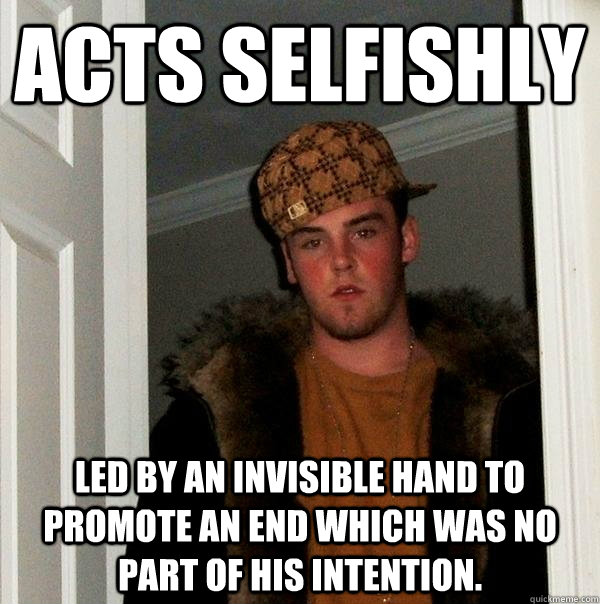
Invisible hand

So what does entrepreneurship mean? There are two general definitions, and both bear on the question of how to go about having a peaceful, productive, and morally praiseworthy society. The more general of the two is judgment in the face of uncertainty. That is, given that we don’t know what tomorrow will look like, and we certainly don’t know what the world will look like in 10, 25, or 50 years, we have to make wise, forward-looking decisions. We don’t have enough information to simply plug the relevant data into an Excel spreadsheet and get the “correct” action from a formula. In other words, understanding the ubiquity of entrepreneurship means that we still consider The Use of Knowledge in Society to be relevant.

The more specific definition is pursuit of pure economic profit (above “normal returns to capital, labor, etc.”) by pursuing hitherto un- or under-exploited opportunities. Such breaks from the status quo are the creative acts necessary for economic progress. Entrepreneurship is the human face of economic change that provides a micro-level description of what economists might otherwise wave their hands over and call “technology.” This sort of entrepreneurship is an important source of uncertainty about the future. 2014 is so much different from 1964 because of the actions of innovative entrepreneurs out to improve their own lives.

You’ll notice that I haven’t defined entrepreneurship in a way that actually is inimical to cronyism. That’s because not all entrepreneurship is productive. Destructive entrepreneurship is the pursuit of economic profit that makes the entrepreneur better off at the expense of someone else resulting in a net-loss. So we should be concerned not only with allowing individuals the autonomy necessary to be entrepreneurial (rather than merely reacting formulaically to top-down commands), but also with establishing institutions that direct people to help others.

Invisible hand

Turn the Page; New Bombings in Russia

[Editor’s note: the following is a short essay by Payam Ghorbanian. Payam was born in Tehran, Iran. He got his bachelor of science in Engineering from Zanjan University in Zanjan, Iran. He has been participating in liberal political activities and he was involved with some think tanks in Iran. He is doing research in the field of international relations and Iran’s foreign policy as an independent activist. He is now living in San Jose, California.

I cannot endorse this essay, but I am excited to post it because of its potential as a conduit for intercultural dialogue and exchange. I have left his essay largely intact, but did break up some of his longer paragraphs for clarity’s sake. Thanks to Payam for taking the time to write this.]

There is a narrow line between acting and having a reason and acting because of reason, reason is not merely the cause of the one’s acting. As Brain Fay said the having of this reason is the cause of agent’s acting and the reason does not explain the act, the act doesn’t occurred because of the one’s specified reason. After Boston bombing in the United States, Piers Morgan in his live show asked one of the Boston bomber’s friends to find out whether or not the bomber guy had any accent when he was speaking English. He probably wanted to give us a hint that the bomber might got involved in this disaster because of being teased by others around him. Morgan wanted to downgrade the threat of sinister ideology to personal reasons of bomber, which he was unsuccessful because of the friend responded: “no, not at all.”

Islamic fundamentalism has the holy goal to build or revive the Islamic nation the same as thousands years ago and to be able to run that nation with extremist religious rules in order to build the distinguished nation in order to beat the westernized nation in the judgment day.  I have to mention that it is not actually only about Islam, all historical religions because of consequences of compacting with modernism and being frequently defeated have this potential ambition to draw the utopia for their followers, although now we are facing with Islamic fundamentalism which is the great threat for all modernized countries. Even though they are fighting with modernism, they constantly use the modern stuffs for getting to the final step like weapons, electronic connections, chemical bombs, internet, computer and etc. This battle would not end up if we just want to focus on a single aspect of it. On the other hand, if we are going to say that they are only a threat when they attack us or our allies, so we might be able to divide them into the good and bad and take an advantage of them for stopping the threat of wicked (but modernized) countries like Russia, China or even Bashar Al-Asad’s regime in Syria. It should be drawn by us as a red line.

Dokka Umarov is the person who is known for several attacks in Russia with the goal of reviving the Islamic State in Caucasus; being so closed to Al-Qaeda. Getting involved in Syrian war made him the one of the most dangerous rebel leaders for Russian nation. He also said he will prepare the maximum force to disturb the security of the Winter Olympics on February 7 in Sochi and now he has this ability to challenge president Putin. The last operation of terrorist group in Volgograd’s bombing killed 34 people on December 31, 2013. It is just the beginning of the wrong way, retaliation of rolling in Syria with the hands of terrorist group inside the Russia.

This upcoming Olympic is not just a regular event for Russia. It is a pose of pride, especially for Mr. Putin and maybe for all Russians to get their confidence back and show off the 40 billion dollar which has been spent for preparing of this event till now and it could be seen as a heritage of Putin’s presidency. After these recent attacks Mr. Putin said: we will tough and consistently continue to fight. He also has pointed his finger at the Kingdom of Saudi Arabia (KSA) and call up for retaliation, which I think it is just more a threat, rather than a real action in order to prevent upcoming attacks.

When someone threatens you with an attack and at the same time someone else tries to blackmail you and offers you that if you want to prevent this attack you have to do something for me, it means that there is a connection between the person who threatens you and the person who wants to prevent the attack.

Prince Bandar Bin Sultan is the director general of Saudi Arabia intelligence agency from July 2012 until now and he was the KSA ambassador to the United States from 1983 to 2005. He was known for helping Bin Laden’s family to leave US after September 11. He consistently tried to get involve his country in Syrian crises and after found out that United States is not interested in taking military action in Syria, he prominently criticized Obama’s policy regarding the Arabian countries. He said: KSA would shift away from United States over Syria. He has been using millions of dollars of his country in Syrian’s war without getting anywhere and now this war is getting more predominated by dragging inside the Iraq as we have seen during the last month.

Bin Sultan has also tried to convince Russia to give up Al-Asad’s regime by offering them to control and stop Chechen terrorist groups during the winter Olympics and also by purchasing weapons from Russia worth of billions of dollars, as the news said. However, he was ultimately unsuccessful.  Mr. Putin knows this rule that if you take just one step back as a result of being frightened by terrorist groups, finally you will be totally turned away. I am into every activity which stops Mr. Putin and China’s government and their ambitions to build the new evil empire but I never ever think about using terrorist groups in order to push them back. They are modernized countries which means they can be backed off by modern means.

The Saudi Arabia with the eternal sick king and hundreds of princes with the lack of any discipline over them seems like an oligarchy. Increasing oil price and powerful armies which has been supplied by United States would really inflate their egos without any financial structure. They really think they can get involved in the games of power. They are in the same path where the last king of Iran was which is going directly to the land of darkness and being unaware of what their people really want and finally overthrowing by them but in this case of Saudi Arabia it takes a long time because of the unfortified middle class but it will ultimately happen. Just take a glance to the Mohammad Reza Shah’s interview in 1974 with BBC he said: “I think our country in the next 10 years will be what you are today. In next 25 years; according to other people, I am not saying that, will be among 5 most prosperous countries of the world.” Several years after this interview, all these bubbles just busted and he could not or would not realize what his people, especially the middle class, are looking for maybe just a little bit of freedom.

Unfortunately the Saudi Arabia and several countries in the Middle East can be called as the ‘necessary dictatorship’. I just made up this word to explain my thought. At this time these regimes surpass far their people, any effort to change the regime will invite the extremists to the party so we obviously prefer to face with dictators instead of terrorists but these sorts of countries should be pushed forward by international union to start reforms. I really like the way that the United Arab Emirates (UAE) has followed by opening the gates of the country to the foreign investors with the useful rule of “51 percent of a business must be owned by a UAE national.” This means involving the local people in the business and helping them to lift up instead of putting them down by giving them money occasionally. A person who owns a business will be much more conservative about the definition of Jihad. Now in KSA by the sinister ideology, minds are polluted. Hostility and animosity just spread out so we can tell it will be prolonged but it should start right now otherwise allowing these countries to use the extremists as a political weapon or even helping them in Syrian War will just ignite the worst catastrophe. Remember Al-Qaeda was supposed to fight with Soviet Union but now it fights with the free world and all aspects of that.

Frihet eller rättvisa?

På sjuttiotalet formulerade Robert Nozick ett argument mot så kallade ”rättvisa resursfördelningar”, alltså politiska åtgärder som tar från en person och ger till en annan för att samhället ska uppnå ett mer rättvist resursinnehav. Argumentet har sedan slipats på av bland andra Eric Mack och lyder nu ungefär såhär.

Anta ett samhälle där privat egendom finns och får säljas, köpas eller bytas helt fritt, men först efter att den har arrangerats om politiskt enligt ett visst fördelningsschema. Fördelningsschemat kan vara exempelvis att alla får precis lika mycket eller att en andel tas från de rika och ges till de fattiga. Du, läsaren, får välja vilket slags fördelningsschema som ska användas och bestämma alla dess detaljer. Oavsett hur det ser ut ska det vara avsett att generera ett rättvist tillstånd av resursinnehav som kallas för D1.

Säg nu att detta fördelningsschema genomförs så att tillstånd D1 råder. Säg också att invånarna i samhället efter fördelningen byter resurser med varandra för att på egen hand uppnå ett tillstånd de själva föredrar. Müsli byts mot corn flakes. Kvällsskift byts mot lördagspass och en hundralapp byts mot åtta folköl. En duktig basketspelare erbjuder en halv miljon människor att komma och se henne spela för bara tio kronor per person och tillfälle, och blir därmed mycket rikare än de flesta andra i samhället. Saker och ting byts helt enkelt så att alla blir lite mer nöjda än vad de var tidigare. Det tillstånd som uppnås av att folk frivilligt byter saker med varandra kallas för D2.

Resursinnehavet i tillstånd D1 var rättvist. Det har uppnåtts genom det fördelningsschema som du, läsaren, själv har valt. Men D1 strider med D2, vilket var tillståndet som invånarna föredrog. Eftersom D1 är rättvist kan inte D2 vara det, för då hade du valt D2 redan från början när du utformade ditt fördelningsschema. Vad är det med fri byteshandel som medför orättvisa från D1 till D2?

Argumentet fångar någonting om essensen i marknadsekonomin. Först och främst är dess enkelhet en fingervisning åt svårigheten i att på politisk väg skapa ett ”rättvist” tillstånd. Den som bestämmer måste fördela resurserna så bra att ingen längre vill byta någonting (vilket socialismens kalkyleringsproblem visar är väldigt svårt, eller helt omöjligt). Men framför allt visar argumentet att ett fördelningsschema som är avsett att uppnå rättvisa är oförenligt med frihet. Om människor använder sin frihet till att byta saker med varandra rubbas det du kallar för rättvisa. Ett samhälle kan alltså inte ha både frihet och ett ”rättvist resursinnehav” samtidigt.

Läs mer:

  • Robert Nozick, Anarchy, State, and Utopia, kapitel 7, sektion 1
  • Eric Mack, ”Self-ownership, Marxism, and Egalitarianism”, Politics, Philosophy & Economics, vol. 1, no. 1, 2002

Bons restaurantes e liberdade

Sugiro um “rolezinho” lá no meu blog para apreciar o tema citado no título. Digamos que é um aperitivo. 🙂

From the Comments: Was Colonialism Good for the Natives?

NEO, in response to my musings on the rule of law in Africa, writes:

Thanks, Brandon. Like I said, I don’t know very much at all about Africa, right now I’m looking a bit more at the British in Egypt/Sudan. But currently I know mostly what I read and I suspect you know what I see, so I’m not about to argue with you on it.

Given what you know, I see really good things ahead for them. And that is very good, both for them and us. Somebody once said that prosperous folks try to avoid wars because its hard on the china. I know, it’s simplistic but, its also true.

I get the impression, and I could easily be wrong here, that it might have been better for everyone if the Empires had lasted a few more decades, it looks to me like the people learned the lessons but not the mechanics of creating the institutions.

Excellent point NEO, especially about wars being bad for the china.

Now, the colonial empires were bad for just about everybody (the factions that were able to capture the rent generated by imperial policies were excepted, of course). While European imperialism did open up the markets in Africa and Asia to their mercantile spheres of influence, these policies did not open up the markets to genuine world trade. This has had several ramifications for individual liberty in the post-colonial world.

In order to open up the economies of Africa and Asia to their mercantile systems, the Europeans created a great legal code for the mercantile systems. These legal codes helped reduce transaction costs and protected the private property of European citizens abroad, which helped to foster more trade within the mercantile systems. Unfortunately, the legal codes of both the British and the Dutch (I can’t speak for the Latin states, but judging by the state of affairs that these regions are now in, I assume that such policies were just as bad, if not worse) created a two-tiered system of justice: Europeans and a small number of local elites were able to count on the legal system to protect their private property, but everybody else was relegated to a second-class citizenship. This two-tiered system was not good for the populations of Africa and Asia, nor were they good for European citizens.

It goes without saying that the colonial apparatuses did not have to do much work in regards to grafting the indigenous legal and political systems of the African and Asian polities onto the mercantile system. Most of the African and Asian polities that the Europeans subdued were already protectionist and despotic, so colonial policy became a careful matter of picking the right factions to ally with. It is important to note that the policies of the polities in Africa and Asia were responsible for their weakened state, not any sort of cultural attributes. Up until the Napoleonic Wars, Europe was still pretty much on par with the rest of the world as far as living standards went. With the advent of peace on the continent, and new legal codes that extended private property rights (including rights to freer trade in the world) to a larger segment of its citizens, Europe became far too powerful for everybody else.

We could argue, of course, that certain cultural attributes of Europeans at that time contributed to successful implementation of such policies (and we would be right), but culture is always changing. It is our task to ensure that we continue to contribute to a culture that values individual liberty above all else.

Again, this is not say that African and Asian peoples have never known liberty. Private property has been around for a long time. The arrival of European states (not merchants) into these regions of the world created a burgeoning market for all things war, and as hostilities increased, so too did the health of these states.

David Theroux’s latest on Secular Theocracy

Duck Dynasty and the Secular Theocracy.”

For more on David’s argument about secular theocracy, start here.

Whatever was true now was true from everlasting to everlasting….

A very interesting post popped up in the technology subreddit on reddit.com a couple of days ago.    It was simply titled “What reddit looked like 9 years ago”  and the content was “Exactly what it says on the tin”.   

A web archive of reddit nine years ago.  The real fun was in the comments though where a redditor with the highly appropriate and musically astute username of “WarOnErrorism” posted the following:   

Third fuckin page. “NSA Spied on U.N. Diplomats in Push for Invasion of Iraq “

Edit: And on the 6th page: “AT&T NSA Wiretap Whistleblower Marc Klein’s Story In His Own Words”

Edit 2: Same page: “Whistle-Blower Outs NSA Spy Room”  

Links added for posterity.  

Nearly a decade ago the truth was out in the open for anyone to see and it was ignored.

Around the Web

  1. Women and Men, Why Can’t We All Just Disagree?
  2. Al-Qaeda Leaks: Baghdadi and Golani Fight Over the Levant Emirate
  3. A new Nollywood film (wiki article on Nollywood)
  4. Why American Presidents love foreign affairs
  5. So you want to live in a free society: What Hayek saw
  6. The US government’s war on poverty