SOTU: a Masterwork of Co-option.

Sheila Broflovski ‘solves’ the ‘problem’ of ‘obscenity’.

A professor of Political Science at my school described the modern left-right paradigm for the class today — to paraphrase, he summed up the political landscape of the US with the all-too familiar perspective: ‘conservatives want less government, and liberals want more government’.

I opined, silently, in my seat.  Sensing my disapproval, the professor asked if anyone had a differing perspective on the country’s political spectrum.  I raised my hand and pointed out the perspective of this oft-regurgitated axiom of political theory.  rephrased the point: Conservatives want liberty, and Liberals want safety.  When it was suggested by a classmate that I was coloring the axiom to suit my political bent, I defended my choice of language.  This phrasing, I argued, is the happy middle ground between the original, popular formulation that the professor used, and a statement that more closely aligns with my actual opinion: Conservatives want freedom, and Liberals want slavery.

When placed together, these three phrasings of the same observation illustrate the powerful effect nomenclature can have on a statement — and sheds a pinhole of light onto the vastness of the power of language analysis with respect to ideology:

Conservatives want less government, and Liberals want more government.

Conservatives want liberty, and Liberals want safety.

Conservatives want you to be free, and Liberals want you to be a slave. 

The words we chose to use when we frame our thoughts betray our underlying perspective.  Language is the seat of understanding, and can be deconstructed to suggest motivation and perspective.  Analyzing the language used by self-styled ‘progressive liberals’  (forgive the quotes — the term itself is completely removed from cogency as a representation of meaning, as is ‘conservative’.  These two terms as used in modern US politics do not come anywhere near connoting accurate definitions) yields a lexicon that I dub the language of Co-option.  This liberal dictionary is used by a vast majority of the public out of rote; most people do not consider deeply the meaning of the language they use.  Those that speak this dialect knowingly craft the language, and therefore, the thinking, of the larger public who adopts the dialect and spreads the meme and built-in collectivist programming therein.

This Language of Co-option is the language of our classrooms.  It is the language of our politicians.  It is Hegel.  It is Sociology.

Let’s vivisect the following liberal sociological speech pattern:

is bad for society.  We should do so that happens instead.”

To make the point that much clearer, let’s translate the above formulation into political rhetoric:

“For American families, x is a real problem, so our administration is committed to policy so that z will result.”

To define our terms:  the value in this construction represents a ‘problem’ — to be specific, some suggested verifiable disadvantageous phenomena, that would be mitigated by taking action.  These instances exist; we can plug in some terms for our variables to create cogent statements:  Suffocating is problematic for humans, therefore humans should breathe.  This construction is cogent because human beings need to breathe in order to avoid suffocation, which is indeed, harmful to humans.  However, such statements rarely provide people with new insights, because cause and effect tend to be plainly apparent; most everyone knows that they need to breathe to live.  It seems tedious to think such obvious statements would warrant comment, let alone, say, a State of the Union address.

The power of this statement only manifests when coupled with action — the y variable.  The point of x, of stating an obvious ‘problem’, is merely to gain the agreement of the audience to the that will follow.  In fact, in political speech, and need not have any real connection at all.  This effect has been pointed out by others, including the research of behaviorist Ellen Langer, who’s research suggests merely by adding any explanation to a request one can improve the chance of a ‘yes’ in response.

For example, take this phrase from the State of the Union Address last night:

“There are other steps we can take to help families make ends meet, and few are more effective at reducing inequality and helping families pull themselves up through hard work than the Earned Income Tax Credit.”

to simplify:  “Poverty (x) is a problem for people, and we can fix inequality (z) with the EITC (y).”

Let’s break it down critically.  Poverty is always a problem for a family, as it is averse to survival.  If you don’t eat, you starve — as obvious as the sun shining in the sky.  This statement alone is almost as bereft of importance as ‘nice day, huh?’ or ‘how about those (insert local sports team name)!’ The President must have had a reason to make the comment.  The statement made in this way implies poverty is a fixable problem in society, rather than a product of the human condition or the laws of our natural world.  The first law of the human condition is scarcity; there is never enough of any resource to satisfy demand in any economy.  When coupled with the Second Law of Thermodynamics, any natural system in the universe behaves the same way.  POTUS makes the statement about poverty implying a collective problem that can be solved by some action.

The showstopper for libertarians is usually y.  The solution to the problem offered by the state is ALWAYS aggressive force.  In the above example, that aggression is in the form of extortion — specifically, theft of property through threat of violent action via taxation.  This is stated in a positive light as phrased; the Earned Income Tax Credit is sold to the public as a tax break for some people, but comes at the expense of everyone else.  The fact that your government is extorting less money from some than from others is aptly defined as ‘inequality’, but this obvious truth is distorted and reversed completely with Co-optive language to masquerade as benevolence, yielding the aberration cited.

This construct is the essence of the Hegelian ‘crisis, reaction, solution’, and is a hallmark of Co-optive speech and thought, and permeates our zeitgeist.  Freedom-minded individuals hear this language and know just how ubiquitous it is in society — keep it in mind the next time you hear someone spray about what ‘We’ must ‘do’.  Co-option is built in to the culture and mindset of authoritarianism, and in fact, the democratic process itself as naked tyranny of the supposed majority.

Please, feel free to post your co-optive, authoritarian quotes in response below!

Narrating the Decline from a Classroom Desk,

L.A.Repucci
The State of the Union and the State of our Liberties

Nevertheless it is important not to fall into the delusion that President Obama presents the greatest danger to the culture of liberty. A historian looking back a hundred years from now is likely to group the Reagan, Bush I, and Clinton presidencies together as an era when the state receded or at least did not grow, as measured by regulatory and fiscal burdens on our lives. But Bush II relentlessly increased domestic spending and created more government involvement in health care with the Medicare D program for prescription drugs. It was President Bush who initiated many of the NSA programs.

In short, there are more similarities between Bush II and Obama than their supporters or detractors care to acknowledge. And almost all of the similarities suggest that the risks to our liberty today transcend the actions of any particular politician.

From John McGinnis. Read the rest.

From the Comments: More on Property Rights

Rick chimes in on my musings about political entrepreneurship:

Reducing competition *is* a way to reduce competition. A company can invest effort in increasing value or reducing availability of substitutes (both shifting demand) or in reducing costs or shifting costs onto others (supply shifts).

(Okay, now I’m going to go into some philosophical stuff purely for my own benefit…)

That’s the high level story, but it rests on a foundation of property rights; by which I mean the de facto property rights that actually matter, not some rights assigned by Santa, or rights that are just and proper as defined by very sensible arguments by libertarians. “Society” generally accepts that the government holds particular property rights that touch on a number of possible exchanges in order to promote–we can tell that that’s the case because people aren’t willing to undergo the cost of stripping those rights away. The hotel lobby has recognized that to be the case and so has asked the state to exercise those rights in a way that benefits the hotel lobby and they have offered some sort of exchange (which may be as vague as “social capital”/reasonable expectation of future political support, or as explicit as bribes, but probably something in between). This exchange has altered the shape of the socio-political-economic environment in which similar exchanges may occur in the future.

Addendum: Pretty much all of the ‘comments‘ in Warren G’s post on the seven rhetorical weak spots of libertarians are worth re-reading, too.

Rick Weighs on Intellectual Property: More Questions Than Answers

Adam recently posted that the British government is contemplating pretty outrageous penalties for Internet pirates. Naturally I wanted to chime in with an outrageously long comment about the nature of property and the (im)possibility of intellectual property (IP) rights. That’s just the libertarian thing to do! There’s a lot to say and it will take more than a few beers to sort this whole thing out, so I’m going to limit myself which means I’ll just raise more questions than I answer…

So let’s start with why IP doesn’t make a lot of sense. IP is information and information wants to be free. My use of a song doesn’t prevent you from using it. IP isn’t scarce in the way a car is. Besides, there’s some evidence that government enforcement of IP does more harm than good. And pirates end up spending more to buy IP than other people anyways (I usually listen to music for free on Grooveshark, but the other day I thought, “I’d really like to tell Willie Nelson that I think his music is great,” so I bought an album even though I could have listened to it for free!). And besides, musicians can make money by performing live.

But just because it isn’t a tangible thing, doesn’t mean we are forbidden from attaching rights to it, even in anarchy. Property rights are a “bundle of sticks.” I own my land, but you might have a right to the sunshine I would block if I built a skyscraper. Likewise, a society can come to some sort of quasi-unanimous agreement that the creator of a song has the right to control its use, even in the form of digital files.

Now, government enforcement of IP laws is fraught with difficulties even before we get to public choice issues. Should a patent be 20 years or 19.5? If the optimal patent length is 16 years, then the current system is a net subsidy and so creates economic inefficiency. But determining the optimal length in a world of benevolent political actors is an incredibly complex problem. How stringently should patents be enforced? How do we account for the differences in conditions that affect different patents (or copyrights, etc.)? This argument doesn’t say “don’t do IP,” it just says, “hey, this whole venture has its own set of costs we need to account for. It’s conceivable that we conclude that the optimal patent is probably between 5 and 20 years, but if we’re off by more than 4 years the costs of the error will outweigh the net benefits of the patent.

Then there’s the public choice problems. We don’t want IP law to be some Mickey Mouse operation set up to hurt consumers.

But (and that’s a big but!) we have to return to this issue of property rights. When I buy an apple, I’m concerned with the physical thing, but really I’m buying a bundle of rights. The rights are what’s being exchanged, and then later exercised. These rights are socially determined and often-but-not-always-or-even-mostly enforced by government. Yes, if I steal your car the government will probably get involved. Yes, the government provides a back-stop to rights enforcement in a lot of areas. But rights are ultimately a social-political construct that can exist in anarchy. What does this mean? First, it means that we could conceivably have intellectual property rights . Second, it means that we could have such rights in a state of anarchy.

Obviously the nature of the good will affect the viability of such a system. Enforcing IP laws is difficult enough when some third-party can come in and say “you’re a pirate and you’re going to jail.” In a common law situation where you have to make the plaintiff whole, it’s difficult to say what that means. Reputation plus property rights might keep comics from stealing others’ material, but it might just separate the comedy industry into auteurs with sophisticated audiences and Carlos Mencia with less sophisticated audiences.

We can safely label a law or institution as legitimate if it is unanimously accepted. In the case of IP, such unanimity seems unlikely. In any case, I still suspect that government involvement in IP does net harm although I’ll grant that it’s a (probably impossible to answer) empirical question.

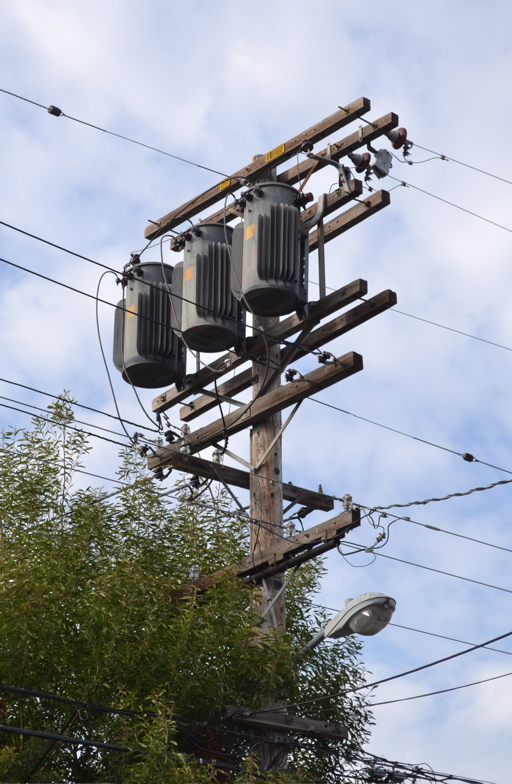
Gratitude to a Power Pole

Image

Whilst ambling around San Carlos recently, I came upon the power pole shown here. Ugly, isn’t it? Or maybe not. In fact, my reaction was one of gratitude, prompted in part by the “Gratitude” chapter in Joel Wade’s excellent book, Mastering Happiness (available at drjoelwade.com). I had listened to the chapter the previous evening.

What is there about this power pole that warrants gratitude, and to whom? The answer lies in really looking at the pole and pondering the devices, wires and cables attached to it.

The top crossbar holds wires that provide the electrical supply, probably three-phase 440 volts. I know the supply comes from a substation a mile away which in turn is fed from very high voltage transmission lines east of the freeway. Three transformers on the pole step the 440 down to 220 and feed it to surrounding buildings.

Ugly grey boxes? Not to me. Some anonymous engineers put their heart and soul into designing those transformers. The basic idea of a transformer has been known for years: use a pair of coils with different winding densities to convert electrical energy into magnetic energy and then back to electrical at a desired voltage. But to design a really good transformer requires careful attention to fabrication costs, reliability, safety, and operating efficiency. No transformer is perfect; some energy gets lost as waste heat, and heat must be dissipated even in the hottest weather lest temperatures exceed safe operating levels. (Notice the cooling fins on each transformer.) The fluid bath which enhances efficiency must never leak – or more precisely, the probability of leakage must be kept extremely low. Nice job, guys (maybe gals, too). Thanks!

I see telephone wires. Of course, wireline telephone service is declining but still there is a lot to ponder. Four blocks away is a big windowless AT&T building which I believe houses switching equipment that was a marvel in its day.

I see coaxial cables that transmit television and internet signals. Just think of the torrent of information coursing through those cables. These days we all take megabit download speeds as a God-given right. Try to picture millions, perhaps hundreds of millions of bits traversing one of those cables every second. In addition, the cables entering those poles from Comcast’s central office, wherever that may be, carry a mix of packets destined for different recipients. They must be sorted and delivered on time and in the proper sequence to the various recipients served by our pole. I see three small boxes on the pole that may perform that function. The Post Office is a block away. Imagine the sorters there sorting a million letters per second!

I see a small device which may be an antenna for the new wireless electric and gas meters. Predictably, there have been complaints about health effects from these devices, likely from people who have no clue about the difference between ionizing radiation and RF radiation. Others have complained about privacy. I personally feel no need to hide the details of my electrical usage. I look forward to the advent of time-of-day pricing that these meters will enable. The resulting incentives should save money for many people including me. In addition, PG&E will be able to forestall increases in peak power capacity.

The pole itself is a tree trunk treated with creosote. Aluminum is used in substation structures and transmission towers but is evidently uneconomical for street poles. Wooden poles eventually rot and require replacement. But replacing a pole requires far less time and labor than in past times because of the improved equipment and procedures that have been developed.

Now I grant you that such poles will remain ugly in the eyes of many beholders no matter how much they may learn about their function. So why not put all the wires underground? Just dig a trench and move them, right? Not so fast, it’s nowhere near that easy. Of course it can be done and has been done but there are many complex and expensive details. For one thing, most of the buildings served by the relocated lines would require interior modifications to accept cables from underground rather than overhead. It wouldn’t do, as part of a beautification project, just to run cables down the outside of a building from the old rooftop connection point to the new underground point. Underground transformers are costlier and harder to access. The old service must be kept running until the new service is ready, and the switchover must be done quickly and near-perfectly. The costs and benefits of an undergrounding project should be carefully weighed before it is undertaken.

Gratitude to a power pole? No, in the spirit of Leonard Read’s I, Pencil I owe my gratitude to the countless individuals who made it possible. I think of Faraday and Maxwell who gave us the keys to understand electromagnetism. Edison and Tesla who pioneered power generation. Anonymous engineers and linemen who make it happen. Bold thinkers of the Enlightenment who paved the way for what McCloskey calls bourgeois dignity and the consequent explosion of Western living standards in the last three centuries.

Some people are moved to gratitude by religious iconography. Good for them. For me, a power pole does the trick.

Trade and cruelty

Time for me to geek out on basic economics again. I’ve been on a Top Gear kick and I’m currently watching the North Pole special. Richard is taking a sled dog team to the north pole and Jeremy and James are racing him in a truck (in order to be the first people to drive a car to the North Pole).Their big advantage is that they can drive as hard as they want, whereas Richard is limited by how hard the dogs can go. Hypothetically he could push them harder and get their faster, but to do so would be cruel. This got me thinking.

The car is what economists call capital, whereas the dogs are labor. Strictly speaking the dogs are capital as well, but due to our enlightened modern ethical precepts we’re morally concerned with their welfare. Remember Planet of the Apes? Those damn, dirty apes had been thought of like chattel slaves, and the folly of that was shown by their taking over the earth. Legally, if your sled dogs won’t run, you can get rid of them. Putting them down might be considered cruelty to animals and thus illegal (I’m not sure), but it would certainly be considered immoral by many westerners. If we think about a labor-capital continuum, dogs are closer to the labor side than cattle, and a car is all the way over at capital.

So capital has a different moral standing than labor (or “quasi-labor” like dogs), but does that mean there’s no possibility of cruelty?Running the truck into the side of a glacier won’t make an engineer cry, but it would create work for a mechanic and wrecker operator (assuming they decide to recover it). “But wait,” you say, “jobs are awesome! JOBS!”

But I put it to you: jobs aren’t good. If they don’t pay the mechanic, then they’re making him (or her) suffer. To make someone work is to be cruel. But in the real world nobody makes mechanics do their work, people induce them to do that work by making it worth their time. Mutually advantageous trade is beautiful and kind. (Okay, that’s only certain with euvoluntary exchange).

Oh! And an I, Pencil moment: The truck made it to the north pole, allowing two middle aged, out of shape men, to make a journey that otherwise probably would have killed them. Through gains from trade, and capital that both represented and applied embedded knowledge, in order to reach a destination that has been visited by no more than a few dozen humans.

UK considering long prison terms for file sharers

https://torrentfreak.com/uk-considers-throwing-persistent-internet-pirates-in-jail-140123/

Up to ten years in fact.  While there is debate in the libertarian community over intellectual property laws I think that I would be hard pressed to find many libertarians that think downloading a movie should put an “offender” in prison for a similar amount of time as stealing a car. 
 

Is China running out of cash?

Is China running out of cash?

China Halts Bank Cash Transfers

“The People’s Bank of China, the central bank, has just ordered commercial banks to halt cash transfers.”

Could we be seeing the start of total economic collapse? The answer, ceteris paribus, is yes and the Austrian Business Cycle Theory (ABCT) explains why.

To quote Ludwig Von Mises’ explanation of the final act of the ABCT:

Ludwig von Mises stated that the “crisis” (or “credit crunch“) arrives when the consumers come to reestablish their desired allocation of saving and consumption at prevailing interest rates.[12][

This means that when consumers finally realize that the money they have invested has actually been malinvested in the economy they then seek to acquire as much of their money as possibly from said investments. Most of which take the form of bank deposits.

The linked article reminds us that this is the numerous such time that China has adopted this policy saying:

“So what’s really going on?  This crunch follows similar incidents in June and December of last year.  In June, for instance, the central bank used the excuseof a “system upgrade” to allow banks to shut down their ATMs and online banking platforms.  As a result, they conserved cash and thereby avoided a nationwide meltdown.”

Other instances, such as this one in England where “[s]ome HSBC customers have been prevented from withdrawing large amounts of cash because they could not provide evidence of why they wanted it,” show that this problem may not be contained to China and may be spreading to the international market.

What does Murray Rothbard say will happen when this “credit crunch” inevitably occurs?

Wasteful projects, as we have said, must either be abandoned or used as best they can be. Inefficient firms, buoyed up by the artificial boom, must be liquidated or have their debts scaled down or be turned over to their creditors. Prices of producers’ goods must fall, particularly in the higher orders of production—this includes capital goods, lands, and wage rates […]

this means a fall in the prices of the higher-order goods relative to prices in the consumer goods industries. Not only prices of particular machines must fall, but also the prices of whole aggregates of capital, e.g., stock market and real estate values. In fact, these values must fall more than the earnings from the assets, through reflecting the general rise in the rate of interest return […]

“Since factors must shift from the higher to the lower orders of production, there is inevitable “frictional” unemployment in a depression, but it need not be greater than unemployment attending any other large shift in production. In practice, unemployment will be aggravated by the numerous bankruptcies, and the large errors revealed, but it still need only be temporary […]

Another common secondary feature of depressions is an increase in the demand for money. This “scramble for liquidity” is the result of several factors: (1) people expect falling prices, due to the depression and deflation, and will therefore hold more money and spend less on goods, awaiting the price fall; (2) borrowers will try to pay off their debts, now being called by banks and by business creditors, by liquidating other assets in exchange for money; (3) the rash of business losses and bankruptcies makes businessmen cautious about investing until the liquidation process is over.

With the supply of money falling, and the demand for money increasing, generally falling prices are a consequent feature of most depressions. A general price fall, however, is caused by the secondary, rather than by the inherent, features of depressions.

So is the massive failure of all economies imminent? Well not necessarily because the government can take some steps to prevent the immediate failure.

According to Mises:  

“Continually expanding bank credit can keep the borrowers one step ahead of consumer retribution (with the help of successively lower interest rates from the central bank). In the theory, this postpones the “day of reckoning” and defers the collapse of unsustainably inflated asset prices.[12][14] It can also be temporarily put off by price deflation or exogenous events such as the “cheap” or free acquisition of marketable resources by market participants and the banks funding the borrowing (such as the acquisition of land from local governments, or in extreme cases, the acquisition of foreign land through the waging of war).[15]

The “false” monetary boom ends when bank credit expansion finally stops – when no further investments can be found which provide adequate returns for speculative borrowers at prevailing interest rates”

These steps only “kick the can down the road” and delay the inevitable since “the longer the “false” monetary boom goes on, the bigger and more speculative the borrowing, the more wasteful the errors committed and the longer and more severe will be the necessary bankruptcies, foreclosures and depression readjustment.”

We may be seeing the beginning of the next great depression here but only time will tell.  One thing is certain though, a massive economic readjustment is coming and the central banks of the world have only been aggravating the problem.  When it will hit is anyone’s guess but in this author’s opinion we are either looking at a repeat of the early 30’s or a repeat of the early 40’s and I can only hope we can avoid going through both.

Oxfam: Combined wealth of the 85 richest people is equal to that of the poorest 3.5 billion – half the world’s population

I’ll bet the 85 richest people in the world have been beneficiaries of a good deal of rent seeking, but I still think there’s a positive spin to stories like this.

Let’s say (for the sake of not working too hard to write this post) that when we adjust for theft and its dead weight costs, the net productive wealth of group A (the wealthy) is just 25% the total wealth, that’s a mean productive wealth of 10.3 million times the average member of group B. For a humanitarian, this means that their fight to improve the plight of the world’s poor, has the potential to pick up trillion dollar bills off the sidewalk. This isn’t just little embossed portraits of old dead white men, it’s genuine human flourishing! Of course this message would be more meaningful if the numbers were something like “combined wealth of the poorest 3.5 billion is equal to the combined wealth of the poorest X million residents of OECD countries.”

That made up percentage, if it’s even remotely accurate, is a similar call to arms for those of us opposing politically supported privilege. And it just so happens that the humanitarian and libertarian causes overlap nicely! There is institutionalized theft and there is poverty, and that’s bad news. But the problems have been recognized and solutions are being fought for.

Around the Web

  1. Reading Tocqueville in Qatar and at Georgetown
  2. Colonialism and Anti-Colonialism: Blame Nationalism for Both
  3. The Issue of Selective Prosecution
  4. Eric Prince: Out of Blackwater and into China; The WSJ‘s weekend interview with the founder of Blackwater is particularly good. If you hit a paywall, just copy and paste the title and enter it into your Google search bar. Click on the first link and voila.
  5. A short history of economic anthropology (grab a cup of coffee first)
  6. The market may be colorblind, but politics isn’t: Race, class and economic opportunity

Nice Weather, Female Exhibitionism, and Scientific Research

Something interesting happened in Santa Cruz the past two or even three weeks. (I write on January 25 2014.) Or rather, something did not happened that should have. (I am alert to the dog that did not bark, as in Sherlock Holmes.)

For a long time now in the winter of 2013-014, comments on the weather have been in the national news much more frequently than is usual.

It’s been rather warmer here in Santa Cruz this January than it usually is in the middle of August. The Japanese cherry tree across the street has even been fooled into blooming! Although it’s a small city, I think Santa Cruz is a world center for warmism and for climatism (also for organic foodism, for vegetarianism, for nutism – it means eating only nuts – for deadly bicyclism,* for primitive feminism, for obligatory lesbianism, for residual Trotskysm, for holistic medicine, and perhaps also for holistic plumbing, I am not completely sure.)

Yet, yet, I never heard a peep through the local grapevine in the past few weeks about how the unseasonably warm weather was another proof of global warming. I only refer to the informal grapevine; I wouldn’t know if the local press had said anything. I don’t read it much; I have many unimportant things to do.

I have two explanations for this apparent surprising silence, one pretty sure, one tentative.

First, warm weather in January puts people in a good mood, even in California, even if they don’t want to be in a good mood. For one thing, the young women were walking around for days with the smug little look of nearly all women, everywhere, who get to show a bit of skin at a completely unexpected time. Their ebullient mood is catchy. The young men appreciate though they have been taught to avert their eyes lest they be accused of visual rape. The old guys frankly stare and smile, trying to remember why they do. (I know wherewith I speak!) The older women don’t seem to mind; it brings back warm memories, I would guess.

How about this: The strength of a national feminist movement is inversely correlated with mean winter temperatures?

My second, and tentative hypothesis about the lack of sententious comments about the warm weather in California is that ordinary people have finally caught on: You cannot argue that unexpectedly high temperatures in one fifth of the country are proof of global warming while maintaining that unprecedented low temperatures, at the same time, in three fifth of the countries do not contradict this view. You can’t have it both ways.

Of course, there is that other, newer beast, “climate change.” It goes like this:

If it’s warmer than usual, it’s because of man-made greenhouse gases. If it’s colder, it’s because of man-made greenhouse gases.

I laugh, I laugh stupidly but I could actually see this kind of argument made in a legitimate manner. You could try to show oscillations around a baseline. The baseline would have to be fixed. You couldn’t chose another baseline every time you did not like the weather facts. You would have to show that the oscillations have greater amplitude than was/is the case in some other test period or place (planet?). The greater amplitude oscillations would have to last for some reasonable period (not six years, for example). Finally, you would have to make a credible effort to show that high-magnitude oscillations are causally linked to greenhouse gas emissions. You couldn’t simply show two graphs looking a little bit alike and beginning and ending at times of your convenience, for example.

You would also have to publish prominently all the results of well designed research that indicated no greater oscillations than usual or no link between greater oscillations and the magnitude of man-made greenhouse gas emissions. Honestly, you would also have to explain which man-made emissions do what: car exhausts, air pollution from nuclear plants, cattle belches. (The seconds don’t exist, I am just toying with your minds; the third is not a joke at all; look it up.)

Note that I did not use at all the word “proof.” A reasonably objective demonstration satisfying all the above would give this denier pause. Also, climate scientists who, I am told, overwhelmingly “believe” in climate change would have to make an creditable effort to stop the irresponsible media bullshit spread every day in their names. (More on the last point another day soon.)

Not much to ask and a tall order!

* See my piece “Global Warming and Child Sacrifice” at Facts Matter

Why Young Women Are Stupid (If They Are): A Scientific Inquiry

The Victoria’s Secret catalog mailing list is several tens of thousand times longer than the mailing list of the National Organization For Women. The feminist wheel has turned enough for brave male social scientists like me finally to consider from a scientific viewpoint an issue that has been with us forever.

Here is the issue: Anyone who has ever tried to win an argument with a reasonably well-informed eleven-year old girl and lost knows that something pretty bad must happen – on the mental front – to the females of our species shortly after they reach that age. (A lexicographic irony is that “front” is the French word for “forehead.” )

I won’t affirm that young women tend to be stupid, for two reasons. First, it would offend my young Indian niece, back in Calcutta. (The parenthetical part of the title is in deference to her feelings.) Second, as my super-intelligent wife often states in a an accusatory tone of voice, I am still a kind of closet liberal. This is the same wife who suspects Attila the Hun was kind of a big softie with his silly cut-off heads of his enemies hanging from his saddle. Incidentally, I owe my wife many of my late-life insights about womanhood.

As so often happens in a the Verstehen school of sociological philosophy, my first grasp of the problem came to me during a moment of idleness. I was contemplating my twelve-year old son watching television with his index finger in his nose up to the elbow. The incongruous thought hit me: “In two or three years at most, some pretty young woman is going to think him irresistible!” I started chuckling when the double thought crossed my mind that I was facing a veritable scientific quandary and possibly the seeds of its solution.

Now, to get a handle on the problem, we need to go back a few thousand years, a few hundreds of thousands of years actually. Let’s remember that we, humans, have only known agriculture and animal husbandry for about 10,000 years. Both were discovered or invented in the Middle-East, widely defined, or in India. (An Indian friend of mine keeps telling me that India already had advanced agriculture when my European ancestors were still trying to figure out how to come down from the trees. That is pure slander; my ancestors walked from East Africa; they did not brachiate.) Before that, for as long as there have been humans, and proto-humans, they led a precarious existence.

At the center of this precariousness lied the cave bear. Imagine a carnivorous creature with ten inch-canines standing ten feet tall when irritated and weighing in at one thousands pounds. (That would be the smaller ones.) Our ancestors hanged out near cave bears much of the time for two reasons. First, they used the same caves as the bears to protect themselves from the elements. Second, they soon discovered in themselves a predilection for the carrion cave bears left lying around, like all predators.

With this propinquity, meals where our ancestors were themselves the main course, and close-calls, unavoidably occurred frequently. That we survived as a species nevertheless calls for an explanation. Here it is below. Although it’s somewhat speculative, it’s in full accordance with what we know of the more general forms of human behavior and with evolutionary theory both.

Grandpa and Grandma Caveperson most likely lived in small extended family groups of fifteen and to fifty people. There are good technical reasons for this explanation centered around what semi-nomadic humans can carry and, especially, the number of babies and small children. In close encounters with cave bears, you can be sure there were young males, teen-age boys, who stayed behind to throw stones at the monsters. Probably no one could lob rocks heavy enough, or with enough force, to do serious damage to any bear. Yet, an avalanche of rocks could delay the bear long enough to allow many, or some, women with small children, and pregnant women to scamper away.

This survival strategy poses one problem though: The young rock throwers must have suffered a high rate of mortality. Thus, the very traits of brashness, courage, and accuracy that saved the group at Time 1 were in constant danger of disappearing with those who bore those traits and thus to be unavailable at Time 2.

Something had to compensate for the high mortality among the young rock throwers. That something is obvious: They had to be able to reproduce disproportionately. Do the arithmetic: If one in ten of the wimpy youths dies before siring offspring but one in two of the tough ones, after a short while, the propensity to stay behind and taunt the bears will disappear in the population. That is, unless the surviving rock artists manage somehow to have more than twice more children that their timid brothers and cousins. It turns out that the best solution to this quandary, widely observed in many species, including humans, is female mating choice.

If young human females actively wanted to mate with rock throwers, the right traits could be transmitted down the generations forever. But of course, intelligent young women wanted to have nothing to do with the morons. Accordingly, they reproduced, and their children survived, at an inferior rate. Thus, the traits supporting simple good judgment had a tendency to thin out in the relevant populations.

Female air-heads, who were hot for the delinquents, passed on their genes in large numbers to both their female and their male children. And so on, to this day where we encounter few cave bears. These things are hard-wired. It takes a while for a trait that was useful previously to vanish from a population because it has lost its usefulness. The trait may never disappears if it does not become dysfunctional in the current situation. And this, my friends is why young women would be stupid (if they were stupid).

Scientific note: One condition that would hasten the demise of female stupidity would be if intelligent women had more children surviving to reproductive age than stupid women. There is no reason to believe that they do, overall. By the way, that’s what the phrase “survival of the fittest” means: Having children who themselves have children.

If you are of the female persuasion, Dear Reader, and if my sage observations make you livid, or red with anger, as the case may be, stop and ask yourselves: How many of your girlfriends actively demonstrate their erotic attraction to bad boys?

Creative Destruction in the Levant

Creative destruction ain’t just a place for the marketplace, baby! The National Interest has an article out by Mark Donig on “The Twilight of Sykes-Picot.” It’s a great piece that basically acknowledges the end of an era (European imperialism and cartographic arrogance), and what this will mean for the United States.

Sykes-Picot is an agreement between France and Great Britain that divided the Ottoman Empire up between the two after World War I (the article goes into a bit more detail if you’re interested). Russia was also a part of the negotiations for carving up Europe’s sick man, but after the Bolsheviks seized power all imperial pretenses associated with the West were abandoned in Moscow. European cartographers abandoned the Ottoman approach (learned over centuries of trial and error) to governing territories in the Levant and instead carved up the region as they saw fit. The end result was, of course, a number of states that could only be held together by a strong man. Today, these post-colonial states are collapsing and in their place are a greater number of pseudo-states.

In many of these pseudo-states, Islamists run the show. Donig, an international law student, is worried that if states like Syria and Iraq collapse, the chemical and biological weapons stockpiled in secret locations will fall into the wrong hands. Donig’s suggestion is that the US pay very close attention to what is happening in the Levant, but I think he is much too pessimistic.

The US should embrace political disintegration in Levant wholeheartedly. Doing so would mean recognizing sovereignty of nasty-looking regimes. Yet is would also end the power struggles for the “center” in Sykes-Picot states, which would in turn end the reign of strong men in the region for good (for a concise explanation on why strong men emerge in post-colonial states, see “Imperialism: The Illogical Nature of Humanitarian Wars“).

Were the US to embrace decentralization in the Levant, it would be wise for Washington to play an active role implementing trade agreements both between the new states  as well as with Washington. The separatist movements in Scotland and Catalonia illustrate my garbled point well. Scots and Catalonians don’t want independence without membership into the international trading confederation known as the EU, and membership in an international confederation requires relinquishing some sovereignty (Daniel Larison inadvertently makes this point here; people on both the Left and Right who point to evils of EU rarely acknowledge that many states and regions would love to be a part of this confederation, warts and all, and that they stake their very separatist claims on such a membership).

Trade agreements would play an integral role in making or breaking these new states within their newly decentralized region (see Becker or yours truly on the importance of trade in politically fragmented regions). Once recognizing sovereignty of new states, the US would gain some much-needed trust from the peoples of these new states, and then Washington could use that influence to push for more economic integration (between the new states and with the new states) while at the same time recognizing the reality of political fragmentation in the region.

At any rate, full-on American diplomacy in this area is a must, especially given the TNI report’s account of possible chemical weapons stockpiles. This is something the US could work with Russia on, thus building a measure of trust which could, in turn, be used to work with Moscow elsewhere (especially in Europe). It still surprises me that dovish policymakers in Washington and Moscow have not yet used their respective government’s mutual enemy (Islamism) to build much-needed bridges between the two countries.

Weekly Wakeup 01-24-2014

Making this a quick copy paste job today.  It has been a busy week.

To make a long story short, read this.

Myth:  The Great Depression was caused by government inaction in the face of a failing economy.

Reality:  The Hoover administration was the most active interventionist of a non-war economy in American history.

To quote the man himself:

“[W]e might have done nothing. That would have been utter ruin. Instead, we met the situation with proposals to private business and to Congress of the most gigantic program of economic defense and counterattack ever evolved in the history of the Republic. We put it into action.

No government in Washington has hitherto considered that it held so broad a responsibility for leadership in such times. . . . For the first time in the history of depression, dividends, profits, and the cost of living have been reduced before wages have suffered.”

And to quote the Murray Rothbard about Hoover’s actions:

At St. Paul, at the end of his campaign, Hoover summarized the measures he had taken to combat the depression: higher tariffs, which had protected agriculture and prevented much unemployment, expansion of credit by the Federal Reserve, which Hoover somehow identified with ‘protection of the gold standard’; the Home Loan Bank system, providing long-term capital to building-and-loan associations and savings banks, and enabling them to expand credit and suspend foreclosures; agricultural credit banks which loaned to farmers; Reconstruction Finance Corporation (RFC) loans to banks, states, agriculture, and public works; spreading of work to prevent unemployment; the extension of construction and public works; strengthening Federal Land Banks; and, especially, inducing employers to maintain wage rates. Wage rates ‘were maintained until the cost of living had decreased and the profits had practically vanished. They are now the highest real wages in the world.’ But was there any causal link between this fact and the highest unemployment rate in American history? This question Hoover ignored.

Hoover had, indeed, “placed humanity before money, through the sacrifice of profits and dividends before wages,” but people found it difficult to subsist or prosper on “humanity.” Hoover noted that he had made work for the unemployed, prevented foreclosures, saved banks, and “fought to retard falling prices.” It is true that “for the first time” Hoover had prevented an “immediate attack upon wages as a basis of maintaining profits,” but the result of wiping out profits and maintaining artificial wage rates was chronic, unprecedented depression. On the RFC, Hoover proclaimed, as he did for the rest of his program, “Nothing has ever been devised in our history which has done more for those whom Mr. Coolidge has aptly called the ‘common run of men and women.'” Yet, after three years of this benevolent care, the common man was worse off than ever.

Hoover staunchly upheld a protective tariff during his campaign, and declared that his administration had successfully kept American farm prices above world prices, aided by tariffs on agricultural products. He did not seem to see that this price-raising reduced foreign demand for American farm products. He hailed work-sharing without seeing that it perpetuated unemployment, and spoke proudly of the artificial expansion by business of construction “beyond present needs” at his request in 1929-30, without seeing the resulting malinvestment and business losses.

While claiming to defend the gold standard, Hoover greatly shook public confidence in the dollar and helped foster the ensuing monetary crisis by revealing in his opening campaign speech that the government had almost decided to go off the gold standard in the crisis of November, 1931—an assertion heatedly denied by conservative Democratic Senator Carter Glass.

The spirit of the Hoover policy was perhaps best summed up in a public statement made in May, before the campaign began, when he sounded a note that was to become all too familiar to Americans in later years—the military metaphor:

The battle to set our economic machine in motion in this emergency takes new forms and requires new tactics from time to time. We used such emergency powers to win the war; we can use them to fight the depression (321-323).

Myths about Libertarianism

Many articles have recently appeared in magazines, web sites, and social media criticizing free markets and libertarian ideas. It seems to me that this opposition is a result of a growing interest in freedom as people realize that the economies of the world are in serious trouble. As people see continuing high unemployment, slow growth, ever greater government debt, environmental disaster, more turbulent weather, and endless wars, some folks seek solutions in greater freedom while others seek solutions in greater state control. The critics of libertarianism and economic freedom have fallen for several fallacies.

1. Critics confuse today’s mixed economies, a mixture of markets and government intervention, with a “free market.” A truly free market is an economy in which all activity is voluntary for all persons. Government intervention changes what people would otherwise voluntarily do. A pure market would not impose the taxation of labor and capital. It would not prohibit trade with Cuba. Free markets would not subsidize industry. Any peaceful and honest action would be free of restrictions and taxes. That is not the economy we have today in any country.

2. Critics use the term “capitalism” to falsely blame markets for economic trouble. Those opposed to private enterprise call today’s economies “capitalist.” They then note that the economy has trouble such as poverty, great inequality, unemployment, and recessions. The critics conclude that “capitalism” causes these problems. This illogic uses a sly change in meaning. They use the term “capitalism” as a label for the current economies and also to refer to free markets. It makes no sense to label the economy as XYZ and then say XYZ causes problems. The critics use the double meaning of “capitalism” to blame the non-existing free market for social problems. This confusion is often deliberate, as I have found that it is almost impossible to get the critics to replace their confusing use of the term “capitalism” with clearer terms such as either the “mixed economy” or the “pure market.”

3. Critics think that the “market” means “anything goes.” For example, they think that a free market allows unlimited pollution. They often call this, “unbridled capitalism.” But freedom stops at the limit of harm. In a pure market with property rights for all resources, pollution that crosses outside one’s own property is trespass and invasion. This violation of others’ property rights would require compensation, and that payment would limit pollution.

4. Critics confuse privatization with contracting out. They then blame private enterprise for problems such as occurs with private prisons. When government contracts with private firms to produce roads, it is still a governmental road. When governments hire private contractors to provide services in a war, it is still government’s war. Government sets the rules when firms do work under contract. Genuine privatization means transferring the whole ownership, financing, and operation to a private firm.

5. Critics overlook subsidies. Government distorts the economy with subsidies to agriculture, energy production, and other corporate welfare. The biggest subsidy is implicit: the greater land rent and land value generated by the public goods provided by government and financed mostly from taxes on labor and enterprise. Critics not only ignore this implicit subsidy but also overlook the explicit subsidies to agriculture and programs such as the promotion of ethanol from corn.

6. Critics do not understand the crowding out of private services because of government programs. The critics of libertarianism say that with less government, old folks and poor folks would starve and die because they would not receive social security and medical care. What they overlook is that the reason many of the elderly have little savings for retirement is that government took away half their income while they were working. Income taxes reduce their net wages, while sales taxes raise the cost of living. Low-income people pay little or no income tax, but they pay hefty sales and excise taxes, and they indirectly pay property taxes from their rental payments to landlords. Libertarians want to abolish poverty and have a society where all people have good medical care. They just want to accomplish this by letting workers keep their full pay, which would enable them to pay for their own medical services. Also, with no taxes on interest and dividend income, people would be better able to provide for their own retirement income, indeed to have much more than social security now provides.

7. Critics fail to understand contractual governance. A pure market would not consist of isolated individuals. Human beings have always lived in community associations. In a free market, communities such as condominiums, land trusts, and civic associations would provide the public goods that the members want.

8. The critics of market believe that corporations control the economy, exploit labor, and plunder the planet. Corporations do have power, but mainly because they obtain subsidies and monopoly privileges from governments. But labor unions and lawyers also lobby the government for power and favors. Rather than blaming private enterprise, the critics should examine how the structure of government enables special interest to obtain power and wealth.

Leo Tolstoy wrote in 1905 that nobody really argues with the economics and philosophy of Henry George and public revenue from land rent; the critics either misunderstand the concepts, or they create misinformation. The same applies to critics of libertarianism. The fact that the critics falsify the free market in criticizing it implies that the actual concept is sound, otherwise they would provide valid arguments.

Nobody has refuted the free market and the libertarian ethic of “live and let live”. The critics of liberty either misunderstand it or else falsify it. Even when their errors in logic, their false evidence, and their confused terminology are pointed out, the critics persist in their falsification. They are stubbornly anchored to their viewpoints. Why this is so is a problem I will leave to psychologists to figure out.