What About Terrorism?

Thoughts on terrorism from “The Moral Arc: How Science and Reason Lead Humanity toward Truth, Justice, and Freedom” by Michael Shermer (Holt, 2015).

I may be doing more quoting here than is allowed under “fair use” but here goes.  I will paraphrase his seven myths about terrorism.

  1. Terrorists are pure evil. This was what Bush said after 9/11, but studies show they are typically motivated by outrage at U.S. foreign policy.
  2. Terrorists are organized. There is no top-down, central organization directing terrorism.
  3. Terrorists are diabolical geniuses. The shoe bomber and others following 9/11 were incompetent.
  4. Terrorists are poor and uneducated. They are typically higher-income, better-educated individuals.
  5. Terrorism is a deadly problem. Compare 13,700 homicides per year with 3,000 from 9/11 and an average of 70 terrorist deaths per year, or 7.8 per year excluding 9/11.
  6. Terrorists will acquire and use a nuclear weapon or a dirty bomb. A real danger, but nuclear weapons require a lot of scarce material and sophisticated engineering.
  7. Terrorism works. Terrorists usually wait until after their deed is done and then proclaim that whatever outcome happened was in fact their goal.

Please read the book yourself.  The section I have paraphrased (pp. 80-86) is a response to objections to his thesis that the over-arching trend of recent decades is toward a safer, more peaceful world.

I’ll add some thoughts of my own:

  1. Groups based on violence and hatred will eventually self-destruct as they splinter into factions and devour one another.  But “eventually” leaves time for a lot of damage.
  2. This seems like a great opportunity for Western governments to cooperate with Russia and perhaps China because Islamic terrorism is a threat to all those parties.

Leaders of all the Western nations have expressed outrage, as has Putin.  Radio silence thusfar from leaders of Islamic nations which, one presumes, have a lot to gain by distancing themselves from terrorism.

Philosophical Research on Seasteading

The Seasteading Institute has recently published my philosophical dissertation on ‘Seasteading’. You can find it in the key research section of their Law and Policy page: http://www.seasteading.org/law-and-policy/.

Wayne Gramlich and Patri Friedman[1] founded the Seasteading Institute in 2008 in order to promote the seasteading movement, which has intellectually attracted mostly libertarian-minded individuals. The institute has also attracted funding from Paypal cofounder and early facebook investor Peter Thiel.[2]

A seastead is a permanent habitable dwelling on the ocean that preferably lies outside governmental waters. The Seasteading Institute believes that the creation of permanent societies on the seas can provide an experimentation space for innovative forms of socio-political organizations. The ultimate aim of seasteading is that newly emerging societies will inspire social changes around the world and contribute to human flourishing. First seasteads will be small-scale projects and they may even be constructed within existing governmental territories. However, seasteads could expand organically as technologies improve and innovative ideas of the functions of seasteads would emerge. One of the core ideas of seasteading is that an open experimentation space for social organizations will lead to progress in social rules and legislations, just as an experimentation space for new technologies leads to technological progress.

It is undeniable that social rules and legislations heavily influence all aspects of life, including technological progress and social well-being. One could for example compare North and South Korea, two countries that separated from each other in 1945. Both countries have had more or less the same culture and similar natural resources. However, what differs is their form of social organization; the North came under communist rule, whereas the South embraced western-style capitalism and democracy. Almost 70 years later, the differences in wealth, technological advancement, and social well-being are striking. South-Korea’s GDP per capita is for example 18 times larger, its internet penetration is more than 815 times greater, its life expectancy rate is 10 years longer, and the heights of South Korean pre-school boys are on average 4 centimeters longer. (Taylor, 2013, April 8).

The Seasteading Institute believes that, given that social progress and well-being heavily depend on how society is structured, mankind could make a huge step forward by letting social entrepreneurs start up seasteads to compete with governments in the industry of law-making and by letting millions engage in the experimentation with new forms of social organization.

In the paper, I provide a philosophical investigation of the concept of seasteading from a libertarian anarchist perspective. My investigation revolves around the following research question: “given that governments are resistant to structural changes of governance, how can mankind discover better forms of social organization?”

I argue that seasteading can fulfill that important role of moving mankind forward by experimenting with and finding new forms of social organizations that are best for human flourishing.

In the first chapter, I maintain that one core focus of political philosophy is to deal with the realities of value pluralism and political disagreements. I also contend that the most common form of social organization, representative democracy, does not satisfactorily deal with these realities. Hence, we should look for political possibilities beyond representative democracies. In order to discover these possibilities, we should experiment with new forms of social organization.

Chapter two discusses why there is currently little experimentation with social orders. I approach the issue from a meta-system level perspective and contend that all land on earth is more or less already claimed by states, which leaves little opportunity for people to start new societies on land. By applying the theory of monopoly economics, I maintain that the state’s monopoly on jurisdiction and coercion does not encourage them to provide good rules of law. It rather makes states extremely resistant to large-scale social changes. The obvious solution for finding better forms of governance then would be the introduction of competition into the industry of governments.

Chapter three deals with the epistemological attitude required for the experimentation space. I maintain that this attitude consists of having a sociological imagination, being epistemologically modest, realizing that social order can emerge spontaneously, and that the utopian dream of a single perfect society is impossible.

Chapter four discusses seasteading as the means by which the experimentation space could be realized. By homesteading the seas, a community can build and test new forms of social organization outside the scope of current governments’ control. It could generate new knowledge on social orders, thereby contributing to political philosophy and the social sciences. It could moreover also ease political tensions between citizens with different comprehensive doctrines.

Finally, I raise two objections to seasteading and address them accordingly.

If you would like to see an awesome seastead design, you should watch this video here:

Footnotes
[1] It may be interesting to know that Patri Friedman is the grandson of Milton Friedman and the son of libertarian anarchist David Friedman.

[2] Peter Thiel, previously a student of Political Philosophy at Stanford University, is also founder of the libertarian-minded newspaper The Stanford Review. He is a venture capitalist who is very much influenced by the Austrian School of Economics. With this in mind, it may not be surprising that the early mission of PayPal was to give its users more control over their money by enabling them to switch currencies. The goal of PayPal was to make it, in Thiel’s words (1999), “nearly impossible for corrupt governments to steal wealth from their people through their old means [inflation and wholesale currency devaluations] because if they try the people will switch to dollars or Pounds or Yen, in effect dumping the worthless local currency for something more secure” (Jackson, 2004).

References
Jackson, E.M. (2004). The PayPal Wars: battles with eBay, the media, the mafia, and the rest of planet earth. Los Angeles: World Ahead Publishing, Inc.
Taylor, A. (2013, April 8). A Crazy Comparison of Life in North Korea and South Korea. Retrieved from http://businessinsider.com
Thiel, P. (2009). The Education of a Libertarian. Retrieved from http://cato-unbound.org

BC’s weekend reads

  1. France has less and less influence in the EU, and fears to use what it still has (peep B-Stock here at NOL from awhile back, too)
  2. U of Missouri Student VP: “I think that it’s important for us to create that distinction and create a space where we can all learn from one another and start to create a place of healing rather than a place where we are experiencing a lot of hate like we have in the past.” Mmhm. And what better way to learn from one another than by restricting what can and cannot be said?
  3. Along the Divide: Israel’s Allies (long book review)
  4. Standing Up for Migrant Workers in the Arab Gulf (don’t forget Amit’s piece on migrant workers from Bangladesh here at NOL)
  5. Economic rationality versus full rationality
  6. Rand Paul strikes back
  7. The Case for Brexit (contra B-Stock here at NOL)

Goose Pimples and Hypocrisy

This is a micro alert. Be careful, reading this might make you uncomfortable.

It’s a November afternoon, a rather nice November but November all the same. There is a wedding on the little lawn on the cliff right above Steamer Lane. (Note for my overseas friends in Germany, Turkey, and Illinois: Steamer Lane is a famous cold water surf championship spot in Santa Cruz, California. The whole area, on the Monterey Bay, is exceptionally beautiful.)

The bride is late; surprise! The groom’s buddies are milling around in their comfortable enough tuxedos.* The bridesmaids are sitting and flocking together in their bareback, bare-arms, low-cut long dresses. A cool sea breeze is blowing, of course. Anyone could have predicted it. The ladies are obviously cold, as they should be. Anyone would be. Exemplary social scientist that I am, I make it a point to pass close enough to verify that goose pimples prevail. This goes on for at least an hour. It’s true nippling weather. Maybe that’s the point and I am just missing it.

I don’t know why no one in charge of the women of the bridal party planned for this weather. I don’t know why the bridesmaids’ uniform could not have included a tasteful shawl. Frankly, I don’t know if any of them would have used a shawl in preference to shivering though. (One young woman in my entourage says, “No way!”) At any rate, it’s difficult to take seriously the claim that women are tired of being considered sex objects. Those women, and the women of every American bridal party I have ever seen are bravely and determinedly on display. It’s not an intellectual display; it’s not a talent show; it’s not an IQ contest. I would swear they are disturbed, possibly enraged at the thought of not being considered sex objects on this occasion, after so much effort. The chasm between public discourse and reality has rarely been so wide since the Victorian Age. In the long run, political correctness is sure to induce some sort of collective schizophrenia, it seems to me.

Just to be painfully clear: I am not criticizing the bridesmaids’ behavior – bless their hearts! I hear that young men are ever more reluctant to commit. And you don’t catch flies with vinegar. And there must be a reason why Mother Nature placed women’s breasts on their chests rather than on their backs. (It’s so they can watch men watching them and take it from there.) I am not deriding the women in the bridal party at all. Female exhibitionism has been an attractive part of my worldview ever since I can remember (maybe since three or four years of age). I am just not becoming used to the grossly hypocritical denial that forms today the social context of such displays. It even bothers me worse than ever.

Someone has to shout, “Bullshit!” I wish older women would do it. In their regretted absence, here I am! You can count on me.

* “How gauche,” my snobbish Parisian side is thinking. Tuxedos are evening attire; they should never see the sun.

From the Comments: Money, Currency, and Bitcoins

Dr Gibson chimes in on Chhay Lin‘s most recent post about bitcoins (I hope there will be more):

“Unspent dollars means reduced sales, and as sales decline, profits drop, layoffs increase, and the total social income decreases, making less money available for consumption. Hoarding induces more hoarding as the economy sinks into a downward spiral.” (Smith, 2009)

That’s a lot of nonsense in just two sentences. (Note this is Smith’s paraphrase of the anti-hoarding argument, which he ably disputes.)

First, there is no distinction between “spent” and “unspent” dollars. Money jumps instantly from one pocket to another whenever it is used in a transaction. All money is “idle” between jumps. This could refer to the demand to hold money which is the inverse of the velocity of money. We hold money for convenience, safety, and occasionally as a hedge against deflation.

Second, decreased velocity means price deflation, other things being equal, and if a fall in velocity happens suddenly and unexpectedly, it can be a temporary boon to buyers and a detriment to sellers. But the idea of a deflationary spiral feeding on itself is silly, if only because we all have to eat. Low prices are the cure for low prices, as bargain-hunters move in and prices stabilize.

Then there’s this “social income” phrase. Real social income is not enhanced by faster spending. It is enhanced by greater productivity which depends on private saving, which in turn depends largely on property-friendly institutions. We cannot spend our way to prosperity.

I’ll also comment on Kaminska’s claim that bitcoins “do not benefit the economy” because they do not bear interest. Along with currency and (in their time) gold and silver coins, bitcoins are what economists call “outside money” meaning they are an asset that is no one’s liability. Checking account balances are a form of “inside money” because they are at once an asset of the account holder and a liability of the bank. When outside money is deposited in a fractional-reserve bank where it becomes inside money, some is kept in reserve and some is loaned out. This apparently what is meant by “benefit to the economy” but in fact it’s a benefit to the bank which can earn profits on the new loans and to the borrower, if all goes well. It’s a detriment to the rest of us because there is an increase in the money supply which causes price inflation.

There is nothing anti-social about holding outside money. Some of us see marginal benefits in holding outside money (security, convenience) that exceed the cost in foregone interest. So what?

My own two cents on this (get it?) is merely that Dr Gibson needs to spend more time at NOL fixing the mistakes of financial journalists and keeping his fellow economists honest. (Notereaders and Notewriters, holla at me and Warren in the ‘comments’ threads if you agree!)

A Phony Race Scandal

You heard it from me first: The scandal at the University of Missouri that led to the resignation of its president recently (11/8/15) stinks to high heaven. It’s a phony. It’s fabricated. How do I know? The real redneck racists being evoked, outlined, sketched in the story would have been proud just to find the can of spray paint to decorate a university building with a swastika. The problem with plotters is that they usually go too far, that they try too hard. The plotters in this case used the supreme refinement of doing the swastika in human feces. That takes effort, planning. It’s just too good to be true!

Why did the president and the chancellor both resign? Two reasons. But first, they did not “resign;” they were pushed out and for good reason. (See below.) Number one reason: University administrators have no backbone, as a general rule. A few years ago, my attorney and I beat up a dozen of them. We made them eat sand; we made them cry. Second reason: University administrators almost always have golden parachutes. Resigning, for such people, is like taking a vacation for others.

Why were they pushed out? There is big money involved although U of Missouri football has not been shining lately, I am told. U. of Missouri, like many other universities, has made itself a financial hostage to a handful of black gladiators they shamelessly insist on calling “students.” Someone correct me if I am wrong but I heard on NPR that one of the “students’” “demands” was for more hires for the university’s black studies program. Sounds tremendously familiar! Same thing happened thirty years ago all over the nation.  The plotters have good memories and no original thought at all. At my former university employer, ten years ago, there were protests leading to the university administration making a large lounge available for the use of “students of color.” (It’s true that no (No) sign was actually posted forbidding entry to whites; fair is fair!)

A student at U. of Missouri staged a hunger strike. Sorry, a hunger strike for five days is just a weight reduction experience. I realize this is an insensitive remark but, W.T. F.! We are witnessing a flurry of artificial racial protests nation-wide because the Democratic Party is desperate about its geriatric, dishwater white line-up. Even if it should win the election, the Democratic Party will still face a tremendous identity crisis. I don’t rejoice. Massive, collective dishonesty soils the water in which we all try to swim.

Notes On Liberty ART

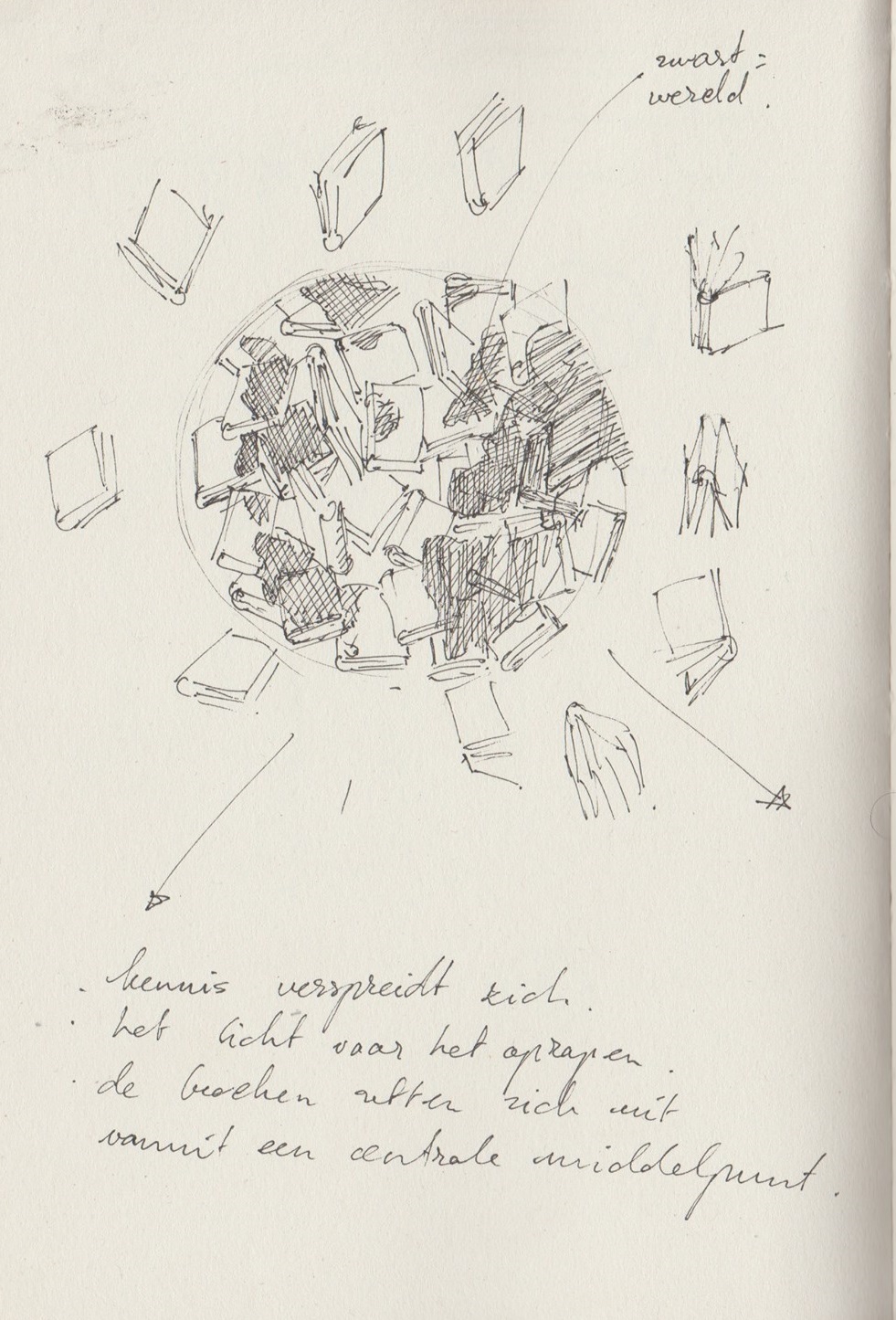
Cheerted Keo, who is a friend of mine and an aspiring Cambodian artist by way of Holland, is in the process of creating a banner or logo for our “Notes On Liberty” website. Inspired by the subtitle ‘Spontaneous thoughts on a humble creed’ and by Friedrich Hayek’s insights on ‘dispersed knowledge’, he has come up with an art work that represents our libertarian philosophy. His work symbolizes Hayek’s key observation that information is decentralized and that each individual knows just a small fraction of what is collectively known. The result of that, as Hayek has clearly stated in his seminal work The Use of Knowledge in Society (1945), is that it is best to let those with local knowledge make their own decisions in how to plan their own lives.

Although I know that the product is not finished yet, I would already like to share his work in progress with you – click on the images to enlarge them.

Cheerted Keo Notes on Liberty sketchCheerted Keo Notes On Liberty wipCheerted Keo Notes on Liberty wip 2

Please share your thoughts with us about the work. He is making the art work for free, but I thought it would be great to give him some exposure in return. Thus, if you appreciate his work, please spread word about this awesome up-and-coming artist.

If you would like to know more about Cheerted Keo’s works, you can visit his website here: www.ckeo.nl. He is quickly building up his portfolio, has had several exhibitions and is also selling some of his art works.

‘The Bitcoin Gospel’ and its Critiques

Last weekend, November 1st 2015, a Dutch television network broadcast a splendid documentary on Bitcoin entitled ‘The Bitcoin Gospel’ (Het Bitcoin Evangelie). It started off with Roger Ver, also known as Bitcoin Jesus in the Bitcoin community for his active promotions of the cryptocurrency, who is standing in his living room in Tokyo sending Bitcoins to the value of 100 Euros into the living rooms of the Dutch. The first person who scans the QR code of the ‘private key’ gets access to a Bitcoin wallet which holds 100 Euros worth of Bitcoins. At the moment of writing, that same amount of Bitcoin has more than doubled to 217.28 Euros. It is a powerful demonstration of how easy currency flows from one side of the planet to the other. If he would have made the transaction through the traditional way, it would have taken several days and it could have cost him up to 30 Euros. Using Bitcoins, he could send the money practically costless, and almost instantly without the need of any intermediaries.

You can watch the full documentary here:

If I could point out my two most favorite scenes, it would be the beginning scene (0:00 – 2:14) in which we can see Roger Ver’s impressive demonstration of Bitcoin transactions and the ending scene (43:43 – 48:24) where the myth making of its founder, Satoshi Nakamoto, is discussed and where an emotional and teary-eyed Roger Ver talks about the subversive nature of Bitcoins against political injustices.

The documentary however, also featured critics of the cryptocurrency – hence providing a balanced perspective of Bitcoins. Its main critic was Izabella Kaminska, a financial blogger at the Financial Times. She has offered several interesting critiques to which I would like to respond in this article.

1) The first critique that Kaminska offers is that Bitcoin prices are too volatile.
Kaminska reminds the viewers of the turbulent swings in Bitcoin prices. Indeed, if one would take a look at the price chart one would see that Bitcoin did rise 800 percent from $129.46 to $1,165.89 in the three month period from September to November 30 in 2013. Within the next four months, the price would plumb to $344.24. The value of Bitcoin is still extremely volatile – it has ranged between $184.32 and $481.51 in the year 2015.

Bitcoin Chart

In my opinion however, Bitcoin’s volatility is not necessarily deplorable. Its volatility is due to its small market and the experimental phase it is still in. The total market capital of Bitcoins currently stands at $5,676,100,709. It effectively means that only a small amount of money flows into or out of the market can already have huge implications for its price movements. It is therefore only natural that its price is still volatile. Volatility also offers prospects of possible gains, hence attracting more capital from investors. Total investments into Bitcoin related projects in 2015 is already more than double that for 2014. (Coindesk, 2015) The more investments are made into Bitcoin related projects, the greater the chance that Bitcoin will be widely accepted so that eventually in the long run products and services can be denominated in Bitcoins. Hopefully, this will make Bitcoins gain the same relatively low-volatility attribute of many fiat currencies.

2) Kaminska’s second critique is that buying Bitcoins does not benefit the economy as it is not loaned out to provide entrepreneurs with investment capital.
Kaminska contends that Bitcoins are simply sitting idly in people’s wallets – it has no interest, it has no yield, and she even claims that the persons who hold them believe that they have “a right to future income flows as if they are investing.” The statement that those who hold Bitcoins think that they have a right to future income flows is quite bold. Bitcoins are like any other investments in that they are always subjected to uncertainties. No serious investor believes that he has a right to profits. The Bitcoin investor is like an entrepreneur – he knows that he can only make a profit if he anticipates future conditions correctly. The notion that one should not hoard Bitcoins or cash or gold corresponds with the false notion that

“Unspent dollars means reduced sales, and as sales decline, profits drop, layoffs increase, and the total social income decreases, making less money available for consumption. Hoarding induces more hoarding as the economy sinks into a downward spiral.” (Smith, 2009)

What this notion does not take into account is that hoarding is an expression of people’s freedom to achieve personal goals or to deal with economic uncertainties. As George Ford Smith (2009) writes in ‘The Case for Hoarding’, the increased demand for money also makes prices fall. Those who are not hoarding are therefore actually benefitting from the decline in prices.

3) Kaminska’s third critique is that Bitcoin has transferred power from the existing elite to the new 1% of the Bitcoin economy, thereby going against the ‘democratization’ effects of Bitcoins that has been preached by its prononents.
In my view, it is only justified that those who have done the research into Bitcoins and who have taken the high risk to invest in new inventions also have a higher rate of return. Similarly, those who were pioneers by investing in Facebook or Microsoft during their inception period also deserve potentially higher rates of return as these companies were running higher risk of failures. If the first adopters of Bitcoins would not have had the opportunity to make enormous amounts of money, they would not have had investment incentives, it would not have got this successful and this critique of Kaminska would not even have been possible.

4) Kaminska had also argued that the Bitcoin community is extremely absolutist and driven by political ideology which is thrusted on everyone else.
She maintains that when she is paying for coffee she just wants the benefits of a working payment network and smooth transactions, not support for a certain political ideology. The idea that payment systems can be apolitical is an illusion. Governments have always had vested interests in the moneys of its citizens as its existence is entirely dependent on taxation and money creation. Any decision to meddle with the government’s schemes of taxation and manipulation of the money supply is hence always politically charged. It seems to me that she is holding an idealized view of our society if she believes that using USD does not support any political-economic system. Her statement that the Bitcoin community is thrusting their political ideology on everyone else is highly arguable as well. The government is an institution that holds the unjust power to determine which currency can serve as legal tender and which goods – including currencies – can be traded or should be outlawed. Unlike governments, the Bitcoin community does not hold the power to initiate force upon the people. It cannot thrust the adoption of the payment network on all citizens. Indeed, Bitcoin is a free market invention that allows, but not forces, anyone to join the payment network voluntarily.

Kaminska is right, when one uses Bitcoins one is supporting the libertarian political ideology. If one pays with Bitcoins, one is supporting a decentralized payment network through which transaction costs have virtually fallen to zero and through which it is much more difficult for governments and banks to track one’s financial transactions. The really relevant question however is not whether you are supporting a political ideology. The question that should be asked is: should we prefer to give our governments, and central banks the power to manipulate the value of our currency or should we prefer the separation of state and money?

References
Coindesk, (2015). State Of Bitcoin. Retrieved from http://www.coindesk.com/research/state-of-bitcoin-q3-2015/
Smith, G.F., (2009). The Case For Hoarding. The Free Market. Retrieved from https://mises.org/library/case-hoarding

BC’s weekend reads

  1. The Two Asian Americas
  2. Is Hawai’i an occupied nation?
  3. A federal system for Britain
  4. Capitalists from Outer Space
  5. The Physics of Extraterrestrial Civilizations
  6. Humane Canada

Buddha, A Lonely Human Rebel

Although I do not consider myself a Buddhist, I have always had much respect for Gautama Buddha and I have always regarded him as an exemplary person.

What I find most sympathetic about Buddha are his humanness, his epistemological modesty, and his insistence to use reason and scientific inquiry to understand the world and to free oneself from social dogmas and religious oppression. It is for these reasons that Gautama Buddha could be considered contumacious or rebellious; he argued tenaciously against the superstitious practices and beliefs of Hinduism. He encouraged his followers to cultivate the mind and develop reason, because he considered it to be an essential element of ‘magga’ or the eightfold path to enlightenment (right understanding, right intention, right speech, right action, right livelihood, right effort, right mindfulness, and right concentration).

Smith & Novak write in Buddhism (2003) that there are six aspects of religion that “surface so regularly as to suggest that their seeds are in the human makeup” (Smith & Novak, 2003, p. 22), and that Gautama Buddha rebelled against all these aspects. The six aspects are:

  1. Authority – which was hereditary and exploitative as brahmins were charging exorbitantly for their services;
  2. Rituals – which became the people’s mechanical means to achieve quick miraculous results in life;
  3. Speculation – which entirely lost its experiential base;
  4. Tradition – which inhibited people from progress. One example is the tradition to instruct religious discourse in Sanskrit, making the brahmins’ knowledge effectively unavailable for the common people;
  5. Divine grace – which became confused with fatalism as to undercut human responsibility. Think for instance about the misinterpretation of ‘karma’ that was abused in order to maintain and rationalize the caste system;
  6. Mystery – which became confused with mystification and led to a perverse obsession with miracles and the occult. (Smith & Novak, 2003, p. 23)

According to Gautama Buddha, they were all too prevalent in the Hinduism of his days and he regarded them to be oppressive of human flourishing. As a revolt against the superstitious Hindu culture, Gautama Buddha preached a philosophy that is:

A. Devoid of authority – he tried to break the brahmins’ monopoly on religious teachings. In addition, he challenged everyone to utilize their own rationality and stop passively relying on the brahmins to tell them what to do.

B. Devoid of rituals – he believed that rites and ceremonies bind the human spirit.

C. Devoid of speculation – the monk Malunkyaputta, troubled by Gautama Buddha’s silence on metaphysical speculations, said:

whether the world is eternal or not eternal, whether the world is finite or not, whether the soul is the same as the body, or whether the soul is one thing and the body another, whether a Buddha exists after death or does not exist after death, whether a Buddha both exists and does not exist after death, and whether a Buddha is non-existent and not non-existent after death, these things the Lord does not explain to me, and that he does not explain them to me does not please me, it does not suit me (Kyimo, 2007, p. 206).

D. Devoid of tradition – he wanted a break from the archaic and he wanted to teach the peoples in their vernacular. On the question why his teachings should be followed, Gautama Buddha answers:

Do not go upon what has been acquired by repeated hearing; nor upon tradition; nor upon rumor; nor upon what is in a scripture; nor upon surmise; nor upon an axiom; nor upon specious reasoning; nor upon a bias toward a notion that has been pondered over; nor upon another’s seeming ability; nor upon the consideration, ‘The monk is our teacher.’ Kalamas, when you yourselves know: ‘These things are bad; these things are blamable; these things are censured by the wise; undertaken and observed, these things lead to harm and ill,’ abandon them.[1]

What Gautama Buddha is effectively saying here is that everything should be questioned; every tradition, every holy book, and even teachers including himself. He taught everyone to use reason and the scientific methodology of inquiry, and he emphasized on doing good and abandoning evil.

E. Emphasizes intense self-effort and opposes fatalism – everyone can become enlightened. He taught everyone that actions are meaningful and that everyone contains the power to change their lives immediately for the better. Everyone was considered responsible for their own actions and happiness. This puts heavy responsibilities on all individuals to make the best of their lives.

F. Devoid of the supernatural – he condemned divination and reliance on Brahma (God). (Smith & Novak, 2003, pp. 24-28) He could not conceive of Brahma who considered himself “the Supreme one, the Mighty, the All-seeing, the Ruler, the Lord of all, the Maker, the Creator, the Chief of all appointing to each his place, the Ancient of days, the Father of all that is and will be”[2] to inflict so much suffering on the peoples:

If the creator of the world entire
They call God, of every being be the Lord
Why does he order such misfortune
And not create concord?
If the creator of the world entire
They call God, of every being be the Lord
Why prevail deceit, lies and ignorance
And he such inequity and injustice create?
If the creator of the world entire
They call God, of every being be the Lord
Then an evil master is he, (O Aritta)
Knowing what’s right did let wrong prevail![3]

At the same time, Gautama Buddha appeared to be one of us: fallible, sensitive, and insecure about life. Despite his immense influence, he remained humble enough as to never claim to be a son or a prophet of God – nor did he ever claim to understand the beginnings of the universe. His teachings were entirely devoted to alleviate man from his misery.

Talking about the Three Greatest Men In History (1935), H.G. Wells said of Gautama Buddha that:

[Y]ou see clearly a man, simple, devout, lonely, battling for light – a vivid human personality, not a myth. Beneath a mass of miraculous fable I feel that there also was a man. He, too, gave a message to mankind universal in its character. Many of our best modern ideas are in closest harmony with it. All the miseries and discontents of life are due, he taught, to selfishness… Before a man can become serene he must cease to live for his senses or himself. Then he merges into a greater being. Buddha in different language called men to self-forgetfulness 500 years before Christ. In some ways he was nearer to us and our needs. He was more lucid upon our individual importance in service than Christ and less ambiguous upon the question of personal immortality. (Wells, 1935, July 13)

Footnotes
[1] From Kalama Sutta: The Instruction to the Kalamas.

[2] From Digha Nikaya 1: Brahmajala Sutta.

[3] From Bhuridatta Jakata.

Bibliography
Examiner. (1935, July 13). Greatest In History. Retrieved from www.trove.nla.gov.au/ndp/del/article/51945346?searchTerm=GLOBE%20READER%20DIGEST%20&searchLimits=

Gunasekara, V.A. (1997). The Buddhist Attitude To God. Retrieved from http://www.budsas.org/ebud/ebdha068.htm

Kalama Sutta: The Instruction to the Kalamas. (1994), Transl. Soma Thera. Retrieved from www.accesstoinsight.org/tipitaka/an/an03/an03.065.soma.html

Kyimo. (2007). The Easy Buddha. London: Prospect House Publishing.

Smith, H., & Novak, P. (2003). Buddhism: A Concise Introduction. New York: HarperOne.
The Crypto Anarchist Manifesto (1988)

Crypto-anarchism is a subversive philosophy that extends anarchism into the world of cyberspace. Crypto-anarchists attempt to protect their privacy and political freedom through the use of information technologies. Timothy May, one of the co-founders of Cypherpunk and writer of the ‘Crypto Anarchist Manifesto’, describes Crypto-anarchism as

“the cyberspatial realization of anarcho-capitalism, transcending national boundaries and freeing individuals to make the economic arrangements they wish to make consensually.”

In this article I would like to post Timothy May’s ‘Crypto Anarchist Manifesto’, which was first spread among like-minded tech-anarchists in mid-1988 at the “Crypto ’88” conference. The Manifesto was also discussed at the first physical Cypherpunk meeting in 1992. Most people have never heard of Cypherpunk, but they might know their most notable member: Julian Assange, founder of Wikileaks.

See here the full Manifesto:

A specter is haunting the modern world, the specter of crypto anarchy.[1]

Computer technology is on the verge of providing the ability for individuals and groups to communicate and interact with each other in a totally anonymous manner. Two persons may exchange messages, conduct business, and negotiate electronic contracts without ever knowing the True Name, or legal identity, of the other. Interactions over networks will be untraceable, via extensive re- routing of encrypted packets and tamper-proof boxes which implement cryptographic protocols with nearly perfect assurance against any tampering. Reputations will be of central importance, far more important in dealings than even the credit ratings of today. These developments will alter completely the nature of government regulation, the ability to tax and control economic interactions, the ability to keep information secret, and will even alter the nature of trust and reputation.

The technology for this revolution–and it surely will be both a social and economic revolution–has existed in theory for the past decade. The methods are based upon public-key encryption, zero-knowledge interactive proof systems, and various software protocols for interaction, authentication, and verification. The focus has until now been on academic conferences in Europe and the U.S., conferences monitored closely by the National Security Agency. But only recently have computer networks and personal computers attained sufficient speed to make the ideas practically realizable. And the next ten years will bring enough additional speed to make the ideas economically feasible and essentially unstoppable. High-speed networks, ISDN, tamper-proof boxes, smart cards, satellites, Ku-band transmitters, multi-MIPS personal computers, and encryption chips now under development will be some of the enabling technologies.

The State will of course try to slow or halt the spread of this technology, citing national security concerns, use of the technology by drug dealers and tax evaders, and fears of societal disintegration. Many of these concerns will be valid; crypto anarchy will allow national secrets to be trade freely and will allow illicit and stolen materials to be traded. An anonymous computerized market will even make possible abhorrent markets for assassinations and extortion. Various criminal and foreign elements will be active users of CryptoNet. But this will not halt the spread of crypto anarchy.

Just as the technology of printing altered and reduced the power of medieval guilds and the social power structure, so too will cryptologic methods fundamentally alter the nature of corporations and of government interference in economic transactions. Combined with emerging information markets, crypto anarchy will create a liquid market for any and all material which can be put into words and pictures. And just as a seemingly minor invention like barbed wire made possible the fencing-off of vast ranches and farms, thus altering forever the concepts of land and property rights in the frontier West, so too will the seemingly minor discovery out of an arcane branch of mathematics come to be the wire clippers which dismantle the barbed wire around intellectual property.

Arise, you have nothing to lose but your barbed wire fences!

Footnote

[1] This is clearly a wordplay on the opening sentence of Karl Marx’ and Friedrich Engels’ The Communist Manifesto which reads: “A spectre is haunting Europe—the spectre of communism.”

Cave Paintings and Elementary Science

This is a travel story of sorts, of travel through time, to an extent. Be patient.

Directly to the west of Marseille, the second largest city in France are a series of beautiful, narrow coves, like fjords, situated in a sort of desert. They are called “calanques” in French. They are accessible only by sea or through a long walk on hot rocky ground. Although they constitute a separate world, the calanques are close to Marseille, as the crow flies. They used to be a major fishing resource for the city. You can be sure they were never forgotten during the 2600 years of the city’s existence. Also, the city was founded by Greeks and thus, it always had a literate population, one that kept records.

Marseille and its environs are where SCUBA was invented, the first practical solution to the problem of men breathing underwater. Accordingly, the calanques were always and thoroughly explored after 1950. In 1985, one of the co-inventors of SCUBA discovered a deep cave in one of the calanques. He couldn’t resist temptation and swam into it until he reached a large emerging room. I mean a cave where he could stand and breathe regular air. His name was Cosquer.

Cosquer visited there several times without saying a word about his discovery. Soon, he observed dozens of beautiful paintings belonging to two distinct periods on the upper walls of his cave. The art of the first period was mostly hand imprints or stencils. The art of the second, distinct period, comprised 170-plus beautiful animals including many horses, ibex and others mammals, also fish, seals and other sea creatures. Archaeologists think the painting of the first period were done about in about 25 000 BC, those of the latter period date back to about 18 000 BC, they believe.

Today, the entrance to the cave is about 125 feet below sea level. We know that paleolithic men did not have SCUBA. They simply walked into the cave for their own reasons, with their own purposes in mind. Thus, the sea level was at least 125 feet lower then than it is today. The people of Marseille never saw the cave. They would have written about it. There would be records. They would not have forgotten it. They simply did not know of its existence during the past 2600 years.

Sometimes in the past 20 000 years, the sea rose 125 feet or more. That’s an amplitude several times greater than any of the direst predictions of the official United Nations Intergovernmental Panel on Climate Change for the next century. The IPCC squarely blames a future ocean rise (one that has not been observed at all, yet) on abnormal emission of several gases, especially CO2 . These abnormal emissions in turn, the IPCC affirms are traceable to human activities such as driving cars and producing many useful things by burning fossil fuels.

It seems to me that basic good science requires that causal analysis begin with a baseline. In this case, it would mean something like this: In the absence of any burning of fossil fuels, the ocean rose 125 feet sometimes during the past 20,000 years. Let’s see if we can find evidence of the ocean rising above and beyond this order of magnitude since humanity began burning fossil fuels in large quantities, about 150 years ago.

The conclusion will likely be that nothing out of the ordinary happened. Hence, fossil fuel emissions are probably irrelevant to this particular issue. (This leaves open the possibility that such emissions are odious for some other reason. I mean that CO2 is plant food. Too much CO2 may promote weed growth in our fields and gardens. )

The ocean is not currently rising and if it is, the existence of the Cosquer cave suggests that it’s rising to a tiny degree. Let’s keep things in perspective. Let’s discard openly and loudly every part of the building of a complex hypothesis that does not work. Those who don’t take these obvious cleansing measures simply have a lot of explaining to do. They should not be allowed to wrap themselves in the mantle of science while violating Science 101 principles.

One of the conceits of the Warmist movement is that you don’t have a right to an opinion unless you possess a doctorate in Atmospheric science. By this dictate, anybody who has to keep a job, raise children, or pay a mortgage is out of the discussion. This is the typical posturing of intellectual totalitarianism. Note what’s missing in the story above: It says nothing about what did cause the ocean to rise between 18 000 B. C. and today. It’s enough to know that whatever it was, it was not the massive burning of fossil fuels. The story is complete as is. Don’t quit your job and apply to graduate school!

South Park’s ‘Safe Space’: A Parody On Stepford Students

Do you know what Stepford students are? This article by Brendan O’Neill explains:

They’re everywhere. On campuses across the land. Sitting stony-eyed in lecture halls or surreptitiously policing beer-fuelled banter in the uni bar. They look like students, dress like students, smell like students. But their student brains have been replaced by brains bereft of critical faculties and programmed to conform. To the untrained eye, they seem like your average book-devouring, ideas-discussing, H&M-adorned youth, but anyone who’s spent more than five minutes in their company will know that these students are far more interested in shutting debate down than opening it up.

Stepford students demand the ‘right to feel comfortable’. Their eyes “glazed with moral certainty”, they demand ‘safe spaces’ – spaces where no student would feel threatened or unwelcome. They seek safety from words, ideas, Zionists, ‘blurred lines’, Nietzsche etc. This new generation of students believe that self-esteem is more important than everyone else’s liberty to speak up their mind. At some universities, like Brown University, ‘safe spaces’ have been set up so that students can take refuge from ‘disturbing ideas’.

Now comes the greatest part: the concept of ‘safe spaces’ has been discussed in South Park’s latest episode. It is hilarious!

Republican Tax Plans are Misguided

Predictably, Republican candidates are showcasing tax plans offering goodies for everybody. When some spoilsport has the nerve to point out the worsening deficit that would result, the most common retort is that the tax cut will spur economic growth enough to overcome the higher deficit. Some day. Somehow.

Of course lower tax rates will spur growth so that the loss in tax revenue will be less than proportional to the cut in tax rates. But it is foolish to think that we’re ensconced on the far side of the Laffer curve, for those who know that phrase, which simply means that tax rates are so high that cuts will produce higher revenue.

What about the claim that a flat tax is fairer than the graduated rates we have now? Perhaps, but how does one judge the fairness of any tax? The usual answer is that taxes should be based on the taxpayer’s ability to pay. But that is a nebulous concept at best. It means that somehow we figure out how much income is necessary and how much is up for grabs by politicians  Do we need a cell phone, cable TV, air conditioning? Who’s to say?

At least a flat tax would treat everybody alike. Or would it? Under a flat tax, where everybody hands over the same percentage of their income, those who earn a lot pay more money than those who don’t. Why? Do the high earners consume more government services? Are high earners bad people who deserve punishment?

I concede that some tax schemes could be fairer than others. For example, much as I might like the idea of complete tax exemption for septuagenarian European-American males, I’ll grant that would be a bit unfair. But in the end no tax can be entirely fair because taxation is coercive activity: stealing if you like.

Don’t get me wrong: I like tax cuts, preferably across the board, but targeted cuts are fine with me too. But the focus on the tax code is misplaced. The root problem is the amounts of real goods and services that are consumed by politicians and bureaucrats. Whether they are financed by taxation or borrowing is a secondary issue.

Republicans should be drawing up lists of programs to reduce or eliminate. “Defense” spending should be at the top of the list. The list should be broad enough that everybody’s ox is gored. Who knows, this approach might actually gain some traction with the fed-up electorate.

The selfish meme

There are two senses in which to consider the phrase.

  1. The sense in which memes enter or exit our minds.
  2. The sorts of behavior encouraged by our memes.

For those who don’t know what I’m talking about:

A meme (/ˈmm/ meem)[1] is “an idea, behavior, or style that spreads from person to person within a culture”.

Richard Dawkins introduced the idea in his famous book: The Selfish Gene. The bulk of his book discusses examining the gene as the basic unit of analysis in evolutionary studies. He introduces the idea of the meme as a different form of replicator. Both genes and memes will only be reflected in the outcome of biological and cultural evolution if they exhibit fitness–if they are able to survive.

So the cultural traditions that helped hunter-gatherer societies survive droughts or harsh winters tended to survive and spread. Over time a culture accumulates this sort of practical, tacit knowledge. (Side note: this week’s Econtalk has Cesar Hidalgo who does really interesting work trying to indirectly measure the presence of such tacit knowledge in market economies.) And if culture is made up of memes, the same way organisms are made up of genes.

Looking at genes as the unit of analysis (as opposed to the organism) explains some otherwise mysterious behavior. It provides a plausible explanation of altruism: we care for our children more than anyone because 50% of their genes are our genes. A nephew is still precious, but not as important to us because the expected ratio of shared genes between the two of you is 25%. A gene that prompts you to protect your children is likely to survive longer than a gene that doesn’t prompt you. (And genes that hang around with such kin-protects genes are also more fit than their competition.) A gene that prompted you to be kind to neighbors makes sense when you live in small groups. But a gene that prompted you to be kind to total strangers might be a liability in a world where strangers were dangerous.

Cultural evolution certainly makes sense as a gradual mutation of different cultural practices merging together to make what is called (and perceived) as a unique body of culture. It’s a complex of knowledge, ideas and basic assumptions, social interface protocols, and it’s deeply embedded in how we engage in the world. (Perhaps we can’t remember our infancy because we didn’t have a cultural lens through which to reference anything to anything else…) One thing that I’m sure we’ve all noticed is that it can be almost painful to have to reject a cherished belief. It’s even difficult to see one of these memes challenged.

Now genes don’t have to be small bits of genetic code. They can be something simple like “make this enzyme when you get a chance.” But as a unit of replication, you should consider the smallest discrete chunk of genetic coding that replicates itself. If a particular pattern isn’t fit, it will leave the gene pool, while the fit collections of genetic instruction spread. So you might end up with long complex strings of genetic material akin to a computer program. Initially simple scripts might gather as successful collections of genes that work well together. The “produce stomach acid” gene works well with the “produce a stomach” gene and soon the two are virtually inseparable. They’ve become a simple script: “Do this, then that, then maybe this other thing.” Scripts gather into multi-cellular organisms with different functions that can respond differently to different stimuli. Soon you’ve got a complex set of code as your replicating unit.

More complex genes are necessary to prompt more complex behavior. It’s worth noting that Dawkin’s theoretical framework sometimes looks like a hyper-rational economics model. Evolutionary Stable Strategies are a Nash Equilibria that are robust to invaders. They occupy a niche and survive. But this evolution is happening in the context of increasing complexity. The system is learning*. This isn’t an instantaneous process**, but it is gradually becoming more sophisticated.

A complex gene will get bugs due to random mutation, but as long as it’s still generally fit, it will survive. And over time, more subtle and sophisticated programs identify new niches. And we get plant genes surviving by filling the “eat sunlight” niche and animals in the “eat plants” niche, and bacteria co-evolving with animals’ digestive systems.

Slowly working through this long, blind, random process genes surviving this hostile environment develop behaviors that help them flourish (the “four F’s of evolution: Fighting, fleeing, feeding, and reproduction”). Gradually they stumble into opportunities, and an important one was social behavior.

More and more complexity, round and round, until we start to get our first little bits of sentience. I’ve been watching a chinchilla hop around my apartment for a couple weeks now and I’m astonished by how much effort she puts into genuinely exploring her world. She tests objects for structural integrity and learns what she can and can’t jump on. She tests boxes with her teeth, I don’t know what for. She’s distinctly learning and not merely existing or surviving. She’s comfortable and does not know fear (I’ve seen her scare one particularly wussy cat). That sort of behavior requires a great deal of complexity which requires a great deal of genetic material.

I’m noticing as I write this that the biggest gene (i.e. discrete, replicated set of genetic code) must be that very large collection of genetic patterns that must come together in order for a one’s offspring to simply be the same species.*** I’ve heard that humans and chimps share 94 percent of our genetic material. That overlap tells me that some larger percentage than that is what makes us actually a human. The difference between any two individuals, then, must be among a very small portion of their total genetic makeup. This small portion is where genetic competition occurs in the arena of sexual reproduction.

In any case, our first memes (behaviors) seem to be transmitted biologically. Later, with more complex genes, we are able to replicate more complex behaviors. Eventually, we get complex enough to build up a sense of consciousness****.

A complex enough gene might have a subroutine that sets off an error; something like the pain our consciousness experiences when things are going poorly*. And likewise for a meme. Though more likely is that the error is being returned by our psychology. (If our genes are assembly language, our psychology is the operating system, and culture is the mess of basic programs that makeup our desktop environment.)

When we think of memes as self-replicating units, interesting questions arise: what sort of patterns will be robust to competition? Which will occupy what niches? What happens when incompatible memes come together in one mind? What sort of eusocial behaviors are possible? How much do our memes govern our behavior? (This is where nature and nurture overlap.)

Obviously one possibility is a “selfishness meme,” or a culture that hits an equilibrium of distrust. But there are many others, and how they combine matters. At this level we’re essentially asking questions about psychology, culture, and institutions. The fodder of all the social sciences comes together here. Different memes will be transmitted in different ways (which is perhaps what defines the disciplines), but any of these memes may be complex enough to have a defense mechanism that involves activating various processes (including other memes, perhaps) and perhaps making people feel anger and related emotions when someone questions our beliefs and may even push people to fight with their life for their memes.


*We’re computers, markets are computers, societies are computers, the ecosystem is a computer, Earth is just a big giant computer. It processes data and creates new data.

** The next Hayek rap should include the phrase “it’s spontaneous order, not instantaneous…”

*** I could imagine it as made up of some set of smaller genes in some complex, rather than one monolithic gene but I don’t have the language to communicate that idea concisely.

**** And it must be noted that this consciousness is built out of parts designed for the poop-and-panic machines that were our evolutionary ancestors. It’s like building a super computer* out of a truck load of Pez dispensers and a warehouse full of chainsaws. And yet, how else could it be done.