The Heights of French-Canadian Convicts, 1780 to 1830

A few days ago, it was confirmed that my article with Vadim Kufenko and Alex Arsenault Morin on the heights of French-Canadians between 1780 and 1830 was accepted for publication in Economics and Human Biology. In that paper, we try to introduce French-Canadians before 1850 to the anthropometric history literature by using the records of the prison of Quebec City. Stature is an important measure of living standards. As it is heavily related to other aspects of health outcomes, it is a strong measure of biological living standards. More importantly, there are moments in history when material living standards and biological living standards move in opposite directions (in the long-run, this is not the case).

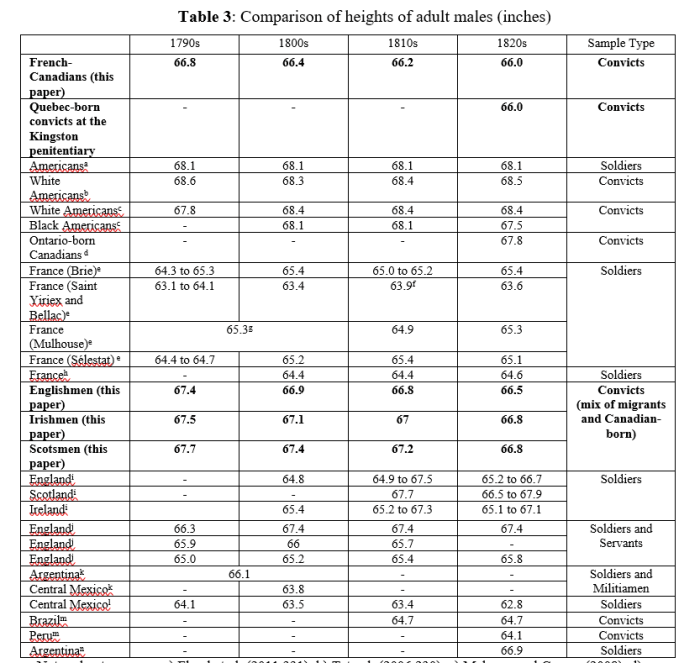
We find three key results. The first is that the French-Canadians grew shorter throughout the era when living standards did not increase importantly (and were very volatile). This puts them at odds from other places in North America where increases in stature were experienced up until the 1820s. Furthermore, stature stops falling around 1820 when economic growth picked up. This places the French-Canadians in a unique category in North America since it seems unlikely that they experienced a strong version of the antebellum puzzle (decline in stature with increases in material living standards which is what the US experienced). The second key result is that the French-Canadians are the shortest in North America, shorter even than Black Americans in slavery. However, they are considerably taller than most (save Argentinians) Latin Americans. More importantly, they are considerably taller than their counterparts in France. The third key result is related to the second key result. Today, French-Canadians are noticeably shorter than other Canadians. However, the gap was more important in the late 19th century and early 20th century. Pegged as a “striking exception” within Canada, we do not know when it actually started. Thanks to our work, we know that this was true as far back at the early 19th century.

The working paper (dramatically different than the accepted version) is here and I am posting key results in tables and figures below.  Moreover, I will be talking about anthropometric history and economic history with Garrett Petersen of Economics Detective Radio this Tuesday (I do not know when the podcast will be made available, but you should subscribe to that show anyways).

Heights.png

Table3.png

Immigration, Cultural Change, and Diversity as a Cultural Discovery Process

I have spent a couple of posts addressing various spurious economic and fiscal arguments against looser immigration restrictions. But, as Brandon pointed out recently, these aren’t really the most powerful arguments for immigration restrictions. Most of Donald Trump’s anti-immigrant rhetoric revolves around strictly alleged cultural costs of immigration. I agree that for all the economic rhetoric used in these debates, it is fear of the culturally unfamiliar that is driving the opposition. However, I still think the tools of economics that are used to address whether immigration negatively impacts wages, welfare, and unemployment can be used to address the question of whether immigrants impact our culture negatively.

One of the greatest fears that conservatives tend to have of immigration is the resulting cultural diversity will cause harmful change in society. The argument goes that the immigrant will bring “their” customs from other countries that might do damage to “our” supposedly superior customs and practices, and the result will be a damage to “our” long-held traditions and institutions that make “our” society “great.” These fears include, for example, lower income immigrants causing higher divorce rates spurring disintegration of the family, possible violence coming from cultural differences, or immigrants voting in ways that are not conducive to what conservatives tend to call “the founding principles of the republic.” Thanks to this insight, it is argued, we should restrict immigration or at least force prospective immigrants to hop through bureaucracy so they may have training on “our” republican principles before becoming citizens.

There are a number of ways one may address this argument. First, one could point out that immigrants face robust incentives to assimilate into American culture without needing to be forced to by restrictive immigration policies. One of the main reasons why immigrants come to the United States is for better economic opportunity. However, when immigrants are extremely socially distant from much of the native population, there a tendency for natives to trust them less in market exchange. As a result, it is in the best interest of the immigrant to adopt some of the customs of his/her new home in order to reduce the social distance to maximize the number of trades. (A more detailed version of this type of argument, in application to social and cultural differences in anarchy, can be found in Pete Leeson’s paper Social Distance and Self-Enforcing Exchange).

The main moral of the story is that peaceable assimilation and social cohesion comes about through non-governmental mechanisms far more easily than is commonly assumed. In other words, “our” cultural values are likely not in as much danger as conservatives would have you think.

Another powerful way of addressing this claim is to ask why should we assume that “our” ways of doing things is any better than the immigrant’s home country’s practices? Why is it that we should be so resistant to the possibility that culture might change thanks to immigration and cultural diversity?

It is tempting for conservatives to respond that the immigrant is coming here and leaving his/her home, thus obviously there is something “better” about “our” cultural practices. However, to do so is to somewhat oversimplify why people immigrate. Though it might be true that, on net, they anticipate life in their new home to be better and that might largely be because “our” institutions and cultural practices are on net better, it is a composition fallacy to claim that it follows from this that all our institutions are better. There still might be some cultural practices that immigrants would want to keep thanks to his/her subjective value preferences from his or her country, and those practices very well might be a more beneficial. This is not to say our cultural practices are inherently worse, or that they are in every instance equal, just that we have no way of evaluating the relative value of cultural practices ex ante.

The lesson here is that we should apply FA Hayek’s insights from the knowledge problem to the evolution of cultural practices in much the way conservatives are willing to apply it to immigration. There is no reason to assume that “our” cultural practices are better than foreign ones; they may or may not be, but it is a pretense of knowledge to attempt to use state coercion to centrally plan culture just as it is a pretense of knowledge to attempt to centrally plan economic production.

Instead of viewing immigration as a necessary drain on culture, it may be viewed as a potential means of improving culture through the free exchange of cultural values and practices. In the market, individuals are permitted to experiment with new inventions and methods of production because this innovation and risk can lead to better ways of doing things. Therefore, entrepreneurship is commonly called a “discovery process;” it is how humanity may ‘discover’ newer, more efficient economic production techniques and products.

Why is cosmopolitan diversity not to be thought of as such a discovery process in the realm of culture? Just as competition between firms without barriers to entry brings economic innovation, competition between cultural practices without the barrier to entry of immigration laws may be a means of bettering culture. When thought of in that light, the fact that our cultural traditions may change is not so daunting. Just as there is “creative destruction” of firms in the marketplace, there is creative destruction of cultural practices.

Conservative critics of immigration may object that such cultural diversity may cause society to evolve in negative ways, or else they may object and claim that I am not valuing traditions highly enough. For the first claim, there is an epistemic problem here on how we may know which cultural practices are “better.” We may have our opinions, based on micro-level experience, on which cultural practices are better, and we have every right to promote those in non-governmental ways and continue to practice them in our lives. Tolerance for such diversity is what allows the cultural discovery process to happen in the first place. However, there is no reason to assume that our sentiments towards our tradition constitute objective knowledge of cultural practices on the macro-level; on the contrary, the key insight of Hayek is it is a fatal conceit to assume such knowledge.

As Hayek said in his famous essay Why I’m Not a Conservative:

As has often been acknowledged by conservative writers, one of the fundamental traits of the conservative attitude is a fear of change, a timid distrust of the new as such, while the liberal position is based on courage and confidence, on a preparedness to let change run its course even if we cannot predict where it will lead. There would not be much to object to if the conservatives merely disliked too rapid change in institutions and public policy; here the case for caution and slow process is indeed strong. But the conservatives are inclined to use the powers of government to prevent change or to limit its rate to whatever appeals to the more timid mind. In looking forward, they lack the faith in the spontaneous forces of adjustment which makes the liberal accept changes without apprehension, even though he does not know how the necessary adaptations will be brought about. It is, indeed, part of the liberal attitude to assume that, especially in the economic field, the self-regulating forces of the market will somehow bring about the required adjustments to new conditions, although no one can foretell how they will do this in a particular instance.

As for the latter objection that I’m not valuing tradition, what is at the core of disagreement is not the value of traditions. Traditions are highly valuable: they are the cultural culmination of all the tacit knowledge of the extended order of society and have withstood the test of time. The disagreement here is what principles we ought to employ when evaluating how a tradition should evolve. The principle I’m expressing is that when a tradition must be forced on society through state coercion and planning, perhaps it is not worth keeping.

Far from destroying culture, the free mobility of individuals through immigration enables spontaneous order to work in ways which improve culture. Immigration, tolerance, and cultural diversity are vital to a free society because it allows the evolution and discovery of better cultural practices. Individual freedom and communal values are not in opposition to each other, instead the only way to improve communal values is through the free mobility of individuals and voluntary exchange.

On power-display bias and the historians

This is an excerpt from my upcoming book at Palgrave McMillan which discusses Canadian economic history. This excerpt relates to a point that I have made numerous times on this blog regarding the bias for power held by historians and how it often leads them to inaccurate conclusions (here and here):

When the great historian Lord Acton warned that, “absolute power corrupts absolutely,” he was not only referring to imbuing certain fallible humans with excessive powers, but also as a caution to historians for their assessment of politicians. Too often, politicians become known for “greatness” because of their actions, regardless of how much they impoverished society or put in place measures that would ultimately erode their citizens’ quality of life. By the same token, some eminent figures remain unknown, relegated to a footnote in the history books, even though they have contributed in a more significant way to economic enrichment, cultural development, and social cohesion. Grand gestures and large-scale social projects inspired by good intentions do not always yield great results – or desirable ones.

If we truly want to assess the Quiet Revolution and the “Great Darkness” with any clarity, we must consider politicians’ actions in a more realistic scope, and sift through the quantitative and qualitative data that show how people thought and acted in the everyday. Through the use of rigorous tools, statistical methods and economic theories, we ought to consider how things might reasonably have developed otherwise without the Quiet Revolution. This is what I have tried to do in this book. (…)

The discourse on Quebec modernity that emerged along with the Quiet Revolution coincided with the emergence of a strong interventionist State. When we compare Quebec to other Western countries, however, our analysis reveals that the State did not play a major role in modernization here. After all, it was in a period when Quebec’s State apparatus was less active compared to the rest of Canada that it was able to progress in leaps and bounds. Of course, the State must have had some effect in certain areas, but the Quiet Revolution was not responsible for the bulk of positive outcomes that came to term during this period. Analyzing trends, causes, explanations and secondary forces at play in Quebec society’s metamorphosis definitely requires a degree of patience and effort. It would be much less onerous to take the easier path of only looking at the State’s activities as worthy of attention in this regard. If we fail to make these efforts, we risk succumbing to the “Nirvana Fallacy.” In order words, we tend to put the State on a pedestal: it becomes a kind of disembodied entity in a virtual reality where it plays the VIP or starring role. Comparing reality with a utopia necessary leads us to conclude that utopia is better, but this approach is utterly fruitless.


Illegal Immigration: Pres. Trump’s New Measures

I can’t wait for the raging assaults by the pseudo-cultural elite and by the media against Pres. Trump to stop to begin criticizing some of his decisions, as I would with any other president.

I have heard and read reports that the president intends to launch a policy of accelerated repatriation of illegal aliens. It will single out criminals for priority deportation (as was the case under Mr Obama). At this point, almost everybody agrees about getting rid of illegal aliens who are real criminals, especially the violent ones. Again, the new policy sounds a lot like Mr Obama’s, with a few details different. The details often matter when it comes to human lives, also when it comes to traditions of government. Here are two such details.

First, I have heard that even traffic tickets qualify an illegal alien for quick deportation. Make a wrong u-turn and your life gets broken up.

Second, I have heard and read that even being merely charged with a crime places you at the head of the line for deportation. Someone who looks like you steals a car. You get charged by mistake. You are gone.

The first detail seems awfully rough to me. I would feel better if the word “recidivist” were included. A person who breaks driving rules repeatedly is a trouble-maker we can do without. A guy who is too distracted to interpret the U-turn sign (could be me – once) is not exactly a criminal in the real sense of the word.

It’s true that such extreme severity would improve the driving of all illegal aliens. The claim is probably also correct however that it would interfere with aliens’ (legal and not) willingness to cooperate with the local police. Aside from this, I would bet it would involve significant law enforcement costs just to process traffic tickets through to the Immigration Service. I am a conservative, I am against big government, even against big government at the local level. I don’t want tax money, federal, state, or local, to be wasted processing a U-turn violator. It seems irrational to me.

The second, detail concerns the treatment of people only charged with a crime. It’s simple. I just don’t want any of them to be included in the priority list. Having any branch of government treating the accused as guilty simply goes too strongly against everything I believe. It’s un-American.

Yes, I have not forgotten that the subjects have no right to be in the country in the first place. I don’t care. It’s not about illegal aliens’ rights. Immigrants, legal or not, have no rights as a category as far as I am concerned. They only possess the ordinary human rights of anyone under American jurisdiction.

It’s about a slippery slope for all. If we begin officially thinning out the traditional wall between “charged” and “guilty,” where are we going to stop?

I understand that a lawyer would argue that the person is technically not being deported for the imaginary crime of being charged but because he has no right to be in the country, period. Do you know the one about the lawyer….

Brazil six months after Dilma Rousseff

Six months after President Dilma Rousseff’s impeachment, Brazil remains plunged into one of the biggest crises in its history. Economically the outlook is worrisome, with little chance that the country will grow again anytime soon. Politically the government of President Michel Temer has little credibility. Although brought to power by a process whose legitimacy cannot be questioned (even if groups linked to the former president still insist on the narrative of the coup – although without the same energy as before), Temer has no expressive popular support and is attached to oligarchic interests difficult to circumvent. In other areas, the crisis is also present: urban violence is increasing, unemployment, especially among the young, remains high, and education is among the worst in the world, among other examples. It is surprising that Brazil, considering its GDP, is one of the largest economies on the planet.

As I predicted in a previous article, Dilma Rousseff’s departure from power, however just and necessary, would not be the solution to all Brazil’s problems. Rousseff, although president of the country, was far from having a leading role in the Brazilian reality. As local press often put it, she was just a pole put in place by former President Luis Inacio Lula da Silva hoping to one day return to power (which he never completely left). Today, however, Lula is the target of several corruption investigations and is expected to go to jail before he can contest new elections. Meanwhile, the government of Michel Temer offers little news compared to the previous.

Michel Temer is a lifelong member of PMDB. PMDB was formed during the Military Government that lasted from the early 1960s to the early 1980s. It was the consented opposition to the military, and eventually added a wide variety of political leadership. Leaving the military leadership period, some tried to keep the PMDB united as a great democratic front, but this was neither doable nor desirable. Keeping the PMDB together was not feasible because what united its main leaders was only opposition to the military government. In addition, the party added an irreconcilable variety of political ideas and projects, and it was not desirable to keep them together because it would be important for Brazilian political leaders to show their true colors at a moment when internationally the decline of socialism was being discussed. After a stampede of many of its most active leadership to other parties (mainly to the PSDB), the PMDB became a pragmatic, often oligarchic, legend and without clear ideological orientation, very similar to the Mexican PRI.

Being a party of national expression, the PMDB had oscillating relations with all Brazilian governments since the 1980s, but with one certainty: the PMDB is a party that does not play to lose. Eventually a part of the party leadership understood that the arrival of the PT to the presidency of the country was inevitable and proposed an alliance. This explains the presence of Temer as Rousseff’s vice president. But it would be wrong to say that the PMDB simply joined the winning team: the PT was immeasurably benefited by the alliance, and probably would not have reached or remained in power without the new ally. The alliance with the PT also showed that, despite the ideological discourse, the PT had little novelty to offer to Brazilian politics.

Although he has waved with reforms in favor of economic freedom, Temer has done little that can considered new so far. The freezing of government spending, well received by many right-wing groups, does not really touch the foundations of Brazilian statism: the government remains almost omnipresent, only without the same money to play its part. The proposed pension reform, similarly, does not alter the fundamentals of the state’s relationship with society. Finally, Temer put the economic policy in the hands of Henrique Meirelles, who had already been President of the Central Bank of Lula. Meirelles is one of the main responsible for the crisis that the country faces today, and its revenue to get around the problems remains the same: stimulus spending. In other words, do more of what brought us to the current situation in the first place.

A positive aspect of the current Brazilian crisis is the emergence or strengthening of right-wing political groups. Although the Brazilian right still is quite authoritarian, there are inclinations in favor of the free market being strengthened. Of course, strengthening a pro-market right annoys the left, and this is perhaps the best sign that this is a political trend gaining real space. While it is still difficult to see a light at the end of the tunnel, the 2018 presidential election may be the most relevant to the country since 1989.

A hidden cost of the war on drugs

AI just completed another paper (this time with my longtime partner in crime Vadim Kufenko) where we question an hypothesis advanced by Samuel Bowles regarding the cost of inequality. In the process, we proposed an alternative explanation which has implications for the evaluation of the war on drugs.

In recent years, Samuel Bowles (2012) has advanced a theory (well-embedded within neoclassical theoretical elements while remaining elegantly simple) whereby inequality increases distrust which in turn magnifies agency problems. This forces firms to expend more resources on supervision and protection which means an expansion of the “guard labor force” (or supervisory labor force). Basically, he argues there is an over-provision of security and supervision. That is the cost of inequality which Bowles presents as a coordination failure. We propose an alternative explanation for the size of the guard and supervisory labor forces.

Our alternative is that there can be over-provision of security and supervision, but this could also be the result of a government failure. We argue that the war on drugs leads to institutional decay and lower levels of trust which, in turn, force private actors to deploy resources to supervise workers and protect themselves. Basically, efforts at prohibiting illicit substances require that limited policing resources be spread more thinly which may force private actors to expend more resources on security for themselves (thus creating an overprovision of security). This represents a form of state failure, especially if the attempts at policing these illicit substances increase the level of crime to which populations are vulnerable. To counteract this, private actors invest more in protection and supervision.

Using some of the work of Jeffrey Miron and Katherine Waldock, we show that increases in the intensity of prohibition enforcement efforts (measured in dollars per capita) have significant effects on the demand for guard labor. Given that guards represent roughly 1 million individuals in the US labor market, that is not a negligible outcome. We find that a one standard deviation increase in the level of drug enforcement efforts increases the ratio of guards to the population by somewhere between 12.92% and 13.91% (which is the equivalent of roughly 100,000 workers).

While our paper concentrated on proposing an alternative to the argument advanced by Bowles regarding the cost of inequality, we (more or less accidentally) measured a hidden cost from the war on drugs. The insecurity (increased crime rates and spillovers from illegal markets into formal markets) brought forth by drug prohibition  forces an over-provision of security and supervision (our supervision measure which includes workers that supervise other workers were smaller than with the security guard measure).

Basically, a hidden (private cost) of the war on drugs is that we must reallocate resources that we could have used otherwise. Its a little like when I say that it is meaningless to compare healthcare expenditures to GDP in Canada and the United States because Canadians assume costs in a hidden manner through rationing. Waiting lists in Canada are longer than in the US. The cost is lost wages and enduring pain and that cost will not appear in measures of expenditures to GDP. The war on drugs works the same way. There is a fiscal cost (expenditures dedicated to it and the taxes that we must impose), there is a crime cost (destruction of lives and property) and there is a reallocation cost of privately providing security which is hard to measure.

*The paper is available here. 

Communist Yugoslavia

Below is an excerpt from my book I Used to Be French: an Immature Autobiography. You can buy it on amazon here.


I was led into a large cell with an arching stone ceiling I would have called a dungeon except that it was harshly lit. There were about twenty-five men in the room, mostly in their late twenties. They greeted me loudly in their language. An older man who looked vaguely middle class because he wore a suit (without a tie) asked me in Italian where I was from. There were five or six blankets altogether. A tall, bony guy with the ravaged face of an operetta brigand requisitioned two and handed them to me. Then, we all lined up for whole-grain bread and soup. (Yes, whole-grain used to be the cheapest before it became fashionable, in the seventies.) The brigand pushed me to the head of the line. Then he showed me that you had to dunk the hard bread into the soup to soften it. After dinner, I had a long, civilized conversation with the old man, he speaking Italian and I, French. He told me that most of my cellmates were returning from Germany where they had gone to work without a proper Yugoslav exit visa, and that they were awaiting trial for that low-grade offense. “Why don’t they look more worried?”- I asked. (The mood was, in fact, downright merry.) He told me each would get a few months in the poker but that the cars they had bought in Germany with their earnings would be awaiting them when they got out. In fact, he said, the jail had a parking lot reserved for that usage. Real communism, communism as it existed, communism with a small “c,” was not simple!

As evening came, the inmates prepared for bed in their own rudimentary ways. There was tenseness when the brigand signaled for me to set down my two blankets next to him, on a raised wooden platform. I was old enough to doubt a free lunch existed. I perceived that I was the cutest thing in the joint, and the youngest! With no gracious way to escape, I did as he suggested. Tension turned into panic when he took my head into the crook of his arm. I withdrew brusquely. He delivered himself of a vociferous and loud speech that I guessed was at once re-assuring and reproachful. There was probably no ambiguity in his gesture. Yugoslavia was the beginning of the mysterious Orient, deep into Western Europe, with different customs. Later, I saw soldiers, and once, a pair of policemen, walking peaceably hand in hand. The brigand had just adopted me as a brother. He was no jail predator. For all I know, he had protected me from the real thing.

The Enforcement Costs of Immigration Laws are Greater than Alleged Welfare Costs

As I mentioned in my note yesterday, the common argument that immigration is significantly costly through welfare is mostly empirically falsified. The fact of the matter is immigrants usually aren’t qualified for such programs, illegal immigrants mostly cannot and do not receive them, and immigrants as a whole wind up contributing more to the government’s balance sheet through economic growth and tax receipts than they take through welfare transfer payments.

However, there is one fact I neglected to mention yesterday worthy of its own post: if those opposed to immigration on the grounds of welfare costs were really sincere in that argument, they also need to consider the fiscal costs of enforcing their beloved immigration laws. As the New York Times editorial board pointed out yesterday, these costs are not insignificant:

The Migration Policy Institute reported in 2013 that the federal government spends more each year on immigration enforcement–through Immigration and Customs Enforcement and the Border Patrol–then on all other federal law enforcement agencies combined. The total has risen to more than $19 billion a year, and more than $306 billion in all since 1986, measured in 2016 dollars. This exceeds the sum of all spending for the Federal Bureau of Investigation; the Drug Enforcement Administration; the Secret Service; the Marshals Service; and the Bureau of Alcohol, Tobacco, Firearms, and Explosives.

These fiscal costs get worse when you consider that Donald Trump wants to expand ICE’s budget even further and, of course, the $8-$12 billion dollar wall.

Further, if you are a civil liberties type concerned with the social and fiscal costs of mass incarceration, immigration enforcement looks even bleaker:

ICE and the Border Patrol already refer more cases for federal prosecution than the entire Justice Department, and the number of people they detain each year (more than 400,000) is greater than the number of inmates being held by the Federal Bureau of Prisons for all other federal crimes.

The war on immigrants makes the war on drugs look tame.

Of course, these costs are pretty small when compared to the welfare state, but immigrants are not the ones driving up those welfare costs and they might even reduce it with more tax receipts. The truth is that furthering immigration restrictions and enforcement is truly fiscally irresponsible, not respecting the right to freedom of movement and contract.

Welfare Costs are not a Good Argument Against Immigration

Note: A version of this was initially posted on my old, now defunct blog. However, has become increasingly relevant in the age of Trump, and is worthy of reconsideration now.

It’s one of the most common arguments against looser immigration going back to Milton Friedman to Donald Trump. It is commonly claimed that even though loosening immigration restrictions may be economically beneficial and just, it should be opposed due to the existence of the welfare state. Proponents of this claim argue that immigrants can simply come to this country to obtain welfare benefits, doing no good for the economy and adding to budget deficits.

Though this claim is on its face plausible, welfare is not nearly as much of a compelling reason to oppose immigration as so many argue. It is ultimately an empirical question as to whether or not the fiscal costs of immigration significantly outweigh the fiscal benefits of having more immigrants pay taxes and more tax revenue economic growth caused by immigration.

Before delving into the empirical studies on the matter, there is one very important fact that is too often neglected in these discussions: there are already heavy laws restricting all illegal immigrants and even the vast majority of legal ones from receiving Welfare. As the federal government itself–specifically the HHS–notes:

With some exceptions, “Qualified Aliens” [ie., legal immigrants] entering the country after August 22, 1996, are denied “Federal means-tested public benefits” for their first five years in the U.S. as qualified aliens.

If we were to allow more immigrants, there are legal mechanisms stopping them from getting welfare. There are some exceptions and even unlawful immigrants occasionally slip through the cracks, but this is already a major hole in the case that welfare means we should hold off on immigration reform. The vast majority of immigrants cannot receive welfare until years after they are legalized.

However, for the sake of argument, let us ignore that initial hole in the case against increased immigration. Let’s generously assume the majority of immigrants–legal and illegal–can somehow get their hands on welfare. There is still little reason to expect that additional immigrants would be any more of a fiscal drag on welfare programs for the vast majority of our population simply because they are not the type of people who typically wind up on welfare. Our welfare programs are primarily designed to protect a select few types of people: the sick and elderly (Social Security and Medicare), and women and children (SCHIP, SNAP, TAMPF, etc.) If one looks at the demographics of immigrants coming into the country, however, one finds that they do not fit in the demographics of those who typically qualify for welfare programs. According to the Census Bureau, the vast majority (75.6%) of the total foreign-born population (both legal and illegal immigrants) are of working age (between 25 and 65).  Most immigrants, even if they were legal citizens, would not qualify for most welfare programs to begin with.

On the other hand, poverty rates are higher among immigrants and that means more would qualify for poverty-based programs. However, most immigrants are simply not the type to stay in those programs. Contrary to common belief, immigrants are mostly hard-working innovators rather than loafing welfare queens. According to Pew Research, 91% of all unauthorized immigrants are involved in the US labor force. Legal immigrants also start businesses at a higher rate than natural born citizens and file patents at almost double the rate of natives. As a result, immigrants have fairly high social mobility, especially intergenerationally, and so will not stay poor and on welfare all that long.

Put it together, and you find that immigrants generally use many major welfare programs at a lower rate than natives. Immigrants are 25% less likely to be enrolled in Medicare, for example, than citizens and actually contribute more to Medicare than they receive while citizens make Medicare run at a deficit. From the New York Times:

[A] study, led by researchers at Harvard Medical School, measured immigrants’ contributions to the part of Medicare that pays for hospital care, a trust fund that accounts for nearly half of the federal program’s revenue. It found that immigrants generated surpluses totaling $115 billion from 2002 to 2009. In comparison, the American-born population incurred a deficit of $28 billion over the same period

Of course, nobody would advocate restrictions on how many children are allowed to be born based on fiscal considerations. However, for some reason the concern becomes a big factor for immigration skeptics.

If you are still not convinced, let us go over the empirical literature on how much immigrants cost fiscally. Some fairly partisan studies, such as this one from the Heritage Foundation (written by an analyst who was forced to resign due to fairly racist claims), conclude that fiscal costs are very negative. The problem, however, is that most of these studies fail to take into account the dynamic macroeconomic impact of immigration. Opponents of immigration, especially those at the Heritage Foundation, generally understand the importance of taking dynamic economic impacts of policy changes into account on other issues, e.g. taxation; however, for some (partisan) reason fail to apply that logic to immigration policies. Like taxes, immigration laws change people’s behavior in ways that can increase revenue. First of all, more immigrants entering the economy immediately means more revenue as there are more people to tax. Additionally, economic growth from further division of labor provided by immigration increases tax revenue.  Any study that does not succeed in taking into account revenue gains from immigration is not worth taking seriously.

Among studies that are worth taking seriously, there is general consensus that immigrants are either a slight net gain fiscally speaking, a very slight net loss or have little to no impact. According to a study by the OECD of its 20 member countries, despite the fact that some of its countries have massive levels of immigration, the fiscal impact of immigration is “generally not exceeding 0.5 percent of G.D.P. in either positive or negative terms.” The study concluded, “The current impact of the cumulative waves of migration that arrived over the past 50 years is just not that large, whether on the positive or negative side.”

Specifically for the United States, another authoritative study in 1997 found the following as summarized by David Griswold of the Cato Institute:

The 1997 National Research Council study determined that the typical immigrant and descendants represent an $80,000 fiscal gain to the government in terms of net present value. But that gain divides into a positive $105,000 fiscal impact for the federal government and a negative $25,000 impact on the state and local level (NRC 1997: 337).

Despite the slight negative impact for states, as Griswold notes, there is no correlation between immigration and more welfare for immigrants:

Undocumented immigrants are even more likely to self-select states with below-average social spending. Between 2000 and 2009, the number of unauthorized immigrants in the low-spending states grew by a net 855,000, or 35 percent. In the high-spending states, the population grew by 385,000, or 11 percent (U.S. Census 2011; NASBO 2010: 33; Passel and Cohn 2011). One possible reason why unauthorized immigrants are even less drawn to high-welfare-spending states is that, unlike immigrants who have been naturalized, they are not eligible for any of the standard welfare programs.

The potential fiscal impact of immigration from the Welfare state is not a good reason to oppose it at all. There are major legal barriers to immigrants receiving welfare, immigrants are statistically less likely to receive welfare than natives for demographic reasons, and all the authoritative empirical evidence shows that immigrants are on net not a very significant fiscal drag and can, in fact, be a net fiscal gain.

Inequality and Regional Prices in the US, 2012

I have just completed a short piece on the impact of regional prices on the measurement and geographic distribution of low income individuals. Basically, Youcef Msaid and myself* used the March 2012-CPS data combined the BEA’s regional purchasing power parities database to correct incomes.

We found is that the level of inequality is very modestly overestimated (0.5%). Now this is a conservative estimate since we used state-level corrections for price differences. This means that we took price corrections for New York state as a whole even if there are wide differences within New York state. Obviously, with more fine-grained price-level adjustments we would find a bigger correction but it is hard to imagine that it could surpass 1-3%.

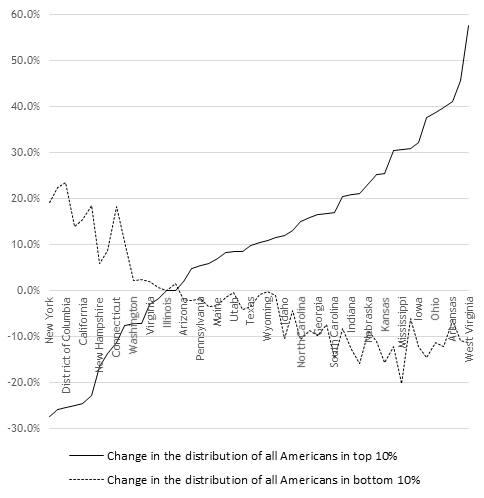
That was not our most important result. Our most important result relates to where the bottom decile of the income distribution is geographically located. We find that instead of being found disproportionately (relative to their share of the total US population) in poorer states, the bottom decile is disproportionately found in rich states. The dotted black line in the figure below illustrates the change in the number of individuals who are, nationally, in the bottom 10%. New York and California have significant increases while West Virginia has a large decrease. The dark black line shows the same for the top 10%.

fig2

Another way to grasp the magnitude of this change is to relate the change to the population shares of each decile by state. For example, New York had 6.29% of the US population in 2012 and 6.61% of all Americans in the bottom 10% of the income distribution before adjusting for regional purchasing parities. After adjusting however, New York’s share of the bottom 10% surges to 7.88%.

Why does it matter? Because most of the cost difference adjustments come from differences in housing costs. The first obvious point is that housing is a crucial aspect of any discussion of inequality. The second, but less obvious point,  is that these differences are massive barriers to migration within the United States and the poorest are those for whom these barriers are the heaviest. Unfortunately, the high-cost areas are also high-productivity areas (New York, San Francisco for example) whose high costs are largely the result of restrictions on the supply of housing. This means that high-productivity areas – which would raise the wages of low-skilled and low -income workers are inaccessible to them. It also means that those who were present before the increase in productivity of these areas capitalized the gains in more valuable real estates (even if this means lower real incomes).

In this light, the geographic reallocation of the bottom 10% is consistent with an emerging literature that argues that inequality is in great a result of housing policy (see notably Rognlie’s reply to Piketty in the Brookings Papers).  This small modification (I consider it small) that me and Youcef made has important logical ramifications.

* Thank you to my friends Rick Weber (who blogs here at NOL and whose research can be seen here) and Ryan Murphy (whose research can be found here) who provided good comments to bring the paper to the stage where we are ready to submit.

Wedding date and superstitions

There is a neat new paper in the most recent edition of the Journal of Population Research by Gabriele Ruiu and Marco Breschi on wedding dates and superstitutions in Italy. Here is the abstract:

In Italy, it is believed that Tuesdays and Fridays are particularly unlucky days for weddings as well as the 17th day of each month. Previous studies realized in the aftermath of the Second World War have shown the strong influence that these superstitions had in determining the wedding dates in the entire country. We have used exhaustive data collection of all marriages celebrated in Italy in the years 2007–2009 to investigate whether superstitions are still able to influence the choices of spouses. We find that this influence is still present after the great economic, social and demographic transformation of Italian society. We also show that a wife’s education reduces the influence of superstition on the choice of the date of marriage while those who opt for a religious rite are also those who are more careful in avoiding inauspicious days.

Rules of Warfare in Pre-Modern Societies

As my first foray into NOL blogging, I figured I would bring up a recent debate I had liberty, war, and peace that lingered in my mind: how have rules of war been maintained throughout history without a central enforcing agency? This question is fundamental to the understanding of the nation-state in IR theory, and is also an astonishing example of spontaneous order in an anarchic and chaotic scenario.

The quandary exists because even the laudable negative rights of life, liberty, and property ownership, as Eric Mack discusses in his essay on Just War Theory, require a positive enforcement by others. Similarly, “rules of war”–such as refraining from attacking non-regulars, not attacking neutral parties, abiding by the terms of treaties, treating prisoners of war with respect, etc.–are, theoretically, difficult to establish and dependent on positive enforcement. This is because if Party A respects these rules, they provide a perverse incentive to Party B to take advantage of Party A’s restraint, and if doing so gives Party B the upper hand, they can enjoy the benefits of betraying the rules of war with impunity. This is a classic Prisoner’s Dilemma, and if it generalized across many nations, the theory of rational choice would lead us to expect a coordination problem, in which those using the strategy of Party B would dominate the Party A’s.

I am certainly not the first to identify this, and the literature on overcoming coordination problems through iteration of the Prisoner’s Dilemma, regime collaboration, and international organizations and treaties is incredibly thorough (just for a taste, you can see James Morrow’s book, F.V. Kratochwil’s book, and articles by Duncan Snidal, Arthur A. Stein, and even James Buchanan and Victor Vanberg). However, I thought it would be interesting to examine the historical evidence of effective rules of war, particularly from the premodern period. Because global communication technology and networks, international courts, treaties, and organizations, and deterrence based on the terrifying weapons of modern war were lacking in antiquity and on through roughly the 18th century (open to argument on that one), premodern societies seem to be the best test of the effectiveness of rules of war and their mechanisms. I won’t discuss any in detail, and I am skipping many rules of war for which their effectiveness is not discernable (such as the Mahabarata, Deuteronomy, and the Quran), but here is a list of interesting examples for discussion:

  • The archaic Greek poleis:
    • As Victor Davis Hanson argues in his influential book, the Western Way of War, the incentive to focus on agricultural production and the fact that citizen-warriors were personally responsible for military service made the costs of long-term campaigns, especially given the lack of siege technologies and the difficulty in laying waste to wheat fields and olive trees, higher than the potential benefits. However, there were still disputes to be resolved, and raiding was still harmful to the agriculture of polis that was raided. In order to limit costs to both invader and defender, the poleis developed the hoplite warfare strategy, in which citizen-soldiers met for decisive conflicts in traditional, if not previously agreed, locations, in which limited territorial gains were afforded to the victor. While this does not describe every aspect of 7th-5th century warfare in Greece, this strategy pervaded the Greek mainland and allowed disputes to be resolved with minimal collateral damage and investment.
  • Thucydides’ Athens:
    • Though Thucydides’ History of the Peloponnesian War is seen as the invention of realism based on its “the strong did what they could, and the weak suffered what they must” representation of self-interest in foreign policy, his narrative as a whole shows an important constraint in war: if a military power makes war with the expressed intent of empire-building without casus belli, they will entrench their enemies, alienate neutral states, and cause divisiveness on the home front because they have lost the moral high ground. Thucydides notes that the majority of Greeks opposed Athens on the grounds of their selfish empire-building, and because of their inability to convince Sparta of their just motives, brutality to neutral states, internal dissension during the Sicilian expedition, and many other misfortunes of war (plague, death of Pericles, Persian intervention), Athenian power was broken. The lesson: Party B (from above) must consider the international reaction to abusing Party A, and at least make a public showing that the war is just. Also, if Hitler had only read his Thucydides, he might have known that marching through Belgium may be tactically sound, but he was risking the same reaction that the Athenians risked in the Melian massacre.
  • POW’s and ransoming in antiquity
    • Several rules of warfare were maintained through the mutual benefits to combatants, the most notable being the conventions concerning ransoming. From at least 5th century Greece (in the Sphacteria incident) to Caesar, citizens could be ransomed following a battle—and there were even conventional levels of payment for these POW’s. This was a benefit specifically afforded to “civilized” foes, and Roman practice increasingly became enslavement rather than ransom, but this convention was widespread for centuries, possibly showing that ransoming enemies is an Iterated Prisoner’s Dilemma.
  • Ancus Marcius and Just War Theory:
    • Along the same lines as the Thucydides example, the Romans engaged in the ritual of the fetiales, including the enumeration of the just cases for war, before invading an enemy. This limited war to official disagreements with neighboring states, and other religious conventions were maintained that limited certain tactics in war (a noteworthy passage of the Aeneid shows that putting on the armor of your enemies for stealth purposes would be doubly punished by the gods). These conventions included looking down on poison as woman’s weapon and on taking some religious statuary as booty, and though Roman generals still poisoned wells or robbed cities of their gods, they received negative reactions by their contemporaries.
  • Hostage policies throughout antiquity:
    • Another problem with the rules of war is the enforcement of treaties, which have credible commitment problems. Both Greeks and Romans made imperial gains by breaking treaties, but it was common practice to overcome the credible commitment problems of both alliances and treaties to end wars that hostages, usually the children of influential citizens or nobles, were exchanged. Whether they were exchanged both ways (more common in alliances) or passed only one way (usually from the defeated to the victorious), hostages were used at least 250 times by Rome and countless times by other ancient civilizations to ensure the enforcement of treaties.
  • Carthage’s “Truceless War”:
    • While we often think of ancient war as anarchic and based on the whims of generals, wars that completely lacked conventions or limitations were rare. In fact, following truces that allowed for collection of the dead, ransoming of both the living and the dead, and supplication for one’s own life go back at least as far as the Iliad, and wars that lacked such conventions were shocking to ancient historians. Such wars occurred when one side broke a general convention, usually the convention of allowing enemies to surrender alive and be ransomed. Because of this betrayal, their opponents would also stop following any rules of war, and such wars became not about achieving strategic goals but annihilating the opponent entirely. Carthage, following their loss in the First Punic War, fought a truceless war with their former mercenaries due to lack of payment that featured escalations in mutilation and crucifixion until the mercenaries were wiped out, at great cost in men and money to Carthage.
  • Roman 3rd party arbitration or intervention:
    • The Romans, after they gained international prominence but before they ruled the whole Mediterranean, took an interest in wars between their neighbors. While this sometimes included imperialism, in several instances they served as a 3rd party arbitrator of peace, and even as an enforcer of peace in Antiochus IV’s invasion of Egypt.
  • Blood feuds:
    • While mentioning blood feuds brings up images of Hatfields, McCoys, and senseless brutality over generations, blood feuds were actually a mechanism for limiting violence through threat of reprisal. While the effectiveness of this mechanism may be debatable, its intention as a limitation of violence is notable in several pre-modern societies, especially the Scots and Slavs.
  • Chivalric codes:
    • We should be careful of romanticizing this example, but from the 12th to 14th centuries, chivalry established rules of conduct for how knights should treat knights on and off the battlefield. Much of the conception of chivalry comes from poetic fictions about historical figures that were vicious or corrupt in many ways. However, it was actually the battlefield codes, such as ransoming rather than killing noble foes, that were actually practiced the most often, a trend that saw a brutal reversal in the War of the Roses. One might point out that neither the chivalric codes nor the earlier Roman codes of war included avoidance of harming civilians. This shows that, while rules of war were effective in practice at many points in history, they did not always have the same conceptions of what these rules were made to protect.
  • The Roman Catholic Church:
    • Catholicism influenced the rules of war in two ways: like the fetiales of the Romans, it established the grounds on which war was justifiable (and was influential on the ideals of chivalry), and the pope himself, through the power of excommunication, could limit the warring impulses of kings and lords. While many popes used their power to cause conflict, the church still had both moral influence and bargaining power, and was a powerful international institution for centuries that forced treaties on Christian rulers, provided a court of arbitration, and, several times, that tried to unite these leaders in war against non-Christians. The influence of Catholic peacekeeping measures waxed and waned from Charlemagne onward, but the Peace and Truce of God was one of the earliest attempts to protect non-combatants in wartime

This very incomplete list represents a lot of the more conventional examples of this phenomenon (sorry, but I am very conventionally educated). I would love if those who have other examples, especially from outside of Greece, Rome, and the Western World, would bring them up in the comments so I can expand my knowledge of the history of the rules of war!

The many iterations of rules of war in pre-modern societies shows the effectiveness of spontaneous order in creating systems that promote liberty and peace. These rules did not eliminate violence, cruelty, or imperialism, but they forced self-interested parties to check their selfish impulses. This is not an argument that international organizations with the goal of limiting war are unnecessary (and the Geneva Conventions are a laudable example of voluntary self-enforcement), but rather a demonstration of the wide reach of both Smith’s invisible hand and Hayek’s spontaneous order: even in the most anarchic of trades, long-term individual self-interest can support general interest, and a certain level of order is imposed on the chaos of war through the unplanned conventions of societies.


ἐν μὲν γὰρ τῇ οἱ παῖδες τοὺς πατέρας θάπτουσι, ἐν δὲ τῷ οἱ πατέρες τοὺς παῖδας

In [peace], sons bury their fathers, but in [war], fathers bury their sons.

–Herodotus, The Histories, 1.87.4.

How Canada Tracked the US during the Great Depression

Over the last few years, while I continued my research on other fronts, I started spending small amounts of time on a daily basis to read about the Great Depression and more precisely, how Canada lived through the depression.

Since the old adage is that Canada gets pneumonia when the US gets the flu, I thought that it was a worthy endeavor (although Pedro Amaral and James McGee have been working on that front) to try to see what insights we can derive from looking at Canada’s experience during the Great Depression (especially since it had a very different banking system).

In the process, I managed to collect in a datasheet, the Industrial Production Index of Canada (consisting largely of heavy industry with some light industries and utilities, making it a relatively well-rounded index). This is what it looks like.

industrialproduction

Other than seeing Canada’s experienced mirrored in the US experience (except for the 1935-1937 window), I am not sure what to make of it. However, I thought it worthwhile to share that information publicly.

Where the state came from

One of the questions that led me to libertarianism was “what is the state?” More than that: Where did it come from? How it works? What’s the use? Analogous questions would be “what is politics?” and “what is economics?” If my classroom experience serves as a yardstick for anything, the overwhelming majority of people never ask these questions and never run after answers. I do not blame them. Most of us are very busy trying to make ends meet to worry about this kind of stuff. I even sought an academic training in politics just to seek answers to these questions. For me it’s nothing to have answers, after all, I’m paid (albeit very poorly paid) to know these matters. Still, I wish more people were asking these types of question. I suspect that it would be part of the process to review the political and economic situation in which we find ourselves.

Many times when I ask in the classroom “what is the state?” I receive in response that Brazil is a state. In general I correct the student explaining that this is an example, not a definition. The modern state, as we have it today, is mainly the combination of three factors: government, population, and territory. The modern state, as we have it today, can be defined as a population inhabiting a specific territory, organized by a centralized government that recognizes no instance of power superior to itself. Often, in the academic and popular vocabulary, state and government are confused, and there is no specific problem in this. In fact, the two words may appear as synonyms, although this is not a necessity. It is possible to distinguish between state and government thinking that the state remains and governments go through.

The state as we know it today is a product of the transition from the Middle Ages to the Modern Age. I believe that this information alone should draw our attention enough: people have lived in modern states only in the last 500 years or so. Throughout the rest of human history other forms of political organization have been used. I am not saying (not here) that these other forms of organization were better than the modern state. I am simply saying that the modern state is far from being natural, spontaneous, or necessary. Even after 1500 the modern state took time to be universally accepted. First, this model of organization spread throughout Europe at the beginning of the Modern Era. It was only in the late 18th century and early 19th century that this model came to be used in the American continent. The modern state spread globally only after the decolonization movement that followed World War II. That is: the vast majority of modern states are not even 70 years old!

What is the purpose of the state? At least in my experience, many people respond by “providing rights” or “securing rights.” People think about health, education, sanitation, culture, security, etc. as duties of the state towards society. It is clear that many people think about health, education, housing, etc. as rights, which in itself is already questionable, but I will leave this discussion for another time. The point I want to put here is that empirically states have only cared about issues like health and public education very recently. In the classic definition of Max Weber (late 19th century), the state has a monopoly on the legitimate use of violence. In other words, virtually anyone can use violence, but only the state can do it legally. That is: the primordial function of the state is to use violence within a legal order. Other functions, such as providing health and education, came very late and only became commonplace with the welfare state that strengthened after World War II.

I find it always interesting to see how we live in a young world. Basically the entire world population today lives in some state and expects from this state a minimum level of well-being. However, this reality is only about 70 years old. The idea that we need to live in states that provide us with a minimum of well being is not natural and far from obvious. To understand that the modern state is a historical institution, which has not always existed, it is fundamental to question its validity. Moreover, to note that the functions of the state that seem obvious to us today did not exist 70 years ago leads us to question whether it is valid to expect things such as health and education from the state.

My personal perception is that the modern state (defined by territory, population, and government) is better than any alternative that has already been proposed. However, the state of social well-being is only a sugar-watered socialism. Socialism, by definition, does not work, as Ludwig von Mises very well shows. Partial socialism is as likely to function as full socialism. Expecting the state to use violence within legal parameters is valid and even fundamental. But to expect that this same state may successfully diversify its activities entering the branches of health, education, culture, etc. is a fatal conceit.

Once, Cubans were (maybe) richer than Americans

In light of what we see today, this is hard to believe. However, as a result of Castro’s death, I accidentally became interested in the history of this fascinating island and the more I discover, the more shocked I am at “the path” that Cuba has taken. One of these reasons is provided below by Victor Bulmer Thomas in his Economic History of Latin America since Independence. Now, Thomas uses a different approach than the commonly used Maddison data (he believes the assumptions are too heroic). He uses indicators correlated with GDP per capita to fill in the gaps and he finds that Cuba was generally richer than the United States for most of the 19th century (see below):

cubaus

Now, I am not convinced by the figure Thomas presents. However, I am also skeptical of the levels presented by Maddison (where Cuba is roughly 60% as rich as the US in 1820). In between are some more reasonable estimate (see this great discussion in this book as well as this discussion by Coatsworth).  Moreover, there is the  issue of slavery which distorts the value of using GDP per capita because of high levels of inequality (however, it distorts both ways since the US was also a slave economy up to the Civil War).

Nonetheless, this tells you about the “path not taken” by Cuba.