- Blood on the land in Brazil Gregory Duff Morton, New York Review of Books
- “Blackness” in France and in America Sarah Claire Dunstan, JHIBlog
- What if prejudice isn’t the cause of racism? Blake Smith, Aeon
- Mexico is whooping the film world’s butt Ioan Grillo, New York Times
“Does Russia own a piece of the US?”
That’s the title of my latest piece over at RealClearHistory. An excerpt:
The Russian-American Company was run through Saint Petersburg and thus had a strict racial hierarchical code in place, in conformity with the latest beliefs about race at the time. The neighborhoods of Fort Ross were segregated, but an archaeologist at the University of California, Berkeley, Kent Lightfoot, has produced excellent research at Fort Ross, showing how the Company’s racist charter was unofficially ignored, with miscegenation widespread (“creoles” was even created as an official race for documentation purposes) and interethnic activities commonplace. The people inhabiting Fort Ross preferred to follow instead something the anthropologist Jean-Loup Amselle calls “mestizo logics.”
Please, show me some love.
Kent Lightfoot can be found at NOL here. Jean-Loup Amselle can be found at NOL here. I also give a shoutout to Andrei Znamenski‘s work in the piece, so be on the lookout for that.
I didn’t get to delve as much into this piece as I’d have liked to. I wanted to get more into the inner workings of the Russian-American Company and compare it to the Dutch East India Company, but that sounds like a tall task even for a PhD dissertation.
I don’t think I did a good enough job of highlighting just how rich Pacific Rim trade was in the early 19th century. I tried in vain to sneak a reference to Hawaiian laborers that could be found throughout the Pacific world at the time of Fort Ross’ founding, but I’ve got a 600 word limit.
Also, I wanted to highlight the fact that Native Americans weren’t losers in the opening up of the Pacific to the world. They were active participants in the globalization of the Pacific Rim trade. They were powerful. I don’t know if I’d focus on California Indians to highlight Native American actors. I’d probably focus on an area a little further north, in the Puget Sound-Vancouver area.
At any rate, hope you enjoy the piece!
Nightcap
- A Brief History of Tomorrow David Berlinski, Inference
- The Invention of World History S. Frederick Starr, History Today
- Actually, Western Progress Stems from Christianity Nick Spencer, Theos
- Correcting for the Historian’s Middle Eastern Biases Luma Simms, Law & Liberty
Deep Learning and Abstract Orders
It is well known that Friedrich Hayek once rejoiced at Noam Chomsky’s evolutionary theory of language, which stated that the faculty of speaking depends upon a biological device which human beings are enabled with. There is no blank slate and our experience of the world relies on structures that come from the experience in itself.
Hayek would be now delighted if he were told about the recent discoveries on the importance of background knowledge in the arms race between human beings and Artificial Intelligence. When decisions are to be taken by trial and error at the inside of a feedback system, humans are still ahead because they apply a framework of abstract patterns to interpret the connections among the different elements of the system. These patterns are acquired from previous experiences in other closed systems and provide with a semantic meaning to the new one. Thus, humans outperform machines, which work as blank slates, since they take information only from the closed system.
The report of the cited study finishes with the common place of asking what would happen if some day machines learn to handle with abstract patterns of a higher degree of complexity and, then, keep up with that human relative advantage.
What is worth being asked is not whether Artificial Intelligence eventually will surpass human beings, but what group of individuals will overcome the other: the one which uses technology or the one which refuses to do so.
The answer seems quite obvious when the term “technology” is related to concrete machines, but it is not so clear when we apply it to abstract devices. I tried to ponder the latter problem when I outlined an imaginary arms race between policy wonks and lawyers.
Now, we can extend these concepts to whole populations. Which of these nations will prevail over the other ones: the countries whose citizens are enabled with a set of abstract rules to based their decisions on (the rule of law) or the despotic countries, ruled by the whim of men?
The conclusion to be drawn is quite obvious when we are confronted with a so polarised question. Nevertheless, the problem becomes more subtle when the disjunction concerns on rule of law vs deliberate central planning.
The rule of law is the supplementary set of abstract patterns of conduct that gives sense to the events of the social reality in order to interpret human social action, including the political authority.
In the case of central planning, those abstract patterns are replaced by a concrete model of society whose elements are defined by the authority (after all, that is the main function of Thomas Hobbes’ Leviathan).
Superficially considered, the former – the rule of law as an abstract machine – is irrational while the latter – the Leviathan’s central planning – seems to respond to a rational construction of the society. Our approach states that, paradoxically, the more abstract is the order of a society, the more rational are the decisions and plans that the individuals undertake, since they are based on the supplementary and general patterns provided by the law, whereas central planning offers to the individuals a poorer set of concrete information, which limits the scope of the decisions to those to be based on expediency.
That is why we like to state that law is spontaneous. Not because nobody had created it -in fact, someone did – but because law stands by itself the test of time as the result of an evolutionary process in which populations following the rule of law outperform the rival ones.
Nightcap
- Whatever Happened to Patient Confidentiality? Irfan Khawaja, Policy of Truth
- What Critics Don’t Understand About Gun Culture David French, the Atlantic
- Making Guns Obsolete Frances Woolley, Worthwhile Canadian Initiative
- Can Libertarianism Be A Governing Philosophy? Michael Munger, Law & Liberty
Nightcap
- Don’t give the Feds anywhere to hide Scott Sumner, EconLog
- Tariff Truths and Income Tax Iniquities Brian Domitrovic, Law and Liberty
- A Proper Accounting of Glass-Steagall Daniel D Leger, American Affairs
- The new constitutional case against ObamaCare Ilya Somin, Volokh Conspiracy
On demography and living standards in the colonial era
This is a topic that has been bugging me. Very often, historians will (accurately) point out mortality statistics in the United States, Canada (Quebec) and the Latin America during the colonial era were better than in the comparable Old World (comparing French with French, British with British, Spanish with Spanish). However, they will argue that this is evidence that living standards were higher. This is where I wish to make an important nuance.
Settlement colonies (so, here there is a bigger focus on North America, but it applies to smaller extent to Latin America which I am more tempt to label as extractive – see here) are generally frontier economies. This means that they are small economies because of small populations. This means that labor and capital are scarce relative to land. All outputs that come from the relatively abundant factor will thus tend to be cheaper if there is little international trade for the goods that they are best at producing. The colonial period pretty much fits that bill. The American and Canadian colonies were basically agricultural colonies, but very few of those agricultural outputs actually crossed the Atlantic. As such, agricultural produces were cheap. This is akin to saying that nutrition was cheap.
This, by definition, will give settlement colonies an advantage in terms of biological living standards. As they are not international price takers, wheat is cheaper than in the old world. This is why James Lemon spoke of the New World as the “Best poor man’s country” (I love that expression) : it was easy to earn subsistence. However, beyond that it is very hard to go beyond. For example, in my dissertation (articles still in consideration at Cliometrica and Canadian Journal of Economics) I found that when wages were deflated by a subsistence basket containing very few services and manufactured goods and which relied heavily on untransformed foods, Canada was richer than the richest city of France. Once you shifted to a basket that marginally increased transformed goods and manufactured goods, the advantage was wiped away.
Yet, everything indicates that mortality rates were greater in Paris and France and than in Quebec City and Quebec as a whole (but not by a lot) (see images below). Similar gaps seem to exist for the United States relative to Britain, but the data is not as rich as for Quebec. However, the data that exists for New England suggests that death rates were lower than in England but the “bare bones” real incomes measured by Lindert and Williamson show that New England may have been poorer than Great Britain (not by much though).
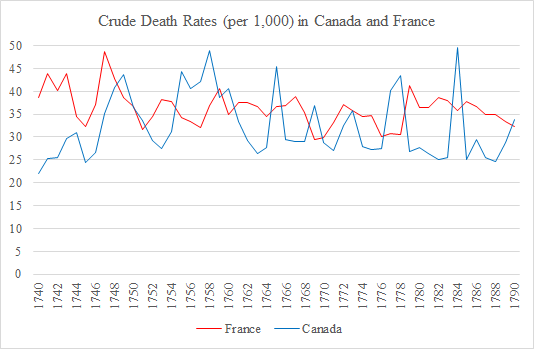
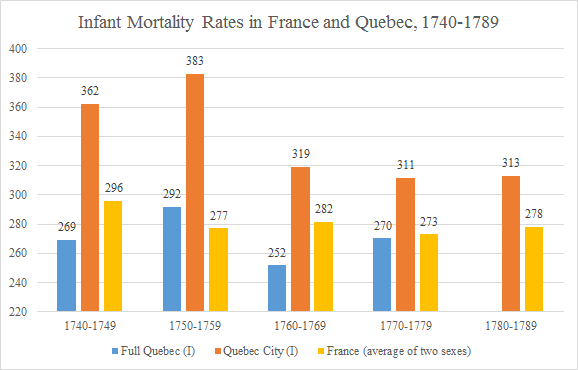
I am not saying that demographic and biological data is worthless. Quite the contrary (even I wanted to, I could not since I have a paper on the heights of French-Canadians from 1780 to 1830)! The point is that data matters in context. The world is full of small non-linearities between variables. While “good” demographic outcomes are generally tracking “good” economic outcomes, there are contexts where this may be a weaker relation (curvilinear relations between variables). I think that this is a good example of that point.
On why complexity from simple rules is counterintuitive
“… normally we start from whatever behavior we want to get, then try to design a system that will produce it. Yet to do this reliable, we have to restrict ourselves to systems whose behavior we can readily understand and predict–for unless we can foresee how a system will behave, we cannot be sure that the system will do what we want.
“But unlike engineering, nature operates under no such constraint. So there is nothing to stop systmes like those at the end of the previous section from showing up. And in fact one of the important conclusions of this book is that such systems are actually very common in nature.
“But because the only situations in which we are routinely aware both of the underlying rules and overall behavior are ones in which we are building things or doing engineering, we never normally get any intuition about systems like the ones at the end of the previous section.”
The deeper you dig into math and computer science, the more Hayekian things look. The impossibility of economic calculation under socialism has important counterparts in Godel and Turing/Church.
Nightcap
- One-party systems loved by the Left, ignored by Trump Oliver Kamm, CapX
- George W Bush’s Forgotten Crimes Against Democracy James Bovard, the Hill
- Peshawar, Sicily, and the Fatal Conceit of Intervention Peter Miller, Views
- How to Seize the Moral High Ground Wayland Hunter, Liberty Unbound
10 Greatest Speeches of All Time
That’s the topic of my latest column over at RealClearHistory. Obviously, I took a break from my World War I-themed posts to do this one. Here is an excerpt:
4. Duty, Honor, Country speech by Douglas MacArthur: May 12, 1962. General Douglas MacArthur was a divisive figure in his day. For many, he was too martial for a constitutional republic, too outspoken for a General, and some of the policies he argued for (foreign and domestic) were a bit too hawkish for my stomach. William Manchester’s biography of Douglas MacArthur, American Caesar, helped show me how important republican governance was to the General, though. MacArthur thought deeply about republicanism and the effects that war had on a republican citizen’s virtues and characteristics. I have the slight advantage of having Manchester’s work on MacArthur etched into the back of my mind while reading through the latter’s speech, given to cadets at West Point two years before his death: “His name and fame are the birthright of every American citizen. In his youth and strength, his love and loyalty, he gave all that mortality can give. He needs no eulogy from me; or from any other man. He has written his own history and written it in red on his enemy’s breast.” You can read the whole speech here.
These columns are aimed at a different crowd that what I am used to here at NOL, but I think I do a pretty decent job of weaving rather mundane topics (great speeches from an American point of view) into the fabric of more fundamental questions about our global society. Read the rest to find out if I’m way off the mark on this one.
Nightcap
- The Forgotten Everyday Origins of ‘Craft’ Sarah Archer, the Atlantic
- Changes in the Nature of Work Jacques Delacroix, NOL
- Why America Can’t Go Swiss on Guns Kevin Sullivan, RealClearWorld
- Eccentric culture is what makes the West unique Rémi Brague, Montréal Review
How poor was 18th century France? Steps towards testing the High-Wage Hypothesis (HWE)
A few days ago, one of my articles came online at the Journal of Interdisciplinary History. It is a research note, but as far as notes go this one is (I think) an important step forwards with regards to the High-Wage Hypothesis (henceforth HWE for high-wage economy) of industrialization.
In the past, I explained my outlook on this theory which proposes that high wages relative to energy was a key driver of industrialization. As wages were high while energy was cheap, firms had incentives to innovate and develop labor-saving technologies. I argued that I was not convinced by the proposition because there were missing elements to properly test its validity. In that post I argued that to answer why the industrial revolution was British we had to ask why it was not French (a likely competitor). For the HWE to be a valid proposition, wages had to be higher in England than in France by a substantial margin. This is why I have been interested in living standards in France.
In his work, Robert Allen showed that Paris was the richest city in France (something confirmed by Phil Hoffman in his own work). It was also poorer than London (and other British cities). The other cities of France were far behind. In fact, by the 18th century, Allen’s work suggests that Strasbourg (the other city for which he had data) was one of the poorest in Europe.
In the process of assembling comparisons between Canada and France during the colonial era (from the late 17th to the mid-18th centuries), I went to the original sources that Allen used and found that the level of living standards is understated. First, I found out that the wages were not for Strasbourg per se. They applied to a semi-rural community roughly 70km away from Strasbourg. Urban wages and rural wages tend to differ massively and so they were bound to show lower living standards. Moreover, the prices Allen used for his basket applied to urban settings. This means that the wages used were not comparable to the other cities used. I also found out that the type of work that was reported in the sources may not have belonged to unskilled workers but rather to semi-skilled or even skilled workers and that the wages probably included substantial in-kind payments.
Unfortunately, I could not find a direct solution to correct the series proposed by Allen. However, there were two ways to circumvent the issue. The most convincing of those two methods relies on using the reported wages for agricultural workers. While this breaks with the convention established by Allen (a justifiable convention in my opinion) of using urban wages and prices, it is not a problem if we compare with similar types of wage work. We do have similar data to compare with in the form of Gregory Clark’s farm wages in England. The wage rates computed by Allen placed Strasbourg at 64% of the level of wages for agricultural workers in England between 1702 and 1775. In comparison, the lowest of the agricultural wage rates for the Alsatian region places the ratio at 74%. The other wage rates are much closer to wages in England. The less convincing methods relies on semi-skilled construction workers – which is not ideal. However, when these are compared to English wages, they are also substantially higher.
Overall, my research note attempts a modest contribution: properly measure the extent to which wages were lower in France than in Britain. I am not trying to solve the HWE debate with this. However, it does come one step closer to providing the information to do so. Now that we know that the rest of France was not as poor as believed (something which is confirmed by the recent works of Leonardo Ridolfi and Judy Stephenson), we can more readily assess if the gap was “big enough” to matter. If it was not big enough to matter, then we have to move to one of the other five channels that could confirm the HWE (at least that means I have more papers to write).
Nightcap
- China Portrays Racism as a Western Problem the Economist
- Pure Racism and Chinese Dining Jacques Delacroix, NOL
- Imagining a New China Fiammetta Rocco, 1843
- A German’s View of China’s Rise Peter Gordon, Asian Review of Books
Trump’s humor is not very funny to the world’s liberal democracies
The Chinese Communist Party, on February 25, 2018, made a significant announcement — that the two-term limit for Presidency will be abolished through an amendment to the constitution. This means that current President Xi Jinping will be President for life. This amendment was tabled on March 6, 2018 by the Communist Party during the two week National People’s Congress (which began on Monday, March 5, 2018).
According to a CNN recording, Donald Trump, while reacting to this development, stated:
He’s now president for life, president for life. And he’s great. And look, he was able to do that. I think it’s great. Maybe we’ll have to give that a shot someday.
The US President also called Xi a “gentleman,” and said that the latter had treated Trump very well during his China visit in November 2017. Trump’s reaction to Xi’s decision has been criticized by some politicians in the US, while other major Western democracies have not commented on the decision.
Trump’s inconsistency on China
Trump’s views with regard to China have not been consistent, as is the case on many other issues. Candidate Trump had used tough language for China; at one campaign rally, for example, candidate Trump stated:
We can’t continue to allow China to rape our country and that’s what they’re doing. It’s the greatest theft in the history of the world.
During his visit to China in November 2017, the US President had, interestingly enough, criticized his predecessors, and said that he does not hold China responsible for the skewed trade relationship:
[…] I don’t blame China. After all, who can blame a country for taking advantage of another country for the benefit of its own citizens? I give China great credit […] I do blame past [US] administrations for allowing this out of control trade deficit to take place and to grow. We have to fix this because it just doesn’t work […] it is just not sustainable.
While the US President is unpredictable, the criticism of his predecessors on foreign soil came as a shock to everyone.
Trump’s myopic approach towards complex economic and strategic issues has helped China
Trump’s recent praise of the constitutional change which will enable Xi to be President for life may have embarrassed many Americans and Liberals in other parts of the world. They would have perhaps expected the US President to raise a red flag.
The fact is, however, that many of Trump’s foreign policy decisions – withdrawing from the Trans Pacific Partnership (TPP) trade deal in January 2017, or repeatedly criticizing NATO (North Atlantic Treaty Organization) and stating that members are not meeting their ‘financial obligations’ or, more recently, the imposition of tariffs on imports of aluminium and steel – are embarrassing steadfast allies in Asia and Western Europe. All these decisions have sent a message globally that Trump’s view of the outside world is driven by domestic politics and transactionalism – and not realism as some would have us believe. This is in contrast to his predecessors, who valued relationships but also understood the relevance of common democratic values as a binding thread. Trump on the other hand is quite comfortable with authoritarian leaders.
Trump has often expressed admiration for authoritarian leaders like Vladimir Putin, and Phillipines President Rodrigo Duterte. Duterte, who is controversial for using extrajudicial methods to deal with a Filipino drug problem, has presided over a drug war that has cost the lives of more than 4,000 people. While praising Duterte, Trump said:
I just wanted to congratulate you because I am hearing of the unbelievable job on the drug problem. Many countries have the problem, we have a problem, but what a great job you are doing.
During their meeting on the sidelines of the ASEAN Summit in Manila (November 2017), Trump did not sufficiently raise US human rights concerns, and was criticized by many American politicians, including Republican Senator John McCain. The US-Philippines Joint Statement, while speaking about the challenge of the drug problem, did refer to a human rights issue (issued after the meeting between Trump and Duterte):
The two sides underscored that human rights and the dignity of human life are essential, and agreed to continue mainstreaming the human rights agenda in their national programs to promote the welfare of all sectors, including the
most vulnerable groups.
It would be pertinent to point out that the previous administration had criticized Duterte for adopting such measures. In return, Duterte used offensive language aimed at President Obama.
While the US has been in bed with authoritarian regimes in the past and turned a blind eye on many occasions to human rights violations, no one can deny the fact that even transactionalist Presidents like Ronald Reagan paid lip service to democracy and human rights. In a speech at Westminster, Reagan stated:
Democracy is not a fragile flower […] Still it needs cultivating. If the rest of this century is to witness the gradual growth of freedom and democratic ideals, we must take actions to assist the campaign for democracy.
Similarly, George W Bush, who was often thought of as being very simplistic, spoke about the importance of democratic values as a common binding factor with many of its allies.
Conclusion
In conclusion, while reasonable ties between Washington and Beijing are good news, Trump’s public appreciation of authoritarian leaders and their methods is worrying because at the global level there is a feeling that authoritarian leaders and systems deliver better results compared to chaotic democracies.
The US has always been the flagbearer of democracy, liberal values, and human rights. It is a matter of concern, then, when the leader of such a country pays little attention to these issues. In a way, Trump has played a pivotal role in wrecking the liberal order, and by doing so has created a situation where Beijing will not have to change its ways, but may well create a parallel order which many countries will be willing to join due to China’s economic prowess.
Nightcap
- The Left’s Double Standard on the Power of Media Madeline Grant, CapX
- What Happens Next for British Left? Zoe Williams, Times Literary Supplement
- Americans are richer and happier than Europeans Scott Sumner, EconLog
- South Africa decides Zimbabwe is an instruction manual Johnathan Pearce, Samizdata

