On celebrating the new year with a thought experiment

Each time I start teaching classes at the business school where I am a course lecturer, I am always amazed at the disconnect between the quantitative facts and the beliefs that individuals have. My favorite relates to poverty and inequality.

Everybody seems to think that poverty is increasing and that worldwide inequality is increasing. Each time, I have to show figures to shoot down those beliefs. I also do it in the french media of my home province of Quebec where – as a result of pointing out those facts – I am branded as a “neoliberal” for being optimistic for the fate of mankind.

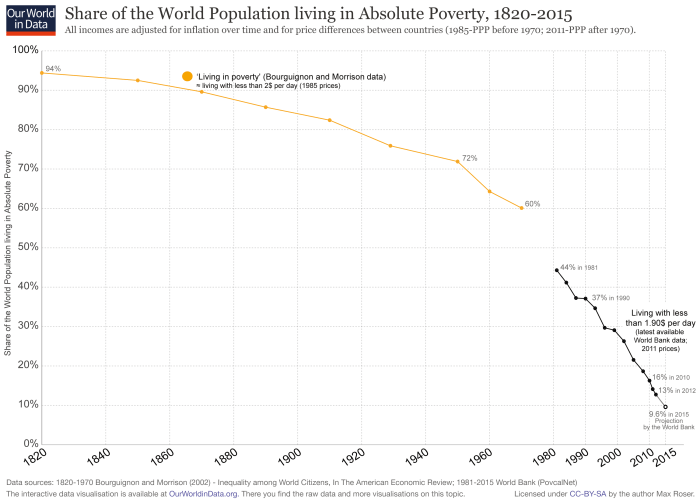
However, let’s think about it in the context of the new year to see why there is room for optimism. Let’s make a thought experiment similar to John Rawls’ original position but somewhat differently. You have a hat with all the years since the neolithic age, each on a separate piece of paper. If you had to hope for one year in particular, which would prefer? I would pick 2016!

By picking 2016, I have one chance in ten of living under extreme poverty. At any earlier point in time, these odds would have been close to 90%. (The data comes from the Our World In Data project by the amazing Max Roser).

World-Poverty-Since-1820-full

Although this diminished poverty does not explain every improvement with regards to every other metrics of living standards (life expectancy, infant mortality, nutrition, heights, body mass, survival to diseases), it does explain an appreciable part of these improvements.

Sit down with some friends to celebrate the new year and ask them about this “thought experiment”. Ask them if they would pick 2016. Once it is presented as such, I am sure that in spite of all the headwinds facing mankind, they will be optimistic.

NGDP, NGO and total expenditures

I did not think that my post on NGO versus NGDP would gather attention, but it did (so, I am happy). Nick Rowe of Carleton University and the (always relevant) blog Worthwhile Canadian Initiative responded to my post with the following post (I was very happy to see a comment by Matt Rognlie in there).

Like Mr. Rowe, I prefer to speak about trade cycles as well. I do not know how the shift from “transactions” to “output” occurred, but I do know that as semantic as some may see it, it is crucial. While a transaction is about selling a unit of output, the way we measure output does not mean that we focus on all transactions.  I became aware of this when reading Leland Yeager (just after reading about the adventures on Lucas’ Islands). However, Nick (if I may use first names) expresses this a thousand times better than I did in my initial post. When there is a shift of the demand for money, this will affect all transactions, not only those on final goods. Thus, my first point: gross domestic product is not necessarily the best for monetary transaction.

In fact, as an economist who decided to spend his life doing economic history, I do not like gross domestic product for measuring living standards as well (I’ll do a post on this when I get my ideas on secular stagnation better organized). Its just the “least terrible tool”. However, is it the “least terrible” for monetary policy guidance?

My answer is “no” and thus my proposition to shift to gross output or a measure of “total spending”. Now, for the purposes of discussion, let’s see what the “ideal” statistic for “total spending” would be. To illustrate this, let’s take the case of a change in the supply of money (I would prefer using a case with the demand for money, but for blogging purposes, its easier to go with supply)

Now unless there is a helicopter drop*, changes in the money supply generate changes in relative prices and thus the pattern (and level) of production changes too. Where this occurs depends on the entry point of the increased stock of money. The entry point could be in sectors producing intermediary goods or it could closer to the final point of sale. The closer it is to the point of sale, the better NGDP becomes as a measure of total spending. The further it is, the more NGDP wavers in its efficiency at any given time. This is because, in the long-run, NGDP should follow the same trend at any measure of total spending but it would not do so in the very short-run. If monetary policy (or sometimes regulatory changes affecting bank behavior “cough Dodd-Frank cough”) causes an increase in the production of intermediary goods, the movements the perfect measure of total spending would be temporarily divorced from the movements of NGDP. As a result, we need something that captures all transaction. And in a way, we do have such a statistic: input-output tables. Developed by the vastly underrated (and still misunderstood in my opinion) Wassily Leontief, input-output tables are the basis of any measurement of national income you will see out there. Basically, they are matrixes of all “trades” (inputs and outputs) between industries. What this means is that input-output tables are tables of all transactions. That would be the ideal measure of total spending.  Sadly, these tables are not produced regularly (in Canada, I believe there are produced every five years). Their utility would be amazing: not only would we capture all spending (which is the goal of a NGDP target), but we could capture the transmission mechanism of monetary policy and see how certain monetary decisions could be affecting relative prices.** If input-output tables could be produced on a quarterly-basis, it would be the amazing (but mind-bogglingly complex for statistical agencies).

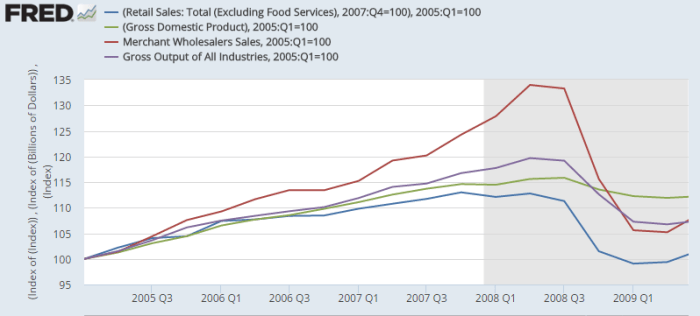
The closest thing, at present, to this ideal measure is gross output. It is the only quarterly statistic of gross output (one way to calculate total spending) that exists out there. The closest things are annual datasets. Yet, even gross output is incomplete as a measure of total spending. It does not include wholesale distributors (well, only a part of their activities through value-added). This post from the Cobden Centre in England details an example of this. Mark Skousen in the Journal of Private Enterprise published a piece detailing other statistics that could serve as proxies for “total spending”. One of those is Gross Domestic Expenditures and it is the closest thing to the ideal we would get. Basically, he adds wholesale and retail sales together.  He also looks at business receipts from the IRS to see if it conforms (the intuition being that all sales should imitate receipts claimed by businesses). His measure of domestic expenditure is somewhat incomplete for my eyes and further research would be needed. But there is something to be said for Skousen’s point: total nominal spending did drop massively during the recession (see the fall of wholesale, gross output and retail) while NGDP barely moved while, before the recession, total nominal spending did increase much faster than NGDP.

NGONGDP1

In all cases, I think that it is fair to divide my claim into three parts: a) business cycles are about the deviation from trends in total volume of trades/transactions, thus the core variable of interest is nominal expenditures b) NGDP is not a measure of total nominal spending whose targeting the market monetarist crowd aims to follow; c) since we care about total nominal spending, what we should have is an IO table … every month and d) the imperfect statistics for total spending show that the case made that central banks fueled spending above trend and then failed to compensate in 2008-2009 seems plausible.

Overall, I think that the case for A, B and C are strong, but D is weak…

* I dislike the helicopter drop analogy. Money is never introduced in an equal fashion leading to a uniform price increase. It is always introduced through a certain number of entry points which distort relative prices and then the pattern of trade (which is why there is a positive short-term relation between real output and money supply). The helicopter drop analogy is only useful for explaining the nominal/real dichotomy for introductory macro classes.
** Funny observation here: if I am correct, this means that Hayek’s comments about the structure of production would have been answered by using Leontief’s input-output table. Indeed, the Austrians and Neoclassicals of the RBC school after them have long held that monetary policy’s real effects are seen through changes in the structure of production (in the Austrian jargon) or by inciting more long-term projects to be undertaken creating the “time to build” problem (in the RBC jargon). Regardless of which one you end up believing (I confess to a mixed bag of RBC/Austrian views with a slight penchant to walk towards Rochester), both can be answered by using input-output tables. The irony is that Hayek actually debated “planning” in the 1970s and castigated Leontief for his planning views. Although I am partial (totally) to Hayek’s view on planning, it is funny that the best tool (in my opinion) in support of Hayek is produced by an intellectual adversary

Giving Up On The Masses

In 2012, during Ron Paul’s second presidential candidacy as a Republican, I felt deflated with the masses again. Again, the masses were not going to vote a libertarian into office. It was the same year in which I read Murray Rothbard’s Ethics of Liberty and Hans-Hermann Hoppe’s Democracy: The God That Failed. What struck me at that time was the realization that democracy is actually an extremely poor political system to make society become more libertarian. Democracy is not even a guarantee whatsoever for political and economic freedoms. Its success is dependent on the uprightness of the masses, but where are the masses to stand up against war, bank bailouts, taxation, police aggression etc? If the government is truly a gang of thieves and murderers, as I believe it is, then the voting masses are advocates of theft, harassment, assault, and murder.

I do not believe that the masses are ready for freedom, because freedom means taking responsibility for one’s life and actions – a frightening prospect for the masses who lack the strength to face insecurities in life. Ingrained with fear of their own and their neighbours’ incapability to live a ‘responsible’ life, they are attracted to masters who can arrange their lives for them. The masses have also never thirsted for truth. Whoever can supply them with illusions is easily their master, and whoever attempts to destroy their illusions is always their victim. They want to be comfortable and cuddled to death. Thinking is too much hassle for the mass-man. The masses have moreover a love for egalitarianism and a disdain for those who are different, who are more successful and more beautiful. They hate freedom, because in freedom man naturally maintains his distance from his fellow human beings.

Being discontent with the masses and deflated in my philosophical views on politics and economics, I took Peter Thiel’s following dictum to heart: “The masses have given up on unregulated capitalism, so those who still support unregulated capitalism should give up on the masses.” Instead, I have put my hope on such technological advances of decentralization as cryptocurrencies, seasteading, 3D-printing, and localized energy conservation and production.

Don’t target NGDP, target NGO!

Before I start blogging at Notes on Liberty, I just want to say how happy I am to join this collaborative venture. I generally blog in French at the Journal de Montréal and my English writings are confined to my academic papers. Hence, I am very happy to communicate with English audiences.

Actually, this is an opportunity to write about NGDP targeting. In the anglosphere, this rule-based approach to monetary policy has been very popular. In the french world where I evolve, it is close to a fringe point of view (given a strong Old Keynesian/New Keynesian viewpoint). As a result, any effort to expand on the issue requires that the issue first be raised. Hence, I have avoided discussing monetary policy in my French writings. But there is a point that needs to be made about NGDP targeting as advanced by people like Scott Sumner, George Selgin, the late Bill Niskanen, Marcus Nunes, Benjamin Cole, David Beckworth, Lars Christensen and David Glasner : the idea of targeting nominal spending (me switching from the term NGDP to “nominal spending” is important) does not mean that we ought to target nominal gross domestic product.

The intuition behind NGDP target is that monetary policy should be aimed at reacting to changes in demand for money. Thinking of the equation of exchange (MV=PY), a change in V should be matched by an opposite change in M so that MV remains stable. Any increases in Y(output)should be met by reductions in P(rices) and no changes in MV. In practice, NGDP targeting is about avoiding deviations from long-term trends in NGDP. However, while the equation is often presented as MV=PY, the original papers by Irving Fisher and others present it as MV=PT where Y (output) is substituted by T (transactions).

But is PT the same as NGDP? At any point in time, total spending in the economy is much greater than the sum of final goods. There are intermediate goods which are being produced – intangible capital, capital inputs and producers goods.  NGDP avoids calculating these because it would lead to double-counting. Work by Austrian-friendly scholars like Mark Skousen proposes that the double-counting is actually a strength in certain cases. This is because the double-counting gives greater weight to production.  Skousen calls it “Gross Output”(GO) and he finds that GDP is generally a fraction of GO (at 53% in 1982).

Now, GDP is best for measuring welfare in the long-run. However, for short-run discussion, nominal GDP is not (at all) the sum of nominal spending. Imagine an easy monetary policy which incites firms to produce more, there might be a lag between the increased production and “arrival on shelves” for consumers to buy.  This occurs as firms acquire new producer goods and/or gear themselves to producing goods for other producers. This means that in the short-run, the ratio of NGO to NGDP (nominal Gross Output) could vary. Easy monetary policy could make NGO grow faster than NGDP.

In a way, I am saying that NGDP is while the equation of exchange should be about all transactions (T in the original Irving Fisher papers) and transactions is best represented by NGO. As a result, NGO is a better proxy for trends of nominal spending. Let’s make a first test of this (and I hope this gets the ball rolling) by looking at the data.

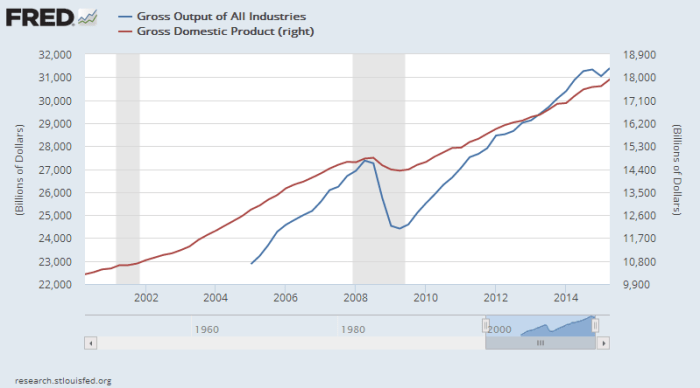
The NGDP crowd claims that prior to 2008, monetary policy was easy, allowing NGDP to grow above trend. Tight monetary policy during 2008-2009 led to a significant drop below trend which was the cause of the recession. With NGO (gross domestic output for all industries as presented by St-Louis Fed), we see the same story but much more clearly!

NGONGDP

From 2005 (when the data start for NGO) to 2008, NGO grows much more rapidly that NGDP (the ratio actually increases to 2008) and then it falls dramatically in 2008-2009 and barely recovers to remain stable thereafter. However, the drop from 2008-2009 is much more pronounced than that for NGDP. This suggests that “overall” nominal spending did fall more than NGDP suggests.

If monetary policy should shift to targeting nominal spending, NGDP is not the best indicator – NGO is.

Natural Rights and Taxation

A moral right is a correlative or flip side of a moral wrong. The right to have X means that it is morally wrong or evil to deny the holder from having X by stealing or destroying it. The right to do X means it is evil for others to forcibly prevent a person from doing X.

People have the natural right to do anything that does not coercively harm others, and the natural right to be free from coercive harm. Natural rights are based on natural moral law, as expressed by the universal ethic. By the universal ethic, all acts, and only those acts, which coercively harm others are evil. I and others have written on natural moral law, easily searched on the Internet.

A legal privilege is a special power or income granted to particular people because of their political status. A king is privileged because of his inheritance and laws regarding this. A slave owner is privileged to own another human being. There are no privileges in natural moral law, since one of the premises from which the universal ethic is derived is human moral equality, an equality of moral worth, implemented as equality before the law and equal legal rights.

In the Constitution of the United States, the 9th Amendment states, in its entirety, “The enumeration in the Constitution, of certain rights, shall not be construed to deny or disparage others retained by the people.” The other rights are common-law and natural rights. Therefore the U.S. Constitution recognizes natural rights, and all laws in the USA should be consistent with the 9th Amendment, although in practice, the 9th is ignored and not widely understood.

This brings us to two court cases. In Murdock v. Pennsylvania, 319 U.S. 105 (1943), the Supreme Court stated that a law requiring solicitors to purchase a license was an unconstitutional tax on the Jehovah’s Witnesses’ right to freely exercise their religion. The Court ruled that “The state cannot and does not have the power to license, nor tax, a Right guaranteed to the people,” and “No state shall convert a liberty into a license, and charge a fee therefore.”

In another case, the Court ruled similarly, that “If the State converts a right (liberty) into a privilege, the citizen can ignore the license and fee and engage in the right (liberty) with impunity.” (Shuttlesworth v. City of Birmingham, Alabama, 373 U.S. 262).

The principles behind the statements of the Court have to apply generally. The federal and state governments may tax privileges, but may not tax a natural right. Since people have a natural right to engage in labor for wages, taxes on wages violate natural rights and therefore the Constitutional rights recognized by the 9th Amendment. Taxes on trade and goods also violate natural rights, which is why state laws claim, incorrectly, that, when they impose a sales tax, they are taxing the privilege of selling goods. (For example, it is written that “California assesses a sales tax on sellers for the privilege of doing business in California.”)

If natural rights are violated by taxing wages, the same applies to the products of labor and the income from the products. Thus a person has the natural right to fully keep and trade produced goods and the financial counterparts as shares of companies and their incomes.

The U.S. Constitution does provide government with the power to tax. Article I, Section 8, states, “The Congress shall have power to lay and collect taxes, duties, imposts and excises.” The 16th Amendment restricts the income tax to being levied as an indirect tax, but otherwise did not alter or add to the powers of Article I.

There is an apparent contradiction. Article I empowers government to tax imports and goods, and other taxes, but the 9th Amendment prohibits taxing acts which are natural rights.

Clearly the founders did not oppose taxing as such. But the letter and spirit of the law have to go beyond the intents of the founders. The Constitution also did not explicitly outlaw slavery, despite its recognition of preexisting rights. When slavery was later abolished, this was in accord with justice as prescribed by natural moral law and the 9th.

If a parent says to a child, you may go outside and play, and also says, do not throw rocks at the squirrels, the permission to play does not imply that anything goes. Thus when the Constitution authorizes taxes, but then, in an Amendment, says, by implication as recognized by the Supreme Court, that government may not tax a right, then the power of taxation has been constrained.

The U.S. Constitution creates an imposed but limited government, and the founders recognized the need for revenues. The sources of government revenue boil down to two original sources: labor and land. There is human exertion, and there is what nature provides.

Since human exertion and its gains are a natural right, the only source left is nature’s resources, land. Thus the moral question is whether the ownership of land is a natural right. This issue is, of course, much disputed. In my judgment, the moral law of property is, “To the creator belongs the creation, and where there is no creator, the benefits belong to the people in equal shares.” The universal ethic is based on the premise, from the nature of humans being, as John Locke wrote, “all equal and independent,” the independence being that thinking and feeling occur individually.

The benefits of land are measured as its economic rent. Therefore, the rent belongs to the people, and by natural moral law, the individual right of the possession of land is conditional on paying the rent to the rightful owners, the people. A tax on land rent does not violate the natural rights of the title holder.

Although the rent really belongs to the people and not to an imposed government, since government is already an imposition, it violates natural rights the least when rent is used for public revenues to pay for public goods that generally benefit the people. The people receive the rent in kind rather than in cash.

If consistently implemented, the 9th Amendment, backed up by the Murdock case, implies that the income tax as well as excise taxes should not tax the right of labor and trade. The greatest challenge of humanity is to recognize the full spectrum of human natural moral rights.

—————————————————

A similar article by me appears in progress.org as “Rights and Privileges”.

Urging Cambodians To Critique Their Culture

Brandon has recently referred to my comment that the Cambodian culture is ‘backward’ in this post. In response to that, I would like to share some more thoughts about the Cambodian culture and why I would urge all Cambodians (and all others) to critique their own culture.

I notice that some Cambodian people romantically adore their Khmer culture. Some people’s adoration stretches to the extent that they cannot accept any critiques about their culture as if critiquing the culture equals criticizing the person. Their adoration takes levels that are frightening me – examples are sentiments of supreme nationalism, the gullible belief in distorted histories that have pushed Cambodians into a victimized position that they gladly exploit in political and personal relations, and their willingness to fight and die for the country. To them, the excessive love of one’s culture or nation is noble, but to me it is ridiculous. It doesn’t require heart to love something, it requires more heart to critique the thing you love.

Several aspects of the Khmer culture that I find absolutely deplorable:

  • the hierarchical structure of its social life. Cambodian children are raised to respect and to be obedient toward their elders and toward Buddhist monks. Instilled with strict social rules, the Cambodians are unable to properly reflect on social values and social norms. Children are not encouraged to think for themselves, and to oppose their elders as the elders are always considered right. It should be no surprise that they grow up lacking self-reflective skills;
  • the people´s highly status oriented attitude and their low demeanor toward those who are more wealthy. Cambodian people are extremely status oriented and excessively adore those who enjoy a higher status. It is considered impolite to make eye contact with someone of higher status. In return, empowered by a feeling of superiority despite their plain stupidity, those of higher status look down on the lower classes;
  • their idleness and slowness, which seems to be common among most native South-East-Asians and which may be attributed to their tropical climate. Cambodian people are lazy and like to spend their time gazing around mind-numbingly;
  • its false and pretentious intelligentsia. The Cambodian intelligentsia are like dogs: they bark so much, but they know absolutely nothing! Equipped with beautiful words and eloquent expressions, their words are often empty of substance. They are good at doubtlessly regurgitating any knowledge or wisdom that they have read, but are incapable of critical thinking and of constructing their own ideas;
  • and worst of all its culture of self-pity. Cambodians like to pity their own existence and it is in this self-pity that their suffering is multiplied and their extreme egoism is revealed. This most self-destructive emotion which drowns them in a sea of depression is often used as a weapon to manipulate others, and is sometimes expressed through hysterical lamentations. See here and here for some examples of their miserable cries.

Although I know that my harsh critique of Cambodian culture does not please some Cambodians, they should know that in criticism there is often a desire to improve the people’s situation and to elevate them. It requires effort and energy to care enough about something to speak freely about it. I would urge all Cambodians who would like to improve their nation to gather the strength to stand above their culture so that they can look down on it, reflect on it, and critique it – even better, make fun of it and eventually transcend it.

Hence, Cambodian, go and indulge yourself in some self-mockery!

Freedom of Speech on Campus

Much controversy rages over campus speech these days. Examples abound; here’s one from George Washington University about students hanging flags from their dorm windows. What legitimate free speech rights do students enjoy on campus? The answer is: it depends.

Before examining the dependency, let’s distinguish natural rights from contractual rights. Natural rights are entitlements that stem directly from our humanity. It’s often said that freedom of religion and freedom of speech are natural rights but they aren’t. The only genuine natural rights are property rights: control of our own body, control of our own material and intellectual creations, and control of things we have acquired through voluntary transactions.

Contractual rights arise from an exchange that plays out over time. If I’m a student at GWU, a private University, I may have been promised that in return for my tuition, I will acquire a number of entitlements including freedom of speech on campus, within limits (no yelling “fire!” in a crowded lecture hall). That’s the only freedom of speech I have on campus. If GWU should want to forbid pro-Israel speeches on campus, for example, and I accept that as a condition of admission, then I have no right to lobby for Israel on campus.

Things get complicated when the institution is publicly owned.[1] Who owns San Jose State University? Not “the people”—that would be meaningless. The owner is the person or group who has final say over campus property and policies. That might be the Board of Trustees of the California State University, but how much of their control have they relinquished to what other parties? Hard to say, and in particular it’s hard to say who gets to set restrictions on campus speech—and of course all manner of such restrictions are necessary if the business of the University is to go forward. No blocking hallways, no disrupting classes, etc.  In the case of a public university, somebody has to decide what sort of speech is allowed, usually according to what is politically palatable to the loudest voices.


To repeat, the only genuine natural rights are property rights. Freedom of speech or religion are not fundamental rights but are contingent on the ownership of property involved in any particular speech or religious activity.

[1] “Public ownership” is actually an oxymoron because ownership means some people are excluded while public means everybody is included.

Why Few ‘Social Justice Warriors’ Actually Care About Social Justice

I notice that many people love to defend ‘equality for the sexes’, ‘equality for all ethnicities’, because ‘everyone is beautiful… everyone is awesome… everyone is sacred’. All these sound extremely good, noble and well, but I have realized throughout the years that most of these so-called ‘social justice warriors’ do not truly care about social justice at all as one cannot truly stand for justice without an inquisitive mind.

These people repeat everything that sounds good, but barely put any effort in understanding the issues at hand. They lack the critical faculty to subject ideals to severe critical scrutiny. For this reason, they are extremely susceptible for ideals that at first sight seem wonderful, but that are actually rotten and damaging. They also do not possess enough modesty in how little they know. Most social justice warriors are therefore irrationally and vehemently defending a cause they do not truly understand. The worst thing is that many of them refuse to explore the issues of social justice, to look for underlying evidence to support their arguments, to read, and to learn. Many of them are self-deceivers, and discussions with them often turn out to be a vexation as it is impossible to appeal to their reason.

I agree with Michael Huemer that actually most people who fight for a ‘noble cause’ “are chiefly moved, not by a desire for some noble ideal, but by a desire to perceive themselves as working for the noble ideal – not, for example, by a desire for justice, but by a desire to see themselves as promoting justice” (Huemer, 2012, p. 19). The ultimate test to find out whether a social justice warrior truly cares about justice is to have a rational conversation about issues of justice and see whether he is willing to defend his noble ideals rationally and whether he is open for learning.

Reference
Huemer, M. (2012). In Praise Of Passivity. Studia Humana, 1, 2, pp. 12-18.

To Pledge or Not to Pledge

I attended a public meeting last night as I do from time to time. It’s a bad habit I can’t seem to shake. Like many of the more formal public meetings in this country, it started with the Pledge of Allegiance. (Foreign readers may not know that this is a 31-word quasi loyalty oath of allegiance to “the flag.”) When the time comes, everyone is supposed to stand, put their heart on their hand, face the flag, and recite the Pledge in unison, which is drummed into all schoolchildren.

My policy during the last several years has been to stand and remain silent with my hands at my side. I don’t make a spectacle of myself by staying seated, but I’m not willing to say the Pledge, for several reasons.

  • It’s too much like religion, and not just because of the “Under God” phrase
  • I don’t like feeling like a sheep following the herd
  • I don’t like the implication that we should bow and scrape to our rulers

Plenty of people would brand me a traitor for my attitude, an ingrate who doesn’t appreciate the benefits of living in the good ol’ U.S.A. In fact, I am quite grateful that I live in the U.S.A. because

  • I grew up in this culture and feel a part of it (omitting rock “music”)
  • The land is beautiful
  • Our politicians are less rapacious than in some other countries
  • We still have a reservoir of individualist sentiment that resists the “Progressives” and the neocons and their relentless push for a made-in-America brand of fascism
  • The libertarian movement has grown enormously in the years since 1971 when I signed on

I do indeed feel some kind of loyalty to the land and the people. But not to the government. And to swear allegiance to the Constitution, as the newly elected councilmen did last night, is a farce because the Constitution was shredded years ago, starting with Abraham Lincoln and perhaps earlier. At the federal level, they swear allegiance to the Constitution and then turn around and spit on it.

But wait, you might say, if you’re loyal to the people you have to be loyal to the government because we elect our leaders. But that’s a slender thread indeed. The government is controlled by unelected bureaucrats and powerful special interests. The government is not “the people.”

So, with only the mildest misgivings, I’ll go on boycotting the Pledge.

Which countries are of US interest?

I was reading my news stream when I noted a blog post from the Cato Institute discussing the silliness of adding Montenegro to NATO. I don’t disagree per se. I certainly don’t see the value of adding Montenegro to NATO, if the purpose of NATO is to protect the US. Nor do I disagree with the general US-libertarian belief that the US has over extended itself in terms of military alliances.

I do wonder though what countries US-libertarians should desire to maintain a military alliance with. A North American military alliance, ranging from Canada to Panama and including the Caribbean, makes sense to me. The Atlantic and Pacific Oceans are our greatest defenses, but I welcome military cooperation from our geographical neighbors.

Beyond there though it gets tricky. Western Europe is certainly rich enough to protect itself. The main reason I am hesitant to leave NATO altogether is the nuclear question. France and the UK are the only European powers with nuclear weapons, but several others are part of NATO’s nuclear sharing program. Should the US leave NATO would these countries seek nuclear weapons for themselves? Would the UK/France provide substitute weapons? Ending military ties with Europe would likely be the easiest option in terms of cutting down on allies.

Japan and South Korea are likewise rich countries, but here too the nuclear question arises. Japan has a cultural aversion to nuclear weapons that I do not see it overcoming in the foreseeable future. South Korea may be willing to use nuclear weapons, but its strained historical relationship with Japan leaves me concerned about the future possibility of a Korean-Japanese alliance to counterweight China PRC. I believe that Japan should be encouraged to modify its constitution to allow its military greater freedom in action and to consider acquiring nuclear weapons of its own. Other nations in the region, such as the Philippines, are outmatched in conventional weaponry or, in the case of Australia, too far away geographically to be of much use in restraining China PRC’s influence in east Asia.

I am hopeful that within my lifetime China PRC will transition to a liberal democracy, but till then I am skeptical about allowing it free reign in east Asia. For the foreseeable future it is hard for me to consider an east Asia without a significant role for the US. Nor would I be particularly against offering South Korea and/or Japan statehood in a United States of the Pacific.

Thoughts? I admit that international politics is not my area of expertise and I more than welcome other’s thoughts on the matter. I also admit that I am not viewing these issues from a pure libertarian perspective but with a splash of nationalism.

As readers may know our own Brandon is playing around with creating a NOL foreign policy quiz similar to the Nolan libertarian quiz.

El Día que los Argentinos Superamos el Cinismo

Hace una semana que Mauricio Macri (Cambiemos) es el nuevo presidente electo de Argentina y ya todo parece distinto. A pesar de muchas y muy perjudiciales medidas del gobierno kirchnerista saliente (nombramiento de personal, sanción de leyes controvertidas, emisión de dinero, endeudamiento de último momento) la mayoría de los ciudadanos nos sentimos optimistas respecto del futuro en Argentina. Incluso ya nos hemos puesto a debatir acerca de las ventajas y desventajas de tal o cual ministro elegido por Macri, como si viviéramos en un país normal.

El domingo pasado, cuando ya era seguro que Macri había ganado las elecciones y estaba dando su discurso, lloré. No era un llanto triste, ni siquiera un llanto de emoción, era un llanto de alivio. Luego algunos amigos y familiares me confesaron que también habían llorado. Sentí (sentimos) que nos habían sacado el pie del pecho, que nos ahogaba desde hacía mucho tiempo.

Macri ganó en una segunda vuelta contra Daniel Scioli (Frente para la Victoria), candidato del gobierno kirchnerista. Pero no es la figura de Macri ni las propuestas de políticas públicas de Cambiemos (coalición del partido de Macri -Propuesta Republicana-, la tradicional Unión Cívica Radical y el partido de Lilita Carrió, Coalición Cívica) las que nos hicieron saltar las lágrimas. Era el sentir que, finalmente, podíamos descomprimir, que podíamos proyectarnos, planear; que, después de mucho tiempo, podíamos opinar sin miedo.

Y creo que esa emoción estaba conectada, a su vez, con la sensación de que los argentinos (o la mayoría al menos) habíamos dado un primer paso hacia la superación de un profundo cinismo que tiñó la política, e incluso todas las relaciones sociales en la Argentina los últimos años y que el modelo kirchnerista supo explotar y profundizar, enseñando con el ejemplo.

¿A qué me refiero con el cinismo?

Mucho se ha hablado del resentimiento argentino pero, a mi entender, el cinismo es un paso posterior y más profundo de este sentimiento. Al resentimiento lo entiendo como un derivado de la envidia en su aspecto más negativo. Es decir, como el deseo de tener lo que el otro tiene o de estar en una situación (más privilegiada) en el que el otro se encuentra y que uno no puede alcanzar. Es algo así como la suma de la envidia y la impotencia. El resentido prefiere que nadie goce de aquel “privilegio” del que él no puede gozar. Lo más insólito es que en Argentina el resentimiento se da en todas sus variedades, no sólo de los pobres a los ricos, de los viejos a los jóvenes, de los feos a los lindos, de los gordos a los flacos, sino que uno puede encontrar una persona joven, linda, flaca y rica que sea tremendamente resentida (porque los padres no lo quisieron, porque creen que no tienen las oportunidades que tendrían en otros países, porque no encuentran motivación en nada, porque quiere que alguien lo admire y no encuentran quién, etc.).

A pesar de esto, encuentro en este sentimiento todavía un resabio positivo: el resentido entiende, todavía, que alguien puede llegar a algo bueno a través de medios legítimos u honestos. No descree totalmente de la posibilidad de que a alguien (no a él) le haya ido bien, se haya hecho rico, sea admirado o tenga algún talento por derecho propio. El resentido sólo siente que él no es capaz de tal proeza y, por lo tanto, preferiría que nadie lo pueda lograr.

Creo que el cinismo implica un paso más, aquel que sostiene la idea de que nada puede ser obtenido legítimamente, de buena fe. Que no existen caminos honestos, legítimos, correctos, meritorios u honorables que nos puedan llevar a un bienestar personal o material. Para el cínico todo es engaño, trampa, privilegio o arbitrariedad. Así, se sospecha que toda persona que tiene dinero, lo obtuvo de forma ilegítima, como producto de una actividad ilegal (corrupción, negociado), o de alguna trampa o subterfugio (no pagar impuestos, estafar) o que, meramente, es una persona de suerte (herencia). Incluso si esta persona no ha realizado ninguna actividad inmoral o ilegal, probablemente la haya realizado su antecesor (padre, abuelo) o alguien por él. Pero esto no se aplica sólo a la fortuna material, el cínico argentino ya no cree que se pueda lograr nada (título, puesto, premio, honores) de forma legítima. Es seguro que detrás de ello ha habido contactos, favores, negocios ilegales, trampas.  Lo peor es que, finalmente, lleva adelante una vida plagada de mentiras, trampas y violación de las reglas, creyendo que está justificado, que así son las cosas. “Es lo que hay” reza una de las frases más horribles del vocabulario argentino actual.

El cinismo, así, se ha independizado ya del resentimiento y cuenta ahora con fuerza propia, sosteniendo toda una estructura de creencias y relaciones. Si llevamos esta cosmovisión a la política, vemos cómo ésta se ha concebido últimamente sólo como el medio particular donde se busca desembozadamente el poder (y la riqueza mal habida) y donde se habilitan todos los medios para llegar a este objetivo. En definitiva, la política representa una forma velada de violencia que ya no es quizás, física, pero si es psicológica, social, institucional. De esta manera, aquellos que (por fuerza o por azar) obtienen la mayoría, pueden, entonces, hacer lo que quieran, interpretando las reglas a su favor e incluso cambiándolas cuando no les convengan. Estoy segura que durante mucho tiempo, muchos argentinos no criticaban las formas autoritarias y, en muchos casos, delictivas del gobierno porque consideraban que, de ellos estar en su lugar, hubieran hecho lo mismo. Esto representa, en mi opinión, el sumun del cinismo. Ya no se tiene confianza ni siquiera en la constitución moral de uno mismo.  Esto nos ha llevado a la situación penosa en la que nos encontramos, no sólo de pobreza material (a causa del delito público y privado) sino de fragilidad institucional, en la cual nadie puede crear expectativas, planear, crecer, cooperar o siquiera, coordinar con los demás.

El triunfo de Macri puede leerse de muchas formas pero, independientemente de sus características como líder, hubo un gran número de personas que lo eligieron porque preferían votar cualquier candidato al candidato del kirchnerismo, Daniel Scioli. Éste, aunque al principio parecía mucho  más abierto al diálogo y  moderado que la familia Kirchner, terminó representando al “modelo” kirchnerista, un paquete muy pesado compuesto por una forma muy autoritaria de ejercicio del poder, un embrollado conjunto de consignas y prejuicios y una forma muy sospechosa de hacer negocios.

Macri se presentó como un candidato de “buena fe” (lo repetía siempre que podía) y el mero hecho de que mucha gente haya creído posible que nos gobierne una persona que se presente de esta manera ya significa, para mí, un gran paso hacia el abandono del cinismo.

Varios elementos más se suman a este panorama: más allá de las críticas, todos los candidatos de Cambiemos hicieron un gran esfuerzo por no contestar los agravios que, desde la “campaña del miedo” de Scioli, no faltaban ni un solo día. Además, la imagen franca y honesta de María Eugenia Vidal y su victoria como gobernadora de la provincia de Buenos Aires (tradicionalmente gobernada por caudillos peronistas) dejó entrever que los ciudadanos tienen un límite respecto de cuánta agresión, falta de gestión y maltrato pueden soportar. Por último, el macrismo ofrece gestión, dialogo, equipos, aprendizaje, todo un vocabulario ajeno al debate político nacional de los últimos doce años.

Por una vez, muchos votantes comenzaron a pensar que tal vez tanto descreimiento en sí mismos y en las instituciones –que, en definitiva, son el fruto de las interacciones de los individuos-, nos habían llevado a la pobreza e inseguridad en la que vivíamos.  Que quizás ya era momento de abandonar la sospecha constante, el enfrentamiento sin cuartel, la resignación frente al delito, el abandono de la libertad y el gobierno del miedo.

No sé cómo gobernará Macri a nivel nacional pero le auguro lo mejor a él y a su equipo. Ya llegará el momento de analizar sus decisiones y planes de acción. Mientras tanto, me alegro de que gran parte de los argentinos, de una vez (y espero que para siempre) hayamos comenzado a abandonar el cinismo y a creer en los caminos de esfuerzo, talento, trabajo, confianza, cooperación. Por último, espero que este camino nos lleve a confiar más en nosotros, en nuestras capacidades y valores y que gocemos del valor de ejercer nuestra libertad.

The Incredible Bread Machine (R.W. Grant)

This is a legend of success and plunder
And a man, Tom Smith, who squelched world hunger.
Now, Smith, an inventor, had specialized
In toys. So, people were surprised
When they found that he instead
Of making toys, was BAKING BREAD!

The way to make bread he’d conceived
Cost less than people could believe.
And not just make it! This device
Could, in addition, wrap and slice!
The price per loaf, one loaf or many:
The miniscule sum of under a penny.

Can you imagine what this meant?
Can you comprehend the consequent?
The first time yet the world well fed!
And all because of Tom Smith’s bread.

A citation from the President
For Smith’s amazing bread.
This and other honors too
Were heaped upon his head.

But isn’t it a wondrous thing
How quickly fame is flown?
Smith, the hero of today
Tomorrow, scarcely known.

Yes, the fickle years passed by;
Smith was a millionaire,
But Smith himself was now forgot
Though bread was everywhere.

People, asked from where it came,
Would very seldom know.
They would simply eat and ask,
“Was not it always so?”

However, Smith cared not a bit,
For millions ate his bread,
And “Everything is fine,” thought he,
“I am rich and they are fed!”

Everything was fine, he thought?
He reckoned not with fate.
Note the sequence of events
Starting on the date
On which the business tax went up.
Then, to a slight extent,
The price on every loaf rose too:
Up to one full cent!

“What’s going on?” the public cried,
“He’s guilty of pure plunder.
He has no right to get so rich
On other people’s hunger!”

(A prize cartoon depicted Smith
With fat and drooping jowls
Snatching bread from hungry babes
Indifferent to their howls!)

Well, since the Public does come first,
It could not be denied
That in matters such as this,
The Public must decide.

So, antitrust now took a hand.
Of course, it was appalled
At what it found was going on.
The “bread trust,” it was called.

Now this was getting serious.
So Smith felt that he must
Have a friendly interview
With the men in antitrust.
So, hat in hand, he went to them.
They’d surely been misled;
No rule of law had he defied.
But then their lawyer said:

The rule of law, in complex times,
Has proved itself deficient.
We much prefer the rule of men!
It’s vastly more efficient.
Now, let me state the present rules.

The lawyer then went on,
These very simpIe guidelines
You can rely upon:
You’re gouging on your prices if
You charge more than the rest.
But it’s unfair competition
If you think you can charge less.

A second point that we would make
To help avoid confusion:
Don’t try to charge the same amount:
That would be collusion!
You must compete. But not too much,
For if you do, you see,
Then the market would be yours
And that’s monopoly!”

Price too high? Or price too low?
Now, which charge did they make?
Well, they weren’t loath to charging both
With Public Good at stake!

In fact, they went one better
They charged “monopoly!”
No muss, no fuss, oh woe is us,
Egad, they charged all three!

“Five years in jail,” the judge then said.
“You’re lucky it’s not worse.
Robber Barons must be taught
Society Comes First!”

Now, bread is baked by government.
And as might be expected,
Everything is well controlled;
The public well protected.

True, loaves cost a dollar each.
But our leaders do their best.
The selling price is half a cent.
(Taxes pay the rest!)

A Victory for the Big Center

“To my left, the wall,” Argentina’s President Cristina Fenández de Kichner (CFK) had expressed some months ago. Many of her detractors agreed with her on this opinion, while some others doubted where exactly to place the wall -and how far. The label of “Populist” might be subject to controversy as well, but everyone will at least agree on one single definition: her political strain could be everything but centrist.

Notwithstanding “Peronism vs anti Peronism,” “Populism vs Rule of Law,” “Left vs Right,” “Kirchnerism vs anti Kirchnerism” were some of the terms articulated along the presidential campaign whose run off has just had been won by Mauricio Macri, from the challenging front “Cambiemos” (Let’s Change), the decisive point of discussion of the past election was “Big Center vs Hegemony.”

The Big Center could be defined as the coalition of the Center-Left and the Center-Right in order to preserve a political system which allows the competition between both wings from the menace of a radical hegemonic force. That is why it would be a mistake to characterize the winning coalition as a Center-Right or a non-Populist political party. “Cambiemos” (Let´s Chance) has won the election with the support of both Centre-Right and Centre-Left voters and both Populist and non-Populist strains. Its political platform contains an orthodox monetary policy as well as the continuity of the policies on helping to alleviate poverty. Mauricio Macri won in the main cities with European ancestry population, such as Buenos Aires, Córdoba, Rosario, Mendoza, and also won in the Province of Jujuy, where he finished his campaign with a ancient ritual salutation to the Pachamama, one of the most important pre-Columbian deities.

By the width of “Cambiemos” coalition one could imagine how much was at stake. Which will be the final turn of the new government is something that generates no concern among its supporters. It is clear that it will remain circumscribed to the “Big Center.” Perhaps the definition will depend upon the ability of the Peronist Party -from now on in the opposition- to reassess its political strain: to turn into a Center-Right party, or into a Center-Left one or to insist on becoming a radical force. Given that “Cambiemos” has been delimiting its political discourse as a mirror of the “Kirchnerism,” we can expect the former to place itself in the political spectrum in reaction to its opposition. Nevertheless, all of us are convinced that Argentina’s political language will return to the categories of the Modern democracies.

Book Review: Hans-Hermann Hoppe – Economic Science and the Austrian Method

I decided to read Hans-Hermann Hoppe’s Economic Science And The Austrian Method (1995) in order to grasp a deeper philosophical understanding of the Austrian School’s methodology of economic inquiry. I was especially interested in Immanuel Kant’s influence on Ludwig von Mises and how Mises had used Kant’s epistemological insights to construct praxeology, the study of human action (economics included) that is purely deductive in nature.

Those who are acquainted with scientific methodologies in the field of economics may have heard of the controversies surrounding praxeology. Living in an empirical age, many people may be inclined to question the validity of a science that claims to arrive at economic laws from pure deduction whose validity can be established independently from observations. Praxeological propositions are indeed much more “like those of logic and mathematics, a priori” (Mises, 1966, p. 32). Such a science may strike the skeptics as being disquietly dogmatic.

In this book review, I will firstly give a brief discussion why it is important at all to discuss the epistemological foundations of economic science. Thereafter, I will discuss Hoppe’s thesis. I will describe the philosophical aspects of praxeology that can be traced back to Kantian epistemology. I will moreover summarize Hoppe’s critique of empiricism and historicism, and why Mises believed that economics is essentially praxeology. Lastly, I will give my personal thoughts on the book.

Why should we discuss the epistemological foundations of economic science?
The most immediate answer to this question is that different epistemological foundations lead to different methodologies and different theories, which can lead to different interpretations of real-life phenomena. Take for example the interpretation of an historical economic event, the Great Depression. Murray Rothbard, because he is working within the context of praxeology makes use of the praxeological Austrian Business Cycle Theory. This theory focuses on the expansion of the money supply as an explanation of the onset of the ‘boom’ in the 1920’s which eventually resulted in the ‘bust’ in 1929. Milton Friedman and Anna Schwartz in A Monetary History Of The United States (1963), while not applying the ABCT, have focused only on the contraction of the money supply and the resulting higher interest rates in 1928 as the main cause of the Great Depression. Their application of different economic methods has led them to look for different possible historical causes of the Great Depression which has effectively resulted in different accounts of the same historical event. It therefore matters what economic methods are employed in economic research.

Now that we have established the importance of inquiring epistemological foundations and methodologies of economic science, I will turn to Hoppe’s thesis.

Kant and synthetic a priori propositions
Working within the rationalist tradition of Leibniz and Kant, Mises attempts to present the proper way through which economic science – a science that according to Mises falls within the broader science of human action, praxeology – should be conducted. He resorts to the Kantian conception of the nature of knowledge and explains praxeology in terms of Kantian terminology. Hence, Hoppe firstly directs the reader to Kantian epistemology.

Kant had developed the idea that all propositions are either analytic or synthetic and either a priori or a posteriori. The difference between analytic and synthetic propositions is that the former is true by virtue of their meaning or as Kant would have phrased it himself, “the predicate B belongs to the subject A as something that is (covertly) contained in this concept A” (Kant, 1781, A:6-7). Take for instance the following proposition: “Bachelors are unmarried.” This proposition is analytic, because the predicate, ‘unmarried’, is part of the concept of a bachelor. Analytic propositions are regarded as tautological propositions; they simply restate the definition or a concept incorporated within a word and therefore they do not tell us anything meaningful about the world. A synthetic proposition on the other hand is a proposition whose predicate concept is not contained in the subject’s concept. It could therefore express something meaningful about the world. An example of a synthetic proposition is: “All bachelors are unhappy.” The concept ‘unhappy’ is not contained within the definition of ‘bachelor’, and expresses something meaningful about ‘bachelors’.

The distinction between a priori and a posteriori is as follows: a priori propositions are propositions whose justification does not rely upon experience, but solely on logical reasoning. The justifications of a posteriori propositions on the other hand, do rely upon experience. Examples of a posteriori propositions are “Some bachelors I have met are unhappy” or “Siddharta Gautama left the palace.”

The big question is: do synthetic a priori propositions exist? Kant certainly believed that they do exist, “and it is because Mises subscribes to this claim that he can be called a Kantian” (Hoppe, 1995, p. 18). In Critique of Pure Reason (1781), Kant contended that synthetic a priori propositions do exist and as an example he took mathematics (Kant, 1781, p. 55). The statement “7 + 5 = 12” is not dependent on experimentation and the concept 12 is not contained in either the definitions of 7 or 5. According to Kant, a priori propositions are derived from self-evident axioms. We can find such axioms by reflecting upon ourselves and understanding ourselves as knowing subjects. However, how can truth claims derived from reflection in our mind have any basis in reality? Is Kant here running into the problem of idealism – a notion that it is the mind that constructs reality and superimposes itself upon reality in such a way that it fits within the mind’s necessary laws?

According to Hoppe, Kant had not given a satisfactory response to this issue and future thinkers would have to take on the challenge of solving this problem. Hoppe believes that Mises had done so successfully when he had averred that action provides the link between mind – body and between mind – external world: “[W]e must recognize that such necessary truths are not simply categories of our mind, but that our mind is one of acting persons. Our mental categories have to be understood as ultimately grounded in categories of action” (Hoppe, 1995, p. 20). It is through action that the mind and reality are related: “[A]cting is a cognitively guided adjustment of a physical body in physical reality” (Hoppe, 1995, p. 70).

Another issue that arises with regards to the possibility of synthetic a priori propositions, and which I have found quite confusing myself is the following: does Hoppe suggest that we can arrive at knowledge without any experience of ourselves or the external world at all? No, according to Hoppe “the truth of a priori synthetic propositions derives ultimately from inner, reflectively produced experience” (Hoppe, 1995, p. 19). This experience is phrased by Stolyarov II as “the mind’s identification of facts about actually existing entities, including the identifier himself” (Stolyarov II, 2007, p. 53). In this sense, the action axiom is experientially-derived, but it is not subjected to the empiricists’ narrow view that all knowledge must be testable, verifiable, or falsifiable.

Empiricism, Historicism, and Praxeology
When Mises systematically constructed the foundations of praxeology, he faced a double-challenge; (A) empiricism which was quickly becoming the main influence in the economics discipline, and (B) historicism which was then a prevailing ideology at German-speaking universities.

(A) Empiricism
Empiricism is the “philosophy which thinks of economics and the social sciences in general as following the same logic of research of that, for instance, of physics” (Hoppe, 1995, p. 28). Hoppe writes that empiricism is governed by the following two related basic propositions:

(1) that empirical knowledge, knowledge about reality, must be subjected to falsifiability and verifiability by observational experience;
(2) and that empiricist research formulates their explanations in terms of causality, i.e. “if A, then B”. (Hoppe, 1995, pp. 28-29)

Hoppe continues to write that the validity of empirical statements

can never be established with certainty… The statement will always be and always remain hypothetical… Should experience confirm a hypothetical causal explanation, this would not prove that the hypothesis was true. Should one observe an instance where B indeed followed A as predicted, it verifies nothing… Later experiences could still possibly falsify it. (Hoppe, 1995, p. 29)

Empirical knowledge is hence contingent on historical facts. Neither confirmation nor falsification by observational experience can prove that a relationship between phenomena does not or does exist. By emphasizing that our knowledge of reality must stem from observational experience, they directly deny a science that avers that a priori knowledge can give us any meaningful explanation of real phenomena. However, as Hoppe and Mises point out, the statement that meaningful synthetic a priori propositions cannot exist is itself a synthetic a priori proposition. Mises has put this empiricist contradiction the following way in The Ultimate Foundation of Economic Science (1962):

The essence of logical positivism [logical empiricism] is to deny the cognitive value of a priori knowledge by pointing out that all a priori propositions are merely analytic. They do not provide new information, but are merely verbal or tautological, asserting what has already been implied in the definitions and premises. Only experience can lead to synthetic propositions. There is an obvious objection against this doctrine, viz., that this proposition that there are no synthetic a priori propositions is in itself a … synthetic a priori proposition, for it can manifestly not be established by experience. (Mises, 1962, p. 5)

Hoppe mentions a second contradiction of empiricism which regards historical events. Empiricists believe that particular events may cause any particular human action. They attempt to find such causal relationships in order to explain historical events. However, in order to do so, empiricists must assume that causality within historical sequences exists through all times. This assumption itself is not based on experiential observations, and must presuppose a priori knowledge that “time-invariantly operating causes with respect to actions exist” (Hoppe, 1995, p. 36). In addition, Hoppe identifies a third contradiction with respect to social phenomena. The empiricists believe that in order to confirm and falsify hypotheses, one must be able to learn from historical and social experience. If one would deny this, then why should one engage in empirical research at all? This however presupposes that “one admittedly cannot know at any given time what one will know at a later time and, accordingly, how one will act on the basis of this knowledge” (Hoppe, 1995, p. 37). Admitting that humans learn from historical and social experience, one cannot deny that empirical causal constants in human action do not exist. “The empiricist-minded social scientists who formulate prediction equations regarding social phenomena are simply doing nonsense” (Hoppe, 1995, p. 38). Predicting human action is not a science according to Hoppe.[1]

The empiricists are mistaken in applying the methodology of the natural sciences into the fields of social science in order to predict human actions. Unlike natural elements, human beings can and do act differently under equal conditions. Thus, social history cannot yield any knowledge that can be employed for predictive purposes. Relating this to the quantity theory of money; if the money supply for instance increases, one can still not predict whether the demand of money will change as this is entirely dependent on human action. Nonetheless, one could assert that if the demand for money stays constant and the money supply increases, then the purchasing power of money will fall (Hoppe, 1995, pp. 44-45).

(B) Historicism
Historicism, the second challenge that Mises had to face, does not take nature as its model but literary texts. Historicists believe that there are no objective laws in economics, and that “historical and economic events are whatever someone expresses or interprets them to be” (Hoppe, 1995, p. 54). Historicism is therefore extremely relativist. However, according to Hoppe also historicism is fundamentally self-contradictory. If there are only interpretations and hence no constant time-invariant relations, then there is also no historicist constant truth about history and economics. If historicism does not give us any reason to believe in its doctrine, why should we adhere to its epistemological philosophy if its proposition implies that they themselves may not be true?

Next to his refutations of empiricism and historicism, Mises had hoped that he could demonstrate the existence of true synthetic a priori propositions. Such propositions would (1) not be derived from experience, and (2) they must yield self-evident axioms so that when one tries to deny it one is involved in self-contradiction. Mises believes that these two requirements are met by the axiom of action – the proposition that human beings act and display intentional behaviour (Hoppe, 1995, pp. 60-61). According to Mises, purposeful human behaviour exhibits a person’s pursuit of an end which he attempts to reach through the employment of particular means (at least time and body). The fact that a person pursues a particular goal with his action reveals that he places a relatively higher value (preference) on the goal than any other goals of action that he could have thought of at the beginning of his action. Human action also happens sequentially, implying that the actor can only pursue one goal at a time in which he has to forego other valuable goals temporally. Action therefore also implies choices and costs. An action furthermore implies loss (and profit), because every action accompanies a certain degree of uncertainty, whether the goal achieved has resulted in the value one has expected can only be known in retrospect. All these categories of action – values, ends, means, choices, preferences, costs, profit, loss, and time – are at the heart of economics (Hoppe, 1995, pp. 61-63). This insight establishes economics as a science of human action. Or as Hoppe asserts more precisely,

all true economic theorems consist of (a) an understanding of the meaning of action, (b) a situation or situational change – assumed to be given or identified as being given – and described in terms of action-categories, and (c) a logical deduction of the consequences – again in terms of such categories – which are to result for an actor from this situation or situational change (Hoppe, 1995, pp. 63-64).

The existence of the categories of action is derived a priori from the axiom of action, and not through observation. Any attempt to disprove it is futile, since “a situation in which the categories of action would cease to have a real existence could itself never be observed or spoken of, since to make an observation and to speak are themselves actions” (Hoppe, 1995, p. 63).

My thoughts on Hoppe’s book
The book serves as an excellent summary of praxeological philosophy and is a must-read for anyone who wants to start learning more about the subject. Reading the book, one feels that it is extremely concise (around 80 pages), but also dense. Hoppe directly discusses the essential philosophical aspects that one must know in order to understand praxeology as developed by Mises, and fortunately he leaves many footnotes for further reading.

I believe that Hoppe has skillfully shown that economics is part of praxeology, and that it indisputably deals with such categories of human action as values, ends, means, choices, preferences, profit, loss, time, and causality. He has furthermore provided a well-reasoned critique of the empiricist and historicist-hermeneutical interpretations of economics by showing that they are necessarily self-contradictory.

Understanding that economics should not be conducted within the methodological framework of the natural sciences has severe implications to the ways we should deal with data of real world phenomena. If, like praxeologists claim, we cannot predict human action then there is also little reason to believe that effective social engineering is possible. The fundamentals of the praxeological methodology are therefore also immediately relevant within discussions on the roles of the state in planning the economy.

Footnotes
[1] Hoppe calls it entrepreneurship.

Bibliography
Friedman, M. & Schwartz, A.J. (1963). A Monetary History of the United States 1867-1960. Princeton: Princeton University Press.
Hoppe, H.H. (1995). Economic Science and the Austrian Method. Auburn: Ludwig von Mises Institute.
Kant, I. (1781). Critique of Pure Reason. (W.S. Pluhar, Trans.) Indianapolis: Hackett Publishing Company, Inc.
Mises von, L. (1942). Social Science and Natural Science. In R.M. Ebeling (Ed.) Money, Methods, and the Market Process (pp. 3-15). Retrieved from http://mises.org
Mises von, L. (1966). The Ultimate Foundation of Economic Science. Retrieved fromhttp://mises.org
Stolyarov II, G. (2007). The Compatibility of Hoppe’s and Rothbard’s Views of the Action Axiom. The Quarterly Journal of Austrian Economics, 10, 2, pp. 45-62.
Gifts for Professors

I welcome NoL writers to continue the discussion on the attacks in France, the refugee crises (note: plural form), and general mayhem in the middle east.

On an infinitely lighter note – what do NoL readers think is an appropriate gift for students to give to their Professors? Like Brandon I am applying to doctoral study this cycle. I ordinarily have given small gifts (e.g. thank you cards, sweets, etc.) to my teachers at the end of the year, but I’m stumped on what to do for those Professors who have agreed to be my letter of recommendation writers.

Is a nice bottle of wine fine? What’s an equivalent to wine if said professor is a Muslim and/or Mormon? Is it considered rude to give a ‘bigger’ gift to LOR writers than other professors?

All thoughts are welcome.