Foreign Policy Survey

A project I’ve been playing around with for a while has been better understanding the policy views of libertarians. In a few policy areas one should expect near-unanimous agreement on what constitutes the libertarian position. I would, for example, find it hard to believe someone was a libertarian if they supported minimum wage laws. In other areas though it isn’t clear what the libertarian position is.

Foreign policy is one such area. As has been discussed on NoL, it isn’t clear that a singular libertarian foreign policy can exist. Contemporary libertarianism is heavily tied to the US, which further complicates matters. A US based libertarian might oppose NATO on grounds that it over extends the power of the government. A libertarian based in Poland on the other hand might support NATO as a necessary countermeasure to the threat of attack from Russia.

To answer these questions I’m playing around with a pilot study.  The survey can be accessed here. It should take 10-15 minutes and I would appreciate if you could all take it. The survey is aimed for US libertarians, but feel free to take if you’re elsewhere.

Emphasis on the ‘pilot’. I am still playing around with wording and such. I am debating which demographic questions can be removed to reduce possibility of identification – I know many libertarians are skeptical about taking these surveys out of privacy concerns. If you have any comments/suggestions feel free to do so in the comments.

New Year Research Resolutions – or – What are you working on?

Hi everyone. I am your co-blogger. Seeing as the end of the year is approaching I thought it would be nice to know what everyone is working on research wise. So if you have the time post the three (or less) research projects you hope to finish in the upcoming year in the comments below and in a short sentence describe each one.

I’ll start off:

(1) Social Remittances:

I am exploring how social remittances, the transmission of political capital through emigrants, affected the 2000 Mexican elections by increasing demand for improved institutions. Based on an earlier NoL post here.

(2) Libertarian Public Opinion Project:

I’m working on this with Brandon; the plan is to field a survey of the libertarian movement to answer questions such as ‘Is there a uniform libertarian foreign policy?’. Reddit apparently has done a straw poll of market anarchists: 2016, 2015, 2014, 2013

(2) Rodney King Riots 25 Years Later:

Next year will be the 25th anniversary of the Rodney King Riots and I plan to combine new survey data with older regional surveys to see if race relations have improved in Los Angeles since then.

My review for Rogue One: A Star Wars Story

I just watched Rogue One: A Star Wars Story, and I believe it is a very important movie to review if you are a lover of liberty in the classical liberal tradition. Before starting the review itself, I’d better say that I like the old Star Wars movies very much (episodes IV to VI), especially Empire Strikes Back and Return of the Jedi, but other than that, my knowledge of the Star Wars universe is very limited. With that said, please be kind with me hardcore fans, and, of course, spoilers ahead!!! Continue reading

Canadian Megatrends: Top 1% income share and median age

Statistics Canada just came up with a study on the top income share of the top 1% in Canada. As I have explained elsewhere, my view of inequality is that: a) it has increased; b) not as much as we think; c) a lot of the increase is from desirable factors (personal utility maximization differing from income maximization or international immigration) or neutral factors (demography, marriage); d) that the inequality that is worrisome stems either from birth or government manipulations of the market and; e) that those stemming from government manipulations, direct (like subsidizing firms) or indirect (like the war on drugs which means that a large number of individuals are jailed and then released with a “prison earnings penalty” which stymies their income levels and growth), are the easiest to fight.

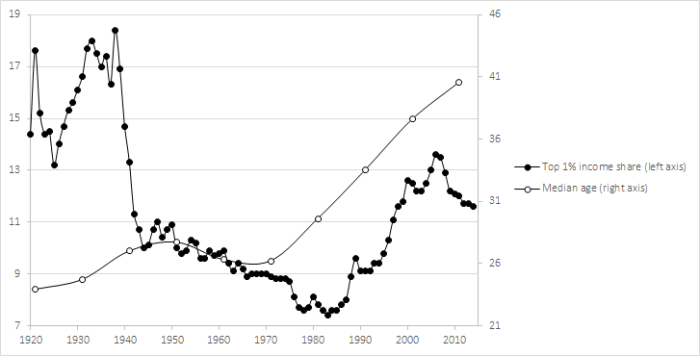
The recent Statistics Canada study allows me to make my point again with regards to element C of my answer. As I looked at their series, all I could think was “median age”. A lot of the variations seem to be related to the median age of the population. I went back to the census data I had collected for my book and plotted it against the data. This is what it looks like.

medianage

Why would there be a relation? Well, each year you measure the income distribution, the demographic structure of that population changes. As it grows older, you have more people at the top of their earnings curve relative to those at the bottom. Not only that, but earnings curve seem elongated in recent times – we live longer and so some people work older as witnessed by increased labor force participation rates above a certain age closer to retirement. And the heights of the earnings curve are now higher than ever before while we also enter later into the labor market.

Now, I am not sure how much aging would “explain away” rising inequality in Canada, but there is no point denying that it does explain some of it away. But, I would not be surprised that a large part is explained away. Why am I saying that? Because of this paper on Norway’s age structure. 

In Norway, the median age in 1950 was much higher than it was in Canada back then and today, it is roughly the same as Canada (although Canada has had a steeper increase in inequality). And according to the paper on Norway, adjusting for composition bias in inequality measures caused by aging, eliminates entirely the upward trend in that country. In fact, it may even reverse the trend whereby inequality adjusted for age has actually declined over time. This is a powerful observation. Given that Canada has had a steeper increase in median age, this suggests that the increase in inequality might be simply the cause of a statistical artifice.

Summing up: the year of irrationality

Brandon says I’ve got one last chance to write his favorite post of the year. But it’s the end of a long semester and I’m brain dead, so I’m just going to free ride on his idea: a year end review. If I were to sum up the theme of this year in a word, that word would be irrational.

After 21 months of god awful presidential campaigning, we were finally left with a classic Kodos vs Kang election. The Democrats were certain that they could put forward any turd sandwich and beat Trump, but they ultimately lost out to populist outrage. Similar themes played out with Brexit, but I don’t know enough to comment.

Irrationality explains the Democrats, the Republicans, and the country as a whole. The world is complex, but big decisions have been made by simple people.

We aren’t equipped to manage the world’s complexity.

We aren’t made to have direct access to The Truth; we’re built to survive, so we get a filtered version of the truth that has tended to keep our ancestors out of trouble long enough to get laid. In other words, what seems sensible to each of us, may or may not be the truth. What we see with our own eyes may not be worth believing. We need more than simple observation to actually ferret out The Truth.

Our imperfect perceptions build on imperfect reasoning faculties to make imperfect folk economics. But what sounds sensible often overlooks important moving parts.

For every complex problem there is an answer that is clear, simple, and wrong.

Only a small minority of the population will ever have a strong grasp on any particularly complex thing. As surely as my mechanic will never become an expert in economics, I will never be able to do any real work on my car. The trouble arises when we expect me or my mechanic to try to run the country. The same logic applies to politicians, whose job (contrary to what your civics teacher thinks) is to get re-elected, not to be a master applied social scientist. (And as awful as democracy is, the alternative is just some other form of political competition… there is no philosopher king.)

But, of course, our imperfect perception and reasoning have gotten us this far. They’ve pulled us out of caves and onto the 100th floor of a skyscraper*. Because in many cases we get good enough feedback to learn a lot about how to accomplish things in our mysterious universe.

We’re limited in what we can do, but sometimes it’s worth trying something. The trouble is, I can do things that benefit me at your expense. And this is especially true in politics (also pollution–what they have in common is hot air!). But it’s not just the politicians who create externalities, it’s the electorate. The costs of my voting to outlaw gravity (the simplest way for me to lose a few pounds) are nil. But when too many of us share the same hare-brained idea, we can do some real harm. And many people share bad ideas that have real consequences.

Voting isn’t the only way to be politically engaged, and we face a similar problem in political discourse in general. A lot of Democrats are being sore losers about this election rather than learning and adapting. Trump promised he would have done the same had he lost. We’re basically doomed to have low-quality political discourse. It’s easy and feels (relatively) good to bemoan that the whole world is going to hell.

We’re facing rational irrationality. Everyone is simply counting on someone else to get their shit together, because each of us individually is more comfortable with our heads firmly up our asses.

It’s a classic tragedy of the commons and it should prompt us to find some way to minimize the harm of our lousy politics. We’ve been getting better at this over the centuries. Democracy means the levers of power can change hands peacefully. Liberalization has entailed extending civil and economic rights to a wider range of people. We need to continue in this vein. More freedom has allowed more peace and prosperity.


So what do we do? I’d argue that we should focus on general rules rather than trying to have flawed voters pick flawed politicians and hope for the best. I don’t mean “make all X following specifications a, b, and c.” I mean, if you’re mad, try and sue someone. We don’t need dense and exploitable regulations. We don’t need new commissions. We just need a way for people to deal with problems as they arise. Mind you, our court system (like the rest of our government) isn’t quite ready for a more sensible world. But we can’t be afraid to be a little Utopian when we’re planning for the long run. But let’s get back to my main point…

We live in an irrational world. And it makes sense that it’s that way; rationality is hard. We can see irrationality all around us, but we see it most where it’s cheapest: politics and Facebook. The trouble is, sometimes little harmless irrational acts add up to cause real harm. Let’s admit we’ve got a problem with irrationality in politics so we can get better.


*Although that’s only literally true in 17 cases.

2016: Year in Review

I hope you have all been enjoying the run-up to your holiday season. Happy Holidays, Merry Christmas, Happy Kwanzaa, Happy Hanukkah, etc. to the whole world, from me.

NOL had another great year, and it wouldn’t have been so great without you. Some of the older Notewriters have parted ways or disappeared from the blogosphere, and some newer blood has stepped up to fill in the gaps, including Nick Cowen, Lode Cossaer, Mark Koyama, Vincent Geloso, Zak Woodman, Adrián Lucardi, and William Rein. Keep your eyes peeled to NOL in 2017, baby!

Below are some of the top posts of 2016. (I am only going by the numbers this ’round, but I’ll try to patch together some of my favorites next week.)

These posts summed up the most viewed posts of 2016, but as I mentioned above I am going to highlight my favorites of the year next week.

NOL has been around since 2012 and I’m starting to see a number of posts attain “classic” status, which simply means that they are popular year after year and thus have a bit of staying power. Barry’s post on Foucault’s political thought always brings in a bunch of traffic, as does my post on libertarian intelligence. Amit’s post about migration from Bangladesh has become a classic since only last year, as has Rick’s “Gun control: Centralized vs Dispersed.”

Thanks for another great year, dear readers, this place wouldn’t be around without you. So keep stopping by, keep those comments coming, keep arguing with us (and each other), and I hope you’ll stick around for another year in 2017.

Next week: My favorite posts at NOL for 2016!

Has Canada been Poorer than the US for so long?

A standard stylized fact in Canada is that we are poorer, on average, than the average American. This has been presented as a fact that is as steady as the northern star. But our evidence on Canadian incomes is pretty shoddy prior to 1870 (here I praise M.C. Urquhart for having designed a GNP series that covers from 1870 to 1926 and links up with the official national accounts even if I think there are some improvements that can be brought to measuring output from some key industries and get the deflator right). But what about anything before 1870? There are some estimates for Ontario from 1826 to 1851 by Lewis and Urquhart (great stuff), but Ontario was pretty much the high-income of Canada.

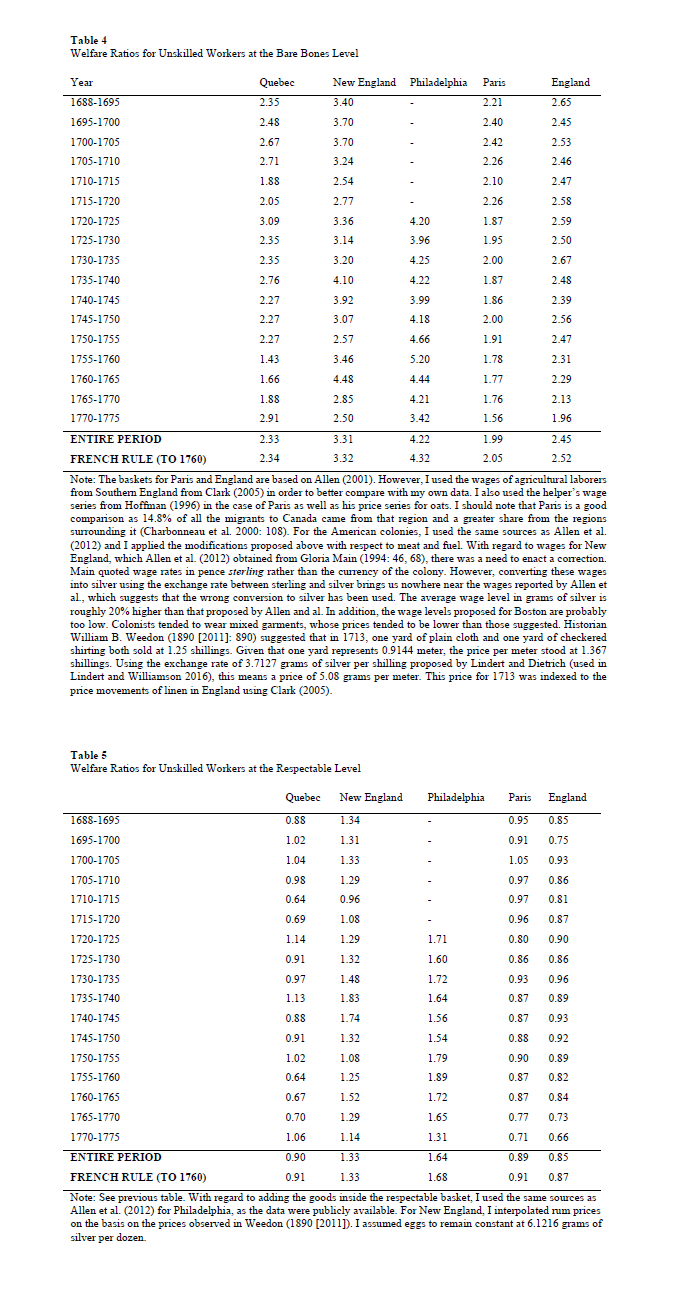
So, can we go further back? This is what my work is about (partially), and I just made available my results on Canadian living standards (proxied by Quebec where the vast majority of the population was) from 1688 to 1775 as captured by welfare ratios. So that’s pretty much the closest we can get to the “founding”. Below are my results derived from this paper. They show that the colonists in Canada were not very much richer than their counterparts in France with the basket meant to capture the meanest of subsistence and roughly equal to their counterparts in France with a basket that includes more manufactured goods like clothing and more alcohol. This explains why most migrants from France to Canada were “volunteered” (in the sense that they were pretty much reluctant migrants) for migration. But the key interesting result is that relative to New England – the poorest of the American colonies – it is poorer regardless of the basket used. Thus, there seems to be truth to the common logic about Canadians being always poorer than the Americans.

comparingcanadane

However, I am not fully convinced of my own results. This may surprise some. The reason is not that I do not trust my data (in fact, I think it is superior to most of what exists for the time given that I will be able to proceed to tons of other data). The reason is simple (and rarely discussed): natives.

Natives are always omitted from the stories of living standards. But they existed nonetheless. In terms of national accounts, if the British and French settlers dispossessed and killed natives, their welfare losses are just not computed. But the welfare losses of a musket shot to the head are real. I have always been convinced that if we could correct estimates of living standards to account for the living standards of natives, the picture would change terribly. The reason is two-fold. The first reason is that the historiography is pretty clear that while they were obviously not nice, the French were nicer than the British towards the Natives (at least until 1763 when the British shifted strategy). In fact, trade between French and Natives was very frequent and so it might be that for the whole population (natives + settlers), the French-area peoples enjoyed more growth and higher average levels. In the British colony, if the settlers killed and dispossessed natives, this is basically the British turning native capital stocks into their own capital stock or into consumption (which would enter settlers GDP but not change total GDP). In essence, this is basically a variation on the arguments of Robert Higgs with regards to measuring the American GDP in World War Two and Albrecht Ritschl on the German interwar growth. I am pretty sure that adjusting for the lives of natives would show a greater level for Canada leading to rough equality between the two colonies. However, I am not sure if the argument would cut that way (my guts say yes) since in their conjectural growth estimates, Mancall and Weiss show that with the natives included, their zero rate of income per capita growth turns into a positive rate.

Nonetheless, I still think that knowing that the settlers were better off in the US as an improvement over the current state of knowledge. Until ways to impute the value of native output and production are found, my current estimates are only a step forward, not the whole nine yards.

Trump and Tillerson Could Save Our Bacon

If Trump is anything like the deal-maker he claims to be, and if Tillerson can translate the expertise and connections he gained as CEO of a gigantic international corporation into diplomatic skills, we could be spared from a nasty confrontation with a nuclear-armed Russia.

Putin is not a nice man. His incursions into Crimea and Ukraine are inexcusable. But he does have a rationale for his claim of aggressive threats from NATO, and this has served hun well in diverting attention away from the drastic declines in liberty and prosperity in Russia. As this article indicates, the West promised not to expand NATO into Eastern Europe but did so anyway, even threatening to include Ukraine and Georgia, which are geographically Russia’s underbelly. How would we like it if the Soviet Union had proposed including Cuba in the Warsaw Pact?

Trump and Tillerson should make a deal with Putin. It must give Putin incentives to pull out of Ukraine and perhaps Crimea, although the latter was historically Russian and Tatar. It must give him something to brag about to his people.  This in contrast to Obama, who declared Russia to be merely a regional player.  Who could blame all Russians for taking this as an insult? He should have praised Russia as a major international player, capable of great contributions to world peace, while taking quiet steps to keep them from making trouble.

The Baltic states are indefensible. Neutralization has worked well for Finland and it ought to work well for the Baltics and Ukraine. Putin could be given a green light to take over Belarus, a socialist basket case that is ethnically very similar to Russia. He could even be invited to join NATO.  This may not be so crazy given that Russia and the West share Christian roots and a common threat from Islamo-fascists.

Some would bring up Chamberlain’s capitulation to Hitler. Skillful negotiations should be able to avoid that trap. The stakes are high, and right now Trump and Tillerson are our best hope of avoiding a possible catastrophe.

Does socialism need to be corrupt?

Brazil is going through a deep crisis right now. It is tempting to say that this is the greatest crisis in the country’s history, but I am quite afraid to make this comment. Unlike England and the United States, which have experienced significant institutional stability in the past 200 or 300 years, Brazil has gone through several political breakdowns in its history, and the current economic crisis is far from the hyperinflation of the 1980s. But there is a characteristic that links the present crisis to the previous ones: the presence of a tendentially authoritarian state.

Although Brazil was governed by an openly socialist party only between 2003 and 2016, this does not mean that socialist characteristics were not present in the country much earlier. One of the central theses of F.A. Hayek in the Road to Serfdom is that the democratic socialist parties of Western Europe (notably the Labor Party in England) had more features in common with the Nazis and fascists than they would have liked to admit. In other words, the differences between left (even a moderate left) and extreme right were illusory: they both had the fundamental characteristic of trying to plan society centrally.

The opposition between spontaneous order and central planning was one of the central theses in Hayek’s career. In Fatal Conceit he develops this theme a lot, showing how the opposition between central planning and lack of planning is a fallacy: society will forcibly be planned. The question is by whom: for a small group of people on behalf of all the others, or for a large group of individuals, each with limited responsibilities? According to Hayek, this distinction between central planning and individual planning is one of the central separations between an authoritarian society (left or right) and a truly free society.

It is difficult to say if the PT (“worker’s party”) government between 2003 and 2016 was the most corrupt in Brazilian history. Homesick people can always claim that corruption was also present in previous governments (it was just not investigated), and possibly they would be right. Before becoming a country ruled by a socialist party, Brazil has always been a patrimonialist country. And this is a fundamental point that adherents of socialism cannot understand: Brazil has never been a capitalist country, at least not in the sense that the liberal tradition employs.

Starting from Hayek, we conclude that central planning is impossible. Planners do not have the information they need to make their plans. As Mises taught, without private property there is no price formation, and without price formation the economic calculation is impossible. This opens space for what Hayek calls a fatal conceit: the assumption that it is possible to run a country from a central body, a presupposition that not only fails to achieve its goals, but also leaves piles of corpses on the way.

The PT government was probably the most corrupt in Brazilian history because it was what most rejected capitalism. The opposite of the free market is the attempt to centrally plan the economy. To centrally plan the economy, an army of administrators is needed. To watch over these administrators, a host of supervisors is needed, and so on. Corruption is inevitable.

Socialist governments are always among the most corrupt, and the reason is simple: the more government, the more corruption. A simpler, more decentralized government is not perfect. But it’s the best we can wish for. It would certainly be a government with less control over money, and thus less likely to steal.

Wars and Presidents: Avoiding the Power-Display Bias

This week on EconTalk, Russ Roberts interviewed Bruce Bueno de Mesquita on how presidents who took the United States to war find themselves higher in the rankings of “Great Presidents” (see this paper by Henderson and Gochenour on the issue)  For some time now, I have found myself in agreement with that contention as wars are generally momentous events that stand out in history. In contrast, the man who sits by and does nothing except preventing a war or making it easier for people to trade, that is harder to observe.  But why would evaluating Presidents be associated with such a premium? Individuals are aware that wars are bad, so why are they praising this? On other metrics, how do Presidents fare?

On the power-display bias 

In my forthcoming book on Canadian economic history (published by Palgrave McMillan as part of their Studies in Economic History), I reviewed some pantheons and counter-pantheons of Presidents (which I will present below) and I felt I had to offer my argument regarding these pantheons:

The established pantheon and the counter-pantheon differ mostly due to people’s bias towards positively assessing outward signs of power. When he wrote to one of his correspondents that “absolute power corrupts absolutely,” British historian Lord Acton was not only speaking of politicians, but also of those would retroactively judge them: Acton was referring to a general human tendency – accentuated amongst historians – to be more forgiving of those who hold power, because the powerful are judged by their actions. Indeed, it is easier to size up a politician who undertook significant reforms – regardless of the results obtained thereby – than to evaluate the achievements of one who passively held the line. If the reformer fails, it can be said that at least he tried. Moreover, a given president’s place in the pantheon is closely linked to how many Americans he killed during the military conflicts that defined his reign. The more Americans killed per capita overall, the higher a given president’s ranking in the list of “greats.”

Economic history teaches us, however, that the most proactive presidents may not be the most beneficial to their country, on the contrary. For several years now, Franklin Delano Roosevelt (1933-1945) has been the subject of increased criticism in the economic literature for his interventionist economic policies between 1932 and 1939. Economists Albrecht Ritschl, Monique Ebell, Lee Ohanian and Harold Cole have determined that FDR’s interventionist policies in fact served to prolong the Great Depression.

In other words, the bias we have when evaluating men with power is that we evaluate based on the exercise of displaying the use of power. Those who refrain from using it are, properly, not recorded as historical events are conflicts/tensions/oppositions. This I think is generally a bias that is easily to fall prey to. I am not immune to that even if I happen to have libertarian leanings. I often see in one politician or another in history a man/woman that I wish would be here today to “save the day” (one of my childish belief). But each time I dig around that person, I am less enthused. For example, I used to be an admirer of William Pitt the Younger – a fierce one. After all, he had assisted Wilberforce in ending the slave trade, he had instituted a sinking fund to repay the British public debt (he had willfully tied his hands) and he he had been moderately sympathetic to the American revolution. I saw his role in the wars against France as a contest of circumstances. But, that was the point, I was ready to discount the war. In addition, as I read the work of Jane Humphries on child labor in industrializing Britain (here and here), I discovered more unsettling things.  During the French Wars, the build-up of the British state did lead to some crowding-out on factors markets, notably the labor market. Upon complaints of manufacturers, Pitt proposed to “Yoke Up the Children”. More precisely, he proposed the use of orphan in the public care to work as pauper apprentices to firms at pences on the shilling (bad pun of pennies on the dollar). He “lent” orphans to private firms and its hard to assume that they consented to work (as Humphries’s use of oral histories makes clear). If a person with libertarian leanings like me was willing to excuse such a man before, it is quite telling of how limited knowledge shores up the reputations of powerful men. This is because their use of power overshadows all the rest. Their use of power is like the joke about economists looking where the lamppost is: we evaluate them on what their use of power has illuminated.

Other Metrics

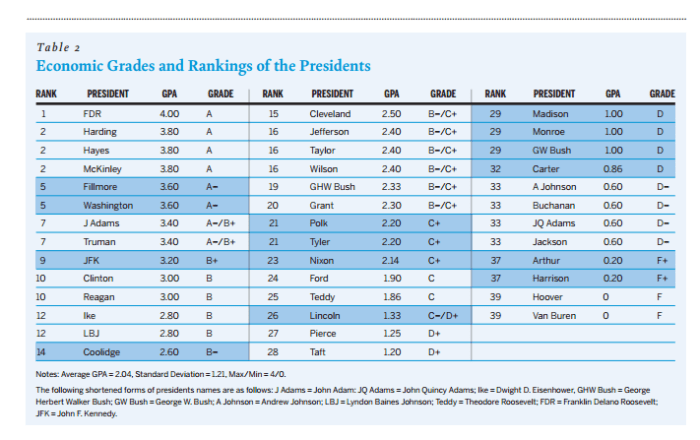
So, are there any other metrics that are less subjected to our inherent power-display bias? Obviously, anything that has a subjective element will be biased. However, evaluating the evolution of living standards under their rule is one way to go at it. Mark Zachary Taylor, in an article published in PS: Political Science and Politicsproposed an economic ranking of US Presidents since 1789. Whichever way you cut it, there is a weak rank correlation between the rankings of presidential greatness and the ranking of economic grades.

Ranking.png

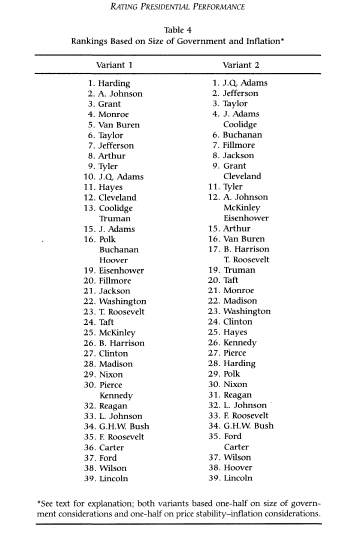
There is another type of ranking, which is more subtle. It measures how much Presidents refrained from expanding federal power. This exercise was made by Richard Vedder and Lowell Gallaway (two great economic historians) who measured presidents based on their changes to the size of government and inflation. This measure alone (see table below) is not sufficient to be convincing, but taken as part of a constellation of rankings, it provides a key piece of evidence. This is really a counter-pantheon to the rankings of presidential greatness. In fact, one could see it as the cost for societies of presidential greatness.

presidentialgreatness

When comes the time to evaluate great rulers, being aware of our biases is crucial (as Lord Acton, I think they should rarely be excused based on flimsy excused like circumstances – the virtue of being an historian/economic historian is that we have enough hindsight to say how terrible certain choices were).  And that awareness should lead us to develop a “dashboard” of rankings to properly weigh the impact of such rulers.

How Well Has Cuba Managed To Improve Health Outcomes? (part 1)

Since the passing of Fidel Castro, I have devoted myself to researching a proper assessment of his regime’s achievements in matters of health care. The more I dig, the more I am convinced that his regime has basically been incredibly brilliant at presenting a favorable portrait. The tweaking of the statistics is not blatant or gigantic, it is sufficiently small to avoid alerting demographers (unlike when Davis and Feshbach, Eberstadt and Miller and Velkoff found considerable evidence of data tweaking in the USSR which raised a massive debate). Indeed, a re-computation of life expectancy based on life tables (which I will present in the new few weeks) to adjust for the false reclassification of early neonatal deaths as late fetal deaths (raising the low infant mortality rate by somewhere 28% and 96%) suggests that somewhere between 0.1 and 0.3 years must be knocked off the life expectancy figures. Given that the variations between different measurements available (WHO, World Bank, MINISAP, CIA, FAO) are roughly of that magnitude, it falls within a very reasonable range of errors. This statistical tweaking is combined with an over-dramatization of how terrible the situation was in 1959 (the life expectancy figures vary from 63.9 years to 65.4 years at the beggining of the Castrist regime). But that tweaking is not sufficient to invalidate the massive downward trend.  As a result, the majority of public health scholars seem confident in the overall level and trend (and I tend to concur with that statement even if I think things are worse than presented and the slope of the downward trend is too steep).

Those little tweaks have been combined with the use of massive coercive measures on the local population (beautifully described  by Katherine Hirschfeld in what should be an example of ethnographic work that economists and policy-makers should rely on because it goes behind the data – see her book Health, Politics, and Revolution in Cuba: 1898-2005) that go from using doctors as tools for political monitoring to the use of abortion against a mother’s will if it may hinder a physician’s chance of reaching the centrally-decided target without forgetting forced isolations for some infectious patients. Such methods are efficient at fighting some types of diseases, but they are associated with institutions that are unable to provide much economic growth which may act as a palliative counter-effects to how choices may make us less healthy (me having the freedom to eat too much salt means I can die earlier, but the type of institutions that let me eat that much salt also avoid infringing on my property rights thus allowing me to improve living standards which is the palliative counter-effect).  With such a trade-off, the issue becomes one of the ability of poor countries to improve in the absence of extreme violence as that applied by the Castrist regime.

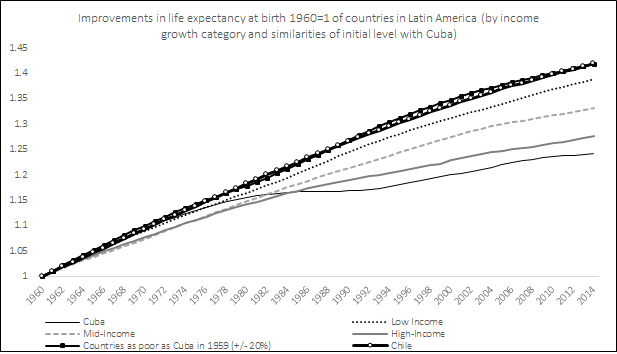
Over the next few weeks, I will publish many re-computations of health statistics to sustain this argument as I write my article.  The first one I am doing is the evolution of life expectancy from 1960 to 2014. What I did is that I created comparatives for Cuba based on how much living standards (income per capita). Cuban living less than doubled over that 49 years period (82% increase) from 1959 to 2008 (the latest available data from the high-quality Maddison data).  Latin American and Carribean countries that saw their living standards less than double (or even decline) are Argentina (+90%), Bolivia (+87%), El Salvador (+68%), Haïti (-33%), Honduras (+71%), Jamaica (+51%), Nicaragua (-17%) and Venezuela (+7%). This forms the low income group. The remaining countries available are separated in two groups: those whose income increased between 100% and 200% (the mid-income group composed of Brazil, Colombia, Mexico, Peru, Uruguay, Ecuador, Guatemala, Panama and Paraguay) and those whose incomes increased more than 300% (the high-income group composed Chile, Costa Rica, Dominican Republic, Puerto Rico and Trinidad & Tobago).  I also compared Cuba with a group of countries that had incomes per capita within 20% of the income per capita of Cuba.  So, how did Cuba’s life expectancy increase?

Well, using only the official statistics (which I do not fully trust although they are from the World Bank Development Indicators Database), Cuba life expectancy (which was already pretty high by Latin American standards in 1959) increased 24%. However, all other countries – which were well below Cuba – saw faster increases. The countries that had the least growth in Latin America saw life expectancy increase 38% and the countries that were equally poor as Cuba saw life expectancy increase an impressive 42%. Chile, whose life expectancy was only 57.5 years against Cuba’s 63.9 in 1960, also increased more rapidly (also 42%) and it has now surpassed Cuba (81.5 years against 79.4 years) and what is more impressive is that this rate has increased in a monotonic fashion regardless of changes in political regimes (democracy, socialism, Pinochet, liberal democracy) while Cuba’s rate seems to accelerate and decelerate frequently. Now, this is assuming that the figures for 1960 are correct. I have surveyed the literature and it is hard to find a way to say which of the estimates is the best, but that of the World Bank for 1960 is the lowest. There are other rates, contained in McGuire and Frankel’s work – the highest stands at 65.4 years for 1960. That means that the range of increase of life expectancy in Cuba is between 21.4% and 24.2%. Its not earth-shattering, but it makes Cuba’s achievements less impressive (although it is impressive to keep increase life expectancy from an already-high level). But as you can see, more important improvements could have been generated without recourse to such violent means. In fact, as a post that I will publish this week shows, the decline in car ownership from 1959 to 1988 probably played moderately in favor of the increase in life expectancy while the massive increase in car ownership in all other countries played (all else being equal) in favor of slowing down the increases in life expectancy (but being too poor or making it illegal to import a foreign car is not health care and I deem it improper to consider that this accident from misfortune should be praised).

improvementslifeexpectancy

In a way, what I am saying is that the benefit is not as impressive as claimed. Given the costs that Cubans have to assume for such a policy, anything that makes the benefits look more modest should make more inclined to cast a damning judgment on Castro’s regime.

Coming up (I will add the links as they are published) :

  1. Life Expectancy Changes, 1960 to 2014
  2. Car ownership trends playing in favor of Cuba, but not a praiseworthy outcome
  3. Of Refugeees and Life Expectancy
  4. Changes in infant mortality
  5. Life expectancy at age 60-64
  6. Effect of recomputations of life expectancy
  7. Changes in net nutrition
  8. The evolution of stature
  9. Qualitative evidence on water access, sanitation, electricity and underground healthcare
  10. Human development as positive liberty (or why HDI is not a basic needs measure)

The most depressing thing with Chetty et al.

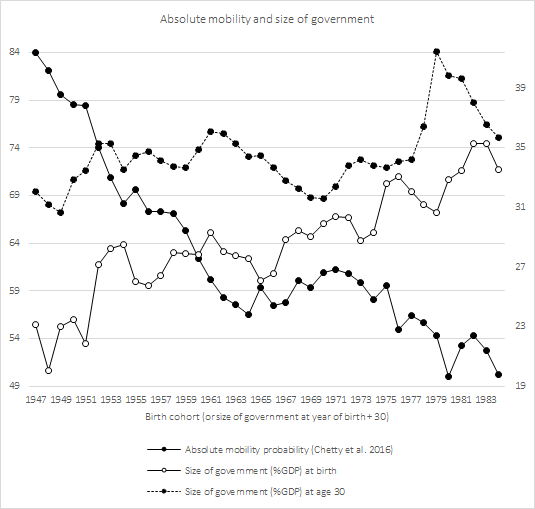
The Chetty et al. paper has been on my mind over the weekend (see Saturday’s post). The one thing that has moved more or less in line with the absolute mobility measure of Chetty et al. has been…the size of government.

I know that as soon as some of you read the last four words on the previous paragraphs, your eyes rolled. However, even from a social-democratic perspective, it is depressing! It is not the first time I make this observation.   In the pages of Essays in Economic and Business HistoryI recently reviewed Unequal Gains (authored by Peter Lindert and Jeffrey Williamson and published at Princeton University Press) and I observed that the “great leveling” they observed from the 1910s to the 1970s had a lot to do with the northward migration of American blacks, the closing of the gender wage gap and the convergence of the southern states. I also observed that the increase in inequality in the United States after 1970 occurred at the same time as an the state grew more in size and scope (see blog post here).

However, as I mentioned elsewhere, I am very skeptical of the tax-based data on inequality in the United States and I am afraid to push that point. However, the Chetty et al. data provides further confirmation: trends in inequality/social mobility deteriorates as the state becomes more active (see the graph below).

sizegov

Now, I am aware that the causality can cut both ways. It may be that inequality (economic mobility) is rising (falling) in spite of increasing state action, it may be that state action is fueling the the rise (reduction) of inequality (economic mobility) or it may be that the state has no effects whatsoever on the evolution. Regardless of which of the three viewpoints you tend to adopt (I lean towards a mixture the second option – see my paper with Steve Horwitz here which is under consideration for publication), the implications are immensely depressing with regards to social policy in the last 75 years.

Sons outearning Fathers in Chetty et al. : working hours should be considered

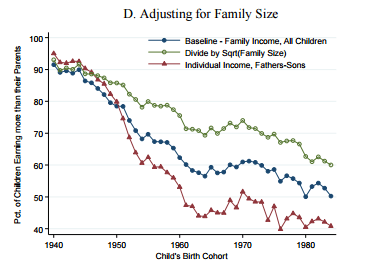
In response to my post yesterday, my friend and economist/nuclear engineer (great mix) Laurent Béland pointed out that the Father-Sons mobility figures in Chetty et al. are depressing. Yes, at first glance, they are (see below – the red line). fathersons

But, at second glance, it is not as terrible. Think about family structures with the 1940 birth cohorts. The father works and, in most likelihood, the mother is a stay-at-home father. Most of the earnings come from the father who probably works 45 to 60 hours a week.  If my father earns 40,000$ at 60 hours a week or earn 40,000$ at 40 hours a week, the line remains at the same height, but we are not talking about the same living standard in reality. Chetty et al. do not account for hours worked to achieve income.  The steep decline – faster than the baseline of household-size adjusted decline – matches the steep increase in female labor force participation and the decline labor force participation of males (see graph here and Nicolas Eberstadt’s work here) as well as the decline in hours worked by males.

If the question had been “what are your chances of out-earning your father per hour worked”, then the red line would not have fallen like that. Income divided by labor supplied would probably bring the red-line back with the blue-line.

Note: Again, please note that I am not trying to rip apart Chetty et al. (as some have claimed elsewhere). Their work is great and as a guy who does all his research on providing data series regarding economic history, I am never going to rip on someone who does hard data work like Chetty et al. did ! My point is that I am not convinced that the decline is so big. And, in good faith, it seems that Chetty et al. do try to put the “caution” labels where its needed – and its important to discuss those caution labels before some politician or two-cents-pundit goes all Trump on us by saying stuff that this doesn’t say!

Cheap college: Ten Tips

If you’re about to embark on your undergraduate education in the US or Canada, you probably have a good chance of ending up owing some money to pay for your studies and expenses. Can you avoid financial disaster and still end up with a pretty good “education” section on your CV? I believe so, and I’d like to share with you a few tips on cheap college education. They might turn out to be useful, whether you want to go straight to the job market after graduation or whether you have further studies in mind.

I did my undergraduate degree in Brazil. Then, I moved to the UK and completed my graduate education there with a very generous stipend. I also taught in higher education in both countries, including two top universities in the UK. I worked part-time for an institute attached to a university in Europe. Now I work at a major university in South Africa. I know a few things about higher education, and here’s a list of tips for you.

1. Accept a full-tuition scholarship.
If you’ve received an offer of a full-tuition scholarship, go for it. As long as it’s not a loan. No brainer. You’re being subsidised to study full-time. This is your job now. Do a little bit of networking and career skills training, but focus on your degree. Try to do as well as you can. The problem with this strategy is that, quite frankly, the vast majority of students aren’t offered scholarships that get even close to covering full tuition costs.

2. Avoid the athletics trap.
Don’t count on your prowess in sports to put you in a position where you earn full tuition to study. Athletics scholarships cover at most a fraction of the college cost. At most, you’d be able to combine an athletics scholarship with some other source of funding, but even if you get to that stage, you’ll have to figure out a way of earning B+ or A on average with little time to study.

3. Split your degree.
This is the oldest trick in the book. Yet, not enough students seem to follow it. I didn’t know the North American system very well, and I owe this point to Gary North. He explains it on this video. In the US, you can save a lot of money by doing the first two years of your degree at a community college or some other low-cost higher education institution. You can earn an Associate degree and then transfer credits to a four-year college to complete your Bachelor’s degree. One advantage (apart from the financial factor) is that you could do it in the evenings, while you earn some money during the day. Another advantage is that permanent teaching staff in a small college or a community college are gifted teachers – that’s why they were given their jobs in the first place – whereas at a major university professors are rewarded according to their research achievements and teaching might not be terrible, but it’s not necessarily the best you can get either.

4. Try distance learning.
This is emerging as a major alternative to traditional university attendance. You can either earn credits (which you can, later, transfer) or a whole degree at a fraction of the normal cost of university attendance. You can also combine this with point (3) above.

5. Stay with your parents.
Okay, as a Brazilian I didn’t see any problem in staying home for another four years during my university education. There are advantages and disadvantages to this, and it’s up to you to decide if this strategy is worth it, depending on your family’s culture and habits. But the fact is that, even if your parents charge you some rent, they won’t charge as much as the average university dorm would. This means you can save. Plus there won’t be any learning curves related to living in a completely new locality. This strategy requires you to do either a distance-learning degree or to attend your local college, and you can combine this with points (3) and (4) above.

6. Distance learning abroad.
This can be combined with (3), (4) and (5) above. The truth is, most employers don’t care very much about where you got your undergraduate education, except if the place is one of the top five or ten universities in the country. Higher education in the UK is slightly cheaper (on average) than in the US, and often much cheaper if you’re doing it online. You can register at the Open University, or at the University of London’s international programmes. Depending on the area of study, you can even do a distance degree part-time while you work, paying for each course at a time. The University of Aberdeen, for example, offers a distance degree in Religious Studies along those lines. If you give up halfway, you can still earn a CHE degree after completing the first year, a HE Diploma after two years, and the undergraduate course in the UK normally lasts for three years (except, normally, for Scotland).

If you want to save even more money and benefit from favourable exchange rates, you could also apply to study at the University of South Africa (UNISA), one of the world’s largest universities. UNISA has a very good reputation. Remember Nelson Mandela? He earned a degree there. For South Africans, each year of study costs around 1,000 dollars, and if you live abroad, you need to pay extra, but not a whole lot more. There are no classes. Normally, you use multimedia material, lots of written material, and travel to some place in your country where you can do the exams. So you need to factor in the cost of travel, but it still might be worth it. Other South African universities, such as North-West University, also offer distance degrees for certain fields.

7. Move abroad.
This is also becoming more of an alternative for North Americans. In Germany, for example, you can register at a university, as long as you can prove you know the German language well, and get a degree from some of the top universities in the world. The downside is the learning curve of moving abroad, visa bureaucracy and, perhaps, the cost of living in Europe might not be worth it. For example, you could pay low tuition fees in Finland, but it’s not that cheap to live there. For a tuition fee of around 1,000 Euros per year you can also do a degree in Portugal or Spain. Tuition fees in France and Italy are also relatively cheap. All this assumes you can prove you know the local language well enough to register. Depending on where you go, the case for doing a degree abroad is even stronger. In Portugal and Spain, an undergraduate degree normally takes four years. In Italy and France, it depends. In Germany, it normally takes three. This means you save a whole year of expenses.

8. Erasmus+.
If you decide to do your degree in Europe, you can still end up experiencing campus life and networking in North America. The reason is that students at European universities can be selected to do a year abroad under the Erasmus+ programme, and some of the partner universities are from North America. This is not very easy, but what I mean to say is simply that going abroad doesn’t mean abandoning any hope of experiencing student life in North America.

9. Cut corners while still following the rules.
You should thank Gary North for pointing this out. In a North American degree, you must do a number of credits, including electives or credits you can choose, as part of the total number of credits you must earn to obtain the degree. You can cut corners and save time and money by learning independently and then doing a credit-awarding exam. Some of the exams you can do are for general courses you’d end up doing as an elective anyway.

10. Make sure you do French and German.
How does this relate to “cheap college”? I confess there’s no direct relation. But I’d still urge you to do French and German as electives, particularly if they’re “for reading knowledge“. Those are intensive courses that get you to be able to read scholarly work in French or German by the end of a semester. This might not in itself make your college life cheaper now, but it will get you some skills you can use in the future. It gives you a head start in applying for the top, well-funded, PhD programmes in the US and Canada, in case that’s what you’re planning to do. Most PhD courses require you to have reading knowledge of at least one, if not two, of these languages. You might as well do it now. Moreover, if you just want to go to the workplace after you graduate, this can also give you a little advantage over the competition. While it doesn’t necessarily make your college any cheaper, this strategy will make your life easier by adding another relevant item to your CV which might turn out to be very useful in the near future.

I hope those tips can be useful. Maybe you’re even reconsidering whether you should really get deep into debt in order to earn a degree. Well, here’s my appeal. Please reconsider. Student loans may be common. Some even call this kind of debt an investment. But it’s not healthy to owe tens, if not hundreds of thousands of dollars when you’re just 22 or 23 and under pressure to find a good job to pay that money back. You want to be free. Maybe you want to go to a well-funded graduate programme without that stress. Maybe you want to get married. Who knows? Before accepting a loan to finance your education, please consider these alternative options. I urge you.

Before concluding, a disclaimer. I’m not saying any of these tips will work in every case. Be responsible and make sure you understand the details and implications of any decisions you make. Check, for example, if your target university or college will accept credit transfers from the place where you obtained those credits. Read the small print. But this is more or less what you’d be doing if you accepted a loan – you’d read the small print, right?

Carta de Voltaire dirigida a Rousseau, em resposta a ele

Um excelente texto mostrando o contraste entre dois conceitos de liberdade. Voltaire representa a liberdade do liberalismo clássico: o indivíduo deve ser livre de constrangimentos externos, ser livre para buscar sua concepção individual de felicidade. Rousseau representa outra concepção de liberdade: o indivíduo só será livre se acatar um conceito de felicidade que os demais irão lhe impor. Rousseau está por trás de basicamente todas a ditaduras estabelecidas desde então, principalmente as de esquerda, formadas por pessoas de bem que sabem o que é bom para os outros, que falam que o capitalismo só cria problemas e que deveríamos fazer um governo mais “democrático”. Em outras palavras, pessoas chatas, agressivas, que não respeitam as decisões alheias e sentem uma incontrolável vontade de ensinar para os outros o que é bom.

30 de Agosto de 1755

Recebi, senhor, vosso novo livro contra o gênero humano, e vos agradeço por isso. Vós agradareis aos homens, sobre quem fala vossas verdades, e não os emendará. Ninguém poderia pintar um quadro com cores mais fortes dos horrores da sociedade humana, para os quais nossa ignorância e debilidade tem tanta esperança de consolo. Ninguém jamais empregou tanta vivacidade em nos tornar novamente animais: pode-se querer andar com quatro patas, quando lemos vossa obra. Entretanto, como já faz mais de sessenta anos que perdi este costume, percebo, infelizmente, que é impossível recomeçar, e deixo essa maneira natural àqueles que são mais dignos que vós e eu. Já não posso mais embarcar para encontrar os selvagens do Canadá, em primeiro lugar, porque as doenças de que sofro me prendem ao redor do maior médico da Europa, e não encontraria a mesma assistência junto aos Missouris. Em segundo, porque a guerra está sendo travada lá naquele país, e o exemplo de nossas nações tornou os selvagens quase tão perigosos quanto nós. Devo me limitar a ser um selvagem pacífico, na solidão que escolhi, perto de vossa pátria, onde vós devíeis estar.

Concordo convosco que a literatura e as ciências causaram ocasionalmente muitos danos. Os inimigos de Tasso fizeram de sua vida uma longa série de infortúnios. Os de Galileu fizeram-no gemer dentro da prisão, aos setenta anos de idade, por haver entendido como a Terra se movimenta; e o que é ainda mais desonroso, obrigaram-no a desdizer-se. Desde que vossos amigos começaram a publicar o Dicionário Enciclopédico, os rivais os desafiam com o tratamento de deístas, ateus e mesmo de jansenistas.

Se porventura eu puder me incluir entre aqueles cujos trabalhos não trouxeram mais do que a perseguição como única recompensa, poderei mostrar-vos o tipo de gente perseguidora que me prejudica desde que produzi minha tragédia Édipo; uma biblioteca de calúnias ridículas impressas contra mim. Um ex-padre jesuíta, que salvei da desgraça total, me pagou o serviço que lhe prestei com um libelo difamatório; um homem, ainda mais culpado, imprimiu minha própria obra sobre o século de Luís XIV com notas nas quais a mais crassa ignorância vomitou as mais baixas imposturas; um outro, que vendeu a um editor, usando meu nome, alguns capítulos de uma pretensa História Universal; o editor, ávido o suficiente para imprimir esse amontoado de erros crassos, datas erradas, fatos e nomes mutilados; e, finalmente, os homens covardes e vis o suficiente para me responsabilizar pela publicação desta rapsódia. Eu mostrar-vos-ei a sociedade contaminada por este tipo de homens – desconhecido em toda a antiguidade – que, não podendo abraçar uma profissão honesta, seja de trabalho manual ou de serviço, e desafortunadamente sabendo ler e escrever, se tornam agentes literários, vivem de nossas obras, roubam os manuscritos, alteram-nos, vendem-nos. Eu poderia lamentar-me porque fragmentos de uma zombaria, feitos há pelo menos trinta anos, sobre o mesmo sujeito que Chapelain foi burro o bastante para tratar seriamente, circulam hoje pelo mundo, graças à traição e avareza desses infelizes, que misturaram suas grosserias às minhas pilhérias, e preencheram as lacunas com uma estupidez equiparada somente à sua malícia e que, ao cabo de 30 anos, vendem por toda parte um manuscrito que é apenas deles, e digno tão somente deles.

Eu poderia acrescentar, em último lugar, que roubaram uma parte do material que eu juntei nos arquivos públicos para usar na História da Guerra de 1741, quando era historiador da França; que venderam a uma livraria de Paris esse fruto de meu trabalho; que nessa época invejaram minhas posses, como se eu estivesse morto e pudessem colocá-las à venda. Eu poderia mostrar a ingratidão, a impostura e o roubo me perseguindo por quarenta anos, do pé dos Alpes ao pé do meu túmulo. Mas o que eu concluiria de todos esses tormentos? Que não tenho o direito de reclamar; que o Papa, Descartes, Bayle, Camões e centenas de outros sofreram injustiças iguais, ou ainda maiores; que este destino é o de quase todos daqueles que foram inteiramente seduzidos pelo amor às letras.

Admita, senhor, que estas coisas são pequenas desgraças particulares de que a sociedade pouco se apercebe. Que importa para a humanidade que alguns zangões roubem o mel de poucas abelhas? Os homens das letras fazem grande estardalhaço de todas estas pequenas querelas, enquanto o resto do mundo ou os ignora ou disso gargalha.

De todos os desgostos afetando a vida humana, esses são os menos graves. Os espinhos ligados à literatura, ou um pouco menos de reputação, são flores quando comparados aos outros males que a todo momento inundam a terra. Admita que Cícero, Varrão, Lucrécio ou Virgílio não tiveram a menor culpa nas proscrições. Mário era um ignorante, Sila, um bárbaro, Antônio, um crápula, o imbecil Lépido leu um pouco de Platão e Sófocles; enquanto Otávio César, covardemente apelidado de Augusto, esse tirano sem coragem, agiu apenas como um assassino detestável no momento em que privou a sociedade dos homens de letras.

Admita que Petrarca e Boccaccio não fizeram nascer os problemas da Itália; que as brincadeiras de Marot não produziram São Bartolomeu, e que a tragédia de Cid não produziu a guerra da Fronde. Os grandes crimes são cometidos apenas pelos grandes ignorantes. O que faz e fará sempre deste mundo um vale de lágrimas é a avidez e o indomável orgulho dos homens, desde Thamas-Kouli-Kan, que não sabia nem ler, até um oficial de alfândega, que não sabe nem contar. As letras alimentam, endireitam e consolam a alma; elas vos servem, senhor, durante o tempo que escreveis contra elas. Vós sois como Aquiles, que se encolerizava contra a glória, e como o padre Malebranche, que, com sua imaginação brilhante, escrevia contra a imaginação.

Se alguém tem o direito de queixar-se da literatura, sou eu, porque em todos os momentos e em todos os lugares ela serviu à minha perseguição; mas deve-se amá-la, não obstante o mau uso que dela fazem; como deve-se amar a sociedade na qual tantos homens maldosos corrompem os suscetíveis; como deve-se amar a sua pátria, mesmo que ela nos trate com alguma injustiça; como se deve amar o Ser Supremo, apesar das superstições e do fanatismo que desonram tão freqüentemente o seu culto.

M. Chappuis disse-me que vossa saúde anda muito mal, deveis restabelecê-la na terra natal, aproveitando junto à sua liberdade, beber comigo o leite de nossas vacas, e passear em seus campos.

Muito filosoficamente e com a mais alta estima, etc