- An ancient epic poem recounts the ‘Indian war’ of Dionysus Blake Smith, the Wire
- Sketchbook of 15th-century engineer Johannes de Fontana Bennett Gilbert, Public Domain Review
- Van Gogh’s love affair with Japan Joe Lloyd, 1843
- Relatedness: De-toxifying the mind Peter Miller, Views
Author: Brandon Christensen
Lunchtime Links
- 25 years after Waco | Freedom of Conscience and the Rule of Law
- The US-Japan Alliance and Soviet competition | Some thoughts on “Thinking About Libertarian Foreign Policy”
- Japan’s rent-a-family industry | In Search of Firmer Cosmopolitan Solidarity
- The story of the skull of a victim of the Indian Uprising of 1857 | Myths of Sovereignty and British Isolation, III
- Reviving India’s classical liberal party | Classical Liberalism and the Nation State
- The decline of regional American art | A History of Regional Governments
- Michelle Pfeiffer keeps getting better and better | On the paradox of poverty and good health in Cuba
- “It was the most devastating loss in the history of the Library.” | No, natural disasters are not good for the economy
Nightcap
- The West’s bombing of Syria meets some approval from Muslims Bruce Clark, Erasmus
- Should the Italian Prime Minister support the Democrats? Michelangelo Landgrave, NOL
- The ugliness of international politics Edwin van de Haar, NOL
- Rent-Seeking Rebels of 1776 Vincent Geloso, NOL
Eye Candy: the languages of Brazil
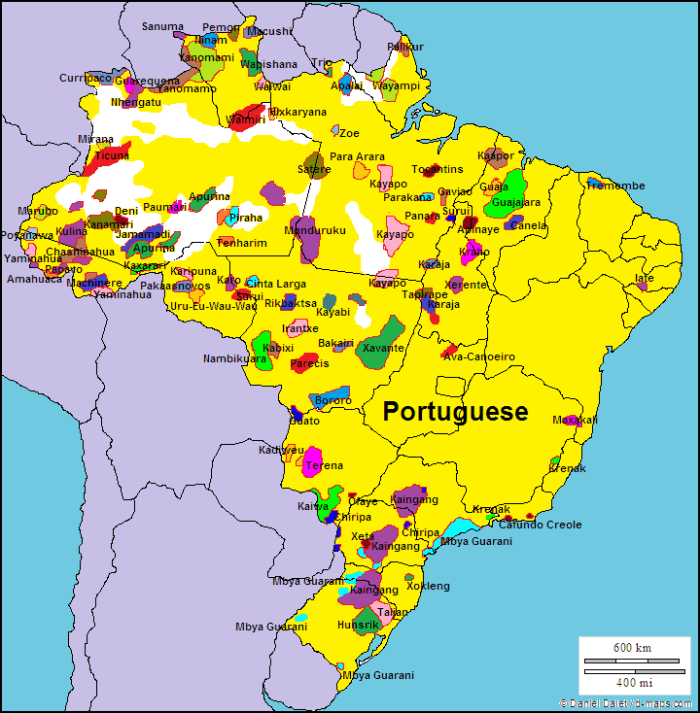
My only question: no Spanish, anywhere? Not even along the borders?
Nightcap
- What is the cost of “tractable” economic models? Beatrice Cherrier, Undercover Historian
- Facts vs. hand-waving in economics Chris Dillow, Stumbling and Mumbling
- How factories changed the world Donald Sassoon, New Statesman
- Defending the Mughals became a way to defend colonial rule Blake Smith, the Wire
Nightcap
- The end of empire and the birth of neoliberalism Deirdre N. McCloskey, Literary Review
- Gimme shelter: safe spaces and f-bombs in higher ed Irfan Khawaja, Policy of Truth
- Can Fresno State fire a professor for being an ass on Twitter? Ken White, Popehat
- The worst effects of climate change may not be felt for centuries Charles C. Mann, TED Ideas
“10 little-known fascist governments”
That’s the subject of my weekend’s RealClearHistory column. An excerpt:
7. Romania and the Iron Guard. Sandwiched between the communist Soviet Union and the fascist Axis powers of central Europe, Romanian society struggled to find its footing after a comparatively wonderful campaign during World War I, but Bucharest eventually chose to side with Berlin and Rome instead of Moscow. Romanian fascism was known for including the Orthodox Church into its anti-communist, anti-Semitic, and anti-capitalist rhetoric. Romania’s fascists almost made the Nazis look like boy scouts, especially when the Iron Guard organized and implemented one of Europe’s bloodiest pogroms, ever: the Iași pogrom. Just over 13,000 Jews, along with their liberal and Orthodox defenders in the city of Iași, were butchered on the streets where they once plied their trades. Romania, a member of the Axis for most of the war, was second only to Germany in the number of Jews it killed during World War II.
Please, read the rest.
Oh, and I wrote about America’s greatest maritime disaster on Tuesday for RCH‘s blog, the Historiat.
Nightcap
- One of the 19th century’s most mysterious and eccentric figures Rhys Griffiths, Public Domain Review
- Internationalists are more libertarian than non-interventionists Isabel Hull, London Review of Books
- Why is the US military all over Africa? Eric Schewe, JSTOR Daily
- California is a model for divorce, not domination David French, National Review
Nightcap
- The cursed wonders of India Rishika Yadav, Spontaneous Order
- Robot of Jihad? A Guide to Tipu’s Tiger Blake Smith, the Appendix
- Black pictures (film) Darryl Pinckney, New York Review of Books
- A Male Feminist’s Crisis Michael Friedrich, New Republic
Nightcap
- Why the West is Suicidal Daniel McCarthy, Modern Age
- US Constitution requires congressional authorization for war Ilya Somin, Volokh Conspiracy
- When autarky becomes the only solution Branko Milanovic, globalinequality
- Revolution, Lightning, and the People’s Will Kevin Duong, Public Domain Review
Nightcap
- India Moves Toward a Regional Reset Suhasini Haidar, The Hindu
- France’s troubled obsession with India Blake Smith, the Caravan
- How the Soviet Union Secretly Mapped the World Bridgett Kendall, Literary Review
- How Soviet artists imagined life in space Vincze Miklós, io9
The news cycle vs. current events
The other day, while badgering my fellow Notewriters to blog more often, I mentioned that current events are different from the news cycle, and are still important to dissect and blog about. This distinction between the news cycle and current events was sparked by economist Arnold Kling’s recent post on where he gets the news (found in one of last week’s Nightcaps). Basically, the news cycle is terrible. I rarely pay any attention to it. CNN, a left-of-center media outlet that almost everybody has heard of, has on its front page today (the wee morning hours of 4-23-17) a great example of the news cycle:
- Kellyanne Conway to Dana Bash: OK, you went there
- Conway says asking about her husband’s anti-Trump tweets is a ‘double standard’
- Analysis: Trump’s score-settling creates jarring contrast
- WSJ: Trump to ask North Korea to dismantle nuclear arsenal before talking sanctions relief
- Opinion: Macron’s bromance with Trump will come at a price
- Biographer: Trump has lied since youth
- Melania Trump plans state dinner on her own
- Stelter: One Trump lie is crystal clear
You get the idea, and remember that CNN is a well-established, long-running media outlet. Other media outlets that focus on the news cycle are just as bad, if not worse (at least CNN pretends, most of the time, to wrap its clear bias in a cloth of objectivity). This is a far cry from the concept of “current events.” Current events, in my view, are arguments about ideas, events, or even people that take place between at least two sides in specific time frame. Most of the time, “current events” involve using events (usually) or people (rarely) to defend or attack an idea. You see the difference? Have a better definition?
The news cycle is largely garbage, but it can still be useful, especially for international news. I never visit RealClearPolitics, for example, because it focuses on the news cycle, but I stop by RealClearWorld, which usually conveys the news cycles of other countries, once or twice a day. Even though I’m consuming a news cycle, I’m still learning something because it’s a news cycle about a place very different from my own.
Five or ten years from now, the bullet points from CNN will be useless and forgotten, but the arguments put forth into the stream of current events will be useful and maybe even prized. What baffles me is that the news cycle, while almost universally loathed, is far more popular in terms of consumption than current events. Doesn’t everybody know how to use Google by now?
Nightcap
- Between property and liability Robin Hanson, Overcoming Bias
- National Health Service S.O.S. James Meek, London Review of Books
- Life lessons from reading Thucydides and hiking at night Miguel Monjardino, City Journal
- Blowing stuff up John Quiggin, Crooked Timber
Eye Candy: Computer games, worldwide

These are the most-owned games on Steam, a digital distribution platform (wiki). This was fascinating to me for a bunch of different reasons. You can come up with your own, I’m sure. Here are the wikis for the games:
- Team Fortress 2 (orange)
- PlayerUnknown’s Battlegrounds (yellow)
- Dota 2 (red)
- Counter-Strike: Global Offensive (blue)
- Unturned (green)
I have played none of these games…
Nightcap
- The art of everyday politics in imperial China Michael Szonyi, Aeon
- Busting the myth of Global Britain Nick Pearce, New Statesmen
- The Russia-Turkey-Iran Axis is flimsy, at best Dimitar Bechev, American Interest
- Does the West have a vision for the Western Balkans? Mieczysław Boduszyński, War on the Rocks

