From the Comments: Greece, the Euro zone, and Russian prowess

Dr Amburgey writes:

I just returned yesterday from a week in Athens for an academic conference. There seemed to be a big socio-economic divide in voting intentions. The unemployed and menial workers were definite No votes. The Yes votes were physicians and a few academics. Personally I think they should bag the euro and go back to the drachma.

Brandon: how long do you think it will be before Putin is making deals in Athens? Might be nice to have a friend in the EU when sanctions come up again. Port privileges for the Russian navy would be very conveniently located as well.

Jacques has a good, thoughtful response (“Leaving the Euro zone does not require leaving the European Union”) that I wholeheartedly agree with (and that I’ve blogged about here and here), and it appears Dr Amburgey is in agreement with us (though does he think Greece should stay in the EU?). Contra Dr Foldvary, I do not think there is any need for Greece to leave the EU. If anything, the EU should be adding more states, though not expanding its geographic space.

Regarding Russia, I simply don’t know. Russia – along with Turkey, Iran, and China – is a society that is very hard to understand let alone predict (I would add India/Pakistan to this list, but the states of the Indian subcontinent are traditional post-colonial states and are therefore much easier to predict; the other four were never conquered or carved up by imperial cartographers). The whole Crimea debacle still has me smarting. Nevertheless I’ll add my thoughts to the conversation.

I don’t think Athens will grow closer to Moscow. There are two major reasons:

  1. Greece fears Russia, which is why Athens has remained in NATO for so long.
  2. Most Greeks – even the ‘No’ voters in this recent referendum – don’t want to leave the EU; Greeks overwhelmingly want to be a part of ‘Europe’.

There are couple of minor reasons, too, though I don’t know how minor they are. 1) Greece is not Ukraine. 2) Russia’s economy is in shambles. Greeks have a higher standard of living than do Russians.

On the flip side, the Greeks are always thinking about the Turks. If an opportunity presents itself (though I cannot think of any arising), Athens may start to edge closer to Russia (a traditional enemy of Turkey) if it thinks Ankara is getting antsy about its former province. This is pretty extreme, though. Also, Russia’s economy may be in shambles, but it seems like Moscow always has plenty of money for military expenditures, and rent stemming from a Russian port in the Mediterranean Sea might be too tasty to resist for a country saddled with so much debt.

At this point I don’t think Greece has much clout in European politics, so I don’t see Moscow viewing Athens as a reliable friend in Brussels.

Around the Web: Greece Edition

  1. Tyler Cowen has been owning this debate.
  2. Unfortunately, Greek citizens have been too fed up with the rest of the world to listen.
  3. (Perhaps libertarians and their arguments were just late to the party.)
  4. This is still the best concise sociological analysis of Greece and the EU I’ve come across.

It’s worth noting here that the overwhelming majority of ‘No’ voters – the ones who just rejected the EU after their elected, far Left leader walked out of talks days before said talks were scheduled to end – don’t want to leave the EU. Confused? See the Cowen link.

Matthew and I had a dialogue on Greece awhile back here at NOL that might be of interest.

From the Comments: Intervention, Blowback, and Bad Faith

I find the debate they’re having somewhat confused. Your response to Kling is on the right track, but I would question the terms of the debate from the outset.

The relevant question is whether US intervention produces armed resistance, and whether that resistance counts as blowback. It does, on both counts. Whether that resistance/blowback counts as “terrorism” by some narrow definition is really beside the point. And whether the resistance is morally justified is yet another issue altogether.

Kling mentions US intervention in Latin America and claims that there’s been no “terrorism” in response. How would he characterize the Cuban-Soviet precipitation of the Cuban Missile Crisis, which was a response to the Bay of Pigs invasion? Soviet positioning of nuclear weapons system was meant to strike fear in us (and did). “Fear” is a synonym for “terror.” The Cuban-Soviet policy was a response to our intervention. That’s blowback.

Re Asia, you’re right to adduce the Saigon counterexample you come up with, but that understates the relevant point. The relevant point is that the whole Tet Offensive was blowback for our intervention! The NVA and Vietcong may not have attacked the mainland of the US, but they killed more Americans than Al Qaida did, so again, I don’t see the point of a narrow fixation on a particular tactic, terrorism.

While we’re at it, why not try US intervention in…the US? Think Wounded Knee 1973 and generally, the armed confrontations between the American Indian Movement and the FBI in the mid 1970s (which most Americans regarded as terrorism on the part of the Indians). AIM regarded Indian reservations as occupied land and acted in kind. That was blowback for our Indian policy.

This is not to deny that terrorism can arise from causes unrelated to blowback or perceived blowback. Nor is it to deny that Islamist terrorism may have distinctive features. But it’s very misleading to suggest that Middle Eastern terrorism is sui generis, and confusing to distinguish “Middle East” and “Asia,” as you correctly point out in your post.

This is from Dr Khawaja (of Policy of Truth infamy). I found the dialogue somewhat confusing, too. I think the fact that economists, who are used to thinking in terms of costs and benefits, were stepping outside of their comfort zones (something I wish more of them would do, by the way) goes a long way towards explaining why there is so much confusion.

Yet I also think that there is much to learn from narrowing the terms of the debate. Kling wants to talk about “terror” rather than “armed resistance,” and I think it’s good to meet him on his own terms. This way it is easier to knock down ignorant arguments for all to see. Dr Khawaja broke down a complex misunderstanding (or simply Kling’s bad faith) in a straightforward manner, but sometimes I find that arguing on Mr Bad Faith’s own terms  – knowing full well that his argument is being made in bad faith – leads to useful outcomes. Jacques, for example, has become noticeably less hawkish since he first tried to pick on me. He has not necessarily become more dovish mind you, but he has become much more cautious about promoting US militarism abroad.

Kling and Henderson on intervention and blowback

David Henderson, an economist at the Naval Postgraduate School’s GSBPP and also the Hoover Institution, alerted me to a remark made by another economist, Arnold Kling, about libertarian foreign policy. Both posts are worth reading, of course, but in the ‘comments’ thread of Henderson’s post, Dr Kling elicited a terse response from Dr Henderson for arguing the following:

David, the U.S. has intervened in Asia, Europe, Latin America, and the Middle East. We have not experienced terrorism except from the Middle East, and there the role of blowback is not clear–there are plenty of other causes, and Middle Eastern terrorists seem perfectly happy to operate in countries that have not invaded Iraq.

I think you have proved my point. Your preferred policy is non-intervention, and so blowback is your desired cause for terrorism. But you only look for evidence that confirms this. Go through the thought experiment of believing that terrorism is not caused by blowback, and then look for evidence from that perspective. That is what I ask for when someone has a “desired cause.”

You can read Dr Henderson’s response here, but I thought I’d go in a different direction with this. First, though, I’d like to thank Dr Kling for broaching this subject. Few libertarians do so (our own Drs Delacroix and van de Haar being two stubborn exceptions).

What I’d like to do is take Dr Kling’s second paragraph to heart and try to pin down some relevant facts I think are missing from his first paragraph, which I’ll break down, for the sake of dialogue, piece-by-piece.

the U.S. has intervened in Asia, Europe, Latin America, and the Middle East.

Kling left off Africa from his list of places the US government has intervened in. This is a huge omission because there has been plenty of terrorist attacks (successful or otherwise) aimed at US targets on the African continent, from Nigeria in the west to Kenya all the way in the east (a span, via each state’s respective most populous city, of 5,328 km; Los Angeles to New York City is about 4,500 km).

We have not experienced terrorism except from the Middle East, and there the role of blowback is not clear

Again, the US has been the target of terrorism in places other than the Middle East. Aside from Africa (the 1998 embassy bombings being perhaps the prominent examples, though there are more), the US has been the target of terrorism in Asia, Latin America, and Europe. I think much of Dr Kling’s confusion regarding blowback in due to his poor geographic knowledge. The Middle East (or Near East), for example, is also a part of Asia. Pakistan and Afghanistan, where many terrorist attacks against US targets have been undertaken, are not considered to be a part of the Middle East by specialists. Below is a partial list of terrorist attacks against US targets in the past:

  • In 1927, the US embassy (along with other foreign embassies) in Nanking, China came under sustained gunfire from both state and non-state actors, and at least one American died (“the Nanking Incident”);
  • In the 1920s and 1930s, many American institutions – public and private (or ostensibly private) – were bombed by left-anarchists upset over the unjust executions of two prominent Italian anarchists in Boston (“Sacco and Vanzetti”);
  • In 1964 the US embassy in Gabon was bombed twice in the same month;
  • In 1965 a car bomb exploded outside of the US embassy in Saigon, South Vietnam, and Leftist factions claimed responsibility;
  • In 1984 a car bomb exploded outside of the US embassy in Bogota, Colombia, but no faction came forward to claim responsibility (it is largely attributed to one of the drug cartels in operation there);
  • In 1985 a Left-wing terrorist organization attacked the Soviet, Chinese, and American embassies in Peru;
  • In the mid-1980s a Leftist terrorist organization attacked US embassies in Indonesia and Italy.

Again, this is just a partial list. In the spirit of Kling’s argument, what I suggest we do here is divide up terrorist bombings into two segments: 1) the period of 1945-1991 (the Cold War), and 2) everything else. I think this is a fair move because during the Cold War the line between state and non-state actors became especially blurred.

Even if we decide to ignore my suggestion of dividing terrorist attacks into two segments, one picture that becomes much clearer is that all of the attacks are political, and terrorism against US targets does not come solely from the Middle East (or even states with large Muslim populations). I hope these two issues are conclusions that we can all agree upon. If this does not nudge the evidence in favor of the intervention-causes-blowback thesis, I don’t know what does. I think Kling’s next line of reasoning will help us elaborate on this a bit more:

there are plenty of other causes [of terrorism], and Middle Eastern terrorists seem perfectly happy to operate in countries that have not invaded Iraq.

I think this statement actually breaks the back of the hawks’ argument. First, though, when did we move from a discussion about intervention causing terrorism to a discussion about invading and occupying Iraq causing terrorism? Is Kling guilty of the bait-and-switch fallacy here? I am forced to conclude that he is, although in fairness his point was raised in a ‘comments’ thread rather than in a post of its own.

His bait-and-switch aside, Kling’s point about “plenty of other causes” of terrorism is one worth thinking through a bit more. There are four lines of thought that I’d like to explore here: 1) Now would be a good time to draw up a distinction between intervention and occupation. Up until now, we have been discussing foreign policy colloquially and ostensibly in terms of intervention, but the difference between the two concepts I just highlighted is huge and needs a bit of clarification. Some of the fuzziness surrounding the two concepts has to do with Kling’s charge of normative libertarian foreign policy. Dr Henderson, for example, cites the scholarly work of Robert Pape and Ivan Eland (as well as the observations of Paul Wolfowitz) to bolster his claim that intervention leads to blowback, but those guys are referring to the explicit occupation of territory, not intervention. This does not mean Dr Henderson or libertarians more broadly are wrong, of course, but only that dialogue on this topic suffers from a lack of detail. The Cold War-era bombings I listed above can be attributed to intervention. The terrorist attacks pre- and post-Cold War can be attributed to intervention as well, but also to occupation. Does this make sense?

2) While Kling is lazy in his assertion about “Middle Eastern terrorists” being “perfectly happy” with attacking states that did not invade Iraq, he has a really good point, albeit one made unintentionally: terrorism is an international phenomenon, and not something that can be attributed to a specific region (or religion). If we take a step back and look at terrorism more broadly (i.e. not just in a US context, which I think highlights well the consequences of intervention and occupation), what do we see? I don’t know about you, but I see terrorism in Russia, China, India, Pakistan, the US, Europe, all of Africa, Latin America, and, just for good measure, the rest of Asia, too. This leads me to train of thought Number 3: terrorism is political, as even death cults like Aum Shinrikyo in Japan or lone wolves like the Unabomber or the white nationalist shooter in Charleston are overtly political. I know I’ve harped on this already, but Dr Kling’s point helps make this much easier to understand.

Much of the terrorism, if not all of it (I hope readers will provide counter-examples), not directed at the US and its allies (which do intervene and do occupy) is done in the name of separatist movements within a state. While states claim sovereignty over their territories, and use IGOs such as the United Nations to bolster these claims, the separatist movements believe themselves to be occupied by a foreign power. Pape makes this crystal clear in his work on the (nominally Buddhist but militantly Left-wing) Tamil Tigers of Sri Lanka.

If terrorism is political, but it is not aimed at foreign intervention or occupation/separatism, what would terrorists hope to accomplish by murdering people? Given the calculated political nature of terrorism highlighted above, I fail to see how terrorism could be carried out randomly, except in works of fiction like Batman comics or old James Bond movies. The fictional nature of random acts of terrorism leads me in to my fourth and last train of thought, namely that I think Kling is introducing a red herring when he states that “there are plenty of other causes” of terrorism. This is simply not true. Since Dr Kling didn’t provide any examples, and since I don’t want to attempt to read his mind, I can only hope he reads this post and provides me with some examples that I can proceed to debunk.

While I think Dr Kling raises an excellent topic that needs to be discussed way more often, he, like Dr Delacroix, simply does not have his facts straight when it comes to foreign affairs. Ideology and dialogue are important components of the free and open society, but without a good grasp of the relevant facts of a matter those tools for improving our livelihoods become worthless, at best.
From the Comments: Libertarians and Love

Rick responds to my question about heartless libertarians:

You’re spot on. There’s a mental image I’ve read (and I’m going to butcher this because I don’t remember it clearly) of a moral gradient (I’m 60% sure that’s what it’s called). The way I fit this concept in my head is that we each have a sort of a topographical map of something hill-shaped. This map represents the moral weight we put on others and ourselves. We’re at the center, and the points furthest away are those strangers from far away that we will never meet in our lives. Different areas may represent different groups of people. Even better, instead of a topographic map, you’re forming it with a finite amount of playdough. Some people might have more or less playdough than others, but they’re usually pretty similar.

Say one person’s hill is shaped like Grinch mountain (incredibly steep) he holds himself in far higher esteem than anyone else, even those very close to him. Someone whose map is a flat plain (or plateau, but it’s hard to tell, isn’t it?) is messiah-like in her even-handedness with humanity; every person is as valuable to her as her mother. Both of these are very different from normal, and we like to see other people be normal. Sometimes quirkiness is acceptable, and I suppose we might admire someone whose map looks like a ridge representing her strong devotion to the children of an African village she visits every year as well as animals of all sorts.

When I compare my moral gradient to the people around me, I notice some important differences. I put a much higher weight on strangers and foreigners. I still probably put a lower weight on the poor than a typical democrat. But that effect is swamped when you account for how much more I care about strangers and foreigners. So if I care more about the world’s poor, then who’s missing out on love? From whence came this playdough? I’m pretty sure it’s my girlfriend’s coworkers. I honestly can’t keep them straight and I can’t piece together the stories I hear about them into anything but the most abstract people.

I think my moral gradient might be pretty typical for a libertarian. Like you, I don’t want to put people out and that can appear stand-offish. But that’s really just me saying, “I don’t know you, but I believe you aren’t simply a solipsist delusion left here for my abuse or neglect.” But other-oriented sentiments come at a cost. I consider people in the abstract, where non-libertarians consider people on a case-by-case basis. Each one is special, but only a few of them actually count. Most people incorporate Dunbar’s number as both the limit of their social network and a limit to the number of people they actually care about. For me, I basically recognize “family”, “friend”, “human being”. I don’t have “second cousin, twice removed” or “friend’s ex-boyfriend’s cool cousin that I still hang out with some times.”

That’s all a very long winded way of saying “egh, their measure for love might have been focusing on love for those in-between strangers whose names I just can’t remember for the life of me.”

Here is the wiki for Dunbar’s numbers (Robin Dunbar is a British anthropologist). Here is more from Rick on the topic. The ‘moral gradient’ Rick speaks of probably has to do with the research of the economists Sandra Peart and David Levy (I’d start here, if you’re interested), but I’m just wagering a guess.

The Lowest Levels of Love (with apologies to Dr Amburgey)

Different Types of Love scale

The Different Types of Love scale is a 40-item measure of loving feelings toward four different groups. Participants indicate agreement with statements concerning friends […], family […], generic others […], and their romantic partner […]

Results.

Table 4 shows that libertarians showed the lowest levels of loving feelings toward others, across all four categories (although the difference with conservatives on love for friends was not significant).

Interpretation.

Consistent with the results on the Identification with All of Humanity scale, the libertarian independence from others is associated with weaker loving feelings toward friends, family, romantic partners, and generic others. It is noteworthy that differences between liberals and conservatives were generally small (except toward generic others). Libertarians were the outliers.

You’ll always be my bro, though. These results come from a paper by a bunch of moral psychologists, including Jonathan Haidt. I’ve blogged about the paper before, in regards to intelligence. (Libertarians are smarter than conservatives and liberals, remember? It turns out that we are bigger jerks, too.)

My intuition tells me that this is an incomplete analysis, though (the paper’s authors say as much, up front, in the paper itself). It’s not that libertarians are less loving than conservatives and liberals, it’s simply that we show our love in a different way, most likely in a way that isn’t represented in the sampling process. Libertarians could not, for example, be the ardent internationalists that we are without some measure of “love” for humanity.

Here is an example of what I mean. Suppose I am walking down the street and I see a bum with a cardboard sign and a tip jar (a paper cup from Carl’s Jr). The bum is drunk, and a little stoned. I say to myself, “Damn, that guy is in a crappy situation.” I reach into my pockets to see if I’ve got some change or, better yet, a couple of cigarettes. I am comfortable in claiming that most libertarians – sans those raised on the Atlantic coast of the US – go through the same thought process. If I put myself in that guy’s shoes, anything more than what I spare for him becomes a nuisance to me. Does this make sense? So if I’m panhandling, and somebody tries to do more than give me their change or spare me a couple of smokes, they become a pain in my ass. Why would I want to be a pain in our hypothetical bum’s ass?

This same thought process can be attributed to family, friends, and romantic partners. We’re not being jerks, we’re respecting your autonomy. I know for a fact that this can be a shallow admission of truth for some to hear, but it’s the truth nonetheless.

The libertarian’s outlier-ness in regards to conceptions about love may explain why we have such a tough time politically. (Our superior cognitive skills, which prompts us to be more open to getting at the truth of some matter, also goes some way toward explaining why we fail politically, as politics is emphatically about avoiding the truth.)

Morality (“love”) is simply one of a number of different spheres of conception about how the world works (including, say, economics, history, or sociology). However, morality is often the only sphere that people can afford to use to make judgments about this or that policy or social puzzle. This is because the training that is required to understand more complex topics like economics or sociology is expensive (“time”) and hard to come by. So, for example, there are a number of explanations for why foreign aid to Somalia is bad. You can use historical explanations or sociological ones or economic arguments, but the first – and often only – line of reasoning used by most people is moral in nature. Thus:

Giving money to poor countries is morally wrong.

Not exactly a game-winner, right? Look at what a jerk you are. Should we, as libertarians, be spending more time explaining to others why we think the way we do?

New issue of Econ Journal Watch is out

For those of you just tuning in to NOL, Fred is an editor for the journal, and Warren is its math reader.

Evolution, moral sentiments, and the welfare state: Many now maintain that multilevel selection created a sympathetic species with yearnings for social solidarity. Several evolutionary authors on the political left suggest that collectivist politics is an appropriate way to meet that yearning. Harrison Searles agrees on evolution and human nature, but faults them for neglecting Hayek’s charge of atavism: The modern polity and the ancestral band are worlds apart, rendering collectivist politics inappropriate and misguided. David Sloan Wilson, Robert Kadar, and Steve Roth respond, suggesting that new evolutionary paradigms promise to transcend old ideological categories.

Evidence of no problem, or a problem of no evidence? In 2009, Laura Langbein and Mark Yost published an empirical study of the relationship between same-sex marriage and social outcomes. Here Douglas Allen and Joseph Price replicate their investigation, insisting that conceptual problems and a lack of empirical power undermine any claim of evidence on outcomes. Langbein and Yost reply.

The progress of replication in economics: Maren Duvendack, Richard W. Palmer-Jones, and W. Robert Reed investigate all Web of Science-indexed economics journals with regard to matters concerning replication of research, including provision of the data and code necessary to make articles replicable and editorial openness to publishing replication studies. They explain the value of replication as well as the challenges, describe its history in economics, and report the results of their investigation, which included corresponding with journal editors.

A Beginner’s Guide to Esoteric Reading: Arthur Melzer describes techniques and devices used in esoteric writing.

Symposium:
Classical Liberalism in Econ, by Country (Part I): Authors from around the world tell us about their country’s culture of political economy, in particular the vitality of liberalism in the original political sense, historically and currently, with special attention to professional economics as practiced in academia, think tanks, and intellectual networks.

Chris Berg: Classical Liberalism in Australian Economics

Fernando Hernández Fradejas: Liberal Economics in Spain

Mateusz Machaj: Liberal Economics in Poland

Patrick Mardini: The Endangered Classical Liberal Tradition in Lebanon: A General Description and Survey Results

Miroslav Prokopijević and Slaviša Tasić: Classical Liberal Economics in the Ex-Yugoslav Nations

Josef Šíma and Tomáš Nikodým: Classical Liberalism in the Czech Republic

All the links are pdfs. The website is here.

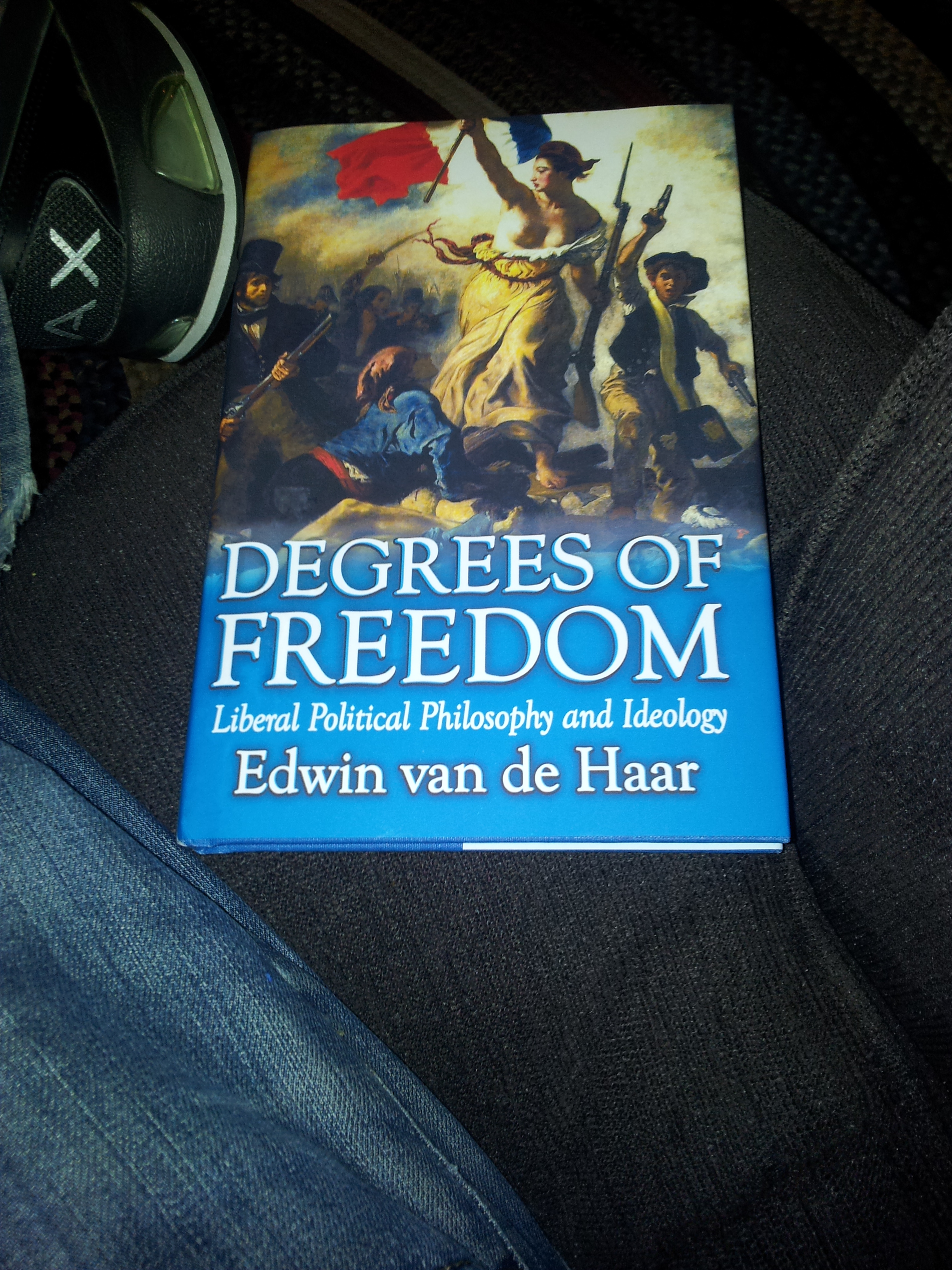
Look at what just arrived in my hands

Van de Haar's "Degrees of Freedom: Liberal Political Philosophy and Ideology"
Van de Haar’s “Degrees of Freedom: Liberal Political Philosophy and Ideology”

It’s Dr van de Haar’s newest book, straight from the Netherlands. You can pick up your own copy here (mine was a gift from Dr V, one of the many perks of being an annoying blog editor!). He’s got more books that you can find either on his ‘About…’ page here at NOL or on the sidebar. Thanks Dr van de Haar!

I know Dr Khawaja (of Policy of Truth infamy) was thinking of getting this book reviewed for Reason Papers, too. I don’t have the training in political philosophy to do the job, but I can say, just by reading through the first couple of pages in his introduction, that I could have benefited immensely from this book if I had been introduced to it in Political Science 101.

Aside from the introduction, I also briefly read through Edwin’s section near the back of the book (pgs. 120-126) titled ‘The Neoliberal Phantom’, and believe that it would be very useful for liberals of all stripes when confronted with poorly constructed anti-liberal arguments (the geographer – NOT anthropologist – David Harvey, for example, gets the full Dutch treatment from Dr van de Haar). It should be noted that this section is probably (again, I don’t have any training in this area) a little less useful for academics confronting more sophisticated attacks against liberalism, but it’s a very good primer for intense undergraduates and graduate students who have to deal with the relentless, poorly reasoned attacks on liberalism in their studies and at seminars.

When I read the whole thing I’ll be sure to post a review here at the blog. If I get word of somebody who wants to review Dr van de Haar’s book for Reason Papers (check out what’s on tap right now, by the way), I’ll try to post the good news here, too.

Secession in Europe (but not the EU)

NOL‘s roster has blogged about secession within the EU before, but what about dissatisfied regions joining Switzerland’s cantons instead of the EU? Read more, from the WSJ, to find out…

Around the Web

  1. Olivier Roy on Laicite as Ideology, the Myth of ‘National Identity’ and Racism in the French Republic
  2. Prague ’68 and the End of Time
  3. How To Spot And Critique Censorship Tropes In The Media’s Coverage Of Free Speech Controversies
  4. The Swamping that Wasn’t: The Diaspora Dynamics of the Puerto Rican Open Borders Experiment
  5. A Voice Still Heard: Irving Howe
  6. Borders and Bobbing Heads: Postcoloniality and Algeria’s Fiftieth Anniversary of Independence (so close, and yet so far…)
  7. The New Yorker on the recent scientific fraud, with its epicenter at my alma mater. (Delacroix remains startlingly relevant because of it.)

Bernard Lewis, Edward Said, Facts, Ideology, and the Middle East

I recently came across an excellent interview conducted by Evan Goldstein, who is the editor of Arts & Letters Daily and the Chronicle of Higher Education, with Bernard Lewis, who is an eminent historian of the Middle East from Princeton. There were three things that stood out to me in the interview: 1) the potential for ideological rigidity in academia, 2) the importance of history for analysis of recent events, and 3) the astonishing, obstinate ignorance of foreign policy ideologues when it comes to understanding enemies. Three excerpts from Goldstein’s interview with Lewis can best illustrate my points.

On the potential for ideological rigidity, Lewis – who I first came across from reading Edward Said’s infamous postmodern polemic Orientalism – has much to tell us:

Age has not mellowed Lewis, especially on the topic of the late Edward Said, whose 1978 polemic, Orientalism, upended Middle East studies and placed Lewis in the position of having to defend his scholarship against charges of racism and imperialism. Lewis vividly remembers reading Orientalism for the first time. “Apart from Said’s ill will,” he says, “I was appalled by his ignorance.” […] Lewis and Said met only once, in 1986, for a debate at the annual conference of the Middle East Studies Association. Dubbed the “shoot-out at the MESA corral,” the event drew 3,000 spectators. Whether or not Lewis thinks he won that day’s battle, however, he seems to be under no illusion that he lost the war.

“Middle Eastern studies in this country is dominated by the Saidians,” he says, his voice rising in indignation. “The situation is very bad. Saidianism has become an orthodoxy that is enforced with a rigor unknown in the Western world since the Middle Ages.” This groupthink, he says, taints everything: jobs, promotions, book reviews. “If you buck the Saidian orthodoxy, you’re making life very difficult for yourself.”

In 2007, Lewis and some like-minded scholars, including Fouad Ajami, of the Johns Hopkins University, founded the Association for the Study of the Middle East and Africa. The idea, Lewis says, was to create space for opinions that deviate from the MESA mainstream, “to maintain an independent academic integrity in Middle Eastern studies.”

This is an important argument. I minored in MENAS at UCLA, which has one of the most prestigious MENAS programs in the world, and was never required to read the work of Bernard Lewis. How can this be, especially given Lewis’ towering influence on MENAS in the scholarly world? The answer is, of course, orthodoxy. Dogma. What is most disturbing about orthodoxies that gain a monopoly in a field of study is that truth becomes a political agenda rather than an aim for scholarly research. Those who, as Lewis notes, dedicate their lives to answering questions as best they can are necessarily at odds with the dogmas of the field. Postmodern Saidians have imposed the worst sort of orthodoxy, too: If you are not from the Middle East, or if you are not Muslim, then you are by default an agent – willing or otherwise – of imperial aggression and Western chauvinism. Those who question, or dismiss, Saidian insights into the Middle East and North Africa are “being political” while those who do not question Saidian insights are performing scholarly research. Can anybody else see the fallacy here?

This orthodoxy dominates MENAS scholarship. While interacting with my professors at UCLA I was given plenty of opportunities to subtly acknowledge my adherence to Saidism. I did not. I did not question Saidianism, either. I only expressed an innocent desire to gain insights into the work of the guy called out so often in Orientalism, Bernard Lewis. I was told, on numerous occasions, that Lewis had not been read, though of course it never hurts to gain the other side’s perspective. Could the orthodoxy Lewis identifies and assails be any clearer? (Here is the website to Lewis’ Association for the Study of the Middle East and Africa, by the way.)

Aside from vehemently disagreeing with the patron saint of MENAS, Lewis has also gained notoriety for his connection to the second Bush administration’s illegal invasion and subsequent occupation of Iraq. I don’t want to get into the details of his participation here (Goldstein does a good job of that in the interview itself, and I actually lost a little bit of respect for Lewis because of his evasive answers to Goldstein’s questions about his relationship with the Bush administration), but his insights into how the Middle East actually works should be of particular interest to libertarians and especially libertarians who sometimes read me for my quirky (even by libertarian standards) take on American foreign policy. Careful readers can hopefully recognize my overall argument in Lewis’ intricate understanding of the Middle East:

His disagreement with the Bush administration, he explains with a sigh, was not over the goal (regime change), but the tactic (full-scale invasion). Lewis says he argued for recognizing the leadership in northern Iraq as the country’s legitimate government and arming those forces if necessary. In the decade since the first Persian Gulf war, he says, Kurds and Arabs had managed to build a nascent democracy under the protection of the no-fly zone.

“That was the way to do it,” he says. “Simply to invade was the wrong way to do it, and I thought so and said so at the time.” Why didn’t he speak out before the invasion? “I didn’t feel at that crucial moment that it was right to take a public stance against the war.”

Aside from his inability to own up to his mistaken support for the Bush administration (or making his opposition to its policies public), Lewis is spot on. Look at what he is saying, and remember that his analysis is sharpened by a lifetime of prestigious scholarship on the Middle East: the West should have recognized that the illegitimate borders of Iraq had produced differing modes of governance in different regions, and that it would be morally acceptable to recognize the claims of sovereignty then being shouted out by the peoples of northern Iraq.

I am not even in the same ballpark as Lewis when it comes to understanding the Middle East. He is a retired-but-prestigious historian from Princeton; I am a potential graduate student with a B.A. from UCLA; yet he and I have come to the same conclusion, and it’s not hard to see why (it is also worth asking yourself the following question: Is Lewis right?):

  1. The Middle East is a region of the world with lots of different cultures (this is a truth that many foreign policy experts flatly ignore).
  2. The borders drawn up by the victors of World War I do not line up with these cultures anywhere in the Middle East, save perhaps Saudi Arabia.
  3. These artificial borders, and the international governing institutions that sanctify them, make necessary the presence of a strong man to keep these borders from collapsing.
  4. Since strong men are bad, and bottom-up institutions are good, it makes perfect sense – from a realist perspective and from an idealist perspective – for the West to recognize and incorporate the claims of sovereignty made by these bottom-up, nascent states.
  5. Invading and occupying a country, with the goal of molding it into a democracy, is a stupid idea because…
  6. …democracy cannot do for artificial states what strong men can: namely, keep borders in place without affecting the regional balance of power.

Yet the power balancers, and the realists who think that strong men serve Western interests better than democracies do, cannot adequately explain why these same strong men are so hard to control, and indeed often end up as enemies of the West (Saddam Hussein, anyone?). Lewis’ scholarship explains this well. The ideologues – the Western chauvinists and the postmodern Saidians – cannot explain this or, more likely, are unable to explain this because it flatly debunks their dogmas.

Speaking of dogmas, I have given too much attention to the orthodoxy currently strangling MENAS programs around the world, and not enough to those harbored by Western chauvinists. Goldstein reports:

Lewis pulls a Russian book off the shelf and slowly reads his name, in Cyrillic, on the cover. He smiles. His books have been translated into 29 languages. The Middle East and the West, published in 1964, was even translated into Arabic by the Muslim Brotherhood. Lewis is particularly fond of that edition’s preface: “I don’t know who this person is,” the translator wrote, “but one thing is clear. He is, from our point of view, either a candid friend or an honest enemy, and in any case one who disdains to distort the truth.” Lewis chuckles at that.

There is a common trope in many conservative Western circles that Islamists are so beholden to ideology and hatred of all things Western that they are incapable of understanding other modes of thought. Yet it is very clear from this excerpt that Islamists are interested in understanding other ideologies. Islamists, like socialists in the West, are more interested in molding better human beings than in making us freer. Instead of acknowledging this, many experts in foreign policy circles simply pretend that their opponents are savages and incapable of thinking like a true civilized individual. This mindset, too, contributes to the ongoing violence in the Middle East.

The West has a role to play in the Middle East. If it wants to reduce violence and raise standards of living, then policymakers in Washington and Brussels need to accept the fact that their conceptions of the Middle East have largely been shaped by dogma. Muslims are capable of doing bad things. So are Westerners. The West needs to support bottom-up decentralization in the Middle East until it is no longer possible to distinguish a West from a Middle East or, at least, until the West and the Middle East are as similar as Texas and California (or Germany and France). Until policymakers realize that the Middle East’s autocrats are a direct result of central planning efforts made elsewhere, and until MENAS scholars own up to the fact that their dogmas do more harm than good, peace and prosperity will elude the region.

From the Comments: What do progressives think of Hillary Clinton?

This comes from Professor Terry:

I suspect I’m the only one around here that spends significant time on progressive blogs etc so let me tell you what it’s like over there….Progressives seem depressed but resigned. HRC will be the nominee. There are no other viable candidates. Sanders will be entertaining, O’Malley not so much….there’s no one on the sidelines. Prof. P’s [‘P’ is for ‘Pinocchio’ – bc] lust driven fantasy about Sen. Warren aside, no last minute candidacy from her.

Progressives take some solace in not having someone from the Republikan Klown Kar selecting Supreme Court nominees but that’s about it. Progressives take it for granted that the Democratic nominee will win the general election [they can read the electoral map and count]. They aspire to take back the senate but have no illusions about the House of Representatives so no significant new legislation will happen.

In my opinion scenario 3 is inevitable, I will dearly miss the Obama administration and it will happen sooner than I’ll like…

Thanks Dr A. This is excellent insight, and I am curious about the names of these progressive blogs. Who knows: some of them might even end up on NOL‘s vaunted blogroll. Professor Terry, by the way, teaches and researches up at a fancy business school in Toronto.

I still don’t have a solid definition of what ‘progressive’ means, though. It’s Left-wing. It’s anti-racist (or purportedly, anyway, as it can be argued that identity politics is itself racist, but I digress). Aside from those qualities, I don’t see much about it that is progressive. They are protectionists. They love big government except when they don’t. They are Democrats, or at least anti-GOP, but doesn’t necessarily approve of the Democratic leadership (especially when it works with Republicans). This leads me to suspect that progressivism is a political movement rather than ideological or intellectual one. This deduction, in turn, suggests to me that progressives are the US’s reactionaries (conservatives). I would be happy to change my tune about progressives once I get a solid definition of what they actually believe in, but again I don’t have one and reactionaries are usually defined by what they oppose (in this case Republicans) rather than what they stand for.

Anyway, NOL‘s blogroll – one of the best, if not the best blogroll out there in my humble opinion – has a bunch of Leftist group blogs on it, including: Angry Bear, Crooked Timber, Disorder of Things, Duck of Minerva, JHIBlog, Lawyers, Guns & Money, the RBC, Monkey Cage, and Mischiefs of Faction. None have coughed up a definition of ‘progressive’ yet, but Professor Terry has an open invitation to do just that here at NOL.

Every society needs its reactionaries, of course. It would just be nice of progressives to actually, honestly identify themselves as the reactionary party here (and as the Tories do in the UK), rather than deceive themselves by referring to their reactions as “progressive.” The Progressives of the 19th century (different bag of reactionaries than today’s progressives) did the exact same thing when they started calling themselves “liberals” in order to make their policies more palpable to the general voting public, and look how that turned out.

Liberty is what creates progress, not legislation. Just ask all of those progressives currently resigned to voting for HRC because she’s “better than the alternative.”

Around the Web

  1. Hokusai and the wave that swept the world
  2. Xenophobia in South Africa: Historical Legacies of Exclusion and Violence
  3. Death in Venice: Eighteenth Century Critiques of Republicanism
  4. 2 Fantastic Exhibitions at the Asian Art Museum
  5. Not All Libertarian Rightists/Leftists Are “Thick”: A Reminder
  6. What We Can Learn from Confederate Foreign Policy

From the Footnotes: Race, Nationality, and Empire

We have more to say than space allows about ‘race’ and ‘community’ as an imperial organizing category, especially in the British Empire, and about complex transformations and incongruities in decolonization as plural, hierarchical fields of multiply ‘races’ and ‘communities’ were constituted into new nation-states. A return to the dictionaries shows that while definitions of ‘nation’ before World War II sometimes connected nations to states, they invariably defined nations as ‘races’ and made the connection to race, not state, primary. Challenges to this linkage of nation and race were available at the time, notably Renan’s 1882 lecture rejecting race, language, and territory as bases for nationality. This argument eventually became famous. But the dictionaries changed only after that crescendo of failure of nations seeing themselves as races destined to dominate empires, the global catastrophes following the German effort to found an Aryan Third Reich and the Japanese effort to build a Co-Prosperity Sphere with the Yamato race as nucleus. Benedict Anderson deserves credit for insisting upon annihilation of the shared descent definitions of nation, for insistence that the nation is first of all imagined, ideal, and realized in co-dependence with a state. Yet in this, we think, he is the theorist observing at dusk, theorizing the world-order of quiescent nation-states built decades before by the architects of a United Nations in the rubble of the Second World War – and theorizing them not as 20th-century contingencies but as a modern necessity. To Anderson, the disconnection of nation from race or descent group and its connection to the state was, ironically, not an historical development but something intrinsic to the nation. The fact of the Nazis notwithstanding, he found scholarship seeing any connection between nationalism and racism simply ‘basically mistaken’.

This from “Nation and Decolonization: Toward A New Anthropology of Nationalism” by John D Kelly and Martha Kaplan in Anthropological Theory (gated, unfortunately).

Some Quick Facts About Nepal

Dr J suggested I post some thoughts on the recent, devastating earthquake in Nepal, but I don’t know if I have much to add. Over at Policy of Truth, one of Dr Khawaja’s friends was in Nepal when the quake happened and there are some photos that his friend was able to take. And a development economist has some good advice on giving to Nepal.

Instead, I’ll just break down some interesting tidbits about the country. I can’t do any better than Wikipedia (minus most of the links):

Nepal […] is a landlocked country located in South Asia. With an area of 147,181 square kilometres (56,827 sq mi) and a population of approximately 27 million, Nepal is the world’s 93rd largest country by land mass and the 41st most populous country. It is located in the Himalayas and bordered to the north by the People’s Republic of China, and to the south, east, and west by the Republic of India. Nepal is separated from Bangladesh by the narrow Indian Siliguri Corridor and from Bhutan by the Indian state of Sikkim. Kathmandu is the nation’s capital and largest metropolis.

The mountainous north of Nepal has eight of the world’s ten tallest mountains, including the highest point on Earth, Mount Everest, called Sagarmāthā (सगरमाथा) in the Nepali language. More than 240 peaks over 20,000 ft (6,096 m) above sea level are located in Nepal. The southern Terai region is fertile and humid.

Hinduism is practiced by about 81.3% of Nepalis, the highest percentage of any country. Buddhism is linked historically with Nepal and is practiced by 9% of its people, followed by Islam at 4.4%, Kiratism 3.1%, Christianity 1.4%, and animism 0.4%. A large portion of the population, especially in the hill region, may identify themselves as both Hindu and Buddhist, which can be attributed to the syncretic nature of both faiths in Nepal.

A monarchy throughout most of its history, Nepal was ruled by the Shah dynasty of kings from 1768—when Prithvi Narayan Shah unified its many small kingdoms —until 2008. A decade-long Civil War involving the Communist Party of Nepal (Maoist), followed by weeks of mass protests by all major political parties, led to the 12-point agreement of 22 November 2005. The ensuing elections for the 1st Nepalese Constituent Assembly on 28 May 2008 overwhelmingly favored the abolition of the monarchy and the establishment of a federal multiparty representative democratic republic. Despite continuing political challenges, this framework remains in place, with the 2nd Nepalese Constituent Assembly elected in 2013 in an effort to create a new constitution.

Nepal is a developing country with a low income economy, ranking 145th of 187 countries on the Human Development Index (HDI) in 2014. It continues to struggle with high levels of hunger and poverty. Despite these challenges, the country has been making steady progress, with the government making a commitment to graduate the nation from least developed country status by 2022.

Nepal’s GDP (PPP) per capita stands at about Intl$ 2,300 according to the World Bank, which is lower than Bangladesh and on par with Senegal (in west Africa), and Tanzania and South Sudan (both in east Africa). GDP (PPP) per capita is, of course, my favorite unit of measurement for comparing the health and wealth of societies.

I couldn’t find much information on ethnic groups, but the number of religions practiced, plus the number of languages spoken by significant portions of the population and coupled with the decade-long civil war between Maoists and monarchists, is enough to suggest – to me – that the country has no tradition of liberalism whatsoever, and will thus likely remain in poverty for a long, long time – despite the fact that a federal state has recently been implemented from the bottom up.

Ideas matter, though at the same time, the question of federalism versus liberalism seems a lot like the question about the chicken or the egg. If a Maoist insurgency and a reactionary monarchy can give way to a liberal federation in the middle of the Indian-Chinese border I’ll disavow learning altogether and take up the cloth in liberalism’s name!

I am hoping Dr Ranjan – a South Asian specialist – can jump in and provide us with some insight as well, but spring is a busy time for scholars.