- Our own Edwin van de Haar being interviewed about Degrees of Freedom (audio interview)
- Does Gun Control Work? Ben Carson Says Yes. ADL Says No but Yes
- The Vanishing Europe of Jürgen Habermas
- Leviathan (movie review)
- Thinking Anew | What, precisely, changed in the 18th century? (book review)
- This Is What Russia REALLY Fears in Syria
Author: Brandon Christensen
Russia in Syria: A Gift to the West (but not to Syrians)
I don’t see why so many Western commentators and analysts are up in arms over Russia’s move into Syria. (Actually, I do: From Ukraine to Iran to Syria, Moscow has been more active in geopolitics than it has been for nearly 25 years.) Moscow’s move into Syria can only be seen as a gift to the West, in terms of strategy and geopolitics. Think of it this way:
Russia has no military experience whatsoever outside of its borders. The Russian military did a ruthlessly good job of stamping out secessionist movements in the Caucasus, and its internal security bureaucracy has done a great job of stifling dissent and shaping the narrative that Moscow wants to be highlighted. Yet Russia’s success outside of its borders has been paltry, at best.
Intervention in Ukraine has brought widespread, global condemnation upon Russia, and economic sanctions to boot.
The Russians in Syria are going to be ruthlessly slaughtered and exploited by the myriad of factions in the region. Not only is Russia backing the wrong horse (Assad), it is backing it up with hardware and personnel that have no experience with the region. Russia has produced an insular intellectual class over the past 15 or 20 years, and this is going to play out badly for its Syrian intervention.
The West, which has an awful lot of experience playing factions off on each other in the Near East, will most likely take advantage of Russian ignorance (to the detriment of Syrian society as whole) and as a result the world will see a Russian military outsmarted, outgunned, and outmanned by an insurgency with no official support from the outside world. The Russians are going to get bloodied in Syria. I don’t see why Western hawks are so keen on making Russia “pay” for its excursion on the global diplomatic stage.
From the Comments: Asylum Seekers and the Canadian Experience
Dr Amburgey takes some precious time out of his schedule to rebut Dr J:
@Brandon
I can understand your reluctance to yet again engage with Professor Pinocchio’s fact-resistant Islamophobia. However you must give him credit for actually using some real data. Granted the choice of country and time period are idiosyncratic [id est cherrypicked] but anything not pulled straight from his anus is a dramatic change. Should you feel like responding in kind, use this: Canada for the period 2004 – 2013. Top 8 countries of origin for refugees landing in Canada
Columbia – 17381
China – 15344
Sri Lanka – 12326
Pakistan – 10641
Haiti – 7872
Mexico – 6512
India – 4988
USA – 4451Based on this data Catholicism and Hinduism far outstrip Islam as religions producing sick societies.There is currently no other view that is even modestly supported by anything but ideological intransigence.
Indeed. Only the most ideological of ideologues continue to pretend that Islam is responsible for the problem in the Middle East.
When the Austro-Hungarian empire collapsed, the Holocaust happened. One could argue that, because the state is less efficient on the post-Ottoman world, what we’re witnessing is a process similar to the one we witnessed in the Occident, only in a much more haphazard way.
BC’s weekend reads
- Introducing… Jesus and Mo
- On private property and the commons
- Why Merkel’s Kindness to Asylum Seekers Could Reflect a German Soft Spot for Islam
- Why I find the Mthwakazi monarchy restoration unjustified
- September (a song about me)
- From the Far Right to the Far Left
- Beyond Neoliberalism (book review)
From the Comments: Trying to Make Sense of Left and Right (Again)
This one is from yours truly, in a delightful back-and-forth with Dr Amburgey:
Ok. Clearly we need to be using terms that mean the same things to both of us. It’s your thread so tell me what constitutes ‘The American Right’ and what constitutes ‘The American Left’. Once we have a common understanding of terminology we can resume the discussion.
I have been working on a post about this very topic, and this conversation is helping me immensely. Thanks.
First, I think there is a distinction that has to be made between the ‘ideological’ and the ‘political’. The ideological rests atop a higher tier than does the political, like a pyramid. The ideological tier houses philosophical and moral insights, which are produced through the academy and in think tanks. The political tier houses organizations dedicated to parties (I think that factions and parties are two different components of a society, and that factions represent a tier below the ideological and above the political).
The American Right is ideological. The GOP is political. (Factions would consist of actors like bureaucracies, trade unions, industrialists, banks, medical doctors, etc., but can also be used to describe intra-party, or coalitional, differences) The American Right is currently home to three broad ideologies: neo-conservatism (elite and moderate), libertarianism (elite and radical), and traditionalism (populist and radical). I emphasize ‘currently’ because neoconservatives and libertarians were at one point Leftist factions in US history, and could easily end up there again in the near future. In many post-colonial and post-socialist societies, for example, both of these ideologies are considered to be on the Left.
The American Left is currently home to three broad ideologies: fascism, communism, and racism. Just kidding! The three ideologies are, I would argue: New Deal liberalism (elite and moderate), technocratic liberalism (elite and radical), and progressivism (populist and radical).
New Deal liberals and neo-conservatives are only moderate because they are dominated by Baby Boomers and Baby Boomers dominate the population at the moment. Libertarians and the technocrats are broadly younger and more cerebral (hence the radicalism). Traditionalism and progressivism are ideologies for the vulgar mob, of course.
Ideology, using the pyramid analogy, trickles down from the top tier into the factional and political tiers. This is just how it works in societies governed by laws rather than by men. Libertarians have been dominating the ideological discussion for the last 30 years or so, and the technocrats have been playing defense, largely because they are politically aligned – wrongly, of course – with socialism’s failure, but also because technocrats are just libertarians who don’t have the chutzpah to become non-conformists.
Successful politicians from the Democrat Party have been trying to balance their New Deal liberalism with the insights of their technocratic betters, but have been calling themselves ‘progressives’ because of the populist narrative and the fact that they need the votes of the vulgar mob to be successful.
I already don’t like this because I don’t think the Left deserves to be considered ‘liberal’ at all, and there is also the shortcoming of being strictly American in scope. We have got to think in internationalist terms when we discuss power and liberty. NOL has tried to hash this whole issue out before, by the way, and numerous times.
BC’s weekend reads
- The debt of a Pope called Francis to past Syrian refugees, Part 1 (be sure to check out parts 2 and 3, too)
- Ten Things I Want My Children To Learn From 9/11 (and also “Ten (or So) Lessons of 9/11“)
- Hellburners Were the Renaissance’s Tactical Nukes
- The Inevitable Divorce: Secular France and Radical Islam
- How Petty Traffic Fines Ruin Lives in Milwaukee (and Everywhere in America)
- Edwin and Barry both have excellent posts on current events in Europe and the Near East (Jacques has a related post); be sure to scroll through all the comments in their respective threads…
An update from Memphis (Russo-Baltic edition)
Dr Znamenski (bio, posts) sent me an email updating me on his recent shenanigans:
I also appreciate your remark that we need to reach out to other libertarian-leaning people rather than singing to only a libertarian chorus. Even though I am notorious for not contributing to NOL, I devoted this summer to reach out to liberty-minded people in Europe by going to St. Petersburg, Russia, and delivering there a public talk (in Russian) on “Heroics of the New Deal and Its Critics” at a downtown hotel and afterwards I met with the audience for a free-style interactive talk on current challenges to individual liberty. Then I proceeded to Tallinn, Estonia, where I met a group of Estonian libertarians and delivered a talk (in English) on geopolitical imagination of Russian nationalism (used current Alaska-related Russian patriotic rhetoric as an example). Then proceeded back to Russia, where at Samara University again I gave a talk on the mythology of FDR and New Deal Keynesianism and how it was appropriated in 2003-2008 by the Putin regime that was building the “vertical” of its power. My argument was that politico-economic regime whose “validity” was “scientifically” proven by Keynes in 1936 by now became a kind of a fetish that is associated with a good government. Hence, the “Heroics of the New Deal” title. The Estonian visit was especially pleasant and inspiring.
I also met an informal leader of Estonian libertarians […] Very productive and charismatic guy. I need to navigate him to you and to NOL, which will greatly benefit from his contributions (if any). His English is impeccable too. See his picture attached to this letter (they have Mises Institute of Estonia) in addition to a few other images from Estonia (the country where all paper work exists only in electronic form and a flat tax return occupies only one page!). The country [Estonia] was the first in Europe to introduce universal flat tax (1994), which replaced three tax rates on personal income and one on corporate profits. The flat tax rate was on 26%, which later was reduced to 20%. Several countries of Europe followed the suit and benefited from this. Very simple system, which helped this tiny backwater country of 1 million plus something people to dramatically raise its well-being. To their frustration, even Russian nationalists, who remain quite influential in Estonia due to the presence of a large Russian minority, have little economic discontent among Russians to chew on. The latter simply compare their economic situation in their historical homeland where average salary is $500 and Estonia where this salary is $1150.
Dr Znamenski has some excellent ideas brewing (on US-Russian relations in the Arctic, Crimean secession, and Foucault), and hopefully he can find the time to post them in the very near future. Notice, too, that Dr Znamenski refers to Russians as Europeans (or, at least, considers St Petersburg to be European). A small observation, I know, but one that I suspect has big sociological implications. Check out these pictures he sent me:


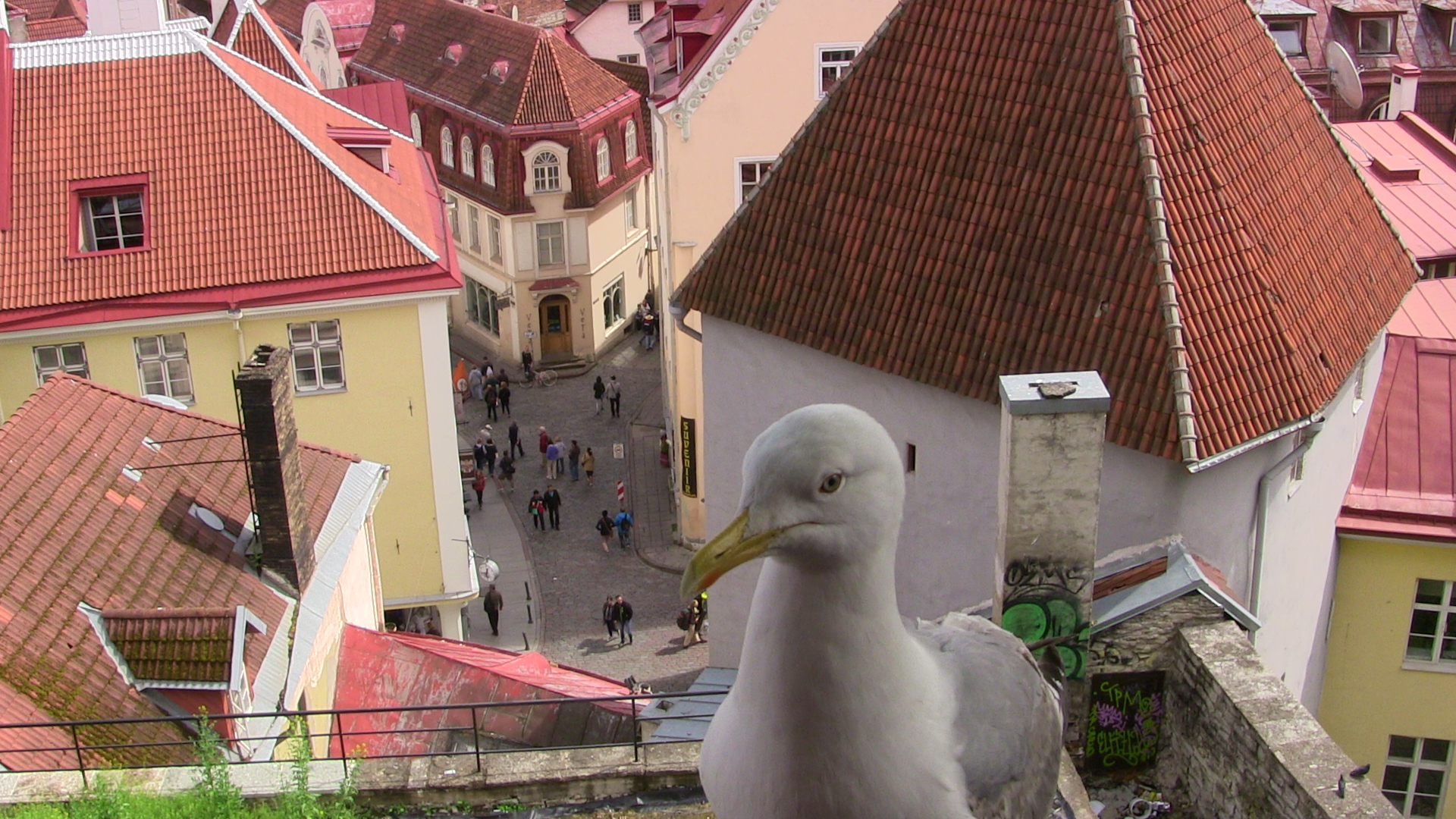
The death knell of Open Borders?
The world of the 1990s and aughts is now gone. A borderless, wall-less world will be relegated to the musty, threadbare realm of academia and on the white papers of a few brave think tanks. The flood of war refugees from Syria has been overwhelming Europe’s political and cultural sensibilities (Europe’s political sensibilities are quite innovative, but it is stagnating culturally; not a good combination for societies trying to manage large influxes of mostly unwelcome refugees). In the US, demagogues on the Right and the Left have been trashing immigrants and the freedom of movement in the name of the Worker.
The freedom of movement of individuals is a fundamental right that I will advocate on behalf of for the rest of my life, and yet I have been cautious in embracing the trendy calls for Open Borders by technocrats and non-paleo libertarians. My caution had less to do with my disdain for the cultures of those respective factions than it did with my inability to imagine a world of Open Borders as the prominent factions presented it. The Open Borders trend brought too many questions to my mind. For example, what if only a few countries recognize Open Borders? Why should people be free to move to one area but not to another? What is fair about any of that?
Open Borders was, in my mind, a short-sighted cultural campaign aimed at furthering freedom. There is nothing wrong with this, of course, as some such campaigns end up furthering freedom in the long run (though these campaigns can also damage the push for more freedoms, too). In this respect, Open Borders was a big success. It brought technocratic Leftists around to the idea of loosening restrictions not only on labor but capital as well. It brought lots of non-Europeans into the libertarian fold. The Open Borders campaign made the unspoken nationalisms of trade protectionism and immigration restriction taboo for smart people.
Yet, as current events so blatantly illustrate, freedom of movement is not in the same camp as, say, freedom of speech. Freedom of speech is culturally sacred to Westerners. Every individual in the West believes that her freedom of speech is inalienable. This, even though free speech is always under political and legal attacks from factions vying for power over others. (These political and legal attacks, of course, are a necessary evil for a free and open society. If this doesn’t make sense, recall that “freedom of speech” is a right protected so well by states like North Korea and Cuba that the rulers of those countries consider it a crime to claim otherwise.) For those who want a world where freedom of movement is in the same camp as freedom of speech, more hard work and more critical thinking is required. My small contribution is below.
If there had been political bonds – a la (con)federation of some kind – between Syria and EU states (or other Arab states), then the horrific violence that has been tearing Syria apart could have been avoided. The opposing parties would have had to spell out their differences in a parliamentary setting, and if they could not come to any kind of agreement then the opposing parties could have hashed out their differences in a legal setting, either by suing each other in the courts or by pursuing secession options (which would have likely led all parties back into parliamentary negotiations). In fact, the legal and political jostling could have been done simultaneously.
Look at the EU. Just look! Open Borders is possible because the states involved in the confederation are bonded together politically. They had come to an agreement about Open Borders (amongst other policies) and how to recognize, respond, and respect such a policy.
Look at the US. Open Borders is possible because the states involved in the federation are bonded together politically. They had come to an agreement about Open Borders (amongst other policies) and how to recognize, respond, and respect such a policy.
Now look at Syria and the EU. Open Borders is not possible because these states have no political bonds. Instead, people are being murdered and driven from their homes. People are being harassed by policemen and bused from one country to another. People are being barred from riding trains. People are dying at sea.
Open Borders is a watered down policy prescription that is too Western-centric (ask me how). It’s better than nothing, mind you (like free trade agreements), but it’s worth reminding ourselves that it’s not a comprehensive answer to the question of freedom of movement. As such, it’s easier to attack or dismiss when things go wrong. Here is yours truly blabbing at the mouth back in May of 2014:
I think that there is a way to incorporate open borders into a One Big Change-style reform while also leaving room for other improvements such as financial competition in the markets (rather than between governments) and competing tax regimes. I’d dig deeper and go a little more structural. I’d federate the entire world, and I wouldn’t make the federation out of the current agglomeration of nation-states, either. I would destroy the states currently in place and federate the administrative units that currently operate underneath the nation-state.
This, I think, would do a great job of incorporating open borders (everyone is part of the same federal union now), financial competition (no more national banks), tax regimes (you can more easily vote with your feet), and a common legal system that protects individual rights such as private property and freedom of religion.
Now, you wouldn’t want to do this in a ‘top-down’ manner. The best way to get the ball rolling on such a proposal would be to tack on a constitutional clause of some sort that merely opens the door to dialogue on closer political ties between peoples. So, in the case of the US, a clause could be adopted that makes it possible for states or disgruntled sub-states to approach the US about collaborating more intimately. An even better option would be to find an already existing clause in the constitution that allows for such a thing. Maybe nothing comes of it. Maybe people balk at American pomposity. At least, at least that is until their strong man starts bombing their neighborhoods or their social democracy starts adding a few extra zeros to its currency…
Holla back!
UPDATE: Re-reading through this made me realize that I’m addressing a different aspect of freedom of movement than the Open Borders crowd. They’re focused on the ‘why’ whereas I’m focused on the ‘how’.
What is the distance between Damascus and Budapest?
According to distancecalculator.com, it’s 2,123 km (or 1,319 miles).
The distance between Damascus and Abu Dhabi? 2,021 km (or 1,256 miles).
If I had to flee a war zone on foot to a wealthy cosmopolitan city I’d rather go through Turkey and Romania than Iraq and Saudi Arabia, too. The West is on the precipice of a damnable moral failure (link, in case you’ve been living under a rock). In the name of fairness, though, a regional perspective ought to be adhered to.
I have a slight digression. Can anybody here imagine what the plight of the war refugees would be like going through post-socialist states like Romania and Bulgaria if they had not been a part of the EU? Let me put this into context a bit more. In order to join the EU, post-socialist states in Eastern Europe had to reform their political and legal systems in a manner that was satisfactory to the traditional Western states of the confederation. A major aspect of these reforms was making sure that governments have a harder time assaulting individual rights. This clause, or whatever you want to call it, for joining voluntarily the EU was less about a cultural chauvinism on the part of the core EU states and more about tempering the overt racist and nationalistic undertones of the post-socialist societies in Eastern Europe. Context matters, especially when there’s a lot of finger-pointing going on.
Here is a map I’ve edited for you:
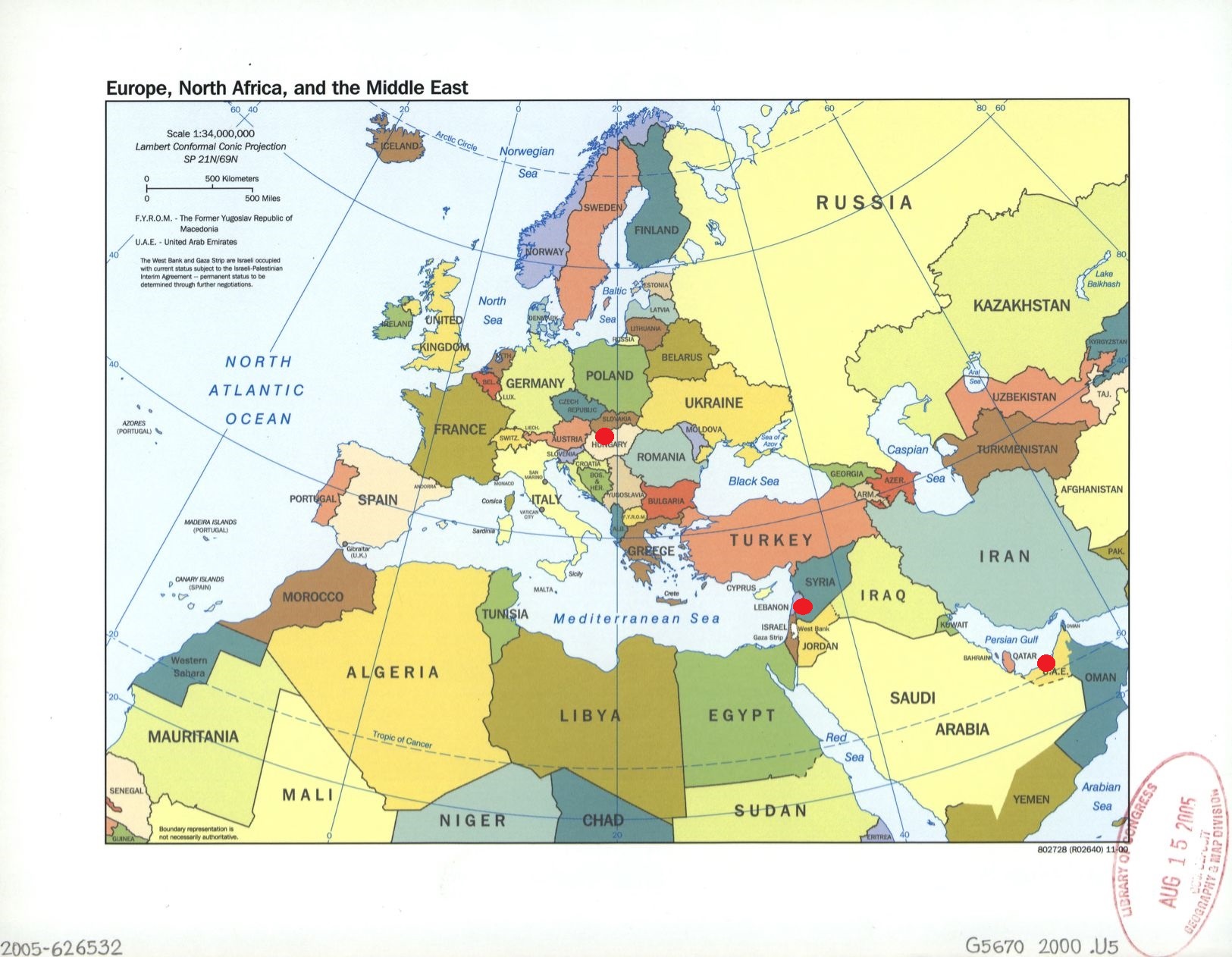
The three big red dots represent the cities of Budapest in Hungary, Damascus in Syria, and Abu Dhabi in the United Arab Emirates (UAE). Visual perspectives are great. I already added my two cents about what needs to be done, in fact I did so around this time last year.
From the Comments: The Contribution of American Allies to Pax Americana
Dr Stocker answers my concerns about free-riding and rent seeking with this gem:
Good points Brandon. On the rent seeking, I think you are broadly correct, but I would offer two qualifications. European nations/the EU often foot a lot of the bill/take on associated civilian tasks where America has taken military action, so that the US is not subsidising the defence and security needs of Europe quite as much as it might seem. So for example, in the Yugoslav breakup led to US military operations and a comparatively passive role for Europe, but a lot of the afterwork was taken on by Europe and there is no point in military intervention without work on building civil society to create long term security and stability. Going back a bit further to the first Gulf War/expulsion of Saddam from Kuwait, Germany and Japan did pay a lot towards the cost in return for not participating. Despite [this] they got a lot of abuse in the US Congress from politicians who don’t appear to understand that their non-intervention in the Gulf owed a lot to constitutions and attitudes which the US encouraged/imposed during post-World War II occupation. Recently, though European govts have been cautious in what they say in public about the Ukraine crisis and containing Putin, there is a growth in military spending and co-operation done in fairly quiet ways largely with the aim of deterring Putin from adventurism in the Baltic states. Just one example, Germany has recently taken 100 Leopard II tanks out of retirement and work is underway for the Leopard III. Moving to the Pacific, Japan is enhancing its military and weakening constitutional restrictions on the deployment of the military (imposed by the US in the post-war Constitution) in reaction to Chinese assertiveness.
While I think it is broadly correct that the US has been paying for a military burden which should be born by Europe and Japan, the situation is not as extreme as it often assumed in the US and as far as I can see is moving in a more balanced direction. In general while it is true that the US has a very impressive military machine with some impressive technology and officers, I think some Americans are a bit over confident about this. A lot of Americans, at least amongst those who take an interest in military kit, appear very convinced that the Abrams 2 is the best tank anywhere, I would suggest that in military capacity, for cost, the Leopard II is probably better (it certainly does much better in export markets) and even in absolute terms ignoring cost, the French Leclerc (which is extremely expensive) has a good claim to be the best tank around, and the Korean K2 is another strong but very expensive candidate. The Abrams is expensive, heavy, difficult to transport and difficult to keep in sufficient fuel, though it can certainly do a very good job. A lot of Americans appear to be incapable of thinking of France as anything other than a surrender monkey joke in military terms, which is really very far from the reality, as can be seen by the very strong role that France is now taking in northwest Africa against violent Islamist fundamentalists. The US military may well be able to have the same military capacity for lower cost if it moves away from the Abrams II model of a tank that is expensive to run and transport as well as build.
So broadly a correct point Brandon, but I think the situation is a bit better than is often understood in America and is moving in the right direction as Japan and Europe are getting used to the idea of taking responsibility for dealing with new threats from China, Putinist Russia and the hydra of Islamist fundamentalists.
A very good point, and an even better angle with which to view the world.
My only quibble is that the right direction American allies are moving can easily be changed without a more fundamental shift in institutional arrangements between us. Some sort of federal or confederal arrangement would go a long way toward addressing this issue, and would further deepen the economic and cultural ties between constitutional democracies.
Or am I just looking for problems where there are none, in order for my arguments to gain ground?
From the Comments: The Troubling Philistinism of American Libertarians
Dr Khawaja, back from his summer escapades in the West Bank, the Pine Ridge Reservation, and Ohio, takes some time to riff off of my complaints about libertarian criticism of the arts and humanities:
I think you’re being much, much too kind to Caplan. The connection between the Morson essay and the Caplan post is actually pretty clear: Caplan is explicitly defending the sort of philistinism that Morson is worried about. I know that Caplan comes out and insists that he’s not a philistine. But he’s actually the walking paradigm of one.
“The fact that most of the books failed to minimally pique even my interest reflects poorly on them.” Uh, not really. Maybe he should walk over to the psychology section and read up on “projection” and “attribution error.” It doesn’t even occur to him to ask whether his reaction is just an idiosyncratic response to this particular library.
“Could the problem be my lack of expertise?” Gee, there’s a toughie. I looked up the Fenwick collection. Here’s one item at random from their electronic databases:
Kotobarabia Arabic eLibrary Campus Faculty, Staff and Students only Some full text available
This Arabic-only database contains a wide range of Arabic content ranging from contemporary novels to national heritage scientific treatises.
[East View Information Services]What are the chances that Bryan Caplan could read even the first sentence of the first ten items of any search of this database? Are Tayeb Salih, Ghassan Kanafani, Neguib Mahfouz, or Abderahman Munif embarrassing? Is the secondary literature on them embarrassing (whether in Arabic, English, French, or any other langauge)? Or is Caplan’s ignorant, off-hand dismissal of the contents of his university library what’s really embarrassing?
I looked up the works of Charles Issawi, Albert Hourani, George Hourani, Clifford Geertz, Edward Said, Annemarie Schimmel, Michael Cook, Patricia Crone, Fouad Ajami, and for that matter, Mansour Ajami–all there. These are just random names I remembered off the top of my head from my undergraduate study of Near East Studies. (Mansour Ajami was my Arabic teacher. His name came up randomly because I searched for Fouad Ajami. I had no idea he’s written three books, but he has. Should I be embarrassed by that discovery?) My degrees are in Politics and Philosophy, so NES is way outside of my official areas of expertise. But you’d have to be a moron to be embarrassed by the presence of such work in a library, and it’s all there. You’d also have to be a moron to be embarrassed by the presence of more contemporary work in NES (or Geography, or Anthropology….), especially if, like Caplan, you knew nothing about it.
Just for fun, I did a search on my own last name, not because I expected anything of mine to show up, but just because that’s as random a search as you can imagine. The first hit is a guy named Mahboub Khawaja who’s written a book “Muslims and the West.” I don’t have the book here, but wouldn’t a person of average curiosity be tempted to take a look?
I did a search on my first name, too. Suroosh Irfani’s book on the Iranian revolution looked interesting.
I then clicked one of the Subject Headings underneath, “Europe-Relations-Islamic Countries.” You’d have to be brain dead not to be intrigued by half of what comes up. You could spend a lifetime reading that stuff. Oh wait. That’s kind of what scholars of the field do.
That’s just one casual set of micro-searches of one sub-field by one amateur follower of that field. Imagine multiplying searches of this kind simply for comparative politics and area studies. As you did, you’d multiply counter-examples to Caplan’s ridiculous claims. Then imagine you branched out to other fields. Same result.
Doing all that would be a waste of time, but don’t assume that because I’ve restricted my searches to one field or sub-field, my results are idiosyncratic. I probably could have done the same for Romantic poetry, the history of Reconstruction after the Civil War, Beethoven, Hannah Arendt’s views on Zionism, the luminist school of American landscape painting, American Indian law, Thomism, or literary studies of the works of the Bronte sisters–to name a totally random set of topics. My ex-wife Carrie-Ann Biondi is an indexer (actually the French language indexer) for The Philosopher’s Index. Every month or so, TPI would ship a box of philosophy journal articles to our house for her to index, and I’d spend part of an hour looking through them. Some of it was crap, but most of it was not. I NEVER had Caplan’s response to it. I was awestruck at how much good stuff was being produced. I’ve organized the Felician Ethics Conference for seven years in a row, and have probably read over 200 papers for it. I’ve mostly had the same reaction–curiosity, gratification, sometimes admiration, sometimes even awe.
The bottom line is that Caplan has no idea WTF he’s talking about. The interesting questions are not the ones he ignorantly poses, but rather: Why have libertarians so adamantly and resolutely come to valorize the all-out philistinism and ignorance of people with views like his? Why are we expected to take views like his seriously? If there is a “waste of paper” involved here, why doesn’t that phrase apply to what he’s written on this subject?
Back to prepping for class. The semester begins tomorrow.
I can only add that Irfan is right when he says I am “much, much too kind.” If only more people would come to realize this…
Also, I don’t think this philistinism is limited to Dr Caplan. There is a troubling trend within American libertarianism that is leading towards a kind of cultural chauvinism. Luckily, we live in a polycentric community here in the States and thus have lots of access to other ways of thinking about the world. I want my federal government to be much more libertarian, and I want more polities participating in my more libertarian federal government, and I want Washington to be more like my type of libertarianism. But that doesn’t mean I think those that disagree with me in matters of taste are a waste (of paper, of space, or of anything else).
If anything, those that disagree with me make my life that much more fulfilling, as I am an argumentative son of a bitch. My tolerance is not an endorsement of the status quo, either; any money going from Washington to the arts and humanities (and the sciences) should stop flowing immediately. I still think, despite Dr Khawaja’s excellent point, that libertarians like Caplan and Brennan are subtly attacking this latter notion, that government funding of the arts and sciences is not that bad. They’re just doing a bad job.
Or maybe they’re just philistines.
Ian Bremmer’s American Foreign Policy Quiz
Ian Bremmer, a political scientist at NYU (and numerous think tanks), has teamed up with Time to put together this quiz on what you think the proper role for the US (“America”) is in the world today. According to Bremmer, a neoconservative, there are three basic points of view with regard to the US’s role in the world: Independent, Indispensable, and Moneyball (you can read his explanation for these three types, as well as his analysis of how major presidential candidates fit into these categories, here).
I ended up being “caught between Independent and Moneyball America,” just like Rand Paul. Leave your scores in the ‘comments’ thread! Bremmer got his PhD in political science from Stanford back in 1994.
The Importance of Literature
I’ve got two long-form posts in my queue that are not quite finished. One is on how individuals rent-seek identity, and the other is on political labels and dialogue. In the mean time, here is an excerpt from an insightful essay on the (supposed, in my opinion) decline of arts and the humanities in American universities:
Democracy depends on having a strong sense of the value of diverse opinions. If one imagines (as the Soviets did) that one already has the final truth, and that everyone who disagrees is mad, immoral, or stupid, then why allow opposing opinions to be expressed or permit another party to exist at all? The Soviets insisted they had complete freedom of speech, they just did not allow people to lie. It is a short step, John Stuart Mill argues, from the view that one’s opponents are necessarily guided by evil intentions to the rule of what we have come to call a one-party state or what Putin today calls “managed democracy.” If universities embody the future, then we are about to take that step. Literature, by teaching us to imagine the other’s perspective, teaches the habits of mind that prevent that from happening. That is one reason the Soviets took such enormous efforts to censor it and control its interpretation.
This is from Gary Saul Morson, who teaches literature at Northwestern, writing in Commentary. This essay, for reasons I cannot fathom, reminded me of two recent posts by two prominent libertarians, economist Bryan Caplan and philosopher Jason Brennan, that deride the arts and humanities. Here is Caplan:
I’m an academic. A university library is supposed to be a warehouse of great thoughts. But the vast majority of the books seemed literally indefensible. Lame topics, vague theses, and godawful writing abounded.
Brennan’s post is more tongue-in-cheek but still worth reading.
Just replace ‘evil’ with ‘stupid’ or ‘lame’ or ‘useless’ and…voila.
Now, I’ve been around libertarian circles long enough to know that these critiques, of the arts and humanities, put forth by libertarian academics are more about debunking Leftist narratives (“you can, and should, do what you want because you, simply by being alive, have a right to whatever you want, including access to the arts and humanities”) than they are about trashing the arts and humanities, but I am a bit worried that the newest readers to old libertarian arguments are not as familiar with the subcontext of Caplan’s and Brennan’s arguments. These newer readers might not be as familiar with the old Leftist arguments about the arts and humanities being something that everybody should have access to, and as a result these newer libertarians might become anti-education, or worse: anti-democratic, though not anti-democratic as in being critical of the democratic process as it stands today, but anti-democratic as in becoming intolerant to views that are shown to be less superior in some way to our own.
I wish the more prominent libertarians among us would remember to include reminders that the ultimate target of their attacks are Leftist narratives that ignore reality, and not education.
Silent Majorities: Mass Incarceration Edition
What vexed [political scientist Michael] Fortner was that The New Jim Crow seemed to be two different books. One did a powerful job showing how mass incarceration undermines black communities and perpetuates racial inequality. The other — and this was the vexing part — advanced a political theory about how we got here. That history stressed the resilience of white supremacy. First came slavery; when slavery ended, a white backlash brought Jim Crow segregation; when Jim Crow crumbled, a backlash to the civil-rights movement spawned yet another caste system, mass incarceration. Each time, writes Alexander, an associate professor of law at Ohio State University, proponents of racial hierarchy achieved their goals “largely by appealing to the racism and vulnerability of lower-class whites.”
“I remember feeling like, where are the black folks in this story?” Fortner says. “Where are their voices? They’re constantly victimized. They’re not powerful. And then I thought about, well, who the hell brought down the original Jim Crow? It was black power. It was black folk organizing, mobilizing successfully against racial structures in the South, in the North. And what happened to all that power? What happened to all that agency? It sort of disappeared.”
Except it didn’t. By examining historical records, Fortner found that black people had retained their power when it came to crime policy. At one place, in one moment, their voices were critical: Harlem in the years leading up to the Rockefeller drug laws. It was there that residents were besieged by heroin addiction and social disorder — what a late-1960s NAACP report called a “reign of criminal terror.” And it was there that a “black silent majority” of working- and middle-class residents rallied to reclaim their streets. New York’s ambitious governor seized on their discontent to push for harsh narcotics policies that would enhance his standing within the Republican Party. The result: some of the strictest drug statutes in the country, mandating long minimum sentences for a variety of drug crimes.
More here. By Marc Perry writing in the Chronicle Review.

