Taken together, the evidence suggests that the Kuba state is associated with a deterioration of intrinsic motivations to follow the rules. This does not mean that the Kuba Kingdom was not a successful and well-functioning state. From the historical and anthropological literature, we know that it was. Although the state was prosperous and orderly, the evidence suggests that it eroded the intrinsic propensity of its subjects to follow rules even when enforcement is absent. (28)
The institutionalization of the Standestaat did not proceed smoothly. It was the result of almost continuous internal and interstate conflicts. Its ultimate beneficial results in strengthening the independence of towns and in providing a legal-constitutional basis for state power were neither anticipated nor necessarily desired by many of the participants in the conflicts, who would have preferred to gain absolute power. But benefits there were: Arbitrary government power was reduced; separation of powers between church and state were formalized; disruptive local feudal lords were controlled; highly specialized legal codes to regulate economic and fiscal exchanges were developed; and finally there began to emerge a loyalty to state structures which went beyond faithfulness to any particular king or ruling house. (186)
This is from sociologist Daniel Chirot’s 1985 article (pdf) “The Rise of the West” in the American Sociological Review. Hayek is not cited in the bibliography. I am reminded of this old tweet by economist Bill Easterly…
Did you know that in 1987 the government of Morocco formally submitted an application to become a member of the European Union?
Brussels flatly rejected the application, arguing publicly that Morocco was not a European country and also that Morocco had a poor human rights record. This rejection marks one of the biggest mistakes that Brussels has ever made in its short-but-brilliant history (along with instituting a central bank).
Does anyone know of any scholarly literature showing that the admittance of authoritarian states to the EU or other federal-esque institutions will have the effect of liberalizing the political regimes of such states, as long as the republics admit these states one or two at a time? I did a blog post on it awhile back, but a blog post is not a peer-reviewed journal article.
The best counter-example of federalism-as-a-path-to-liberty that I can think of is the pre-Civil War US. The US federal system was made up, in part, of a number of authoritarian states that promoted and enforced chattel slavery. This example does not address the EU model, however, where Brussels admits neighboring poor states and a gradual liberalizing effect takes place.
In the US example, factions within the slave states benefited economically from the use of slaves, and this economic prosperity was tied up directly to the political institutions of the US. So, the US Senate had a number of pro-slavery representatives that not only made sure slavery could not be attacked politically, but also that the interests of slaveholders were advanced at the expense of the non-slaving states (and, of course, the slaves themselves). In other words, a powerful minority with interests very different from the general intent of the classical liberal framework of Madison’s constitution.
Once the number of free states became great enough to overcome the number of slave states in the Senate, a war became much more likely. It became more likely because the interests of the (illiberal) slaveholders were directly challenged by the numerical superiority of free state representatives in both houses.
In short, the pre-Civil War US was made up of two factions – one liberal and one illiberal – that were almost equal in power. The EU does not have to worry about this, though. It should be much bolder in admitting despotic, neighboring states into its apparatus. (The same goes for the US.) Imagine if Morocco had been admitted into the EU in 1987. There would likely be representatives in Brussels bitching about austerity instead of representatives of the King torturing and imprisoning Moroccan citizens for reasons unknown.
The notion of the person is constantly renegotiated and is at stake between groups situated within the same political entity as well as between neighboring political entities. With advent of [France’s colonial] district register and the resulting written registration of identity, the notion of a person acquired a greater fixity. It became much more difficult to change identity or even to modify the spelling of one’s first or last name. Since it could no longer affect the components of the person, the negotiation of identity shifted, as in the case of the West, onto other sectors of social and individual life. (135)
This is from the French anthropologist (and high school friend of our own Jacques Delacroix) Jean-Loup Amselle, in his book Mestizo Logics: Anthropology of Identity in Africa and Elsewhere. The book is hard to read. The English translation (the one I’m reading) was published by Stanford University Press in 1998, but the original French language version came out in 1990. Between the translation and the fact that the book was written for specialists in the field of political anthropology and the region of French Sudan, strenuous effort was required on my part to stay focused and motivated to finish the book. The preface alone is worth the price of admission, though, especially if you’ve been following my blogging with any great interest over the years.
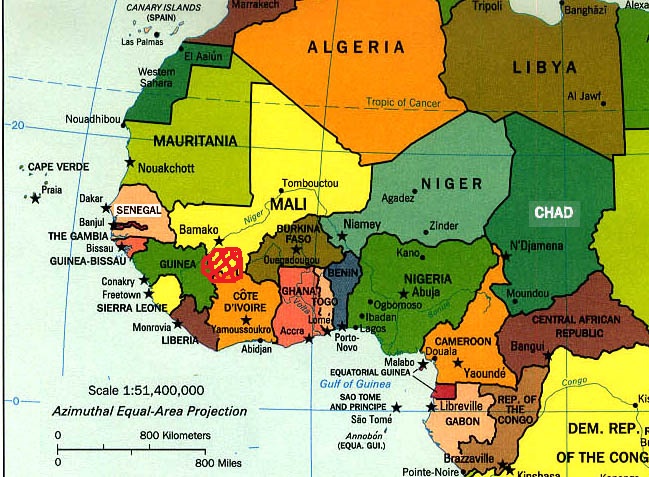
My intent is not to write a review, but rather to build off Amselle’s work and present some of my efforts in blog form here at NOL. But first, a map of the region, Wasolon, that Amselle specializes in:
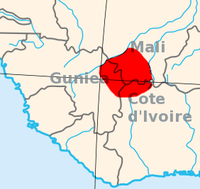
Wasolon is that big red marking that I’ve drawn on the map. You can see that it’s about as big as Sierra Leone. Just for clarity’s sake, here is a second map with a closer view of Wasolon:
Notice the rivers? source: wikipedia
Amselle’s argument for why his approach to identity is superior to others’ is convincing. He performed all of his fieldwork (15 years’ worth as of 1990) in Wasolon, or briefly in neighboring areas, reasoning that “research within numerous regions of a well-circumscribed area […] has allowed me to observe systems of transformation [in] societies that have been in contact for centuries. This has protected me from being forced into large analytical leaps and from engaging in [the current anthropological trends of] abstract comparativism and the identification of structures (xii-xiii).” This defense of his methodology, coupled with his insights on French colonial administration in the late 19th and early 20th centuries, gives me reason to believe that Amselle’s work is an excellent blueprint for better understanding the complete and utter failure of post-colonial states and the violence these collective failures have produced.
I want to take a specific route using the introductory quote, even though I could take a number of different routes using that passage. I could, for example, focus on the invention of the individual and muse about its consequences in regards to the rise of the West. I could go on and on about how other societies had writing – but not the individual- and therefore did not have the institutions necessary for “capitalism” that the West did around the 16th century. Et cetera, et cetera. Instead, I’m going to take a geopolitical route (the West is still practicing colonialism) that has a decidedly philosophical direction to it (nationalism and ethno-nationalism are both bullhooey).
First, the geopolitical context. Wasolon was basically a war zone in the 18th and 19th centuries. It was an important producer of cotton, a minor producer of rubber and ivory, and a net exporter of slaves. Wasolon was unfortunate enough to be caught between Saharan empires backed by Arabic culture, money, and technology, and coastal empires recently enriched through cultural, economic, and technological exchange with rapidly-expanding European populations. Caught between these two geographic poles, polities in Wasolon oscillated between being decentralized chiefdoms, small independent states, empire builders themselves, and vassals of empires. In such an uncertain setting, the identity of people themselves necessarily oscillated as often as their political systems did.
When the French arrived militarily on the scene (there was already a long history of economic, political, and cultural exchange between the “French” and Wasolonians; I put French in quotation marks because, of course, many Europeans found it to be much easier to use “French” as an identity in French Sudan rather than their own), Wasolon was home to many decentralized chiefdoms, and they were all in the midst of a protracted and brutal war with the Samori Empire, a Saharan polity that rose quickly and ruthlessly to prominence in the late 19th century.
The Samori Empire – which the French military was in contact with due to its centralized political structure (it had a bureaucracy and an organized military, for example) – claimed Wasolon as a vassal state and the French, out of ignorance or expediency (to attribute it to malice gives French central planners too much credit), simply took Samori at its word (a policy that continues to play out to this day in international affairs, but more on this below).
The French military commanders and, later, colonial administrators eventually figured out that Wasolon was not a loyal vassal. From the French perspective, the resisting chiefdoms in Wasolon had formed an alliance against the Samori Empire, and this alliance was based on an ethnic solidarity shared by all Fulani. Amselle labors to make the point that this alliance was based on a “mythical charter” long prominent in Fula oral traditions (and has some basis in the historical accounts of Arab and European travelers). This “mythical charter” served as the basis for the French colonial understanding of the Fula and eventually for the notion of a Fulani ethnic identity. The problem here is that the “mythical charter” was just that: a myth.
As we saw in Chap. 5, colonial ethnology merely reproduces this local political theory by taking it literally, thereby assimilating these “mythical charters” to a real historical process. Such a reproduction is what makes this ethnology truly colonial. (179)
In the Chapter 5 that Amselle alludes to in his footnotes, Mestizo Logics explains how the Fula people of Wasolon adopted fluid political identities over the centuries, depending on who was in power and who was about to be in power. This fluidity played, and continues to play, a much more important role in how people identified themselves politically (“local political theory”) than either culture or language.
Amselle illustrates this point best by pointing out that a number of chiefdoms in Wasolon claimed to be Fula at the time of the French conquests in the late 19th century, but that the populations spoke a different language than the Fula and were culturally distinct from the Fula (these Wasolon chiefdoms claiming Fulaniship were Banmana and Maninka in language and culture rather than Fula). Amselle then points out that Fula chiefdoms existed outside of Wasolon that don’t claim to be Fula – even though they are culturally and linguistically Fula – and instead identified as something more politically expedient (he doesn’t elaborate on what those non-Fula Fulani identify as, only that they did, and still do).
The French state’s act of writing down and categorizing this “mythical charter” as a distinct feature of Wasolon’s Fulani thus created the Fula ethnic group and, through imperial governance, ensconced this new group into its empire’s hierarchy based on traits that ethnographers, colonial administrators, historians, and managers of state-run corporations had recorded (accounts written by merchants not connected to the state in some way could not be trusted, of course).
Basically, when the French showed up to build their empire in west Africa they bought the narrative espoused by a couple of the factions in the region and based their empire (which was only feasible with the advent of peace in Europe after the Napoleonic Wars) on that narrative. The results of this policy are eye-opening. Aside from the fact that the present-day states of Mali, Cote d’Ivoire, and Guinea are failures, the old rules of fluid identity used by Wasolonians for political and economic reasons were erased and new rules, based on bureaucratic logic (“ethnicity”), were wrested into place by the French imperial apparatus. These new ethnic identities soon took on characteristics, ascribed to them by others, that quickly became stereotypes. The ethnic groups with good stereotypes (like being hard-working) ended up – you guessed it – in positions of power, first in France’s imperial apparatus and then for a short time after independence.
Sound familiar?
If it doesn’t, think about international governing institutions (IGOs) like the United Nations or the World Bank for a moment. Why don’t these institutions recognize the likes of Kurdistan, Baluchistan, or South Ossetia? Is it because these IGOs are evil and oppressive, or simply because these bureaucracies cannot adapt quickly enough to a world where identity and the necessities of political economies are always in flux?
This phenomenon is not limited to post-colonial Africa, either. Think about African-Americans here in the United States and the stereotypes attributed to them. Those stereotypes – good and bad – are a direct result of bureaucracy.
Individualism, to me, is the best way to tackle the long-standing problem created by colonial logic abroad, and racism at home. Government programs that seek to help groups by taking from one and giving to another are just an extension of the bureaucratic logic revealed by Amselle’s work in French West Africa. But what is a good way to go about implementing a more individualized world? Open borders?Federation?
Sheng [Hong] uses the term in this broader sense, so that we can say that tianxia zhuyi is the idea of a global civilization that encompasses a diversity of cultures. In fact, this interpretation matches with the historical evolution of the Chinese empire, which was a multiethnic body politic based on certain universal civilizational principles and artifacts such as the Chinese script.
It is essential why Sheng makes that distinction. He claims that globalism, which he considers to be a Western term, is actually violating basic principles of economic liberalism in opting for trade liberalization but containing international migration.
That is from Carsten Herrmann-Pillath, a Professor of Business Economics at the Frankfurt School of Finance and Management, in a chapter titled “Smith, Confucius and the Rise of China.” The chapter is in Volume 8 of The Adam Smith Review, edited by Fonna Forman, which in turn was a gift from Edwin to me. There is no mention of Mises or Hayek (or NOL!) in the bibliography. Herrmann-Pillath continues:
So, globalism is a conceptual framework which still builds on the conception of the nation state and hence economic nationalism […] Ideas about the transition from the ‘nation state’ to a new political order based on culture and civilization continue to flourish among Chinese intellectuals until today. (88)
Unlike Chhay Lin and Matthew, I don’t know very much about ancient or medieval Chinese political thought, but I can buy Sheng’s argument. In fact, I’m surprised it has taken this long for scholars anywhere in the world to realize that certain schools of thought in an empire would be internationalist. What is more curious to me, though, is this “new political order based on culture and civilization.” Why not base it on the individual? It seems to me that basing political orders on hard-to-define terms like “culture” and “civilization” will only lead to major problems, such as cultural chauvinism, down the road.
How do the United States and others achieve victory against Islamic State without empowering sectarian actors who will seek to poison the reconciliation that Iraq needs to hang together?
That’s the question posed by Craig Whiteside, an associate Professor of Theater Security Decision Making for the Naval War College at the Naval Postgraduate School, over at War on the Rocks. Dr Whiteside’s recommendations (“avoid all cooperation with sectarian militias, continue to target Islamic State with minimal collateral damage, patiently train and equip the security forces, ensure it’s done by Iraqis with subtle, behind the scenes help”) are just what you’d expect from a military strategist with a PhD, but his question highlights well what’s wrong with current thinking on non-state actors in Washington and also explains why central planning fails in areas other than managing an economy.
Whiteside’s line of thought is pretty standard, and it goes something like this: Islamic State is bad and Iraq is good. Islamic State is bad not because it lawlessly slaughters more people than Iraq (obviously not true, especially when you account for the Hussein regime), but because it is a non-state actor with political, economic, cultural, and military capabilities that threaten the existence of state actors. Hence his worry over how to defeat Islamic State while still keeping Iraq in one piece.
This is a terrible way to think about international relations and strategy, and it governs the logic of the republic’s finest thinkers.
Why not think about the situation in the Levant in the following way instead:
There is a “world order” of sorts that is composed of states. The states themselves have been patched together over the course of centuries. The world order itself has been patched together over the course of centuries.
Iraq is a state that was patched together by the UK and France, in accordance with the logic of the world order at the time. Thus, Iraq was able to become a legitimate member of organizations like the UN, FIFA, OPEC, etc. However, because Iraq was patched together by the world order rather than by the people of Iraq (acting through contentious factions), it can only, ever “hang together” under a regime governed by a strong man.
The appearance of Islamic State in what is now Iraq is just an attempt by Iraqis to govern themselves. Islamic State is an attempt, made possible by the power vacuum left by the invasion and occupation of the US and its allies, to join the world order (hence the “state” in Islamic State). It’s a horrible attempt, which is just what you’d expect from a people who have likely never had a chance to experiment in self-governance. Nevertheless, people in what is now Iraq are trying to patch together their own states.
The world order should recognize these attempts instead of trying to maintain the status quo. Change can be a good thing. As an example, just compare the brutality of the Hussein regime, a legitimate state actor, with that of Islamic State. It’s not even a contest, especially in terms of people murdered.
Wouldn’t recognizing Whitehead’s “sectarian actors,” instead of seeking to isolate or destroy them, be a much better avenue to peace and prosperity in the region? Recognition by the world order, haphazardly and pragmatically patched together itself, would bestow responsibility onto non-state actors. It would signal a trust in the ability of Iraqis to govern themselves. It would help to rationalize diplomacy and trade in the region. And it would put an end to the vicious cycle of strong men in the Middle East.
Instead of asking what the US and its allies can do to eliminate violent non-state actors from the region, isn’t it time to start asking what the West can do, as equal partners, to facilitate more self-governance in the Levant?
That central planning suffers from a knowledge problem is a given in many elite economics circles today (even economists at the Federal Reserve recognize it), but I don’t think this argument has extended into other fields of thought or other bureaucracies yet. A fatal conceit indeed.
Has there ever been a Holocaust in the Middle East?
Pogroms were an annual affair in Russia, and we all know how much Christian Spain loved its Jews. The Holocaust was horrific.
I also realize that anti-Semitism is rampant in the Middle East. Some of this is because of Israel, and some may be because some imams interpret the Koran to be anti-Semitic, but there’s never been any kind of mass murder committed by Muslims against Jews in the Middle East on the scale that has occurred in the West.
Is this because the West was industrialized and therefore had better access to technology with which to kill large amounts of people? Is it because the structure of states in the West made it easier to run roughshod over the liberties of minorities? These are the only two explanations that I can think of that make any sense. The second of the two possibilities seems like an especially weak option, given the amount of carnage post-colonial states have managed to produce (though, in a paradox, it is often minorities that do the killing and oppressing in these post-colonial states, rather than majorities; maybe this helps to explain why there has never been a Holocaust in the Middle East…).
The first possibility is reasonable enough, but since most of the states in the Middle East that are rich enough to “test” this hypothesis have expelled the Jews from their territories, it’s virtually impossible to know.
I am simplifying things here, I realize. I want to give this much more thought (and I have been), but I think that, given the toxic climate in the public sphere concerning Islam, it’s important to point out the obvious.
That’s the title of this short piece by yours truly. Please take a look and leave me some feedback. I am turning it into a longer essay that I hope to shop around once it’s complete.
I’m glad you highlighted the Ilya Somin/Will Wilkinson debate [here – bc], but I just found the whole thing so damn confused. I’m not a libertarian (or an Objectivist) but I ended up leaning more toward Somin than toward Wilkinson. But the real problem is that the terms “moderation” and “extremism” are left undefined throughout. Extremism in the pursuit of clarity is no vice, and moderation in the pursuit of muddle is no virtue.
In that respect, at least, I think Ayn Rand’s analysis of “extremism” makes more sense than anything that either Somin or Wilkinson are saying. As she puts it, “‘extremism’ is a term which, standing by itself, has no meaning. The concept of ‘extreme’ denotes a relation, a measurement, a degree….It is obvious that the first question one has to ask, before using that term, is: a degree–of what?…Measurements, as such, have no value-significance–and acquire it only from the nature of that which is being measured” (Rand, Capitalism, pp. 196-97). The nature of what’s being measured is the one thing that neither Somin nor Wilkinson discuss (though Somin certainly comes closer). Which is why the debate they’ve having is relatively pointless.
Wilkinson treats his youthful encounter with Ayn Rand as nothing more than that. If he took a closer look at what she said, I think he’d find that there’s more there than he remembers.
That’s from the infamous Dr Khawaja, who does his blogging at the always excellent Policy of Truth group blog. You can find a link to Rand’s Capitalismhere. I think Dr Khawaja is wrong to suggest that this debate is relatively pointless, though, at least to libertarians who care about electoral politics. I do agree with him that Wilkinson should revisit his familiarity with Rand’s work, though.
Many of you already know that two of NOL‘s Senior Editors are associated with Econ Journal Watch, thus making its publication a family affair. Fred is on the editorial board and Warren is its math reader. Here are some of the highlights I found worth noting in the latest issue:
Eli Heckscher’s Ideological Migration Toward Market Liberalism: Benny Carlson explores the intellectual evolution of a great Swedish economist.
Symposium: Classical Liberalism in Econ, by Country: Authors from around the world tell us about their country’s culture of political economy, in particular the vitality of liberalism in the original political sense, historically and currently, with special attention to professional economics as practiced in academia, think tanks, and intellectual networks.
The latest issue of Reason Papers, vol. 37, number 2 is now out; officially, it’s the Fall 2015 issue, but we only just managed to put it up on the website last night. This link will take you to a monster-size PDF to the whole issue (almost 250 pages). This link will take you to the journal’s Archive page, where you can access individual articles for this or any past issue (you have to scroll down a bit). Finally, this link will take you to three (time sensitive) Calls for Papers issued by the journal’s editors: one on “the philosophy of play” (March 1, 2016); one a fifteen-year retrospective on 9/11 (July 1, 2016); and one an Authors-Meet-Critics symposium on Douglas Den Uyl and Douglas Rasmussen’s forthcoming book The Perfectionist Turn: From Meta-Norms to Meta-Ethics (February 1, 2017).
My own small contribution to Reason Papers can be found here (pdf).
“[S]overeignty is a constitutional idea of the rights and duties of the governments and citizens or subjects of particular states.”
To me, a constitution is like a contract. It’s close to set in stone and it lays out these rights and duties. But the idea of sovereignty Jackson is pointing toward in that quote would be better understood as laying out a sort of meta-prize; it’s a delineation of the commons that potential groups within that area may compete over or cooperate in. To be fair, a constitution is a similar sort of commons (especially when that constitution includes the right to collect tax and lead armies). The question of how to govern the commons is *the* question on the domestic side.
On the international end of things, anarcho-capitalism calls for muddying the borders of these commons. This has obvious costs and benefits: it makes the emergence of a productive polycentric order easier, but it also opens access to what would have been relatively closed commons. I think the missing piece in the world governance question, whether from a classical liberal, minarchist, or anarchist perspective is the question of how a polycentric order would emerge and function (e.g. standards associations, norms of arbitration/dispute resolution, etc.).
Sean McFate, a political scientist at National Defense University in Washington, DC, has a fascinating article in Aeon about the reemergence of mercenary and quasi-mercenary security firms throughout the world. The whole article is fulfilling throughout, especially if you’re a well-read anarchist or a history buff, but I wanted to highlight this tangent:
With the fall of the South African apartheid regime, unemployed soldiers from special forces units such as the 32nd Battalion and the Koevoet (‘crowbar’ in Afrikaans) special police formed the first modern private military company, appropriately named Executive Outcomes. Unlike WatchGuard, Executive Outcomes was not a military enterpriser but a true mercenary firm, waging war for the highest bidder. It operated in Angola, Mozambique, Uganda and Kenya. It offered to help stop the genocide in Rwanda in 1994, but Kofi Annan – then head of UN peacekeeping – refused, claiming ‘the world may not be ready to privatise peace’. Annan’s was an expensive ideology, given the fact that 800,000 people died. By 1998, the company closed its doors, but the mercenary market for force surged.
Two aspects are important here, one said and one unsaid. First, the unsaid. If this mercenary outfit was “waging war for the highest bidder,” why did it offer to go in to Rwanda to stop the bloodshed? I think scholars assume the worst when it comes to stateless actors and warfare. Why has Anheuser-Busch begun shipping free cans of water into Flint, MI?Why does Wal-Mart donate billions of dollars to charity? When it comes to reputation, costs may sometimes not make sense to outside observers who don’t have a sufficient understanding of benefits. Why on earth would a corporation built solely to wage war for the highest bidder be interested in offering its services to a country that would not be able to afford its services? To ask the question is to answer it, of course, but understanding incentives using a costs-benefits framework requires more effort than you might suspect.
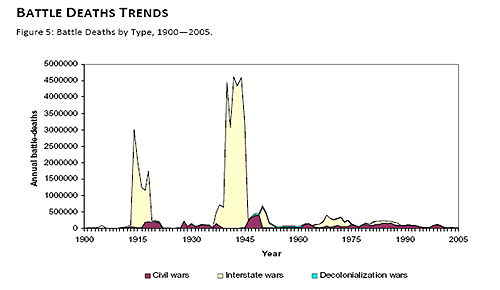
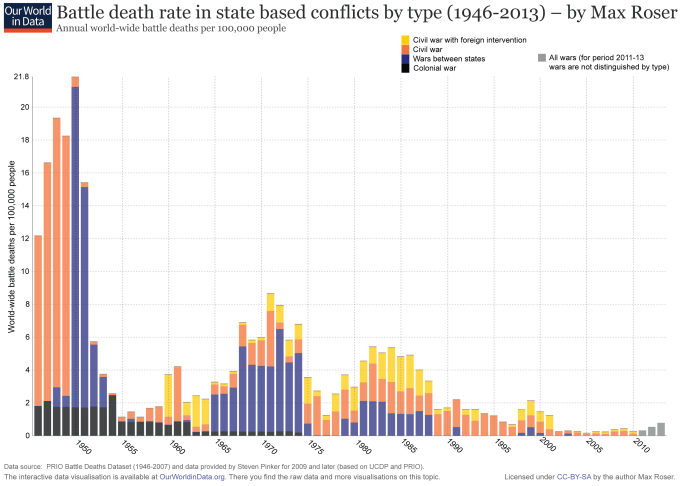
There is simply no logical coherence to the idea that, in a world where stateless mercenary firms are the prominent form of security, violence and lawlessness will reign supreme; nor is there any evidence whatsoever to suggest that “[m]ore mercenaries means more war, as they are incentivised to start and expand wars for profit, and turn to criminality between contracts.” Indeed, as McFate notes in his excellent article, the market for security is already becoming freer and while he ends his piece on a depressing note, lamenting this indisputable fact of the present-day world, I couldn’t help but remember the now-famous graph on battle death trends produced by political scientist Jay Ulfelder (using data from the Uppsala Conflict Data Program [UCDP]), which illustrates nicely the overall decline in deaths due to warfare violence around the world:
Notice that the most deadly conflicts are the ones involving states with armies that had been nationalized?
Now, two graphs showing that deaths from warfare have been in decline for half a century does not necessarily mean that a freer market in security services has led directly to this overwhelmingly good news. I am confident in claiming, though, that the freeing up of security services markets, combined with the steady presence of a few, still-powerful nationalized armies has led to a reduction in war-related deaths (and violent conflict in general). Both graphs illustrate well what happens when there are too many nationalized armies vying for power and prestige. (It is worth noting here that the main goal of diplomats and policymakers everywhere, no matter their ideological orientation or citizenship status, is still to avoid another world war.)
Second, the said. Annan’s refusal to decriminalize mercenary activities led directly to the 800,000 Rwandan deaths. How is this moral failing any better than when a mercenary firm breaks its contract and ends up killing a few dozen more people than it was supposed to? Again, the graphs are useful here: When conflict is nationalized, everybody suffers; when it is privatized, atrocities happen but not on the same scale we have seen with nationalized conflicts. It’s not even close. Annan’s short-sightedness reminds me of economist Scott Sumner’s 2012 summary of Hillary Clinton’s view of the War on Drugs:
[…] in response to a final question on drugs (from a Latin American reporter), she said drug legalization would do no good because drug dealers are really bad people, and they would simply do other crimes. No discussion of how America’s murder rate fell in half after alcohol was legalized in 1933.
Like drug use, the privatization of security services causes many people, well-educated or otherwise, to bristle at the notion without quite thinking through its logical implications. While ugly, mercenary firms are far more efficient and effective at quelling “bush wars” than are nationalized armies and, in turn, mercenary outfits are far less capable of sowing the type of destruction that nationalized armies routinely carry out.
I don’t think that a world with a few nationalized armies and an abundance of mercenary firms is necessarily the best option going forward, though. It is, however, a better option than most scholars and analysts give it credit for. In fact, it’s the best option at the moment, and while the status quo may sometimes be ugly, remember the graphs. Privatization of security services has contributed, at least in part, to a more peaceful and less violent world.
In order to move forward from this status quo it is best not lament the way things are going, but to acknowledge that things are the way they are for a reason, and then look for avenues to alter the status quo without falling back on a blanket policy like nationalizing security services again. The horrors of the World Wars should still be fresh in our minds, and the horrors of those wars were enabled and encouraged by nationalized security forces.
The best way to move forward is by looking at where these “bush wars” are taking place and begin thinking about ways to incorporate these regions into the global order (such as it is). This policy represents a departure from traditional post-war thinking about international relations, but it doesn’t make it radical or unfeasible. Indeed, there is a long tradition of republican thinking in Western thought pertaining to international relations. The West needs to start recognizing the legitimacy of secessionist sentiments in the post-colonial world, even if it means friction with Russia and China.
Washington and Brussels will have to endure charges of hypocrisy when it comes to ignoring the lobbying efforts of places like Tibet and Dagestan, but Biafra should have become a member state of the United Nations long ago. Baluchistan should have access independent of Pakistan and Iran to the IMF and World Bank. Two or three soccer teams from the region known as Kurdistan could easily be present in all major FIFA tournaments. Examples abound throughout the world. The West should also be open to recognizing arguments made by Russia and China for the independence of regions. There is no good reason why Western diplomats should ignore Moscow’s recognition of places like South Ossetia and Donetsk; doing so only hardens Russia’s stance on recognizing secession in parts of the world where its influence is limited or non-existent and forces the West into bed with unsavory post-socialist regimes.
The West needs to start being more inclusive when it comes to its own federal and republican institutions, too. Morocco, for example, should have had its 1987 application to join the European Union taken seriously (same goes for Turkey). The US federation needs to be actively courting polities like Puerto Rico, Coahuila, Alberta, and Micronesia to join the union. Both the EU and US are contracts designed to dampen violent conflict by fostering diplomatic, economic, and cultural intercourse between provincial polities. The reasoning behind exclusionary policies simply doesn’t answer why these republican, supranational organizations should not be actively recruiting neighboring or geopolitically useful administrative units into their representative systems.
Without this change in mindset the status quo will continue, which again if we remember the graphs is not all that bad, but something worse may happen: There could be a reversion to the blanket nationalization of security services that we saw during World Wars I and II.
 Notes On Liberty