A History of Regional Governments (Part 1)

Cities have historically been compact hyper-dense communities. This is because cities have been constrained in size by the average resident’s capacity to reasonably travel throughout the city within a day. Cities built before the dawn of the automobile are often noted for being walkable. It is doubtful that the walkability of these cities is due to any planned attempt to make them so as the urban planning profession is a relatively new discipline. Rather older cities are walkable because they had to be. For most of history the average man could only travel as far as his own legs could take him. Horses and other beasts of burden substantially increased one’s travel range, but even up to the 19th century ownership of such beasts was beyond the reach of the every man. Any real estate developer who attempted to build outside a city’s natural growth boundary would as such find it difficult to attract the necessary foot traffic to make his endeavor economically feasible.

This constraint in outward growth also led to older cities being easily dominated by a single local authority. This changed with the creation of the automobile. As noted above, a beast of burden was already capable of extending the effective range of their owner. The automobile similarly would have done little to influence the growth of cities if it were inaccessible to the average man. What made the automobile such a game changer to the future of cities was that it was within the reach of the average man’s finances.  In their early days, as in our own, automobiles presented a serious financial investment but were nonetheless cheap enough to afford.

With the advent of the economic automobile the general public was no longer constrained to the urban core. Attracted by cheap land prices in the periphery an increasing portion of the city settled in the periphery region – the so called suburbs. The development of suburbs had several immediate effects, but of interest to us is its effect on local government. At first cities attempted to annex the suburb regions but it was not before long that some suburbs rejected annexation. One of the first such cases was in when Brookline, a wealthy suburb of Boston, rejected annexation in the late 19th century. Even some suburbs which originally agreed to annexation changed their minds and fought to regain their independence.

Suburb residents had been driven to migrate from the cities in search for cheap housing, but they also valued their new found independence from urban politics.  Many suburbs elected to instead incorporate as cities by their own right. Despite their political independence the suburbs remained economically tied to the mother cities. It did not take long for the limits of this style of organization to be realized. In the greater New York metropolitan area New York and New Jersey local governments found themselves unable to settle basic questions regarding their common port. Meanwhile in Los Angeles the various local governments were unable to efficiently synchronize their electric current systems. Los Angeles proper synchronized its electrical system with the rest of the nation in 1936 but the rest of the metro didn’t make the switch for another twelve years. In greater Boston the suburbs found themselves unable to provide for quality running water and other basic utilities. These problems only increased as population growth increasingly favored suburbs and urban sprawl intensified.

Early reformers suggested the creation of a new layer of government, between state and local government, which would preserve the independence of the suburbs whilst creating a central authority capable of providing for regional needs.  Attempts to create regional governments were retarded by the actions of local governments who jealously guarded their own powers. It is unclear what would have happened if things would have been allowed to play out without federal intervention.

It was at the height of the New Deal era that the modern regional government was born. The Roosevelt administration began to encourage regions to form councils of government and other regional government associations if they wished preferential federal aid. The Truman and Eisenhower administrations codified this policy with the Housing Act of 1949 and 1954 respectively. Section 701 of the 1954 Housing Act in particular would serve as the benchmark for years to come in promoting the creation of regional governments. As a result of these actions almost one hundred regional governments were formed. The regional governments formed tended to be in name only. Local governments agreed to their formation in order to secure federal funding but granted their regional counterparts little actual control in day to day affairs. Regional governments were relegated to providing technical advice to local government and to aiding state government with paperwork, but were unable to pursue their own objectives. Meanwhile the growth of the suburbs continued strong, aided in part due to the return of WW2 veterans and the preferential mortgage packages offered to them.

The federal government attempted to bolster the strength of regional governments with the passage of the Highway Act of 1962. Thus far federal legislation had merely given preferential treatment in aid allocations towards regional governments. The Highway Act of 1962 made federal aid contingent on having areas with a population greater than 50,000 create a regional development plan. In practice the act gave regional governments little power as the language was broad enough to allow state and local governments to circumvent them. Once more regional governments found themselves with little teeth and better termed advisory bodies.
Epstein on Rand Paul’s foreign policy views

Published a while ago, still a good read: “Rand Paul’s Fatal Pacifism.”

Around the Web

  1. Contrary to popular myth, Democrats are just as ideological as Republicans, and Republicans are just as group-centric Democrats
  2. The Rule of Karlowitz: Fiscal Change and Institutional Persistence (pdf)
  3. The Privilege of Checking White Privilege
  4. The Wealth of Subnations: Geography, Institutions, and Within-Country Development (pdf) (h/t Adrián)
  5. Shakespeare in Tehran “I also noticed among the men a few who stood apart and did not seem to be either students or faculty. It was not difficult to imagine who these might be.”
  6. The new economic history of Africa (pdf)

Which MPOs are most efficient?

I have been working on a project to measure the efficiency of Metropolitan Planning Organizations (MPOs). MPOs are one of the levels of government often forgotten. When we think of government we usually think of federal, state and local government. MPOs lay between local and state government. My local MPO for example, the Southern California Association of Governments (SCAG) for example covers all of the southern Californian counties except for San Diego. Other MPOs, such as the Delaware Valley Region Planning Commission, cross over several states. Nominally MPOs are concerned with setting transportation policy, but in effect they have broad powers over many areas of regional economic development.

Most MPOs have no elected leadership and instead either appoint their own heads or draw from their constituent members. By no means am I a little ‘d’ democrat; I do not see much value in democracy to decide public policy. It is however concerning that these form of government have little oversight over them of any sort. My hope is that my work will provide much needed information on how well (or badly) these MPOs are doing their jobs.

I am attempt to rank MPOs on two basis: transportation services and air quality. Below is a ranking of the top 77 largest metro regions by their adjusted cost efficiency for providing transit services. I used metropolitan level data from 1991 to 2011 to construct these figures. By adjusted I mean that I attempted to take into account for factors that affect their cost efficiency, namely level of federal funding which is negatively associated with cost efficiency. I hope to be able to better calculate these figures in the future taking into account spatial factors that affect efficiency, but I have to start somewhere right?

1. Raleigh
2. Virginia Beach
3. Honolulu
4. El Paso
5. Orlando
6. Wichita
7. Memphis
8. Baton Rogue
9. Cincinnati
10. Indianapolis

….

70. Bridgeport
71. Akron
72. Seattle
73. Albuquerque
74. Knoxville
75. Worcester
75. Dallas
76. San Jose
77. McAllen

The full ranking can be found here: Efficiency Residual.

Thoughts?

Liberty and Homer

The ‘Expanding the Liberty Canon’ label is not adequate for some texts that ought to be discussed with regard to liberty, since they have something important to say about liberty, but even on an expanded inclusive definition cannot be said to put forward a case for liberty, certainly  not from the perspectives of classical liberalism, libertarianism, the liberty movement, or any other label for thinking which favours liberty understood as individual rights, markets, voluntary association, and rule of law over communalism, collectively directed distribution, state domination of society, and administrative rules.

I have plenty of further texts to discuss under the ‘Expanding the Liberty Canon’ heading, but here is a beginning to the ‘Liberty and…’ sequence. It is an appropriate starting point in that the epic poems associated with the name of Homer, The Iliad and The Odyssey are at the very beginning of European literature, culture, and knowledge. This is not say that there is pure beginning to Europe’s cultural and intellectual heritage with no precursors and no outside influence. It is to say that these are the first big texts in the history of anything that can be labelled European history. The name ‘Homer’ conceals considerable uncertainty about whether these poems have a single author and if so who.  What can be safely said is that these are long poems written down in approximately 800 BCE, drawing on a long oral tradition of sung poetry, referring to a world of Mycenaean late Bronze Age Greeks, who traded with and fought with the peoples of Anatolia, in a civilisation that disappears from the archaeological record in about 1 100 BCE.

On the side of Homer not being a hero of liberty is the apparent endorsement of a world where war and piracy have greater respect than trade and manufacture, the greatest role for a man is to defeat enemy armies and sack their cities, women’s role is to stay at home, do a lot of weaving, and obey their husband. Political authority is patriarchal-monarchical, based on the claim that kings are warrior-hero aristocrats are close to the gods. Ordinary people are deprived of choices and influence, subordinated to the hero-aristocrat class and may even be slaves. In The Iliad, a league of Greek kings lays siege to Troy for ten years, purely for reasons of honour connected with a Trojan Prince taking a Greek queen from her husband back to Troy. The violent destruction on enemy cities, the enslavement and murder of civilians, the organised theft of property are all part of the value system of Greeks and Trojans. In The Odyssey after various adventures on the way back from Troy, Odysseus massacres a group of aristocrats who have been trying to marry his wife during the twenty years of his absence, living in his palace using up the wealth, and follows this up with a massacre of those servant women who were too friendly with the massacred men.

So where does liberty come into this world of violence and traditionalist authority? One part of the answer to this question is that maybe the Homeric epics are critical of this world, at least in some part. The exploration of where there might be a critical distance in the Homeric poetry from the most disturbing aspects of the world it depicts gets into much detailed and questions of ambiguity to pursue here, but is something to bear in mind when reading Homer. Leaving that aside, there is the underlying issue of the formation of a world of poetic creation, which in some degree must be distant from and reflect on a world, so raising the possibility of individual critical perspectives.

Anyway, even staying at the level of the more direct and literal meaning, it portrays different possibilities of individual character and ways of being. In The Iliad we are see Achilles the proud angry warrior who lives to become the hero of song, even if that means dying young. His devotion to violence co-exists with a belief that he has rights as an individual against his overlord, a passionate devotion to his best friend, a capacity to overcome his angry nature when he allows the father of the Trojan hero, Hector, who killed his friend to take the body for honourable burial.

Hector himself has a near Achilles level of ‘heroic’ violence combined with a deep and self-effacing attachment to his wife and child. Many other possibilities of human individuality are explored including that of the most intelligent and cunning of the Greek leaders, Odysseus, who understands that war is won by stratagems as well as devotion to violence. This man of reflection, forethought and an early form of the life of the mind, becomes the centre of the second Homeric epic, The Odyssey, which recounts the ten years of his journey back from Troy to his homeland of Ithaca.

Odysseus starts back with his own fleet of ships carrying an army of Ithaca, by the time he gets back to Ithaca all of this is lost, and he is alone, in disguise playing the part of a vagabond when he arrives on his home island. Early in his adventures he described himself as No-man to trick his way out of danger from the giant Polyphemus and then proudly shouts his real name at the giant on his escape. This is at the base of his ten year journey since the god Poseidon is the father of  Polyphemus and takes revenge on Odysseus when Polyphemus can tell his father how Odysseus harmed him. Again and again Odysseus has to struggle with his own impulses and with the need to play a part, stretching his identity, in order to return to his island kingdom. So he is growing as an individual, exploring all the possibilities of individuality, including self-concealment, self-invention, and self-transformation.

The extreme violence of the return of Odysseus is followed by the brief description of a new beginning in Ithaca, an order of social peace in which a possible cycle of revenge is pre-empted through oaths and the prospect of justice settling differences rather than violence. This reconciling ending of The Odyssey itself builds on the sombre peace at the end of The Iliad, when a truce is agreed so that the city of Troy can bury and mourn its hero Hector, so that the values of peace and acknowledgement of individual suffering can stand up against the cycle of destructive violence.

In these and many other ways, Homeric epic offers much to stimulate thought about the nature of individuality and the kinds of social form which might allow individuals to flourish together, even in its depiction of the most destructive outcomes of human passions.

Mexican immigration and the Open Border: Mexicans Go Home and Mexican Kindness

I just returned from a two-plus weeks stay in Mexico for the second time in less than five months. A couple of comments to add to my previous essay on Mexican underdevelopment. Plus, some unrelated political sociology comments.

In 2009, my friend and I published a long piece on Mexican emigration to the US in the libertarian periodical The Independent Review. (Nikiforov and I are both immigrants to the United States.) The article is entitled, “If Mexicans and Americans Could Cross the Border Freely (pdf),” and the full text is available through a link on this blog. In that article, we argued that we would all be better off if the southern American border were open to crossing by citizens of both countries with no expectation of a change in citizenship for either.

Well, the politicians did not listen to us then and their inattention led to the recent Republican fiasco whereas, President Obama used an executive order to more or less legalize five million illegal aliens, most of them Mexicans whereas, the Republican Senate called him out and ended up caving piteously. (Do you remember or have you already forgotten? Stupidly, Republicans tried to use the threat to de-fund Homeland Security at a time when aggravated terrorism news fill the airwaves.) As often happens, the Republican leadership confused the issue of constitutional principle with the substantive issue of limiting immigration. Myself, I would chose total firmness on the first and flexibility on the second, for fear of ending up the A.H., no matter what the outcome. The Republican leadership lost the constitutional arm wrestling and still ended up the A. H. Congratulations, guys!

Our article was long and intricate as is normal for a scholarly piece. Here are two highlights from that piece on which I wish to comment after my two recent stays in Mexico:

A We argued that Mexicans – who constitute the largest immigrant group to the US – should be given special treatment over other aliens. Several reasons for this: They are our close neighbors; they have been joined to us through NAFTA for now 23 years, insuring that our lives are tightly enmeshed economically. Then, because of a long series of past interactions some may find deplorable, Mexicans tend to make very good immigrants. Two reasons for this superiority, in turn. First, nearly everyone agree that Mexicans (in the US) tend to be very hard workers. Even their direct competitors in the work place tend to assent to this judgment. Second, sociologically, Mexicans make good immigrants because they are astonishingly familiar with our society, including with our institutions, before they set foot on American soil. In particular, Mexicans don’t find perplexing our fundamental constitutional principle of separation of religion and government. (That’s, as opposed to immigrants from other areas I could name.)

Nikiforov and I argued that Mexican citizens should enjoy unimpeded passage into the US, and the freedom to take any job for which they qualify, all without any path to American citizenship because, Mexicans already have a citizenship, that of Mexico. We point out that the European Union has used this model for more than twenty years and experienced few downsides. (The current ferment in Europe about and opposition to immigration does not involve neighbors from the EU, with one single exception I will discuss if someone asks me.)

B We proposed that many Americans would find it comfortable to spend their last years in Mexico because of a specific aspect of Mexican culture, to wit, contemporary Mexicans tend to be sweet in general and considerate to older people in particular.

This is what I found in twice two and half weeks in Puerto Vallarta in the pas five months that is relevant to these issues.

First, on the matter of Mexicans wanting to work in the US but not necessarily wishing to live there, we were much more right than we thought when we wrote about this. The anecdotal evidence is overwhelming that this would work. Everywhere I went in Puerto Vallarta , I bumped into people who knew some English that they had learned in the US, mostly as illegal immigrants here working at undesirable jobs. None of those people had been expelled, deported. All had returned to Mexico under their own power after saving some money. Thus, they had chosen to go home because it’s home, just as we predicted in the article.

One middle-aged man sticks to my mind, a taxi driver. He had stayed in the US (illegally) for several years. He had refrained from visiting with his family in Mexico for stretches of two or three years at a time to avoid being unable to return to the US. You might say that he was trapped in the US for longer periods than he wished because of our immigration laws. He finally decided to go back to Mexico and to his family for good after he had saved enough money to build a house for each of his three daughters. He specified that only one of the daughters was of marriageable age by the time he had the three houses standing. To my mind, this is an exemplary story of emigration/immigration. On my query, the man declared himself satisfied with his choice and with his life since his return from the US.

He was earning, driving a taxi, about 1/5 or less of what he earned in the US doing unpleasant work. He liked his job; he enjoyed returning to his family every evening; he liked the schools; paradoxically, he liked Mexican schools. (This is paradoxical because daily life in Puerto Vallarta, including in the schools is much more relaxed, much more genteel than what prevails in the US except in the most elite neighborhoods. In that part of Mexico, the bloody drug traffic-based blood-thirsty banditry is found strictly in the newspapers. It is not at all apparent in daily life. The quality of this daily life is at the antipodes of the impression of Mexico reaching us through the US media. Gangs are not in the school unlike in Salinas, California, for example.)

On point B, the attractiveness of Mexico to older Americans, I find that I tend to censor myself anytime I write about the topic because I fear appearing to be gushing like a teenage girl. During my last stay, of two and half weeks, I did not meet a single Mexican man, woman or child who was not completely pleasant except two. One was a taxi driver and he was morose but, that’s because he was drunk. (Nobody is perfect.) The second was a female merchant who acted displeased because I tried to bargain down an item in which I was interested. Another merchant – from whom I actually bought and whom I befriended – told me later that my bargaining had been reasonable and that the woman was undergoing a painful divorce. Mexico is not perfect and I may have looked like the woman’s soon-to-be ex-husband. You never know; these things happen.

Absolutely everywhere, my gray beard drew the kind of respectful behavior I don’t expect in the US. (And that I don’t deserve, to be honest!)

I can hear the snickering from here: “Of course, he stays in a tourist ghetto were everyone is occupationally obligated to appear nice.” No, I did not spend all my time there; I was forced to go out and I liked to go out. I found that everyone smiles a lot, including at each other, even among perfect strangers, that everybody ceded passage, that waiting lines are always orderly. Being a formerly great social scientist, I yielded, of course, to the temptation to conduct verbal experiment. Unfailingly, I made everyone I wanted to laugh at the drop of a hat. I mean small children, old ladies and adults of all sexes. (Yes, my Spanish is that good. Eat your heart out or learn to conjugate irregular verbs! Those are your choices. There are no others.)

Issue A and B are joined in the strangest way within my latest short stay in Mexico. Puerto Vallarta in the winter is swarming with Canadians. Their flight from the cold may have a great deal to do with this fact but it has a virtuous side-effect. I suspect many flew in to warm up and ended up warmly loving Mexicans for the reasons I depicted above. They beat Americans at it, in that city, at least. Oh, and the only sullen faces around Puerto Vallarta all belong to them. It became a game of pop-sociology for me: guessing from afar who was American and who was Canadian. It soon become embarrassingly easy: The Americans are the loud ones who say hello and who laugh easily. (Besides, I think the presence of Canadians explains much of the bad food there.)

After this last experience, I am very tempted to start a new racist fad: Speaking ill of and persecuting Canadians. It could be fun and they are not (yet) a federally protected minority.

Whither the ‘Liberty Canon’ series, amongst other questions?

For those of you who have been wondering what happened to Dr Stocker’s posts here at NOL, the man has been busy:

Apologies for lack of blogging. Rather basic tasks, particularly very detailed note taking on Homer for a philosophy and literature class on Homer and Vico, are the main reason. Hopefully the immersion in Homer will pay off soon in blogging, research and writing, as well as teaching.

Anyway rather appropriately given my current preoccupation, I have very recently been offered a contract by Macmillan Palgrave to co-edit the Palgrave Handbook of Philosophy and Literature. It should be out in 2017, comprising a large number of essays on basic topics in philosophy and literature, with the editors contributing an apparatus of an introduction, conclusion, index and the like, along with an essay each.

The other editor is Michael Mack of the Department of English Studies, Durham University, UK. Do have a look at his university homepage and see details of his extensive and excellent contributions to philosophy and literature. I’m very fortunate that he has agreed to work with me on this project.

Back to Homer now. Blogging here again and getting on with other commitments soon.

Congrats are in order to Dr Stocker, though I have to say I’ll miss him while he’s working. Maybe when he’s done with his very serious work, I can convince him to blog not only about the history of thought in the Western world, but also to blog more often about domestic Turkish politics and liberal (i.e. libertarian) UK politics, and affairs in the Middle East (three more areas where his expertise is second to none; see here and here, for example). What do you say?

I know I state this often, but be sure to follow along in the ‘comments’ threads to some of our conversations. Unlike a lot of blogs, they’re of pretty high quality (if you ask me!).

I know Jacques just got back from Mexico, and Matthew is still trolling Europe (last I heard he was in Greece), so hopefully their travels will elicit some expert notes about the world.

Has Senator Rand Paul been reading NOL?

Oooo lawdy!

“Part of the problem is the Kurds aren’t getting enough arms,” Paul said. “The Kurds are the best fighters. The arms are going through Baghdad to get to the Kurds and they’re being siphoned off and they’re not getting what they need. I think any arms coming from us or coming from any European countries ought to go directly to the Kurds. They seem to be the most effective and most determined fighters.”

In addition, Paul called for giving the Kurds their own country for them to defend against radical Islamists.

“But I would go one step further: I would draw new lines for Kurdistan and I would promise them a country,” Paul said.

Cue the notes here at NOL on adhering to a more internationalist foreign policy: decentralization, secession, devolution, and federation. Notice that Paul is not calling for the US to draw up boundaries between imperial powers. He’s simply calling for the international community that the US largely built to recognize the sovereignty claims of peoples in the post-colonial world, peoples who were ignored when the imperial powers did their carving up over a century ago.

Which option sounds better to you: 1) ignoring the whole situation in the Middle East, 2) pretending that states in the Middle East are legitimate and continuing with the status quo (random bombing campaigns, giving money to dictators to squelch Islamists and socialists), or 3) recognizing that the US could contribute to a more internationalist world by welcoming aspirant regions into statehood, and destroying the legacies of colonialism and Third World nationalism?

Eye Candy: the GDP (PPP) per capita of OECD Administrative Units (UPDATED)

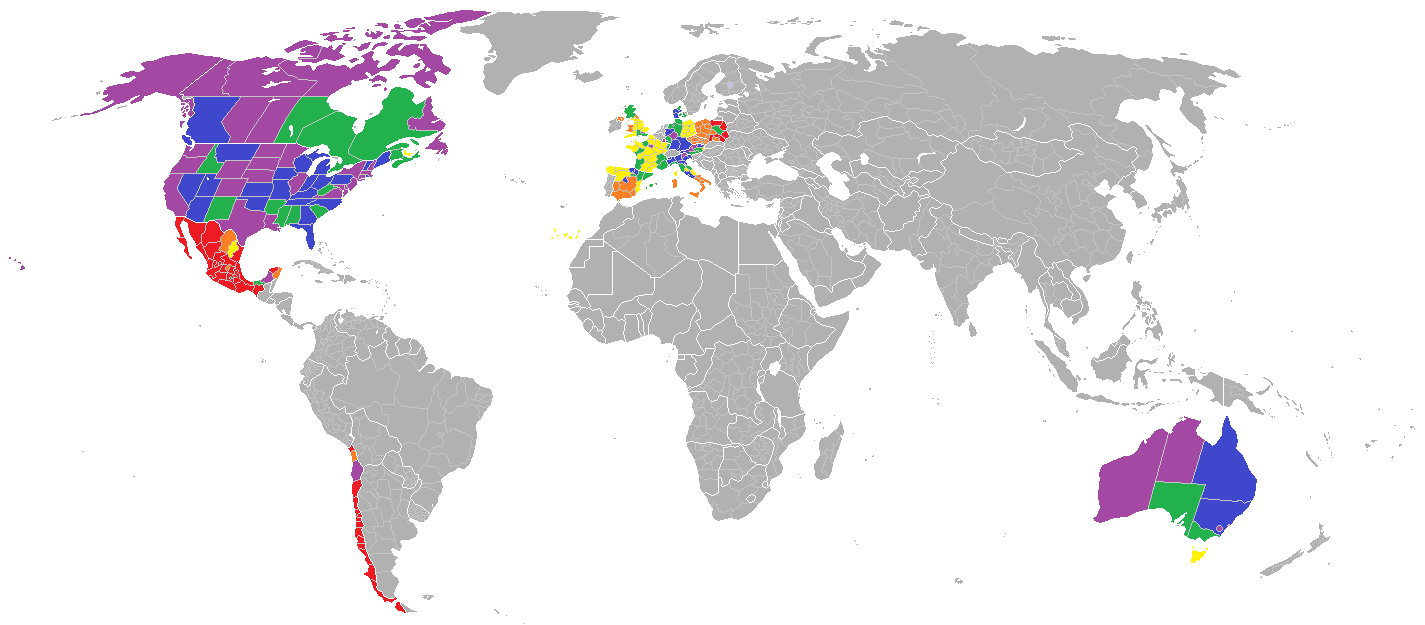
Here is what I was able to patch together in my free time.

The countries I’ve filled in were about half of the OECD. The data is hard to get on administrative units elsewhere in the world (I got my data from the OECD website), but it was also hard to get for OECD states. The reason it was hard is because OECD data collectors divide up administrative units into two separate categories (TL2 and TL3) that sometimes correlate to traditional administrative units (such as California or New South Wales) and are sometimes arbitrary creations of EU or OECD bureaucrats designed specifically for data collection (rather than for understanding the historical trajectory of regions within a state).

Does this make sense?

To make matters worse, sometimes the TL2 category correlated with an actual administrative unit with political representation in a capital, and sometimes the TL3 category was the actual administrative unit with political representation. So I had to thumb through the nitty-gritty details of how OECD states send representatives to central parliaments and then match those real-life details to the data collectors TL2 and TL3 categories.

Does this make sense?

The map above highlights the US, Canada, Australia, Germany, France, the UK, Spain, Poland, Austria, Italy, Czech Republic, Chile, Denmark, and Mexico. These countries are all TL2 states.* I have no idea what that is supposed to mean for data collectors, but it means to dorks like me that their TL2 categories send political representatives to capital cities, whereas their TL3 categories likely send political representatives to regional capitals.

Does this make sense?

I have continued entering the data that the OECD has provided for the GDP (PPP) per capita of TL3 units (which send political representatives to capital cities), but the map I downloaded does not outline TL3 units (it only outlines TL2 units). So unless I want to spend time carving out TL3 units onto a TL2 map I am going to have to stop filling out the map. I’m all for collaboration on this, of course.

Here is the table I have (very slowly) been working on, but when I colored in the map above (the TL2 states), I divided them up into six groups based on highest GDP (PPP) per capita to lowest. The richest administrative units were purple, followed by blue, followed by green, followed by yellow, followed by orange, followed by red. So: purple is rich, red is poor. Got it? Because I started adding the TL3 states to the table, and because the map doesn’t allow for me to add the TL3 states to it, I forgot the range of the colored TL2 units. Dividing them up into six groups is a pretty easy task, though, so you should just trust my coloring scheme.

The map I created doesn’t have a very good zoom-in function, but what I found interesting is that Europe has a lot more economic inequality than the US, Canada, and Australia. Look at France. It’s mostly yellow, and the only purple (rich) administrative unit is Paris metro. This suggests, of course, that wealth in France is concentrated in the capital. The UK looks just like France (as does Spain). Germany is divided in half (as is Italy), and Austria and Denmark are cool, rich colors. Canada and Australia only have one yellow province each, and the US has none. Mexico looks just as Michelangelo described it, and Chile looks like Spain.

This is the OECD page I’ve been using. Here’s how I find regional GDP (PPP) per capita:

  • select “Regions and Cities”
  • select “Large (TL2) and Small (TL3) regions” – remember it’s either/or here: either TL2 or TL3 but not both
  • select “regional GDP per capita”
  • Then for measures (top of table) select “per head, current prices, current PPP”

I’ve been using 2011.

This pdf lists the “territorial grids” (TL2 and TL3 regions) of the OECD. The pdf didn’t help me figure out which regions send political representatives to capital cities and which are arbitrary, bureaucratic creations (I got to do that on my own!), but lists can definitely be helpful. In many cases I was able to figure out which units are politically viable and which are arbitrary for data collecting purposes just by looking at the list.

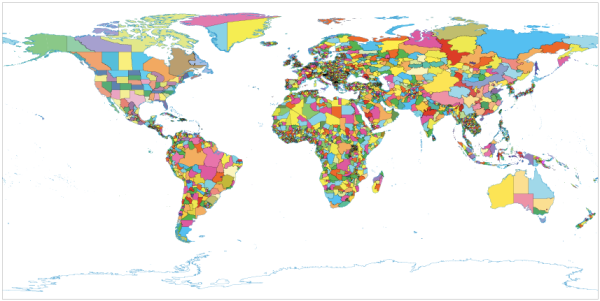
Finally, here is a map – courtesy of kelsocartography.com – of the world’s administrative units, at the TL2 level. Lots of work to do.

A good map of the world's administrative units
Here is a map of the world’s administrative units (courtesy of kelsocartography.com), but not necessarily the units that data collectors use to calculate GDP (PPP) per capita.

I like using the GDP (PPP) per capita of administrative units because I think it gives a much more stark picture of life around the world. I have pointed out before that the UK is now poorer than Mississippi, but breaking down the UK in the same manner as we do the US reveals that not only is the UK poorer than the poorest US state, the purchasing power parity of British citizens within the UK looks a lot more unequal than what we see in the United States. What is going on in the UK? The NHS can’t be that bad.

* – Oops, except for Denmark (it’s TL3)

UPDATED (3/11/2015): Continue reading

Fifty Years of Voting

I cast my first vote in 1964, shortly after turning 21, the legal voting age in those days. I voted for Barry Goldwater who, although he described himself as a conservative, didn’t fit that category by today’s standards. He was for free markets but he was not particularly religious and he held a laissez-faire attitude toward alternate lifestyles. He was, unfortunately, a war hawk, so he wouldn’t fit very well into today’s libertarian category, either.

Four years later I voted for Richard Nixon, sad to say. I somehow thought he was for free markets, being a Republican. I was cured of that delusion by a wakeup call at 8:15 AM on Monday, August 16, 1971. That was the moment I saw the headline in the L.A. Times announcing Nixon’s dastardly Sunday evening perfidy: price controls, closing the gold window, and an import tariff surcharge. All of these statist actions very quickly played out disastrously. Their personal import was to cure me of any notion that Republicans were necessarily friends of liberty. I became a libertarian that Monday morning and never looked back.

Of course that decision meant never again voting for a winner.  I voted for John Hospers in 1972, and he actually got one electoral vote from a renegade Republican elector, Roger MacBride, who was the LP candidate in 1976. Ed Clark’s 1980 campaign on the Libertarian ticket, generously funded by the Koch brothers, gave me brief hope for the new party, which we all know has come to naught. I’ve “wasted” my vote on Libertarian candidates ever since. Thanks to Proposition 14 in California, I can only vote for Libertarians in the primary elections; minor parties are shut out of the general election. In many races the general election is a contest between two Democrats. I resist any urge to vote for the lesser evil of the two so now I just leave most of my ballot blank and vote against all tax measures.

If we must have voting, I offer a couple of common-sense reforms:

  • Raise the voting age to 30. People under that age are clueless.
  • Require voters to pass a stiff qualification exam, something far more rigorous than the simple literacy tests of yore.
  • Institute a stiff poll tax, at least enough to cover election costs. Why force non-voters to pay?

I’m tempted to throw in land ownership as another criterion, but the foregoing should suffice. Of course this reform would leave many people feeling disenfranchised, but so what? Most people are far too ignorant to judge issues and candidates rationally and should be kept away from voting booths at all costs. Anyway, the system would leave a path open for people to earn enfranchisement by working hard to satisfy the above criteria.

Would I apply for enfranchisement under my proposed system?  No way; I have better things to do.  Will I vote this year?  I suppose so. I have no idea what will be on the ballot, but there will doubtless be some lame-brain propositions to vote against.

Some notes I wrote that I’ll never finish

Here you go. Make of them what you will – BC.

—————————–

I would argue that it can matter, and often does, from a certain vantage point.

The West is not open-minded when it comes to recognizing centrifugal forces in a post-colonial state, though. The argument is that smaller states will have less power than the single, unified state currently in place. (when Democrat Joe Biden borrowed my arguments by suggesting Iraq be carved up into three states.) This doesn’t refute your musings, at all, but complements them in a way.

So size does matter, from a certain point of view.

———————————————————————————-

zero-sum game is not real; logic is sharp mostly in socialists and libertarians, so then we move on to facts to get at the truth of the matter.

————————————————————

I tend to see the West as Europe, the Anglo-Saxon world, and Latin America. Korea, Japan, and India are also Western in my mind, but I am an open-minded son-of-a-bitch and realize that some folks just can’t see the connection. They see brown and yellow people, and they see the struggle between conservatism and liberalism being played out there, and they think to themselves “those aren’t Western societies!”

Russia is somewhere in-between the West and the other West. India, Pakistan, Bangladesh, Iran, Turkey, the entire Levant, North Africa, hell, the entire Arab world save for Saudi Arabia and Yemen were Western until the Cold War ramped up.

Why do Europeans and Latin Americans tend to be much more hawkish than North Americans? (I can’t say much about Indians and East Asians, though I suspect they are somewhere in between North Americans and Europeans.Latin Americans because their choices are very different from the traditional West’s; Pakistan and China are very different from Russia and the Arab world, and the US plays different roles in Asia as well.)

——————————————————

Fuddy-duddy conservatives and large swathes of the Left are not advancing the conversation. Jacques complains that Foucault is full of shit. Leftists – far from being offended or threatened, simply roll their eyes (if he’s lucky), or – more often – simply ignore him.

Irfan’s link to Reason Papers shows this well. I think it’s absolutely true that postmodernism is dead. I think it was invented to replace socialism. The paper is correct in all of these things. What do conservatives do in response to this simple fact? Throw poo-poo at Leftists and stay stubbornly in their ideological cage.

This is why Barry’s posts are so impressive. They advance knowledge and understanding. The reactions – from both the monkeys in the cage on the Left and the monkeys in the cage on the Right – to Barry’s pieces range from vitriolic to rudely skeptical. This signals, to me at least, that Barry is on the right track. He is much closer to the Truth than the poo-poo flingers.

Unfortunately in the post-colonial world, those fuddy-duddy conservatives and murderous Leftists dominate the conversation.

————————

http://en.wikipedia.org/wiki/List_of_princely_states_of_India

————————-

“If free enterprise becomes a proselytizing holy cause, it will be a sign that its workability and advantages have ceased to be self-evident. (111)” – Eric Hoffer, True Believer 1951 (1989 reprint)

—————————

I wonder if Falk includes supporting bad laws in this maxim?

—————————-

Is ISIS Islamic? Yes and no. Obviously, it is in some respects, but it’s a new kind of Islam. It’s political and has designated its ideological others as ‘the West’, while operating against the notion of the nation-state. I think it’s postmodernism carried to its logical end, with a regional twist of course. (Think of the destruction, real and imagined, of all those ancient artifacts. That’s post-modernism at work, not the strains of Islam we’ve been accustomed to for the last 1,500 years.

How to think like an individualist

Postmodernism is disposed of incisively. “Just as Western politicians and generals annex foreign lands, postcolonial theorists argue, so Western intellectuals impose their knowledge on the rest of the world,” Malik writes. But Western philosophy does not replicate the ways and methods of Western imperialism. Its criteria and methods, but also its values, are completely different. So is its relationship to the non-European world, which is not one of subjugation and annexation, but of interaction and accommodation. The key concepts of Western secular modernity that are hardest to contest – universalism, democracy and individual liberty – were not, in reality, products of Western imperialism, and are actually not compatible with it. Anti-colonialism in modern times is as much a product of Western philosophy as of non-European thought, or more so. There are also other key Western ideas, such as Marx’s critique of capitalism, that have demonstrated an impressively wide appeal in every part of the globe but remain as much contested today in the West as anywhere else.

Kenan Malik stole all my ideas. I guess I should start applying for insurance salesman positions, eh? Read the rest, by Jonathan Israel. But wait, there’s more.

Any nation that has an official religious establishment faces the problem of “standardizing” the religion to satisfy the demands of the establishment. Note that the law [passed by Austria’s parliament forcing Austrian Muslim organizations to use a German-language Qur’an] doesn’t outright ban competing translations of the Qur’an, but gives the official imprimatur of the Austrian government to an approved translation. It doesn’t seem to have occurred to Austrians to distinguish the rights-protecting and religious-establishment-establishing functions of the state, and to dump the latter over the side. But I suspect it hasn’t occurred to the Austrian Parliament because it hasn’t quite occurred to Austrian Muslims, either. There are perks to be had if you accept government sponsorship of your religion: once you’re enticed by them, it becomes hard not to do a deal with the Devil to keep them in place. I don’t know about the standardized German translation, but my translation of the Qur’an suggests that seduction is the Devil’s AOS.

This is from the infamous Irfan Khawaja over at Policy of Truth. Read it.

From the Comments: Mass Migration and Open Borders

Fears of mass migration are overblown. Each person who migrates must cover certain costs – one must abandon one’s social network, often must abandon property, must fund transportation and the transition.

For instance, when I crossed America from Pennsylvania to California, I had to pay for transportation expenses, the first month’s rent, a security deposit, and other expenses. Migration, whether within or between countries, tends to be self-limiting.

This is from papalibertarian. Check out his blog. I am still ambivalent about the whole open borders project. Of course I support freedom of movement for individuals (“labor”) to cross arbitrary borders, just as I do for goods (“capital”). Papa L’s comment only bolsters my support for open borders, but what about the people who don’t migrate?

What about the people who, for all the reasons Papa L describes and more, cannot migrate?

Federation or some other form of political union answers this question much better than mere open borders. Think about the old couple in California who would like to move to Mexico because of its lower cost of living. Under open borders, they can do it but they wouldn’t have many rights (tit-for-tat and all that). If that old couple migrated from California to Oregon they’d still have all their rights. Why shouldn’t they have these rights simply for migrating from California to Sonora? Federation would strengthen migrants’ rights whereas mere open borders would only grant migrants the ability to cross borders.

I suspect many open borders advocates are incrementalists, so I can’t fault them for not answering my silly questions, but I do hope that they come to see open borders as an incremental phase leading to a much more politically integrated world (as well as economically and socially integrated).

Let’s clear up the liberal mess

It appears there are as many liberalisms as there are liberals. To name just a few: libertarianism, classical liberalism, bleeding heart liberalism, economic liberalism, political liberalism, social liberalism, high liberalism, minarchism, objectivism, anarcho-capitalism, neoliberalism. And in international relations theory there is for example neoliberal institutionalism, liberal internationalism or embedded liberalism. Clearly this all amounts to a liberal mess. I attempt to sort it out in my forthcoming book Degrees of Freedom. Political Philosophy and Ideology (Transaction Publishers, April 2015).

Getting a decent grasp of liberal political thought does not have to be this complicated. You only need to keep in mind a perennial question in political philosophy: what is the just relation between the state and the individual? Roughly, there are three answers: the state should have (almost) no role in individual life, the state should have a limited role, or the state should have a fairly large role. The liberal variants that are associated with these answers are libertarianism, classical liberalism and social liberalism, respectively. To be sure, these three are not completely mutually exclusive, while the thinkers associated with these do not always neatly fit the categorization.

This is not the right place to discuss the methodological underpinnings in detail. Suffice it to note that the divide is based on the analysis and ranking of the main political concepts in classical liberalism, social liberalism and libertarianism. This method originates in the writings of British political theorist Michael Freeden. Put briefly, every political ideology should be seen as a framework made of a number political concepts, who vary in importance. Accordingly, all three liberal variants have core, adjacent and peripheral concepts. Sometimes the individual concepts overlap, but in total there is significant variation, leading to the three liberal variants.

Classical liberalism originates from the eighteenth century Scottish Enlightenment, not least in in the writings of David Hume and Adam Smith. It is also associated with thinkers such as Ludwig von Mises, Friedrich Hayek, Milton Friedman and James Buchanan. It has a realistic view of human nature, which means that man is seen a mix between rationality and emotion. Individual freedom is the main classical liberal goal, which is best preserved by protection of classical human rights (freedom from), the rule of law in public affairs and reliance on spontaneous ordering processes in society, such as the free market. The classical liberal state is limited, which means it does have to perform or arrange for a number of important public tasks. Besides defense, police and judiciary this mainly concerns a minimal amount of welfare arrangements, some environmental regulation, or other issues that cannot be dealt with through the markets.

Libertarianism and social liberalism both originate from the nineteenth century and they constitute the two contrasting poles of the liberal spectrum. Libertarians think the classical liberals allow the state to grow too big. They favor a stricter protection of individual rights to life, liberty and property which to them ensures a just and good functioning society, where free people will be able to use their talents and cooperate in strictly voluntary ways. Some, like Murray Rothbard or Hans-Hermann Hoppe, argue this society can totally rely on spontaneous order for the provision of all necessary services and therefore want to abolish the state completely. Others, such as Ayn Rand, think there is a need to publicly organize defense, police and judiciary.

The social liberals (liberals in the contemporary American sense), such as John Stuart Mill or John Rawls think the libertarian and classical liberal ideas lead to social injustice. They argue that individual flourishing demands a fuller, positive kind of liberty (rights to), which enables individuals to fully develop themselves. Individuals should be able, especially through education, to learn skills and get knowledge to use their natural talents, at the labor market and elsewhere. Otherwise the idea of liberty is just formal, lacking any practical meaning. Concern for social justice also entails the redistribution of income (through taxation), to ensure a welfare system (social security, public health) that takes care of the less fortunate. This leads to a much bigger role for the state than in the other two liberalisms.

Interestingly, these differences also show up in the liberal views on international relations. Libertarians favor the least active (state) interference in world politics, classical liberals recognize the implications of uneven power distributions and believe in the spontaneous ordering effects of the balance of power, while the social liberals are supporters of international organizations and international law.

Needless to say this is just a very short description of the three liberal variants. Much more can also be said about the reasons to discard the other forms of liberalism that figure in the public debate. Still, in my view, this division into three stands up to critical scrutiny, is methodologically sound and therefore by far the best way to sort the liberal mess.

From the Comments: Russia Resurgent and a Libertarian Strategy

I am working on a speculative piece about the recent assassination of liberal (i.e. libertarian, a.k.a. internationalist) politician Boris Nemtsov in front of the Kremlin. In the mean time, here is an old comment of mine on Russia’s new grand strategy:

Thanks Dr A,

I still think this is all a part of Russia’s symbolic strategy against the West. As you mention, the referendum is not legally binding and nobody aside from Moscow has recognized it.

What I think the best option available to the West would be to go ahead and recognize the independence of regions within Russia’s “official” borders (the territories you mentioned, for example).

To back this up, simply make a mockery of the whole process going on in Crimea. Have a couple of silly press conferences. Then, to add teeth to the recognitions, publicly announce some weapons deals with Georgia and Ukraine. Publicly announce that all Western arms-related bans in the Caucasus are to be repealed.

Then point out, in a rueful manner, that Canada and Mexico are under threat from domestic fascists and must be invaded in order to protect the American citizens and lovers of American citizens in those two countries.

Mocking Russia’s current moves in Crimea will have a much greater impact on policy decisions and public opinion than economic sanctions (which will only make things much, much worse).

Sanctions are a prelude to war.

There is also the issue of secession and political oppression to think about. As it stands, the Crimeans should be able to vote their way out of a political union with Kiev. So, too, should Dagestanis, Chechens, Karelians, etc., be able to vote their way out of a political union with Moscow. The fact that only guns have so far been able to secure a vote in favor of public opinion (Crimean secession from Ukraine) suggests that liberalism has yet to reach enough minds and institutions to have the positive impact that I think it could have on the world.

I also don’t buy the argument, made by some, about the fact that at least one of these oppressed post-socialist, post-Soviet regions was able to secede from a political center it deemed oppressive and should therefore be viewed in a positive light, even if it was Moscow’s guns which brought about the change. To me this line of reasoning is akin to arguing that the US invasion of Iraq was a cautious positive for the world, even though half a million people died due to the invasion, because there is now one less dictator in the world.

Secession needs to be viewed as a legitimate political option for peoples and this recognition needs to be incorporated into the legal systems of liberal societies if we want to avoid more conflicts like the one between Russia and Ukraine. The world is devolving politically, which means secessionist tendencies will increase, and if there is no political or legal mechanism (much less intellectual recognition) for dealing with these aspirations then be prepared for more problems in the post-colonial world (see this and this), but not so much in the West (see this and this). Liberals, of course, have been at the forefront of the secession debate since John Locke first brought it up in his 1689 classic Second Treatise of Government.