Возвращаясь к нашей ситуации…

Привет,  друзья! Сложная ситуация на работе и обилие, собственно, самой работы не позволяет мне очень часто здесь появляться, хотя “историческое” время, в которое мы живем, в общем-то обязывает.

Сперва я думал опять поднять тему Украины, но потом решил слегка сменить курс: я не буду сам рассказывать про текущую политическую ситуацию в  стране, а попрошу вас, чтобы вы сами рассказали, какие сведения преподносят вам ваши новостные каналы, и как вы к этому относитесь. В общем, приглашаю подискутировать на эту тему в комментариях. Чтобы слегка сузить тему обсуждений, давайте поговорим о санкциях, которые зарубежные страны хотят ввести против России, и чем эти санкции могут обернуться для ваших стран. Не будем забывать, что в современном мире все взаимосвязано, и меры против нас неизбежно отразятся на экономике стран, эти меры применивших.

Санкт-Петербург живет своим чередом. Шок от событий в Киеве сменился какой-то апатией. Народ обсуждает новости, прекрасно понимая, что от разговоров ситуация не изменится, и что президент решит сам так, как нам будет лучше, на его взгляд. Несмотря на сильный ветер, в городе много отдыхающих, гуляющих, и туристов. Летние кафе потихоньку организуют обслуживание на свежем воздухе, а у Петропавловской Крепости уже можно встретить первых загорающих на солнце. Мариинский театр показывает спектакли, концерты и балеты. Кинотеатры крутят новинки кинематографа, а в Эрмитаж привозят временные выставки из всех уголков мира. Политика – это политика, а культура и жизнь – это культура и жизнь. По улицам моего города не бегают националисты с бейсбольными битами и призывами к насилию, даже полиция в метро проверяет подозрительных людей крайне деликатно. Периодически проводятся митинги за вмешательство или невмешательство в дела Крыма, на которые приходят разное количество людей: где-то побольше, где-то поменьше. В целом, жители моего города мало чем отличаются от жителей, скажем, Лондона или Лос-Анджелеса. Единственное, что нас сейчас различает – это то, каким образом промывают нам мозги средства массовой информации.

Demos sin cracia

democracia2

Las democracias modernas instituidas como “el gobierno de la mayoría” comenzaron a aparecer ya entrado el siglo XIX y se popularizaron velozmente.  Al lado de ella, la promoción de los ideales del sufragio universal, la igualdad de derechos y obligaciones entre hombre y mujer, la abolición de la esclavitud y del trabajo forzoso de curso legal, entre otros principios empezaron a dispersarse como un veloz germen en las sociedades occidentales y sus ex-colonias.  Han pasado ya 200 años desde que el germen democrático se dispersó por el mundo.  Sin embargo, los más recientes acontecimientos que han perturbado el flujo de las democracias de mayorías se ha visto afectado en Ucrania, Venezuela y desde hace dos días en El Salvador.

¿Por qué será que el ideal de la democracia ha “fallado” en estos países? 

Los argumentos a favor y en contra son muchos y muy complejos. Deben ser comprendidos desde distintas perspectivas y entender las posiciones tomadas por todos los actores que se han visto afectados de manera directa e indirecta por estos eventos.  Nosotros, el resto del mundo observador, podemos participar con ideas para ojalá descubrir más preguntas en nuestro camino. Hoy quiero compartirles una idea que cruzó por mi mente.

¿Acaso nuestro problema no ha sido que hemos tenído más “demos” que “cracia” en nuestro gobierno y en el desarrollo de nuestro rol ciudadano?

¿A qué me refiero con esto?

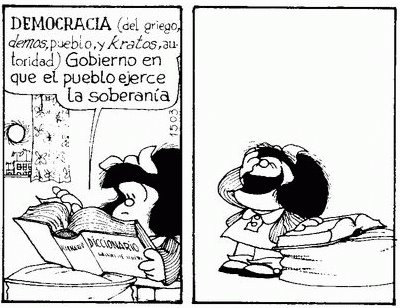
El término democracia es antiguo y complejo y se forma a partir de los vocablos “demos” traducido al castellano como -pueblo y/o poder- y “cracia” que indica un -gobierno o sistema-.  Así y actualizando el término desde la antigua Grecia a nuestros días, la democracia se refiere al gobierno del pueblo.

¿Pero acaso no ha sido el pueblo el que se ha volcado a la rebelión en Ucrania, Venezuela y El Salvador? Entonces, ¿la democracia reaccionó en estos países contra la democracia?

Quizás lo que ocurre en estos tres países (que son producto de la colonización y de la subyugación a los imperios durante la Guerra Fría) es que quizás no han pasado el suficiente tiempo en independencia institucional y maduración de sus gobiernos como para lanzarse desbocados a procesos democráticos que deben ir de la mano de una reforma educativa y cultural de la ciudadanía.  Pero, ¡alto! Que conste, que no me refiero a que estos países post-coloniales y post-guerra fría deban regresar bajo el control de un dictador o de una metrópoli.  Sino que, la participación del pueblo (demos) no debería avanzar cuando se ha descuidado o se ha impedido continuar el proceso de institucionalización de la democracia en la vida ciudadana.

Ucrania, Venezuela y El Salvador tienen como un común denominador la inmensa pobreza y la enorme desigualdad educativa y cultural entre la elite gobernante que heredó el poder de sus antiguos amos colonizadores y el grueso de la población. La mayoría de la población en estos países ha sido condicionada a servir como un “agente legitimador” al momento de ejercer su voto pero no se le ha permitido adquirir conciencia absoluta de su rol como “ciudadano legitimador empoderado”. Porque es su voto el que le permite exigir responsabilidad, honestidad y resultados en el equipo de gobierno que eligió en las urnas.

Titulo: 7 killed in post-election protests
Via: FoxNews

En Venezuela ha sido la población cansada y agotada de la corrupción la que ha tomado conciencia del poder de su voto al exigir la renuncia del gobierno revolucionario (aún a pesar de que recientemente había sido electo por el voto de las mayorías).  Es acá que el pueblo ha empezado a ilustrarse en su poder como votante y garante.

Titulo: Days of Protest in Ukraine
Via: The Atlantic

En Ucrania ha sido el pueblo el que también ha tomado conciencia del poder de su voto y de su derecho de autodeterminación pidiendo la anexión de Crimea y su mayoría étnica rusa a Rusia debido a sus distintos intereses económicos, políticos y culturales con el resto del país.

Titulo: El TSE pidió a los contendientes que respeten los resultados que el pueblo decida.
Via: http://www.lapagina.com.sv

Y en El Salvador desde el día lunes debido a que las elecciones presidenciales concluyeron con una cercana diferencia de votos entre los partidos ARENA y FMLN. ARENA rechazó el conteo de las elecciones luego del anuncio de su derrota. 6,000 votos marcaron la diferencia y el partido ARENA rechazó la legalidad del proceso democrático.

Espero que no sea aún tarde para extender una invitación a reflexionar a los ciudadanos salvadoreños sobre el funcionamiento del gobierno democrático y de la necesidad de estudiarlo a más profundidad y, quizás, comprender que el voto de la mayoría (aún si efectivamente ganará por 6mil votos de diferencia) no es garante suficiente de legitimidad.  Y que, es urgente que ambos partidos realicen un pacto serio, democrático y honesto antes de queso se derramé una sola gota de sangre.

En Venezuela, Ucrania y El Salvador es aún posible alcanzar acuerdo y pactos de concertación que partan del respeto al gobierno democrático y que busquen una inclusión de ideas, actores y modificaciones a los actuales procesos en los que el Pueblo (demos) colabore en la construcción y progreso del del Sistema de gobierno (cracia).

Esto evitará muertes y violaciones a los derechos individuales.  Pero más importante aún, permitirá la evolución y maduración de sistemas democráticos de gobierno en estos países que aún ahora se vieron afectados por la injerencia de los poderes imperiales en sus asuntos. Que envidia que en estos países quizás estén a las puertas de un desarrollo democrático del cual nuestros países vecinos podrían aprender mucho.

Would you buy “Made in USA by Rich White People”?

You need your lawn mowed,do you hire the kid down the block who’s saving money for a car, or a surgeon? First off, the kid obviously needs the money more. And that matters. Second, do you really want to pull the doctor away from saving lives? What if he isn’t saving lives? He’s still improving lives. This applies to any productive person (okay, maybe not lawyers). This doctor could be doing things I think are a total waste, but the people paying him disagree with you; as long as they’re paying their own way, who am I to disagree?

What am I getting at here? By world standards (and especially by historical standards) American workers are incredibly productive and wealthy. Yeah, everyone’s got money problems, and the mortgage isn’t paying itself, and prices are rising, and all the rest. But at the end of the day, having an American worker do something a Bangladeshi could is analogous to having a surgeon do something a teenager could. Are working conditions in the third world good? No. Should you be concerned with the well-being of Americans? Yes. Does this justify buying American? No! A resounding no!

Natural Law and Economics

The field of “law and economics” applies economic theory to the consequences of law. This branch of economic theory examines the laws that would maximize efficiency and equity. The theory compares, for example, the incentives created by criminal versus tort law to determine the mix of laws that minimize the social cost of wrong-doing. Law and economics studies contract law to determine when a contract is proper, what is the most effective way to enforce contracts, and how best to deal with breach of contract.

The pure market has voluntary exchanges that involve contracts, and so the structure of contract law becomes important. Deficient law and enforcement breeds uncertainty, corruption, and less prosperity. Since contracts are part of the market, contract law is also within the market, and the enforcement and governance that forms the legal infrastructure is part of the market.

Law and economics also deals with external effects, acts that affect others without compensation. The theory examines taxes, regulations, bargaining, and lawsuits as ways to deal with bad effects such as pollution. Another contrast is between property rights and liability rules. A liability rule does not prohibit a trespass, but requires compensation when it happens. And so law and economics contrasts prohibiting an action in advance, versus dealing with the consequences after the act is done.

People think of the market economy as having buying and selling, supply and demand, production and consumption. But there is much more to the market than a customer buying a product. The product may be defective, or the seller might not get paid. There are many legal doctrines that deal with such problems. These are part of the market and part of economics.

A pure free market economy would include the body of law that has evolved over hundreds of years. There are several origins of law: constitutional law, legislated statute law, the common law from decisions by judges, the law merchant of commerce, and natural moral law.

An anarchist society would need much of the law that now applies to marriages and families, lawsuits, crimes, contracts, and uncompensated effects on others. The difference would be that the anarchist society would have voluntary governance, by individual consent, rather than an imposed government. But a network or federation of voluntary communities would need much of the same law that we have today.

One controversial area of law and economics is whether there should be legal monopolies on “intellectual property,” i.e. copyrights on expressions and patents on inventions. Today’s law is mostly utilitarian, providing protection from copying for a limited time in order to provide incentives to creations, although political influence has extended copyright protection for long durations.

The difference between a libertarian society and today’s world is that there would be no laws prohibiting peaceful and honest acts, even if they are offensive. Drugs, prostitution, and gambling would be legal. There would be no restrictions on trade such as with Cuba or on the production, importation, and use of hemp.

Whether in today’s world or a libertarian world, there should be a basic “law of the market” which prescribes that products are presumed to be safe and effective unless stated otherwise. But a pure free market would avoid laws that restrict one’s own use, or consensual use, of property. Lawsuits would mostly adhere to the British system in which the loser of a case would have to pay the legal costs of the winner, which would greatly reduce frivolous law suits, thereby reducing overall litigation costs.

Today’s complex tax laws would be abolished in free-market law and economics, because honest and peaceful transactions would not be hampered by imposed costs. The public finance consistent with a free market would include voluntary user fees, penalties for damage such as pollution, and the land rent that comes from nature or is generated by population and government’s public works. The full employment of a pure free market would provide the job security that comes from employers needing to fill positions, with few idle workers from which to choose.

The complexity of today’s division of labor makes the law that governs relationships necessarily complex, but the clout of lawyers, special interests, and bureaucrats make the law excessively restrictive and needful of attorneys. A truly free society would make the law the servant of the economy and not its master.

What economic theory needs to take into account is that the field of law and economics is not just one of many applications of economics but rather an inherent part of the market economy, and so law has to become more integrated into economic theory. Also, equity is a goal of law and economics, along with efficiency, and an objective application of equity cannot exist without its foundation, natural moral law. “Natural law and economics” needs to become a prominent part of law and economics.

On Stephen Hawking, Vader and Being More Machine Than Human

Is Stephen Hawking more machine than man? The author makes an apt comparison between Hawking and other high profile people with assistants. That comparison should show (contrary to the emphasis the author makes elsewhere) that it’s not so much man/machine, so much as distributed cognition (is that the right term?). And understood as such, this phenomenon is one that we all engage in, and increasingly so in the modern world of mass literacy, peaceful coexistence, pens, paper, and smart phones.

Hawking is the focal point of his network. It’s interesting to note that his output is largely the output of his network, but it’s still directed by him. We should be no more disappointed that he doesn’t do his own calculations than we should be that we don’t wash our own laundry by hand. Hawking can’t do the mechanical, he can only do the thinking. Having assistance surely improves the quality of his thinking, but it is still his mind that we are concerned with. Are his assistants getting short shrift? They aren’t getting the sort of celebrity that Hawking gets, but in their own networks they will certainly do well to be part of his team; his students will have valuable letters of recommendation.

It’s an interesting article that provides insight into how Stephen Hawking works, but it ends on an odd note:

Because, surrounded as we are by our world of technology and digital information, aren’t we all disabled? We, like Hawking, like Obama and his brain trust, are unable to think and complete the results of our thoughts without being attached to a network of people, instruments, machines – and the living laboratories through which it is all distributed.

We are all (Hawking included) able to think without assistance. Yes, our thinking is enhanced by cooperation with others (in conversation and debate, consultation, etc.). Yes, we all require some interface between our thoughts and our audience, whether that’s a pen and paper or a computer, but I think the way to think of it is that we are enabled. Enhancing our thinking isn’t cheating.

El legado de Hugo Chávez

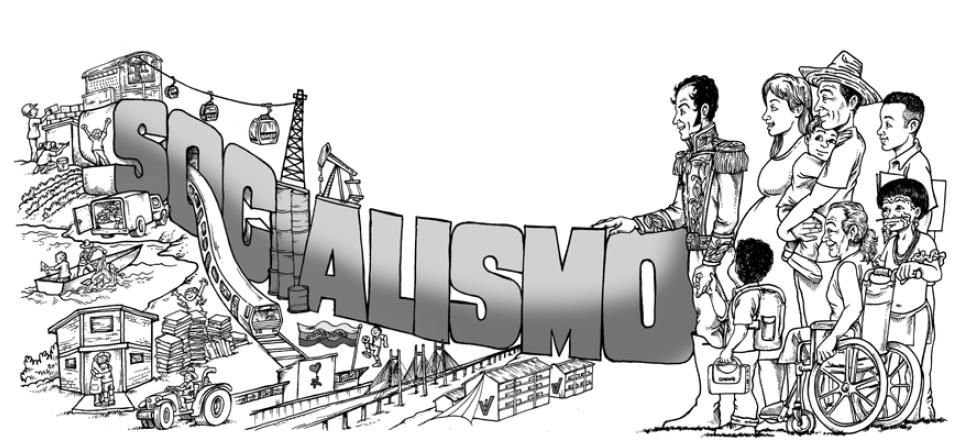
Propuesta del Candidato de la Patria Comandante Hugo Chávez Para la gestión Bolivariana socialista 2013-2019. Via: http://forajidosdelanetwar.blogspot.com/2012/11/caricaturas-e-imaginarios-en-la.html

Hace un año el actual presidente de Venezuela, Nicolás Maduro, anunció la muerte de Hugo Chávez.  Chávez fue el líder de la Revolución  Bolivariana en Venezuela y gobernó el país durante 14 años.  Maduro fue juramentado luego Presidente y recientemente ganó la reelección popular con una campaña que prometía continuar  con el legado de su mentor.

En el 2013, los datos del legado que dejaban los 14 años del gobierno socialista presentados por el Centre for Research on Globalization y por la Embajada Venezolana en los Estados Unidos son reveladores:

  • Venezuela cuenta con servicios de salud y educación universales gratuitos. Antes, 70% de los venezolanos no tenía acceso a servicios de salud.
  • Se eliminó el analfabetismo en el país.  Antes, 40% de los venezolanos eran analfabetos.
  • En los últimos 10 años, el PIB venezolano ha crecido al ubicarse en un nivel alrededor de los 300 mil millones de dólares. Esto representa un crecimiento sustancial frente a la década de los noventa cuando el PIB del país no llegaba a los 100 mil millones de dólares.
  • Se redujo en un 40% el costo de los productos de la canasta básica.
  • Aumentó el salario mínimo en más del 600%
  • Redujo el desempleo del 20% al 6%
  • El Índice de Desarrollo Humano (IDH) en Venezuela aumentó de 0,69 en  1998 a 0,84 en  2008, lo cual eleva a Venezuela a ser un país con rango de desarrollo humano medio a uno con rango alto.
  • De 2008 a 2012, el IDH descendió a 0,748 y alcanza el puesto 71 de 187 naciones y territorios que participaron de la medición.
  • Venezuela ocupa el puesto 71 entre los 179 países que figuran, según el informe anual del Programa de Naciones Unidas para el Desarrollo (PNUD). El coeficiente de Gini, que mide la desigualdad de ingresos, alcanzaron en 0.390 en 2012, el nivel más bajo en la historia de Venezuela y el más bajo en el Continente latinoamericano. En 1998, era de 0,4865.
  • Desde 1999, Venezuela incrementó sus relaciones comerciales con otros países en el hemisferio, así como con otras regiones del mundo. La mayor parte del comercio de Venezuela continúa siendo llevado a cabo en la región, con alrededor del 70% de las exportaciones de petróleo con destino a los países de las Américas, y los mercados de América del Sur, América Central y el Caribe están ganando importancia.
  • En 2012, un año antes de la muerte de Chávez, Venezuela era el tercer socio comercial más grande de Estados Unidos en América Latina y el número 14 más grande en el mundo, además de ser el cuarto proveedor de petróleo a EE UU.

Pero no todo ha sido fácil de conseguir en esta bonanza de estadísticas sociales y los drásticos cambios en el nivel de vida del pueblo venezolano han sido el resultado de muchos sacrificios impuestos en la población venezolana.

Con el ascenso de Chávez y el éxito inmediato de los cambios socioeconómicos en la población, la élite política chavista se aseguró el poder absoluto al conseguir el voto mayoritario en elecciones democráticas gracias a millones de venezolanos beneficiados por las reformas socialistas.  Este poder absoluto (democrático) permitió al gobierno socialista continuar con su plan e imponer restricciones a la libertad de expresión de la oposición, expropió sin muchos problemas industrias, eliminó fácilmente y sin mucha oposición el derecho a la propiedad privada y capturó los ahorros de millones de venezolanos.

Para Maduro, Chávez y muchos otros ideólogos socialistas antes de ellos, cualquier medio era justificable para la consecución del ideal revolucionario socialista.  Latino América, que durante décadas sirvió de laboratorio para experimentos económicos y políticos de líderes del mundo desarrollado fue la arena idónea para regresar a la dulce tentación socialista que había sido lograda con relativo éxito en otros continentes.

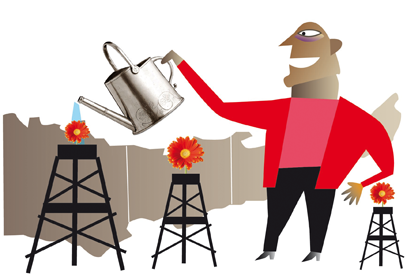
La fórmula del legado de Chávez es simple y poderoso:

Populismo anti-imperialista

+

petróleo nacionalizado

=

Socialismo clientelista 

Titulo: Sembrar petróleo. Por Emiliano Teran Mantovani. via: http://forajidosdelanetwar.blogspot.com/2012/11/caricaturas-e-imaginarios-en-la.html

La movilización y apoyo de los votantes en una nación democrática es fácil de conseguir cuando se posee el capital económico, político y/o militar para ofrecer al pueblo una salida de los sistemas de economía mixta extractivos que durante el siglo XX fueron implementados por las naciones desarrolladas del Norte Global y que fueron apoyadas por elites patrimonialistas en los territorios del Sur. El éxito de la revolución Bolivariana aseguró para otros países interesados en este experimento una segura y jugosa fuente de donativos para facilitar el efecto domino socialista que tanto temieron los ideólogos realistas gringos durante la Guerra Fría.  Sin duda, el legado de Chávez sigue vivo un año después de su muerte.

En los últimos dos meses la movilización de un importante grupo de la población venezolana causó manifestaciones en las ciudades más importantes del país.  Los manifestantes tenían muchas peticiones que iban desde reclamos por la corrupción del partido gobernante, reclamos por los altos índices de inflación que afronta el país y solicitudes de renuncia de los líderes de la revolución bolivariana.

Independientemente de cuántos  años más dure el partido revolucionario en el poder es seguro que su legado fue la implementación de una exitosa revolución socialista clientelista sostenida en la venta de petróleo a las economías mixtas del resto del mundo que mejoro los índices de desarrollo humano como nunca antes habíamos visto.  Así es que mientras el mundo siga dependiendo del oro negro, el mundo seguirá escuchando del legado de Chávez.

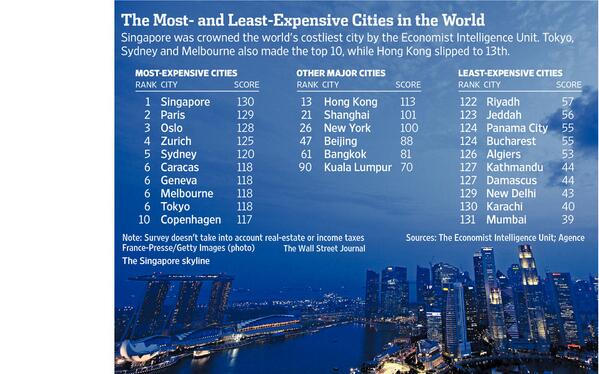
Este caro legado ha costado la libertad y los derechos de propiedad de miles de individuos. Venezuela sigue y continuará enfrentando desafíos en materia de seguridad, pues la tasa de homicidios de la región es la más alta del mundo. El regimen chavista es diariamente acusado de corrupción, incompetencia y la probabilidad de que esto cambie no es del interés de nadie. El año pasado la inflación fue del 56% y la escasez de productos básicos continuó agudizándose hasta este año.  Caracas se ha convertido en una de las ciudades más caras del mundo ocupando el puesto #6 según datos del WSJ.

Embedded image permalink

Polystate, part 2

After much distraction I’m back to continue my review of Polystate: A Thought Experiment in Distributed Government (part 1 is here). But now that I think about it, this isn’t so much a review, as a book club (of one…) where I respond to the book.

In this section, ZW gets into the benefits of polystates. He starts with the benefit of choice. Someone born into North Korea is utterly screwed, but someone born into an unattractive anthrostate can simply leave when they reach the age of consent. The reverse is also true: someone may join an anthrostate that the rest of us see as distasteful. Want to join a cult? You’re free to. The thought of that possibility will certainly make your inner-paternalist squeamish, but remember that if you aren’t free to make mistakes, you simply aren’t free.

Another benefit I wouldn’t have thought of is that traditionally problematic systems of government have a higher chance of success when they are separated from geography. For example:

It may be that the failure of collectivization has not got to do with the individual so much as the aggregate. If 95% of people work poorly in a collectivized environment, any random collectivized farm will perform poorly. But it may be the case that 5% of people would excel in such an environment.

I would expect a communist to protest that geographic seclusion is necessary to create New Communist Man. How are people supposed to learn how to shed their egoism if they cannot help but see the vulgar bourgeoisie all around them? But that sword cuts both ways and shows a benefit of polystates ZW didn’t bring up: a child raised in a fascist anthrostate can see non-fascists and so make a more informed decision of whether to stick with fascism when they get older.

ZW sees the polystate as offering a sort of decentralized Tiebout competition. That covers the demand side (what benefits to provide to whom). Adding in the supply side (who will face what opportunity costs) raises the problem of economic calculation in socialism. But ZW takes it in a different direction, hypothesizing that sorting between anthrostates would lessen decision making costs due to more homogeneous populations.

Choice ensures we get more of what we want with less hassle but also provides the option of exit at low cost. Taking geography out of the equation means that there is a larger number of potential state-competitors, as well as more credible movement on the part of citizens.

He raises an interesting problem related to a recent post of mine:

[T]here may be a difference between good governance and governance which pleases one’s constituency… But, regardless of the philosophy of good government, there is an extent to which good governance must have to do with what voluntary citizens decide is good.

First off: No! Government and governance are two different things! But putting that aside, the big problem we face is how to not just aggregate preferences (a difficult problem in itself), but how to ensure that (or even determine if) our method of aggregation results in something good.

I think cable TV is pretty good at giving people what they want, but I also think that the product is overwhelmingly bad. It’s not a big deal with TV because there are so many alternative sources of entertainment and information (although cable news might have existential dangers). Similarly, I think government broadly gives people what they want (not peace and prosperity, but xenophobia, “doing something,” paternalism, and the like) but that’s not a good thing. The idea of the U.S. senate was to prevent people from having too much choice so that good institutions could be preserved. So could the degree of choice offered by polystates be to much? On the other hand, how could you determine an answer without incorporating the revealed preferences of the governed?

Finally, ZW gets into an especially meaty benefit of anthrostates: peace. It’s hard to start a war with a disbursed enemy (“semi-random geographic distribution), and hard to finance one when your citizens can switch to a more peaceful government. This could be especially important in avoiding territory disputes as humans explore and colonize space (for example, if resources on the moon become valuable enough to justify the expense of following Newt Gingrich up there).

That concludes Book 1 of Polystate, and that’s where I’ll stop for now. I’ll be picking through the book fairly slowly, so I recommend that you buy the book for yourself!

A thought on competition

“Start-ups, or market entries lead to new business development, whereas incumbent firms might be forced to dissolve by the increased competition of the new firms. More indirectly, the new businesses and the removal of older, perhaps less efficient businesses, might lead to improved competitiveness and economic growth.”

From van Praag and Versloot (2007).

The above quote is from a paper on entrepreneurship. Pretty much anyone who studies entrepreneurship has at least passing familiarity with some aspects of Austrian economics. The above quote struck me for showing the difference between the mainstream view of competition and the Austrian view. For Austrians competition is a process; you compete with rivals by offering better terms to potential trading partners. For mainstream economists competition is a state; when there are lots of market actors there is competition.

The first use of competition is Austrian: new firms out-compete old firms. The second is mainstream: getting rid of inefficient firms leads to “improved competitiveness.” They don’t write “entry of new firms force old firms to be more competitive,” but “a change in the makeup of the market results in more competition.”

I think a lot of mainstream, equilibrium based economics is really just short-hand for the complex processes Austrians think about. But I think people forget that it’s shorthand and that leads to thinking about the economy statically, like some thing with a certain arrangement that can probably be rearranged. The difference between the two concepts of competition is a reflection of this. A market with lots of different firms is probably competitive, but that’s no guarantee. We need to think about how long those firms have been doing what they’re doing, and that leads us to see how industries with few (or even one) firm may still face competition.

Ukraine

The Russian gangster state is about to take the Ukraine apart as I write.

This is not our fight, I think. There are no big American interests at stake. American lives are not endangered. As I write, there is not big humanitarian crisis (as there is in Syria, and continuing) either.

I hope we  mostly agree in this country that national borders are not sacred. We are not sworn to go to war to have them protected. If the Ukraine becomes two states  or if a part of it becomes incorporated into Russia, that’s alright with me. I hope it happens quickly and with little bloodletting.

The argument that we are on the side of Ukrainian democrats is not very convincing, right now. I just don’t know. I don’t think they know.

The main downside of this crisis, as I see it, is that President Obama was not able to keep his big mouth shut. He just gave another reason for political mafiosi, tin-pot dictators, savage tyrants, and pure fascist states such as Iran and North Korea to consider the US a paper tiger. That is very dangerous. It leads to gambling miscalculations, a la Saddam Hussein.

A Bit More on Ukraine

Evgeniy’s plea for balance in the Russia-Ukraine conflict has produced, in my mind, an interesting dialogue on propaganda – both of the Western and of the Russian variety.

Let me come out and say with some conviction that I am not a supporter of the Putin regime. Nor do I believe much of the analysis that comes out of the Russian press. (This is because the vast majority of the Russian press is controlled by the state, and not because it is Russian or because it generally espouses pro-Russian sympathies.)

Evgeniy, for example, cites reports from the Russian press claiming that half a million people have fled Ukraine for Russia since the beginning of the year (when the demonstrations started). If half a million people fled from one place to another in a month, from anywhere in the world it would be headline news, but for some reason only Russian citizens have heard of this exodus? I don’t buy it.

Now, this number may be a misunderstanding based on a bad translation. In fact, I think this may be the case. My translation of Evgeniy’s comment states that the Russian press reports that “since the beginning of the year (January 2014) in Russia has resettled about 500,000 refugees from Ukraine.” Emphasis mine. Has this resettlement been ongoing since the end of the Cold War? However, judging by Evgeniy’s comment, it looks as if resettlement has only begun in January of this year, so if this is indeed the claim that the Russian press is making then it is obviously false.

Terry’s excerpted quote from the Daily Beast fares no better in the facts department, though, despite the Daily Beast being a private organization. The op-ed is an attempt to debunk “Putin’s Crimea Propaganda Machine” as if Putin has the power to control everything the Russian press publishes. State control of the media, especially in a country as large and diverse as Russia, does not mean that the bureaucratic process magically disappears. Bureaucracies and especially regulators are actors in their own right, and as such are beholden to certain constraints and processes that come with the way these institutions are organized.

So in the spirit of open inquiry and debate, there are a couple of facts I’ve gathered that I think are important to note.

  1. The President of Ukraine was ousted in a coup. He was elected by a very slim margin and accusations (from both sides) of voter fraud were rampant.
  2. The opposition that recently installed a new President therefore gave democracy the finger. This is not in itself a bad thing, but many Western observers tend to side with the pro-West faction as if it was democratic. It is not.
  3. The exiled President signed an agreement with the opposition last month guaranteeing early elections and more power to the legislature at the expense of the executive branch. This is as peaceful and as democratic as it gets, and the opposition gave, as I said, the finger to this agreement.
  4. The opposition has fascists in its cabinet. It has also installed Ukrainian Jews to high-ranking positions. The Muslim Tartars in Crimea stand to lose the most during Russia’s occupation.
  5. Ukrainians are sick of their government – right or left, pro or anti -and this has yet to be addressed by anyone other than Dr Foldvary as far as I can tell.
  6. No shots have been fired. Moscow has reiterated that it is in Crimea to protect its naval base and Russian citizens. I have a feeling that Russian troops will be back in Russia within the year. Crimea will get to keep its autonomous status within Ukraine, and Kiev will be forced to think twice before it attempts to impose its will on Crimea arbitrarily. This is a good thing, as it limits the size and scope of government.
  7. So far most, if not all, information about military activities have been coming from governments, not from the free press. This can only lead to more misunderstanding and more suspicion.
  8. War is the health of the state. In times like these, journalists should be criticizing their own governments rather than the governments of others. In the West, where the press remains relatively free, there is more criticism of government policies concerning foreign affairs than there is in Russia.

At the end of the day, I have to agree with Evgeniy’s plea for toleration and prudence: “Please do not judge this conflict only from one side.”

Towards a Free and Prosperous Ukraine

The violence in Ukraine demonstrates once again the failure of centralized democracy. Whenever we see masses of people protesting and rallying in the city streets and squares, it shows that the structure of government has failed. The prime purpose of democracy is social peace. The mass demonstrations show that the people cannot express their views and make policy decisions through the formal channels of government, so they take to the streets.

When government fails, there is another path towards political change: civil disobedience. Rather than massing in the city square or taking control of government buildings, the protestors can stop obeying the government. They can stop paying taxes and stop obeying unjust rules. Civil disobedience is how India won independence and the US civil rights movement ended segregation. Today, protestors use social media to spread the message. Some activists will be put in prison, but there is not enough room to put half the population in jail.

The conflict in Ukraine originated in the 2010 election for president, in which the opposition accused the winner of fraud. The protests began in November 2013, when the president switched from making a trade agreement with the European Union in favor of a pact with Russia, which provided aid to the government of Ukraine.

The protests in Ukraine were intended to be peaceful, but mass protests often become an attractive nuisance for provocateurs. When a small minority of protesters start throwing rocks or fire bombs at the police, that becomes the signal for the police to use lethal force, and then the protestors return fire, and the result is violence and death. Peaceful civil disobedience is decentralized and does not provide such a venue for the chaos makers.

Ukraine is the largest country that is entirely in Europe. It was in the Russian Empire until the Bolshevik revolution of 1917, when it became an independent state. It soon became a republic within the USSR. The Soviet structure of councils and republics served to preserve the identity of Ukraine, which even had its own membership in the United Nations, and achieved independence with the break-up of the USSR in 1991.

Now, in February 2014, following the failure of government repression, the Ukrainian parliament has dismissed the president, restored the 2004 constitution, freed the previous prime minister, and appointed an acting president. The agreement between the government and the opposition was facilitated by the foreign ministers of France, Germany, Poland and a representative of the president of Russia.

The national anthem of the country is “Ukraine has not yet perished.” Millions of Ukrainians died during the years of forced collectivization under the Soviet Union, and more millions, including many Jews, were slaughtered during World War II, but the Ukrainian identity has persevered. Ukrainians now have a unique opportunity to reshape their future.

Some of the conflict in Ukraine comes from its ethnic mix. The westernmost part of the country was part of Poland prior to World War II, although that territory along other neighboring areas had been Ukrainian previously. In 1954, the Crimea was transferred from the Russian Republic to Ukraine. The eastern half of Ukraine is culturally Russian; the main religion is Eastern Orthodox. The western part is ethnically Ukrainian and Catholic, and the people of western cities such as Lviv identify with Europe. Ukraine needs to restructure its governance as well as its economy in order to achieve social peace and prosperity.

Ukraine has a centralized government, but also has 24 provinces, plus the nominally autonomous republic of the Crimea, and two city districts, Kiev and Sevastopol. The democracy of Ukraine can become more authentic by decentralizing the governance into a federation of its subdivisions. An association agreement with the European Union should reduce trade barriers, while the Ukraine should also pursue free trade with Russia and its other neighbors.

The economy of Ukraine suffers from its oppressive tax system. The new tax code adopted in 2011 has 18 national and 5 local taxes. The major taxes include corporate and personal income taxes, a value added tax, and excise taxes. But there is also an economy-friendly, though small, land tax, and royalty taxes on the extraction of natural resources. The current tax rate on corporate gross income is 16 percent. The value-added tax rate of 17 percent is imposed on the sale of goods, including imports. There is also a high social security tax of up to 49.7 percent.

Ukraine’s land tax is paid by the owners and users of land. The tax rates depend on the use of the land. For pastures, the rate is one-tenth percent of the land value, and for farms the rate is three-hundredths of a percent. There are also local real estate taxes per square meter of dwelling space with the tax rate from 1% to 2.7% of the monthly minimum wage.

The Ukranian tax system has been criticized for its complexity, its disincentives to labor and enterprise. and its inducement for tax evasion. Ukraine has the potential to become a great agricultural and industrial economy, but its tax and regulatory policies have been holding it back. The Fraser Institute’s index of economic freedom calculates Ukraine’s level at 6.16 on a range from zero to pure freedom at 10. Out of 152 economies, Ukraine ranks 126 in economic freedom, near the bottom among the countries of the world. The Heritage Foundation index also ranks Ukraine as “repressed,” especially low on investment freedom and freedom from corruption.

If Ukranians seek prosperity, they would be wise to eliminate all their taxes other than the land tax and also enact national and local pollution taxes. The land value tax should be uniform for all land, based on its current market price or rent when put to its best use, regardless of its current use. The elimination of the other taxes would stop tax evasion and liberate the underground economy.

Ukrainians should stop blindly copying the dysfunctional tax system of the European Union and adopt a modern 21st century public finance system suitable to the global economy and Ukraine’s position between Russia and the EU. They can avoid either joining the EU or a Russian-led Eurasian Union by legislating free trade with both regions. They should enact domestic free trade by avoiding the taxation of labor, enterprise, and produced wealth. With rising public revenue from land value, and with rising wages, Ukraine could reduce its social security taxes until the government either funds pensions from land rent or replace government pensions with private retirement accounts.

Land-value taxation would also promote a decentralization of governance and a reduction of corruption. The land of Ukraine is rich and can well support its public finance, and let Ukraine to not just avoid perishing, but to flourish.
Are small businesses entrepreneurial?

Between 1958 and 1980 the number of businesses in the U.S. economy increased from 10.7 million to 16.8 million. But the relative economic importance of small business in the overall economy declined over this period. Between 1958 and 1977 the share of employment accounted for by firms with fewer than 500 employees decreased from 55.5 percent to 52.5 percent. Between 1958 and 1979 the share of business receipts obtained by companies with less than $5 million in receipts declined from 51.5 percent to 28.7 percent. Between 158 and 1977 the share of value added contributed by firms with 500 or fewer employees decreased from 57 percent to 52 percent. (Zoltán J. Ács, Bo Carlsson, and Charlie Karlsson 1999, 7)

That’s an enormous relative increase in the importance of big businesses. Consider that change in light of macroeconomic conditions and political thought at the time. It seems almost like the dark ages. I think it also shows an apparent correlation between business, government, and ideology. Since the mid ’70s, small businesses have gained importance in the U.S. economy while also leaving the dark ages of mid-20th century illiberalism.

From the Comments: Musings on the Ukraine Fiasco

Riffing off of my post about the current crisis in Ukraine, Matthew writes:

Based on the track record of Russia vis a vis the West, I imagine the following scenario unfolding:

Russia (continues) to occupy the Crimea, while America and Europe (continue) to demand the withdrawal of Russian forces from the province. Putin, calculating that the West lacks the stomach for direct confrontation, refuses. Hysteria in the media and in government publications, which are ultimately the same thing, rises. A lack of direct conflict between Russian and Ukrainian forces, however, lends little credence to the mass panic broadcast over Western media. The furor dies down in time. Russian presence becomes normalized in the Crimea.

Or, the interim government, bolstered by further illicit monetary aid from America, pulls a Georgian move and attacks the Russian forces stationed in Crimea. Russian forces will quickly rout the Ukrainians sent against them, and most likely march towards Kiev – whether they take it or not will depend on the response of the international community, as with Georgia. Regardless of who instigated the violence, the Western media will blame Russia, and the war drums will grow louder. UN sanctions are unlikely, since Russia is a permanent member of the Security Council, but some form of economic punishment will occur. Russia will draw closer to China, Iran, and Syria. The status quo ante will be upended in no one’s favor: Ukraine will be in shambles, Russia and America will be set at odds.

Regardless of the above two scenarios, meanwhile, the Ukrainian economy is in free fall, and the IMF offers the dual poisons of austerity and liberalization to the interim government. Facing an intransigent Russia and the wolf-faced smile of the West, the interim government accepts the IMF’s offer. Like Russia before it, Ukraine is left even worse for wear by the rapid pace of economic liberalization, and is thus too weak to resist the Russian presence in Crimea. Thus, the West has succeeded in breaking off a chunk of post-Soviet Ukraine and bringing it into its influence, while Russia largely retains what it had beforehand: its Black Sea Fleet in Sevastopol, along with the de facto annexed province of Crimea. It is too early to tell, but perhaps the rest of Russified Ukraine will also join their brothers in Russified Crimea, and the state will break up along linguistic lines.

Who can tell what will occur? My money is on Russia, but maybe Obama will come up with some game winning stratagem (don’t snicker!).

Does anybody else care to make their predictions? You know where the ‘comments’ sections is!

О ситуации с Украиной и Россией

Являясь единственным автором постов в сообществе Notes On Liberty, который живет в России и может как-то “иначе” рассказать о текущей ситуации между двумя странами, хочу сделать небольшое заявление, которое, скорее всего, поддержит большая часть населения России. Я хочу обратиться ко всем авторам и читателям сообщества из других стран: будьте умнее ваших новостных лент и газет. Большинство ресурсов освещают ситуацию крайне односторонне – с той позиции, которая выгодна лишь одной стороне. “Правый сектор” (украинская неонацистская организация, которая сейчас имеет влияние в стране) рисует нас зверями и оккупантами, зарубежные газеты также поддерживают позицию нового правительства Украины, которое пришло к власти в результате переворота и пока что не может считаться легитимным. Сейчас против России ведется настоящая информационная война! Нам не нужна Украина, и нам не интересен и не нужен раскол этой страны, так как все мы “братья-славяне”. Совет Федерации России одобрил введение ограниченного контингента российских войск в Крым исключительно для защиты Черноморского Флота от возможных провокаций, а также для защиты русских граждан, проживающих в Крыму, так как в условиях нестабильности местные органы защиты вряд ли смогут в полной мере пресекать провокации анти-российских группировок. Еще раз повторю: фраза “совет федерации одобрил введение ограниченного контингента” по Российским законам означает лишь одно – у президента Российской Федерации теперь есть законное право на введение войск, НО не факт, что он им воспользуется. Разумеется, вооруженный конфликт никому не нужен, и нам в первую очередь. У нас всех есть друзья-украинцы, у многих на Украине живут родственники. Мы, по-правде, с недоумением относимся ко всем этим событиям, которые происходят сейчас.

Пожалуйста, не судите о конфликте лишь с одной стороны. Не знаю, какими новостными ресурсами вы пользуетесь там, CNN, BBC, Russia Today или чем-либо еще – потрудитесь разобраться в проблеме со всех сторон, потратьте свое время на всестороннее изучение вопроса, не удовлетворяйтесь первыми полученными результатами, которые скорее всего будут отражать позицию вашего президента или правительства.

Le nouveau racisme américain et l’impérialisme français

La tache est infinie d’eduquer les Francais pour leur faire jeter aux orties les cliches anti-Americains plus ou moins malveillants qu’ils trainent depuis soixante ans. Comme personne d’autre ne le fait, je me porte volontaire, de temps en temps, pour les aider a les remplacer par des cliches plus frais sur les Etats-Unis.

La Cour d’Appel qui correspond a la region de San Francisco vient de donner raison au directeur d’une ecole secondaire qui avait interdit a ses eleves le port ou l’affichage du drapeau …americain. Le tribunal a donne pour raison que ce drapeau risquait d’offenser les “Mexicains” de l’ecole.

Le debut de l’histoire remonte a Cinco de Mayo (en Espagnol dans le texte) de l’annee derniere. Il s’agit d’un fete officielle de l’Etat de Californie qui commemore une victoire militaire Mexicaine de 1862. C’est une fete qui passe inapercue presque partout au Mexique.

L’Etat de Californie l’a adoptee on ne sait plus trop pourquoi. Peut-etre que c’etait sous l’impulsion propre de la gauche cul-cul bien pensante locale aussi ignorante qu’avide demontrer sa sensibilite vis-a-vis des “minorites.” Peut-etre que cela a ete impose par un groupe de pression de Mexicano-Americains, raciste et fascisant qui se nomme lui-meme: “La Raza, ” “la Race.” (Ai-je meme l’imagination d’inventer de telles insanites?) En tous cas, selon mes sondages, forcement peu scientifiques mais tres frequents, le pourcentage d’Anglos capable de d’identifier les evenements ainsi commemores tourne autour de 0. Le pourcentage des jeunes d’origine hispanique monte jusqu’a 5. Il me faut ajouter pour etre honnete, qu’un 5% additionnel de ces derniers est en mesure d’affirmer: “Je ne sais pas ce que c’est mais je sais que ce n’est pas l’anniversaire de l’independance mexicaine.” En tous cas, cette commemoration a des effets positifs sur la consommation californienne de bieres mexicaines (d’ailleurs tres bonnes).

Et l’imperialisme francais alors, vous dites-vous? Et bien voila, en 1861, l’armee francaise du soi-disant Empereur Napoleon II (socialiste pour une bonne partie de sa carriere ploitique) a recu l’ordre d’aller attaquer la Prusse. Manque de chance, elle a tourne a doite au lieu d’a gauche. Elle s’est donc retrouvee au Mexique. De fil en aiguille, ell a fini par conquerir brievement tout le pays et a y installer un empereur fantome, un Autrichien obscur et palot. Ell profitait alors bien sur du fait que les Etat-Unis etaient eux-memes preocupes par le projet de s’entretuer pendant leur propre guerre civile. En attendant, au debut, les Mexicains de presidet Benito Juarez avaient bel et bien gagne contre le corps expeditionaire francais.

Pour en revenir a la Californie, le 5 Mai de l’annee derniere, dans une ecole sans importance d’une ville sans importance situee au sud de San Jose (Silicon Valley), des eleves d’origine mexicaine s’etaient presentes en class a portant des t-shirt figurant le drapeau mexicain. Des eleves Anglos avaient replique en enfilant des t-shirts a l ‘image du drapeau americain. Il y avait eu des bousculades entres eleves des deux groupes sans nulle doute echauffes par la presence de filles, aussi des deux groupes, en t-shirts sans dessins particuliers mais bien moulants.

La Cour d’Appel, en interdisant de fait de montrer le drapeau americain en Amerique a elle-meme fait la preuve d’une sorte de racisme, anti-blanc, cette fois-ci. En plus, elle a bien demontre son prejuge racial inconscient en identifiant comme “Mexicains” la categorie sociale que sa decision est censee proteger des bobos spirituels. Il est certain qu’elle voulait dire: “Americains d’origine mexicaine” car il n’y probablement pas ou que tres peu de “Mexicains” dans cette ecole. (N.B.: Toute personne nee aux Etats-Unis est citoyenne americaine, un point, c’est tout.)

PS Moi-meme, je suis tres satisfait de l’existence en Californie d’une forte emigration d’origine mexicaine (30% ou plus de la population de ‘Etat.) , y compris les sans-papiers. D’une part, se sont de gens faciles a aimer. D’autre part, ils apportent beacoup. Je crois meme bien que les enfants qu’ils font aujourd’hui supporteront la majeure partie du poids financier de la retraite Securite Social de mes propres enfants, vers 2045.