- The example of Charles Krauthammer Henry Farrell, Crooked Timber
- Turkey tries to legitimize incursion in northern Iraq Adnan Abu Zeed, Al-Monitor
- Why America won’t declare war Matthew Fay, Niskanen Center
- Stare Decisis and judge-made law Will Baude, Volokh Conspiracy
Turkey
More on the Turkish Elections
This is a sequel to my recent post Turkish Elections: Some Hope, so is best read after reading its predecessor.
In the last post, I covered the National Assembly elections on the 24th June. The first round of the presidential elections will take place on the same day and there will be a run-off between the two main candidates on the 8th July, if no candidate gets more than 50% on the first round.
As by far the strongest personality in Turkish politics over the last 15 years, Recep Tayyıp Erdoğan was no doubt expecting to win in the first round easily. He did so in 2014 when he was first elected to the presidency at a time when the president’s powers were much smaller. The two largest opposition parties of the time (CHP and MHP) put up a joint presidential candidate little known to the public and who did become much better known during the campaign. The campaign was in fact a surrender to Erdoğan who went on to ignore the constitutional limits on the presidency and push through plans for a presidential republic with little of the checks and balances known in other presidential republics, at least those in established democracies.
This presidential campaign has been an unpleasant surprise for Erdoğan. He has turned the MHP into a satellite party which supports him for the presidency. The cost of that, however, is that he has tied himself to a declining party in an attempt to compensate for a weakening of AKP (Erdoğan’s party) support since the days when it got 50% and over of the electorate.
The opposition has now found an energy unprecedented during the Erdoğan-AKP years (since 2002). It has turned the first round of the presidential election into a run-off to decide who will face Erdoğan in the second round, maximising opposition strength as its candidates enthuse different sectors of Turkish society against the current regime. It now looks impossible for Erdoğan to win the first round (without the help of rigging which is a real danger).
Some thought the opposition had already failed the presidential election when Abdullah Gül, who was President before Erdoğan, declined to run as a candidate of the small opposition religious conservative party SP. The idea around was that the two main opposition parties would accept him as a joint candidate. It is not clear this would have ever happened, and anyway Gül declined to run. He had been a founder of the AKP, but has not re-joined since leaving the office of President in 2014. At that time the President was required to resign from any political party. Gül has made indirect criticisms of the AKP under Erdoğan, but is a non-confrontational politician who has not put himself in clear opposition to Erdoğan and few expected he ever would. Some had the attitude that Gül was the only chance of the opposition winning the presidential election. I was never convinced myself. Adopting an AKP politician central to the AKP’s colonisation of the state and parts of civil society, particularly the main media companies, would have been a defeatist gesture, particularly given Gül’s own lack of energy in very stark contrast with Erdoğan.
The four largest opposition parties will all run presidential candidates, though three of these parties have formed a joint list for the National Assembly elections. Two of these candidates have a real chance to win. That is Meral Akşener and Muharrem İnce. Akşener is the leader of the second opposition party, İYİ, which broke away from the MHP. It has overtaken the MHP as the largest nationalist party. Though it has a clearly nationalist orientation, mixing Atatürk republicanism with nostalgia for the Ottomans and pre-Ottoman Turkish leaders, it has a a milder version of this than the MHP. İnce is a centre-left secularist CHP politician who previously tried to replace Kemal Kılıçdaroğlu as leader of the CHP.
Kılıçdaroğlu is not a strong public personality and has often been dismissed even by CHP sympathisers. However, he did a good job of keeping the CHP relevant in the period after the coup attempt of July 2016, when Erdoğan seemed to be achieving even more complete domination of Turkish public life. Kılıçdaroglu most famously led a Justice March from Ankara to Istanbul last summer, usefully turning his anti-charisma reputation into an image of quiet decency and endurance, marching for many days under a hot Turkish sun, though he is in his late 60s and there were constant fears of state promoted violence against the march.
Kılıçdaroğlu was again dismissed as too passive at the time Gül declined to run, and Kılicdaroğlu ruled himself out of the Presidential contest. It has turned out that he has maximised his strengths and weaknesses, by showing the inner self-confidence to allow his rival İnce to run for the most powerful office in Turkey. İnce has been a great campaigner so far and is doing better than I expected.
I thought Akşener would easily be the strongest opposition candidate, and she is doing well, but is very close to İnce, both for getting through to the second round and defeating Erdoğan. The latest opinion polls suggest Erdoğan would beat both but by a very small margin, meaning that a strong campaign by İnce or Akşener could win in the end, particularly if supporters of rival parties turn out in a spirit of unity for change.
The general thinking in Turkey now is that the opposition is likely to win the National Assembly but not the Presidency. Nevertheless the presidential contest is going far better than expected for the opposition and Erdoğan could look very diminished running in the second round after the AKP-MHP electoral list loses the National Assembly (where it currently has a two-thirds majority). İnce represents the most leftist and most nationalist element of the CHP. This combination is not unusual in Turkey, though left-nationalists prefer to identify themselves through the Turkish word for patriot rather than nationalist. I thought this would be a problem for İnce, in that he might be a negative both for Kurdish and centrist voters, but he has shown a capacity to reach out and make gestures to these sectors. Since the CHP National Assembly list has reduced the number of left-nationalists, his presidency would not be the unconstrained triumph of that particular point of view.
Turkish Elections: Some Hope
What with being rather exhausted by an accumulation of projects in recent months, I have been extremely absent from Notes On Liberty. Teaching is over for the summer and I hope to make up for lost ground across a few areas, but first I must address the current situation in Turkey.
There will be early elections on 24th June for the National Assembly and the Presidency. If no candidates win an overall majority for the presidency, there will be a run off between the two leading candidates on 8th July. The National Assembly is elected through proportional representation (d’Hondt system, if you’re interested in the details). The elections were scheduled for November next year, so they are very early. The reason offered by the government is the need to complete the transition to a strongly presidential system in view of supposed administrative uncertainty interfering with government until the last stage of the constitutional change, which is triggered by the next election after last year’s constitutional referendum, and the supposed need for ‘strong’ presidential government to deal with the present situation in Syria and Iraq.
However, anyone who is not a hopelessly naive follower of regime publicity knows that the real reasons are the decline in the economy and the rise of a right-wing party opposed to the current regime, which could erode the regime’s electoral base. I use the term ‘regime’ deliberately to refer to the fusion of the AKP (dominant political power), the personalised power of President Erdoğan and the state apparatus, including the judiciary. There is no state independent of a party power which itself has become subordinate to the will of one man. The police, judiciary, and prosecution service are quite obviously biased towards the government. Civil society has not escaped the hegemonising pressure. All the main media companies are controlled by cronies of Erdoğan and the AKP. Both state media and the main commercial media present a government point of view with little coverage of the opposition. Private media companies are of course entitled to push their own opinions, but these opinions are in reality dictated by Erdoğan, with the calculated intention of excluding opposition points of view except in highly parodic and manipulated terms. The construction industry is forced to support Erdoğan in order to obtain contracts for the endless pubic projects and projects officially or de facto guaranteed by the tax payer. This instrument of political control is enhanced through endless, often grandiose projects regardless of the state of public and private debt. In this politics, interest rates are artificially low with the consequence that inflation is rising and the currency is constantly devalued in international markets.
A lot of the above will be already understood by readers, but particularly after a long break in writing I think it is important to set the scene for the elections. Whatever the AKP says in public about economic performance, officials have admitted in private that they are worried about an economic crisis before the regular date for the elections. It is also clear that the AKP hoped to keep the new right-wing party IYI (Good) out of the elections because of the complex registration process to participate in elections, amongst other things requiring registration of a minimum number of provincial branches. IYI is a break away from the well established Nationalist Action Party (MHP), and is already larger in members with more opinion poll support, so its exclusion would be particularly absurd.
The IYI Party’s problems with registration were resolved in ways that are part of the hope that does exist in this election. The main opposition party (and oldest party in Turkey), the leadership of the Republican People’s Party (CHP), which has a left-wing and secularist identity, allowed (or maybe insisted) that enough of its deputies in the National Assembly join the small group of IYI defectors from the MHP to guarantee an automatic right to electoral participation.
President Recep Tayyıp Erdoğan was only able to change the constitution to make it a very strongly presidential system, rather than a parliamentary system as it had been, because the MHP changed its position after years of critcising Erdoğan. The pretext was ‘unity’ after the attempted coup of 2016, though it was clear the whole country was against it anyway. The real reason was that the MHP has been losing support under a leader who has become unpopular and the only hope of staying in the National Assembly, given a 10% threshold, was an electoral deal with the AKP (which stands for Justice and Development Party). The election law was changed so that parties can form joint electoral lists in which voters can choose between parties in the list when voting, and the party concerned can have deputies so long as the votes within the list allow at least one to get into the National Assembly. In effect, the percentage threshold to enter the National Assembly has been reduced to less than 1%. This seemed to the AKP to be a great achievement allowing them to compensate for declining support of both AKP and MHP by joining them in one list and bringing in another small nationalist party.
However, the opposition has moved to make more use of the new rules. The CHP and IYI have formed a joint list, which also include SP (Felicity Party), a religious conservative party which has common roots with the AKP and is the sixth party in Turkey in support (about 2.5 % in recent polls). A small centre right party has candidates on the IYI list within the joint list. The Liberal Democrat Party, which is classical liberal and libertarian in orientation, but is very small, has a candidate who used to be LDP leader on the CHP list within the list. This is a bit complicated, but the success of putting this complex alliance together shows there is hope of various forces opposed to the authoritarian slide for various reasons uniting around common goals of a more restrained state, rule of law, less personalisation of power and a more consensual institutionally constrained style of government.
The other important force is HDP (People’s Democratic party), itself an alliance of small leftist groups with a Kurdish identity and leftist party which has strong support in the southeast. The HDP promotes peace in the southeast through negotiation between the state and the PKK (Kurdistan Workers’ party) armed insurgent/terrorist group. There is no organic link I can see between the HDP and the PKK, but the overlapping aims of the PKK and HDP for Kurdish autonomy and political recognition of the PKK has always made it easy to label the HDP as terrorist. It is simply not possible in these circumstances to include it in a broad opposition list, particularly given the attempts of the regime to block the HDP from any political activity: labeling it “terrorist,” arresting its leaders and many mayors leading to central government take over of HDP municipalities in the southeast. However, the opposition on current poll ratings needs the HDP to get past the 10% threshold to deprive the AKP-MHP list of a majority in the National Assembly. The main list might do it on its own, but this is less than certain. There is a risk of electoral rigging influencing the result, particularly in the southeast which is under even more authoritarian security state conditions than the rest of the country. It is therefore important for the HDP to get clearly more than 10% and to get votes from people who might otherwise vote CHP, outside the southeast to get pass any dirty tricks.
This is already long so I will stop and return to the Turkish elections soon. I hope readers have got to the end of this and have a reasonable background now for future posts.
Nightcap
- Chinese view of Germany’s rise Francis Sempa, Asian Review of Books
- The lost kingdom of Kush James MacDonald, JSTOR Daily
- Purges and Paranoia in Erdoğan’s ‘new’ Turkey Ella George, London Review of Books
- The British Empire strikes back Colin Kidd, New Statesman
Nightcap
- Skripal Case Descends into a Propaganda War der Spiegel
- American options in the face of Turkish-YPG crisis Burak Kadercan, War on the Rocks
- Syria’s Nuclear Program Was Always a Doomed Idea Robert Farley, National Interest
- How George HW Bush dodged death by cannibalism in WWII Jennifer Wright, RealClearLife
Eye Candy: Kurdistan
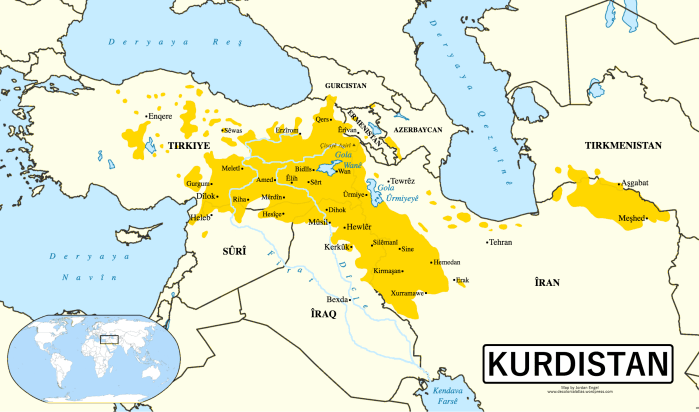
Countries with significant Kurdish populations in the Near East: Turkey, Syria, Iraq, and Iran.
Countries with significant Kurdish populations in the Near East that the United States has bombed or put boots on the ground in: Iraq and Syria.
Countries with significant Kurdish populations in the Near East that the United States has threatened to bomb and possibly invade: Iran.
Countries with significant Kurdish populations in the Near East that the United States is allied with: Turkey.
Three of the four countries with significant Kurdish populations in the Near East are (or was, in the case of Iraq) considered hostile to the US government, so the use of Kurds to further American Realpolitik in the region is almost obvious, until you consider that Turkey has been a longtime ally of Washington.
Suppose you’re a big-time Washington foreign policy player. Do you arm Kurdish militias in Syria, encourage continued political autonomy in Kurdish Iraq, finance Kurdish discontent in Iran, and shrug your shoulders at Istanbul? Seriously, what do you do in this situation?
Nightcap
- The long fight for equal liberty David Lowenthal, History Today
- Gun seizures have already led to too many abuses James Bovard, the Hill
- Turkish questions, Kurdish responses Amberin Zaman, Al-Monitor
- How American students are unlearning liberty David French, National Review
Nightcap
- It’s not gerrymandering if it benefits Democrats Aaron Bycoffe, FiveThirtyEight
- Just because you’re paranoid doesn’t mean they aren’t out to get you Rod Dreher, the American Conservative
- Planting trees beneath Turkish bombs in Syria Matt Broomfield, New Statesman
- In the long run we are all dead Charles Goodhart, Inference
Lunchtime Links
- High Hitler (drugs, drugs, drugs!)
- every generation gets the drugs it deserves
- Lawsplainer on federal and state marijuana laws
- why illegally obtained evidence is generally inadmissible in court
- Putin and patriotism: national pride after the fall of the Soviet Union (excerpt)
- long, fraught history of Pakistan and the US
- Old Dogs, New Tricks: Turkey and the Kurds
- Good piece, but I’m still waiting for a great book (or article) on the Hanseatic League. All the great ones are probably in German…
2017: Year in Review
Well folks, another year has come and gone. 2017 was Notes On Liberty‘s busiest year yet. Traffic came from all over the place, with the most visits coming from the US, the UK, Canada, Australia, and India. (In the past, India and Germany have vied for that coveted 5th place spot, but this year India blew Germany out of the water.)
NOL is a voluntary cooperative, and as such this year saw the introduction of 6 new Notewriters: Kevin Kallmes, Nicolás Cachanosky, Ash Navabi, Tridivesh Maini, Matthew Bonick and Trent MacDonald.
Michelangelo invited Kevin to join, Nicolás is an old grad school buddy of Rick‘s, I reached out to Tridivesh, and Ash and Matthew were invited on Vincent‘s initiative.
Speaking of Vincent, 2017 was his year. He had Tyler Cowen (MarginalRevolution), Mark Thoma (Economist’s View), Anthony Mills (RealClearPolicy), Barry Ritholtz (Bloomberg), Don Boudreaux (Cafe Hayek), John Tamny (RealClearMarkets) and Pseudoerasmus (a well-regarded economic historian) all link to his thoughts multiple times over the course of the year. His Top 10 list for best papers/books in recent economic history (Part 1 and Part 2) were legitimate viral sensations, dominating the top 2 spots on NOL‘s most-read list. Other huge posts included “Did the 30 Glorious Years Actually Exist? (#5),” “The Pox of Liberty – dixit the Political Economy of Public Health (#9),” “James Buchanan on racism,” “The GDP, real wages and working hours of France since the 13th century,” “Did 89% of American Millionaires Disappear During the Great Depression?,” and “A hidden cost of the war on drugs.” My personal favorite was his “Star Trek Did More For the Cultural Advancement of Women Than Government Policies.” Dr Geloso’s thoughts made up 40% of NOL‘s 10 most-read 2017 posts.
My favorite posts from Edwin this year were his analyses of Dutch politics – “Dutch politics, after the elections” and “North Korea at the North Sea?” – but the reading public seemed to enjoy his posts on Ayn Rand, especially her thought on international relations, and his summary of Mont Pelerin Europe more than anything else. Van de Haar’s day job is in the private sector, so his blogging is understandably light (especially given his incredible publishing output in academic journals). I look forward to what looms ahead in 2018.
Federico’s most recent post on artificial intelligence and the law got love from some major outlets, including FT‘s Alphaville blog and 3 Quarks Daily. His question “Does business success make a good statesmen?” and his report on a Latin American Liberty summit are worth reading again, but my personal favorites were his comments on other Notewriters’ thoughts: first jumping in to add some historical clarity to Bruno’s post on Latin American conservatism and then to add layers onto the debate between Mark and Bruno on the Protestant Reformation. Federico has been invaluable to NOL‘s welcoming, skeptical culture and I cannot wait to see what he comes up with in 2018.
Barry was generous enough recount the situation in Turkey after the coup earlier in the year, and fruits of this endeavor – Coup and Counter Coup in Turkey – can be found in six parts:
- “First of a series of posts on Turkey since 15th July 2016 and background topics“
- “Immediately after the coup and party politics“
- “Gülenists and Kemalists“
- “The Kurdish issue in Turkey“
- “Jacobins and Grey Wolves in Turkey“
- “Presidential Authoritarianism in Turkey“
Dr Stocker also began writing an appendix to his six-part series, which resulted in a first post on authoritarianism and electoral fixes. Barry is hard at work on a new book, and of course the situation in Turkey is less than ideal, so I can only hope he has a bit more time in 2018 for NOL.
Michelangelo had a banner year at NOL. His #microblogging has been fun, as were his post analyzing relevant data from his surveys: What libertarians think of climate change, for example, or urban planning in Oregon. Michelangelo also utilized NOL to play around with concepts like race, marriage markets, data, Spanish language services, affirmative action, and freeware, to name a few. My absolute favorite Michelangelo post this year was his excellent “Should we tax churches? A Georgist proposal.” Michelangelo is a PhD candidate right now, too, so if he ever gets some time to himself, watch out world!
Rick also had a banner year at NOL. His post arguing against Net Neutrality was one of the most-read articles of the year here (#4), and many of his wonkier thoughts have been picked up by the sharp eye of Anthony Mills (RealClearPolicy) and the excellent Chris Dillow (Stumbling and Mumbling). Rick is my favorite blogger. Posts on cycling in Amsterdam, subsidies, management and measurement, linguistics, more subsidies, and my personal favorite of his for the year, “Why do we teach girls that it’s cute to be scared,” always make me think and, more importantly, smile.
Bruno’s blogging was also amply rewarded this year. His thoughts on some of the problems with postmodernism brought in the most eyeballs, but thankfully he didn’t stop there: Articles introducing postmodernism and highlighting the origins of postmodernism also generated much interest. RealClearWorld picked up his post analyzing Brazil post-Rousseff (he had more analysis of Brazilian politics here and here), and his post delving into whether Nazism is of the left or the right provoked quite the dialogue. Dr Rosi was at his best, though, when prompted by Mark to further advance his argument that the Protestant Revolution played an integral role in the rise of the freedom of conscience. Times are tough in Brazil right now, so I can only hope that Bruno continues to play a vital role as a Notewriter in 2018.
Chhay Lin, now in the private sector, had his post about Bruce Lee’s application of Taoist philosophy head to the top of reddit’s philosophy sub, and his post on Catalonia and secession got love from RealClearWorld and Lew Rockwell (Political Theater). I hate to be *that* guy distracting a man from making his money, but I hope to see Chhay Lin pop in at NOL much more often in 2018!
Zak has been busy with a number of different projects, as well as attending Michigan-Ann Arbor full-time. He still managed to have one of his posts, on “libertarian” activist hypocrisy (#10), highlighted in the Guardian, the UK’s premier left-wing mouthpiece. His post on The Nancy MacLean Disgrace earned him plaudits from the online libertarian community and Don Boudreaux (Cafe Hayek), and his posts on open borders and income inequality show just how much of a bad ass he has become. I had a tough time trying to pick out my favorite Zak article of 2017, so I’m just gonna highlight all three of them:
- “Immigration, Cultural Change, and Diversity as a Cultural Discovery Process“
- “Why I’m No Longer A Christian…“
- “Against Libertarian Populism“
They’ve all got great self-explanatory titles, so do yourself a favor and read ’em again! Hopefully Zak can continue to work NOL in to his many successful ventures in 2018.
Jacques continues to amaze me. He’s been retired from academia for – as far as I can tell – at least a decade and he’s still producing great material that’s able to reach all sorts of people and places. His post on the Ottoman Empire and libertarianism (#6), which was featured at RealClearWorld and much-shared in Ottomanist corners of Twitter – took aim at popular American libertarian understandings of decentralization and seems to have landed pretty squarely on target. My favorite post of Dr Delacroix’ this year was about French Africa (also featured at RealClearWorld), but his late-year book review on Christopher De Bellaigue’s 2017 book about Islam might end up being a classic.
Bill’s 2017 here at NOL was productive and he continues to impress. His “Speech in academic philosophy: Rebecca Tuvel on Rachel Dolezal” brought in thousands of readers, but it was not his ability to draw crowds that I found impressive. His ability to tackle tough concepts and tough issues came to the forefront this year: drug use, “vulvæ,” more drug use, party culture (my personal fave), schooling (another personal fave), more schooling, and music (personal fave). Bill’s ability to weave these trends together through the lens of individual freedom is so much fun to read and important for fostering a culture of tolerance and respect in today’s world. I can’t wait to see what 2018 has in store for him!
Nicolás came out firing on all cylinders this year. With excellent dialogues between himself and Vincent, as well as between himself and guest blogger Derrill Watson (who I hope will be back for more in 2018), Dr Cachanosky’s passion for teaching has shown through clearly and brightly. I hope 2018 – his first full year with NOL – is filled with much more hard-hitting but insightful blogging from Nicolás.
Ash brought the heat, too. Check out the subject matter of his first few posts here at NOL: “A Right is Not an Obligation,” “Physical Goods, Immaterial Goods, and Public Goods,” “The Economics of Hard Choices,” “Markets for Secrets?,” “A Tax is Not a Price,” and “A Radical Take on Science and Religion.” Like Nicolás, Ash’s first full year at NOL is coming up, and if 2017 is any indication, readers can look forward to an interesting and engaging 2018.
Mark’s first full year here at NOL was a definite barnburner. His debate with Bruno on the Protestant Reformation (#8) brought in a bunch of eyeballs, including from RealClearHistory, while his “The Return of Cyclical Theories of History” also brought in thousands of readers, thanks in large part to Robert Cottrell’s excellent website, the Browser. Dr Koyama’s review of Aldo Schiavone’s The End of the Past also caught Mr Cottrell’s eye and the attention of his readers. Mark’s post on geopolitics and Asia’s “little divergence” is well worth reading again, too. Like Zak and Bill’s posts, I couldn’t choose just one favorite, so I give you two:
- “Political Decentralization and Innovation in early modern Europe“
- “Some Thoughts on State Capacity” (an especially good criticism of American libertarian understandings of the “state capacity” literature)
We’re lucky to have Mark here at NOL.
Kevin, like Ash and Nicolás, brought the ruckus for his first few posts here at NOL. Kevin’s very first post at Notes On Liberty – “Rules of Warfare in Pre-Modern Societies” (#3) – ended up on the front page of RealClearHistory while his “Paradoxical geniuses…” earned a spot on the Browser‘s prestigious reading list. Not a bad start. Kevin will be finishing up the second half of his first year of law school (at Duke), so I doubt we’ll see much of him until June or July of 2018. My personal favorite, by the way, was Kevin’s “Auftragstaktik: Decentralization in military command.” His posts on taking over Syria – Roman style, the median voter theorem, and inventions that didn’t change the world also got lots of love from around the web.
Nick’s post on public choice and Nancy MacLean (#7) earned a nod from Arnold Kling (askblog), Don Boudreaux (Cafe Hayek), Chris Dillow (Stumbling and Mumbling), Mark Thoma (Economist’s View), and pretty much the entire online libertarian community, while his post analyzing the UK’s snap election earned a spot at RealClearWorld. Dr Cowen’s thoughts on school choice and robust political economy, as well as a sociological analysis of Trump/Brexit prompted by Vincent, all garnered love from libertarians and scholars around the world. My favorite Cowen post was his question “Is persecution the purpose?”
Overall, it was a hell of a year here at Notes On Liberty. I’m really looking forward to 2018. Here’s to a happy, healthy you. Oh, and my proudest piece this year was “North Korea, the status quo, and a more liberal world.” HAPPY NEW YEAR!
*The Islamic Enlightenment* | A critical review
De Bellaigue, Christopher. (2017) The Islamic Enlightenment: The Struggle Between Faith and Reason 1798 to Modern Times. Liveright Publishing Corporation (Norton & Company) New York, London.
In 1798, in view of the Pyramids, a French expeditionary force defeated the strange caste of slave-soldiers, the Mamlukes, who had been ruling Egypt for several centuries. The Mamlukes charged the French infantry squares on horseback, ending their charge with the throwing of javelins. The Mamlukes were thus eliminated from history. The French lost 29 soldiers. In the conventional narrative, the battle woke up the whole Muslim world from its long and haughty slumber. The defeat, the pro-active reforms of Napoleon’s short-lived occupancy, and the direct influence of the French scholars he had brought with him lit the wick of the candle of reform or, possibly, of enlightenment throughout the Islamic world.
De Bellaigue picks up this conventional narrative and follows it to the beginning of the 20th century with a dazzling richness of details. This is an imperfect yet welcome thick book on a subject seldom well covered.
This book has, first, the merit of existing. Many people of culture, well-read people with an interest in Islam – Islam the sociological phenomenon, rather than the religion – know little of the travails of its attempted modernization. Moreover, under current conditions of political correctness the very subject smells a little of sulfur: What if we looked at Muslim societies more closely and we found in them some sort of intrinsic inferiority? I mean by this, an inferiority that could not easily be blamed on the interference of Western, Christian or formerly Christian, capitalist societies. Of course, such a finding could only be subjective but still, many would not like it, and not only Muslims.
Second, and mostly unintentionally, possibly inadvertently, the book casts a light, an indirect light to be sure, on Islamist (fundamentalist) terrorism. It’s simple: Enlightened individuals of any religious background are not likely to be also fanatics willing to massacre perfect strangers. Incidentally, I examine this issue myself in a fairly parochial vein, in an essay in the libertarian publication Liberty Unbound: “Religious Bric-à-Brac and Tolerance of Violent Jihad” (January 2015). With his broader perspective, with his depth of knowledge, De Bellaigue could have done a much better job of this than I could ever do. Unfortunately he ignored the subject almost entirely. It wasn’t his topic, some will say. It was not his period of history. Maybe.
Lunchtime Links
- oil and Kurdistan
- after Raqqa, Iraq’s army turns on Kurdistan
- “There has been a common and unfortunate tendency among many analysts and policy makers to underestimate the strength of Iraqi nationalism”
- separatist movements in Europe don’t actually want independence
- GREAT topic, but poor methodology, poor theory, poor use of data, and bad faith
- meh (try this book review instead)
- Law without the State [pdf]
BC’s weekend reads
- Barry has a book review of Nietzsche’s political thought in the Los Angeles Review of Books!
- (check out Barry’s 2014 NOL post on Nietzsche’s contributions to the liberty canon)
- a good analysis on the Arab cold war between 2 sets of American allies
- a great analysis on the Kurds, the Yazidis, and Turkey
- the Zanzibar-North Sea swap
- walruses, the Arctic, and science
BC’s weekend reads
- heads roll at top of Turkey’s military in latest purge | Turkey’s 16th of April referendum will pave the way for authoritarianism
- great piece on Macron’s recent economic policies | French expatriates and foreign Francophiles
- Italy will be the EU’s third power once the UK leaves | the uniqueness of Italian internal divergence
- attempts to shut down free speech will no longer be tolerated, at least at Claremont McKenna | when is speech violence?
- cool science stuff is gonna happen soon | what makes it science?
BC’s weekend reads
- I thought the Nancy MacLean’s book attacking James Buchanan was great for present-day libertarianism, in that it only weakens the already weak Left. Henry Farrell and Steven Teles share my sensibilities.
- What is public choice, anyway? And what is it good for?
- One of the Notewriters reviews James C Scott’s Seeing Like A State
- Aztec Political Thought
- Turkey dismisses 7,000 in fresh purge
- 10 Chinese Megacities to See Before You Die
 Notes On Liberty