Illegal Immigration: Pres. Trump’s New Measures

I can’t wait for the raging assaults by the pseudo-cultural elite and by the media against Pres. Trump to stop to begin criticizing some of his decisions, as I would with any other president.

I have heard and read reports that the president intends to launch a policy of accelerated repatriation of illegal aliens. It will single out criminals for priority deportation (as was the case under Mr Obama). At this point, almost everybody agrees about getting rid of illegal aliens who are real criminals, especially the violent ones. Again, the new policy sounds a lot like Mr Obama’s, with a few details different. The details often matter when it comes to human lives, also when it comes to traditions of government. Here are two such details.

First, I have heard that even traffic tickets qualify an illegal alien for quick deportation. Make a wrong u-turn and your life gets broken up.

Second, I have heard and read that even being merely charged with a crime places you at the head of the line for deportation. Someone who looks like you steals a car. You get charged by mistake. You are gone.

The first detail seems awfully rough to me. I would feel better if the word “recidivist” were included. A person who breaks driving rules repeatedly is a trouble-maker we can do without. A guy who is too distracted to interpret the U-turn sign (could be me – once) is not exactly a criminal in the real sense of the word.

It’s true that such extreme severity would improve the driving of all illegal aliens. The claim is probably also correct however that it would interfere with aliens’ (legal and not) willingness to cooperate with the local police. Aside from this, I would bet it would involve significant law enforcement costs just to process traffic tickets through to the Immigration Service. I am a conservative, I am against big government, even against big government at the local level. I don’t want tax money, federal, state, or local, to be wasted processing a U-turn violator. It seems irrational to me.

The second, detail concerns the treatment of people only charged with a crime. It’s simple. I just don’t want any of them to be included in the priority list. Having any branch of government treating the accused as guilty simply goes too strongly against everything I believe. It’s un-American.

Yes, I have not forgotten that the subjects have no right to be in the country in the first place. I don’t care. It’s not about illegal aliens’ rights. Immigrants, legal or not, have no rights as a category as far as I am concerned. They only possess the ordinary human rights of anyone under American jurisdiction.

It’s about a slippery slope for all. If we begin officially thinning out the traditional wall between “charged” and “guilty,” where are we going to stop?

I understand that a lawyer would argue that the person is technically not being deported for the imaginary crime of being charged but because he has no right to be in the country, period. Do you know the one about the lawyer….

The Enforcement Costs of Immigration Laws are Greater than Alleged Welfare Costs

As I mentioned in my note yesterday, the common argument that immigration is significantly costly through welfare is mostly empirically falsified. The fact of the matter is immigrants usually aren’t qualified for such programs, illegal immigrants mostly cannot and do not receive them, and immigrants as a whole wind up contributing more to the government’s balance sheet through economic growth and tax receipts than they take through welfare transfer payments.

However, there is one fact I neglected to mention yesterday worthy of its own post: if those opposed to immigration on the grounds of welfare costs were really sincere in that argument, they also need to consider the fiscal costs of enforcing their beloved immigration laws. As the New York Times editorial board pointed out yesterday, these costs are not insignificant:

The Migration Policy Institute reported in 2013 that the federal government spends more each year on immigration enforcement–through Immigration and Customs Enforcement and the Border Patrol–then on all other federal law enforcement agencies combined. The total has risen to more than $19 billion a year, and more than $306 billion in all since 1986, measured in 2016 dollars. This exceeds the sum of all spending for the Federal Bureau of Investigation; the Drug Enforcement Administration; the Secret Service; the Marshals Service; and the Bureau of Alcohol, Tobacco, Firearms, and Explosives.

These fiscal costs get worse when you consider that Donald Trump wants to expand ICE’s budget even further and, of course, the $8-$12 billion dollar wall.

Further, if you are a civil liberties type concerned with the social and fiscal costs of mass incarceration, immigration enforcement looks even bleaker:

ICE and the Border Patrol already refer more cases for federal prosecution than the entire Justice Department, and the number of people they detain each year (more than 400,000) is greater than the number of inmates being held by the Federal Bureau of Prisons for all other federal crimes.

The war on immigrants makes the war on drugs look tame.

Of course, these costs are pretty small when compared to the welfare state, but immigrants are not the ones driving up those welfare costs and they might even reduce it with more tax receipts. The truth is that furthering immigration restrictions and enforcement is truly fiscally irresponsible, not respecting the right to freedom of movement and contract.

Welfare Costs are not a Good Argument Against Immigration

Note: A version of this was initially posted on my old, now defunct blog. However, has become increasingly relevant in the age of Trump, and is worthy of reconsideration now.

It’s one of the most common arguments against looser immigration going back to Milton Friedman to Donald Trump. It is commonly claimed that even though loosening immigration restrictions may be economically beneficial and just, it should be opposed due to the existence of the welfare state. Proponents of this claim argue that immigrants can simply come to this country to obtain welfare benefits, doing no good for the economy and adding to budget deficits.

Though this claim is on its face plausible, welfare is not nearly as much of a compelling reason to oppose immigration as so many argue. It is ultimately an empirical question as to whether or not the fiscal costs of immigration significantly outweigh the fiscal benefits of having more immigrants pay taxes and more tax revenue economic growth caused by immigration.

Before delving into the empirical studies on the matter, there is one very important fact that is too often neglected in these discussions: there are already heavy laws restricting all illegal immigrants and even the vast majority of legal ones from receiving Welfare. As the federal government itself–specifically the HHS–notes:

With some exceptions, “Qualified Aliens” [ie., legal immigrants] entering the country after August 22, 1996, are denied “Federal means-tested public benefits” for their first five years in the U.S. as qualified aliens.

If we were to allow more immigrants, there are legal mechanisms stopping them from getting welfare. There are some exceptions and even unlawful immigrants occasionally slip through the cracks, but this is already a major hole in the case that welfare means we should hold off on immigration reform. The vast majority of immigrants cannot receive welfare until years after they are legalized.

However, for the sake of argument, let us ignore that initial hole in the case against increased immigration. Let’s generously assume the majority of immigrants–legal and illegal–can somehow get their hands on welfare. There is still little reason to expect that additional immigrants would be any more of a fiscal drag on welfare programs for the vast majority of our population simply because they are not the type of people who typically wind up on welfare. Our welfare programs are primarily designed to protect a select few types of people: the sick and elderly (Social Security and Medicare), and women and children (SCHIP, SNAP, TAMPF, etc.) If one looks at the demographics of immigrants coming into the country, however, one finds that they do not fit in the demographics of those who typically qualify for welfare programs. According to the Census Bureau, the vast majority (75.6%) of the total foreign-born population (both legal and illegal immigrants) are of working age (between 25 and 65).  Most immigrants, even if they were legal citizens, would not qualify for most welfare programs to begin with.

On the other hand, poverty rates are higher among immigrants and that means more would qualify for poverty-based programs. However, most immigrants are simply not the type to stay in those programs. Contrary to common belief, immigrants are mostly hard-working innovators rather than loafing welfare queens. According to Pew Research, 91% of all unauthorized immigrants are involved in the US labor force. Legal immigrants also start businesses at a higher rate than natural born citizens and file patents at almost double the rate of natives. As a result, immigrants have fairly high social mobility, especially intergenerationally, and so will not stay poor and on welfare all that long.

Put it together, and you find that immigrants generally use many major welfare programs at a lower rate than natives. Immigrants are 25% less likely to be enrolled in Medicare, for example, than citizens and actually contribute more to Medicare than they receive while citizens make Medicare run at a deficit. From the New York Times:

[A] study, led by researchers at Harvard Medical School, measured immigrants’ contributions to the part of Medicare that pays for hospital care, a trust fund that accounts for nearly half of the federal program’s revenue. It found that immigrants generated surpluses totaling $115 billion from 2002 to 2009. In comparison, the American-born population incurred a deficit of $28 billion over the same period

Of course, nobody would advocate restrictions on how many children are allowed to be born based on fiscal considerations. However, for some reason the concern becomes a big factor for immigration skeptics.

If you are still not convinced, let us go over the empirical literature on how much immigrants cost fiscally. Some fairly partisan studies, such as this one from the Heritage Foundation (written by an analyst who was forced to resign due to fairly racist claims), conclude that fiscal costs are very negative. The problem, however, is that most of these studies fail to take into account the dynamic macroeconomic impact of immigration. Opponents of immigration, especially those at the Heritage Foundation, generally understand the importance of taking dynamic economic impacts of policy changes into account on other issues, e.g. taxation; however, for some (partisan) reason fail to apply that logic to immigration policies. Like taxes, immigration laws change people’s behavior in ways that can increase revenue. First of all, more immigrants entering the economy immediately means more revenue as there are more people to tax. Additionally, economic growth from further division of labor provided by immigration increases tax revenue.  Any study that does not succeed in taking into account revenue gains from immigration is not worth taking seriously.

Among studies that are worth taking seriously, there is general consensus that immigrants are either a slight net gain fiscally speaking, a very slight net loss or have little to no impact. According to a study by the OECD of its 20 member countries, despite the fact that some of its countries have massive levels of immigration, the fiscal impact of immigration is “generally not exceeding 0.5 percent of G.D.P. in either positive or negative terms.” The study concluded, “The current impact of the cumulative waves of migration that arrived over the past 50 years is just not that large, whether on the positive or negative side.”

Specifically for the United States, another authoritative study in 1997 found the following as summarized by David Griswold of the Cato Institute:

The 1997 National Research Council study determined that the typical immigrant and descendants represent an $80,000 fiscal gain to the government in terms of net present value. But that gain divides into a positive $105,000 fiscal impact for the federal government and a negative $25,000 impact on the state and local level (NRC 1997: 337).

Despite the slight negative impact for states, as Griswold notes, there is no correlation between immigration and more welfare for immigrants:

Undocumented immigrants are even more likely to self-select states with below-average social spending. Between 2000 and 2009, the number of unauthorized immigrants in the low-spending states grew by a net 855,000, or 35 percent. In the high-spending states, the population grew by 385,000, or 11 percent (U.S. Census 2011; NASBO 2010: 33; Passel and Cohn 2011). One possible reason why unauthorized immigrants are even less drawn to high-welfare-spending states is that, unlike immigrants who have been naturalized, they are not eligible for any of the standard welfare programs.

The potential fiscal impact of immigration from the Welfare state is not a good reason to oppose it at all. There are major legal barriers to immigrants receiving welfare, immigrants are statistically less likely to receive welfare than natives for demographic reasons, and all the authoritative empirical evidence shows that immigrants are on net not a very significant fiscal drag and can, in fact, be a net fiscal gain.

What the Bible really says about how to treat refugees

Recently a text written by Jesse Carey, in Relevant Magazine, supposedly about what the Bible says about immigrants, refugees and displaced people, has come to me. The text is a bit old (from November 17, 2015), but is being reheated because of President Trump’s recent decisions in this area. Given these things, here are some comments on “What the Bible Says About How to Treat Refugees.”

Carey presents what he calls “12 verses about loving immigrants, refugees and displaced people”. The first thing to note is that none of the texts presented by Carey mentions the word refugees. The texts speak about foreigners, the poor and needy, travelers, strangers, and neighbors, but never about refugees. A refugee is a foreigner, but not every foreigner is a refugee. The same goes for stranger. Amazingly, refugee is also not synonymous with traveler. Every refugee is traveling (against his will, it is assumed), but not everyone who is traveling is a refugee. Finally, a refugee can be poor and needy, but poor and needy and refugee are also not synonymous. It seems that Carey has difficulty reading: when he sees words like foreigner or traveler or poor and needy or stranger his brain reads refugee. Either that or he’s being flagrantly dishonest.

The second observation is that, in the language used by Jesus, for the Christian every refugee is a neighbor. Not every refugee is poor and needy, not every foreigner is a refugee, nor does every stranger is a refugee and not every traveler is a refugee. But for the Christian, every human being is a neighbor, and so deserves his mercy. The problem is that Carey wants to apply this to immigration policies, and immigration policies are not made by Christian individuals, but by governments.

The history of the relationship between churches and governments is long, complex and tumultuous. To make a quick summary, suffice it to say that during the Middle Ages church leaders and political leaders fought and argued among themselves about who would dominate the people of Europe. The Bishop of Rome wanted to be above the Emperor of the Holy Roman Empire. At the local level, bishops and priests fought with nobles of all kinds. The result was a general confusion. One of the great victories of the Modern Era, beginning with the Protestant Reformation (which celebrates 500 years this year) was the separation of churches and state. Especially since the Peace of Westphalia in 1648, the tendency has been for states not to use their arms to impose a religion on the population. Carey wants to go the other way. He even cites 1 Corinthians 12:12-14 as if it applied to every human being, and not only to Christians.

The Bible teaches that individual Christians must care for needy people, and certainly refugees fall into this category. But the Bible does not teach that the state should do this. The role of the state, according to the Bible, is to carry the sword to punish wrongdoers and to benefit those who follow the law (the classic text regarding this is Romans 13). In other words, biblically the function of the state is restricted to security. Receiving immigrants is certainly a policy with which Christians can agree, but fully open borders, without any vigilance, are a delusion and nothing more. Wrongdoers can disguise themselves as immigrants to enter a country, and it is up to the state to do some kind of security check.

I am not discussing here the details of Trump’s current policy for immigrants and refugees. It is quite possible that there are aspects within it that Christians can or should disagree with. But by wanting to impose Christian behavior on the state, Carey goes against one of the greatest victories of the Modern Age, the separation of churches and state, something amazing for a liberal and progressive author. Does he approve of compulsory prayer in schools, the end of teaching Darwinism and punishment for those who do not attend Sunday worship? Hope not.

Roger Williams has already presented this discussion very clearly more than 300 years ago: Christians cannot impose their religion using the state for this. What can be expected Biblically from the state is in the second table of the law: you shall not murder, you shall not steal, you shall not give false testimony … Basically, do not hurt others, do not lie to them and do not take their stuff without permission, things that any kindergarten child knows are wrong. I do not think we need the Bible to teach us that.

I hope that the state is open to immigration as much as possible, being restricted only by security concerns. I hope Christians will welcome the refugees. I hope the wall of separation between church and state is never overthrown. And I hope that the rulers of the United States will leave the Islamic world for the Islamists to take care of. They already have enough work taking care of the safety of Americans in North America.

On immigration, trade, and inequality: why nobody should care (that much)

Recently, I read snippets from George Borjas’s book, We Wanted Workers (I got distracted and reverted to reading Leah Platt Boustan’s Competition in the Promised Land).On its heels came this article by Dani Rodrik in Foreign Policy. Both work make the same case, that free movement of goods and people may imply some negative effects on inequality. Borjas argues that immigration increases inequality while Rodrik argues that low-skilled workers are displaced.

Both arguments are not convincing.

First of all, immigration will always increase inequality in one area. This is by definition. Unless the migrants follow the same distributional pattern as the host population, inequality will increase. If somebody from Cuba enters the United States at the tenth percentile, he increases inequality by swelling the ranks of low earners. If somebody from China enters the United States at the 90th percentile, he increases inequality by swelling the ranks of the high earners. However, from a global perspective (world population), inequality has actually dropped since the migrant has a greater income than in the past. After all, bringing a Haitian to the US may increase US inequality measures but the ten-fold increase in his income (this number comes from my colleague Ben Powell) means that worldwide inequality drops.

To be honest, I know that Borjas is probably aware of this point, but many of those who spin his work don’t get it. Borjas’s argument is little more sophisticated. His claim is that low-skilled workers (high school dropouts) see their wages go down while everybody else (high school graduates and university graduates) gains from immigration. This increases inequality because they are left behind economically. But this is where his argument is alike that of Rodrik and where it misses the target dramatically.

While I could be lazy and simply say that many other scholars place Borjas at the extreme of the spectrum of academics with regards to the effects of immigration on labor markets. Indeed, there are more scholars who find that low-skilled workers also gain from immigration all things being equal. But, I won’t be lazy. Let me assume, for the sake of argument, that the empirical result is valid. If unskilled workers are displaced, why can’t they find new employment elsewhere. If the effects of immigration are so positive for everybody else, it means that everybody else is substantially richer and they can demand more goods. Are there barriers preventing the unskilled from acquiring jobs? The answer is emphatically yes.

The ability to find a new form of employment following changes in the labor market depends on the frictions that exist on the labor market. Some of them are natural. We have to assume search costs (time, energy, some money) to look for a job and get the training for that job. But there are also barriers that create unnecessary frictions. The rise of occupational licencing is one of those (growing) frictions (see here, here and here). We could also point out that product regulations tend to affect the prices of goods that weigh more heavily in the consumption baskets of lower-income workers (here and here) thus pulling the poorest down. We could also point to the fact that states with right to work laws seem to have enjoyed more limited increases in inequality than the states without such laws (here). We could also underline the fact that housing regulations are making it harder for unskilled workers to move to dynamic areas, thus locking them in low-productivity areas (here). And the list could go on for a few more pages, but I think the point is made: there are tons of factors that make displacement a problem. However, those who worry about it when it comes from changes resulting from trade or immigration are concerned with a minor (and positive in the long-run) variable. In a way, Borjas and Rodrik are (rightfully) concerned about the poorest but they fail to identify the problem like if a doctor was concerned with his patient’s loss of sight rather than concentrating on the brain tumor that caused the loss.

Free trade and open borders generate massive benefits. But there are short-term costs as production methods and resources are being reallocated. Many government policies amplify exponentially these costs and delay reallocation. This creates the inequality they bemoan.

A non-argument against immigration

I often encounter the argument that immigrants, especially Muslims, are so different from the populations of their host countries that they threaten the institutional foundations of these societies. As a result, the logic goes, we must restrict immigration.

I do not accept that argument as valid nor do I accept it as sufficient (in the case I am wrong) to make the case in favor of further restrictions on immigration.

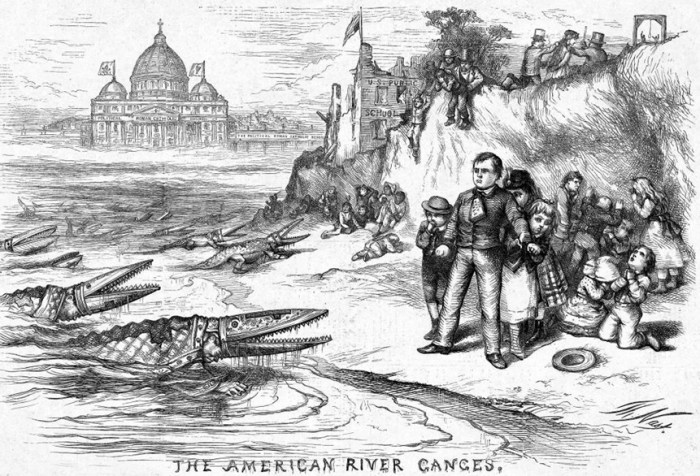
First of all, the “social distance” between immigrants and the hosts society is very subjective. The caricature below offers a glimpse into how “unsuited” were Catholic immigrants to the US in the eyes of 19th century American natives. Back then, Catholics were the papist hordes invading America and threatening the very foundations of US civilization. Somehow, that threat did not materialize (if it ever existed).  This means that many misconceptions will tend to circulate which are very far from the truth. One good example of these misconceptions is illustrated by William Easterly and Sanford Ikeda on the odds of a terrorist being a muslim and the odds of a muslim being a terrorist. Similar tales (especially given the propensity of Italian immigrants to be radical anarchists) were told about Catholics back then. So let’s just minimize the value of this argument regarding going to hell in a hand basket.

nast1

But let us ignore the point made above – just for the sake of argument. Is this a sufficient argument against more immigration? Not really. If the claim is that they hinder “our” institutions, then let them come but don’t let them participate in our institutions. For example, the right to vote could be restricted to individuals who are born in the host country or who have been in the country for more than X-number of years. In fact, restrictions on citizenship are frequent. In Switzerland, there are such restrictions related to “blood” or “length of stay”. I am not a fan of this compromise measure (elsewhere I have advocated the Gary Becker self-selection mechanism through pricing immigration as a compromise position).*

The point is that if you make the argument that immigrants are different than their host societies, you have not made the case against immigration, you have made the case for restrictions against civic participation.

* Another “solution” on this front is to impose user fees on the use of public services. For example, in my native country of Canada, provincial governments could modify the public healthcare insurance card to indicate that the person is an immigrant and must pay a X $ user fee for visiting the hospital. Same thing would apply for vehicle licencing or other policies. Now, I am not a fan of such measures as I believe that restrictions on citizenship (but offering legal status as residents) and curtailements of the welfare state are sufficient to deal with 99% of the “problem”. 

US Immigration: a Primer

President Trump was elected for a variety of reasons but any observant person knows that the general topic of immigration played a significant role. Mr Trump appears unfamiliar with the current American immigration system and he is ignorant of the economic benefits of immigration, or he downplays them. Below I address modest parts of both topics. I aim for sensationalism rather than for completeness.

First a little bit about the American immigration system such as it is in January 2017. There are two main bizarre ideas among Trump supporters about the real system: One regards who is allowed to come into this country (legally, I mean); the other strange misconception has to do with how aliens become US citizens.

The system by which the US admits immigrants is a little complicated and its description relies on a specialized legal jargon. In my considerable experience, few people have the patience to sit through a lecture on American immigration policy. So, let me cut to the chase:

THE NON-EXISTENT ORDERLY QUEUE

There is no way, zero way, the average married Mexican can legally immigrate into this country.

This is worth mentioning because many are under the impression that illegal immigrants are cheats who cut through the line instead of patiently waiting their turn.

The “average Mexican” does not have American-born children, children who are US citizens by birth. Mexicans who do have such children and the children are minors go to the head of the line. There is no (zero) line for those who don’t have close relatives who are Americans or legal immigrants. This example illustrates the US immigration policy that accounts for most legal immigrants in most years: Family re-unification.  

Sophisticated people noticed long ago that there is an instantaneous way to acquire an American relative. It’s to marry an American. Doing so for the purpose of gaining admission to the US is illegal for both parties involved. I don’t know if anyone ever goes to jail for it but it’s ground for immediate deportation. Nevertheless, I am told by some of my immigrant friends that there is a thriving little cottage industry of visa brides and grooms for a fee in some parts of the country. I cannot verify this rumor but I believe it.

Similarly, there is only one way the average married Irish man or woman may immigrate into this country: Winning a lottery. (You read this right: a lottery which one may play as often as one wishes; it has not entry fee.) In 2015, only about 49,000 people, all from Europe and Africa, gained admission on the basis of winning that lottery.

Some legal immigrants gain admission under the broad category of “employment related reasons.”  This category includes high-level programmers as well as farriers. (Look it up.) It’s a small number. In 2015 they made up about 15% of all one million-plus legal admissions. Our average Mexican and our average Irishman does not qualify here either.

You may have heard of an “investor’s visa” accorded to foreigners who will create employment in the US. That’s always a tiny number, about 10,000 in 2015.  It’s not always open. Congress decides about if every so often.

There is a third main, amorphous way by which foreigners are admitted, “asylum” broadly defined. I call it “amorphous” because the definition of who is a refugee or an asylum seeker can be changed by Congress in a very short time. The President decides how many can be admitted in either category. The number admitted under this category is accordingly highly variable. It was about 150,000 in 2015. It could have become 500,000 in 2016 because of a new crisis anywhere in the world. (It didn’t.) The current, Trump figure of  50,000 seems just about normal historically. Yet, there is wide variation about the average.

There is thus no orderly queue that Felipe or Ahmed could join on their own if they wanted to avoid becoming illegal aliens.

That’s it, folks. If you want to know more about the raw numbers, study the relevant pages in the Statistical Abstract of the US.

So, contrary to what I suspect is a widespread idea among conservatives, it is not the case that there is an orderly, wide-open legal way to immigrate into this country that illegal immigrants perversely ignore. Illegal immigrants are not rudely jumping to the head of the line; they come in through a side-door the US does not seem able to close.

One more thing, a programmatic idea: Instead of the present admission policies (plural)  based on viciously absurd selection we have, we could take a page from the Australian and from the Canadian playbooks. That is, we could coolly decide what kind of immigrants we want and try and tailor a door to those precise dimensions. Presently, we are doing very little of this, however unbelievable it may sound. Such a rational procedure would not not need to eliminate refugee and asylum seekers admissions.

I am personally in favor of such a reform . I also think special policies  should apply  to our proximate neighbors to the north and to the south. I developed this idea with Sergey Nikiforov in an article [pdf] published in the Independent Review several years ago.

Incidentally, I am a product of a rational immigration policy myself. I was admitted on merit alone. I rest my case! Thank you for asking. OK, truth be told, I tried to come in as a spouse of an American citizen but she dumped me.

GAINING CITIZENSHIP

On to the next misconstrued idea. I keep hearing (on talk radio, I confess) irate citizens affirming that foreigners who don’t want to take American citizenship should not be admitted. The case hardly arises.

In fact, in reality, to be allowed to become a US citizen, to take American citizenship, requires several years of residence in this country after being legally admitted. (See above.)

Hence, personal preference plays little role in determining which immigrant does not become a US citizen. I don’t have the numbers but I am sure that, as a rule, the vast majority of legal immigrants adopt American citizenship shortly after they are legally empowered to do so. It is true that, in theory, some hesitation or some problems may arise in connection with some countries of origin who do not wish to recognize dual citizenship. In practice, depriving anyone of his passport is low on the list of priorities of most countries from which new US citizens originate. (India may be an exception – a curious exception – as if the country were facing an unbearable burden of immigrants of all sorts.)

The consequence of this scenario is that, contrary to what I think is a widespread notion, there is no horde of legal immigrants living in this country and peevishly and disloyally refusing to take American citizenship. It also follows that there is no mass of illegal immigrants who obstinately refuse American citizenship. It’s not available to them, period.

I think it’s legitimate to be opposed to illegal immigration and even to legal immigration but it’s best to do on the basis of correct information.

The New Colossus

Not like the brazen giant of Greek fame,
With conquering limbs astride from land to land;
Here at our sea-washed, sunset gates shall stand
A mighty woman with a torch, whose flame
Is the imprisoned lightning, and her name
Mother of Exiles. From her beacon-hand
Glows world-wide welcome; her mild eyes command
The air-bridged harbor that twin cities frame.
“Keep, ancient lands, your storied pomp!” cries she
With silent lips. “Give me your tired, your poor,
Your huddled masses yearning to breathe free,
The wretched refuse of your teeming shore.
Send these, the homeless, tempest-tost to me,
I lift my lamp beside the golden door!”
— poem by Emma Lazarus, 1883

“Ugly Conservative Sacred Cows”

I think this piece has regained currency. Look at it when you have a chance.

Thank you.

French Expatriates and Foreign Francophiles

First, a definition: an expatriate is someone who lives outside the country of his birth on a more or less permanent basis. I am dealing here with French expatriates specifically, a fairly rare breed in relation to the size of the French population, rarer than English and American expatriates, for example.

The French expatriates often land in a particular town of a particular country at a particular time for no particular reason. They may have been heading somewhere else and gotten stuck along the way. They always include wives and former wives of natives who may have divorced them, or died. Coming from different epochs (such as before and after the establishment of French social democracy in the 1980s), they form historical strata. Each stratum remembers a different France, and the strata may entertain disparate and often incompatible visions of the fatherland.

They have developed new habits in the country where they live and, without knowing it, they have drifted far from their culture of origin. Many disseminate patently false notions about the country where they were raised; they do it more or less innocently because myth-making and absence go well together. Their French self is forever a young person, or even a child. Their own children are simply natives of their land of residence with a smattering of the French language and no real curiosity, forever strangers to their parents.

The Francophiles are yet another story. They are people who don’t have the luck to have been born French but who love what they imagine is French culture with a degree of repressed hysteria. No part of the world is free of them. I have bumped into them everywhere I have been; they have victimized me everywhere with their undeserved love. Many but by no means all are also francophone to some extent. Some gain standing in their own mind via their real or imagined mastery of what they have decided is a superior national culture.

They are usually very parochial, doubly so because they are fixated on France and on their own country, to the exclusion of knowledge of any other part of the world. Others are teachers of French who feel professionally obligated to revere that which they teach and, by extension, everything French. Often, they don’t even know the language very well, limited as they are by the cramped discourse of textbooks, without awareness of the vigor, of the colorfulness, and, especially, of the frequent crudeness of the real French language of both literature and everyday life. (“Cul-de-sac,” for example, means “ass of a bag.”)

Once, a long time ago, in Bolivia of all places, I observed that the two groups mixed well. It was at a Bastille Day celebration at the French consulate. The French expats and the Francophiles shared the rudimentary popular imagery of the 1789 French revolution, that beheaded a king for the sake of “public salvation,” and his pretty, frivolous young queen, just in case. (That was after storming a prison-fortress, the Bastille, that was largely undefended.)

Think of reading my book: I Used to Be French: an Immature Autobiography. It’s available from Amazon, under my name. I need the bucks. Please!

To Women Voters:

I take the liberty to point out a small number of issues that I am told are important to women. I do it because I used to be a respectable social scientist and because I have been retired for ten years which gives me plenty of time to stay informed.

Women voters have been misled for years by propaganda explicitly pointed at them. It wasn’t necessarily a conspiracy though but a kind of uncritical cultural convergence. Many of those who spread misinformation believe it themselves. So, in a way, they are morally innocent. That’s no reason to follow them down the wrong path, and down the cliff. Below are five topics about which you may have received false information that has been repeated over and over until it sounded true.

The first female president

There is a widespread feeling among American women that it’s time finally to elect a female president. For some, it’s a sort of symbolic restitution. I can’t speak to this because I am only a man. Other voters, both females and males, seem to think that a female presidency would result in significant improvements in the lives of American women. A relevant reminder: Eight years ago, Americans elected the first African-American president. For many, it was a vote filled with hope for positive change in the area of race. After two Obama administrations, almost eight years later, it’s time to take stock. However you evaluate the Obama administrations in general, two facts stand out. First, race relations in American have not improved (to say the least). Second, African-Americans are not better off than they were eight years ago. In fact, they are slightly worse off economically. (My own position on having a woman President is straightforward: I would vote for Stanford Professor Condoleeza Rice, for President, in a heartbeat.)

Abortion

The 1973 Roe vs Wade decision made abortion on demand available throughout the territory of the United States. Candidate Trump has provided a list of potential nominees to the Supreme Court . Some of those nominees are pro-life. This raises the question of what would happen in the unlikely event that Roe vs Wade were overturned by a new Supreme Court. You may have been led to believe that abortion would become illegal. That’s simply not true. Legislation on abortion – if any – would revert to the individual states as the Constitution requires (same as murder, theft, sequestration, and spitting on the sidewalk). The likelihood that all fifty states would forbid abortion on demand is simply zero. The likelihood that half of them would is also zero, I believe. The worst case scenario is that abortion would become geographically inconvenient. (In case you wonder, I believe, just like former President Bill Clinton, that abortion should be legal, safe, and rare.) There is no chance that not electing Mrs Clinton will make abortion illegal.

Pay disparities

We have been told that women received interior pay for equal work for so long that it has almost become the truth. Even my local female Republican candidate for Congress uses this line. It’s not the truth. The reality is that women receive unequal pay for unequal work. There are various reasons why this is. (A broader treatment of this matter is on my blog and accessible through these two links.) In fact, paying women unequal pay for equal work has been against federal law for more than thirty years. Doing it is an invitation to costly class action suits. It’s probably important not to vote for someone on the basis of “facts” that are not facts at all. And then, there is the issue of why anyone would mislead you so badly. (Myself, I am going to vote for the Republican lady candidate for Congress although I think she should check her facts better.)

Immigration

Candidate Clinton has said clearly that she is is for open borders. This may come from a generous heart. Yet there are too many people from poor countries who want to come to the US to live. Even, if all of them are good people, the USA is like a lifeboat: If too many climb aboard, the boat capsizes and everybody drowns, the original passengers (Americans as well as existing immigrants) and the newcomers (would-be immigrants). To remain a decent society, a generous society, the US has to somehow restrict admission. Open borders is not a possible policy, it’s a dangerous fantasy. (In case you are wondering: I am an immigrant myself, so is my wife.)

Civility

Candidate Trump bragged – thirteen years ago – about making crude sexual gestures. There has not been a single formal complaint or any charge brought against him on this account. That’s although – unlike former Pres. Bill Clinton at the same stage – he has temptingly deep pockets, the kind of pockets that would give fighting courage to any moderately aggressive attorney. Candidate Trump often also has a filthy mouth, and he occasionally uses sexist language, that’s a fact. Candidate Clinton is good friends with and approves of, and patronizes artists who routinely sing of perpetrating gross sexual violence on women (including in the last days of her campaign). They too use obscene words. They do so routinely, every time they perform. (I don’t use such language myself but my wife of forty years does, another story, obviously.)

Please share this and ask your friends to share.

What’s the difference between open borders and Open Borders?

There are two meanings here. I’ll define them below:

  • There are open borders, where borders are open and anyone can move between them
  • There are Open Borders, where borders to rich states are open to people from poor states, but the borders to poor states are closed to immigration

Open borders are fairer than closed borders. If people can move from poor states to rich ones, that’s good. But what about people who want to move from rich states to poor ones? Open Borders addresses the first issue but not the second one. Libertarians are enamored with the second type of open borders these days, for a couple of reasons. The main reason, and the only one I’m going to name here, is that most of us are pragmatic and therefore support any kind of liberalization in labor markets we can get. If we can get our respective polities to open up their borders to poor migrants, so be it. Let’s do this in any way we can.

But what we are advocating for is not open borders. It’s labor market liberalization. I understand the need for sloganeering these days. I get it. Y’all are thinking on the margin. I’m all for Open Borders.

How, though, do we get actual open borders?

How can senior citizens from the US have the freedom to choose retirement in not only Florida or Oregon, but Tamaulipas or Veracruz, too?

How can middle class Californians have the freedom to choose between not only Texas or Colorado for relocation, but Chihuahua or Neuvo Leon?

My answer is, of course, federation, but I also realize my argument is politically unfeasible for the time being (even though it’s an old argument). Any other ideas, or is Open Borders the best we can do for now?

A short note on minorities and the Left

Lately I have been thinking about how minorities affect the Democratic Party here in the US. Basically, all minorities vote for the Democrats in national elections, but minorities tend to be conservative culturally. This has the effect of pulling the Leftist party waaaaay to the center (a fact that makes it hard for me to complain about Democrats’ pandering tactics).

Sure, the GOP will always be the party of old white people, but if the Democrats’ left-wing is essentially neutered due to minority voting blocs within the Party, who cares?

The fact that the Democrats pine for minorities explains why the US has never had a very powerful socialist movement. Socialists will often blame “neoliberals,” “capitalists,” “reactionaries,” and other assorted boogeymen, but doesn’t the minority insight make much more sense?

This minority insight has also got me thinking about demographic changes in Europe over the past 30 years. Basically, Europe has had a huge influx of immigrants since the fall of socialism. In the old days, Sweden was for Swedes, France was for the French, Germany was for Germans, etc. etc. This  mindset helps to explain why European states had such overbearing welfare states and why economic growth was so limited up until the late 1980s.

As immigrants moved into these welfare states, the Left-wing parties began to pander to them. This had the same effect as it did in the United States: culturally conservative voting blocs diluted the Leftism of traditionally Left-wing parties. As a result, these welfare states became less robust and economic growth became attainable again.

A big underlying point about my musings on this subject is that socialism relies on nationalism in the area of popular politics and policymaking. Without Sweden for the Swedes-type sloganeering, socialism becomes ridiculous to the masses. This underlying point, along with the straightforward fact that immigrants dilute socialist power (economic, political, and cultural), suggests to me that libertarians who pay close attention to popular politics should relax when it comes to the fact that minorities don’t find libertarian ideals all that appealing.

Immigrants’ Complaints

I can’t watch or listen to the liberal media without hearing reports of immigrants complaining about how badly they are treated by the wider American society. (Yes, I listen to National Public Radio nearly every afternoon. It’s my intellectual duty and also my secret vice.) Something does not add up in the oppressed immigrant narrative though. First, before I explain, forgive me in advance because I am about to transgress on good manners in two different ways.

First transgression first. I spent much of five years of my youth in graduate school learning not much more than the following: My own experience, basically a collection of anecdotes, proves nothing. Point well taken. But the anecdotes within my reach can sometimes pile up to the point that they make some questions unavoidable. Below is one such question.

I know many immigrants, and different kinds of immigrants. First, like everyone else who lives in California, I know many Mexican immigrants. I understand Spanish perfectly. (I mean, as well as English; you be the judge.) I speak it well because, like French, my native language, it’s just a dialect of Latin. I hang around the abundant Spanish language media often. If Mexican immigrants complained, it would have come to my attention. I only remember one such case, a young woman who had come to this country as a child. She confided that she thought my colleagues, her professors, favored “Caucasians” in grading. She was actually failing because her English was poor. I made her do an assignment in Spanish and I understood why she was frustrated. My colleagues were not unfair to her. Her English language self’s IQ was stuck at room temperature  (in F degrees) while her Spanish self must have been jumping around the 120 mark. No one had bothered to tell her the obvious: “You need to learn English better.” Not American society’s fault, except for having tolerated her without adequate language training, and for the university that had admitted her, ditto. (Incidentally that school’s affirmative action program was a success overall, I thought.)

The foreign-born Hispanics I know and meet are all in a wonderful mood in public. Of course earning in one hour what would take you a day in Mexico and two days in El Salvador would put anyone in a good mood. There are three or four bastards of them, Hispanics, who force me to wake at 6 every morning because they walk under my window guffawing and laughing loudly. As I have written elsewhere, on this blog, the evidence for Hispanics’ satisfaction is easy to find.

I also know Asian and European immigrants, who are mostly middle-class, and a handful of Middle Easterners. The latter, mostly Muslims, feel under siege, of course; it would be a miracle if they did not. It’s not really American society’s fault that nearly all the mass murderers of civilians in recent years insisted on shouting “Allahu Akbar.” Yet, even those immigrants sure as hell are not packing their bags, or, if they do, it’s in minute numbers. I would bet there is no exodus out of the country.

The Asian and Europeans I know tend to exult in their American residence; they often act smugly about it although all of them miss something from their country of origin, at least their relatives. (For me, it’s not so much relatives as blanquette de veau; look it up.) Nevertheless, many of those middle-class immigrants find a political home on the left of the American spectrum because they have never been exposed to the ideal of small government. Even the smart ones usually don’t realize that government is a predator. More anecdotic transgression: If I ask myself who seems to be happier, on the average of those I meet more or less daily, immigrants or native born Americans, the answer comes loud and clear: the immigrants.

So, I am seriously beginning to consider if the reporting of widespread complaints by immigrants is not fabricated, with the help of a handful of fairly sophisticated minority members of the media. I mean, for example, the blond, lying CNN Mexican-born anchor who can’t open his mouth without proffering a vicious untruth.

Here is my second violation of convention. I am only doing it because being an immigrant gives me special privileges (and being old also does). If there are really, really many immigrants with serious grievances I don’t worry much because they are all citizens, citizens of some other country, that is. It seems to me, most of them could pack up and leave and go home to where they are citizens. That’s except for the refugees from war. The latter don’t have much of a leg to stand on however. Whatever shortcomings American society has, at least, here, we don’t kill you on purpose unless we know you personally.

That’s a real advantage.

I wish we had a national program to pay for one-way tickets for disgruntled immigrants. It might not even require taxpayer money. There must be tens of thousands like me. I give money voluntarily to save tigers in the wild. Sending back bad immigrants into the wilderness is a good cause too. So, it could be done by free public subscription. Or this country could institute a small tax on in-coming immigrants to constitute a fund that finances one-way tickets on demand. It would be fair, like an assigned risk insurance pool is fair. My guess is that it would be one of the few government programs that does not overspend its budget. It would have, at least ,the merit of putting an end to the BS* in the liberal media.

Ah, but the Democratic Party won’t allow it! It would never permit such practical innovativeness because malcontents are its bread and butter.

Incidentally, the ambitious guy inside me wonders if we couldn’t have a second one-way ticket program, one for native-born Americans who hate America. Of course, I am thinking only about a voluntary program. It would have the merit of ranking all the dissatisfied who don’t avail themselves of the offer of  a one-way ticket as at least moderately satisfied. It would stop some of the implicit blackmail of America. It’s not a cruel proposal, I think the Canadians would take them.

* Note for my overseas readers: B.S. are the discreet initials for “bullshit” a colloquial term for an argument without merit. It’s unfair to bulls  that mostly mind their business and don’t argue much.

Reply to Matthew Strebe on Hoppe and Immigration

In response to my recent post on immigration, fellow Notewriter Matthew Strebe asserts two main objections to my defense of open borders: freedom of movement is not a right in the first place so immigration restrictions are not violating anyone’s rights, and that citizenship is relevant to the debate over the impact of policies. In order to make the case for the first, Strebe relies on Hans-Hermann Hoppe’s anarcho-capitalist counterfactual, which has been debated at length over the past twenty or so years by libertarians. I think the second argument is inconsistent with the first and winds up begging the question. Before I delve into the argument, I should mention that I neglected to bring it up in my first post because I hadn’t really seen many people bring it up in recent years and was addressing arguments which I considered most pertinent to the current discussion on this topic among libertarians. That said, it is worth addressing again since Mr. Strebe has brought it up.

The Anarcho-Capitalist Counterfactual

Mr. Strebe presents the argument that the right to freedom of movement is not really a right at all because, in the absence of a state, people would not have the right to traverse across owned property, and ultimately free movement would become a privilege to be handed out at the whims of private property owners, an argument originally made by Hans-Hermann Hoppe.

This argument gets off to a bad start when Mr. Strebe, quoting Hoppe, claims the argument for free movement to work “it is – implicitly – assumed that the territory in question is unowned, and that the immigrants enter virgin territory (open frontier).” This assumption need not be made. Typically, when an immigrant seeks to come to another country they want to buy or rent some previously owned property which is being voluntarily sold or rented out to them. This would be perfectly acceptable under anarchism as, without a state to control who can contract with whom, there is little reason why person A can’t contract with person B just because a third party forces A away. Even from Hoppe’s perspective, borders are arbitrary; and this is hinted at when Hoppe himself calls them “unnatural” and “coercive.”

Even ignoring this, Mr. Strebe continues:

In Hoppe’s example of an anarcho-capitalist society, all land is privately owned, and so freedom of movement becomes absurd. How could one individual have the untrammeled ability to traverse another person’s property? The only proper relation is one of mutual freedom of association – one property owner may decide to hang out with, say, Mexicans, while another would not. Freedom of movement becomes dependent on individual consent, which in turn (using the historical example of the monarchy) is based on calculated self-interest. This leads to another possibility: all property owners could willingly confederate and decide they will not associate with Mexicans or some other group, and freedom of movement to that group, such as it was, ceases to exist. Thus, freedom of movement as a human right is absurd in an anarcho-capitalist society because there is no freedom to traverse the unowned land.

Even though this federation could hypothetically happen under anarchism, this does not mean freedom of movement is a farce. Freedom of movement does not simply mean freedom to traverse land, it also means freedom to buy land regardless of location, or contract with other consenting individuals regardless of location. Immigration restrictions not only forbid movement across land, they also forbid freedom of contract. When I said “freedom of movement,” I was referring to a bundle of rights. Even if you do not accept that freedom to traverse land is a human right other rights would exist under anarcho-capitalism are still trampled upon by immigration restrictions.

Further, what government does by restricting immigration is not at all analogous to what happens when a private owner of land puts up no trespassing signs. Government not only restricts immigrants from entering publicly owned land (such as the area near the border, or national parks), they also restrict the immigrants from entering privately owned land, most of which they would be welcome to buy up for themselves or work on by its rightful owners, simply because that land is on the other side of a line in the sand called the border. It would be as if two people agreed to contract together on a piece of privately owned land in anarcho-capitalism, yet a third person who owned another piece of land unaffected by the contract used force to stop the contract from happening. Government is not only restricting movement to land that it properly owns, but it also restricts movement to lands privately held by its citizens.

Hoppe himself acknowledges this in his discussion of “forced exclusion:”

Now, if the government excludes a person while even one domestic resident wants to admit this very person onto his property, the result is forced exclusion (a phenomenon that does not exist under private property anarchism). Furthermore, if the government admits a person while there is not even one domestic resident who wants to have this person on his property, the result is forced integration (also non-existent under private property anarchism).

Of course, Hoppe still favors immigration restrictions because he believes it will result in more “forced integration,” a point Mr. Strebe brings up which will be addressed at length in a moment. My point: even under Hoppe’s own argument, it is incorrect to say “in a monarchy, the king owns all the land, and in a democracy, an association of elected bureaucrats holds sovereignty over all land[.]” The government doesn’t own all the land, private citizens do. Restricting citizens from voluntarily contracting with non-citizens is, in fact, restricting those citizens’ own freedom of association as well.

But even if we concede that government owns some public land, this would still not be analogous to anarcho-capitalism as Hoppe argues for it. For Hoppe, the state is illegitimate in the first place because it acquires its existence (including the ownership of public land) through an immoral monopoly on force. To bring back the example of anarchism, suppose that I claimed ownership over all the land in a region which I gained by killing the previous owners and forcing everyone else on the territory into submission with guns. Does this grant me the moral right to stop people from moving onto land I stole and do not rightfully own? If so, then we have an extremely perverse notion of property rights. Government doesn’t really “own” any property, it steals it through force.[1] Private citizens own most of the land within a geopolitical border to begin with, and the land the government does own it does not rightfully own as it only acquires land through coercion.

Even if we grant that anarcho-capitalism would end all immigration and freedom of movement, how does this carry any normative force for what policies an existing state should have? As Don Boudreaux points out, under anarcho-capitalism, one is not allowed to speak freely on private property, and hypothetically a group of property owners could form a federation and ban the expression of certain opinions. Does this mean the government is justified in restricting free speech in publicly owned areas, or in the nation at large? Of course not. Further, no one would argue that this makes “freedom of speech” a farce as a human right because there is a scenario in which it hypothetically wouldn’t exist in its pure form under anarcho-capitalism.[2]

This brings us to the point about “forced integration.” To call allowing individuals to contract with other members of a nation-state or own land in a nation state “forced integration” is really bizarre. As Don Boudreaux argues:

[L]abeling open immigration as “forced integration” is disingenuous. Such a practice is identical to labeling the First Amendment’s protection of free speech as “forced listening.” But keeping government from regulating speech is not at all the same thing as forcing people to listen. Likewise, allowing people to immigrate to America is not the same thing as forcing Americans to associate against their wills with immigrants. Under a regime of open immigration, I need not hire or dine with anyone whom I don’t wish to hire or dine with. Indeed, whenever government restricts immigration it coercively prevents me, as an American, from hiring or dining with whoever I choose to hire or dine with. An immigrant who receives no welfare payments engages only in consensual capitalist acts with those (and only those) domestic citizens who choose to deal with the immigrant. Just as trade restraints are, at bottom, restrictions on the freedoms of domestic citizens, so, too, are immigration restraints restrictions on the freedoms of domestic citizens.

As Walter Block and Anthony Gregory point out, this type of argument could justify many other statist interventions:

Hoppe’s position that keeping illegals off public property because of their supposed “invasiveness” could easily be extended to other matters, aside from free trade. Gun laws, drug laws, prostitution laws, drinking laws, smoking laws, laws against prayer—all of these things could be defended on the basis that many tax-paying property owners would not want such behavior on their own private property. Such examples are hardly without a real-world basis. Large numbers of Americans would not allow guests in their homes if those guests had machineguns or crack cocaine in their possession. The principle of the freedom to exclude and set conditions for entry onto private property simply cannot be extended to the socialized public sphere, or else all sorts of unlibertarian, illiberal policies could be as easily justified as border controls. In other words, just because an individual—or many individuals—would not want act X to occur on their property does not mean that, according to libertarian law, it can be prohibited as a general principle, even on so-called “public property.”

To me, forced integration as a concept is incoherent. Allowing someone to exist within geopolitical borders is not the same as forcing others to associate with that person. It confuses the public-private distinction, which has been fundamental to classical liberal thought throughout the entire tradition.

But even if we accept it as a legitimate argument, Mr. Strebe and Hoppe need to prove why “forced integration” is more of a problem than “forced exclusion.” They believe they have shown this under democracies because democratic politicians will be a more predominant problem in democracies because democratic leaders are more likely to admit stupid riff-raff who will vote for them rather than people who the landowners would not want to associate with. Empirically, this argument seems implausible. If this were the case, then why does the US government need to forcibly stop private citizens from engaging in labor contracts with illegal immigrants?

But even if this were the case, wouldn’t that be an argument in favor of open borders? Open borders as a policy mean that democratic politicians can make no judgments on who can and cannot enter the country, including the “bums” and “parasites” Hoppe doesn’t like get in as well as the immigrants “superior” people would want to associate with. If the citizenry truly do not want to associate with these “bad” immigrants then the immigrants will have problems finding others to contract with (meaning they won’t find a job and will be destitute), face severe social exclusion by the citizens, and will be less likely to immigrate in the first place or will go back to their country due to their misery here. Freedom of association would win out under open borders. Why would closed borders—when democratic politicians really are the only ones making decisions about who can come into the country and who cannot—result in more forced integration than open borders?

Hoppe does have somewhat of a response to this when he points out how government owned roads and non-discrimination laws will increase “forced integration.” But as Alexander Funcke argues, these arguments are based on some pretty faulty assumptions:

As he notes that migrants may “proceed on public roads and lands to every domestic resident’s doorsteps […] and to access, protected by a multitude of non-discrimination laws, […]”, etc., he need to explain why they would be a greater nuance than the current population. To argue this, he claim a strong human ethno-cultural homophilia, e.g.: “[In a residential area, the] desire for undisturbed possession—peace and quite—is best accomplished by a high degree of ethno-cultural homogenity.” This claim, hinges on two questionable assumptions. First, that the ethno-cultural distances within countries dwarfs the between-state distances. This is far from obvious, New York City and London seem ethno-culturally closer than the two U.S. cities, New York City, NY, and Albuquerque, NM. El Paso, TX, seem closer to El Ciudad Juarez, Mexico, than to Boston, MA. Secondly, as Thomas Schelling and many after him has shown, what on the surface look like strong homophily often is a product of path-dependency and at most weak preference for at least someone similar.

Even if “forced integration” were a coherent concept and more of a prevalent problem, that in itself wouldn’t refute a policy of open borders. Many immigrants choose to relocate because of conditions of poverty or oppression, to find for themselves a better life. Is it just that the state should forcibly keep non-citizens impoverished simply because some citizens feel uncomfortable existing in the same geopolitical borders as someone they do not like? It’s a pretty counter-intuitive and morally questionable argument to make.

In sum, border restrictions are not consistent with anarcho-capitalism because they restrict freedom of contract and freedom of association as well as freedom of movement, even if you deny that freedom of movement is a fundamental human right. And even if anarcho-capitalism would abolish immigration, that carries no normative force for why existing states should do so.

Ingroup vs. Outgrouping on Citizenship is Inconsistent with Anarcho-Capitalism

Mr. Strebe thinks that he can show why my reduction ad absurdum doesn’t work because it is enforced on non-citizens and not citizens:

[I]t assumes there is an equivalency between immigration and any other government policy, such as Medicare or eugenics. Without such an equivalency, Mr. Woodman’s appeal to the faulty logic of his interlocutors’ argument falls apart, as his own argument no longer possesses the balance between its two examples it relies upon for its logical and persuasive force. Here’s the problem: Medicare or eugenics are internal policies that affect the ingroup, the citizenry, only. Immigration is an external policy that affects both an outgroup, the immigrants, and the ingroup, the citizenry.

This is simply begging the question: why would such an ingroup-outgroup dynamic in regards to citizenship be morally relevant in the first place? Mr. Strebe tries to address this in his conclusion:

It should be clear that this is a non-sequitur: non-citizens do not have rights to the sovereign territory of a country, which is held either by private citizens or the public. The government does not restrict their rights when it refuses to grant them the privilege of traversing land that is publicly held for the ingroup because they had no rights to that land to begin with. Because the government is nominally beholden to the ingroup, and not to any outgroup, rights discourse concerning the outgroup is fundamentally absurd when considered in terms of Hoppe’s arguments.

I’m not sure why asking for a major premise to be justified is a non-sequitur, but Hoppe’s arguments are contradictory with what Mr. Strebe says here. Hoppe’s argument hinges on the idea that the government and its citizens are the only ones who have the right to exist within a nation. Here’s how Mr. Strebe’s argument above works, correct me if I’m wrong:

  1. If an individual or group has rightful ownership over a property, they may rightfully exclude others from trespassing on the property.
  2. The government and its citizens rightfully own the territory within a nation-state.
  3. Therefore, the government is justified in prohibiting non-citizens from entering a nation-state but not citizens.

How does 2 at all follow from Hoppe’s argument?[3] Hoppe claims that government is an illegitimate monopoly on force. If this is the case, how can the state have rightful sovereign ownership over any property in the first place? If it is the case that the state is illegitimate, and the ingroup-outgroup of citizenship and borders distinction is itself only a result of the state’s “unnatural” existence (which Hoppe himself admits), then how can you claim that only citizens as defined by an illegitimate government “have sovereign rights over the territory of a country?” It’s an argument that is inconsistent with the whole premise of anarcho-capitalism in the first place, and again confuses the private nature of property ownership with the coercive, public nature of government. If it is the case that the distinction between non-citizens and citizens is simply the result of the illegitimate, arbitrary use of government force, then the analogies to Medicare and eugenics are still valid.

Conclusion

I think this whole discussion is misleading because I do not believe in deontological natural rights and think Hoppe’s conception of property is untenable in the first place. Despite this, Mr. Strebe and Hoppe’s anarcho-capitalist counterfactual fails on its own terms. A state which stops its citizens from contracting with non-citizens is a fairytale in the absence of the state because the concept of “citizen” and “noncitizen” is dependent on the existence of the state in the first place. Of course, property owners could prohibit certain individuals from trespassing on their property, but that is not at all analogous with what the state does when it restricts immigration. And even if we accept everything about the anarcho-capitalist counterfactual argument, there still is no moral reason to treat non-citizens differently than citizens.

But Mr. Strebe is right about one thing: my original post did not address the problem of tribalism, which I agree is the root cause of most opposition to immigration, but that seems to be a separate issue from Hoppe’s argument and I don’t see very many libertarians making purely tribalist arguments. There are two ways to coherently argue that my reductio ad absurdum is invalid: 1) by claiming that there is some moral reason for treating citizen’s rights differently than non-citizens (tribalism) or 2) by claiming that immigration restrictions are not really violating anyone’s rights in the first place. Hoppe’s argument doesn’t make a libertarian case for tribalism: at most, it can make the case that freedom of movement isn’t really a right and so immigration restrictions are not rights-violations. I believe it fails to make this case, but that’s a separate argument from tribalism. Even if I agree that freedom of movement understood simply as the ability to traverse land isn’t a right, I can easily reply: “Sure, freedom of movement per se isn’t a right, but immigration restrictions also violate freedom of contract, so the reductio still stands.” If Mr. Strebe wants to show why the reductio ad absurdum is invalid, he will need to 1) provide an argument for why treating citizens differently than non-citizens, or tribalism, is justified or 2) show that freedom of contract isn’t really a right or that immigration restrictions do not really violate this right.

I thank Mr. Strebe for this opportunity to discuss these topics with him, and look forward to his response.


[1] It is worth noting at this point that I think that discussion over who has the “natural right” over property based on past ownership is not the best way to approach property rights, which are themselves an ever-changing result of tacit knowledge and spontaneous order, see Hayek’s discussion of property in chapter two of the Fatal Conceit. Also, I think Hoppe’s vision of anarcho-capitalism is likely not what would happen and tends too far in the direction of a perverse crytpo-feudalism. However, the point is that to say government owns property and therefore is justified in forcibly controlling who can or cannot enter a country is inconsistent with Hoppe’s own deontological arguments against government in the first place.

[2] At this point, it is worth mentioning that David Gordon argues this is not self-evidently absurd because we do not talk about “rights” when discussing the use of public land, but prudential consequences. So it is fine to restrict the “riff raff” in, for example, an airport just as it is fine to restrict movement across public roads. Even if we accept this premise, then Hoppe’s argument that we should not consider consequences and only the morality of immigration, which is how he starts his argument, is thrown out the window and we are going into the realm of consequentialist arguments, which Hoppe admits are in favor of pro-immigration even with the added caveat that economic growth isn’t the end-all-be-all of welfare because value is subjective. Hoppe’s argument against immigration will then have to hinge entirely on consequentialist cultural-based argument, such as his rhetoric about “forced integration.”

[3] I would also heavily qualify 1 with a more nuanced notion of “possession” versus “property” inspired by mutualism, but that is a discussion for another day.