Expanding the Liberty Canon: Tacitus on Barbarian Liberty

Cornelius Tacitus was a Roman senator and historian from the early Roman Empire. Some details of his life are oddly evasive given his high status in the Roman system and his fame as a writer. It is not known what his first name was (Romans had three names), but Gaius and Publius are the most widely accepted hypotheses. It is not clear where he was born except that it was some distance from the city of Rome. Southern France (or Gaul) or northern Italy are the most widely accepted hypotheses. His exact dates of birth and death are not known, but he lived from about 56 to 117CE.

Tacitus was one of the great antique historians and prose stylists. He deserves to be read by liberty enthusiasts for the record he provides of ideas of liberty in Rome, as well as for reasons of literary appreciation and general historical knowledge. His historical work includes the Annals and the Histories, which are a major source of information about the history of the early Roman empire, as well as of the political attitudes of the traditional Roman ruling class at that time.

There is some overlap between the Histories and the Annals, and the texts under discussion in the present post, which are On Agricola and On Germany, but the first two texts will be covered in a later post. I have already had a lot to say about the republicanism of the Athenians and the Romans, so it is time to consider how the ancients conceived of liberty in the ‘barbarian’ nations, those nations lacking the cities, literary, and unified legal-political systems known to Greek and Roman writers.

Another topic to be considered later is how the ancient republicans understood good rule in a monarchy (the Cyropaedia of Xenophon from ancient Athens is the most obvious example), and deals with the education of the Persian king Cyrus. There is some overlap between the topics of wise monarchy and barbarian liberty, particularly if we look at how these ideas evolve over time, something that will be explained at the end of this post.

Tacitus’ general position on Roman politics was that of an aristocrat and enthusiast for the Republic, who despised many of the early emperors, but was at least willing to give credit to those emperors he believed were behaving with respect regarding the aristocracy and old republican values. In particular, Tacitus gives a negative view of the personality and means of rule used by the second emperor Tiberius, a far more scathing impression of the following emperor Caligula, and a generally horrified impression of Roman leaders and the culture of Rome until the time of Nerva and Nerva’s successor Trajan. Nerva and Trajan are the first two of the Five Good Emperors, also including Hadrian, Antoninus Pius, and Marcus Aurelius.

That sequence is conventionally regarded as the highpoint of the Roman Empire before a decline which ends in the fifth century fall of the West and the formation of Hellenic despotism in the East. That is not exactly a view universally accepted by historians now, and I do not refer to it to endorse it, but to refer to a very powerful story influencing the understanding of history and the fate of states over the centuries.

Anyway, Tactitus did much to form the earlier part of that time-honoured if now much criticised historical understanding. It seems to me that it is as least correct to see some substantial, if very variable, respect for republican forms and manners until the death of Marcus Aurelius, though supreme power had been premised on control of the military since Julius Caesar’s time. After Marcus Aurelius, maybe some republican legacy remains in that the Senate in Rome always has some influence, but that influence looks weak compared with that of the power of the military, which decided the name of the emperor in times of uncertainty or became the source of coups by would be emperors.

Tacitus’s republican-inspired criticisms of emperors who humiliated or ignored the Senate were not a wish for popular government; this was a distinctly aristocratic wish for liberty for those who deserved to exercise liberty, combined with nostalgia for a stern public morality of self-restraint and courage associated with the memory of the early Republic. Tacitus’ objections to unrestrained emperor rule were partly of mild behaviour towards slaves and the promotion of freedmen over free men.

The freedman had a particular legal status in Rome: as a slave emancipated from slavery, but still bound to render services to the master who freed him (I’m excluding women here as they do not enter into the politics of the time) and who could be taken back into slavery if he failed to recognise his obligations. So only the children of a freedman were truly free and they were still of socially low status, at least according to the old aristocratic families in the Senate.

Emperors were happy to give important jobs to freedmen who owed them particular loyalty, rather than aristocrats who might believe in their own rights independent of the emperor. So Tacitus, along with other senators, was very much in favour of a state, a kind of republic under an emperor, ruled by free men, on the understanding that only a very limited class of men deserved freedom, understood as the right to exercise political power as well as non-political legal rights.

One way in which Tacitus examines an alternative to the apparent decadence of Rome was with reference to the barbarian subjects or enemies of Rome. He was particularly concerned with two groups of barbarians, Britons and Germans. He discusses the Britons as part of his tribute to his father-in-law Agricola, the Roman governor of ‘Britannia’ (England, Wales and a very variable part of Scotland) who consolidated the conquest undertaken by the Emperor Claudius.

As Tacitus notes, Julius Caesar failed to conquer Britannia, so noting the limitation of the effective founder of the Emperor system, though its formal start is associated with the consolidation of powers and titles, new and old, by Caesar’s successor Augustus. Tacitus is also referring to the difficulties of conquering the Britons, who had a fierceness lacking in the Roman legions (disciplined and brave in battle as they were).

Tacitus’ praise for his father-in-law is enhanced by and feeds into recognition of the difficulties of subduing the fiercely independent people of this terribly cold, rainy, and foggy land at the edge of the Roman world. As Tacitus notes, resistance to Rome first came from a queen, Boudicca, occupying a role of political and military leadership closed to Roman women. Tacitus has little else to say about this situation, but at least has acknowledged a form of struggle for liberty under a woman beyond any episode of Roman history.

The biggest voice for British love of liberty is given to Calgacus leading opposition to Rome in the highlands of Britannia. Tacitus attributes a speech to him, which is likely to have much more to do with Tacitus’ own imagination and political sensibility than anything the historical Calgacus ever said. We will never be sure about this, but in any case Tacitus gives an important example of some deep ambiguities in Roman thinking about liberty and their own civilisation.

Calgacus condemns the greed for wealth of the Romans and portrays them as only exercising power through enslaved peoples rather than their own courage and merit. The reference to “enslaved peoples” is to people politically and militarily subdued by the Romans, with most remaining above slave status, rather than the enslavement in the strongest sense of every individual within a people.

The liberty the Britons are depending on comes from a simple moral struggle to defend family and immediate community from foreign domination, not from a wish to enslave others. Calgacus recognises the remoteness of Brittania from Rome and from Roman civilisation, making their struggle a struggle of wilderness, mountains, and places by the sea against a gigantic continental force, fighting with nothing to lose except the liberty of simple peoples with simple lives.

Tacitus is giving voice to a mentality he admires though coming from a people who deserved to be slaves because they failed to throw off Roman mastery. That is partly a matter of war, which Tacitus implies through Calgacus, the Britons lacked talent for over time as opposed to a capacity for isolated surprise victories. Tacitus both admires the courage of the barbarians and despises their lack of discipline. The real source of their slavery though is the luxury that Roman rule brings to Britannia (in practice this can only apply to a minority of urban dwellers and larger to a minority Romanised upper class within that category), so that the Britons forget liberty as they enjoy the fine living of Roman civilisations.

Tacitus himself enjoyed that fine living while continuing an idealisation of Britons as simple, hardy, brave people, which in early history even applied to aristocrats who were small property owners, farming their own land. Tacitus both wished to keep his privileged life and use the ideal of simple republican virtue against the emperors and those corrupted by emperors.

Tacitus wrote on the difficult to conquer but finally conquered Britons and also on the impossible to conquer Germans. The Germans again resisted Caesar, but unlike the Britons resisted a succession of Roman Emperors. Like the Britons, the Germans are portrayed as living at the edge of the liveable world, in this case surrounded by forests and swamps with no gold or metal and little in the way of farming. The lack of gold and silver marks the Germans as mere barbarians, but also makes them free of the corruption the Romans had suffered.

Tacitus discusses the political situation of the Germans as variable as they are divided between many tribes, but generally they have a strong monarchy or a monarch who appears to largely exist to lead in war rather than dominate the society. The latter kind of monarch tends to rule through freedmen according to Tacitus, so duplicating the tendency of Roman emperors to keep political power way from those who fit to exercise liberty and leave it to the slavish in nature.

The Germans are portrayed as brave but with reference to family and immediate community, who are all present in battle (including the women) rather than to the state, or ‘public thing’ (‘res publica’), which is how Romans understood their own state at any time, republican strictly speaking, or imperial in forms. Again Tacitus shows a mixture of contempt for the backwardness of it, and admiration for the so far uncorrupted bravery on behalf of the little world of everyday life. The emotional passion of the Germans is also admired, but regarded as inferior overall to the discipline and self-control of a proper Roman aristocrat like Agricola.

Significantly, Tacitus thinks the kind of Stoic self-control and extreme rationality, discussed from the political point of view in an earlier post on Seneca, is going too far. Despite the influence of Stoic thinking on the Roman upper class and Seneca’s association with resistance to evil emperors, Tacitus wants some passion leftover from the barbarian mentality, as part of the makeup of the Roman ruling class. Their liberty requires passion as well as self-restraint.

As indicated at the beginning of this piece, over time there is some convergence between Tacitus’ respect for barbarian liberty and Xenophon’s interest in good kingship in a ‘barbarian’ (as in non-Greek, though not as in backward) state, that is the Persian Empire.

This is the outcome of the Medieval dominance of monarchy as a political form in western and central Europe, combined with increasing knowledge of ancient republican ideals as knowledge of Latin increases in the Middle Ages, followed by increasing knowledge of Greek in the Renaissance.

The social and political structure of Medieval states, in which there are still some city republics, where monarchies allow self-government to city merchants, and find it necessary to consult estates, or assemblies, of nobles, clergy, and merchants, the cult of aristocratic-knightly prowess in war, and independence of barons from kings, all suggest ways in which European monarchs, aristocrats, and intellectuals pick up on republican ideas and apply them to a monarchy.

Enlightenment ideas of liberty themselves dealt with the tension and combination of Roman order and barbarian spirit. The most sustained attempt to turn this into a philosophy of history, state, and law, can be found in Montesquieu’s Spirit of the Laws, which emphasises that the Roman Empire in the west was overwhelmed by Germanic tribes and succeeded by Germanic kings, with particular emphasis on France.

Early Frankish-German kings and aristocrats brought Germanic laws and customs to Roman Gaul, but some elements of Roman law survived particularly in the church. The Roman law was fully revived in the thirteenth century in a process strongly established with the growing power of the French monarchy and the emergence of a French nation. So for Montesquieu, the French monarchy of his time rested on a mix of Germanic liberty, which was primitive republican in origin, given the limited role of early German kings, under a monarchy and aristocracy that was Germanic and origin, and in which Roman law provided an ordered structure for liberty.

The Roman component, like the Germanic component, was republican in origin. Montesquieu himself is taken in both republican and monarchist ways, and he was looking at how the two come together in complex interactions in European history to create liberty with increasing commerce and moral sensitivity, under law, as he knew it. Adam Smith was also very sensitive to this historical complexity of law and liberty, looking back to both the Graeco-Roman and barbarian republics with various mixtures of admiration and concern. He was certainly aware of the Tacitus style of neo-republican contempt for those supposed unworthy of liberty and feared that modern republics might engage in the same polarisation between full citizens and the excluded.
Local Citizenship

In his latest blog over in Openborders.info, my usual stamping grounds, Nathan Smith discusses the need for citizenship to be voluntary. I agree with Nathan Smith wholeheartedly here. What value is citizenship if a man is forced to have it? A fellow citizen is someone you should be willing to share a meal with during the bests of time. A fellow citizen is someone you should be willing to trust in the trenches during times of war. A meal is never pleasant when your company is forced to be there, and I for one wouldn’t want to fight alongside an unwilling ally.

If citizenship is to be voluntary however the offer of citizenship should also be voluntary.  That is to say that a polity should be able to decide who it wishes to offer citizenship to. United States immigration law currently adds new citizens without much consultation to current citizens on whether they wish to accept newcomers. This is a plain violation of the right to free association.

It is for this reason that I disagree on granting US citizenship to its current illegal alien population. It is true that on occasion a majority of the US public favors granting a pathway to citizenship to the illegal alien population, but even during the best of times a substantial portion are opposed to it. I cannot see a justification to force someone to associate with another in political union when alternatives exist. To be fair, I also oppose granting citizenship to newborn babies regardless of whether their parents are recent Pakistani migrants or from Nebraska.

I favor instead replacing national citizenship in the United States with local citizenship. Cities are small enough that disgruntled minorities can easily move to somewhere more favorable to their views. City formation is also fluid enough that they can be broken up much more easily than their larger counterparts.

By no means is my proposal to radically change citizenship. The concept of citizenship was born in the Greek polis, and carried into the modern era through the Italian city-states and, to a lesser extent, the Swiss cantons and the Hanseatic League cities. Movement towards local citizenship would be the return to tradition, not a departure from it.

It was only after the French Revolution that we saw the rise of national citizenship as an idea in the western world. Arguably in the United States local citizenship was important up till the passage of the 14th amendment, which allowed the federal government to effectively nationalize citizenship.

We can already see early signs of local citizenship regaining popularity. In my home city of Los Angeles local citizenship is offered to residents who can prove they have a ‘stake’ in the future of the city. Stakeholder status is independent of migrant status and allows one to both vote and run in local elections. Stakeholder status can be achieved by showing that one lives, works, or owns property in Los Angeles.

Article 9, Section 906 of the Los Angeles City Charter readers:

“(2) neighborhood council membership will be open to everyone who lives, works or owns property in the area (stakeholders);”

In New York State there is a proposed bill, ‘The New York is Home Act’, that would grant New York state citizenship to those who have paid state taxes, have no substantial criminal record, and lived in the state for a certain number of years. This proposal is independent of one’s federal migration status.

The European Union also offers a model on how local citizenship can exist in union with federal citizenship. I favor this model the least as the EU regulates the obligations of member states towards federal citizens so heavily that the difference between local citizenships are becoming increasingly marginal. I fear that the ultimate outcome will be that, as in the United States, federal citizenship in Europe will simply become national citizenship.

My ideal world is composed of three pillars (1) local citizenship, (2) open borders, and (3) a common market. Cities could elect who they wish to grant the privilege of being involved in political life, and individuals themselves would be free to decide which city, if any, they would wish to join. There would still be those who felt they were being forced to politically associate but, an open borders regime coupled with fluid city formation and a common market, should allow this number to be minimized.


In his latest blog post on world government Brandon Christensen implicitly discusses world citizenship. I have previously aired my disagreement with Christensen on the issue of world government, but feel obliged to point out that the matter of citizenship is also one of the areas that leave me skeptical of world government. Namely my concerns are that:

(1) World citizenship would force all of humanity to associate politically, even if we rather not.

(2) World citizenship would create free rider problems among political actors. Why should one forgo the costs of becoming informed on political issues if their marginal effect on world issues is close to nill? Meanwhile larger governments, even if initially federal in nature, have a nasty tendency to increasingly take over local affairs. We need only look at the progression of transportation and education in the United States from being local affairs to federal ones.

On my to do list is to explore what the optimal amount of citizens is and a more detailed response to Christensen on the issue of world government. On the off chance that I should die before I can write the latter response, let me state for the record that I am actually quite supportive of international agreements such as NAFTA that bring us closer to a common market. I am even in favor of formalizing the loose federation that composes the western world. Where I stray is that I prefer an international order where powers like the Chinese and Russian spheres are strong enough to compete with the west.

P.P.S. I offer apologies if I drop off here and there. I lurk the consortium daily, and if I don’t reply it is because I’ve not yet mastered time management as well as others.

Into the ear of every anarchist that sleeps but doesn’t dream…

We must sing, We must sing,We must sing…


There is no libertarian art.

Well, that is a slight exaggeration, but not much of one. Art is a vital part to any social movement and it is one area where libertarians suffer immensely. Sure there are libertarian leaning authors such as Robert Heinlein and modern Austrian economic art like the guys over at www.econstories.tv but for the most part there are few non-academic ways to inspire potential libertarians.

This is a problem I lament when I am feeling negative about the prospects for a free society which, to be fair, is usually the case. Sometimes reading an article about Intellectual Property just isn’t enough to get the passion flowing.

“But Wait!” You say, “you failed to mention the author who brought tens of thousands of people into the libertarian fold. The late, the great, the Ayn Rand!”


….yea about that.


I don’t like Ayn Rand. There, I said it. Bring out the pitchforks and tie me to a Rearden Steel railroad track if you must but I stand by my statement. Now I know what you are all thinking: “But her works exemplify the individual freedoms that a libertarian society should strive for!” or “Dagny is a strong independent woman who don’t need no government!”

Yes, I am aware, but it isn’t Ayn Rand the author I dislike. Actually it isn’t even Ayn Rand the person that I dislike. I don’t like the idea of Ayn Rand. The metaphysical zeitgeist that surrounds and worships her throughout every circle of the libertarian movement from Walter Block to Milton Friedman to every other subscriber on www.reddit.com/r/libertarian.

All too often I have had to argue about libertarianism through the lens of someone whose only exposure to the philosophy is Ayn Rand and the objectivist selfishness that nearly everyone associates with capitalism. In short, I think she is bad for libertarianism and provides no end of ammunition that can be used against those of us with a more nuanced moral/ethical position.

Here is the kicker though. I have not read a single Ayn Rand novel. Not Anthem, not the Fountainhead, and especially not her magnum opus Atlas Shrugged. My knowledge of her works (outside of objectivist philosophy) comes mostly through a bit of osmosis during many diatribes in my conversion to libertarian thought and the first few chapters of Anthem I read in high school before being bored to tears.

I feel that my lack of personal experience with the work of Ayn Rand is a great injustice to someone so influential to many (but certainly not all) of the ideals that I hold so dear and maybe, just maybe, I can siphon off some of the passion that so many others feel when reading her novels.

So it is my objective to spend the next several weeks (months perhaps) reading Atlas Shrugged along with you, the faithful readers here at www.notesonliberty.com, and recording chapter based summaries of my thoughts, opinions, and analysis from a literary, ethical, and philosophical standpoint. These will be full of personal anecdotes and armchair analysis so be prepared for a tumultuous ride through one of the “great?” works of the 20th century.

Part one of many comes tomorrow morning.

Voter Fraud; Women as People

The Democratic Party is strongly opposed to voter identification. It would only mean that people would have to do the same thing to vote  that they have to do to catch a plane, obtain a driver’s license or open a bank account. In the past, they pointed to cases of hardship such as invalids, very old people etc  for whom it would be arduous or impossible to perform the simple tasks associated  with getting an ID. Point well taken. No citizen should be deprived of his right to vote because of ill health and such.

When a  proposal is made to pick up such hardship cases and to take them to be registered free of charge at a time of their convenience, the Democratic Party is still opposed, just  as a opposed. When I vote in my 90% Democrat town (just a guess, maybe it’s only 85%), I always make it a point to show my ID. The poll officials react to my gesture with frank horror. Why?

Nothing stops the Democratic Party from declaring that it would accept voter ID if such and such precautions were taken to ensure that no one is disenfranchised. It does not. Why?

Inescapable conclusion, it seems to me:

1 The Democratic Party benefits more from voting fraud than does the Republican Party;

or, 2 The Republican Party is more respectful of the fundamental constitutional  process of voting than is the Democratic Party.

Am I missing something?

Separate topic:

A youngish woman parks her car in front of my house frequently. I have good reasons to think she is a social worker. There is a window sticker on the car  that says “Mills Alumna.”

Mills College used to be a college for rich girls in the East Bay of San Francisco. Some years ago, it started admitting males. Digression: What kind of guys seek admission to a women’s college? My guess is that the lot would be evenly divided between cold hearted predators and closeted gays.

Anyway, the car also sports a bumper sticker that proclaims: “Feminism is the radical notion that women are human beings.”

Good point but, frankly, what’s the point? Is there any segment of opinion in America that denies this self-evidence? Who is this young woman trying to persuade? Or is it just another shotgut guilt tripping: I am a man; I think women are people; I have always thought so. (After all, I was reared by a mother.) But maybe, there are bad, ignorant men somewhere, maybe even in my neighborhood, who really believe that women are not human beings. Bang, guilty by association! Again!

If at least the bumper sticker were in Arabic, or in Farsi.

Secession and libertarianism – Ukraine Edition

The most basic rule of schoolyard behavior is this: Don’t challenge the school bully if your knees are buckling under you. Mr Obama keeps ignoring the rule, with predictable results: One tyrant, one despot after another receives his confirmation that the USA is no dangerous, no matter what you do. Thinking the US in not dangerous is very dangerous for the world. I keep challenging the ones and the others, including mainstream libertarians, to say what will, or should replace the pax americana that has given us relative peace since 1945. No one cares to answer.

This introduction, not by way of beginning to argue that the US should have gone to war over Crimea. I don’t believe it should have; I don’t even think the US should have risked war ever so little because of Crimea. I think rather that Mr Obama should have been absent, with a pass for the nurse’s office, for example. Neither am I being pathetically “realistic,” here. Mine is a principled position. Let me explain.

Anyone who has any libertarian fiber but who maintains his criticality should be instinctively in favor of secessions. Two reasons.

First if being governed is an assault on individual liberty, being governed by those who are unlike you in some fundamental way is a doubly liberticide. Fundamental differences include, but are not limited to, language. That’s because your language largely determines the way you see the world and your sensitivities, what’s important to you as a person. Governors who have different beliefs, who operate on the basis of different assumptions, who nurture different dislikes than you are bound to commit slow rape on you every day of your life. That’s true even if they harbor zero hostile intention toward you. And that’s unless you volunteer, of course, as many immigrants like me – do.

I wish good luck to the Catalan independentists and to the Scottish autonomists. I would even if you proved to me beyond the shadow of a doubt that powerful economic interests undergirth their efforts. It’s true that Catalonia is more prosperous than the rest of Spain. It does not prevent Catalans from feelings how they do. They probably would, if they were less prosperous. I don’t know if the Scots would like to split from the UK absent North Sea oil but, if they do, they do, and that’s it. I believe, of course, that the Tibetans have had a solid claim for secession for all the time they have been under Chinese rule. (And, yes, it may well be that the objective quality of their lives has improved under Chinese Communist Party dictatorship.)

Am I saying that it’s better to be oppressed by those you think of as your kin?

Yes.

The Crimean population overwhelmingly wanted secession from Ukraine. Without the presence of Russian guns, the referendum would have been, maybe, 76 % in favor rather than 96%. The final result would have been the same. It’s not difficult to entertain this double thought: Putin is a gangster and the Crimeans would rather be Russian citizens.

Speaking of Putin: The fact that he used exactly the same arguments as Hitler in 1939 does not logically imply that he did something like dismantling and gobbling up independent Czechoslovakia. The Czechs and the Slovaks, were not volunteers the way most Crimeans are. The annexation of Crimea by Russia changes little to all this. (See below.) Crimeans did not feel Ukrainian, overall and they were tired of being very poor under the Ukraine. They would rather be moderately poor as Russians. It’s not hard to believe either.

The second reason for libertarians to favor secession instinctively is that rational people cannot treat the boundaries of nation-states as if they were sacred, the way most governments pretend to do. At best, one could argue that that fiction contributes to world stability. (I doubt it but it’s not a stupid position.) Rather, the borders of existing nation-states are often the result of centuries of sometimes successful wars (France), or of recent shameless robbery of one’s neighbors (the US), or of colonial bureaucratic insouciance (Iraq). In some cases, the tracing of boundaries looks like a joke: Take for example the long penis-like extension of Afghanistan into China in the eastern part of the former country. The mapmaker, probably a junior English officer must have chuckled with relief in his loneliness.

National boundaries may be useful or even indispensable (to control entry, of undesirables, for example) that makes them a necessity, or a necessary evil. Nothing confers on them a status above critical thinking: Sometimes, the violation of existing borders should not be countenanced; sometimes, such violation deserves only a shrug.

Note with respect to the present annexation of Crimea by Russia following this secession, I am saying nothing about the ensuing strengthening of the Russian kleptocracy. The encouragement of tyrants inherent in the Putin impunity also belongs in another essay.

The fact is that the prevention of secession has always produced tons of mischief, most of it violent, much of it an affront to basic human decency.

Hitler used the existence of a sizable German minority in a strategically important part of Czechoslovakia, of smaller Hungarians-speaking and of Ukrainian-speaking smaller minorities elsewhere to start World War II. It’s possible, even likely that Hitler would have used another excuse absent this one. But linguistic minority aspirations gave a cover of semi-legitimacy to his aggressive action. Without such legitimacy, it is quite conceivable that British and French public opinions would have demanded that Hitler be stopped while it was still possible. (The whole sorry story of Western passivity and vacillation in 1938-39 is recounted in minute, hour-by hour detail in William Shirer’ s classic: The Rise and Fall of the Third Reich.)

In more recent times, we witnessed violent and massive ethnic cleansing in Kosovo , the three-year long siege of a large city one hour flight from Rome, Sarajevo, and the starvation and daily bombing of its civilian population, and the massacre of thousands of men and boys, also in Bosnia. Most of these horrors could have been avoided by finely wrought enough secessions, even at county level if necessary.

A contrario examples abound of the healthful, virtuous nature of secession as a solution to intercommunal tensions. Some come from the most unlikely places.

The dissolution of Czechoslovakia – a radical form of secession – in 1993 was so peaceful that it went almost unperceived . The resulting Czech and Slovak Republics have since continued separately on their fairly prosperous paths. They maintain sound relationships as good neighbors (as very good neighbors, more or less like the US and Canada).

Paradoxically, today’s Iraq offers a striking example of the virtuousness of secession. The world follows with a tired eye Iraqi Arabs eviscerating each other along communal lines. That is, the Sunni Muslim Arabs there and the Shiite Muslim Arabs there are slaughtering each other every day, same as when the presence of Americans was said to cause all the murderous civil strife. Many Sunnis and many Shiites consider themselves members of existentially different groups. They do so for reasons that are probably difficult for Westerners to understand (except those who remember the Wars of Religion in Europe, of course, between 1520 and 1648.) It matters not; as far as they are concerned, those are reasons worth killing and dying for. Keeping them bottled up together, forced co-habitation, is not likely to attenuate these sentiments. (Think of ill-matched college roommates.)

In the meantime, you hardly ever hear of the Northern third of the same country, bloodied Iraq. I refer to “Kurdistan,” still formally a part of the Iraqi republic. Kurdistan, which does not exist officially, is people mostly by Kurds, a group with a distinctive language unrelated to Arabic. They comprise both Sunnis and Shiites. As far as the facts on the ground are concerned, Iraqi “Kurdistan” has achieved secession from its bloodied mother country. No shot was fired in spite of the quick-trigger violence of the Middle-East. The Kurdish area is so prosperous and so peaceful that others go there on vacation. The vacationers are first of all, Arabs from other parts of Iraq seeking relief from incessant violence in their part of the country. Second, Turks are crossing their southern border in increasing numbers for the same purpose . (May of those Turkish tourists are probably themselves ethnic Kurds.)

And we should not lose track of the fact that the 25 years of Saddam tyranny over all of Iraq, accompanied by internal massacres and two wars he started deliberately found what legitimacy it possessed in the supposedly sacred duty to keep Iraq unified. (Keep in mind that the Saddamite regime utterly lacked traditional legitimacy and religious legitimacy, or the political legitimacy that comes from winning fair elections, or any other source of legitimacy.)

Had Iraq broken up earlier into a Kurdish north, a Sunni center and a Shiite south, the world and, especially, the martyred Iraqi people, would have been spared enormous misery. It’s not too late to achieve this end.

I am speculating that many people’s unexamined attachment to the general concept of national border harks back to an earlier time, a time when they were coterminous with economic boundaries and with information boundaries. Not long ago, French citizens ate almost only French food, they wore only French-made clothing (there was even a lively traffic in illegal, smuggled blue jeans), and heard and read only news originating in France in French. All was produced almost entirely with French capital. National boundaries were then the very containers of our existence defined in the most concrete ways. None of this is true anymore for most countries. Borders are porous to most things including words (if not yet to people). Many people are thus ready to fight for a reality that disappeared quite a while ago.

A major more or less unintended effect of this pursuit of ghosts is that it easily turns to bloodshed, domestic and international. So, many Spaniard are resisting the threatened secession of Catalonia as if it would become a catastrophe of sorts for them. There is still little realization that nations that perceived themselves as homogeneous (for whatever reason) are spared major conflicts, including civil conflict. Homogeneous Denmark, with a similar level of development, is more peaceful than bi-community (linguistic communities) Belgium. Either a Walloon or a Flemish secession there would improve the lives of both Walloon and Fleming.

Secession is usually a good thing overall, for peace, and for individual liberties. Let them go and they will lose the ability to stab you in your own kitchen with your own kitchen knife. They may even become your friends, after a while.

N.B. I still have not heard anyone, or heard of anyone saying that he regretted voting for Obama. Amazing!

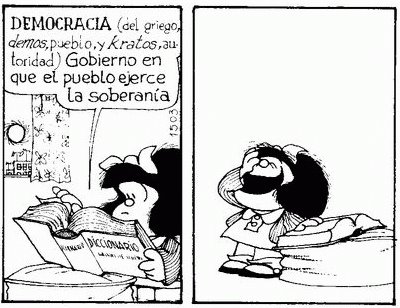
Demos sin cracia

democracia2

Las democracias modernas instituidas como “el gobierno de la mayoría” comenzaron a aparecer ya entrado el siglo XIX y se popularizaron velozmente.  Al lado de ella, la promoción de los ideales del sufragio universal, la igualdad de derechos y obligaciones entre hombre y mujer, la abolición de la esclavitud y del trabajo forzoso de curso legal, entre otros principios empezaron a dispersarse como un veloz germen en las sociedades occidentales y sus ex-colonias.  Han pasado ya 200 años desde que el germen democrático se dispersó por el mundo.  Sin embargo, los más recientes acontecimientos que han perturbado el flujo de las democracias de mayorías se ha visto afectado en Ucrania, Venezuela y desde hace dos días en El Salvador.

¿Por qué será que el ideal de la democracia ha “fallado” en estos países? 

Los argumentos a favor y en contra son muchos y muy complejos. Deben ser comprendidos desde distintas perspectivas y entender las posiciones tomadas por todos los actores que se han visto afectados de manera directa e indirecta por estos eventos.  Nosotros, el resto del mundo observador, podemos participar con ideas para ojalá descubrir más preguntas en nuestro camino. Hoy quiero compartirles una idea que cruzó por mi mente.

¿Acaso nuestro problema no ha sido que hemos tenído más “demos” que “cracia” en nuestro gobierno y en el desarrollo de nuestro rol ciudadano?

¿A qué me refiero con esto?

El término democracia es antiguo y complejo y se forma a partir de los vocablos “demos” traducido al castellano como -pueblo y/o poder- y “cracia” que indica un -gobierno o sistema-.  Así y actualizando el término desde la antigua Grecia a nuestros días, la democracia se refiere al gobierno del pueblo.

¿Pero acaso no ha sido el pueblo el que se ha volcado a la rebelión en Ucrania, Venezuela y El Salvador? Entonces, ¿la democracia reaccionó en estos países contra la democracia?

Quizás lo que ocurre en estos tres países (que son producto de la colonización y de la subyugación a los imperios durante la Guerra Fría) es que quizás no han pasado el suficiente tiempo en independencia institucional y maduración de sus gobiernos como para lanzarse desbocados a procesos democráticos que deben ir de la mano de una reforma educativa y cultural de la ciudadanía.  Pero, ¡alto! Que conste, que no me refiero a que estos países post-coloniales y post-guerra fría deban regresar bajo el control de un dictador o de una metrópoli.  Sino que, la participación del pueblo (demos) no debería avanzar cuando se ha descuidado o se ha impedido continuar el proceso de institucionalización de la democracia en la vida ciudadana.

Ucrania, Venezuela y El Salvador tienen como un común denominador la inmensa pobreza y la enorme desigualdad educativa y cultural entre la elite gobernante que heredó el poder de sus antiguos amos colonizadores y el grueso de la población. La mayoría de la población en estos países ha sido condicionada a servir como un “agente legitimador” al momento de ejercer su voto pero no se le ha permitido adquirir conciencia absoluta de su rol como “ciudadano legitimador empoderado”. Porque es su voto el que le permite exigir responsabilidad, honestidad y resultados en el equipo de gobierno que eligió en las urnas.

Titulo: 7 killed in post-election protests
Via: FoxNews

En Venezuela ha sido la población cansada y agotada de la corrupción la que ha tomado conciencia del poder de su voto al exigir la renuncia del gobierno revolucionario (aún a pesar de que recientemente había sido electo por el voto de las mayorías).  Es acá que el pueblo ha empezado a ilustrarse en su poder como votante y garante.

Titulo: Days of Protest in Ukraine
Via: The Atlantic

En Ucrania ha sido el pueblo el que también ha tomado conciencia del poder de su voto y de su derecho de autodeterminación pidiendo la anexión de Crimea y su mayoría étnica rusa a Rusia debido a sus distintos intereses económicos, políticos y culturales con el resto del país.

Titulo: El TSE pidió a los contendientes que respeten los resultados que el pueblo decida.
Via: http://www.lapagina.com.sv

Y en El Salvador desde el día lunes debido a que las elecciones presidenciales concluyeron con una cercana diferencia de votos entre los partidos ARENA y FMLN. ARENA rechazó el conteo de las elecciones luego del anuncio de su derrota. 6,000 votos marcaron la diferencia y el partido ARENA rechazó la legalidad del proceso democrático.

Espero que no sea aún tarde para extender una invitación a reflexionar a los ciudadanos salvadoreños sobre el funcionamiento del gobierno democrático y de la necesidad de estudiarlo a más profundidad y, quizás, comprender que el voto de la mayoría (aún si efectivamente ganará por 6mil votos de diferencia) no es garante suficiente de legitimidad.  Y que, es urgente que ambos partidos realicen un pacto serio, democrático y honesto antes de queso se derramé una sola gota de sangre.

En Venezuela, Ucrania y El Salvador es aún posible alcanzar acuerdo y pactos de concertación que partan del respeto al gobierno democrático y que busquen una inclusión de ideas, actores y modificaciones a los actuales procesos en los que el Pueblo (demos) colabore en la construcción y progreso del del Sistema de gobierno (cracia).

Esto evitará muertes y violaciones a los derechos individuales.  Pero más importante aún, permitirá la evolución y maduración de sistemas democráticos de gobierno en estos países que aún ahora se vieron afectados por la injerencia de los poderes imperiales en sus asuntos. Que envidia que en estos países quizás estén a las puertas de un desarrollo democrático del cual nuestros países vecinos podrían aprender mucho.

Italy overturns ‘absurd’ drug law equating marijuana and hard drugs

Italy overturns ‘absurd’ drug law equating marijuana and hard drugs

The title really gives all of the details. Libertarians are usually quick to celebrate these kinds of liberalizations of government authority but I always take these times to reiterate and oft forgotten fact.  Italy has not “given more rights to drug users”.  I hear this so often and strangely enough almost universally from more “left” policies such as gay marriage “Massachusetts has given the right to marry to homosexuals.”  This is a blatant misrepresentation of the truth.  The right of self-ownership is universal and each and every person already has the right to consume any drugs they please or to marry whomever they choose.  Government action has taken away those rights and them removing that restriction is not the same as giving away rights.  Rights cannot be granted, they are innate and inalienable.  Rights can only be removed by force.  Two forces in this world deny rights to others.  Criminals and the Government.  Most libertarians do not make a distinction between the two.

Order, Order, Order

In the conventional wisdom, as you become older, you tend to like order more and more. That is, with age, one is supposed to become more “conservative” in the traditional sense of the term. Personally, I have escaped the curse. Instead, I find myself resenting more and more the growing imposition of petty rules by public entities.

It began a few years back when the city of Santa Cruz banned sleeping. OK, let’s be honest, you may still sleep legally in your bed. The city made it illegal to sleep in public. It’s true that the homeless are a plague here. Many are in a near-constant state of NDUI (not driving under the influence). Many are poor lost souls who are a danger to themselves and occasionally to others. Thus, three or four years ago, a local shopkeeper walking to work was knifed to death in broad daylight. Her killer had spent the previous 48 hours in a shelter muttering about and to his Bible. No one reported him,of course because he had not done anything illegal until then. Next!

The ban on sleeping made me acutely uncomfortable at the time. First, it was plainly inhumane. Second, if you prevent human being from doing what their human nature demands, they will find another way to do it. So, informal camps proliferate in the wooded areas juxtaposing the town. Here, in Central California, we are in a period of prolonged drought. Do we need unattended campfires and campfires attended by people who don’t play with a full deck?

A petty use of power, municipal power, applied in a search for orderliness led to greater and far more dangerous disorder.

I don’t even know if there are enough night shelters for everyone who wants one. I know that there will always be sane but houseless people who don’t want to be in a shelter, by choice. A sizable part of me respects their choice. You may not force people in places where they don’t want to be without due process. The Constitution is completely clear on this. And, I am not in favor of more shelters anyway because I believe they attract the economically feeble to Santa Cruz thus aggravating the problem.

You don’t have to be a “soft” to want the Constitution respected.

Now, since then, there as been a multiplication of city rules. This happens while the crime rate plunges. The fewer crimes the more rules. The crime rate is tanking all over the country; Santa Cruz city rules can hardly take the credit. What am I to think?

Here is a quiz: The Santa Cruz City Council is dominated by:

a Republicans;

b Democrats;

c Leftists to the left of the Democratic Party

Not far is the independent harbor. I used to admire the Santa Cruz (Small Yacht) Harbor. It was the only government and quasi-government organization I knew that stayed clear of reliance on taxes. Harbor users -in their many guises- supported the maintenance of the harbor. They included boat slip renters like me, of course, but also beach goers whose coffee paid for the rent the coffee shop paid to the harbor in return for an excellent commercial location. Harbor users also included patrons of the good restaurant that dominates the harbor entrance with its million dollar view. The restaurant goers gladly paid solid parking fees, of course, and a portion is remitted to the harbor.

I also liked the way the harbor administration put to work underused resources such as the large general parking lot reserved for boat owners that tends to stand more than half empty after four pm. The harbor had an agreement with the self- same restaurant to hold musical barbecues once a summer week evening on the beach it, the harbor, administers. The restaurant got its profits from the sale of barbecued food and the harbor pocketed full parking fees from those not holding slip stickers. The arrangement drew crowds. It was all a little bit untidy but not much. Twice, on such a barbecue evening, I leaned spontaneously out of my truck to congratulate the officer directing parking and to assure him, unsolicited, that this particular slip owner, me, was not (NOT) inconvenienced at all.

And then, someone retired and there was a new sheriff in town. Under the new harbormaster, several things that were allowed became forbidden overnight. The harbor hired a full-time parking enforcer, like the town next door. Suddenly, the one harbor employee the average harbor user interacted with was the parking enforcement officer. This necessarily hostile and heartless functionary supplanted the traditional harbor officers who save boats, and sometimes lives, every weekend. The mood changed and not for the better. I am not speaking for bitterness about parking fines here; with my slip rental goes a permanent parking sticker permit.

Maintaining a stricter order often requires stricter rules that make most people unhappy. Eve if it’s only a little bit unhappy, the bad feeling accumulates.

Then, stand-up surfboards had to be segregated from boats. Boats are limited to 5 m/h inside the harbor anyway. Some boats under sail inside the harbor regularly exceed the speed limit. Those are steered by aces. How bad can a collision be under these conditions, really? Has there been a single collision involving a standup board? Did a boat owner complain about stand-up boards being in the way? Maybe. Did ten complain? I doubt it. (I have not asked; I don’t trust I would get a valid answer I could cite.) My point is that one can always find a complainer or two. If you handed out free ice cream to poor children and cleaned carefully afterward, there would be some curmudgeons to object. I am sure there are boat-owning slip renters who complain even about the ocean swells. But everyone knows that good harbors are bustling with activity. Those who detest the corresponding moderate disorderliness have no business in a harbor at all. They should be reminded of the fact that there is a long waiting list for their slips instead of listened to.

The art of civilized administration requires that complaints be ignored up to a point. It also includes remembering the second most important American maxim: “If it ain’t broke, don’t fix it until it is.”

Then, there are the new signs that shout at you that fishing from docks is “prohibited.” For as long as I remember, 20 year-plus, children fished from the docks. It was an excellent, healthy, commendable form of leisure for kids, including poor kids, if you ask me. Were there ever any accident as a result, even one? I don’t think so. The signs affirm further and vengefully that the prohibition is: “strictly enforced.” No joking with serious matters here! We are not kidding. Don’t even think of enjoying yourselves!

The posted “minimum” fine is $174. Think about it: Your otherwise well-behaved 12-year old gives you the slip to try to catch a sardine or two. He gets caught. You are into it for about twenty hours of minimum wage. This comes close to a violation of the Eighth Amendment, prohibiting cruel and unusual punishment, I think. There may also be here a subtle breach of contract involved here. When I first rented a slip in the harbor, fishing from the docks was common practice. The locked dock that was part of the rental gave me special access to a pleasant fishing spot. Then, after twenty years, the contract becomes unilaterally modified to my detriment. The harbor did not bother to re-negotiate the contract.

I agree that this is a very small kind of tyranny but it’s tyranny all the same. The habit of being oppressed nearly always begins small in democratic countries. Our tiny liberties are eroded slowly until we don’t even remember we ever had them.

In the same period, I have heard the crew of one of the few remaining commercial fishing boats left in the harbor complain that they are made to feel unwelcome. I have no proof that their allegation is correct but, I wonder, why would they make it up? It jibes with the other forms of turning of the screw I mention. There is no doubt that the harbor would be neater without fishing boats. Fish smells and the rushed commercial fishermen drop the occasional dead fish into the harbor water. And, well, it’s a yacht harbor, after all. And, by the way, if slips only went to middle-aged nuns who work as librarians, the harbor would be even neater.

Occasionally, I take my grand-daughter to buy live crabs directly from a boat. It’s an expedition for her. It’s unforgettable. It shows her that some food does not come from the supermarket. But who am I to lay claim to such privilege? And who the hell are the commercial fishermen to insist on making a living from a harbor originally created by the Army Corps of Engineers with tax money?

On 2/3/14, coming out of a restaurant, my family and I were treated to a wonderful geyser-like spout of water reaching much higher than a three storied building. No, it was not a whale; the scene was a couple of miles inland, on a busy commercial artery, at a street intersection. We watched in utter fascination for more than fifteen minutes. (I posted a still picture of the event on my Facebook. Look for it.) I am obviously no expert, but I believe that while I looked on several hundreds of thousands of toilet flush- equivalents of city water were lost forever. I know, I know, accidents happen; no system is perfect. But why did it take so long to cap the leak? There is a fire station five or six blocks away.

I almost forgot to tell you: At the very same time, the same evening, there was an important meeting of the Santa Cruz Water Commission to make recommendations about water rationing to the City Council in view of the current drought.

Would I make this up? Would I dare? Do I have the talent?

In my immediate surroundings, the only rule or law I have seen abolished in the past twenty years or so concerns dogs. They used to be prohibited on the main commercial drag of Santa Cruz, Pacific Avenue. The prohibition has been rescinded. Dog owners are numerous and determined. Their victory renews my faith a little in democracy. I wish I could cite more examples though.

Sometimes, the ugly thought crosses my mind that public entities are increasingly run for the benefit of their nominal employees. Karl Marx was almost right about classes, maybe . (See, on this topic: “Karl Marx Was Right (Pretty Much)“)

More on local government action: “Coyotes: How Government Bureaucrats Think

The Power of Propaganda and the Japanese Empire

Economist Kurt Schuler has a fascinating post on the various currencies that were used in mainland East Asia during World War II over at the Free Banking group blog.

Unfortunately, there are three paragraphs in the post that attempt to take libertarians to task for daring to challenge both the narrative of the state and the narrative of the nation regarding that horrific reminder of humanity’s shortcomings. He is writing of the certainty of the US’s moral clarity when it came to fighting Japan (the post was published around Pearl Harbor remembrance day):

The 1940 U.S embargo of certain materials frequently used for military purposes was intended to pressure Japan to stop its campaign of invasion and murder in China. The embargo was a peaceful response to violent actions. Japan could have stopped; it would have been the libertarian thing to do. For libertarians to claim that the embargo was a provocation is like saying that it is a provocation to refuse to sell bullets to a killer.

Then, in December 1941, came not just the Japanese bombing of Pearl Harbor, but an attack on the whole of Southeast Asia: Hong Kong, Singapore, what is now Malaysia (British colonies), Indonesia (a Dutch colony), the Philippines (scheduled under American law to become independent in 1945), Thailand (independent). In 1942 there followed the invasion of Burma, a bit of India, and a few of the Aleutian Islands, plus the bombing of Darwin, Australia.

With that history in mind, how can anybody think that the United States could have made a durable peace with Japan? It would have lasted as long as would have been to Japan’s military advantage, no longer. Japan was hell-bent on conquest. Nothing since its emergence as a major international power suggested a limit to its ambitions. It only ceded in the face of superior force. Even as Allied forces retook territory, Japanese fanaticism was such that the government did not surrender until after the U.S. military dropped two atomic bombs. To ignore the long pattern of Japanese aggression as quite a few libertarians are wont to do is not just historically ignorant but dangerous, because it closes its eyes to the hard truth that some enemies are so implacable that the only choice is between fighting them and being subjugated by them. It took a prolonged U.S. military occupation to turn Japan from the aggressor it was to the peaceful country it has become. (source)

This is an unfortunate mischaracterization of what went on in World War 2, but it also does a fairly good job of demolishing some of the arguments that libertarians have come up with in regards to this debate. You see, the issue of World War 2 is one that is usually foisted upon libertarians as an example of the benevolence of the State: Washington crushed two powerful, evil war machines in one fell swoop and then stood up to a third evil empire for forty years.

Libertarians often get confronted with this interpretation of history and they get bothered by it. This argument gets under their skin. They often make up excuses for Japan’s actions, or they avoid dealing with what actually happened in the time period. This response is also unfortunate because the general principles of libertarianism – individual freedom, strong property rights, internationalism – explain the events of World War 2 well, but only once the facts are looked at clearly and thoroughly. The power of propaganda is immense. The fact that so many people believe that the United States was the good guy in the war against Japan is astounding, and I think the heavy weight that is placed upon the shoulders of those who dare to defy the standard account of the US’s war with Japan flusters the seeker of truth.

Even though libertarians get hot-headed on this issue and stumble, thus making Schuler right in a sense, his argument is absolutely wrong. What follows is an attempt to calm things down, and to explain why Schuler is wrong and what libertarians need to get right.

Tokyo did not want to expand beyond a certain point, due to the ideological consensus of the governing party at the time. The narrative of the governing party was that great civilizations had natural territories over which they naturally lorded. For the Japanese, this natural territory (which was, of course, entirely arbitrary and ahistorical) was called, amongst other things, the East Asia Co-Prosperity Sphere. It included the Korean peninsula, Manchuria, Southeast Asia, Indonesia, the Philippines, coastal China, Mongolia, Malaysia (including Singapore and Brunei), and a separatist region in India known as Azad Hind. Any territory beyond these lands were inhabited by – again according to the ideology of the dominant political party at the time – peoples who did not conform to the standards set by the Japanese people (and those ranked directly beneath them; the ones I just mentioned). These foreign peoples were treated accordingly, especially in Melanesia.

What this suggests is that, contra Schuler, the Japanese were not “hell-bent on conquest.” Rather they simply wanted to carve out a territorial space that has obvious parallels with the German conception of Lebensraum. This is not a coincidence, by the way, for the ideologies of the dominant parties in Germany and Japan were cut from the same racist cloth.

Hawaii might have been a target for the Japanese military eventually, due to the large number of people living there with Japanese ancestry, but even this is stretching the limits of generosity. Hawaiians of Japanese ancestry considered themselves to be Hawaiians, or Americans, before Japanese (this probably due to the fact that the Japanese government sent some of its citizens over to Hawaii by force, but that is another story for another day; hopefully you can see why loyalty to Hawaii and the US was a given to people of Japanese ancestry on the islands). A Japanese invasion of the US mainland is simply an incredibly silly notion, which is why I think Dr Schuler relies upon the irrefutable fact of Japanese lust for conquest. Can you not see where propaganda is at work here?

Now, obviously the Japanese were warmongering at the time. There is no doubt about this. However, it hardly follows that the Japanese were a threat to the American republic.

For instance, look at what the Japanese military ended up attacking:

  • European and American colonies (which were burdens rather than boons for both the colonized and the colonizing)
  • Thailand, a kingdom with a long history of playing foreign powers off on each other
  • and parts of China (which could hardly lay claim to much of its territory anyway)

If I’m not mistaken, Europe and the United States are thousands of miles away from Japan, and yet they had militaries occupying foreign lands in East Asia. Again, Japan was certainly an aggressive state in the early 20th century, but it seems extremely unfair to ignore the military occupation – by Western states – of Asian lands and the Jim Crow-esque political regimes that they enacted and enforced. Notice, too, that the military incursions of the Japanese Empire do not stray too far from the official ideology of the governing political party. This is also true of Nazi Germany and Fascist Italy. It was also true of Soviet Russia, but for different reasons. The Soviets engaged in worldwide imperial ambitions (“spreading the revolution”) after solidifying their rule at home, and this imperialism was part and parcel of the dominant ideology of Leninism. I am digressing.

Japan did declare war on the US, so I think Washington’s war was just, but it hardly follows that Japan was “hell-bent on conquest,” or that its military would have invaded the United States, or that Tokyo’s decision not to curl up in the fetus position and simply accept US economic warfare was “unlibertarian.” Suppose Japan had conquered the US. What would its armies have uncovered?

Think of it this way: What incentive would Japan have to conquer the United States? Where were the plans to do so? Doesn’t it make more sense to look at Japan’s war on the US as part of its broader effort at creating and maintaining its hold over the territory it deemed to be the natural lord over? Why waste so many resources invading and occupying a territory dominated by people who were part of another race (as per the prevailing ideology of Tokyo at the time)? Oh, that’s right: Because Japan was “hell-bent on conquest.”

Propaganda is very powerful, but it’s also important not to label everything you disagree with as propaganda. That makes you sound like a crackpot. For instance, I don’t think anything Dr Schuler argues is driven by pure propaganda. Such an insinuation on my part would simply be garbage, and (rightly) treated as such in the public sphere. However, the notion that the US military stopped a war machine “hell-bent on conquest” is a product of propaganda. This notion is strengthened by personal and cultural narratives, and in time it takes on a life form of its own.

One last thing: Dr Schuler argues that the embargo Washington placed on Tokyo “was a peaceful response to violent actions,” but surely you can see how that policy was actually a violent response to violent actions. Whether that violence to counter other violence was a good thing or not is a question that cannot be answered in this already-too-long post.

(One more last thing: Here is an excellent essay on ideology in developing states that might be worth checking out; it doesn’t deal directly with the Japanese Empire but does deal with some of the concepts [especially nationalisms] that confront us when thinking about the rise of the Japanese Empire.)

The State of the Union and the State of our Liberties

Nevertheless it is important not to fall into the delusion that President Obama presents the greatest danger to the culture of liberty. A historian looking back a hundred years from now is likely to group the Reagan, Bush I, and Clinton presidencies together as an era when the state receded or at least did not grow, as measured by regulatory and fiscal burdens on our lives. But Bush II relentlessly increased domestic spending and created more government involvement in health care with the Medicare D program for prescription drugs. It was President Bush who initiated many of the NSA programs.

In short, there are more similarities between Bush II and Obama than their supporters or detractors care to acknowledge. And almost all of the similarities suggest that the risks to our liberty today transcend the actions of any particular politician.

From John McGinnis. Read the rest.

Oxfam: Combined wealth of the 85 richest people is equal to that of the poorest 3.5 billion – half the world’s population

I’ll bet the 85 richest people in the world have been beneficiaries of a good deal of rent seeking, but I still think there’s a positive spin to stories like this.

Let’s say (for the sake of not working too hard to write this post) that when we adjust for theft and its dead weight costs, the net productive wealth of group A (the wealthy) is just 25% the total wealth, that’s a mean productive wealth of 10.3 million times the average member of group B. For a humanitarian, this means that their fight to improve the plight of the world’s poor, has the potential to pick up trillion dollar bills off the sidewalk. This isn’t just little embossed portraits of old dead white men, it’s genuine human flourishing! Of course this message would be more meaningful if the numbers were something like “combined wealth of the poorest 3.5 billion is equal to the combined wealth of the poorest X million residents of OECD countries.”

That made up percentage, if it’s even remotely accurate, is a similar call to arms for those of us opposing politically supported privilege. And it just so happens that the humanitarian and libertarian causes overlap nicely! There is institutionalized theft and there is poverty, and that’s bad news. But the problems have been recognized and solutions are being fought for.

Myths about Libertarianism

Many articles have recently appeared in magazines, web sites, and social media criticizing free markets and libertarian ideas. It seems to me that this opposition is a result of a growing interest in freedom as people realize that the economies of the world are in serious trouble. As people see continuing high unemployment, slow growth, ever greater government debt, environmental disaster, more turbulent weather, and endless wars, some folks seek solutions in greater freedom while others seek solutions in greater state control. The critics of libertarianism and economic freedom have fallen for several fallacies.

1. Critics confuse today’s mixed economies, a mixture of markets and government intervention, with a “free market.” A truly free market is an economy in which all activity is voluntary for all persons. Government intervention changes what people would otherwise voluntarily do. A pure market would not impose the taxation of labor and capital. It would not prohibit trade with Cuba. Free markets would not subsidize industry. Any peaceful and honest action would be free of restrictions and taxes. That is not the economy we have today in any country.

2. Critics use the term “capitalism” to falsely blame markets for economic trouble. Those opposed to private enterprise call today’s economies “capitalist.” They then note that the economy has trouble such as poverty, great inequality, unemployment, and recessions. The critics conclude that “capitalism” causes these problems. This illogic uses a sly change in meaning. They use the term “capitalism” as a label for the current economies and also to refer to free markets. It makes no sense to label the economy as XYZ and then say XYZ causes problems. The critics use the double meaning of “capitalism” to blame the non-existing free market for social problems. This confusion is often deliberate, as I have found that it is almost impossible to get the critics to replace their confusing use of the term “capitalism” with clearer terms such as either the “mixed economy” or the “pure market.”

3. Critics think that the “market” means “anything goes.” For example, they think that a free market allows unlimited pollution. They often call this, “unbridled capitalism.” But freedom stops at the limit of harm. In a pure market with property rights for all resources, pollution that crosses outside one’s own property is trespass and invasion. This violation of others’ property rights would require compensation, and that payment would limit pollution.

4. Critics confuse privatization with contracting out. They then blame private enterprise for problems such as occurs with private prisons. When government contracts with private firms to produce roads, it is still a governmental road. When governments hire private contractors to provide services in a war, it is still government’s war. Government sets the rules when firms do work under contract. Genuine privatization means transferring the whole ownership, financing, and operation to a private firm.

5. Critics overlook subsidies. Government distorts the economy with subsidies to agriculture, energy production, and other corporate welfare. The biggest subsidy is implicit: the greater land rent and land value generated by the public goods provided by government and financed mostly from taxes on labor and enterprise. Critics not only ignore this implicit subsidy but also overlook the explicit subsidies to agriculture and programs such as the promotion of ethanol from corn.

6. Critics do not understand the crowding out of private services because of government programs. The critics of libertarianism say that with less government, old folks and poor folks would starve and die because they would not receive social security and medical care. What they overlook is that the reason many of the elderly have little savings for retirement is that government took away half their income while they were working. Income taxes reduce their net wages, while sales taxes raise the cost of living. Low-income people pay little or no income tax, but they pay hefty sales and excise taxes, and they indirectly pay property taxes from their rental payments to landlords. Libertarians want to abolish poverty and have a society where all people have good medical care. They just want to accomplish this by letting workers keep their full pay, which would enable them to pay for their own medical services. Also, with no taxes on interest and dividend income, people would be better able to provide for their own retirement income, indeed to have much more than social security now provides.

7. Critics fail to understand contractual governance. A pure market would not consist of isolated individuals. Human beings have always lived in community associations. In a free market, communities such as condominiums, land trusts, and civic associations would provide the public goods that the members want.

8. The critics of market believe that corporations control the economy, exploit labor, and plunder the planet. Corporations do have power, but mainly because they obtain subsidies and monopoly privileges from governments. But labor unions and lawyers also lobby the government for power and favors. Rather than blaming private enterprise, the critics should examine how the structure of government enables special interest to obtain power and wealth.

Leo Tolstoy wrote in 1905 that nobody really argues with the economics and philosophy of Henry George and public revenue from land rent; the critics either misunderstand the concepts, or they create misinformation. The same applies to critics of libertarianism. The fact that the critics falsify the free market in criticizing it implies that the actual concept is sound, otherwise they would provide valid arguments.

Nobody has refuted the free market and the libertarian ethic of “live and let live”. The critics of liberty either misunderstand it or else falsify it. Even when their errors in logic, their false evidence, and their confused terminology are pointed out, the critics persist in their falsification. They are stubbornly anchored to their viewpoints. Why this is so is a problem I will leave to psychologists to figure out.

The political Left and violence: An uncomfortable, subconscious symbiosis

I recently set up a Twitter account (you can follow me here; you can follow Notes On Liberty here) and after a couple of days of using its newsfeed I’ve decided to tally up the number of tweets from Leftists that either call for outright violence or allude to violence against their political enemies. Now obviously these guys are joking and I don’t think that any of them actually mean what they say, but the fact that this project even struck me as something to do is flabbergasting.

I think the fact that there are so many allusions to violence – against political enemies – in my newsfeed, combined with the recent labors of the media to rid the Colorado school shooter’s political leanings from the narrative of that particular story, has put me at unease* and made me particularly sensitive to the culture of ‘high’ media.

The allusions to violence harbor an authoritarian tendency that I think often goes unnoticed. I didn’t notice anything until a couple of days ago. Yet they are there, in plain sight. You can find these appeals and allusions to violence on the Right as well, but not from the people and organizations I follow on Twitter.

For example, I don’t follow rednecks or Party activists but rather professors, journalists, wonks and publication outlets that I think provide great, in-depth insights into the world around me. Most of these individuals and organizations are Left-leaning, and I have yet to ever (ever) see an appeal to violence coming from an intellectual conservative or libertarian organization. I see it from the intellectual Left so often that I am now going to start tallying such outbursts.

This is worrisome for a bunch of reasons, but three stand out to me:

  1. Joking about violence is not very funny; Jon Stewart and Stephen Colbert don’t do it, and now we know why
  2. The hypocrisy coupled with the veiled and not-so-veiled threats against political enemies is nothing short of barbarism
  3. It convincingly shows just how shallow Leftist thought has become; resorting to violence in an argument is, as we all know, a sign of defeat

Added together, these three major reasons make a solid foundation for a fascistic political movement. Look at my most recent ‘favorited’ tweet, from an assistant editor for The New Republic:

“If I were running Bloomberg View…the thing I would most want would be for Bloomberg to get hit by a bus.”

Ha. Ha. This is hilarious, right?

These are the same people who, in the wake of many mass shootings, have claimed that one of Sarah Palin’s campaign websites was indirectly responsible for senseless acts of violence (because of animated target signs that hovered over a map).

Disgusting, and yet there is a definite silver lining in all of this. Reason #3, as outlined above, is largely responsible for the intellectual Left’s impotence and fetish for domestic political violence.

Violence and the lust for power have gone virtually hand-in-hand with Leftism since the mid-19th century, of course, and this is largely because their plans for humanity are simply not feasible. And these plans, in turn, are not feasible because they are not congruent with reality.

Let me see if I can illustrate my point by digressing for a moment. Benito Mussolini was a Leftist his entire life. National socialism for German workers was a child of the Left. Maoism and Leninism were Leftist to the core. All were violent. All failed miserably and yet I see the underpinnings of these philosophies – these worldviews – in the rhetoric of the present-day American Left.

Not good. Nor is it good that the present-day Left denies its own bloodlines. Conservatives and libertarians are often quick to fess up to any historical misdeeds done in the name of their ideologies. Not so with the Left. I think this may have to do with the fact that while Leftist regimes were responsible for hundreds of millions of unnecessary deaths in the 20th century alone there are very few historical misdeeds perpetrated in the name of classical liberalism.

At any rate, I’ll keep you all updated on my tally. In the name of justice I will also keep a tally on tweets of violent fantasies that go out in the name of libertarianism or conservatism. My sampling size is small, of course. I only follow intellectuals and publications that give voice to intellectuals. This will be interesting.

* The fact that an evil person’s political views have been marginalized is not what is important. I think such views (if any) should be, as there is obviously something other than a shooter’s political leanings that is responsible for the horrific violence. What is important is the fact that if this shooter had been a self-identified conservative or libertarian it would have been plastered all over the news and it would still be getting air time as you read this.

A (very) Quick Primer on Natural-Rights.

by Adam Magoon

The first step in understanding natural rights theory is to ask a simple but profound question.  Do you own yourself?

Well, let’s start with the definition of ownership.  Dictionary.com gives us “the act, state, or right of possessing something.” Digging deeper we find the definition of possession as “the state of having, owning, or controlling something.” The last part of that definition is key; controlling.  There is a modicum of truth in the old adage possession is 9/10ths of the law.  Nine times out of ten to own something is to control it.

Now getting back to our original question: Do you own yourself?  Well do you control your own body and mind?  We do not need to delve into psychology to answer this question.  I alone can move my arms up and down, I can choose to stand, walk, eat, think, write, create, or to do nothing at all.  I alone am in control over my body.    This is an indisputable fact.  The very act of questioning this fact proves it true; for if you do not have control over your thoughts and actions how could you possibly disagree?

Self-ownership is the cornerstone of libertarian natural rights philosophy and what the libertarian means when he uses the term “natural rights”.

To quote Murray Rothbard: “The fundamental axiom of libertarian theory is that each person must be a self-owner, and that no one has the right to interfere with such self-ownership”

Under this philosophy of self-ownership there are two important subcategories that I will just touch on for further elaboration at another time.

The Non-aggression Principle: is an ethical stance which asserts that “aggression” is inherently illegitimate. “Aggression” is defined as the “initiation” of physical force against persons or property, the threat of such, or fraud upon persons or their property.

This is why the threat of violence cannot be used to negate the concept of self-ownership.  Holding a gun to my head and telling me to raise my arm does not mean you own the right to raise my arm any more than a thief owns the jewelry he stole.  Ownership cannot be transferred through violent means.

And the concept of homesteading which is best explained by John Locke:

“[E]very man has a property in his own person. This nobody has any right to but himself. The labour of his body and the work of his hands, we may say, are properly his. Whatsoever then he removes out of the state that nature hath provided, and left it in, he hath mixed his labour with, and joined to it something that is his own, and thereby makes it his property. It being by him removed from the common state nature placed it in, it hath by this labour something annexed to it that excludes the common right of other men. For this labour being the unquestionable property of the labourer, no man but he can have a right to what that is once joined to. . . .

He that is nourished by the acorns he picked up under an oak, or the apples he gathered from the trees in the wood, has certainly appropriated them to himself. Nobody can deny but the nourishment is his. I ask then when did they begin to be his? . . . And ‘tis plain, if the first gathering made them not his, nothing else could. That labour put a distinction between them and common. That added something to them more than nature, the common mother of all, had done: and so they become his private right. And will any one say he had no right to those acorns or apples he thus appropriated, because he had not the consent of all mankind to make them his? . . . If such a consent as that was necessary, man had starved, notwithstanding the plenty God had given him. We see in commons, which remain so by compact, that ‘tis the taking part of what is common, and removing it out of the state Nature leaves it in, whichbegins the property; without which the common is of no use”

Very quickly I will also mention a couple of the more common arguments that arise when natural rights are discussed.

First, natural rights do not extend from god or any other supernatural or theological forces.  They are based on rational and philosophical thought.  They are what is known as an “a priori”  argument.  To put it simply, natural rights are a logical deduction based on a number of easily recognized facts, primarily the concept of self-ownership.

Second, governments do not, and indeed cannot, grant any rights that natural rights have not already granted.  Let’s look at a current event that everyone always seems to think about backwards; the legalization of drugs for personal consumption.  Because of the right to self-ownership each and every individual already has the right to do whatever they choose with their own body as long as they do so with their own property and do not violently harm others in the process.   Even if the U.S. government “legalized” the use of drugs tomorrow, they are not granting anyone the right to do drugs, they are merely removing their own restrictions on something that is already a right.   The idea that law comes from the state is known as ‘legal positivism’  and proponents are hard pressed to defend actions such as slavery and extermination that were made legal by many nations throughout the course of human history.


Recommended Reading:

http://mises.org/rothbard/ethics/ethics.asp

Climate Change and the First Amendment

Like nearly everyone in the world, I don’t have the training to judge directly the pronouncements of organizations that affirm that there is:

a) Serious temperature rise on a global scale (“global warming”).

b) That it is caused by human activity (such as burning fossil fuels or keeping too many belching cattle).

c) That human beings must quickly reverse manufacturing growth and driving (and growth in cattle) or suffer devastating consequences.

Instead, I have to rely on indirect evidence to judge the claims of specialists and to decide what the appropriate action would be (including deliberate inaction). This is not a new situation. We all do this all the time. So, I am unable to assess the talent of the surgeon who is going to open up my chest but I can sure smell the booze on his breath and make the logical jump that it’s not good news. Similarly, I know little about the care of automobile engines but when I see a car mechanic banging on an engine with the back of a screwdriver, I am alerted.

The quality of specialists is not the only way indirectly to gauge the quality of a viewpoint. It’s also legitimate to infer the seriousness of a claim by assessing the quality of its believers. Thus, I am leery of so-called “alternative medicine” and other “informal” health perspectives because many of their proponents seem to live in la-la Land in matters other than health. And if marathon runners kept falling dead at 39, I would have good reason to wonder if running is that good for you. (I said “if.”) If the proponents of Chinese traditional medicine turned out to be sick all the time, I would have to think twice (thrice) about its merits. (I know, there is a causation issue in this sentence. It’s not a solution; it’s part of the problem.)

The quality of its followers say something about the credibility of a creed, I believe.

Here is an anecdote about the credibility of climate change proponents, “ccprops.” It’s only an anecdote. It may be isolated. It may represent no one but those involved. Or, it may sound familiar. Think!

I live in the Green People’s Socialist Republic of Santa Cruz. My wife and I may be the only residents with anti-Obama bumper stickers. (There is a good chance we only get away with it because leftists can’t spell: “Obamination,” mine says.) Those residents who are not greenies or leftists of some kind tend to observe a discreet silence. The voice of rationalists like me who oppose big government and the myths that support it is muffled to the point of being mostly inaudible. I am not saying that I am a victim; I am suggesting a minor degree of heroism.

One ordinary day, I am peacefully drinking coffee at my downtown coffee shop. My daughter and my five-year old grand-daughter are with me. There is a demonstration on the other side of the street, yards away, of about 200 people, most young, a few of retirement age. They have placards and they sing slogans against pipelines, all pipelines, against global warming, for the environment. I notice that some of them wear what I think is a fairly witty t-shirt sign: “Don’t frack your mother.” The usual collection of Mother-Earth loving catastroph-tropic semi-educated Santa Cruz crowd, I think.

When the demonstration disperses because of rain (the environment does not cooperate), a group of five demonstrators comes to sit under an umbrella of my coffee shop. After a while, they start making ingratiating noises toward my attractive, impossibly cute grand-daughter. I tell them in a calm voice that they may not talk to the child because I think they carry a bad, morally objectionable message.

I am just tired of letting my enemies go unchallenged. I believe they have enough influence collectively to sap what’s left of the economic life of California. They are precisely endangering my grand-daughter’s future with their anti-economic mindless message. There is no reason to waste an opportunity to show some unkindness here.

They are stupefied. This is Santa Cruz, California, after all. It’s one of the world centers of foo-foo-headedness. By locals standards, these people are 100% virtuous. More importantly, in their parochial minds, they are 100% right. They have never encountered hostility before, not even opposition. No one has ever treated them that way. They did not know anyone actually could, even legally. They kind of believe that the First Amendment protects them against criticism. They don’t know that it only enjoins the government. (“Congress shall make no law … abridging the freedom of speech, or of the press….”) They don’t know that the First does not guarantee against a private person making you cry with unkind comments. Nowhere does the First say or suggest: “Dr D shall not say hurtful things to silly Luddite greenies.”

Many young people are in the same state of ignorance nowadays. It may be because they don’t read much. It may be because they believe wrongly that they already know the Constitution. It’s the result of many years of left liberal education that is both biased and lazy. Even a friend of mine accuses me of “starting a fight.” I did no such thing. I was peacefully drinking my coffee while reading the WSJ. A bunch of strangers began yelling empty and offensive slogans near my face and I replied very moderately. “But they have a right….” Of course, they have a right; I did not say otherwise. I only instructed them to not speak to the child for whom I am responsible. I told them why in a brief and moderate way.

Immediately, the demonstrators start using religious-sounding language: You are “deniers” they say. Boy, that hurts! Boy, I am glad there is not much firewood handy! (I am not that stupid. I know well that they are trying to compare me to with theory of evolution “deniers.”)

A  frumpy woman in her forties presents herself as an expert because she is making a documentary on climate change, she says. This leaves me cold. Santa Cruz is full of self-declared, self-admiring artists. (I know this for sure, I am one.) I am thinking that if I worked on a movie about human female sexuality it would be no evidence that I know anything on the topic. Am I right?

For some mysterious reason, the film-making housewife insists on treating me as if I were a born-again Christian. Again, I have no idea what she would have done that. I don’t look the part in any way. I am sure I don’t act Christian, whatever that may be. I am absolutely certain I did not say anything leading to that kind of identification. I am an atheist of the calm, non-militant kind. Religion is not at the forefront of my preoccupations except sometimes, the silly Earth worshiping of her gang, precisely. As I said, the madness is close to the surface. The woman appears a little strange, a little twisted.

Temperatures have already risen by 1.4 degrees – the woman experts asserts in a loud voice.

Centigrade or Fahrenheit – I ask?

Yes – she says.

I ask again.

I don’t know – she brushes off my question.

In how long – I ask viciously – in what period?

I don’t know, she says with disarming honesty.

I am under the impression that her ignorance about the things she, herself, chose to evoke does not trouble her a bit.

Are you smarter than the 95.5% of scientists who believe in climate change – she challenges me with finality?

I refrain from answering out of humility. (Could well be that I am; I wouldn’t be that surprised; depends what you call a scientist; I have been reading for more than a half century; I read well; I retain better than most – not better than most at Harvard, better than most in the street. I went to an excellent or maybe just good graduate school, etc.) Also, I was seized like an overworked engine by this affirmation. I have encountered it for years with some variations in digits. I will just make again the obvious point the statement calls for:

If it were true that 95.5 % of scientists believed that there was man-made global warming that will have disastrous consequences, if it were true in reality, how in the world would anyone know this? Has there been a worldwide poll with strict definitions of who is a “scientist”? Was it conducted according to all the known intricate rules of polling including careful, neutral wording? What qualified pollster organization accomplished such a big difficult task? Why isn’t the pollster bragging about it? 95.5% is obviously a bogus number some one made up years ago and that keeps being repeated by believers. Its precision itself cries out, “Phony.” People who assert it are asserting that they don’t know what they are talking about, that they lack ordinary criticality. They are asking to not be believed.

The woman is joined by two younger people who appear to be her children. (Craziness might be hereditary.) A young man of about twenty is using the F word loudly five feet from my grand-daughter they all thought so cute three minutes ago. I am not a prude; I am not especially clean talking but there is no chance, zero chance that I would use such language in the presence of a small child. These people are insane. I don’t mean this figuratively. I mean literally. I mean that if they showed the same loud zeal in connection with say, parking, or house painting, they would risk being institutionalized.

In addition to factual waywardness and bad logic ccprops demonstrate their moral blindness in small ways as well as in big ones. They insist on their right to kill birds, for instance, including the legally protected bald eagle, in order to continue installing wind mills that contribute essentially nothing to the resolution of the imaginary problem of global warming (WSJ 10/11/13 “Fighting Climate Change by killing Eagles,” Robert Bryce.)

I listen to them calling the local talk shows. (I used to have a local talk show radio program myself.) They sound insane even if they are right. Most callers of talk shows are perfectly reasonable. Left-oriented ccprops are of a feather with rightists Bildeberg conspirators. Why do both kinds of callers sound regretful that it’s not yet technically feasible to murder over the airways?

Notice what I am not doing: They can go on demonstrating their irrationality, their lack of trustworthiness, their ignorance. It’s protected by the First Amendment. I will continue to try to make them cry every chance I get. It’s protected too.