Warren Harding’s Fiscal Cliff

The economy is in rough shape right now but suppose it were even worse: unemployment at 12% rather than 8%; GDP falling at a 17% annual rate rather than rising slowly.  A close advisor to the President counsels an array of interventions to stimulate the economy but is ignored.  Instead, the President cuts Federal spending in half and engineers drastic reductions in income  tax rates for all groups.  Meanwhile the Federal Reserve, rather than cranking up the printing presses for a round of monetary stimulus, snoozes through the whole year.

Now there’s a fiscal cliff for you.  If today’s thinking about the fiscal cliff of Jan. 1, 2013 held true, surely such policies would tank the economy big-time.

The foregoing scenario actually happened.  The year was 1920, the President was Warren G. Harding and his close advisor was none other than Herbert Hoover, who as President from 1929 to 1933 would have his way – raising taxes, jawboning wages, and slapping a killer tariff on the economy, thereby doing a great deal to turn the rather mild downturn of 1929-30 into the Great Depression which, with lots of help from Franklin Roosevelt, would plague the nation for another decade.
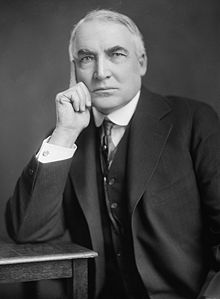
So what happened in Harding’s time?  Things were pretty rough for a while but by the summer of 1921, signs of recovery were already visible.  The following year, unemployment was back down to 6.7% and hit 2.4% by 1923 (source: Thomas Woods, “The Forgotten Depression of 1920″).  A budget surplus arose resulting in a noticeable decline in the national debt.  Business confidence soared and the 1920’s boom was off and running.

President Harding has gotten a bad rap from history because of the scandals that erupted during his administration as well as his chronic womanizing and his passion for the bottle.  But in the countdown of 20th century Presidents that I might do for this blog should I ever get ambitious, I will start with Harding as the least bad President of that sad century and work my way down from there.  I’ll let you  guess who I will honor as the Worst President of the Century.

How does the looming fiscal cliff compare with the policies of 1920?  In case you’ve been hiding under a rock lately (not a bad way to ride out the election campaign!), the fiscal cliff is the set of automatic tax increases and spending cuts that were agreed to when the debt ceiling was raised in 2011.  Congress decided to force its future self to act by lighting a time bomb that it would surely – surely! – defuse before it could go off.  The fuse has now burned to within 1/8 inch of the bomb.

The bomb’s tax increases and spending cuts would reduce the deficit by an estimated $600 billion in one year.  That may be the most accurate estimate but it’s only an estimate.  Congress can set tax rates but tax revenues depend on the size of the tax base.  If highly productive people, those who would take the biggest hit, decide to Go Galt, the tax base could shrink.  And as Jeff Hummel likes to point out, tax rates, particularly the top marginal rates, have varied drastically over the years and yet tax receipts have not varied much from 20% of GDP, excepting the World War II years.

Not only might tax receipts fall short, but expenditures could rise if additional welfare payments such as unemployment benefits or food stamps were to rise.

But let’s assume the fiscal cliff happens and the deficit is indeed reduced by $600 billion. Using figures for the fiscal year just ended, we would still have a $400 billion deficit which would have to be financed by borrowing.  As always, this would be new borrowing, on top of the borrowing needed to roll over the daily stream of maturing debt.  And we mustn’t forget the Social Security Trust Fund which until last year has mitigated the deficit by “investing” its surpluses (FICA tax revenues minus benefit payments) in Treasury securities.  Those FICA surpluses have now turned to deficits which for the present are offset by interest payments on Trust Fund holdings but will eventually require the Trust Fund to stop rolling over maturing securities and, should the trend continue, to deplete its holdings entirely.  All of these developments exacerbate the main federal deficit.  The same applies to the much smaller Medicare Trust Fund.

So I say, with a glance over my shoulder at 1920, bring on the fiscal cliff!  Let the cuts happen, thereby ending a lot of wasteful and harmful spending – particularly “defense” spending.  Let tax rates rise; people will work around them.

But it won’t happen because too many special interests will rise up to prevent it:

  • There are enough military personnel, military contractors, their suppliers, relatives and hangers-on to prevent significant cuts in defense spending.
  • The 27% cut in Medicare physician fees will lead doctors to brush away their Medicare patients like flies, sending those patients hobbling off to howl at their their Congressmen.
  • Millions of middle class people will gasp when their tax preparer tells them they’ve been caught in the dreaded Alternative Minimum Tax trap.  Others will escape the trap only to find that their ordinary income tax rates have risen substantially.
  • Still more millions will see their FICA (Social Security) tax rate revert to the 2010 rate of 6.2% from the current 4.2% “stimulus” figure.

The fiscal cliff won’t happen, at least not all of it, except perhaps for a brief period in January which will be fixed retroactively.  And so, though I hate to say it, I think the longer-term odds of pulling out of our fiscal death spiral are pretty slim.  Many think the government will resort to the time-honored remedy of the printing press, but Jeff Hummel has made a solid argument as to why this option won’t work and why there will be a default on Treasury securities instead.

Hummel also urges economists to do whatever they can to warn people not to count on government largess.  Most young people have written off Social Security for their future and that’s a good thing.  (Not so good for Social Security recipients like me who are increasingly unemployable yet hope to live another 25 years.)  We must take responsibility for our own health care, first by watching our health habits and second by cultivating a personal relationship with a physician, perhaps offering him or her cash payments.  We should be leery of Treasury Securities or of banks, mutual funds, etc. that rely heavily on these securities.  Sock away a few gold and silver coins.

We’re in for a rough ride, I fear, over the next few years.  But the sun will still rise and tangible assets will remain.  Provided enough of us have taken precautions, social unrest will be manageable and maybe, just maybe, the cancer that is called Social Democracy will be shaken off once and for all.

Election Reform: a Modest Proposal

Texas and other states have passed laws requiring voters to present valid ID at their polling place.  How could this be controversial?  These days we have to present ID to get on Amtrak, pick up mail at the post office, transact with a bank teller, etc., etc.  Is proper ID any less important for voting?  But a court recently struck down the Texas law saying it impacts minorities disproportionately.  Hummph.  If laws against aggravated assault affect minorities disproportionately should those be overturned also?

But why bother about this issue?  There surely is some voter fraud happening, but how much does it matter?  The real problem with democracy is simply the results.  The worst get on top, as Hayek put it, Exhibit A being, of course, the Sewer Rat in the White House.  As the electorate has broadened, starting with white male landowners at the Founding all the way down to today’s situation where anyone with a pulse who is at least 18 and claims to be a citizen can vote, and with direct election of senators in between, the quality of elected officials has gone steadily downhill.  Barack Obama!  Harry Reid!  Mike Huckabee!  Nancy Pelosi!  Compare this crew with George Washington, James Madison, Thomas Jefferson.  Are you sick at your stomach yet?

Herewith a modest reform proposal:

  1. Raise the voting age to 30
  2. Disqualify all government employees and all recipients of any government entitlement: social security, medicare, etc.
  3. Adopt a stiff qualification exam, to be re-taken every five years
  4. Mandate a poll tax sufficient to cover election expenses

Let’s now consider objections one by one:

Objection: people would feel disenfranchised. People who lost their vote would be bummed, no doubt, but they would still have the prospect of earning a vote to aspire to.  Voting would be seen as a privilege to be earned, and the quality of votes cast would skyrocket as would the quality of campaign rhetoric.

So as not to cause too much upset, the voting age could be raised gradually and the poll tax raised in steps.

Objection: corruption. It might be worthwhile for special interests to track down individual voters and offer them bribes or intimidation.  But if the voter roles were shrunk by a factor of a thousand, for the sake of argument, that would still leave a hundred thousand or so voters nationwide.  That leaves quite a bit of effort for lobbyists and other crooks to track them all down.

Besides, corruption is proportional to the amount of power that resides with government.  Regulation of lobbyists, campaign reform and all that will never mean anything as long as so much money and power are at the disposal of politicians.  My voter reform proposal will lead to a drastic shrinkage of government and thus drastically reduced rent-seeking opportunities and incentives.

Furthermore, as things stand with campaign promises.  How much worse would outright cash bribes be?

Objection: bias. Outcomes would be skewed toward the viewpoints of the eligible voters, which would not be representative of the general population.  Exactly!  The whole point is to restrict voting to an elite who can think and act rationally and not be swayed by the sort of demagogic appeals we hear from the aforementioned politicians and their ilk.

Is this idea likely to gain traction?  Not any time soon, but it’s fun to speculate.  An interesting alternative is Fred Foldvary’s “cellular democracy.”  Perhaps he’ll be moved to post that idea here.

Anti-Americanism: Lesson One, Europeans

Hostile liberal members of the American media have been repeating for years that the Bush presidency caused the prestige of the US in the world to decline sharply. In addition, they whine endlessly that the US is disliked pretty much more than it ever has been. I think tender-hearted liberal commentators are confusing several issues, some of which have nothing to do with Pres. G.W. Bush or with any of his policies.

As a person with a very good knowledge of another society and culture (France) and a pretty good understanding of several others (most of Latin America plus Spain), I may be able to help disentangle the impressions they are giving the general American public concerning their country’s popularity in the world. I also have better than average access to Germany and to Russia thanks to several long-term friendships.

I wish to begin by stating that I believe popularity is considerably overstated as a geopolitical resource. Governments do what they do largely on the basis of their calculated self-interest. Love of another country probably plays little role in the tactical alliances they form. (I must say that I could be talked into believing that there exists a sort of solidarity of kinship linking Canada, the United Kingdom, and Australia with this country. This solidarity may contribute to making the public opinion of those democratic countries more tolerant of policies they don’t especially like than they would be absent the felt kinship.)  Continue reading

Why Blog?

Blogging is very time consuming. It’s cutting seriously into the life of leisure for which I am so obviously gifted. I am certainly not trying to achieve fame. I renounced that particular kind of folly many years ago: It’s not worth it because you are likely to fail. It’s not even worth it when you succeed according to many tabloid stories.

I can’t even say I am terribly successful in terms of effect achieved.

Only 26 people at most read my most recent ambitious posting, “Fascism Explained”. Writing it took me the better part of two or three half-days. Its sequel, “How about Communism?” captured only a little less of my free time and it was read by the same small number of people at best.

My two biggest hits ever, “The Inauguration; the Hamas Victory” and “Advice to Pres. Obama on Manhood” were each read by 56 people maximum.

Why am I alienating my free time that way? Why this fairly futile effort on my part? I could be on my pretty boat on Monterey Bay catching suicidal and cognitively challenged fish. Or, I could simply be reading one of the books I have been wanting to read for weeks. I might even rub my wife’s feet instead. (She is a talented artist and a conservative who thinks Attila the Hun was kind of a girlie man. The only thing that reaches her nowadays is hard foot massaging.)

There is an answer to this multiply-worded single question above:  Continue reading

Atrocities: Municipal, State, and Zionist

The City Council of Santa Cruz, California is going to spend $200,000 to decorate, embellish, create a planned turnabout in an important touristy location. I am not sure we need a turnabout at all. It confuses Americans. If we need one, I don’t know why it has to have artistic qualities as judged by the philistines on the city council. The location itself is quite beautiful. Is the council determined to compete with Mother Nature? I guess there is no economic crisis after all. (The council is dominated by Leftists.)

To make things worse, the commission goes to an artist from Rhode Island, clear across the continent. The local paper, an objective ally of the council, does not say how the awardee was selected. Santa Cruz has thousands of artists. Sometimes, it seems that everyone who is not a therapist, an acupuncturist, a herbalist, or a teacher is an artist. Some residents combine two or more of the above avocations, as you might expect. The fiscal irresponsibility has reached the point where I am going to say “no” to any expenditure, I don’t care how justified the cause would seem to me if I understood it. I don’t want to know. It’s “No.” In the current context, this expenditure is an obscenity and a small atrocity.

I listened to the debate yesterday between the two California candidates for the beleaguered office of governor of this failing state. I am going to vote for Meg Whitman, of course, the former CEO of E-Bay. The main reason is that she is not Jerry Brown, a charlatan I have known all my adult life and a proven failure at every political office he has tried. He has tried most of them, incidentally, including Governor, twice, in the late seventies and early eighties. Continue reading

The French Presidentials and Cinco de Mayo

I have been busy producing a legible and clean copy of my memoirs: “I Used to Be French….” It’s an endless process. By the way, if you are an agent, don’t be shy about asking to read this remarkable and witty document.

While my back was turned, the world continued to turn. The French lost the battle of Puebla and they lost an election, all in the same day.

People in California celebrate Cinco de Mayo with beer and more expensive stuff. Few know what they are celebrating, Anglos, never, children of Mexicans, seldom, Mexican immigrants, often but not always. Myself, I celebrate too because I like beer, Mexicans and Mexican beer. I celebrate discretely though.

In the battle of Puebla, in 1862, under the presidency of Benito Juarez, a Mexican army achieved victory over a French expeditionary forces against all expectations. What happened is that the French thought they were on their way to Prussia to beat on that emerging power before it was too late. They turned right instead of left outside Paris by mistake. Somehow, they ended up in Mexico and the rest is history, mostly forgotten history. They left behind in Mexico, probably pan dulces, and less probably, the name for roving musicians in charro costumes, mariachis (“marriage”). Continue reading

The American Parade

In the United States, a strong indigenous form of theater has not developed (middle-brow and high-brow forms were both imported from Europe when already mature). Had a specifically American variety of theater arisen, it would probably not have become tied to locality because of the high geographic mobility of the population. So, instead of theater, Americans have invented their own, strikingly direct kind of identity-enhancing performance: the parade.

In lesser American towns, parades are often a disorderly or downright messy mixture of military spit-and-polish, of crass commercial advertising, of ideological propaganda, of politicking, and of public declarations of self-satisfaction with one’s hobbies. In one very small, prosperous town on the West Coast, the last 4th of July parade included, among other attractions, the Kazoo Club, the Folding Lawn Chairs Marching and Drill Team, Zero Population Growth, the local Democratic Club, a grassroots group intent on gaining school district autonomy, and two old car buff clubs. These were followed by a lone couple (a pair) of tap dancers. There was also a moms’ club, whose sole purpose appeared to be Momaffirmation. (They did not seem to be bragging either about themselves or about their kids, who incidentally, were not even dressed up for the occasion.) Of course, there were several musical marching bands – at various levels of proficiency, from the superb to the pathetic – all much and equitably applauded. Continue reading

Somaliland in the News

Reports the BBC:

Leaders from Somalia and Somaliland have held their first formal discussions on the future of the self-proclaimed Somaliland republic.

It broke away in 1991 and wants to be a separate country – but it has not been internationally recognised.

Mogadishu wants the northern territory to be part of a single Somali state.

Since declaring independence, Somaliland has enjoyed relative peace in contrast to the rest of Somalia, which has been plagued by conflict […]

It was the first time in 21 years that there had been formal, direct contact between the authorities in Mogadishu, and the Somaliland administration, which used to be a British colony, whereas southern Somalia was governed by Italy.

The two sides agreed the talks should continue and, in a declaration, they called on their respective presidents to meet as soon as possible – this could be as early as next week in Dubai.

They also called on the international community to help provide experts on legal, economic and security matters, which our correspondent says are all issues that will need to be addressed in clarifying the future relationship between Somalia and Somaliland.

This is great news! Continue reading

The Cold in California, in Europe, and in Liberal Hearts (Updated)

Note: This is a replay.

It’s been an unusually cold and rainy month of May in northern California. Thousands of miles to the east and north, in Paris, France, a May cold record held for sixteen years was beaten recently according to Le Figaro of 5/11/10. I don’t know if any of this means anything in terms of so-called “ global warming” ( a few points don’t make a trend). I am certain however that the climate duffuses would be clamoring if the month of May had been especially warm in either part of the world. Al Gore is speaking in Santa Cruz this week. He is a rich man with no sense of ridicule. He became rich by selling imaginary protection against an imaginary ill, global warming, while living in a giant house and flying in executive jets with his entourage, Hollywood-style. Meanwhile, my wife and I dry our laundry on the line, in the backyard, like both of our grand mothers used to do. I wonder how many climate activists forgo an electric or gas dryer, to help save the planet. I have not found one yet though I keep asking.

Here is a micro story about how liberals think, a slice of life. Last Saturday, I go by a young friend’s of mine who is holding a garage sale. I may find something to buy from her in spite of my wife’s warning that she will divorce me if I bring anything else into the house (except the beautiful quilts I get for her at the flea market, of course). At least, I will bring my friend cheerful moral support. I know I am in enemy territory there, ideologically. It matters not because likability does not follow strict ideological lines and because those who are meritorious by conservative standards are not all conservatives. (A reason for hope, by the way.) Continue reading

Vote! Or not.

We have an election in California next week.  I offer two gloomy premises about voting:

  1. My vote doesn’t matter.
  2. The outcome doesn’t matter.

As to premise #1, have you ever voted in an election that was decided by one vote?  The odds favoring that outcome are somewhere in the lottery-winning range. The standard objection is, “what if everyone felt that way?”  My answer is, I don’t control everyone, just myself.

As to premise #2, I should say the outcome matters very little.  For many years I deluded myself that Republicans would hold back the tide of collectivism.  What was I thinking?  George Bush, who I would concede was a decent man, made a lot of mistakes and did a great deal of harm.  Must I elaborate?  The wars, the Patriot Act (an Orwellian name if there every was one), torture of “detainees,” the social security drug benefit, and worst of all, setting the stage by his failures for the current White House occupant who I take to be hell-bent for fascist dictatorship. Notwithstanding these premises, I’m going to vote as I always do.  I’ll tell you why at the end.  First a little about next week’s ballot.

I registered Republican in 2008 so I could vote for Ron Paul but then switched back to Libertarian. I find that in the Presidential primary, I can choose from no fewer than nine candidates on the Libertarian ticket.  I thought Gary Johnson already got the nomination at the convention.  What’s this vote all about?

This year California’s new “jungle primary” system takes effect. Now anyone can vote for candidates of any party in the primary (excepting Presidential choices), and the top two vote-getters, even if they are of the same party, will appear on the general election ballot.  This is supposed to make races more competitive but I think it will do the opposite – move us closer to a one-party state.  We’ll see how many of the general election races offer a choice of two Democrats (or in a few districts, perhaps two Republicans).

Leafing through the voter information pamphlet, I find a stew of 24 Senate candidates: six Democrats, 14 Republicans, two Peace & Freedom, and one each American Independent and Libertarian.  Incumbent Dianne Feinstein will win the primary and the general election without mussing a hair of her signature coiffure, and with so many Republicans competing with one another, it’s likely a Democrat will come in second and appear on the general election ballot along with Senator F (who can be quite sensible at times, for a Democrat).

I’ll vote for the Libertarian, the perennial Gail Lightfoot.  The Libertarian Party needs to draw enough votes in each election to keep its status as a qualified party, and it knows that a female name always draws a certain number of votes, and an American Indian name adds a few more.

Not much choice for Congress: the Democratic incumbent, another Democrat, and a Republican.  The other Democrat is a bit of a nut case, so it might be fun voting for him.  On second thought, I’ve never voted for a Democrat in my whole life, so why start now?  The Republican shows a faint libertarian spark.  I suppose I’ll vote for her.

Ours is the only county in California whose supervisors (county legislators) are elected by districts.  Yet every county voter gets to vote in all the districts.  Bizarre.  I did notice that one candidate opposed building a new jail.  I’ll vote for him and leave the rest blank.  I don’t want to become confused or discouraged by learning any of his other positions.

There are two state propositions, a dumb one about term limits and a $1 per pack cigarette tax.  Why not just send all the smokers to the gas chambers?  On second thought, we need to keep them alive so we can work them as slaves.

Three county tax measures are automatic noes.

So why will I vote?  I can only muster two reasons:

  1. With so many people voting by mail, they have consolidated the voting places.  Mine is now a mile away.  I like that because if the weather is good I’ll have a nice hike through the open space to get there.
  2. I feel some sort of emotive satisfaction in voting.  We all like to believe we are having our say when voting, preposterous as that notion is. For many young people, voting for Barack Hussein in 2008 was a positive expression of hope, which one hopes has been wrung out of all but the densest of them by now.  I felt that same youthful enthusiasm when casting my first-ever vote, for Barry Goldwater in 1964, so I understand.  But now the satisfaction, as you can tell, is thoroughly sardonic.

Not only will I vote, but I have actually contributed to candidates: Ron Paul, Gary Johnson, and Art Robinson who is running for Congress in Oregon.  I offer no excuse for this behavior.  I herewith publicly  resolve to make no further donations this year.

It gets worse.  I twice ran for office, once coming perilously close to winning.  That memory is too painful so I won’t elaborate.

In November I will vote for Gary Johnson.  Knowing that B.O. will carry California I needn’t worry about whether Mr. Romney might make a slightly less evil President.  There will be nasty state tax increases to vote against as well.

Santa Cruz Vandals, Drums, and Left-Wing Authoritarianism

I live in wonderful times in a wonderful place. Important history is re-playing itself before my eyes. This a sequel to my recent previous blogs (“Freedom Fighters…” and, “The Leftist Municipality….”)

The story has to do with the fact that a few fast-moving people dressed in black caused about $100,000 worth of damage in six or seven storefronts withing three blocks of each other. (The damage cost estimate comes from the local paper. I cannot verify it.) That was in Santa Cruz, California.

The vandals came out of a demonstration of a few hundred young people with no particular agenda, except the usual vague left-wing slogans and a few more about the new Arizona law on illegal immigration . (See my posting on that too: “Illegal Immigration…,” “The Arizona Immigration Law…,” and, “Immigration: More on Conservative….”) It was supposed to be a “May Day” celebration, but May Day is the first of May and the demonstration was on the second. Well, nobody is perfect and this is a beach town.

I did not learn much from the videos on YouTube except that one demonstrator was wearing a tie. There seems to be a consensus that the window breakers were few and well prepared and that they had kept their intentions secret. I believe there were fewer than ten actively involved in the vandalism.

There were no police present at the scene for a long time. I pointed out in previous postings: 1 That the police had other priorities, and, 2 That it was not surprising that they did, given the nature of the city government. Here is more, more blatant evidence. Again, this is contemporary political history in a small capsule. Continue reading

Secession, Small States, and Decentralization: A Rejoinder to Dr. Ayittey

Dr Ayittey has kindly responded to my rebuttal.

You can’t mix secession with decentralization of power; oranges and apples. Your statements that “Smaller states would be much better for Africa than the large ones in place” and “The more “Little Djiboutis” there are, the better” are ridiculous. At a time when small countries are coming together to form larger economic blocs – EU, AU, ASEAN, Mercosur, etc. – you recommend going in the other direction: The creation of more little states that are not economically viable. Would you recommend the break-up of the US into 50 little states? Check your own history.

The original US Constitution was inspired by the Iroquois Confederacy. Under that Constitution, the South elected to secede, which led to the Civil War (1861-1865). Why didn’t the US allow the South to secede? It would have led to GREATER decentralization of power.

Now, I want to let everybody know that this exchange is happening over Twitter, so be sure to take Dr. Ayittey’s response in stride and in context.

First up are his first and last statements: Continue reading

African Political Structures: A Debate

I just hooked a big fish on the end of my line when I tweeted about my support for secession of Azawad to Dr. George Ayittey, an economist at American University and one of Africa’s leading lights of classical liberalism.  I have a talent for ribbing people in just the right place at just the right time, and the following response I got from Dr. Ayittey confirms my magnificent talent (some may disagree with the label ‘talent’, but I digress).

In response to my support for Azawad, Dr. Ayittey tweeted the following: Continue reading

Mali: Let It Collapse, Duh!

Mali is a landlocked state created by imperialist France in the late 19th century. Due to the Western intervention in Libya, in which NATO bombed the brutal dictator Moammar Ghaddafi out of power, a large wave of unrest has reached the Saharan states of Mali, Chad, and Niger.

Recently, a coup overthrew the democratically elected head of the Malian state, and an insurgency in the north just declared its independence from Bamako. This is a good thing, and I will get to why this event is a good thing, but first I want to lament the way in which the West is handling this secession. The West seems intent on keeping its creation alive and propped up, regardless of the incessant pulls away from these structures that post-colonial states often face. I have criticized this aspect of Western foreign policy before, in regards to Somalia, Nigeria, and Libya, but it appears that the West is much more open to the idea of its creations falling apart than it used to be. Indeed, the Daily Star, a Lebanese daily newspaper, reports: Continue reading

Some Musings on China: Why We Need Not Fear Beijing

The recent ouster of Bo Xilai from the Communist Party can provide an interesting glimpse into the political mechanisms of the Chinese state. The fact that Mr. Bo was dismissed for “corruption” charges means that he was probably doing something right, or that he was too sloppy with his privileges and embarrassed the wrong people. We all know that socialism, in all its forms, leads to benefits for the few at the expense of the many (remember the bailouts of Western financial institutions?), but Mr. Bo’s ouster deserves a closer look, because he was a fairly prominent politician, and was actually slated as a possible successor to Hu Jintao, the Communist party’s current boss.

What I want to focus on is the fact that Mr. Bo was ousted at all. This move means that Beijing is becoming increasingly responsive to the demands of its citizens. Indeed, as China continues to liberalize its markets, democratic initiatives, whether real or appeasing, will continue to bubble up throughout the fascist state. This is because democracy is the natural political order that arises out of market-based institutions (private property, international trade, etc.). The world will have to be careful with China’s democratic transition though. Democracy is not a good thing in itself, especially democracy that is based upon an allegiance to a state. I am thinking of France in the 19th century and Germany in the 20th, although the democracies that sprung up during the post-colonial revolutions can also be good examples.

The main ideas behind the post-colonial revolutions were state sovereignty and democracy – not liberty – and the results, I think, speak for themselves. Continue reading