What Exactly is Profit, Anyway?

Co-editor Fred Foldvary explains over at FEE’s revamped website:

We also need to distinguish economic revenue from accounting revenue.  Suppose a thief enters a house and steals $1,000 of loot.  To break into that house he bought a tool for $100.  Ignoring the opportunity cost of his time, the thief’s accounting revenue is $1,000, and his cost is $100.  Is the $900 net gain a profit in the economic sense?

Stolen loot is not real profit because it is a forced transfer of goods or money from the victim to the thief.  True profit is a net gain from production and exchange.  If someone gives you a gift of $100, it too is just a transfer.

If instead of directly stealing wealth someone uses the government to forcibly take money from some and give it to others, the gain is also not true profit.

Read the rest here.

Methodological Individualism

That’s the title to co-blogger Warren Gibson’s latest piece in the Freeman. I wish I could copy and paste the whole thing, but you’ll have to settle for this juicy tidbit:

Let’s start with what methodological individualism is not.  It has nothing to do with “rugged individualism.”  It is not ideology at all.  It is a term that describes the essential nature of human thought and action.  It is a bedrock principle on which Mises grounds his entire exposition of economics.

“The Hangman, not the state, executes a criminal.”  This is Mises’s pithy summary of methodological individualism […]

When we think about the hangman from the point of view of praxeology (Mises’s name for the science of human action) we are not concerned with the social or psychological factors that may have influenced his action, nor the neural firings in his brain, nor the musculoskeletal actions in his arm.  We are simply observing that actions are always initiated and carried out by individuals and are always motivated by the individual’s expectation of being better off as a result of the chosen action rather than some alternative.

Do read the whole thing.

Israelis Deliberately Slaughter Palestinian Civilians; Assad Cool!

As I write, the Israeli Air Force has killed almost twenty Gazans including an important terrorist leader. It did this as a part of its never-ending self-defense against terrorism emanating from Gaza. I wouldn’t be surprised if the number of Gazan dead rose to near one hundred in a short time.

In the past, Israel exchanged hundreds of Palestinian prisoners for one Israeli captive. Once it was against the corpse of an Israeli. The same sort of strange arithmetic prevails with respect to the civilian victims of Israeli military action, according to world-wide liberal opinion. Collateral killings of Arabs by Israeli Jews are unspeakable atrocities. When Arabs deliberately target and massacre Arabs though it’s not really so bad, not really. Mark my word, it will take only days, if not hours, for the liberal media to treat the twenty, or the hundred victims, of Israeli action as more reprehensible than President Assad 20,000 ( and counting).

Look again: 100/20,000.

It’s pretty clear anyway that Arabs killed by other Arabs just get up and dust themselves off when the cameras are gone.

I hope the new Islamist government of Egypt understands that any Israeli government will nuke parts of Egypt rather than see Israel, the state, and even more importantly, its population, seriously threatened. I am not confident that it does understand. Islamists are a parochial lot (ah, ah!) with feet firmly planted in the seventh century. I fear their ignorant, bellicose fantasies. Continue reading →

Around the Web

  1. Ron Paul’s Farewell Speech to Congress.
  2. A decent briefing of the Israeli-Gaza conflict. I hope to have more on this in the near future. From the LA Times.
  3. Free Speech on Campus? Yeah right. Universities are some of the most reactionary places in a given society, and the free speech codes they have built up over the past 60 years plainly shows this bias. Quick thought: if universities are so reactionary, why are they dominated by hard Leftists? Gold star to anyone who ventures to answer this! From the WSJ.
  4. Old Soviet jokes become the new American reality. Written by an immigrant from the former Soviet Union. Take it with a pinch of salt, though…

Go Bruins!

That is all.

I’m originally from northern California, by way of Utah (long story: ask me about it sometime!), but I love Los Angeles! One of the world’s greatest cities.

In case you are wondering, UCLA’s football team just beat Southern Cal and won the division title in the nation’s toughest football conference. I don’t care what you say, but until I see some SEC teams come out West and play our boys, I’ll continue to argue that the West plays the best football in the country.

As for Southern Cal, well, there’s always basketball season…

Atomic Radiation and Mental Health

The average level of radiation to which inhabitants of the beautiful city of Denver  are exposed is .9 rem (zero point nine). The level of radiation in the hots spots around the damaged Fukushima nuclear reactor was .1 rem (zero point one).  Yes, it’s nine times lower near Fukushima than in Denver.

Denver residents concerned about the effects exposure to radiation have on their health should evidently have moved to the Japanese hot spots for greater safety, it seems to me. I hear the price of real estate plummeted in that area.

The first paragraph is drawn from “The Panic Over Fukushima” in the Review section of the Wall Street Journal of August 18 – 19 2012. The article is by Richard Muller, PhD,  a Professor of Physics at the University of California, Berkeley. (But what does he know?)

The cynical deduction in the second paragraph is mine, of course. Here are more.

Shouldn’t alarmists employ their high capacity for panic in connection with large and certain killers of people such as road accidents and the myriads of illnesses that unwashed hands cause?

How difficult is it to understand that nuclear energy is the cheapest and the safest alternative to poisonous coal emissions and to “blood for oil”? Yes, it’s that simple. Continue reading →

Around the Web

  1. The Future of Freedom Foundation has revamped its website. Be sure to give those guys some love.
  2. Reason on the Israeli airstrikes in Gaza.
  3. For some reason I keep coming back to this blog. The writing is just superb.

Have a good weekend!

Warren Harding’s Fiscal Cliff

The economy is in rough shape right now but suppose it were even worse: unemployment at 12% rather than 8%; GDP falling at a 17% annual rate rather than rising slowly.  A close advisor to the President counsels an array of interventions to stimulate the economy but is ignored.  Instead, the President cuts Federal spending in half and engineers drastic reductions in income  tax rates for all groups.  Meanwhile the Federal Reserve, rather than cranking up the printing presses for a round of monetary stimulus, snoozes through the whole year.

Now there’s a fiscal cliff for you.  If today’s thinking about the fiscal cliff of Jan. 1, 2013 held true, surely such policies would tank the economy big-time.

The foregoing scenario actually happened.  The year was 1920, the President was Warren G. Harding and his close advisor was none other than Herbert Hoover, who as President from 1929 to 1933 would have his way – raising taxes, jawboning wages, and slapping a killer tariff on the economy, thereby doing a great deal to turn the rather mild downturn of 1929-30 into the Great Depression which, with lots of help from Franklin Roosevelt, would plague the nation for another decade.
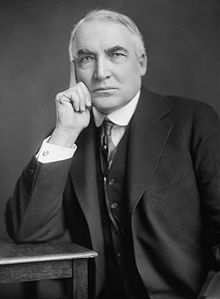
So what happened in Harding’s time?  Things were pretty rough for a while but by the summer of 1921, signs of recovery were already visible.  The following year, unemployment was back down to 6.7% and hit 2.4% by 1923 (source: Thomas Woods, “The Forgotten Depression of 1920″).  A budget surplus arose resulting in a noticeable decline in the national debt.  Business confidence soared and the 1920’s boom was off and running.

President Harding has gotten a bad rap from history because of the scandals that erupted during his administration as well as his chronic womanizing and his passion for the bottle.  But in the countdown of 20th century Presidents that I might do for this blog should I ever get ambitious, I will start with Harding as the least bad President of that sad century and work my way down from there.  I’ll let you  guess who I will honor as the Worst President of the Century.

How does the looming fiscal cliff compare with the policies of 1920?  In case you’ve been hiding under a rock lately (not a bad way to ride out the election campaign!), the fiscal cliff is the set of automatic tax increases and spending cuts that were agreed to when the debt ceiling was raised in 2011.  Congress decided to force its future self to act by lighting a time bomb that it would surely – surely! – defuse before it could go off.  The fuse has now burned to within 1/8 inch of the bomb.

The bomb’s tax increases and spending cuts would reduce the deficit by an estimated $600 billion in one year.  That may be the most accurate estimate but it’s only an estimate.  Congress can set tax rates but tax revenues depend on the size of the tax base.  If highly productive people, those who would take the biggest hit, decide to Go Galt, the tax base could shrink.  And as Jeff Hummel likes to point out, tax rates, particularly the top marginal rates, have varied drastically over the years and yet tax receipts have not varied much from 20% of GDP, excepting the World War II years.

Not only might tax receipts fall short, but expenditures could rise if additional welfare payments such as unemployment benefits or food stamps were to rise.

But let’s assume the fiscal cliff happens and the deficit is indeed reduced by $600 billion. Using figures for the fiscal year just ended, we would still have a $400 billion deficit which would have to be financed by borrowing.  As always, this would be new borrowing, on top of the borrowing needed to roll over the daily stream of maturing debt.  And we mustn’t forget the Social Security Trust Fund which until last year has mitigated the deficit by “investing” its surpluses (FICA tax revenues minus benefit payments) in Treasury securities.  Those FICA surpluses have now turned to deficits which for the present are offset by interest payments on Trust Fund holdings but will eventually require the Trust Fund to stop rolling over maturing securities and, should the trend continue, to deplete its holdings entirely.  All of these developments exacerbate the main federal deficit.  The same applies to the much smaller Medicare Trust Fund.

So I say, with a glance over my shoulder at 1920, bring on the fiscal cliff!  Let the cuts happen, thereby ending a lot of wasteful and harmful spending – particularly “defense” spending.  Let tax rates rise; people will work around them.

But it won’t happen because too many special interests will rise up to prevent it:

  • There are enough military personnel, military contractors, their suppliers, relatives and hangers-on to prevent significant cuts in defense spending.
  • The 27% cut in Medicare physician fees will lead doctors to brush away their Medicare patients like flies, sending those patients hobbling off to howl at their their Congressmen.
  • Millions of middle class people will gasp when their tax preparer tells them they’ve been caught in the dreaded Alternative Minimum Tax trap.  Others will escape the trap only to find that their ordinary income tax rates have risen substantially.
  • Still more millions will see their FICA (Social Security) tax rate revert to the 2010 rate of 6.2% from the current 4.2% “stimulus” figure.

The fiscal cliff won’t happen, at least not all of it, except perhaps for a brief period in January which will be fixed retroactively.  And so, though I hate to say it, I think the longer-term odds of pulling out of our fiscal death spiral are pretty slim.  Many think the government will resort to the time-honored remedy of the printing press, but Jeff Hummel has made a solid argument as to why this option won’t work and why there will be a default on Treasury securities instead.

Hummel also urges economists to do whatever they can to warn people not to count on government largess.  Most young people have written off Social Security for their future and that’s a good thing.  (Not so good for Social Security recipients like me who are increasingly unemployable yet hope to live another 25 years.)  We must take responsibility for our own health care, first by watching our health habits and second by cultivating a personal relationship with a physician, perhaps offering him or her cash payments.  We should be leery of Treasury Securities or of banks, mutual funds, etc. that rely heavily on these securities.  Sock away a few gold and silver coins.

We’re in for a rough ride, I fear, over the next few years.  But the sun will still rise and tangible assets will remain.  Provided enough of us have taken precautions, social unrest will be manageable and maybe, just maybe, the cancer that is called Social Democracy will be shaken off once and for all.

National Economic Systems: An Introduction for Intelligent Beginners – 3

My Debt, your Debt and Future Poverty.

I told you in previous installments of this series of essays that we, in the USA, are not facing one economic crisis but two.

The fist crisis is a recession. It’s a common event in the long run of market economies. Recessions are defined by serious people (according to me) as two consecutive quarters or more of economic shrinkage. Recessions go away whether any government does anything about them or not. One school of thought (Keynesian), to which the Obama administration belongs, maintains that large government spending – stimulation- can lessen or shorten a recession. I argued that the Obama stimulus package of several months ago cannot possibly stimulate, even if you believe in the stimulation scenario.

The second crisis, by far the most serious, is the abnormally high debt the federal government has incurred since President Obama came to office. It disturbs me because the people, you and I, will have to pay interest on the debt for a long time, and eventually re-pay the principal. Else, the government will have to repay its debt in bad currency, in devalued or in eroded currency. If this happens, we will simply all be poorer, in real terms, If your dollar is worth half in ten years of what it is worth now, you will simply have to pay two dollars for what you buy today for one dollar. There is no reason to assume your income will automatically follow. This is a common fallacy (perhaps the topic for another essay): It takes about forty Indian rupees to buy a US dollar today and the same mountain bike that costs 400 US dollars in this country costs 600 US dollars in India. A good income in India would be 12,000 dollars per year. (That’s about twelve times the national average.)  Continue reading →

Le nouveau mandat d’Obama

Selon ce que j’ai entendu à la télé française pendant la campagne, les Francais ont souvent du mal à comprendre le sytème électoral américain. Celui-ci est, à vrai dire, assez peu accessible à l’intuition.

Voici une précision sur l’élection présidentielles de 2012 qui aura échappé, je crois, à tous les commentateurs Francais. Obama l’a emporté en Floride, après un comptage épuisant, par 50% contre 49,15% seulement. Au plan national, Obama a gagné les élections de façon décisive avec 332 voix de grands électeurs contre 206. Cependant le proche examen du vote populaire impose une interprétation divergente du mandat que lui aura octroyé cette élection.

Un court article du Wall Street Journal du 14/11/12 fait observer qu’il aurait suffit de 333.000 votes supplémentaires pour Romney, répartis sur seulement trois états, pour que ce dernier l’emporte. Ceci pour un total de suffrages exprimés dépassant 120.000.000 (cent vingt millions), ou donc une proportion comme ceci: 333/120.000.

Je répète qu’Obama a indubitablement gagné. Cependant, il n’est pas possible de considérer sa victoire comme écrasante.

Ce fait explique en partie pourquoi beaucoup des conservateurs défaits par cette élection, moi y-compris, se prononcent déjà pour que le Parti Républicain se serve de sa majorité à la Chambre des Représentants pour faire de l’obstructionisme vis-à-vis des politiques fiscales à venir du président re-élu.

[Editor’s note: this essay first appeared on Dr. Delacroix’s blog, Facts Matter, on November 14th 2012]

Foldvary on the Concept of “Forward”

Co-editor Fred Foldvary has an excellent post on the historical meaning of the Obama campaign’s choice of the word “Forward” as its political slogan. He writes:

The issue here is not about any political campaign, but the social concept of “forward.” Socialism is, first of all, a family of concepts. Some socialists seek greater statism, the control of society by the state. Other seek “social democracy,” whereby people vote on the major policy options. There are also socialists who seek to put the means of production, land as well as capital goods, in the hands of worker cooperatives.

Usually the “forward” thinkers seek, if not as an ultimate goal, then as the instrumental goal, a governmental control at least of the “commanding heights” of the economy: the financial system, the highways, education, medical care, and retirement pensions. Socialists seek strong controls on the remaining private production, and they also seek an equalization of wealth through a massive redistribution, with highly progressive taxation.

But the world has already experienced the results of “forward” policies in the failed economies of the old USSR, the China of the 1950s and 1960s, Cuba, North Korea, and Eastern Europe. The “forward” socialists seek a progression to the failed past. Of course they claim that their brand of socialism is different from that of the collapsed USSR, but the evidence of history reveals what was attempted in practice world-wide, even when it differs from hypothetical doctrines.

And this, too:

Instead of “forward,” a better metaphor may be “upwards.” Upward takes us to a higher place, and also to the origin of a flow such as a river. But how do we know which way is “up”?

Do read the whole thing, and what do you guys think of Dr. Foldvary’s suggestion of moving “upwards”?

National Economic Systems: An Introduction for Intelligent Beginners – 2

Part Two: Taxing the Rich.

I argue in Part One of this essay that the stimulus package could not possibly stimulate the economy the way a stimulus package is supposed to do. That is, the present stimulus package cannot shorten or lessen the current recession by stemming the growth of unemployment and by jump-starting the national economy, the way Keynesian economics has it. I suggested there had to be another agenda for this massive spending of public money.

Recessions – two consecutive quarters when the national economy contracts instead of expanding – are common under capitalism, in market economies. They wane, whether or not anyone does anything about them. This fact makes if difficult to assign credit to government measures designed to lessen or shorten recessions when economic indicators do look good. Economic indicators don’t look good right now, although some of the press is announcing the beginning of the beginning of the end of the recession.

At any rate, the recession will end eventually. That is, economic growth will resume. I would bet on it but I don’t know when. When growth resumes, we will be left with the second economic crisis facing us. That second crisis is less routine, more extraordinary, and more worrisome than the first crisis, the recession itself. It’s massive public indebtedness. I have to go into the reasons why the Federal Government is even able to incur massive debt. Continue reading →

Around the Web

  1. Delacroix shares his thoughts on Obama’s re-election.
  2. Cowen on the fiscal cliff.
  3. Oh goody.

I’ve had a crappy midterm session. Forgive my hasty posts of late. On the bright side: I am now officially off the streets (at least until February).

Happy hump day everybody!

Brandon Vindicated (and Relieved!)

I read a lot of blogs in my spare time, and one of my favorites is the Monkey Cage, a blogging consortium made up of technocratic, internationalist-minded Left-wing political science professors. They rarely disappoint. I know what you’re thinking, but if I could choose which faction of the left I would want opposing libertarian policies it would be the technocratic Left. It a movement that has individual liberty in mind and is, as I mentioned, internationally-minded.

Notice also how I take into account the fact that an opposition to my own views are a necessary component of my utopia. Too many advocates of liberty don’t realize this when they argue about politics. Which factions would play the role of opposition in an anarcho-capitalist paradise, for example? It seems to me that the quality of one’s perfect opposition is actually quite a good gauge for measuring the quality of one’s political ideal (if I do say so myself!).

Anyway, Patrick Egan, of NYU, has a new post up explaining that the economy was indeed the central issue of the election, and then busts out the data to back up his argument (and help me save face!). I think this is an important point because I’ve already made the rounds around the blogosphere and many otherwise smart, competent people seem to want to chalk up Obama’s victory to something other than the economy.

From Egan’s post: Continue reading →

From the Comments: Social Conservatives Need to Go

Longtime reader –Rick observes:

The Republicans need to re-brand and delete all social conservative positions from their platform. If the God freaks don’t like it, too bad. Let them stay home, vote Democrat or Republican as they wish. So called conservatives should be concentrating on small government, a strong military, a philosophically principled foreign policy, and a secular judiciary that ignores all religions and judges based on the facts and the rule of law.

Their new platform needs to be more inclusive, particularly with Hispanic concerns, not out of a sense of pragmatics, but if America is to develop an expanded trade relationship with Hispanics, how willing will their governments be to participate with radical xenophobes who treat their southern neighbors with disdain in juxtaposition to the favorite status given to our neighbors to the north?

It’s economics. They need jobs, we need workers and an expanded tax base as well as new trading partners. Let the Xenophobes vote with the KKK as a bloc. Their absence won’t be missed. The Constitution states that all men were created equal – not just U.S. citizens and Canadians.

However, I won’t get my hopes up that the leadership will suddenly turn rational and see the possibility of gaining 2 or 3 new voters for every one bigot they ignore in constructing their philosophical/political planks.

I couldn’t have said it any better myself. The sooner the GOP turns its back on social conservatives, the sooner it can get back to being a national political party again. Be sure to check out –Rick’s blog here.