BC’s weekend reads

  1. Barry has a book review of Nietzsche’s political thought in the Los Angeles Review of Books!
  2. (check out Barry’s 2014 NOL post on Nietzsche’s contributions to the liberty canon)
  3. a good analysis on the Arab cold war between 2 sets of American allies
  4. a great analysis on the Kurds, the Yazidis, and Turkey
  5. the Zanzibar-North Sea swap
  6. walruses, the Arctic, and science

Lunchtime Links

  1. Trophy-taking and dismemberment as warfare strategies [pdf]
  2. optimally vague contracts and the law [pdf]
  3. Germanic and Carthaginian republicanism
  4. traditional resurgence in tropical Africa [pdf]
  5. crisis bureaucracy: homeland security and the political design of legal mandates [pdf]

Inventions that didn’t change the world

Have you ever learned about an amazing invention–whether it was the Baghdad battery or the ancient Roman steam engine or Chinese firecrackers–and wondered why it didn’t do more to change the world? In this podcast, we examine a selection of curiosities and explore hypotheses for why their inventors didn’t use them to full effect.

We move VERY quickly through a range of fascinating examples and hypotheses, and therefore leave a lot up to discussion. We hope to see your thoughts, feedback, and additions in the comments section!

For any invention that you want to learn more about, see the links below:

Knossos’ toilets

In the 2nd millennium BC, a “palace” (now thought to be a building that served as administrative, trade, and gathering hub) had running-water toilet flushing. Much like the Roman Cloaca Maxima, likely a HUGE public-health benefit, but basically died out. Does this show that military protection/staving off the “Dark Ages” was the only way to maintain amazing inventions?

Link: http://www.nature.com/news/the-secret-history-of-ancient-toilets-1.19960;

The Nimrud lens

Whether it was a fire-starter, a magnifying glass, or (for some overeager astronomy enthusaists), the Neo-Assyrian ground-crystal Nimrud lens is an invention thousands of years out of place. While the Egyptians, Greeks, and Romans all used lenses of different sorts, and glass-blowing was certainly popular by the 1st century BC in Roman Egypt, no glass lenses were made until the Middle Ages and the potential scientific and engineering uses of lenses–that can hardly be understated even in their 16th-to-18th-century applications–had to wait another couple millennia. Many devices like the Baghdad battery and Antikythera device are heralded for their possible engineering genius, but this seems like a simple one with readily available applications that disappeared from the historical record.

https://en.wikipedia.org/wiki/Nimrud_lens

Hero of Alexandria’s steam engine

In the 1st century AD, Hero was a master of simple machines (that were mostly used for plays) and also invented a force pump, a wind-powered machine, even an early vending machine. However, he is likely most famous for his Aeolipile, a rotating steam engine that used heated water to spin an axle. The best attested use of this is for devotion to the divine and party tricks.

https://en.wikipedia.org/wiki/Aeolipile

The ancient mechanical reaper

Ancient Gallo-Romans (or just Gauls) invented a novel way of grain harvesting: rather than using sickles or scythes, they used a mechanical reaper, 1700 years before Cyrus McCormick more than tripled the productivity of American farmers. This antiquated device literally but the cart before the oxen and required two men to operate: one man to drive the beasts, and another to knock the ears off the stalk (this reaper was obviously far less sophisticated than McCormick’s). This invention did not survive the Volkswanderung period.

http://www.gnrtr.com/Generator.html?pi=208&cp=3

http://reapertakethewheel.blogspot.com/2013/03/impacts-of-invention.html

Note: the horse collar (which allowed horses to be used to plow) was invented in 1600-1400 BC in China AND the Levant, but was not applied widely until 1000 AD in Europe. https://en.wikipedia.org/wiki/Horse_collar.

Inoculation

Madhav, an Indian doctor, compiled hundreds of cures in his Nidana, including an inoculation against smallpox that showed an understanding of disease transmission (he would take year-old smallpox-infected flesh and touch it to a recently made cutaneous wound). However, the next 13 centuries did not see Indian medical understanding of viruses or bacteria, or even copied techniques of this, development. https://books.google.com/books?id=Hkc3QnbagK4C&pg=PA105&lpg=PA105&dq=madhav+indian+smallpox+inoculation&source=bl&ots=4RFPuvbf5Y&sig=iyDaNUs4u5N7xHH6-pvlbAY9fcQ&hl=en&sa=X&ved=0ahUKEwic8e-1-JXVAhUp6IMKHfw3DLsQ6AEIOjAD#v=onepage&q=madhav%20indian%20smallpox%20inoculation&f=false

At least, thank god, their methods of giving nose jobs to those who had had their noses cut off as a punishment survived: https://en.wikipedia.org/wiki/History_of_rhinoplasty

The Chinese:

List of all chinese inventions:

https://en.wikipedia.org/wiki/List_of_Chinese_inventions#Four_Great_Inventions

Gunpowder

Gunpowder was discovered by Chinese alchemists attempting to discover the elixir of life (irony, no?)

https://www.thoughtco.com/invention-of-gunpowder-195160

https://en.wikipedia.org/wiki/Four_Great_Inventions

(maybe a good corollary would be Greek fire, which was used effectively in naval warfare by the Byzantines, but which was not improved upon and the recipe of which is still secret: https://en.wikipedia.org/wiki/Greek_fire)

Printing

The Chinese invented the printing press possibly as early as the 6th century. However, unlike the explosion of literacy seen in much of Europe (particularly Protestant Europe–see our last podcast), the Chinese masses never learned to read. In fact, in 1950 fewer than 20% of Chinese citizens were literate. Compare this to Europe, where some societies saw literacy rates of as high as 90% (Sweden, Male population) in some societies within a few centuries of the introduction of the printing press. Why? There may be several reasons–cultural, religious, political–but in our opinion, it would have to be the characters: 100,000 blocks were needed to create a single set.

http://www.nytimes.com/2001/02/12/news/chinas-long-but-uneven-march-to-literacy.html

https://en.wikipedia.org/wiki/History_of_printing_in_East_Asia

They also invented pulped paper by the 2nd century BC: https://en.wikipedia.org/wiki/List_of_Chinese_inventions.

The compass

Invented by 200 BC for divination and used for navigation by the Song dynasty; despite this and the availability of easily colonizable islands within easy sailing distance, the Chinese did not colonize Indonesia, Polynesia, or Oceania, while the Europeans did within the century after they developed the technology and first sailed there.

https://en.wikipedia.org/wiki/History_of_the_compass.

The rudder

While they did not invent the rudder, they invented the “medial, axial, and vertical” sternpost rudder that would become standard in Europe almost 1,000 years before it was used in Europe (1st century AD vs 11th century).

Natural gas

The Chinese discovered “fire wells” (natural gas near the surface) and erected shrines to worship there.

https://link.springer.com/referenceworkentry/10.1007%2F978-1-4020-4425-0_9568

They even understood their potential for fuel, but never developed beyond primitive burning and bamboo piping despite having advanced mining techniques for it by the 1st century BC.

Chinese miscelleni:

Hydraulic powered fan: https://en.wikipedia.org/wiki/Fan_(machine)#History

Cuppola furnace for smelting and molding iron: https://en.wikipedia.org/wiki/Cupola_furnace.

Coke as a fuel source: https://en.wikipedia.org/wiki/Coke_(fuel).

Belt-drive spinning wheel: https://en.wikipedia.org/wiki/Coke_(fuel).

The Precolumbian wheel

The pre- and early Mayans had toys that utilized primitive wheels, but did not use them for any labor-saving purpose (even their gods were depicted carrying loads on their backs). This may have been because scaling up met with mechanical difficulties, but the potential utility of wheels in this case with a bit of investment literally sat unrealized for centuries.

https://tcmam.wordpress.com/2010/11/11/did-pre-columbian-mesoamericans-use-wheels/

The Tucker:

http://www.smithsonianmag.com/history/the-tucker-was-the-1940s-car-of-the-future-135008742/

The following book contained some of our hypotheses:

https://books.google.com/books?id=ynejM1-TATMC&pg=PA399&lpg=PA399&dq=roman+and+greek+labor-saving+devices&source=bl&ots=BI6GVGTrxC&sig=8ZJqirOVUyjH7TNq0fcW6UUPn1k&hl=en&sa=X&ved=0ahUKEwj55O7395XVAhVqwYMKHSb2Dy4Q6AEIKTAB#v=onepage&q=roman%20and%20greek%20labor-saving%20devices&f=false


The rest of our hypotheses were amalgamated from our disparate classes in economics and history, but none of them are our own or uncommon in academic circles. Thanks for listening!

Some thoughts on the ivory tower; part 1: discrimination

I entered academia in 2009 when I started my bachelor’s degree and began graduate studies in 2014 when I entered a master’s program. I have been in the ivory tower in some form for almost a decade. Others have spent much more time in the tower than I, but I am hardly a newcomer. I hope then that I can offer thoughts on discrimination and mental health in the ivory tower.

In the past few years I have noted an increased self-aware discussion on the lack of diversity, both in terms of phenotype and ideology, in the ivory tower. The tower is full of center-left white men. I have seen various formal (e.g. #womenalsoknowstuff ) and informal groups groups advocate for greater inclusion in the tower. For the record there are non-leftist groups involved in this as well. CU Boulder has a program to increase conservative intellectuals. The Institute of Humane Studies (IHS) essentially serves to advocate for classical liberals in the tower. 

There is nothing wrong with these goals. Women also knows stuff tries do this by advertising the work of female scholars. IHS does it by inviting classical liberals to book discussions – and providing beer. Both approaches sound sensible to me. My concern is that ultimately the pipeline isn’t being fixed. Not really. Both approaches help those who managed to enter, at minimum, graduate school but do little to help solve more structural reasons for why there respective groups are rare in the tower.

Why are there so few women and classical liberals (and especially so few classical liberal women!) in academia? It’s partly cultural and partly institutional.

Minorities get made fun of in academia. Academics like to think of themselves as cosmopolitan, but it’s a big lie. A recent undergrad thesis by a Berkeley student looked at misogynistic discussions on an online forum frequented by economists. I disagree with the research design of the paper, but I believe the general argument that the tower is filled with misogyny. I also believe it’s filled with dislike for conservatives, Christians, atheists, whites, blacks, Arabs, Chinese, etc.

I don’t think the tower is unique in this. Human beings divide themselves by groups and I don’t see why that will ever change. I think the academy is just a bit whiter and a bit more lefty because of sorting effects. You can see this happening even within the tower. Classical liberals sort into economics – how many classical liberal anthropologists do you know? Not counting NoL’s chief editor? Some minorities sort into ethnic studies. How many black game theorists do you know? Native American psychometricians?

What can we do? I’m not sure. We can improve the pipeline so that grad students, and eventually faculty, get more diverse. However I suspect the sorting problem will remain. Superficially we will have more diversity, but is it really diversity if we’re sorted by discipline and subfields? Should we force new classical liberals to enroll in sociology grad programs? I don’t know. Maybe we should give up on diversity all together and focus on abolishing the state. Maybe? Who knows? What do you  all think?

By the way if you want to know what true cosmopolitanism is, visit an inner city. True cosmopolitanism is seeing blacks, Mexicans and Koreans eating pupusas made by a Honduran. Everything else is a GAP commercial concoted by HR people.

Human Action, Ch. 1

Well, I finally started reading Human ActionOne connection stood out to me from the first chapter. 

First, there’s much more attention paid to fundamental philosophy than I expect from economic treatises. This is understandable given that Mises felt he had to set the stage — sparring, as he says, with the irrationalists, polylogists, historicists, positivists, behaviorists, and other economists within the youngest science. Every undergrad, cracking open Hobbes’ Leviathan, is startled to find lengthy remarks on human cognition in what they thought was only a work of political philosophy; this was a similar experience. 

There are noticeable allusions between von Mises and pre- and post-Tractatus Wittgenstein. Both Austrians and both Ludwigs, the economist writes that “It is impossible for the human mind to conceive logical relations at variance with the logical structure of our mind. It is impossible for the human mind to conceive a mode of action whose categories would differ from the categories which determine our own actions” (p. 25). Similarly, for the philosopher, the logical structure of thought (and language) was a central theme of Tractatus Logico-Philosophicus; one of the young Wittgenstein’s conclusions was that some (ethical, aesthetic, metaphysical) postulates go beyond the limits of language and, when crunched into such human linguistic straightjackets, create sheer nonsense (leading to such maxims like, “What can be said at all can be said clearly…”) (TLP, §7).

Each Ludwig, of course, limited their inquiry to the human mind, discovering, like Kant, universal conditions of rational beings (or so I garner so far from Mises). 

Another methodological point in common. Ludwig von Mises, in section The Alter Ego, remarks on “the ultimate given,” an idea which, I believe, is unpopular in contemporary epistemology. The empirical sciences must reach final points of inquiry, upon which their tools fail to produce deeper insight. This is so because, to Mises, there are only “two principles available for a mental grasp of reality, namely, those of teleology and causality” (p. 25): teleology belonging to purposeful behavior, and causality to non-purposive objects of study. The former, applied ad infinitum, must stop at the unmoved mover, and the latter can only invoke an infinite regress. This point is important for deploying praxeology as a deductive science.

This doesn’t seem like a new insight, but it’s also one that Wittgenstein touches upon in a different way in Philosophical Investigations, writing in the first segment “Explanations come to an end somewhere.” The use of language in daily life does not imply ultimate, elucidated concepts between speakers; we never ask for these and likewise we do not need them to communicate. Reaching deeper into shared insight also leads to confusion; we talk of objects and ideas as ‘wholes’ and ‘composites,’ but these categories are not unambiguous. Wittgenstein situates the sense of concept-analysis only within a language game: “The question ‘Is what you see composite?’ makes good sense if it is already established what kind of complexity — that is, which particular use of the word — is in question. If it had been laid down that the visual image of a tree was to be called ‘composite’ if one saw not just a single trunk, but also branches, then the question ‘Is the visual image of this tree simple or composite?’, and the question ‘What are its simple component parts?’, would have a clear sense — a clear use.” So therefore, “To the philosophical question: ‘Is the visual image of this tree composite, and what are its component parts?’ the correct answer is: ‘That depends on what you understand by “composite”.’ (And that is of course not an answer but a rejection of the question.)” (PI, §47).

In the future I might post on Mises’ short use of terms like “being,” “change,”and “becoming,” which he uses in a sense reminiscent of Parmenides.

Wittgenstein, Philosophical Investigations. G. E. M. Anscombe trans.

von Mises, Human Action. Scholar’s Edition. Ludwig von Mises Institute.

Worth a gander

  1. good update on the mayhem in the Middle East
  2. as good as that update is, though: Iraq, Saudi Arabia to reopen border crossings after 27 years
  3. great read on Russia’s Far East and Russia’s travel writing genre
  4. in Russia, Lutheranism (Protestantism) is considered a “traditional” religion (h/t NEO)
  5. how social is reason?

Make neo-Nazis flop off Broadway: public choice and Tina Fey’s sheetcaking

tumblr_n2evlqgunn1sbf1mqo4_500

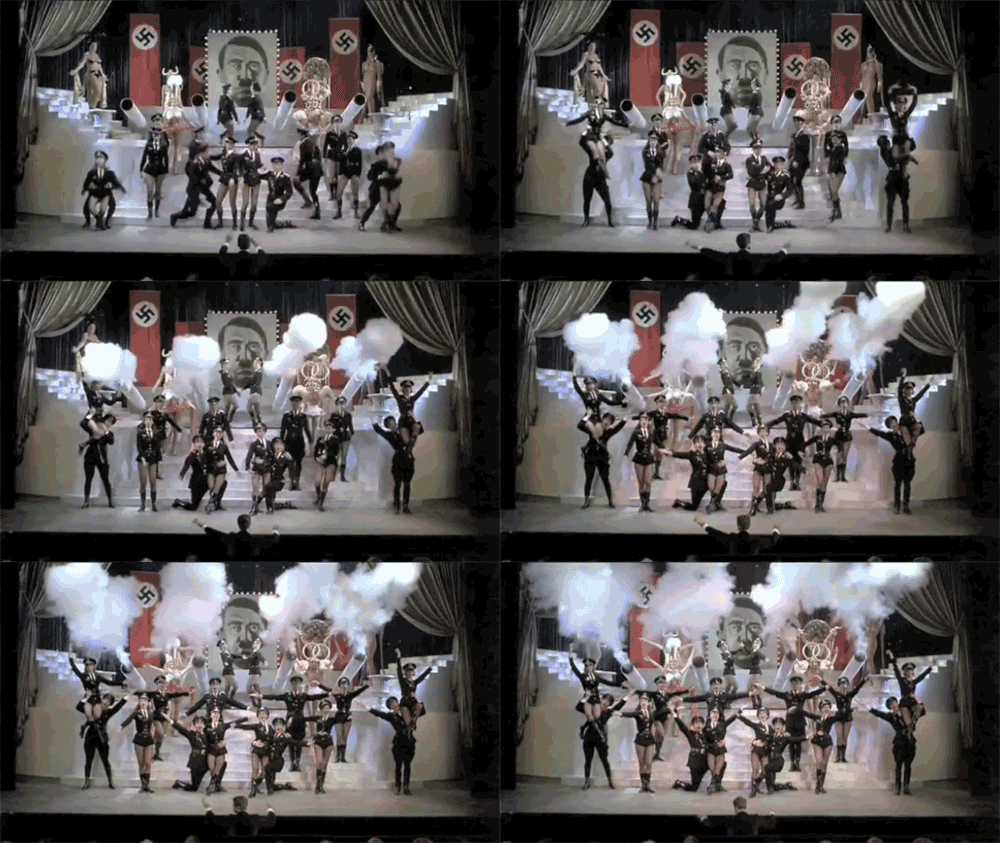
A week ago a white supremacist rally in Charlottesville protesting the taking down of Confederate Memorial statues turned fatally violent. Other protests were due to take place this weekend in multiple U.S. cities, including New York (now postponed). How should citizens and public authorities deal with this upsurge in violent neo-Nazi protest? I am with Tina Fey on this one: don’t show up, have some cake, and encourage the NYPD to prevent violence.

Some on the left have tried opportunistically and mistakenly to associate Virginian school public choice scholarship with the far-right. This is a sadly missed opportunity because James Buchanan’s theory of club goods helps explain how far-right street protests emerge and suggest how authorities might best subdue them. I draw on John Meadowcroft’s and Elizabeth Morrow’s analysis of the far-right English Defence League (EDL).

Continue reading

Lunchtime Links

  1. violence among foragers [pdf]
  2. building legal order in ancient Athens [pdf]
  3. why Congo persists [pdf]
  4. toward an old new paradigm in American international relations [pdf]

Worth a gander

  1. Zero hour for Generation X
  2. Confederate flags and Nazi swastikas together? That’s new.
  3. America at the end of all hypotheticals
  4. What’s left of libertarianism?
  5. Factual free market fairness
  6. Thinking about costs and benefits of immigration

Is Socialism Really Revolutionary?

A central feature of Karl Marx’s thought is its teleological character: the world walks inexorably towards communism. It is not a question of choices. It is not a question of individual decisions. Communism is simply the direction in which the world walks. Capitalism will collapse not because of some external force, but because of its own internal contradictions (centrally the exploitation of the workers).

I don’t know exactly what History classes are like in other countries, but in basically all my academic trajectory I was bombarded with some version of Marxism. Particularly as far as my country was concerned, the question was not whether a socialist revolution would happen, but why it was taking so long! Looking at events in the past, the reading was as follows: the bourgeoisie overthrew the Old Regime in the French Revolution. At that time the bourgeoisie were revolutionaries (and therefore left-wing). However, overthrowing the monarchy and establishing a constitutional government, the bourgeois became advocates of the new order (and therefore, reactionary, or right-wing). Socialists have become the new revolutionaries, the new left, the new radicals.

This way of seeing history has a Hegelian background: there are no absolutes. History moves through a process of thesis, antithesis, and synthesis. History’s god is learning to be a god. I’ve written earlier here about how this kind of relativistic view does not stand on its own terms. Now I would like to say that this way of looking at history can be intellectually dishonest.

According to the historical view I have learned, there is no absolute of what is left or right. One political group is always to the left or to the right of another, depending on how much this group is revolutionary or reactionary. Thus, the bourgeois were revolutionaries at one time, but today they are no longer. But what happens when the Socialists come to power? Do not they themselves become reactionary, defenders of the status quo? According to everything they taught me, no. The revolution is permanent. My assessment is that at this point they are partly right: the revolution must be permanent.

Socialists can not take the risk of becoming exactly what they fought at the first place. In practice, however, this is not the case: the Socialists occupy the posts of the state and begin to defend their position and these positions more than anything else. That’s what I see in my country today. In practice, it is impossible to be revolutionary all the time, just as it is impossible to be relativistic in a consistent way. I have not yet met a person who, looking at the red light, said “but to me it’s green and all these other cars are just a narrative of patriarchal society.”

Politics is unfortunately, for the most part, simply a search for power. Even the most idealistic groups need the power to put their agendas into practice. And experience shows that once installed in power, many idealistic groups become pragmatic.

Socialism is not revolutionary. It is only a reaction against the real revolution that is capitalism defended by classical liberalism. Classical liberalism says: men are all equal, private property is inviolable, exchanges can only occur voluntarily and no one can be forced to work against their will. Marxism responds: men are not all the same (they are divided into classes), private property is relative (if it is in the interest of the collective I can take what was once yours) and you will work for our cause, whether or not you want to. In short, Marxism is a return to the Old Regime.

When Should Intellectuals be held Accountable for Popular Misrepresentations of their Theories?

Often an academic will articulate some very nuanced theory or ideological belief which arises out of a specialized discourse, and specialized background knowledge, of their discipline. It is not too surprising that when her theory gets reprinted in a newspaper by a non-specialist journalist, taken up by a politican to support a political agenda, or talked about on the street by the layman who doesn’t possess specialized knowledge, the intellectual’s theory will be poorly understood, misrepresented, and possibly used for purposes that are not only not justified but the exact opposite of her intentions.

This happens all the time in any discipline. Any physicist who reads a You Tube thread about the theory of relativity, an economist who opens a newspaper, biologist who reads the comments section of a Facebook post on GMOs, psychologist who hears jokes about Freud, or philosopher who sees almost any Twitter post about any complex world-historical thinker knows what I’m talking about. Typically, it is assumed that a popularizer or layperson who misunderstands such complex nuanced academic theories always must be answerable to their most intellectually responsible, academic articulation. It is usually assumed that an intellectual theorist should never be concerned with the fact that her theories are being misunderstood by popular culture, and certainly, she shouldn’t change a theory just because it is being misunderstood.

For many disciplines in many contexts, this seems to be true. The theory of relativity shouldn’t be changed just because most people do not possess the technical knowledge to understand it and popularizers often oversimplify it. Just because people do not understand that climate change means more than rising temperatures doesn’t mean it is not true. The fact that some young earth creationist thinks that the existence of monkeys disproves revolution doesn’t mean an evolutionary biologist should care.

Further, it’s not just natural sciences to which these apply, but also the social sciences. Just because methodological individualism is often misunderstood as atomistic, reductive ethical individualism doesn’t mean economists should abandon it any more than people’s various misunderstandings of statistical methods mean scientists should abandon those methods. Likewise, the fact that rational choice theory is misunderstood as meaning people only care about money, or that Hayek’s business cycle theory is misunderstood as meaning only central banks can cause recessions, or that a Keynesian multiplier is misunderstood as meaning that all destructive stimulus is desirable because it equally increases GDP does not mean that economists who use them should abandon those theories based on non-substantive criticisms based on over simplified or straw man misunderstandings of those theories.

On the other hand, there are other times where it seems that popular misunderstandings of some academic writings do matter. Not just in the sense that a layperson not understanding science leads them to do unhealthy things, and therefore the layperson should be educated on what scientific theories actually say, but in the sense that popular misunderstandings point out some deficiencies in the theory itself that the theorist should correct.

To take an example (which I’m admittedly somewhat simplifying) from intellectual history. Early in his career John Dewey advocated quasi-Hegelian comparisons of society to a “social organism.” For example, in an 1888 essay he defended democracy because it “approaches most nearly the ideal of all social organization; that in which the individual and society are organic to each other.” Though Dewey never meant such metaphors to undermine individuality and imply some form of authoritarian collectivism, he did want to emphasize the extent to which individuality was constituted by collective identifications and social conditions and use that as a normative ideological justification for democratic forms of government.

By 1939, after the rise of Bolshevism, fascism, and various other forms of Hegelian-influenced illiberal, collectivist, authoritarian governments, he walked back such metaphors saying this:

My contribution to the first series of essays in Living Philosophies put forward the idea of faith in the possibilities of experience at the heart of my own philosophy. In the course of that contribution, I said, “Individuals will always be the center and the consummation of experience, but what the individual actually is in his life-experience depends upon the nature and movement of associated life.” I have not changed my faith in experience nor my belief that individuality is its center and consummation. But there has been a change in emphasis. I should now wish to emphasize more than I formerly did that individuals are the final decisive factors of the nature and movement of associated life.

[…] The fundamental challenge compels all who believe in liberty and democracy to rethink the whole question of the relation of individual choice, belief, and action to institutions, and to reflect on the kind of social changes that will make individuals actually the centers and the possessors of worthwhile experience. In rethinking this issue in light of the rise of totalitarian states, I am led to emphasize the idea that only the voluntary initiative and voluntary cooperation of individuals can produce social institutions that will protect the liberties necessary for achieving development of genuine individuality.

In other words, Dewey recognized that such a political theory could be easily misunderstood and misapplied for bad uses. His response was to change his emphasis, and his use of social metaphors, to be more individualistic since he realized that his previous thoughts could be so easily misused.

To put a term to it, there are certain philosophical beliefs and social theories which are popularly maladaptive, that is regardless of how nuanced and justifiable it is in the specialized discourse of some intellectual theorist they will very often be manipulated and misused in popular discourse for other nefarious purposes.

To take another example, some “white nationalist” and “race realist” quasi-intellectuals make huge efforts to disassociate themselves with explicitly, violently racist white supremacists. They claim that they don’t really hate non-whites and want to hurt them or deprive them of rights, just that they take pride in their “white” culture and believe in (pseudo-)scientific theories which purport to show that non-whites are intellectually inferior. It is not very surprising, to most people, that in practice the distinction between a “peaceful” race realist and a violently racist white supremacist is extremely thin, and most would rightly conclude that means there is something wrong with race realism and race-based nationalist ideologies no matter how much superficially respectable academic spin is put on them because they are so easily popularly maladaptive.

The question I want to ask is how can we more explicitly tell when theorists should be held accountable for their popularly maladaptive theories? When does it matter that public misinterpretation of a somewhat specialized theory points to something wrong with that theory? In other words, when is the likelihood of a belief’s popularly mal-adaptivity truth-relevant?  Here are a few examples where it’s a pretty gray area:

  1. It is commonly claimed by communitarian critics of liberalism that liberalism reduces to atomistic individualism that robs humanity of all its desire for community and family and reduces people to selfish market actors (one of the original uses of the term “neoliberal”). Liberals, such as Hayek and Judith Shklar, typically respond by saying that liberal individualism, properly understood, fully allows individuals to make choices relevant to such communal considerations. Communitarians sometimes respond by pointing out that liberalism is so often misunderstood publicly as such and say that this shows there is something wrong with liberal individualism.
  2. It is claimed by critics of postmodernism and forms of neo-pragmatism that they imply some problematic form of relativism which makes it impossible to rationally adjudicate knowledge-claims. Neo-pragmatists and postmodernists respond by pointing out this is misunderstanding their beliefs, the idea that our understanding of truth and knowledge isn’t algorithmically answerable to correspondence doesn’t mean it’s irrational, postmodernism is about skepticism towards meta-narratives not skepticism towards all rational knowledge itself, and (as Richard Bernstein argued) these perspectives often make hardcore relativism as incoherent as hardcore objectivism. The critic sometimes responds by citing examples of lay people and low-level academics using this to defend absurd scientific paradigms and relativistic-sounding theories of morality or epistemology and this should make us skeptical of postmodernism or neo-pragmatism.
  3. Critics of Marxism and socialism often point out that Marxism and socialism often transform into a form of authoritarianism, such as in the Soviet Union or North Korea. Marxist and socialists respond by saying that all these communist leaders misused Marxist doctrine, Marx doesn’t really imply anything that would lead of necessity to authoritarianism, and socialism can work in a democratic, more free context. The critic (such as Don Lavoie) will point out that the institutional incentive-structure of socialism ncessarily require a sort of militarism due to the economic incentives faced by socialist governments regardless of the good intentions of the pure intentions of the socialist theorist, in other words they claim that socialism is inherently popularly maladaptive due to the incentives it creates. The socialist still thinks this isn’t the case and, regardless, the fact that socialism has turned authoritarian in the past was because it was in the hands of irresponsible revolutionaries/popularizers and that isn’t relevant to socialism’s truth.
  4. Defenders of traditional social teachings of Christianity with respect to homosexuality claim there is nothing inherently homophobic about the idea that homosexual acts are a sin. In the spirit of “Love the sinner, hate the sin,” they claim that being gay isn’t a sin but homosexual acts are the sin. Christians should show love and compassion for gay people, they say, while still condemning their sexual behavior. Secular and progressive Christian critics respond by pointing out how, in practice, Christians do often act very awfully towards gay people. They point out it is very difficult for most Christians who believe homosexual acts are sinful to separate the “sin” from the “sinner” in practice regardless of the intellectually pure intentions of their preacher, and that such a theological belief is often used to justify homophobic cruelty. Since you will judge a faith by its fruits (a pretty Christian way of saying that popular mal-adaptivity is truth-relevant), we should be skeptical of traditional teachings on homosexuality. The traditionalist remains unconvinced that this matters.

It is important to distinguish between two questions: whether these beliefs are popularly maladaptive empirically (or, perhaps, just very likely to be) and whether the possibility of them being popularly maladaptive is relevant to their truth. For example, a liberal could respond to her communitarian critic by pointing out empirical evidence that individuals engaging in market exchange in liberal societies aren’t selfish and uncaring about their communities to undermine the claim that their individualism is popularly maladaptive in the first place. But that response is different from a liberal saying that just because their individualism has been misunderstood means that they shouldn’t care about it.

We should also distinguish the question of whether beliefs are likely to be maladaptive from whether their mal-adaptivity is truth-relevant. For example, it is conceivable that a popularized atheism would be extremely nihilistic even if careful existentialist atheists want to save us from nihilism. An atheist could say that appears unlikely since most non-intellectual atheists aren’t really nihilists (which would answer the former question), or by saying that people’s misunderstanding of the ethical implications of God’s non-existence is not relevant to the question of whether God exists (which would answer the latter question). For now, I am only concerned with when maladaptivity is truth-relevant.

There are a couple of responses which seem initially plausible but are unconvincing. One potential response is that positive scientific theories (such as evolution and monetary economics) do not need to worry about whether they are likely to be popularly maladaptive, but normative moral or philosophical theories (such as liberal individualism or theological moral teachings) do not.

However, this confuses the fact that scientists do often make normative claims based on their theories which seem irrelevant to their popular interpretation. For an instance, it’s not clear that a monetary economist, who makes normative policy conclusions based on their theories, should care if the layman does not understand how, for example, the Taylor Rule, Nominal Income Target, or Free Banking should work. Further, there are philosophical theories where popular maladaptively doesn’t seem to matter; for example, Kantians shouldn’t really fret if an introductory student doesn’t really grasp Kant’s argument for the synthetic a priori, and analytic philosophers shouldn’t care if most people don’t understand Quine’s objections to the analytic/synthetic distinction.

I’m unsure exactly how to answer this question, but it seems like answering it would clear up a lot of confusion in many disagreements.

The Counterfactual and the Factual

Historians often appear skeptical of counterfactual arguments. E.H. Carr argued that “a historian should never deal in speculation about what did not happen” (Carr, 1961, 127). Michael Oakeshott described counterfactual reasoning as ‘a monstrous incursion of science into the world of history’ (quoted in Ferguson, 1999). More recently, Eric Foner is reported to have found “counterfactuals absurd. A historian’s job is not to speculate about alternative universes …It’s to figure out what happened and why” (cited in Parry, 2016, here).

Such skepticism is striking to the modern economic historian, who since Robert Fogel’s work on the impact of the railroad on American economic growth has been trained to think explicitly in terms of counterfactuals. Far from being the absurdity Foner suggests, counterfactuals represent the gold standard in economic history today. Why? Because they are the sine qua of causal analysis. As David Hume noted, a counterfactual is exactly what we invoke whenever we use the word “cause”: “an object, followed by another, . . . where, if the first object had not been, the second would had never existed” (Hume, 1748, Part II).

Hume’s reasoning can best be understood in the context of a controlled experiment. Suppose a group of randomly selected patients are treated with a new drug while another randomly selected group are assigned a placebo. If the treatment and control groups were ex ante indistinguishable, then the difference between the outcomes for these two groups is the causal effect of the drug. The outcome for the control group provides the relevant counterfactual which enables us to assess the effectiveness of the drug.

The modern revival of economic history is based largely on the skill with which economic historians have been able to use econometric tools to replicate this style of experimental design using observational data. Such techniques enable economic historians to assess such counterfactuals as how much did slavery contribute to Africa’s underdevelopment?, what was the impact of the Peruvian Mita? or the effects of the Dust bowl?

The rejection of the counterfactual approach by historians such as Foner seems to run deep and constitutes a major divide between historians and economic historians; it is therefore well worth exploring its source.


To begin with, let’s set aside some of the reasons why historians have dismissed counterfactuals in the past. We need not, for instance, pay too much attention to the attachment of Marxists (like Carr) and Hegelian idealists (like Oakeshott) to teleological history. Of course, if history represents the unfolding of a dialectical process, then events that did not occur cannot, by definition, constitute the subject of historical analysis. Crude Marxism (and Hegelianism) is, I hope, still out of favor. But another reason why historians are skeptical of the counterfactual seems better grounded. And this is historians’ attachment to the factual.

Consider, Niall Ferguson’s edited volume Virtual History. It provides an excellent defense of counterfactual history. The counterfactuals considered by Ferguson and co, however, are largely in military or diplomatic history: what would have happened had the Nazis’ invaded Britain? etc.

These counterfactuals are a useful way to think through a question. But their power typically depends on reversing a single decision or event, i.e. suppose Hitler doesn’t issue his Stop Order in June 1940 or Edward Grey decides not to defend Belgium neutrality, what then? To be plausible everything else has to be held constant. This means that counterfactuals in diplomatic and military history shed light on the short term consequences of particular events. But the ceteris paribus assumption becomes harder to maintain as we consider events further removed from the initial counterfactual intervention. Thus, we have a reasonable idea of what Nazi rule of Britain in 1940 might have looked like — with the SS hunting down Jews, liberals, and intellectuals and restoring Edward VIII to the throne. But once we consider the outcomes of a Nazi ruled Britain into the 1950s and 1960s, we have much less guidance. Lacking any documentary evidence of the intentions of Britain’s Nazi rulers in the post-war era leaves us in the realm of historical fiction like Robert Harris’ Fatherland or CJ Sansom’s Dominion; there are simply too many degrees of freedom to do conduct historical analysis. Counterfactuals become problematic once we run out of facts to discipline our analysis.

This is the one fact it a valid reason for historians to be skeptical of counterfactuals. The actual historical record has to serve as a constant constraint on historical writing. This goes back to Leopold von Ranke, the scholar responsible for history’s emergence as an academic discipline in the 19th century. Ranke and his followers insisted on rigorous documentation and established the idea that the craft of the historian lay in the discovery, assembly, and analysis of primary sources. Ranke urged historians to focus on what actually happened; simply put, the facts ma’am, just the facts. Many criticisms have been levied at Ranke in the intervening 150 years, and to jaded post-modern eyes this approach no doubt appears hopeless naïve. But we should not dismiss Ranke’s strictures too quickly given what happens when historians abandon them (here and here). What is important here is that the same Rankian strictures that helped form history as an academic discipline, also rule out speculating about things that didn’t happen. They instill in historians a natural skepticism of counterfactual, alternative, history.

Moreover, while military history lends itself naturally to counterfactual analysis, other areas of history such as social or economic history where change is typically more gradual appear less suitable. After all: how is one to assess such complex counterfactuals as the fate of slavery in the US South in the absence of the Civil War?


These are questions which benefit from counterfactual reasoning but which, unlike diplomatic, political or military history, often requires training in the social sciences to answer. For example, take a question that is of interest to historians of capitalism: would slavery have disappeared quickly without the civil war?

From the 1950s to the 1970s, cliometric historians utilized economic theory to try to answer this. They employed economic models to assess the profitably of slavery and to infer the expectations of slave owners in the south (here). The main finding was that, contrary to the suppositions of historians (who at the time were often sympathetic to the southern cause): slavery was extremely profitable in 1860 and slaveholders foresaw the institution lasting indefinitely. In this case, their use of counterfactual reasoning overturned the previous historical orthodoxy.

The issue of the economic importance of slavery to the American economy in the early nineteenth century is also a counterfactual question. Implicitly it asks what would GDP have been in the absence of the slave-produced cotton. Here it is not only economic historians who are making counterfactual arguments. Foner championed Ed Baptist’s book The Half Has Never Been Told. But in it, Baptist argued that almost 50% of GDP in 1836 was due to slavery, itself a counterfactual argument. He is arguing that, in the absence of slavery, the American economy would have been roughly half the size that it was. This claim is certainly false based as it is on double-counting. But the problem with Baptist’s argument is not that he had made a counterfactual claim, but that he conducted counterfactual analysis ineptly and that his estimates are riddled with errors (see here and here).

All of this sheds light on why counterfactuals are so often dismissed by historians. There is an important and deeply shared sense that the counterfactual approach is ahistorical and an unfamiliarity with the techniques involved. A natural lesson from the Baptist affair is that historians should become more familiar with the powerful tools social scientists have to assess counterfactual questions. Taking counterfactuals seriously is a way to make progress on uncovering answers to important historical questions. But there is also a sense in which the historians’ suspicion of counterfactual may be justified.


There remain many questions where counterfactuals are not especially useful. The more complex the event, the harder it is to isolate the relevant counterfactual. Recently Bruno Gonçalves Rosi at Notes on Liberty suggested such a counterfactual: “no Protestant Reformation, no freedom of conscience as we know today”.

But in comparison to what we have considered thus far, this is a tricky counterfactual to assess. Suppose Bruno had said, “no Martin Luther, no freedom of conscience as we know it today”. This would be easier to argue against as one could simply note that absent Luther there probably won’t have been a Reformation starting in 1517, but at some point in the 1520s-1530s, it is likely that someone else would have taken Luther’s place and overthrown the Catholic Church. But taking the entire Reformation as a single treatment and assessing its causal effect is much harder to do.

In particular, we have to assess two separate probabilities: (i) the probability of freedom of conscience emerging in Europe in the absence of the Reformation (P(Freedom of conscience|No Reformation)); and (ii) the probability of freedom of conscience emerging in Europe in the presence of the Reformation (P(Freedom of conscience| Reformation)). For Bruno’s argument to hold we don’t just need P(FC|R) > P (FC|NR), which is eminently plausible. We also need P(FC|NR) to equal zero. This seems implausible.

The problem becomes still more complex once one recognizes that the Protestant Reformation was itself the product of economic, social, political and technological changes taking place in Europe. If our counterfactual analysis takes away the Reformation but leaves in place the factors that helped to give rise to it (urbanization, the printing press, political fragmentation, corruption etc.), then it is unclear what the counterfactual actually tells us. This problem can be illustrated by considering a causal diagram of the sort developed by Judea Perle (2000).

Here we are interested in the effect of D (the Reformation) on Y (freedom of conscience). The problem is that if we observe a correlation between D and Y, we don’t know if it is causal. This is because of the presence of A, B, and F. Perhaps these can be controlled for. But there is also C. We can think of C as the printing press.

The printing press has a large role in the success of the Reformation (Rubin 2014). But it also stimulated urbanization and economic growth and plausibly had an independent role in stimulating the developments that eventually gave rise to modern liberalism, rule of law, and freedom of conscience. The endogeneity problem here seems intractable.

Absent some way to control for all these potential confounders, we are unable to estimate the causal effects of the Protestant Reformation on something like freedom of conscience. In contrast to the purely economic questions considered above, we don’t have a good theoretical understanding of the emergence of religious freedom. Counterfactual reasoning only gets us so far.

Historians need economic history (and this means economic theory and econometrics). And economists need historians. They need historians to make sense of the complexity of the world and because of their expertise and skill in handling evidence.

BC’s weekend reads

  1. the Kurdish bourgeoisie is against separatism (kinda, sorta)
  2. Qatar waives visas for 80 nationalities amid Gulf boycott
  3. doesn’t Pakistan already suck? Isn’t that why this is happening in the first place?
  4. Similar moves are open to someone living in Pakistan. But those are different contexts than France or the US.
  5. I read this twice, very carefully, but am unconvinced (the use of stats is amateurish)
  6. The music was acid house, the drug: Ecstasy.
  7. The Plastic Pink Flamingo, in America [pdf]

Public choice and market failure: Jeffrey Friedman on Nancy MacLean

Screen Shot 2017-08-09 at 23.25.50

Jeffrey Friedman has a well-argued piece on interpreting public choice in the wake of Nancy MacLean’s conspiratorial critique of one of its founding theorists, James Buchanan. While agreeing that MacLean is implausibly uncharitable in her interpretation of Buchanan, Friedman suggests that many of Buchanan’s defenders are themselves in an untenable position. This is because public choice allows theorists to make uncharitable assumptions about political actors that they have never met or observed. In this sense, MacLean is simply imputing her preferred own set of bad motives onto her political opponents. What is sauce for the goose is good for the gander.

I think Friedman’s arguments are a valid critique of the way that public choice is sometimes deployed in popular discourse. A lot of libertarian commentary assumes that those seeking political power are uniquely bad people, always having self-interest and self-aggrandisement as their true aim. Given that this anti-politics message is associated with getting worse political leaders who are becoming progressively less friendly to individual liberty, this approach to characterising politicians seems counterproductive. However, I don’t think Friedman’s position is such a good fit for Buchanan himself or most of those working in the scholarly public choice tradition.

Continue reading

The case of James Damore: defending the Google engineer who was fired over a ‘controversial memo’

Yesterday, news broke out that Google had fired their engineer James Damore for disseminating a memo which was meant to be an invitation for open and honest discussion on Google’s left bias. CEO Sundar Pichai said the engineer had violated Google’s code of conduct by ‘advancing harmful gender stereotypes’.

DasKapital calls Damore a ‘diversity hater’, and Metro News calls him ‘anti-women’. The Guardian calls the memo ‘sexist’ and shamelessly maintains that the memo argues for the “biological inferiority of his female colleagues, and how this made them less suitable for tech.”

Reading through the 10-page memo myself, I find the memo very reasonable and I stand behind it 100%. Like Damore, I believe that we should stop assuming that gender gaps imply sexism.

What is Damore arguing against?

Damore argues that “Google’s left bias has created a politically correct monoculture that maintains its hold by shaming dissenters into silence.”

The several discriminatory practices that Google has instituted as a result of their left bias are:

  • Programs, mentoring, and classes only for people with a certain gender or race.
  • A high priority queue and special treatment for “diversity” candidates.
  • Hiring practices which can effectively lower the bar for “diversity” candidates by decreasing the false negative rate.
  • Reconsidering any set of people if it’s not “diverse” enough, but not showing that same scrutiny in the reverse direction (clear confirmation bias).
  • Setting org level OKRs for increased representation which can incentivize illegal discrimination.

In short, Damore argues that:

  • Google’s political bias has equated the freedom from offense with psychological safety, but shaming into silence is the antithesis of psychological safety.
  • This silencing has created an ideological echo chamber where some ideas are too sacred to be honestly discussed.
  • The lack of discussion fosters the most extreme and authoritarian elements of this ideology.
  • Extreme: all disparities in representation are due to oppression.
  • Authoritarian: we should discriminate to correct for this oppression.
  • Differences in distributions of traits between men and women may in part explain why we don’t have 50% representation of women in tech and leadership. Discrimination to reach equal representation is unfair, divisive, and bad for business.

What did Damore write about women?

Damore writes that women and men differ biologically and that this results in different personality traits, preferences they hold, and the career choices they make.

On biological differences

Damore writes that men and women differ biologically in many ways and that not all differences are socially constructed:

I’m simply stating that the distribution of preferences and abilities of men and women differ in part due to biological causes and that these differences may explain why we don’t see equal representation of women in tech and leadership. Many of these differences are small and there’s significant overlap between men and women, so you can’t say anything about an individual given these population level distributions.

On personality differences

Damore writes that women, on average, have more openness directed towards feelings and aesthetics rather than ideas. This makes them have a stronger interest in people rather than things and explains in part why women relatively prefer jobs in social or artistic areas.

In addition, women express their extraversion as gregariousness and agreeableness rather than assertiveness.

Women, on average, also have higher anxiety, and lower stress tolerance which makes high stress jobs less attractive to women.

Compared to men, women on average also look for more work-life balance.

Damore’s overall message

Damore explains his overall message as follows:

I hope it’s clear that I’m not saying that diversity is bad, that Google or society is 100% fair, that we shouldn’t try to correct for existing biases, or that minorities have the same experience of those in the majority. My larger point is that we have an intolerance for ideas and evidence that don’t fit a certain ideology. I’m also not saying that we should restrict people to certain gender roles; I’m advocating for quite the opposite: treat people as individuals, not as just another member of their group (tribalism).

Again, I think this is extremely reasonable. Unfortunately, in a world driven by irrational and zealous egalitarians, those who use logic and reason are easily labeled bigots.

Reference

Damore, J. (2017). Google’s Ideological Echo Chamber