- good piece of American sociology by Jeffrey Friedman (h/t Alberto Mingardi)
- Daniel Larison on the devastation in Puerto Rico
- Don Boudreaux has the best take I’ve read or heard on the Trump-pro athlete fiasco, and remember when conservatives blasted Obama for sticking his nose where it didn’t belong when cops killed a black kid in Baltimore?
- Chris Dillow explains Leftist confusion about Brexit
- smart Leftists talking about smart things (penguins, of course!)
North Korea at the North Sea?
Yesterday, both Houses of Dutch Parliament jointly opened the parliamentary year, which is always held on the third Tuesday in September, and is known as “Budget Day.” Normally, there is not much pomp and glory in the Low Lands, but on “Little Princes Day” (as the day is literally called), we go all-out: the King and Queen are driven in a horse-pulled carriage to the Hall of Knights, the oldest part of the parliamentary buildings (built around 1250), surrounded by military troops in full ceremonial dress. The King reads his speech (actually written by and under full political responsibility of the Prime Minister and cabinet) from a huge throne, announcing the government’s plans for the next year. Male ministers in morning coats, ladies in dresses and hats, with the powerful elites also assembled.

After the reading, the Royal couple make their way back to one of their palaces in the centre of The Hague, returning once to greet the masses from the balcony.
Meanwhile, the Minister of Finance officially presents the 2018 budget to the Lower House. The separate budgets of all departments are laws, which will have to pass both Houses before 31 December. This process is normally preceded by a two day debate on “the general state of the country,” but this year it is skipped because there is only a caretaker government in office. It awaits the finalization of negotiations for a new government, which started right after the elections on 15 March. Still no government is formed, although it is widely expected that a four-party coalition will be presented within a few weeks, consisting of small Christian left wingers, centre Christian Democrats, and two social liberal parties, D66, and Prime Minister Mark Rutte’s VVD.
Although much improved since the low point of the Great Recession, around 2011-2012, the public finances are still shocking from a classical liberal perspective. The income of the national government is 285 billion Euro (around 338.5 billion USD), which is 43% of GDP.
It consists mainly of several mandatory insurance premiums for collective arrangements (112.2 billion Euro), income tax (55.4 billion; the highest bracket of 51.5% tax applies to all personal income over 68.507 Euro), and VAT (52.8 billion). The rest are mainly specific taxes, related to companies, the environment, excises, dividends, et cetera. In 2011, the public share of GDP was still 47%, while in the 1980s it reached peaks of around 60%. Not exactly anywhere near an ideal liberal situation, no matter what liberal persuasion you are. Personally, I would argue that 25% should be the max for a decent set of state tasks, but I am sure that makes me some weird Northern European commie in some American libertarian eyes!
The situation is even more dire if we see where that money is spent. Health care (80.4 billion euro) and social security (79 billion) are always in competition as the largest spending departments. So that is 56% of the budget already and both increase annually, no matter the economic circumstances. The third post is public education (35.4 billion), followed by funds for provinces and municipalities (24.4 billion), foreign affairs and foreign aid (12), police and judiciary (10.3), defense (8.4), and infrastructure and environment (also 8.4), with the other departments taking parts of the rest. Despite a very rare expected budgetary surplus of 7.8 billion in 2018, the national debt is still 53.7% of GDP. Perhaps not bad in international comparison, still not good for any liberal.
These numbers are only part of the story, because there are also numerous local taxes, and the number of liberty-inhibiting regulations, from European, national, provincial and local origin are staggering. There is not one really free market, and there are hardly parts of individual life not regulated or influenced by the state. A comparison with North Korea is of course still far-fetched, yet socialism is alive and kicking on the North Sea shores.
In my view it is evidence of the remarkable power of capitalism that The Netherlands is still one of the richest countries on earth, a global top 15 economy (GDP per capita), with only 17 million inhabitants. No matter how hard you curb it, the capitalist system still delivers amazing results. Of course, the opportunity costs of the Dutch regulatory state are very high. In terms of personal liberty there are not many better places on the planet. Yet in other fields it is a different story. Economic freedom is a mess, which means that the material aspects of personal freedom are seriously restricted. Yet the worst is the mentality. Sadly, most Dutch have traveled the whole Hayekian Road to Serfdom, making a shift to classical liberalism highly unlikely.
On Financial Repression and ♀ Labor Supply after 1945
I just came back from the Economic History Association meeting in San Jose. There are so many papers that are worth mentioning (and many have got my brains going, see notably the work of Nuno Palma on monetary neutrality after the “discovery” of the New World). However, the thing that really had me thinking was the panel on which one could find Barry Eichengreen and Carmen Reinhart (who was an early echo of the keynote speech by Michael Bordo).
Here’s why : Barry Eichengreen seemed uncomfortable with the current state of affairs regarding financial regulation and pointed out that the after-war period was marked by rapid growth and strong financial regulation. Then, Reinhart and Bordo emphasized the role of financial repression in depressing growth – notably in the period praised by Eichengreen. I have priors that make more favorable to the Reinhart-Bordo position, but I can’t really deny the point made by Eichengreen.
This had me thinking for some time during and after the talks. Both positions are hard to contest but they are mutually exclusive. True, it is possible that growth was strong in spite of financial repression, but some can argue that by creating some stability, regulations actually improved growth in a way that surpassed the negative effects caused by repression. But, could there be another explanation?
Elsewhere on this blog, I have pointed out that I am not convinced that the Thirty Glorious were that “Glorious”. In line with my Unified Growth Theory inclinations (don’t put me in that camp, but don’t exclude me either I am still cautious on this), I believe that we need to account for demographic factors that foil long-term comparisons. For example, in a paper on Canadian economic growth, I pointed out that growth from 1870 to today is much more modest once we divide output by household-size population rather than overall population (see blog post here that highlights my paper). Later, I pointed out the ideas behind another paper (which I am still writing and for which I need more data, notably to replicate something like this paper) regarding the role of the unmeasured household economy. There, I argued that the shift of women from the household to the market over-measures the actual increase in output. After all, to arrive at the net value of increased labor force participation, one must deduce the value of foregone outputs in the household – something we know little about in spite of the work of people like Valerie Ramey.
Both these factors suggest the need for corrections based on demographic changes to better reflect actual living standards. These demographic changes were most pronounced in the 1945-1975 era – that of the era of rapid growth highlighted by Eichengreen and of financial repression highlighted by Reinhart and Bordo. If these changes were most momentous in that period, it is fair to say that the measurement errors they induce are also largest in that era.
So, simply put, could it be that these were not years of rapid growth but of modest growth that were overestimated? If so, that would put the clash of ideas between Bordo-Reinhart and Eichengreen in a different light – albeit one more favorable to the former than the latter.
But heh, this is me speculating about where research could be oriented to guide some deeply relevant policy questions.
A photo of Vincent and Michelangelo
Proof that NoL bloggers are living beings. Anyone else have photos of NoL meet ups?

Deontology and consequentialism, again
Christopher Freiman, associate professor in philosophy at William and Mary and writer at Bleeding Heart Libertarians, identifies as both a libertarian and utilitarian. Since my first real introduction to libertarianism was Harvard theorist Robert Nozick, I originally envisioned the philosophy as a rights-based, and thereby in some sense deontological, political theory, with like-minded economists and political scientists arguing for its merits in terms of material conditions (its consequences). In university philosophy courses, “libertarianism” means self-ownership and property rights, often through Nozick’s analytic approach. Consequentialism looked more like a top-down approach on how to live, one that doesn’t necessarily suggest any political theory, or does so only ambiguously.
In living by a deontological ethics, considerations about the consequences of an action will almost inevitably come into play, especially when pressed with more extraordinary cases. (Brandon has pointed out their ostensible — I think it only that — compatibility.) The right of an individual to not be violently attacked, for example, seems trumped in the face of the alternative immediate destruction of every other human being. I don’t think this is a great method for deducing practical principles, however. Although considering extreme cases might be entertaining and enlightening as to the durability of a thesis, their pragmatic import is typically negligible.
However, in considering their philosophical compatibility, libertarianism and utilitarianism feel at odds, and not over extreme counterexamples. Let’s look at a few low-hanging fruits. Suppose the National Security Agency had advanced knowledge that someone was planning to attack a nightclub in Orlando a few weeks prior to June 12, 2016. Private security would have increased, several clubs would have shut down. Were the threat classified as serious enough, state government might debate the Constitutionality of entering peoples’ homes and forcefully taking firearms; they might do this and succeed. Any further firearm sales would also be prohibited. This is an awful lot of state power and intrusion. However, fifty lives are plausibly saved, including Omar Mateen, and the lives of their family and friends are not devastated. Using a hedonistic calculus, these efforts look justified. Now, ignoring the NSA’s incompetency, suppose that our security agencies predicted the hijackings several months before September 11, about sixteen years ago to this day. In a utilitarian model, would the choice to prevent any civilian boarding for so many days, in order to prevent tragedy, be the correct one? In essence, is the partial nuisance to a substantial number of people overridden by the imperative to save 2,996 lives? Certainly — through utilitarianism — yes: the government ought to intervene and shut down air travel. In fact, the state determined it had a compelling interest immediately after the attacks and did this very thing, balancing national security over civil liberties.
Utilitarianism and liberal positions also challenge each other aggressively on issues like gun rights. In theory, were it possible to completely remove firearms from the states, there would be a gain in utility for the lives saved that would otherwise be lost to gun violence accidental or otherwise. Many people suffering nuisance (e.g. loss of pleasure from visiting the shooting range and insecurity about home invasion) is less consequential than the saving of lives.
And what of abortion? I align with reproductive rights, like plenty but not nearly all libertarians. Is choice, here, compatible with utilitarianism? All the additional children, bringing their own default happiness (cf. David Benatar for a counterargument), might be a utility bomb large enough to warrant invasive pro-life measures under utilitarianism, regardless of first, second or third trimester.
There are surely historical arguments that protest awarding the consequentialist victory so easily to the side of authoritarianism. For example, a nation equipped with the administrative power to invade private citizens’ homes and families, or cancel intranational travel or immigration, is probably not the nation which, in the long run, leads to the most utility or happiness. Nationhood aside, if all firearms were removed from society, this too might not be that which leads to the greatest net utility: maybe home invasion becomes epidemic; maybe rural areas that capitalize on hunting fall into unforeseen economic concerns; maybe the sheer quantity of the nuisance outweighs the beneficial effect of confiscation. The consequences of most of these issues are empirical and fall to historical argument. However, at least to me, utilitarianism seems incompatible with a variety of rights-based libertarian commitments, and thus deontological considerations become essential.
Here is another challenge to utilitarianism in general, and particularly Bentham’s project of a utilitarian legal system: discovering utils, or quantifying how much utility is connected to any action, is difficult. (And, since it has been, in all instantations, attached to government policy — not cooperation among peoples — it suffers from planning concerns on an even more detrimental scale.) The calculation is even more challenging when considering “short” versus “long term” effects. In the cases of Patriot Act-style defense, gun control (were it possible), and abortion, large-scale government intervention is, prima facie, justified by utilitarianism; yet over time, it may become evident that these choices result in overall poorer consequences. How much time do we wait to decide if it was the utilitarian decision? — And in the episodes of history, did any of those scenarios play out long enough to give a definitive “long term” case study? Swapping classical for “rule ulitarianism” doesn’t remove this epistemic barrier. There isn’t a non-arbitrary rule that determines how many moments into the future one must wait before judging the utility-consequence of any action, for those actions where we cannot pinpoint the closed-system end of the casual chain. Another related concern is that utilitarian judgments take on society as a whole, with little room for specific circumstances and idiosyncracies. This is why it strikes me as viciously top-down.
Thus the two philosophies, one etho-political and one entirely ethical, appear to conflict on several important considerations. (Most of the principles of the Libertarian Party, to name one platform, are not utilitarian.) Lengthy historical arguments become necessary to challenge the compelling nature of particular hypotheticals. J. S. Mill, whose utilitarian work inspired much of the classical liberal tradition, was, at the end of the day, a consequentialist; however, his harm principle from On Liberty is definitively rights-based, and this principle is at the core of his libertarian import, along with his anti-paternalism as espoused by people like Freiman. Freiman acknowledges some of the criticisms of utilitarianism, being (I think) a Millian and a libertarian, including one of its most prominent objections from those concerned with individual liberty: the separateness of persons, as offered from critics like Rawls. His response to this problem is essentially the one that falls to historical argument: “While it is possible for utilitarianism to recommend organ harvesting, hospitals that expropriate organs would not contribute to a happy and peaceful society in the real world.” This empirical conjecture leaves the realm of philosophy for us.
The inconsistencies promulgated by Mill — from his political philosophy, namely in On Liberty (1859), and his ethical philosophy, namely in Utilitarianism (1863) — may be why both consequentialist and deontologist libertarians can find support in his writings. Combinations like these are no doubt why Brandon finds the two compatible.
I don’t find them compatible, though utilitarianism as it was understood before Rawls may be the worse of the two (although rhetorically more effective). The modern father of deontology, Immanuel Kant, rejected the consequentialist ethos in his call to “treat people as ends, not means.” Utilitarianism, as broadly understood, has every reason to produce an omnipotent authority figure that will approve any gamut of regulatory and coercive policies if it seems to benefit the greatest interest of the majority. The “seems to” part is the only part that matters, since plans have to be acted on the basis of best knowledge; and I would maintain that estimating utils is never certain, being an empirical question made especially blurry by historical confusion. Brandon gave the example of the Great Leap Forward as an instance where we see utmost disregard for human sanctity in the sake of majoritarian or nationalist or “best interest” considerations.
Yet Kant can be interpretated as no less controlling. Deontology, from deos “duty,” is the study of what is morally permissible or obligatory, and to this natural rights is just one possible derivative. He is taken to be a natural rights theorist, and there is a separateness of persons explicit in his ethics absent from Bentham and Mills’ greatest happiness principle. But although Kant’s metaphysics of morals has persons, and not majorities, his Protestant upbringing shines through in his conservative views on sexuality and otherwise non-political behavior.
In a comment on Freiman’s post, Matt Zwolinksi objects to his assertion that utilitarianism is opposed to the interference of government in private, consenting interactions between adults (for some of the reasons mentioned above, and I agree). Zwolinski says, on the other hand, that Kant was strongly anti-paternalist. I doubt this. Immanuel Kant wrote criticisms of casual sex — each party is self-interested, and not concerned about the innate dignity of the other — and, like other Enlightenment philosophers, advanced that true freedom is something other than acting how one wishes within the bounds of others’ rights (true freedom is, in fact, acting according to how Kant wants you to act). It’s not exactly clear if his traditionalist positions on personal morality follow from his categorical imperative, but his duty ethics in isolation prohibits many activities we would take to be personal freedoms regardless. Kant might have opposed forms of government paternalism, but his entire ethical philosophy is paternalistic by itself.
For example, what would a Kantian say about a proposal to legalize prostitution? When someone pays another for sexual favors, the former is definitely not considering the latter’s innate dignity. The person who sells their body is treated as means to an end and not an end in themselves. Presumably, since Kant thought the state has a role in regulating other behavior, he would be against this policy change. This is confusing, though, because in most trades people use each other as means and not ends. The sexual transaction is analogous enough to any sort of trade between persons, in which we consider each other in terms of our own immediate benefit and not inherent humanity. When I purchase a Gatorade from a gas station, I am using the cashier as the means to acquire a beverage. Kantian deontologists could, the same as the utilitarians, call to organize all the minutiae of personal life to coordinate with the ideals of one man from Königsberg.
Meanwhile, what does the classical utilitarian say about legalizing prostitution? We only have to weigh the utility gained and lost. First of all, it helps the customers, who no longer have to enter the seedy black market to buy a one-night stand. Next, it helps the workers, who in a regulated marketplace are treated better and are less likely to receive abuse from off-the-radar pimps. There would likely be a dip in human trafficking, which would raise the utility of would-be kidnapees. In addition, it creates new jobs for the poor. If you are in poverty, it automatically benefits you if a new way to create income is opened up and legally protected. Further, with legalization there would be less stigmatization, and so all involved parties benefit from the mitigated social ostracization too. The disutility is minor, and comes from the pimps (who lose much of their workforce), abusive tricks who get away with physical violence as long as prostitution is underground, and the slight increase in moral disgust from involved sexual prudes around the globe. So, it seems safe to award the legalization case to Bentham and Mill, and indeed decriminalizing prostitution is the right thing to do. (Although we see another fault. Since all humans are equal, their utility too is considered equally: the utility of “bad men” is worth as must as the utility of “good men,” there being no meta-util standard of good.)
In this situation, utilitarianism helps the libertarian cause of individual freedom and self-determination; in others, duty based ethics are a closer bet. Natural rights perspectives, from Cicero and Aquinas to Nozick and Rothbard, on average satisfy more of the conditions which we find essential to libertarian concerns, especially when the emphasis is on the individual. That said, Kant is a deontologist and not necessarily a freedom-lover. Neither utilitarianism nor Kantian deontology point obviously to libertarianism. The moral psychology research of Jonathan Haidt gives us reason to surmise that it’s mostly “left-libertarians” that think in terms of consequences, and “right-libertarians” that stick to natural rights or deontologic premises. I think, regardless of which theory is more correct, they both capture our ethical intuitions in different ways at different times — and this without even considering other popular theories, like Aristotle’s virtue ethics, Rawlsian justice as fairness, loyalty ethics or Gilligan’s ethics of care.*
I like a lot of Christopher Freiman’s writing on Rawls and basic income. However, I find utilitarianism has to submit to empirical inquiry a little too often to answer fundamental questions, and in its ambiguity often points to policy that disrespects the atomic individual in favor of a bloated government. I don’t think utilitarianism or deontology à la Kant are the bedrock of libertarian principles, but ultimately natural rights is the most non-incorrect position and groups together most cohesively the wide range of positions within libertarianism.
* Gilligan’s ethics of care is terrible.
Minarchism, Anarchism, and Democracy: A Shared Challenge
Minarchism–basically as small a government as we can get away with–is probably the most economically efficient possible way to organize society. A night watchman state providing courts of last resort and just enough military to keep someone worse from taking over.
The trouble (argues my inner anarchist) is that if we’ve got a government–an organization allowed to force/forbid behaviors–we’re already on the slippery slope to abuse of powers through political trading. Without an entrenched culture that takes minarchism seriously it’s only a matter of time before a) the state grows out of control and you’re no longer in a minarchist Utopia, or b) a populace unwilling to do their part allows violent gangs to fill the power vacuum.
Having a government at all is a risky proposition from the perspective of someone worried about the abuse of that power. Better not to risk it at all.
Anarchism relies on the right culture in a similar way. This is clear to critics of anarchism (basically it’s just the minarchists who are willing to take anarchists seriously at all) and is the crux of an important argument against anarchism. Without the right culture, what’s to stop people from just creating some new government? Nothing at all.
In fact, we face the same problem in the military-industrial-nanny-state complex of our imperfect real world. For any government–or lack of government–to work, the ideological framework of the people living in that society has to line up properly. To the extent people are ignorant, distracted, short-sighted, biased, or mean-spirited, we get governance that reflects those flaws.
If we want to live in a better world, we can argue all day about what sort of government we do or don’t want. But ultimately we have to work on improving the culture, because the median voter is still in charge.
The Dreamers and Me
President Trump just announced that he was rolling back an Obama executive order intended to give respite to illegal immigrants brought to the US by their parents when they were minors. I know what I feel about this action. I have to figure out what I think. (I can cry with the best of them! Left-wing liars are having a field day right now. One just said on NPR that the purpose of the decision is to make America “white again,” N. S.!)
I am an immigrant. I immigrated into this country at 21. I was a high school dropout from France. I had no marketable skill but I knew English pretty well. I had no money. (That’s “Not any.”) I carried a small suitcase containing mostly some Navy clothing from my recent service. The Unites States did not need me.* No one had invited me except the late George and Rose-Marie McDaniel of Novato, California. (They had met me during my stint as a high school exchange student three years earlier, financed by others.) Don’t worry, I am not going to cram down your throat yet another heroic story of hard immigrant work and well deserved achievement.
I prospered in this country for more than fifty years. I had a very good American life. I lived well and I thrived unexpectedly from an intellectual standpoint. My wife, an artist and also an immigrant, was able to paint as we raised our children. All of this because many individuals and several institutions gave me a push and a pull, an encouraging word, and downright gifts along the way (including free tuition at both a community college and a major university). If I were given only two words to describe American society, they would be: “generous, fair.”
The American society I know does not visit upon the sons the sins of the fathers. It especially does not do so when the sins of the fathers were mostly misdemeanors at the time they were committed – entering the country illegally was only a misdemeanor. The American society I know would not throw over the fence its young neighbors to somehow manage in a foreign country they know little or not at all, in a language they may know badly or, again, not at all. Those among us who would do either must be blinded by anger. (And there are good reasons to be angry about immigration.)
In his announcement, President Trump did not throw out anybody, as the Left-leaning media made it sound. First, he gave Congress six months to do what Congress should have done in the first place: Solve through legislation the human and ethical problem posed by the presence in our country of hundreds of thousands of immigrants who are technically illegal through no fault of theirs. The president is playing chicken with Congress: If you do nothing, you will be collectively responsible for a gross, un-American injustice. Keep in mind that the president retains the right to promulgate his own royal reprieve it Congress fails to act.
Second, the president is using this opportunity to prod Congress, Republicans and Democrats alike, to begin instituting wholesale immigration reform. It’s a reform just about everyone agrees must take place. It has not begun because it’s a political hot, hot potato for both parties. For the Republicans, there is the honest realization that our borders must, in the end, be under control lest our cherished institutions end up dissolving. Let me give you an example. How many people can we admit who believe that separation of church and state is anathema, an insult to the face of God, and still live in our constitutional republic? (And, if you think the question is Islamophobic, you are just afraid of questions!)
For the Democrats the issue is how to stem the rising anger of many of their troops about immigration without turning off the spigot of automatic Democratic voters that immigrants mostly are. (The Democratic Party is vanishing, I think. That’s why it’s so mean. Without a steady flow of poor immigrants, its death will be hastened. The Republican Party has different problems which also threaten it existence, possibly.)
Notice what I did not say here: I did not say anything about any kind of immigrants having rights as immigrants. I don’t think we do.
* Nevertheless, I have a document somewhere that certifies that my continued presence in the US serves the welfare of the country. It was earned 12 years later, another story, obviously. If I could find it, I would frame it and put it online to enrage “progressives.”
The Cost of ‘Free’ – or why I don’t like freeware
This is a partial response to Fabio Rojas recent post on the fate of Stata, a statistics package, given the rise of a free alternative, R. Rojas and others have many reasons for why R is a good package, but for now I wish to deal with the argument that it being ‘free’ is a virtue.
R is free, but I see it as a fault because it reveals that it doesn’t have a devoted support system and because it isn’t free at all. It’s actually very costly!
If you’ve spent any time with an economist you should know that there is no such thing as a free lunch. If R is free we should not simply assume it is better. To the contrary we should ask why it is free. As I have tried to argue elsewhere, it is because when you purchase software you aren’t just purchasing a few lines of code. You’re purchasing the support system that comes with it. When a company purchases Stata, or any commercial software, they do so with the expectation that they can call a dedicated hotline for troubleshooting. As software has evolved you’ve seen companies experiment with pricing to acknowledge the fact that we don’t purchase a one time software but a continuous support system.
Consider Xbox or Playstation’s online services. Their use is charged on a per time basis because it costs money to run servers and provide customer support. Even ‘freemium’ games, which nominally don’t require any money to play, survive off micro transactions which enable companies to earn steady revenues in exchange for continuing support and new content. I would not be surprised if freemium statistical software is tried in the future – access to basic regressions is free but more advanced models cost money to run. I half joke.
But let’s assume you’re good at coding and don’t need much support outside of a few days reading an R book. Should you praise R for being ‘free’? No, because you still paid the time value of your time. Every hour spent learning how to code in R is an hour you could have spent doing any number of things.
Now to be clear, you may still want to learn R if it frees up your time in the future by automating X process. This post isn’t to argue against adopting R. My point is only to say that it isn’t free in a meaningful sense. Adopting R costs in the sense that you’re giving up a devoted support system and value of time equal to how long it takes you to become proficient in it.
It’s possible that once you account for those things R is still ‘cheaper’ than commercial software like Stata or SPSS. That is an empirical question beyond the scope of this post.
A Little More on “Price Gouging”
In my previous post on this subject I argued that the critics of “anti price-gouging laws” are mistakenly assuming that is possible to satisfy demand at the pre-natural disaster price. That is, sadly of course, fiction. It it not our reality anymore and we are better accepting the new situation than blindly deny it. As many economists are explaining these days, to not let prices increase after a natural disaster does more harm than letting prices increase. This can easily be seen in a demand and supply graph.
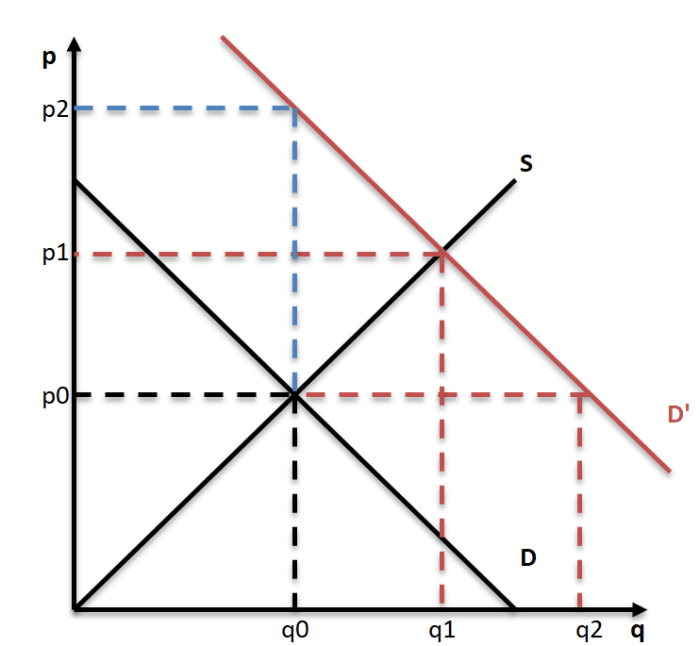
Consider first just the lines in black. Those lines represent the pre natural disaster situation. What is considered “normal prices”. At price p0, a quantity q0 of a good is traded in the market (i.e. bottles of water.)
Now there is a shock. A hurricane hits this region and demand increases (shifts to the right). This is the demand line in color red. The red dotted line that extends to the right shows the size of the shortage (q2 – q1) at the “normal and fair” price.
Price gouging is an emotional loaded word, but it doesn’t have any specific economic meaning. How does “price gouging” show up in this graph? It is the increase in price from p0 to p1. This is the increase in price required to satisfy the higher demand and provide the extra number of goods (q1 – q0). No… supply is not horizontal.
What happens if price increases are banned? Then at the pre-crisis quantity (q0), consumers are willing to pay p2, a price even higher than price gouging. This means two things. First, a number of people in need will be unable to acquire the goods (the empty shelf problem). Second, that the actual total cost (to those who acquire the quantity q0) is p2, not p0. The difference between the price in the store and total cost falls into waiting in long lines, visiting a long number of stores, bribing producers (yes… with natural disaster price controls also lead to black markets), calling favors., etc. Any principles of microeconomic textbook has plenty of more examples under the price ceiling discussion.
There are three scenarios being discussed here.
- Quantity q0 at price p0
- Quantity q1 at price p1
- Quantity q0 at price p2
The natural disaster makes scenario 1 impossible. And it is not clear that scenario 3 is better for those in need than scenario 2. Less goods are provided at a higher total cost than in scenario 2.
One final remark. Note that in this analysis the natural disaster only affected demand. Of course, it is quite likely that supply would also be affected. The point, however, is to show that prices are not pushed up only by produces. As we can see in this case, it is consumers who are increasing the price and producers reacting to the new behavior of consumers.
The language of the economy: prices
50 Things That Made the Modern Economy is looking for a 51st thing. Below is the email I sent them.
Price Gouging: Reality vs Fiction
In a previous post I comment on a too common economic fallacy, that a natural disaster is good for the economy because of its alleged impact on GDP. Economic fallacies are not the only misconceptions gaining momentum during a natural disaster, but a confusion between reality and fiction becomes also quite common. The issue of price gouging provides a good example of this situation.
After a natural disaster, the price of certain goods such as water or gas, increases significantly. This is seen as an immoral exploitation by merchants who are taking advantage of the people affected by the natural disaster. Even though in this post I want to comment on another issue, it is worth mentioning that the now limited resources should be allocated to those in most need (rather than, for instance, to whoever happens to be the first one in line.) And unless someone has a crystal ball, there is no way of knowing who is in most need without changes in relative prices.
The mention to reality versus fiction refers to the fact that the critics of price gouging seem to (implicitly) assume that the natural disaster did not occur. It is plausible to assume that an event like this would (1) shift the supply to the left [reduce supply of goods] and (2) shift the demand to the right [increase the demand of goods.] At the usual (or “normal”) price these goods are in serious shortage.
This means that in the event of a natural disaster the option is between (1) having goods at a higher price or (2) not having goods at the “normal” price. This is the new reality. The old and normal reality does not exist anymore. To limit price gouging results in a lower price in the store, but not goods on the shelf. This would not help those in need. The fiction consists in thinking that a larger supply can be secured without an increase in the price (why should we assume supply is horizontal when these goods usually have a low elasticity?) An efficient policy would secure the provision of goods rather than secure a low price without the goods. Reality, rather than fiction, should be the first driver of a policy designed to assist during a natural disaster. As Milton Friedman insisted, a policy is to be valuated by its results (or design), not by its intentions.
The first rule for an efficient policy should be to not get in the way of changes in relative prices. Otherwise help will become erratic and inefficient. It might be more efficient, for instance, to make use of firms specialized in logistics (i.e. firms such as Walmart) and subsidize the demand than start a price control policy. For instance, a tax credit or a check can be sent to those affected by the natural disaster allowing them to pay the now higher prices. Similarly, a subsidy can be given to those firms bringing goods to the damaged areas (who says the government has the monopoly of charity or that the only one who can do it efficiently?) A policy on these lines would be more efficient than interfering with relative prices.
However, some opponents of price gouging seem to be more interested in damaging merchants than in making sure resources will be efficiently allocated among the ones affected by the natural disaster. Those who do not oppose price gouging do so because they have the affected ones first in line. It is not about merchant’s revenue, it is about allocating goods efficiently. Damaging the merchants should not be more important than worsening the situation of those in need.
Declare Peace on North Korea!
The United States should offer a peace treaty with North Korea and offer diplomatic relations. The Korean War did not officially end. Let’s end it now.
The chiefs of North Korea have feared an invasion by the USA. They recognize that several heads of countries without nuclear weapons, such as in Lybia and Iraq, were overthrown. It is recognized that nuclear weapons that can be sent to the USA provide a deterrent against an overthrow of the state and even against an assassination of the Korean head of state.
The government of North Korea has evidently convinced the people there that the USA is their enemy and a threat. That propaganda would be less effective if there were a peace treaty.
So the US government should, together with South Korea, China, Russia, and the United Nations, offer to negotiate a peace treaty with North Korea.
The USA has negotiated with North Korea on a stoppage of its nuclear weapons project, but North Korea will not give up its weapons, and negotiations along with economic pressure will not be effective, since their greatest accomplishment has been their nuclear achievements, and the Chinese leaders seek to avoid an economic collapse.
Therefore a peace treaty with North Korea should not seek to end the nuclear status of the regime, but eliminate the deeper problem of mutual fears. The peace treaty would state that the U.S. recognizes North Korea as a sovereign country, and that there will be no invasion.
If the government of North Korea refuses to negotiate a peace treaty, then it will be seen that the hostility is being generated by North Korea, not the USA. The USA should then declare peace unilaterally. With the governments of South Korea and China, the USA would write a peace treaty and they would declare unilateral peace. The US would offer diplomatic relations, and if refused, would appoint an ambassador anyway, who would reside in China.
The US government would then broadcast to the people of North Korea, and send them messages via leaflets and computer files, that the USA has declared peace.
The opponents of a peace treaty could argue that this would leave North Korea with weapons that could reach US territory. But if the North Koreans will refuse to give up their nuclear capability, the peace treaty does not increase the danger. Indeed, the treaty, when agreed to by North Korea, would increase safety by prohibiting North Korea from providing nuclear materials and technology to others.
If North Korea accepts the peace treaty, the US would withdraw its troops from South Korea. Their presence is antiquated, since the threat would be from missiles rather than from an invasion by North Korean troops.
North Korea would gain four advantages from a peace treaty. First, assurance that the US is no longer a potential threat. Second, global diplomatic recognition. Third, removal of US troops from Korea. Fourth, the ability to trade freely with the rest of the world.
If the North Korean regime is not suicidal and seeks to maximize its well being, it would accept a peace treaty. But even if it does not accept a treaty, a unilateral offering would deflate its fears and propaganda.
———————————
This article also appears in http://www.progress.org
No, natural disasters are not good for the economy.
Every time there is a natural disaster old economic fallacies make their appearance. And they are usually always the same. In particular, the argument that a natural disaster is good for the economy. This should make little sense. Wealth is not created by destroying things. A natural disaster destroys wealth, doesn’t create it. I doubt anyone affected by a hurricane would argue that he is better off after the natural disaster than before.
The argument that an event such as a natural disaster is good for the economy rests in the positive impact seen in GDP (as is argued) after the natural event. If GDP increases, then the economy is doing better. But this is a misreading of GDP. This variable is a flow of wealth, it is not a stock of accumulated wealth. It is possible that wealth creation (flow) increases at the same time the stock of wealth is decreasing. And this is what happens during a natural disaster.
Imagine that someone’s house caught fire and burns down. Because of this situation, this person decides to start working extra hours to increase his income and be able to buy a new one. The extra hours makes his income (GDP) increase. But his situation is considerable worst because he lost his stock of wealth (remember Bastiat’s broken window fallacy…?). Arguing that a natural disaster (or a war, etc…) is good for the economy is like arguing that this person is better of because he has to work extra hours to recover his loss.
This is just another case of a too common fallacy in economics. We know that if the economy is doing better the result will be better GDP and unemployment indicators. But from observing a better GDP and unemployment indicators we cannot, and should not, conclude that the economy is doing better. More important than observing what is happening to GDP is understanding why is changing its behavior.
It could be argued that one of the problem of the Keynesian view of the world is the focus on what happens to output and unemployment rather than why these variables are moving. Not surprisingly, we get to the conclusion that going to war (or having a natural disaster) would be a good way to achieve full employment.
A short note on ideological neutrality
William‘s excellent post on dishonesty reminded me of an equally excellent post by John McGinnis over at Liberty Law Blog on the ACLU and free speech. The post ended, though, with the following sentence:
It would be a tragedy for our nation if the ACLU’s decision begins to dissolve the strong social fabric supporting the ideologically neutral First Amendment.
Ach. There is nothing neutral about the First Amendment. It’s a law based on liberal ideology. The idea of free speech is based on liberal ideology. The other ideologies out there pay great lip service to free speech, but there’s no First Amendment in the post-colonial states of Africa and Asia. Free speech is trumped by an ambiguous form of censorship called “hate speech” in other OECD countries (Western Europe, Australia-New Zealand, Japan). There is no First Amendment in Russia or China or Venezuela.
Liberalism is the only ideology out there that actually encourages rival ideologies to attack it, not with provocative laws but with one specific law that allows all factions the same space for their platform. The First Amendment is not neutral at all; it is instead an aggressive flaunting of liberalism’s staying power and ability to deliver freedom.
When libertarians start thinking of their preferred values as “neutral” or “centrist” they begin to echo the Left, which has been dishonest with itself for the past 45-50 years. That’s a road I’d hate to the movement plod through.
What is going on in Brazil
I’ve been thinking about writing a short essay about some of the things going on in Brazil right now, especially concerning politics and economics, for my English speaking friends. I guess one can get really lost in the middle of so much news, and to the best of my knowledge, some left-leaning journalists are saying quite some nonsense already. So here we go!
President Dilma Rousseff was impeached over a year ago. Her party, the Workers Party (Partido dos Trabalhadores, or PT in Portuguese) is officially a social democrat party, close to the European social democracy tradition, i.e., socialists who want to attain power through a non violent, non revolutionary path. In the end, as it happens with so many big parties, PT has many internal tendencies and in-fighting, but I believe the party can be summarized especially in two tendencies.
On one hand you have cultural Marxists, in the Frankfurt School but even more in the Antonio Gramsci tradition. Many people in PT and other Brazilian socialist parties understood long ago that they had to win a cultural war before they won the political war. And so, these factions are much more interested in feminism, gay rights, and minority rights in general than in anything else. To the best of my knowledge, this is a strategy that backfires somewhat: cultural Leftism is a self defeating philosophy, and so, cultural Marxists are more and more into a witch hunt that damages even themselves. They make a lot of noise, to be sure, but they can’t run a country.
On the other hand, many Brazilian socialists are almost entirely pragmatic. It seems that they forgot about Marxism long ago, and are somehow even convinced of the Washington Consensus. They know basic economics, such as money doesn’t grow on trees and there’s no such thing as free lunch. But they also don’t want to lose face, and most importantly, don’t want to lose position. So, they surely won’t take measures that really shrink the size of the state to a healthy degree.
Dilma’s supporters still say she was the victim of a coup. Of course, she wasn’t. She was impeached with overwhelming evidence of her wrongdoings according to Brazilian law. Other than that, it is hard to believe in a coup where all branches of government agree and the military are not involved in any way. Eventually her supporters sophisticated the argument by saying she was the victim of a “parliamentary coup.” It is nonsense, but if we take it with a grain of salt we can be reminded of something important in Brazilian politics – or politics in general. Dilma was not impeached because of her wrongdoings. Many politicians in Brazil have done similar or worse things than her. She was impeached because she lost support, mostly in the legislative branch. For the wrong reasons (opposition to Dilma), the representatives did the right thing.
One of the problems that Brazil faces today is that the same congress that impeached Dilma for the wrong reasons expects from her successor, Michel Temer, the political favors they used to get from Dilma’s predecessor, Luis Inacio Lula da Silva. But these favors are not cheap. Other than that, even if he is a crook, Temer seems to realize that Brazil can’t suffer any more socialism. In the end Brazil is facing some (sort of) free market reforms, but without really shaking the basis of a state too big to function properly.

