Rosenbloom on the Colonial American Economy

Joshua Rosenbloom is an economic historian worth following if you are interested in American economic history during the colonial era. He has recently published what appears to be an overview article of the topic (probably for a book or an invited symposium) which perfectly summarizes the current state of the research. I believe that this should be widely read by interested parties.  Here are key excerpts for some of the topics he discusses. I provide some comments to enrich his contribution, but these should be understood as complements rather than substitutes to this excellent overview of the American economy during the colonial era.

On Economic Growth 

Mancall and Weiss (…) concluded that likely rates of per capita GDP growth could not have been higher than 0.1 percent per year and were likely closer to zero. In subsequent work, Mancall, Rosenbloom and Weiss (2004) and Rosenbloom and Weiss (2014) have constructed similar estimates for the colonies and states of the Lower South and the Mid-Atlantic regions, respectively. Applying the method of controlled conjectures at a regional level allowed them to incorporate additional, region-specific, evidence about agricultural  productivity and exports, and reinforced the finding that there was little if any growth in GDP per capita during the eighteenth century. Lindert and Williamson (2016b) have also attempted to backcast their estimates of colonial incomes. Their estimates rely in part on the regional estimates of Mancall, Rosenbloom and Weiss, but the independent evidence they present is consistent with the view that economic growth was quite slow during the eighteenth century.

This is still a contentious point (see notably this article by McCusker), but I believe that they are correct. In my own work, using both wages and incomes, I have found similar results for Canada and Leticia Arroyo Abad and Jan Luiten Van Zanden have found something roughly similar for the Latin American economies (Mexico and Peru).

It is also consistent with even simplistic accounts of the neoclassical growth model. The New World was an economy of abundant land input whose outputs (agricultural produce) were mostly meant for local consumption. If one wanted to increase his income, all he had to do was use more inputs at really low costs. There is very little in this situation to invest in increasing total factor productivity and incomes would only increase at the dis-aggregated level (following the same region over time) as we are capturing the extent of inputs included over time (e.g. the long-settled farmer has a high income because he has had the time to build his farm, but the short-settled farmer brings the average down because he is just starting that process).

On Monetary History and Monetary Puzzles

In lieu of specie, the colonists relied heavily on barter for local exchange. In the Chesapeake transactions were often denominated in weights of tobacco. However, tobacco was not used as a medium of exchange. Rather merchants might advance credit to planters for the purchase of imported items, to be repaid at harvest with the specified quantity of tobacco. Elsewhere book credit accounts helped to facilitate transactions and reduce the need for currency. The colonists regularly complained about the shortage of specie, but as Perkins (1988, p. 165) observed, the long run history of prices does not suggest any tendency of prices to fall, as would be expected if the money supply was too small. (…) With only a few exceptions the colonies issuance of these notes did not give rise to inflationary pressures. There is by now a large literature that has analyzed the relationship between note issuance and prices, and finds little evidence of any correlation between the series (Weiss 1970, 1974; Wicker 1985; Smith 1985; Grubb 2016. As Grubb (2016) has argued, this suggests that while the circulation of bills of credit may have facilitated exchange by substituting for book credit or other forms of barter, they did not assume the role of currency.

In this, Rosenbloom summarizes a puzzle which has been the subject of debates since the 1970s (starting with West in 1978 in this Economic Inquiry article). In many instances (like South Carolina and Pennsylvania), the large issues of paper money had no measurable effect on prices.  This is a puzzle given the quantity theory of the price level. The proposition to solve the puzzle is that as the paper money printed by colonies tended to be backed by future assets, they were securities that could circulate as a medium of exchange. If properly backed and redeemed, people would form expectations that these injections were temporary injections and there would be no effect on the price level all else being equal. Inflation would only occur if redemption promises were not held or were believed to be humbug. This proposition has been heavily contested given the limited information we hold for the stock of other media of exchange and trade balances. I have my own take on this debate on which I weigh using a similar Canadian monetary experiment (see here), but this is a serious debate. Basically, it is a historical battleground between the proponents of the fiscal theory of the price level (see notably the classical Sargent and Wallace article) and the proponents of the quantity theory of the price level.  Anyone interested in the wider macroeconomic debate should really focus on these colonial experiments because they really are the perfect testing grounds (which Rosenbloom summarizes efficiently).

On Mercantilism, the Navigation Acts and American Living Standards

The requirement that major colonial exports pass through England on their way to continental markets and that manufactures be imported from England was the equivalent of imposing a tax on this trade. The resulting price wedge reduced the volume of trade and shifted some of the producer and consumer surplus to the providers of shipping and merchant services. A number of cliometric studies have attempted to estimate the magnitude of these effects to determine whether they played a role in encouraging the movement for independence (Harper 1939; Thomas 1968; Ransom 1968; McClelland 1969). The major difference in these studies arises from different approaches to formulating a counterfactual estimate of how large trade would have been in the absence of the Navigation Acts. In general, the estimates suggest that the cost to the colonists was relatively modest, in the range of 1-3 percent of annual income. Moreover, this figure needs to be set against the benefits of membership in the empire, which included the protection the British Navy afforded colonial merchants and military protection from hostile natives and other European powers.

The Navigation Acts were often cited as a burden that the colonists despised, but many economic historians have gone over their impact and they appear to have been minimal. It does not mean that they were insignificant to political events (rent-seeking coalitions tend to include small parties with intense preferences). However, it does imply that the action lies elsewhere if someone wants to explain the root causes of the revolution or that one must consider distributional effects (see notably this article here).

These are the sections that I found the most interesting (as they relate to some of my research agendas), but the entire article provides an effective summary for anyone interested in initiating research on the topic of American economic history during the colonial era. I really recommend reading it even if all that you seek is an overview for general culture.
The populist right in India, and the US

All eyes in India have understandably been on some important political developments over the past few days.

First, the by-election results of 3 parliamentary seats and 2 legislative seats were made more interesting by fact that BJP (Bharatiya Janata Party, a Hindu nationalist party, and India’s largest) had to face a surprising rout in the strongholds (Gorakhpur, Phulpur) of Uttar Pradesh’s Chief Minister (Yogi Adityanath) and Deputy Chief Minister (Keshav Prasad Maurya).

Second, there has been talk of other regional parties joining hands and forming an Anti-Congress Front. Two days after the election results, the exit of the Telugu Desam Party (TDP) from the BJP-led National Democratic Alliance (NDA) and its decision to pass a no confidence motion (which BJP is likely to win) has certainly made the fight for 2019 more interesting.

While it remains to be seen whether the opposition parties in 2019 can give the BJP a run for its money, those interested in US politics will have closely followed the result of a Congressional by-election (18th District) where Democrat candidate Connor Lamb (a 33 year old Marine) defeated Republican Candidate Rick Saccone in a close contest. This is a significant win after the triumph of Senator Douglas Jones in Alabama. Jones became the first Democrat to win a Senate Seat in Alabama (a Republican stronghold referred to as “Ruby Red”) since 1997.

The US President, who is quick to comment on virtually every issue, on Twitter, remained silent on the result of the 18th District.

The US President did state, at a private fundraiser for Missouri Senate candidate Josh Hawley, that the Democrat candidate’s stance on key economic issues was akin to that of Trump:

The young man last night that ran, he said, ‘Oh, I’m like Trump. Second Amendment, everything. I love the tax cuts, everything.’ He ran on that basis, Trump said. He ran on a campaign that said very nice things about me. I said, ‘Is he a Republican?’ He sounds like a Republican to me.

Lamb conservative on social and economic issues?

Trump’s views were echoed by a number of other Republicans. House Speaker Paul Ryan called Lamb a “pro-gun, anti-Nancy Pelosi conservative.”

While Republican Representative Chris Collins of New York said that he doesn’t “think you’ll see another candidate like Lamb,” another representative from the state of Pennsylvania, Mike Kelly, argued that Lamb was “more like a Republican.”

There is some truth in the President’s assertions, because Lamb did support the President’s imposition of tariffs on aluminium and steel imports. Said Lamb: “we have to take some action to level the playing field.” Even on issues like gun control and abortion, his views were to the right of conventional Democrats, though not absolutely in sync with the Republicans.

Why Trump can not ignore this defeat

Irrespective of what US President Donald Trump may say, the fact is that he had won the state by 20 points in the US Presidential election of 2016, and his economic agenda had found strong resonance. Trump, along with Vice President Mike Pence, had also campaigned for Saccone.

Significantly, in the last two Congressional elections, Democrats had not even bothered to field candidates in PA 18.

The announcement to impose tariffs on aluminium and steel had been made one week before the election, clearly with an eye on reaching out to large sections of ‘blue collar workers’. The US President calculated that he would be able to regain his popularity, but the results clearly show that Trump’s ‘ultra nationalism’ and economically inward looking policies by themselves will not suffice. He will also need to change his style of functioning and not continuously sack individuals.

Republican Speaker Paul Ryan himself had dubbed this verdict as a ‘wake up call’. Other Republicans have been forthright in their analysis of the defeat and blame Trump’s approval ratings for the same.

Doug Heye, a Republican strategist and former spokesman for the Republican National Committee, said:

There is a very real problem facing Republicans in the months ahead and that problem is Donald Trump’s approval rating.

What does Lamb’s win mean for the Democrats

Lamb’s victory may also result in some changes within the Democrats. Lamb has been pitching for a change in leadership and does not get along particularly well with Nancy Pelosi, Minority Leader of the US House of Representatives:

I have said, and I continue to say, that I think we need new leadership at the top of both parties in the House.

Pelosi however was quick to deny that Lamb’s criticism of her had anything to do with the outcome:

I don’t think that that really had that much impact on the race […] He won. If we hadn’t won, you might have a question, but we won — the ‘D’ next to his name was very significant.

The electoral verdicts in India and US have one common message: ‘economic insularity’,  and the whipping up of ultra-nationalist emotions can not make up for vacuous policies.

There are messages for the opposition in both the US and India; in spite of right wing nationalism having failed to address substantive issues, the voter is looking for new options — leaders with imaginative ideas outside of the cozy club .

If one were to specifically look at India, the fence sitters may not be particularly happy with the existing order, but does that imply that they will automatically tilt towards the opposition? The politics of doles and sops will not work. A progressive social agenda, which is in sync with the diverse ethos of this country, has to be complemented by a pro-reform economic agenda (which is of course inclusive, and sensitive to the concerns of the poorest).

Conclusion

What is clear however is that Trump’s re-election in 2020 and Modi’s in 2019, are not a done deal. One would have to say though, that in spite of the recent UP verdict, there is a higher probability of Modi being re-elected than Trump.

It remains to be seen whether the current populist right narrative, which is a lethal cocktail of inward looking economic thinking and conservative social policies, can be countered effectively, and defeated at the hustings, by a progressive, forward looking agenda. Will India and the US take the lead in challenging this narrative?

Nightcap

  1. The ponchos of Chiapas and globalization Virginia Postrel, Reason
  2. Why are prices so high in the Pacific? Stephen Howes, DevPolicy
  3. The problem of democracy…in 1848 Pamela Nogales, JHIBlog
  4. Management vs. Managerialism Chris Dillow, Stumbling & Mumbling

Nightcap

  1. Islam and the European Enlightenment the Economist
  2. Tales of a female bomber Lincoln Krause, War on the Rocks
  3. Christianity in China is uncrushable Charles Horner, Claremont Review of Books
  4. What would the ideal introduction to Catholicism look like? Paul J. Griffiths, Commonweal

World War I destroyed Christianity

That’s the argument I put forth in this week’s RealClearHistory column. As usual I frame the argument in the form of a “Top10,” and in this case I used battles. An excerpt:

6. Battle of Asiago: May 15 – June 10, 1916. Another nasty battle fought along the Austro-Italian Front, Asiago is considered a victory for Italy even though it lost more men than the Austro-Hungarians. Altogether, the surprise attack launched by the Hapsburgs inflicted severe casualties on the Italians, with the latter losing 140,000 men and the aggressor losing 100,000. The surprise did not work for the Hapsburgs, either, as their armies were turned back and the position continued to be held by the Italians. There is a beautiful war memorial dedicated to both sides in Asiago today, and there are no crosses to be found for the dead there.

Please, read the rest.

Nightcap

  1. Dutch Jews face tough, age-old questions Bruce Clark, Erasmus
  2. Elections signal the end of an era in Italy Joel Weickgenant, RealClearWorld
  3. Hamas dips its toes in regional politics Adnan Abu Amer, Al-Monitor
  4. Stunningly beautiful photos of art from Tibet Joshua Daugherty, JHIBlog

Nightcap

  1. The English-Scottish Border Alasdair McKillop, New Statesman
  2. How to change the course of history David Graeber, Eurozine
  3. Universities are destroying freedoms of speech and association Andrew Sullivan, New York Magazine
  4. Soviet Bloc’s environmental catastrophes James Bovard, Explore Freedom

3 key problems with Trump’s style of functioning

The removal of Rex Tillerson as Secretary of State (who was replaced by Mike Pompeo, Director of the CIA) reiterates three key problems in US President Donald Trump’s style of functioning: First, his inability to get along with members of his team; second, impulsive decisions driven excessively by ‘optics’ and personal chemistry between leaders; and, finally, his inability to work in a system even where it is necessary.

Tillerson, who had differences with Trump on issues ranging from the Iran Nuclear Deal (which Trump has been wanting to scrap, though his stance was moderated by Tillerson) to the handling of North Korea, is not the first member (earlier senior individuals to be sacked are, amongst others, Michael Flynn, who was National Security Adviser, and Chief Strategist Steve Bannon) to exit hurriedly. Gary Cohn, Director of the National Economic Council, quit recently after opposing the US President’s tariffs on imports of steel and aluminium.

The US President tweeted this decision:

Mike Pompeo, Director of the CIA, will become our new Secretary of State. He will do a fantastic job! Thank you to Rex Tillerson for his service! Gina Haspel will become the new Director of the CIA, and the first woman so chosen. Congratulations to all!

The US President admitted that Tillerson’s style of functioning was very different from his own (alluding to the latter’s more nuanced approach on complex issues).

Interestingly, the US President did not even consult any of his staff members, including Tillerson, before agreeing to engage with North Korean Dictator Kim Jong Un. The South Korean National Security Advisor, Chung Eui Yong, had met with Trump and put forward the North Korean dictator’s proposal of a Summit.

The US President agreed to this proposal. Commenting on his decision to engage with Kim Jong Un, Trump tweeted:

Kim Jong Un talked about denuclearization with the South Korean Representatives, not just a freeze. Also, no missile testing by North Korea during this period of time. Great progress being made but sanctions will remain until an agreement is reached. Meeting being planned!

While Chung stated that the Summit would take place before May 2018, White House has not provided any specific dates.

There is absolutely no doubt that, at times, bold steps need to be taken to resolve complex issues like North Korea. Trump’s impulsive nature, however – refusing to go into the depth of things or seeking expert opinion – does not make for good diplomacy.

In fact, a number of politicians and journalist have expressed their skepticism with regard to where North Korean negotiations may ultimately lead. Ed Markey a Democratic Senator from Massachusetts, stated that Trump “must abandon his penchant for unscripted remarks and bombastic rhetoric to avoid derailing this significant opportunity for progress.”

In a column for the Washington Post, Jeffrey Lewis makes the point that there is a danger of Trump getting carried away by the attention he receives. Says Lewis in his column:

Some conservatives are worried that Trump will recognize North Korea as a nuclear-weapons state. They believe that an authoritarian North Korea will beguile Trump just as it did his erstwhile apprentice, American basketball player Dennis Rodman. They fear that Trump will be so overjoyed by the site of tens of thousands of North Koreans in a stadium holding placards that make up a picture of his face that he will, on the spot, simply recognize North Korea as a nuclear power with every right to its half of the Korean peninsula.

All Trump’s interlocutors have realized that while he is unpredictable, one thing which is consistent is the fact that he is prone to flattery. During his China visit, for instance, Trump was so taken aback by the welcome he received and the MOU’s signed with Chinese companies that he started criticizing his predecessors.

Finally, while Trump, like many global leaders, has risen as a consequence of being an outsider to the establishment, with people being disillusioned with the embedded establishment, the US President has still not realized that one of Washington’s biggest assets has been strategic alliances like NATO and multilateral trade agreements like NAFTA. The United States has also gained from globalization and strategic partnerships; it has not been one way traffic.

It remains to be seen how Tillerson’s removal will affect relations with key US allies. If Trump actually goes ahead with scrapping the Iran nuclear deal (2015), it will send a negative message not just to other members of the P5 grouping, but also India. In the last three years, India has sought to strengthen economic ties with Iran and has invested in the Chabahar Port Project. New Delhi is looking at Iran as a gateway to Afghanistan and Central Asia. If Tillerson’s successor just plays ball, and does not temper the US President’s style of conducting foreign policy, there is likely to be no stability and consistency and even allies would be skeptical.

Japan on its part would want its concerns regarding the abduction of Japanese citizens by Pyongyang’s agents, decades ago, to not get sidelined in negotiations with North Korea. (13 Japanese individuals were abducted in 2002, 5 have returned but the fate of the others remains unknown.) Prime Minister Shinzo Abe has made the return of the abductees a cornerstone of his foreign policy, and his low approval ratings due to a domestic scandal could use the boost that is usually associated with the plight of those abductees.

The removal of Tillerson underscores problems with Trump’s style of functioning as discussed earlier. The outside world has gotten used to the US President’s style of functioning and will closely be watching what Tillerson’s successor brings to the table.

Nightcap

  1. Blood on the land in Brazil Gregory Duff Morton, New York Review of Books
  2. “Blackness” in France and in America Sarah Claire Dunstan, JHIBlog
  3. What if prejudice isn’t the cause of racism? Blake Smith, Aeon
  4. Mexico is whooping the film world’s butt Ioan Grillo, New York Times

“Does Russia own a piece of the US?”

That’s the title of my latest piece over at RealClearHistory. An excerpt:

The Russian-American Company was run through Saint Petersburg and thus had a strict racial hierarchical code in place, in conformity with the latest beliefs about race at the time. The neighborhoods of Fort Ross were segregated, but an archaeologist at the University of California, Berkeley, Kent Lightfoot, has produced excellent research at Fort Ross, showing how the Company’s racist charter was unofficially ignored, with miscegenation widespread (“creoles” was even created as an official race for documentation purposes) and interethnic activities commonplace. The people inhabiting Fort Ross preferred to follow instead something the anthropologist Jean-Loup Amselle calls “mestizo logics.”

Please, show me some love.

Kent Lightfoot can be found at NOL here. Jean-Loup Amselle can be found at NOL here. I also give a shoutout to Andrei Znamenski‘s work in the piece, so be on the lookout for that.

I didn’t get to delve as much into this piece as I’d have liked to. I wanted to get more into the inner workings of the Russian-American Company and compare it to the Dutch East India Company, but that sounds like a tall task even for a PhD dissertation.

I don’t think I did a good enough job of highlighting just how rich Pacific Rim trade was in the early 19th century. I tried in vain to sneak a reference to Hawaiian laborers that could be found throughout the Pacific world at the time of Fort Ross’ founding, but I’ve got a 600 word limit.

Also, I wanted to highlight the fact that Native Americans weren’t losers in the opening up of the Pacific to the world. They were active participants in the globalization of the Pacific Rim trade. They were powerful. I don’t know if I’d focus on California Indians to highlight Native American actors. I’d probably focus on an area a little further north, in the Puget Sound-Vancouver area.

At any rate, hope you enjoy the piece!

Nightcap

  1. A Brief History of Tomorrow David Berlinski, Inference
  2. The Invention of World History S. Frederick Starr, History Today
  3. Actually, Western Progress Stems from Christianity Nick Spencer, Theos
  4. Correcting for the Historian’s Middle Eastern Biases Luma Simms, Law & Liberty

Deep Learning and Abstract Orders

It is well known that Friedrich Hayek once rejoiced at Noam Chomsky’s evolutionary theory of language, which stated that the faculty of speaking depends upon a biological device which human beings are enabled with. There is no blank slate and our experience of the world relies on structures that come from the experience in itself.

Hayek would be now delighted if he were told about the recent discoveries on the importance of background knowledge in the arms race between human beings and Artificial Intelligence. When decisions are to be taken by trial and error at the inside of a feedback system, humans are still ahead because they apply a framework of abstract patterns to interpret the connections among the different elements of the system. These patterns are acquired from previous experiences in other closed systems and provide with a semantic meaning to the new one. Thus, humans outperform machines, which work as blank slates, since they take information only from the closed system.

The report of the cited study finishes with the common place of asking what would happen if some day machines learn to handle with abstract patterns of a higher degree of complexity and, then, keep up with that human relative advantage.

As we stated in another place, those abstract machines already exist and they are the legal codes and law systems that enable their users with a set of patterns to interpret controversies concerning human behaviour.

What is worth being asked is not whether Artificial Intelligence eventually will surpass human beings, but what group of individuals will overcome the other: the one which uses technology or the one which refuses to do so.

The answer seems quite obvious when the term “technology” is related to concrete machines, but it is not so clear when we apply it to abstract devices. I tried to ponder the latter problem when I outlined an imaginary arms race between policy wonks and lawyers.

Now, we can extend these concepts to whole populations. Which of these nations will prevail over the other ones: the countries whose citizens are enabled with a set of abstract rules to based their decisions on (the rule of law) or the despotic countries, ruled by the whim of men?

The conclusion to be drawn is quite obvious when we are confronted with a so polarised question. Nevertheless, the problem becomes more subtle when the disjunction concerns on rule of law vs deliberate central planning.

The rule of law is the supplementary set of abstract patterns of conduct that gives sense to the events of the social reality in order to interpret human social action, including the political authority.

In the case of central planning, those abstract patterns are replaced by a concrete model of society whose elements are defined by the authority (after all, that is the main function of Thomas Hobbes’ Leviathan).

Superficially considered, the former – the rule of law as an abstract machine – is irrational while the latter – the Leviathan’s central planning – seems to respond to a rational construction of the society. Our approach states that, paradoxically, the more abstract is the order of a society, the more rational are the decisions and plans that the individuals undertake, since they are based on the supplementary and general patterns provided by the law, whereas central planning offers to the individuals a poorer set of concrete information, which limits the scope of the decisions to those to be based on expediency.

That is why we like to state that law is spontaneous. Not because nobody had created it -in fact, someone did – but because law stands by itself the test of time as the result of an evolutionary process in which populations following the rule of law outperform the rival ones.

Nightcap

  1. Whatever Happened to Patient Confidentiality? Irfan Khawaja, Policy of Truth
  2. What Critics Don’t Understand About Gun Culture David French, the Atlantic
  3. Making Guns Obsolete Frances Woolley, Worthwhile Canadian Initiative
  4. Can Libertarianism Be A Governing Philosophy? Michael Munger, Law & Liberty

Nightcap

  1. Don’t give the Feds anywhere to hide Scott Sumner, EconLog
  2. Tariff Truths and Income Tax Iniquities Brian Domitrovic, Law and Liberty
  3. A Proper Accounting of Glass-Steagall Daniel D Leger, American Affairs
  4. The new constitutional case against ObamaCare Ilya Somin, Volokh Conspiracy

On demography and living standards in the colonial era

This is a topic that has been bugging me. Very often, historians will (accurately) point out mortality statistics in the United States, Canada (Quebec) and the Latin America during the colonial era were better than in the comparable Old World (comparing French with French, British with British, Spanish with Spanish). However, they will argue that this is evidence that living standards were higher. This is where I wish to make an important nuance.

Settlement colonies (so, here there is a bigger focus on North America, but it applies to smaller extent to Latin America which I am more tempt to label as extractive – see here) are generally frontier economies. This means that they are small economies because of small populations.  This means that labor and capital are scarce relative to land. All outputs that come from the relatively abundant factor will thus tend to be cheaper if there is little international trade for the goods that they are best at producing. The colonial period pretty much fits that bill. The American and Canadian colonies were basically agricultural colonies, but very few of those agricultural outputs actually crossed the Atlantic. As such, agricultural produces were cheap. This is akin to saying that nutrition was cheap.

This, by definition, will give settlement colonies an advantage in terms of biological living standards. As they are not international price takers, wheat is cheaper than in the old world. This is why James Lemon spoke of the New World as the “Best poor man’s country” (I love that expression) : it was easy to earn subsistence. However, beyond that it is very hard to go beyond. For example, in my dissertation (articles still in consideration at Cliometrica and Canadian Journal of Economics) I found that when wages were deflated by a subsistence basket containing very few services and manufactured goods and which relied heavily on untransformed foods, Canada was richer than the richest city of France. Once you shifted to a basket that marginally increased transformed goods and manufactured goods, the advantage was wiped away.

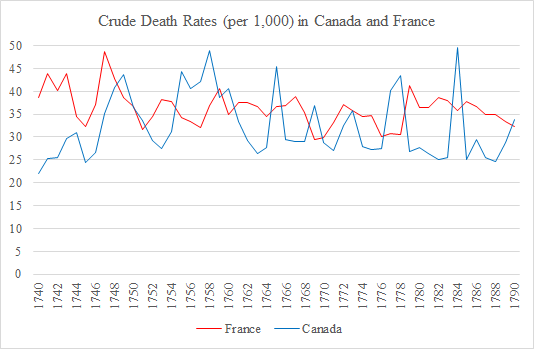
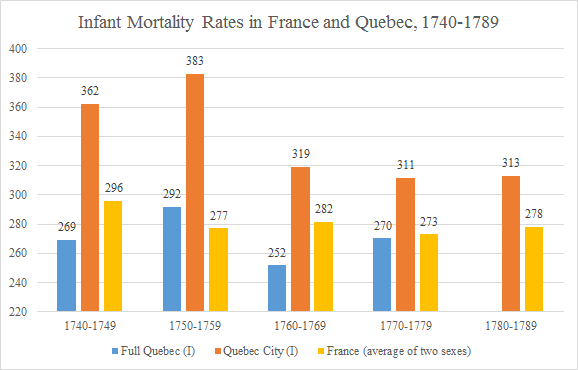
Yet, everything indicates that mortality rates were greater in Paris and France and than in Quebec City and Quebec as a whole (but not by a lot) (see images below).  Similar gaps seem to exist for the United States relative to Britain, but the data is not as rich as for Quebec. However, the data that exists for New England suggests that death rates were lower than in England but the “bare bones” real incomes measured by Lindert and Williamson show that New England may have been poorer than Great Britain (not by much though).

Crude Death Rates

IMR

I am not saying that demographic and biological data is worthless. Quite the contrary (even I wanted to, I could not since I have a paper on the heights of French-Canadians from 1780 to 1830)! The point is that data matters in context.  The world is full of small non-linearities between variables. While “good” demographic outcomes are generally tracking “good” economic outcomes, there are contexts where this may be a weaker relation (curvilinear relations between variables). I think that this is a good example of that point.