- Piracy in Antarctica Philip Hoare, Spectator
- Federalism, good (Canada) and bad (E.U.) Nick Rowe, Worthwhile Canadian Initiative
- Why Macedonia’s name is such a problem Nikola Zečević, National Interest
- How international hegemony changes hands Kori Schake, Cato Unbound
Who are the protectionists in Africa?
Rwanda, a country that thankfully avoided “humanitarian” military intervention by Western powers during a nasty killing spree in the 90s, is leading the charge on free trade in Africa. Of the 54 countries on the African continent, 44 have signed the agreement, but the traditional economic giants of the continent – Nigeria and South Africa – have not. Surprisingly, Botswana, an example often cited by economists as an African success story, has not signed it either.
CNBC reports on why Nigeria has so far refused to join the agreement, citing a consultant who specializes in global trade:
There is a general sentiment among (labor unions and industry bodies) that Nigeria’s export capacity in non-oil sectors isn’t sufficiently robust yet to expose itself to external competition.
Unions and “buy local” capitalists: The scourge of prosperity and progress worldwide, but also not much of a surprise.
What will be interesting to see is where this bold experiment leads. How can 44 countries with poor institutions come together to form a free trade pact? I am hoping this will lead to more states in Africa. My logic goes something like this: stronger economic ties will hasten the demise of current African states’ superficial institutions, while allowing informal institutions to flourish. Because these informal institutions are better at solving coordination problems, they’ll eventually be recognized as states. Here’s how I put it back in 2012:
A better way of looking at it, and one that I have pointed out before, is to look at Europe realize that it shares roughly the same amount of polities as does Africa (50-ish) despite being four times smaller. I bring up the comparison with Europe because in the Old World things like ethnicity still have a strong hold on how individuals identify themselves with their various social spheres. Rather than the 50-ish number of polities in Africa that we have today, a better way of solving Africa’s problems would be to let the polities currently in place dissolve into 400 polities. Or 500. Then, I think, Africans would know peace and prosperity.
I’d add, today, that this would only be possible if the links built by this free trade pact endure. Economic integration is vital to the dissolution of Africa’s despotic states. (h/t Barry)
Nightcap
- Singapore, capitalism, and market socialism Scott Sumner, EconLog
- China’s Creditor Imperialism Brahma Chellaney, Project Syndicate
- Chairman Xi, Chinese Idol Ian Johnson, New York Review of Books
- Trump may be rude, but that doesn’t make him a tyrant Ted Galen Carpenter, the Skeptics
Brazil top court delays decision on blocking prison for ex-president Lula
Brazil’s Supreme Court decided that leftist former president Luiz Inacio Lula da Silva cannot be sent to prison for a corruption conviction until he exhausts all possible appeals. About that:
“It will be of little avail to the people, that the laws are made by men of their own choice, if the laws be so voluminous that they cannot be read, or so incoherent that they cannot be understood: if they be repealed or revised before they are promulg[at]ed, or undergo such incessant changes, that no man who knows what the law is to-day, can guess what it will be tomorrow.” – James Madison (16 March 1751 – 28 June 1836), fourth President of the United States (1809–1817), co-author, with John Jay and Alexander Hamilton, of the Federalist Papers, and traditionally regarded as the Father of the United States Constitution.
“Brazil is not for beginners.” – Antônio Carlos Jobim (January 25, 1927 – December 8, 1994), also known as Tom Jobim, Brazilian composer, pianist, songwriter, arranger, and singer. Widely considered as one of the great exponents of Brazilian music.
What on earth was the Dervish state?
That’s the topic of my latest column at RealClearHistory. An excerpt:
2. Sovereignty and suzerainty are concepts that have little to no bearing on today’s world, but perhaps they should. Prior to the end of World War II, when the U.S. and U.S.S.R. became the globe’s alpha powers, suzerainty was often used by imperial powers to manage their colonies. Suzerainty is a formal recognition, by a power, of a minor polity’s independence and autonomy, and a formal recognition by the minor polity of the power’s control over its diplomatic and economic affairs. Suzerainty was used especially often by the British and Dutch (and less so by France and other Latin states, which preferred more direct control over their territorial claims), as well as the Ottoman Empire. The U.S.-led order has focused on sovereign states rather than unofficial spaces, and this has led to many misunderstandings. Somalia, which has long been a region of suzerains, is a basketcase today largely because it is approached by powers as a sovereign state.
Please, read the rest. The Dervish state was an ally of the Ottoman and German empires during World War I.
Nightcap
- Canada’s Jews: Maple Leaves and Mezuzahs Bruce Clark, Erasmus
- We’re still no closer to the end of Pi Oliver Roeder, FiveThirtyEight
- Why is Trump turning his back on Iran’s Christians? Doug Bandow, the Skeptics
- What’s divine about divine law? Jacob P. Ellens, Law and Liberty
Trump’s personal game might work in China
In spite of all the economic and strategic differences between the US and China, personal relationships play an important role in bilateral relations between Washington DC and Beijing.
Trump’s Ambassador to China
One of the first appointments made by US President Donald Trump was that of Terry Branstad as US Ambassador to China. The key reason was Branstad’s personal rapport with Chinese President Xi Jinping. This began in 1985, when Branstad was Governor of Iowa, while Xi Jinping an official from Hebei was visiting Iowa. In 2011, Branstad visited Beijing, and met with Xi at the Great Hall of the People. In February 2012, when he was vice-president, Xi stopped in Muscatine, Iowa, where he met not just with Branstad but with big industrialists and farmers from the states.
The US President, commenting on the reason for appointing Branstad, stated:
Governor Branstad’s decades of experience in public service and long- time relationship with President Xi Jinping and other Chinese leaders make him the ideal choice to serve as America’s ambassador to China.
During US President’s China visit in November 2017, Branstad, who shares a good rapport with Trump, did the groundwork for the visit. While in recent weeks tensions between both countries have escalated, with Trump imposing tariffs on Chinese goods worth $60 billion, the American president was delighted with the welcome he had received during his trip and had even told the Chinese President: “My feeling towards you is incredibly warm.”
It would be pertinent to point out that Trump’s decision to appoint Branstad as Ambassador to China (December 2016) came as a relief to the Chinese, given the fact that the US President took Taiwanese President Tsai-Ing Wen’s phone call, much to the chagrin of Beijing (since this went against established US policy).
If one were to look beyond the role of personal relationships in the very complex but important Beijing-Washington relationship, China lays a lot of emphasis on experience (educational, professional) in the US. If one were to examine the credentials of some of the top officials in Xi Jinping’s administration, US education as well as experience in dealing with economic issues pertaining to the US, has played a key role in some of the Chinese President’s appointments.
For instance, Liu He, whom Xi Jinping has appointed as a Vice Premier for overseeing the economy and financial sector, is US educated. Liu, who speaks fluent English, obtained a master’s degree in public administration from the Kennedy School of Government (Harvard University) in 1995. Apart from his in-depth understanding of the Chinese economy, Liu has also been involved in important discussions with US leaders.
Another significant appointment by Xi Jinping is that of Yi Gang, who has been named as Governor of the People’s Bank of China (PBOC). Yi obtained a business degree from the Hamline University in St. Paul, Minnesota, and a Ph.D. in economics at the University of Illinois, before moving to Indiana University at Indianapolis as a professor in 1986. He taught later at the Peking University in Beijing, before moving to the PBOC in 1997.
While economic and strategic issues are too complex to be driven by personal relationships or chemistry (though Trump seems to be a keen believer in personal chemistry given the emphasis he lays on individual ties) alone, an in-depth understanding of the culture, politics, and economics of one’s interloctutors is especially handy. Given the current tensions between both countries over tariffs, this dynamic may prove to be especially useful.
Nightcap
- A question about Israel for a Bleeding Heart Libertarian Irfan Khawaja, Policy of Truth
- How Putin has changed, and subjugated, Russia Christian Esch, der Spiegel
- Russia’s bite is not nearly as powerful as its bark Daniel DePetris, the Skeptics
- Who cares about Washington anymore? Parag Khanna, Politico
India’s near-abroad: Iran’s regional moves
Close attention was paid by sections of India’s strategic community (and understandably so) to the statement of Iranian Minister of Foreign Affairs, Dr Javad Zarif, during his visit to Pakistan, in which he extended an invitation to Pakistan to join the ambitious Chabahar Project (about 70 kilometres from China’s ambitious Gwadar Project).
Zarif, while delivering a lecture at the Institute of Strategic Studies Islamabad (ISSI), stated:
We offered to participate in the China-Pakistan Economic Corridor (CPEC). We have also offered Pakistan and China to participate in Chahbahar
He further went on to state that Iran’s ties with India were not in any way targeted at Pakistan, just as Islamabad’s ties with Riyadh were not against Iran.
Surprise in India
This invitation surprised many in India, given the fact that it has provided financial assistance for Phase 1 of the project and will operate two berths. During Iranian President Hassan Rouhani’s visit in February 2018, one of the tangible outcomes was the lease contract signed by IPGL (Indian Port Global Limited) and Iran’s Port and Maritime Organization, for operating Phase 1 (Shahid Beheshti Port) over an 18-month period. The joint statement also made a clear reference to India’s unwavering commitment to the Chabahar-Zahedan Rail Line, which will enable transportation of goods all the way up to the Afghan border. The Indian side also stated that it would like to see Chabahar as part of the INSTC (International North South Transport Corridor). The INSTC will help in connecting India to Russia and Europe, via Iran.
Chabahar as India’s answer to Gwadar
Many in India have looked at Chabahar as India’s answer to the Gwadar Project, and of course its gateway to Afghanistan and Central Asia. The project is especially important to New Delhi because it enables India to bypass Pakistan, which has flatly refused to give India access to Afghanistan and Central Asia. In 2016, during Indian Prime Minister Narenda Modi’s visit to Iran, India, Iran, and Afghanistan had signed a three nation transport and transit corridor pact to enhance connecitivity. While leaders of all three countries spoke about the relevance of this agreement in the context of connectivity, the Iranian President had made it clear that it was not targeted at anyone. Said Rouhani:
[This pact is] not against any other country […] it is beneficial to the entire region.
India also sent a consignment of wheat (15,000 tonnes) to Afghanistan through the Chabahar Port in 2017. The shipment was dispatched from Kandla (Gujarat, India) and reached Chabahar in Iran. From Chabahar it was transported by road to Nimroz Province in Afghanistan.
India’s response
Replying to Zarif’s statements in a press briefing, India’s Spokesman Raveesh Kumar stated that:
[It is the] prerogative of the government of the Islamic Republic of Iran to choose its partners for the development of infrastructure facilities there.
Kumar also explained the strategic relevance of the project given its geo-political importance.
India-Iran ties beyond the Chabahar Port
Ever since the signing of the nuclear agreement in 2015 between Iran and the P5+1 countries, business linkages – and not just the Chabahar Project – between Iran and India have gotten a fillip. In 2017, India’s oil imports from Iran went up to 4.37 million barrel per day, even though there was a dip between April-December 2017 due to tensions between both countries on the Farzand B gas field. (Iran was supposed to award the gas field to India, but there have been differences on terms and conditions.) During Rouhani’s visit, both countries decided to address the obstacles related to banking and taxation, in order to bring about closer economic linkages.
Iran has thus emerged as an important strategic and trade partner for India.
What may have surprised sections of Indian government, along with its strategic thinkers, would be the Iranian invitation given to Pakistan, in spite of bilateral tensions between the two. In May 2017, for example, the Iranian Army Chief, Major General Mohammad Bagheri, had threatened to strike terror camps in Baluchistan (Pakistan) after the killing of ten Iranian guards by Jaish-Al-Adl in the Sistan-Baluchestan province. Said Baqeri:
[…] unless Pakistan control[s] the borders, arrest[s] the terrorist[s] and shut[s] down their bases […] we will hit their safe havens and cells wherever they are.
Since then tensions between the United States and Iran have also risen, and the latter has a close relationship with China. This has reshaped the Pakistan-Iran dynamic.
New Delhi’s real challenge
The real challenge for India in the near future is the hawkish stand of US President Donald Trump’s most recent appointee: Michael Pompeo (who was earlier head of the CIA, a main American intelligence agency). Trump is also likely to replace his current National Security Advisor, HR Mcmaster, and one possible replacement is John Bolton (former US Ambassador to the United Nations), a known hawk on Iran.
Pompeo would go along with Trump, and have no qualms in scrapping the Iran Nuclear Deal in May 2018, the next date when the issue comes up for consideration.
Pompeo’s predecessor, Rex Tillerson, had differed with Trump on this issue on more than one occasion. During the election campaign, Trump had criticized the Nuclear Agreement. He had dubbed the agreement a ‘disaster’ and ‘the worst deal ever negotiated’. In an address to a Pro-Israel Lobby group, AIPAC, the US President had gone to the extent of stating that dismantling the deal would be his first priority.
Tillerson, no dove on Iran by any stretch of imagination, had categorically stated that dismantling the deal was not in US interests, though the US President disagreed. Commenting on their disagreements about Iran, Trump had stated:
When you look at the Iran deal, I think it’s terrible […] it was okay. I wanted to either break it or do something, and he felt a little bit differently. So we were not really thinking the same.
Tillerson was closely working with European countries to rework the deal, and address some of the Trump administration’s concerns.
The Chair of the Senate Foreign Relations Committee, Bob Corker, has also predicted that Trump will walk out of the Deal: “The Iran deal will be another issue that’s coming up in May, and right now it doesn’t feel like it’s going to be extended.”
More aggressive Saudi Arabia
Saudi Arabia is likely to become more aggressive after the exit of Tillerson. In fact, on the eve of Saudi Crown Prince Mohammed Bin Salman’s arrival in the US, the Saudi Foreign Minister, Adel al-Jubeir, criticized the Iran Nuclear deal. Said the Saudi Foreign Minister:
Our view of the nuclear deal is that it’s a flawed agreement.
During the Saudi Prince’s visit, Trump too did not miss out on an opportunity to lambast the Iran nuclear agreement. While commenting on the future of the deal, the US President stated:
The Iran deal is coming up soon and you will see what will happen […] Iran hasn’t been treating that part of the world, or the world appropriately.
According to the Arab News it was also decided that the United Arab Emirates, Saudi Arabia, and the US would set up a trilateral security forum which would look not just at issues pertaining to Middle East and Iran, but also South Asia.
Conclusion
India would be advised to be cautious, and while some sections the Right have been ecstatic with Trump’s stance vis-à-vis Pakistan (not to mention China), New Delhi needs to be prepared for some turbulence as a consequence of the recent changes within the Trump Administration. New Delhi needs to articulate its strategic and economic interests in Iran, not just to the US, but also to Saudi Arabia. In the past, the US has not objected to Iran’s close ties with India, but it remains to be seen whether or not Trump and his team will exhibit flexibility and pragmatism vis-à-vis Iran.
New Delhi has a myriad of foreign policy challenges, and Trump’s rigidity towards Iran is likely to be a major one in the near future.
Nightcap
- Unconventional Trump successful in Korea Jung Woo Lee, New Statesman
- Iran’s mullahs are out of answers Ali Safavi, RealClearWorld
- Cultural costs of high housing prices in England Chris Dillow, Stumbling and Mumbling
- The new challenge to ObamaCare Randy Barnett, Volokh Conspiracy
Are voting ages still democratic?
Rather par for the course, our current gun debate, initiated after the school shooting in Parkland, has been dominated by children — only this time, literally.
I’m using “children” only in the sense that they are not legally adults, hovering just under the age of eighteen. They are not children in a sense of being necessarily mentally underdeveloped, or necessarily inexperienced, or even very young. They are, from a semantics standpoint, still teenagers, but they are not necessarily short-sighted or reckless or uneducated.
Our category “children” is somewhat fuzzy. And so are our judgments about their political participation. For instance, we consider ourselves, roughly, a democracy, but we do not let children vote. Is restricting children from voting still democratic?
With this new group of Marjory Stoneman Douglas high school students organizing for political change (rapidly accelerated to the upper echelons of media coverage and interviews), there has been widespread discussion about letting children vote. A lot of this is so much motivated reasoning: extending suffrage to the younger demographic would counter the current proliferation of older folks, who often vote on the opposite side of the aisle for different values. Young people tend to be more progressive; change the demographics, change the regime. Yet the conversation clearly need not be partisan, since there exist Republican- and Democrat-minded children, and suffrage doesn’t discriminate. (Moreover, conservative religious groups that favor large families, like Mormons, could simply start pumping out more kids to compete.)
A plethora of arguments exist that do propose pushing the voting age lower — 13, and quite a bit for 16 (ex. Jason Brennan) — and avoid partisanship. My gripe about these arguments is that, in acknowledging the logic or utility of a lowered voting age, they fail to validate a voting age at all. Which is not to say that there should not be a voting age in place (I am unconvinced in either direction); it’s just to say that we might want to start thinking of ourselves as rather undemocratic so long as we have one.
An interesting thing to observe when looking at suffrage for children is that Americans do not consider a voting age incompatible with democracy. If Americans do not think of America as a democracy, it is because our office of the President is not directly elected by majority vote (or they think of it as an oligarchy or something); it is not undemocratic just because children cannot vote. The fact that we deny under-eighteen year olds the vote does not even cross their minds when criticizing what many see as an unequal political playing field. For instance, in eminent political scientist Robert Dahl’s work How Democratic is the American Constitution? the loci of criticism are primarily on the electoral college and bicameral legislature. In popular parlance these are considered undemocratic, conflicting with the equal representation of voters.
Dahl notes that systems with unequal representation contrast to the principle of “one person, one vote.” Those with suffrage have one or more votes (as in nineteenth-century Prussia where voters were classified by their property taxes) while those without have less than one. Beginning his attack on the Senate, he states “As the American democratic credo continued episodically to exert its effects on political life, the most blatant forms of unequal representation were in due time rejected. Yet, one monumental though largely unnoticed form of unequal representation continues today and may well continue indefinitely. This results from the famous Connecticut Compromise that guarantees two senators from each state” (p. 48).
I quote Dahl because his book is zealously committed to majoritarian rule, rejecting Toqueville’s qualms about the tyranny of the majority. Indeed, Dahl says he believes “that the legitimacy of the Constitution ought to derive solely from its utility as an instrument of democratic government” (39). And yet, in the middle of criticizing undemocratic American federal law, the voting age and status of children are not once brought up. These factors appear to be invisible. In our ordinary life, when the voting age is brought up, it is nearly always in juxtaposition to other laws, e.g., “We let eighteen year olds vote and smoke, but they have to be 21 to buy a beer,” or, on the topic of gun control, “If you can serve in the military at 18, and you can vote at 18, then what is the problem, exactly, with buying a gun?”
What is the explanation for this? We include the march for democracy as one progressive aspect of modernity. We see ourselves as more democratic than our origin story, having extended suffrage to non-whites, women and people without property. We see America under the Constitution as a more developed rule-of-the-people than Athens under Cleisthenes. So, we admit to degrees of political democracy — have we really reached the end of the road? Isn’t it more accurate that we are but one law away from its full realization? And of course, even if we are more of a representative republic, this is still under the banner of democracy — we still think of ourselves as abiding by “one person, one vote” (Dahl, 179-183).
In response, it is said that children are not properly citizens. This allows us to consider ourselves democratic, even while restricting direct political power from a huge subset of the population while inflicting our laws on them.
This line of thought doesn’t cut it. The arguments for children as non- or only partial-citizens are riddled with imprecisely-targeted elitism. “Children can be brainwashed. Children do not understand their own best interests. Children are uninterested in politics. Children are not informed enough. Children are not rational. Children are not smart enough to make decisions that affect the entire planet.”
Although these all might apply, on the average, to some age group — one which is much younger than seventeen, I would think — they also apply to all sorts of individuals distributed throughout every age. A man gets into a car wreck and severely damages his frontal lobe. In most states there is no law prohibiting him from dropping a name in the ballot, even though his judgment is dramatically impaired, perhaps analogous to an infant. A nomad, who eschews modern industrial living for the happy life of travel and pleasure, is allowed to vote in his country of citizenship — even though his knowledge of political life may be no greater than someone from the 16th century. Similarly, adults can be brainwashed, adults can be stupid, adults can be totally clueless about which means will lead to the satisfaction of their preferred ends.
I venture that all Americans do not want uninformed, short-sighted, dumb, or brainwashable people voting, but they will not admit to it on their own. Children are a proxy group to try to limit the amount of these people that are allowed in on our political process. And is banning people based on any of these criteria compatible with democracy and equality?
Preventing “stupid” people from voting is subjective and elitist; preventing “brainwashable” people from voting is arbitrary; preventing “short-sighted” people from voting is subjective and elitist, and the same for “uninformed” people. We come to the category of persons with severe mental handicaps, be their brain underdeveloped from the normal process of youth, or injury, or various congenital neurodiversities. Regrettably, at first glance it seems reasonable to prevent people with severe mental defects from voting. Because, it is thought, they really can’t know their interests, and if they are to have a voting right, it should be placed in a benefactor who is familiar with their genuine interests. But now, this still feels like elitism, and it doesn’t even touch on the problem of how to gauge this mental defect — it seems all too easy for tests to impose a sort of subjective bias.
Indeed, there is evidence that this is what happens. Laws which assign voting rights to guardians are too crude to discriminate between mental disabilities which prevent voting and other miscellaneous mental problems, and make it overly burdensome to exercise voting rights even if one is competent. It is hard to see how disenfranchising populations can be done on objective grounds. If we extended suffrage from its initial minority group to all other human beings above the age of eighteen, the fact that we prolong extending it to children is only a function of elitism, and consequently it is undemocratic.
To clarify, I don’t think it is “ageist” to oppose extending the vote to children, in the way that it is sexist to restrict the vote for women. Just because the categories are blurry doesn’t mean there aren’t substantial differences, on average, between children and adults. But our reasoning is crude. We are not anti-children’s suffrage because of the category “children,” but because of the collective disjunction of characteristics we associate underneath this umbrella. It seems like Americans would just as easily disenfranchise even larger portions of the population, were we able to pass it off as democratic in the way that it has been normalized for children.
Further, it is not impossible to extend absolute suffrage. Children so young that they literally cannot vote — infants — could have their new voting rights bestowed upon their caretakers, since insofar as infants have interests, they almost certainly align with their daily providers. This results in parents having an additional vote per child which transfers to their children whenever they request them in court. (Again, I’m not endorsing this policy, just pointing out that it is possible.) The undemocratic and elitist nature of a voting age cannot be dismissed on the grounds that universal suffrage is “impossible.”
It is still perfectly fine to say “Well, I don’t want the boobgeoisie voting about what I can do anyway, so a fortiori I oppose children’s suffrage,” because this argument asserts some autocracy anyway (so long as we assume voting as an institutional background). The point is that the reason Americans oppose enfranchising children is because of elitism, and that the disenfranchising of children is undemocratic.
In How Democratic is the American Constitution? the closest Robert Dahl gets to discussing children is adding the Twenty-Six Amendment to the march for democratic progress, stating that lowering the voting age to eighteen made our electorate more inclusive (p. 28). I fail to see why lowering it even further would not also qualify as making us more inclusive.
In conclusion, our system is not democratic at all,
Because a person’s a person no matter how small.
Lessons from the Stamp Act
That’s the subject of my latest over at RealClearHistory. Peep game:
The refusal of the colonies to pay for the war they initiated also led to the flare up of a simmering tension between elites on both sides of the British Atlantic: representation. The colonists wanted to send representatives to London and have them participate as full members of the body politic. The elite on the islands, however, were openly disdainful of American elites and probably did not want to disperse their power even more thinly by admitting new seats. Adam Smith was especially prescient on this matter, actually arguing that London could avoid most of its trouble by simply admitting American representatives to parliament.
Please, read the whole thing.
Nightcap
- The long fight for equal liberty David Lowenthal, History Today
- Gun seizures have already led to too many abuses James Bovard, the Hill
- Turkish questions, Kurdish responses Amberin Zaman, Al-Monitor
- How American students are unlearning liberty David French, National Review
Electricity in Quebec before Nationalization (1919 to 1939)
A few weeks ago, I mentioned that I am generally skeptical of “accepted wisdom” on many topics. “Accepted wisdom” is a construction of a stylized fact by a party with intense preferences that is gradually able to remove nuances over time to solidify its preferred narrative. The example I gave a few weeks ago concerned antitrust laws. There are many more. One of those concerns a research agenda that I laid claim to in a recent article in Atlantic Economic Journal (co-authored with my dear friend Germain Belzile): the nationalization of electricity in Quebec.
My home province of Quebec is basically one giant network of rivers well-suited for the production of hydro-electricity – a potential that was noticed in the late 19th century and led to a rapid expansion of the network. Historians (and some economists) have depicted the early electrical industry in Quebec as a “trust” (a cartel) that gouged consumers and could only be resolved, as witnessed by the neighboring province of Ontario, by nationalization (which occurred in two waves – one in 1944 and one in 1962).
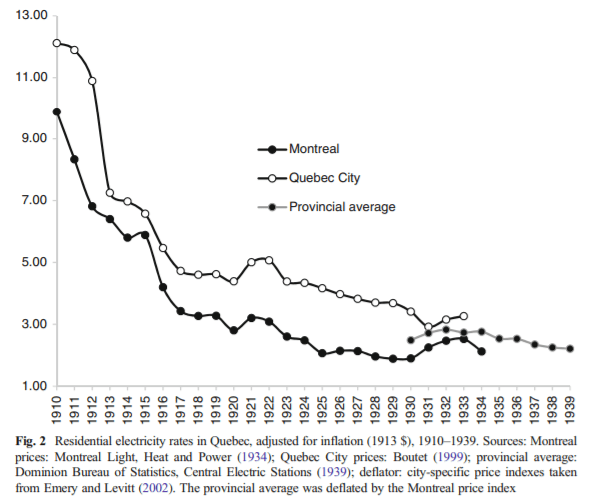
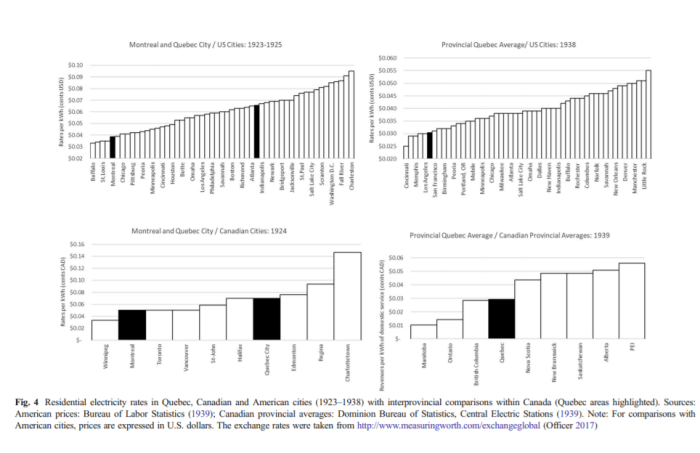
In the article I published with Belzile, I argue that this narration is largely incorrect. First, before nationalization prices in Quebec were falling and were low by North American standards (see figures below). Second, production was expanding rapidly. This is in spite of the fact that taxes imposed on the electrical industry grew rapidly over time from less than 10% of total expenditures to close to 30%. Moreover, we point out that looking at residential prices is bound to yield bad comparisons (if we can call those made above as “bad”) if there is price discrimination. The industry price discriminated and offered incredibly low prices for industrial customers (large power) than in Ontario or anywhere else in Canada (in spite of the taxes it was operating under and the fact that Ontario subsidized its own).
We also point out that there was a dynamics of interventionism problem. The neighboring province of Ontario (more populous and richer than Quebec) nationalized its industry and set prices well below the market level which is an implicit subsidy. However, at the subsidized rate, Ontario could not supply its own demand and had to buy at the market price in Quebec. Its over-equilibrium quantity of energy demanded was transferred on the freer Quebec market, thus increasing prices on that market.
We also argue that there was wide heterogeneity of rates in Quebec that relate to the structure of municipal regulation (the level at which electricity was regulated pre-1935). The price differences depended on the political games involving rent-seeking firms and politicians (best exemplified by the case of Quebec City). Cities with high prices were places where the electrical market was heavily politicized and franchises (i.e. the contracts fixing rate schedules over long periods of time to recoup capital investment) were short and subject to holdups.
This latter point is meant for us (me and Germain) to stake a claim on future research to document the nationalization and regulation process at the municipal level and see what the effects on prices and outputs were. In a certain way, I am trying to establish a research agenda extending the skepticism of “accepted wisdom” that has emerged with the economic history of antitrust in the United States to the case of electricity trusts in Quebec. This first article is, I believe, a promising start for such an inclusion.
Nightcap
- What would “lesser Mexico” look like? Noel Maurer, The Power and the Money
- Picasso’s nudist streak Fiammetta Rocco, 1843
- In Asia, the copy is the original Byung-Chul Han, Aeon
- Pakistan’s Deadly Game with the U.S. Anthony Loyd, New Statesman
 Notes On Liberty