How will Imran Khan’s electoral triumph affect Pakistan’s relationship with India?

Many analysts (internal and external) believed that the 2018 election would be a tough fight with the PTI (Pakistan-Tehreek-I-Insaaf) having a slight edge (as a consequence of support from Pakistan’s deep state). Surveys also predicted a close fight (the importance of undecided voters was highlighted in all of these) with the PTI having a slight edge.

Former PM Nawaz Sharif’s return to Pakistan, along with daughter Maryam Nawaz Sharif, in spite of both facing jail terms, was thought of by many as a gamble which could have been a game changer in Punjab. Sharif returned to Pakistan, leaving his ailing wife Kulsoom Nawaz in London, and this, many believed, would help PML-N (PTI’s chief rival) in securing sympathy votes.

Ultimately, the PTI actually romped home quite comfortably, and emerged as the single largest party with 119 parliamentary seats, while the PML-N was a distant second with 63 seats (PML-N did emerge as the single largest party in the provincial election) and the People’s Party of Punjab (PPP) was at the third position.

Imran Khan’s India Policy

While there has been a lot of focus on the support which PTI has received from the army, there is also curiosity about what sort of policy Imran Khan will follow vis-à-vis India. It has been argued that the Indian establishment is not particularly comfortable with Imran Khan (who, unlike Sharif, may not challenge the Pakistan army’s India policy). The Indian High Commission in Islamabad is supposed to have been in touch with some of his close advisors (every government keeps channels of communications open with all political forces, and there is nothing unusual about this) in the run up to the elections.

At this stage, it is very tough to predict Imran Khan’s precise approach towards India. On the one hand, he has made belligerent statements against India, accusing Nawaz Sharif of being soft on India. While speaking in 2016, Khan had stated:

‘Our premier [Nawaz Sharif], instead of raising voice [for Kashmiris], is busy in making his business flourish there.

On another occasion he had taken a dig at Nawaz Sharif, saying that not every Pakistani is more concerned about his business than his country.

In fact, a day before the polls, Khan stated that Nawaz Sharif was more concerned about India’s interests and was even willing to discredit Pakistan’s army, which is why India preferred him.

How seriously should we take Imran Khan’s rhetoric

In the past few elections, including Nawaz Sharif’s triumphs in 1997 and 2013, anti-India propaganda did not find much traction, and the PML-N itself has indulged in anti-India rhetoric. So Khan’s statements should not be taken seriously.

A retired diplomat who has served in Pakistan, TCA Raghavan, also the author of a book titled People Next Door very aptly stated:

These statements are very common in Pakistan politics. We have to separate political rhetoric from what he actually does when he is in power.

No substantial headway can be expected over the next few months, between both countries, given the mammoth geopolitical and economic challenges which Imran Khan is facing. On the Indian side too, no grand gesture can be expected, given the fact that elections are to be held in May 2019. Backdoor diplomacy, of course, cannot be ruled out. A meeting between Imran Khan and Indian Prime Minister Narendra Modi on the sidelines of the United Nations General Assembly (UNGA) is also a possibility.

In the long run however, there could be some movement forward. In his first address to the Pakistani people, Imran Khan spoke in favor of resolving contentious issues through dialogue, while also pitching for closer economic linkages and jointly combating poverty.

In a media interview recently, he stated:

If you have a good relationship with India, it opens up trade, and trade with a huge market. Both countries would benefit.

PTI has made strong inroads into Punjab, and the business community of the province has been in favour of closer economic ties with India for sometime.

Imran’s familiarity with India

During Khan’s address to the Pakistani people, he also spoke about his familiarity with India, as well as personal ties through his cricketing career.

In 2015, during his visit to India, Imran met with PM Modi and backed peace initiatives between both countries. During his visit, Imran also met with Delhi Chief Minister Arvind Kejriwal (who he praised) and, in the past, he has had kind words for Nitish Kumar’s governance.

Even some of Khan’s close advisors, like former Foreign Minister Khurshid Kasuri and current Vice President of PTI Shah Mahmood Qureshi (who also served as Foreign Minister during the PPP government led by Asif Ali Zardari), are experienced and are familiar with India. Kasuri has numerous personal friendships in India, Qureshi, an agriculturalist, was president of the Farmers Association of Pakistan and has strong links in Indian Punjab.  

Conclusion

Pakistan is facing numerous internal challenges and it is virtually impossible to comment on how things will pan out in the context of India-Pakistan ties. A lot will, however, depend upon the intent of the Pakistan army, as well as ties between Imran Khan and the army, and the role which both China and the United States play in South Asia. While Imran Khan’s initial overtures should be welcomed, it is best to wait and watch and not prophesize, as far as India-Pakistan relations are concerned.
Nightcap

  1. Liberal Education and Civil Character Ann Hartle, Modern Age
  2. The Enrightenment Henry Farrell, Crooked Timber
  3. Understanding and Misunderstanding ‘Dog-Whistling’ Blake Smith, Quillette
  4. On class separation Chris Dillow, Stumbling & Mumbling

Ottomanism, Nationalism, Republicanism VII

Now this series moves onto the first government that resulted from a peaceful electoral transfer of power in Turkish and Ottoman history, the government of Adnan Menderes and the Democrat Party (DP), which came to power in 1950.

The DP was more open to religious conservative sentiment and more free market oriented, though that has to be understood in a very relative way. In power, the DP expanded the number of state enterprises, used economic clientelism to generate business backing, and tolerated an inflation rate of about 20%, though it did also open the economy more to international investment. It was not only more open to religious conservatism (which included creating more pressure for school students to take religion classes and openly Islamist attitudes from some DP politicians), but had a highly nationalist aspect to it, which overlapped. This can be seen most dramatically in the case of the attacks on Greeks in Istanbul in 1955, leading to systematic destruction of property and the loss of about 30 lives.

Though the Menderes government tried to deny involvement and engaged in a token crackdown on ultranationalist groups afterwards, there is plenty of eye-witness information that Democrat Party officials orchestrated mob violence and the police were ordered to remain passive. The army also played a role, drawing on the NATO Gladio structure (groups preparing to resist Soviet occupation, which have also been associated with violent deep state activities in Italy and Spain), to establish a covert command-and-control group. The riots were orchestrated in reaction to armed Greek resistance to British rule in Cyprus, which was seen as threatening the reduction of Cypriot Turks to a second class minority in Cyprus.

We see here the intersection of religious chauvinism (as in Muslim hatred of Orthodox Christians), nationalist chauvinism (as in Turkish hatred of Greeks), inter-state conflict (Greek-Turkish rivalry over the future of Cyprus), inter-communal tension in a historically connected territory (Greek-Turkish rivalry in Cyprus which was an Ottoman possession for centuries), decolonisation (the breakdown of British colonialism in Cyprus) and Cold War covert security structures.

We also see here how troubled claims of the Turkish right to offer something more liberal than Kemalism are. There has been a persistent tendency of some Turkish liberals to go along with this for Menderes in the 50s, Türgüt Özal in the 80s, and Erdoğan in the 2000s and even early 2010s. This is all highly misguided, as will be discussed in future posts. For now, we can concentrate on the record of the Menderes government in encouraging and instrumentalising a combination of ethnic and religious chauvinism, along with growing attacks on the freedom the press and freedom of opposition culminating in the imposition of martial law in early 1960.

The Democrat Party pioneered the politics now followed by the AKP, in which democracy means the dominance of the majority (understood in artificially homogenous terms) in terms of political processes and officially promoted culture combined with the squeezing out of minority and oppositional politics and culture. Elements of economic liberalisation become drowned in state cronyism and inflationary debt-financed vote buying. This is what we might now call authoritarian populism, illiberal democracy, or electoral authoritarianism. Sad to say this has taken place with the assistance of those in Turkey who describe themselves as liberal.

This bad understanding of democracy was promoted by the manner in which the Menderes government ended. A military coup led to: government by military council, the dissolution of the Democrat Party, the arrest of DP politicians, the subsequent execution of Menderes and two other ministers, the adoption of a new constitution by referendum during the military government, the creation of a military-dominated national security committee with power to place issues on the cabinet agenda, and the encouragement of nationalisation.

The complication in this highly illiberal process is that aspects of the new constitution were good from a liberal point of view, including the creation of an elected senate (the first upper house in republican history) and the legalisation of the socialist left, which had been previously heavily squeezed by both the Republican People’s Party and the Democrat Party. Some of the more liberal members of the Democrat Party contributed to the constitutional revision process, so we just can see the process as a straightforwardly anti-liberal process, however undesirable the process was from a liberal point of view.

The political change through coup left disturbing elements in later Turkish political life, which are still with us: the attitude that military intervention is a normal way to end political crisis, the identification of opposition to government with the formulation of a military coup, a victim-desire for revenge mentality amongst the most socially and religiously conservative parts of Turkish society.

The army colonel who proclaimed the 1960 coup on state radio, Alparslan Türkeş, was already known as a militant nationalist. He was purged from the military government along with other colonels who were formulating some kind of long term radical authoritarian regime, and carried on in politics as the most prominent figure in the history of Turkish ultranationalism.

İsmet İnönü enjoyed his last period in power from 1961 to 1965 as Prime Minister. Süleyman Demirel emerged as the new big figure on the centre right. Türkeş and his associates entered politics through infiltration of the National Peasant Party, which broke away from the Democrat Party in the 60s with a more aggressively religious and nationalist program. More on this and later developments in the next post.

Nightcap

  1. Srebrenica and Demagogues Keith Doubt, Berfrois
  2. Habermas and pimps: the world of the day and the world of the night Branko Milanovic, globalinequality
  3. Why didn’t the Crusades succeed? (Aleppo is not a Syrian city) Harry Munt, History Today
  4. The awkwardness of remembering the Romanovs Bruce Clark, Erasmus

Nightcap

  1. African-American incomes in mid-century Tom Westland, Decompressing History
  2. Black American Culture and the Racial Wealth Gap Coleman Hughes, Quillette
  3. When Black Unemployment Rates Were Equal to White Unemployment Rates… Vincent Geloso, NOL
  4. My Great-Grandfather, the Nigerian Slave Trader Adaobi Tricia Nwaubani, New Yorker

RCH: America’s WWII internment camps

Folks, I forgot to link to last weekend’s piece at RealClearHistory. It was about World War II internment camps in the US. An excerpt:

As a quick historical reminder, the United States government, under the direct orders of Democratic president Franklin D. Roosevelt, imprisoned hundreds of thousands of Americans and recently immigrated foreigners for the crime of being Japanese or German (the Italians got some flack, too, but less so than the other two), or for having a Japanese or German surname.

The vast majority of these imprisoned people were Japanese or Japanese-American. In fact, the total amount of interred German or German-American prisoners was roughly 11,000, and the number of Italian or Italian-Americans much smaller than that.

Please, read the rest.

Nightcap

  1. Fear of a Black France Grégory Pierrot, Africa is a Country
  2. Children of the Rohingyas and their Search for Identity Iffat Nawaz, Coldnoon
  3. The Invention of Representative Democracy Katlyn Marie Carter, Age of Revolutions
  4. Is psychedelics research closer to theology than science? Jules Evans, Aeon

Nightcap

  1. Artificial Intelligence: How the Enlightenment ends Henry Kissinger, the Atlantic
  2. What if we have already been ruled by an Intelligent Machine – and we are better off being so? Federico Sosa Valle, NOL
  3. We are in a very, very grave period for the world Henry Kissinger (interview), Financial Times
  4. What should universities do? Rick Weber, NOL

On Robert Allen’s defense of the High-Wage Economy hypothesis

The high-wage economy thesis is a topic I have blogged about many times before as I think it is an important debate among economists and economic historians (see notably here and here, see also this contribution of mine to the Journal of Interdisciplinary History). For those unfamiliar with this thesis, here is a simple summary of the idea advanced by Robert Allen: high wages relative to capital units was a key force in the industrialization of Britain and thus it explains why the Industrial Revolution was British before if was anything else.

As I have explained in the aforementioned blog posts, I am unsure of where I stand regarding this idea. I tend to be skeptical, but I have stated the evidence needed to convince me of the opposite. In the past year or so, there has been an avalanche of articles on the topic including this article by Humphries and Weisdorf, a follow-up working paper by the same authors, another paper by Judy Stephenson and a working paper by Stephenson (bis). Today, Robert Allen replies to his critics in this working paper.

I find that some of the points are convincing, however I must take issue with a particular point that falls into my ballpark as Allen mentions my work on wages in France (the aforementioned article in Journal of Interdisciplinary History). In my research, I pointed out that Allen’s computations underestimated wages outside Paris. With the correct computations, the rest of France does not appear as poor relative to England as Allen suggests. Allen concedes this point but then goes to state the following:

Geloso (2018) has pointed out that the Strasbourg unskilled wage series for 1702-64 is low in comparison to that of comparable towns, and workers may have received food, which has not been taken into account.  This is a perceptive point, but its implications are limited. The most important use I make of the Strasbourg evidence is in calculating the ratio of the wage to the user cost of capital. If the Strasbourg wage in this calculation is raised to that of neighbouring towns, the wage-capital cost ratio does rise but only by a small degree. The reason for this somewhat surprising result is that the wage is also an argument in the formula for the user cost of capital–building workers have to build the machines and the mills that house them–so the denominator of the ratio increases as well as the numerator, although to a lesser extend.

This is a incorrect characterization of my argument. First, I did not state that wages in Strasbourg did not account for in-kind payment. I stated that in-kind payment was evidence that the wages did not pertain to Strasbourg! The wages from the primary sources were for a city some 70 km away from Strasbourg, they did not concern unskilled workers and they included large in-kind compensation. To correct for this problem, I compared agricultural wages in England with those around Strasbourg that had been collected by Auguste Hanauer. What I found was the the lowest wages in farming were equal to 74% of farm wages in Southern England (as opposed to 64% with Allen’s stated wages). While I did not report this in the article because I had doubts, it is worth pointing out that the high bound of farm wages in Strasbourg is above the level reported for Southern England (which acts a proxy for England – see table 2 in my paper). As Strasbourg is a proxy for living standards outside Paris, my finding suggests a much smaller gap in living standards. It also entails a much more important change in the cost of capital to labor (wages are in the range of 50% above those suggested by Allen and sometimes they are higher by more than 100% which would mean a halving of the relative cost of capital! These are not peanuts to be thrown on the sidewalk!

Second, I ought to point out the nature of my argument. I was not trying to prove/disprove the high-wage hypothesis. My point was much more modest. The mirror of the question as to why the industrial revolution was British is why it was not French. France had a large population offering large returns to scale (in both economic and political organizations) and an array of navigable rivers that facilitated internal trade. It also key pockets of Lancashire-like industrialization such as Normandy (for textile) and Mulhouse (the French Manchester). As such, it is an entirely reasonable endeavor to try to situate living standards in France relative to Britain. If France was massively poorer than England, then Allen has a greater likelihood of being correct. If it was closer to an equal footing (I do not believe that anyone places France above England in circa 1750), then Allen’s critics have a greater likelihood of being correct.* However, regardless of the answer, the data does not infirm/confirm the high-wage hypothesis. It merely situates relative likelihood. As I point out that wages were quite above those postulated by Allen, I am merely stating the extent of the reasonableness of being skeptical of the high-wage hypothesis.

Finally, it is worth pointing out that the work of Leonardo Ridolfi is absent from Allen’s reply. The latter’s work is very important as it echoes (in a much richer manner) my point that wages outside Paris were not as low as cited by Allen.**

*As I assume a greater equality of capital returns across both countries, the smaller the wage gap, the smaller the relative differences in capital/labor costs ratios.
** Ridolfi shows France had incomes equal to 64% of English incomes circa 1700. However, I am skeptical of this figure. This is because, while I trust the index produced by Ridolfi, I am unconvinced about the benchmark year to convert the index into international dollars.

Nightcap

  1. How conservatives won the law Steven Teles (interview), Wall Street Journal
  2. Libertarians in the Age of Trump Ross Douthat, NY Times
  3. Political theory for an age of climate change Alyssa Battistoni, the Nation
  4. Nationalists versus empire: A brief history of the African university Mahmood Mamdani, London Review of Books

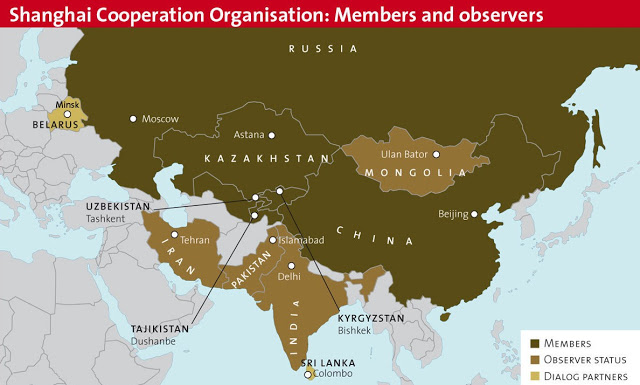
Eye Candy: Shanghai Cooperation Organization

NOL map SCO 2018
Source

First off, Shanghai and Warsaw are two very different cities, and because of that I think the SCO is a different animal than the Warsaw Pact. For one thing (aside from the difference in the two cities, one being selected for its geographical prominence, the other for its commercial acumen), the Warsaw Pact was a military alliance led by the Soviet Union, while the SCO is dedicated to political and economic cooperation as well as military security. Notably, the security aspect of the SCO is dedicated to coordinating state-led efforts against terrorism and separatism rather than against a rival alliance.

I don’t see anything wrong with multilateral efforts undertaken by states other than the US. I don’t see any need to worry, fret, or otherwise suspect the SCO of undermining world peace and prosperity. The fact that the SCO is made up of cooperating autocratic regimes rather than democratic ones does not faze me. The SCO has been making overtures to the democracies of India, Iran, and Sri Lanka (be sure to check out Tridivesh’s excellent take on India and the SCO), and multilateral cooperation among states is in itself an exercise in political participation among equals, albeit not at an individual level.

There is also cause to be happy that China and Russia have bound themselves up in such a prominent cooperative venture, too, given the two powers’ history of fighting each other. The SCO is contributing to peace and prosperity, and while it appears on the surface that the venture is designed to be a rival of the Western-built world order, the Shanghai Cooperation Organization actually contributes to it.

(h/t Nick)

Nightcap

  1. Turkish underworld joins war on journalists Amberin Zaman, Al-Monitor
  2. Turkish underworld has long history of working for Ankara Barry Stocker, NOL
  3. Russia meddles in Greece-Macedonia name bargain Kerin Hope, Financial Times
  4. The ugly plight of Turkey’s hidden Armenians Kapil Komireddi, the National

Nightcap

  1. Before Indiana Jones came Abraham Hyacinthe Anquetil-Duperron Blake Smith, Aeon
  2. Can economists and humanists ever be friends? John Lanchester, New Yorker
  3. A Guaranteed Income would undermine the social virtues of work John McGinnis, Law & Liberty
  4. On Alexandria Ocasio-Cortez, Palestine, and the Left Corey Robin, Crooked Timber

Animation Review #1: Burn the Witch

I am a big fan of animation, but I often have to ‘turn my brain off’ to enjoy a comic trying to make political commentary. With rare exceptions, like the Incredibles series, the industry has a strong statist bent. The industry is so statist that Superman: Red Son, a story line with the premise that Superman landed in the Soviet Union instead of the United States, ends with the message that communism would work if only it were a bit more democratic. Note that I say statist bent, as opposed to leftist bent. They are smaller in number, but there are several conservative comics (e.g. the Kingsman) that leave a statist aftertaste.

I can’t do much on the supply side of liberty-friendly comics, but I can at least highlight those comics that I think fellow libertarians might enjoy via blog posts.

First off is Burn the Witch, a new comic series published by Shonen Jump. I was pleasantly surprised when I read through Tite Kubo’s Burn the Witch. Tite Kubo is best known for authoring Bleach, a comic about Japanese school children fighting demons in fantasy Mexico.

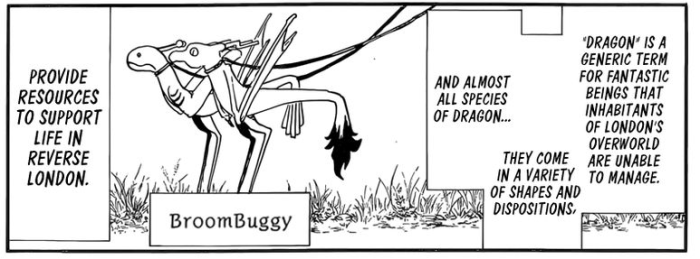
Dragons.png

Burn the Witch is about Anglo-Japanese school children fighting demons in fantasy Britain. The twist? Unlike their counterparts in fantasy Mexico, the British demons (referred to as ‘Dragons’ in-series) aren’t killed outright. Instead they are raised for the resources they provide. Only ‘bad’ demons who are killing humans or otherwise causing destruction are killed. It is noteworthy that the protagonists refer to themselves as ‘conservationists’. They kill the occasional demon, providing the story with action scenes when doing so, but their primary purpose is to conserve them. In an off hand comment the protagonists note that their fantasy Mexican counterparts are barbaric and indiscriminately kill their demons.

Contrary to the protagonist’s comments, it isn’t that individual fantasy Mexicans are barbaric so much that fantasy Mexico doesn’t recognize property rights in demons. Since no one has a property right in demons, no one has an incentive to conserve, much less domesticate, them in fantasy Mexico. Fantasy Britain enjoys strong property rights and consequently has minimal problems associated with its demons. One of the protagonists is ethnically from fantasy Mexico, but seems to be thriving under fantasy Britain’s rules. The story’s lesson? Property rights matter.

Only one chapter of Burn the Witch has been published thus far, and it’s unclear if it’ll become a recurring series, but I like what I’ve seen so far.

Thoughts? Comments? As always, write in the comments below. If you’re a fan of animation and a fellow libertarian, consider joining the anime libertarian alliance facebook group.

Nightcap

  1. Brexit as neoliberal politics Chris Dillow, Stumbling and Mumbling
  2. Russia and “dark globalization” John Connelly, Public Books
  3. Rand Paul finds lots to like in Trump’s presser with Putin Elana Schor, Politico
  4. Did Trump just help stop Brexit? Andrew Sullivan, Daily Intelligencer