- Imagining post-abortion America Rachel Lu, the Week
- A visit to Noah’s Ark Stephen Cox, Liberty Unbound
- Adam Smith as centre-left economist (and nothing else) Branko Milanovic, globalinequality
- Tequila and US-Mexican security relations Raúl Benítez Manaut, War on the Rocks
Nightcap
- The Druze are losing their young (to secularism) Bruce Clark, Erasmus
- If Brett Kavanaugh Drops Out, Will Trump Pick Amy Coney Barrett? Damon Root, Reason
- Trump’s dirty war in Yemen Conor Friedersdorf, the Atlantic
- How to find a beer in Muslim West Africa Will Brown, 1843
India’s approach towards BRI: Need for pragmatism
(new title)
Recently, China’s consular general in Kolkata, Ma Zhanwu, while speaking at a function, proposed a bullet train connecting Kunming (in China’s Yunnan Province) with Kolkata, the capital of India’s eastern state of West Bengal. Said Ma:
With joint efforts of India and China, a high-speed rail link could be established between the two cities.
It would be pertinent to point out that the proposal for a bullet train connecting Kunming and Kolkata had been discussed earlier at the Greater Mekong Subregion (GMS) meet in 2015. In fact, enhancing connectivity between India and China through the Kolkata-Kunming multi-modal corridor (officially the Bangladesh-China-India-Myanmar Economic Corridor, or BCIMEC), which covers a distance of 2,800 kilometres, has been under discussion for over 2 decades, through the Track II K2K (Kolkata-Kunming) dialogue. During former India Prime Minister Manmohan Singh’s China visit, in October 2013, sister city relations were established between Kunming and Kolkata.
In recent years, China has been pro-actively reaching out to West Bengal Chief Minister Mamata Banerjee, and has invited her to visit on repeated occasions, though she has been unable to visit (she was all set to visit in June 2018, but her trip was cancelled at the last moment). Apart from this, a number of Chinese investors have expressed interest in investing in West Bengal and even attended the Bengal Global Business Summit 2018.
Given the increasing emphasis on connectivity with South East Asia, through India’s North East (one of the key aims of India’s ‘Act East Policy’), it was believed that the BCIMEC would tie in neatly with India’s vision for connectivity.
However, tensions between India and China – due to the Doklam standoff as well as Beijing’s insistence that BCIMEC be included in its official Belt and Road Initiative (BRI) – have contributed to a wane in New Delhi’s interest in the project, at least for the time being. The Rohingya crisis, and more general tensions between Bangladesh and Myanmar, are also a major impediment to the project.
The China Myanmar Economic Corridor: Why New Delhi should pay close attention
While a high speed train is an ambitious project, New Delhi can not be closed to the BCIMEC and should pay close attention to the China-Myanmar Economic Corridor (the Memorandum of Understanding for this project was signed on September 9, 2018). While the China-Myanmar Economic Corridor (CMEC) has been under discussion for some time, there have been numerous debates with regard to the economic implications for Myanmar (the Kyaukphyu Deep Sea Port project, as well as Special Economic Zones, have been contentious). The increasing debate on the issue of ‘debt trap diplomacy’ has only increased apprehensions within sections of the Myanma government (the stake of Chinese conglomerate CITIC in the deep sea port has been reduced from 85 percent to 70 percent due to domestic pressures). Myanmar has also made it clear that it would not like to depend only on Chinese investments, and the recently-signed MOU categorically states that third party investments from Japan, South Korea, and Thailand in CMEC projects are more than welcome. Interestingly, an article on CMEC in Chinese media acknowledges some of the apprehensions vis-à-vis CMEC, and also bats for closer cooperation between China and other Asian and Western countries.
The proposal for the bullet train connecting Kolkata-Kunming came days after the agreement had been signed between China and Myanmar. China would like to extend this corridor all the way to India (while speaking about rail connectivity between Kunming and Kolkata, the Chinese diplomat also spoke about an industrial cluster along the route).
How should New Delhi play it?
While New Delhi’s objections to the BRI are valid, it does need to shed blinkers. It is free not to participate in those components of the project with which it is not comfortable, but there are projects, like the BCIMEC, where it can easily find common ground with China. This will give a boost to India’s infrastructure in the eastern and northeastern part of the country, and complement it’s Act East Policy. If third countries are allowed to invest in CMEC, Indian companies should explore opportunities, as this will enhance their presence in Myanmar while also bolstering the Act East Policy.
China’s narrative in South Asia
Post the Wuhan Summit, there has been a clear change of narrative from the Chinese side. China has expressed its keenness to work jointly with India in Afghanistan – in capacity-building projects. This was unthinkable a few years ago.
China’s burgeoning economic relationship with Nepal has sent alarm signals in New Delhi. China’s decision to give Nepal access to its ports (Tianjin, Shenzhen, Lianyungang and Zhanjiang) raised the hackles in New Delhi. Pragmatists realize that New Delhi can not dictate Nepal’s ties with China, and the fact is that Kathmandu would like to benefit economically from its ties with both China and India.
Interestingly, China has been urging Nepal to strengthen economic ties with India. During his visit to Beijing, Nepal’s Prime Minister, K.P. Oli, made an unequivocal pitch for strong ties between Kathmandu and New Delhi (as well as Kathmandu and Beijing). He stated that the economic progress of both India and China was an opportunity for Nepal, and stated that Nepal wanted to emerge as a bridge between both countries, and would not like to get embedded in zero sum geopolitical games. Nepal’s former Prime Minister, Prachanda, during his visit to India, also referred to the need for close ties with both India and China.
India should also keep in mind a few other points
While many in New Delhi are pointing to Malaysian Prime Minister Mahathir Mohammad’s stand against Chinese projects, it is important to keep in mind that while the Malaysian PM has scrapped a few projects, he has continued to reiterate the relevance of the China-Malaysia relationship (there is need for nuance). Second, it is one thing to point out the shortcomings of the BRI project, but India needs to prove its own track record in big ticket connectivity projects (New Delhi has been extremely slow when it comes to the implementation of connectivity projects within the neighbourhood). Third, there are areas where India is already working with China, so rigidity and paranoia do not make much sense. If even Japan is willing to participate in certain projects of BRI, there is absolutely no reason why India should not at least be open to elements of the project. It is also important to look at connectivity from an economic dimension and not a narrow security prism as large sections of India’s strategic community do. Finally, New Delhi can not put all its eggs in the American basket. While India’s strategic relationship with the US has witnessed an improvement, and Washington has repeatedly spoken about the need for greater connectivity within the ‘Indo-Pacific’, the US is not likely to invest significantly in economic connectivity projects. India thus can not be totally dismissive of Beijing-led connectivity initiatives.
While New Delhi needs to exhibit pragmatism, Beijing on its part needs to address the concerns of India, and other countries, with regard to the BRI.
Nightcap
- Symmetry and Asymmetry as Elements of Federalism: A Theoretical Speculation Charles Tarlton, Journal of Politics
- The asymmetry of European integration, or why the EU cannot be a ‘social market economy’ Fritz Scharpf, Socio-Economic Review
- The past and future of European federalism: Spinelli vs. Hayek Federico Ottavio Reho, Martens Centre
- Secular Nationalism, Islamism, and Making the Arab World Luma Simms, Law & Liberty
Nightcap
- The conversations that cryptocurrency kills Sonya Mann, Jacobite
- How and why the 1st Amendment became a weapon for the right Jedediah Purdy, the Nation
- Are libertarians crazy? Pierre Lemieux, EconLog
- As Venezuelans starve, Maduro gives oil away to Cuba Jorge Carrasco, CapX
RCH: 10 corporations that gave capitalism a bad name
That’s the subject of my weekend column over at RealClearHistory. An excerpt:
5. Dutch East India (1602-1799). The VOC, as the Dutch East India Company was known, exemplified corporate plunder and colonial oppression in the 17th and 18th centuries. Its demise was only met after Napoleon’s revolutionary armies conquered the Netherlands, and for nearly 200 years the VOC brutally oppressed and exploited Asian lands in the name of monopoly and Dutch interests of state. The VOC was created to give the Netherlands a presence in the burgeoning world of global trade that had been started by Spain and Portugal after the former’s colonization efforts in the New World. The VOC wanted to cut off Spain and Portugal (and, later, the U.K., France, and U.S.) from world trade, and monopolize industries in order to benefit Dutch society. This logic led directly to not only the horrible things that happened in VOC-governed territory, but also to the corruption and unnecessary wars that happened in the Netherlands.
Please, read the rest.
Nightcap
- How a Huguenot philosopher realised that atheists could be virtuous Michael Hickson, Aeon
- Christian Pentecostalism has crept to the center of public life in Nigeria Ebenezer Obadare, Africa is a Country
- Last words about Nancy MacLean’s attack on James Buchanan Henry Farrell, Crooked Timber
- Are tariffs a big threat to China? Scott Sumner, EconLog
Nightcap
- Meet “Ninja,” electronic gaming’s first big star Elaine Teng, ESPN
- India’s response to China’s rise TV Paul, War on the Rocks
- The Dutch in Java Jenny Watson, Berfrois
- Nancy MacLean’s bad faith is getting tiresome Steven Teles, Niskanen
Nightcap
- How Buddha became a popular Christian saint Blake Smith, America
- Russia, Germany at loggerheads over Idlib Yekaterina Chulkovskaya, Al-Monitor
- Arab melancholia Thomas Patier, Los Angeles Review of Books
- Does Locke’s entanglement with slavery undermine his philosophy? Holly Brewer, Aeon
Nightcap
- On “Madison’s nightmare” Ilya Somin, Volokh Conspiracy
- Good parenting versus good citizenship Gina Schouten, Crooked Timber
- The birth of the British East India Company Francis Sempa, Asian Review of Books
- The bitterness of Adam Smith Branko Milanovic, globalinequality
Nightcap
- Identity: the lies that bind Laura Miller, Slate
- Puzzles about college Javier Hidalgo, Bleeding Heart Libertarians
- Nike is winning the culture war David French, National Review
- Oslo is dead. Long live Oslo! Martin Indyk, the Atlantic
INDIA: A case study in the demise of representative democracy
India of 1947 had battled decades of colonialism to embrace self-rule. Whatever divisions seeped through party ranks, coalesced – and how beautifully – to fight for the right the people to a democracy. Having a common enemy helped. Compounded by the ability of the political leaders of that time to weave magic through words, connecting the plights of the millions to the queen-ship of one propelled movements across the breadth of the Indian subcontinent. While much has been said of the academic prowess as well as the oratory skills of the Founders, it was their ability to connect across barriers of identity that ultimately pushed the wheel. How dearly they protected their freedom of speech, expression and press is perhaps telling of the importance they assigned to being connected with those they had chosen to represent. How is it then that a deeply flawed election system and disjointed lines of public communication yielded one of the biggest civil disobedience movements the world had ever seen?
In terms of representation and reach, India 2018 is better abled than India 1947. And yet, it fell upon the unelected shoulders of four men and one woman to correct a deeply violent, colonial and bigoted law. The right to sexual identity was granted by five cis heterosexual individuals; the ones in need of representation reduced to being mere petitioners. India celebrated breaking off one more shackle, the Judiciary reveled in being the harbinger of liberal values to the Indian legal system yet one more time and the Parliament, as always, stayed mum. It is not that either of the institutions have embraced staunch anti/pro liberal positions. The Indian judiciary has its share of misogynists much like the Parliament. Misogyny is not illegal. But what is illegal is the Parliament’s distance from her electorate. Even if one were to contend that a majority of India does not support homosexuality, the increasing momentum of the movement should have propelled an informed debate within and without the Parliament. Instead, the government chose to not object to the petitions filed in favor of decriminalizing homosexuality as if that is the extent of the responsibility they owe to the LGBTQ community of the country. The distance between a judicial decriminalization of homosexuality and one done through a legislative device is the distance between a populist democracy and a representative one. The counter-majoritarian difficulty seems almost trivial when democratic institutions lose their representative character.
The biggest reason behind the rising legitimacy of an essentially non-democratic institution as the Judiciary is not a power grab by the Supreme Court judges. Howsoever activist they might get, the requirement of giving a reasoned decision tempers their emotions. The Indian Parliament, on the other hand, has come to rely on this increasing politicization of the judiciary to avoid political battles that might require concessions from their mostly unreasoned manifestos. The result is a lack of deliberation that is disturbingly dismal for a democracy as huge as India. The requirements of representation have come to be restricted to a periodical holding of elections. Members of Parliament are neither Burkean agents nor Pateman’s representatives. They are a political class unto themselves working towards a steady demise of the largest democracy in the world.
RCH: 10 Dead Nazis You’ve Never Heard Of
Yup, dead Nazis. That’s the subject of my weekend column for RealClearHistory. An excerpt:
8. Karl Haushofer (died 1946). While it is perhaps unfair to include Haushofer in this list (he denied being a Nazi and his wife and son were, under Nazi law, considered to be “half-Jews”), his ideas about the world and how he went about promoting them are too important to leave out of the Nazi story. Haushofer became a geopolitical theorist after World War I and is credited with introducing to the German public (including the Nazis) the idea of “Lebensraum,” or “living space.” According to Haushofer, Germany could only compete with the Western powers if it had control over areas of Europe stretching from Norway to the Caspian Sea. Once the German military controlled this geographic space, the Nazis could begin exterminating the indigenous people there to make room for German colonists. Haushofer also viewed Japan as a natural ally of Germany and was instrumental in convincing the Nazis to partner up with Tokyo. One of Haushofer’s former students, Rudolf Hess, was one of Hitler’s closest confidants, and it’s unlikely that Haushofer, bitter about the terms of peace imposed on Germany by France and the U.K. after World War I, did not exploit his former student’s position as Deputy Führer. He and his wife committed suicide together in 1946. Their son had been murdered by the S.S. in April of 1945.
Please, read the rest (if you haven’t already!).
Eye Candy: France’s 50 largest islands
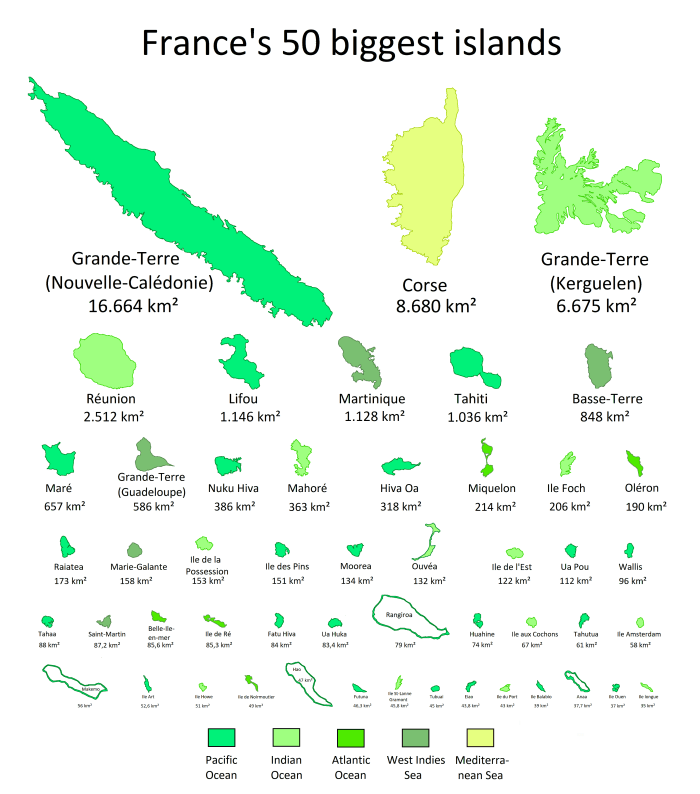
This is pretty cool. France still has an overseas presence in the Pacific, the Caribbean, the Mediterranean, the Indian and Antarctic oceans, and the Atlantic (including St. Pierre and Miquelon, an archipelago just off the coast of Newfoundland, a province of Canada). Here’s a good Wikipedia list of France’s islands. It’s in French. Translate it to English, if you must. Browse and soak it all in. Here is Jacques at NOL on all things French. And here is Vincent at NOL on all things Quebec, which is a French-speaking province in Canada.

