- Kingdoms of Faith: A New History of Islamic Spain Nicola Clarke, History Today
- After Rushdie’s The Satanic Verses Kenan Malik, Guardian
- The labor theory of value, explained Branko Milanovic, globalinequality
- The closest exoplanet to Earth could be “highly habitable” Adam Mann, Scientific American
Nightcap
- American Indian? Bruno Cortes, Claremont Review of Books
- Italy is the new Argentina Alberto Mingardi, Politico
- The case for Kavanaugh Randy Barnett, Volokh Conspiracy
- Israel’s Russia problem is dangerous Michael Koplow, Ottomans & Zionists
RCH: law schools and Thurgood Marshall
Yesterday’s RealClearHistory article was all about law schools, with a little bit of Thurgood Marshall thrown in for good measure (he took his seat on the US’ highest court Oct 2, 1967):
If the Supreme Court’s liberal and conservative justices all come from one of two law schools, the prevailing mode of thinking about the law is going to be not only out of touch with most of the legal profession (and general populace), but also with the idea of a judicial branch dedicated to overseeing the laws of a vast, continent-spanning republic. Marshall’s supreme courts were elitist and aristocratic, which is what they were supposed to be, but what do you call a court that is so insular and so self-selecting that only two law schools are represented?
This is not a plea to lower standards in order to broaden the field, but there are a lot of good law schools in America, which is, after all, a republic governed by laws, not men. If the Kavanaugh debacle proves too much of a problem for federal politicians (Kavanaugh went to Yale’s law school), perhaps President Trump should think of looking elsewhere for a nominee.
Please, read the rest. In it, I include 3 people who would be good SCOTUS Justices. Feel free to add your own…
Nightcap
- Police tailgating as entrapment Irfan Khawaja, Policy of Truth
- The mandatory canteens of communist China Hunter Lu, Atlas Obscura
- Will Shiite militias become Iraqi Basij? Hamdi Malik, Al-Monitor
- When details matter (Brexit) Chris Dillow, Stumbling & Mumbling
Nightcap
- The fantastic truth about China Alec Ash, ChinaFile
- Civilization in the wilderness (Argentina) JN Nielsen, The View from Oregon
- Giving psychiatry another look Pierre Joseph, Aeon
- Immigration and the Commerce Clause Ilya Somin, Cato Unbound
Eye Candy: Gay marriage in Europe (2018)
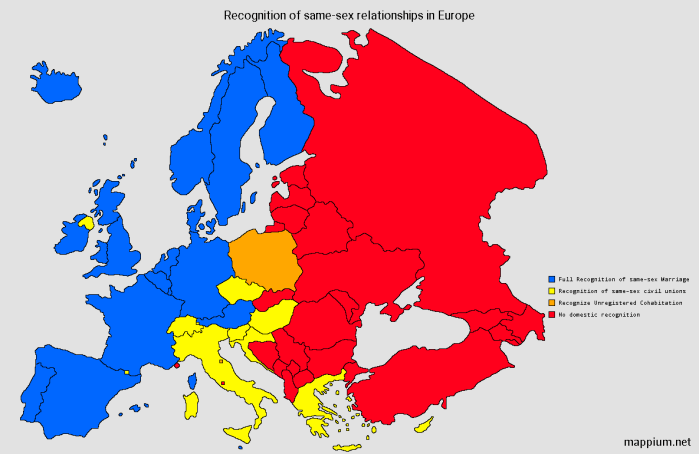
Opponents of gay marriage might have trouble explaining this one, at least in the free world.
Too many shadows whispering voices. Faces on posters too many choices. If when why what how much have you got…
The EU’s laudable Asia Connectivity Strategy
The European Union (EU) has put forward a plan for enhancing connectivity within Asia, and has been dubbed as the Asia Connectivity Strategy.
The EU does not want to give an impression that the Asia Connectivity Strategy (ACS) is a counter to the Belt and Road Initiative (BRI). Yet, senior officials of the EU, while commenting on the broad aims and objectives of the project, have categorically stated that the primary goal of the Asia Connectivity Strategy is enhancing connectivity (physical and digital) while also ensuring that local communities benefit from such a project, and that environmental and social norms are not flouted (this is a clear allusion to the shortcomings of the BRI). There are no clear details with regard to the budget, and other modalities of the project (EU member countries are likely to give a go ahead for this project, before the Asia-Europe Meeting in October 2018). The EU has categorically stated that it would like to ensure that the ACS is economically sustainable.
Other alternatives to BRI: the US
It is not just the EU, but also the US, along with Japan and Australia, which are trying to create an alternative vision to the BRI.
Nightcap
- A nationalism untethered to history Mark Koyama, Liberal Currents
- The virtue of nationalism? Alberto Mingardi, Cato Journal
- America desperately needs a healthy conservatism Andrew Sullivan, Daily Intelligencer
- After racism, the Left struggles to find a new menace Robert Merry, American Conservative
Nightcap
- The Tlatelolco massacre of 1968 Lorna Scott Fox, Times Literary Supplement
- Western Civilization “not welcome” in Australia Bella d’Abrera, Quillette
- Umber: The color of debauchery Kelly Grovier, BBC
- An interview with VS Naipaul Patrick Marnham, Literary Review
Opportunities for blockchain-based social media in developing countries
On September 22nd, I presented my Serey project – a blockchain based social media platform in Cambodia – at BitFest 2018 in Amsterdam. It was organized by the BitShares Foundation and mainly attended by enthusiasts of BitShares and Graphene technology. Being part of the Bitshares/Graphene family, I was invited to speak at the conference.
We shared the stage with other graphene projects as BitSpark, DasCoin, PayGer, BitCrab, RuDEX and many others. I look forward to work together with anyone that seeks to decentralize our future, that has a vision in which every human being is free, and where blockchain technology provides the tools to secure our rights to life, liberty, and property.
Stan Larimer was there as well, and he had something interesting to say about how BitShares will import EOS technology through a middle-layer. This will greatly benefit the whole BitShares/Graphene community, including Serey.
Regarding my own presentation, I have made the case that Blockchain is not only a technological revolution, but essentially a social, political and economic revolution. I believe it’s a tool that will move us into a more decentralized world that was envisioned by the earliest internet adopters. As more internet applications were built, it became clear that it would not become as decentralized as these adopters hoped. These applications suffered from a centralized system in which data was stored and controlled on a single or a small number of servers. Those who controlled these servers, the men-in-the-middle, dictated the rules of the platform. They could look into your data, modify your data, prevent you from accessing your data etc.
Blockchain eliminates these so-called “men-in-the-middle”. Its censorship-resistant property provides many great opportunities for developing countries where the rule of law are often weak or underdeveloped. One opportunity that I have been trying to seize in Cambodia is the creation of a social media platform that could not be controlled or censored by a single party. As Cambodians are becoming more tech savvy, and more connected to the outside world through internet access, it’s a great time to roll out a Blockchain-based social media platform where people can express themselves freely. The advantage of a social media is that it’s easier to build the network effect that can reach critical mass in a relatively short period of time. Once we gain enough momentum, I would like to tokenize the national currency, the Riel, develop a Serey Wallet, and provide anyone who has access to the internet the opportunity to open a wallet (bank account) for free and use our tokenized Riel for e-commerce, remittances, savings, loans etc. Although Cambodia has experienced tremendous economic growth in the past two decades and the World Bank has moved Cambodia’s status from a lower-income bracket to a lower-middle-income bracket, 83% of Cambodians still remain unbanked.
Doing so, I hope we will promote freedom of expression and an intellectual society in Cambodia, as well as help banking the unbanked.
Below, you can find my slides for the presentation.
RCH: 10 most divisive Supreme Court justices in American history
It turns out that SCOTUS appointments have had a long history of dividing American society. An excerpt:
9. Roger Taney (1836-64). Taney rose up the political ranks as Andrew Jackson’s right-hand man. Jackson tried to get him on the Supreme Court in 1835 but his nomination was rejected by anti-Jacksonian Whigs in the Senate. After the Whigs were swept away in the 1836 election campaign, Jackson renominated Taney, but this time for the position of Chief Justice, and he was confirmed 21-15 after a bitter debate in the Senate. The Taney court is responsible for the Dred Scott case that tore the fledgling republic apart, and for helping Jackson abolish the national bank. Taney and Lincoln clashed often, too, as Taney ruled that Lincoln’s suspension of habeas corpus was unconstitutional, but Taney never did go home during the Civil War and served out his term as Chief Justice until his death in 1864. He holds the second-longest tenure of any Chief Justice.
Please, read the rest, and try to remember: this divisiveness is a feature of the system, not a bug.
Nightcap
- Legendary fart battles in the Samurai Era Richard Farrell, Vintage News
- The other side of Weimar (Germany) art David Bennun, 1843
- India’s ingenuous approach to life Christian Koch, BBC
- Revisiting the American Century Ronald Radosh, Claremont Review of Books
Nightcap
- Neoliberalism is making the world much more equal Scott Sumner, EconLog
- How effective are Islamic states at satisfying the religious needs of their citizens? Nile Green, Los Angeles Review of Books
- Socialism won’t get rid of bosses, either Christopher Freiman, Bleeding Heart Libertarians
- Hayekian communism Branko Milanovic, globalinequality
Nightcap
- Understanding Homo Economicus in Deeper Terms Garreth Bloor, Law & Liberty
- The Homo Economicus is “The Body” of the Agent Federico Sosa Valle, NOL
- Worker ownership: threat or promise? Chris Dillow, Stumbling & Mumbling
- Flower Fires Setsuko Adachi, Berfrois
China-Myanmar Economic Corridor and the limits of ‘Cheque Book Diplomacy’
On September 9, 2018 Myanmar and China signed a memorandum of understanding (MoU) for establishing the China-Myanmar Economic Corridor (CMEC), as part of China’s ambitious Belt and Road Initiative (BRI). The corridor will traverse a distance of approximately 1700 kilometres and seeks to connect Kunming (in China’s Yunnan Province) with Myanmar’s key economic points – Mandalay, Yangon, and Kyauphkyu.
According to the MOU, both sides have agreed to collaborate in a number of areas. Some of the important areas identified for collaboration by both countries are: infrastructure, construction, manufacturing, agriculture, transport, finance, human resources development, telecommunications, and research and technology.
Chinese Foreign Minister Wang Yi had first announced the proposal to build CMEC during his meeting with Myanmar’s State Counselor Aung San Suu Kyi in November 2017. The MOU had been finalized in February 2018.
The CMEC is an ambitious project from which Myanmar could benefit immensely. Yet, there have been apprehensions with regard to the economic feasibility of the project, and Myanmar does not want to meet the fate of other countries which have fallen into what has been dubbed as a ‘Debt Trap’.
Opposition to Kyauphkyu
There has been skepticism with regard to the BRI project in general, and China’s involvement in the SEZ and Sea Port to be set up in Kyauphkyu (a coastal town in the Rakhine Province) in particular. Large sections of the population have been questioning the economic rationale of the project – and the benefits for Myanmar. CITIC (China’s biggest financial conglomerate) was awarded both projects, but it had to reduce its stake from 85 percent to 70 percent in the Sea Port after vehement opposition from the local population. Locals found the 85-15 arrangement unreasonable. Fearing a debt trap, the NLD government in Myanmar has also reduced the initial value of the Sea Port project – a whopping $7.3 billion USD to $1.3 billion. There has been opposition to the SEZ as well (mainly on environmental grounds), and while the initial Chinese take in the SEZ (originally valued at $2.7 billion) was 51 percent, it is likely to be revised.
U Kan Zaw, a Minister in the erstwhile Than Sein government (and Chairman of the Kyauphkyu SEZ tender committee), confessed that Myanmar was not very keen for Chinese investment (it had sought investments from the UK and Europe), but it was not left with any other option once other countries declined to invest.
China beginning to acknowledge shortcomings of BRI projects
Of late Beijing has expressed a willingness to re-examine some aspects of BRI-related projects (including CMEC and the China Pakistan Economic Corridor – CPEC). On the face of it, at least Beijing seems open to addressing the worries of countries which are part of the BRI.
Chinese media itself is trying to send a message that Beijing is responsive to concerns of countries which are part of the BRI initiative. A recent example is an article in CGTN on CMEC, which acknowledged not just the drawbacks of the project, but also the fact that the response to CMEC has been tepid so far in Myanmar. Said the article:
CMEC is temporarily suffering from a cold reception, we believe that it is an excellent endeavor.
The authors of the article also makes a significant point: that Chinese businessmen are not familiar with Myanmar. While the article could be referring to the lack of familiarity with Myanmar’s policies, many host countries have been critical not just of the ‘one sided’ nature of Chinese economic investments, but their unwillingness to understand local cultures, and the fact that they remain aloof from the local population.
On a number of occasions, Chinese businessmen have even misbehaved with locals. In Pakistan, on two occasions, Chinese businessmen have beaten up policeman, and this did not go down well with the local population.
While alluding to the failure of big ticket infrastructure projects, the article also refers to the need for Chinese investments in ‘light industry’ as opposed to ‘heavy industry’ (in a reference to infrastructural mega projects, such as those which were scrapped by Malaysian Prime Minister Mahathir Mohammad).
One of the interesting aspects of CMEC is that Myanmar was keen to have third party investments, and not restrict itself only to Chinese investments. Investments will come from countries in South East Asia and East Asia — Thailand, South Korea, and Japan. While China’s economic presence in Myanmar is staggering, this has not gone unchallenged and of late countries like South Korea are also increasing their presence in Myanmar. The authors of the CGTN article also try to pitch for Chinese cooperation with other countries, arguing that joint investments will mean not only lesser economic and political burden for China, but that they could also reduce hostilities between Western and Chinese companies.
Finally, the article speaks about the need for greater cooperation between Myanmar and China in the sphere of agriculture (especially aquaculture), and that this cooperation should be economically beneficial for the local population.
Conclusion
It remains to be seen whether China will actually acknowledge the genuine concerns of countries participating in the BRI, and whether or not it will actually take some tangible steps to address the apprehensions. As stated earlier, Beijing seems slightly more flexible in its negotiations, but whether this is a short term trend (which many would argue is a consequence of Malaysian PM Mahathir Mohammad’s straight talking with China) or not remains to be seen.
China may be further compelled to change its approach towards overseas economic investments after the recent electoral rout of Abdulla Yameen (outgoing Maldivian President), considered to be pro-China. One trend which is clearly emerging, as was evident from the electoral verdict of Maldives, was that leaders (many of whom position themselves as strongmen) blindly following Chinese diktats for short term economic goals does not go down well with ordinary citizens, and China may need to address its perception problem by looking beyond Cheque book Diplomacy.

