Brazil, the country of Carnival (?)

Maybe for most English speakers it isn’t even known, but we are in the Carnival week. Carnival is a festive season that occurs before the liturgical season of Lent. The main events typically occur during February or early March. It typically involves public celebrations, including events such as parades, public street parties and other entertainments. I’m unashamedly taking some elements from Wikipedia here to try to explain it. It is basically equivalent to Mardi Gras. Carnival (or Carnaval, as we say it in Portuguese) is a big thing in Brazil. Or maybe not. That’s what this post is about.

Carnival is a Christian feast, at least in its origin. It occurs right before lent. Lent is the forty days that antecede the Passover. The idea was that people would fast (at least to some degree) during the forty days of lent. Therefore, Carnival was the last opportunity for forty days to indulge in some pleasures of the flesh. Carnival literally means “remove meat”, from the Late Latin expression carne levare. “Farewell to meat” is another possible translation. However, carne is not solely meat in Latin; it also refers to the flesh, especially in the Christian association between sin and flesh. Carnaval, therefore, is the feast of the flesh – taken literally or not. At least in Brazil, to my knowledge, the relationship between Carnival, Lent and Passover is little known. I believe that most people just take it to be a major party that happens sometime between February and March.

Brazil is popularly known as the country of Carnival, Samba and Soccer. Of these three, I kind of like the last one. Not so much the first two. To my knowledge, Carnival has always been very popular in Rio de Janeiro, at least since the early 19th century. At that time, it was known as Entrudo, a celebration in which mostly people throw water on one another, like in a water balloon fight. However, there were some improvements: people started throwing some liquids other than water if you know what I mean and that even at strangers. The party was also an opportunity for slaves to poke on their masters. Carnaval eventually became associated with the slaves’ African culture, and I suppose that’s how the Christian origins were somewhat lost. Today, Carnaval in Rio is strongly associated with Samba music.

I haven’t done a very scientific research for this, but to my knowledge, most people in Rio actually don’t like Carnaval. Carnaval is a street party, with all that comes with it: people leave tons of trash behind; people get drunk, and often violent; the music can get really loud and sometimes going on for hours, even into the night. Given the specific nature of the festival, there are people having sex on the street and other things happening as well. It is hard to say this without sounding moralistic, but the thing is that Carnaval ends up being the most anti-libertarian thing one can imagine. If “don’t do onto others what you don’t want to be done onto you” is the golden rule we’re trying to put into practice, Carnaval is the undoing of this.

In the late 19th century, some authorities already realized that the festival was getting out of control and tried to organize it somehow, mostly to no avail. But things really got out of control in the early 20th century. Coming out of the monarchy, Brazilian intellectuals were dedicated to the task of identifying the Brazilian identity. Sérgio Buarque de Holanda made a huge contribution to this with is Roots of Brazil (Raízes do Brasil), in which he said that Brazilians had a hard time understanding and applying the impersonal relationships necessary for a modern capitalistic society. Another major contribution in this conversation was done in 1933 by anthropologist/sociologist Gilberto Freyre in his book Casa-Grande e Senzala (English: The Masters and the Slaves). In this book, Freyre argued that the Brazilian national identity was the result of miscegenation (both biological and cultural) between masters and slaves.

On the one hand, I want to say that Freyre’s argument was revolutionary because he was saying that Brazilians were not an “inferior race” because of race-mixing. Just the opposite: Brazilian culture was permeated by highly positive elements exactly because of miscegenation. Consider that Freyre was saying that in the 1930s, when race-mixing was still a major taboo in the US, not to mention Nazi Germany. But on the other hand, I believe that Freyre contributed to a movement that gave up trying to “civilize” Brazil.

The topic of civilization is always a polemic one because it implies that some cultures are superior to others. I don’t want to go that way. But I also don’t want to be a cultural relativistic. Some cultures are superior to others in some aspects. There is nothing culturally superior in leaving tons of trash in the streets after a street party. There is nothing culturally superior in imposing your music taste on others. There is nothing superior in imposing your take on sexuality on others.

In the late 19th century, some authorities were trying to organize Carnaval in Rio de Janeiro because things were getting out of control. In the early 20th century, most authorities gave up that enterprise because they decided that Rio de Janeiro (and Brazil) is that “mess”. Instead of trying to correct the bad aspects of Carnaval, they decided to celebrate it as the very essence of Brazilian culture. Eventually, into the 20th century, Carnaval became a great example of panem et circenses policy.

I understand that in the early 21st century more and more people in Brazil are getting sick and tired of Carnaval, and that has some connections with politics. Typically (though definitely not always) people on the left want to celebrate Carnaval. People on the right typically (though definitely not always) don’t want to. Some people on the left are already saying that Bolsonaro’s government represents the taking over of government by Christian fundamentalists. I doubt. They may be right at a very low degree. But for the most part, what is happening is that Brazil is too diverse for a single project of nation to work for everybody. Ironically Gilberto Freyre was right: we are the result of this mixture, and this is not a bad thing. People only need to learn to respect the opinions, tastes and preferences of the other elements in this mix.

Amy Klobuchar is the libertarian candidate we don’t deserve

Here’s Slate on the person I would vote for, if I voted. Instead, the Democrats are gifting the Republicans a Jewish socialist with a Brooklyn accent to run against Donald Trump…

More campaign-finance fiction

Today, Jacobin reports on Bernie Sanders’ proposal to give each American a $50-$200 voucher to spend on politicians’ political campaigns. I’m the lead counsel challenging a similar voucher program in Seattle, so I have some feelings on this subject.

The article opens with this classic ipse dixit: “Everyone knows that rich people skew our political priorities through big-money donations to candidates.” Really? I didn’t know that. But of course this is the big assumption behind so much campaign-finance hype, one that is vague and unprovable, like all good political rhetoric.

My first question here would be an attempt to resolve an ambiguity: what does “skew” mean? Where’s the magical baseline of “unskewed” political priorities? That baseline does not and never has existed. This opening line also fails to account for causation. That is, do donations influence eventual votes, or are both donations and votes attracted to candidate strength? I’ve yet to see a convincing argument that donations have ever “bought” a major federal election.

The article also seems to assume, as many do, that liberal politicians are the ones losing out in the big-donor world. This just isn’t so. Candidates from across the political spectrum receive plenty of cash. Heck, Hillary outspent Trump 3 to 1 in 2016. If she was hoping her donors would “buy” her the election, she was sorely disappointed.

The article also parrots the frequent refrain about our “broken” campaign-finance system. Again, compared to what? Where’s the unbroken system and what does it look like? At the end of the day, politicians need to figure out how to appeal to voters with all that money. How are our politics “skewed” if both parties are receiving plenty of funding with which to present a message that draws votes?

As for the actual voucher proposal, I think most Americans would rather keep their $50-$200 dollars and spend it on something other than a politician, but that’s just a hunch.

Be Our Guest: “Elizabeth Warren’s Degrading Diversity Plans”

The significance of an individual from a disadvantaged group earning a respected occupation and excelling displays the potential of people from that group to overcome prejudice and contribute to the betterment of the world, thus providing distinction for the individual and garnering pride and acclaim for the group. Shoehorning disadvantaged groups into positions as a political statement renders their presence as purely symbolic.

This is from John Lancaster, and it’s excellent. John likes to Be Our Guest here at NOL. Please, read the rest. And if you’ve got something to say, why not say it?

The Least Empathic Lot

On standard tests of empathy, libertarians score very low. Yet, the world’s “well-known libertarian bias” coupled with many people’s unwarranted pessimism makes us seem like starry-eyed optimists (“how could you possibly believe things will just work themselves out?!”).

Under the Moral Foundations framework developed and popularized by Jonathan Haidt, he and his colleagues analyzed thousands of responses through their YourMorals.org tool. Mostly focused on what distinguishes liberals from conservatives, there are enough self-reported libertarians answering that the questionnaire to draw meaningful conclusions. The results, as presented in TED-talks, podcast interviews and Haidt’s book The Righteous Mind: Why Good People Are Divided by Politics and Religion contains a whole lot of interesting stuff.

First, some Moral Foundations basics: self-reported liberals attach almost all their moral value to two major categories – “fairness” and “care/harm.” Some examples include striving for equal (“fair”) outcomes and concern for those in need. No surprises there.

Conservatives, on the other hand, draw fairly evenly on all five of Haidt’s different moralities, markedly placing weight on the other three foundations as well – Authority (respect tradition and your superiors), Loyalty (stand with your group, family or nation) and Sanctity (revulsion towards disgusting things); liberals largely shun these three, which explains why the major political ideologies in America usually talk past one another.

Interestingly enough, In The Righteous Mind, Haidt discusses experiments where liberals and conservatives were asked to answer the questionnaire as the other would have. Conservatives and moderate liberals could represent the case of the other fairly well, whereas those self-identifying as “very liberal” were the least accurate. Indeed, the

biggest errors in the whole study came when liberals answered the Care and Fairness questions while pretending to be conservatives.

Within the Moral Foundations framework, this makes perfect sense. Conservatives have, in a sense, a wider array of moral senses to draw from – pretending to be liberal merely means downplaying some senses and exaggerating others. For progressives who usually lack any conception of the other values, it’s hard to just invent them:

if your moral matrix encompasses nothing more than Care and Fairness, then to imagine a political opponent is to reverse one’s own position for those foundations – that Conservatives act primarily on other frequencies, on other foundations, wouldn’t even occur to them.

Libertarians, always the odd one out, look like conservatives on the traits most favoured by liberals (Fairness and Care/Harm); and are indistinguishable from liberals on the traits most characteristic of conservatives (Authority, Loyalty, and Sanctity). Not occupying some fuzzy middle-ground between them, but an entirely different beast.

Empathy, being captured by the ‘Care’ foundation, lines up well with political persuasion, argues Yale psychologist Paul Bloom in his Against Empathy: The Case for Rational Compassion. Liberals care the most; conservatives some; and libertarians almost none at all. Liberals are the most empathic; conservatives are somewhat empathic; and libertarians the least empathic of all. No wonder libertarians seem odd or positively callous from the point of view of mainstream American politics.

Compared to others, libertarians are more educated and less religious – even so than liberals. Libertarians have “a relatively cerebral as opposed to emotional cognitive style,” concluded Haidt and co-authors in another study; they are the “most cerebral, most rational, and least emotional,” allowing them more than any others to “have the capacity to reason their way to their ideology.”

Where libertarians really do place their moral worth is on “liberty” (a sixth foundation that Haidt and his colleagues added in later studies).  Shocking, I know. Libertarians are, in terms of moral philosophy, the most unidimensional and uncomplicated creatures you can imagine – a well-taught parrot might pass a libertarian Turing test if you teach it enough phrases like “property rights” or “don’t hurt people and don’t take their stuff.”

The low-empathy result accounts for another striking observation to anyone who’s ever attended an even vaguely libertarian event: there are very few women around. As libertarians also tend to be ruthlessly logical and untroubled by differential outcomes along lines of gender or ethnicity – specifically in small, self-selected samples like conferences – they are usually not very bothered by the composition of their group (other than to lament the potential mating opportunities). The head rules, not the heart – or in this case, not even the phallus.

One of the most well-established (and under-appreciated) facts in the scientific community is the male-female divide along Simon Baron-Cohen’s Empathizing-Systemizing scale. The observation here is that males more often have an innate desire to understand entire systems rather than individual components – or the actions or fates of those components: “the variables in a system and how those variables govern the behaviour of that system,” as Haidt put it in a lecture at Cato. Examples include subway maps, strategy games, spreadsheets, or chess (for instance, there has never been a female world champion). Women, stereotypically, are much more inclined to discover, understand, mirror and even validate others’ feelings. Men are more interested in things while women are more concerned with people, I argued in my 2018 Notes post ‘The Factual Basis of Political Opinion’, paraphrasing Jordan Peterson.

The same reason that make men disproportionately interested in engineering – much more so than women – also make men more inclined towards libertarianism. A systemizing brain is more predisposed to libertarian ideology than is the empathizing brain – not to mention the ungoverned structure of free markets, and the bottom-up decentralized solutions offered to widespread societal ills.

Thus, we really shouldn’t be surprised about the lack of women in the libertarian ranks: libertarians are the least empathic bunch, which means that women, being more inclined towards empathy, are probably more appalled by an ideology that so ruthlessly favours predominantly male traits.

As I’ve learned from reading Bloom’s book, empathy – while occasionally laudable and desirable among friends and loved ones – usually drives us towards very poor decisions. It blinds us and biases us to preferring those we already like over those far away or those we cannot see. The “spotlight effect” that empathy provides makes us hone in on the individual event, overlooking the bigger picture or long-term effects. Bloom’s general argument lays out the case for why empathy involves in-group bias and clouds our moral judgements. It makes our actions “innumerate and myopic” and “insensitive to statistical data.” Empathy, writes Bloom:

does poorly in a world where there are many people in need and where the effects of one’s actions are diffuse, often delayed, and difficult to compute, a world in which an act that helps one person in the here and now can lead to greater suffering in the future.

In experiments, truly empathizing with individuals make us, for instance, more likely to move a patient higher on a donation list – even when knowing that some other (objectively-speaking) more-deserving recipient is thereby being moved down. Empathy implores us to save a visible harm, but ignore an even larger (and later) but statistically-disbursed harm.

Perhaps libertarians are the “the least empathic people on earth.” But after reading Bloom’s Against Empathy, I’m not so sure that’s a bad thing. Perhaps – shocker! – what the world needs is a little bit more libertarian values.

Climate crisis or censorship crisis?

Yesterday, the Chair of the U.S. House Select Committee on the Climate Crisis wrote an ominous letter to the CEO of Google. For the second time, the Chair is leaning on Google to police and remove “dangerous climate misinformation” on YouTube. The letter doesn’t threaten direct legal action against Google, but it nonetheless raises serious concern because it runs so counter to the free speech tradition and the value of a robust internet.

According to the Chair, “YouTube has been driving millions of viewers to climate misinformation videos every day, a shocking revelation that runs contrary to Google’s important missions of fighting misinformation and promoting climate action.” The Chair states her own unequivocal commitment to “promoting ambitious federal policy that will … eliminate barriers to action, including those as pervasive and harmful as climate denial and climate misinformation.” It’s hard not to see the veiled threat here.

Note the letter’s subtle casting of the consumers of information as passive actors that must be protected, rather than rational actors who choose what information to consume, a choice they’re entitled to make. She says “YouTube has been driving millions of viewers to climate misinformation” and that Google should “correct the record for millions of users who have been exposed to climate misinformation.” This language strips accountability and action from the viewers, as if they are a captive audience held down and forced to view climate denial videos with eyelid clamps like a scene from A Clockwork Orange. But if that content is promoted and viewed, that’s because there’s a consumer demand for it. The passive language used in the letter exemplifies the paternalism that often lurks behind censorship: for their own welfare, we must protect the public from information they wish to consume.

Note also the absolutism woven into the letter. Google cannot both be committed to climate action and committed to an open culture of public discourse. In the war for humanity’s survival, one priority must dominate above all others.

The letter also relies on the tired tactic of impugning speakers’ motives. Anyone who expresses “climate misinformation” on YouTube just wants “to protect polluters and their profits at the expense of the American people.” It’s impossible for an absolutist to consider that views opposed to her own might be sincerely held. Plus, research has shown that political views frequently do not line up with individual self-interest. Only a shallow thinker or someone with an agenda assumes a political viewpoint is rooted in a selfish motive.

As for the constitutional implications of the letter, there is no question that the federal government cannot impose on Google the duty to remove “climate misinformation” or “climate denial” content. False speech is not exiled from the sanctuary of First Amendment protection. Of course, some false speech can be penalized, such as libel, slander, or fraud. But these are circumstances where there’s some other legally cognizable harm associated with the false statement for which recovery is warranted. There is no general rule that false speech is unprotected.

Government should never be in the position of arbitrating truth. Particularly in the context of hotly debated political controversies, allowing government to label one side as gospel and penalize dissidents opens the door to legally enshrined orthodoxy. As Justice Robert Jackson said 80 years ago: “If there is any fixed star in our constitutional constellation, it is that no official, high or petty, can prescribe what shall be orthodox in politics, nationalism, religion, or other matters of opinion or force citizens to confess by word or act their faith therein.” That’s what the power to ban “climate misinformation” entails.

Indeed, government refereeing of truth will almost always shade toward discrimination against disfavored viewpoints. For example, there is “misinformation” out there on both sides of the climate debate. Those who peddle wild doomsday predictions are just as unhinged as those denying the realities of climate change. Yet the Chair does not propose to censor such misinformation.

When I see such zealous effort to shut someone up, I can’t help but ask myself why the censor is so afraid. The targeting of this speech is likely only draw attention to it. Why worry about the hacks? I’ve always believed what John Milton expressed centuries ago in the Areopagitica: “Let [Truth] and Falsehood grapple; who ever knew Truth put to the worse in a free and open encounter?” Of course, that doesn’t mean that falsehoods lack convincing power, but truth in the end has the edge. Rather than pick the winner in advance, we do much better by letting truth emerge through open debate, bloodied but victorious.

Protecting your privacy: asymmetric cryptography (part 2)

This is the second of four posts in which I discuss cryptography. If you read all four posts, you will understand the differences between symmetric and asymmetric cryptography, why the US government were against the spread of modern cryptography, how it has resulted in the first crypto war between code rebels (techno-libertarians) and the US government, and how you can easily protect your privacy using Pretty Good Privacy (PGP).

The topics of the four posts are:

  1. What is symmetric cryptography;
  2. What is asymmetric (public key) cryptography;
  3. The first crypto war between code rebels and the government;
  4. How to easily use PGP to protect your e-mail communication.

What is asymmetric (public key) cryptography

In my previous post, I mentioned four disadvantages of symmetric cryptography. These disadvantages are:

  1. The secret key must be shared between sender and receiver, before messages can be exchanged safely, preferably over a secure channel.
  2. The secret key is in two separate places.
  3. The sender of the message must trust the receiver that he will not steal or copy the secret key.
  4. It is not scalable for, for example, e-commerce.

Soon after the publication of the Data Encryption Standard (DES), asymmetric (public key) cryptography was invented by the Stanford graduate student, Whitfield Diffie, and Stanford Professor, Martin Hellman. This was a huge revolution within cryptographic research, because up until then it was thought that there should always be a shared secret key for the communication between the sender and receiver. The main question that Diffie and Hellman were trying to solve was: how can you create secure communication over a unsecure channel, when two corresponding people have never had contact with one another and therefore have not yet been able to share secret keys with each other.

The solution, public key cryptography, was introduced by Diffie and Hellman in their paper, ‘New Directions in Cryptography’ (1976). It inspired more cryptographic research outside the circles of secret agencies. Soon after the first publication on public key cryptography, three young Professors at MIT, Ron Rivest, Adi Shamir and Leonard Adleman, developed the now famous RSA public key cryptosystem in 1977.

Merkle Diffie Hellman
Ralph Merkle, Martin Hellman, and Whitfield Diffie. Merkle is known for his invention of Merkle trees, which is a tree-like structure of cryptographic hashes that organizes for example Bitcoin transactions. The public key cryptosystem, as published in ‘New Directions in Cryptography’, is mostly known as the Diffie-Hellman key exchange. Hellman, however, recognizes the contributions of Merkle for the Diffie-Hellman key exchange.

RSA
Adi Shamir, Ron Rivest, and Len Adleman. Inventors of the RSA cryptosystem.

Public key cryptography works as follows. There are two separate keys that correspond mathematically with one another: the public key and the private key. The public key is used to encrypt a message, and can be shared to other people. The private key is used to decrypt a message, and should be kept secret. Public key cryptography is hence a two way function. Just by knowing someone’s public key, it’s not possible to find out the person’s private key.

In our below example,

  1. Alice would like to send a secret love message to Bob.
  2. Bob has a corresponding public an private key, and sends the public key over a unsecure channel to Alice.
  3. Alice uses Bob’s public key to encrypt her secret love message.
  4. Alice sends the secret love message to Bob.
  5. Bob uses the corresponding private key to decrypt the message and finds out that Alice loves him.

Public Key cryptography
Alice and Bob use public key cryptography to exchange secret messages.

Doing so, you can have private correspondence over an unsecure channel. Actually, we’re using public key cryptography all the time. Whenever you see a green padlock in front of the URL bar, it means that the data you enter on the website is first encrypted before it’s sent out.

Digital Signatures

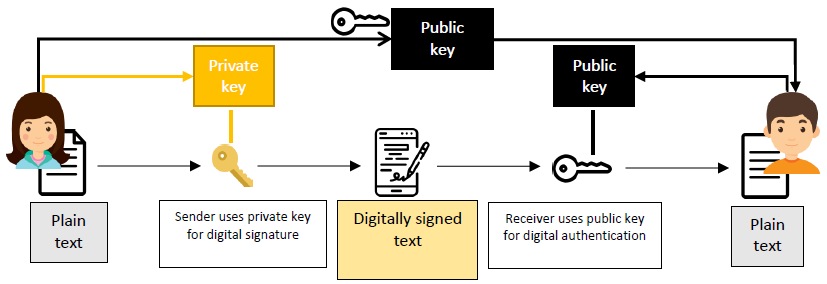
Public key cryptography is not only used for the encryption and decryption of messages, but also for message authentication. If Alice would not have encrypted her message with Bob’s public key, but with her own private key, then the encrypted message can be decrypted with her public key. If you receive a message of John Locke and you’d like to know whether it’s really sent out by Locke, then you could look up his public key and use it to decrypt his message. If the result is plaintext, and assuming that Locke is the only person in the world who possesses the only private key that can produce the encrypted message, you can be sure that the message was sent by Locke. In other words: applying a private key to a message is the equivalent to putting a digital signature.

Digital Signatures
Alice puts a digital signature on her message, and Bob digitally verifies that the message is truly coming from Alice. This is an easy way of using digital signatures. In reality, a text is hashed first with a hash algorithm, before it is encrypted with the private key. Bob then uses Alice’s public key to decrypt the message to retrieve the hash, and compares the resulting hash with the original hash of Alice’s message.

Digital signatures are particularly important, because they provide the following security aspects:

  1. Authentication: it offers proof that the message comes from the right person.
  2. Non-repudiation: we cannot deny that the signee has sent it.
  3. Data integrity: the message cannot be altered after it has been signed.

Diffie and Hellman saw great potential for public key cryptography in the coming digital age. The US secret intelligence, however, were not happy with this development in cryptography and tried to prevent public use of this new cryptosystem. The standoff between privacy advocates of whom many were cryptographers and the US government is known as the first crypto war.

In part three of this series, we will discuss the crypto war. Eventually, at the end of the post series, you will be able to encrypt your e-mails using public key cryptography.

“A classical liberal view of the Iran crisis?”

Some initial thoughts:

Classical liberals will not be surprised by the repeated occurrence of violence and war in the Middle East and will understand the realities of the unstable region where Iran is an important player. Their analysis will view the regional balance of power in the context of the global balance of power. They will also take account of the history of US-Iranian relations […]

This is from fellow Notewriter Edwin, writing for the Institute for Economic Affairs in London. It was part of a nightcap a few days ago, but I thought I’d give it some more love with a post of its own.

Edwin likes to use the “balance of power” strategy to explain the classical liberal position (check out his now classic article in the Independent Review), but I don’t know how true this is. Traditionally, hasn’t the balance of power method been favored by conservatives like Metternich and Kissinger?

I know he’ll respond by telling me that I have a socially liberal view of IR because I favor more federation, but I don’t know how true this is either. Shouldn’t trade-offs and cooperation in the context of power take precedence in classical liberal theories of IR? What sounds more liberal to you, then: a strategy of balancing power between separate actors, or a strategy of finding trade-offs and binding actors together in a manner (federal) that maximizes those trade-offs?

Sunday Poetry: Gender Equality where it matters? The Scandinavian Unexceptionalism

Deja-Vu! Social Democrats once again bring up the topic of “Democratic Socialism” to cure all of the evils of the world. Once again, the Scandinavian countries (Sweden, Finnland, Denmark and Norway) are used as an example of how “a third way Socialism” can work. Although I still would consider myself young, I have already lost all of my stamina to engage in the same debates all over again until they pop up again a few months after.

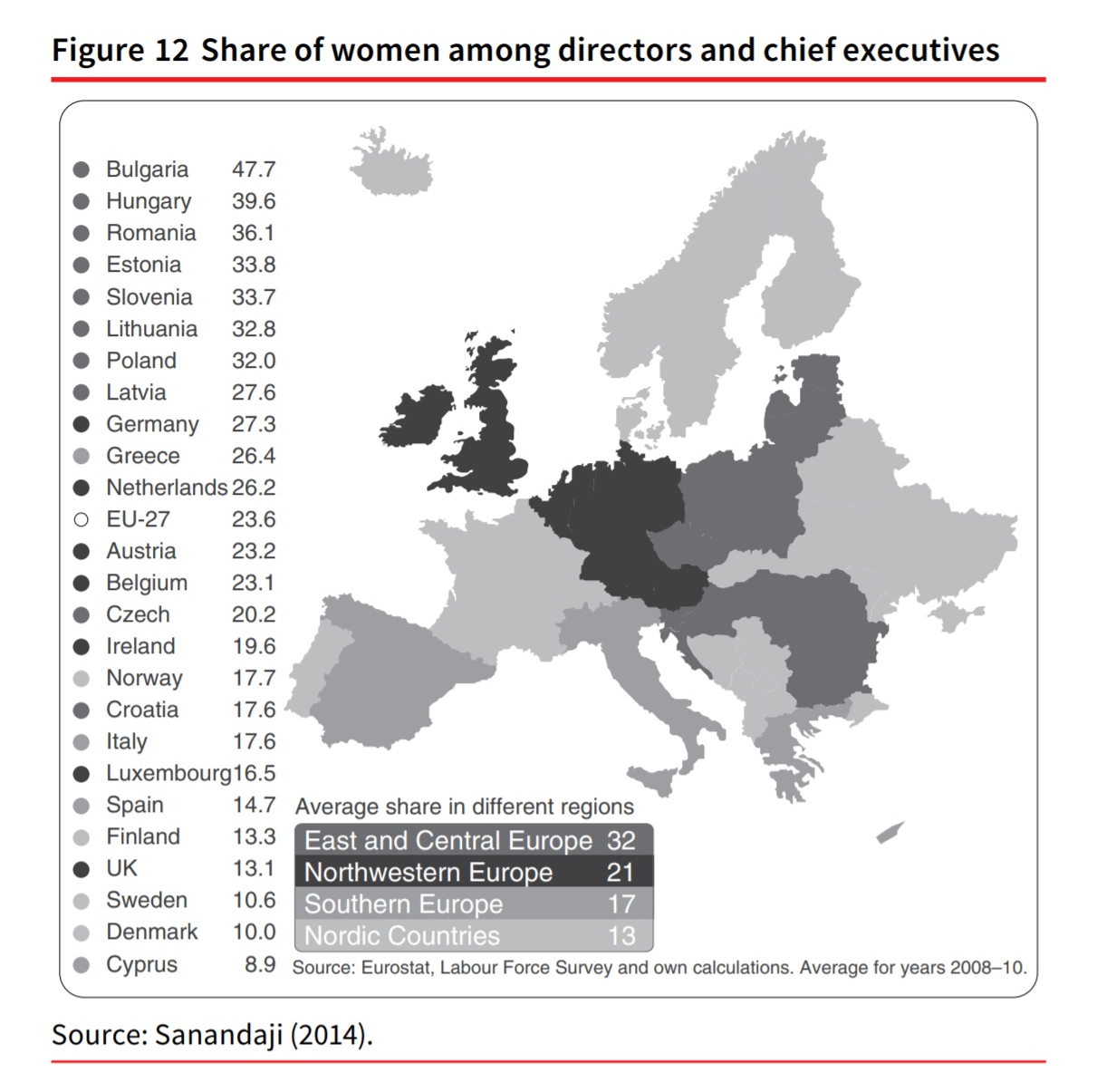
So, instead of pointing out the fallacy in labelling the Scandinavian countries moderately socialist (Nima Sanandaji, for example, does an excellent job in doing so), I want to look at one aspect in particular: The myth of peak emancipation of woman in the labour market in these countries. So apologies for neglecting Poetry once again for the sake of interesting information. Have a look at the following graphic and the remarks by Sanandaji:

“Some boards in Nordic nations are actively engaged in how the companies they represent are run. Others have a more supervisory nature, meeting a few times a year to oversee the work of the management. The select few individuals who occupy board positions – many of whom reach this position after careers in politics, academia and other non-business sectors – have prestigious jobs. They are, however, not representative of those taking the main decisions in the business sector. The important decisions are instead taken by executives and directors. Typically individuals only reach a high managerial position in the private sector after having worked for a long time in that sector or successfully started or expanded a firm as an entrepreneur. The share of women to reach executive and director positions is the best proxy for women’s success in the business world. Eurostat has gathered data for the share of women among ‘directors and chief executives’ in various European countries between 2008 and 2010. The data show that Nordic nations all have low levels of women at the top of businesses. In Denmark and Sweden, only one out of ten directors and chief executives in the business world are women. Finland and the UK fare slightly better. Those Central and Eastern European countries for which data exist have much higher representation.

sanandaji.png

[…]

A key explanation lies in the nature of the welfare state. In Scandinavia, female-dominated sectors such as health care and education are mainly run by the public sector.
A study from the Nordic Innovation Centre (2007: 12–13) concludes: Nearly 50 per cent of all women employees in Denmark are employed in the public sector. Compared to the male counterpart where just above 15 per cent are employed in the public sector. This difference alone can explain some of the gender gap with respect to entrepreneurship. The same story is prevalent in Sweden. The lack of competition reduces long-term productivity growth and overall levels of pay in the female-dominated public sector. It also combines with union wage-setting to create a situation where individual hard work is not rewarded significantly: wages are flat and wage rises follow seniority, according to labour union contracts, rather than individual achievement. Women in Scandinavia can, of course, become managers within the public sector, but the opportunities for individual career paths, and certainly for entrepreneurship, are typically more limited compared within the private sector.

If you are interested in the whole book, it is completely available online for free.

I wish you all a pleasant Sunday.

A happy ten-year anniversary to the case people love to hate

This month marks the ten-year anniversary of one of the most despised and misunderstood Supreme Court cases: Citizens United v. Federal Election Commission.

I love Citizens United. It stands as perhaps the most important First Amendment decision of the last decade. Yet it’s come to symbolize the illicit marriage between money and power, while what actually happened in the case is largely an afterthought. I remember encountering an enraged signature-gatherer outside a Trader Joe’s a few years ago who was engaged in one of the many campaigns to amend the Constitution to put an end to Citizens United. I thought he might have a coronary when I told him that it was one of my favorite Supreme Court decisions. I deeply regret not asking him if he could rehearse for me the facts of the case. Maybe he would’ve surprised me.

So what did Citizens United actually say? The law at issue banned corporations from using general treasury funds for electioneering, with civil and criminal penalties for corporations that spent money to speak on pressing political issues of the day. The Supreme Court said that a small-time political organization (that happened to be incorporated), Citizens United, could not be banned from publishing a film critical of a presidential candidate. It’s hard to find speech of a higher order of significance than that.

Citizens United held that government cannot ban political expenditures just because people choose to speak through the corporate form. This is a classic example of an old rule–government cannot censor speech based on the identity of the speaker.

Much of the fury over Citizens United is premised on a guttural abhorrence for the corporation. But corporations are just groups of people who have chosen to organize through a particular structure. And most don’t realize that the law at issue in Citizens United also banned unions from using general treasury funds for electioneering communications.

Much of the popular criticism of the case that I’ve seen seems to believe that Citizens United was the first case to establish that corporations had First Amendment rights. It wasn’t. In fact, not even the dissenters in the case would’ve held that corporations lack such rights. That was an uncontroversial and settled matter. And it should be obvious as to why. If corporations don’t have First Amendment rights, then the New York Times doesn’t have First Amendment rights, along with many other media organizations. (I’ve heard the excuse that freedom of the press would still protect media organizations independently, which is a misunderstanding of the freedom of the press, which doesn’t offer greater speech protections to media than non-media).

Citizens United gets a bad break, and I wish it a happy anniversary.

A blatant campaign-finance boondoggle

The City of Seattle is poised to pass a plainly unconstitutional campaign-finance law later this month. The bill would limit contributions to political action committees that are not controlled by or connected to a candidate to $5000 per election cycle. The Ninth Circuit Court of Appeals, which would govern the outcome of any litigation, has already said several times that limiting contributions to independent PACs (meaning independent of a candidate’s campaign) violates the First Amendment.

The rationale is pretty straightforward. Any limit on political spending is a limit on speech, so it must satisfy the First Amendment. In Buckley v. Valeo, the United States Supreme Court said that contribution limits directly to candidates are usually okay because they (arguably) reduce the likelihood of corrupt quid pro quo exchanges between candidates and donors. But Buckley struck down limits on independent expenditures (meaning expenditures that aren’t donated to a candidate but speak independently for or against a candidate). Independent expenditures, unlike direct contributions, are not coordinated or controlled by the candidate, so there is less of a risk that an independent expenditure is actually an illicit quid pro quo. Since limits on independent expenditures restrict speech without actually doing anything to prevent corruption, they violate the First Amendment.

Contributions to PACs that engage in independent expenditures are basically the same as independent expenditures–there isn’t a direct connection to a candidate, so there simply is no genuine risk of corruption. The City of Seattle probably knows this, and they either don’t care or they hope to change the state of the law. I look forward to the forthcoming judicial rebuke.

Really, I find the entire premise behind limits on either contributions or expenditures to be highly dubious. While there are no doubt a few instances where a contribution to a candidate is given in direct exchange for some future favor once the candidate wins office, the vast majority of contributions are not that. They’re donations to support a candidate because his platform reflects the donor’s policy preferences. Most corrupt exchanges of money, when they do occur, almost certainly occur under the table and outside the context of highly regulated campaign contributions. Thus, contribution limits penalize a wide range of legitimate political speech to get at a vanishingly small (and unknowable) number of malefactors.

Defenders of campaign-finance laws tend to emphasize the huge amount of political spending as per se evidence of the need for reform. (When you compare the amount of political spending to other spending in the economy, it becomes quite clear that the amount of money in electoral politics simply isn’t that much). This claim that money in elections is fundamentally bad has always struck me as bizarre. That money is spent by both sides on political speech that informs the public. Why should we assume that this is a bad thing? Of course all political speech has a partisan aim–to convince voters to vote for so-and-so. But the information hardly compels voters to do so. At the end of the day, it seems much better to have a public informed by politically motivated communications than to have less information.

Campaign-finance advocates also like to point out that candidates who receive the most money tend to win. Again, it isn’t obvious why this is a bad thing. It seems rather obvious that popular candidates will attract both dollars and votes, not because they get lots of money, but because they’re popular. This is a classic failure to acknowledge the difference between correlation and causation. To date, no significant evidence has surfaced demonstrating that dollars cause votes.

And what about the concern over undue influence? Of course, politicians may be responsive to high-dollar donors. But again, this is a correlation issue. The NRA gives money to candidates who support the NRA’s  policy preferences. When the candidate reaches office and fights gun control, is it because of the NRA’s support, or was the NRA’s support prompted by the candidate’s pre-existing policy platform? Over and over, the deeply felt convictions of campaign-finance advocates seem to rest on a house of cards.

In any case, even if risk of quid pro quo corruption is a valid reason to restrict speech, Seattle’s bill goes well beyond that rationale. PACs engage in core political speech, as do the individuals who donate to them. That speech merits protection.

Politics according to the Bible

Yeah, let’s go for a topic that is generally polemic. What I’m going to present here will not be exhaustive, but at least I believe it’s a fair and honest (although very breathy) treatment on the topic.

First things first, I believe that the Bible is the Word of God. I believe it was written by people (very likely all men) who were inspired by God. This means that the Bible is not their book. It’s God’s book. Also, although it was written in contexts and cultures very different from ours today, it is still true because it speaks of things that are eternal. So, with that in mind, here are some things I believe the Bible teaches on politics.

The whole Bible is a story of creation, fall, redemption and restoration. God created the World “very good”. However, man fell from this status when he sinned. Sin is to disobey God’s law or to fail to conform to it.  When the first man, Adam, sinned, we all sinned, because Adam was our federal representative. It may sound unfair that we are all punished for something that someone else did, but students of politics shouldn’t be surprised. We suffer (or benefit) from things we didn’t do all the time. In this particular case, God chose Adam as humanity’s representative. God is just. It was a just choice. After Adam fell, Jesus became the federal representative of a part of humanity that God decided to save. This is the “redemption”. The restoration is God reversing the effects of the fall through the church.

The whole Bible story can be summarized as “kingdom through covenant”. A covenant is a solemn agreement between at least two (not necessarily equal) parties, involving promises and sanctions. God made a covenant with Adam. Adam broke that covenant. God made a covenant with Jesus. Jesus fulfilled the covenant. By fulfilling it, Jesus became the king of a people, the church.

Jesus’ covenant was anticipated by some covenants in what we call the Old Testament. Although the theories vary, the point is that God’s covenants with Noah, Abraham, Moses and David somehow anticipate Jesus. This means that in the Old Testament God’s people was mostly one nation, Israel, organized as a nation-state. This nation-state had civil laws. One great mistake is to try to apply these civil laws to any state today. Israel was an anticipation of the real people of God, the church. The church is not a nation-state. It doesn’t have civil laws. Actually, Jesus repeatedly said that his kingdom was not of this world, meaning that it would not be brought by political force.

The fact that Israel was an anticipation of the true church doesn’t mean that all the laws given to Israel are irrelevant today. The moral law given in the 10 commandments is still biding. even the civil laws, although no longer bidding, can be informative. The point is that these laws cannot be enforced by any state. They have to be preached. People must be left free to join. Or not.

What the church can expect from the state? It would certainly be great to live in a country that fully conforms to God’s moral law, but this is not a realistic expectation. The best we can expect is a state that keeps people free to decide whether they want to join the church or not. Other than that, there is a moral law that we all can benefit from: don’t hurt others and don’t pick their stuff without permission.

Trying to enforce God’s kingdom was one of the greatest mistakes Christians committed through the centuries, and I believe many Christians are still doing it today. We want people to be Christians not out of their free choice, but by coercion. Or we want people to externally behave as Christians when they are not. Again: the best we can do is to let people free to decide. And meanwhile, demand that we are also free to practice our religion, no matter what other people think about it.

Why some countries are stuck in poverty

It is fairly common for young children in Brazil (or at least in Rio de Janeiro, the part of the country I know better) to call adults “uncle” or “aunt”. My closest friends’ children call me uncle and I’m totally ok with that. I do see them as my nephews and nieces. That also happens in schools: children up to 11 or 12 call the teachers “aunt”. Some people think that this is normal or even cute. However, I studied in a school that strictly forbid children to call the teachers aunt. The teachers were supposed to be called simply “teacher”. One interchange became folkloric in my house: “Am I your father’s sister? Am I your mother’s sister? Am I married to your uncle? Then I’m not your aunt.” Ouch! As gruff as it might sound, that’s the mentality I grew up with. My mother was also never totally comfortable with some of my friends calling her “aunt”.

One of my favorite interpretations of Brazil came from Sérgio Buarque de Holanda (1902-1982). In his book Raízes do Brasil (Brazil roots, 1936) he made an analysis of the country, saying that the problem with Brazilians is that they are cordial. Using Max Weber’s categories, Holanda said that Brazilians don’t know how to conduct formal, impersonal relationships. It is really hard for them (or I should say, for us) to understand that the guy in office is the guy in office and not our friend.

I would say that many times I saw Holanda’s interpretation in action. Students who thought they were my friends and that because of that I would go easy on their exams. Colleagues who thought I wouldn’t fine them when I was working in the library. People I barely knew, who were friends of my friends, who thought I would give them answers for the exams. I managed to be friends of some students, but that was the exception. Most students had a hard time distinguishing between “Bruno, my friend” and “Bruno, my professor”. Worse, some, I don’t know how, came to the conclusion that I was their friend.

Lula da Silva, Brazil’s former president, presented himself as a father. He introduced Dilma Rousseff, his successor, as a mother. Getúlio Vargas, the horrendous dictator from the 1930s was widely known as “the father of the poor”. I’m sad to say that Jair Bolsonaro, Brazil’s current and supposedly right-wing president, doesn’t really scape this logic. It may be nice and cute when little children call adults aunt or uncle, but it sickens me when grownups use this language. Even more so, when they use it to people they don’t even know!

Sergio Buarque de Holanda is one of the few things from college I profited from reading. It helped me to escape the Marxist bog that is much of Brazilian humanities academia. Years later I read Good Capitalism, Bad Capitalism and I discovered that Brazil was not alone. That is the problem with many so-called capitalist countries that still lag behind. They are not really capitalist in the sense that the US, much of Western Europe or Japan and other Asian countries are, and one of the main reasons for that is that people don’t know how to conduct impersonal, formal relationships. The teacher is not your aunt, and the country is not a big family.

Intellectuals You Should Know About

I read a lot. Wide, deep and across quite a number of different fields. As a self-proscribed ‘writer’ and ‘editor’, reading much is both satisfying an intellectual desire and a professionally useful practice in familiarize myself with various styles, voices and topics. A common tip for aspiring writers is to read someone they admire and try to imitate their style; at this, at least, I am somewhat successful, as a friend recently told me that my style reminded him of Deirdre McCloskey. Full of idolized admiration for Deirdre’s work, I couldn’t imagine a higher praise.

As readers, the eternal curse of modernity is our laughable inability to keep up with the couple of millions of books that are published every year. Not to mention written materials on blog or respectable outlets or in magazines and journals. As consumers of the written word, we are completely outstripped, utterly defenseless and overwhelmingly inundated.

When in September I published my discussion of geographer and anthropologist Jared Diamond’s impressive work, I got a lot of feedback of astonishment from friends and family – including the friend that praised me for occasionally (accidentally…?) write like McCloskey: “Wow,” he said, “I’ve never heard of him before!”

Huh, I thought. I wonder what other household names of public intellectuals are not read as much as they deserve.

My exact reaction of astonishment was more like a gaping “What?!”, betraying my wanna-know-everything attitude, slight elitism and writer lifestyle. Contrary to the belief that our times is one of all talking and no listening (well, writing and no reading), it takes a vast amount of reading before you can produce anything that others want to read. Sure, anybody with a laptop and an internet connection can start a blog and flush out their thoughts (I did so for years) but it takes knowledge to say something intelligent and interesting – knowledge acquired by extensive reading.

It also takes a lot of practice to develop a voice of one’s own. Authors with astonishing and recognizable writing styles are made, not born.

What, then, should you read?

In light of this surprise, I decided to make a list of intellectuals I would advise anybody to read. Note that this is not a list of the most important thinkers ever, nor is it a collection of the most profound academic contribution to various disciplines. Instead it’s a gathering of writers whose popular writing (often in addition to their rigorous academic work) is exactly that – popular. That means that a lot of others liked them (and if you’re anything like others, you might too) and more importantly: a lot of smart people you meet are rather likely refer to these authors or to the ideas contained in their work. Here are 11 authors I would consider to be household names and whose writing will make you a much smarter and interesting person.

Jared Diamond

Let’s begin our list with aforementioned Jared Diamond, whose trilogy on humanity is compulsory reading for pretty-much everyone. This year he released Upheaval, which received very mixed responses and that I decided to skip after hearing his pitch on Sam Harris’ Making Sense podcast. Diamond’s publisher maintains that this is the third installment of his “monumental trilogy” of how civilizations rise and fall, but to me that was The World Until Yesterday: 

  • Guns, Germs and Steel is the book that definitely made Diamond a well-known name, the kind of Big Picture civilizational economic history we have recently seen in Yuval Harari’s work – the author of Sapiens: A Brief History of Humankind, that strangely boring book that everyone seems to be reading these days – or the less well-known but more captivating Columbia professor Ruth DeFries’ The Big Ratchet. If you like, you could describe this Pulitzer prize-winning book as well-written geographical reasons for why the West is rich and the Rest isn’t. If that’s your thing, read away.
  • Collapse: How Societies Choose to Fail or Succeed, the book that my September piece was mostly concerned with, is a dense story of many different human civilizations falling apart: Easter Islanders, Native Americans in the dry southwest or central America and my favourite chapter: The Greenland Norse. Complemented with the Fall of Civilizations podcast and Dan Carlin’s recent book The End is Always Near would make you ridiculously interesting to talk to in these hyper-catastrophist times. Upheaval is a natural extension of Collapse so if you crave more, that one is for you.
  • I would rather point to The World Until Yesterday for Diamond’s third gem as it is a deep dive into the lives of traditional societies in general, but in practice mostly New Guinean societies. Somehow, Diamond made anthropology exciting!

Paul Collier

Rapidly moving up in controversy, Paul Collier is an Oxford development economist whose work most intellectuals have a distinctly firm opinion about. His popular claim to fame rests on:

  • Exodus, a very cool (and prescient!) take on global migration. Highly recommended.
  • The Bottom Billion, for a plunge into global poverty and development economics. It might be slightly outdated (published in 2007) as many of the 60 failing countries he identifies have seem quite some growth in the last decade.

I should also recommend his latest book, Future of Capitalism, but I wasn’t very impressed with it. In these times of political polarization, populist uprisings, urban-rural divides and worries about AI, it is still a relevant read.

Whenever Collier speaks, you want to listen.

The Four Horsemen of Atheism (or “New Atheism”):
Christopher Hitchens, Sam Harris, Richard Dawkins, and Daniel Dennett

to which we should add the “one Horse-woman“, Ayaan Hirsi Ali, whom I’m ashamed to only know as “the wife of Niall Ferguson” (yes, my background is money and history, OK, not politics or religion…).

Together, these 5 brilliant minds may have helped many out of their religiosity, but their contributions loom much larger than that. As most of the Western world has gradually abandoned faith, their religious inclinations have turned to other areas: environmentalism (Mike Munger’s take on recycling never gets old!), invented hierarchies or social justice. The writings of these five horsemen can be hugely beneficial here too. Some recommended reading includes:

Speaking of Ferguson, as I’m a big financial history guy, I am shamelessly squeezing in this prolific writer, professor (well, Senior Fellow at Hoover institution nowadays) and public intellectual:

I should also mention his two-volume biography of Henry Kissinger (first volume 2015, next probably finished next year), which I ignored (politics is boring) and his recent book The Square and the Tower, which I heard very bad things about – and so downgraded for now.

Steven Pinker

Ah, this Harvard cognitive scientist and linguist-turned-public-intellectual is a must-read. His top trilogy, which I voraciously consumed last fall, includes:

  • The Blank Slate, the best description of this book that I ever heard came from Charlotta Stern, sociologist at Stockholm University: every sound argument against the “Nurture Only”-idea that biology doesn’t matter compiled into a single book. Yes, you want to read it.
  • The Better Angels of Our Nature, a Big Picture humanity-scale look at violence, resurrecting Norbert Elias’ Civilizing Process theory to explain why we hurt and kill each other less than at probably any point in human history. Nassim Nicholas Taleb (see below) is decidedly not convinced
  • Enlightenment Now! The Case for Reason, Science, Humanism, and Progress, as if Better Angels wasn’t Big Picture enough, here’s the ultimate case for why humanity is doing pretty well, why doomsday sayers are wrong on every count and why we shouldn’t despair. Many of the topics of Better Angels re-occur in Enlightenment Now!, but I don’t regret reading both as Pinker’s prose is easy to follow and his content well-sourced should you require more convincing. Originally a cognitive scientist, he has a ton of more books you might wanna check out – The Language Instinct, for instance, ranks pretty high on my Next Up list:
  • The Language Instinct
  • How the Mind Works
  • The Stuff of Thought

Matt Ridley

Speaking of optimistic people taking a Big Picture view of humanity, zoologist and science writer Matt Ridley is a must. Tall (like me!), Oxford-educated (like me!) and techno-optimist (like me!), no wonder I like him.

At last, How Innovation Works is schedule for May 2020. 

Nassim Nicholas Taleb

Oh, boy – here’s a controversial one. Frequently does he get into loud and hostile arguments with other high-profile intellectuals, and rarely does he pull any punches. His popular writing is found in the “Incerto” serie – the Latin term for ‘doubt’ or ‘uncertainty’ that capture Taleb’s core work. The set of books are together described as “an investigation of luck, uncertainty, probability, opacity, human error, risk, disorder, and decision-making in a world we don’t understand:”

They are intended to push One Big Idea: that we frequently overlook how random the world is, ascribing causality where none belongs and overestimate what we can know from (relatively recent) past events. Black Swans, the proverbial unpredictable event, dominates the social sciences in Taleb’s view. While the 2000-odd pages worth of the Incerto series may seem daunting, the books (and even the individual chapters) are designed not to fall very far from each other. The interested reader can, in other words, pick any one of them and work backwards in accordance with whatever is of interest. You wanna read all – or any – of them.

Having read Fooled by Randomness first, I’ve always held that highest. Be ready for a lot of sarcastic and frequently hostile (but thoughtful) objections of things you took for granted.

In sum: just bloody read more

Any selection of important contemporary intellectuals is arbitrary, highly skewed and super-unfair. There are more, many more, whose fantastic writings deserve attention. As I said, the eternal curse of modernity is our laughable inability to keep up with avalanche of cool stuff written every year.

As readers, we are overrun – and the only thing you can do to keep is is to read more. Read widely.

Above are some amazing thinkers. Drop me a line or tweet me with readings you would add to a list like this.

Hong Kong Police storm Polytechnic University of Hong Kong: a selection of news articles

《BBC》

//Those who remain seem determined to fight to the end, no matter the risk.//

https://www.bbc.co.uk/news/world-asia-china-50452277

《Financial Times》

//“Everyone is exhausted and [when] someone wants to leave, they can’t. There are even kids that are 11, 12 years old,” said a social worker trapped in the campus//

https://on.ft.com/2XnuyPo

《The Guardian》

//“Those people on the front, they are putting their lives on the line to fight for what they believe … they are doing it for all of us.” – Calvin See, 27//

https://www.theguardian.com/world/2019/nov/17/fire-rocks-and-teargas-fly-in-day-of-battle-at-hong-kong-university

《The New York Times》

//“They were all in good spirits,” he said. “They were not being deterred. They were ready to be arrested. They said, ‘We stand for freedom, dignity, democracy, human rights.’ They said they were staying.” – The pastor, William Devlin//

《Washington Post》

//“Carrie Lam’s murderous regime has resorted to brutality, which makes Hong Kong become a state of savage existence and astonishes the international communities,” he said in a statement early Monday.//

https://www.washingtonpost.com/world/hong-kong-police-pummel-university-with-water-cannon-as-officer-hit-by-arrow/2019/11/17/f004c978-091f-11ea-8054-289aef6e38a3_story.html?hpid=hp_hp-top-table-main_hong-kong-7am%3Ahomepage%2Fstory-ans

《The Times》

//“We’re fighting for our rights: we’re fighting for freedom of expression,” said a woman aged 25 who identified herself only as Mary-Jane. //

https://www.thetimes.co.uk/edition/world/hong-kong-police-use-sonic-weapon-against-protesters-in-battle-for-university-2glk882r2

《Al Jazeera》

//”The Hong Kong government has all along decided to treat this as a law-and-order matter and has had no willingness to negotiate or talk or listen in any serious way to the demands of the protesters. At the end of the day, there has to be some kind of political solution,” Roderic Wye told Al Jazeera.//

https://www.aljazeera.com/news/2019/11/hong-kong-fire-tear-gas-protesters-injure-officer-arrow-191117111609972.html

《CNN》

//”If we don’t come out, no one will come out and protect our freedoms. Polytechnic University is my home,” – A 23-year-old protester and Polytechnic University alumnus//

https://edition.cnn.com/2019/11/17/asia/hong-kong-protests-november-17-intl-hnk/index.html