During her recent visit to China, a Democratic Senator from Massachusetts, Elizabeth Warren (perceived by many as a potential Presidential Candidate of the Democratic Party in 2020), came down heavily on US President Donald Trump’s approach towards foreign policy, arguing that it lacks substance, is unpredictable, and does not pay much attention to liberal values and human rights, which according to her has been the cornerstone of US foreign policy for a long time.
Trump’s unpredictability
Commenting on Trump’s unpredictable approach towards Asia, Warren stated:
This has been a chaotic foreign policy in the region, and that makes it hard to keep the allies that we need to accomplish our objectives closely stitched-in.
Critical of US approach towards China
Warren met with senior Chinese officials including Liu He, vice-premier for economic policy, Yang Jiechi, a top diplomat, and the minister of defense, Wei Fenghe, and discussed a number of important issues including trade and the North Korea issue.
Warren criticised China for being relatively closed, and stated that the US needed to have a more realistic approach towards Beijing. She also spoke of the need for the US to remain committed to raising Human Rights issues, and not skirt the issue, while dealing with China.
In recent days, numerous leaders in India’s South have spoken in one voice against the 15th Finance Commission — arguing that it is unfair to South Indian states. The bone of contention is a directive in the terms of reference given to the Finance Commission, which states that the distribution of revenues amongst states should be based on the 2011 census, as opposed to the 1971 census. During this period, South Indian states have fared well in controlling their population, while Bihar, Uttar Pradesh, Madhya Pradesh, Rajasthan, and Uttar Pradesh – all northern states – have been unsuccessful. South Indian states have put forth the argument that they have been penalized for controlling their population, while states which have not fared particularly well have been rewarded.
Some leaders have also objected to the commission dubbing important welfare schemes as ‘populist’ without understanding the economic and social dynamics of different states.
Rwanda, a country that thankfully avoided “humanitarian” military intervention by Western powers during a nasty killing spree in the 90s, is leading the charge on free trade in Africa. Of the 54 countries on the African continent, 44 have signed the agreement, but the traditional economic giants of the continent – Nigeria and South Africa – have not. Surprisingly, Botswana, an example often cited by economists as an African success story, has not signed it either.
CNBC reports on why Nigeria has so far refused to join the agreement, citing a consultant who specializes in global trade:
There is a general sentiment among (labor unions and industry bodies) that Nigeria’s export capacity in non-oil sectors isn’t sufficiently robust yet to expose itself to external competition.
Unions and “buy local” capitalists: The scourge of prosperity and progress worldwide, but also not much of a surprise.
What will be interesting to see is where this bold experiment leads. How can 44 countries with poor institutions come together to form a free trade pact? I am hoping this will lead to more states in Africa. My logic goes something like this: stronger economic ties will hasten the demise of current African states’ superficial institutions, while allowing informal institutions to flourish. Because these informal institutions are better at solving coordination problems, they’ll eventually be recognized as states. Here’s how I put it back in 2012:
A better way of looking at it, and one that I have pointed out before, is to look at Europe realize that it shares roughly the same amount of polities as does Africa (50-ish) despite being four times smaller. I bring up the comparison with Europe because in the Old World things like ethnicity still have a strong hold on how individuals identify themselves with their various social spheres. Rather than the 50-ish number of polities in Africa that we have today, a better way of solving Africa’s problems would be to let the polities currently in place dissolve into 400 polities. Or 500. Then, I think, Africans would know peace and prosperity.
I’d add, today, that this would only be possible if the links built by this free trade pact endure. Economic integration is vital to the dissolution of Africa’s despotic states. (h/t Barry)
In spite of all the economic and strategic differences between the US and China, personal relationships play an important role in bilateral relations between Washington DC and Beijing.
Trump’s Ambassador to China
One of the first appointments made by US President Donald Trump was that of Terry Branstad as US Ambassador to China. The key reason was Branstad’s personal rapport with Chinese President Xi Jinping. This began in 1985, when Branstad was Governor of Iowa, while Xi Jinping an official from Hebei was visiting Iowa. In 2011, Branstad visited Beijing, and met with Xi at the Great Hall of the People. In February 2012, when he was vice-president, Xi stopped in Muscatine, Iowa, where he met not just with Branstad but with big industrialists and farmers from the states.
The US President, commenting on the reason for appointing Branstad, stated:
Governor Branstad’s decades of experience in public service and long- time relationship with President Xi Jinping and other Chinese leaders make him the ideal choice to serve as America’s ambassador to China.
During US President’s China visit in November 2017, Branstad, who shares a good rapport with Trump, did the groundwork for the visit. While in recent weeks tensions between both countries have escalated, with Trump imposing tariffs on Chinese goods worth $60 billion, the American president was delighted with the welcome he had received during his trip and had even told the Chinese President: “My feeling towards you is incredibly warm.”
It would be pertinent to point out that Trump’s decision to appoint Branstad as Ambassador to China (December 2016) came as a relief to the Chinese, given the fact that the US President took Taiwanese President Tsai-Ing Wen’s phone call, much to the chagrin of Beijing (since this went against established US policy).
If one were to look beyond the role of personal relationships in the very complex but important Beijing-Washington relationship, China lays a lot of emphasis on experience (educational, professional) in the US. If one were to examine the credentials of some of the top officials in Xi Jinping’s administration, US education as well as experience in dealing with economic issues pertaining to the US, has played a key role in some of the Chinese President’s appointments.
Another significant appointment by Xi Jinping is that of Yi Gang, who has been named as Governor of the People’s Bank of China (PBOC). Yi obtained a business degree from the Hamline University in St. Paul, Minnesota, and a Ph.D. in economics at the University of Illinois, before moving to Indiana University at Indianapolis as a professor in 1986. He taught later at the Peking University in Beijing, before moving to the PBOC in 1997.
While economic and strategic issues are too complex to be driven by personal relationships or chemistry (though Trump seems to be a keen believer in personal chemistry given the emphasis he lays on individual ties) alone, an in-depth understanding of the culture, politics, and economics of one’s interloctutors is especially handy. Given the current tensions between both countries over tariffs, this dynamic may prove to be especially useful.
All eyes in India have understandably been on some important political developments over the past few days.
First, the by-election results of 3 parliamentary seats and 2 legislative seats were made more interesting by fact that BJP (Bharatiya Janata Party, a Hindu nationalist party, and India’s largest) had to face a surprising rout in the strongholds (Gorakhpur, Phulpur) of Uttar Pradesh’s Chief Minister (Yogi Adityanath) and Deputy Chief Minister (Keshav Prasad Maurya).
Second, there has been talk of other regional parties joining hands and forming an Anti-Congress Front. Two days after the election results, the exit of the Telugu Desam Party (TDP) from the BJP-led National Democratic Alliance (NDA) and its decision to pass a no confidence motion (which BJP is likely to win) has certainly made the fight for 2019 more interesting.
While it remains to be seen whether the opposition parties in 2019 can give the BJP a run for its money, those interested in US politics will have closely followed the result of a Congressional by-election (18th District) where Democrat candidate Connor Lamb (a 33 year old Marine) defeated Republican Candidate Rick Saccone in a close contest. This is a significant win after the triumph of Senator Douglas Jones in Alabama. Jones became the first Democrat to win a Senate Seat in Alabama (a Republican stronghold referred to as “Ruby Red”) since 1997.
The US President, who is quick to comment on virtually every issue, on Twitter, remained silent on the result of the 18th District.
The US President did state, at a private fundraiser for Missouri Senate candidate Josh Hawley, that the Democrat candidate’s stance on key economic issues was akin to that of Trump:
The young man last night that ran, he said, ‘Oh, I’m like Trump. Second Amendment, everything. I love the tax cuts, everything.’ He ran on that basis, Trump said. He ran on a campaign that said very nice things about me. I said, ‘Is he a Republican?’ He sounds like a Republican to me.
Lamb conservative on social and economic issues?
Trump’s views were echoed by a number of other Republicans. House Speaker Paul Ryan called Lamb a “pro-gun, anti-Nancy Pelosi conservative.”
While Republican Representative Chris Collins of New York said that he doesn’t “think you’ll see another candidate like Lamb,” another representative from the state of Pennsylvania, Mike Kelly, argued that Lamb was “more like a Republican.”
There is some truth in the President’s assertions, because Lamb did support the President’s imposition of tariffs on aluminium and steel imports. Said Lamb: “we have to take some action to level the playing field.” Even on issues like gun control and abortion, his views were to the right of conventional Democrats, though not absolutely in sync with the Republicans.
Why Trump can not ignore this defeat
Irrespective of what US President Donald Trump may say, the fact is that he had won the state by 20 points in the US Presidential election of 2016, and his economic agenda had found strong resonance. Trump, along with Vice President Mike Pence, had also campaigned for Saccone.
Significantly, in the last two Congressional elections, Democrats had not even bothered to field candidates in PA 18.
The announcement to impose tariffs on aluminium and steel had been made one week before the election, clearly with an eye on reaching out to large sections of ‘blue collar workers’. The US President calculated that he would be able to regain his popularity, but the results clearly show that Trump’s ‘ultra nationalism’ and economically inward looking policies by themselves will not suffice. He will also need to change his style of functioning and not continuously sack individuals.
Republican Speaker Paul Ryan himself had dubbed this verdict as a ‘wake up call’. Other Republicans have been forthright in their analysis of the defeat and blame Trump’s approval ratings for the same.
Doug Heye, a Republican strategist and former spokesman for the Republican National Committee, said:
There is a very real problem facing Republicans in the months ahead and that problem is Donald Trump’s approval rating.
What does Lamb’s win mean for the Democrats
Lamb’s victory may also result in some changes within the Democrats. Lamb has been pitching for a change in leadership and does not get along particularly well with Nancy Pelosi, Minority Leader of the US House of Representatives:
I have said, and I continue to say, that I think we need new leadership at the top of both parties in the House.
Pelosi however was quick to deny that Lamb’s criticism of her had anything to do with the outcome:
I don’t think that that really had that much impact on the race […] He won. If we hadn’t won, you might have a question, but we won — the ‘D’ next to his name was very significant.
The electoral verdicts in India and US have one common message: ‘economic insularity’, and the whipping up of ultra-nationalist emotions can not make up for vacuous policies.
There are messages for the opposition in both the US and India; in spite of right wing nationalism having failed to address substantive issues, the voter is looking for new options — leaders with imaginative ideas outside of the cozy club .
If one were to specifically look at India, the fence sitters may not be particularly happy with the existing order, but does that imply that they will automatically tilt towards the opposition? The politics of doles and sops will not work. A progressive social agenda, which is in sync with the diverse ethos of this country, has to be complemented by a pro-reform economic agenda (which is of course inclusive, and sensitive to the concerns of the poorest).
Conclusion
What is clear however is that Trump’s re-election in 2020 and Modi’s in 2019, are not a done deal. One would have to say though, that in spite of the recent UP verdict, there is a higher probability of Modi being re-elected than Trump.
It remains to be seen whether the current populist right narrative, which is a lethal cocktail of inward looking economic thinking and conservative social policies, can be countered effectively, and defeated at the hustings, by a progressive, forward looking agenda. Will India and the US take the lead in challenging this narrative?
The removal of Rex Tillerson as Secretary of State (who was replaced by Mike Pompeo, Director of the CIA) reiterates three key problems in US President Donald Trump’s style of functioning: First, his inability to get along with members of his team; second, impulsive decisions driven excessively by ‘optics’ and personal chemistry between leaders; and, finally, his inability to work in a system even where it is necessary.
Tillerson, who had differences with Trump on issues ranging from the Iran Nuclear Deal (which Trump has been wanting to scrap, though his stance was moderated by Tillerson) to the handling of North Korea, is not the first member (earlier senior individuals to be sacked are, amongst others, Michael Flynn, who was National Security Adviser, and Chief Strategist Steve Bannon) to exit hurriedly. Gary Cohn, Director of the National Economic Council, quit recently after opposing the US President’s tariffs on imports of steel and aluminium.
Mike Pompeo, Director of the CIA, will become our new Secretary of State. He will do a fantastic job! Thank you to Rex Tillerson for his service! Gina Haspel will become the new Director of the CIA, and the first woman so chosen. Congratulations to all!
The US President admitted that Tillerson’s style of functioning was very different from his own (alluding to the latter’s more nuanced approach on complex issues).
Interestingly, the US President did not even consult any of his staff members, including Tillerson, before agreeing to engage with North Korean Dictator Kim Jong Un. The South Korean National Security Advisor, Chung Eui Yong, had met with Trump and put forward the North Korean dictator’s proposal of a Summit.
The US President agreed to this proposal. Commenting on his decision to engage with Kim Jong Un, Trump tweeted:
Kim Jong Un talked about denuclearization with the South Korean Representatives, not just a freeze. Also, no missile testing by North Korea during this period of time. Great progress being made but sanctions will remain until an agreement is reached. Meeting being planned!
While Chung stated that the Summit would take place before May 2018, White House has not provided any specific dates.
There is absolutely no doubt that, at times, bold steps need to be taken to resolve complex issues like North Korea. Trump’s impulsive nature, however – refusing to go into the depth of things or seeking expert opinion – does not make for good diplomacy.
In fact, a number of politicians and journalist have expressed their skepticism with regard to where North Korean negotiations may ultimately lead. Ed Markey a Democratic Senator from Massachusetts, stated that Trump “must abandon his penchant for unscripted remarks and bombastic rhetoric to avoid derailing this significant opportunity for progress.”
In a column for the Washington Post, Jeffrey Lewis makes the point that there is a danger of Trump getting carried away by the attention he receives. Says Lewis in his column:
Some conservatives are worried that Trump will recognize North Korea as a nuclear-weapons state. They believe that an authoritarian North Korea will beguile Trump just as it did his erstwhile apprentice, American basketball player Dennis Rodman. They fear that Trump will be so overjoyed by the site of tens of thousands of North Koreans in a stadium holding placards that make up a picture of his face that he will, on the spot, simply recognize North Korea as a nuclear power with every right to its half of the Korean peninsula.
All Trump’s interlocutors have realized that while he is unpredictable, one thing which is consistent is the fact that he is prone to flattery. During his China visit, for instance, Trump was so taken aback by the welcome he received and the MOU’s signed with Chinese companies that he started criticizing his predecessors.
Finally, while Trump, like many global leaders, has risen as a consequence of being an outsider to the establishment, with people being disillusioned with the embedded establishment, the US President has still not realized that one of Washington’s biggest assets has been strategic alliances like NATO and multilateral trade agreements like NAFTA. The United States has also gained from globalization and strategic partnerships; it has not been one way traffic.
It remains to be seen how Tillerson’s removal will affect relations with key US allies. If Trump actually goes ahead with scrapping the Iran nuclear deal (2015), it will send a negative message not just to other members of the P5 grouping, but also India. In the last three years, India has sought to strengthen economic ties with Iran and has invested in the Chabahar Port Project. New Delhi is looking at Iran as a gateway to Afghanistan and Central Asia. If Tillerson’s successor just plays ball, and does not temper the US President’s style of conducting foreign policy, there is likely to be no stability and consistency and even allies would be skeptical.
Japan on its part would want its concerns regarding the abduction of Japanese citizens by Pyongyang’s agents, decades ago, to not get sidelined in negotiations with North Korea. (13 Japanese individuals were abducted in 2002, 5 have returned but the fate of the others remains unknown.) Prime Minister Shinzo Abe has made the return of the abductees a cornerstone of his foreign policy, and his low approval ratings due to a domestic scandal could use the boost that is usually associated with the plight of those abductees.
The removal of Tillerson underscores problems with Trump’s style of functioning as discussed earlier. The outside world has gotten used to the US President’s style of functioning and will closely be watching what Tillerson’s successor brings to the table.
The Chinese Communist Party, on February 25, 2018, made a significant announcement — that the two-term limit for Presidency will be abolished through an amendment to the constitution. This means that current President Xi Jinping will be President for life. This amendment was tabled on March 6, 2018 by the Communist Party during the two week National People’s Congress (which began on Monday, March 5, 2018).
According to a CNN recording, Donald Trump, while reacting to this development, stated:
He’s now president for life, president for life. And he’s great. And look, he was able to do that. I think it’s great. Maybe we’ll have to give that a shot someday.
The US President also called Xi a “gentleman,” and said that the latter had treated Trump very well during his China visit in November 2017. Trump’s reaction to Xi’s decision has been criticized by some politicians in the US, while other major Western democracies have not commented on the decision.
Trump’s inconsistency on China
Trump’s views with regard to China have not been consistent, as is the case on many other issues. Candidate Trump had used tough language for China; at one campaign rally, for example, candidate Trump stated:
We can’t continue to allow China to rape our country and that’s what they’re doing. It’s the greatest theft in the history of the world.
During his visit to China in November 2017, the US President had, interestingly enough, criticized his predecessors, and said that he does not hold China responsible for the skewed trade relationship:
[…] I don’t blame China. After all, who can blame a country for taking advantage of another country for the benefit of its own citizens? I give China great credit […] I do blame past [US] administrations for allowing this out of control trade deficit to take place and to grow. We have to fix this because it just doesn’t work […] it is just not sustainable.
While the US President is unpredictable, the criticism of his predecessors on foreign soil came as a shock to everyone.
Trump’s myopic approach towards complex economic and strategic issues has helped China
Trump’s recent praise of the constitutional change which will enable Xi to be President for life may have embarrassed many Americans and Liberals in other parts of the world. They would have perhaps expected the US President to raise a red flag.
The fact is, however, that many of Trump’s foreign policy decisions – withdrawing from the Trans Pacific Partnership (TPP) trade deal in January 2017, or repeatedly criticizing NATO (North Atlantic Treaty Organization) and stating that members are not meeting their ‘financial obligations’ or, more recently, the imposition of tariffs on imports of aluminium and steel – are embarrassing steadfast allies in Asia and Western Europe. All these decisions have sent a message globally that Trump’s view of the outside world is driven by domestic politics and transactionalism – and not realism as some would have us believe. This is in contrast to his predecessors, who valued relationships but also understood the relevance of common democratic values as a binding thread. Trump on the other hand is quite comfortable with authoritarian leaders.
Trump has often expressed admiration for authoritarian leaders like Vladimir Putin, and Phillipines President Rodrigo Duterte. Duterte, who is controversial for using extrajudicial methods to deal with a Filipino drug problem, has presided over a drug war that has cost the lives of more than 4,000 people. While praising Duterte, Trump said:
I just wanted to congratulate you because I am hearing of the unbelievable job on the drug problem. Many countries have the problem, we have a problem, but what a great job you are doing.
During their meeting on the sidelines of the ASEAN Summit in Manila (November 2017), Trump did not sufficiently raise US human rights concerns, and was criticized by many American politicians, including Republican Senator John McCain. The US-Philippines Joint Statement, while speaking about the challenge of the drug problem, did refer to a human rights issue (issued after the meeting between Trump and Duterte):
The two sides underscored that human rights and the dignity of human life are essential, and agreed to continue mainstreaming the human rights agenda in their national programs to promote the welfare of all sectors, including the
most vulnerable groups.
While the US has been in bed with authoritarian regimes in the past and turned a blind eye on many occasions to human rights violations, no one can deny the fact that even transactionalist Presidents like Ronald Reagan paid lip service to democracy and human rights. In a speech at Westminster, Reagan stated:
Democracy is not a fragile flower […] Still it needs cultivating. If the rest of this century is to witness the gradual growth of freedom and democratic ideals, we must take actions to assist the campaign for democracy.
Similarly, George W Bush, who was often thought of as being very simplistic, spoke about the importance of democratic values as a common binding factor with many of its allies.
Conclusion
In conclusion, while reasonable ties between Washington and Beijing are good news, Trump’s public appreciation of authoritarian leaders and their methods is worrying because at the global level there is a feeling that authoritarian leaders and systems deliver better results compared to chaotic democracies.
The US has always been the flagbearer of democracy, liberal values, and human rights. It is a matter of concern, then, when the leader of such a country pays little attention to these issues. In a way, Trump has played a pivotal role in wrecking the liberal order, and by doing so has created a situation where Beijing will not have to change its ways, but may well create a parallel order which many countries will be willing to join due to China’s economic prowess.
The Quadrilateral Security Dialogue (QSD) consisting of India, Australia, Japan, and the US has been pitching in favor of a ‘Free and Fair Indo-Pacific’ ever since the first meeting between representatives of member states in November 2017.
Shinzo Abe, the current Prime Minister of Japan, actually proposed this arrangement about a decade ago. Diplomatic engagement began, and joint military exercises were even held, but a change in guard in Australia, as well as Chinese complaints to member states, resulted in the end of the arrangement. Given the increasing focus on the ‘Indo-Pacific’ region and the strengthening of strategic ties between all four countries, reticence was finally shed and representatives of the four countries met in November 2017, on the eve of the East Asia Summit in Manila. The main aim of the alliance, thus in other ways, has been to check China’s assertiveness, especially in the South China Sea, and democracy has been one of the key binding factors between the Quad. The U.S. State Department, after the meeting in November 2017, issued a statement that the United States is “committed to deepening cooperation, which rests on a foundation of shared democratic values and principles.”
More recently, the joint statement issued after the meeting between Trump and Australian Prime Minister Malcolm Turnbull in February 2018, reiterated the point about a Free and Open Indo-Pacific. Said the joint statement between both countries: Continue reading →
The Weekly Standardrecently posted an open letter from a very brave sociology professor at UCLA that’s worth mentioning here. I have just three things to add.
First, the sociologist, a self-identified conservative, is doing the right thing by urging the Bruin Republicans to cancel its proposed speech by a shock jock. The subject? “10 Things I Hate About Mexico.”
Second, as alumni I’m embarrassed. I’ve never been a fan of Bruin Republicans, but aping the tactics of Republican groups at less selective schools is pathetic.
Third, back to the open letter: it’s amazing and you should read it (link, again). Apparently, it was so convincing that the Bruin Republicans cancelled the event. What Rossman does – subtly, clearly, and powerfully – is point out to not only Bruin Republicans but everybody else involved in this fiasco that being politically conservative is not the same thing as being a member of the Republican Party. More importantly, by defending the right to speak while vehemently opposing the subject matter, Rossman makes an excellent case for moving the Republican Party in a more classically liberal direction.
Sticking up for your beliefs is important. Always has been, always will be. The pen is still mightier than the sword.
For those who don’t know what I’m talking about, Rand Paul delayed a new, 700-page congressional budget that purportedly adds $300 billion to the deficit. CNN has the money shot:
“When the Democrats are in power, Republicans appear to be the conservative party,” Paul said at one point. “But when Republicans are in power, it seems there is no conservative party. The hypocrisy hangs in the air and chokes anyone with a sense of decency or intellectual honesty.”
Read the rest. The delay lasted a couple of hours. What I found most interesting was the complaining, by Senators and House Representatives alike, about having to stay up until 4 or 5 in the morning to pass the budget.
Good. At first I was incensed that politicians could think of nothing other than getting a good night’s sleep after adding hundreds of billions of dollars to the deficit (these are the same people who have voted to give themselves six-figure salaries for their “public service”), but then I remembered, thanks in part to Rick’s constant reminders, to give my enemies all my faith. Washington’s politicians probably believe they are doing honest work, and that adding to the already massive deficit is okay as long as it achieves a bipartisan consensus.
One other thought: Rand Paul is playing politics when he uses the term “conservative” to describe budget discipline. He knows, like Jacques, that conservatives are unprincipled, middle-of-the-road opportunists, but in today’s public discourse, fiscal discipline is somehow associated with conservatism, so he uses the term “conservative” to describe his libertarian politics.
Does anybody know where the deficit actually stands?
I taught for thirty years. That makes me an expert on verbal dishonesty. I can tell the difference between a student who let the dog eat his assignment and a student who made his dog eat his assignment.
And, I am saying this in connection to?
I am eager to read the Democrats’ and, perhaps, the FBI’s rejoinder to the memo they described as riddled with falsehoods and with omissions. I have some expectation that they will dig themselves in deeper when they try to make up for the omissions. You read it here first; please, give me credit.
The NYT and the Washington Post are on editorial record asking for prior censorship on the famous memo. It’s unheard of in times of peace. Two major leftist newspapers asked the government to violate the First Amendment, the very constitutional disposition that guarantees freedom of the press. The rank and file “liberals” I know and pay attention to in real life and on Facebook also fought transparency, in this case. Myself, and the conservatives I know, want the full sunlight on this and related matters.
I saw on CNN that House Representatives oppose releasing the Democrats’ rejoinder or version of the same memo. If that’s true (if), I am totally against this stance. I want to know everything; I don’t need babysitting of any kind.
As I write, Democrats and Republicans are gearing up for a battle to transform an American immigration system that has changed little in fifty years. President Trump seems eager to alter both the number of immigrants and the nature of qualifications for immigration. His Democratic opponents call him “racist.” (Democratic extremists call anyone they don’t like “racist,” perhaps because they have exhausted all normal political insults.) The so-called “lottery” door to immigration is attracting special scorn from the president and from other high-ranking Republicans. Many in the general public, not well versed in matters of immigration, listen to the president’s attacks with perplexity or disbelief: a “lottery”? This short essay aims to throw light on the topic with a small number of figures.
In 2016 there were 1,200,000 admissions to permanent residency in the US. That’s the granting of the famous “green card” which gives one full rights to work, to go in and out of the country, but no political rights, no right to vote, and no right to be elected – until now. Permanent residency is not citizenship. This must be obtained later, separately after five or three years (the latter, for spouses of US citizens) in almost all cases. Nearly all legal residents who wish to eventually become American citizens.
“Admission” is a legal-bureaucratic term. Many of those so admitted have already been in the US, some for years, while their case was being processed. The number physically arriving in the US on that year is much larger because it includes tourists, students, and others who are supposed to be visitors staying only for a stated length of time. Immigrants are admitted on the basis of one of five broad categories:
Occupational/business qualification, family relationship to someone already legally in the US. (The latter actually includes two legal-bureaucratic categories. The distinction between the two need not concern us here.) This family-based category accounts for the bulk of legal immigration, 67% of the total in 2016. Refugees (and “asylees”) account for another large number that is variable from year to year. There is also a category “Others” which gathers a small number of odds and ends admissions otherwise not fitting into another category.
The most interesting basis for admission is the quaintly called “Diversity.” It’s an actual lottery. It’s a lottery without admission fee where one can play as often as one cares to. It contributed 50,000 admissions in 2016, or 4% of the total admitted. The number is so small that it hardly would seem to be worth the attention of policy makers, except perhaps when a lottery winner engages in spectacular criminal acts as happened in New York in the fall of 2017.
Once, in the late 80s, Senator Ted Kennedy discovered that immigration to the US included practically no Irish people. He got angry and, on the spot, devised a remedy that became – through his influence in Congress – the diversity lottery. I can’t guarantee this story is true but it’s plausible and its spirit explains well the existence of this strange anomaly.
The main reason some parts of the globe send few immigrants to the US is that most opportunities to do so are sucked up by the prevalence of immigration based on family status in other areas. It’s the result of a quasi-random starting point combined with chain immigration. Suppose a single young Mexican male manages to move to the US legally (worry not how). Within a couple of years he goes back to Mexico to get married. He brings his wife to the US. It turns out he already had a son in Mexico, from another woman. He brings the son over too. The couple has several children, all US born. Soon, they would like to have built-in babysitters. They bring in both of the wife’s parents and the husband’s surviving mother. So, in this unremarkable story, we go – in the space of less than ten years – from one immigrant from Mexico, to six. After a few more years, any of the foreign born adults may bring one or two more immigrants, including brothers and sisters. The US-born children can also bring in their Mexican uncles, aunts, and cousins, though it would take a long time. There is a natural snowball effect built into the system.
To the extent that Congress wishes to cap the total number of immigrants brought in (excluding refugees), national contingents that happened to be numerous early may monopolize a very large number of available immigration opportunities. This leaves the door almost closed to other nationalities that were not present in large numbers early. The purpose of the lottery is to improve the US immigration chances to people living in areas of the world that have been under-served for a little while. Accordingly, lottery slots are allocated among regions observed to be contributing a small number of immigrants by other means. The drawing occurs individual under-served region to under-served region. Each region corresponds more or less to a continent (distinguishing between South America and North America).
The lottery products are interesting. First, the lottery results in a frequency distribution of admissions by country of origin that would be difficult to predict in general. Second, it would be hard to forecast which countries would end up still undeserved. In 2016, lottery admissions included people from 152 countries. Only six countries passed the (arbitrary) bar of “diversity” lottery of 2,000 immigrants into the US. They were, by order of the magnitude of their immigrant contingent:
Egypt, Nepal, Iran, Congo (formerly Zaire), Uzbekistan, and Ethiopia.
Ukraine, with 1,915, almost made the cut.
In 2016 also, four Uruguayans qualified under the lottery (that’s 4, four units.)
Together, the core western European countries of Belgium, Denmark, France, Germany, Italy, Ireland, the Netherlands, Portugal, Spain, the United Kingdom, Sweden, and Norway, sent a grand total of 1,390 to the US under this qualification. That’s between 2 and 3% of the total diversity lottery winners. Although European countries do send immigrants to the US under other programs, Europe is classified as one of the under-served regions. It also turns out to be under-served by the lottery. In 2016, about one per thousand of the immigrants admitted to the US came from the conventionally defined core western European areas under an admission program intended to correct for under-representation. The Republic of Ireland produced 51 winners. Sen. Kennedy hardly got his way.
Anybody who calls the current American immigration system racist is out of his mind, probably dishonest as well as ignorant and, more likely, dishonestly ignorant. Inevitably, any forthcoming reform of American immigration laws is going to give results that will seem racist in comparison. Brace yourselves with facts!
I am an American sociologist by training, with a doctorate from a good university. I am also an immigrant and married to another immigrant, from another country. Together, we have two adopted children, both born abroad. I have lived in the US for fifty years. During that time, I have rarely been out of touch with immigration issues although they are not one of my subjects of systematic scholarly inquiry. Many other essays are here in Notes On Liberty and also on my blog: factsmatter.wordpress.com.
I am both a brilliant social scientist and a sensitive moralist. Both facts force me to wade into the “shithole” controversy. I will try to diverge from what has been said ad nauseam in the media but I cannot avoid some repetition.
First, I would bet 60/40 that he said it, just as reported. The president is a sort of verbal pervert, an addict. He gets so much pleasure from scandalizing the prim liberals that he can’t stop himself. Policy successes only encourage him; they give him room to maneuver, so to speak. I can certainly empathize. So, I don’t want to deny him but I wish he had not said it. See why below.
Second, yes, some countries are shitholes. That’s why so many, NOT displaced by war, are eager to risk drowning in the cold winter Mediterranean to escape. That’s why some escape a couple of unnamed countries in the Caribbean by floating on inner tubes. That’s why Venezuelan border guards are unequal to the task of keeping immigrants out. (I made this up. I want to make sure you are paying attention.) All the same, there are plenty of good people who live in shithole countries, friends and potential friends of America. The president should avoid making them feel worse than they already do.
Third, there was rush, a veritable melee, to charge President Trump with racism because of the comment. Rude and crude is not enough because not enough Americans care. (Many of us are both; many more are one or the other, at least occasionally.) The president has to be a racist; that’s important. So, this leaves me pondering: If Mr Trump had called, say, Russia a shithole it would have been OK because Russians are 97% white? Do you see the credibility problem here?
What provided the steam, the power in this matter is Mr Trump’s infatuation with merit-based immigration. His eruction took place shortly after Mr Trump had declared the US needs more immigrants from countries such as Norway (where many people must have merit, obviously).
I think that here his logic is dead wrong or, at least, mostly wrong.
For whatever historical reasons or because of their own current virtues, or because of their oil deposits, Norwegians live very well. I think it’s all Norwegians. Even poor Norwegians have it good. Possibly, it’s especially poor Norwegians who have it good because of an insanely generous social safety net. I hate to tell you but Norwegians have both a GDP/capita higher than Americans AND a welfare state. The only weak spot is the climate but then, they are used to it, what, after centuries, and many are rich enough to go south for part of the winter anyway.
Given all this, what kind of Norwegians would think of emigrating to the US? I think, two kinds. First, there would be adventurers and very ambitious entrepreneurs. Second, there would be the scum of Norwegian society, including a large criminal element not satisfied with the lifestyle the dole provides.*
Now, think of a society that is less than rosy. (I won’t call it a bad name because I follow my own advice.) I am thinking of a society where there is no escape from garbage and even from human feces except deep in the tropical forest. Would the well educated, decent people with middle-class aspirations from such a society wish to come to the US? You bet! That society has given us thousands of quality entrepreneurs, many dedicated and hard workers, and talent in every segment of American society, including academia, the judiciary, and literature. I am thinking of India, of course.
So, here is the question: Would we rather have the cream of an objectionable society such as India or the scum of a good society such as Norway**. I think that’s the real choice and Mr Trump does not begin to understand it.
Early Brazilian foreign policy was criticized for being too Europe-centered. Brazil declared its independence from Portugal in 1822 in a process unique in the Americas: Dom Pedro I, the country’s first head of state and government, was the son of Dom João VI, king of Portugal. This gave Brazil a sense of continuity with the former metropolis – unique in the Americas. Although Dom Pedro I renounced his rights in the Portuguese succession line to become Brazil’s first Emperor, early Brazilian foreign policy was very much a continuation of late Portuguese policy.
Early in the 19th century Portugal became involved in the Napoleonic Wars on the English side. Portugal and England enjoyed then an already long friendship. When Napoleon invaded the Iberian Peninsula, Dom João, then Prince Regent, decided to move the Portuguese imperial capital to Rio de Janeiro, instead of fighting a war he believed he could not win. This move consolidated the Anglo-Portuguese alliance of that time, as Dom João’s policy was backed up by England.
In South America, Dom João first decision was to finish the colonial exclusivism Portugal enjoyed with its colony, opening Brazil’s ports to friendly nations. With most of Europe at war and occupied by French armies, England was basically the only friend Brazil and Portugal had at the time. But his policies meant that Brazil had a move towards liberalism unknown until that moment. The country’s trade with the outside world rose as English products entered the Brazilian market.
When Dom João returned to Europe, Brazilian elites were unwilling to give up the freedom conquered in the previous years; in that case, something not that different from what happened in Spanish America. With Dom Pedro I as Prince Regent in Brazil, the independence movement grew strong until complete secession in 1822.
With that in mind, it’s possible to understand how early Brazilian foreign policy was mostly a continuation of Dom João’s policy: Dom Pedro I’s first task was to get recognition of Brazil’s independence from Portugal. That happened with English support. The United States was the first country to recognize Brazil’s independence, but this was welcomed coldly in Rio de Janeiro.
In response to English help, Dom Pedro I kept and improved the trade benefits England already enjoyed with Brazil. He also occupied Uruguay, a region disputed between Spain and Portugal, leading to a war with Argentina and, despite renouncing his rights to the Portuguese throne, kept close relations with his family in Portugal.
Dom Pedro I’s foreign policy was a reason for growing opposition. He could not win a war against Argentina and his connection to Portugal was a constant reason for accusations of recolonization plans. Topping that was the perception of Brazilian elites that the trade agreements with England were bad for Brazil. For these and other reasons, Dom Pedro I resigned in 1831 and returned to Portugal, leaving the Brazilian throne to his son, Dom Pedro II.
Dom Pedro II was only five years old when he ascended to the throne, and so despite being the head of state, he could not govern the country. The 1830’s were a period of regencies when few important decisions were made in Brazil’s foreign policy. But in another topic, that was a crucial decade in Brazilian history: the political tendencies present in Dom Pedro I’s reign became more formal political parties in the late 1830’s: the Conservative Party, that defended progress inside of order, and the Liberal Party, that defended more radical changes.
Dom Pedro II’s adulthood was anticipated in 1840, and besides a short period of Liberal rule, the conservatives dominated Brazilian politics for most of the 1840’s to the 1870’s. In domestic politics, conservatives wanted to centralize politics and bureaucracy in Rio de Janeiro and leave little autonomy to the provinces. They claimed to be afraid of the extremes of mob rule, despotism, and oligarchy, and therefore defended progress inside of order. This meant conserving much of the Portuguese heritage. It was up to the state to build the nation and to lead a modernization process. Ironically, many important conservative leaders were former adversaries to Dom Pedro I and accused him of despotism. However, once in power, they said the country needed to be saved from excesses of liberty.
The conservatives talked about the 1830’s as a period of dangerous upheaval in Brazil. Indeed, the country faced several regional revolts that could have fragmented the Empire. Anyway, the conservative answer was to secure the integrity through a stronger government. In their understanding, Brazil was simply not ready for a certain level of liberty.
The tension on the Korean Peninsula can be felt throughout the entire Pacific Rim right now. North Korea, a dictatorship with a shaky grasp on its populace, has nuclear weapons and is launching non-nuclear missiles over Japan and threatening South Korea and the United States. To make matters worse, the only state in the region that Pyongyang deems worthy of dialogue, China, refuses to engage in much multilateral work to defuse the situation.
If I were South Korea and China I would have an advanced missile shield system right on the border of North Korea, and if I were Japan I would have an advanced missile shield system spread all along my massive coastline. However, China is engaging in trade sanctions against South Korea for trying to build a missile shield along it’s border with North Korea, ostensibly because such a missile shield would threaten Beijing’s territorial integrity. This is a huge strategic mistake on China’s part. North Korea is ruled by the son of a brutal dictator who is in the midst of remaking the People’s Republic in his image. Pyongyang is launching missiles over wealthy democracies and threatening perceived enemies with nuclear annihilation. China is ignoring all of this, and undertaking policies designed to underwhelm multilateral efforts at containing North Korea because Beijing wants North Korea to serve 3 purposes: 1) a useful buffer state (but read this), 2) a hostile reminder that it considers Taiwan as part of China, and 3) as a good bargaining chip when dealing with the United States in the region.
Given that the United States is not geographically a part of East Asia, and given that Washington figures prominently in not one, not two, but all three major reasons why China refuses to engage robustly in more multilateral actions against such a destructive neighbor, we must ask ourselves: Why is the United States still in South Korea? The answer is that Koreans want them there.
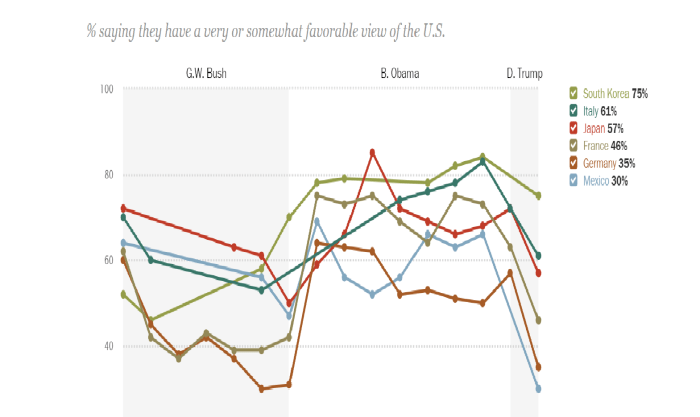
Check out the latest results of a Pew Survey asking people what they think about the United States:
75% of South Koreans have a favorable or somewhat favorable view of the US even after the election of Donald Trump. That’s higher than the other baseball-friendly countries like Italy (61%) and Japan (57%), and much higher than next-door neighbor Mexico (30%) and longtime NATO partner Germany (35%).
China is wrong to believe that an American withdrawal would suddenly make North Korea a breezy member of the international community of states. Kim Jong Un’s regime depends on foreign enemies to survive. James Madison put it best:
The means of defense against foreign danger have been always the instruments of tyranny at home. Among the Romans it was a standing maxim to excite a war whenever a revolt was apprehended. Throughout all Europe, the armies kept up under the pretext of defending have enslaved the people.
North Korea would bully Seoul and Tokyo and cajole Beijing even moreso because Washington would not be there to bear the burden of Liberal Hegemonic Boogieman.
But I’m not a Chinese citizen and this is a post about a more liberal world, so I’d like to switch gears and focus on something that all libertarians are secretly obsessed with: money.
What kind of deal is the US getting by having troops stationed along the 38th parallel? I know the US is a target of a dictator’s nuclear arsenal because of troops along the 38th, and I know the US has to expend considerable resources on the Korean Peninsula to protect Seoul, so costs are understood, but what about benefits? What about payment? What does US get in return for protecting South Korea?
Trade – a big aspect of libertarian foreign policy – is not that big of a deal for either country: the United States makes up about 14% of South Korea’s exports, and South Korea makes up nearly 3% of the United States’ exports. This means that China, for example, is a larger, more important trading partner to both countries than either is to each other.
One of the benefits I’ve found is South Korea’s participation in multilateral military actions undertaken under the umbrella of US military leadership. South Korea has provided troops for dozens of current UN missions in sub-Saharan Africa and post-British Asia, and also participated in the US-led invasions and occupations of Afghanistan and Iraq (Seoul’s troops left Iraq in 2008 and Afghanistan in 2014). I also learned that South Korea deployed 325,000 soldiers to South Vietnam from 1964-1973, losing roughly 5,100 soldiers and welcoming home another 11,000 wounded soldiers.
Seoul’s participation in Vietnam was a shocking discovery for me. It forced me to reassess America’s relationship with South Korea. The status quo is actually a decent trade-off. The status quo is cooperative, not coercive. The status quo isn’t so bad from a libertarian standpoint: There is a trade-off with mutually beneficial exchange involved, there is a cooperative rather than coercive relationship between both sides, and tens of millions of people are freer than they otherwise would be because of it.
We can still make the alliance marginally better, though. We can still take small steps to a much better world. Consider federation between the two countries.
Deudney’s book uses theory and history to show that, among other things, republican security theory is, and always has been, from antiquity to the present day, the most important question that scholars of international relations have had to grapple with. For centuries, republics started out with the best of intentions, the best of circumstances, and always managed to decay into despotism or succumb to conquest by neighboring despots. The United States, Deudney goes on, managed to get out of this trap through federal union and, because of its peculiar geographic situation, a full-fledged republican security bargain was able to come to full fruition.
Deudney bases this part of his argument on Hendrickson’s little-known but immensely persuasive book. Hendrickson argues that the newly independent 13 states and their eventual federal union should best be viewed in an international relations framework. In order to protect themselves not only from powerful empires but more importantly from each other, the 13 states entered into a federal union that held them responsible for a limited number of shared responsibilities (such as international security and ensuring republican government in their domestic realms) and left plenty of space for each of them to exercise policymaking as they saw fit. In order to avoid a race to the bottom – where the 13 states formed security blocs between themselves and used Spain, France, and the UK to undermine their rivals – the 13 states built, piece-by-piece, a cooperative international system and called it a federation.
With America’s domestic liberties under increasing assault, largely because the current situation places so much emphasis on certain checks and balances over others, adding additional “states” in the form of South Korea’s provinces would breathe new life into all of the institutions necessary for both security and republican domestic governance.
The inevitable Korean bloc
The biggest fear that such a federation would bring about is the fear of a Korean bloc, or the disintegration of the precarious balance of power between the two parties in the US. Although partisans on both sides no doubt loathe that their side is even with the other in terms of influence and numbers, most Americans are very happy with the two party status quo (if they weren’t happy there would no longer be a two party status quo).
Admitting 5 to 7 new “states,” former Korean provinces, makes it seem like this delicate two party balance would be quickly destroyed with the advent of a Korean bloc which has no interest in traditional American politics. I assure you there would be no Korean bloc. Look at the most recent Korean elections:
You’ll notice there’s 5 parties instead of 2 like in the States. That’s because South Korea uses proportional representation whereas the United States uses the FPTP system. The end result of both systems is the same: a center-right bloc and a center-left bloc. In South Korea’s case, the red and the grey districts are right-wing, and the other three colors are left-wing. (source)
There is a Left-Right divide focused on policy and to a lesser extent ideology rather than an ethnic one, just like here in the States.
The Korean Left would line up nicely with Democrats (it even has an anti-American streak that isn’t anti-American at all, only anti-GOP, just like the Democrats!). The conservative wing of South Korea might form a Korean bloc but it would be ineffective in the House and Senate because of its small number.
Libertarians are often dissatisfied with the status quo, even though they’re often the first to point out that life in Western states continues to get better and better. The status quo relationship between South Korea and the United States is great. But it could always be a little bit better.