Brazil, the country of Carnival (?)

Maybe for most English speakers it isn’t even known, but we are in the Carnival week. Carnival is a festive season that occurs before the liturgical season of Lent. The main events typically occur during February or early March. It typically involves public celebrations, including events such as parades, public street parties and other entertainments. I’m unashamedly taking some elements from Wikipedia here to try to explain it. It is basically equivalent to Mardi Gras. Carnival (or Carnaval, as we say it in Portuguese) is a big thing in Brazil. Or maybe not. That’s what this post is about.

Carnival is a Christian feast, at least in its origin. It occurs right before lent. Lent is the forty days that antecede the Passover. The idea was that people would fast (at least to some degree) during the forty days of lent. Therefore, Carnival was the last opportunity for forty days to indulge in some pleasures of the flesh. Carnival literally means “remove meat”, from the Late Latin expression carne levare. “Farewell to meat” is another possible translation. However, carne is not solely meat in Latin; it also refers to the flesh, especially in the Christian association between sin and flesh. Carnaval, therefore, is the feast of the flesh – taken literally or not. At least in Brazil, to my knowledge, the relationship between Carnival, Lent and Passover is little known. I believe that most people just take it to be a major party that happens sometime between February and March.

Brazil is popularly known as the country of Carnival, Samba and Soccer. Of these three, I kind of like the last one. Not so much the first two. To my knowledge, Carnival has always been very popular in Rio de Janeiro, at least since the early 19th century. At that time, it was known as Entrudo, a celebration in which mostly people throw water on one another, like in a water balloon fight. However, there were some improvements: people started throwing some liquids other than water if you know what I mean and that even at strangers. The party was also an opportunity for slaves to poke on their masters. Carnaval eventually became associated with the slaves’ African culture, and I suppose that’s how the Christian origins were somewhat lost. Today, Carnaval in Rio is strongly associated with Samba music.

I haven’t done a very scientific research for this, but to my knowledge, most people in Rio actually don’t like Carnaval. Carnaval is a street party, with all that comes with it: people leave tons of trash behind; people get drunk, and often violent; the music can get really loud and sometimes going on for hours, even into the night. Given the specific nature of the festival, there are people having sex on the street and other things happening as well. It is hard to say this without sounding moralistic, but the thing is that Carnaval ends up being the most anti-libertarian thing one can imagine. If “don’t do onto others what you don’t want to be done onto you” is the golden rule we’re trying to put into practice, Carnaval is the undoing of this.

In the late 19th century, some authorities already realized that the festival was getting out of control and tried to organize it somehow, mostly to no avail. But things really got out of control in the early 20th century. Coming out of the monarchy, Brazilian intellectuals were dedicated to the task of identifying the Brazilian identity. Sérgio Buarque de Holanda made a huge contribution to this with is Roots of Brazil (Raízes do Brasil), in which he said that Brazilians had a hard time understanding and applying the impersonal relationships necessary for a modern capitalistic society. Another major contribution in this conversation was done in 1933 by anthropologist/sociologist Gilberto Freyre in his book Casa-Grande e Senzala (English: The Masters and the Slaves). In this book, Freyre argued that the Brazilian national identity was the result of miscegenation (both biological and cultural) between masters and slaves.

On the one hand, I want to say that Freyre’s argument was revolutionary because he was saying that Brazilians were not an “inferior race” because of race-mixing. Just the opposite: Brazilian culture was permeated by highly positive elements exactly because of miscegenation. Consider that Freyre was saying that in the 1930s, when race-mixing was still a major taboo in the US, not to mention Nazi Germany. But on the other hand, I believe that Freyre contributed to a movement that gave up trying to “civilize” Brazil.

The topic of civilization is always a polemic one because it implies that some cultures are superior to others. I don’t want to go that way. But I also don’t want to be a cultural relativistic. Some cultures are superior to others in some aspects. There is nothing culturally superior in leaving tons of trash in the streets after a street party. There is nothing culturally superior in imposing your music taste on others. There is nothing superior in imposing your take on sexuality on others.

In the late 19th century, some authorities were trying to organize Carnaval in Rio de Janeiro because things were getting out of control. In the early 20th century, most authorities gave up that enterprise because they decided that Rio de Janeiro (and Brazil) is that “mess”. Instead of trying to correct the bad aspects of Carnaval, they decided to celebrate it as the very essence of Brazilian culture. Eventually, into the 20th century, Carnaval became a great example of panem et circenses policy.

I understand that in the early 21st century more and more people in Brazil are getting sick and tired of Carnaval, and that has some connections with politics. Typically (though definitely not always) people on the left want to celebrate Carnaval. People on the right typically (though definitely not always) don’t want to. Some people on the left are already saying that Bolsonaro’s government represents the taking over of government by Christian fundamentalists. I doubt. They may be right at a very low degree. But for the most part, what is happening is that Brazil is too diverse for a single project of nation to work for everybody. Ironically Gilberto Freyre was right: we are the result of this mixture, and this is not a bad thing. People only need to learn to respect the opinions, tastes and preferences of the other elements in this mix.

Edge of Democracy in Brazil?

The past few days Brazilian internet was packed with commentaries about The Edge of Democracy (Portuguese: Democracia em Vertigem), a 2019 Brazilian documentary film directed by Petra Costa that was nominated for Best Documentary Feature at the 92nd Academy Awards (and lost). To be honest, I didn’t watch this movie and I’m not planning to. My life is already quite busy as it is. However, judging by the trailer and by what people were saying, “The film follows the political past of the filmmaker in a personal and intimate way, in context with the first term of President Lula until the events leading to the impeachment of Dilma Rousseff, analyzing the rise and fall of both presidents and the consequent sociopolitical crisis that swept the country. The arrest of Lula paved the way for the rise of Jair Bolsonaro and his eventual presidency” (from Wikipedia). Vox says this: “Filmmaker Petra Costa grew up in a politically involved family in Brazil, and that’s her starting point for The Edge of Democracy, in which she traces recent developments in Brazilian politics and shows how the country moved so quickly from a fledgling democracy toward far-right authoritarianism”. So, it seems to me that the movie is about how Brazil was becoming a vibrant democracy under the rule of the Workers’ Party and now it’s becoming a far-right autocracy. Judging by that, these are some thoughts on how I see democracy in recent and past Brazilian history.

Brazil was a Portuguese colony, but this was different from America being an English colony. There were not thirteen colonies in Brazil. Portugal’s oversight of Brazil was stronger than England’s over America. There was basically no space for local rule in Brazil. Therefore, Brazil came from its colonial days with basically no self-government experience.

Brazil became independent from Portugal in 1822. But again, this was different from America’s independence. In 1808 the Portuguese royal family came to Brazil, running away from Napoleon. Brazil became a United Kingdom with Portugal in 1815. Dom João VI, the Portuguese king, gave in to the court’s pressure and went back to Portugal in the early 1820s. However, he left his son Dom Pedro I as prince regent in Brazil. And at this Pedro declared Brazil’s independence in 1822.

Dom Pedro I was crowned as Emperor of Brazil and ruled until 1831. Suffering multiple pressures, he went back to Portugal like his father before him. From 1831 to 1840 Brazil was ruled by several regents. In 1840 Dom Pedro I’s son, Dom Pedro II, became emperor. He ruled until 1889, when he was deposed by a military coup.

Brazil has been a republic ever since, but not like America. We didn’t simply have presidential elections every four years. The first two Brazilian presidents were virtually military dictators. Civilians came to power in 1894 and ruled until 1930, but these were not exactly democratic times. Mostly the country was ruled by coffee oligarchs.

The last of these coffee planter presidents ruled until 1930. Then Getúlio Vargas came to power in a coup. He ruled until 1945. Vargas was deposed but continued to be a major political player. So much so, that he came to the presidency in the 1950s. He committed suicide in 1954, while still in office. Basically, the country was still under Vargas’ shadow from 1945 to 1964. And that’s when the military came to power.

Brazil was under military governments from 1964 to 1985. This is the historical period that people tend to remember and refer to the most. The military came to power because the population asked them to. There was a great fear of communism, and the army would theoretically defend Brazil against this. I am not saying that this fear was justified or that military governments was the right solution, but this is how most people thought at that time.

The last military president surrendered power in 1985. Since then, Brazil has been ruled by civilians. The Workers’ Party (or Partido dos Trabalhadores, PT, in Portuguese) became one of the most competitive political forces in Brazil in this period. Officially founded in 1980, it always had Luiz Inácio Lula da Silva as one of its main leaders. The Workers’ Party always presented itself as broadly leftist, without further specification. Among its founders were sympathizers of Roman Catholic Liberation Theology, radical socialists who defended armed opposition to the dictatorship, and union workers (Lula among them).

Lula was presidential candidate in 1989, 1994 and 1998, always coming in second place with about 30% of the votes. During those years Lula and the Workers’ Party were radically opposed to the economic reforms Brazil was going through. Like in other countries, Brazil was suffering from the crumbling of years of populism. The Washington Consensus was the order of the day, but the Workers’ Party was against everything it called “neoliberalism”. “Out with FHC (Fernando Henrique Cardoso, Brazil’s president from 1995 to 2002) and the IMF” was their usual chant. The party even defended not paying Brazil’s staggering international debts. Lula still hung out with socialist leaders, mostly Fidel Castro. However, in 2002 he presented a different platform. Advised by advertising professional and political strategist Duda Mendonça, he announced that, if elected president, he wouldn’t undo FHC’s economic reforms. Plagued by several international economic crises (Mexico, Asia, Russia, Argentina), Brazil was having a hard time entering the free-market world. The once highly popular FHC came out from office with low popularity. The combination of these factors (FHC’s low popularity at the time and Lula’s promise to pursue a less radical path) opened the way for the Workers’ Party to come to Brazil’s presidency.

In the first years of his government Lula was true to his promise. He not only maintained but deepened FHC’s economic reforms. After the initial shocks, Brazil slowly reacted to the free-market medicine and the economy started to grow. This guaranteed Lula’s reelection in 2006, although by then major corruption scandals already surrounded his presidency, centrally the Mensalão scandal. This scandal broke in 2005 when it was discovered that the Workers’ Party gave monthly payments to several deputies from other parties to vote for legislation that was favored by the ruling party. Although the investigations implicated some of Lula’s closest allies, the president himself managed to get off scot-free.

Lula’s second term in office marked a change from the first and even from his party’s historical stand up until then. The Workers’ Party since its inception always posed as a firm adversary to corruption. Political corruption is hardly something new in Brazil. Going back to the beginning of this text, one of Brazil’s historical problems has always been the difficulty of separating public and private. This was ironically famously observed by Raymundo Faoro, one of the Workers’ Party initial supporters. In Donos do Poder (Owners of the Power) Faoro observed that Brazil has always been led by ruling elites who saw public property as their property. In this scenario the very idea of corruption becomes fuzzy since ruling elites believe they are not stealing – they are simply using what is rightly theirs! It is against this scenario that Faoro and others proposed a technocrat professional bureaucracy. After the Mensalão scandal, however, the Workers’ Party became cynical towards corruption. Their usual response to it became to say that previous governments also did it, that they didn’t invent corruption or simply to say that Lula was an innocent man being politically persecuted by the elites. In sum, Workers’ Party officials and supporters were divided between those who, while not denying the veracity of the corruption scandals, tried to minimize it, and those who completely denied it.

Lula left his second term in office still high on popularity. So much so that he was able to elect his successor, Dilma Rousseff. Dilma, however, would face several difficulties in her presidency. Number one, although somewhat forgotten by the general public, the corruption scandals were still a reality that would surface every now and then. Second, Brazil was suffering the effects of the 2008 world economic crisis. Finally, Dilma was herself a shamefully inept leader.

As I mentioned before, Lula came to power in 2003 mainly because he and others in the Workers’ Party were able to (partially) come to terms with the fact that the Washington Consensus is called a consensus for a reason: as much as some things in political economy are debatable, some are not – centrally, you can’t spend money that you don’t have forever. Dilma would have none of that. Although she is famously very confused in the way she speaks, all things point to the fact that Dilma is trapped in a painfully outdated Keynesian mentality. Trapped in this mentality, she overspent – against Brazilian law. For this reason, she was impeached.

Dilma’s impeachment was followed by a short government of her vice-president, Michel Temer, and now the country is governed by Jair Messias Bolsonaro. Bolsonaro was for many years an obscure politician from Rio de Janeiro, elected mostly to corporately defend the military as workmen. Almost an unofficial union leader for soldiers. Bolsonaro, however, is also an admirer of the Brazilian army in general. He graduated from Academia Militar das Agulhas Negras, something akin to West Point. As a reformed army captain, he fiercely believes that the military did save Brazil from communism in the 1960s. As I mentioned before, that’s exactly what people in the 1960s believed. I’m not saying that they were right.

Ironically, leftists greatly benefited from the military governments of the 1960s-1980s. The guerrilla in Brazil’s countryside was crushed by the armed forces and the urban armed resistance was mostly weak and disorganized. Some important leaders in the Workers’ Party came precisely from these two. But Brazilian armed forces were shamefully unprepared to fight a cultural war. While some sectors of the left were still following Mao Zedong or Che Guevara, trying to reach power by force, others were reading Gramsci and the Frankfurt School, following a more cultural path to power.

In any case, the left was very good at posing as victims. In the years that followed the military governments, there was a tendency to romanticize the resistance. Some people, artists and politicians, made whole careers on that. To be “persecuted by the dictatorship” became a major asset.

But the truth is that Brazilian left never fought for democracy. This isn’t meant to depreciate them. It’s just a statement of fact. Actually, what I meant in the first paragraphs was to show that Brazil has a very weak democratic tradition. Beginning very early in the 20th century, shortly after the Russian Revolution, communists tried to take power in Brazil by force. Again, this is just a statement of fact. This continued up to the early 1960s when, fueled by Cold War fear (some might say paranoia, I don’t really mind), people begged the armed forces to take power. Has it not lasted for so long, the military governments would probably have been long forgotten or taken as something positive. But because they lasted for so long, the left was able to play its cards and pose as democratic victims of an authoritarian regime.

And this is, I believe, how we come to 2020. Bolsonaro has, I believe, a wrong idea about the military governments. Even if they were truly necessary to avoid a communist coup, they shouldn’t have lasted for so long. Besides that, the military presidents had their ups and downs in how they governed the country. Bolsonaro mostly can’t see that. The left, on the other hand, romanticizes the dictatorship. Some of them seem to actually believe in the lie that they were fighting for democracy. They were not. Had they won the war against the military forces, Brazil would have become something akin to Castro’s Cuba or Mao’s China. Had the military not won against the guerrillas, Brazil would have something akin to Colombia’s FARCs.

In sum, Brazil is still trapped in things that happened in the 1960s. Socialists, of course, wanted a big state. That’s basically their ideology. Ironically, in order to fight that, the military built an equally gigantic state. Petra Costa’s family got rich, fabulously rich, during the military governments. Today her family has contracts with the Workers’ Party. Some things change, but others remain the same: some people don’t care if governments are red or blue. All they care about is the green of the dollars. And a smaller state would be bad business for this kind of people.
The Least Empathic Lot

On standard tests of empathy, libertarians score very low. Yet, the world’s “well-known libertarian bias” coupled with many people’s unwarranted pessimism makes us seem like starry-eyed optimists (“how could you possibly believe things will just work themselves out?!”).

Under the Moral Foundations framework developed and popularized by Jonathan Haidt, he and his colleagues analyzed thousands of responses through their YourMorals.org tool. Mostly focused on what distinguishes liberals from conservatives, there are enough self-reported libertarians answering that the questionnaire to draw meaningful conclusions. The results, as presented in TED-talks, podcast interviews and Haidt’s book The Righteous Mind: Why Good People Are Divided by Politics and Religion contains a whole lot of interesting stuff.

First, some Moral Foundations basics: self-reported liberals attach almost all their moral value to two major categories – “fairness” and “care/harm.” Some examples include striving for equal (“fair”) outcomes and concern for those in need. No surprises there.

Conservatives, on the other hand, draw fairly evenly on all five of Haidt’s different moralities, markedly placing weight on the other three foundations as well – Authority (respect tradition and your superiors), Loyalty (stand with your group, family or nation) and Sanctity (revulsion towards disgusting things); liberals largely shun these three, which explains why the major political ideologies in America usually talk past one another.

Interestingly enough, In The Righteous Mind, Haidt discusses experiments where liberals and conservatives were asked to answer the questionnaire as the other would have. Conservatives and moderate liberals could represent the case of the other fairly well, whereas those self-identifying as “very liberal” were the least accurate. Indeed, the

biggest errors in the whole study came when liberals answered the Care and Fairness questions while pretending to be conservatives.

Within the Moral Foundations framework, this makes perfect sense. Conservatives have, in a sense, a wider array of moral senses to draw from – pretending to be liberal merely means downplaying some senses and exaggerating others. For progressives who usually lack any conception of the other values, it’s hard to just invent them:

if your moral matrix encompasses nothing more than Care and Fairness, then to imagine a political opponent is to reverse one’s own position for those foundations – that Conservatives act primarily on other frequencies, on other foundations, wouldn’t even occur to them.

Libertarians, always the odd one out, look like conservatives on the traits most favoured by liberals (Fairness and Care/Harm); and are indistinguishable from liberals on the traits most characteristic of conservatives (Authority, Loyalty, and Sanctity). Not occupying some fuzzy middle-ground between them, but an entirely different beast.

Empathy, being captured by the ‘Care’ foundation, lines up well with political persuasion, argues Yale psychologist Paul Bloom in his Against Empathy: The Case for Rational Compassion. Liberals care the most; conservatives some; and libertarians almost none at all. Liberals are the most empathic; conservatives are somewhat empathic; and libertarians the least empathic of all. No wonder libertarians seem odd or positively callous from the point of view of mainstream American politics.

Compared to others, libertarians are more educated and less religious – even so than liberals. Libertarians have “a relatively cerebral as opposed to emotional cognitive style,” concluded Haidt and co-authors in another study; they are the “most cerebral, most rational, and least emotional,” allowing them more than any others to “have the capacity to reason their way to their ideology.”

Where libertarians really do place their moral worth is on “liberty” (a sixth foundation that Haidt and his colleagues added in later studies).  Shocking, I know. Libertarians are, in terms of moral philosophy, the most unidimensional and uncomplicated creatures you can imagine – a well-taught parrot might pass a libertarian Turing test if you teach it enough phrases like “property rights” or “don’t hurt people and don’t take their stuff.”

The low-empathy result accounts for another striking observation to anyone who’s ever attended an even vaguely libertarian event: there are very few women around. As libertarians also tend to be ruthlessly logical and untroubled by differential outcomes along lines of gender or ethnicity – specifically in small, self-selected samples like conferences – they are usually not very bothered by the composition of their group (other than to lament the potential mating opportunities). The head rules, not the heart – or in this case, not even the phallus.

One of the most well-established (and under-appreciated) facts in the scientific community is the male-female divide along Simon Baron-Cohen’s Empathizing-Systemizing scale. The observation here is that males more often have an innate desire to understand entire systems rather than individual components – or the actions or fates of those components: “the variables in a system and how those variables govern the behaviour of that system,” as Haidt put it in a lecture at Cato. Examples include subway maps, strategy games, spreadsheets, or chess (for instance, there has never been a female world champion). Women, stereotypically, are much more inclined to discover, understand, mirror and even validate others’ feelings. Men are more interested in things while women are more concerned with people, I argued in my 2018 Notes post ‘The Factual Basis of Political Opinion’, paraphrasing Jordan Peterson.

The same reason that make men disproportionately interested in engineering – much more so than women – also make men more inclined towards libertarianism. A systemizing brain is more predisposed to libertarian ideology than is the empathizing brain – not to mention the ungoverned structure of free markets, and the bottom-up decentralized solutions offered to widespread societal ills.

Thus, we really shouldn’t be surprised about the lack of women in the libertarian ranks: libertarians are the least empathic bunch, which means that women, being more inclined towards empathy, are probably more appalled by an ideology that so ruthlessly favours predominantly male traits.

As I’ve learned from reading Bloom’s book, empathy – while occasionally laudable and desirable among friends and loved ones – usually drives us towards very poor decisions. It blinds us and biases us to preferring those we already like over those far away or those we cannot see. The “spotlight effect” that empathy provides makes us hone in on the individual event, overlooking the bigger picture or long-term effects. Bloom’s general argument lays out the case for why empathy involves in-group bias and clouds our moral judgements. It makes our actions “innumerate and myopic” and “insensitive to statistical data.” Empathy, writes Bloom:

does poorly in a world where there are many people in need and where the effects of one’s actions are diffuse, often delayed, and difficult to compute, a world in which an act that helps one person in the here and now can lead to greater suffering in the future.

In experiments, truly empathizing with individuals make us, for instance, more likely to move a patient higher on a donation list – even when knowing that some other (objectively-speaking) more-deserving recipient is thereby being moved down. Empathy implores us to save a visible harm, but ignore an even larger (and later) but statistically-disbursed harm.

Perhaps libertarians are the “the least empathic people on earth.” But after reading Bloom’s Against Empathy, I’m not so sure that’s a bad thing. Perhaps – shocker! – what the world needs is a little bit more libertarian values.

Sunday Poetry: Hermann Hesse’s Stages

Not much to say about this one. Helps me to take the edge off stressful times.

Phases

As every flower fades and as all youth
Departs, so life at every stage,
So every virtue, so our grasp of truth,
Blooms in its day and may not last forever.
Since life may summon us at every age
Be ready, heart, for parting, new endeavour,
Be ready bravely and without remorse
To find new light that old ties cannot give.
In all beginnings dwells a magic force
For guarding us and helping us to live.
 
Serenely let us move to distant places
And let no sentiments of home detain us.
The Cosmic Spirit seeks not to restrain us
But lifts us stage by stage to wider spaces.
If we accept a home of our own making,
Familiar habit makes for indolence.
We must prepare for parting and leave-taking
Or else remain the slaves of permanence.
 
Even the hour of our death may send
Us speeding on to fresh and newer spaces,
And life may summon us to newer races.
So be it, heart: bid farewell without end.
 
I wish you all a pleasant Sunday.

Computational Economics is the Right Perspective

Here’s a vastly oversimplified picture of mainstream economics: We pick some phenomenon, assume all the context into the background, then build a model that isolates only the variables specifically relevant to that phenomenon.

Once you’ve simplified the problem that way, you can usually build a formal mathematical model, make a few more (hopefully) reasonable enough assumptions, and make some strong ceteris paribus claims about your chosen phenomena.

That’s a reasonable enough approach, but it doesn’t shed much light on big picture issues. I’m interested in root causes, and this “reduce things to their component parts” approach doesn’t give enough of a big picture to find those roots.

How do we broaden our perspective? One approach is to return to the more “literary” approach of the pre-Samuelson days. A bit of philosophy of science has me convinced that the primary flaw of such an approach is rhetorical. Written and mathematical arguments leave some assumptions in the background, but the latter is more convincing to a generation of economists trained to be distrustful of natural language (and too trusting of algebra).

As a pluralist, I think we should use as many approaches as we can. Different schools of thoughts allow you to build different imaginary worlds in your mind. But the computational approach isn’t getting enough play. I’d go so far as saying agent based modeling is the right form of mathematics for social science.

What does this mean? In a nutshell, it means modelling processes, simulating those processes, and seeing how interactions between different agents leads to different sorts of outcomes.

A common trope among Emergent Order folks is how ants are individually stupid but collectively brilliant. Neoclassical economics runs into the opposite problem: individually brilliant individuals who get trapped in Prisoners’ Dilemmas.

Computational economics starts with models that are more like ants than homo economicus. Agents are essentially bundles of heuristics/strategies in an out-of-equilibrium world. But these competing (and cooperating) strategies can interact in interesting ways. Each agent is a part of all the other agents’ environment, so the mix of strategies is a function of the success of the strategies which is a function of the mix of strategies in the environment.

In essence, computational economics starts from what the mainline economists have long recognized: human society is a complex, interwoven, recursive process. The world is, essentially, a sort of meta computer with a complex web of programs interacting and evolving. We don’t need to assume in any sort deus ex machina (that’s a bit of an overstatement, but we haven’t got time to explore it this week), we just need replicating entities that can change over time.

Such a view, to my mind, provides an end run around rationality assumptions that can explain the brilliance of entrepreneurship (without making heroes out of the merely lucky) as well as the folly unearthed by Behavioralist economics (without the smugness). We’ve always known it. It’s all just evolution. But the methodology hasn’t made its way into the main stream of economics. If there are any undergrads reading this on their way to a PhD program, let me know in the comments so I can point you in some interesting directions!

Nomic-nomics?

Perhaps the coolest thing I’ve found on the Small Internet so far is the game Nomic. From where I found it:

Nomic was invented in 1982 by philosopher Peter Suber. It’s a game that starts with a given set of rules, but the players can change the rules over the course of the game, usually using some form of democratic voting. Some online variants exist, like Agora, which has been running since 1993.

It’s a game that’s about changing the game. Besides offering a tempting recreational opportunity, I think this could be formalized in such a way to make it rival the Prisoners’ Dilemma (PD) in shedding light on the big social scientific questions.

The PD is a simple game with simple assumptions and a variable-sum outcome that lets it work for understanding coordination, competition, and cooperation. One of my favorite bits of social science is Axelrod’s Evolution of Cooperation project. It’s basically a contest between different strategies to an iterated PD (you can play a variation of it here). That the “tit for tat” strategy is so successful sheds a lot of light on what makes civilization possible–initial friendliness, willingness to punish transgressions, and willingness to return to friendliness after punishing these transgressions.

A fantastic extension is to create a co-evolutionary simulation of a repeated PD game. Rather than building strategies and pitting them against each other, we can be totally agnostic about strategies (i.e. how people behave) and simply see what strategies can survive each others’ presence.

The evolutionary iterated PD is about as parsimonious a model of conflict/cooperation as we could make. But there is still a lot of structure baked in; what few assumptions remain do a lot of heavy lifting.

But if the structure of the game is up for grabs, then maybe we’ve found a way to generalize the prisoners’ dilemma without assuming on extra layers of complexity.

Of course, the parsimony of the model adds complexity to the implementation. Formalizing Nomic presents a formidable challenge, and getting it to work would surely create a new

But even if it doesn’t lend itself to simulation, it strikes me as the sort of exercise that ought to be happening in classrooms–at least in places where people care about building capacity for self governance (I’ve heard such places exist!).

Let’s play!

A bit of stage setting, then let’s start a game in the comments section. I get the impression that this game is nerdier than Risk, so you’ve been warned (or tempted, as the case may be).

The basic premise is that are mutable rules and immutable rules (like Buchanan’s view of constitutions). Players take turns to propose rule changes (including transmuting rules from a mutable to an immutable state). As part of the process, we will almost surely redefine how the game is won, so the initial rule set starts with a pretty boring definition of winning.

We’ll use Peter Suber’s initial rules with some variations to suit our needs. The rules below will be (initially) immutable.

117. Each round will happen in a new comment thread. A new round cannot start until the rule change proposed in the previous round has been voted on. If technical problems result in having to start a new comment thread, that thread should include the appropriate reference number and it will be understood to be part of the same comment thread.

I will take the first move to demonstrate the format in the comments section.

118. The final vote count will be determined after 24 hours of silence. Players may discuss and cast votes, and change their votes. But after 24 hours of no new comments, the yeas and nays will be tallied and the outcome determined accordingly. In cases requiring unanimity, a single nay vote is enough to allow a player to start a new round without waiting the full 24 hours. The final vote will still occur (for purpose of calculating points) after 24 hours of silence.

Despite being numbered 118, this rule will take priority over rule 105.

119. Anyone who is eligible to comment is eligible to play. If it is possible to start a new round, anyone may start that round. In the event that two people attempt to start a round at the same time (e.g. Brandon and I post a comment within a couple minutes of each other) priority will be given to whichever was posted first and the second comment will be voided.

120. The game will continue until someone wins, or everyone forgets the game, in which case the winner will be the last person to have had their comment replied to.

A Lesson in Inventing Your Own Statistics

Nothing makes me happier than pointing out when someone is wrong.

I admit, that’s a pretty sad life. And for some unfathomable reason that doesn’t endear me to the person who uttered the incorrect statement – which it really should as I’m correcting some mistaken belief of theirs, assisting them on the path to truth.

Perhaps, as Jonathan Haidt teaches us, my endeavour is a hopeless one as approaching truth is forever clouded by confirmation bias. Polarization runs rampant and scientific disciplines are scarred by replication crises and publication bias.

I don’t take issue with any of those points: reduce my ambitions to “a little less wrong” and what follows still holds.

A few days after the Riksbank had upped its interest rate to 0% last month, Daniel Lacalle, a Spanish economist, author and fund manager – and whose musings are usually quite insightful – decided to vent his (questionable) objections to central banks and negative interest rates (NIRP) in a very strange way:

  1. Deliver a bunch of vague one-liners about monetary policy and unsustainable capital markets.
  2. Make shit up about Sweden and Swedish capital markets.

Obviously, I don’t mind too much the rhetoric of those who vehemently oppose central banks, but I do mind people pulling numbers out of their behinds and just inventing things about the world that clearly are not true.

So let’s do some fact-checking.

It’s apparently really bad for governments to have public debt – and negative interest rates allegedly work like crack-cocaine for politicians in their endless desire for more and more and more underfunded expenditures. Spend away, minister!

Except that many (non-crisis) countries such as Sweden aren’t borrowing. In fact, Sweden’s debt-to-GDP ratio is at its lowest point since 2012 and has been dropping like a stone since about the time that the Riksbank first lowered its policy rate to below 0%. In fact, as the Riksbank sits on over 35% of the outstanding government debt, there’s been quite a scramble among commercial banks to meet their capital requirements; there aren’t enough bonds to go around. The big macro debate in Sweden right now is over how much more the government ought to spend given that the debt is so small.

My favorite part is when Lacalle starts inventing numbers to support his case. Strangely enough, he’s arguing that NIRP fuels an unsustainable boom such that increasing share prices and property prices (things that most of us individually tend to think are good or at least harmless) are, in Lacalle’s mind, actually evidence of how bad life is.

Ye, I too hate it when my retirement fund or house go up in value.

  1. Sweden’s “Real estate price index has increased 50 percent (from 160 points to 240).”

The official statistics agency, Statistics Sweden, reports a +17 increase in broad real estate indices since early 2015, but they only include data until late-2018. The index is also on a completely different level, suggesting that Lacalle used some other source. 

Using numbers from Ekonomifakta we find house price increases of 9% and 19% across various regions from Q1 2015 (when the Riksbank NIRP policy began) to Q3 2019. Again, wrong index numbers so couldn’t have been Lacalle’s source.

But maybe house prices have increased some in the last few months such that Lacalle’s 50% number is correct? No, they’ve been flat, reports the realtor industry organization Svensk Mäklarstatistik.

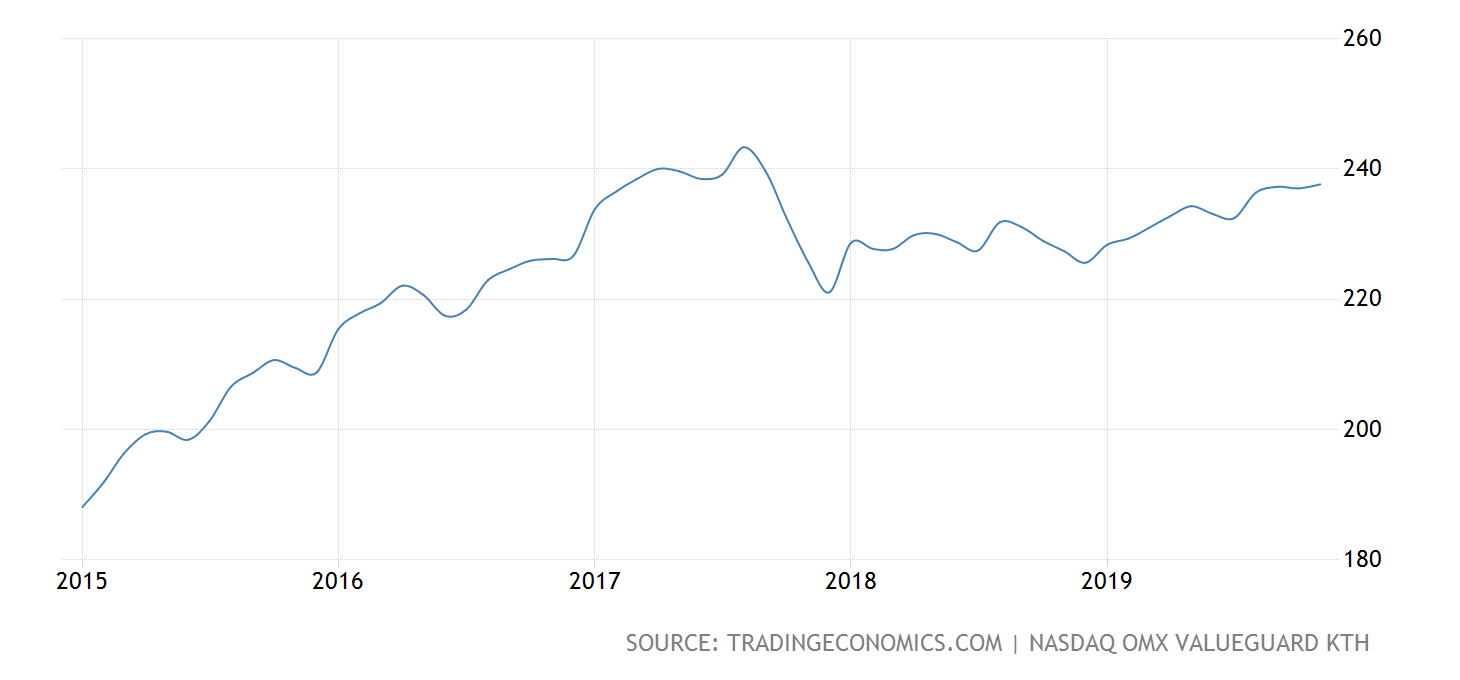
Searching high and low for a Swedish house price index that conforms to Lacalle’s peculiar range (160 to 240), I finally found a promising one at Trading Economics:

Trading econ Sweden House Price Index.png

Interestingly enough, Lacalle seems to have misread the chart; the index value for Feb 2015 is around 190 – not 160 – producing a much more reasonable +26% increase over the last five years. Even that, as we’ve seen with the more reputable sources above, might be tad exaggerated.

2. Sweden’s stock market is up “more than 20%”

Next up: the stock market – always a grateful subject for unsubstantiated rants.

“more than 20%” is cheating as technically anything above “20%” would work. Curiously enough, no index for the Swedish stock market shows those numbers between Feb 18, 2015, and today:

  • OMXS30, a commonly quoted index that does not include dividends, is up 8% since then.
  • Using indices that do account for (reinvested) dividends, OMXSPI shows 27.5% gain since NIRP was introduced;
  • OMXS30GI shows a 30.5% gain;
  • and OMXSCAPGI reports a 52% return.

Then again, if gradually increasing stock markets are a bad thing, then why didn’t Lacalle go with the highest, most inflated number he could find?

3. “Average residential index” is apparently up 27%

Not a statistics I’m familiar with, but I refer the reader to (1) above for sources on property prices.

4. “nonreplicable assets have risen between 30 and 70 percent”

First: that’s quite a range, Sir.
Second: ye, I’ve never heard that term before (let alone something to measure it) – and neither, it seems, has Google. I suspect Lacalle invented some more numbers to complement his already fake-y statistics. 

Tl;dr – don’t just make shit up, kids. Do look into your claims before you mindless utter them. You may be entitled to your own opinion (actually not really), but you can’t just believe whatever you want, making shit up along the way.

Sunday Poetry: Rüstow vs. Mises

One of the bests books I’ve read this year was Serge Audier’s & Jurgen Reinhoudt’s relatively unknown (unfortunately!) translation of the protocols of the Walter-Lippmann-Colloquium. The NOUS-Network organized a wonderful seminar in which we thoroughly discussed the book and the emergence of Neoliberalism. For the preparation of this weekend’s Hayek-Kreis seminar, I reread the book and stood once again in awe of the magnificence of the discussion during the Colloquium.

By the way: If you are an undergraduate, graduate, or PhD scholar, please consider joining the NOUS-Network for Constitutional Economics and Social Philosophy as a Young Affiliate! NOUS is an information platform and a community for interdisciplinary research. The network links all academic fields relevant for thinking about social order and liberty. It spans philosophy, politics, economics and fosters scholarly research, contact and exchange.

In the following excerpt, it becomes clear, that the participant’s opinion on the psychological and sociological causes of the decline of Liberalism differed significantly. Mr Rüstow eloquently captures the standpoints of the two opposing groups (not without bias to be fair) and even cheekily disses Ludwig von Mises.

“Mr Rüstow: ‘All things considered, it is undeniable that here, in our circle, two different points of view are represented. One group does not find anything essential to criticize or to change in traditional liberalism, such as it was and such as it is, apart from, naturally, the adjustments and the current developments that are self-evident.

In their view, the responsibility for all the misfortune falls exclusively on the opposite side, on those who, out of stupidity or out of malice, or through a mixture of both, cannot or do not want to discern and observe the salutary truths of liberalism. 

We, on the other hand, we seek the responsibility for the decline of liberalism in liberalism itself; and, therefore, we seek the solution in a fundamental renewal of liberalism. In order to justify in a positive manner this second point of view, I have to refer to what I have said and, especially, to the excellent arguments of Mr Lippmann.

Here, I would only like to draw attention to the fact that if the unwavering representatives of old liberalism were right, the practical prospects [for liberalism] would be almost hopeless. Because it does not really seem that old liberalism has gained in persuasive and in seductive force or that the arguments, no matter how shrewd they may be, of these representatives have the least possibility of bringing about a conversion movement within the realm of Bolshevism, Fascism, or of National Socialism. If they did not listen to Moses and the prophets—Adam Smith and Ricardo—how will they believe Mr. von Mises?'”

As always, I wish you all pleasant Sunday.


Sunday Poetry: Junger’s War Observations

Without noticing it, I heavily built my reading schedule this year around of what one might call a “post-liberal reading list”. The idea, that the demise of social institutions might be the inevitable consequence of an ongoing individualization of society struck me as initially convincing. I am currently in search of good examinations on the ultimate effect Liberalism has on the development of social institutions. Hopefully, Steven Horwitz’ “Hayek’s Modern Family” will provide me with some compelling arguments to refute the post-liberal agenda.

Not directly being post-liberal, but pointing towards the importance of “homecoming and belonging”, Sebastian Junger’s book “Tribe” has had a lasting influence on me. I found the following observations of a war refugee voluntary reentering Sarajevo during its siege both fascinating and devastating.

“What catastrophes seem to do – sometimes in the span of a few minutes – is to turn back the clock on ten thousand years of social evolution. […]

“‘I missed being that close to people. I missed being loved in that way’, she told me. ‘In Bosnia – as it is now – we don’t trust each other anymore; we became really bad people. We didn’t learn the lesson of the war, which is how important it is to share everything you have with humans being close to you. The best way to explain it is that the war makes you an animal. We were animals. It’s insane – but that’s the basic human instinct, to help another human being who is sitting or standing or lying close to you.’

I asked Ahmetašević if people had ultimately been happier during the war. 
‘We were the happiest,’ Ahmetašević said. Then she added: “And we laughed more.'”

I wish you all a pleasant Sunday.

Psychedelics versus modern philosophy

Anyone who studies philosophy has run into the assumption that psychoactive drugs and philosophy go hand-in-hand. Really, after analytic and continental, and whatever other traditions people come up with, there could be another sect, that of “stoner philosophy,” which is something like Mister Rogers, Alan Watts and Bob Ross thrown into a peaceful blender. This is when you’re sitting around getting high, wondering if aliens exist, instead of sitting in a classroom, wondering if other people’s minds exist.

A historical study of this connection, from East to West, would probably scandalize a lot of “serious” philosophers, and show some regular inebriation, but in general, I think the two are opposed (tragically or not). Particularly, the institutionalization of philosophy, when “natural philosophy” and “moral philosophy” etc all became separated some time after Hobbes, is opposed to what it sees as a lay way of thinking about the world. As my philosophy of science professor told me – you become a philosopher when you have your doctorate.

Professional philosophers and “psychonauts” are in opposition to each other. The analytics and continentals have spent centuries building elaborate systems – developing monstrous levels of specificity, so as to make their work completely incomprehensible to the rest of the world – and earning credentials to close the gates of access. Meanwhile, the casual or professional tripper is able to buy a tab for less than $10 and experience, or imagine they experience, market-price existentialism without reading a page of Camus.

The professional philosopher sneers in bad faith at psychedelic profundity because it makes them seem irrelevant.

On the other hand, the inarticulate tripper is not in such a great place. The psychonaut rests on intuition, and is probably not equipt with the critical thinking and logical itinerary to make sense of the journey on the comedown. A trip promises insight but also promises that neither your epistemic priors nor a rational reconstruction will be enough to establish its validity – by its very nature. (Psychedelic knowledge is “revealed,” not “discovered,” right?) You might get an insight that looks good, but is bad, without you knowing it. (I wrote about this in college. Holy shit my writing was bad.)

What happens when you irrationally, psychonautically attach to an idea that’s immune to logical tinkering? If you believe something for irrational reasons you’ll hang on to it for even longer than something that you believed for rational reasons, because new rational reasons can talk you out of a logogenetic idea, but not an irrationally-formed one. Depending on the centrality of the belief, of course.

The psychonaut claims easy knowledge, but could have trouble organizing it in the other, orderly web of belief of his coldly-discovered priors. However, this kind of knowledge has taken a high prestige today, with help from accredited social figures like Steve Jobs dosing LSD. In a way, the win of casual inebriated profundity is a “people’s victory” over the esoteric, pretentious toils of the professional philosophers. If you can figure out Truth by serotonin-fucking yourself on any day of the week then there’s no need to study Heidegger… and there’s even less reason to get a PhD in phenomenology, making institutional philosophy obsolete.

So, philosophers will be opposed to the psychonauts because it trivializes their hard-earned degrees (bad faith), and trivializes all their carefully crafted logic (slightly less bad faith). Psychonauts will be opposed to the philosophers for their specialized field which must explicitly reject such spontaneous routes to knowledge. The people taking psychedelics find themselves fighting some sort of anti-scientific elitism war, doing Feyerabend’s work. The tension is worse with the professional, modern philosophical class, but still exists in general.

A survey of history would show a lot of intertwining, but ultimately, I think the newer age of philosophy has a lot more overlap with other drugs than psychedelics (specifically Epicurean as opposed to elucidatory drugs, e.g. Adderall, analgesics, cocaine) — which is its own interesting question.

Sunday Poetry: Camus about Europe

Albert Camus is the most influential writers to me (See here why). This passage is from his third “Letter to a German Friend” (1944), depicting his unbroken love for European culture in the dark times of the second world war.

“Sometimes on a street corner, in the brief intervals of the long struggle that involves us all, I happen to think of all those places in Europe I know well. It is a magnificent land moulded by suffering and history. I relive those pilgrimages I once made with all the men of the West: the roses in the cloisters of Florence, the gilded bulbous domes of Krakow, the Hradschin and its dead palaces, the contorted statues of the Charles Bridge over the Vltava, the delicate gardens of Salzburg. All those flowers and stones, those hills and those landscapes where men’s time and the world’s time have mingled old trees and monuments! My memories have fused together such superimposed images to make a single face, which is the face of my true native land. … It never occurred to me that someday we should have to liberate them from you. And even now, at certain moments of rage and despair, I am occasionally sorry that the roses continue to grow in the cloister of San Marco and the pigeons drop clusters from the Cathedral of Salzburg, and the red geraniums grow tirelessly in the little cemeteries of Silesia.”

I wish you all a pleasant Sunday.

Intellectuals You Should Know About

I read a lot. Wide, deep and across quite a number of different fields. As a self-proscribed ‘writer’ and ‘editor’, reading much is both satisfying an intellectual desire and a professionally useful practice in familiarize myself with various styles, voices and topics. A common tip for aspiring writers is to read someone they admire and try to imitate their style; at this, at least, I am somewhat successful, as a friend recently told me that my style reminded him of Deirdre McCloskey. Full of idolized admiration for Deirdre’s work, I couldn’t imagine a higher praise.

As readers, the eternal curse of modernity is our laughable inability to keep up with the couple of millions of books that are published every year. Not to mention written materials on blog or respectable outlets or in magazines and journals. As consumers of the written word, we are completely outstripped, utterly defenseless and overwhelmingly inundated.

When in September I published my discussion of geographer and anthropologist Jared Diamond’s impressive work, I got a lot of feedback of astonishment from friends and family – including the friend that praised me for occasionally (accidentally…?) write like McCloskey: “Wow,” he said, “I’ve never heard of him before!”

Huh, I thought. I wonder what other household names of public intellectuals are not read as much as they deserve.

My exact reaction of astonishment was more like a gaping “What?!”, betraying my wanna-know-everything attitude, slight elitism and writer lifestyle. Contrary to the belief that our times is one of all talking and no listening (well, writing and no reading), it takes a vast amount of reading before you can produce anything that others want to read. Sure, anybody with a laptop and an internet connection can start a blog and flush out their thoughts (I did so for years) but it takes knowledge to say something intelligent and interesting – knowledge acquired by extensive reading.

It also takes a lot of practice to develop a voice of one’s own. Authors with astonishing and recognizable writing styles are made, not born.

What, then, should you read?

In light of this surprise, I decided to make a list of intellectuals I would advise anybody to read. Note that this is not a list of the most important thinkers ever, nor is it a collection of the most profound academic contribution to various disciplines. Instead it’s a gathering of writers whose popular writing (often in addition to their rigorous academic work) is exactly that – popular. That means that a lot of others liked them (and if you’re anything like others, you might too) and more importantly: a lot of smart people you meet are rather likely refer to these authors or to the ideas contained in their work. Here are 11 authors I would consider to be household names and whose writing will make you a much smarter and interesting person.

Jared Diamond

Let’s begin our list with aforementioned Jared Diamond, whose trilogy on humanity is compulsory reading for pretty-much everyone. This year he released Upheaval, which received very mixed responses and that I decided to skip after hearing his pitch on Sam Harris’ Making Sense podcast. Diamond’s publisher maintains that this is the third installment of his “monumental trilogy” of how civilizations rise and fall, but to me that was The World Until Yesterday: 

  • Guns, Germs and Steel is the book that definitely made Diamond a well-known name, the kind of Big Picture civilizational economic history we have recently seen in Yuval Harari’s work – the author of Sapiens: A Brief History of Humankind, that strangely boring book that everyone seems to be reading these days – or the less well-known but more captivating Columbia professor Ruth DeFries’ The Big Ratchet. If you like, you could describe this Pulitzer prize-winning book as well-written geographical reasons for why the West is rich and the Rest isn’t. If that’s your thing, read away.
  • Collapse: How Societies Choose to Fail or Succeed, the book that my September piece was mostly concerned with, is a dense story of many different human civilizations falling apart: Easter Islanders, Native Americans in the dry southwest or central America and my favourite chapter: The Greenland Norse. Complemented with the Fall of Civilizations podcast and Dan Carlin’s recent book The End is Always Near would make you ridiculously interesting to talk to in these hyper-catastrophist times. Upheaval is a natural extension of Collapse so if you crave more, that one is for you.
  • I would rather point to The World Until Yesterday for Diamond’s third gem as it is a deep dive into the lives of traditional societies in general, but in practice mostly New Guinean societies. Somehow, Diamond made anthropology exciting!

Paul Collier

Rapidly moving up in controversy, Paul Collier is an Oxford development economist whose work most intellectuals have a distinctly firm opinion about. His popular claim to fame rests on:

  • Exodus, a very cool (and prescient!) take on global migration. Highly recommended.
  • The Bottom Billion, for a plunge into global poverty and development economics. It might be slightly outdated (published in 2007) as many of the 60 failing countries he identifies have seem quite some growth in the last decade.

I should also recommend his latest book, Future of Capitalism, but I wasn’t very impressed with it. In these times of political polarization, populist uprisings, urban-rural divides and worries about AI, it is still a relevant read.

Whenever Collier speaks, you want to listen.

The Four Horsemen of Atheism (or “New Atheism”):
Christopher Hitchens, Sam Harris, Richard Dawkins, and Daniel Dennett

to which we should add the “one Horse-woman“, Ayaan Hirsi Ali, whom I’m ashamed to only know as “the wife of Niall Ferguson” (yes, my background is money and history, OK, not politics or religion…).

Together, these 5 brilliant minds may have helped many out of their religiosity, but their contributions loom much larger than that. As most of the Western world has gradually abandoned faith, their religious inclinations have turned to other areas: environmentalism (Mike Munger’s take on recycling never gets old!), invented hierarchies or social justice. The writings of these five horsemen can be hugely beneficial here too. Some recommended reading includes:

Speaking of Ferguson, as I’m a big financial history guy, I am shamelessly squeezing in this prolific writer, professor (well, Senior Fellow at Hoover institution nowadays) and public intellectual:

I should also mention his two-volume biography of Henry Kissinger (first volume 2015, next probably finished next year), which I ignored (politics is boring) and his recent book The Square and the Tower, which I heard very bad things about – and so downgraded for now.

Steven Pinker

Ah, this Harvard cognitive scientist and linguist-turned-public-intellectual is a must-read. His top trilogy, which I voraciously consumed last fall, includes:

  • The Blank Slate, the best description of this book that I ever heard came from Charlotta Stern, sociologist at Stockholm University: every sound argument against the “Nurture Only”-idea that biology doesn’t matter compiled into a single book. Yes, you want to read it.
  • The Better Angels of Our Nature, a Big Picture humanity-scale look at violence, resurrecting Norbert Elias’ Civilizing Process theory to explain why we hurt and kill each other less than at probably any point in human history. Nassim Nicholas Taleb (see below) is decidedly not convinced
  • Enlightenment Now! The Case for Reason, Science, Humanism, and Progress, as if Better Angels wasn’t Big Picture enough, here’s the ultimate case for why humanity is doing pretty well, why doomsday sayers are wrong on every count and why we shouldn’t despair. Many of the topics of Better Angels re-occur in Enlightenment Now!, but I don’t regret reading both as Pinker’s prose is easy to follow and his content well-sourced should you require more convincing. Originally a cognitive scientist, he has a ton of more books you might wanna check out – The Language Instinct, for instance, ranks pretty high on my Next Up list:
  • The Language Instinct
  • How the Mind Works
  • The Stuff of Thought

Matt Ridley

Speaking of optimistic people taking a Big Picture view of humanity, zoologist and science writer Matt Ridley is a must. Tall (like me!), Oxford-educated (like me!) and techno-optimist (like me!), no wonder I like him.

At last, How Innovation Works is schedule for May 2020. 

Nassim Nicholas Taleb

Oh, boy – here’s a controversial one. Frequently does he get into loud and hostile arguments with other high-profile intellectuals, and rarely does he pull any punches. His popular writing is found in the “Incerto” serie – the Latin term for ‘doubt’ or ‘uncertainty’ that capture Taleb’s core work. The set of books are together described as “an investigation of luck, uncertainty, probability, opacity, human error, risk, disorder, and decision-making in a world we don’t understand:”

They are intended to push One Big Idea: that we frequently overlook how random the world is, ascribing causality where none belongs and overestimate what we can know from (relatively recent) past events. Black Swans, the proverbial unpredictable event, dominates the social sciences in Taleb’s view. While the 2000-odd pages worth of the Incerto series may seem daunting, the books (and even the individual chapters) are designed not to fall very far from each other. The interested reader can, in other words, pick any one of them and work backwards in accordance with whatever is of interest. You wanna read all – or any – of them.

Having read Fooled by Randomness first, I’ve always held that highest. Be ready for a lot of sarcastic and frequently hostile (but thoughtful) objections of things you took for granted.

In sum: just bloody read more

Any selection of important contemporary intellectuals is arbitrary, highly skewed and super-unfair. There are more, many more, whose fantastic writings deserve attention. As I said, the eternal curse of modernity is our laughable inability to keep up with avalanche of cool stuff written every year.

As readers, we are overrun – and the only thing you can do to keep is is to read more. Read widely.

Above are some amazing thinkers. Drop me a line or tweet me with readings you would add to a list like this.

Discovery Processes

A good friend of mine encouraged me to read this note published by James Jay Carafano, Vice President of The Heritage Foundation.

Despite being as compelling as it is well intentioned, the article misses to mention one of the main arguments for free markets: what once Friedrich Hayek described as “the competition as a discovery process.”

Indeed, the concept is insinuated in Carafano’s piece of writing: “He decided to make a splash in the sports car market by jumping into the race car racket. Initially, he planned to do it by buying the world’s premier race car manufacturer, Ferrari. But that plan fell flat. So Ford moved to Plan B: to field his own, all-American team.”

Businessmen, like any other kind of people, are rational: initially, they try to maximize their profits by avoiding competition. They are not heroes and nobody can ask them to be so. People, businessmen included, respond to incentives.

When there is not any other choice than competition, then innovation, ingenuity, and creativity arise. Not because of a change in the mind of certain businessmen, but for new innovative entrepreneurs outperform the non competitive ones.

The free market capitalist system James Jay Carafano praises is mostly an institutional arrangement named -once  again- by Hayek as “competitive order.” Nevertheless, the most interesting question for our times is not about the virtues of the said free market capitalist system -which seem to be out of discussion- but whether competition under the rule of law deserves to have a Kantian “Cosmopolitan Purpose.”

Sunday Poetry: Adorno about traffic lights

I hate the Frankfurt School. Even more, I hate Theodor W. Adorno. Apart from his atrocious Sociology (I think his philosophy is ridiculous too, but I have not dealt with it in depth yet), he had a very bizarre opinion on Jazz.
However, he seemed to be a heavy fan of traffic lights. In 1962 he wrote the following words to the local newspaper:

“When crossing the Senckenberg plant, near the corner of Dantestraße, one of our secretaries was run over and seriously injured after a passerby had been killed in an accident at the same place a few days earlier. On the way to university, one has to run across the street in an unworthy way, as if one was running for his life. If a student, or a professor, is in the state that is actually appropriate for him, namely in his mind, then the threat of death is immediately prevalent.” 

In consequence of his rant, albeit 25 years later, the city built the now-famous Adorno-Ampel in Frankfurt near his faculty. Kind of lovely anecdote.

I wish you all pleasant Sunday.

Sunday Poetry: Rilke’s “Autumn Day”

It has been a more than stressful week. To indulge in Rilke’s dreamy thoughts is not only a perfect stress-relief but also a chance to reminisce about the most beautiful moments of this autumn.

Rainer Maria Rilke – Autumn Day

“Lord: it is time. Great was the summer’s feast.
Now lay upon the sun-dials your shadow
And on the meadows have the winds released

Command the last fruits to round their shapes;
Grant two more days of south for vines to carry,
to their perfection thrust them on, and harry
the final sweetness into heavy grapes.

Who has not built his house, will not start now.
Who is now by himself will long be so,
Be wakeful, read, write lengthy letters, go
In vague disquiet pacing up and down
Denuded lanes, with leaves adrift below.”


I wish you all a pleasant Sunday.