Milton on Free Political Institutions: ‘The Tenure of Kings and Magistrates’ (1649), ‘A Treatise of Civil Power in Ecclesiastical Courts’ (1659), ‘The Ready and Easy way to Establish a Free commonwealth’ (1660)

“He was, as every truly great poet has ever been, a good man; but finding it impossible to realize his own aspirations, either in religion or politics, or society, he gave up his heart to the living spirit and light within him, and avenged himself on the world by enriching it with this record of his own transcendental ideal.” (Comment on John Milton by the English poet Samuel Taylor Coleridge, 1772-1834)

For my introduction to Milton see here, for my post on freedom of the press in Milton see here.

Milton made important arguments for the kind of political institutions which would serve liberty, as well as discussing to goal of freedom in discussion of opinion. Though there are two basic Milton texts identified here, I will not attempt to distinguish them here, let alone take into consideration every possibly relevant text by Milton. This is a period of rapid change in political institutions in England (also applying but unevenly and differently in Ireland and Scotland; at this time Wales has to be considered part of England), of experimentation including the execution of King Charles I just before the publication of the first essay identified was published and the institution of a Commonwealth and Free State, in that year, and of reaction in the sense of royal Restoration in the year that the last essay identified was published. Context matters and so does change, but I think for the purposes of this post as opposed to a blog about the details of Milton’s life as a man of letters and politics, this will be mostly an overview rather than a tracking of Milton’s evolution.

As with his views on free speech, Milton’s views on political institutions mix religious commitments with knowledge of English history and great scholarship of ancient texts. The knowledge of ancient texts to some degree overlaps with the knowledge of religious texts, which is one reason why intensified study of the Bible in the sixteenth and seventeenth century tended to serve general cultural development and liberty.

Milton’s objections to monarchy are partly established through his reading of the Old Testament/Hebrew Bible where he argues that God warned the ancient Jews against adopting the institution of monarchy. Anyone interested in following up which parts of Hebrew scripture Milton is using here should start with the First Book of Samuel, Chapter 8. Disasters that befall the Biblical Jews are in some measure the consequence of ignoring God’s counsel in this matter. Of course, many have seen the Bible as justifying not just monarchy, but absolute monarchy so Milton goes to some effort to argue that monarchy was a second best institution for the Jews from God’s point of view and that the Jews never gave their monarchs absolute power.

The view that Milton has then, of the rights and powers of kings, is that they are established by covenant with the community and not a divine authority which the community must obey. The idea of covenant is important in Christianity, with regard to the view that the ancient Jews had a covenant with God as his chosen people and that Christ offered a new covenant for all humans willing to follow him as the son of God. These covenants were very much emphasised in the Protestant culture of the sixteenth and seventeenth centuries, which thought it was returning to a relation with God obscured by centuries of Catholic interposition of church hierarchy between believer and divine word.

The idea of covenant moved quite quickly from theology to political and legal thought in Hugo Grotius (1583-1645), a Dutch theologian and legal-political thinker who was one of the major shapers of modern thought in these matters. Milton does not emphasise him in these essays, but he was certainly an influence. For Grotius, the covenant is at the centre of theology, and influences his view of the obligation to obey law and government, though he does not use the language of covenant greatly in that context. The point being in political terms that in some way laws and political institutions rest on some choice of the community to obey them. In Grotius’s thinking, this is more about the reason for obedience than an incitement to rebellion where laws and institutions lack popular backing, but the latter aspect is necessary outcome. This ambiguity carries on into the Leviathan of Thomas Hobbes (1551) which takes a foundational social covenant (defined more in legalistic than theological terms) as the basis of absolute obedience to the sovereign, but certainly influences the view of John Locke’s Essay Concerning Civil Government (1690) according to which ‘the people’ (in practice Locke meant the upper classes reğresented in Parliament) the right to overthrow government.

So Milton precedes Locke’s view that rebellion against unjust government is lawful, even admirable, and that laws are uniquely made by ‘the people’ in Parliament and never by a monarch. Milton himself draws on earlier historical precedent for this view of government as based on contract and the right of rebellion against government which ignores that contract. Particularly important is the Dutch Revolt of the late Sixteenth Century, in which merchant towns rebelled for political, commercial, and religious reasons against the absolutist Catholic monarchy of Spain which had acquired them for rather accidental dynastic reasons in recent history. Final agreement with Spain took a long time, but the new Dutch Republic quickly established the possibility of a mercantile republic in modern Protestant Europe and offered support to those who considered republics to be more Protestant than monarchies. Milton draws further on recent Scottish history, pointing out that a Protestant Scottish parliament had deposed Mary, Queen of Scots, in the preceding century. In general, Milton argues that the idea of monarch contradicts the idea of an ordinary human with an ordinary body, with legal accountability like anyone else, and so can never be incorporated properly into a state of free citizens.

Though monarchy which obeys such agreements is allowable from Milton’s point, it is not ideal and is very likely to decay into outright tyranny. Nevertheless he offers examples of how great monarchs of European history, including Roman Emperors, accepted that their power was only justified by serving law and the good of the community. As Milton emphases the last great Roman Emperor Justinian (ruling from Constantinople towards the end of the period during which any Roman Emperor controlled much territory beyond Anatolia and the Balkans) produced the greatest codification of Roman law, making himself the servant of law, not god on Earth. In any case is monarchy might be just about tolerable in many societies for Milton, the proper practice of Protestant Christianity certainly required a freedom from the religious and institutional church authority demanded by kings. Protestant ideas of free discussion of religious ideas and self-governing groups of believers could not thrive under a king (which was a reasonable estimate since Protestant Dissenters were not really equal citizens until the nineteenth century when the monarchy had become largely ceremonial, and indeed the last monarch who really struggled for a more than figurehead role, George III, was en enemy of religious emancipation).

Milton developed a view of how a republic, or commonwealth, might survive over the long term, certainly a longer term than the period it lasted in England, in its purest form only from 1649-52, and then the Lord Protectorship of Oliver Cromwell until 1658 and his heir Richard Cromwell until 1660. He thought that while the country might need a new parliament in 1660, once elected it should serve permanently, replacing dead or absent members through its own method. What Milton seems to advocate here though is not a permanent republican law, but something necessary to institute a permanent republic. Milton thinks of the beginnings of  a republic as embattled and as needing to act more like an army than a fully stabilised and secure civil republic should. Both the chance for election and eligibility to vote can be restricted while the republic secures itself against selfish internal a faction and external danger. Here Milton runs into the problem Niccoló Machiavelli, an ardent republican despite frequent misrepresentations, encountered in The Prince, how to get a people that is not very republican and maybe not very ready for a republic to the point where civic virtue and understanding of public good are strong enough for a workable republic.

Milton’s life and public service under the take over of the English republic by the quasi-monarch Oliver Cromwell, followed by his life and exile from public life under the restored monarchy, is the context for the quotation from Coleridge at the head of this post. For Milton, republicanism and associated ideals, became more and more associated with some better and other world. After the Restoration Milton certainly became the author of poetry rather than political essays, producing in particular Paradise Lost, a religious epic which places him just below Shakespeare in general evaluation of English literature. We could look there for a more ‘transcendental’ exploration of republicanism and liberty, and I had hoped to do so. However, this task will be deferred as I think a responsible investigation of republicanism in Milton’s poetry, though a recognised area of discussion, is just too big and different to incorporate into this sequence of posts. Later I hope.
Contra Argumentation Ethics

The proposition in argumentation ethics is that “arguing for any political position other than libertarian anarchism is logically inconsistent” (wiki).  This proposition was set forth in 1988 by Professor Hans-Hermann Hoppe of the University of Nevada at Las Vegas. The basic idea is that the non-aggression principle is a premise implied in every argument, and so it cannot be logically denied in any doctrine. The concept of argumentation or discourse ethics had been developed by several German philosophers, such as Jürgen Habermas.

The non-aggression principle is that aggression – the initiation of force or fraud against a person –  is morally evil. The argumentation proposition is that non-aggression is a presupposition of every argument, and so the concept cannot be logically denied within an argument. If a person argues that slavery is justified, the contradiction is that by engaging in argument with another person, he is implying that they are both seeking to arrive at truth by persuasion as equal independent non-slave parties. Since the person who argues for slavery is not using force to make the other person a slave, that implies that he is thereby rejecting slavery. It is then logically and performatively inconsistent for him to argue that enslaving any other person would be justified.

The prevailing argument for a libertarian ethic, based on natural moral law, is based on human nature applied to human action, rather than argumentation. The two premises set forth by John Locke in his Second Treatise of Government are human independence and equality.

Independence is the biological statement that persons think and feel as independent beings. Equality means that human beings have an equal moral worth, which is the basis of Jefferson’s statement that we are created equal, and is the basis of equality before the law. The equality premise is based on the observation that there is no inherent master-slave relation among human beings, and so equality is more consistent with human biology than any inherent moral superiority of any race, sex, or culture.

Hoppe states that concept of human nature is too diffuse to provide a determinate set of premises for natural law. Locke’s premises of independence and equality indeed have fuzzy edges, such as for beings not yet born, but they seem to be clear enough for practical purposes. Libertarians have no consensus on issues such as abortion, capital punishment, land value subsidies, the use of the military, and the justification of imposed government, but argumentation does not resolve such issues either. One needs additional premises to solve issues such as personhood, e.g. under which conditions is a human organism a person with rights. After all, one cannot have discourse with a newly born baby.

The concept of argumentation ethics has been rejected by several libertarian scholars, for example the article in The Journal of Libertarian Studies (Spring 2006) by Robert Murphy and Gene Callahan. They point out that at most, argumention establishes self-ownership only to one’s mind and mouth, and only during the argument. A slave owner can argue with a slave while the slave is in chains, and then murder the slave. The superiority of the slave owner is not refuted by the owner’s asking the slave whether he prefers to be strangled or shot with a bullet.

As pointed out by Murphy and Callahan, a statist may believe that under particular conditions, the initiation of force is justified, even though when this is discussed, the parties are equally in their ability to argue.

Another refutation was made by Jason Brennan in “Hoppe’s Argumentation Ethics Argument Refuted in Under 60 Seconds.” Brennan first presents two definitions. “A liberty right is something that grants me permission to do something. A claim right is something that entails others have obligations, responsibilities, or duties toward me.”

He then writes:

“all I need to avoid a performative contradiction here is for me to have a liberty right to say, ‘I propose such and such.’ I need not presuppose I have a claim right to say ‘I propose such and such.’ Instead, at most, I presuppose that it’s permissible for me to say, ‘I propose such and such’. I also at most presuppose that you have a liberty right to believe what I say. I do not need to presuppose that you have a claim right to believe what I say. However, libertarian self-ownership theory consists of claim rights… Hoppe’s argument illicitly conflates a liberty right with a claim right, and so fails.”

Yet another refutation of argumentation is made in “Justopia” by Justin:

“That flaw is revealed by showing that intent matters. This flaw eliminates the performative contradiction aspect because one cannot, without further information, determine whether many of the statements that Hoppe would claim are performative contradictions actually are performative contradictions.”

The Lockean foundation for natural moral law does not suffer from such flaws. Based on its premises from human nature, the universal ethic has three basic rules:

  1. Acts which are welcomed benefits are good.
  2. All acts, and only those acts, which coercively harm others are evil.
  3. All other acts are neutral.

It is curious why some natural-law libertarians have not accepted Locke’s libertarian ethic and have instead turned to German discourse philosophy. Perhaps the answer involves psychology and sociology rather than pure philosophy. At any rate, argumentation ethics is not the answer.

(This article also appears in http://www.progress.org )

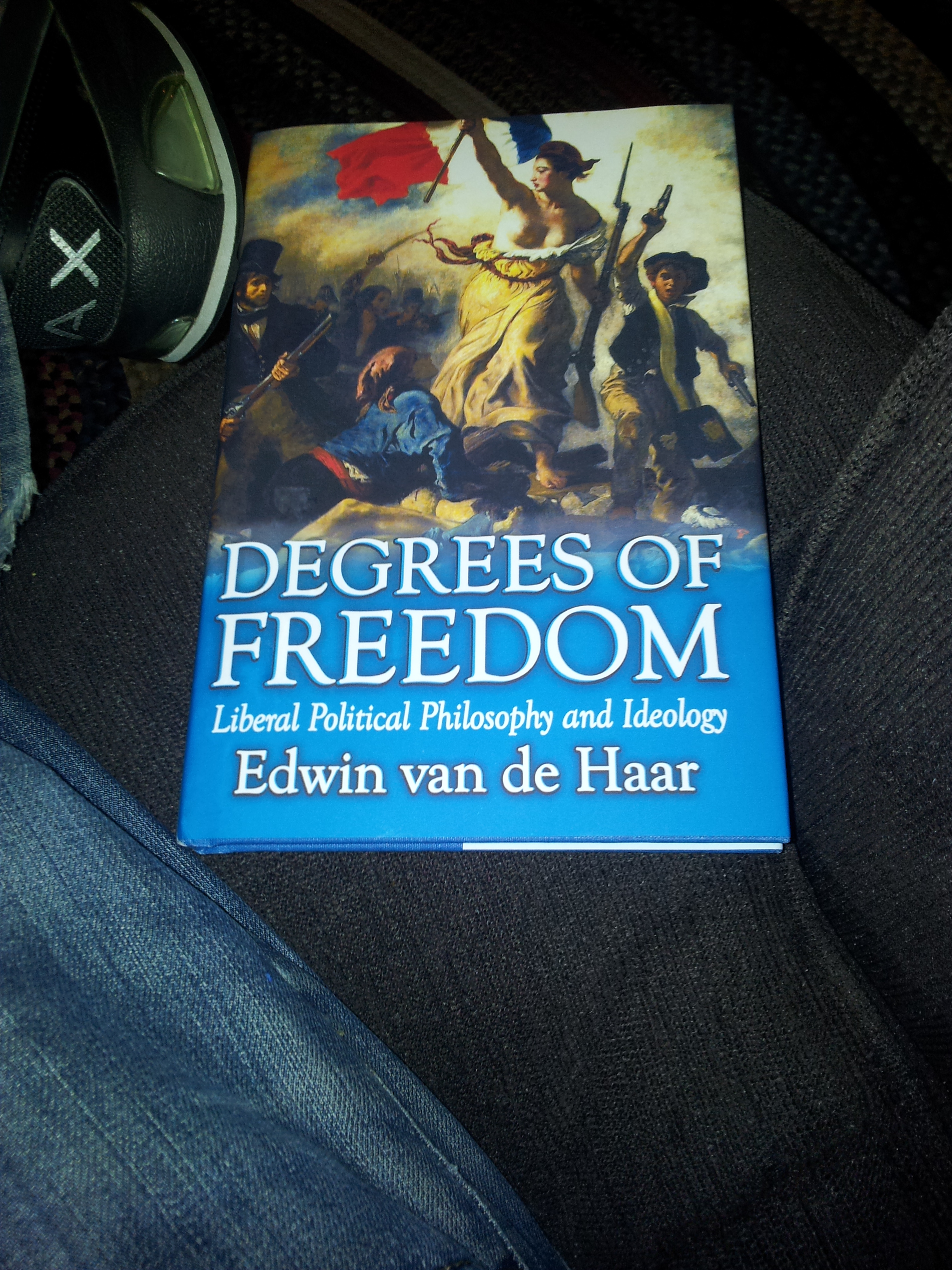
Look at what just arrived in my hands

Van de Haar's "Degrees of Freedom: Liberal Political Philosophy and Ideology"
Van de Haar’s “Degrees of Freedom: Liberal Political Philosophy and Ideology”

It’s Dr van de Haar’s newest book, straight from the Netherlands. You can pick up your own copy here (mine was a gift from Dr V, one of the many perks of being an annoying blog editor!). He’s got more books that you can find either on his ‘About…’ page here at NOL or on the sidebar. Thanks Dr van de Haar!

I know Dr Khawaja (of Policy of Truth infamy) was thinking of getting this book reviewed for Reason Papers, too. I don’t have the training in political philosophy to do the job, but I can say, just by reading through the first couple of pages in his introduction, that I could have benefited immensely from this book if I had been introduced to it in Political Science 101.

Aside from the introduction, I also briefly read through Edwin’s section near the back of the book (pgs. 120-126) titled ‘The Neoliberal Phantom’, and believe that it would be very useful for liberals of all stripes when confronted with poorly constructed anti-liberal arguments (the geographer – NOT anthropologist – David Harvey, for example, gets the full Dutch treatment from Dr van de Haar). It should be noted that this section is probably (again, I don’t have any training in this area) a little less useful for academics confronting more sophisticated attacks against liberalism, but it’s a very good primer for intense undergraduates and graduate students who have to deal with the relentless, poorly reasoned attacks on liberalism in their studies and at seminars.

When I read the whole thing I’ll be sure to post a review here at the blog. If I get word of somebody who wants to review Dr van de Haar’s book for Reason Papers (check out what’s on tap right now, by the way), I’ll try to post the good news here, too.

Epistemological modesty and unintended consequences

What has attracted me most to libertarianism – next to the Non-Aggression Principle – is its attitude towards our knowledge which can be described as epistemologically modest. Epistemology is a branch of philosophy that is concerned with our knowledge: how do we know what we know, what is the nature of our knowledge, what is its scope, and what is justified belief? Libertarianism is modest in the sense that it promotes an awareness of how little we know about the social forces in our society, and what the particular consequences are when certain social forces are at play.

In ‘The Pretense of Knowledge’ (1974), Friedrich Hayek had given an excellent account on the libertarian epistemological modesty. He writes that when policy makers are epistemologically immodest – meaning that they unjustly believe that they truly understand the social world to the extent that they can plan or direct certain social forces to achieve certain ends – they will do more harm than good in their efforts to improve the social order. Hayek argues that each individual knows just a fraction of what is collectively known. Since knowledge is decentralized and each individual has unique information with regards to his or her particular circumstances, it is best to leave those with local knowledge to take decisions on how to plan their lives. Unfortunately, many do-gooders ignore Hayek’s advice and attempt to plan and control society. The dangers of epistemological immodesty are visible all around us. Take for example the NATO-led war campaign against Gaddafi in Libya in 2011. The meddling with Libya’s internal affairs has led to many unintended consequences that were totally unforeseen by most politicians: in a country that was previously relatively peaceful, manifold precious lives have perished, many have been wounded, many children have become orphaned, millions of people are trying to flee the civil war and to find refuge in other countries, ISIS has taken control of several parts in Libya, and terrorism has now become more widespread. Politicians who believed that they knew enough about the social forces in Libya, and how they could overthrow Gaddafi and turn it into a peaceful democracy have been dead wrong.

The epistemologically modest libertarian knows that military, economic, and political interventionism, always leads to unintended consequences. It is therefore best to refrain ourselves from such interventions as much as possible. This anti-planning sentiment had been graciously expressed by the American physicist Robert Oppenheimer when he discussed world affairs:

It is perfectly obvious that the whole world is going to hell. The only possible chance that it might not is that we do not attempt to prevent it from doing so.[1]

[1] I cannot verify the authenticity of this quote. It was attributed to Robert Oppenheimer by Alan Watts.

Around the Web: Notewriters Edition

Woah, it’s been a slow week here at NOL. I can’t speak for anybody else, but I’ve been busy. Michelangelo and Edwin have both recently had their work published by the Cato Institute, and that’s cool.

I wish, of course, that my fellow Notewriters would toot their own horns a little more often, especially on the blog, but rest assured loyal readers, we’re staying busy.

New issue of Reason Papers is out

“A Journal of Interdisciplinary Normative Studies.” Check it out (pdf). Yours truly makes an appearance at the end of the journal, if you’re interested (I critique the student libertarian movement using an informal ethnographic method).

Here is the rest of the line-up:

Symposium: Christine Vitrano’s The Nature and Value of Happiness

Human Happiness and Virtue: Are They Related and, If So, How? —John Kleinig

Happiness, Pleasure, and Satisfaction —Christopher Rice

Response to My Critics —Christine Vitrano

Symposium: Emergencies

Consent-Based Permission to Kill People and Break Their Things —Stephen Kershnar

Catastrophic Events versus Infectious Disease Outbreak: Distinct Challenges for Emergency Planning —Thomas May et al.

Discussion Notes

Happiness or Life, or Both: Reply to Ole Martin Moen —David Kelley

Reply to Danny Frederick’s “Review Essay: Mark D. Friedman’s Nozick’s Libertarian Project: An Elaboration and Defense” —Mark D. Friedman

Reply to Mark Friedman —Danny Frederick

Articles

Fetuses Are Like Rapists: A Judith-Jarvis-Thomson-Inspired Argument on Abortion —Stephen Kershnar

The Scope of Attorney Confidentiality —Clifton Perry

Portraits of Egoism in Classic Cinema II: Negative Portrayals —Gary James Jason

Don’t Be an Ass: Rational Choice and Its Limits —Marc Champagne

Review Essay

Review Essay: Philip Booth’s . . . and the Pursuit of Happiness: Wellbeing and the Role of Government —Gary James Jason

Book Reviews

Robert Audi’s Moral Perception —Danny Frederick

Paul Blackledge’s Marxism and Ethics —Dan Swain

Gerhard Böwering et al.’s The Princeton Encyclopedia of Islamic Political Thought —Adam Walker

Afterwords

The Symbolic Clash of Whiplash —Robert Begley

In Search of Student Radicalism: YAL, SFL, and the GOP —Brandon Christensen

Be sure to check out the easy-to-navigate archives, too. Browsing through these issues is well-worth your time. Here (pdf), for example, is an issue with an excellent symposium on Sari Nusseibeh’s What Is a Palestinian State Worth?

The Dalai Lama on Inequality

There are many people who blame “capitalism” for the world’s economic problems, such as poverty, unemployment, inequality, and environmental destruction. This common belief is based on a confusion of meaning, and a lack of analysis. It is neither surprising nor noteworthy that many people fail to apply consecutive thought to economic issues, but it is sad that the Dalai Lama, as an influential religious leader, has not fully applied his compassionate thought to examine the causes and effective remedies of social problems.

The Dalai Lama, leader of Tibetan Buddhists, has identified himself as a Marxist socialist. He blames “capitalism” for economic inequality, and sees the Marxist alternative as the alternative that would increase equality. He advocates a more “human approach,” which implies less “capitalism” and more socialism. The Dalai Lama adds that he is not a Leninist, meaning that his Marxist views do not imply a desire for a totalitarian state.

The Dalai Lama believes that Marxism is founded on moral principles, such as economic equality, while “capitalism” is founded only on the pursuit of profit. His social and economic views were published in the 1996 book Beyond Dogma: Dialogues and Discourses. He said there that Marxism is concerned with the poor and with exploited minorities. Therefore, he said, “I think of myself as half-Marxist, half-Buddhist.” The Dalai Lama had studied Marxist ideology in China during the 1950s, and became attracted to it.

The essential problem with the word “capitalism” is that it is used both as a label for current economies, which are a mixture of markets and governmental interventions, and for the concept of private enterprise and free markets. Its use as a label for mixed economies makes it meaningless to blame “capitalism” for economic problems.

This confusion is similar to blaming diets for ill health. The diet of most people is a mixture of healthy foods such as vegetables and unhealthy stuff such as excessive sugar. The proposition that “diets” cause illness may be true, but it tells us nothing about which elements of our diets are causing the problem.

Likewise, to blame “capitalism,” meaning the mixed economy, for economic inequality, is meaningless, as this does not tell us which elements of the economy are causing the problem, whether it is markets or interventions. Blaming “capitalism” is worse than useless; it fogs the mind, because the label for mixed economies gets confused with the other meaning, private enterprise, so that, in a sly tacit shift of meanings, markets get blamed for economic woes.

It is meaningless to accuse “capitalism,” as a label, as only caring about profit and ignoring the poor, because the actual “mixed economy” cannot have any thoughts or feelings. Moreover, the concept of a pure market economy does have an ethical basis. The pure market is an economy in which all activity is voluntary. The concept of voluntary human action implies the existence of a universal ethic, or natural moral law, that designates acts as good, evil, or neutral, with voluntary action being good or neutral, and involuntary action consisting in coercive harm, which is evil.

One of the premises from which natural moral law is derived is the concept of human equality, that human beings have an equal moral worth, and should therefore be equal in the application of law. Human equality does not imply that all persons should have an equal income or wealth, because moral equality implies an equal self-ownership (or ownership of one’s body) of all persons. Therefore, each person properly owns his wage and the goods and investments bought from his wage. Income, however unequal, that comes from labor, including entrepreneurship, is not an evil outcome.

The mixed economy does create poverty, but not from private entrepreneurship. The poverty comes from government’s taxing the poor and subsidizing the rich. A study by the Institute on Taxation and Economic Policy and the Pew Research Center recently concluded that the poorest fifth of households pay more than twice the state and local tax rate (11 percent) as the richest one percent. Also, although the rich pay a much higher tax rate on their income, many of the rich get their money back implicitly in the form of the higher rent and land value generated by government spending, paid for by taxes on wages, goods, and enterprise profits. The taxes on the poor are even higher than that found in the study, as there are federal excise taxes included in goods, and also, federal taxes and restrictions on labor and self-employment add to the interventionist burden of the poor.

The economist Henry George wrote that “There is in nature no reason for poverty.” Poverty and excessive inequality are caused by human institutions. If Marxism implies income redistribution or government ownership of industry, this treats, and mistreats, the symptoms, not the causes. The main causes are the stifling of labor and enterprise from taxation and imposed barriers. The ultimate remedy is a completely free market, with voluntary, contractual, decentralized governance. Given today’s states and taxes, government interventions can be minimized with a constitutional prohibition of restrictions and imposed costs on peaceful and honest enterprise, thus with taxes only on bad effects – pollution – and on the ground rent generated by government’s public goods.

If he understood the ethics and economics of liberty, then the Dalai Lama would become a much greater global leader in promoting effective reforms that would not only promote liberty but also greater prosperity and social peace.

From the Comments: Foucault, Obscurity, and Liberty

Jacques and Barry had an excellent back-and-forth on Barry’s post about Foucault’s contributions to liberty. Here is Dr Stocker’s final response to Dr Delacroix’s questions:

Well Jacques, my last comment was not supposed to be the full reply to your preceding comment, as I tried to make clear. As I said I needed time to think before posting anything from Foucault. I was just preparing the way with comments on the background to Foucault’s style. On Montaigne, how easy is Montaigne? Maybe he seems clear to you and other French people who read him in the Lycée. I teach a lot of Montaigne in Istanbul and students don’t find him easy. Maybe his style at a sentence by sentence level is clearer than Foucault, but I would say only Foucault at his most supposedly obscure. Montaigne can seem clear because he writes in a conversational way, appearing to just comment informally on something in his mind. However, his essays are endlessly digressive and shifting in viewpoint and claim within just one essay, some of which are very long and very detached from the starting point. He mixes quotations from classics, historical illustrations, unreliable anecdotes, and personal memories, in ways which could be often said to obscure as much as clarify any underlying claim, though sometimes a relatively simple maxim seems to be the point. Even there, one really has to think about the relation between the apparent maxim and Montaigne’s shifting point of view to get the underlying point/points. The way that the style interacts with Montaigne’s mind and the uncertainties of his point of view, and the persistent anxieties about saving his world of experience from extinction in death, all have some echoes in Foucault and in various ways it seems to be me that Foucault works on a basis in Montaigne, even if adding the kind of abstract language, vocabulary and sentence construction coming from a mixture of German philosophy since Kant, and poetic-literary language since the Romantics.

Now for a couple of quotations. The first is a random selection from the book that first made him famous, History of Madness. The second is a less random selection from his late essay ‘What is Enlightenment?’.

History of Madness, page 29 (2006 Routledge edition translated by Murphy and Khalfa)

Rising up in spirit towards God and sounding the bottomless depths into which we find ourselves plunged are one and the same, and in Calvin’s experience madness is the measure of man when he is compared to the boundless reason of God.

In its finitude, man’s spirit is less a shaft of the great light than a fragment of shadow. The partial and transitory truth of appearances is not available to his limited intelligence; his madness discovers but the reverse of things, their dark side, the immediate contradiction of their truth. In his journey to God, man must do more than surpass himself—he must rip himself away from his essential weakness, and in one bound cross from the things of this world to their divine essence, for whatever transpires of truth appearances is not its reflection but a cruel contradiction.

‘What is Enlightenment?’ (as published in Michel Foucault Essential Works vol 1, ed. Rabinow, 2000), p 315

We must obviously give a more positive content to what may be a philosophical ethos consisting in a critique of what we are saying, thinking, and doing, and through a historical ontology of ourselves.
1. This philosophical ethos may be characterised as a limit-attitude. We are not talking about a gesture of rejection. We have to move beyond the outside-inside alternative; we have to be at the frontiers. Criticism indeed consists of analysing and reflecting upon limits. But if the Kantian question must was that of knowing what limits knowledge must renounce exceeding, it seems to me that the critical question today must be turned back into a positive one: In what is given to us as universal, necessary, obligatory, what place is occupied by whatever is singular, contingent, and the product of arbitrary constraints? The point in brief, is to transform the critique conducted in the form of necessary limitation into a practical critique that takes the form of a possible crossing-over.

In the first passage above, Foucault uses a language recognisable to anyone who has read much Heidegger to discuss the thought of the 16th century religious reformer Calvin. Since Heidegger’s thought in Being and Time has some roots in Reformation theology this maybe a particularly intriguing way of using Heidegger. The finitude of man compared to God is something that alludes to Heidegger’s understanding of the essential mortality, finitude, temporality of humanity. It also brings out how for Calvin, madness is an aspect of the limitation of human consciousness compared with that of God. In this passage Foucault is bringing together 16th century religious thought, the way that some 20th century philosophy approaches the themes of earlier philosophy and religion when concerned with questions of the limit of experience, how the question of defining ‘madness’ relates to the questions of defining consciousness, experience and limits from the viewpoints of the dominant ways of thinking and organising experience at the time, the ideology operating in the institutions and laws which are applied to the ‘mad’. What Foucault also brings out is that madness’ was closely related to a positive idea of transcending human bounds, so that the stigmatisation of madness then as now is intimately associated with altered states of consciousness that are given value. The use of a ‘mad’ perspective in 20th century Surrealism is one of the aspects that Foucault is alluding to here, an the ways that such aestheticised encounters with the limits of consciousness and rationality relate to earlier religious ideas of exalted spiritual states.

In the second passage above, Foucault is still concerned with the limit and while individual passages in Foucault may seem obscure, he had a very persistent interest in limits of experience, and related questions over some decades, so it is possible to build up an accumulating familiarity with Foucault’s treatment of the issue. The ‘message’ in that passage is the value of moving from Enlightenment of a Kantian kind, which places limits on the claims of universality, to a a kind of Enlightenment based on exploration of the non-necessity of limits, the exploration of the plurality of individual instances unlimited by rationalistic limitations. This is a very Montaigne-like thought, even if the language is more ‘obscure’. There is a commitment to a ‘historical ontology’, that is the understanding of ourselves as individuals and of the ‘human’ in general as the product of contingency and circumstances rather than a deep self or deep humanity detached from experience and history. This is both a proposal for the study of human institutions and discourses as Foucault already had been doing for decades and a proposal for an ethics which values subjectivity in its variability and different contexts. There is no clear limit to knowledge or consciousness, just as there is no clear limit between different areas of knowledge or experience. Foucault’s idea of Enlightenment knowledge and ethics is to keep exploring and pushing at the limits that have been assumed, which is a way of showing their continent constructed nature as well as the way that consciousness is always dealing with a sense of inside and outside that is open to transformation.

In both passages above, I would argue, Foucault uses allusion and compression of multiple allusions, to show connections and differences, and to make us think about those connections and differences. Calvin’s thought about theology has implications for defining ‘madness’, Enlightenment scientific inquiry is related to assumptions about limits of reason and experience. The ‘obscurity’ arises from the way that the syntheses, allusions, and challenges to a priori boundaries are put in a language which shows these things at work rather than just saying that they exist and makes us aware that the language we constantly use is structured and energised by the unions and tensions contained within these thoughts.

If one simply wants the ideas about institutions, history, discourse and so on in Foucault, without the ‘obscure’ language, then to some degree these can be found in Foucault’s lectures, and then maybe more so in those commentators committed to a clarification of Foucault for those not immersed in the use of philosophical language to convey meaning beyond the most literal transmission of messages, commentators including Gary Gutting, Ian Hacking, and Hans Sluga. I recommend them to anyone who finds Foucault’s style to be a chore but wants to find out about ideas which have certainly influenced a lot of work in the humanities and the social sciences.

The whole dialogue between the two starts here, if you’re interested.

Why Republican Libertarianism? IV

(This text was written for the European Students for Liberty Regional Conference in Istanbul at Boğaziçi University. I did not deliver the paper, but used it to gather thoughts which I then presented in an improvised speech. As it was quite a long text, I am breaking it up for the purposes of blog presentation)

(I took a break from posting this over the holiday period when I presume some people are checking blogs, rss feeds, and the like, less than at other times of the year. Catch up with the three previous posts in the series, if you missed them, via this link.)

The most important advice Machiavelli gives with regard to maintaining the state, is to respect the lives and honour of subjects, refrain from harassing women, avoid bankrupting the state with lavish expenditures, uphold the rule of of law outside the most extreme situations,  and concentrate on military leadership, which is to turn monarchy into a hereditary command of the armies, a republican idea, if the monarch withdraws from other areas of state business and certainly from law making. That is certainly how John Locke, at the beginning of classical liberalism saw the role of kings.

It is true that unlike antique thinkers, Machiavelli does not see human nature as essentially ‘good’, at least when guided by reason and law. What those thinkers meant by good was a life of self-restraint difficult to make compatible with commercial society. Machiavelli understood the benefits of commercial society compared with feudalisms, and though there was an element of antique nostalgia in his thinking, he understood like the political economists of the eighteenth century that public goods come from self-interest, softened but not eliminated, by some sense of our connections and obligations to others.

Machiavelli’s longest book on political thought is The Discourses, a commentary on the Roman historian Livy’s account of the earlier periods of Roman history, covering the early kings and the republic. Here Machiavelli makes clear beyond any doubt that his model state was a republic and though it was Rome rather than Athens, he takes the original step of seeing Rome as great not because of Order, but because of the conflicts between plebeians and patricians (the poor or at least non-noble masses and the aristocracy), which resulted in a democratisation process where the plebeians learned to think about the common good and where everyone shared in a constructive competitiveness which developed individual character through civic conflict under law (well a large part of the time anyway). His view of the republic requires both a sphere of common political identity and action and a competitive non-conformist spirit.

Machaivelli’s republican hopes for Florence, and even the whole of Italy, were dashed by the Medici princes and a period of conservative-religious princely absolutism under foreign tutelage in Italy, but his ideas lived on and not just in the one sided stereotypes. He had an English follower in the seventeenth century, James Harrington, author of Oceana. Harrington hoped for republic in England, though a more aristocratic one that Machiavelli tended to advocate, and was too radical for his time, suffering imprisonment during the rule of Oliver Cromwell, the leader of a republican revolution who became a new king in all but name. There was a British republic, or commonwealth, after the Civil War between crown and parliament, lasting from 1649 to 1652, which was then not exactly absolved but became a less pure republic when Cromwell became Lord Protector.

Even so the republican poet, John Milton, served Cromwell as a head of translation of papers from foreign governments. Milton is more famous as a poet than as a political thinker, nevertheless he wrote important essays on liberty, drawing on antique liberty in Greece and Rome, as well his republican interpretation of the ancient Jewish state (important to Milton as a deep religious believer whose most famous poems are on Biblical stories). Milton helped change English literary language, almost overshadowing the ways that he furthered republican political ideas and did so on the basis of an Athenian model of law and free speech. His defence of freedom of printing, Areopagotica is named in honour of the central court of Athenian democracy (though with older roots) and draws on the idea of a republic based on freedom of speech and thought. Both Milton and Harrington were major influence on the Whig aristocratic-parliamentary liberalism of the eighteenth century and early nineteenth and so feed directly into classical liberalism in practice and the defence of liberty of speech and thought to be found in Mill’s On Liberty.

The development of classical liberalism and the libertarian thought of the present come out of the republicanism of antiquity and the early modern period. There is a strand of thought within libertarianism which is anti-politics or only minimally willing to engage with politics as a part of communal human life. However, the parts of the world where liberty is most flourishing, if far short of what we would wish for, are where there ‘republics’ in the original sense, that is political power is shared between all citizens, regardless of the issue of whether a royal family provides a symbolic head of state.

On the whole, historically commerce has been linked with the existence of republics, even within monarchist medieval and early modern England the City of London was a partly autonomous city republic focusing resistance to royal power as it protected its commercial gains from state destruction. Despotism, and the state that plunders civil society, wish for a depoliticised atomised society. Republican politics can go wrong, but the answer is republican reform, republics with less of the aspects of absolutist monarchy and traditionalist power structure, not an idealisation of states which exist to preserve and reinforce forms of authority obnoxious to open markets, individuality, equality before the law, and the growth of tolerance for forms of living not so well recognised by tradition.

Why Republican Libertarianism? I

(This text was written for the European Students for Liberty Regional Conference in Istanbul at Boğaziçi University. I did not deliver the paper, but used it to gather thoughts which I then presented in an improvised speech. As it was quite a long text, I am breaking it up for the purposes of blog presentation)

Republicanism has been on the rise as a term in political theory debates since the late 1990s, where it has joined egalitarian liberalism (that is a version of liberalism in which the state decides on income and wealth distribution, markedly more flat than the distribution achieved by the market, at least in intention), communitarianism, and libertarianism in the main recognised streams of political theory along with radical democracy, deliberative democracy, and Marxism.

The egalitarian liberal position emphasis rights, justice, and rational political procedures claiming that constituently employed they lead to a morally based economic pattern of distribution distinct from the relatively spontaneous activities of the market and civil society. Libertarianism (covering anything that might be regarded as classical liberal or libertarian) tends to have the same basis and argue that correct understanding leads to a more market based individualistic view of how economic goods should be distributed.

Communitarianism is most economically egalitarian but includes social conservatives as well as social liberals. It argues that views about justice have proper foundation in the rules according to which humans live in, form, and maintain communities, rather than individual rights. It tends to be anti-libertarian but a communitarianism based on voluntary communities below the level of the state, or independent of the state, can converge with form of libertarianism emphasising the freedom to create voluntary communities of those with shared visions of the good life, socialist, capitalist or anything else.

Marxism is, I presume, well known enough to need no introduction and radical democracy is the attempt to make Marxism, or something like it, compatible with liberalism in democracy and rights, and maybe even compatible with libertarianism in some social and moral issues. Deliberative democracy is the view that political institutions and laws should rest on a constant process of public discussion and negotiation, presumed to engage most of the population.

Simply explained, republicanism is the view that political institutions and laws rest on the tendency for human communities to have a political aspect, and liberty to have some aspect of rights of political participation, where there is some life is devoted to discussion of the best institutions, laws, and policies for maintaining liberty. If all this sounds rather libertarian, it has to be said that republican political theory in its current manifestation, which goes back to the late 90s, has used there same arguments as egalitarianism, but taking the understanding of liberty in a different direction.

In the egalitarian liberal understanding, liberty is just as much to do with state designed economic equality, or limitations on inequality, as individual rights to life, property, and freely chosen version of the individual good life. From the egalitarian liberal perspective, which theorises the views of new liberals, constructive liberals, social liberals, and progressives since the late nineteenth century, ‘liberty’ must include the idea of some equality in the distribution of economic goods as part of the fairness or equality of respect, which is part of those aspects of liberty concerned with individual rights under law.

The idea of republicanism as now discussed in academic circles, at least those largely concerned with a ‘normative theory’ approach to political theory emphasising conceptual analysis  was developed by the Irish philosopher Philip Pettit (long based between the US and Australia). Pettit rests his arguments on a mixture of a historical republican tradition going back to antiquity, and arguments about the meaning of liberty and what kinds of liberty there are. The arguments in Pettit, like many other discussions of liberty, refer back to a famous paper by the philosopher and historian of ideas Isaiah Berlin in ‘Two Concepts of Liberty’ (1958), which rest on a view of the history of political ideas, so again we come back to a historical argument.

Republicanism in recent political thought has another inspiration, (at least for those concerned with the more cultural, literary, historical, and interpretative aspects of political theory) from an a mid twentieth century writer on politics and philosophy, Hannah Arendt. Arendt is hard to situate politically, and has been taken up both by radical democrats and conservatives. She was rather evasive on the subject of socialism versus capitalism, however the basis in her thought for this was that political issues should be distinguished from social welfare issues, which certainly seems to exclude the possibility of socialist or even egalitarian liberal ideas entering into her basic political assumptions.

Arendt looked back to ancient Athens, in contrast with Pettit who takes Rome as his starting point, and to a culture of competition to prove excellence, which was aristocratic in origin. Athens at the the time it was home to Aristotle, as well as many other notable cultural and philosophical figures, was a democracy based on citizens meeting in the centre of the city to make laws and make the major decisions about state actions.

For Arendt, the political culture of the democracy took up the aristocratic tradition of competitiveness to produce a political life that itself cultivated excellence through contests, and a concern with the public good, at the same time as it was producing great culture, as part of the same pattern. She points to the largely political decision making of the assembly, which was not engaged in attempts to change shares of economic goods.

Economists are special, but what about Palestinians and American blacks?

I’ve got the post-Thanksgiving flu. I know which toddlers are guilty of infecting me, and which aunts and uncles are responsible for this egregious assault on my happiness. Revenge will be sweet.

I’d like to get to Warren’s smackdown of my reparations proposal and also to Matthew’s thoughts on justified violence against the state (which were indirectly related to my own post on Ferguson), but first I’ve got to get to two interesting topics that have piqued my interest.

The first is Irfan Khawaja’s recent critique over at Policy of Truth of Jason Brennan’s new book on voting. As usual, Khawaja brings up a number of great points (too many, actually, for a lowly ethnographic enthusiast like me), and they deserve to be read by all (be sure to check out the ‘comments’ thread, too).

Here is an excerpt (Khawaja has flipped the tired script of many American academics by bringing in a fresh perspective):

I can’t work through all the details here, but take a look at Brennan’s argument in light of the preceding. Either my East Jerusalem case is a counter-example to his thesis, or it’s a defeater for it. In the first case, it refutes the thesis as stated. In the second case, it suggests that the thesis is highly misleading as stated. Given that, my argument requires that Brennan qualify his claims about the ethics of voting in ways that take more explicit stock of cases like the East Jerusalem one–something that would substantially change the “flavor” of his theory.

Brennan’s work has, of course, gotten a lot of excellent treatment in libertarian circles because of both his blogging activities (hint, hint, slackers) and because libertarians have a long, storied distrust of democratic politics (though this is largely an anarchistic distrust rather than the conservative-aristocratic one we North Americans think we are familiar with).

Switching gears, I also need to comment on an interesting paper (pdf) about the “Superiority of Economists” I came across over at MR. It was written by two sociologists and an economist, and it has a number of excellent insights (MR‘s link to the paper was broken, but MR also provided a link to comments by economist Paul Krugman, and his link to the paper was unbroken).

Most of the paper is a rehash of arguments about economics relative to the other social sciences (and the humanities) that libertarians have been having for a long time. (In my anecdotal experience, libertarian economists are quickest to defend the profession of economics from detractors, but they are also the quickest to defend the other social sciences from detractors (and, more importantly, incorporate non-economics research into their own). Leftist and conservative economists, by contrast, condescendingly acquiesce to attacks from other disciplines, but are also very, very disdainful of The Others’ contributions to research.) Libertarian economists generally share the same suspicions as The Other disciplines about the ability of economics to imitate the physical sciences using mathematical models (or that these models are even indicative of how humans “work”). See Warren’s piece (pdf) in Econ Journal Watch for more on these suspicions.

The last section before the conclusion (“A life of their own”) is really good and totally worth the click. It’s about economists and their relationship to everybody else in their society (this paper is made better by the fact that it is written by French academics with an intimate understanding of life in both the US and France, just like some other scholar that we all know and loathe love).

On page 18 the paper cites a few studies and lab experiments which have purportedly shown that people who study economics are, on the whole, less likely to cooperate than everybody else. There are a number of implications that the paper goes over (“does economics attract a certain type of personality?”, for example), but I wanted to focus on what is not discussed in the paper: The fact that economists probably have a different (actually, a more coherent and precise) understanding of the meaning of cooperation. Many criticisms of economics are clearly made of straw. One of the things that initially attracted me to libertarianism was the intelligent, well-informed critiques of economics as I then understood it (“homo economicus“) that were given by libertarians.

I also learned, on page 19 and contra Dr Amburgey’s repeated assertions, that economists are politically (and decisively) to the Left of the average American voter.

Another fascinating page 19 insight is that there is more income inequality ($57k gap between the top 10% and the median) in economics relative to other disciplines, but on this point the authors lose a golden opportunity to do some real sociological analysis (the authors focus instead, and predictably, on the economics profession’s recent prosperity as a whole relative to other academic disciplines; that is to say, on the income inequality between economics and The Others within academia). Earlier in the paper (7-14) an organizational comparison between economics and The Others highlighted the fact that the economics community tends to be more hierarchical, more incestuous, and possesses a “unitary disciplinary core,” which means that virtually all graduate schools teach the same concepts. The Others, in contrast, are “more decentralized, less cohesive, and [possess] less stable prestige rankings.” (9)

The most basic insight that stood out to me when I read the data on incomes was that the disparities and organizational structures of the social sciences and humanities represent a microcosm of society as a whole (pick any ole society you’d like): When rigid hierarchies are enforced, conformity and parochialism (incestuous is too strong a word here) arise, income inequality is more prevalent, and the pecking orders are more entrenched.

In contrast, societies that are “more decentralized and less cohesive” have more variety, much less deference to an established authority (such as a pecking order), and less income inequality ($42k gap between the top 10% of sociologists and the median). There are less women in economics relative to the other disciplines, and the median economist almost has the same income as a top 10% sociologist ($103k to $118k, a difference of only $15k).

Well, this post has already gone on for far too long (I hope to use it as a springboard for future musings) but I will end by noting that on page 23 the paper points out that economics is a very moral discipline, which is something non-libertarian economists vehemently deny. Libertarian economists, on the other hand, have been pointing this out for centuries.

Friends of Liberty and Friends of Montaigne II: Marie de Gournay (Expanding the Liberty Canon series)

Marie Le Jars de Gournay (1565-1646) was a minor aristocrat from Sancerre in central France who became a leading scholar and writer of her time, and an important advocate of women’s liberty through her scholarly career against the dismissive attitude of powerful men of the time, and through her writing in favour of equality between men and women. She was a friend of Michel de Montaigne, one of the great historical advocates of liberty if in a rather enigmatic manner, and he even treated her as an adoptive daughter. After the death of Montaigne, she lived on the Montaigne estate as a guest of the family, while preparing the third edition of Montaigne’s Essays, a contribution to the history of thought and thinking about liberty in itself.

Gournay’s work in the transmission of Montaigne’s thought is though just one episode in a life of writing covering translations of the classics, literary compositions, and essays. Two essays in particular mark important moments in the case for liberty to apply equally between the two sexes: The Ladies’ Complaint and Equality of Men and Women. In these brief, but rich texts, Gournay argues that there can be no liberty, where goods are denied, so since women have been deprived of the goods of equal esteem, there is no liberty.

She points to the frequency and intensity of denial of equal esteem to women and contests it through the examples in which women have been esteemed, or we can see that women have performed great deeds on a level with great men. The argument is very much that of a Renaissance Humanist, that is someone educated in the languages, history, and literature of antiquity, as great expressions of human spirit and with the assumption that these are the greatest expressions of human spirit. Greatness of literary, intellectual, and statecraft in modern languages, modern thought, and modern states, is possible where  continuing from the classical tradition. Since the emphasis is on pagan classical antiquity, the Humanists to some degree placed humanity above Christian theological tradition, though some Christians were also Humanists and secular Humanist achievements to some degree interacted with scholarship of the Hebrew and Greek languages of the Bible, along with the Greek and Latin used by church thinkers.

Gourany’s concerns are largely secular but she does deal with the place of women in the Bible. For the Hebrew Bible (Old Testament) She points out that if the Queen of Sheba (often thought to refer to an ancient queen of Yemen, or possibly Sudan) visited King Solomon, because she knew of his great wisdom then she too must have had an interest in wisdom, and had some high level of scholarship, learning, and intellectual work herself.

With regard to the New Testament, she comments on St Paul’s injunction in his Epistles that women be silent in church and not take the role of priest. Gournay argues that Paul was not writing out of contempt for women, but fear that men would be distracted and tempted by women speaking out in church serves whereto as part of the congregation or as priests. The limitation on the role of women is not therefore based on beliefs about the supposed inferiority of women, but control of male desire.

On the role of women in the Bible, Gournay argues that in general we should not argue that it supports an inferior role for women, given that God created both men and women in the beginning, and given that men are commanded to leave their parents in order to find a wife. The connection between man and woman, and the idea that a man’s life is completed by association with a woman, is the main message of Christian scripture for Gournay.

Looking at the more secular aspects of Greek and Roman antiquity, Gournay deals with philosophical and with historical concerns. On the philosophical side she notes the importance that Plato gives to the priestess Diotima (unknown outside Plato’s writings) in his dialogue The Symposium, which appears to recount conversations about love in a dinner and drinking party in Athens attended by some of the leading people of the time.

Plato shows Socrates presenting the views of Diotima as the correct ones on love, and Socrates, the teacher of Plato, always appears in Plato’s dialogues as a representative of truth. So Gournay points out, it must be conceded that Plato claims that his ideas, and those of Socrates, are in some degree dependent on the thought of women of their time. In that case, Aristotle made himself absurd when  he claimed that women were defective and inferior, since he was the student of Plato and therefore was in some way formed by ideas that Plato said came from Diotima.

Plato’s student Aristotle may have claimed women were inferior by nature to men, but Antisthenes, a follower of Socrates regarded women and men as equal in virtue. Gournay also refers to the tradition according to which Aspasia, female companion of the Athenian democratic leader Pericles (admired by Plato and Aristotle though they did not share his democratic principles) was a scholar and thinker of the time. There is a lack of contemporary sources confirming this view, but this applies to much about the antique world, so Gournay’s suggestions about Aspasia are just as strongly founded as many claims about antiquity, and the investigation of tradition is itself an important part of any kind of intellectual history.

Moving onto Roman historiography, Gournay points out the role take by women in the tribes of Germany and Gaul, according to Tacitus. Women serve as judges of dispute and as battlefield participants inciting male warriors to fight fiercely. So she can point to a revered classic source, which suggests that women had roles in ancient France and Germany denied to them in those countries in early modern times. In general, as she points out, the antiques often referred to a tribe of female warriors, known  as Amazons, which may have some historical origin in Scythian tribes from north of the Black Sea.

Gournay uses her formidable Humanist learning to demonstrate the ways in which equality between men and women had been recognised in the ancient past, on some occasions in some places at least. Showing that women have been recognised as equal to men in some contexts is evidence that the lower status of women in many societies is a result of socially embedded prejudices rather than any difference in abilities. As Gournay notes, rectifying denial of rights to women is part of the basis for real enduring liberty.

Friends of Liberty and Friends of Montaigne I: de La Boetie (Expanding the Liberty Canon series)

Etienne de La Boétie (1530-1563) was from Sarlat in the southwest of France. He developed strong interests in poetry, classics, and politics as a youth and was rather precocious. It has even been suggested that he wrote his great political essay ‘Discourse on Voluntary Servitude’ (also known as ‘One against All’) at the age of sixteen, though there is no universally accepted date for its composition. He started a career as a judge in Bourdeaux at an unusual age, followed up by diplomatic work. He was also a translator of Greek classics and a poet who associated with a distinguished group that included the greatest French Renaissance poet Pierre Ronsard.

De La Boétie died at a sadly young age, but before that he wrote the great political essay under discussion here, and made friends with the Bordeaux judge and author of the Essays, one of the great works of French and European literature, philosophy, and self-examination. I have considered Montaigne as a thinker about liberty and though he did not directly express enthusiasm for liberty-oriented radicalism, he certainly had friends who did, including de La Boétie and an early feminist to be considered in the next post.

It has been claimed that Montaigne wrote ‘Discourse on Voluntary Servitude’ himself, which combined with the claim that de La Boétie wrote it at the age of sixteen suggests considerable uncertainty about the status of the text. I will just go with the more average assumptions, which are that de La Boétie was the author and wrote it later than the age of sixteen (or eighteen, as also been suggested).

Anyway, the friendship of Montaigne and de La Boétie was itself a major event in French and European culture, since de La Boétie’s death appears to have played a late part in Montaigne retiring from the judiciary and a melancholia, which led him to begin composing the Essays. One of the most famous essays, ‘On Friendship’, is in part a meditation on the friendship with de La Boétie and the sadness that Montaigne feels that his life is no longer shared with him.

The topic of friendship itself connects with ancient ideas of political liberty, so that the essay itself can be taken as part of the evidence that Montaigne sympathised with ancient republican liberty and wished for its revival. Montaigne’s essay is, as one would expect given Montaigne’s constant shifts in point of view and exploration of difficulties in ideas of some appeal, more open to difficult moments in the idea of friendship, such as the willingness of a friend to cooperate with the other friend’s lawless projects.

De La Boétie’s stye is to develop a thesis with great passion and rhetoric; skill, rather than obviously exploring all sides of a question, though he is certainly best understood with a critical approach to what he might mean and openness to different approaches. Attempts to fit de La Boétie too narrowly into any recent conception of liberty are unlikely to do him justice, as can be seen in the wide range of people who have sought inspiration from more individualistic and more collectivist understandings of both anarchism and republicanism.

‘The Discourse on Voluntary Servitude’ may be taken as anarchistic in that de La Boétie argues for resisting the authority of any individual or group over a nation, or group of people however defined. It may taken as republican in that de La Boétie uses the language and references of ancient republican tradition in Aristotle, Polybius, and Cicero, which gives all citizens some role on law-making and government actions through public assemblies. The theoretical work itself reflects on the experience of Ancient Greek city-states and Rome before the Emperor system.

What de La Boétie opposed to the unjust rule of one or a group is law and an idea of liberty, which he defines as natural, and in opposition to the unnatural tendency to those who rule without regard to law. His way of thinking looks connected to that of the tradition going back to Aristotle of ‘natural law’ as those laws shared by all communities and therefore to be seen as belonging to human communities by the nature of humans, or their communities, rather than those laws arising from specific localised customs and necessities. De La Boétie resists an exact account, suggesting he is concerned with the defence of liberty as natural against tyranny, defined as monstrous.

De La Boétie starts the Discourse with reference to Homer, making clear his classical points of reference. The idea comes from Odysseus (de La Boétie uses the`Latinate version of the name, Ulysses) in The Iliad that it is better to have one master than many. De La Boétie takes his starting point then the necessity of condemning one person rule, which must be tyranny whether that individual came to  power through inheritance, election, or usurpation (coup). In that respect, de La Boétie might be taken as an anarchist resisting all authority, as well as a pacifist, since he points to the power of one resisting on the obedience of many who could easily shake of the power of one, without force, if they ignored the claims if the one to sovereign power.

On the whole though, de La Boétie appears to be thinking of the antique republican tradition of sharing power between individuals and councils (and the human value of such participation), so that no one individual or council can have unchecked power. Both the Athenian and Spartan republics are mentioned favourably from this point of view, as is their armed resistance to the invasion of Greece by Persia, itself under the power of one. The ancient Greeks are associated with republican virtues in which liberty is more important than wealth or comfort. It is not so much anarchy, as sharing of political power that de La Boétie recommends, and war is accepted where necessary to resist domestic or foreign tyranny.

There is a justified anarchistic reading of de La Boétie, if we are willing to distinguish that from de La Boétie’s own view. He was an admirer of the sharing of power between citizens in ancient city-states, where there was close to no bureaucracy and administrative functions by modern standards, and what there was could be realistically managed by committees of citizens. This can come close to an anarchistic view of purely voluntary institutions substituting for the state, particularly if we accept a natural law view in which everyone is likely to favour the same basic laws as ‘natural’ or we have some other reason for thinking the same laws will be discerned and accepted as right by the whole body of citizens. I do not recommend such a view, but it is at least worth exploring.

The issue of friendship, which connects de La Boétie with Montaigne, comes into the republicanism of de La Boétie in that friendship is what a tyrant cannot have, while friendship between citizens is what unites them in struggle against tyranny. The tyrant can only have sycophants and enemies, no friends since they must be equals. A society based on friendship between citizens is not based on coercion and the privilege of one, or a few, who control the state. Friendship itself contains the idea of a good that benefits at least two people, so undermining the idea that we can only have a form of power seeking individualism unconcerned with the common good, and that it is possible to live as a human while ignoring common goods and rights.

A Matter of Expectancies

We agree with the opinion that radical social discontent is strongly related to a disappointment of expectancies. The relation emerges from the observation that the most extremist activists are not the most disadvantageous people in society but persons who have a relative wealthy social background and a high level of education. People often believe that radical ideals must be addressed to the poor, because they have “nothing to loose but their chains”, and then get astonished when they find out that most revolutionaries come from the elites. The answer to this puzzle is that political conservatism and radicalism mostly depend on the degree of fulfillment of previous expectancies –or, better, the current expectancy of fulfillment of previous expectancies.

I consider that this contention allows us to translate the Egalitarian claims for a more fair society into the language of the Classical Liberalism. A Classical Liberal view may agree on that every individual deserves to be treated with equal consideration and respect, if this means that the most quantity of expectancies are to be fulfilled only when citizens are equal before the law and the restrictions on individual plans are the minimal necessary for them to coexist. This is all the Egalitarianism that Classical Liberalism can provide.

Notwithstanding, there is an enormous advantage of Classical Liberalism on Egalitarianism about this issue: Classical Liberalism judges every individual plan of life only at a very general and abstract degree (do not kill anyone but in self defense; do not coerce liberty of locomotion of anyone, and so on). On the other hand, Egalitarianism needs to qualify the legitimacy of every individual plan of life in accordance to a particular scale of merit on which there is no guaranteed consensus.

But let us suppose that, due to “the veil of ignorance” which we were behind, we might reasonably agree on a particular scale of merit in order to judge the legitimate limits between each personal plan. We reasonably accepted some particular restrictions in our property and liberty in order to proceed to the redistribution of wealth regulated by the system we agreed on when we were “behind the veil of ignorance”. The problem is that we had accepted an Egalitarian system behind the veil of ignorance, but we formed our personal plans and expectancies when later unveiled.

If this is so, we may expect of every Egalitarian system to be unstable. We are in serious trouble when this instability is attributed not to a lack of freedom, but to an absence of regulation –and that is how markets become both accused of being the oppressing iron cage of liberty and the chaos. The other way is to regard each plan of life as intrinsic valuable as far as it does not interfere with basic aspects of other’s. It is true that expectancies are made from perceptions and that sometimes the system works as the tale of the fox and the grapes. But, at least, every individual will be full responsible not of his chance but of what he does with it. That is a right to fight for: not equality, not even prosperity, but the right to be responsible for one’s own days.

Expanding the Liberty Canon: Tacitus on Barbarian Liberty

Cornelius Tacitus was a Roman senator and historian from the early Roman Empire. Some details of his life are oddly evasive given his high status in the Roman system and his fame as a writer. It is not known what his first name was (Romans had three names), but Gaius and Publius are the most widely accepted hypotheses. It is not clear where he was born except that it was some distance from the city of Rome. Southern France (or Gaul) or northern Italy are the most widely accepted hypotheses. His exact dates of birth and death are not known, but he lived from about 56 to 117CE.

Tacitus was one of the great antique historians and prose stylists. He deserves to be read by liberty enthusiasts for the record he provides of ideas of liberty in Rome, as well as for reasons of literary appreciation and general historical knowledge. His historical work includes the Annals and the Histories, which are a major source of information about the history of the early Roman empire, as well as of the political attitudes of the traditional Roman ruling class at that time.

There is some overlap between the Histories and the Annals, and the texts under discussion in the present post, which are On Agricola and On Germany, but the first two texts will be covered in a later post. I have already had a lot to say about the republicanism of the Athenians and the Romans, so it is time to consider how the ancients conceived of liberty in the ‘barbarian’ nations, those nations lacking the cities, literary, and unified legal-political systems known to Greek and Roman writers.

Another topic to be considered later is how the ancient republicans understood good rule in a monarchy (the Cyropaedia of Xenophon from ancient Athens is the most obvious example), and deals with the education of the Persian king Cyrus. There is some overlap between the topics of wise monarchy and barbarian liberty, particularly if we look at how these ideas evolve over time, something that will be explained at the end of this post.

Tacitus’ general position on Roman politics was that of an aristocrat and enthusiast for the Republic, who despised many of the early emperors, but was at least willing to give credit to those emperors he believed were behaving with respect regarding the aristocracy and old republican values. In particular, Tacitus gives a negative view of the personality and means of rule used by the second emperor Tiberius, a far more scathing impression of the following emperor Caligula, and a generally horrified impression of Roman leaders and the culture of Rome until the time of Nerva and Nerva’s successor Trajan. Nerva and Trajan are the first two of the Five Good Emperors, also including Hadrian, Antoninus Pius, and Marcus Aurelius.

That sequence is conventionally regarded as the highpoint of the Roman Empire before a decline which ends in the fifth century fall of the West and the formation of Hellenic despotism in the East. That is not exactly a view universally accepted by historians now, and I do not refer to it to endorse it, but to refer to a very powerful story influencing the understanding of history and the fate of states over the centuries.

Anyway, Tactitus did much to form the earlier part of that time-honoured if now much criticised historical understanding. It seems to me that it is as least correct to see some substantial, if very variable, respect for republican forms and manners until the death of Marcus Aurelius, though supreme power had been premised on control of the military since Julius Caesar’s time. After Marcus Aurelius, maybe some republican legacy remains in that the Senate in Rome always has some influence, but that influence looks weak compared with that of the power of the military, which decided the name of the emperor in times of uncertainty or became the source of coups by would be emperors.

Tacitus’s republican-inspired criticisms of emperors who humiliated or ignored the Senate were not a wish for popular government; this was a distinctly aristocratic wish for liberty for those who deserved to exercise liberty, combined with nostalgia for a stern public morality of self-restraint and courage associated with the memory of the early Republic. Tacitus’ objections to unrestrained emperor rule were partly of mild behaviour towards slaves and the promotion of freedmen over free men.

The freedman had a particular legal status in Rome: as a slave emancipated from slavery, but still bound to render services to the master who freed him (I’m excluding women here as they do not enter into the politics of the time) and who could be taken back into slavery if he failed to recognise his obligations. So only the children of a freedman were truly free and they were still of socially low status, at least according to the old aristocratic families in the Senate.

Emperors were happy to give important jobs to freedmen who owed them particular loyalty, rather than aristocrats who might believe in their own rights independent of the emperor. So Tacitus, along with other senators, was very much in favour of a state, a kind of republic under an emperor, ruled by free men, on the understanding that only a very limited class of men deserved freedom, understood as the right to exercise political power as well as non-political legal rights.

One way in which Tacitus examines an alternative to the apparent decadence of Rome was with reference to the barbarian subjects or enemies of Rome. He was particularly concerned with two groups of barbarians, Britons and Germans. He discusses the Britons as part of his tribute to his father-in-law Agricola, the Roman governor of ‘Britannia’ (England, Wales and a very variable part of Scotland) who consolidated the conquest undertaken by the Emperor Claudius.

As Tacitus notes, Julius Caesar failed to conquer Britannia, so noting the limitation of the effective founder of the Emperor system, though its formal start is associated with the consolidation of powers and titles, new and old, by Caesar’s successor Augustus. Tacitus is also referring to the difficulties of conquering the Britons, who had a fierceness lacking in the Roman legions (disciplined and brave in battle as they were).

Tacitus’ praise for his father-in-law is enhanced by and feeds into recognition of the difficulties of subduing the fiercely independent people of this terribly cold, rainy, and foggy land at the edge of the Roman world. As Tacitus notes, resistance to Rome first came from a queen, Boudicca, occupying a role of political and military leadership closed to Roman women. Tacitus has little else to say about this situation, but at least has acknowledged a form of struggle for liberty under a woman beyond any episode of Roman history.

The biggest voice for British love of liberty is given to Calgacus leading opposition to Rome in the highlands of Britannia. Tacitus attributes a speech to him, which is likely to have much more to do with Tacitus’ own imagination and political sensibility than anything the historical Calgacus ever said. We will never be sure about this, but in any case Tacitus gives an important example of some deep ambiguities in Roman thinking about liberty and their own civilisation.

Calgacus condemns the greed for wealth of the Romans and portrays them as only exercising power through enslaved peoples rather than their own courage and merit. The reference to “enslaved peoples” is to people politically and militarily subdued by the Romans, with most remaining above slave status, rather than the enslavement in the strongest sense of every individual within a people.

The liberty the Britons are depending on comes from a simple moral struggle to defend family and immediate community from foreign domination, not from a wish to enslave others. Calgacus recognises the remoteness of Brittania from Rome and from Roman civilisation, making their struggle a struggle of wilderness, mountains, and places by the sea against a gigantic continental force, fighting with nothing to lose except the liberty of simple peoples with simple lives.

Tacitus is giving voice to a mentality he admires though coming from a people who deserved to be slaves because they failed to throw off Roman mastery. That is partly a matter of war, which Tacitus implies through Calgacus, the Britons lacked talent for over time as opposed to a capacity for isolated surprise victories. Tacitus both admires the courage of the barbarians and despises their lack of discipline. The real source of their slavery though is the luxury that Roman rule brings to Britannia (in practice this can only apply to a minority of urban dwellers and larger to a minority Romanised upper class within that category), so that the Britons forget liberty as they enjoy the fine living of Roman civilisations.

Tacitus himself enjoyed that fine living while continuing an idealisation of Britons as simple, hardy, brave people, which in early history even applied to aristocrats who were small property owners, farming their own land. Tacitus both wished to keep his privileged life and use the ideal of simple republican virtue against the emperors and those corrupted by emperors.

Tacitus wrote on the difficult to conquer but finally conquered Britons and also on the impossible to conquer Germans. The Germans again resisted Caesar, but unlike the Britons resisted a succession of Roman Emperors. Like the Britons, the Germans are portrayed as living at the edge of the liveable world, in this case surrounded by forests and swamps with no gold or metal and little in the way of farming. The lack of gold and silver marks the Germans as mere barbarians, but also makes them free of the corruption the Romans had suffered.

Tacitus discusses the political situation of the Germans as variable as they are divided between many tribes, but generally they have a strong monarchy or a monarch who appears to largely exist to lead in war rather than dominate the society. The latter kind of monarch tends to rule through freedmen according to Tacitus, so duplicating the tendency of Roman emperors to keep political power way from those who fit to exercise liberty and leave it to the slavish in nature.

The Germans are portrayed as brave but with reference to family and immediate community, who are all present in battle (including the women) rather than to the state, or ‘public thing’ (‘res publica’), which is how Romans understood their own state at any time, republican strictly speaking, or imperial in forms. Again Tacitus shows a mixture of contempt for the backwardness of it, and admiration for the so far uncorrupted bravery on behalf of the little world of everyday life. The emotional passion of the Germans is also admired, but regarded as inferior overall to the discipline and self-control of a proper Roman aristocrat like Agricola.

Significantly, Tacitus thinks the kind of Stoic self-control and extreme rationality, discussed from the political point of view in an earlier post on Seneca, is going too far. Despite the influence of Stoic thinking on the Roman upper class and Seneca’s association with resistance to evil emperors, Tacitus wants some passion leftover from the barbarian mentality, as part of the makeup of the Roman ruling class. Their liberty requires passion as well as self-restraint.

As indicated at the beginning of this piece, over time there is some convergence between Tacitus’ respect for barbarian liberty and Xenophon’s interest in good kingship in a ‘barbarian’ (as in non-Greek, though not as in backward) state, that is the Persian Empire.

This is the outcome of the Medieval dominance of monarchy as a political form in western and central Europe, combined with increasing knowledge of ancient republican ideals as knowledge of Latin increases in the Middle Ages, followed by increasing knowledge of Greek in the Renaissance.

The social and political structure of Medieval states, in which there are still some city republics, where monarchies allow self-government to city merchants, and find it necessary to consult estates, or assemblies, of nobles, clergy, and merchants, the cult of aristocratic-knightly prowess in war, and independence of barons from kings, all suggest ways in which European monarchs, aristocrats, and intellectuals pick up on republican ideas and apply them to a monarchy.

Enlightenment ideas of liberty themselves dealt with the tension and combination of Roman order and barbarian spirit. The most sustained attempt to turn this into a philosophy of history, state, and law, can be found in Montesquieu’s Spirit of the Laws, which emphasises that the Roman Empire in the west was overwhelmed by Germanic tribes and succeeded by Germanic kings, with particular emphasis on France.

Early Frankish-German kings and aristocrats brought Germanic laws and customs to Roman Gaul, but some elements of Roman law survived particularly in the church. The Roman law was fully revived in the thirteenth century in a process strongly established with the growing power of the French monarchy and the emergence of a French nation. So for Montesquieu, the French monarchy of his time rested on a mix of Germanic liberty, which was primitive republican in origin, given the limited role of early German kings, under a monarchy and aristocracy that was Germanic and origin, and in which Roman law provided an ordered structure for liberty.

The Roman component, like the Germanic component, was republican in origin. Montesquieu himself is taken in both republican and monarchist ways, and he was looking at how the two come together in complex interactions in European history to create liberty with increasing commerce and moral sensitivity, under law, as he knew it. Adam Smith was also very sensitive to this historical complexity of law and liberty, looking back to both the Graeco-Roman and barbarian republics with various mixtures of admiration and concern. He was certainly aware of the Tacitus style of neo-republican contempt for those supposed unworthy of liberty and feared that modern republics might engage in the same polarisation between full citizens and the excluded.