Harrington, Commonwealth of Oceana, and A System of Politics (Expanding the Liberty Canon): First of Two Parts

James Harrington (1611-1677) was synonymous with the idea of democracy in Britain for centuries, but is not much read now beyond the ranks of those with strong interest in seventeenth century British history or the history of republican thought. Republicanism was the word used for thought about a political system under law and in which power is shared, with some protection of individual liberty, until the word liberal started being used in the eighteen century, with more emphasis though on the idea of liberty of trade and commerce. The republican tradition certainly stretches back to Aristotle in ancient Greece and can be taken back to his teacher Plato, though that often troubles modern readers for whom Plato seems disturbingly indifferent to individual rights and hostile to change. That will be a topic for another post, but for now it is enough to say that Aristotle is likely to seem relevant to ideas of individual liberty for the contemporary reader in ways that Plato may not and Aristotle’s own criticisms of his teacher are likely to seem appropriate to such a reader.

Harrington’s texts are not an easy read in that their structure is not clear and he does not have much in the way of literary style. This explains to a large degree why he is not a familiar name now along perhaps with the appearance of more recent writers in English concerned with liberty and democracy who are both more readable and more concerned with liberal democracy as it has developed since the late eighteenth century, particularly John Stuart Mill. In comparison Harrington seems stuck in early modern idea of democracy and republicanism which are expressed through a knowledge of texts which though not forgotten now are less obviously known to the educated reader. That is the texts of the ancient Greeks and Romans and the Bible. The educated in Harrington’s time were likely to read Latin and often read Greek as well, with major classical texts forming a common frame of reference. The Bible was widely known in the seventeenth century because Christianity was a very dominant force, and Harrington was writing at a time when the Protestant Reformation which led to the translation of the Bible into modern languages and encouragement to the faithful to read the Bible carefully and frequent was still a very living force. Catholics of course read the Bible, but the Catholic authorities resisted translating the Bible into modern languages before the Reformation and gave comparatively less importance to the individual study of it than the Protestant churches. So in short, Harrington’s writing comes from a  time of intimate and shared knowledge of ancient and religious texts, and his way of writing is not too suited to expressing itself to those not acquainted with that culture.

In addition Harrington, assumes some familiarity with the British and European politics of his time, though much of it is of lasting interest with regard to understanding of the formation of modern European states and ideas about the most just form of politics for those states. Venice is a very important example of a republic for Harrington, reflecting its status as the longest lived and most powerful republic known to Europeans at that time. The formation of the Dutch Republic in the late sixteenth century promoted a possibly stronger republic, but Harrington regards it as a loose assembly of city and regional republics, so still leaving Venice as the most powerful republic with a  unified sovereignty. Italy was not united politically at that time and Venice had existed since the eight century as an aristocratic republic in which aristocratic government combined with merchant wealth to an extent that made Venice a leading trading and naval power in the eastern Mediterranean. The Ottoman Empire appears fleetingly as the model of monarchy, an image which dissipated in the eighteenth century when the Ottomans began to seem backward and despotic, and to be at the head of a declining power. The power and the sophistication of the Ottoman state applying a system of laws and justice across a large and diverse territory made a rather different impression in a seventeenth century Europe suffering from religious wars and internal conflict even within powerful states.

Harrington himself lived through the English Civil War (1642-1651), also known as the The English Civil Wars (because it was a series of wars), the Wars of the Three Kingdoms (because it comprised separate conflicts in England, Scotland, and Ireland), and the English Revolution (because it resulted in the execution of King Charles I along with a period of constitutional innovation in the commonwealth and lord protector systems), which included religious conflict between different forms of Protestantism and political conflict between crown and parliament. Harrington was himself part of the section of the gentry supporting parliament against the king, though he also appears to have had friendly relations with Charles I while he was detained by parliamentary forces.

Oceana was originally banned while being printed during the Lord Protector phase in which the head of the parliamentary armies, Oliver Cromwell had become something close to a king. The book was legally published after negotiations between the Lord Protector’s government and Harrington’s family, with a dedication to Cromwell. Harrington was however accused of treason after the restoration of the monarch and though he was released after a short period of punishment never recovered in mind or body. So Harrington’s life and publication history is itself marked with the historical traumas of the time and the failure to establish enduring republican institutions.
Calls for harsh criticism: my first (of four) graduate school statement of purpose

Note: this is my statement of purpose (SOP) for a graduate program in anthropology at Emory University. I am also going to apply to Stanford, New Mexico, and Chicago. This is only a rough draft. I have given myself plenty of time to make these perfect, so I am posting this here in order to get harsh feedback and also in case anybody ever finds himself in my position (looking online for examples). The application process consists of five parts: grades, GRE score, Letters of Recommendation, SOP, and resume. My big weaknesses are the SOP and Letters of Recommendation. Any help I could get on my SOP would be great! UPDATE (4/14): Dr Khawaja has kindly provided a forum for my other weakness, the Letters of Recommendation, over at Policy of Truth and I have been learning a lot.

I am interested in land contestations, property rights in stateless regimes, and state formation. There are two main reasons for this. First, I spent three months in the Ghanaian village of Wiamoase, a remote outpost in the Ashanti region, with a medical anthropologist who was then doing graduate work on placebo effects and shamanism at Boston University. Ghana was on the threshold of a third consecutive, coup-free presidential and parliamentary election cycle and I was able to observe how these elections were interpreted by rural Ghanaians. Two major factions figured prominently in the electoral calculations of Ghanaians: the aid-lending Global North and rival, ethnic-based domestic factions. These calculations reminded of the work done by the historian Charles Tilly on the slow rise of democracy in France and the role played in this contestation by the landowning aristocracy. I then decided to conduct an informal survey where I asked villagers whether they had more trust in the politicians of Accra or in the land-holding chiefs who leased out farmland. The unanimous response to my unscientific survey was that the trust of the villagers was in the land-holding chiefs.

Second, at Cabrillo College – a community college in central California – I did Honors research on Javanese political strategies and the Dutch colonial practices that those strategies induced. I was particularly intrigued by the narrative of condescension that dominated Western scholarship up until the 1960s, when the Javanese finally began to be depicted by (some) historians as active, willing participants in the new relationships that were formed by the arrival of European settlers. I presented the results of this research at Stanford University in 2011 as part of a Bay Area Honors consortium, where challenging feedback from professors and participants allowed me to show how this research is relevant to understanding today’s examples of both large-scale organized violence and economic development (or lack thereof).

This research was also featured, in modified form, at RealClearHistory in February of 2014. RealClearHistory is part of the RealClear online series that features work from academics, policymakers, and journalists from around the world on issues ranging from science to history to international relations. RCH also featured my articles on the limits of Japanese imperial ambitions during the Shōwa era and on the European Union’s potential for avoiding the nationalisms of the 20th century by providing inclusive outlets for separatist aspirations. The research done for these features, coupled with my electoral experience in Ghana, produced two notions of democracy in my mind: democracy as a colonial project, and democracy as a power-sharing institution; both of these notions feature prominently in Somalia, my main area of interest, today.

Building upon the work of Peter Little, states are generally taken to be a necessity because of the benefits they provide in regards to public goods. In the postcolonial context, however, states are often wielded as a bludgeon and used as an ATM machine by those who attain its levers of power. When a faction – usually ethnic- or geography-based – wins out in a postcolonial state, the other factions lose power (this is in contrast to long-established, more-or-less democratic states, where “losers” still have institutional representation in a number of ways).

Given this situation, I am interested in both the process of state formation in the postcolonial context, and in the idea of taking seriously notions of informal sovereignty – as exemplified by non-state (indigenous) cooperation at the regional and local levels of borderlands – within current internationally-sanctioned boundaries. In the course of writing my article on nationalisms and the EU, for example, I discovered that three distinct cultural cores of the world – South Asia (India, Pakistan, Bangladesh, Nepal, Bhutan, and Sri Lanka), the Horn of Africa (Somalia, Eritrea, Ethiopia, Yemen, Sudan, Djibouti), and the European Union – have similar geographic spaces, ranging in size from 4.31 million km² to 4.482 million km². Yet within these similar geographies, the comparative number of states is stark: both the Horn of Africa and South Asia are comprised of six states each, while the European Union has nearly five times as many (twenty-eight since 2013). The GDP (PPP) per capita – a leading measurement tool used to gauge the economic health of a country – of these regions (based on 2012 IMF estimates) provides another stark insight: the EU’s GDP (PPP) per capita stands at $31,018, whereas South Asia’s stands at $3,805 and the Horn of Africa’s is $1,679. These are simple but profound economic and geographic quantitative rifts that have yet to be fully explained, especially in the context of the contestation over defining democracy. Can these macro-level data, in turn, be complemented by looking at informal, cross-border market cooperation, comparative interethnic & intraethnic trading strategies, and power-sharing political institutions? More theoretically: Do these informal economies form the basis of viable states?

The pastoralists in southern Somalia offer an avenue of exploration into these questions, especially the cross-border trade between pastoralists and cattle traders in Somalia and Kenya. I am unaware of research being done on how property rights are agreed upon by the parties involved in this sector of the economy, but the quasi-corporate organizational structure of the actors in the cattle supply chain identified by Dr. Little have ample potential. While much work has been done on the destination of Somali cattle products, and on the traders who act as intermediaries between herders, sellers, and producers, the perspective of Somali herders on the regional informal economy has not been studied in depth. How does both land – as an economic factor of production – and conceptions of property rights affect pastoralists’ economic decisions and political acumen? Ethnographic accounts of herder perspectives on informal economies in general and on the supply chain of their cattle in particular can also build upon the foundations necessary for understanding larger-scale social phenomena such as state formation and neocolonial institutions.

I spent most of my time at UCLA living in an outdoor track-and-field stadium and hauling around a cardboard box with all of my belongings in it, which taught me to be determined and I only mention this because it’s good evidence that I have the perseverance necessary to pursue a doctoral degree from your program. My experience in homelessness is not limited to my time at UCLA. I was born in the cultural center of the Mormon world and, when I left that world at a relatively young age, was exposed to the sometimes harsh realities of poverty in the United States. I mention this experience because it has taught me who to pay attention to depending on what I need and what I want. The work of Peter Little on the formal and informal economies of pastoralists in the Horn of Africa has, in particular, attracted my attention, and I hope to be able to learn directly from him. David Nugent’s work on comparative state formation methods is also an area of research I would learn much from, as is the work of Michael Peletz on Islamic law and its relationship with state formation in Southeast Asia.

Towards a Confederation in the Holy Land

The proposal for a “two state” solution to the Palestinian-Israeli conflict has failed. The Israelis reject it because they want to keep their investment in West-Bank settlements, and they fear that a completely independent Palestinian state would become a launching pad for an attack against Israel. But many Palestinians reject anything less than the full evacuation of the Israeli settlements, as happened in Gaza, and full sovereignty for a Palestinian state that includes all of East Jerusalem.

A “one state” solution is rejected by most Israelis, as the greater population of non-Jewish Arabs would wreck the Jewish self-determination that is the purpose of the State of Israel. The ideal would be a “no state” solution of peaceful voluntary governance, but that is not realistic.

Therefore the logical resolution to the conflict is a “three state” solution: Palestine, Israel, and a confederate government. Palestine would become a member of the United Nations and other international organizations, and Palestine could join the Arab League. But foreign countries would be asked to maintain embassies to the Confederation.

The idea of a confederation has been proposed multiple times, and there is an organization promoting it: IPC, the “Israeli Palestinian Confederation,” which has written a Constitution of the Israeli Palestinian Confederation. Yet this idea has not penetrated the official negotiations, and has had relatively little discussion in the media.

The IPC has created a governance structure, but has deliberately left out policy contents such as the public finances and the division of the land. It is now time to create a peace plan with justice, which would then be offered to the parties as a contract to accept or reject.

The pre-1967 boundaries of Israel have achieved international recognition, and pragmatically should be accepted as the national boundaries of Israel and Palestine. But the forcible removal of people because of their ethnicity or religion has to stop. The just solution is leaseholds. The Israeli settlements would become leaseholds of the Palestinian state. The governments of the Israeli communities would pay the market land rent of their leased land. The rent would be collected by the Confederate government and passed on to the government of Palestine. Thus Israelis would be able to live in the ancient lands of Judea and Samaria, but at a price. Probably some of the settlers would move to Israel, as they would no longer be subsidized.

To avoid continuing conflict, Israel and Palestine would agree to bury past grievances, not to forget them, but to not let them dominate and ruin future relationships.

One problem with a two-state solution is that it would again divide Jerusalem. The Confederation proposal would let East Jerusalem be the capital of Palestine, but would copy the confederate concept to the city as well. There would be an Israeli administration of West Jerusalem, a Palestinian administration of East Jerusalem, and a confederate government for all Jerusalem. The administrations of West and East Jerusalem would not necessarily be along the 1967 boundary, but could incorporate current residency and also put the Old City under the Confederate government.

To assure security for the Israelis, the Palestinian government would not have a military. It has no need for armed forces, as no Arab state will attack it. The Confederation would have a police force, and over time, as trust is developed, some of the military capacity of Israel would be transferred to the Confederate government, whose troops would be volunteers.

The two parts of Palestine would be West Palestine (Gaza) and East Palestine (the West Bank). The Confederation would solve the problem of connecting West and East Palestine. With peace, the checkpoints would be eliminated, and the routes from West to East Palestine would be managed by the Confederate government.

If the Palestinians seek economic growth, they would be wise to eliminate the economically punitive taxes they now have, and implement a prosperity tax shift. Palestine would replace the value-added tax and import duties with a tax on land value. The Israeli settlers would already be paying rent to Palestine, and the payment of ground rent would be extended to all the lands of Palestine. The Palestinians would no longer be dependent on Israel for government revenues.

The Palestinian refugees and residents would have a limited ability to move to Israel, but the returnees would have Palestinian citizenship. The other refugees would be granted compensation, and the Arab countries in which they reside would grant them citizenship in those countries.

The Golan Heights would remain under Israeli jurisdiction, as any negotiations with Syria would have to await the end of the wars and the establishment of democracy in Syria.

The United States should propose the Confederate solution. If it is rejected by the government of Israel, the USA should stop its governmental aid to Israel and promote Palestinian membership in the UN. If the Palestinian authority rejects the Confederation, the US would require new elections in both Gaza and the West Bank, and acceptance of confederation, to continue US aid. The US and Europe would put financial pressure for the acceptance of the just solution.

What needs to be done now is to break through the two-state slogan, to create global publicity for a confederation. The IPC has been attempting it, but the confederate idea will have more substance and more acceptance when it includes a solution to the land question.

Odysseus and Individuality

The Iliad is the story of Achilles moving from rage with an ally to sympathy with an enemy. Many other characters appear and the extremism of Achilles’ character, which leads him to remove himself from battle and therefore the narrative, lends itself to allowing other characters to present other possibilities of human personality.

The Trojan characters, particularly Hector, provide on obvious source of alternatives, but so do the other Greek hero warriors, and one of those who emerges most distinctly is Odysseus. Though Odysseus is a fierce remorseless warrior, inclined towards killing the enemy, particularly when the enemy can be seen as socially inferior, he is also characterised by his intellectual resources. It is highly indicative that one of the major appearances of Odysseus in The Iliad is on a spying trip into the Trojan camp. This early appreciation of the role of intelligence of in warfare is part of what makes the Homeric epics a classic of the theory of war, as well as a class of many other kinds.

Odysseus we see in The Iliad is the best adapted of the Greek kings to moderating disagreements, speaking with a constructive purpose in assemblies and councils, and thinking about the conduct of the war. This does not always make him sympathetic, but it does show that the human individual can exist in a very vivid and alive way through speech and thought as well as through anger and violence.

It is fitting then that Odysseus get his own epic, The Odyssey, which contrasts the very communal, even hyper communal, world of men at war, with the growing isolation of a man separated both from the brothers in arms community of Troy and from his family community back in Ithaca. The journey from Troy to Ithaca takes him right across the Greek world of the time, conveniently for symbolising other kinds of distance between the world of war and the world of human community. That is in part the distance between a world of plunder and slave girls on one side, and a world of productive labour and marriage on the other side. The Homeric poems does not make the contrast as favourable to the home community, as that might suggest.

Clearly the Heroes at Troy in some way feel most alive at war, straining their human faculties most in that endeavour. The Iliad also suggests other ways in which individuals can heighten the sense of life, the athletic competition at the funeral of the Patroclus and the desire to be remembered in poetry are the most obvious. These are not separate activities from war in Homer. Odysseus participates in games and weeps at poetic performance about himself in the land of the Phaeacians. In both cases war is very close. The games nearly turn in to violence between Odysseus and a Phaeacian who ‘accuses’ him of being a merchant and the poetry refers to the Trojan War.

With all due qualifications, we can still say that The Odyssey shows the value for an individual of getting back to the peaceful world of productive labours and familial affections. It also shows an individual losing all of the normal social bonds that define the self and finding other aspects of the self, which are not obviously present in the community of war and plunder or the community of family and labour. These are the aspects of the self which are part of ‘individualism’, of the idea as an individual as having an existence behind and, to some extent, separable from the most deeply entrenched social roles and connections. The appreciation of such aspects of the individual is the ethical foundation of political ideas of liberty, and Homeric poetry, though apparently the product of very communal communities, does much to establish that ethic (in some ways more than later philosophers in the antique world).

Odysseus confronts the possibility of a lonely death at sea after losing all his men in the long journey from Troy. The fault is partly his and partly his men. The vital passage for many of these issues is the adventure in the land of the Cyclops. Odysseus is thoughtless of danger when he takes some of his men to a cave whose occupant is absent, where they feast on the available food. Odysseus is taking assumptions about the applicability of laws of hospitality to an imprudent extreme here, and even tips over in plunder when it seems he plans to return to the ships with much of what is in the cave before the occupant returns.

The occupant, Polyphemus, returns too soon for that and is inherently more inclined to consume his guests than give them presents. Odysseus evades death through cunning, partly by telling Polyphemus that his name is ‘No man’. This idea of Odysseus that he might be taken as anyone and therefore no one, is itself a comment on how being some thing depends on being recognised as someone. It is also a resourceful individual thinking of how to use these abstractions to evade danger. Odysseus, however, guarantees ten more years of danger by boasting of his name and demanding it be known when he is sailing away from the island, incurring the enmity of Polyphemus’ father the god Poseidon.

The danger of the name and the desire for a name is emphasised later in the Sirens episode where malevolent demigoddesses try to lure Odysseus to his death with songs of the glory of Odysseus. To only want to live by your name as warrior heroics is dangerous. Odysseus has to resist this to live and again be thrown back on a very individualised kind of individuality.

The Homeric role in the origins of liberty is then partly bound up with the sense that even an individual very tied to the basic forms of community in his society can only fully thrive and live, if wiling to experience and play with, or suffer, separation from social bonds, and that the strength of those bonds itself rests most strongly on characters who can confront and live from encounters with extreme and even traumatic loss of communal bonds, and without becoming addicted to such situations and there dangers either.

Some more thoughts on what to do with conspiracy theorists and other libertarian sympathizers

Just a quick note on a perennial topic…

Years ago I met my (now) ex-girlfriends crazy uncle. For whatever reason we ended up talking about how some policy or other was a bad idea. “Oh cool,” I thought, a fellow traveler. And then he started talking about how 9-11 was an inside job. “Okay, sure, whatever, but there’s so much else. We could actually convince people that, for example, a better regulatory system could improve the world.” To which he replied that yes indeed 9-11 sure was extra inside-job-y.

Now, this guy was a legitimately crazy uncle, so whatever. But this exchange wasn’t about his being a crazy uncle, because I’ve met plenty of non-crazy, non-uncles who have been similarly zombie-like. Whether they’re of the “Obama is a secret gay Muslim” variety, or any other variety of conspiracy theorist, they are just completely uninterested in attacking the Democratic party for any sensible reason. And this is true of anti-Republicans too. There the conversation is something like “war sure is bad, huh?” “Yeah, and Bush’s puppet masters set the whole thing up.” “Okay, let’s just assume that’s true, how do we reduce the amount of war?” “By getting hung up on evidence that only convinces people who don’t need any more convincing!” “I’m going to go get another drink.”

Here’s the thing: there are plenty of good arguments for opposing whoever it is you want to oppose. Yes, it feels good to talk about how the bums in charge are pawns for the cartoon-mustache-twirlingly-evil powers that be. But if you want to be taken seriously, keep it to yourself.

I see two things going on here. First, these conspiracy zombies are simply bad at thinking like economists. The first rule of being a good economist is that you have to recognize opportunity cost. By perseverating on the big, exciting, good-vs-evil struggle amongst competing factions of the Illuminati (I guess?) you attach all your attention to something you’re unlikely to have any real influence on at the expense of minor but achievable goals like marginal improvement of the immigration system, or school choice, or any number of other things the other side is willing to discuss with you (yeah, yeah, they aren’t willing to discuss that stuff because they’re convinced that your side is in a deal with the devil too…).

Second, and this is more troubling, people have a natural predilection to these sorts of things. People would rather get excited about conspiracies than actually make the world a better place. Is there anything we can do about that? I don’t know. Maybe we need to convince rank-and-file Republicans and Democrats that aliens are conspiring to pit humans against one another by making us argue unproductively rather than simply reform immigration policy. Maybe Krugerz was right?

What is a nation?

This is a reply to Brandon’s latest post. I offer similar thoughts to the below post in my post about ethnicity.

I agree with Brandon that in discussing things we should not limit ourselves to thinking in terms of states. We must consider, as Brandon puts it, both supra and sub states. We must also recall that states are much more fluid than we usually consider them.

When discussing international relations I attempt to get my conversation partners to agree that:

(1) National borders are not stable and,

(2) National identity is more fiction than reality.

The first is easily confirmed by looking at historical maps. Here is a map of the Levant/Greater Middle East in 14th century BC, in 830 BC, in 634 AD, in 1135 AD, and in 1900 AD.

Egypt and Persia are the only two entities that are present in some form or another throughout this time span, and even then their respective borders have fluctuated with only a few core regions being stable. I have yet to find someone who disagrees with the first point.

The second point is harder to get people to concede. We often think of ourselves as a given national identity and find it difficult to imagine that our nation did not exist since the beginning, or at least as far back as imaginable. Most nations have a foundation epic that makes little sense when seriously scrutinized.

Take for example American national identity. Three hundred million plus souls imagine themselves as ‘American’, but what exactly does that mean?

American identity cannot be equated with a specific phenotype; i.e. Americans are not all blue eyed blond people of English descent. In colonial days blacks outnumbered whites in several regions. Today whites in the Mid-Atlantic states are bronze skinned due to the dominance of Mediterranean descent there. The southwest is filled with “Hispanics” who overwhelming self-identify as white but are not considered really white, hence the curious demographic term “non-Hispanic white.” Even in the cradle of the American revolution, Massachusetts, the largest ancestry group is the Irish not English. The only state that is predominantly of English descent is Utah.

Among whites there is constant tension over who was really white and who is a “white negro.” Germans, who are today the largest ancestry group in the US, were the first ‘white’ subgroup to have to fight to prove that they were really white. The Irish, Italians, and others of European descent all had to fight for inclusion into the ‘white’ group. Today Hispanics and Asians are both vying for inclusion.

The revolutionary war serves as the US’ de facto national epic and the leaders of the rebellion are treated (and on occasion sculpted) as demi-gods. Yet the popular image of the revolution is more fiction than reality. Americans paid very little in tax relative to residents of the British isles. George Washington was a horrible military strategist. The founding fathers were not fighting to ensure liberty for the common man – they were fighting to shift control of government from elites in London to elites in Philadelphia. To be sure there were a few true revolutionaries, such as Thomas Paine, who were involved in the hope of genuinely reforming government. For every Paine, though, there were a dozen Hamiltons who wanted to preserve the British Empire, just without the British.

‘American’, in so far as it is an ethnic label, is non-stationary and continually evolving. I would not be amazed if the American label went extinct and was replaced with other labels in the future. Perhaps the Pacific Northwest will become inhabited by Cascadians in the future?

None of this is unique to the American moniker. It is easy to pick on the United States since it is a young nation, but most nations are just as fluid and nonsensical.

What does it mean to be British? Turkish? Austrian? Spanish?

Were the inhabitants of the British isles prior to the Norman invasion British?

The Byzantine Empire was only recently destroyed and many of its inhabitants inter married with Turkic migrants. The Ottomans gave themselves the title of Roman Emperor, “Kayser-i Rum.” A friend of mine jokingly calls Turks “Anatolian Greeks.”

‘Austrian’ as a national identity is arguably younger than the American moniker. Prior to the disestablishment of the Hapsburg Empire in WW1 there was no independent Austrian geopolitical entity. Austria was a constituent member of the Holy Roman Empire, the Hapsburg crown lands, the Austrian Empire, and Austria-Hungary before finally becoming simply Austria following WW1. Austrians are as culturally distinct from other Germans as Bavarians or Swabians are. Why then are Austrians a national group, but the latter two aren’t?

The Iberian peninsula has been under Muslim control (700s~1600s) longer than it has been under a united Spain. Spaniards continue to have significant traces of Arab/Berber genetic material. Despite the actions of Franco, Spanish (or “Castilian”) is not the sole language used in the country. Several million in the country’s northeast wish to cease being Spanish altogether in order to form an independent Catalan.

What is a nation? I argue that it is a group label that is invented and sustained in so far as it serves to further the goals of elites. Within an individual’s lifetime they appear unchanging, but from a historical perspective they are fluid and are frequently created, killed, or reborn as needed. When conversing about geopolitics we cannot ignore national identity, but we must keep in mind that in the long run nationality can be, and is, molded to suit political goals.

Barbarian Liberty and Civilisation in Homer

Following from my last two posts, this will explore the sort of ‘barbarian’ liberty that Tacitus recognised in his time, that is of the early Roman empire, and was further explored by Montesquieu and Humboldt in the eighteenth century in relation to the poetry of Homer. ‘Homer’ here refers to two Greek epic poems attributed to him, The Iliad and The Odyssey, which had a very large presence not only in Greek culture, but in Roman culture which produced a kind of sequel in Latin, The Aeneid of Virgil, a very major work in its own right deserving of separate consideration.

As already indicated Homer shows us warriors of extreme destructive ferocity, who consider it normal and admirable to destroy enemy cities, taking slaves, and collecting loot as well as killing without mercy. A reasonable immediate reaction to that from a liberty supporting point of view is that this is the opposite of what liberty is about, that liberty oriented thought treats  unprovoked violence as the prime evil. Without denying any of that, the kind of violence that the Homeric Heroes engage in is part of a social bond within which voluntary co-operation of some sorts. Here I am referring to heroes not just in the sense of the main protagonists of a story, but the semi-divine status they are accorded in Homer, and by implication which is accorded to them in Mycenaean (late Bronze Age) Greece, where these stories originate.

The Homeric world is one in which there is trade and commerce, but it is regarded as less ‘honourable’ than Heroic violence, including piracy and physical destruction of cites. What this refers to, in fictionalised and poetic ways, is a world of weak enforcement of rules about property and individual security from violence outside small compact communities. Trade is clearly hazardous, running risks of the piracy referred to and maybe trading valuables of a kind acquired by violence, including slaves. Wealth is to a very large degree understood to consist of what can be seized or occupied through violence, including land, livestock and metal objects, rather than the less tangible and physically identifiable wealth of commercial life.

The value of ‘Heroic’ violence is then understandable in a world where there is very limited understanding of forms of wealth and security arising from relations of mutual advantage and respect for rules that apply to more than a small community and maybe its intimate contacts in other communities. Individual achievement and excellence is then understood in very large part as striving for excellence in war, and maybe in associated activities such as competitive sports which may suit strong aggressive warriors, and in which valuables looted in war or even originating with the gods (presumably a metaphoric poetic way of referring to the skilled workers in metal, leather, and precious stones that only the ‘Hero’ class could employ) may be awarded as prizes.

What this picture is building up is the importance of excellence and competition in the Homeric warrior society, and which continues into later stages of ancient Greek society, certainly up to the great cultural achievements and experiments with political liberty and democracy in Athens of the fifth century BCE. Of course the Homeric poetry maybe to a large degree reflects the growth of that culture of individual excellence and competition between whatever tales of Bronze Age wars are the starting point of the oral poetic tradition that leads to Homer and the writing down of the poems as we know them.

The Iliad begins with a story of extreme personal anger at an insult to honour in which the greatest Greek hero, Achilles, withdraws from the war. This is one aspect of the individualistic competitive nature of the warrior culture in Homer and while it is a classic case of uncontrolled temper which threatens social bonds, it is  also a classic case of the growth of individuality. Achilles’ rage is the product of self-awareness of individuality and demands for respect of that individuality, which Achilles directs at someone with some claim to authority over him, Agamemnon the most powerful of the many kings ruling different parts of Greece, and the leader of the Greek league against Troy.

Achilles’ rage does not easily decline and is even increased when the Trojan hero Hector kills his best friend Patroclus. Achilles shows ‘barbaric’ cruelty in not only killing Hector himself, an inevitable response in this world, but in denying Hector’s body a funeral, even throwing it in the dust to decay and be eaten by wild animals. The greatest horror of the Homeric Heroes is to suffer such indignities in death, which are also an attack on the honour and welfare of family and of the community of that dead Hero. In the end, however, Hector’s father, King Priam of Troy, is able to persuade Achilles to return Hectors body and reflect on their shared experience of mourning for loved ones.

What we have in The Iliad is a kind of brutal but real individuality, which at least elevates warriors as individuals above a mass of identical individuals in a collective killing machine. The fierce kind of individuality which leads Achilles to rage at insults to his honour and the death of his friend also shows a capacity to judge wisely in disputes as in Achilles’ way of handling the games which are part of the funeral of Patroclus, and a capacity for empathy with the extreme emotions of others. That is Achilles shows a barbaric strength of warrior individualism and a growth of understanding of impartially administered justice and empathy with the sufferings of others, including his enemies. So we see that ‘barbarian liberty’ encompasses justice within the community and respect of some kind for the individual suffering of others, basic prerequisites for the development of a society in which individual liberty can flourish.

Next week the development of heroic individualism in the character of Odysseus and in The Odyssey.

Gracias, Carlitos

Me refiero a Carlos Bianchi, y el agradecimiento es por habernos enseñado cómo jugar la Libertadores; a los otros dos Carlos que lo merecen ya les corresponderá su post de agradecimiento.

Desde 2000, el record de Boca en la Copa es asombroso. Boca participó en 11 de 15 ediciones, llegando a la final en 6 ocasiones (55%); siempre pasó la primera fase, y sólo una vez se quedó en octavos de final (en 2009, contra Defensor Sporting). En otras palabras, Boca jugó los cuartos de final de dos de cada tres copas disputadas entre 2000 y 2014, y pasó en 6 de 7 semifinales (86%). Para poner esos números en contexto, de los otros 10 equipos que participaron en 9 o más ediciones,* únicamente Peñarol llegó a la final, en 2011 (perdió con Santos). Además de Boca, sólo Inter de Porto Alegre (ganó 2 de 2), Sao Paulo, Santos y Olimpia (1 de 2) llegaron a la final más de una vez.

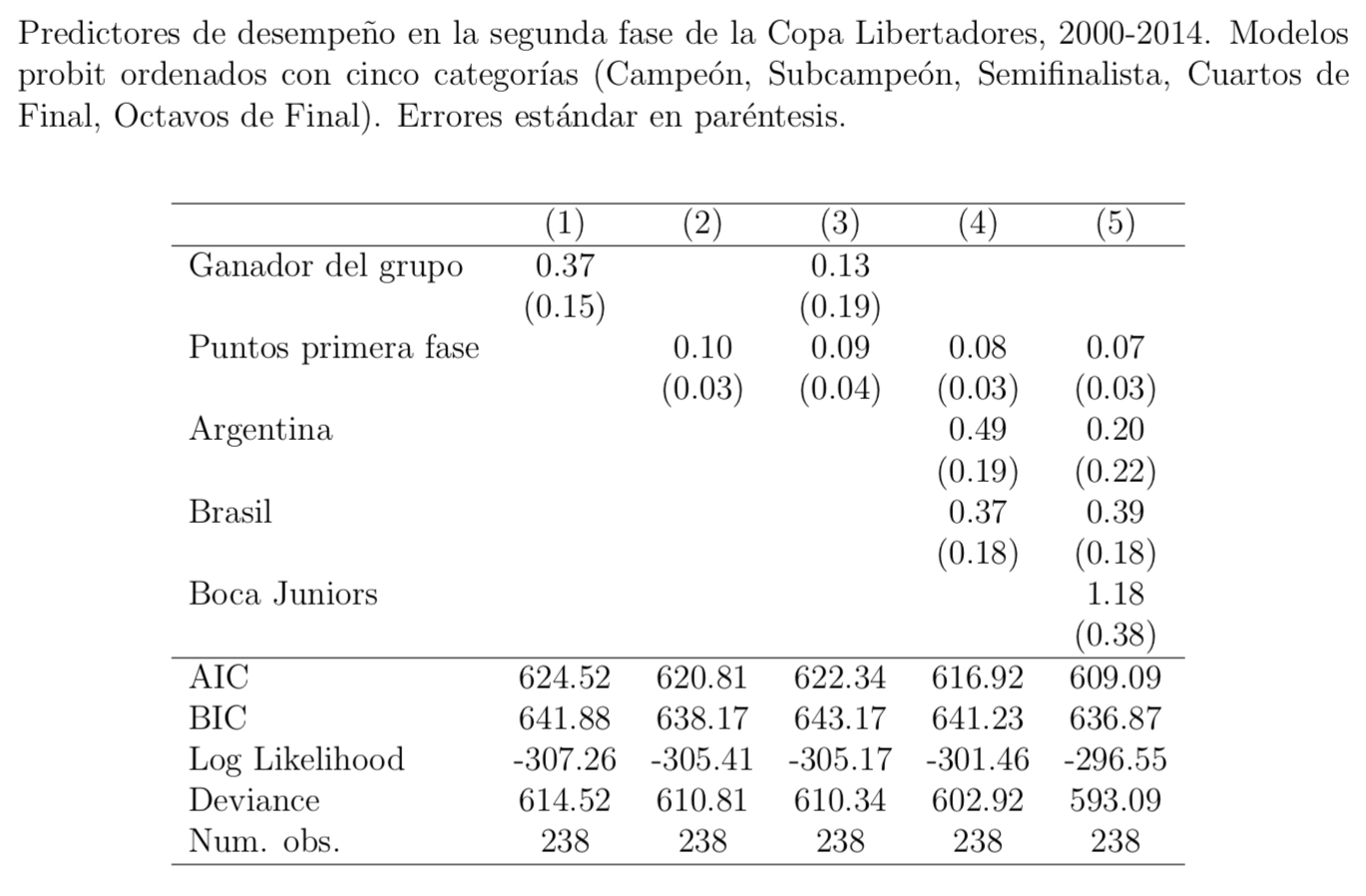
Una forma de examinar esos números con un poco más de rigor es estimar la probabilidad de que un equipo llegue a una determinada instancia (Final, Semi, Cuartos, etc) dadas ciertas variables, como su desempeño en la primera fase o su país de origen. Para ver si ése es el caso, estimé una serie de modelos probit ordenados donde la variable dependiente es la posición en que cada equipo terminó en cada Copa (Campeón, Subcampeón, Semifinal, Cuartos u Octavos). La muestra comprende todos aquellos equipos que llegaron a octavos de final.

Los modelos 1-3 muestran que los equipos a los que les va bien en la primera fase generalmente llegan más lejos, y que el total de puntos obtenidos es más importante que ganar el grupo. Por supuesto, ambas variables están correlacionadas–en promedio, el primero del grupo le saca tres puntos al segundo–, pero a los mejores primeros (y, presumiblemente, a los mejores segundos) les suele ir mejor. El modelo 4 muestra que incluso controlando por la cantidad de puntos obtenidos en la primera fase, los equipos argentinos y brasileños son más fuertes que el resto–lo que es de esperar si consideramos que casi 3 de cada 4 finalistas (22 de 30, ó 73%) vienen de Argentina o Brasil. Sin embargo, el último modelo revela que más que un “efecto Argentina”, lo que hay es un “efecto Boca”: cuando incluimos un dummy para Boca, los equipos argentinos ya no son tan buenos en comparación al resto, pero Boca sí lo es.

TablaGraciasCarlitos

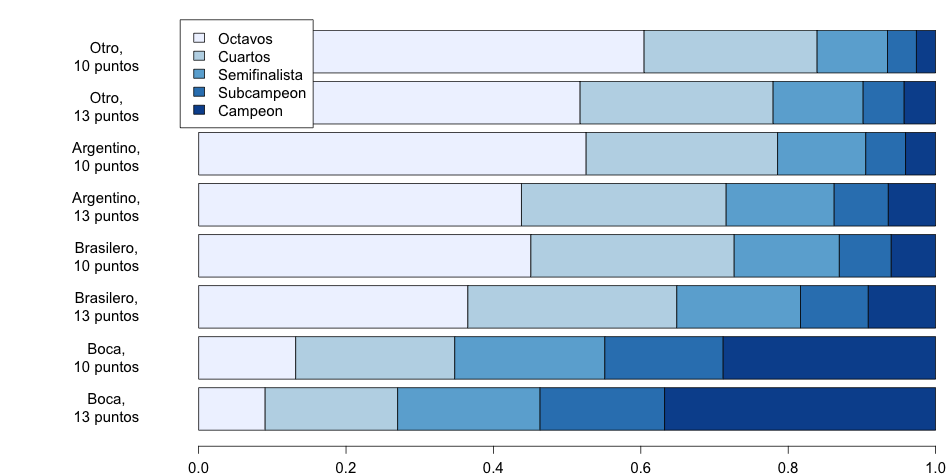
El gráfico de abajo ilustra la magnitude de ese efecto. Las barras indican la probabilidad de que distintos equipos lleguen a una determinada instancia de la Libertadores, dependiendo de su país de origen y el número de puntos obtenidos en la primera fase. Podemos apreciar cómo los equipos que no son argentinos ni brasileños (y los argentinos que pasan con sólo 10 puntos) tienen muchas probabilidades de quedarse afuera en Octavos; asimismo, la diferencia entre un equipo brasileño y uno argentino que no sea Boca es de alrededor de 3 puntos. Pero nada se compara con el Boca post-Bianchi, cuya probabilidad de ganar la final es la misma que la de un equipo brasileño de llegar a semifinales–y ni hablemos de pasar las primeras dos fases.

BocaLibertadores

(*) Los otros equipos que participaron en 9 ó más ediciones son Nacional de Montevideo (15), Cerro Porteño y Libertad de Paraguay (11), Bolívar, Emelec, River, Vélez (10), Caracas, Peñarol y The Strongest (9).

(Publicado originalmente en https://elpaisgeneroso.wordpress.com/)

A proposal to help curb grade inflation.

I have a stack of midterms I’m procrastinating grading, but I’m not simply going to babble on about some minor nuisance in my own life, I’m going to expound on a modest, but promising intervention into the problem of grade inflation which, I believe, costs us millions of dollars every year.

Here’s the basic problem: schools serve a mix of roles, including signaling, human capital formation, and pure consumption. Unfortunately, universities face a problem of grade inflation. I have encountered many students who were very angry that I should even dare to suggest that a C is an acceptable grade. This, despite the fact that C has never been sold as anything but “average- simple, common, adequate but ordinary”.

And why is grade inflation a problem? It makes the signal of a college degree less meaningful. And the result is that students have to pile on ever more credentials at ever more selective institutions to prove themselves. It also leads to students turning school into a GPA maximization game rather than an intellectual pursuit. For top students this isn’t a real problem, but for the rest it may be costly. So here’s my proposal…

Maybe we should be describing the grade distribution as being like the Fahrenheit scale… 73 is just about right; sure it’s a few degrees off, but it’s close enough for government work. 93 Is about as hot as you’d ever really want it to be. Any hotter is superfluous, and besides, this school doesn’t give A+’s. The 90’s are hot; exceptionally so, but the 80’s are pretty warm. Once in a while an 85 degree day can be quite nice, But you don’t really even want too many 80+ grades on your transcript. This is related to a fact that always amazes my students: in econ grad school an A means you over-invested in a class and wasted energy that could have been spent on advancing your dissertation. Too many B’s for a typical undergrad means that they aren’t doing enough intellectual, spiritual, social, and personal exploration outside of class. So what about F’s and D’s? Well, the analogy might fall apart here, but I don’t think we need to sell students on going for F’s, although I think one or two would probably build character.

I think that if this description spread through high schools and colleges then we might just calm the students and parents down a bit. Doing that might just allow us all to slow down enough that the students might actually learn something and retain it.

More on Liberty and Homer: Tacitus, Montesquieu, and Humboldt

As I have discussed before here, there is a way of writing about liberty in a conscious focus on political thought, which finds liberty to be emulated in some respect, going back at least to the first century Roman historian Tacitus. He was referring to the condition of the ancient Britons, within the Roman Empire, but rebelling against it, and the ancient Germans who could not be incorporated into the Empire.

The latter situation may have been at least as much for economic reasons as for the German fighting spirit, but they were certainly difficult to overcome and inflicted one of the great defeats on the Roman legions, at the height of Roman power in the Battle of the Teutoburg Forest in 25CE.

The image of barbarian liberty in Tacitus was certainly in some part shaped by Homer given the deep impact of Greek culture on the Romans, and most relevantly in this instance through the continuation of Homer in the greatest latin epic, Aeneid, which links Rome with the Trojan prince Aeneas. As I pointed out before here, Tacitus’ idea of barbarian liberty strongly influenced Montesquieu’s The Spirit of the Laws (1748, a work I will be posting on in future), whose view of liberty in modern Europe, in brutal but meaningful summary, was of a combination of Roman law and Germanic individualism.

Montesquieu was of course a great part of Classical Liberalism and we can follow up his interest in barbaric liberty with reference to other classical liberals. David Hume and Adam Smith, who were writing after Montesquieu, tended to write on ‘barbarism’ and a related idea of ‘savagery’ with some anxiety regarding the possibility that such societies, or societies closer to that stage than those European nations where civil society had advanced the most, might overwhelm commercial legalistic nations with their unrestrained force.

However, some element of respect for liberty in the most simple societies does manifest itself at times, but mostly through an interest in the earliest stages of the Roman and Greek republics of antiquity, which in Montesquieu’s thinking come between the Germanic individualism and the late Roman legalism. Tacitus was thinking of the ‘virtue’ (in the sense of patriotic courage and love of law) of the early Romans when addressing the courage, rough individuality, and fierce independence of the Britons and Germans.

The most interesting way of linking back from Enlightenment liberalism of the Eighteenth century, for me at least, is via Wilhelm von Humboldt, a thinker I will address in at least one dedicated post in future. Humboldt’s major contribution to political thought, The Limits of State Action, was written in the 1790s, so another generation on from Montesquieu, just after Smith and Hume.

At this point, we might think of a movement from Enlightenment to Romanticism in European thought. While we should be very careful about such general distinctions, and amongst other things not engage in simplistic oppositions, it is appropriate to think of Humboldt as belonging to a phase of interest in the history and current meaning of aesthetics, literature, culture, and language as part of the study of political ideas.

He was in fact a major thinker about language and the infinite capacities inherent in the combinatory nature of language, which was part of his thinking about individual human capacity and the power of voluntary co-operation.

It is the interest in aesthetics, language, culture, historical existence, and the capacity of the inner human which makes him ‘Romantic’ rather than ‘Enlightened’, though again we should avoid stereotype and simple opposition here. Humboldt was very much not against Enlightenment respect for reasons, and some of these ‘Romantic’ themes are in ‘Enlightenment’ texts.

One of the earlier big classics of Enlightenment, The New Science (1725, 1744) by Giambattista Vico, is a good example and that is a book giving great importance to Homer. Vico is someone else who merits at least one dedicated post, so there will be more about him at some point. I am not aware of any evidence that Humboldt read Vico, but he certainly made an impression on German thinkers of the time.

Anyway, Humboldt was a learned classicist from a philological and literary way, which has an impact on his idea of how liberty was strengthened in antiquity, which compensated for the tendency of the ancient state to interfere in the soul, as Humboldt thinks of antique laws and institutions to promote moral and religious traditions.

What compensates for this pressure on liberty is the struggle in the lives of ancient humans, which has two main aspects. First the struggle with nature to have enough food and shelter to preserve life. Second the military struggle with rival states and communities, which was a very frequent experience in antiquity, and was an aspect of the history of the early Greek and Roman republics.

The best place to look for that in antique sources is Homer, because of the breadth of the Homeric world, as well as its poetic qualities, as well as its enormous influence on Greek and Roman culture. I had meant to address how the kind of struggle which can promote some kinds of liberty does appear in Homer, but this post is already long enough, and the best thing is to address Homer directly in the next post.

In the meantime, careful reading of any of the translations in books and post on websites, of The Iliad and The Odyssey (or indeed the original Greek for those fortunate enough to have that linguistic capacity), should I hope provide material to confirm what I’m suggesting.

Which MPOs are most efficient?

I have been working on a project to measure the efficiency of Metropolitan Planning Organizations (MPOs). MPOs are one of the levels of government often forgotten. When we think of government we usually think of federal, state and local government. MPOs lay between local and state government. My local MPO for example, the Southern California Association of Governments (SCAG) for example covers all of the southern Californian counties except for San Diego. Other MPOs, such as the Delaware Valley Region Planning Commission, cross over several states. Nominally MPOs are concerned with setting transportation policy, but in effect they have broad powers over many areas of regional economic development.

Most MPOs have no elected leadership and instead either appoint their own heads or draw from their constituent members. By no means am I a little ‘d’ democrat; I do not see much value in democracy to decide public policy. It is however concerning that these form of government have little oversight over them of any sort. My hope is that my work will provide much needed information on how well (or badly) these MPOs are doing their jobs.

I am attempt to rank MPOs on two basis: transportation services and air quality. Below is a ranking of the top 77 largest metro regions by their adjusted cost efficiency for providing transit services. I used metropolitan level data from 1991 to 2011 to construct these figures. By adjusted I mean that I attempted to take into account for factors that affect their cost efficiency, namely level of federal funding which is negatively associated with cost efficiency. I hope to be able to better calculate these figures in the future taking into account spatial factors that affect efficiency, but I have to start somewhere right?

1. Raleigh
2. Virginia Beach
3. Honolulu
4. El Paso
5. Orlando
6. Wichita
7. Memphis
8. Baton Rogue
9. Cincinnati
10. Indianapolis

….

70. Bridgeport
71. Akron
72. Seattle
73. Albuquerque
74. Knoxville
75. Worcester
75. Dallas
76. San Jose
77. McAllen

The full ranking can be found here: Efficiency Residual.

Thoughts?

Liberty and Homer

The ‘Expanding the Liberty Canon’ label is not adequate for some texts that ought to be discussed with regard to liberty, since they have something important to say about liberty, but even on an expanded inclusive definition cannot be said to put forward a case for liberty, certainly  not from the perspectives of classical liberalism, libertarianism, the liberty movement, or any other label for thinking which favours liberty understood as individual rights, markets, voluntary association, and rule of law over communalism, collectively directed distribution, state domination of society, and administrative rules.

I have plenty of further texts to discuss under the ‘Expanding the Liberty Canon’ heading, but here is a beginning to the ‘Liberty and…’ sequence. It is an appropriate starting point in that the epic poems associated with the name of Homer, The Iliad and The Odyssey are at the very beginning of European literature, culture, and knowledge. This is not say that there is pure beginning to Europe’s cultural and intellectual heritage with no precursors and no outside influence. It is to say that these are the first big texts in the history of anything that can be labelled European history. The name ‘Homer’ conceals considerable uncertainty about whether these poems have a single author and if so who.  What can be safely said is that these are long poems written down in approximately 800 BCE, drawing on a long oral tradition of sung poetry, referring to a world of Mycenaean late Bronze Age Greeks, who traded with and fought with the peoples of Anatolia, in a civilisation that disappears from the archaeological record in about 1 100 BCE.

On the side of Homer not being a hero of liberty is the apparent endorsement of a world where war and piracy have greater respect than trade and manufacture, the greatest role for a man is to defeat enemy armies and sack their cities, women’s role is to stay at home, do a lot of weaving, and obey their husband. Political authority is patriarchal-monarchical, based on the claim that kings are warrior-hero aristocrats are close to the gods. Ordinary people are deprived of choices and influence, subordinated to the hero-aristocrat class and may even be slaves. In The Iliad, a league of Greek kings lays siege to Troy for ten years, purely for reasons of honour connected with a Trojan Prince taking a Greek queen from her husband back to Troy. The violent destruction on enemy cities, the enslavement and murder of civilians, the organised theft of property are all part of the value system of Greeks and Trojans. In The Odyssey after various adventures on the way back from Troy, Odysseus massacres a group of aristocrats who have been trying to marry his wife during the twenty years of his absence, living in his palace using up the wealth, and follows this up with a massacre of those servant women who were too friendly with the massacred men.

So where does liberty come into this world of violence and traditionalist authority? One part of the answer to this question is that maybe the Homeric epics are critical of this world, at least in some part. The exploration of where there might be a critical distance in the Homeric poetry from the most disturbing aspects of the world it depicts gets into much detailed and questions of ambiguity to pursue here, but is something to bear in mind when reading Homer. Leaving that aside, there is the underlying issue of the formation of a world of poetic creation, which in some degree must be distant from and reflect on a world, so raising the possibility of individual critical perspectives.

Anyway, even staying at the level of the more direct and literal meaning, it portrays different possibilities of individual character and ways of being. In The Iliad we are see Achilles the proud angry warrior who lives to become the hero of song, even if that means dying young. His devotion to violence co-exists with a belief that he has rights as an individual against his overlord, a passionate devotion to his best friend, a capacity to overcome his angry nature when he allows the father of the Trojan hero, Hector, who killed his friend to take the body for honourable burial.

Hector himself has a near Achilles level of ‘heroic’ violence combined with a deep and self-effacing attachment to his wife and child. Many other possibilities of human individuality are explored including that of the most intelligent and cunning of the Greek leaders, Odysseus, who understands that war is won by stratagems as well as devotion to violence. This man of reflection, forethought and an early form of the life of the mind, becomes the centre of the second Homeric epic, The Odyssey, which recounts the ten years of his journey back from Troy to his homeland of Ithaca.

Odysseus starts back with his own fleet of ships carrying an army of Ithaca, by the time he gets back to Ithaca all of this is lost, and he is alone, in disguise playing the part of a vagabond when he arrives on his home island. Early in his adventures he described himself as No-man to trick his way out of danger from the giant Polyphemus and then proudly shouts his real name at the giant on his escape. This is at the base of his ten year journey since the god Poseidon is the father of  Polyphemus and takes revenge on Odysseus when Polyphemus can tell his father how Odysseus harmed him. Again and again Odysseus has to struggle with his own impulses and with the need to play a part, stretching his identity, in order to return to his island kingdom. So he is growing as an individual, exploring all the possibilities of individuality, including self-concealment, self-invention, and self-transformation.

The extreme violence of the return of Odysseus is followed by the brief description of a new beginning in Ithaca, an order of social peace in which a possible cycle of revenge is pre-empted through oaths and the prospect of justice settling differences rather than violence. This reconciling ending of The Odyssey itself builds on the sombre peace at the end of The Iliad, when a truce is agreed so that the city of Troy can bury and mourn its hero Hector, so that the values of peace and acknowledgement of individual suffering can stand up against the cycle of destructive violence.

In these and many other ways, Homeric epic offers much to stimulate thought about the nature of individuality and the kinds of social form which might allow individuals to flourish together, even in its depiction of the most destructive outcomes of human passions.

Eye Candy: the GDP (PPP) per capita of OECD Administrative Units (UPDATED)

Here is what I was able to patch together in my free time.

The countries I’ve filled in were about half of the OECD. The data is hard to get on administrative units elsewhere in the world (I got my data from the OECD website), but it was also hard to get for OECD states. The reason it was hard is because OECD data collectors divide up administrative units into two separate categories (TL2 and TL3) that sometimes correlate to traditional administrative units (such as California or New South Wales) and are sometimes arbitrary creations of EU or OECD bureaucrats designed specifically for data collection (rather than for understanding the historical trajectory of regions within a state).

Does this make sense?

To make matters worse, sometimes the TL2 category correlated with an actual administrative unit with political representation in a capital, and sometimes the TL3 category was the actual administrative unit with political representation. So I had to thumb through the nitty-gritty details of how OECD states send representatives to central parliaments and then match those real-life details to the data collectors TL2 and TL3 categories.

Does this make sense?

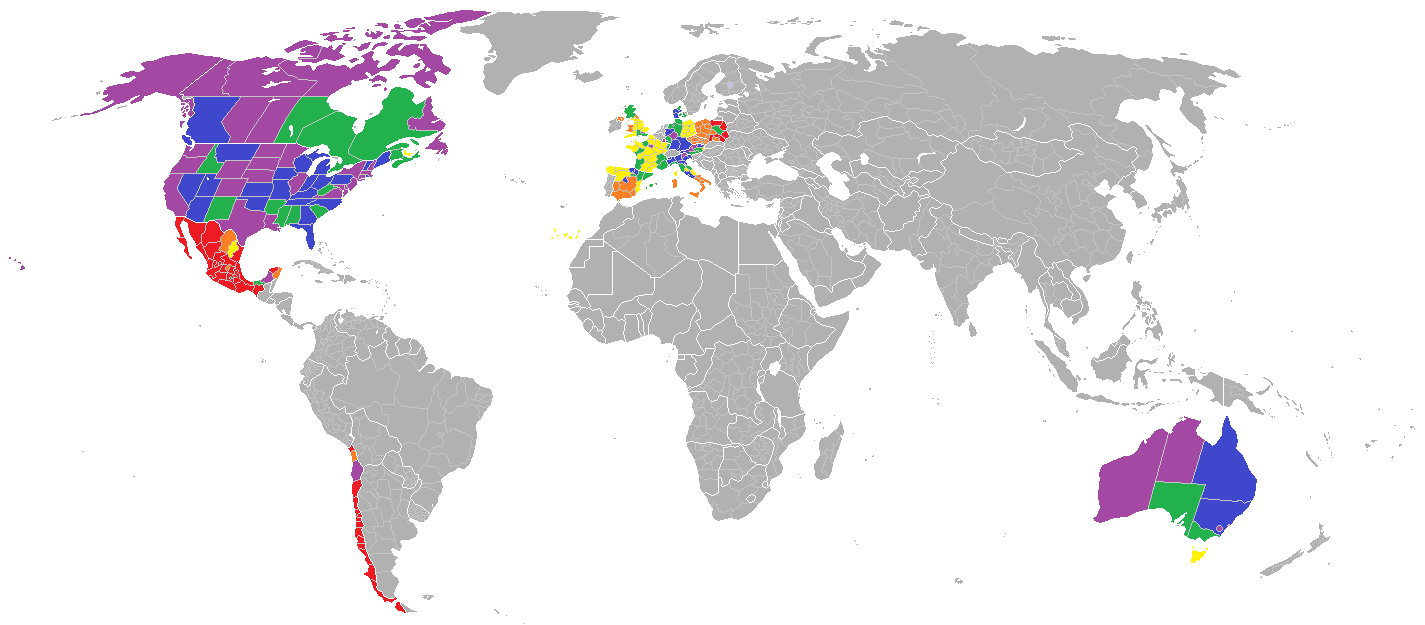
The map above highlights the US, Canada, Australia, Germany, France, the UK, Spain, Poland, Austria, Italy, Czech Republic, Chile, Denmark, and Mexico. These countries are all TL2 states.* I have no idea what that is supposed to mean for data collectors, but it means to dorks like me that their TL2 categories send political representatives to capital cities, whereas their TL3 categories likely send political representatives to regional capitals.

Does this make sense?

I have continued entering the data that the OECD has provided for the GDP (PPP) per capita of TL3 units (which send political representatives to capital cities), but the map I downloaded does not outline TL3 units (it only outlines TL2 units). So unless I want to spend time carving out TL3 units onto a TL2 map I am going to have to stop filling out the map. I’m all for collaboration on this, of course.

Here is the table I have (very slowly) been working on, but when I colored in the map above (the TL2 states), I divided them up into six groups based on highest GDP (PPP) per capita to lowest. The richest administrative units were purple, followed by blue, followed by green, followed by yellow, followed by orange, followed by red. So: purple is rich, red is poor. Got it? Because I started adding the TL3 states to the table, and because the map doesn’t allow for me to add the TL3 states to it, I forgot the range of the colored TL2 units. Dividing them up into six groups is a pretty easy task, though, so you should just trust my coloring scheme.

The map I created doesn’t have a very good zoom-in function, but what I found interesting is that Europe has a lot more economic inequality than the US, Canada, and Australia. Look at France. It’s mostly yellow, and the only purple (rich) administrative unit is Paris metro. This suggests, of course, that wealth in France is concentrated in the capital. The UK looks just like France (as does Spain). Germany is divided in half (as is Italy), and Austria and Denmark are cool, rich colors. Canada and Australia only have one yellow province each, and the US has none. Mexico looks just as Michelangelo described it, and Chile looks like Spain.

This is the OECD page I’ve been using. Here’s how I find regional GDP (PPP) per capita:

  • select “Regions and Cities”
  • select “Large (TL2) and Small (TL3) regions” – remember it’s either/or here: either TL2 or TL3 but not both
  • select “regional GDP per capita”
  • Then for measures (top of table) select “per head, current prices, current PPP”

I’ve been using 2011.

This pdf lists the “territorial grids” (TL2 and TL3 regions) of the OECD. The pdf didn’t help me figure out which regions send political representatives to capital cities and which are arbitrary, bureaucratic creations (I got to do that on my own!), but lists can definitely be helpful. In many cases I was able to figure out which units are politically viable and which are arbitrary for data collecting purposes just by looking at the list.

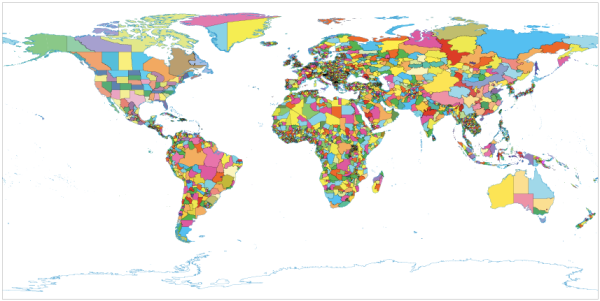
Finally, here is a map – courtesy of kelsocartography.com – of the world’s administrative units, at the TL2 level. Lots of work to do.

A good map of the world's administrative units
Here is a map of the world’s administrative units (courtesy of kelsocartography.com), but not necessarily the units that data collectors use to calculate GDP (PPP) per capita.

I like using the GDP (PPP) per capita of administrative units because I think it gives a much more stark picture of life around the world. I have pointed out before that the UK is now poorer than Mississippi, but breaking down the UK in the same manner as we do the US reveals that not only is the UK poorer than the poorest US state, the purchasing power parity of British citizens within the UK looks a lot more unequal than what we see in the United States. What is going on in the UK? The NHS can’t be that bad.

* – Oops, except for Denmark (it’s TL3)

UPDATED (3/11/2015): Continue reading

What is social justice?

Since only individuals act, only individual actions can be judged.  Groups, governments, corporations, etc. are not acting entities and therefore cannot be judged.  The individuals who act under the aegis of such groups can, of course, be judged.  So what could social justice possibly mean?

Along comes the redoubtable Wendy McElroy with an answer.  It is “forced distribution of ‘privileges’ across society with an emphasis on providing wealth and opportunity to classes of people who are considered to be disadvantaged.”  It matters not whether a particular set of circumstances is the result of voluntary interactions.  Individuals who are female, have dark skin, low income, etc. qualify automatically as victims.  Examples of redress include affirmative action and progressive taxation.

Enough from me.  Please go read Wendy’s post.

What’s wrong with migrating?

This is a response to Irfan Khawaja over at the Policy of Truth blog.

I am of Jewish descent. I am not a JewI was baptized a Catholic as a baby and have no plan to convert in the foreseeable future. I am nonetheless of Jewish descent. My paternal grandfather is a rabbi and my cousins from that side of the family are Jews.

My family patriarch migrated from Germany to Mexico during the turn of the 20th century. He migrated long before the Holocaust, but I wouldn’t be surprised if he was motivated to migrate to escape prosecution in Europe.

I also have slaves in my family tree. My great grand mother (Or was it great great? I forget.) was a black Cuban and my parents thought I might be born with dark skin. Blacks, for those who are keeping score at home, are not native to Cuba. Slavery in Cuba did not end till 1886. My great grandmother migrated to Mexico to escape prosecution in Cuba.

I myself migrated to the United States at the age of two. I might have been born in Mexico, but I was a libertario at birth. I loved Mexican food but that was not sufficient reason to stay in a country with such a poor conception of personal liberty. So I kissed my mother good bye, packed my bags, and crossed the border. I ended up settling down in Los Angeles, where I could have Mexican food and liberty.

What I am getting at here is that there is nothing wrong with migrating.

Had I stayed in Mexico I would likely be dead now. If a cartel member asked me to pay protection tax I would have refused and instead given him a speech on why we should legalize drugs. My town of birth, Morelia, is one of the capitals of the drug trade so you can imagine how long I would have lasted.

Had my great grandmother stayed in Cuba she would have to live with left over discrimination against slaves and their descendants. Worse still her descendants would be living in Castro’s Cuba!

My family patriarch might have survived the Holocaust if he had stayed in Europe. Or he might have been baked.

I agree with Irfan Khawaja that one should be assured of their personal safety and liberty regardless of any incidents of birth. I also agree with him that Benjamin Netanyahu, current Israeli Prime Minister, is wrong to urge European Jews to migrate to Israel. Israel is hardly a safer country for Jews than Europe.

Where I disagree is that I see nothing with migrating or urging others to migrate in pursuit of safety or liberty. There are times when one should hold strong and defend themselves. There are also times when one should realize that your neighbors are bigots and they won’t stop being bigots during your lifetime. If you can improve your quality of life by migrating, why not do so?

For any European Jews who might be reading this: forget about Israel and come to the United States! Specifically come over to my hometown, the San Fernando Valley.  The San Fernando Valley is a lovely community within Los Angeles. The original Karate Kid series, and countless other films, take place in the Valley. The film industry is actually located in the Valley, not Los Angeles itself. Best of all, the valley is filled with Jews. My undergraduate university, Cal State Northridge, has one of the largest concentration of Jews in America. Did I mention that there is plenty of Mexican food to go around?

I’ll be honest, there are some drawbacks to the valley. We are ruled over by the incompetent authorities in Los Angeles city hall and attempts to form our own city have been thwarted over the years. Real estate prices are also high. Despite this though I love the valley and welcome others to migrate there if their current home is undesirable.